How do World Cup playoffs work? Explaining format, pathway for teams and more for UEFA, intercontinental versions originally appeared on The Sporting News. Add The Sporting News as a Preferred Source by clicking here.
JUMP TO:
As countries all around the world hope to be amongst the 48 nations participating in the 2026 FIFA World Cup, the final spots in the tournament field are being filled.
Advertisement
Now that the World Cup draw has been completed and 42 of the 48 nations have cemented their places at the final tournament, there are just the six playoff participants yet to be determined to fill out the field.
Those places will be filled by the UEFA and intercontinental playoffs, which take place just three months before the World Cup commences in the United States, Canada, and Mexico.
The Sporting News details all you need to know about the playoffs, including who will participate, how they qualified, and the format by which the competition will be contested.
2026 WORLD CUP HQ:Latest World Cup news | Full World Cup schedule | Buy World Cup tickets
Advertisement
What are the World Cup playoffs?
The World Cup playoffs are two mini-tournaments that offer certain teams another route into the finals if they failed to qualify automatically.
There are two different World Cup playoffs: one for European (UEFA) teams, and another comprising nations from different confederations (the intercontinental playoffs).
Since UEFA gets 16 spots at the newly expanded 48-team FIFA World Cup, they have their own playoff tournament for the last of those four places. The rest of the world, meanwhile, contests an inter-confederation playoff to determine the final two participants at the tournament.
Advertisement
The winners of the six different playoff pathways were assigned to Pot 4 for the World Cup group-stage draw in December, meaning they can expect to face a more difficult tournament than if they had qualified automatically.
UEFA playoffs
In UEFA World Cup qualifying for 2026, there were 54 participants hoping to secure one of Europe’s 16 places at the competition.
Those 54 nations were spread out between 12 groups. While the group winner advanced to the World Cup automatically, the runners-up were placed in a knockout bracket along with a few UEFA Nations League qualifiers to determine four more participants.
Advertisement
FIFA intercontinental playoffs
The intercontinental playoffs, officially known as either the inter-confederation playoffs or the World Cup playoff tournament, is the final pathway for teams hoping to qualify for the World Cup.
Started in 1998 as a one-off matchup between an Asian and Oceania qualifier, it has grown gradually into the six-team tournament it is today. The 2026 edition comprises one nation from the AFC, CAF, CONMEBOL and OFC confederations, and two from CONCACAF.
Each four-year cycle, as the format of World Cup qualification shifts with the times, the intercontinental playoffs also change slightly to fit the back-end of the qualifying system.
Advertisement
How do the playoffs work?
The UEFA and intercontinental editions have different entry methods, and the European version has a larger field, but each is essentially the same format: a single-elimination tournament in which teams will compete to reach a final, the winners of which will qualify for the World Cup.
2026 UEFA playoffs format
The second-place teams in each of the 16 UEFA qualifying groups advance to the playoffs, along with the four best-ranked group winners from the latest UEFA Nations League who failed to qualify automatically for the World Cup.
The teams are split into four pathways, each with four teams, contesting a four-team mini-bracket to determine the final qualifiers.
Advertisement
Both semifinals and finals are single-elimination matches, with extra time and penalties used if necessary to determine a winner. The host of each path’s final was chosen by a random draw. The seeded teams play their semifinals at home.
Pathway 1
Semifinal
|
Date
|
Time (ET)
|
Match
|
Location
|
|
March 26
|
2:45 p.m.
|
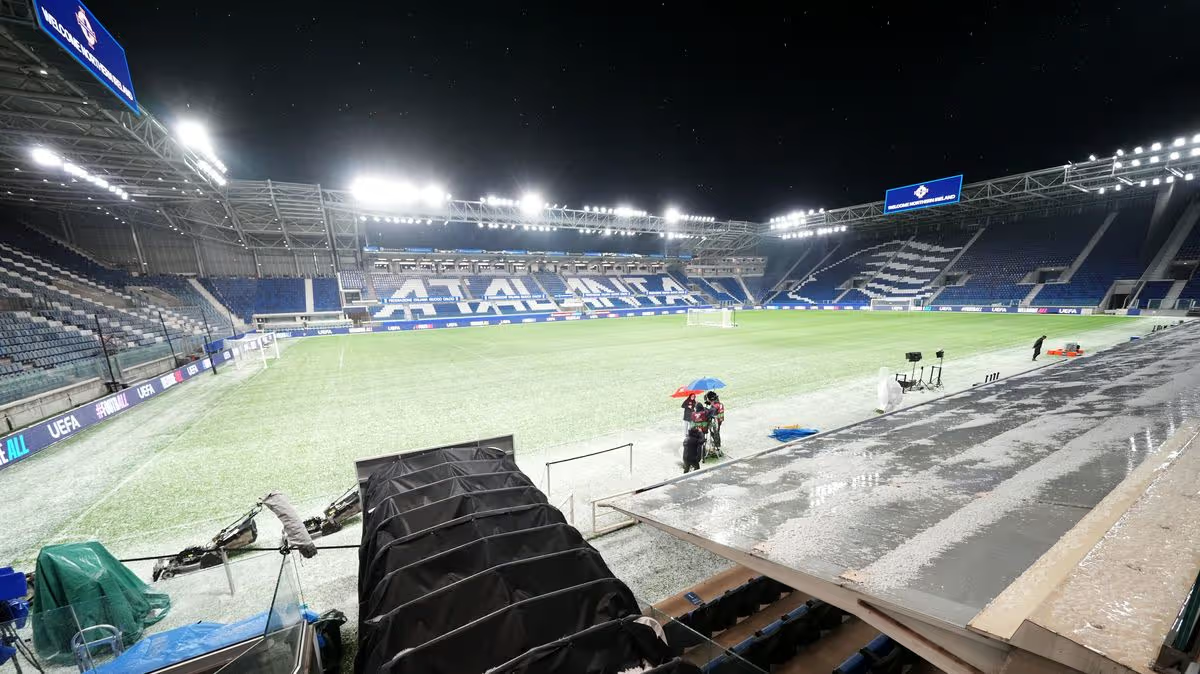
Italy vs. Northern Ireland
|
New Balance Arena (Bergamo, Italy)
|
|
March 26
|
2:45 p.m.
|
Wales vs. Bosnia & Herzegovina
|
Cardiff City Stadium (Cardiff, Wales)
|
Final
|
Date
|
Time (ET)
|
Match
|
Location
|
|
March 31
|
2:45 p.m.
|
Wales/Bosnia & Herzegovina vs. Italy/N. Ireland
|
TBD (Wales/Bosnia & Herzegovina winner host)
|
Pathway 2
Semifinal
|
Date
|
Time (ET)
|
Match
|
Location
|
|
March 26
|
2:45 p.m.
|
Ukraine vs. Sweden
|
Estadi Ciutat de Valencia (Valencia, Spain)
|
|
March 26
|
2:45 p.m.
|
Poland vs. Albania
|
PGE Narodowy (Warsaw, Poland)
|
Final
|
Date
|
Time (ET)
|
Match
|
Location
|
|
March 31
|
2:45 p.m.
|
Ukraine/Sweden vs. Poland/Albania
|
TBD (Ukraine/Sweden winner host)
|
Pathway 3
Semifinal
|
Date
|
Time (ET)
|
Match
|
Location
|
|
March 26
|
12 p.m.
|
Turkey vs. Romania
|
Besiktas Stadyumu (Istanbul, Turkey)
|
|
March 26
|
2:45 p.m.
|
Slovakia vs. Kosovo
|
Tehelne pole (Bratislava, Slovakia)
|
Final
|
Date
|
Time (ET)
|
Match
|
Location
|
|
March 31
|
2:45 p.m.
|
Slovakia/Kosovo vs. Turkey/Romania
|
TBD (Slovakia/Kosovo winner host)
|
Pathway 4
Semifinal
|
Date
|
Time (ET)
|
Match
|
Location
|
|
March 26
|
2:45 p.m.
|
Denmark vs. North Macedonia
|
Parken (Copenhagen, Denmark)
|
|
March 26
|
2:45 p.m.
|
Czechia vs. Rep. of Ireland
|
Fortuna Arena (Prague-Vrsovice, Czechia)
|
Final
|
Date
|
Time (ET)
|
Match
|
Location
|
|
March 31
|
2:45 p.m.
|
Czechia/Rep. of Ireland vs. Denmark/N. Macedonia
|
TBD (Czechia/Rep. of Ireland winner host)
|
2026 intercontinental playoffs format
The six participants were broken into two three-team brackets, with each bracket producing one qualifier.
The brackets were filled out by the draw, which took place on November 20 at the FIFA headquarters in Zurich, Switzerland.
Teams were seeded based on FIFA ranking, with the top two seeds earning a bye to their bracket’s final, while the other four teams contest the semifinals.
Advertisement
Pathway 1
Semifinal
|
Date
|
Time (ET)
|
Match
|
Location
|
|
March 26
|
7 p.m.
|
New Caledonia vs. Jamaica
|
Estadio Akron (Guadalajara)
|
Final
|
Date
|
Time (ET)
|
Match
|
Location
|
|
March 31
|
2 p.m.
|
DR Congo vs. Semifinal winner
|
Estadio Akron (Guadalajara)
|
Pathway 2
Semifinal
|
Date
|
Time (ET)
|
Match
|
Location
|
|
March 26
|
1 p.m.
|
Bolivia vs. Suriname
|
Estadio BBVA (Monterrey)
|
Final
|
Date
|
Time (ET)
|
Match
|
Location
|
|
March 31
|
8 p.m.
|
Iraq vs. Semifinal winner
|
Estadio BBVA (Monterrey)
|
Which teams are playing in the World Cup playoffs?
Six teams will contest the 2026 FIFA intercontinental playoff, producing the final two World Cup participants. In the UEFA edition, 16 teams will compete for another two spots in the tournament proper.
Teams in UEFA playoffs
In the UEFA playoffs, the 12 group runners-up are joined by four qualifiers from the UEFA Nations League.
First up are the highest-ranked group winners yet to qualify, from League A all the way down to League D. If there are fewer than four of those remaining yet to qualify, they move to the highest-ranked group runners-up from the Nations League.
|
Nation
|
Qualified via
|
FIFA rank
|
|
Slovakia
|
Group A runner-up
|
44
|
|
Kosovo
|
Group B runner-up
|
79
|
|
Denmark
|
Group C runner-up
|
21
|
|
Ukraine
|
Group D runner-up
|
30
|
|
Turkey
|
Group E runner-up
|
25
|
|
Rep. of Ireland
|
Group F runner-up
|
59
|
|
Poland
|
Group G runner-up
|
34
|
|
Bosnia & Herzegovina
|
Group H runner-up
|
71
|
|
Italy
|
Group I runner-up
|
13
|
|
Wales
|
Group J runner-up
|
35
|
|
Albania
|
Group K runner-up
|
63
|
|
Czechia
|
Group L runner-up
|
43
|
|
Romania
|
UEFA Nations League
|
49
|
|
Sweden
|
UEFA Nations League
|
42
|
|
Northern Ireland
|
UEFA Nations League
|
69
|
|
North Macedonia
|
UEFA Nations League
|
65
|
Teams in intercontinental playoffs
Each confederation will produce one participant, while CONCACAF will have two. The below table details how they qualified for this phase.
|
Nation
|
Confederation
|
Qualified via
|
FIFA rank
|
|
Iraq
|
AFC
|
AFC playoff winner
|
58
|
|
DR Congo
|
CAF
|
CAF playoff winner
|
48
|
|
Jamaica
|
CONCACAF
|
Highest-ranking group runner-up
|
70
|
|
Suriname
|
CONCACAF
|
Second highest-ranking group runner-up
|
123
|
|
Bolivia
|
CONMEBOL
|
Seventh-place finisher
|
76
|
|
New Caledonia
|
OFC
|
Qualifying tournament runner-up
|
150
|
When are the World Cup playoffs?
Both the UEFA and intercontinental playoffs will be contested in the March FIFA international window.
Advertisement
All semifinals are on March 26, with the finals on March 31.
At the conclusion of these events, all 48 World Cup participants for the 2026 tournament will be confirmed.
Where are the World Cup playoffs played?
In the UEFA playoffs, the seeded teams play their semifinals at home. The home teams for the finalists are determined by a draw conducted in advance.
This is different to how the inter-confederation playoffs are staged.
Traditionally, the FIFA intercontinental playoffs are hosted by the same host nation that the coming World Cup will be contested in.
With the 2026 World Cup set to be played across three countries (USA, Canada, and Mexico), FIFA confirmed what the governor of Mexican province Nuevo Leon, Samuel Garcia gave away a month prior — that the intercontinental playoffs will be held in Mexico.
Advertisement
Two venues will hold two matches each — Estadio Akron in Guadalajara, and Estadio BBVA in Monterrey.
Where will the playoff winners be drawn at the World Cup?
The 2026 FIFA World Cup draw on December 6, 2025 set the matchups for the 2026 tournament.
With the playoff participants not yet known at the time of the draw, all playoff winners were entered into Pot 4 and drawn accordingly.
The UEFA playoff winners were drawn into groups A, B, D, and F. The intercontinental playoff winners were drawn into groups I and K.
Group A table
|
Pos
|
Team
|
PTS
|
GP
|
W
|
L
|
D
|
GF
|
GA
|
GD
|
|
1.
|
Mexico
|
0
|
0
|
0
|
0
|
0
|
0
|
0
|
0
|
|
2.
|
South Africa
|
0
|
0
|
0
|
0
|
0
|
0
|
0
|
0
|
|
3.
|
South Korea
|
0
|
0
|
0
|
0
|
0
|
0
|
0
|
0
|
|
4.
|
UEFA Playoff D
|
0
|
0
|
0
|
0
|
0
|
0
|
0
|
0
|
The UEFA Playoff D qualifier will be either Czechia, Republic of Ireland, Denmark, or North Macedonia
Advertisement
Group A fixtures
|
Date
|
Time (ET)
|
Match
|
Location
|
|
Thu, Jun. 11
|
3 p.m.
|
Mexico vs. South Africa
|
Mexico City Stadium (Mexico City, MEX)
|
|
Thu, Jun. 11
|
10 p.m.
|
South Korea vs. UEFA Playoff D winner
|
Estadio Guadalajara (Guadalajara, MEX)
|
|
Thu, Jun. 18
|
12 p.m.
|
UEFA Playoff D winner vs. South Africa
|
Mercedes-Benz Stadium (Atlanta, GA)
|
|
Thu, Jun. 18
|
9 p.m.
|
Mexico vs. South Korea
|
Estadio Guadalajara (Guadalajara, MEX)
|
|
Wed, Jun. 24
|
9 p.m.
|
UEFA Playoff D winner vs. Mexico
|
Mexico City Stadium (Mexico City, MEX)
|
|
Wed, Jun. 24
|
9 p.m.
|
South Africa vs. South Korea
|
Estadio Monterrey (Monterrey, MEX)
|
STADIUM GUIDES:Estadio Azteca | Estadio Akron | Mercedes-Benz Stadium | Estadio BBVA
Group B table
|
Pos
|
Team
|
PTS
|
GP
|
W
|
L
|
D
|
GF
|
GA
|
GD
|
|
1.
|
Canada
|
0
|
0
|
0
|
0
|
0
|
0
|
0
|
0
|
|
2.
|
UEFA Playoff A
|
0
|
0
|
0
|
0
|
0
|
0
|
0
|
0
|
|
3.
|
Qatar
|
0
|
0
|
0
|
0
|
0
|
0
|
0
|
0
|
|
4.
|
Switzerland
|
0
|
0
|
0
|
0
|
0
|
0
|
0
|
0
|
The UEFA Playoff A qualifier will be either Italy, Wales, Northern Ireland, or Bosnia & Herzegovina
Group B fixtures
|
Date
|
Time (ET)
|
Match
|
Location
|
|
Fri, Jun. 12
|
3 p.m.
|
Canada vs. UEFA Playoff A winner
|
BMO Field (Toronto, CAN)
|
|
Sat, Jun. 13
|
3 p.m.
|
Qatar vs. Switzerland
|
Levi’s Stadium (San Francisco, CA)
|
|
Thu, Jun. 18
|
3 p.m.
|
UEFA Playoff A winner vs. Switzerland
|
SoFi Stadium (Inglewood, CA)
|
|
Thu, Jun. 18
|
6 p.m.
|
Canada vs. Qatar
|
BC Place (Vancouver, CAN)
|
|
Wed, Jun. 24
|
3 p.m.
|
Switzerland vs. Canada
|
BC Place (Vancouver, CAN)
|
|
Wed, Jun. 24
|
3 p.m.
|
UEFA Playoff A winner vs. Qatar
|
Lumen Field (Seattle, WA)
|
STADIUM GUIDES:BMO Field | Levi’s Stadium | SoFi Stadium | BC Place | Lumen Field
Group D table
|
Pos
|
Team
|
PTS
|
GP
|
W
|
L
|
D
|
GF
|
GA
|
GD
|
|
1.
|
United States
|
0
|
0
|
0
|
0
|
0
|
0
|
0
|
0
|
|
2.
|
Paraguay
|
0
|
0
|
0
|
0
|
0
|
0
|
0
|
0
|
|
3.
|
Australia
|
0
|
0
|
0
|
0
|
0
|
0
|
0
|
0
|
|
4.
|
UEFA Playoff C
|
0
|
0
|
0
|
0
|
0
|
0
|
0
|
0
|
The UEFA Playoff C qualifier will be either Slovakia, Turkey, Kosovo, or Romania
Group D fixtures
|
Date
|
Time (ET)
|
Match
|
Location
|
|
Fri, Jun. 12
|
9 p.m.
|
United States vs. Paraguay
|
SoFi Stadium (Inglewood, CA)
|
|
Sat, Jun. 13
|
12 a.m.
|
Australia vs. UEFA Playoff C Winner
|
BC Place (Vancouver, CAN)
|
|
Sat, Jun. 20
|
12 a.m.
|
UEFA Playoff C Winner vs. Paraguay
|
Levi’s Stadium (Santa Clara, CA)
|
|
Fri, Jun. 19
|
3 p.m.
|
United States vs. Australia
|
Lumen Field (Seattle, WA)
|
|
Thu, Jun. 25
|
10 p.m.
|
UEFA Playoff C Winner vs. United States
|
SoFi Stadium (Inglewood, CA)
|
|
Thu, Jun. 25
|
10 p.m.
|
Paraguay vs. Australia
|
Levi’s Stadium (Santa Clara, CA)
|
STADIUM GUIDES:SoFi Stadium | BC Place | Levi’s Stadium | Lumen Field
Advertisement
Group F table
|
Pos
|
Team
|
PTS
|
GP
|
W
|
L
|
D
|
GF
|
GA
|
GD
|
|
1.
|
Netherlands
|
0
|
0
|
0
|
0
|
0
|
0
|
0
|
0
|
|
2.
|
Japan
|
0
|
0
|
0
|
0
|
0
|
0
|
0
|
0
|
|
3.
|
UEFA Playoff B
|
0
|
0
|
0
|
0
|
0
|
0
|
0
|
0
|
|
4.
|
Tunisia
|
0
|
0
|
0
|
0
|
0
|
0
|
0
|
0
|
The UEFA Playoff B qualifier will be either Ukraine, Sweden, Poland, or Albania
Group F fixtures
|
Date
|
Time (ET)
|
Match
|
Location
|
|
Sun, Jun. 14
|
4 p.m.
|
Netherlands vs. Japan
|
AT&T Stadium (Arlington, TX)
|
|
Sun, Jun. 14
|
10 p.m.
|
UEFA Playoff B Winner vs. Tunisia
|
Estadio BBVA (Monterrey, MEX)
|
|
Sat, Jun. 20
|
1 p.m.
|
Tunisia vs. Japan
|
Estadio BBVA (Monterrey, MEX)
|
|
Sat, Jun. 20
|
12 a.m.
|
Netherlands vs. UEFA Playoff B Winner
|
NRG Stadium (Houston, TX)
|
|
Thu, Jun. 25
|
7 p.m.
|
Tunisia vs. Netherlands
|
AT&T Stadium (Arlington, TX)
|
|
Thu, Jun. 25
|
7 p.m.
|
Japan vs. UEFA Playoff B Winner
|
Arrowhead Stadium (Kansas City, MO)
|
Group I table
|
Pos
|
Team
|
PTS
|
GP
|
W
|
L
|
D
|
GF
|
GA
|
GD
|
|
1.
|
France
|
0
|
0
|
0
|
0
|
0
|
0
|
0
|
0
|
|
2.
|
Senegal
|
0
|
0
|
0
|
0
|
0
|
0
|
0
|
0
|
|
3.
|
FIFA Playoff 2
|
0
|
0
|
0
|
0
|
0
|
0
|
0
|
0
|
|
4.
|
Norway
|
0
|
0
|
0
|
0
|
0
|
0
|
0
|
0
|
The FIFA Intercontinental Playoff 2 qualifier will be either Iraq, Bolivia, or Suriname.
Group I fixtures
|
Date
|
Time (ET)
|
Match
|
Location
|
|
Tue, Jun. 16
|
3 p.m.
|
France vs. Senegal
|
MetLife Stadium (East Rutherford, NJ)
|
|
Tue, Jun. 16
|
6 p.m.
|
FIFA Playoff 2 Winner vs. Norway
|
Gillette Stadium (Foxborough, MA)
|
|
Mon, Jun. 22
|
5 p.m.
|
France vs. Playoff 2 Winner
|
Lincoln Financial Field (Philadelphia, PA)
|
|
Mon, Jun. 22
|
8 p.m.
|
Norway vs. Senegal
|
MetLife Stadium (East Rutherford, NJ)
|
|
Fri, Jun. 26
|
3 p.m.
|
Norway vs. France
|
Gillette Stadium (Foxborough, MA)
|
|
Fri, Jun. 26
|
3 p.m.
|
Senegal vs. FIFA Playoff 2 Winner
|
BMO Field (Toronto, CAN)
|
Group K table
|
Pos
|
Team
|
PTS
|
GP
|
W
|
L
|
D
|
GF
|
GA
|
GD
|
|
1.
|
Portugal
|
0
|
0
|
0
|
0
|
0
|
0
|
0
|
0
|
|
2.
|
FIFA Playoff 1
|
0
|
0
|
0
|
0
|
0
|
0
|
0
|
0
|
|
3.
|
Uzbekistan
|
0
|
0
|
0
|
0
|
0
|
0
|
0
|
0
|
|
4.
|
Colombia
|
0
|
0
|
0
|
0
|
0
|
0
|
0
|
0
|
The FIFA Intercontinental Playoff 1 qualifier will be either DR Congo, Jamaica, or New Caledonia.
Group K fixtures
|
Date
|
Time (ET)
|
Match
|
Location
|
|
Fri, Jun. 17
|
1 p.m.
|
Portugal vs. TBD
|
NRG Stadium (Houston, TX)
|
|
Fri, Jun. 17
|
10 p.m.
|
Uzbekistan vs. Colombia
|
Estadio Azteca (Mexico City, MEX)
|
|
Tue, Jun. 23
|
1 p.m.
|
Portugal vs. Uzbekistan
|
NRG Stadium (Houston, TX)
|
|
Tue, Jun. 23
|
10 p.m.
|
Colombia vs. TBD
|
Estadio Akron (Guadalajara, MEX)
|
|
Sat, Jun. 27
|
7:30 p.m.
|
Colombia vs. Portugal
|
Hard Rock Stadium (Miami, FL)
|
|
Sat, Jun. 27
|
7:30 p.m.
|
TBD vs. Uzbekistan
|
Mercedes-Benz Stadium (Atlanta, GA)
|
World Cup playoff history, past results
UEFA playoffs
UEFA has been using a playoff system since 2010, when they were removed from contention at the intercontinental playoff and broken off into their own system.
In the first iteration of the UEFA playoff, eight teams qualified and were matched up by random draw in four two-legged pairings to determine the four qualifiers. It remained this way until the 2022 cycle when it was changed to the current format.
Advertisement
While there were only three playoff qualifiers at in 2022, that has been moved to four with the expansion to 48 teams for the 2026 competition.
|
Year
|
Qualifier
|
Defeated in Final
|
|
2010
|
France
|
Rep. of Ireland
|
|
Portugal
|
Bosnia & Herzegovina
|
|
Greece
|
Ukraine
|
|
Slovenia
|
Russia
|
|
2014
|
Portugal
|
Sweden
|
|
France
|
Ukraine
|
|
Greece
|
Romania
|
|
Croatia
|
Iceland
|
|
2018
|
Switzerland
|
Northern Ireland
|
|
Croatia
|
Greece
|
|
Denmark
|
Rep. of Ireland
|
|
Sweden
|
Italy
|
|
2022
|
Wales
|
Ukraine
|
|
Poland
|
Sweden
|
|
Portugal
|
North Macedonia
|
Intercontinental playoffs
This is the first year that six teams will participate in the intercontinental playoff.
The first edition of the intercontinental playoff was just two teams, as Iran and Australia matched up for a two-legged playoff to determine the final World Cup participant.
From 2002 all the way until 2022, the intercontinental playoff saw four teams participate, pushing for two qualifying spots.
|
Year
|
Qualifier
|
Confederation
|
|
1998
|
Iran*
|
AFC
|
|
2002
|
Rep. of Ireland
|
UEFA
|
|
Uruguay
|
CONMEBOL
|
|
2006
|
Trinidad & Tobago
|
CONCACAF
|
|
Australia
|
OFC
|
|
2010
|
New Zealand
|
OFC
|
|
Uruguay
|
CONMEBOL
|
|
2014
|
Uruguay
|
CONMEBOL
|
|
Mexico
|
CONCACAF
|
|
2018
|
Australia
|
AFC
|
|
Peru
|
CONMEBOL
|
|
2022
|
Australia
|
AFC
|
|
Costa Rica
|
CONCACAF
|
* Progressed via away goals rule after 3-3 aggregate draw























































You must be logged in to post a comment Login