
Crypto World
Here’s what next as Anthropic’s most powerful AI model leaked via unsecured data cache



Anthropic is testing the most powerful AI model it has ever built, and the world wasn’t supposed to know yet.
A data leak reported by Fortune on Thursday revealed that the AI lab behind Claude has trained a new model called “Mythos,” which it internally describes as “by far the most powerful AI model we’ve ever developed.”
The model was discovered in a draft blog post left in an unsecured, publicly searchable data cache, alongside nearly 3,000 other unpublished assets, according to cybersecurity researchers who reviewed the material.
Anthropic confirmed the model’s existence after Fortune’s inquiry, calling it “a step change” in AI performance and “the most capable we’ve built to date.” The company said it is being trialed by “early access customers” and acknowledged that a “human error” in its content management system caused the leak.
The draft blog post introduced a new model tier called “Capybara,” described as larger and more capable than Anthropic’s existing Opus models, which were previously its most powerful.
“Compared to our previous best model, Claude Opus 4.6, Capybara gets dramatically higher scores on tests of software coding, academic reasoning, and cybersecurity, among others,” the draft said.
It’s the cybersecurity dimension that matters most for the crypto industry. The draft blog post said the model “poses unprecedented cybersecurity risks,” a framing that has direct implications for blockchain security, smart contract auditing, and the escalating arms race between attackers and defenders in DeFi.
This week alone, Ripple announced an AI-driven security overhaul for the XRP Ledger after an AI-assisted red team uncovered more than 10 vulnerabilities in its 13-year-old codebase. Ethereum launched a dedicated post-quantum security hub backed by eight years of research.
And the Resolv stablecoin lost its peg after an attacker exploited a minting contract with no oracle checks and single-key access control, the kind of infrastructure failure that more capable AI tools could potentially identify before an attacker does, or exploit faster than defenders can respond.
For the AI token market, the leak raises a different question. Bittensor’s decentralized network recently released Covenant-72B, a model that competes with Meta’s Llama 2 70B, triggering a 90% rally in TAO and driving subnet tokens to a combined market cap of $1.47 billion.
A “step change” from a centralized lab like Anthropic resets the benchmark that decentralized AI projects need to match. The competitive distance between what a well-funded corporate lab can build and what a permissionless network can produce just got wider.
Anthropic said it is “being deliberate” about the model’s release given its capabilities. The draft blog noted the model is expensive to run and not yet ready for general availability. The company removed public access to the data cache after Fortune contacted it.
The leak itself is its own cautionary tale. A company building what it describes as an AI model with unprecedented cybersecurity capabilities left the announcement of that model in an unsecured, publicly searchable data store due to human error. The irony needs no elaboration.


TLDR:
- Goliath mainnet is now live and fully integrated into the Onyx App for real-world DeFi use.
- XCN liquid staking auto-accrues rewards, removing manual claims and boosting capital efficiency.
- The native bridge enables seamless XCN transfers between Ethereum ERC-20 and Goliath networks.
- Goliath runs on aBFT consensus, supporting payments, governance, healthcare, and supply chain use cases.
Goliath mainnet is now live and fully integrated into the Onyx App. The launch marks a major step forward for the Onyx ecosystem. Users can now access bridging, liquid staking, and swapping at app.onyx.org.
The XCN token retains its native Ethereum ERC-20 support alongside the new mainnet. This release brings production-ready consensus, staking, and cross-chain interoperability into real-world use for the first time.
Liquid Staking and Swapping Now Available Across the Network
The Onyx Protocol team announced liquid staking integration directly within the updated Onyx App. Users can stake XCN and maintain liquidity at the same time.
Rewards accumulate automatically through a cumulative index, removing the need for manual claims. When users unstake, they receive their XCN and accrued rewards in one transaction.
The swap feature currently supports XCN, ETH, and USDC on the mainnet. Swaps are accessible when the new network is selected within the app.
This adds capital efficiency to the staking model already in place. The combined tools position the platform as a functional DeFi infrastructure layer.
Onyx Protocol confirmed the development on social media, stating that users can now access Goliath bridging, XCN liquid staking, and swaps at app.onyx.org.
The team also confirmed that XCN will remain the default Ethereum ERC-20 token alongside the new chain. This dual structure allows users to operate across both networks without disruption.
The staking model is built around modern DeFi standards. Capital efficiency remains central to the overall infrastructure design.
Native Bridge Enables XCN Transfers Between Ethereum and Goliath
The native bridge now allows XCN transfers between Ethereum and the mainnet. Users can move assets across both chains through the Onyx App directly.
The bridge supports the ERC-20 standard on one end and the native asset on the other. This setup makes cross-chain activity more accessible for everyday users.
The network operates on asynchronous Byzantine Fault Tolerance, or aBFT, consensus. This architecture delivers high throughput, deterministic finality, and fair transaction ordering.
Tamper-proof execution is also built into the core design. These properties support use cases such as cross-border payments, healthcare audits, and supply chain verification.
The team outlined the next development phase following the mainnet launch. Plans include expanding validator participation and enhancing cross-chain capabilities further.
Developer ecosystem growth and real-world application scaling are also on the roadmap. The project aims to serve mission-critical industries across multiple sectors.
With the network now operational, the Onyx ecosystem moves into a new phase of growth. Staking, bridging, and swapping are now consolidated within one platform.
Further updates are expected as the validator set expands. The XCN token continues to anchor the ecosystem across both Ethereum and Goliath.


Filing Details Emerge
The leakage indicated that Patten had exercised stock options that were awarded to him in 2016 and then sold the stocks. The filing indicated that Fidelity Broking Services was the one that transacted the transaction. Further, the sale seemed small in relation to the previous insider deals Several of the executives have sold shares in March, and this has raised concerns in the market. Phong Le, the chief executive, Andrew Kang, the head of finance, and the former executive, Wei Ming Shao, liquidated holdings. Also, there are executives who have made more than one deal in the same time.
Share issuance has been being followed by investors associated with the Bitcoin strategy of the company. The company has increased its capital base by way of equity offerings to expand its crypto assets. Therefore, the constant line of dilution has exerted pressure on the performance of the stock. The MicroStrategy shares have closed at the end of the last trading session, which was a sign of a general weakness in the market. The share fell by over four percent and settled around one hundred and thirty three dollars. In addition, the trading volumes remained lower than the average in the recent past.
Pre-market statistics indicated further decreases, as shares went down by approximately 2 per cent. The price got nearer to wiping out the gains realised earlier in the month. Therefore, the share has fallen drastically on an annual and yearly basis. Various companies have also reduced their price expectations in accordance with the recent trends. Citigroup, Bernstein and Mizuho analysts reduced forecasts. Nevertheless, one analyst had a higher long-term goal even with the type of near-term pressure.
Bitcoin Adds Pressure
The movement of prices of Bitcoin has also affected the stock direction of MicroStrategy. The cryptocurrency fell in the last session in the course of options expiry. Furthermore, the level of trading has gone up because the prices have been going in a narrow range. The world market has demonstrated signs of reduction of risks both in equities and in digital assets. This has been a contributing factor to the fall in the MicroStrategy shares in the recent past. Moreover, the mood of investors has not been optimistic due to the volatility that persists.
Insider sales, analyst revisions, and Bitcoin weakness are still a pressure on the MicroStrategy stock. The recent revelation has contributed to the near-term performance issues. The stock is therefore under close observation as the market conditions change.
Bitcoin (BTC) price has dropped roughly 9% since briefly touching $72,000 on March 25, erasing all 30-day gains and entering negative territory at -2.6% over the month. It is currently trading flat over the past 24 hours near $66,900.
The decline produced a bearish breakdown of a pattern on the 12-hour chart. However, a hidden bullish divergence suggests a short-term bounce is possible. Whether that bounce has enough fuel to clear the overhead supply depends on the on-chain data.
Head and Shoulders Breaks Down on the 12-Hour Chart
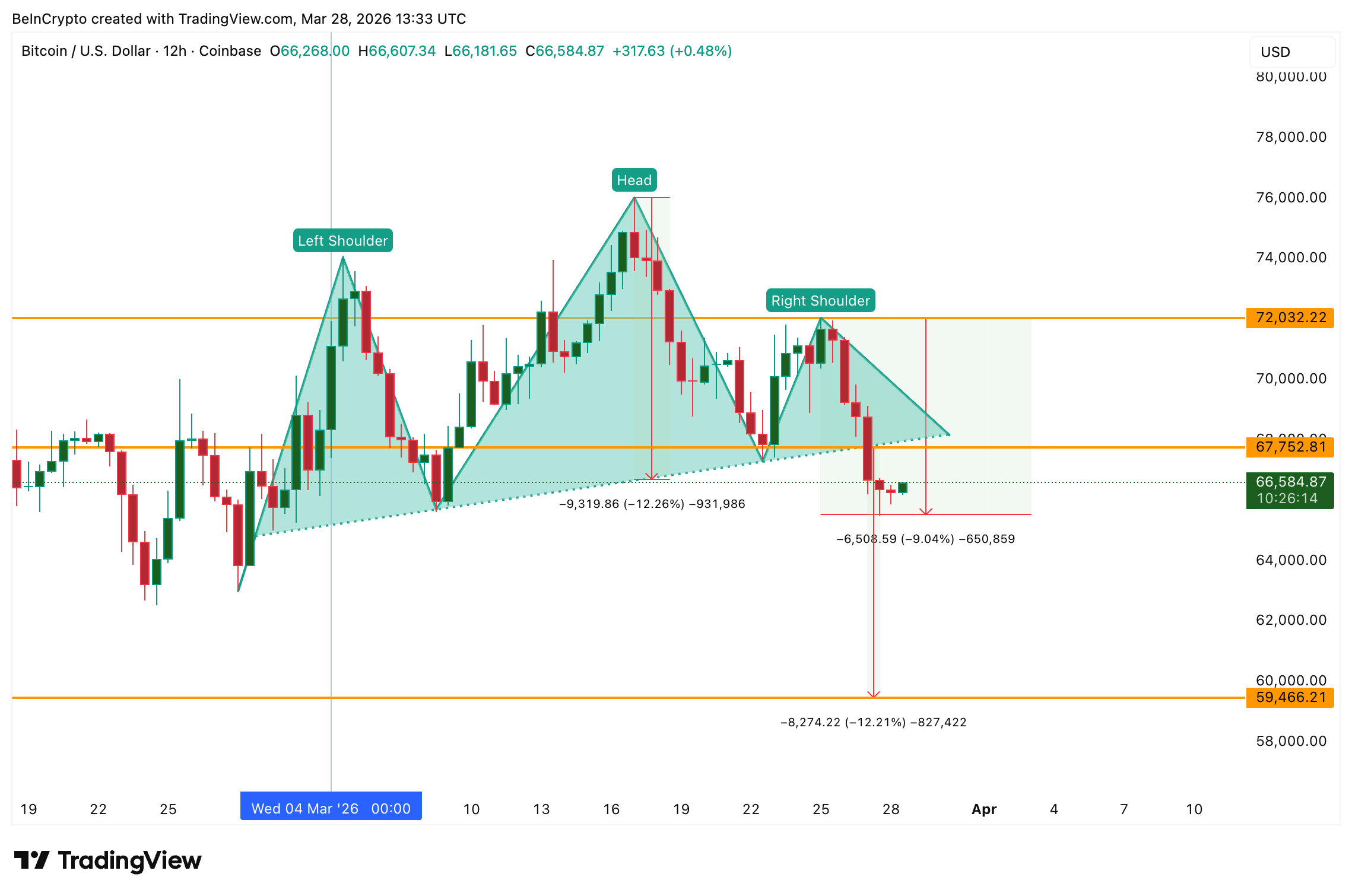
The 12-hour BTC price chart shows a head and shoulders pattern that has been developing since late February. The neckline sat near $67,700, and the breakdown happened on March 27.
Want more token insights like this? Sign up for Editor Harsh Notariya’s Daily Crypto Newsletter here.
On paper, the pattern’s measured move points to a 12% correction from the neckline. If realized, that would push Bitcoin price below the $60,000 psychological mark, targeting the $59,400 zone.
However, the Relative Strength Index (RSI), a momentum oscillator, offers a counter-reading. Between February 28 and March 27, the price formed a higher low while the RSI formed a lower low.
That hidden bullish divergence, which typically hints at trend continuation rather than reversal, has already produced a 1.87% bounce from the recent low.
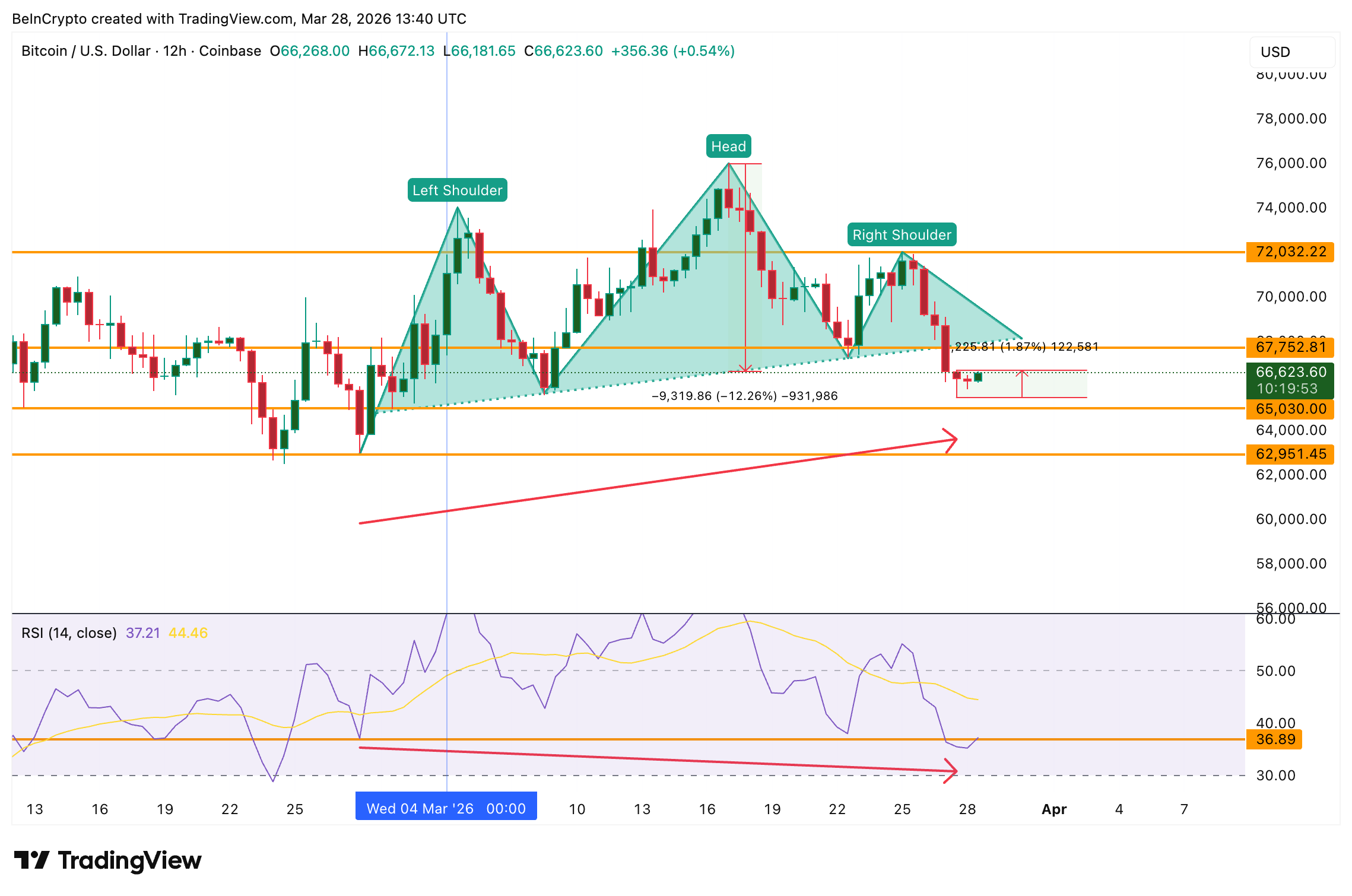
The divergence suggests the floor near $65,000 may hold temporarily. However, the bounce faces a wall of supply directly overhead, and the whales who would normally push through it are not providing enough conviction.
Over 6% of Supply Sits Between $66,900 and $69,400
The UTXO Realized Price Distribution (URPD), a Glassnode metric that maps the price at which Bitcoin’s current supply was last transacted, reveals three dense clusters directly above the current price.
At $66,900 (close to the current price), roughly 2.37% of the total supply last changed hands. At $68,100, another 1.96% sits. And at $69,400, a further 1.96%. Combined, approximately 6.29% of the BTC supply is concentrated in a $2,500 range just above where Bitcoin trades now.
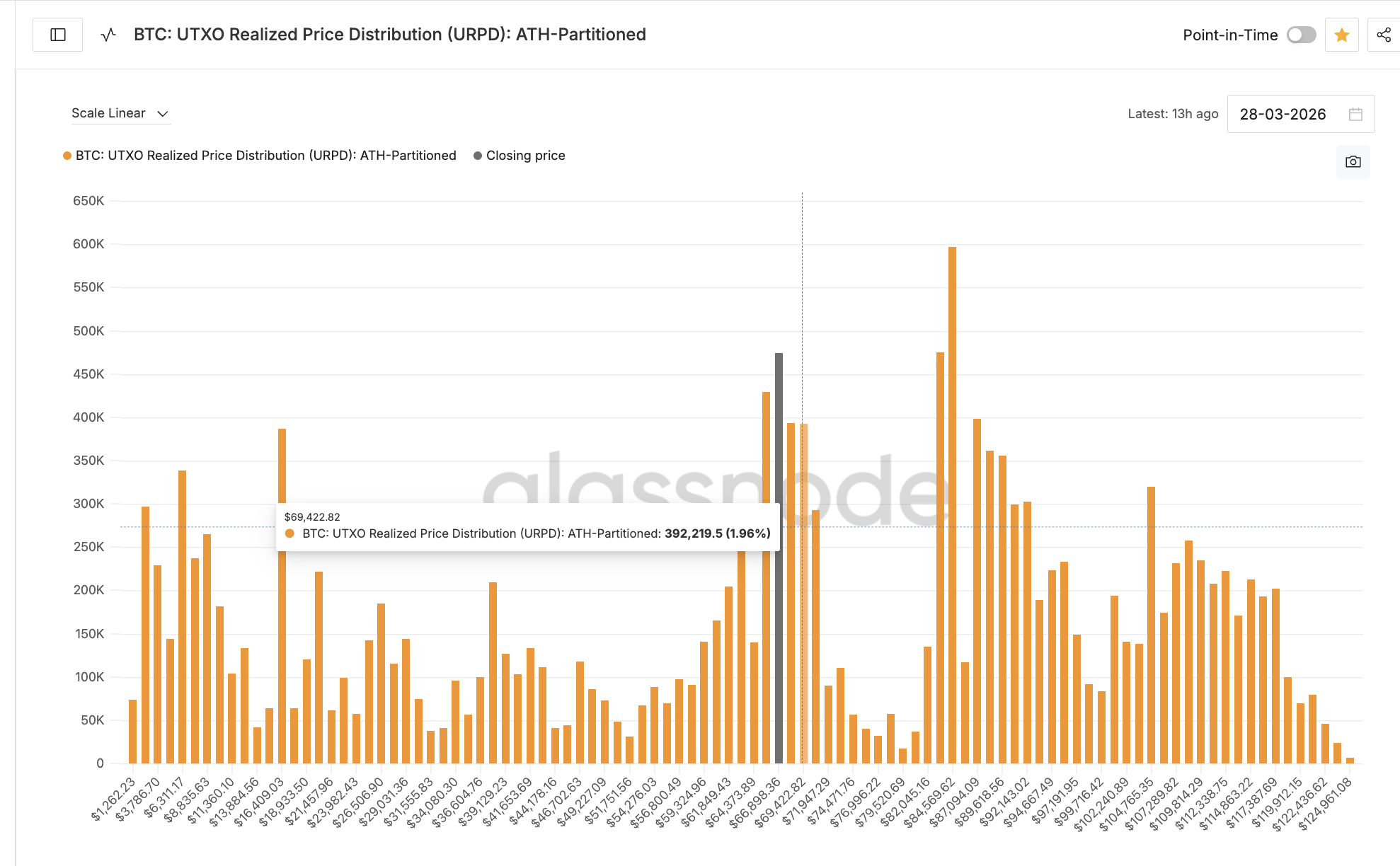
These clusters act as resistance because holders who bought at those prices and are currently sitting near breakeven tend to sell into any bounce to exit at minimal loss.
Whale behavior confirms how alarming these Bitcoin supply zones are currently. The largest cohort holding between 100,000 and 1 million BTC reduced their stash from 675,200 to 670,000 on March 24, a 5,200 BTC drop.
The mid-tier cohort (10,000 to 100,000) dipped and recovered, ending roughly flat at 2.25 million. Only the smallest whale tier (1,000 to 10,000) added marginally, rising from 4.21 million to 4.22 million.
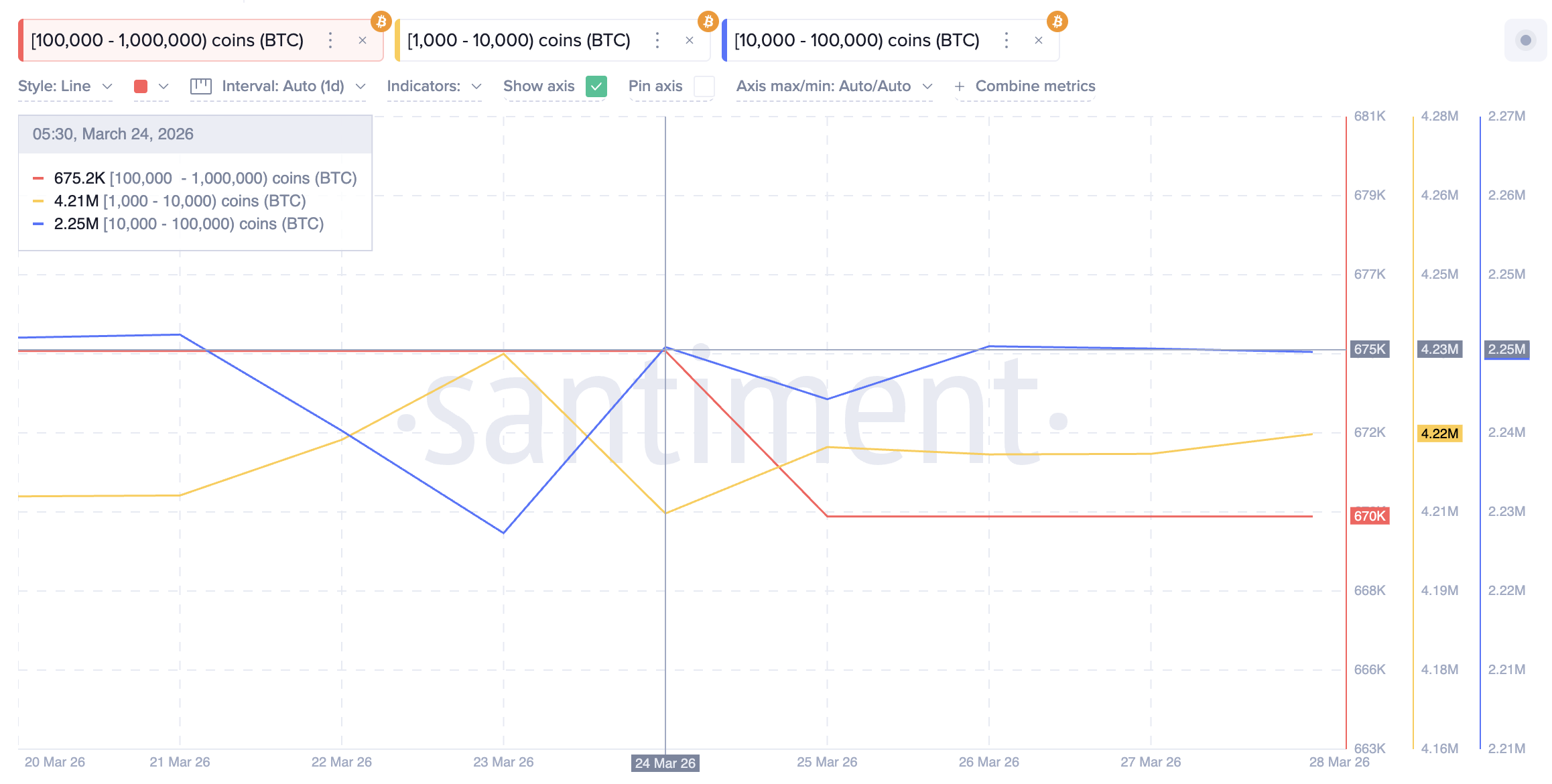
The net effect across all three cohorts is a marginal addition of roughly 4,800 BTC. However, the conviction picture is weaker than that number suggests.
The biggest wallets, which carry the most market-moving weight, reduced exposure by 5,200 BTC. The smallest tier’s 10,000 BTC addition does not offset that in terms of directional influence, because large-holder distribution historically precedes further weakness, while smaller-tier accumulation often reflects dip-buying that gets absorbed by overhead supply.
That means any bounce from the hidden bullish divergence is likely to stall within the $66,900 to $69,400 range (the supply warning we highlighted earlier).
Bitcoin Price Forecast and the $66,600 Line
The most immediate deciding level for Bitcoin is $66,600. Holding above it means the immediate supply cluster has not yet triggered mass selling, yet. A bounce from here could push toward $68,700 and the $70,000 psychological level.
However, $70,000 would require clearing all three supply clusters. Given the weak whale conviction, any bounce under $70,000 remains at risk of another sell wave. The bearish structure only weakens above $72,000, the right shoulder high.
On the downside, losing $66,600 opens the path to $65,200 and $63,300. Below that, the head-and-shoulders measured move of roughly 12% targets the $59,400 zone, pushing Bitcoin below $60,000 for the first time since the February lows.
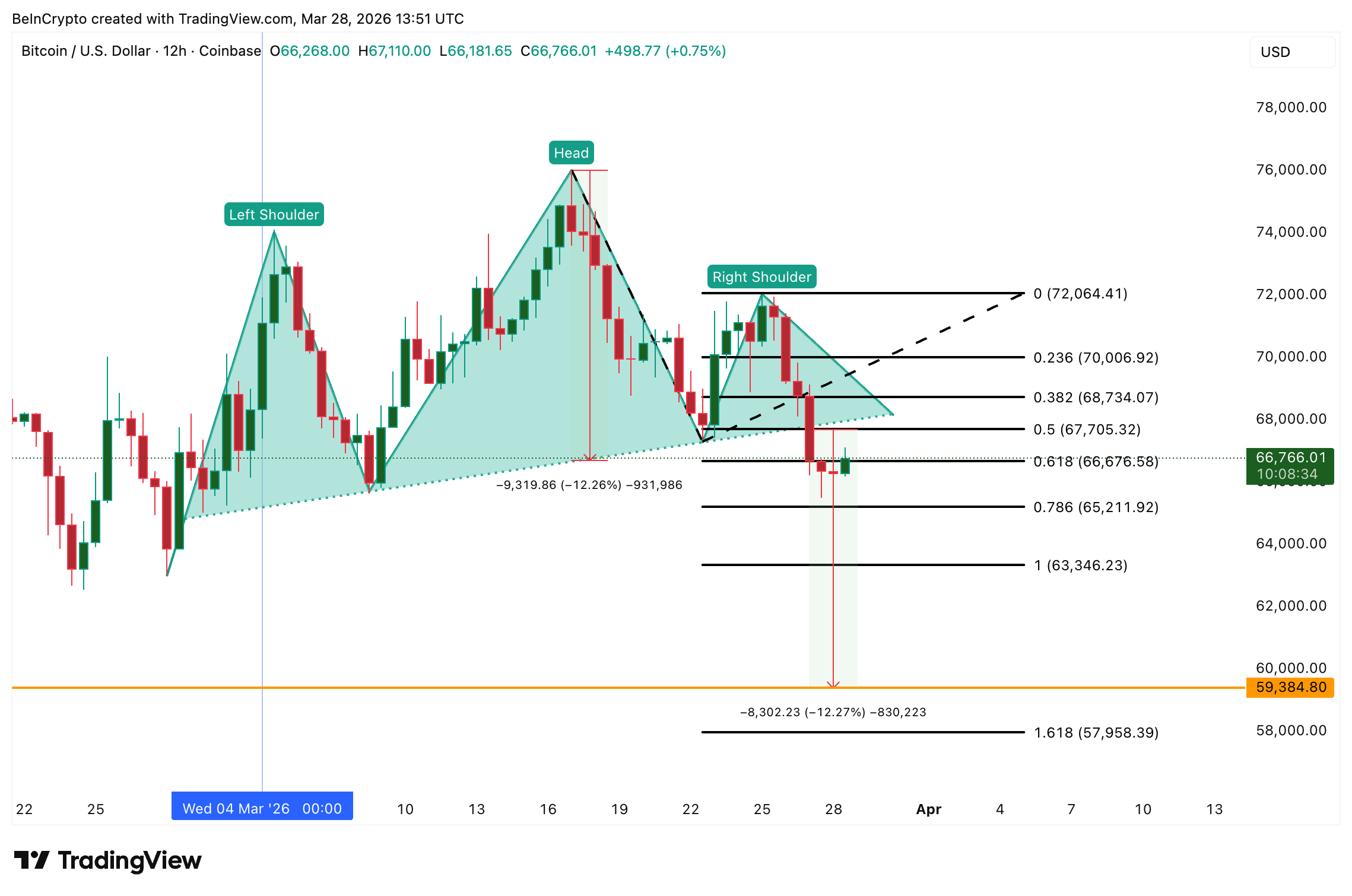
For now, $66,600 separates a shallow bounce toward $69,400 from a measured move breakdown below $60,000.
The post Is Bitcoin Price Finally Heading Below $60,000? Here’s What Technical Charts Show appeared first on BeInCrypto.
TLDR:
- Bitcoin has outperformed inflation 97% of the time, far exceeding gold’s 56% performance.
- Geopolitical tensions and rising oil prices may drive investor interest toward Bitcoin.
- Ethereum’s adoption by Wall Street and AI systems could increase its long-term value.
- Bitmine’s Ethereum holdings, staking, and venture investments position it for institutional growth.
Bitmine CEO Tom Lee emphasized Bitcoin’s performance against inflation at the Futu Investment Exhibition. He stated that since its creation, Bitcoin has outperformed inflation 97% of the time, compared to gold’s 56%.
Lee highlighted that this consistency makes Bitcoin a reliable store of value, attracting institutional attention, especially as the crypto winter shows signs of ending.
Bitcoin’s Inflation Resilience and Market Context
According to Lee, macroeconomic conditions are shaping investor behavior. Ongoing geopolitical tensions and elevated oil prices may slow global growth while benefiting the U.S. economy.
This environment encourages capital allocation to assets correlated with technology and growth, including Bitcoin.
Bitcoin’s long-term track record as an inflation hedge reinforces its appeal. Lee noted that gold, historically seen as a safe haven, has underperformed in comparison, creating a shift in institutional preferences. During the event, Tom Lee highlighted, “Bitcoin outperforms traditional inflation hedges over decades.”
Ethereum’s performance was also discussed, showing patterns similar to past market bottoms in the S&P 500. Analysis of Ethereum’s realized price suggests undervaluation relative to historical recovery points. Lee pointed out that these conditions may support renewed investor interest in crypto markets overall.
Investor behavior is responding to these signals. Reduced sell-side pressure, growing on-chain activity, and improved market sentiment suggest digital assets, particularly Bitcoin, are positioned for potential recovery and broader adoption.
Ethereum Prospects and Bitmine’s Strategy
Lee outlined Ethereum’s emerging role in traditional finance. Wall Street adoption is a primary factor driving future value.
Tokenization allows continuous trading, increased collateral mobility, and more efficient financial processes. Ethereum is viewed as the standard platform enabling these transformations.
AI developments also strengthen Ethereum’s potential. Agentic systems require decentralized identities and instant settlement, which blockchain networks can provide.
Ethereum’s smart accounts are being adapted to support autonomous applications. A tweet during the discussion noted, “Ethereum is preparing for AI and decentralized financial integration.”
Bitmine itself is strategically positioned to leverage these trends. The company maintains significant Ethereum holdings, high trading volumes, and pursues yield-generating strategies. Its Maven initiative focuses on large-scale staking to increase institutional returns.
Investments in ventures like Beast Industries and Orbs, which link to projects such as Worldcoin, further expand Bitmine’s market reach.
Ethereum price targets range from $12,000 to over $62,000, potentially translating to Bitmine share prices between $500 and $1,500, reinforcing the company’s growth prospects.
Crypto World
Crypto’s future is bright in the context of AI’s assault on SaaS, says Kraken-backed SPAC


Don’t be fooled by the prolonged crypto bear market, the industry remains a sound investment and less at risk from replacement by AI than traditional software as a service (SaaS) operations, according to Ravi Tanuku, CEO of KRAKacquisition Corp. (KRAKU), a blank check company backed by U.S. crypto exchange Kraken.
The company, a Nasdaq-listed special purpose acquisition company (SPAC) sponsored by Kraken with venture firms Natural Capital and Tribe Capital, closed its $345 million IPO in January, and is now ready to explore deals with crypto-native firms valued between $2 billion and $10 billion, Tanuku said in an interview.
This might sound ironic, given that Kraken’s parent Payward only this month delayed its much-anticipated IPO as crypto markets collapsed: The CoinDesk 20 Index (CD20) is on track for a sixth straight monthly drop. Tanuku declined to comment on Kraken’s IPO plans, but said he sees things like stablecoins and payments as the next best story after AI, and crypto as a clear survivor amid the total disruption hitting SaaS companies, which traditionally formed part of the IPO pipeline.
Saas’ very existence now seems to be under threat from rapid advancements in artificial intelligence and the potential for machines to write code — one of many areas of skilled labor that could be undone by AI.
“If you were a SaaS company and you wanted to go public and you didn’t go public, you have a bigger problem now, which is whether or not you have an answer for AI,” Tanuku said in an interview. “That’s not like crypto or bitcoin going from 70k to 80k. It’s a more existential, longer-term question that is much harder to shake.”
So if the money that’s not being invested in AI isn’t going to SaaS, does that mean crypto’s next up? Not really, Tanuku said. But it does mean investors are looking for other places to deploy.
“What I would say is the digital-asset thematic is probably one of the stronger secular stories in the market after AI … AI is the best story. Nobody’s going to deny that,” he said.
So what sort of crypto native opportunities is KRAK looking at, and does it include much in the way of AI crossover?
Tanuku said he’s looking at areas where crypto and AI naturally intersect. He mentioned the well-documented excitement over AI agentic commerce, and also raised the possibility of tokenization assisting in feeding AI’s growth.
“I’m curious if somebody doesn’t start to float tokens to figure out how to finance some of this infrastructure, because the build-out is so expensive, there might be interesting ways to provide people yield and returns in a tokenized manner,” Tanuku said.

XRP’s risk-adjusted performance turned modestly positive on March 26, marking a shift after months of flat-to-negative readings. A 30-day average return of 0.00063 accompanies a Sharpe ratio of 0.0267, suggesting that current gains are modest but still outpaced by risk. On-chain data shows persistent accumulation by large holders, implying underlying demand even as price action remains subdued.
Analysts point to a broader pattern: on-chain buying and a slowly improving risk profile could set the stage for a steadier path higher, even if price upside remains constrained in the near term.
Key takeaways
- The XRP Sharpe ratio moved into positive territory for the first time in months on March 26, supported by a 30-day average return of 0.00063.
- Whale activity has remained firm, with CryptoQuant data showing XRP inflows averaging about $9 million per day over the last 30 days, continuing a pronounced accumulation phase that began in late February.
- Open interest surged 14.8% in the 24 hours to March 26, signaling renewed trader participation, alongside repeated long-liquidation spikes above $2 million in recent sessions.
- XRP’s price structure has shifted to a bearish bias: the asset invalidated its previously bullish ascending triangle and shed about 13.63% over ten days, with near-term support at $1.27 and a yearly low near $1.11 in focus.
- Past patterns suggest that prolonged accumulation can precede stronger upside, as seen in Q2 2025 when accumulation preceded a rally to a $3.65 high on July 18, 2025; watchers will want to see if the current phase leads to a similar outcome.
Positive risk-adjusted returns amid on-chain demand
CryptoQuant-derived data indicate that XRP’s improved risk-adjusted profile aligns with a pickup in trading activity. Arab Chain, in a CryptoQuant quicktake, framed the recent Sharpe ratio improvement as part of a gradual rebalancing that could limit downside for holders. However, the analyst cautioned that a return to negative territory would signal renewed volatility and fading momentum.
“If the indicator falls back into negative territory, it could signal a return of volatility and weakening momentum.”
While the short-term signals point to hedged risk, the long-run picture suggests a more constructive tilt if accumulation continues. The last substantial accumulation wave in Q2 2025 culminated in XRP’s expansion rally to an all-time high of $3.65 on July 18, 2025, underscoring how inflows can precede meaningful upside in subsequent months.
Whale flows and market momentum
On-chain trackers show that XRP whale inflows have remained robust, with the 30-day moving average holding around $9 million per day. The sustained demand has persisted since February 27, marking the longest accumulation stretch in months and echoing a broader pattern seen during prior cycles when whales stepped in ahead of bigger price moves.
That trend matters for investors because it points to durable demand that could underpin market returns even if price volatility remains elevated. The question for traders is whether this accumulation translates into sustained upside or simply supports a slower drift higher as macro and liquidity conditions evolve.
Open interest and near-term technicals
Open interest figures reinforce a market where risk is being actively recycled. CryptoQuant data show a 14.8% rise in 24-hour open interest on March 26, the strongest such move since March 4, reflecting renewed participation from long and short positions and a pattern of consecutive long liquidations—$2.5 million on March 18, roughly $2.45 million on March 21, and about $2.15 million on March 26.
From a price-structure perspective, XRP has broken from a bullish ascending triangle, and the prior ten-day slide of around 13.6% points to a bearish bias in the near term. If the current dynamic persists, traders will likely test support around $1.27, with a deeper look toward the yearly low near $1.11 in the weeks ahead.
The combination of a positive risk-adjusted metric and steady whale inflows paints a nuanced picture: a market where demand is accumulating even as prices wobble, potentially laying a groundwork for a more durable move if buyers sustain their activity.
Looking ahead, buyers will want to see whether the positive risk-adjusted read holds and whether whale demand remains steady. The next critical junctures to watch include whether XRP can sustain levels above near-term support and whether accumulation pulses continue to shape the risk landscape in the coming weeks.
Past patterns offer a useful lens: the accumulation phase seen in Q2 2025 preceded a rally to an all-time high later that year, suggesting that continued demand could precede stronger upside if sustained by shifting market dynamics.
Looking ahead, traders will watch if the positive risk-adjusted reads endure and whether whale accumulation remains steady; a sustained move higher will depend on whether demand translates into durable upside beyond the near-term support.

Key Insights
- MetaComp launches AI-driven StableX upgrade to unify compliance, payments, and digital asset operations
- VisionX engine strengthens AML/CFT with multi-layer analytics and near-zero false clean rates
- AgentX and KYA enable regulated AI automation across payments, treasury, and compliance workflows
Singapore-based MetaComp has introduced major upgrades to its StableX Network, aiming to strengthen compliance, payments, and wealth management across fiat and stablecoin systems. The move positions StableX as a compliance-first platform designed to bridge traditional finance and digital assets.
The upgrade integrates three core components: VisionX Engine, AgentX AI layer, and the KYA governance framework, focused on enabling regulated, AI-driven financial infrastructure.
VisionX Engine Enhances AML/CFT Monitoring
The Web2.5 VisionX Engine delivers multi-layered risk monitoring across identity, behavior, and network levels. Identity screening combines traditional KYC data with Web3 wallet intelligence, while behavioral analysis detects transaction anomalies.
Network screening highlights the concealed counterparty risks, offering a closer supervision of the flow of transactions. MetaComp said parallel screening across four blockchain analytics providers reduces false clean rates from around 25% to near zero.
The system supports both cross-border payments and digital asset transactions, allowing institutions to maintain compliance with global AML/CFT requirements.
AgentX Powers AI Financial Execution
AgentX serves as the platform’s AI execution layer, enabling autonomous financial operations. AI agents can handle transactions, detect risks and perform operations on fiat and crypto systems.
The layer enables AI-to-AI communication, enabling automated processes in the payment, treasury and compliance operations. The most important characteristics are real-time transaction intelligence, wallet screening, compliance integration, and a modular and protocol-agnostic infrastructure.
The initial implementation, Agentic KYT, is concerned with the monitoring of transactions as an AML/CFT compliance, which expands the automation of regulation.
KYA Framework Governs AI Activity
The KYA (Know Your Agent) framework provides a regulatory mechanism over AI agents in financial systems. It ensures that AI-based processes are auditable and compliant with regulatory standards.
MetaComp observed that Singapore Model AI Governance Framework is consistent with the given framework, and it helps to responsibly deploy agentic AI in financial services.
AI-Native Automation and Expansion Plans
Together, AgentX and KYA enable AI-native financial automation, allowing intelligent agents to independently manage payments, treasury, and compliance while remaining regulated.
The upgrade is after the $35 million Pre-A round at MetaComp. The company will increase the penetration of StableX in the Asian, Middle East, African and Latin American markets to attract the use by institutions.
MetaComp also published a whitepaper called Cross-Border Payments for SMEs: Voices in ASEAN and the Rise of Stablecoins, which states that the stablecoin is increasingly becoming an important part of enhancing the efficiency of payment.
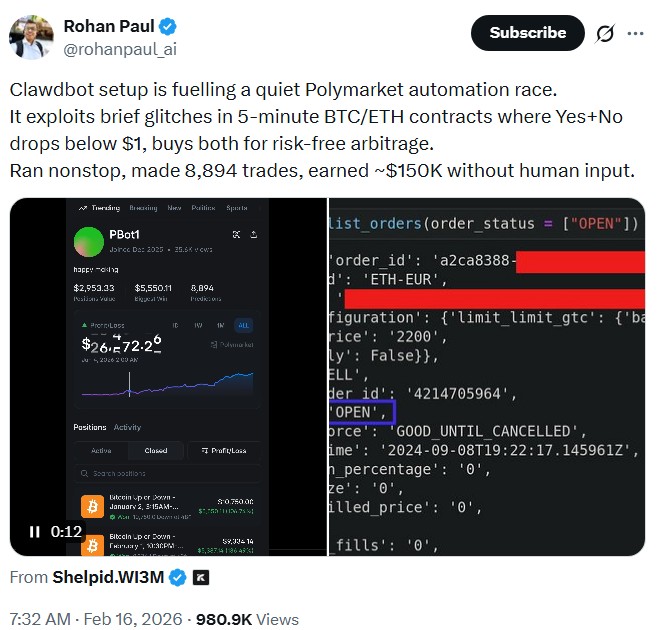
Prediction markets aggregate human judgment in theory, but some of their consistent trading opportunities may end up captured by systems that move faster than any person can.
Arbitrage opportunities can show up as brief mispricings, from outcomes that temporarily fail to sum up to 100%, to short delays in how quickly markets react to new information.
Rodrigo Coelho, CEO of Edge & Node, said bots are already scanning hundreds of markets per second, a role that increasingly overlaps with more advanced AI-driven agents.
“Capturing those opportunities requires monitoring thousands of markets and executing trades almost instantly, which is why they’re largely dominated by automated systems,” Coelho told Cointelegraph.
That makes prediction markets a natural next step for AI-driven systems built to exploit short-lived pricing gaps without human input.

Arbitrage mechanics in prediction markets
Bitcoin and crypto prices haven’t been performing well recently, with BitMine’s Tom Lee calling the current sentiment a “mini-crypto winter.” Meanwhile, prediction markets have emerged as venues where users can bet to profit independently of broader economic conditions.
The rise of prediction markets has also seen opportunities such as what Coelho calls “latency arbitrage,” which rely on short windows too narrow for humans to manually target. He told Cointelegraph:
If there’s even a few-second delay between an event happening and the market updating, bots scan for that and place bets on the correct outcome. For that window, they have a 100% guaranteed win.”
A recent study found that Polymarket exhibits frequent pricing inconsistencies, allowing traders to construct arbitrage positions. These opportunities arise both within individual markets, where probabilities don’t sum to 100%, and across related markets with inconsistent pricing. The researchers estimated that roughly $40 million has been extracted from these inefficiencies.

Prediction markets are still nascent, but their technology has been improving as well. For example, Polymarket recently introduced taker fees to increase trading costs. Outcomes aren’t finalized immediately, making these strategies less reliable and not always profitable.
AI agents could amplify market manipulation risks
Aside from arbitrage, AI agents could increasingly take over activity in prediction markets, raising concerns that automated systems may replicate the same behaviors seen from humans. They are trained on human activity, after all.
Coelho pointed out that large players can influence outcomes by placing sizable bets on one side, and that more advanced agents could exploit similar dynamics at scale.
“If you have a large pool of money and the market is thin, you can bet on one side and sway the market, like we saw in the election when some French guy put in like [$45 million] on Donald Trump winning,” he said.
Polymarket’s open interest was highest around October and early November of 2024, during the US elections, according to Dune Analytics data. Following a sharp initial decline, it has continued to surge in popularity, with politics leading as the most popular topic, followed by sports and crypto.

Related: Federal regulation looms as 11 states go after prediction markets
Pranav Maheshwari, engineer at Edge & Node, said the rapid improvement of AI agents alongside prediction markets makes such risks more urgent and called for guardrails.
“Up until now, AI agents have medium capability and we give them a lot of permissions. With this medium capability, they have already started acting autonomously,” Maheshwari told Cointelegraph.
But in the future, AI agents will have really high capabilities. When it has really high capabilities as humans, you have to restrict their permissions.”
From execution bots to AI-driven systems
Trading itself is undergoing a shift, as automation moves from simple execution bots to more advanced, AI-assisted systems capable of identifying and acting on opportunities in real time.
The systems currently used to exploit market inefficiencies remain largely rule-based, but the tools behind them are evolving.
Archie Chaudhury, CEO of LayerLens, said most retail participants are not using AI agents directly, relying instead on chatbot interfaces like ChatGPT or Gemini for research, while more advanced users are beginning to experiment with automation.
“Some of us simply use coding agents such as Claude Code to create automated bots or algorithms for executing trades, while others take it a step further, using autonomous tools such as OpenClaw to enable the automatic execution of trades and other policies,” he told Cointelegraph.
Related: Do Super Bowl ads predict a bubble? Dot-coms, crypto and now AI
As AI literacy among retail traders rises, agents could broaden access to strategies that were previously limited to institutions, according to Chaudhury. However, this does not eliminate competition, and large institutions are already using AI, though not always publicly.
He added that existing large language model architectures are well suited to interpreting structured financial data, which could lower the technical barrier for building trading systems that would have previously required specialized quantitative expertise.
The same dynamics are already visible across crypto markets, where arbitrage increasingly depends on automation rather than human judgment. As these systems evolve, the edge is shifting execution speed. Those leaning on AI and automation have a clear edge over those that don’t.
Magazine: Agent wastes 14 hours of scammers’ time, LLMs ‘poisoned’ by Iran: AI Eye
P2P.me, a cryptocurrency payments platform, is facing questions over a $20,000 Polymarket bet tied to its own fundraising campaign after disclosing that it traded on the outcome before the round opened publicly.
On March 27, P2P.me announced that it had liquidated a Polymarket betting position on its ability to meet its $6 million fundraising target. The company disclosed that it placed the bets 10 days before officially opening its funding round.
Big Polymarket Profit Sparks Insider Trading Debate
P2P.me admitted that, at the time the wagers were placed, it had already secured an oral commitment of $3 million from the venture capital firm Multicoin.
Some legal observers said the $3 million oral commitment could be viewed as material non-public information, though P2P.me said the absence of signed documents meant the outcome was still uncertain.
P2P.me further defended the trade and characterized the bet as a “vote of confidence.”
“We named the account “P2P Team” deliberately – to give a marketing signal of our presence to the community and reflect our intent to be transparent. But intent isn’t the same as action. Not disclosing at the time was a mistake we own. We took time to study the legal implications before speaking, which is why we stayed silent until now with a “No Comments” stance! – that too is a fair criticism,” it stated.
P2P.me eventually raised $5.2 million from outside investors, allowing the firm to close its Polymarket positions at $35,212. The trade generated a profit of roughly $14,700 from an initial entry of $20,500.
Following the backlash, some investors and industry insiders argued that the incident was being blown out of proportion. They attributed the trade to naiveté rather than malice.
Simon Dedic, co-founder of Moonrock Capital and an investor in P2P.me, defended the team’s character and motive. According to him, the trade was a misguided “guerrilla marketing stunt” designed to show conviction.
“No one with any common sense would risk a $6 million raise over $15,000. The idea was to show such strong conviction in the sale that they’d even bet on themselves. This is exactly why they intentionally named the account ‘P2P team.’ Otherwise, you’d have to argue they’re the most incompetent insider traders of all time,” Dedic added.
Amid mounting criticism on the eve of its planned initial coin offering, P2P.me announced that it would route the proceeds from trading to the MetaDAO Treasury. The company clarified that MetaDAO had no prior knowledge of the trades.
This incident comes at a time when prediction markets are enjoying an explosive growth in the sector. Blockchain platform TRM Labs stated that the sector’s transaction volumes have surged from $1.2 billion in early 2025 to more than $20 billion by January 2026.
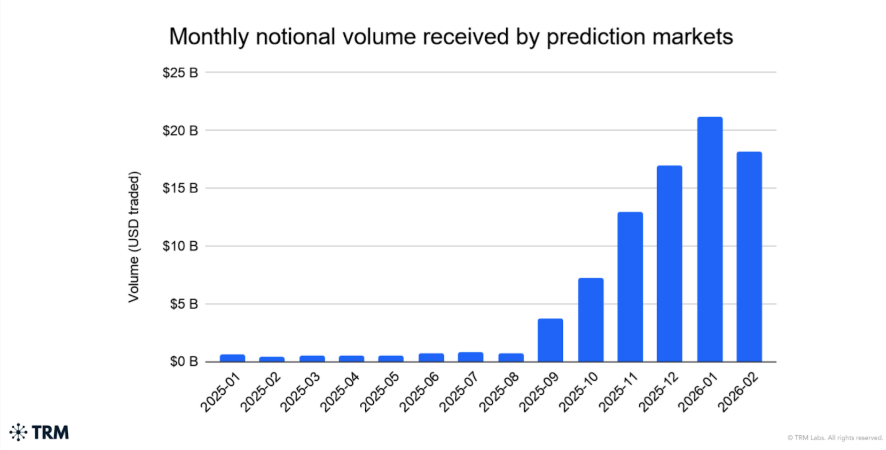
Due to this rapid growth, there have been increasing regulatory concerns about decentralized prediction markets. Platforms such as Polymarket and Kalshi have recently implemented stricter surveillance measures to curb insider trading.
The post P2P.me Faces Insider Trading Allegations Over Polymarket Bets appeared first on BeInCrypto.
Google is preparing to support a multibillion-dollar data center project in Texas leased to Anthropic as competition for AI infrastructure accelerates.
The project, operated by Nexus Data Centers, could exceed $5 billion in its initial phase, with Google expected to provide construction loans, Financial Times reported on Friday, citing people familiar with the matter. A consortium of banks is also competing to arrange financing by mid-year, per the report.
According to the report, Anthropic recently signed a lease for the 2,800-acre campus, which forms part of its broader infrastructure tie-up with Google. Construction is already underway, supported by early-stage debt financing from Eagle Point, a publicly traded closed-end investment company.
The site is expected to deliver around 500 megawatts of capacity by late 2026, roughly equivalent to powering 500,000 homes, with potential expansion to 7.7 gigawatts. Its location is near major gas pipelines operated by companies including Enterprise Products Partners, Energy Transfer and Atmos Energy, allowing the project to rely on on-site gas turbines.
Related: David Sacks’ 130-day term as Trump’s crypto and AI czar has ended
Judge blocks Pentagon ban on Anthropic
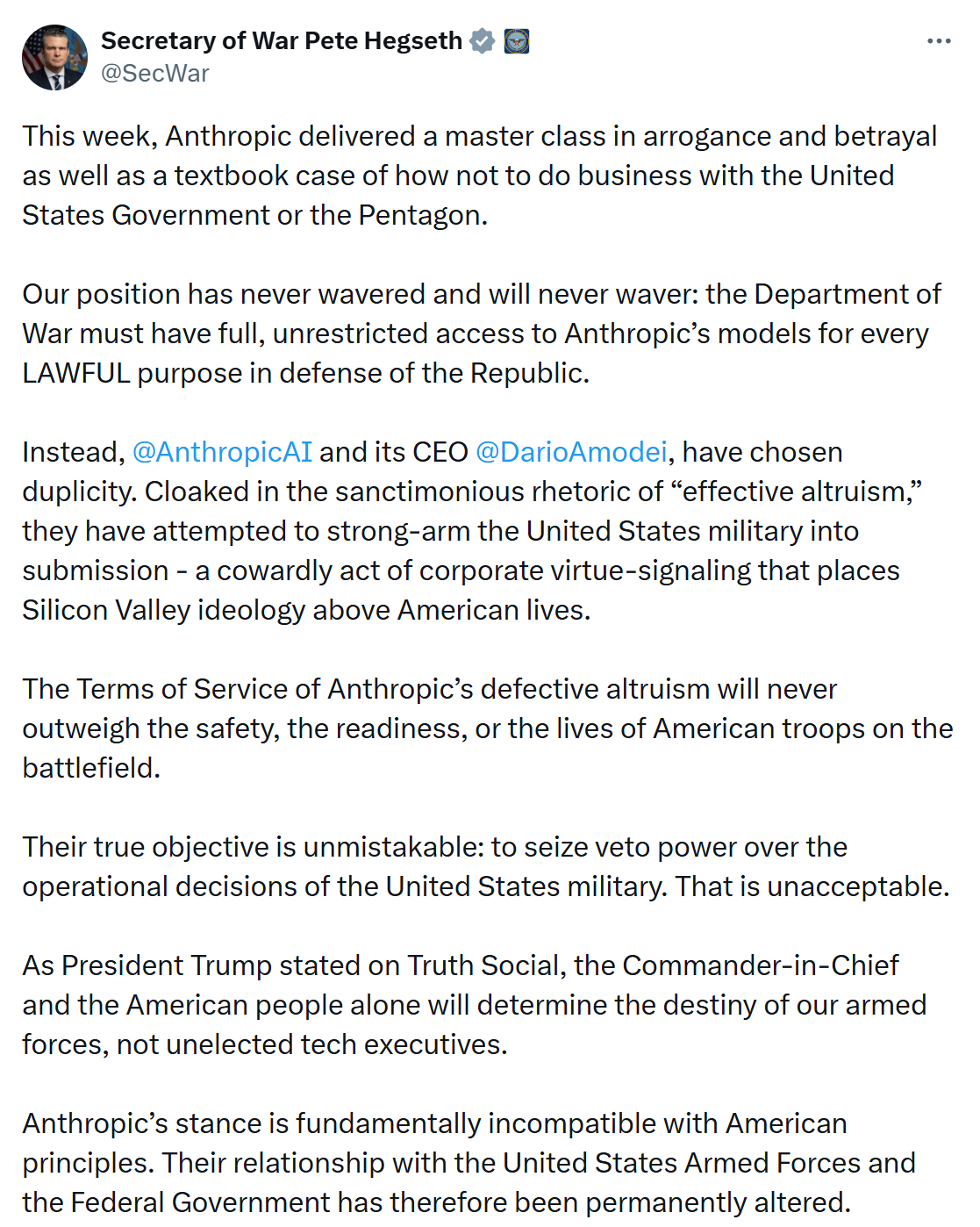
On Thursday, a US federal judge in San Francisco temporarily blocked the Pentagon from labeling Anthropic a national security risk and halting government use of its AI tools. Judge Rita Lin granted a preliminary injunction, pausing a directive backed by President Donald Trump that sought to cut off federal use of Anthropic’s chatbot, Claude.
The ruling came in a lawsuit filed by Anthropic, which argued that Defense Secretary Pete Hegseth overstepped his authority by designating the company a supply chain risk. The judge described the government’s actions as “arbitrary” and warned against branding a US company as a threat without clear legal basis.
The dispute followed a breakdown in negotiations between Anthropic and the Pentagon over the military use of its AI. The company resisted allowing its models to be used for lethal autonomous weapons or mass surveillance, leading to a broader standoff with the administration.

In her decision, Lin said the government may have retaliated against Anthropic for its public stance, calling the measures a likely violation of First Amendment protections.
Related: CFTC Chair Selig says blockchain could help verify AI-generated content
US military used Anthropic AI in Iran strike
As Cointelegraph reported, US military units reportedly used Anthropic’s Claude AI model during a major airstrike on Iran, even after the ban order by Trump. Military commands, including US Central Command (CENTCOM) in the Middle East, reportedly used the AI model for operational support
Magazine: Bitcoin may take 7 years to upgrade to post-quantum — BIP-360 co-author

21 in 21: Michael Saylor on Bitcoin, AI, and Advice for Builders

Real reason Olivia Attwood ‘never legally married’ Bradley Dack revealed after split
Sanofi reports positive phase 3 data for atopic dermatitis drug


-
 NewsBeat3 days ago
Manchester United reach agreement with Casemiro over contract clause amid transfer speculation
-

 News Videos3 days ago
Parliament publishes latest register of MPs’ financial interests
-

 Crypto World7 days ago
Best Crypto to Buy Now: Strategy Just Spent $1.57 Billion on Bitcoin During Fear While Early Investors Quietly Enter Pepeto for 150x Potential
-

 Crypto World7 days ago
Bitcoin Price News: Bhutan Sells $72 Million in BTC Under Fiscal Pressure, but the Smart Money Entering Pepeto Sees What the Market Does Not
-

 Sports5 days ago
Remo Stars and Kano Pillars Strengthen Survival Hopes in NPFL
-

 Sports5 days ago
Gary Kirsten Accuses Pakistan Cricket Board Of ‘Interference’, Mohsin Naqvi Responds
-

 Business6 days ago
No Winner in March 21 Drawing as Prize Rolls to $133 Million for Next
-

 Tech6 days ago
Give Your Phone a Huge (and Free) Upgrade by Switching to Another Keyboard
-

 Tech6 days ago
AI enters the chat: New Seattle dating app relies on tech to facilitate meaningful human connections
-

 News Videos5 days ago
Ch 9 Financial Management Part 1 | Detailed One Shot | Class 12 Business Studies Boards 2026
-

 Tech7 days ago
Today’s NYT Connections Hints, Answers for March 22 #1015
-

 Business2 days ago
Instagram, YouTube Found Responsible for Teen’s Mental Health Struggle in Historic Ruling
-

 Business6 days ago
Will Duke Basketball Win It All? Duke Basketball Enters Second Round as Third Favorite to Claim NCAA Title
-

 Sports5 days ago
2026 Kentucky Derby horses, odds, futures, preview, date: Expert who hit 12 Derby-Oaks Doubles enters picks
-

 NewsBeat18 hours ago
The Story hosts event on Durham’s historic registers
-
 Entertainment5 days ago
Cynthia Bailey Dishes on ‘RHOA’ Season 17, Discusses Kandi
-

 Tech5 days ago
Samsung will soon let you control smart home devices from your car’s dashboard
-
 NewsBeat6 days ago
Update on Wisbech river crash as search for teenage boy enters fifth day
-

 Fashion4 days ago
Does It Matter What You Wear When You’re Laid Off and Looking?
-
 NewsBeat3 days ago
Tesco is selling new Cadbury Dairy Milk bar and people can’t wait to try it
You must be logged in to post a comment Login