Alcaraz gets his teeth into the Zverev service game and there’s a big point at 30-30. Zverev finds the first serve and Alcaraz drops deep after making the return. Zverev strikes, but Alcaraz somehow produces the backhand pass crosscourt, clipping the very outside of the line.
Break point: but Zverev finds the first serve and Alcaraz nets on the return. Alcaraz nets on the backhand and Zverev does well to come through that unscathed.
Jamie Braidwood30 January 2026 04:16
Advertisement
Carlos Alcaraz 3-3 Alexander Zverev*
Bit of a chance for Zverev! He wins the opening point against the Alcaraz serve, standing up to the Spaniard at the baseline. On 0-15, Zverev had the look at the forehand down the line, but nets.
Alcaraz finds good serving from there, landing a wicket wide ace and two more first serves. We hear a roar from him for the first time.
(Getty Images)
Jamie Braidwood30 January 2026 04:12
Advertisement
*Carlos Alcaraz 2-3 Alexander Zverev
It’s been a fine start from Zverev. With his first-serve percentage high, he is rolling through the games and comes through a second love-hold in a row.
(AFP via Getty Images)
Jamie Braidwood30 January 2026 04:07
Carlos Alcaraz 2-2 Alexander Zverev*
Alcaraz steps it up with a stunning backhand winner down the line – shot of the match so far – as the Spaniard holds.
Advertisement
Jamie Braidwood30 January 2026 04:05
*Carlos Alcaraz 1-2 Alexander Zverev
A love-hold for Zverev, who has started well in the bright Melbourne sun. He finds the first serve and powers the forehand winner past Alcaraz.
Jamie Braidwood30 January 2026 04:00
Advertisement
Carlos Alcaraz 1-1 Alexander Zverev*
It’s actually Alcaraz, with this reworked serve since the end of last season, who gets the first ace of the match.
He jumps into a 40-0 lead, but a couple of forehand errors allow Zverev back into it. Alcaraz takes a gulp of air.
And he belts down a second ace, right down the T.
Advertisement
Jamie Braidwood30 January 2026 03:57
*Carlos Alcaraz 0-1 Alexander Zverev
All eyes are on the Zverev serve, a game-changing shot for the German that will likely determine how competitive this semi-final can be. He closes the net and swats a volley to move to 40-15. A backhand error from Zverev is then traded with a forehand error from Alcaraz. Zverev holds.
Carlos Alcaraz bids for his first Australian Open final against Alexander Zverev (REUTERS)
Jamie Braidwood30 January 2026 03:52
Advertisement
Carlos Alcaraz 0-0 Alexander Zverev*
Carlos Alcaraz leads the walk out onto the Rod Laver Arena for his first Australian Open semi-final. The Spaniard lost to Alexander Zverev in the quarter-finals two years ago. Last year, Zverev advanced past Novak Djokovic at this stage when the 10-time champion retired, and he was the runner-up to Jannik Sinner. With his serve, Zverev can take the racket out of Alcaraz’s racket if his serve is on fire. But Alcaraz has come on so much in two years.
Coin toss time: Alcaraz wins the toss and elects to receive.
Jamie Braidwood30 January 2026 03:42
Advertisement
Australia’s Gadecki and Peers defend mixed doubles title
Australia’s Olivia Gadecki and John Peers became the first pair in 37 years to successfully defend the Australian Open mixed doubles title, defeating French duo Kristina Mladenovic and Manuel Guinard 4-6 6-3 10-8.
The wildcard pairing became the first team since Jana Novotna and Jim Pugh in 1989 to retain the crown and the first Australian pair to do so since Margaret Court and Ken Fletcher 62 years ago.
(AFP via Getty Images)
Jamie Braidwood30 January 2026 03:39
Carlos Alcaraz v Alexander Zverev
Here we go! The first of the men’s semi-finals awaits as Carlos Alcaraz continues his hunt for a first Australian Open title and the career grand slam against Alexander Zverev.
Advertisement
What a day it’s going to be: all of the top four seeds have made it to the semi-finals, and we have two blockbuster semi-finals. The sun is out and the roof is open on the Rod Laver Arena.
Speaking after that 52-minute loss, Raducanu admitted she could not summon the power to compete with the two-time grand slam finalist.
She repeatedly declined to chase down drop shots and struggled to put her opponent under any pressure with her return of serve.
Raducanu cut ties with her latest coach Francisco Roig in January and has been working on an ad-hoc basis with Mark Petchey in a bid to rediscover top form.
Seeded 24th, she could have faced compatriot Sonay Kartal – who begins against American Peyton Stearns – in the round of 64 in Miami.
Katie Price has spoken out about her romance with Lee Andrews amid claims he isn’t what he says he is. The pair got married in Dubai weeks after meeting
Katie Price has revealed the unexpected reason why her husband Lee Andrews hasn’t met her kids yet. Lee and Katie got married weeks after meeting for the first time in Dubai, with no family or friends – including any of her children – in attendance.
Her children have yet to meet Lee though in person, despite the businessman getting a tattoo tribute to Katie’s eldest son Harvey. Whilst they haven’t met, Katie has now explained why that’s the case, saying: “I want to get to know him more myself.”
Speaking about how her kids have met Lee via FaceTime, she admitted: “No, like it never is enough. And for me to introduce him to the kids, I won’t be introducing him to the kids yet, because I want to get to know him more myself.
Advertisement
“And I think the thing that everyone can’t get their head round is why have I married him quick. I was there. We got engaged. And it just felt right, so why not get married?”
Later in the interview, Katie also defended her new husband, insisting that he does have a PhD – just not from Cambridge as well as a diplomatic passport in the name of ‘Dr Lee Andrews’.
“His passport says that he’s a doctor, it’s reported that he has a PhD from Cambridge, but Cambridge University said they had never heard of him,” host Ed Balls explained to her.
Katie then replied: “He doesn’t have a PhD from Cambridge, it’s one in Spain. That’s for him to say that he’s got his PhD, but it’s not from Cambridge, I don’t know where that came from, he hasn’t got a PhD from Cambridge at all but he has got a PhD. I’ve seen everything I need to see, on his diplomatic passport, it’s Doctor Lee Andrews, on his normal passport, it’s Wesley Lee Andrews.”
Advertisement
When host Susanna Reid said “I’m not sure you’ve had time to get to know the person to whom you are now married, so why the whirlwind?” Katie then replied to give her opinion on the matter.
“Do you ever really know anyone? If you look at my past marriages, did I ever know they would be what they would be Sometimes I don’t think you can ever know who anyone is…” she had said.
If you are a student in the UK, news of an outbreak of meningitis affecting university students in Kent may be causing you alarm.
The UK Health Security Agency has confirmed 13 cases of invasive meningococcal disease, a severe infection that can cause meningitis and septicaemia (blood poisoning), and is providing antibiotics and guidance to students and their close contacts. Two young people, a year 13 school pupil and a university student, have died. Others are seriously ill.
Why meningitis outbreaks happen at universities
Meningococcal disease is caused by Neisseria meningitidis bacteria. Although many people can carry the bacteria harmlessly in their nose or throat, very occasionally it invades the bloodstream or central nervous system and causes life-threatening illness. Meningitis is an inflammation of the membranes around the brain and spinal cord.
Meningococcal disease spreads through close contact with respiratory droplets. This could be through kissing, sharing drinks or utensils, and coughing and sneezing. This is what makes the risk higher in settings where people live, study and socialise closely together, such as university campuses.
Advertisement
Outbreaks such as the recent one in Kent, especially in communal settings like universities or schools, are less common than individual sporadic cases. While the overall risk remains low, the proportion of cases among young adults and students is higher than in older age groups simply because of the social mixing and living arrangements typical of school and university life.
How to reduce your risk
There is no guaranteed way to eliminate risk entirely, but several practical steps can help.
The first is vaccination. In the UK, there are routine immunisation programmes against key meningococcal strains. The MenACWY vaccine is usually offered in school to protect against four common meningococcal groups and can be given up to age 25 if missed. The MenB vaccine is given to infants. Whether older teenagers have had it varies because the risk profile and vaccine history differ. The MenB vaccine is available privately for teenagers and adults.
So check your vaccination history. You can do this by looking over your vaccination records, asking your GP practice, checking the NHS app or looking at your university or travel clinic records. If you can’t find a record of having a vaccination against meningitis, doctors may recommend vaccinating again – receiving an extra dose is generally safe.
Advertisement
Talk to your friends about their vaccination history, too. People can carry meningococcal bacteria without symptoms. Awareness of your own vaccination status and encouraging friends to be up to date increases community protection.
Even if someone has been vaccinated, they may still be advised to take preventive antibiotics if they were a close contact of a case of meningococcal disease.
It’s a good idea to check your vaccination status. Kmpzzz/Shutterstock
Good hygiene is important. Simple measures like covering your mouth when coughing, not sharing drinks or utensils, washing hands regularly and avoiding close face to face contact when someone is ill can help reduce transmission.
What to look out for
One of the biggest challenges with meningococcal disease is that its early symptoms can look like flu or a bad cold, making it easy to overlook until it becomes severe. According to UK public health guidance, early symptoms can include fever or high temperature, a very bad headache, vomiting or nausea, muscle and joint pain, cold hands and feet, and rapid breathing. Symptoms can develop in different sequences and progress quickly.
Advertisement
As the disease progresses, more specific and serious “red flag” symptoms may appear. These include a stiff neck, confusion or delirium, dislike of bright lights, severe sleepiness or difficulty waking, seizures, and a rash that does not fade under pressure. This last is a key sign of septicaemia, and you can use the “glass test” to help identify it. Press a clear glass firmly against the glass. If it doesn’t fade under this pressure, contact a doctor straight away.
It’s crucial to stress that not all cases will show a rash, and no single symptom alone proves meningitis. But the combination of severe headache with fever, stiff neck, rash or rapid deterioration should prompt urgent suspicion.
If a friend shows symptoms
If you notice a friend exhibiting any concerning signs – especially rapid worsening over hours – take them seriously. Public health advice is clear: if symptoms are worrying or escalating, seek medical help immediately. In the UK, that means contacting NHS 111 for advice, or calling 999 if they are seriously unwell.
Check on your friend regularly, don’t dismiss symptoms as “just a hangover” and err on the side of urgency when in doubt. Early treatment with antibiotics can be lifesaving.
Advertisement
Acting quickly is vital
The Kent outbreak is a stark reminder that although meningococcal disease is uncommon, when it does occur it can progress rapidly and have devastating consequences. Students and young people, in particular, should be aware that illness can be serious even in previously healthy individuals. Early recognition and rapid medical response are vital and vaccination and awareness are primary tools for prevention.
While public health authorities work to contain outbreaks, the first line of defence is individuals and communities. Knowing the symptoms, acting quickly if someone becomes ill, and encouraging vaccination can make the difference between a contained case and a fatal outcome. In meningitis, the disease can escalate within hours. Early recognition and immediate action can save lives.
Kelvin Fletcher and wife Liz welcomed a new arrival to the farm and fans couldn’t get enough
Monde Mwitumwa TV and Celebrity Reporter
18:17, 16 Mar 2026
Emmerdale’s Kelvin Fletcher and his wife, Liz, have been flooded with support from fans after they shared a significant update from their farm. The couple live on a sprawling 120-acre farm with their four young children, and fans often get a glimpse into their busy life as they allow cameras to document their farming journey on their popular ITV show Fletcher’s Family Farm.
Fans of the show have seen Kelvin, who previously played farmer Andy Sugden in Emmerdale, take on real-life farming duties alongside Liz. During a recent episode, which aired on Sunday, they announced that their beloved dog, Ginger, had given birth to three puppies.
Advertisement
The family first discovered that Ginger was pregnant after she was rescued before Christmas last year, having previously suspected she was just wider. At the time, Liz described finding out about the pregnancy as “the best news,” with vet Hugo confirming the pups with a scan.
Ginger has since given birth to the puppies, and Liz shared the happy news with fans. Sharing a clip from the show to the Fletcher Farm Instagram account, Liz admitted: “We’ve had a long night.”
She then explained: “Ginger started showing signs of labour, she was just panting and panting for hours and hours and hours. Then, she was just circulating the room, like, so restless.
“She didn’t know what to do with herself. So I slept on the sofa. She’s made a little bed in this box, so I slept here next to her, and about 5 o’clock this morning, she finally delivered the first pup, and she was amazing. It was fascinating to see.”
While holding one of the newborn pups, Liz said, “Aww, is that just the cutest thing?” The camera then panned over to Ginger feeding her puppies as Liz continued: “This one’s a big lad. What are you…? Boy. They’re all so different. Aww, you want to be warm, don’t you, with your mum? There you go.”
As expected, the comment section was flooded with sweet messages from fans, including one that read: “Omg I can’t cope to cute @liz_fletcher83.” Another wrote: “I just love this programme and watching your family and farm grow!! Watching Ginger with her baby pups made me cry and smile… She is just adorable, and well done, Ginger.”
Advertisement
A third said, “What a lovely feeling bringing your puppies into the world.” Another echoed: “Just beautiful.” Meanwhile, one fan added: “Well done Ginger, you are going to be an amazing mummy.”
It comes as Kelvin and Liz recently shared their hopes that their children would one day take over the farm. During Sunday’s episode, Liz shared her dreams for the future and how important it is to her to have their children involved in the farm.
She said: “Having the kids involved and helping just makes it special, because they’ll one day, hopefully, take over, and me and Kelvin can be in the Bahamas.”
Advertisement
“So I’m hoping that the kids are doing all this, and we’re just sitting back, and they’re sending us money,” she laughed. Kelvin chimed in, “You know what I would actually love, let’s say in, I don’t know, 20 years from now, that I’m just kind of the farm handyman, the farm labourer, and that the kids are running a big farming enterprise. “
“Yeah, do you think you’ll let go, though?” Liz asked. “Do you think you’ll let go of that control? Because, knowing you, I can’t imagine it.” Kelvin reflected, “I think that’s probably the hardest thing for most farming families to let go.” Liz joked: “I won’t. I’ll be on a cruise. I’m doing my shift, and then I’m enjoying the rest of it.”
You can catch up on Fletcher’s Family Farm on ITVX
For the latest showbiz, TV, movie and streaming news, go to the new **Everything Gossip** website.
Walter Burke, 63, of Worthington Road, Lichfield was on his way to a morning job when he ploughed into 59-year-old Jasbir Singh on Birmingham’s city centre ring road
18:14, 16 Mar 2026Updated 18:14, 16 Mar 2026
A man who stumbled into the middle of the road while intoxicated was killed by a private hire driver, a court has heard.
Walter Burke was on his way to a morning job when he ploughed into 59-year-old Jasbir Singh on part of Birmingham’s city centre ring road, Birmingham Live reports.
He was not speeding or driving recklessly in his SEAT Toledo, the hearing was told, but visibility was good and other motorists had managed to avoid the pedestrian.
Advertisement
Ensure our latest headlines always appear at the top of your Google Search by making us a Preferred Source. Click here to activate or add us as your Preferred Source in your Google search settings.
In a dramatic courtroom moment a judge counted to five to demonstrate to the courtroom just how long he had to take evasive action.
Burke, 63, of Worthington Road, Lichfield was found guilty after trial of causing death by careless driving. However he was spared jail at Birmingham Crown Court on Thursday, March 12.
He was instead banned from driving for five years although he has already stopped driving voluntarily since the collision, which was said to have had a profound impact on him.
Advertisement
The incident dated back to October 21, 2023 when at just before 5.30am Mr Singh was walking on the A4540 Boulton Middleway.
Omar Majid, prosecuting, said the pedestrian was ‘intoxicated’ and that by way of comparison his alcohol blood level was twice the legal drink-drive limit, even though he was not behind the wheel himself.
He told the court the road was wet but there was ‘good visibility’ due to street lighting and the fact the road was ‘essentially straight’.
Mr Majid said two other drivers noticed Mr Singh as they approached the roundabout.
Advertisement
He added: “It was noticeable they had no difficulty taking evasive action, braking and moving into a different lane despite their visibility being much worse that it would have been for this defendant.”
CCTV captured what happened next as Burke, driving his SEAT, approached in lane two.
Mr Majid continued: “He drove straight ahead with Mr Singh in the same lane moving from lane three to lane two. While the defendant’s brake lights came on he didn’t slow down or take evasive action whatsoever.
“The only movements was after the collision, a flinch reaction to the collision moving into lane three. The defendant noticeably slowed down after the collision but didn’t stop.”
Advertisement
Burke left the ring road at the roundabout and parked on Hospital Lane nearby. Other drivers pulled up at the scene and alerted emergency services.
Burke later claimed he did not realise he had hit anyone and believed someone had thrown a brick at his windscreen. Mr Majid said he was doing 29 to 32mph at the time of the collision on the 30mph route.
Burke gave no comment in his police interview but claimed at trial he did not see Mr Singh at any point and could not explain why. Mr Majid conceded the victim ‘contributed’ to the incident by being in the road, adding he was ‘vulnerable’ due to his level of intoxication.
A key consideration for determining Burke’s length of sentence was whether his actions amounted to a ‘momentary lapse of concentration’. A collision expert calculated Burke had a 7.6 second window to see Mr Singh.
Advertisement
Judge Peter Cooke said: “Let’s say five seconds. Just think about being at the wheel of a car doing 30mph and not paying attention for one…. two… three… four… five. Is that momentary?”
Joey Kwong, defending, contended it was. He said: “He is deeply distressed about the incident. He expresses remorse and repeatedly states he is sorry. He maintains the collision was an accident.
“He didn’t see the victim at the time. It stops short of accepting responsibility but he does demonstrate emotional acknowledgement of the harm caused. He has stopped driving since the incident despite it being his livelihood.”
Mr Kwong said Burke no longer left his house, ‘suffers in silence’ and was on sleeping medication as well as antidepressants. Judge Cooke, passing sentence, said there was ‘absolutely no excuse’ for his failure to see Mr Singh in the road.
Advertisement
He concluded the victim ‘created a hazard’ which meant other drivers, including Burke, had a duty to ‘take proper care’.
He said the case was nearly so serious that he would have to send Burke to jail to ‘mark the fact of a fatality’, but he ruled he could suspend imprisonment by ‘the narrowest of margins’.
The 2026 Academy Awards revealed a striking contradiction. Many of the winning films grapple with urgent contemporary issues, or difficult questions of historical memory. Yet their makers avoided following up on that political character in their acceptance speeches.
This paradox is revealing of the current political mood in Hollywood: filmmakers are willing to engage with politics in their work, but reluctant to raise their own voices.
It makes for a puzzling irony that contrasts with the attitude of, for instance, the music industry in the Grammy Awards. In a year of tariffs, Epstein files, US Immigration and Customs Enforcement (Ice) shootings and military interventions in Venezuela and Iran, the show’s host, comedian Conan O’Brien, kept the political references contained to harmless jokes.
Even some of the more political speeches, such as Michael B. Jordan’s mention of the Black actors that preceded him when accepting the best actor Oscar, kept to industry boundaries.
Michael B. Jordan’s acceptance speech mentioned the Black actors he felt pathed the way for him.
Only comedian Jimmy Kimmel, whose show Jimmy Kimmel Live! has become strongly critical of President Donald Trump, obliquely mentioned his looming presence when presenting the best feature documentary award.
Politics of the nominated films
This attitude is glaringly detached from what this year’s nominees communicate in their films.
Advertisement
Bugonia, directed by Yorgos Lanthimos, poked at conspiracy theories through its kidnapping plot. The constant ping-pong hustle of Marty Supreme returned to the foundational moment of US capitalism in the 1950s and pointed out that it was already rotten way before Reaganomics and Trump. The Secret Agent, meanwhile, set its thriller story against the historical memory of the dictatorship in Brazil.
The two main winners of the night were also the most political films. Joyfully disguised behind the vampire film conventions and musical performances of Sinners lies a condemnation of ongoing racism in the US. But the film also proposes blues music as an alternative way to experience the world and create loving and protective connections between its inhabitants.
In this sense, Delroy Lindo’s performance as ageing blues singer Delta Slim centres the political core of the film. His retelling of a friend’s murder by lynching is first a lament, then rhythm and finally blues.
Paul Thomas Anderson wins best director for One Battle After Another.
One Battle After Another recaptures the political spirit of 1970s US films such as The Three Days of the Condor (1975), Network (1976) and All the President’s Men (1976). These films reacted against the consequences of the Vietnam War and President Richard Nixon’s resignation in the 1970s. One Battle After Another brings to the present their activist attitude to oppose our contemporary political challenges.
The film’s chilling depiction of state violence against its own citizens connected with the events in Minneapolis and showed how relevant cinema can be when aimed at those in power. But the film had to speak for itself: its director, writer and producer, Paul Thomas Anderson, carefully avoided any direct mention of Trump, Ice or Minneapolis in his three acceptance speeches (for best adapted screenplay, director and film). And Sean Penn, whose political activism as a friend of Hugo Chávez or in favour of Ukraine has often made Hollywood uncomfortable, chose not to attend the ceremony.
Advertisement
Why nominees stayed silent
The reasons for the lack of politics at the awards may be found in the current industrial climate in the US. In September 2025, the Federal Communications Commission took Jimmy Kimmel Live! off the air for a few days, and continues to threaten to do it again. The industry chatter also believes Trump to be responsible for CBS’ decision to not renew The Late Show with Stephen Colbert, another critical outlet.
The possible acquisition, meanwhile, of Warner Bros. by Paramount, presided over by Trump’s ally David Ellison, follows Amazon’s purchase of MGM and Disney buying Twentieth Century Fox. The industrial landscape is concentrating in a handful of technological tycoons. They may may not take kindly to political activism when funding future projects.
One Battle After Another takes the award for best film at the 2026 Oscars. Chris Torres/EPA
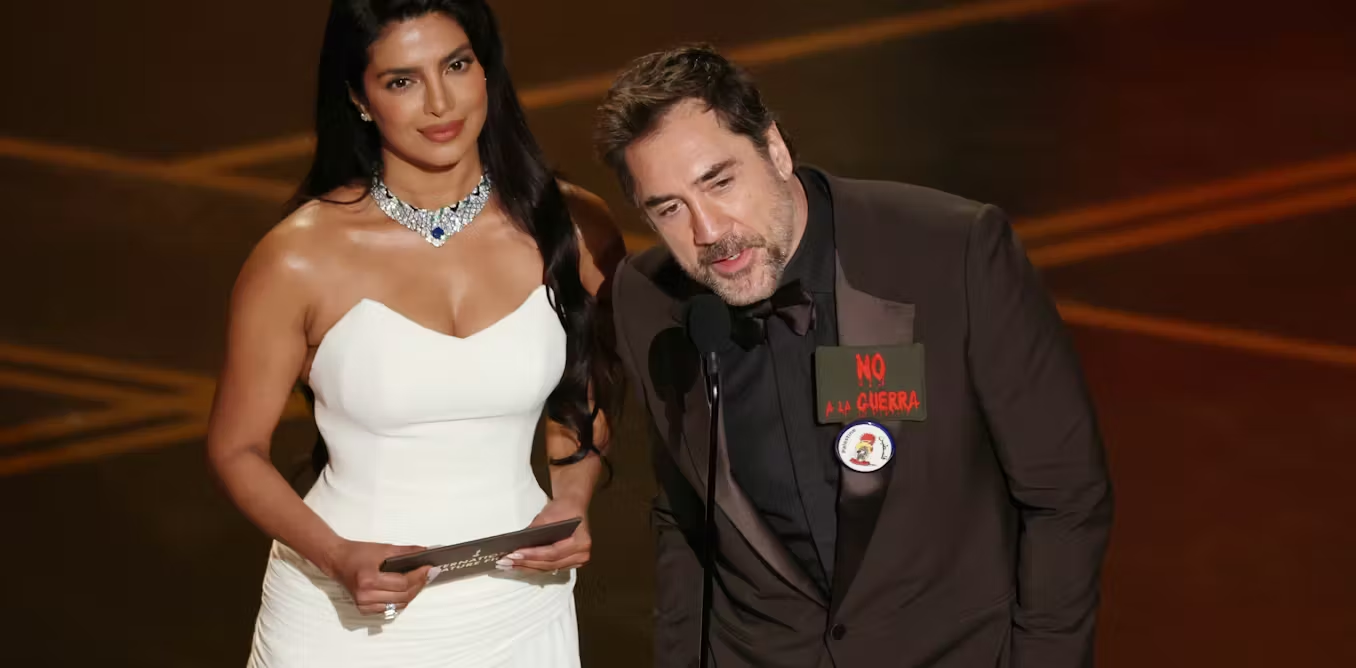
The only political voice that was pointedly raised in the Oscars this year belonged to Spanish actor Javier Bardem.
Bardem appeared on stage to present the best international picture award sporting a lapel that said: “No a la Guerra” – no to war. He had worn the same lapel over 20 years ago when the Spanish Film Academy Awards in 2003 became a loud and clear indictment to Spain’s involvement in the Iraq war.
Advertisement
Bardem left a clear message as he introduced the award: “No to war and Free Palestine.” While films such as this year’s extraordinary intake can and do speak for themselves, the gravity of the moment requires that those who make them join with their own voices.
Bardem’s dissonant appeal reveals where Hollywood’s politics currently lie. They are caught between making committed films and a fear of what the country’s politics will bring.
The White House’s political director recently encouraged party lawmakers during a retreat at the Republican president’s golf club in Florida to focus on immigration enforcement against criminals, a pivot from the mass deportation agenda he ran on. House Speaker Mike Johnson said the aggressive operations have created a “hiccup” for the party, which is now embarking on a “course correction.”
Yet all indications are that Trump’s mass deportation operation is not stalling out but intensifying, with billions of dollars being spent to hire Immigration and Customs Enforcement officers, build warehouse detention sites and meet the administration’s goal of rounding up and removing some 1 million immigrants from the U.S. this year.
“We are at an interesting moment where it has been an inflection point — the public has finally seen what mass detention and mass deportation mean,” said Sarah Mehta, who tracks the issue at the American Civil Liberties Union.
Advertisement
“This is not an agency that’s slowing down,” she said. “They’re really going forward with some of the cruelest policies.”
White House spokeswoman Abigail Jackson said the president’s policies have sent immigrants out of the U.S., either through forced deportations or on their own, and sealed up the U.S.-Mexico border.
“Nobody is changing the administration’s immigration enforcement agenda,” she said.
Senators ready to grill Trump’s DHS nominee over deportations
At the same time, those who believe Trump won the White House with his mass deportation agenda are disappointed the administration did not achieve its goals last year and insist he must do better.
“There has been a lot of talk in Congress and now in the White House about kind of backing away from President Trump’s, candidate Trump’s, mass deportation promise,” said Rosemary Jenks, co-founder of the Immigration Accountability Project, which argues for deportations.
“We believe that now is an opportunity,” she said. “We’ve got to get the deportation numbers up.”
Advertisement
A nation of immigrants no longer?
The debate is playing out as the United States, celebrating its 250th year, squares its founding as a nation of immigrants with images of masked federal agents breaking car windows and detaining people suspected of being in the U.S. without proper legal standing.
The Congress, controlled by Republicans, provided some $170 billion in last year’s tax cuts bill to fuel the effort, more than tripling the budget of ICE.
GOP Sen. Eric Schmitt of Missouri, in a fiery speech, fought back against the Democrats’ proposed restraints. “This question about deporting illegal immigrants was on the ballot. President Trump was not bashful,” he said. “And the American people supported the idea that we are going to deport people.”
Yet there are signs of cracks in the Trump coalition. Some Republicans prefer what one called a more humane approach and are sharing their views with Mullin.
Advertisement
Sen. Ron Johnson, R-Wis., considered a stalwart against illegal immigration, said in his state it’s immigrants who milk most of the dairy cows, and he’s heard from restaurant groups that rely on immigrants to fill jobs.
“Can we just turn back the clock and have these all these people who came in here illegally, just be back home?” he asked.
“In terms of actually implementing that, it’s a lot tougher — particularly, in fact, when you realize a lot of these people, most of them, came here to seek opportunity, wanting freedom,” he said. “They’re working, supporting their family, contributing to organizations and community.”
Mass deportation group wants more
The Mass Deportation Coalition, a group of conservative organizations including the Heritage Foundation and Erik Prince, founder of the security firm Blackwater, was formed recently to keep the administration on track.
Advertisement
It calls last year’s focus on removing violent criminal immigrants “phase one” and says “phase two” should focus this year on deporting immigrants beyond those with violent criminal histories.
Mark Morgan, who served as acting head of ICE and Customs and Border Protection during Trump’s first term and is part of the coalition, said that doesn’t mean roving patrols through Home Depot parking lots. It’s about strategic enforcement focused on immigrants at worksites, those who have overstayed visas and who a judge has already ordered removed, he said.
But they’re facing opposition from within the Republican Party, Morgan said, particularly from those who want to narrow deportation to mainly criminals and from business groups that want to ease up on worksite enforcement.
“The Republicans that are saying that their definition of targeted enforcement is only criminal, they’re wrong. They’re on the wrong side of this,” he said.
Advertisement
“That’s why you see some of the base that’s really becoming apoplectic because they’re like, ‘Wait a minute. You’re talking about only removing criminals now?’ That’s not what you promised,’” Morgan said.
What’s coming next
The deportation advocates as well as those working to protect the rights of immigrants see that the Trump administration’s best chance at reaching its goals is creating an environment so unwelcoming for immigrants that they just leave — what’s often called self-deportation.
Mehta, at the ACLU, expects the administration will step up efforts to end temporary permissions that allow immigrants to remain in the U.S. — particularly refugees and asylum-seekers — while their cases are making their way through the system. She called it a “deliberate attempt to make people undocumented — to take away lawful status — and then to be able to enforce against them.”
Sen. Alex Padilla, D-Calif., said he fears more nonviolent immigrants will be rounded up to fill the new warehouses being equipped as the Trump administration tries to reach its deportation goals.
Advertisement
That’s unacceptable, he said, and among “the key questions that Senator Mullin will have to answer at his confirmation hearing.”
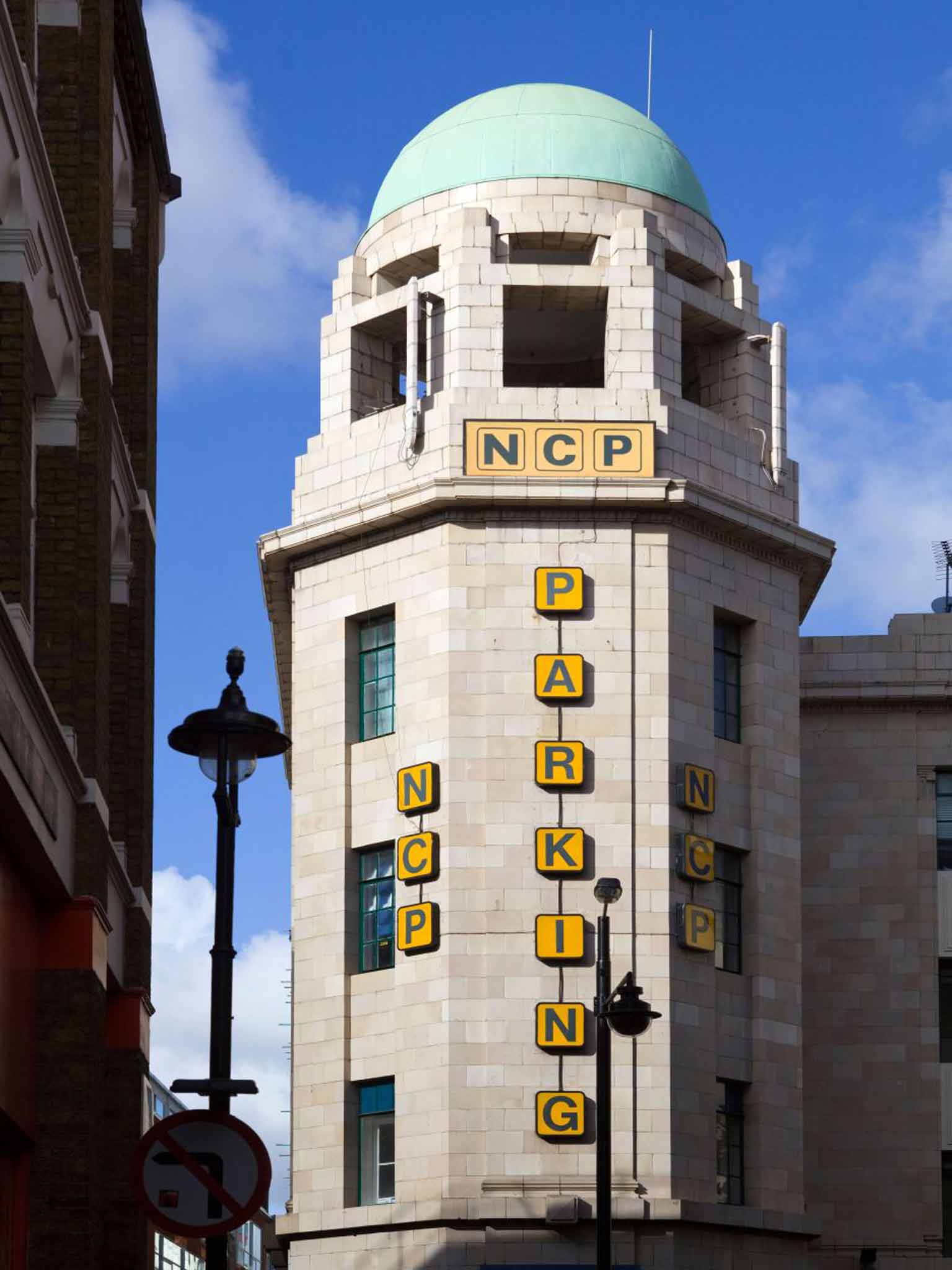
The company, which manages approximately 340 sites nationwide, has struggled with declining occupancy and mounting losses since the Covid-19 pandemic.
PwC has been appointed as administrator for the business.
Despite the move, all NCP car parks will continue to operate as normal, and staff will remain employed while administrators assess the company’s options.
Advertisement
The firm’s financial difficulties stem from a significant post-pandemic drop in demand for parking, which has failed to rebound to pre-Covid levels.
This downturn has been particularly acute in city centre and commuter locations, attributed to shifts in commuting and consumer driving patterns, which have affected car park occupancy.
NCP also cited challenges posed by the high costs associated with long-term inflexible leases on sites that have become unprofitable.
Advertisement
NCP, which is one of the UK’s biggest operators with around 340 car parks nationwide, appointed administrators at PwC (PA)
Some or all of NCP may be put up for sale as one of the options to secure its future.
Administrators said NCP will be assessing the viability of each location, and some sites may need to be closed as a result.
Zelf Hussain, joint administrator and partner for PwC, said: “NCP has faced a challenging trading environment over several years, with changing consumer behaviours impacting volumes, and a high fixed cost base leading to trading losses.
“Our priority on appointment is to ensure continuity of service while we undertake a detailed review of the business.
Advertisement
“All sites are open, staff remain in post, and trading continues as normal.
“We will be engaging with landlords, employees and other stakeholders as we explore all options, including the potential sale of all or part of the business, to secure the best possible outcome for creditors.”
NCP also cited challenges posed by the high costs associated with long-term inflexible leases on sites that have become unprofitable (Getty/iStock)
NCP was founded in London in 1931 and is owned by the Japanese firm Park24.
Advertisement
It operates about 340 car parks across the UK, including in major towns and city centres, airports, hospitals and train stations.
Prices differ at each site, but some central London locations can cost up to £60 for 24 hours of parking.
Latest accounts filed at Companies House show that it made a pre-tax loss of £28.2m in the year to 30 September 2023 and was £22.5m in the red the previous year.
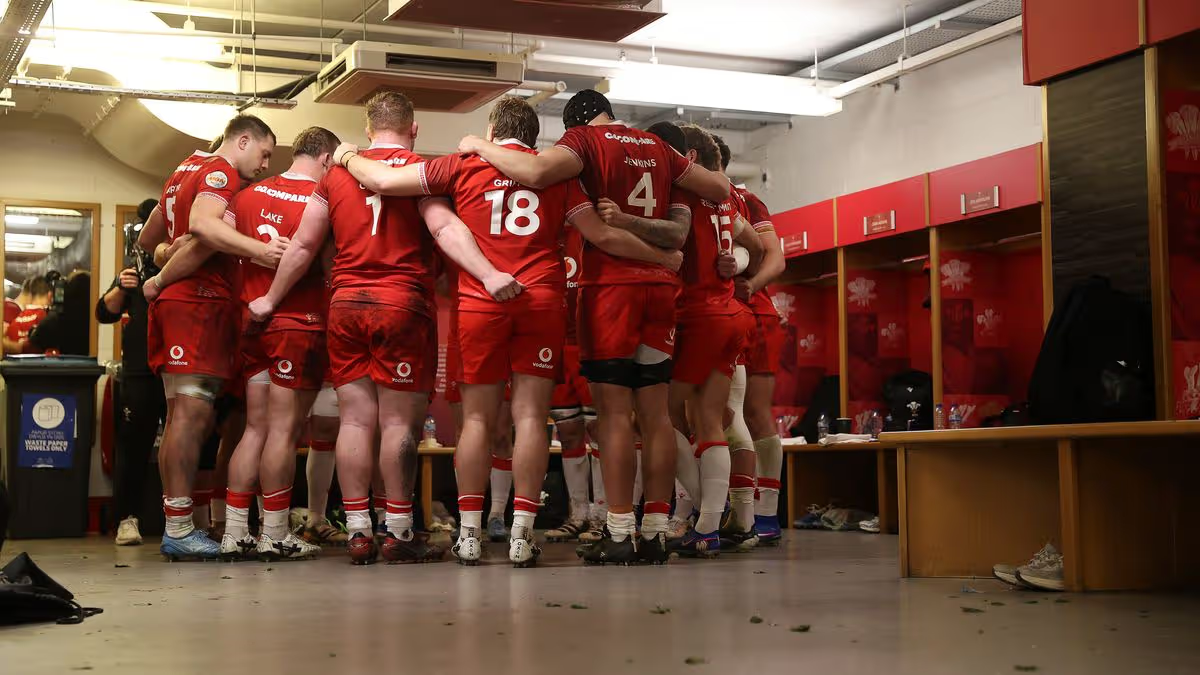
Wales and Lions legend Graham Price gives his thoughts on the result and performance against Italy
17:48, 16 Mar 2026
Advertisement
This was a game that Wales needed to win in order to maintain our level of progress. The response to all the recent adversities mattered most.
Over the past few seasons, Welsh rugby has been through much turbulence because of coaching changes, young players being blooded earlier than expected, and a squad learning how to carry the weight of the red jersey again.
Against Italy, what we saw was a side beginning to understand exactly what that responsibility means.
Italy arrived with genuine confidence. Anyone who has watched them progress over the past couple of championships knows they are no longer the easy fixture they once were. Their attacking structure is sharp, their backs play with ambition and their forwards no longer take a backward step.
Advertisement
For significant periods of this match, they asked serious questions of Wales.
But the difference, and it was a crucial one, lay in how Wales answered those questions. We have had a reputation for being slow starters, even during the times of our greatest success, but the Welsh pack set the tone early. There was a clear intent at the breakdown, where the contest was aggressive throughout. Wales targeted the Italian ball carriers, slowing possession and forcing the visitors to play from less comfortable positions.
It was not always pretty, but international rugby quite often isn’t when the stakes are high.
Advertisement
The scrum in particular offered encouragement. In recent years it has frequently been an area of concern, but on Saturday it provided the platform Wales needed. Stability up front allowed the half-backs to manage territory and apply pressure in the right areas of the field.
And pressure, as every forward knows, eventually produces mistakes.
What pleased Welsh supporters most was the composure when opportunities appeared. Too often in the past Wales have built pressure only to squander it through impatience or indiscipline.
The attack was not over ambitious, but it was effective. Direct carrying through the midfield created space wider out, and when the moment came Wales were ready to strike.
Advertisement
Yet there was also a sense throughout that Wales had another gear if they needed it.
Again, defensively, the organisation was impressive.
One of the most encouraging aspects from a Welsh viewpoint was the contribution of the younger players. Welsh rugby has spent the last couple of years talking about transition, about building the next generation of internationals. Ellis Mee, Ben Carter, Eddie James, Dan Edwards and Alex Mann man have now arrived. Matches like this show why that process matters.
Advertisement
You could see the hunger in the way they chased kicks, fought for turnovers and carried into contact. International rugby is a brutal examination, and these players have had to learn what it demands quickly.
Of course, there are still areas Wales will want to sharpen up. We had difficulties in the lineout and there were phases where our attack became a little predictable. Against stronger opposition those details can become costly.
The key difference was composure. When chances appeared in the opposition 22, Wales were clinical enough to convert pressure into points.
That ability and the calmness to finish opportunities under pressure often separates winning teams from nearly teams.
Advertisement
But progress in Test rugby is rarely perfect.
What matters is the direction of travel. On this evidence Wales are moving in the right way. That is what we have achieved in this year’s tournament.
Get the latest Wales Rugby merch at Kitbag
This article contains affiliate links, we will receive a commission on any sales we generate from it. Learn more
The Six Nations is running from February 5 to March 14 and Wales Rugby fans can get the latest jerseys, hoodies and more at Kitbag.
Momentum in rugby is a funny thing, sometimes it begins with a single tackle or carry and suddenly the whole perspective of the match can change.
I believe that moment came when Aaron Wainwright scored his first try, or rather the manner in which he scored it so soon after the kick off. No one was going to stop him.
But, perhaps the most telling moment came late in the game when Italy mounted one final surge. The Welsh defence was stretched and momentum briefly swung towards the visitors.
Advertisement
In years gone by that might have been the point where doubts crept in and we started to lose our composure and discipline.
Instead, Wales held firm. The tackles were made, the ball was turned over, and the pressure released with a clearing kick that brought a roar from the stands that brought the house down.
It was the reaction that resulted from the appreciation of a team rediscovering its resilience.
Advertisement
Anyone who has experienced a full Principality Stadium during the Six Nations knows it becomes more than just a venue. It’s more like a force of nature.
When Wales began to string phases together and push Italy back, the noise lifted the team to another level.
This performance did not solve every challenge facing Welsh rugby. What this match demonstrated, however, is that the core values of the game in Wales – commitment, pride in wearing the national jersey, and a determination not to yield under pressure – remain intact.
Those are values that have long been associated with Welsh rugby, and it has often been highlighted how crucial they are to the national identity of the game.
Advertisement
Rugby in Wales has always been about more than results. It is about identity, the belief that when players pull on the red jersey they represent communities, history and expectation in equal measure.
In the long run, that foundation is what victories are built upon.
Welsh rugby has faced a period of uncertainty in recent years, and every performance has been judged against that backdrop.
Of course, there’s still work to be done. The attack, the set pieces and discipline will always be talking points. Against stronger sides later in the year, Wales will need to show even more progress.
Advertisement
But rugby seasons are rarely about perfection. They’re about building momentum, learning lessons and finding belief.
This victory over Italy felt like a step in that direction.
For Wales, the important thing wasn’t simply that they won it was how they grew into the contest, handled adversity and showed the kind of grit that supporters expect.
If that spirit continues through the rest of the year, Welsh fans might allow themselves a little optimism.
Advertisement
And in Welsh rugby, optimism can be a powerful thing indeed.
With Chelsea enjoying so much success after signing star players through secret payments, did they get off lightly?
If the club had not been so co-operative they faced a much tougher financial penalty and potentially a points deduction.
The starting point was the aggravating factors – length of time of the wrongdoing, the size of payments, that they were made with the knowledge of senior figures and the seriousness of the breaches.
The Premier League Board concluded Chelsea should be fined of £20m with a transfer ban for two complete and consecutive windows.
Advertisement
But there were mitigating factors to take into account.
BlueCo, which bought Chelsea out of Abramovich’s ownership, self-reported the breaches once it had looked through the club’s books.
Added to that, BlueCo made voluntary disclosures and showed “exceptional co-operation”.
This saw the fine halved to £10m and the two-window transfer ban suspended.
Advertisement
The suspension will be activated if they commit a similar breach in the next two years.
The Board also reserved the right to be able to trigger the suspension at any time in the future if the club makes intentionally untrue declarations.
Chelsea were, however, ordered to pay an unpaid transfer levy of £771,288 in connection to Willian and Eto’o. They were banned from signing academy players for nine months, too.
Importantly, there was no breach of profit and sustainability rules.
Advertisement
When the payments were added to Chelsea‘s accounts they were not in excess of the £105m, three-season spending limit.
If they had been then the prospect of a points deduction would have been real.





















































You must be logged in to post a comment Login