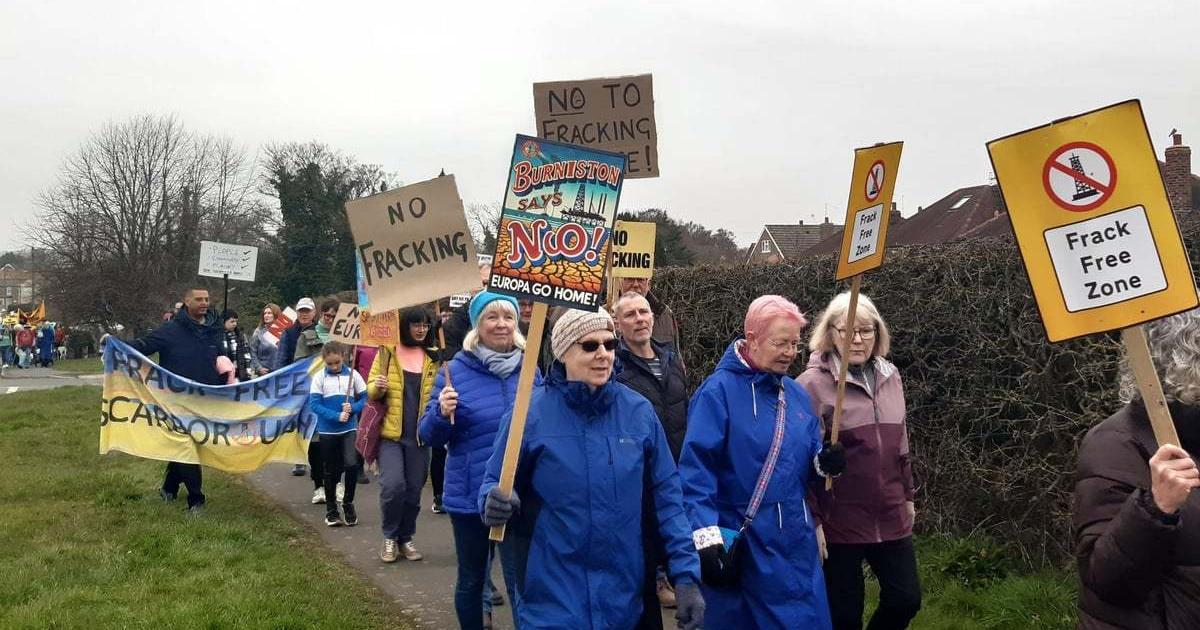
The local authority is expected to decide on an application for a project in Burniston, near Scarborough, involving a process known as “proppant squeeze” – a smaller-scale type of fracking which is not covered by the current moratorium.
Friends of the Earth warned on Thursday (April 9) that other communities could face similar developments nearby unless the government takes action to include proppant squeeze in the ban.
The government said it will “ban fracking for good and make Britain a clean energy superpower to protect current and future generations”.
Fracking, or hydraulic fracturing, is a method of extracting oil and gas from shale rock by pumping liquids deep underground at high pressures to release the gas trapped inside.
The government ended its support for the practice in 2019 after an Oil and Gas Authority report found it was not possible to accurately predict the probability of tremors associated with the activities.
However, proppant squeeze is still allowed because it uses lower volumes of fluid and sand.
In October, energy secretary Ed Miliband vowed to permanently ban fracking, warning the drilling was “dangerous and deeply harmful to our natural environment”.
Friends of the Earth said its concerns are growing that this pledge will not ultimately live up to local communities’ expectations if the low-volume fracking technique can continue.
While the Labour government ended new licences for onshore oil and gas, areas in the north, midlands and south east of England are already licensed for exploration and production, it warned.
The group also cited comments made by energy minister Michael Shanks, who told a Westminster Hall debate in December that the evidence base “is not there at the moment to suggest that low-volume hydraulic fracturing activities have the same associated risks as fracking for shale gas”.
In a report written for the campaign group, leading geologist Stuart Haszeldine, of the University of Edinburgh, outlined evidence that low-volume fracking activities at Preese Hall and Preston New Road in Lancashire in 2019 triggered earthquakes that were felt by nearby residents.
Prof Haszeldine wrote this demonstrated how earthquakes from both large volume and small volume fracking are “equally large and equally unpredictable”.
“Regulatory permission for low-volume fracking does not remove the risk of unpredictable earthquakes,” he added.
Ahead of North Yorkshire Council’s decision, Friends of the Earth said the volumes of fluid proposed for use at Burniston are higher than those used in the week leading up to the highest recorded earthquake at the Preston New Road site in 2019.
Tony Bosworth, a climate campaigner for the group, said: “The government has rightly committed to banning fracking.
“It has triggered earthquakes, blights our countryside, won’t cut UK energy bills, is deeply unpopular with communities and fuels the climate crisis.
“Ministers must reassure communities by banning all forms of fracking – failure to act will undermine Labour’s credibility.”
Recommended reading:
Mr Bosworth said planning authorities should also hold off on deciding fracking applications until the government’s position becomes clear.
Prof Haszeldine said: “Developers are probing to find exemptions from current rules.
“That means locations with sandstone or limestone reservoirs could be drilled and fractured with water and proppant to aid the production of onshore oil and gas, whilst earthquakes could be triggered or felt 15km away.
“The rules need to be more tightly written to safeguard residents against poorly understood effects, not simply hoping that developers get good outcomes.”
North Yorkshire Council will consider the application and its proposals when it meets on April 24 at Scarborough Town Hall.
Cllr Heather Phillips, the council’s executive member for corporate services, said: “We know that this is a planning application that has attracted significant public interest, with more than 1,500 representations made about the proposals.
“As is the case with all planning applications, members of the committee will carefully consider all representations prior to any decision being made.”
A government spokesperson said: “This is a decision for the local authority.
“We will ban fracking for good and make Britain a clean energy superpower to protect current and future generations.”

















































You must be logged in to post a comment Login