Connect with us
DAPA Banner

Tech

Game development diary: TestFlight, trial by fire, and a trophy

Published

on

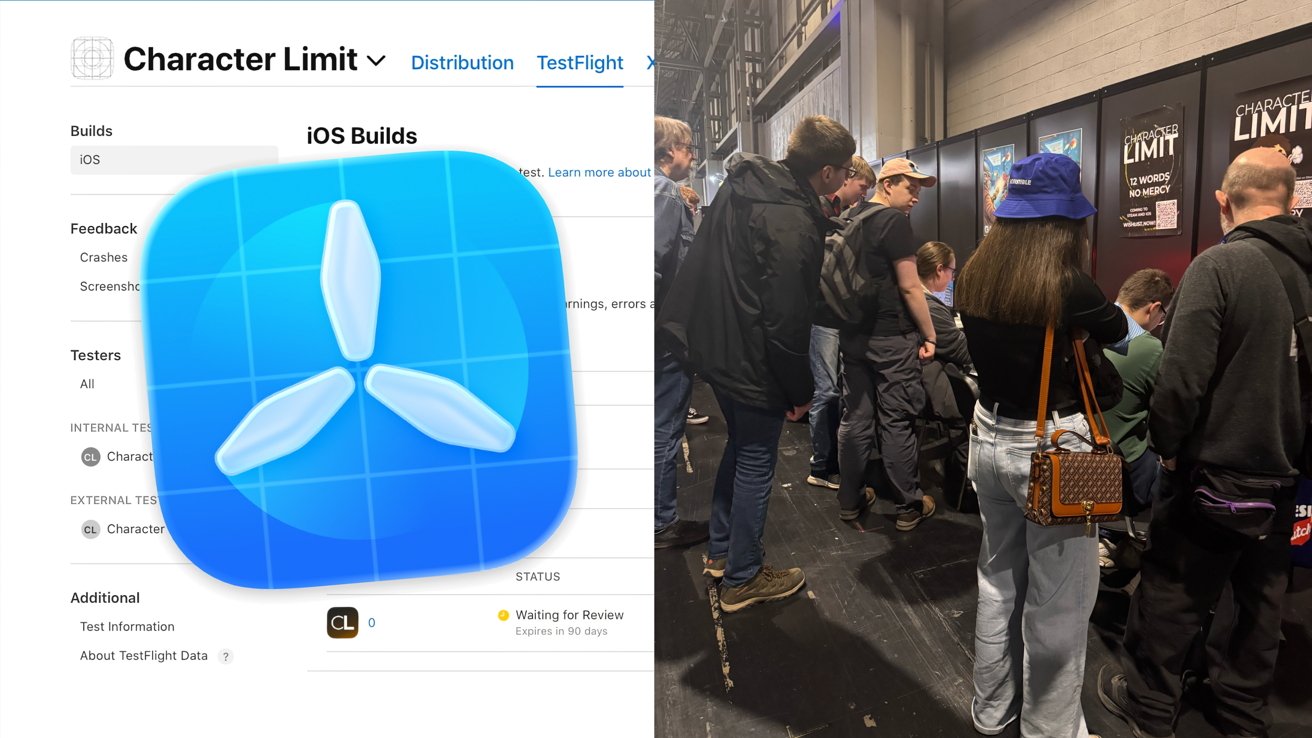
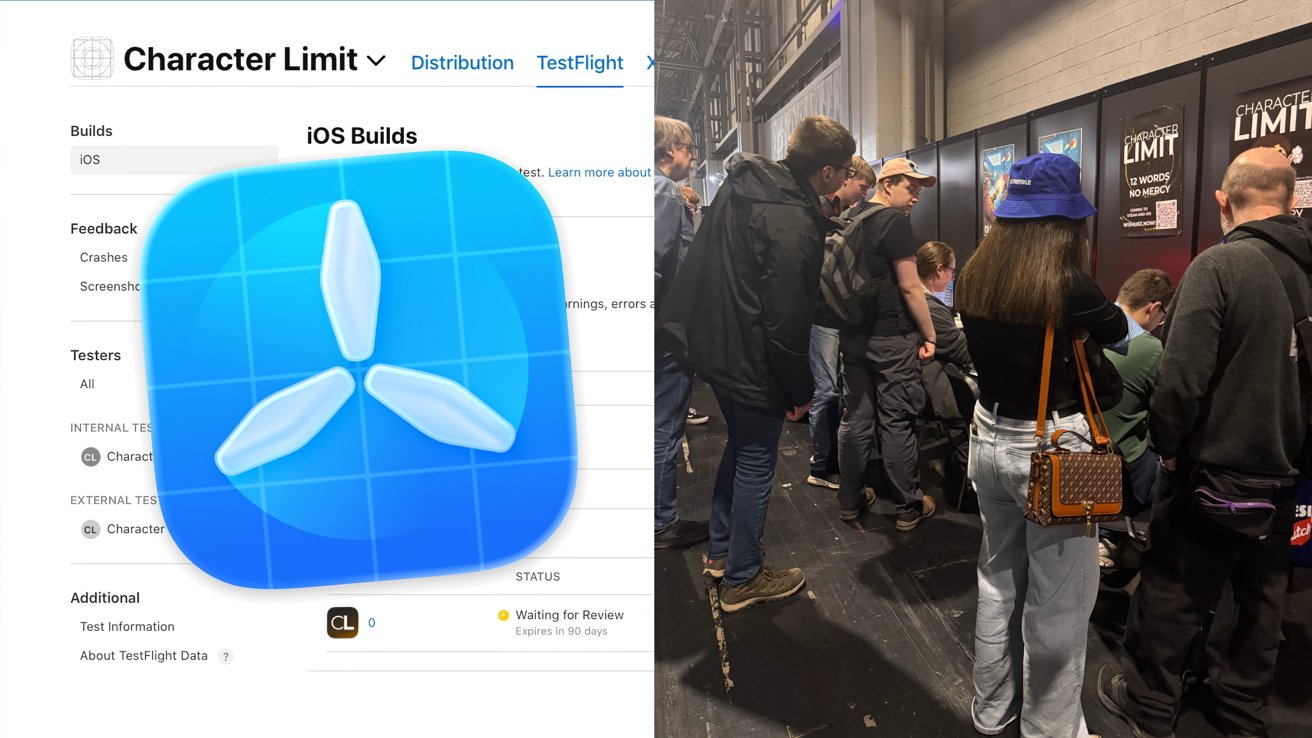
The in-development word game “Character Limit” faced testers in the last two months, but as TestFlight got underway, an unexpected game convention opportunity went especially well.

Split view showing TestFlight app dashboard with large blue TestFlight icon on the left, and a crowd at an event booth titled Character Limit on the right
A tale of two tests: TestFlight and a gaming convention.

Back in early February, Character Limit had reached a good stopping point to get some testing done with real players. A lot of the work had been done, so now it was time to get some bug fixing and polishing done, and to get some real feedback.
This previously came in the form of visits to meet other game developers in Cardiff for brief sessions. But you can only go so far in terms of feedback from a kind audience.
Continue Reading on AppleInsider | Discuss on our Forums

Source link

Continue Reading
Click to comment

You must be logged in to post a comment Login

Leave a Reply

Tech

5 Tech Items You Shouldn’t Try To Donate To Thrift Stores

Published

on


We may receive a commission on purchases made from links.

You might feel like offloading electronics at a thrift store is an easy way to get rid of them while also letting others enjoy their use. To be fair, there are always some cool gadgets and electronics to look out for as a buyer, but there are some tech items that you shouldn’t even try donating to thrift stores. Because of different policies and simple safety concerns, certain pieces of tech will be rejected by thrift stores before they even leave your hands.

A great number of thrift stores have a list of items that they’ll accept or deny. These lists aren’t always uniform across different outlets, but a few pieces of tech are more likely to be refused than not. The ones that get turned down tend to be old or volatile for one reason or another, and stores obviously wouldn’t want to sell things that are broken or even dangerous. In some cases, there might also be items that you just shouldn’t want to give them anyway. Here are five different types of items that just aren’t worth trying to donate to thrift stores.

Advertisement

Printers and fax machines

Fax machines are generally seen as old tech devices that the latest generation will never learn to use, and they aren’t exactly small when compared to other types of electronics like phones or even laptops. Printers are a bit more universal, but again their size still makes them difficult for many thrift stores to accept. Generally, small electronics have a much better chance at being taken off your hands. It’s less a matter of function and more a matter of size and space.

Some thrift stores won’t have this issue for printers, but you might still run into issues depending on the type of printer you give them. In the past, many donators have found difficulty offloading printers that use proprietary cartridges for ink and toner. These are expensive, manufacturer-specific, and sometimes aren’t even made anymore. Even if these older printers are cheap, with so many restrictions on what allows them to work in the first place, many thrift stores simply don’t find it worthwhile to stock them at all.

Advertisement

Batteries, or items with batteries

It shouldn’t be too surprising to hear that thrift stores aren’t very willing to accept loose batteries. You should already be aware of their safety risks, especially if you’ve already experienced batteries leaking from improper storage and use. Besides, considering the specific tasks and devices they’re meant for, you probably don’t have much reason to donate AA or AAA batteries instead of throwing them away. And once they’re used up, you should be recycling them properly, not giving them away.

As you might expect, this rule can apply to more than just the batteries themselves. Car batteries and devices with batteries built-in can pose very similar risks. You might get away with being able to donate the latter, but rechargeable batteries integrated into small electronics such as smartphones can end up getting swollen over time. This is a sign that it’s just about ready to catch fire, and it should go without saying that no thrift store will be happy about that.

Advertisement

Older tech, including CRTs

You might think that a thrift store would happily accept an older television set. They’ve been making a comeback in recent years, and they don’t seem very harmful on the surface. But older CRT televisions are pretty much universally denied by these locations. Some shoppers have found thrift stores carrying CRTs in certain areas, but you might have a tough time getting your local location to accept one.

Once again, the problem here is safety above all else. Goodwill in Southern Alleghenies mentions how it had to stop accepting CRTs because they “contain five to eight pounds of lead.” In this case, there’s also a high cost for the store to offload them in the first place; it’s forced to pay fees and find landfills that will actually take the items. Few places have the freedom or motivation to deal with these issues, and fewer still will want to take the safety risks involved in keeping these stocked.

Advertisement

Computer monitors and other screens

The aforementioned Goodwill location refuses to take flat-screen TVs for similar reasons as CRTs: hazardous materials and risks to safety. But the rules aren’t universal for every location, even when it comes to different Goodwill stores. And this goes for other screens and displays, too, such as computer monitors. It’s really up in the air whether you’ll be able to find a thrift store near you that’ll accept them.

LCD monitors might be an example of tech that’s still worth buying used, but they can still face notable quality issues such as dead pixels. OLED monitors also have the risk of burn-in, which further creates problems with how attractive they are to buyers. Thrift stores aren’t likely to accept broken or damaged electronics, and depending on their definition, monitors with those problems could be quickly denied by them. At that point, it’s a much better decision to take those screens to a recycling center, not a thrift store.

Advertisement

Unwiped storage devices

Donators have faced difficulties in giving their digital storage devices to certain thrift stores, though some locations will still accept them without a major issue. The problem here is on your end, as you can’t be sure that these stores will reliably wipe these drives on their own. If you simply give away your older storage devices carelessly, whoever ends up buying it might end up picking through your personal information. Even a full deletion might not guarantee your safety unless you use special programs or physically destroy the old drive entirely — to the point where there’s no chance a thrift store will accept it.

Advertisement

On top of hard drives, USB flash sticks, and solid state drives themselves, you should be aware of any device that might have storage built-in. This applies most to computers and laptops, obviously, but smart TVs and game consoles can be problematic to donate if you still have them signed into your accounts. Many of the electronics thrift stores refuse are a risk to their safety, but make sure the items they accept aren’t a risk to your own.


Advertisement

Source link

Continue Reading

Tech

NVIDIA’s DLSS 5 Demo Video Briefly Taken Down Because YouTube’s Take Down Process Sucks

Published

on

from the the-italian-job dept

Last month, we discussed NVIDIA’s demo video for its forthcoming DLSS 5 technology and the controversy surrounding it. While I’m going to continue to be of the posture that an injection of nuance is desperately needed in the reaction to AI tools and the like, our comments section largely disagreed with me on that post. That’s cool, that’s what this place is for, and I still love you all.

But this post is not about DLSS 5. Rather, it’s about the video itself and how it was briefly taken down over automated copyright claims thanks to an Italian news channel. Please note that the source material here was written while the video was still down, but it has since been restored.

And now, here we are in April, and NVIDIA’s DLSS 5 announcement trailer is no longer available to watch on YouTube on the company’s official GeForce channel. And no, it’s not because NVIDIA is responding to the feedback and retooling the technology for a re-reveal or re-announcement; it’s now blocked on “copyright grounds.”

A clear mistake, but also one that highlights the limitations of Google’s automated system for YouTube. Apparently, the Italian television channel La7 included footage from the DLSS 5 reveal in a recent broadcast and has since copyrighted it. From there, essentially every video on YouTube with DLSS 5 trailer footage was issued a copyright strike and said to be in violation, with the videos taken down with the following message: “Video unavailable: This video contains content from La7, who has blocked it in your country on copyright grounds.”

Yes, this was clearly a mistake. But it’s a mistake that I’m frankly tired of hearing about, all while Google does absolutely nothing to iterate on its copyright process and systems to mitigate such mistakes. The examples of this very thing are so legion as to be laughable. Whether due to error or due to malicious intent, videos that include content from other videos for the purposes of reporting and commentary, which are then copyrighted and result in takedowns of the source material, happens all the damned time.

Advertisement

This is almost certainly all automated, which means there are no human eyes looking for an error in the flagging of a copyright violation. It just gets tagged as such and taken down. And, no, the irony is not lost on me that we need human eyes to keep an automated copyright takedown on a video about AI from occurring.

What makes this alarming is that the video was taken down with seemingly no human interaction or input, as it’s clear that NVIDIA not only created DLSS 5, for better or worse, but also the trailer that has been a hot topic of discussion this year. We’re assuming this will be resolved fairly quickly. Still, it will be interesting to see whether YouTube responds to this case and claims that false copyright infringement notices like this are prevalent on the platform.

Google hasn’t been terribly interested in commenting on the plethora of cases like this in the past, so I strongly doubt it will now. Which is a damned shame, honestly, because the company really should be advocating for all of the users on its platform, if not especially those that are negatively impacted by this haphazard process.

But, for now, the video is back, so you can go hate-watch it again if you like.

Filed Under: copyright, dlss 5, geforce, takedowns, video games

Companies: la7, nvidia, youtube

Advertisement

Source link

Continue Reading

Tech

Florida launches probe into OpenAI as company eyes massive IPO

Published

on


In a video posted to X, he said his office is examining whether OpenAI’s data and artificial intelligence systems “could fall into the hands of America’s enemies, such as the Chinese Communist Party.”
Read Entire Article
Source link

Continue Reading

Tech

ChatGPT rolls out new $100 Pro subscription to challenge Claude

Published

on

Claude

OpenAI has rolled out a new Pro subscription that costs $100 and is in line with Claude’s pricing, which also has a $100 subscription, in addition to the $200 Max monthly plan.

Until now, OpenAI has offered three subscription tiers.

First is Go, which costs approx $8, second is Plus for $20, and then the final tier is at $200, a jump of $180.

Wiz

On the other hand, Anthropic does not offer an $8 subscription, but it has a $100 subscription that comes between the cheapest $20 and the expensive $200 subscription, and it works for the company because it caters to the coding audience.

OpenAI has realized that it needs to go after coders and enterprises, similar to Anthropic’s strategy.

Advertisement

The company’s answer is ChatGPT Pro, which is designed for people who rely on AI to get high-stakes, complex work done for $100.

After this change, OpenAI’s offering looks like the following:

  • Plus $20 – For lighter use. Try advanced capabilities like Codex and Deep Research for select projects throughout the week.
  • Pro $100 – Built for real projects. For those who use advanced tools and models throughout the week, with 5x higher limits than Plus (and 10x Codex usage vs. Plus for a limited time).
  • Pro $200 – For heavy lifting. Run your most demanding workflows continuously, even across parallel projects, with 20× higher limits than Plus.

All Pro plans include access to advanced features, including:

  • Pro models
  • Codex
  • Deep research
  • Image creation
  • Memory
  • File uploads

OpenAI says the Pro plan also includes unlimited access to GPT-5 and legacy models, but it’s not truly unlimited because the typical “Terms of Use” policies apply, including sharing of accounts.

Automated pentesting proves the path exists. BAS proves whether your controls stop it. Most teams run one without the other.

This whitepaper maps six validation surfaces, shows where coverage ends, and provides practitioners with three diagnostic questions for any tool evaluation.

Source link

Advertisement
Continue Reading

Tech

Mythos autonomously exploited vulnerabilities that survived 27 years of human review. Security teams need a new detection playbook

Published

on

A 27-year-old bug sat inside OpenBSD’s TCP stack while auditors reviewed the code, fuzzers ran against it, and the operating system earned its reputation as one of the most security-hardened platforms on earth. Two packets could crash any server running it. Finding that bug cost a single Anthropic discovery campaign approximately $20,000. The specific model run that surfaced the flaw cost under $50.

Anthropic’s Claude Mythos Preview found it. Autonomously. No human guided the discovery after the initial prompt.

The capability jump is not incremental

On Firefox 147 exploit writing, Mythos succeeded 181 times versus 2 for Claude Opus 4.6. A 90x improvement in a single generation. SWE-bench Pro: 77.8% versus 53.4%. CyberGym vulnerability reproduction: 83.1% versus 66.6%. Mythos saturated Anthropic’s Cybench CTF at 100%, forcing the red team to shift to real-world zero-day discovery as the only meaningful evaluation left. Then it surfaced thousands of zero-day vulnerabilities across every major operating system and every major browser, many one to two decades old. Anthropic engineers with no formal security training asked Mythos to find remote code execution vulnerabilities overnight and woke up to a complete, working exploit by morning, according to Anthropic’s red team assessment.

Anthropic assembled Project Glasswing, a 12-partner defensive coalition including CrowdStrike, Cisco, Palo Alto Networks, Microsoft, AWS, Apple, and the Linux Foundation, backed by $100 million in usage credits and $4 million in open-source grants. Over 40 additional organizations that build or maintain critical software infrastructure also received access. The partners have been running Mythos against their own infrastructure for weeks. Anthropic committed to a public findings report “within 90 days,” landing in early July 2026.

Advertisement

Security directors got the announcement. They didn’t get the playbook.

“I’ve been in this industry for 27 years,” Cisco SVP and Chief Security and Trust Officer Anthony Grieco told VentureBeat in an exclusive interview at RSAC 2026. “I have never been more optimistic for what we can do to change security because of the velocity. It’s also a little bit terrifying because we’re moving so quickly. It’s also terrifying because our adversaries have this capability as well, and so frankly, we must move this quickly.”

Security directors saw this story told fifteen different ways this week, including VentureBeat’s exclusive interview with Anthropic’s Newton Cheng. As one widely shared X post summarizing the Mythos findings noted, the model cracked cryptography libraries, broke into a production virtual machine monitor, and gave engineers with zero security training working exploits by morning. What that coverage left unanswered: Where does the detection ceiling sit in the methods they already run, and what should they change before July?

Seven vulnerability classes that show where every detection method hits its ceiling

  1. OpenBSD TCP SACK, 27 years old. Two crafted packets crash any server. SAST, fuzzers, and auditors missed a logic flaw requiring semantic reasoning about how TCP options interact under adversarial conditions. Campaign cost ~$20,000. Anthropic notes the $50 per-run figure reflects hindsight.

  2. FFmpeg H.264 codec, 16 years old. Fuzzers exercised the vulnerable code path 5 million times without triggering the flaw, according to Anthropic. Mythos caught it by reasoning about code semantics. Campaign cost ~$10,000.

  3. FreeBSD NFS remote code execution, CVE-2026-4747, 17 years old. Unauthenticated root from the internet, per Anthropic’s assessment and independent reproduction. Mythos built a 20-gadget ROP chain split across multiple packets. Fully autonomous.

  4. Linux kernel local privilege escalation. Mythos chained two to four low-severity vulnerabilities into full local privilege escalation via race conditions and KASLR bypasses. CSA’s Rich Mogull noted Mythos failed at remote kernel exploitation but succeeded locally. No automated tool chains vulnerabilities today.

  5. Browser zero-days across every major browser. Thousands identified. Some required human-model collaboration. In one case, Mythos chained four vulnerabilities into a JIT heap spray, escaping both the renderer and the OS sandboxes. Firefox 147: 181 working exploits versus two for Opus 4.6.

  6. Cryptography library vulnerabilities (TLS, AES-GCM, SSH). Implementation flaws enabling certificate forgery or decryption of encrypted communications, per Anthropic’s red team blog and Help Net Security. A critical Botan library certificate bypass was disclosed the same day as the Glasswing announcement. Bugs in the code that implements the math. Not attacks on the math itself.

  7. Virtual machine monitor guest-to-host escape. Guest-to-host memory corruption in a production VMM, the technology keeping cloud workloads from seeing each other’s data. Cloud security architectures assume workload isolation holds. This finding breaks that assumption.

Nicholas Carlini, in Anthropic’s launch briefing: “I’ve found more bugs in the last couple of weeks than I found in the rest of my life combined.”

VentureBeat’s prescriptive matrix

Vulnerability Class

Advertisement

Why Current Methods Miss It

What Mythos Does

Security Director Action

OS kernel logic (OpenBSD 27yr, Linux 2-4 chain)

Advertisement

SAST lacks semantic reasoning. Fuzzers miss logic flaws. Pen testers time-boxed. Bounties scope-exclude kernel.

Chains 2-4 low-severity findings into local priv-esc. ~$20K campaign.

Add AI-assisted kernel review to pen test RFPs. Expand bounty scope. Request Glasswing findings from OS vendors before July. Re-score clustered findings by chainability.

Media codec (FFmpeg 16yr H.264)

Advertisement

SAST unflagged. Fuzzers hit path 5M times, never triggered.

Reasons about semantics beyond brute-force. ~$10K campaign.

Inventory FFmpeg, libwebp, ImageMagick, libpng. Stop treating fuzz coverage as security proxy. Track Glasswing codec CVEs from July.

Network stack RCE (FreeBSD 17yr, CVE-2026-4747)

Advertisement

DAST limited at protocol depth. Pen tests skip NFS.

Full autonomous chain to unauthenticated root. 20-gadget ROP chain.

Patch CVE-2026-4747 now. Inventory NFS/SMB/RPC services. Add protocol fuzzing to 2026 cycle.

Multi-vuln chaining (2-4 sequenced, local)

Advertisement

No tool chains. Pen testers hours-limited. CVSS scores in isolation.

Autonomous local chaining via race conditions + KASLR bypass.

Require AI-assisted chaining in pen test methodology. Build chainability scoring. Budget AI red teams for 2026.

Browser zero-days (thousands, 181 Firefox exploits)

Advertisement

Bounties + continuous fuzzing missed thousands. Some required human-model collaboration.

90x over Opus 4.6. Chained 4 vulns into JIT heap spray escaping renderer + OS sandbox.

Shorten patch SLA to 72hr critical. Pre-stage pipeline for July cycle. Pressure vendors for Glasswing timelines.

Crypto libraries (TLS, AES-GCM, SSH, Botan bypass)

Advertisement

SAST limited on crypto logic. Pen testers rarely audit crypto depth. Formal verification not standard.

Found cert forgery + decryption flaws in battle-tested libraries.

Audit all crypto library versions now. Track Glasswing crypto CVEs from July. Accelerate PQC migration.

VMM / hypervisor (guest-to-host memory corruption)

Advertisement

Cloud security assumes isolation. Few pen tests target hypervisor. Bounties rarely scope VMM.

Guest-to-host escape in production VMM.

Inventory hypervisor/VMM versions. Request Glasswing findings from cloud providers. Reassess multi-tenant isolation assumptions.

Attackers are faster. Defenders are patching once a year.

The CrowdStrike 2026 Global Threat Report documents a 29-minute average eCrime breakout time, 65% faster than 2024, with an 89% year-over-year surge in AI-augmented attacks. CrowdStrike CTO Elia Zaitsev put the operational reality plainly in an exclusive interview with VentureBeat. “Adversaries leveraging agentic AI can perform those attacks at such a great speed that a traditional human process of look at alert, triage, investigate for 15 to 20 minutes, take an action an hour, a day, a week later, it’s insufficient,” Zaitsev said. A $20,000 Mythos discovery campaign that runs in hours replaces months of nation-state research effort.

Advertisement

CrowdStrike CEO George Kurtz reinforced that timeline pressure on LinkedIn the same day as the Glasswing announcement. “AI is creating the largest security demand driver since enterprises moved to the cloud,” Kurtz wrote. The regulatory clock compounds the operational one. The EU AI Act’s next enforcement phase takes effect August 2, 2026, imposing automated audit trails, cybersecurity requirements for every high-risk AI system, incident reporting obligations, and penalties up to 3% of global revenue. Security directors face a two-wave sequence: July’s Glasswing disclosure cycle, then August’s compliance deadline.

Mike Riemer, Field CISO at Ivanti and a 25-year US Air Force veteran who works closely with federal cybersecurity agencies, told VentureBeat what he is hearing from the government. “Threat actors are reverse engineering patches, and the speed at which they’re doing it has been enhanced greatly by AI,” Riemer said. “They’re able to reverse engineer a patch within 72 hours. So if I release a patch and a customer doesn’t patch within 72 hours of that release, they’re open to exploit.” Riemer was blunt about where that leaves the industry. “They are so far in front of us as defenders,” he said.

Grieco confirmed the other side of that collision at RSAC 2026. “If you talk to an operational team and many of our customers, they’re only patching once a year,” Grieco told VentureBeat. “And frankly, even in the best of circumstances, that is not fast enough.”

CSA’s Mogull makes the structural case that defenders hold the long-term advantage: fix a vulnerability once and every deployment benefits. But the transition period, when attackers reverse-engineer patches in 72 hours and defenders patch once a year, favors offense.

Advertisement

Mythos is not the only model finding these bugs. Researchers at AISLE, an AI cybersecurity startup, tested Anthropic’s showcase vulnerabilities on small, open-weights models and found that eight out of eight detected the FreeBSD exploit. AISLE says one model had only 3.6 billion parameters and costs 11 cents per million tokens, and that a 5.1-billion-parameter open model recovered the core analysis chain of the 27-year-old OpenBSD bug. AISLE’s conclusion: “The moat in AI cybersecurity is the system, not the model.” That makes the detection ceiling a structural problem, not a Mythos-specific one. Cheap models find the same bugs. The July timeline gets shorter, not longer.

Over 99% of the vulnerabilities Mythos has identified have not yet been patched, per Anthropic’s red team blog. The public Glasswing report lands in early July 2026. It will trigger a high-volume patch cycle across operating systems, browsers, cryptography libraries, and major infrastructure software. Security directors who have not expanded their patch pipeline, re-scoped their bug bounty programs, and built chainability scoring by then will absorb that wave cold. July is not a disclosure event. It is a patch tsunami.

What to tell the board

Every security director tells the board “we have scanned everything.” Merritt Baer, CSO at Enkrypt AI and former Deputy CISO at AWS, told VentureBeat that the statement does not survive Mythos without a qualifier.

“What security leaders actually mean is: we have exhaustively scanned for what our tools know how to see,” Baer said in an exclusive interview with VentureBeat. “That’s a very different claim.”

Advertisement

Baer proposed reframing residual risk for boards around three tiers: known-knowns (vulnerability classes your stack reliably detects), known-unknowns (classes you know exist but your tools only partially cover, like stateful logic flaws and auth boundary confusion), and unknown-unknowns (vulnerabilities that emerge from composition, how safe components interact in unsafe ways). “This is where Mythos is landing,” Baer said.

The board-level statement Baer recommends: “We have high confidence in detecting discrete, known vulnerability classes. Our residual risk is concentrated in cross-function, multi-step, and compositional flaws that evade single-point scanners. We are actively investing in capabilities that raise that detection ceiling.”

On chainability, Baer was equally direct. “Chainability has to become a first-class scoring dimension,” she said. “CVSS was built to score atomic vulnerabilities. Mythos is exposing that risk is increasingly graph-shaped, not point-in-time.” Baer outlined three shifts security programs need to make: from severity scoring to exploitability pathways, from vulnerability lists to vulnerability graphs that model relationships across identity, data flow, and permissions, and from remediation SLAs to path disruption, where fixing any node that breaks the chain gets priority over fixing the highest individual CVSS.

“Mythos isn’t just finding missed bugs,” Baer said. “It’s invalidating the assumption that vulnerabilities are independent. Security programs that don’t adapt, from coverage thinking to interaction thinking, will keep reporting green dashboards while sitting on red attack paths.”

Advertisement

VentureBeat will update this story with additional operational details from Glasswing’s founding partners as interviews are completed.

Source link

Continue Reading

Tech

A Mercury Rover Could Explore The Planet By Sticking To The Terminator

Published

on

The planet Mercury in true color. (Credit: NASA)

With multiple rovers currently scurrying around on the surface of Mars to continue a decades-long legacy, it can be easy to forget sometimes that repeating this feat on other planets that aren’t Earth or Mars isn’t quite as straightforward. In the case of Earth’s twin – Venus – the surface conditions are too extreme to consider such a mission. Yet Mercury might be a plausible target for a rover, according to a study by [M. Murillo] and [P. G. Lucey], via Universe Today’s coverage.

The advantages of putting a rover’s wheels on a planet’s surface are obvious, as it allows for direct sampling of geological and other features unlike an orbiting or passing space probe. To make this work on Mercury as in some ways a slightly larger version of Earth’s moon that’s been placed right next door to the Sun is challenging to say the least.

With no atmosphere it’s exposed to some of the worst that the Sun can throw at it, but it does have a magnetic field at 1.1% of Earth’s strength to take some of the edge off ionizing radiation. This just leaves a rover to deal with still very high ionizing radiation levels and extreme temperature swings that at the equator range between −173 °C and 427 °C, with an 88 Earth day day/night cycle. This compares to the constant mean temperature on Venus of 464 °C.

To deal with these extreme conditions, the researchers propose that a rover might be able to thrive if it sticks to the terminator, being the transition between day and night. To survive, the rover would need to be able to gather enough solar power – if solar-powered – due to the Sun being very low in the sky. It would also need to keep up with the terminator velocity being at least 4.25 km/h, as being caught on either the day or night side of Mercury would mean a certain demise. This would leave little time for casual exploration as on Mars, and require a high level of autonomy akin to what is being pioneered today with the Martian rovers.

Advertisement

Top image: the planet Mercury with its magnetic field. (Credit: A loose necktie, Wikimedia)

Source link

Advertisement
Continue Reading

Tech

Artemis II Returns From Historic Flight Around the Moon

Published

on

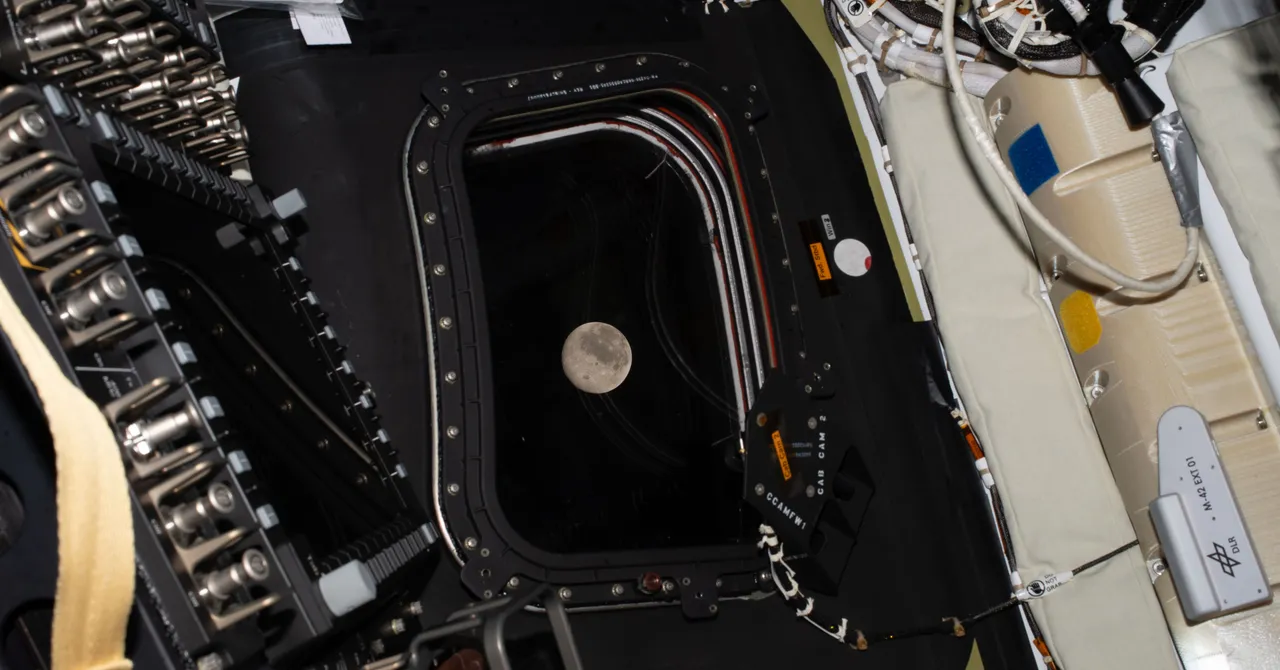
The farthest journey in human history concluded Friday evening when NASA’s Artemis II astronauts returned to Earth after a flight around the moon. The crew’s Orion space capsule named Integrity splashed down in the Pacific Ocean off the coast of San Diego shortly after 5 pm Pacific Time, marking the end of a 10-day, more than 695,000-mile voyage beyond the lunar far side and back.

The four-person crew of Artemis II—commander Reid Wiseman, pilot Victor Glover, mission specialist Christina Koch, and mission-specialist Jeremy Hansen—traveled a greater distance from Earth than ever before, reaching 252,756 miles from our home planet.

“We most importantly choose this moment to challenge this generation and the next to make sure this record is not long-lived,” said Canadian astronaut Hansen as the crew passed the previous record of 248,655 miles set during Apollo 13.

Integrity began its fiery descent when the spacecraft hit Earth’s atmosphere at about 24,000 miles per hour, entering a communication blackout and decelerating from friction as its heat shield reached temperatures of roughly 3,000 degrees Fahrenheit. The plan was for the capsule to deploy two drogue parachutes at an altitude of about 22,000 feet, slowing it to about 200 miles per hour, then deploy pilot chutes pulling the three main parachutes at roughly 6,000 feet. This would further slow the spacecraft to around 20 miles per hour before it splashed into the ocean.

Advertisement

During their mission, the Artemis II crew saw things that no human has seen before. Flying higher above the lunar surface than the Apollo missions, the astronauts were the first people to see the entire disk of the moon’s far side. They also witnessed a solar eclipse from the vicinity of the moon as the sun slipped behind the lunar disk and illuminated it from behind.

“Humans probably have not evolved to see what we are seeing,” said NASA astronaut Glover during the eclipse. He and the rest of the crew described a halo of light surrounding the moon while one side of the lunar surface was bathed in earthshine. Venus, Mars, and Saturn shone among the stars. “It is truly hard to describe. It is amazing.”

Artemis II began on April 1 when the crew launched from NASA’s Kennedy Space Center in Florida atop the 322-foot-tall Space Launch System rocket, the most powerful vehicle to ever carry humans. After conducting multiple altitude-raising engine burns and testing the manual controls of the spacecraft, the crew proceeded with the engine firing known as translunar injection on day two of the mission, which sent them on a trajectory to the moon.

For the next three days, the crew tested the Orion spacecraft’s systems, practiced putting on their spaceflight suits, conducted additional course correction burns, manually flew the Orion capsule again, and prepared for the lunar flyby around the far side of the moon. They also had trouble venting wastewater from the Orion capsule’s toilet into space.

Advertisement

“We definitely have to fix some of the plumbing,” NASA administrator Jared Isaacman said during a conversation with the crew.

At 12:41 am Eastern Time on April 6, Artemis II entered the lunar sphere of influence, where the moon’s gravity overcomes that of Earth. That day, the crew made their closest approach to the moon, flying to about 4,000 miles above the lunar surface. During the lunar flyby, the crew communicated with a team of scientists on the ground, both before and after a roughly 40-minute communication blackout on the far side, to describe geologic features such as craters and canyons.

Just after breaking the distance record, the crew proposed names for two young, unnamed craters on the moon. The first they called Integrity, after their spacecraft, and the second they named Carroll, in honor of commander Reid Wiseman’s wife, who died of cancer in 2020.

Source link

Advertisement
Continue Reading

Tech

France orders all government ministries to ditch Windows for Linux in digital sovereignty push

Published

on

In short: France’s Interministerial Digital Directorate (DINUM) announced on 8 April 2026 that it is migrating its own workstations from Windows to Linux and has ordered every government ministry to formalise a plan to eliminate extra-European digital dependencies by autumn 2026. The directive covers operating systems, collaborative tools, cloud infrastructure, and artificial intelligence platforms. It follows France’s January 2026 mandate to replace Microsoft Teams and Zoom with its domestic Visio platform across 2.5 million civil servants by 2027, and is the most comprehensive digital sovereignty measure the French state has yet announced.

What France is actually committing to

An interministerial seminar convened on 8 April by the Directorate General for Enterprise, the National Agency for Information Systems Security, and the State Procurement Directorate produced a directive with two immediate obligations. DINUM itself, which employs roughly 250 agents, will migrate its workstations from Windows to Linux. All other ministries, including their operators and affiliated bodies, must produce their own reduction plans before autumn 2026. The plans are required to address eight categories of dependency: workstations and operating systems, collaborative and communication tools, antivirus and security software, artificial intelligence and algorithms, databases and storage, virtualisation and cloud infrastructure, and network and telecommunications equipment.

No specific Linux distribution has been named in the public announcement, and individual ministries retain the flexibility to choose their migration path within that framework. The software replacement strategy for the most common desktop tasks is already in place in the form of La Suite Numérique, a stack of sovereign productivity tools developed and maintained by DINUM. It includes Tchap, an end-to-end encrypted messaging application already deployed to more than 600,000 civil servants, Visio for video conferencing, a sovereign webmail service, file storage, and collaborative document editing.

The entire platform is hosted on Outscale servers, a subsidiary of Dassault Systèmes, and is certified SecNumCloud by the French information security agency ANSSI. As of April 2026, La Suite had been tested by some 40,000 regular users across departments before the broader mandate. The next milestone is a first set of “Industrial Digital Meetings” scheduled for June 2026, where DINUM intends to formalise public-private coalitions to support the transition.

Advertisement

The precedent that makes this credible

Announcements of government Linux migrations have a long and largely disappointing history. Most have quietly reversed course under the weight of compatibility problems, vendor pressure, and the path dependence of legacy software. France has a reason to believe this time is different, and the reason is the Gendarmerie nationale. Beginning in 2004 with a phased adoption of OpenOffice, Firefox, and Thunderbird, the Gendarmerie progressively built the internal competencies and governance structures required for a full operating system switch. In 2008 it launched GendBuntu, its customised Ubuntu-based deployment.

Advertisement

By June 2024, GendBuntu ran on 103,164 workstations, representing 97% of the force’s computing estate. The financial outcome has been unambiguous: the project saves approximately two million euros per year in licensing costs and has reduced the total cost of ownership by an estimated 40%. In February 2026, the Gendarmerie was cited explicitly by DINUM as the governance model for the national rollout.

The international context adds further validation. Germany’s state of Schleswig-Holstein, which began its own Microsoft-to-Linux transition in earnest in 2024, completed nearly 80% of its 30,000-workstation migration by early 2026 and recorded savings of €15 million in licensing costs in 2026 alone. The lesson both cases illustrate is the same: phased migration with coherent governance, strong internal support functions, and sustained political will consistently outperforms big-bang approaches that attempt to switch everything at once.

The geopolitical trigger

The April 8 announcement does not exist in isolation. It is the operating-system layer of a digital sovereignty strategy that France has been accelerating visibly since late 2024, driven in significant part by the changed relationship with the United States under the Trump administration. Trump’s tariffs reignited Europe’s push for cloud sovereignty from April 2025 onward, with OVHcloud and Scaleway reporting record client growth as European institutions began actively seeking to reduce their exposure to American vendors. In November 2025, France and Germany convened a joint summit on European digital sovereignty, establishing a task force to report in 2026.

In January 2026, France announced it would replace Teams and Zoom with its homegrown Visio platform for all 2.5 million civil servants by 2027, a move described at the time as digital sovereignty moving from slogan to policy. The April 8 Linux mandate is the same logic applied to the operating system itself. Anne Le Hénanff, Minister Delegate for Artificial Intelligence and Digital Technology, has framed the imperative plainly: “Digital sovereignty is not an option, it is a strategic necessity.” David Amiel, Minister of Public Action and Accounts, who led the announcement alongside Le Hénanff, stated that France “can no longer accept that our data, our infrastructure, and our strategic decisions depend on solutions whose rules, pricing, evolution, and risks we do not control.

Advertisement

The context for that framing is structural: US cloud providers control an estimated 85% of the European cloud market, according to Synergy Research Group, and spending on sovereign European cloud infrastructure is forecast to more than triple to €23 billion by 2027. Europe’s broader bid to reclaim its technology stack has moved from a niche policy concern to a headline political priority across the continent, and France is now moving faster than any other EU member state at the level of government desktop infrastructure.

The limits and the open questions

The April 8 directive is a mandate, not a completed migration. The absence of a specified Linux distribution means each ministry will face its own procurement and compatibility decisions, and the history of public sector IT projects suggests that autumn 2026 plans will vary enormously in ambition and specificity. Certain categories of specialist software, particularly in defence, healthcare, and financial regulation, have deep dependencies on Windows-specific applications for which open-source alternatives either do not exist or are not yet production-ready.

DINUM has acknowledged this through the flexibility it has built into the framework, but the question of how many of those remaining dependencies can realistically be resolved by a government-mandated roadmap is one that will only be answered over the next two to three years. The sovereignty strategy also contains a structural irony that will persist regardless of which operating system runs on civil servant desktops. Even as France replaces Windows with Linux and Teams with Visio, the twelve European AI startups selected for Amazon’s 2026 AWS Pioneers cohort illustrate that the continent’s most ambitious technology projects continue to be built and scaled on American cloud infrastructure. Replacing the desktop layer matters, but it sits above a cloud and compute substrate that remains predominantly American.

The full sovereignty project, if France and its partners are serious about it, will eventually have to address that substrate too. For now, the direction is clear, the political will is real, and the Gendarmerie’s 103,000 Linux workstations provide proof that the goal is achievable at scale. 2025 established AI as the defining technology of the decade, and the decisions governments make now about which infrastructure that AI runs on, and under whose legal jurisdiction, will shape the continent’s digital autonomy for the next generation.

Advertisement

Source link

Continue Reading

Tech

Grab Apple's M5 MacBook Air for $949 this weekend, record low price

Published

on

Thanks to a $150 discount, shoppers can grab Apple’s 2026 M5 MacBook Air 13-inch for a record low $949.

Open Midnight MacBook Air 13-inch laptop with blue abstract wallpaper on screen, large white text reading M5 AIR $949 over a bright pink, yellow, and teal gradient background.

Get the lowest 13-inch MacBook Air price this weekend at Amazon – Image credit: Apple

The 13-inch MacBook Air (2026) is now equipped with Apple’s M5 chip that features a 10-core CPU with 4 super cores and 6 efficiency cores. This allows a performance boost over the M4 model. In the standard spec, which is on sale for $949 at Amazon this weekend, you’ll also get an 8-core GPU, 16GB of unified memory, and 512GB of storage.
Get 13″ MacBook Air M5 from $949
Continue Reading on AppleInsider | Discuss on our Forums

Source link

Continue Reading

Tech

5 Telltale Signs You’re Probably A Bad Driver

Published

on


Few people believe they are bad drivers, which is exactly why terrible drivers remain blissfully unaware that they are menacing the road. In 1981, a Stockholm University study found that the majority of drivers reported having “above average” driving and safety skills. This wasn’t a one-off, either, as a 2021 study by five researchers at the University of Hong Kong and Linköping University reaffirmed the widespread tendency to overstate one’s abilities. 

Try an experiment the next time you’re in a group setting. Ask people what they’d rate their own driving skills, and you’ll probably receive answers ranging from “above average” to “excellent,” which can’t be true. By math and logic, most drivers have to be “average”, as that’s the definition of the word. 

This cognitive dissonance — as the researchers call it — happens because bad driving rarely results in fiery crashes and police chases on TV. It happens every day, through many small failures like poor spacing, inconsistent speeds, late or harsh braking, hesitant decisions, and more such minor problems. Together, these small, irritating problems endanger everyone on the road. Also, all of the signs on this list are objectively measurable failures in vehicle control, not just driving preferences. With all that said, here are five worryingly common signs of a bad driver.

Advertisement

Thinking everyone else is the problem

Perhaps the most definitive metric of what defines a bad driver is the “I’m never in the wrong” attitude. If someone you know is constantly bemoaning the state of drivers on the road, then it’s extraordinarily likely that they are the bad driver themselves. Furthermore, if anyone says something along the lines of “that crash was unavoidable,” that indicates a poor or inexperienced driver. In 2016, a Proceedings of the National Academy of Sciences study found that driver-related issues were to blame in over 90% of cited crashes.

While most literature on driver confidence is published outside the U.S., a 2013 National Library of Medicine (NLM) study by two researchers from NYU and Elizabethtown College found that Americans are prone to thinking they are better drivers than average.

Advertisement

Tailgating other drivers

Many people don’t realize that even if you’re in front of someone going the speed limit, the law requires giving way to someone faster than you. That is why it can be very frustrating to be stuck behind a driver who is camping in the left lane on a highway, especially if you’re in a rush. However, this is not an excuse to tailgate the slowpoke in the left lane, and doing so is dangerous and a telltale sign of a bad driver. Studies have shown that tailgating drastically impacts reaction time and road safety, should an incident occur. 

In most cases, the two or three-second rule should be applied, wherein you look at a fixed object on the road, and ensure at least three seconds pass between your passing that fixed object, and the car in front of you. 

This leaves adequate braking distance should something require a quick stop of the car ahead of you. Furthermore, the evidence overwhelmingly suggests that younger drivers are more likely to be tailgaters than older drivers, though it is one of many common mistakes that even experienced drivers make

Advertisement

Never missing an exit

A lot of you must have seen the “I turn now, good luck everybody else” snippet from “Family Guy”, Seth MacFarlane’s Disney-owned running animated sitcom. There’s a famous saying that goes along the lines of “bad drivers never miss their/an exit”, which is what that snippet plays on. The idea is that someone who is an objectively bad driver will do dangerous things, like cutting across several lanes of traffic, crossing solid yellow or white lines, or braking extremely hard before taking an off-ramp in order not to miss their exit. 

The underlying assumption is that someone who is a “good” driver will prioritize road safety, and if that means adding time and distance to their journey, they’d do it over making a hazardous exit. Of course, the situation can be quite frustrating, especially in certain areas of the U.S. where a single missed exit can result in 15 or even more minutes of extra driving time each journey. The easiest way to not miss exits is to be prepared for them, which might sound intuitive, but is easier said than done. You could be on a new road, visibility could be bad, road markings and signs could be faded, and if you’re going fast, GPS callouts might be a bit delayed. Nonetheless, it’s always better to have a bit more driving time and not cause an accident than to make a risky turn to save a bit of time.

Advertisement

Hard or late braking

Arguably, knowing when to brake (and how much to brake) is the most important skill that a driver can possess, and having a car with a good stopping distance goes a long way in keeping you safe. If you think back to your driving classes, many instructors would have emphasized checking at least the rearview mirror before braking hard, though this may not be possible all the time. On that note, it’s worth taking a look at our guide on how to minimize blind spots in your car, as many drivers fail to set up their mirrors properly.

Anyway, smooth braking is a skill that not a lot of drivers have, because it does take a fair bit of time to develop. Highway traffic can often meet standstill cars, especially near major interchanges in and out of the city. An example would be the Mass Pike interchange in Massachusetts (the U.S. state with the worst drivers, statistically). It is at places like these where you’ll typically hear tires squealing, and more than one person moving into the emergency lane to avoid a crash. 

Advertisement

If your passengers are constantly doing the invisible passenger-side brake stomp, it’s probably worth taking a closer look at your braking habits. The easiest fix to this problem is to drive slower, as you would have more control over the vehicle.

Advertisement

They hesitate at predictable situations

We’ve all been at an intersection, free-right, stuck behind a new driver who cannot judge the speed of an oncoming vehicle before merging onto the road. This either causes frustration among the people waiting in line to turn, or downright danger as the oncoming vehicles need to brake or swerve to avoid an incident. These situations often freak people out, especially beginner drivers. Examples that spring to mind are four-way stops, California stops, free right turns, U-turn areas, roundabouts, and, of course, the notorious zipper merges. 

Poor decision-making in these situations is a telltale sign of a bad driver, such as not matching speed during on-ramp merging, waiting too long to enter a roundabout, taking a U-turn without gauging oncoming traffic, and more. There is strong evidence to suggest that this hesitation disproportionately affects newer drivers. 

A study conducted by four researchers from Jilin University and Yanshan University in January 2021 found a moderate relation between the driver’s total experience and driving violations. This suggests that the more one drives, the easier it becomes to gauge and judge road situations and react to them appropriately. It also means that if you find yourself hesitating with right-of-way and safety decisions, you shouldn’t be too hard on yourself, and that things will get better the more you drive.

Advertisement


Source link

Continue Reading

Trending

Copyright © 2025