
Crypto World
Feds Crypto Trace Gets Incognito Market Creator 30 Years


The creator of Incognito Market, the online black market that used crypto as its economic heart, has been sentenced to 30 years in prison after some blockchain sleuthing led US authorities straight to the platform’s steward.
The Justice Department said on Wednesday that a Manhattan court gave Rui-Siang Lin three decades behind bars for owning and operating Incognito, which sold $105 million worth of illicit narcotics between its launch in October 2020 and its closure in March 2024.
Lin, who pleaded guilty to his role in December 2024, was sentenced for conspiring to distribute narcotics, money laundering, and conspiring to sell misbranded medication.
Incognito allowed users to buy and sell drugs using Bitcoin (BTC) and Monero (XMR) while taking a 5% cut, and Lin’s undoing ultimately came after the FBI traced the platform’s crypto to an account in Lin’s name at a crypto exchange.
“Today’s sentence puts traffickers on notice: you cannot hide in the shadows of the Internet,” said Manhattan US Attorney Jay Clayton. “Our larger message is simple: the internet, ‘decentralization,’ ‘blockchain’ — any technology — is not a license to operate a narcotics distribution business.”

In addition to prison time, Lin was sentenced to five years of supervised release and ordered to pay more than $105 million in forfeiture.
Crypto tracing led FBI right to Lin
In March 2024, the Justice Department said Lin closed Incognito and stole at least $1 million that its users had deposited in their accounts on the platform.
Lin, known online as “Pharoah,” then attempted to blackmail Incognito’s users, demanding that buyers and vendors pay him or he would publicly share their user history and crypto addresses.

Months later, in May 2024, authorities arrested Lin, a Taiwanese national, at New York’s John F. Kennedy Airport after the FBI tied him to Incognito partly by tracing the platform’s crypto transfers to a crypto exchange account in Lin’s name.
The FBI said a crypto wallet that Lin controlled received funds from a known wallet of Incognito’s, and those funds were then sent to Lin’s exchange account.
Related: AI-enabled scams rose 500% in 2025 as crypto theft goes ‘industrial’
The agency said it traced at least four transfers showing Lin’s crypto wallet sent Bitcoin originally from Incognito to a “swapping service” to exchange it for XMR, which was then deposited to the exchange account.
The exchange gave the FBI a photo of Lin’s Taiwanese driver’s license used to open the account, along with an email address and phone number, and the agency tied the email and number to an account at the web domain registrar Namecheap.
The Namecheap account also used funds from Lin’s crypto wallet and exchange account to buy a domain for a website that promoted Incognito, the FBI said.
The agency added that the size of Lin’s deposits at the exchange grew alongside Incognito, starting from around $63,000 in 2021 to nearly $4.2 million over the course of 2023, while an account at a separate exchange saw $4.5 million deposited between July and November 2023.
Magazine: $3.4B of Bitcoin in a popcorn tin — The Silk Road hacker’s story



Bitcoin clawed its way back above $71,000 on Thursday after a sharp selloff earlier in the day dragged prices briefly below the $70,000 mark, mirroring tentative stabilization across global markets.
The move came as a broader rout in technology stocks showed signs of fatigue. Futures tied to the Nasdaq 100 edged higher after two bruising sessions that erased the index’s gains for the year, while European stocks steadied and Asian markets trimmed losses.
Bitcoin had fallen as much as 7% over the previous 24 hours as investors reduced risk across assets tied to growth and leverage. The slide coincided with renewed pressure in precious metals, where silver plunged as much as 17%, extending a brutal reversal after last month’s record rally.
Gold also slipped, underscoring how quickly speculative trades across markets have been unwound.
In crypto, the bounce above $71,000 appears more like short covering than a renewed rush of buyers. Trading volumes remain elevated, but demand in the spot market has thinned, according to analysts.
Stablecoin balances on exchanges have also been drifting lower, suggesting fresh capital is staying on the sidelines rather than stepping in aggressively on dips.
Macro uncertainty continues to weigh on sentiment. Investors are recalibrating expectations around US interest rates amid speculation over Federal Reserve leadership and the risk of a stronger dollar, which typically pressures assets like bitcoin that thrive on easy liquidity.
Some firms remain cautious. Galaxy Digital has warned that, without a clear catalyst, bitcoin could still revisit lower levels if selling resumes.
Others see the bulk of the drawdown as already behind the market, with estimates clustering around a potential bottom in the low-to-mid $60,000 range.
Crypto World
CFTC Formally Withdraws Biden-Era Proposal to Ban Sports and Political Prediction Markets

The agency called the 2024 rule a “frolic into merit regulation” and said it will pursue new rulemaking grounded in the Commodity Exchange Act to provide clarity for prediction market operators.
Commodity Futures Trading Commission Chairman Michael S. Selig has formally withdrawn a 2024 notice of proposed rulemaking that would have banned political, sports and war-related event contracts, marking the clearest signal yet that the agency intends to regulate prediction markets rather than restrict them.
Key Takeaways:
– The CFTC scrapped both its 2024 proposal to ban event contracts and a 2025 staff advisory that had warned firms away from sports-related markets.
– Chairman Selig dismissed the earlier ban as a politically driven “frolic into merit regulation” and committed to building a new rules-based framework.
– The move lands as Kalshi, Polymarket and Coinbase fight a wave of state lawsuits alleging their sports contracts amount to unlicensed gambling.
The agency also rescinded CFTC Staff Letter 25-36, a September 2025 advisory that had warned regulated entities to exercise caution when facilitating sports-related event contracts due to ongoing litigation. In the remarks following the decision, Selig said:
“The 2024 event contracts proposal reflected the prior administration’s frolic into merit regulation with an outright prohibition on political contracts ahead of the 2024 presidential election.”
The CFTC does not intend to issue final rules under the withdrawn proposal, according to the press release.
Instead, the commission will advance a new rulemaking framework anchored in the Commodity Exchange Act, aiming to establish clear standards for event contracts and provide legal certainty for exchanges and intermediaries.
Selig Frames Withdrawal as First Step Toward Comprehensive Event Contracts Rulemaking
The announcement follows remarks Selig delivered on January 29 at a joint CFTC-SEC harmonization event alongside Securities and Exchange Commission Chairman Paul Atkins. As reported, Selig used his first public speech as chairman to outline a broader reset of the agency’s approach to prediction markets.
“For too long, the CFTC’s existing framework has proven difficult to apply and has failed our market participants,” Selig said. “That is something I intend to fix by establishing clear standards for event contracts that provide certainty to market participants.”
Selig also directed staff to reassess the commission’s participation in pending federal court cases where jurisdictional questions are at issue, signaling that the CFTC may intervene to defend its exclusive authority over commodity derivatives.
Prediction Market Platforms Navigate Booming Growth and State-Level Legal Battles
The withdrawal arrives as prediction markets experience rapid expansion and intensifying regulatory friction. Combined trading volumes on Polymarket and Kalshi, the two largest platforms, reached $37 billion in 2025, drawing in major exchanges eager to compete.
Coinbase launched prediction markets through a partnership with Kalshi, a federally regulated designated contract market, in late January. Crypto.com recently spun out its prediction business into a standalone platform called OG. Polymarket returned to the U.S. market in December after receiving CFTC no-action relief, and Gemini secured a designated contract market license for its Titan platform.
Gemini Clears Key CFTC Approval to Launch Prediction Market Platform in US
Billionaire Winklevoss twins’ Gemini Space Station received a key nod from the US Commodity Futures Trading Commission (CFTC) to launch its betting platform ‘Gemini Titan’ to US customers.
The crypto…— Cryptonews.com (@cryptonews) December 12, 2025
Meanwhile, state gaming regulators have pushed back. Nevada filed a civil enforcement action against Coinbase this week, arguing that event contracts tied to sports constitute unlicensed gambling. Coinbase has sued regulators in Michigan, Illinois and Connecticut over similar claims.
The NCAA has also urged the CFTC to halt college sports prediction trading, warning that the sector exposes student-athletes to integrity risks and operates outside state-level safeguards.
Selig, who was sworn in on December 22, has not provided a firm timeline for the new rulemaking, but positioned event contracts as a priority alongside the agency’s broader “Project Crypto” initiative with the SEC.
The post CFTC Formally Withdraws Biden-Era Proposal to Ban Sports and Political Prediction Markets appeared first on Cryptonews.
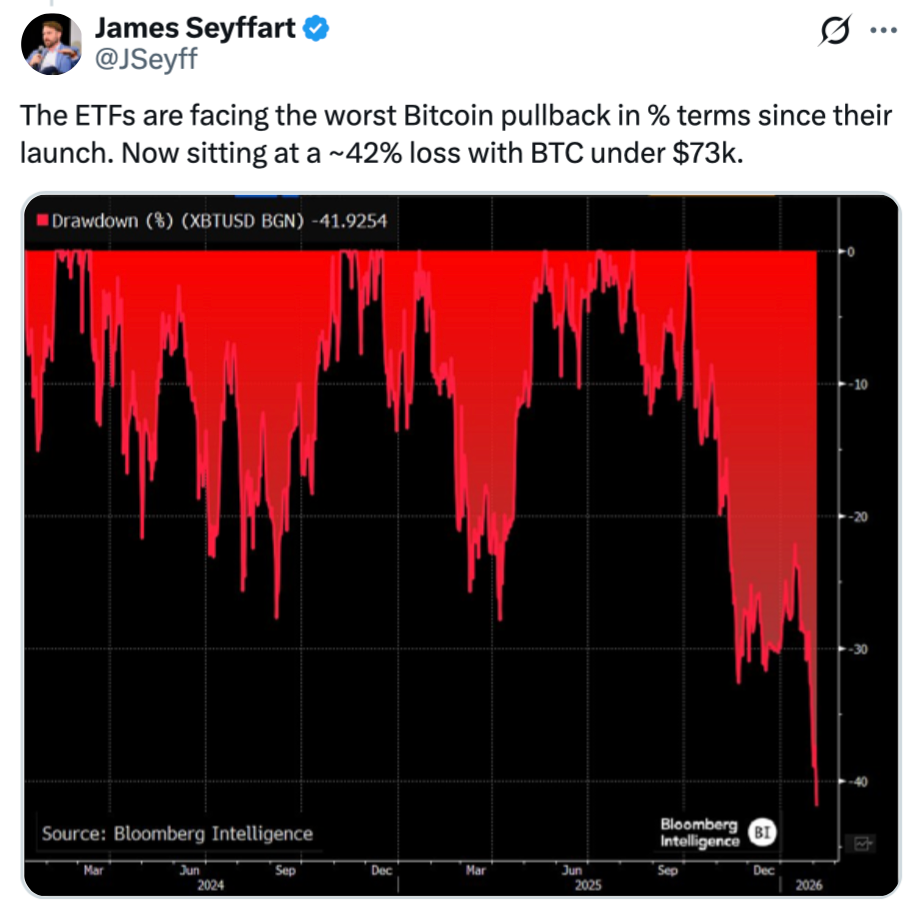
US-based spot Bitcoin exchange-traded fund (ETF) holders are showing relatively firm conviction despite a four-month Bitcoin downtrend, according to ETF analyst James Seyffart.
“The ETFs are still hanging in there pretty good,” Seyffart said in an X post on Wednesday.
While Seyffart said that Bitcoin (BTC) ETF holders are facing their “biggest losses” since the US products launched in January 2024 — at a paper loss of around 42% with Bitcoin below $73,000 — he argues the recent outflows pale in comparison to the inflows during the market’s peak.
Bitcoin ETF holders are “underwater and collectively holding.”
Before the October downturn, spot Bitcoin ETF net inflows were around $62.11 billion. They’ve now fallen to about $55 billion, according to preliminary data from Farside Investors.
“Not too shabby,” Seyffart said.

Meanwhile, investment researcher Jim Bianco said in an X post on Wednesday that the average spot Bitcoin ETF holder is 24% “underwater and collectively holding.”
Bitcoiners are being “very short-sighted.”
Crypto analytics account Rand pointed out in an X post on Tuesday that this is “the first time in history there have been three consecutive months of outflows.”
The extended outflows come as Bitcoin’s spot price has fallen 24.73% over the past 30 days, trading at $70,537 at the time of publication, according to CoinMarketCap.
Some analysts argue that Bitcoin investors are overlooking the bigger picture.
Related: XRP traders more optimistic as BTC, ETH mood turns sour: Santiment
ETF analyst Eric Balchunas said on Jan. 28 that Bitcoiners are being “very short-sighted,” given that Bitcoin’s performance since 2022 has been up over 400%, compared with gold at 177% and silver at 350%.
“In other words, bitcoin spanked everything so bad in ’23 and ’24 (which ppl seem to forget) that those other assets still haven’t caught up even after having their greatest year ever and BTC being in a coma,” Balchunas said.
Meanwhile, CryptoQuant CEO Ki Young Ju said in an X post on Wednesday that “every Bitcoin analyst is now bearish.”
Magazine: South Korea gets rich from crypto… North Korea gets weapons


Base lead Jesse Pollak said the web3 app will focus more on trading features, dialing back its social-heavy approach.
Jesse Pollak, Coinbase’s head of Base and Base App, announced that the Base App will shift its product focus to trading after mixed user feedback on its social-heavy features.
In an X post on Wednesday, Jan. 14, Pollak said the centralized exchange is now refocusing the Base App “to be trading-first,” signaling a shift to a finance focus for the web3 app after months of debate over its direction.
Base is the Ethereum Layer 2 developed by Coinbase, while Base App is the rebranded version of what was Coinbase Wallet, the CEX’s self-custody web3 wallet app.
After the company positioned the rebranded product as a “super app” in July of last year — combining crypto wallet, trading, social, and other functions — Pollak said “hundreds of thousands” of users indeed tried it for creating, trading, and building. But, as Pollak revealed this week, the response to the Base App’s social features was mixed.
“The app felt overly focused on social,” he wrote, adding it felt “too close to web2” and didn’t reflect the range of assets people want to trade. Pollak also wrote that users are asking for “more high quality assets” and a feed that shows not only social tokens.
Finance-First UX
“We’re going to lean into a finance-first UX. We believe it makes more sense to layer social features on top of finance, than the other way around,” Pollak wrote on X.
The shift follows a similar move by Farcaster, a prominent SocialFi protocol that recently stepped back from its original social-first model to focus more on trading.
Commenting on Base’s refocus, Dragonfly Capital partner Rob Hadick said in an X post on Jan. 15 that the move reinforces the view that blockchains work best for moving money, saying that “Base may have been the last meaningful hold out” of the social-first approach in web3.
The change also follows Coinbase CEO Brian Armstrong’s public request for feedback late last year, in which he questioned whether the Base App should prioritize trading, social features, or a mix of both.
The Solana-based launchpad is gaining market share amid a resurgence in creator-linked coins.
Activity on Bags.fm, a Solana-based token launchpad, is spiking this week after the success of Gas Town’s token (GAS) drew traders to the platform.
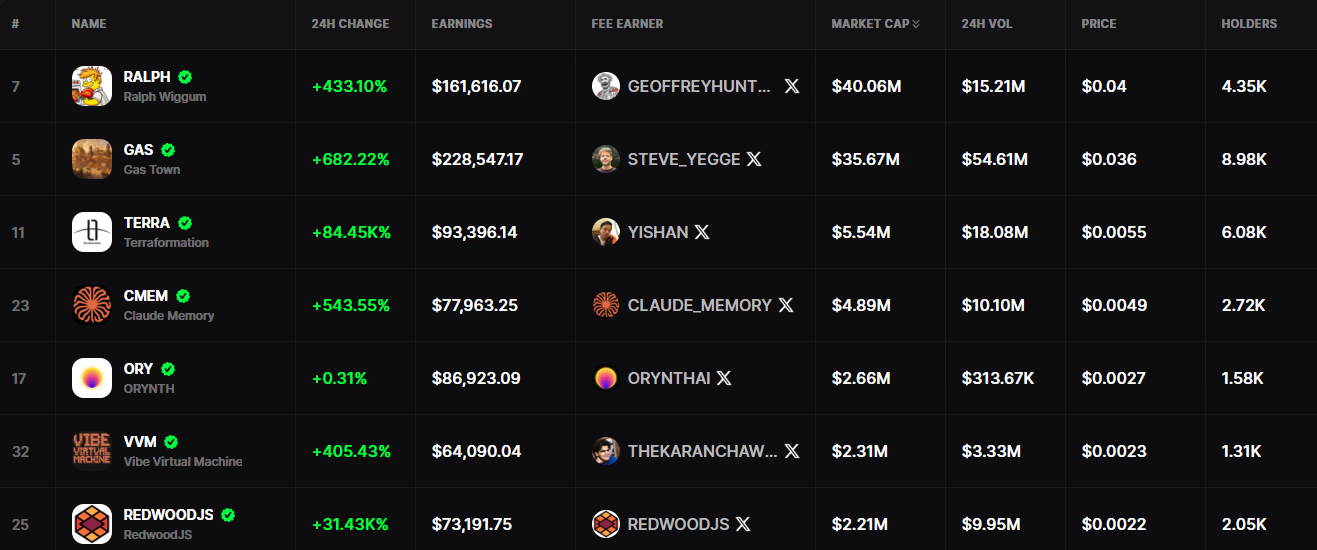
Over the past 24 hours, several Bags.fm tokens posted significant gains: GAS surged 682%, Ralph Wiggum (RALPH) spiked 433%, Claude Memory (CMEM) climbed 543%, and Vibe Virtual Machine (VVM) gained 405%.
Meanwhile, Terraformation (TERRA) and RedwoodJS are up a whopping 84,000% and 31,000%, respectively, after launching earlier this morning.

The momentum is making waves across the launchpad sector. On Jupiter’s launchpad leaderboard, Bags ranked second by market share over the past day, with roughly 33.5% share and $293 million in volume, behind pumpfun at 51.2% and $448 million.
Jupiter data also shows that Bags volume remained relatively muted through late December 2025 and early January, before jumping yesterday as GAS rallied.
How exactly is Bags different?
Bags markets itself as a way for creators, artists, and entrepreneurs to fund ideas by launching coins that anyone can trade, while earning a cut of trading activity as royalties.
Gas Town, for example, is an open-source AI coding-agent orchestrator created by software engineer Steve Yegge. After the project gained traction online, a token linked to Gas Town (GAS) was launched on Bags, and trading activity quickly surged, Yegge explained in a Medium blog post.
As GAS trading picked up, it also generated large fee payouts for the account listed as the token’s “fee earner” (in this case, Yegge), which helped bring more attention to the Bags ecosystem.
The surge echoes recent “attention-driven” crypto cycles, where viral moments lead to sudden onchain revenue. Last year, onchain social platform Zora hit record daily revenue after Base-linked posts sparked a speculative frenzy, even as other metrics, like active addresses and total value locked (TVL), were flat or down.
On its website, Bags says creators earn 1% of trading volume from their coin and can claim the fees after verifying the linked social account. It also encourages creators to build communities around their tokens, with holders benefiting if the coin grows.
The Bags team did not immediately respond to The Defiant’s request for comment.

Binance said assets on its on-chain addresses increased during what appeared to be an attempted bank run, after a wave of social media posts urged users to pull funds from the world’s biggest crypto exchange.
Co-founder He Yi described the episode on X as a coordinated withdrawal push from parts of the community. She said she still did not understand why deposits appeared to outweigh withdrawals once the campaign started, and she framed routine, large-scale withdrawals across platforms as a useful stress test for the industry.
She also urged users to slow down when moving funds, warning that mistakes on blockchain transfers are permanent once confirmed.
In the same post, she pointed users toward self-custody options, including Binance Wallet and Trust Wallet, and suggested a hardware wallet alternative for those who want added reassurance.
Binance Outage Sparks Renewed Talk Of Exchange Risk On Social Media
The comments landed after Binance briefly paused withdrawals on Tuesday, a disruption that revived familiar nerves in a market still sensitive to exchange solvency rumours.
The company first posted, “We are aware of some technical difficulties affecting withdrawals on the platform. Our team is already working on a fix, and services will resume as soon as possible.” Follow-up updates said the issue was resolved in about 20 minutes.
@binance briefly paused withdrawals due to technical issues before restoring service within about 20 minutes, the exchange said on X.#Binance #CryptoTrading https://t.co/95c2xKnUdK
— Cryptonews.com (@cryptonews) February 3, 2026
The short outage quickly turned into a talking point on X, with some users drawing parallels to past exchange failures, such as FTX, and framing the withdrawal push as a stress test of Binance’s plumbing.
He Yi’s message pushed back on that narrative by pointing to net inflows, not outflows, during the campaign window.
Zhao Denies Bitcoin Dump Claims Amid Weekend Selloff
On Monday, Binance co-founder Changpeng Zhao also weighed in, arguing that the market was recycling blame stories as crypto prices slid.
He called the allegations “pretty imaginative FUD” and rejected claims that Binance sold $1B of Bitcoin to trigger the weekend sell-off, saying the funds belonged to users trading on the platform.
Zhao also took aim at the idea that he could steer the market cycle through public comments. “If I had that power, I wouldn’t be on Crypto Twitter with you lot,” he wrote, after some users joked that he “canceled the supercycle” by sounding less confident about the thesis.
The back-and-forth played out as crypto traders stayed jittery and liquidity thinned across venues, conditions that tend to amplify rumours and accelerate crowd behaviour. It also revived a familiar fault line in the market, between traders who keep assets on exchanges for speed and those who see periodic withdrawals as the only credible check.
Binance has leaned on transparency reports to counter those concerns. CoinMarketCap’s Jan. 2026 exchange reserves ranking put Binance at the top with about $155.64B in total reserves, reinforcing its status as the largest liquidity hub in the sector.
The post Binance Says Assets Increased During Suspected Bank Run Attempt appeared first on Cryptonews.
Crypto World
Bhutan Quietly Sells Over $22M in Bitcoin, Triggers Speculation Over Possible Sell-Offs


The Royal Government of Bhutan has moved over $22 million in BTC out of sovereign wallets over the past week alone, drawing attention from the crypto community.
One transaction, 5 days ago, was directly sent to addresses linked to market maker QCP Capital, Arkham data revealed. The moves align with Bhutan’s periodic sales of BTC since it began mining the crypto in 2019.
“From our observations, Bhutan periodically sells BTC in clips of around $50M, with a particularly heavy period of selling around mid-late September 2025,” Arkham wrote.
Besides, the Himalayan Kingdom’s crypto portfolio has gone down more than 70% from its $1.4 billion peak to $412 million, following market depreciation.
Per Bitcoin Treasuries, Bhutan remains the seventh-largest government Bitcoin holder.
Bhutan Heavily Mined BTC in 2023 – Data
Bhutan has been mining Bitcoin since 2019 and saw more than $765 million in BTC profit.
“They mined most of their BTC before the halving in 2024, and tapered heavily after that,” said the Arkham report. “This is because the cost to mine a single Bitcoin roughly doubled, which made mining less efficient.”
Further, the nation seems to have mined 8,200 BTC in 2023 alone, making it the heaviest mining year. It approximately mined 1800 BTC in 2022 and 300 BTC in 2024.
Wallet Transfers Show No Sign of Liquidation
The BTC transfers from the government wallet in the past week come after Bitcoin has been slumping to $70,000. The largest crypto has tumbled 7.36% over the last 24 hours, outpacing the broader crypto market’s 6.39% fall.
Despite the heavy transfers, blockchain data analysts note that they are more likely to be internal reallocation or custodial arrangements rather than liquidation. The country’s wallet balances remain largely unchanged.
Bhutan has made similar mass wallet moves in the past without triggering market crashes.
The post Bhutan Quietly Sells Over $22M in Bitcoin, Triggers Speculation Over Possible Sell-Offs appeared first on Cryptonews.
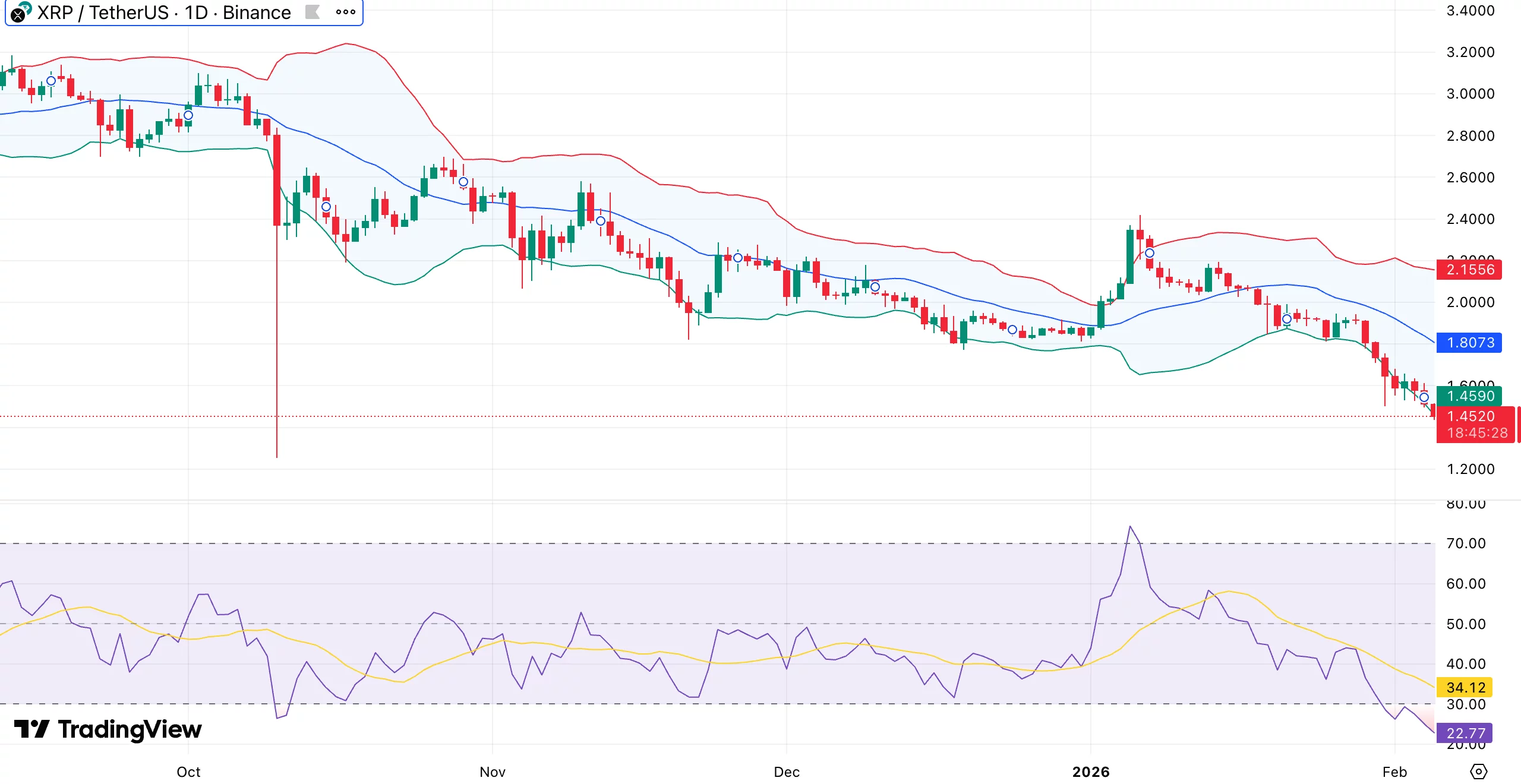
XRP price is testing a critical demand zone near $1.45 as rising on-chain velocity and falling open interest hint at a decisive move ahead.
Summary
- XRP trades near $1.44 after sharp weekly losses, with sellers still dictating short-term direction.
- On-chain velocity has surged to yearly highs, suggesting heavy re-positioning as price weakens.
- A firm hold above $1.45 could spark a short bounce, while a breakdown risks deeper losses.
XRP was trading near $1.44 at press time, down about 10% over the past 24 hours, sliding to its lowest level since November 2024. The token has weakened across all major timeframes, falling 23% over the past week and nearly 40% over the past month.
Price action over the last seven days has remained confined between $1.44 and $1.88, with sellers maintaining control. Even so, market activity has picked up. XRP (XRP) recorded $5.07 billion in trading volume in the past 24 hours, up 25%. This points to heavy participation during the sell-off.
Derivatives data show a more cautious tone. CoinGlass figures indicate futures volume rose 17% to $7.94 billion, while open interest slipped 1.8% to $2.61 billion. This mix suggests that traders reducing leverage while spot activity rises, a setup that can appear near short-term turning points.
XRP velocity spikes as supply shifts hands
A Feb. 4 analysis by CryptoQuant contributor CryptoOnchain highlighted a sharp move in XRP Ledger activity. The seven-day SMA of XRP velocity climbed to 0.013 on Feb. 3, matching the highest levels seen since January 2025.
In previous cycles, this level has appeared at key moments. During this instance, the velocity increase coincided with a price decline, suggesting rapid coin movement rather than steady accumulation. Such conditions are often linked to older holdings changing hands or aggressive short-term trading during periods of stress.
According to the analyst, when velocity reaches its upper range while price struggles, it can mark a high-friction phase in the market. Whether this activity marks late-stage selling or the early stages of stabilization depends on how the price reacts around key support.
In a separate note, CryptoOnchain pointed to a sharp drop in XRP open interest on Binance, which has fallen to $405.9 million, the lowest level since November 2024.
A market reset of this size suggests that leverage has been significantly reduced. The probability of more forced sales drops as positions are unwound. This eases the influence of derivatives on short-term price moves.
Under these conditions, if spot demand holds up, any rebound is more likely to develop in a gradual and orderly way.
XRP price technical analysis
XRP is testing a clearly defined demand zone at $1.45, which has held during prior drops. The token is trading well below its 20-day moving average, placing the price in a stretched position.
XRP has also slipped below the lower Bollinger Band, which points to shrinking volatility. Instead of sellers running out of steam, the price action suggests heavy selling pressure pushing straight into support.
The relative strength index is in the low-30s, indicating that momentum is weak but getting closer to levels where selling pressure often slows.
Smaller bodies and longer wicks on recent candles suggest that sellers are meeting more resistance close to the current price. So far, the $1.45 level has not given way on a daily close.
If buyers continue to defend this zone, a short-term bounce toward $1.60–$1.70 becomes possible, driven by oversold conditions and reduced leverage. For the price to stabilize further, XRP would need to reclaim $1.80 and hold it.
Failure to hold $1.45 would change the picture quickly. A clean break below that level could open the door to deeper losses, as visible support becomes thinner beneath current prices.
Crypto World
Ethereum Lending Hits $28 Billion After Aave Proves DeFi’s Crisis Shield in Weekend Crash
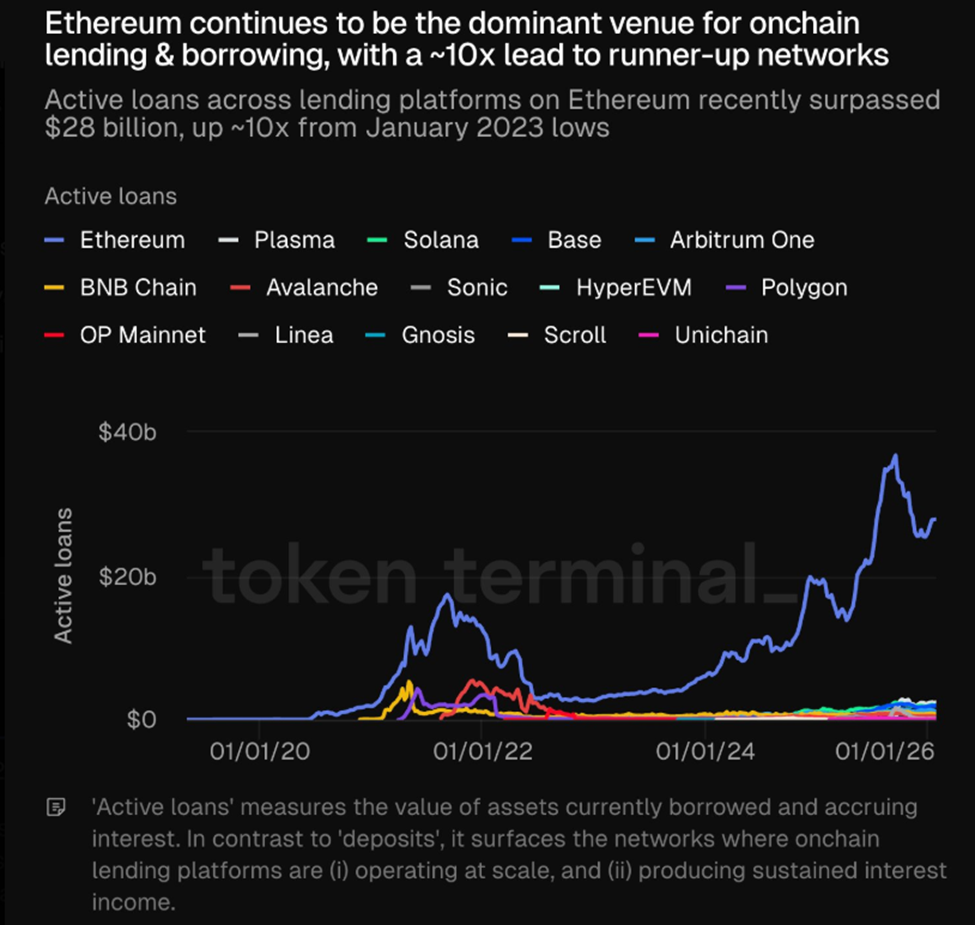
Ethereum’s on-chain lending ecosystem has reached a new milestone, with active loans surpassing $28 billion as of January 2026.
Central to this growth is Aave, the leading Ethereum-based lending protocol, which controls approximately 70% of the network’s active lending market.
Sponsored
Sponsored
Aave’s Automated Liquidations Prevent DeFi Contagion Amid Weekend Crash
Data on Token Terminal shows that the growth in active loans across Ethereum-based lending platforms achieved a tenfold increase from January 2023 lows.
This milestone highlights Ethereum’s continued dominance in DeFi. It gives it a roughly tenfold advantage over competing networks such as Solana and Base.
The surge in lending activity, while a signal of DeFi’s expanding adoption, also raises questions about systemic risk.
In 2022, elevated loan volumes contributed to waves of liquidations that exacerbated broader market downturns. By Q3 2025, crypto lending had reached a record $73.6 billion. This represents a 38.5% quarter-over-quarter increase, and nearly tripling since the start of 2024.
According to Kobeissi analysts, this was driven largely by DeFi protocols benefiting from Bitcoin ETF approvals and a sector-wide recovery.
While leverage in DeFi remains far below that in TradFi sectors—representing just 2.1% of the $3.5 trillion digital asset market, compared to 17% in real estate—its concentration in algorithmic lending platforms like Aave amplifies the potential for rapid, automated liquidations.
Sponsored
Sponsored
Weekend Crash Highlights Aave’s Role as DeFi’s Stabilizer Amid $2.2 Billion Liquidations
The late January 2026 weekend market crash tested this system under extreme stress. Bitcoin dropped sharply from around $84,000 to below $76,000 amid:
- Thin weekend liquidity
- Geopolitical tensions in the Middle East, and
- Pressure from the US government funding uncertainties.
Over $2.2 billion in leveraged positions were liquidated across centralized and decentralized exchanges in just 24 hours.
Aave’s infrastructure played a crucial stabilizing role. The protocol processed over $140 million in automated collateral liquidations across multiple networks on January 31, 2026.
Sponsored
Sponsored
Despite high Ethereum gas fees spiking above 400 gwei, which temporarily created “zombie positions” where undercollateralized loans hovered near liquidation thresholds but could not be profitably cleared immediately, Aave handled the surge without downtime or bad debt.
Aave’s performance prevented what could have been a far more severe contagion across DeFi. Had the protocol failed, undercollateralized positions could have accumulated into bad debt. Such an outcome would trigger cascading liquidations and potential panic across the ecosystem.
Other protocols, including Compound, Morpho, and Spark, absorbed smaller liquidation volumes. However, they lacked the scale or automation to fully replace Aave.
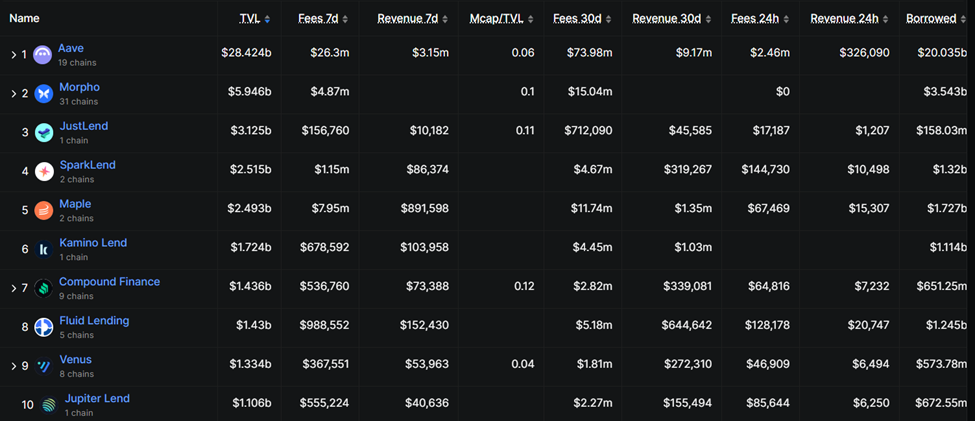
Even large ETH holders, like Trend Research, who deleveraged by selling hundreds of millions of dollars in ETH to repay Aave loans, relied on the protocol’s efficiency to mitigate further market stress.
Sponsored
The weekend crash highlights both the opportunities and vulnerabilities inherent in Ethereum’s lending ecosystem.
While active loans and leverage are rising, Aave’s resilience signals that DeFi’s infrastructure is maturing.
The protocol’s ability to absorb large-scale liquidations without systemic failures highlights Ethereum-based lending as a stabilizing force in volatile markets. It reinforces its “flight-to-quality” reputation among both institutional and retail participants.
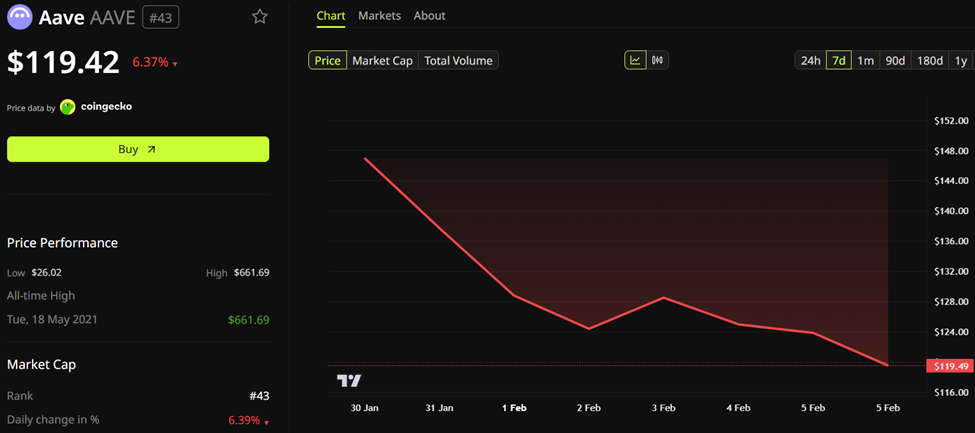
Despite this bullish outlook, the AAVE token is down by over 6% in the last 24 hours, and was trading for $119.42 as of this writing.
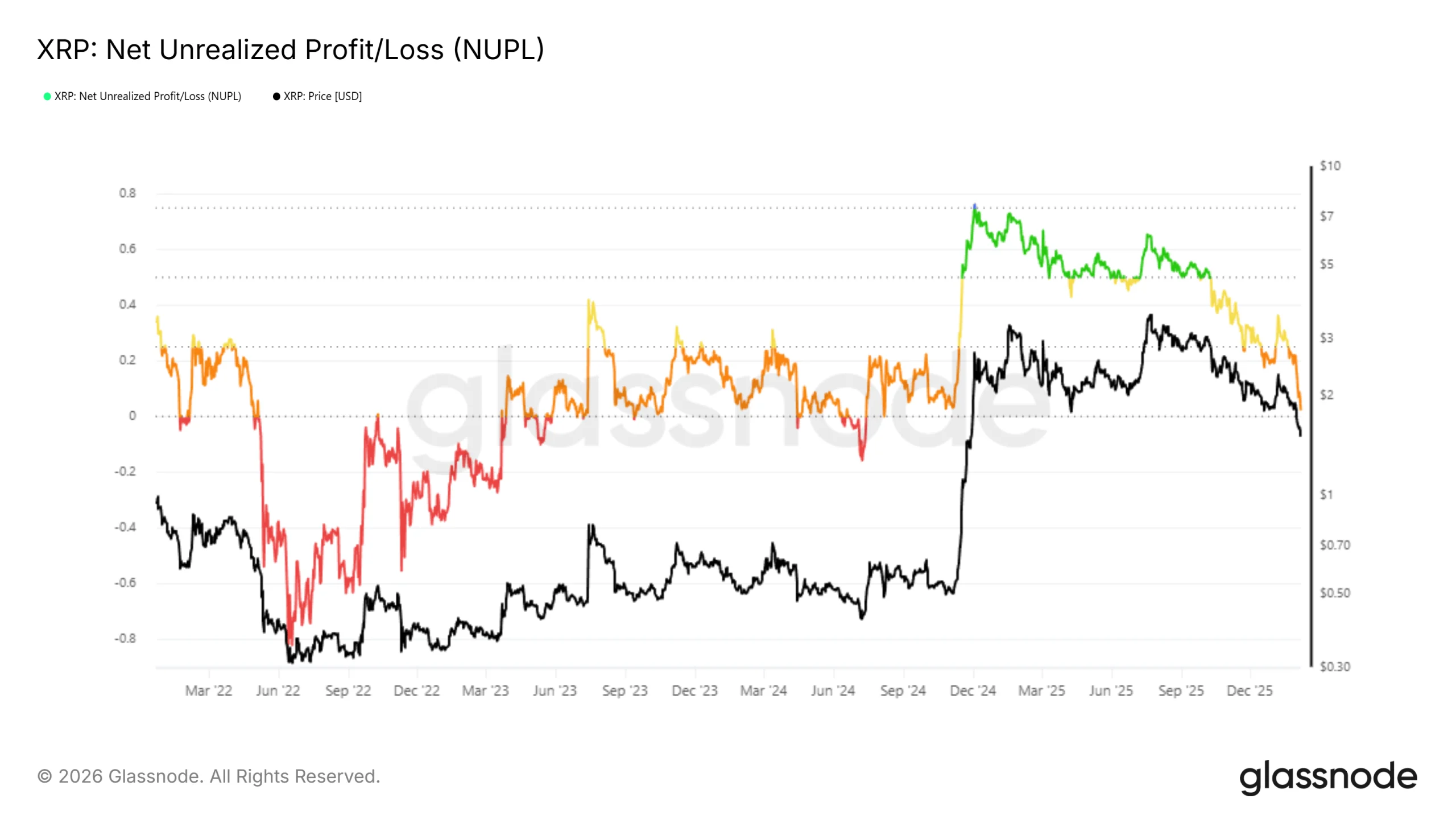
XRP has faced a sharp downturn, falling 24% over the past week as selling pressure intensified across the market. The decline pushed the altcoin into a vulnerable position, breaking a pattern of past recoveries.
This sustained weakness suggests the current correction may reshape XRP’s historical price behavior if demand fails to return.
Sponsored
XRP’s Past Says Recovery Ahead
XRP’s Net Unrealized Profit and Loss is approaching the capitulation zone. At this stage, unrealized losses outweigh minor gains across the circulating supply. Historically, such conditions reduce selling incentives.
Investors often pause distribution and begin accumulating at discounted levels, which can support price stabilization.
However, XRP has not yet shown clear signs of this shift. Selling pressure remains dominant, preventing NUPL from triggering a meaningful reversal. Without accumulation replacing fear-driven exits, XRP struggles to benefit from its typical recovery cues, keeping sentiment tilted firmly toward caution.
Want more token insights like this? Sign up for Editor Harsh Notariya’s Daily Crypto Newsletter here.
Sponsored
XRP Investors Opt to Panic For Now
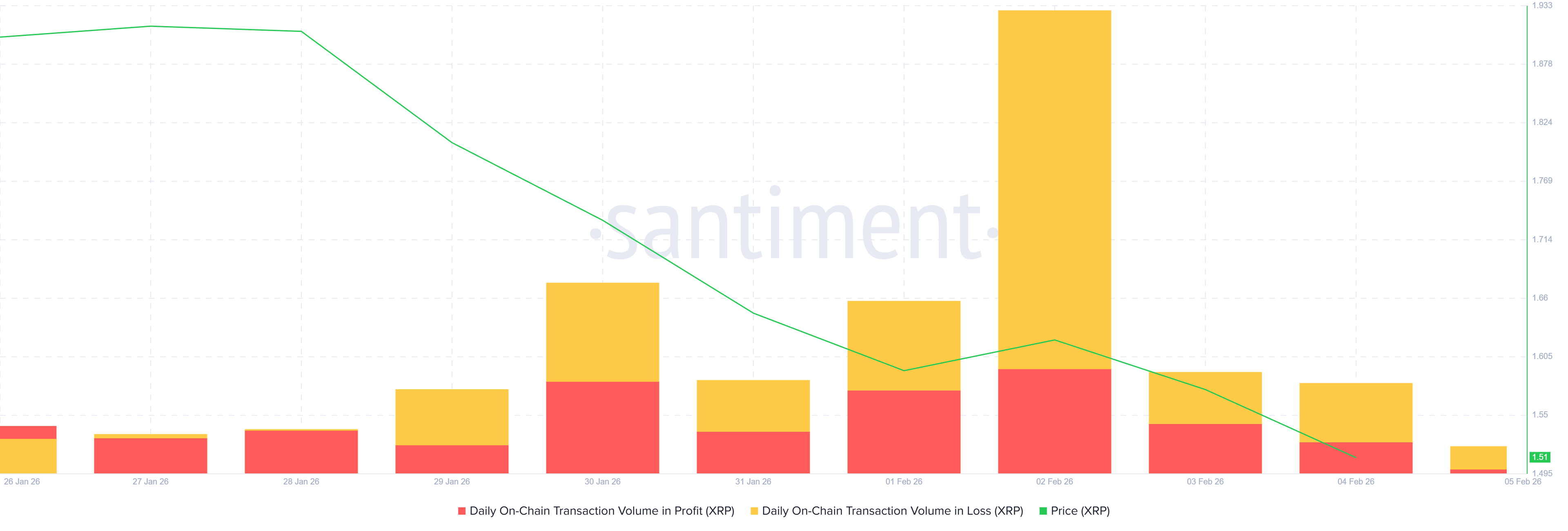
On-chain transaction data reflects sustained panic selling. Over the past week, XRP transactions executed at a loss have consistently exceeded profitable transfers.
Transaction volume on February 2 registered $2.51 billion in losses, against $567 million in profit. This imbalance highlights deteriorating confidence as holders prioritize capital preservation amid falling prices and broader market weakness.
Loss-dominated transaction volume often signals late-stage fear. While such phases can precede recovery, they also deepen drawdowns when unchecked. XRP’s inability to stabilize transaction behavior suggests momentum remains fragile, leaving the asset exposed to further downside unless sentiment improves quickly.
Sponsored
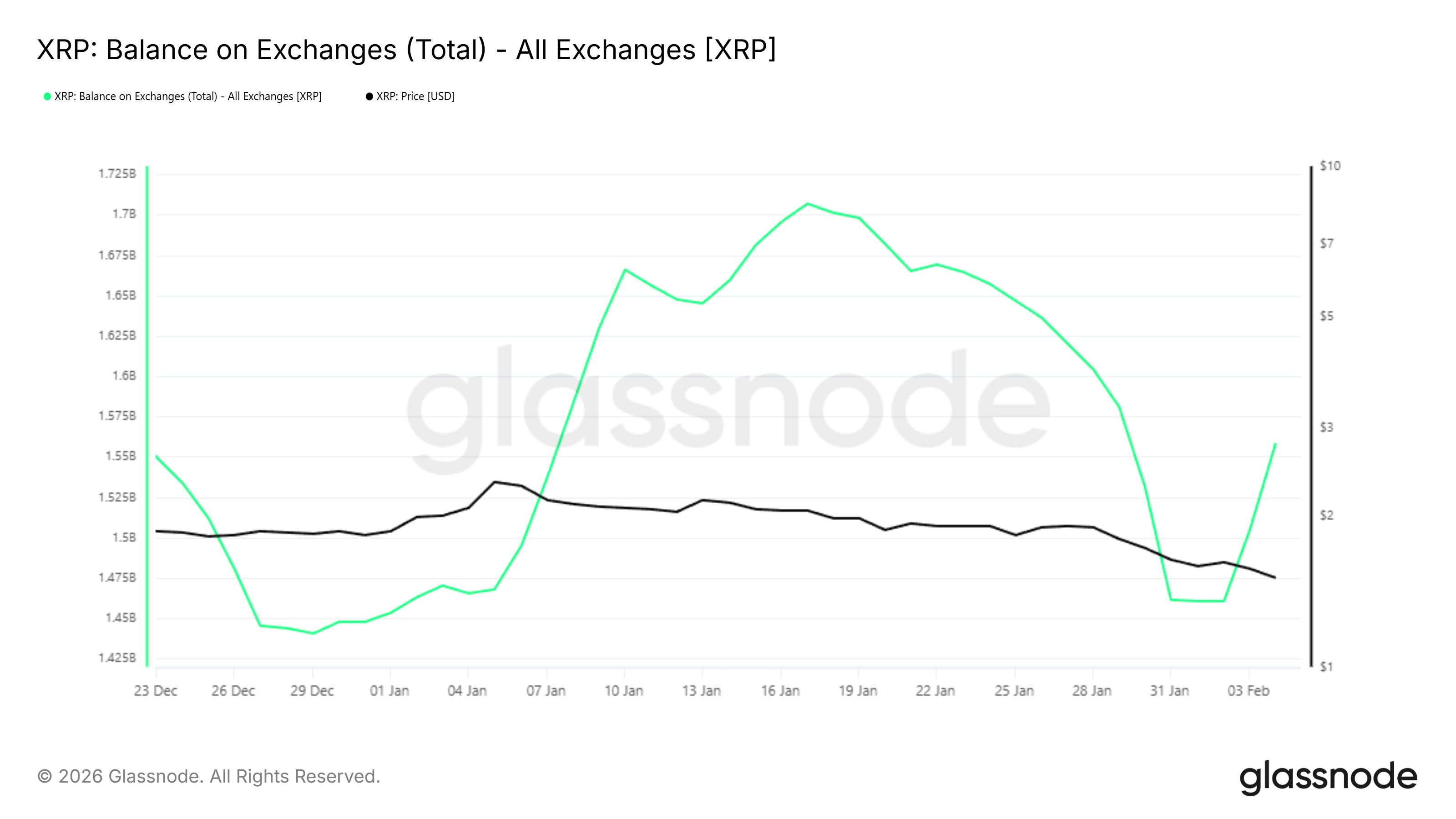
Exchange balance data reinforces bearish signals. Over the last four days, more than 97 million XRP, valued at $140 million, flowed into exchange wallets in mere three days. Rising exchange balances typically indicate intent to sell rather than long-term holding.
This surge reflects growing fear among XRP holders. As more tokens move onto exchanges, sell-side pressure intensifies. Continued inflows reduce recovery odds, as supply expansion often overwhelms short-term demand during periods of heightened uncertainty.
Sponsored
XRP Price Needs To Find Support
XRP price has declined 24.4% over the past week and trades near $1.44 at the time of writing. The asset lost the $1.47 support and is trending toward $1.37. Wednesday marked XRP’s lowest daily close since November 2024, confirming structural weakness.
If bearish conditions persist without meaningful buying interest, further downside appears likely. Losing $1.37 as support could accelerate selling pressure. Under this scenario, XRP price may slide toward $1.28 in the coming days, extending the current corrective phase.
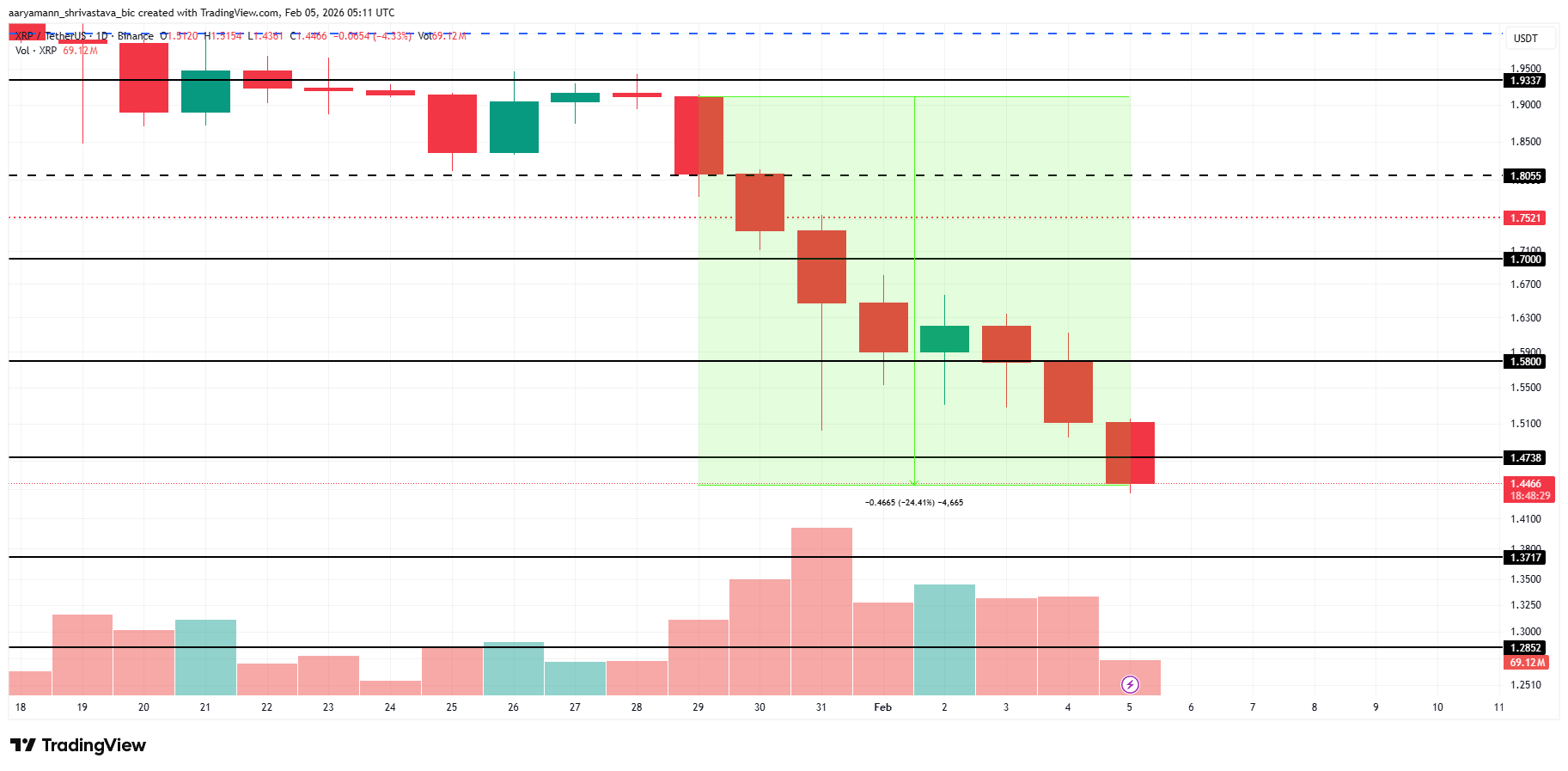
A recovery remains possible if sentiment shifts. Reclaiming $1.58 as support would signal renewed strength. Such a move could push XRP toward $1.70. Securing that level would restore bullish confidence and help recover a portion of recent losses.

General Hospital: Willow’s Plot to Frame Michael Spectacularly Backfires!

Money Speaks #motivation #mindset #selfimprovement

Scots eco airline goes bust as liquidators move in


-

 Crypto World6 days ago
Smart energy pays enters the US market, targeting scalable financial infrastructure
-
 Crypto World6 days ago
Software stocks enter bear market on AI disruption fear with ServiceNow plunging 10%
-

 Politics6 days ago
Why is the NHS registering babies as ‘theybies’?
-
 Crypto World6 days ago
Adam Back says Liquid BTC is collateralized after dashboard problem
-

 Video2 days ago
When Money Enters #motivation #mindset #selfimprovement
-

 Fashion6 days ago
Weekend Open Thread – Corporette.com
-

 Tech1 day ago
Wikipedia volunteers spent years cataloging AI tells. Now there’s a plugin to avoid them.
-

 NewsBeat6 days ago
Donald Trump Criticises Keir Starmer Over China Discussions
-

 Politics3 days ago
Sky News Presenter Criticises Lord Mandelson As Greedy And Duplicitous
-

 Crypto World5 days ago
U.S. government enters partial shutdown, here’s how it impacts bitcoin and ether
-

 Sports5 days ago
Sinner battles Australian Open heat to enter last 16, injured Osaka pulls out
-
 Crypto World5 days ago
Bitcoin Drops Below $80K, But New Buyers are Entering the Market
-
 Crypto World3 days ago
Market Analysis: GBP/USD Retreats From Highs As EUR/GBP Enters Holding Pattern
-

 Crypto World6 days ago
KuCoin CEO on MiCA, Europe entering new era of compliance
-
Business6 days ago
Entergy declares quarterly dividend of $0.64 per share
-

 Sports3 days ago
Shannon Birchard enters Canadian curling history with sixth Scotties title
-

 NewsBeat2 days ago
US-brokered Russia-Ukraine talks are resuming this week
-

 NewsBeat3 days ago
GAME to close all standalone stores in the UK after it enters administration
-

 Crypto World1 day ago
Russia’s Largest Bitcoin Miner BitRiver Enters Bankruptcy Proceedings: Report
-

 Crypto World6 days ago
Why AI Agents Will Replace DeFi Dashboards