
Entertainment
The Greatest Movie of Every Genre in the 2010s

The 2010s were a decade of cinematic reinvention. On one side, you had intimate, blisteringly personal films like Moonlight, Parasite, and Get Out; on the other, blockbuster spectacles at their apex, shattering records and bringing superheroes to the heart of the mainstream. The balance was delicate, but the decade mostly managed to keep it.
The 2010s were also hugely influenced by the rise of streaming and strides in digital filmmaking technology, both of which exerted both positive and negative pressures on the industry, especially in hindsight. With all this in mind, this list ranks the best movies from each major genre throughout the 2010s. Some genres were barely holding on, while others rose to major prominence; however, the genres that have always supported Hollywood all thrived through at least one impactful and universally acclaimed movie.
Action – ‘John Wick’ (2014)

“Do I look civilized to you?” John Wick took a simple, classic premise (an unassuming man with hidden skills out for revenge) but elevated it with pitch-perfect execution. The movie strips action cinema back to fundamentals, and then polishes them to a razor’s edge, focusing on clarity and momentum. We get balletic gunplay, some of the best fight choreography of the 21st century, and a likable protagonist in Keanu Reeves. Unlike most action heroes of the time, he has a soft side. Indeed, there’s a quiet character study beneath the style and mayhem.
John Wick spawned sequels, spinoffs, and countless copycats, but the original remains superior to them all. Its criminal underworld is evocative, its morals often ambiguous, and its mythology endlessly intriguing. Plus, the movie benefits from the fact that it was tailored for Reeves, with the script literally reworked with him in mind. John Wick plays to its star’s talents, as well as riffing nicely on his public image.
Animation – ‘Spider-Man: Into the Spider-Verse’ (2018)

“Anyone can wear the mask. You could wear the mask.” Spider-Man: Into the Spider-Verse broke open new possibilities for animation, as well as superhero movies. Directors Peter Ramsey, Rodney Rothman, and Bob Persichetti crafted a visual revolution, confidently melding comic-book textures, kinetic editing, graffiti-bright colors, and frame-breaking invention. All these bold choices could easily have collapsed into a guady mess, but the directors and animators pull them off masterfully.
The finished product sees animation evolving into pure expression, a superhero film with soul and swagger. The film is joyous without being naive, emotional without being saccharine. Every joke lands, every beat matters, every frame feels alive. Refreshingly, Into the Spider-Verse celebrates multiverses not as a gimmick, but as a metaphor and storytelling tool. The voice acting is great, too. Shameik Moore brings heart and humor as Miles Morales, a hero who learns that anyone can wear the mask, but you have to earn it.
Comedy – ‘The Grand Budapest Hotel’ (2014)

“There are still faint glimmers of civilization left in this barbaric slaughterhouse that was once known as humanity.” Wes Anderson has carved out a niche with his quirky, pastel creations, and The Grand Budapest Hotel is the ultimate execution of that aesthetic. It’s a comedy with a dramatic edge, simultaneously whimsical and melancholic and always meticulously constructed. It’s a story of grace, pastries, prison escapes, and a concierge who believes manners are all that keep the darkness at bay.
At its heart, Ralph Fiennes delivers one of the decade’s great comedic performances as M. Gustave, a refined hotel concierge with a foul mouth, a noble heart, and a gift for chaos. The contrast between him and Voldemort is astounding. The humor is dry and deadpan throughout, but always rooted in affection. Anderson finds both absurdity and beauty in his characters, creating a unique dichotomy covered in sugar and melancholy. Crucially, the movie is funny not in spite of the tragedy, but alongside it.
Drama – ‘Moonlight’ (2016)

“At some point, you gotta decide for yourself who you gonna be.” Moonlight is one of the most poetic dramas of the 2010s, an amazingly patient exploration of masculinity and identity, following the life of Chiron across childhood, adolescence, and adulthood. The character is played by three different actors over those periods: Alex Hibbert, Trevante Rhodes, and Ashton Sanders, who are all fantastic together, creating an immersive portrait of pain and tenderness. Alongside them, you also get Naomie Harris’ devastating intensity and Mahershala Ali’s gentle mentorship (for which he won the Oscar).
Moonlight is a story not about becoming someone new, but about reclaiming who you always were. A big part of what makes it so profound is how it refuses to sensationalize suffering, instead treating emotional truth like something sacred. This approach is conveyed through the writing and restrained performances, but also the film’s visual language. Barry Jenkins takes a lyrical approach to the aesthetic, shows us shimmering waves and faces bathed in blue neon.
Epic – ‘Mad Max: Fury Road’ (2015)
“My name is Max. My world is fire and blood.” Epic movies were on the downswing in the 2010s, with only a few notable examples like The Tree of Life and The Irishman. Arguably, the most compelling is Mad Max: Fury Road, a bold dystopian action extravaganza built on vast landscapes, big setpieces, and even bigger personalities. Tom Hardy and Charlize Theron (as the unforgettable Furiosa) lead a pyrotechnic ballet across the wasteland, where engines roar like beasts and survival is rebellion.
The storytelling is unrelentingly kinetic. Here, George Miller reinvents the chase film as something operatic and gleefully unhinged, replete with monster trucks and flamethrowing guitars. Yet, the universe is also rich and lived in, making sure that all this action doesn’t devolve into mere empty spectacle. The characters and themes lend themselves to endless interpretation and analysis, making Fury Road the decade’s very best expression of the grand and ambitious epic.
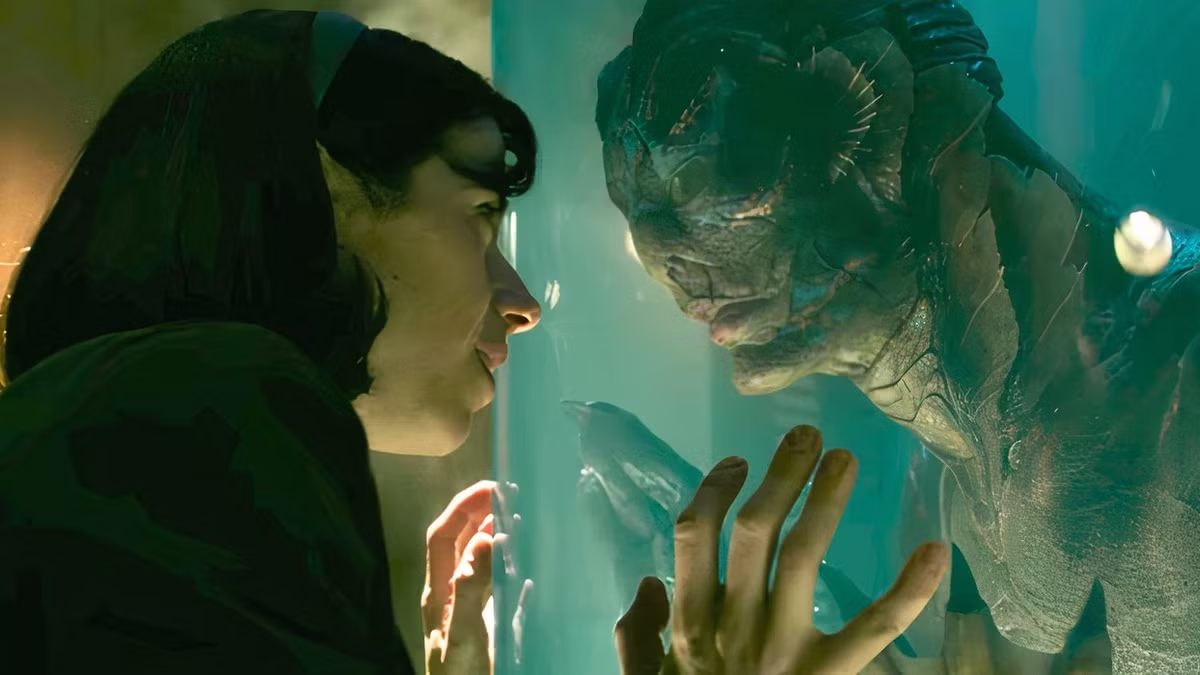
Fantasy – ‘The Shape of Water’ (2017)

“When he looks at me, he does not know what I lack… or how I am incomplete. He sees me for what I am, as I am.” With The Shape of Water, Guillermo del Toro created a fairy tale for outsiders, dreamers, and those who find beauty where others see monsters. Sally Hawkins turns in a wonderful performance as Elisa, a mute cleaner who forms an aching, wordless romance with an imprisoned amphibious creature (Doug Jones). Their bond is tender, rebellious, and defiantly strange. And, with Cold War paranoia swirling around them, their love becomes a kind of resistance.
In other words, The Shape of Water is a very strange movie, but brought to vivid life by a talented cast and crew. Del Toro’s world feels hand-carved, and every frame breathes enchantment. As with the director’s magnum opus, Pan’s Labyrinth, The Shape of Water reminds us that the best fantasy isn’t just about escaping our reality, but rather seeing the world in a brand new light, sometimes with radical empathy.
Horror – ‘Get Out’ (2017)

“Sink into the floor.” Jordan Peele has made several features now, but his first remains his best. With Get Out, he fused comedy and horror into a scalpel-sharp social thriller, exposing racism’s smiling mask and the nightmare lurking beneath polite society. Daniel Kaluuya plays Chris, a man trapped not by monsters, but by manipulation, commodification, and white liberal entitlement. Through the character, Peele hit on feelings and ideas that had been roiling around the culture for years. He crafts the material into something funny, political, suspenseful, and culturally seismic.
Specifically, Peele locates terror in microaggressions, awkward laughs, and assimilation. His concept of the “Sunken Place” immediately became iconic, serving as a metaphor for stolen agency and cultural erasure. But themes aside, Get Out is simply confident and entertaining, a rollercoaster of emotions, playing the audience like a fiddle. It remains one of the very best cultural time capsules of late-2010s America.
Sci-Fi – ‘Arrival’ (2016)

“If you could see your whole life from start to finish, would you change things?” At a time when the genre showed signs of growing stale, Arrival redefined what science fiction could be. Rather than serving up yet another spectacle of alien invasion, Denis Villeneuve gave us a meditation on language, loss, and time. It’s unusually intelligent, and yet still deeply entertaining. On the acting front, Amy Adams does much of the heavy lifting, delivering a soul-shaking performance as a linguist trying to bridge the gap between species, and between past and future.
Villeneuve’s pacing is hypnotic, Jóhann Jóhannsson’s score pulses like a heartbeat, and the visual design (from hovering ships to circular language glyphs) feels both ancient and futuristic. The twist — that language has the power to literally reshape time — hits harder, but the movie’s central idea — that love is worth the inevitable pain — hits even harder. All in all, Arrival is sci-fi at its most human and affecting. What a gem.
Thriller – ‘Gone Girl’ (2014)

“I feel like something to be jettisoned if necessary. That’s how you make me feel.” Gone Girl is the best showcase for David Fincher‘s thriller talents. Here, he makes it look easy, smoothly adapting Gillian Flynn’s bestseller into a psychological battleground between marriage expectations and media spectacle. He’s helped by a committed cast, with Rosamund Pike giving a career-defining performance as Amy Dunne, a believable, 21st-century update of the classic femme fatale. Opposite her, Ben Affleck’s Nick, hapless and guilty-looking even when innocent, becomes the perfect foil.
Fincher uses precise control (cool lighting, clinical framing, ticking sound design) to mirror the story’s manipulation and dread. The result is a labyrinth of lies where image matters more than truth, where crime becomes performance and love becomes warfare. Plus, rather than being a pure genre exercise, Gone Girl conceals satire within the suspense. Under the thriller trappings, it’s a horror movie about marriage.
Western – ‘The Revenant’ (2015)

“As long as you can still grab a breath, you fight. You breathe… keep breathing.” Westerns seemed pretty much played out by the mid-2010s (Django Unchained being a major exception), but Alejandro G. Iñárritu reinvigorated the genre by giving it an unusually believable and brutal treatment. The Revenant is part survival saga, part fever-dream, part spiritual reckoning. Leonardo DiCaprio gives a feral, physical performance as Hugh Glass, crawling through frozen hell to avenge his son. Along the way, he must endure bear attacks, murderous humans, and the unflinchingly bitter cold.
In other words, The Revenant isn’t the classic West of gunfights and saloons. Instead, Iñárritu gives us the West as a raw origin story, where nature tests men down to the bone. Emmanuel Lubezki’s natural-light cinematography complements this perfectly, turning the American wilderness into a cathedral and battleground, sacred yet savage. Revenge motivates Glass, but what the film ultimately offers is transformation, violence giving way to rebirth.



