
Crypto World
Strategy (MSTR) Stock: Analyst Slashes Target 60% Yet Keeps Buy Rating


TLDR
- Strategy stock dropped 5.7% to $125.66 Wednesday, tracking toward its lowest close since September 2024
- Canaccord Genuity maintained a Buy rating while cutting its price target from $474 to $185, a 60% reduction
- The company’s 713,502 Bitcoin holdings are valued at $53.6 billion as Bitcoin trades around $73,000
- Strategy’s premium to Bitcoin assets compressed to 1.06x from previous multiples exceeding 2x
- Analyst expects Bitcoin to rally 20% in 2026 and Strategy to reach a 1.25x valuation multiple
Strategy stock extended its losing streak Wednesday with a 5.7% decline to $125.66. The drop followed Canaccord Genuity’s decision to cut its price target by 60%.
The firm lowered its target from $474 to $185. Canaccord maintained its Buy rating despite the substantial reduction.
Strategy shares are down 72% since July. Wednesday’s decline put the stock on pace for its lowest close since September 9, 2024.
The price target cut reflects Bitcoin’s sharp decline. The cryptocurrency dropped to around $73,000 after hitting record highs above $126,000 in October.
Strategy holds 713,502 Bitcoins worth approximately $53.6 billion. The company’s average purchase price is $76,052 per coin.
Bitcoin Premium Evaporates
Strategy’s valuation premium has collapsed. The stock’s market-to-net-asset-value ratio now stands at 1.06. Investors previously paid more than 2x the value of Strategy’s Bitcoin holdings.
Bitcoin recently traded below Strategy’s average cost. This sparked worries about the company’s debt and dividend payments.
Canaccord analyst Joseph Vani dismissed those concerns. Strategy carries $8 billion in convertible debt against $53.6 billion in Bitcoin assets.
Vani said dividend payments on preferred stock can be funded through modest share sales. He described Strategy’s structure as built to survive a prolonged crypto downturn.
Bitcoin Rebound Expected
The analyst believes Bitcoin has been incorrectly treated as a risk asset. Vani argues it should trade as a store of value based on scarcity and verifiability.
“MSTR shares remain a bit of a lightning rod for media attention when BTC is weak,” Vani wrote. He suggested the business model was designed for market volatility.
Canaccord projects Bitcoin will rebound approximately 20% in 2026. The firm acknowledged uncertainty around timing the recovery.
Strategy won’t recapture its previous premium anytime soon. Canaccord expects shares to reach a 1.25x multiple relative to Bitcoin assets.
Strategy reports fourth-quarter earnings Thursday. The company will likely post an unrealized loss due to Bitcoin’s quarterly decline.
Vani emphasized Bitcoin’s outlook matters more than quarterly results. Strategy’s performance remains directly tied to cryptocurrency prices.
The company pioneered the digital-asset treasury strategy. Strategy issues equity and debt to accumulate Bitcoin holdings.
Bitcoin hit its lowest point in over a year Tuesday. The cryptocurrency’s weakness has pressured Strategy stock throughout the downturn.
Canaccord believes Bitcoin’s sell-off may be nearing an end. The firm sees the cryptocurrency as undervalued at current levels.
Strategy’s convertible debt remains manageable relative to its Bitcoin position. The company’s holdings provide substantial coverage for its obligations.


There are several double-digit movers from the altcoin space, including HASH and RIVER, both of which have skyrocketed by over 12% daily.
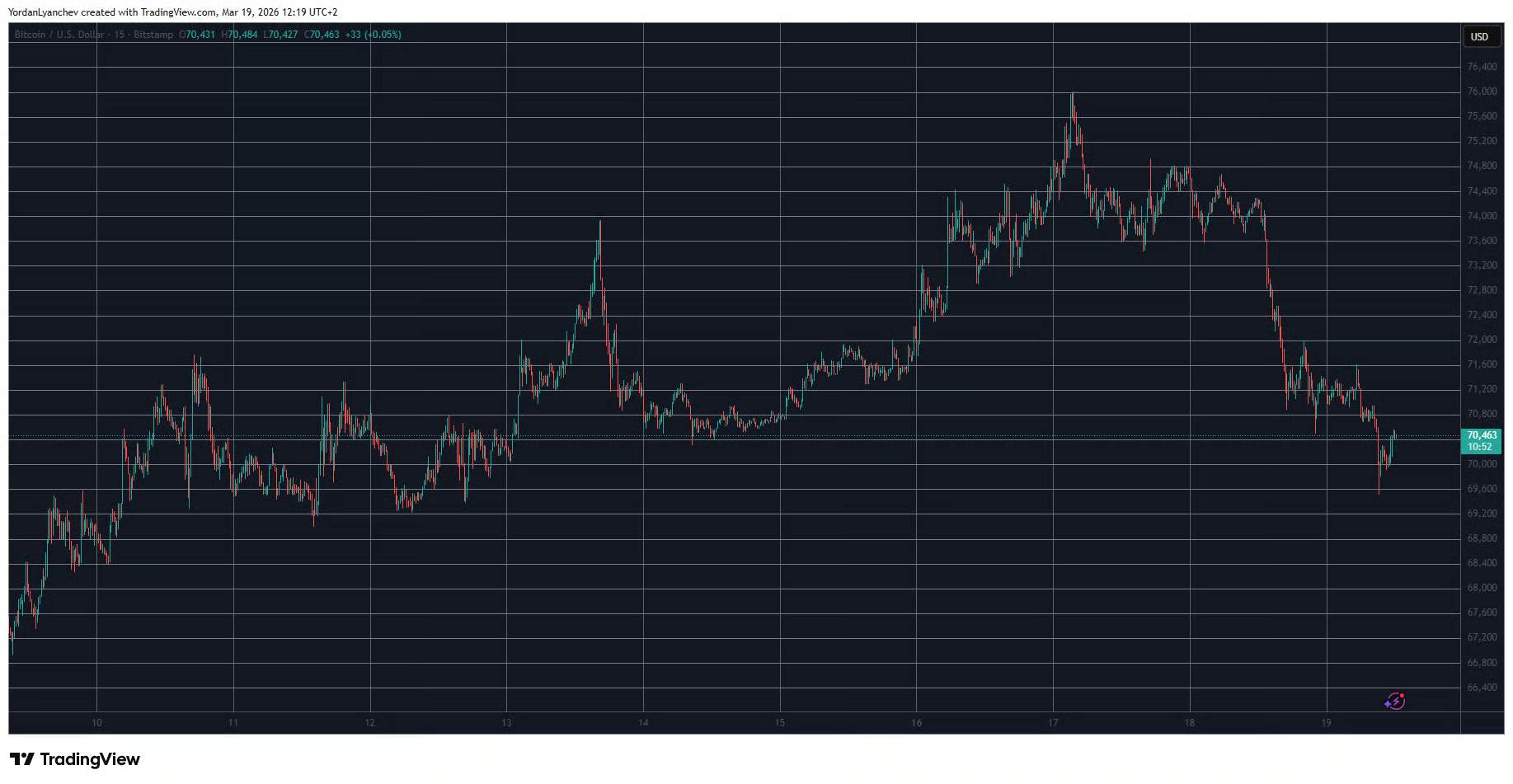
Bitcoin’s price rejection at $76,000 a couple of days ago only accelerated yesterday and earlier today, with the asset dipping below $70,000 for the first time since last Thursday.
The altcoins have faced enhanced volatility as well, with ETH dropping below $2,200 and XRP slipping beneath $1.50. ZEC, WLD, and MNT have plummeted by double digits.
BTC Price Dips Below $70K
The primary cryptocurrency touched $74,000 last Friday when it was stopped and pushed south toward $70,000 during the weekend after the latest bombings in the Middle East. However, it maintained that level, and the bulls stepped up as the new business week began.
The culmination took place on Tuesday morning when bitcoin shot up to its highest price level in roughly six weeks at $76,000. Nevertheless, its progress was quickly halted, and the asset retraced to $74,000.
Although it remained there at first on Wednesday, more volatility ensued in the hours leading up to the highly anticipated second FOMC meeting of the year. BTC dropped by several grand to just under $71,000 when the Fed announced what many expected that it wouldn’t change the interest rates.
Bitcoin bounced to $72,000 at first, but nosedived once again on Thursday morning, dropping below $70,000 for the first time in a week. Despite rebounding to just over that level now, it’s still 5% down on the day. Its market cap has dropped to $1.410 trillion, and its dominance over the alts is down to 56.3% on CG.
Altcoins Bleed
Most larger-cap alts have followed BTC on the way south. Ethereum is down by over 6% daily and sits well below $2,200. XRP lost the $1.50 support after a 3.5% decline. BNB has dipped beneath $650, SOL is down to $90, while ADA, LINK, and XMR have posted even more significant losses.
The biggest daily declines are evident from ZEC (-14%), WLD (-13%), MNT (-11%), and TAO (-10%). In contrast, HASH and RIVER have surged by double digits to $0.144 and $26.6, respectively.
The total crypto market cap, though, has erased $100 billion since yesterday’s peak and is down to $2.5 trillion on CG.

Binance Free $600 (CryptoPotato Exclusive): Use this link to register a new account and receive $600 exclusive welcome offer on Binance (full details).
LIMITED OFFER for CryptoPotato readers at Bybit: Use this link to register and open a $500 FREE position on any coin!
Disclaimer: Information found on CryptoPotato is those of writers quoted. It does not represent the opinions of CryptoPotato on whether to buy, sell, or hold any investments. You are advised to conduct your own research before making any investment decisions. Use provided information at your own risk. See Disclaimer for more information.
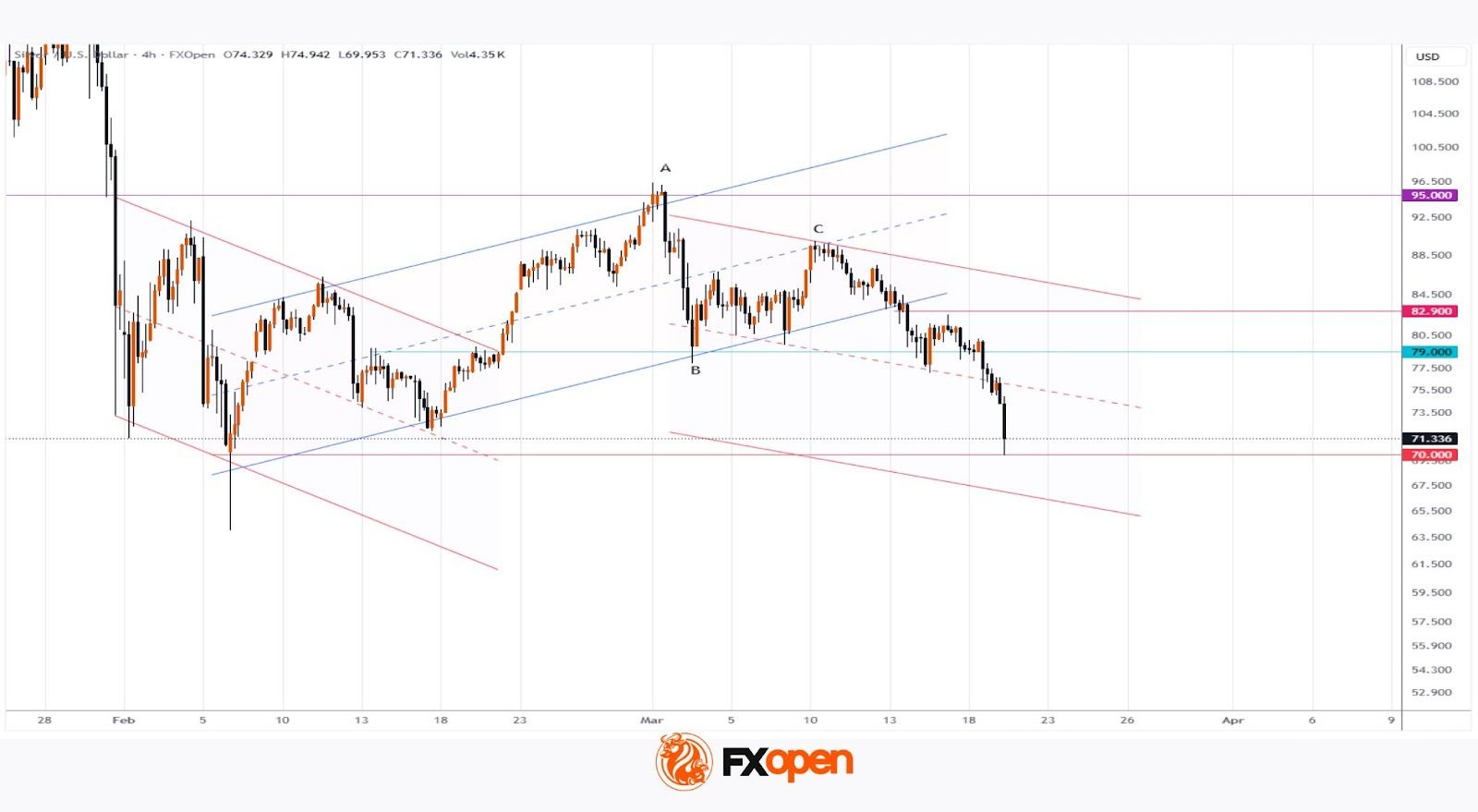
As seen on the XAG/USD chart, the price of silver fell to the $70 level and briefly pierced it, marking the lowest level since early February.
Although geopolitical tensions typically support demand for safe-haven assets, silver is under pressure from expectations of a fresh inflationary surge driven by rising energy prices (as noted earlier, Brent crude has risen above $110).
Yesterday’s “hawkish” comments from Federal Reserve Chair Jerome Powell also played a role. The Fed maintained interest rates, signalling that any future cuts would only occur if inflation stabilises.
Technical Analysis of XAG/USD
On 4 March, analysing the XAG/USD chart, we:
→ drew a blue ascending channel;
→ suggested that price action around the channel’s median could provide key signals.
Over time, the median proved to be a strong resistance. By 10 March, point C had formed, after which:
→ on 13 March, the blue channel was breached;
→ on 17 March, price showed an intraday bearish reversal from the breakout level.
Trading volume analysis indicates that the market remains under considerable pressure.
Although the long lower shadow on the candle near the psychological $70 mark indicates some buyer activity, the overall picture remains bearish. A red descending channel can be drawn on the silver price chart, with its median potentially acting as resistance in the near term, thereby confirming the validity of the constructed channel.
Start trading commodity CFDs with tight spreads (additional fees may apply). Open your trading account now or learn more about trading commodity CFDs with FXOpen.
This article represents the opinion of the Companies operating under the FXOpen brand only. It is not to be construed as an offer, solicitation, or recommendation with respect to products and services provided by the Companies operating under the FXOpen brand, nor is it to be considered financial advice.


Evernorth said its $1 billion proceeds will support building what it expects to be Nasdaq’s largest publicly traded XRP treasury firm.
Nevada-based Evernorth has formally submitted a Form S-4 registration statement to the US Securities and Exchange Commission tied to its planned merger with Armada Acquisition Corp. II.
The latest move advances a deal that would take the XRP-focused treasury firm public on Nasdaq.
Evernorth’s SPAC Deal
The filing introduces Evernorth as a regulated corporate vehicle structured to give public market investors exposure to XRP through an actively managed treasury strategy. The disclosure provides the first look at the firm’s operational blueprint, including how it intends to allocate, manage, and report its XRP holdings within a public company framework.
The company said it has secured more than $1 billion in gross proceeds from a group of institutional backers, among them Ripple Labs, SBI Holdings, Pantera Capital, Kraken, and Arrington Capital, the sponsor behind Armada II. The proceeds will be used to support the creation of what it expects to be the largest public XRP treasury company on Nasdaq. The registration statement, which includes a preliminary proxy statement and prospectus, remains under SEC review and has not yet been declared effective.
Completion of the transaction is subject to approval by Armada II shareholders and other standard closing requirements. Upon closing, the combined entity is expected to trade on the Nasdaq Stock Market under the ticker “XPRN,” pending exchange approval.
Commenting on the development, Michael Arrington, founder of Arrington Capital, said,
“Evernorth continues to emerge as a key gateway for capital markets, underscoring XRP’s rising influence in bridging traditional finance and real-time innovation. This continued progress by Evernorth reflects a wider wave of achievement and momentum of the XRP ecosystem as it expands utility across global finance.”
Evernorth’s announcement comes just days after the SEC issued new guidance, where XRP was included in a group of assets treated as digital commodities. According to the agency, securities regulations typically extend only to tokenized securities, excluding most other digital assets from such legal classification and regulatory scope.
You may also like:
Price Struggle
On the price side of things, $1.50 remains a major hurdle for XRP. The crypto asset surged past this level at the beginning of the week but failed to sustain the momentum. After shedding almost 4% over the past 24 hours, it was trading near $1.46.
Experts say the CLARITY Act could be a major catalyst for XRP. According to EGRAG CRYPTO, the bill may determine whether the token breaks above the $1.65-$1.70 resistance range. The analyst found that the token is forming an ascending triangle, a pattern which is often linked to breakouts, and sees a 65% chance of an upward move. However, a delay in the legislation could lead to a rejection or false breakout.
Binance Free $600 (CryptoPotato Exclusive): Use this link to register a new account and receive $600 exclusive welcome offer on Binance (full details).
LIMITED OFFER for CryptoPotato readers at Bybit: Use this link to register and open a $500 FREE position on any coin!
The European Central Bank (ECB) is seeking industry experts to contribute to workstreams focused on how the digital euro central bank digital currency would function across ATMs, payment terminals and acceptance infrastructure.
In an announcement published Wednesday, the ECB opened applications for two workstreams under its Rulebook Development Group (RDG), covering implementation specifications for ATM and terminal providers, as well as certification and approval frameworks for payment solutions.
The initiative revolves around defining how a potential digital euro would integrate with existing payment systems and hardware, including support for offline transactions and interoperability with standards used across Europe.
The move signals a deeper shift from policy design toward implementation planning, with the ECB seeking input on how a digital euro would work across ATMs, payment terminals and related infrastructure, including offline use and existing technical standards.
Related: ECB reveals Appia roadmap for central bank money in Europe’s tokenized markets
Workstreams target ATM integration, certification frameworks
According to the ECB, one workstream will focus on developing implementation specifications for ATM and terminal providers. This includes communication technologies, offline functionality and the reuse of existing payment standards.
The second workstream will develop proposals for testing, certification and approval processes for payment solutions and infrastructure used by payment service providers within the digital euro ecosystem.
Related: Stablecoins could weaken bank lending and monetary policy in Europe: ECB
The workstreams will report to the RDG, which includes representatives from merchants, payment service providers and consumers.
The ECB said selected experts are expected to provide technical input to support the development of a standardized rulebook.
ECB targets 2027 digital euro pilot
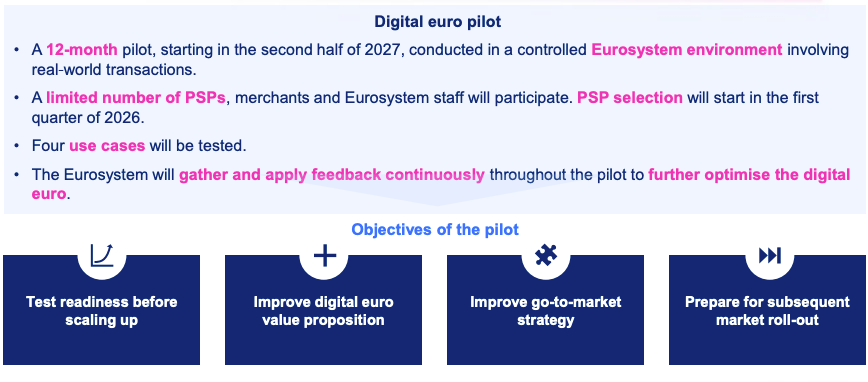
The ECB previously outlined plans to start selecting European Union-licensed payment service providers (PSPs) ahead of a 12-month digital euro pilot expected to start in the second half of 2027.
On Feb. 18, ECB Executive Board Member Piero Cipollone said the pilot would involve a limited number of merchants, Eurosystem staff and PSPs.

While the developments point toward continued progress on a digital euro, the ECB said a final decision on whether to issue it will only be taken after the relevant legislation is adopted.
Magazine: The debate over Bitcoin’s four-year cycle is over: Benjamin Cowen
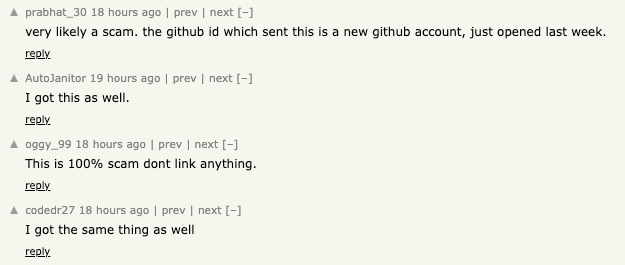
Developers of OpenClaw, a popular open-source AI project, are being targeted by phishing attacks on GitHub with fake token rewards designed to lure users into connecting crypto wallets.
Cybersecurity firm OX Security reported the scam on Wednesday and said it had found no victims so far. OpenClaw creator Peter Steinberger separately warned on X that any emails claiming association with the project are scams, urging users to only visit the official site. “We would never do that. The project is open source and non-commercial,” Steinberger said.
According to OX Security, attackers created fake GitHub accounts that posted messages in repositories they controlled, tagging developers to increase visibility. The posts claimed that recipients had won $5,000 worth of “CLAW,” a non-existent cryptocurrency falsely associated with the project, in an attempt to trick recipients into visiting a cloned website.
The campaign directed users to a cloned website resembling OpenClaw’s official page and prompted them to connect crypto wallets, a common phishing tactic used to steal credentials or secure malicious approvals.

Social media reports suggest that developers were aware of the fraud, with many labeling the campaign as a scam immediately.
OpenClaw creator warned users project would never launch a token
The attack comes months after the OpenClaw creator warned users that the project would never launch a cryptocurrency, and that any token claiming association with him was fraudulent.
“I will never do a coin. Any project that lists me as coin owner is a scam,” Steinberger said in an X post in January.

The phishing campaign marks another attempt by attackers to capitalize on OpenClaw’s viral popularity.
Launched in November 2025, OpenClaw offers a free, open-source autonomous AI agent that runs locally on computers to manage files, software and browser tasks via chat platforms like WhatsApp or Telegram.
Related: Crypto hacks fall to $49M in February as attackers shift to phishing scams
The platform received high GitHub engagement and active social communities, amassing more than 465,000 subscribers on X in the months following its launch.
In a move to fight scams, the OpenClaw project also confirmed a ban on Bitcoin (BTC) and crypto discussions in its official Discord channel in February.
Magazine: 6 massive challenges Bitcoin faces on the road to quantum security


- Institutional demand and ETFs are steadily supporting Solana’s outlook.
- SOL’s price is consolidating, with $115 as a key breakout level to watch.
- High liquidity and leverage may trigger sharp moves soon.
Solana (SOL) has entered a decisive phase where market structure and fundamentals are pulling in different directions.
The SOL price is currently hovering around the $89 level after a period of weakness, and it continues to show signs of building pressure beneath the surface.
This kind of setup often appears before a larger move, especially when liquidity and demand begin to align.
On the broader crypto market, short-term volatility has been driven by profit-taking, shifting sentiment, and changes in leverage across derivatives markets.
At the same time, long-term signals are quietly improving in the background.
Institutional demand and regulatory clarity reshape the outlook
One of the strongest developments supporting Solana is the growing clarity around the regulatory treatment of proof-of-stake assets.
This shift has opened the door for structured financial products tied to Solana. It has also made it easier for institutional investors to participate without directly holding the asset.
The introduction and expansion of exchange-traded products have become a key driver of demand.
These products create a consistent inflow of capital that is less reactive to short-term price movements.
This type of demand tends to accumulate gradually and can support price over time, even during periods of weakness.
At the same time, Solana’s ecosystem continues to expand in meaningful ways.
Stablecoin liquidity on the network has reached record levels, which signals growing participation in decentralized finance (DeFi) and trading activity.
High stablecoin supply often indicates that capital is waiting on the sidelines, ready to deploy when conditions improve.
Derivatives markets are also playing a major role.
Solana’s open interest shows that traders are becoming more active and increasing their exposure.
This creates a more dynamic environment, but it also increases the likelihood of sharp price swings in either direction.
Technical analysis points toward a key breakout zone
From a technical perspective, Solana has been consolidating after a recent rejection near resistance.
The price action suggests that buyers and sellers are currently in balance, with neither side fully in control.
This type of consolidation often precedes a breakout when momentum eventually builds.
The $96.47 level stands out as a critical zone to watch since it represents a region where previous resistance has emerged, and a break above it could signal renewed bullish momentum.

If Solana manages to close above this level with strong volume, it could open the door for a more sustained upward move.
On the downside, the immediate support sits around $77.
A failure to hold this zone could lead to further downside pressure and delay any breakout attempt.

Key Takeaways
- FTX Recovery Trust has announced a $2.2 billion creditor distribution scheduled for March 31, 2026
- The upcoming payment represents the fourth major disbursement following the platform’s 2022 failure, pushing cumulative payouts to approximately $10 billion
- Payment percentages vary by creditor classification, ranging from 5% to 18%, with certain groups achieving full claim recovery
- Numerous claimants argue they remain undercompensated due to distributions calculated using cryptocurrency valuations from 2022 rather than current market rates
- A subsequent distribution is confirmed for May 29, 2026
The bankruptcy trust managing FTX’s asset liquidation has announced plans to proceed with its next significant creditor disbursement following the cryptocurrency platform’s catastrophic failure in November 2022.
BREAKING:
FTX just announced its fourth distribution of $2.2 billion to creditors on March 31st.
Money to flow back in Crypto
pic.twitter.com/8kLdi2887H
— Crypto Rover (@cryptorover) March 18, 2026
According to official statements, the FTX Recovery Trust will release $2.2 billion to qualifying claimants on March 31, 2026. Recipients can expect to receive their allocated funds within one to three business days through designated payment processors including BitGo, Kraken, or Payoneer.
This upcoming disbursement marks the fourth installment under the exchange’s Chapter 11 reorganization framework. While all distributions are denominated in United States dollars, the payment service providers offer beneficiaries the opportunity to exchange their proceeds into cryptocurrency if desired.
The allocation percentages differ across creditor categories for this distribution cycle. Claims from Dotcom customers will receive 18% of their allowed amounts, whereas US customer claims are slated for 5%. Both general unsecured claimants and digital asset loan creditors will see 15% payments. A special classification known as “convenience claims” will achieve a combined 120% recovery rate.
Following this distribution round, multiple creditor classifications will achieve complete claim satisfaction. Specifically, US customers categorized under class 5B, along with claimants in classes 6A and 6B, will reach 100% recovery of their approved claim amounts.
The Controversy Over Valuation Methodology
Notwithstanding the billions distributed to date, numerous claimants maintain they have not received adequate compensation. The primary source of dissatisfaction stems from the calculation method: distributions are computed using cryptocurrency valuations from the November 2022 bankruptcy filing date.
During that period, Bitcoin was valued at approximately $16,871 while Ether traded near $1,258. Both digital assets have appreciated substantially since then, resulting in cryptocurrency holders receiving considerably less purchasing power than their original holdings would currently command.
“FTX creditors are not whole,” stated Sunil Kavuri, an advocate representing creditor interests.
The initial payment wave delivered $1.2 billion in February 2025. A substantially larger $5 billion distribution followed in May 2025, with an additional $1.6 billion disbursed in September 2025. After the March 31 payment completes, aggregate distributions will approximate $10 billion.
Planning continues for a fifth distribution wave scheduled for May 29, 2026. Additionally, the trust has disclosed that preferred equity stakeholders will receive their inaugural distributions on that same date, with April 30 established as the qualification record date. These stakeholders must satisfy ownership certification requirements, complete know-your-customer verification procedures, and submit necessary tax documentation to receive payment.
The Current Status of Sam Bankman-Fried
Sam Bankman-Fried, who founded FTX, received a guilty verdict in 2023 on seven criminal counts encompassing fraud and conspiracy charges, resulting in a 25-year imprisonment sentence.
He has maintained social media activity through a proxy account on X, frequently weighing in on United States political developments. Some analysts interpret this activity as potential groundwork for seeking presidential clemency, although President Trump indicated in January that he would not entertain such a request.
As of March 19, 2026, Bankman-Fried remains incarcerated at Federal Correctional Institution Terminal Island located near Los Angeles. A recent court document filed by his mother indicated that a facility transfer is anticipated within the next several weeks.
The post FTX Bankruptcy Trust Announces $2.2 Billion Creditor Payment for March 2026 appeared first on Blockonomi.
Key Takeaways
- A falling wedge formation is developing on DOGE’s daily chart, a pattern that often signals significant price action ahead.
- Immediate resistance levels are concentrated between $0.105 and $0.11, coinciding with important Fibonacci levels.
- The Relative Strength Index has climbed out of oversold conditions and is nearing neutral territory with modest bullish momentum.
- The 50-day exponential moving average presents a critical overhead obstacle, and a decisive reclaim would signal a potential trend reversal.
- As of March 18, DOGE was hovering around $0.094, reflecting a nearly 5% decline over the previous 24-hour period.
Dogecoin continues to consolidate in the vicinity of $0.10, forming a tightening pattern that has caught the eye of market participants. While historical precedent suggests this setup could lead to significant movement, the immediate outlook remains uncertain.
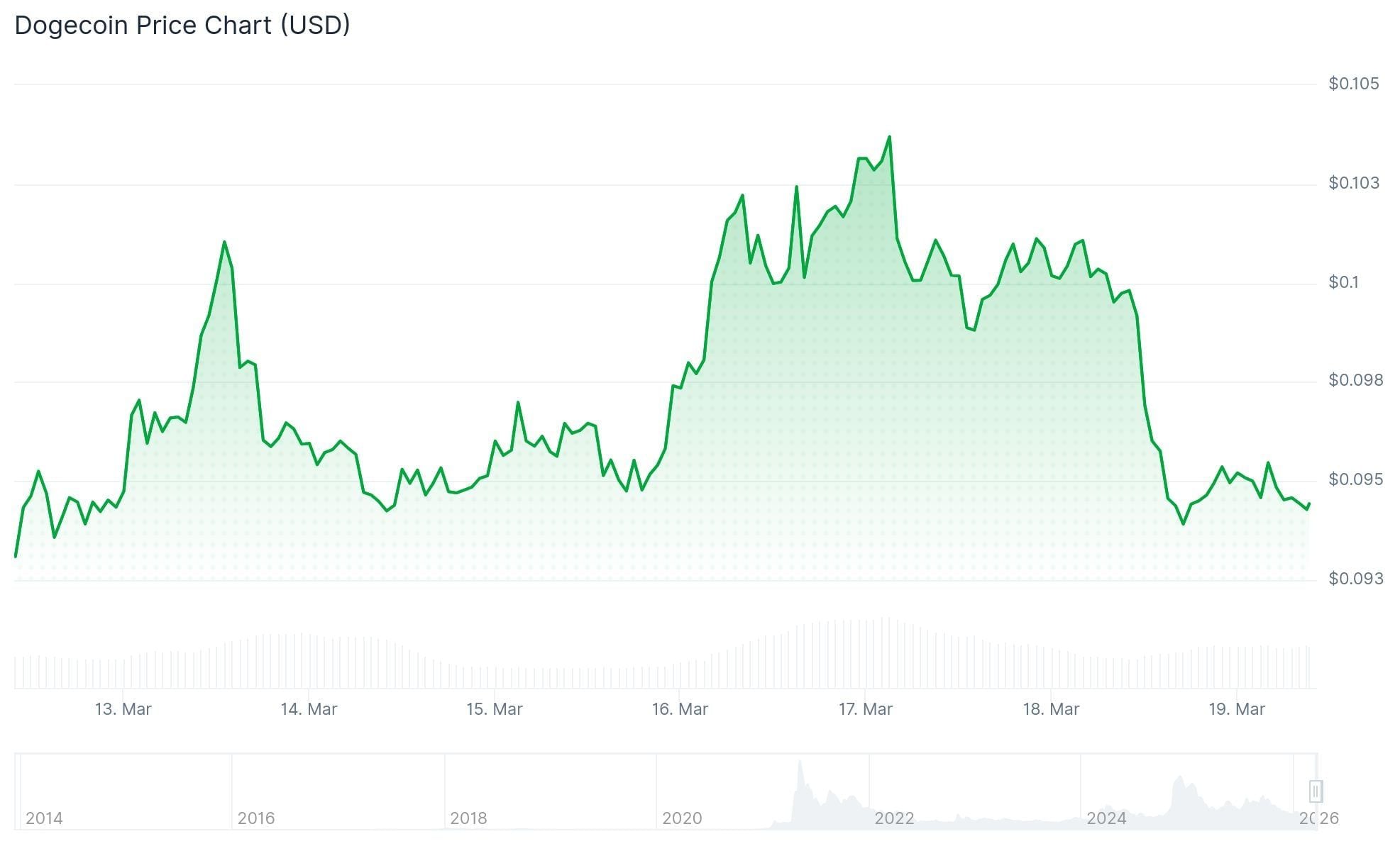
Analysis of the daily timeframe reveals DOGE is developing a classic falling wedge configuration. This technical structure occurs when an asset creates progressively lower peaks while the troughs converge upward. As this price channel narrows, it typically precedes a directional breakout. Long-term holders navigating this decline are anticipating an upward resolution.
The pump on $DOGE should trigger a very nice meme season, historically. pic.twitter.com/lMCUCo34aV
— ray
(@moonbag) March 18, 2026
This compression phase emerged following a pullback from earlier strong performance. Throughout this period, Dogecoin has established descending highs with diminishing selling intensity, indicating potential exhaustion among bearish market participants.
Overhead Resistance Remains Intact
The initial barrier blocking any meaningful bounce lies within the $0.105–$0.11 range. This zone aligns precisely with the 0.5 through 0.618 Fibonacci retracement measurements derived from the latest downward swing. Additionally, this region intersects with clustered short-duration exponential moving averages, creating a concentrated resistance barrier.
Dogecoin has repeatedly approached the $0.10 threshold throughout the past twelve months. On each occasion price pushed above this mark, selling pressure reemerged and drove values lower. Technical observers note this repeated rejection has eroded $0.10’s credibility as dependable support.
A decisive breach above $0.11 could pave the way toward $0.116, with $0.136 as the subsequent target. However, current positioning remains beneath the 50-, 100-, and 200-day moving average indicators, maintaining the prevailing bearish structure.
On March 18, Dogecoin was changing hands near $0.094, reflecting a 4.84% intraday decline.
Breaking the 50-Day EMA Remains Crucial
Even should DOGE successfully navigate past $0.11, the 50-day exponential moving average looms overhead and has shadowed the downward trajectory throughout the correction period. This dynamic indicator continuously adjusts with price action, making any breakthrough increasingly difficult to maintain.
From a historical perspective, successfully recapturing the 50-day EMA has consistently marked the initial legitimate indication of a trend transformation for DOGE. Absent this technical confirmation, market observers view any advance beyond $0.10 as temporary relief rather than meaningful reversal.
The Relative Strength Index has rebounded from deeply oversold readings and currently hovers near the neutral midpoint with modest bullish characteristics. The MACD indicator is similarly positioning for a possible bullish intersection, signaling that downward pressure may be waning.
Current market data confirms DOGE maintains its position above the longer-duration support foundation at $0.086, which marked the most recent localized bottom preceding the current stabilization attempt.
The post Dogecoin (DOGE) Forms Critical Falling Wedge Pattern as Traders Watch $0.10 Level appeared first on Blockonomi.

As AI promises to dramatically compress costs and reshape production, a provocative narrative has taken hold: in an era of AI abundance, virtually everything could become free. Proponents argue that autonomous factories, vast automation, and near-limitless solar energy could push marginal costs toward zero for many goods and services. Yet a closer look at physics, energy economics, and the architecture of infrastructure reveals a more nuanced path from abundance to broad access — one that depends on the ownership and scale of the systems that actually run things.
Opinion by: Merav Ozair, PhD, blockchain and AI senior advisor.
Key takeaways
- Near-zero marginal costs for many digital and even some physical goods are plausible in an AI-driven economy, but energy and AI infrastructure remain the real bottlenecks that prevent a universal “free” regime.
- AI factories — specialized, high-performance data centers and automation platforms — would drive productivity gains, yet they also concentrate wealth and governance power in the hands of a few owners of compute, models, and access.
- Investments in cheap energy, including discussions around fusion and large-scale solar, are central to determining whether abundance can scale. Fusion is still experimental and decades away from commercial viability; fission carries safety and waste concerns, while current grids struggle to support AI-scale workloads.
- Moon-based solar energy and Atomically Precise Manufacturing are presented as pathways to radically reduce costs, but they require unprecedented upfront investment and face substantial technical and logistical hurdles before they could redefine energy economics.
- Even if services become cheaper or “free,” centralized infrastructure risks creating a “soft prison” where control over data, speech, and economic conditions sits with a handful of gatekeepers.
The physics of abundance: why costs won’t disappear
The argument for abundance rests on three pillars: automation that replaces labor, advanced manufacturing and AI-driven logistics that minimize waste and inventory, and energy abundance that makes electricity cheap enough to power widespread production. In combination, these forces could push the marginal cost of many goods toward zero, especially for digital products and services that are replicable at scale.
Automation and AI distribution technologies enable near-continuous production cycles, while innovations such as robotics, 3D printing, and smart logistics reduce the need for extensive human labor and physical stockpiles. Yet even with these advances, energy remains the substrate on which everything else runs. If energy costs drop dramatically, many costs downstream fall with it; if energy remains constrained, the economics of “free” goods become bound to the price of power.
The notion that everything will be free hinges on the assumption that infrastructure can be built and maintained at scale with minimal friction. In practice, the capital outlay for AI factories — data centers whose temperature, latency, and throughput must be precisely managed — is substantial. The article notes that AI infrastructure is becoming an industrialized process, with specialized facilities designed to manufacture intelligence by transforming data into trained models and tokens, rather than merely storing information. The stakes are high: productivity and profits rise as AI amplifies efficiency, but the winners will be those who own and control the core infrastructure.
For those watching the broader technology ecosystem, the emphasis on AI factories and the associated economies of scale helps explain the ongoing shift in valuations and strategic bets toward cloud giants, semiconductor leaders, and hyperscale compute operators. The dynamic resembles earlier industrial eras, where the capacity to own and optimize the underlying engine of production — in this case, AI compute and models — determines who captures outsized gains.
AI factories and the wealth concentration dilemma
The piece frames AI infrastructure as the next industrial revolution, likening it to a pivotal shift in productivity that could dwarf past efficiency gains. Nvidia, AWS, and SpaceX are cited as major players building the backbone of AI systems, with experts noting that productivity and profits will rise as AI-enabled processes scale. The comparison highlights a familiar pattern: as with previous waves of industrial automation, the entities that run the most capable AI factories will likely command outsized profits and influence over how value is allocated.
Structural concentration presents both opportunity and risk for investors and policymakers. On the one hand, leading AI infrastructure providers could offer compelling, long-duration growth narratives grounded in repeated optimization of training, inference, and data workflows. On the other hand, heavy concentration could squeeze competition and shape the distribution of benefits from AI-driven abundance. The article points to a potential divergence between those who own the technology stack — chips, data centers, and AI platforms — and the broader population that might otherwise share in the fruits of increased productivity.
The discussion extends beyond the corporate balance sheet to geopolitical dynamics. The piece notes China’s strategic use of renewable energy to power large-scale AI deployments, underscoring a global race to align energy, data centers, and AI capacity. In such a landscape, policy choices about energy deployment, data sovereignty, and cross-border data flows will matter as much as the physics of energy itself.
Energy frontiers: cheap energy, not cheap electricity
As the article emphasizes, the energy question is the real hinge on the road to abundance. If energy becomes near-free, the economics of AI factories and automated production improve dramatically. If energy remains expensive or constrained, the margin for “free” goods narrows, even with sophisticated automation.
The energy mix under consideration includes traditional options such as nuclear fission, renewables, and potentially future fusion. Fission remains a mature technology, but it comes with long-term waste challenges and proliferation concerns. Fusion, often heralded as the ultimate energy source, remains largely in the research phase and is widely viewed as decades away from commercialization. The current reality is that while fusion could theoretically unlock abundant, cleaner power, it is not yet a practical substitute for scalable, low-cost electricity today.
The piece highlights an ongoing debate: can scalable, cheap energy emerge quickly enough to unlock true abundance, or will the path require a long investment horizon and a gradual shift in how energy and AI infrastructure are financed and deployed?
Moon-based energy and the road to distributed manufacturing
The author surveys Elon Musk’s lunar energy ambitions as part of a broader argument about expanding energy frontiers. The vision here is ambitious: deploying solar power on the Moon to fuel AI infrastructure back on Earth could, in theory, reduce energy costs to near-zero. The envisioned approach involves building autonomous systems — including AI-enabled robots and manufacturing facilities — on the lunar surface, with a network of support from Earth-based systems such as Starlink and other space-oriented capabilities.
Several hurdles accompany this radical idea. The logistics of launching, constructing, and maintaining facilities in a vacuum, coupled with the need for precise manufacturing of advanced AI hardware (potentially via Atomically Precise Manufacturing, or APM), create a formidable capital and technical barrier. Even if lunar fabrication becomes feasible, the question remains who will fund and govern such infrastructure, who will benefit from its outputs, and how the resulting abundance will be distributed.
Nevertheless, the argument that off-Earth energy and materials could eventually reshape cost structures is provocative. If lunar energy and asteroid-derived resources come online at scale, the economics could shift in favor of much more expansive AI deployment and automated production networks. The potential payoff could be immense — potentially extending the reach of AI-enabled abundance far beyond terrestrial limits — but the path is uncertain and expensive.
The soft prison of “free”: control, data, and autonomy
A central warning runs through the discussion: even when access to goods and services becomes cheaper or effectively free, the underlying infrastructure may be highly centralized. Owning the architecture — from data centers to energy supply to manufacturing facilities — implies control over who gets access, under what conditions, and at what price, if any. In a world where “free” is possible primarily because someone else is paying the bill, citizens and users risk trading autonomy for security or convenience. The article argues that many so-called free digital services come at the cost of surveillance, profiling, and behavioral manipulation, turning attention into a form of currency and data into leverage over choices and governance.
In a future of AI abundance, centralization could determine distribution terms, including which individuals or groups enjoy access and under what rules. The blunt reality is that a trillion-dollar opportunity could end up privileging the owners of the centralized infrastructure while leaving broader society with less say over how abundance is allocated. The phrase “if something is free, you are the product” takes on new resonance when the products are self-sovereignty and data rights in a highly automated economy.
Opinion by: Merav Ozair, PhD, blockchain and AI senior advisor.
What to watch next
The coming years will test whether abundance remains a centralized windfall or evolves into a more distributed model where access is genuinely broad-based. For investors and builders, the signals to monitor are energy policy developments, the pace of AI infrastructure rollouts, and regulatory discussions around data rights, space-based manufacturing, and cross-border data flows. The dialogue around Moon-based energy, fusion progress, and the economics of AI factories will shape how quickly and how equitably AI abundance translates into real-world benefits.
As the debate unfolds, readers should follow updates from leading AI and energy initiatives, including coverage of the broader energy transition and the evolving landscape of AI hardware and data-center strategy. The tension between scalable abundance and central control will likely define the next phase of crypto, AI, and tech ecosystem investments.

Hive Digital Technologies announces an AI cloud milestone in Paraguay, describing the development as a step in expanding its cloud capabilities for AI and research. The notice also references Columbia University LLM research spanning New York to Asuncion, indicating the initiative may involve cross-border collaboration or access to regional compute resources. While the full details are not included here, the announcement highlights a shift in the company’s cloud footprint in an important Latin American market. Readers should watch for additional disclosures on scope, participants, and practical implications as the company provides more specifics.
Key points
- AI cloud milestone reached in Paraguay, as described by the company.
- Release references Columbia University LLM research connecting New York and Asuncion.
- Statement implies cross-border compute resources linked to AI research.
Why it matters
The milestone matters because it signals progress in cloud-enabled AI and potential regional access for researchers and institutions. If the initiative enables cross-border collaboration with Columbia University, it could influence how researchers plan experiments, require infrastructure, and coordinate efforts across North and South America. The public details are limited, but the move may shape attention on AI cloud deployments in Latin America and may guide investors and developers monitoring compute availability and academic partnerships in the region.
What to watch
- Clarification of the milestone’s scope, including services and capacity.
- Any partners or institutions involved beyond Columbia University.
- Upcoming disclosures or timelines for broader availability.
Disclosure: The content below is a press release provided by the company or its PR representative. It is published for informational purposes.
HIVE Digital Technologies Reaches AI Cloud Milestone in Paraguay, Powers Columbia University LLM Research from New York to Asunción
This news release constitutes a “designated news release” for the purposes of the Company’s prospectus supplement dated November 25, 2025 to its short form base shelf prospectus dated October 31, 2025.
San Antonio, Texas, March 18, 2026 — HIVE Digital Technologies Ltd. (TSX.V: HIVE) (Nasdaq: HIVE) (FSE: YO0) (BVC: HIVECO) (the “Company” or “HIVE”), a global leader in sustainable digital infrastructure and AI compute, today announced that its BUZZ AI Cloud platform in Asunción, Paraguay is now operational with live GPU compute nodes serving workloads on the platform by an academic research team from Columbia University in New York.
The Asunción deployment is the first GPU cluster to go live under HIVE’s phased strategy to layer AI and high-performance computing (“HPC”) infrastructure onto its existing renewable energy footprint in Paraguay. The cluster is hosted within a Tier-III data center operated by Paraguay’s largest telecommunications provider and is purpose-built to handle AI model training, inference, and computationally intensive research workloads.
HIVE expects to use the results of the cluster to establish the proof of concept for AI compute between New York and Asuncion. From this proof-of-concept, the Company expects to build future Tier III data center capacity in Yguazú, with infrastructure upgrades required to provide high-availability, low-latency GPU AI cloud compute from Paraguay. Paraguay’s hydroelectric generation capacity and the telecom partner’s nationwide fiber backbone provide the energy and connectivity foundation to support that growth. As regional South American institutional and commercial demand for HPC and AI Cloud develops, the pace and scale of the Company’s Tier III expansion in Paraguay will be guided by customer adoption and the Company’s capital position.
Columbia University Research Team Goes Live on BUZZ Cloud
The Columbia University team is using BUZZ Cloud GPU infrastructure to conduct research focused on large language model (“LLM”) pre-training, including end-to-end training of foundation models. The research team’s use of BUZZ Cloud infrastructure is a non-commercial research engagement intended to generate performance data that will inform the Company’s roadmap for scaling commercial HPC capacity in Paraguay. The team is developing optimization algorithms that improve model quality while reducing computational and memory costs, evaluating their methods using standard training metrics such as loss and perplexity, as well as downstream benchmarks.
Their work begins with small- to medium-scale models (0.2B to 2B parameters, including GPT-2-class and LLaMA-style architectures) and is scaling to larger models (8B+ parameters) using multi-GPU distributed training frameworks. The team’s recent focus includes improving and understanding Muon and MuonClip, the latter of which has been used in training industry-level LLMs such as Kimi K2. In early experiments, Muon has shown roughly 1.3x greater efficiency¹ than standard baselines by exploiting the structure of model weights. The team’s LLM reasoning research was recently accepted for publication by Transactions on Machine Learning Research (“TMLR”), a peer-reviewed journal hosted by the Journal of Machine Learning Research (“JMLR”).
Having the Columbia University research team run active LLM training jobs from New York on GPU infrastructure in Asunción provides HIVE with real-world performance data across latency, throughput, and workload management. The Company intends to use these findings to shape its roadmap for scaling HPC capacity in Paraguay, with initial deployment targets through 2027.
Paraguay: The Western Hemisphere’s Next Potential AI Infrastructure Frontier
Paraguay’s President Santiago Peña earned his Master’s degree in Public Administration from Columbia’s School of International and Public Affairs (“SIPA”) in 2003, creating a notable link between the institution whose researchers are now training LLMs on BUZZ Cloud and the nation whose clean energy powers it.
Management believes large-scale AI compute requires two resources Paraguay can deliver in abundance: reliable, low-cost electricity and fiber connectivity with the bandwidth and security to move data across long distances without degradation. HIVE’s existing 300-megawatt (“MW”) renewable power base, sourced from hydroelectric generation, combined with the telecom partner’s enterprise-grade network infrastructure, creates a platform that can serve demanding workloads originating outside Paraguay’s borders, including from North American institutional clients.
Paraguay’s economy has posted strong growth in recent quarters, backed by stable governance and a policy environment that has welcomed foreign infrastructure investment. HIVE believes those conditions, paired with the country’s distinctive energy profile and expanding digital connectivity, position the country to play a growing role in South America’s AI and high-performance computing future.
Strategic Outlook from HIVE Leadership
Frank Holmes, Executive Chairman of HIVE, stated, “HIVE has 300 MW of renewable hydroelectric power operational in Paraguay, with another 100 MW in development. Before scaling an AI factory, it’s prudent to beta test. This deployment marks our first live GPU compute workload in Asuncion and provides the real-world performance data we need to guide our Tier-III expansion roadmap. We started in Paraguay with Bitcoin mining. Layering AI and HPC infrastructure onto that existing energy base is the next phase, and this cluster is the first step in validating that approach.”
Aydin Kilic, President and CEO of HIVE, added, “We are taking a meaningful and impactful approach to developing a solution to being a leader of GPU AI compute and HPC in South America. Having a research team from Columbia University running LLM training workloads on HIVE’s BUZZ Cloud infrastructure in Asunción is a powerful validation of what we are building. We will use this data to validate our proof of concept for GPU Cloud AI compute from New York to Asunción and to build our roadmap for large-scale HPC capacity in Paraguay by 2027.”
About HIVE Digital Technologies Ltd.
Founded in 2017, HIVE Digital Technologies Ltd. is the first publicly listed company to mine digital assets powered by green energy. Today, HIVE builds and operates next-generation Tier-I and Tier-III data centers across Canada, Sweden, and Paraguay, serving both Bitcoin and high-performance computing clients. HIVE’s twin-turbo engine infrastructure-driven by hashrate services and GPU-accelerated AI computing-delivers scalable, environmentally responsible solutions for the digital economy.
For more information, visit hivedigitaltech.com, or connect with us on:
X: https://x.com/HIVEDigitalTech
YouTube: https://www.youtube.com/@HIVEDigitalTech
Instagram: https://www.instagram.com/hivedigitaltechnologies/
LinkedIn: https://linkedin.com/company/hiveblockchain
On Behalf of HIVE Digital Technologies Ltd.
“Frank Holmes”
Executive Chairman
For further information, please contact:
Nathan Fast, Director of Marketing and Branding
Frank Holmes, Executive Chairman
Aydin Kilic, President & CEO
Tel: (604) 664-1078
¹ Claim of efficiency relates to research methods
Neither the TSX Venture Exchange nor its Regulation Services Provider (as that term is defined in policies of the TSX Venture Exchange) accepts responsibility for the adequacy or accuracy of this news release.
Forward-Looking Information
Except for the statements of historical fact, this news release contains “forward-looking information” within the meaning of applicable Canadian securities laws, which may include but is not limited to statements regarding: the performance of the BUZZ AI Cloud platform in Asunción, Paraguay; the ability to replicate and scale this performance; the benefits and advantages of power supply and Internet connectivity in Paraguay, the reorientation of the Swedish facilities to HPC standards; the expected deployment, timing, capacity, and expansion of BUZZ HPC’s GPU-accelerated infrastructure in general; and any other future-oriented statements. Forward-looking information is based on current expectations, estimates, forecasts, and projections, as well as management’s beliefs and assumptions, including that the benefits of the operations in Paraguay can be replicated and scaled, infrastructure will be deployed on the expected timelines and within budget across all sites, demand for AI computing will continue to grow, and regulatory requirements will remain consistent with current expectations, and other related risks as more fully set out in the Company’s disclosure documents under the Company’s filings at www.sec.gov/EDGAR and www.sedarplus.ca.
Forward-looking information involves known and unknown risks, uncertainties, and other factors that may cause actual results, performance, or achievements to differ materially from those expressed or implied by such forward-looking information. Such factors include, but are not limited to the following risks: deployment timelines may change; costs may exceed expectations; performance expectations may not be achieved; demand for AI infrastructure may be lower than anticipated; partnerships or regulatory approvals may not materialize as expected; and the risk factors described in the Company’s continuous disclosure documents available on SEDAR+ at www.sedarplus.ca. Readers are cautioned not to place undue reliance on forward-looking information. The Company disclaims any obligation to update or revise any forward-looking information, whether as a result of new information, future events, or otherwise, except as required by law.
Bitcoin Dips Below $70K After FOMC Meeting, Ethereum Loses $2.2K Support: Market Watch

Iran to play FIFA World Cup but ‘boycott’ US amid Donald Trump’s ‘safety’ warning | Football News

The Fight to Hold AI Companies Accountable for Children’s Deaths


-
 Crypto World5 days ago
HYPE Token Enters Net Deflation as HyperCore Buybacks Outpace Staking Rewards
-

 Tech4 days ago
Your Legally Registered ‘Motorcycle’ Might Not Count Under Proposed US Law
-

 Fashion6 days ago
Weekend Open Thread: Addict Lip Glow
-
 Tech2 days ago
Are Split Spacebars the Next Big Gaming Keyboard Trend?
-
Sports5 days ago
Why Duke and Michigan Are Dead Even Entering Selection Sunday
-

 Business4 days ago
Search for Savannah Guthrie’s Mother Enters Seventh Week with No Arrests
-

 Business5 days ago
US Airports Launch Donation Drives for Unpaid TSA Workers as Partial Government Shutdown Enters Fifth Week
-
Crypto World5 days ago
Coinbase and Bybit in Investment Talks: Could Bybit Finally Enter the US Crypto Market?
-

 Business3 days ago
Australian shares drop as Iran war enters third week
-

 Business5 days ago
Country star Brantley Gilbert enters growing non-alcoholic beer market
-

 Crypto World3 days ago
Crypto Lender BlockFills Enters Chapter 11 with Up to $500M in Liabilities
-

 Sports6 days ago
College Basketball Best Bets: Conference Tournament Semifinal Picks
-

 Politics1 day ago
The House | The new register to protect children from their abusers shows Parliament at its best
-

 Business7 days ago
Trump demands Powell cut rates as Iran conflict raises energy prices
-

 Fashion3 days ago
25 Celebrities with Curly Hair That Are Naturally Beautiful
-

 News Videos17 hours ago
RBA board divided on rate cut, unusually buoyant share market | Finance Report | ABC NEWS
-

 Crypto World7 days ago
Senate Votes to Include CBDC Ban in Bipartisan Housing Bill
-

 NewsBeat7 days ago
Deane Road crash near Bolton colleges and university
-

 News Videos7 days ago
Tom Lee: The 100x Opportunity EVEN Bigger Than Bitcoin (New Ethereum Prediction 2026)
-

 Crypto World17 hours ago
Canada’s FINTRAC revokes registrations of 23 crypto MSBs in AML crackdown


You must be logged in to post a comment Login