
Crypto World
Agent Arc: Infrastructure for Autonomous Capital


Markets don’t sleep. Humans do.
That mismatch is no longer sustainable.
Agent Arc is built on a simple thesis: capital should be able to operate autonomously, continuously, and safely—without emotional interference, latency bottlenecks, or opaque decision-making.
This isn’t another “AI trading bot.” It’s infrastructure for autonomous market execution.
What Is Agent Arc?
Agent Arc is both a data layer and an execution infrastructure designed to run autonomous agents in live markets—24/7, constraint-aware, and fully observable.
The system is built around three non-negotiables:
- Continuous operation
- Enforced risk at the system level
- Full legibility into what the agent is doing and why
No black boxes. No discretionary panic clicks.
The Autonomous Execution Layer
At the core of Agent Arc is a high-performance execution engine that operates directly on user-connected exchange accounts using secure, non-custodial APIs.
Agents:
- Monitor markets in real time
- Execute trades autonomously
- Optimize for latency, liquidity, and capital efficiency
- Enforce strict risk limits on every action
Humans define the rules.
Agents execute them without hesitation or fatigue.
This is execution as infrastructure—not suggestion.
Intelligence & Decision Layer
Agent Arc doesn’t rely on static rules or fragile indicators.
Instead, it processes:
- Market structure
- Price action
- Volatility
- Liquidity
- Sentiment and narrative signals
These inputs are fused into a unified market view. Decisions adapt dynamically as regimes shift. Importantly, decisions are treated as execution inputs, not predictions.
Every action is continuously evaluated against exposure, leverage, and risk constraints.
No vibes. No guesswork. Just enforced logic.
Control & Legibility: The Arc Terminal
Autonomous doesn’t mean opaque.
The Arc Terminal provides a natural-language interface where users can:
- Query portfolio state
- Inspect trade rationale
- Understand exposure and positioning
- See market context in real time
The system explains itself while it runs.
Execution never pauses. Understanding never lags.
Risk Is Enforced, Not Optional
Agent Arc doesn’t ask you to “manage risk.”
It enforces it mechanically.
Risk controls include:
- Position sizing
- Leverage caps
- Exposure limits
- Stop conditions
All applied automatically across agents and venues.
This design intentionally removes emotional intervention while still allowing users to adjust constraints whenever they choose. You control the boundaries. The system enforces them without exception.
Modular by Design
Agent Arc is not a monolith.
Agents are modular. New strategies, execution logic, and intelligence layers can be introduced without disrupting the core infrastructure.
The first reference agent running on this architecture is PSYOPS.
PSYOPS: The Execution Core of Agent Arc
PSYOPS isn’t “a strategy.”
It’s the canonical execution and capital allocation agent of the Agent Arc platform.
Agent Arc provides the infrastructure.
PSYOPS is how capital actually moves.
What PSYOPS Is (and Isn’t)
PSYOPS is not:
- A discretionary trading product
- A copy-trade bot
- A black-box signal feed
PSYOPS defines the baseline execution logic, risk posture, and capital behavior of Agent Arc.
All future agents inherit from this framework instead of competing with it—preventing capital fragmentation and allowing execution intelligence to compound system-wide.
Execution Framework: Statistical Arbitrage, Done Properly
PSYOPS is built around a statistical arbitrage framework optimized for autonomous execution.
Key characteristics:
- Dynamic long and short exposure
- Broad asset universe
- Market-unbiased structure
- Focus on relative inefficiencies, not price direction
By maintaining 20 long and 20 short positions, PSYOPS minimizes reliance on market direction while targeting dispersion and mean reversion.
This approach scales with:
- Discipline
- Speed
- Consistency
Which, conveniently, are things machines are very good at.
Context-Aware, Not Discretionary
Statistical arbitrage is the backbone—but PSYOPS isn’t blind.
Sentiment and narrative signals are incorporated as contextual inputs that influence:
- Confidence
- Timing
- Regime interpretation
They do not override the execution framework.
They refine it.
The result: a system that remains market-unbiased while adapting to the reflexive, sentiment-driven nature of crypto markets.
Non-Custodial by Design
PSYOPS never takes custody of funds.
Execution happens directly on your own exchange account via secure APIs.
- Trades settle in your account
- Risk is enforced where capital actually moves
- No withdrawal permissions
- No custody risk
This is accountability at the execution layer.
Why PSYOPS Sits at the Center
PSYOPS is the economic center of gravity within Agent Arc.
Future agents—whether asset-specific, research-driven, or time-horizon-based—will:
- Inherit its execution logic
- Share its risk framework
- Compound improvements across the system
This is how autonomous capital scales without turning into a spaghetti bowl of competing bots.
How to Get Started with PSYOPS
Step 1: Check Access
Connect a wallet that meets the token-gated requirement by staking $PSYOPS.
Supported on BASE and EVM-compatible wallets.
Step 2: Connect Your Exchange
PSYOPS currently supports Binance Futures.
Important (read this twice):
PSYOPS uses the entire available USDT balance in the connected account.
Strongly recommended:
Use a dedicated Binance sub-account.
Steps:
-
Create a Binance sub-account
-
Fund it with your desired USDT allocation
-
Generate API keys (Futures + Read only, no withdrawals)
-
Connect via the Agent Arc dashboard
Step 3: Deploy and Monitor
Click Start PSYOPS.
From there:
Monitor everything in real time:
-
PnL
-
Trades
-
Open positions
-
Historical performance
Trading Architecture Overview
-
Exchange Connectivity: Binance Perpetual Futures (CEX)
-
Signal Generation: Deep neural network trained on price, volatility, and technical data
-
Portfolio Logic: Market-unbiased long/short allocation
-
Risk Management: Dynamic SL/TP, volatility-adjusted parameters
No pauses. No discretion. Just execution.
$PSYOPS Token Utility
$PSYOPS isn’t decorative.
It powers the ecosystem:
A portion of platform fees may be allocated to token sinks or ecosystem incentives—designed to align usage with long-term system health (not profit promises, not yield theater).
Roadmap Snapshot
Phase 1 – Closed Beta
Phase 2 – Expansion
Phase 3 – Open Beta
Phase 4 – Long-Term Core
-
PSYOPS as a stable execution engine
-
Vault and capital routing integrations
-
Execution APIs for other agents and apps
Final Thought
Agent Arc isn’t betting on better predictions.
It’s betting on better execution.
PSYOPS proves that autonomous agents can:
In markets that punish emotion and latency, autonomy isn’t optional anymore.
It’s inevitable.
FOR REFERENCE
Website | X(Twitter) | Telegram | Discord
REQUEST AN ARTICLE

Disclosure: This article does not represent investment advice. The content and materials featured on this page are for educational purposes only.
Elena Sadovskaya reflects on how experience and shifting crypto regulation shape Inteliumlaw’s hands-on, long-term legal approach.
Summary
- Elena’s early experience at a Big Four firm shaped a practical, hands-on approach to complex cross-border structuring and high-stakes regulatory work.
- Inteliumlaw’s growth has been driven by MiCA-era demand, with CASP licensing and EU-compliant token listings becoming core client needs in 2025.
- Elena sees crypto’s future defined by adaptation: firms that treat regulation as a strategic framework, not an obstacle, are the ones built to last.
Navigating international business structuring in today’s regulatory climate is rarely straightforward, especially for companies operating across borders and emerging sectors like crypto. To better understand how legal professionals approach this complexity in practice, we spoke to Inteliumlaw’s Elena Sadovskaya about how her early experience studying law and later working at Ernst & Young shaped her thinking. Here’s what she had to say.
Hi Elena! Can you share with us how your experience practicing law during the 2nd year of university and later working at a firm like Ernst & Young influenced the way you approach complex international business structuring today?
Elena: Spending almost 4 years at a Big 4 company, Ernst & Young (E&Y), has truly felt like the equivalent of a whole 10 years at most other consulting firms. During this period, I frequently managed multiple tax and transaction structuring projects in parallel for major international clients across a range of industries. Every time it was working with significant deals, large transactions, and high-profile cases, which all allowed me to develop a strong grasp of how large businesses work and what their legal needs are. Most importantly, however, it all sharpened my understanding of how lawyers can guide them through different situations – be it shifting laws at home base, international scaling, heightened regulator attention, or other complex challenges – with tailored solutions.
Now, for Inteliumlaw, neither “impossible” nor “unresolved” cases are part of our vocabulary. With hands-on experience as lawyers for major firms and high-profile cases, we have the necessary know-how to provide robust support for enterprises and also help small businesses eventually grow into larger organizations.
At Inteliumlaw, we uphold the highest standards of work in everything we do, based on our experience with large, sophisticated businesses and a clear understanding of the level of quality they expect and shall get from legal advisers. A core part of these standards is a genuinely responsive attitude to projects we work with, where my overtime experience at E&Y showed how far a law firm must go so that the project gets the desired quality. Today, this enables us to effectively advise on complex international business structuring and other critical legal matters.
In a recent big interview, you shared that Inteliumlaw grew from a small circle of experts to a full-fledged law firm specializing in crypto licensing and other blockchain legal services. What new services or solutions did you introduce in 2025? Which ones have become “bestsellers” among your clients in crypto?
Elena: Last year was extremely fast-paced for all of us at Inteliumlaw. As regulations continued to evolve, we expanded and diversified our legal solutions to meet the demands of modern businesses.
For the crypto sector, we introduced an opportunity to obtain a CASP license in a select few jurisdictions like Poland, the Czech Republic, Lithuania, Cyprus, and beyond. These countries’ licensing conditions went through our rigorous internal analysis and were deemed the most favorable and relevant after MiCA entered into force and replaced the legacy VASP license. In parallel, our scope has expanded to include DAO structuring in the Marshall Islands and RAK, a foundation in Panama, alongside securing a crypto license in UAE (Dubai, VARA), El Salvador, and other markets where a VASP license currently presents a meaningful opportunity. Our website is being gradually updated to reflect the complete range of services we can support you with.
When it comes to “best sellers,” it is hard to highlight something in particular as the answer largely lies in regulatory development, including newly emerged regimes, shifts in current rules, and the scale of adaptation expected from businesses. This year, it was all centered around Markets in Crypto-Assets (MiCA) regulation, and our main focus was assisting firms to adapt to this new reality. Now, Inteliumlaw advises firms on getting a CASP license and delivers end-to-end MiCA-relevant support for token issuance, exchange listings, DeFi project launch, and the preparation of MiCA-compliant white papers and the notification submission process.
Therefore, I could say that our 2025 best-seller request was securing a CASP license and listing a token in Europe with MICA-compliant white papers, where we provide end-to-end, hands-on support through every stage of the process.
Your firm positions itself as a long-term strategic partner rather than a traditional legal service provider. How do you maintain that level of involvement with clients?
Elena: What we do is not just some careless execution of the client order made on autopilot. Rather, every Inteliumlaw client receives a customized approach designed to serve their interests in the most effective way. Our goal is to build long-term relationships with our clients, not driven by “capitalist motives,” but because this is the only way we can always stay on top of their current needs and help them grow a business that will sustain in the long term. When our clients grow, so do we.
As part of our customised approach, we ensure every client has a dedicated manager for their project from day one. In this case, they always have a point of contact who coordinates the project and maintains a 24/7 insight into the client’s status and needs, allowing us to offer the right legal solution.
When maintaining continuous involvement with the client and their needs, for instance, our lawyers continuously analyze the regulations in their home base and in their target expansion markets, helping identify what they might be exposed to early, help them adapt, and advise on the alternatives if needed. Most importantly, we do not walk away when the stakes rise and never leave clients in complex cases, but are actively engaged in finding the best possible solution for them. It makes our life a little bit more complicated compared to other law firms, but it is a principle we do not compromise on.
Many crypto entrepreneurs feel that regulation kills innovation. From your perspective, is this a fair statement? What is your opinion?
Elena: In many cases, yes, though it highly depends on the jurisdiction and its regulation, where the “killing innovation” narrative often stems from authorities imposing unrealistic expectations that far outpace current realities. In some cases, regulators could have opted for a less strict approach to some aspects, which would ultimately lead to minimized conflict and a slower pace of innovation and new projects’ development.
On the other side, without regulation as it is, projects cannot exist. Yet, reacting promptly to different changes can keep the project stable and demonstrate credibility to the market. In practice, the strongest players on the market today are those who are able to adapt to the regulatory expectations; this is what defines the long-term sustainability and how a project gains trust from customers.
An unregulated industry certainly equals much more space for projects that are not reliable. So the ultimate question here is to strike a balance, a “golden mean,” which, in most cases, simply doesn’t exist, making businesses’ lives more complicated.
When a new crypto business approaches you with a request, what are the first questions you ask before even talking about jurisdictions, licenses, or other legal support?
Elena: The very first thing we discuss before everything is each project’s operational model and details of how they function, ensuring we understand the business almost as if we are the one and only founder. This is the foundation of everything: from jurisdiction-based classification of their project and the subsequent regulations applicable to which legal solution(s) we can deliver to best fit the project’s needs.
Luxury ateliers never proceed to manufacturing a tailored suit without taking precise measurements. Our approach is no different. Based on the client’s near- and long-term goals, vision, and the detailed specifics of their work, we advise on the solutions that best match their needs.
Without clear, detailed answers upfront, any discussion of how we can assist would be irrelevant. A minor oversight of a tiny detail can make a tailored suit feel suffocating. Likewise, a small nuance can completely change the course and redefine what the right solution looks like.
How do you evaluate which crypto license is optimal for a client’s business model? Especially, how does this process go for choosing an EU jurisdiction for getting a CASP license?
Elena: Long before the client reaches out, a preliminary analysis has typically been made internally. Every jurisdiction is carefully reviewed for the requirements and the regulator’s approach to issuing licenses, so we understand the level of complexity involved and identify which businesses are most likely to pass through the process.
When the client approaches us, we carry out an in-depth analysis of their setup and objectives. We explore token issuance plans, targeted markets for expansion, where the team is located, and a lot more to shape a compliant strategy. Only after assessing licensing complexity, the client’s objectives, and the budget allocated to ongoing compliance can we recommend the most suitable alternative.
MiCA has completely reshaped how crypto businesses must operate in Europe. What is the biggest misconception companies still have about this regulation?
Elena: Working with crypto firms worldwide – including those already serving EU clients or planning to enter the market – I see one misconception more than any other: many still misunderstand the difference between a VASP and a CASP, assuming they can still onboard EU customers without securing the new authorization. This is especially the case with firms registered in offshore regimes with little oversight. In fact, they can’t.
This misconception is similarly prevalent among companies previously having VASP in Poland and other EU countries. Where firms were not prepared to meet higher requirements beyond their “light-touch” setup, it is becoming hard to adapt to substance requirements, organize client workflows, and develop comprehensive documentation. For businesses already operating in tightly regulated regimes, the transition is typically smoother.
So, I would say the biggest myth now is that a business can still operate as before, targeting Europe while being registered in an unregulated jurisdiction or one known for little oversight. These times are now officially over. Even more concerning is that, in 2026, some still believe crypto is unregulated; it is regulated.
In a recent interview, you called the UAE “one of the most promising global hubs for crypto and Web.” What specific regulatory or economic features give the UAE an edge over Europe or the US?
Elena: What makes them different is their vast resources, readiness, and willingness to invest substantially in the crypto sector, all with the focus on innovation. The UAE is home to lots of corporations with a significant appetite to invest and lead in crypto, which is why there is a consistent effort to shape a regulatory environment that accelerates growth.
The UAE’s approach is truly something unique now. Where Europe tries to follow US standards with an even more stringent rule, the UAE chooses a more liberal option and approaches it more like an opportunity to strengthen the economy. The EU treats crypto much like early societies treated fire: extremely dangerous without control. That’s why the regulation is made to avoid fraud, protect customers, and reduce the room for unreliable projects.
The UAE, on the other hand, is not afraid to introduce something new. It is therefore unsurprising that they have higher adoption rates, new solutions appear faster, and central bank digital coins are being adopted much sooner than anywhere else in the world.
Imagine you can design a new “ideal” crypto jurisdiction by combining elements of 3 already-existing regimes, which would you select and why?
Elena: There is no real need to merge 3 regimes when we can choose one framework as the core and make small adjustments.
In essence, the ideal crypto jurisdiction would match the UAE innovation-first model while offering a less complex procedure to roll out in the region(s). The process of issuing authorization permits (licenses) and understanding projects’ specifics is way too overwhelming now in the UAE. Even so, however, the select few who successfully make it through the process – often after months of waiting for the regulator’s feedback, sometimes only for minor clarifications – ultimately gain access to everything the jurisdiction has to offer.
Subsequently, rationalizing this process to the extent possible would materially strengthen the jurisdiction’s reputation as a crypto-friendly hub, making it the #1 or very close to this status.
In your experience, what are the most underestimated risks when crypto businesses operate “non-compliant but profitable,” beyond fines and license revocation?
Elena: It all comes down to the severity of non-compliance. On the administrative level, there are fines of different sizes and, in the worst cases, license revocations. Yet this is not the greatest fear of most businesses.
The most horrifying skeleton in the closet is when a case turns to criminal law, and the impact goes beyond the project finances to human lives. There are numerous high-profile cases where exchange executives are arrested and prosecuted for money laundering, and this is precisely what everyone wants to avoid.
We’ve learned that you’ve designed over 50 tax-efficient and future-proof structures while also supporting multimillion-dollar deals. Which projects are you the most proud of and why?
Elena: It’s honestly difficult to single out just one project, because every structure we design at Inteliumlaw is built around a very specific business and risk profile. Each of them is its own story, and behind every “successful structure” there are months of very detailed, customized legal, tax, and regulatory work.
That said, I’m especially proud of the projects where we supported businesses from a very early stage and further during their growth into well-known brands. There’s something very rewarding about knowing you didn’t just advise on a structure but helped build the strong legal foundation that allowed the company to scale safely.
In the crypto and web3 space specifically, we’ve worked on a wide range of complex matters: from tokenization of real-world assets (including immovable property) and structuring decentralized exchange and trading infrastructure projects to token issuance and token classification, governance models, and cross-border tax and corporate setups for founders and groups. We’ve also supported projects building trading terminals, platforms, and hybrid web2/web3 models.
What I’m most proud of is not just the number of structures we’ve built, but the fact that many of them were designed to be “future-proof.”
And lastly, what regulatory developments in crypto do you anticipate in 2026? Most importantly, do you think the primary regulatory risk for crypto firms will come from new laws or from aggressive reinterpretation of rules that already exist today?
Elena: 2026 will be a very important year for regulatory consolidation in crypto, especially in Europe. First of all, we expect the expiration of the MiCA grandfathering period around mid-2026, which will force many existing VASP-style structures to either become fully licensed CASPs or exit the market. In practice, this will mean a major clean-up of the industry, with higher compliance costs but also a much clearer regulatory perimeter for serious players.
At the same time, we expect increasing global pressure on so-called “regulatory gap” jurisdictions. Many offshore and semi-offshore hubs that historically served crypto businesses precisely because of lighter regulation will likely introduce more formal crypto frameworks, licensing regimes, and substance requirements. We’re already seeing the early stages of this trend.
On the structural side, I think we’ll see more legally recognized DAOs and on-chain governance models entering the mainstream. But in parallel, decentralized and hybrid web3 projects will continue to move under closer regulatory scrutiny, especially where there is any element of custody, intermediation, token distribution, or profit expectation.
As for regulatory risk, it will likely come from both sides: new laws and aggressive reinterpretation of existing rules. In practice, enforcement and re-qualification under existing financial, securities, AML, and consumer protection regimes may be just as disruptive as brand-new legislation. The industry is maturing, but companies should plan for a tougher, more enforcement-driven environment in the near term.
Disclosure: This content is provided by a third party. Neither crypto.news nor the author of this article endorses any product mentioned on this page. Users should conduct their own research before taking any action related to the company.
Crypto World
BitGo and InvestiFi Partner to Bring Digital Asset Trading to U.S. Financial Institutions

TLDR:
- BitGo and InvestiFi partnership enables banks and credit unions to offer crypto trading in all 50 states.
- Partnership leverages BitGo’s OCC-regulated infrastructure for compliant cryptocurrency services delivery.
- InvestiFi integrates digital asset trading into existing bank accounts through institutional custody solutions.
- BitGo’s CaaS platform provides API-driven framework for financial institutions entering crypto markets.
BitGo Bank & Trust, National Association has formed a partnership with InvestiFi to deliver digital asset trading capabilities to banks and credit unions nationwide.
The collaboration leverages BitGo’s Crypto-as-a-Service infrastructure to provide secure digital asset solutions across all 50 U.S. states.
This partnership enables financial institutions to offer their customers access to cryptocurrency trading through existing InvestiFi accounts. The initiative addresses growing demand for digital asset services within traditional banking frameworks.
Nationwide Digital Asset Trading Through Institutional Infrastructure
InvestiFi will now provide digital asset trading services to its network of partner banks and credit unions in every state.
The platform integrates directly with existing financial institution systems, allowing account holders to trade cryptocurrencies from their current accounts.
This expansion relies on BitGo’s institutional-grade custody and infrastructure solutions. The partnership removes geographic barriers that previously limited digital asset access for many financial institutions.
BitGo operates as a federally regulated digital asset trust bank under Office of the Comptroller of the Currency supervision.
This regulatory status provides a compliant framework for institutions seeking to offer cryptocurrency services. The partnership specifically addresses challenges in complex jurisdictions including New York, Texas, and Idaho.
Financial institutions can now deploy digital asset capabilities while maintaining regulatory compliance standards.
The collaboration between the two companies was announced through official channels. BitGo shared the news on social media, noting that InvestiFi now offers expanded digital asset coverage with OCC-chartered federal oversight.
This enables partner banks and credit unions to deliver secure trading nationwide. The announcement emphasized the role of BitGo’s CaaS infrastructure in powering the expanded services.
Traditional financial institutions require robust custody solutions and scalable infrastructure for digital asset integration.
InvestiFi addresses these needs through its purpose-built platform designed for credit unions and community banks.
The integration maintains a multi-custodian approach while utilizing BitGo’s institutional framework. This structure allows financial institutions to offer cryptocurrency services without building proprietary infrastructure.
Regulatory Framework and API-Driven Solutions
BitGo’s CEO and Co-Founder Mike Belshe commented on the partnership’s strategic direction and institutional focus. “This partnership reflects what banks and credit unions expect when offering digital asset capabilities – security, strong controls, and a regulated foundation,” Belshe stated.
He added that BitGo’s CaaS platform is built to support partners like InvestiFi with infrastructure that aligns with traditional financial institutions.
The statement reinforces the company’s commitment to meeting regulatory and operational standards expected by established financial entities.
InvestiFi CEO Kian Sarresheteh addressed the platform’s approach to integrating cryptocurrency services within traditional banking systems. “Our platform is designed to integrate digital asset investing into the existing banking experience, and that requires institutional-grade infrastructure and custody,” Sarresheteh explained.
He noted that working with BitGo supports the company’s ability to provide secure digital asset services to banks and credit unions nationwide.
The partnership maintains InvestiFi’s multi-custodian approach while expanding service capabilities across all states.
BitGo’s CaaS solution provides an API-driven framework for fintech companies and financial institutions. The platform offers bank-grade qualified custody designed for digital asset trading workflows.
Financial institutions can access these capabilities through standardized integration points. This reduces technical barriers for institutions entering the digital asset space.
The partnership reflects broader trends in digital asset adoption among traditional financial institutions. Banks and credit unions increasingly seek compliant pathways to offer cryptocurrency services to customers.
Partnerships between regulated infrastructure providers and platform companies create these pathways. The collaboration between BitGo and InvestiFi demonstrates one model for delivering digital assets through existing financial channels.

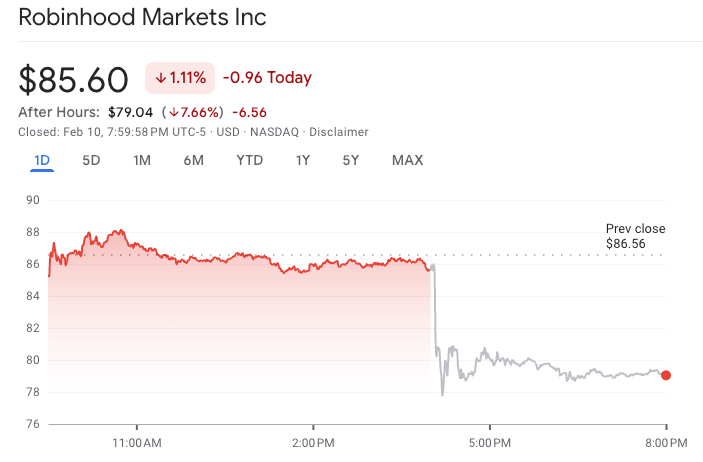
Robinhood dropped in after-hours trading on Tuesday after the trading platform’s latest earnings missed analyst expectations while crypto revenues tanked in the fourth quarter.
Robinhood reported record net revenues of $1.28 billion in Q4, missing Wall Street expectations of $1.34 billion despite increasing 27% year-on-year.
Its crypto-based revenues fell 38% from last year to $221 million after the crypto market entered an extended period of drawdowns in October.
The company’s net income for the quarter fell 34% year-on-year to $605 million, with its earnings per share reaching 66 cents, slightly beating analyst estimates of 63 cents.
Shares in Robinhood (HOOD) fell by 7.66% in after-hours trading to $79.04 after finishing the trading day down 1.1% at $85.60. Its stock is down over 42% since its peak of $148.67 on Oct. 3.

Over the full year, Robinhood said its net revenues for 2025 increased 52% from 2024 to a record $4.5 billion, while its net income for the year jumped 35% to $1.9 billion.
Crypto volume growth lags other products
Robinhood reported that notional crypto volumes across its app and its wholly-owned exchange, Bitstamp, were up 3% quarter-on-quarter in Q4 to a record $82.4 billion.
By comparison, equity trade volumes saw a larger quarterly jump, up 10% to $710 billion, while options contracts traded rose 8% over the quarter to 659 million.
Prediction markets, which the company launched on its platform in March in partnership with Kalshi, have also helped bolster Robinhood’s revenues in Q4, as the appetite for event contracts skyrocketed last year.
Related: Solana treasuries sitting on over $1.5B in paper SOL losses
Robinhood’s “other” transaction-based revenues, which include its products such as prediction markets and futures, hit a record $147 million in Q4, a 375% jump from the same time last year, overtaking its revenues from equity trades for the first time.
Robinhood chair and CEO, Vlad Tenev, said in a statement, “Our vision hasn’t changed: we are building the Financial SuperApp.”
Magazine: 2026 is the year of pragmatic privacy in crypto — Canton, Zcash and more


Industry leaders discussed demand for tokenized real world assets (RWA) during a Consensus Hong Kong 2026 panel featuring Evan Auyang (group president at Animoca Brands), Christian Rau (senior vice president digital assets and blockchain at Mastercard), Nicola White (VP of crypto institutions, Robinhood), and moderator Marcin Kazmierczak (co-founder, RedStone).
The panel echoed BlackRock COO Rob Goldstein’s bold claim: Digital ledgers are the most exciting development in finance since double-entry bookkeeping 700 years ago.
Today, tokenized real-world assets (RWAs) remain firmly institutional territory. Demand centers on tokenized money market funds, U.S. Treasuries, stablecoin integrations, and collateral optimization products like BlackRock’s BUIDL and offerings from Robinhood/Bitstamp highlight the trend.
Retail participation lags, with few attendees raising hands to confirm holding tokenized RWAs in their wallets. Panelists pointed to Europe’s clear regulations as a launchpad for tokenized listed equities, while private credit, real estate, art, and private equity show strong future potential especially as companies stay private longer and demand for fractional, 24/7 access grows.
The consensus: RWAs have moved from hype to real utility for institutions. The next wave mainstream retail onboarding could unlock trillions in illiquid markets once barriers fall.


In a fireside chat at Consensus Hong Kong 2026, Solana Foundation President Lily Liu unpacked her “Internet Capital Markets” vision with moderator Michael Lau, Chairman of Consensus.
Liu asserted that blockchains’ true strength lies in finance and markets, not utopian general-purpose tech. Liu envisioned tokenizing all world assets on-chain, enabling seamless access from everyday payments to high-frequency trading and creating a unified, global marketplace for capital formation.
Liu traced crypto’s capital-raising evolution from early ICOs to rapid modern raises, arguing this extensible primitive should empower non-crypto projects and companies worldwide. Liu stressed democratising talent and capital formation, which is rare in most markets, as crypto’s core societal impact.
Highlighting Asia’s pivotal role, Liu called it crypto’s “core market,” not frontier, given its Bitcoin origins and vast user/talent base. Liu championed revenue-focused metrics over governance tokens, insisting real network and app usage must drive sustainable value accrual to holders for long-term sovereignty and opportunity.


Blockchain company LayerZero Labs is planning to launch its own layer-1 blockchain named “Zero” with backing from ARK Invest and Citadel Securities, and targeting institutional financial markets.
Zero will launch in the fall of 2026, according to an announcement on Tuesday from LayerZero Labs, which also created and maintains the cross-chain messaging protocol LayerZero.
The firm said it will be scalable to two million transactions per second by leveraging zero-knowledge proofs and zero‑knowledge virtual machine Jolt to bypass “the fundamental replication requirement,” which constrains “blockchains to fewer than 10,000 transactions per second.”
LayerZero Labs said Zero will launch with three permissionless environments governed by the underlying network, known as “zones.” It will use the network’s native token and governance asset LayerZero (ZRO) to provide interoperability between zones and across more than 165 blockchains.
Bryan Pellegrino, the CEO of LayerZero Labs, said in a statement that Zero’s “architecture moves the industry’s roadmap forward by at least a decade,” adding: “We believe we can actually bring the entire global economy on-chain with this technology.”
Zero introduces four 100x breakthroughs across storage (QMDB), compute (FAFO), networking (SVID), and zk proving (Jolt Pro).
It lives up to everything we stand for:
– Decentralized
– Permissionless
– Censorship-resistant pic.twitter.com/x5ve1PqAyc— LayerZero (@LayerZero_Core) February 10, 2026
A growing number of financial institutions are moving into crypto as regulations and infrastructure improve, which some predict will bring a new wave of adoption to the space.
Investments from large crypto players
The project has received backing from asset manager ARK Invest, which is becoming a shareholder of LayerZero equity and ZRO, along with market maker Citadel Securities, which has also made a strategic investment in the token.
ARK Invest CEO Cathie Wood will also join Zero’s newly formed advisory board, which includes Michael Blaugrund, vice president of strategic initiatives at the New York Stock Exchange’s parent company, Intercontinental Exchange (ICE), and Caroline Butler, the former head of digital assets at financial services company BNY Mellon.
The investment arm of stablecoin issuer Tether also announced on Tuesday that it had made a strategic investment in LayerZero Labs.
Institutions circling Zero for possible adoption
The project has gained interest from several major institutions, according to LayerZero Labs, which plan to explore the technology for possible use.
Related: LayerZero wins Stargate acquisition in 4-way bidding war
Google Cloud is partnering with LayerZero Labs to explore how AI agents could make micropayments and trade without needing a bank account.
Meanwhile, ICE is looking at Zero for trading and clearing infrastructure to support 24/7 markets and the integration of tokenized collateral. The Depository Trust & Clearing Corporation hopes to use Zero to enhance the scalability of its tokenization service and collateral app chain.
Decentralized trading platform the Global Token Exchange is also planning to build the treasury layer of its decentralized system, Turbo, using Zero, the exchange said in an X post on Tuesday.
Magazine: Bitcoin difficulty plunges, Buterin sells off Ethereum: Hodler’s Digest, Feb. 1 – 7
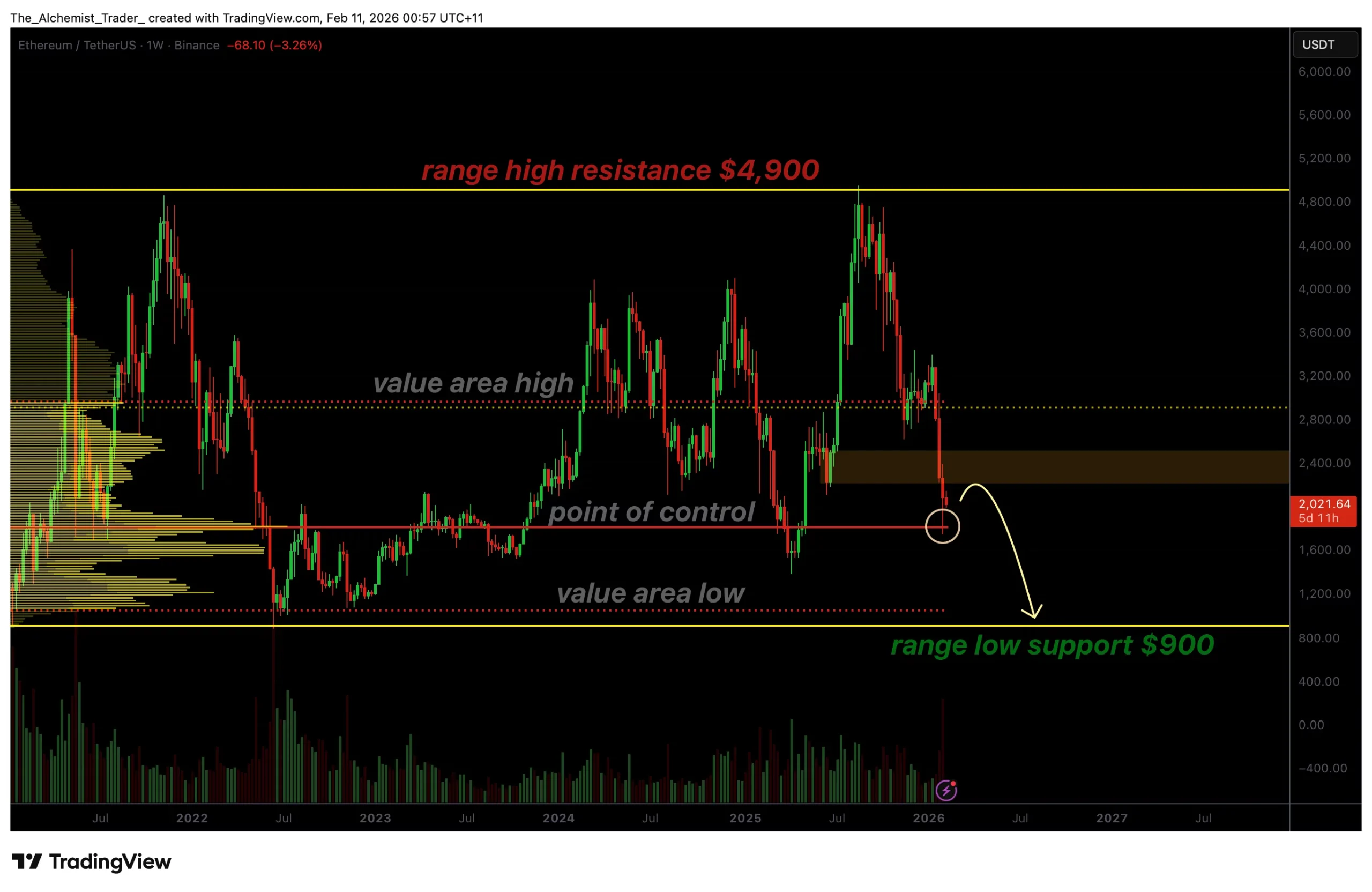
Ethereum price action is showing growing downside risk as weakening liquidity and fragile rebounds increase the probability of a deeper rotation toward the $900 range low.
Summary
- Short-term bounces lack conviction, suggesting rallies may be corrective rather than trend-changing
- Liquidity dynamics favor a downside sweep, with clean lows still attracting price
- Volatility likely to expand, if balance breaks and price seeks deeper acceptance levels
Ethereum (ETH) price continues to trade in a vulnerable position, hovering around a critical support zone known as the point of control (POC). While short-term relief bounces have emerged on lower timeframes, these moves have lacked meaningful bullish follow-through. As a result, Ethereum remains exposed to further downside pressure, particularly as untested liquidity continues to build beneath current price levels.
From a broader market-structure perspective, the ongoing consolidation appears less like accumulation and more like a pause before a continuation. Unless buyers can decisively reclaim control, the risk of a deeper corrective move below $1,000 remains firmly in play.
Ethereum price key technical points
- Ethereum is trading at the point of control, a critical balance level
- Low-volume bounces signal weak demand, raising bull trap risk
- Untapped liquidity sits below range lows, increasing downside probability
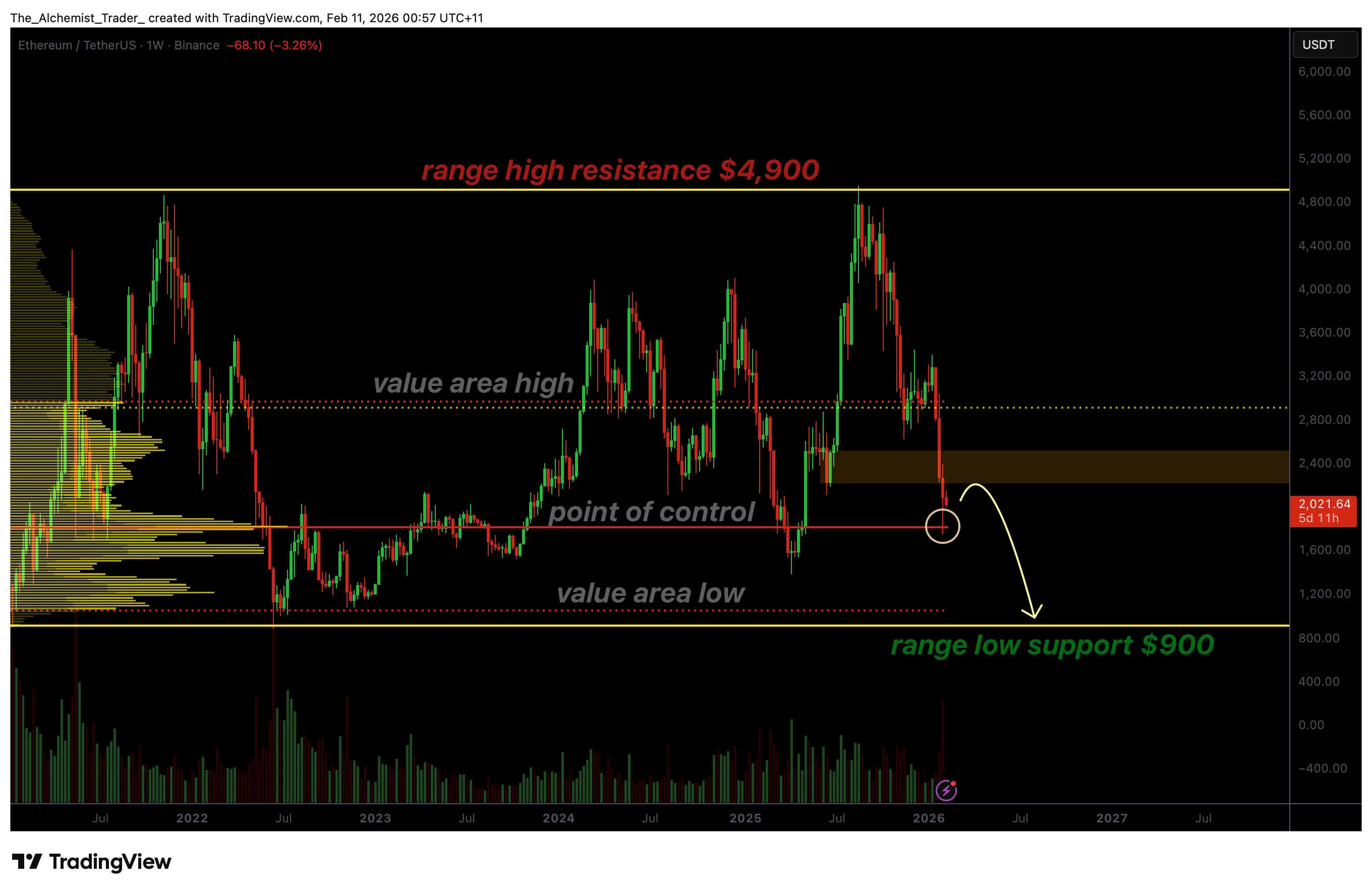
Ethereum’s recent bounce from the point of control has been shallow and short-lived. On the lower timeframes, price has shown temporary stabilization, but these moves have not been supported by strong bullish volume. In trending markets, sustainable reversals typically require expanding participation and aggressive buying, neither of which is currently present.
This type of weak rebound often signals a potential bull trap, in which the price briefly moves higher before rolling over and resuming the dominant trend. As long as Ethereum fails to reclaim higher resistance levels with conviction, short-term rallies remain vulnerable to rejection.
Liquidity below price remains unresolved
One of the most important factors influencing Ethereum’s downside risk is the presence of untouched liquidity beneath current price levels. Clean lows remain intact below the market, suggesting that stop-loss orders and resting sell-side liquidity are concentrated beneath support.
Markets naturally gravitate toward areas of liquidity, particularly during corrective or range-bound conditions. Until this liquidity is addressed, Ethereum remains susceptible to a rotation lower, designed to flush out weak positioning and rebalance the market structure.
Loss of point of control signals expansion risk
The point of control represents the price level at which the most trading activity occurs and often acts as a stabilizing force during consolidation phases. However, once the price loses the POC on a closing basis, it typically signals a shift from balance to imbalance.
If Ethereum decisively loses this level, the probability of an accelerated move increases. In this context, that would likely mean a capitulation-style rotation lower as price seeks the next major area of acceptance. Historically, such moves tend to be swift and volatile, particularly when liquidity below price remains untested.
$900 range low comes into focus
From a high-timeframe perspective, the next major downside target sits near the $900 level. This zone aligns with the value area low and the lower boundary of Ethereum’s broader trading range. Previous interactions with this region have resulted in strong reactions, making it a critical area for potential stabilization or reversal.
A move toward $900 would likely coincide with heightened volatility and emotional selling, characteristics often associated with capitulation events. While such a move may appear bearish in the short term, it could ultimately serve as a necessary reset before a more sustainable base can form.
What to expect in the coming price action
From a technical, price-action, and market-structure perspective, Ethereum remains at risk of trading below $1,000 if current support fails.
The combination of weak bounce attempts, unresolved liquidity, and the potential loss of the point of control favors downside continuation toward the $900 range low.
For this outlook to improve, Ethereum would need to regain control with strong volume confirmation and demonstrate acceptance above higher value areas.

Feeding Claude AI carefully structured prompts unlocks explosive price projections for XRP, Cardano, and Ethereum in 2026.
According to Claude, all three could hit fresh ATHs over the next eleven months.
Below we examine whether Claude’s claims are justified by technical signals and the news cycle.
XRP ($XRP): Claude Maps a Long-Term Route Toward $8 by 2027
In a recent blog post, Ripple confirmed XRP ($XRP) remains central to its vision to make the XRPLedger an institutional-grade payments infrastructure.

Already known for lightning fast settlement and negligible costs, XRPL also offers what could be the two biggest use cases in crypto: stablecoins and real world asset tokenization.
Currently trading near $1.43, Claude predicts XRP could climb to $8 by the end of 2026, a nearly 6x increase.
From a technical standpoint, XRP’s Relative Strength Index (RSI) is uptrending from 31, indicating that investors are buying back in after a period of heavy selling rocked the entire market.
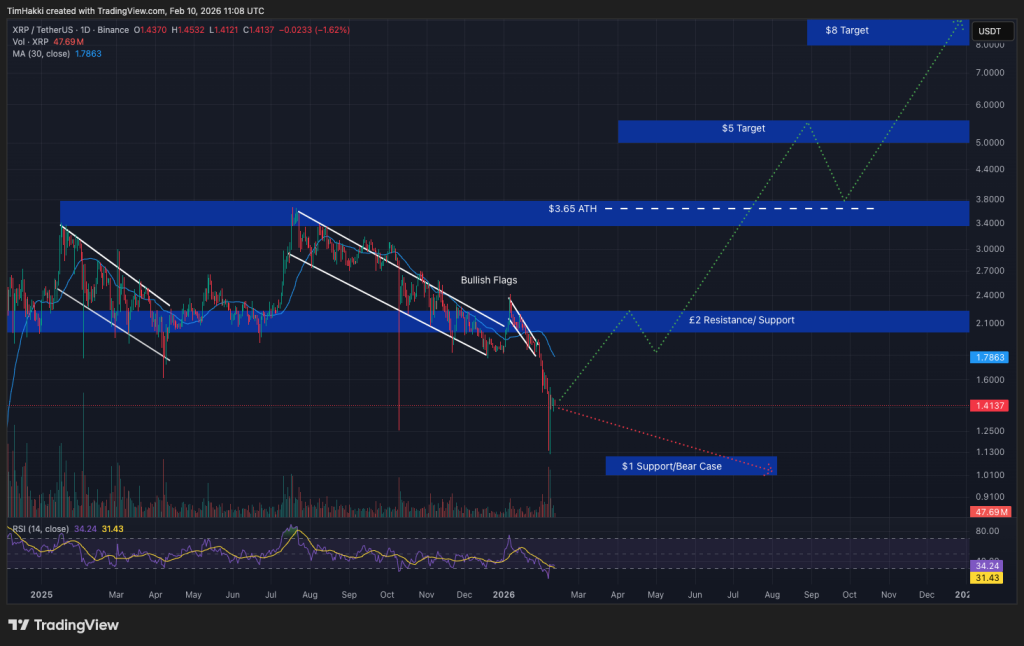
Institutional inflows through newly approved U.S.-based XRP exchange-traded funds, combined with Ripple’s expanding partner network and the potential passage of the U.S. CLARITY bill this year, could even propel XRP beyond Claude’s bull case.
Cardano (ADA): Claude Projects a Potential 1,100% Upside
Created by Ethereum co-founder Charles Hoskinson, Cardano ($ADA) leverages peer-reviewed development, security, scalability, and sustainability.
With a market cap around $10 billion and more than $127 million in TVL Cardano’s growing ecosystem supports its long-term growth.
Claude says ADA could rise over 1,100%, from its current price of $0.26 to $3.25 by Christmas, pushing it comfortably above its 2021 ATH: $3.09.
That said, ADA is currently trading at its lowest level since October 2024. Given the year’s unpredictability so far, another downturn could see ADA slipping the $0.20 to $0.25 support level.
Ethereum ($ETH): Claude Identifies a Possible 5x Setup
Ethereum ($ETH), the world’s leading smart contract platform, underpins most of the DeFi/Web3 infrastructure.
With a market capitalization of around $243 billion and more than $56 billion locked across DeFi protocols, Ethereum remains the primary settlement layer for blockchain commerce.
Its proven security, dominant position in stablecoins, and early leadership in real-world asset tokenization position Ethereum well to capture increased institutional demand.
However, substantial inflows depend on whether U.S. lawmakers approve the CLARITY bill, which will provide the regulatory certainty institutions need to deploy capital on the network, either through stablecoins or tokenized real-world assets.
ETH trades around $2,000, with heavy resistance expected near the $5,000 level after reaching an ATH of $4,946.05 last August.
If Claude’s bullish outlook materializes, a clean breakout above $5,000 could pave the way for multiple new ATHs in 2026, with Claude capping ETH’s growth at a heady $7,500 in a full-scale bull market.
Maxi Doge: Roll Over, Dogecoin! Maxi’s The New Alpha of Memesville!
Finally, while Claude sees XRP, Cardano and Ethereum as relatively safe bets, investors chasing old school crypto upside will want to allocate a small portion of their portfolio to new high-volatility meme coins.
Maxi Doge ($MAXI) is one of the most discussed meme coin presales of 2026 so far, raising $4.6 million before launch.
The project’s mascot is an louche, high-energy parody (and distant cousin) of Dogecoin, blending gym-bro intensity with degen humor to revive the irreverent meme culture that shot Dogecoin and Shiba Inu to stardom.
MAXI is an ERC-20 token on Ethereum’s proof-of-stake network, giving it a smaller environmental footprint compared to Dogecoin’s proof-of-work model.
Presale participants can currently stake MAXI tokens to earn yields of up to 68% APY, with rewards decreasing over time as the staking pool grows.
The token is $0.0002803 in the current presale stage, with automatic price increases triggered at each funding milestone. Purchases are supported via MetaMask and Best Wallet.
Say goodbye to Dogecoin. Maxi Doge is the new alpha in Memesville!
Stay updated through Maxi Doge’s official X and Telegram pages.
Visit the Official Maxi Doge Website Here
The post Leading AI Claude Predicts the Price of XRP, Cardano and Ethereum By the End of 2026 appeared first on Cryptonews.


SkyBridge Capital’s Founder, Anthony Scaramucci, said Wednesday that he is buying bitcoin amid the falling market, while calling Donald Trump a crypto President.
“So 10 days ago, we were buying Bitcoin at 84,000 last week, you’re buying Bitcoin at 63,000 Bitcoin this week, we’re buyers of Bitcoin in this market, again,” Scaramucci said during a conversation with Bullish’s CEO Tom Farley at Consensus Hong Kong.
He added that buying bitcoin in a downward-trending market is akin to catching a falling knife.
Bitcoin recently crashed to nearly $60,000, after hitting a peak of over $126,000 in October this year. Prices have recovered slightly to $69,000 since then amid signs of capitulation in the bitcoin ETF market.
Scaramucci called President Donald Trump a much better President for crypto than his predecessor, but added that Trump’s geopolitical shenanigans, such as his Greenland ambitions, embolden rival Democrats to oppose him on various policies, including those that affect digital assets.
“I’ll just say to you that, like, the Greenland stuff, believe it or not, is actually tied to the industry. If he does stuff like that, it upsets the opposition to the point where they’re like, You know what? We don’t want him to win on anything, and even if it’s going to spite ourselves and cut our own horses off, we will vote against the crypto bill to hurt Donald Trump,” he explained.
Speaking of Layer 1s, Scaramucci said that programmable blockchain Solana will be one of the biggest market share gatherers.
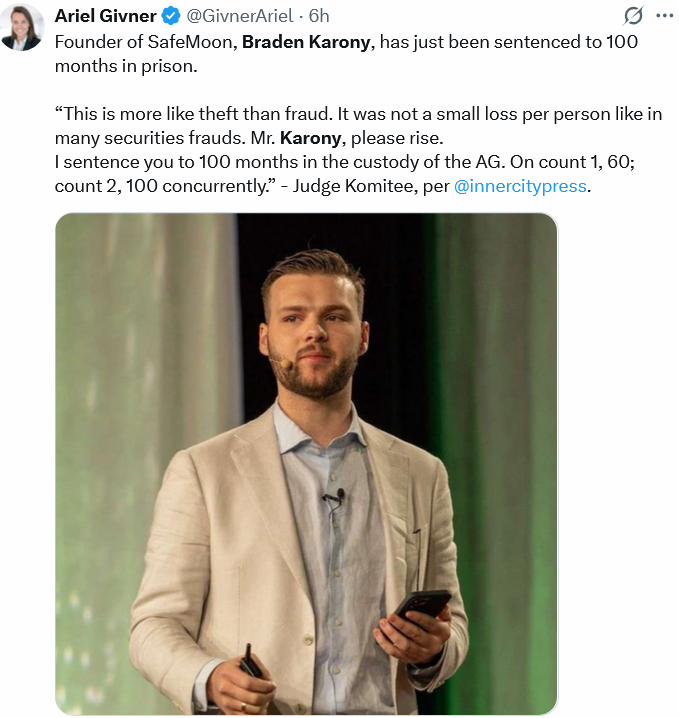
Former SafeMoon CEO Braden Karony has been sentenced to 100 months in prison for stealing $9 million from the crypto platform’s liquidity pool in 2021 to fund a “lavish lifestyle.”
The sentence on Monday comes nine months after Karony was convicted by a federal jury on charges of conspiracy to commit securities fraud, wire fraud and money laundering in May 2025.
“Not only did Braden John Karony abuse his position as CEO, but he also betrayed his investors’ trust by stealing more than nine million dollars in digital assets from his company to fund his lavish lifestyle,” FBI assistant director James C. Barnacle, Jr. said.
Karony used the stolen proceeds to purchase a $2.2 million home in Utah, an Audi R8 sports car, a Tesla, a custom Ford F-550 and Jeep Gladiator pickup trucks.
“Karony lied to investors from all walks of life — including military veterans and hard-working Americans,” US Attorney Joseph Nocella, Jr. said, adding:
“Today’s sentence demonstrates that there are significant consequences for financial crimes. Our Office will continue to vigorously prosecute economic crimes that harm investors and weaken societal trust in the stability and security of digital asset markets.”

Karony was ordered to forfeit approximately $7.5 million, the Department of Justice said, while the amount of restitution to the victims will be determined at a later date.
Two SafeMoon execs convicted, one at large
SafeMoon’s former chief technology officer, Thomas Smith, pleaded guilty in February 2025 to conspiracy to commit securities and wire fraud and is awaiting sentencing.
SafeMoon platform’s creator, Kyle Nagy, remains at large, the DOJ added.
Karony is one of many former crypto executives who have now been convicted and sentenced for crimes committed during the 2021-2022 market cycle, when retail market participation was at its peak.
Others who have been convicted include former FTX CEO Sam Bankman-Fried and former Celsius CEO Alex Mashinsky, who are currently serving 25-year and 12-year sentences, respectively.
Related: Crypto PACs secure massive war chests ahead of US midterms
US President Donald Trump said on Jan. 8 that he wouldn’t pardon the former FTX boss, despite having pardoned former Binance CEO Changpeng “CZ” Zhao in October.
Bankman-Fried hasn’t given up, having asked a federal appeals panel for a new trial on Thursday.
Magazine: The critical reason you should never ask ChatGPT for legal advice

Miss Lymph Founder Sabrina Sweet Shares the Ultimate Detox Guide: From Massage Techniques to Energy Boundaries

Is It Time To Give Up On Crypto And Move On?? How Low Will Bitcoin And Altcoins Go???
Charles Schwab co-chairman Bettinger sells $7.04m in shares

Smart energy pays enters the US market, targeting scalable financial infrastructure

Software stocks enter bear market on AI disruption fear with ServiceNow plunging 10%

Wikipedia volunteers spent years cataloging AI tells. Now there’s a plugin to avoid them.


-
 Tech7 days ago
Wikipedia volunteers spent years cataloging AI tells. Now there’s a plugin to avoid them.
-

 Politics2 days ago
Why Israel is blocking foreign journalists from entering
-

 NewsBeat1 day ago
Mia Brookes misses out on Winter Olympics medal in snowboard big air
-
 Sports4 days ago
JD Vance booed as Team USA enters Winter Olympics opening ceremony
-

 Tech4 days ago
First multi-coronavirus vaccine enters human testing, built on UW Medicine technology
-
 Business2 days ago
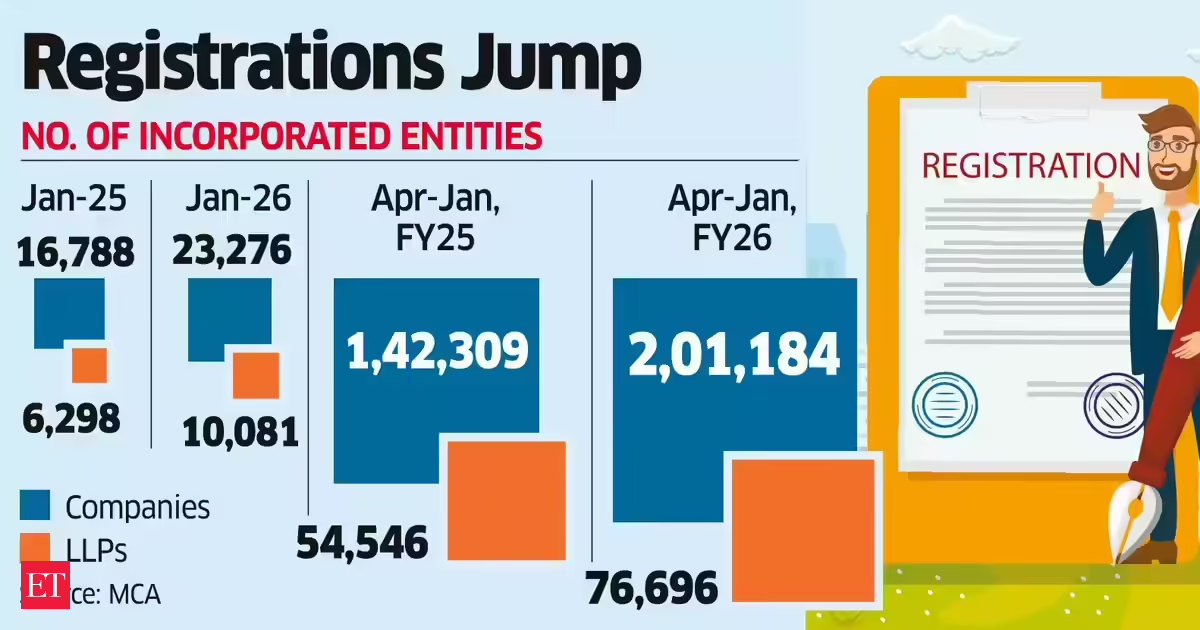
LLP registrations cross 10,000 mark for first time in Jan
-

 NewsBeat2 days ago
Winter Olympics 2026: Team GB’s Mia Brookes through to snowboard big air final, and curling pair beat Italy
-

 Sports2 days ago
Benjamin Karl strips clothes celebrating snowboard gold medal at Olympics
-
Sports4 days ago
Former Viking Enters Hall of Fame
-

 Politics2 days ago
The Health Dangers Of Browning Your Food
-
Sports5 days ago
New and Huge Defender Enter Vikings’ Mock Draft Orbit
-

 Business3 days ago
Julius Baer CEO calls for Swiss public register of rogue bankers to protect reputation
-
 NewsBeat5 days ago
Savannah Guthrie’s mother’s blood was found on porch of home, police confirm as search enters sixth day: Live
-

 Business5 days ago
Quiz enters administration for third time
-

 Crypto World11 hours ago
Blockchain.com wins UK registration nearly four years after abandoning FCA process
-
 Crypto World20 hours ago
U.S. BTC ETFs register back-to-back inflows for first time in a month
-
 NewsBeat2 days ago
Residents say city high street with ‘boarded up’ shops ‘could be better’
-
Sports1 day ago
Kirk Cousins Officially Enters the Vikings’ Offseason Puzzle
-
 Crypto World20 hours ago
Ethereum Enters Capitulation Zone as MVRV Turns Negative: Bottom Near?
-

 NewsBeat6 days ago
Still time to enter Bolton News’ Best Hairdresser 2026 competition