
Crypto World
Bored Ape Yacht Club turns five today and nobody seems to care

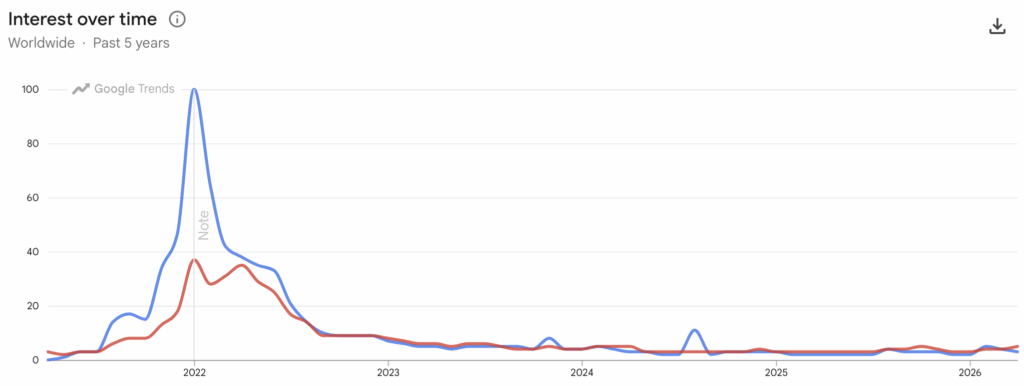
Bored Ape Yacht Club (BAYC) celebrates its fifth birthday today. Unfortunately, celebrations have been a little muted.
The project’s once massive pool of high-profile celebrity supporters that included the likes of Paris Hilton,, Mark Cuban, and Jimmy Fallon, has dwindled, and online interest has cratered.
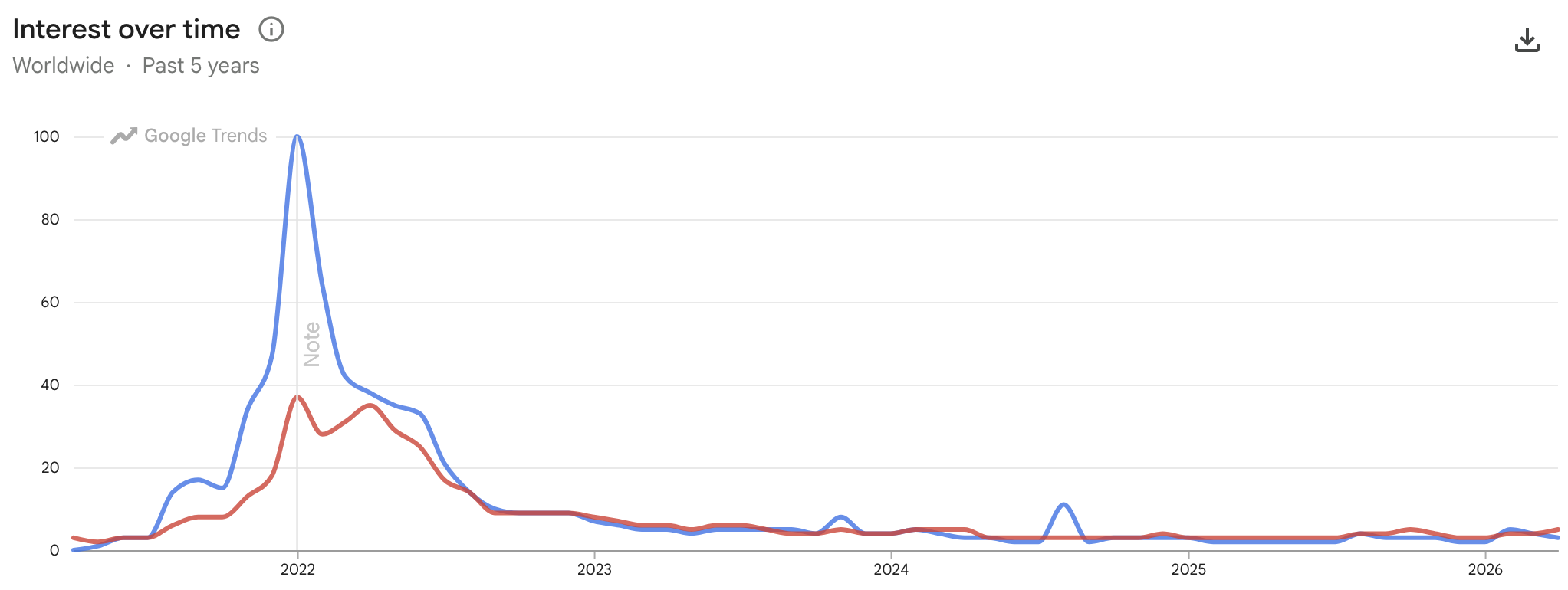
Indeed, searching Google Trends for the term “Bored Ape Yacht Club” reveals that interest in the company is 97 times lower than it was during the NFT frenzy of 2022.
During the height of NFT and Bored Ape Mania, the likes of Snoop Dogg and Eminem promoted the project and the short-lived metaverse fad onstage at various times.
Eminem at least put his money where his mouth is, reportedly buying an Ape for roughly $462,000. Unfortunately, top offers for the same NFT are now sitting at around 8.83 ether (ETH), or $20,000.
Eminem hasn’t posted anything about NFTs or BAYC on his X account since 2022.
Snoop, also spent big, paying $366,000 for four Apes back in 2021. However, the top offers for these four NFTs are worth just shy of $28,000.
And while he’s maintained some support for the floundering project, his enthusiasm seems to have waned. Despite calling it a “cultural juggernaut” at the time, he’s posted very little about the project on X since 2022.
Read more: Yuga Labs directs royalties to bankrupt FTX US
Celebrities aren’t talking about Bored Ape Yacht Club anymore
While Snoop Dogg has continued to mention BAYC from time to time, he now appears to be using it as more of an attention getter for other projects than anything else.
For example, a trip arranged by BAYC for holders to visit Snoop’s compound to celebrate 4/20 ended up being just a promotional stunt for his family’s ice cream brand, Dr Bombay — named after his Ape — which hasn’t posted on X in years.
While Snoop was briefly present at the event, and there was little to no BAYC-themed promotion from him on social media, save for a shoddy AI-generated video of his Ape and a single repost of an old image.
Other celebrities such as, Justin Bieber, Serena Williams, Neymar Jr, Post Malone, DJ Khaled, Paris Hilton, Mark Cuban, and Jimmy Fallon have all supported the BAYC brand.
Canadian pop elf Bieber paid roughly $1.3 million for his very own Ape in 2021. Its current top offer is roughly $19,000 and he’s seemingly not happy, having posted nothing at all about BAYC or NFTs.
Brazilian footballer Neymar Jr. spent over $1.1 million on two APES in 2022, however these are now worth somewhere in the region of $57,000.
Surprise surprise, Neymar hasn’t posted about NFTs or BAYC since 2022.
Talk show host Fallon spent $224,000 buying an Ape in 2021 but its value has since slid to just $19,000.
He hasn’t talked about it on X since.
DJ Khaled, Paris Hilton, Mark Cuban, and Serena Williams have all neglected to mention BAYC since 2022 on X while Post Malone brings up no results for either NFTs or BAYC.
Perhaps worst of all, none of these celebrities wished BAYC a happy birthday today.
Read more: Yuga Labs wants Pauly0x’s $400K worth of crypto seized
As interest in BAYC itself dries up, so too are the funds entering its wider NFT ecosystem.
The floor price of the BAYC collection is down 94.3% from its all-time high in May 2022, while BAYC’s token ApeCoin is also down 99.6% from it’s similarly timed peak.
Last year, one BAYC buyer sold two of his NFTs at a 92% loss despite holding them during the 2022 craze. During the May highs, they were worth $4.3 million, however, they eventually sold them for $420,000.
Five years of legal wrangling and blinding fans
2021/2022 was a wild couple of years for BAYC and its followers.
It appeared to have hit the mainstream in earnest when Jimmy Fallon and Paris Hilton awkwardly promoted the project on his primetime talk show. Meanwhile, Snoop Dogg and Eminem sang the brand’s praises at the MTV VMAs.
However, these celebrity endorsements ultimately led to a 2022 lawsuit which accused the project’s creator Yuga Labs of promoting the NFTs without clarifying their compensation. It also claimed that the NFTs should be classified as securities.
Three years later, a judge dismissed the lawsuit and ruled that NFTs are not, in fact, securities.
Read more: BAYC goes full ‘laser eyes’ and allegedly blinds ApeFest attendees
Further damaging to BAYC’s image was its 2023 ApeFest. The event was a three-day get together in Hong Kong that, far from catapulting Bored Apes to even greater heights, was thrown into chaos when UV lighting used on stage temporarily blinded a number of attendees.
The previous year, Yuga Labs bought the rights to NFT collection CryptoPunks. However, by 2025, it sold that stake to the non-profit Node Foundation for $20 million.
In 2024, Yuga Labs sunk $450 million into web3 game Otherside. Its launch was a virtually unplayable buggy mess.
Today, the firm continues to promote meetups with holders, and recently replaced its former CEO Greg Solano with Michael Figge.
Got a tip? Send us an email securely via Protos Leaks. For more informed news and investigations, follow us on X, Bluesky, and Google News, or subscribe to our YouTube channel.

One AI stock reports earnings on May 4, three weeks before Nvidia prints, and the technical setup is the most oversold it has looked in a year.
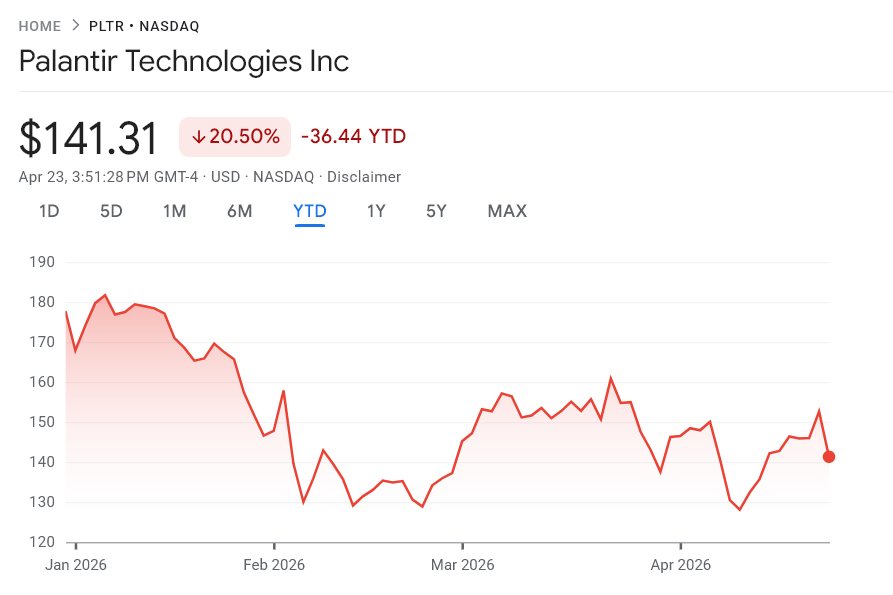
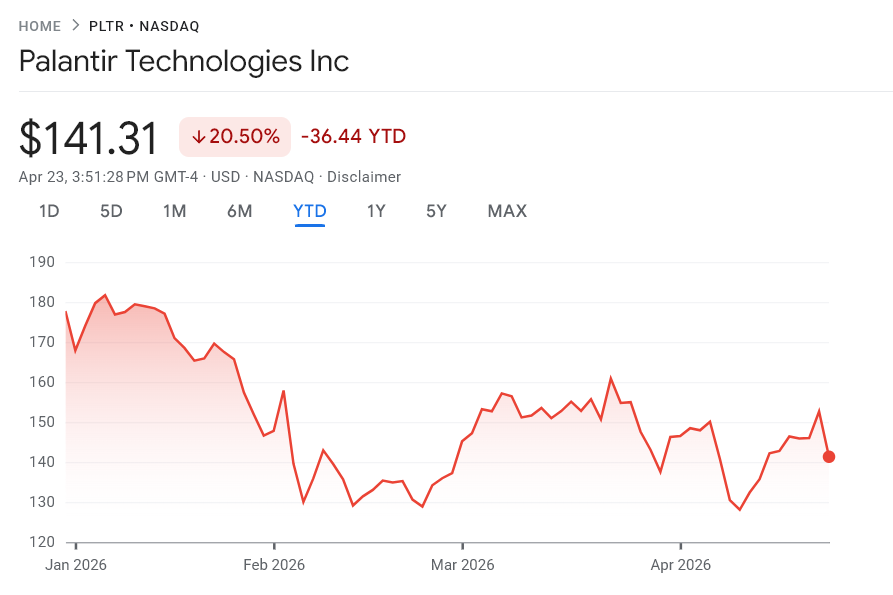
Palantir (PLTR) closed above $143 on April 23, down about 30% from its November peak and roughly 15% year-to-date. The stock has been stuck inside a falling channel since early November, rejected at every bounce. But under the surface, the signals are flipping.
A bullish divergence has played out, institutional money has turned positive, and options traders are quietly setting up for a squeeze. Here is why the May 4 print matters more than Nvidia’s, and where the price has to go.
Palantir Shares are Deeply Oversold
The calendar is the first edge. Palantir (PLTR) reports Q1 2026 earnings on Monday, May 4, 2026, after the close. Nvidia (NVDA) does not report until late May.
That three-week gap makes Palantir the first major enterprise AI stock to print earnings this season. Whatever number it delivers sets the tone that carries into Nvidia’s report. It also shapes how the entire AI trade is priced through mid-May.
The setup is oversold. PLTR is down 30% from its November high and still stuck inside a falling channel on the daily chart. Part of that pressure stems from investor Michael Burry’s April 9 post, in which he claimed AI startup Anthropic was “eating Palantir’s lunch,” citing its surge from $9 billion to roughly $30 billion in annual recurring revenue.
Shares dropped as much as 7% that day. But the Anthropic scare is now priced in, and the bigger picture has not changed.
Want more insights like this? Sign up for Editor Harsh Notariya’s Daily Newsletter here.
Wall Street has not blinked. Morgan Stanley analyst Sanjit Singh flagged on April 16 that this AI stock could “modestly accelerate growth and raise its full-year guidance” on the May 4 call.
In plain terms, that means posting numbers better than promised AND raising the forecast for the rest of the year, the combination investors reward most.
They are pricing a re-rating that a clean May 4 print would unlock. That oversold price, combined with a likely beat-and-raise, is the first half of the setup. The second half is what the chart already shows.
Chart Signals Say the PLTR’s Oversold Setup Is Turning
Nvidia looks stronger on the surface. The stock trades near $201, and its Chaikin Money Flow (CMF), an indicator of institutional money flow, is 0.30.
Palantir’s CMF just crossed back above zero at 0.04. The simple read says Nvidia has heavier buying. The deeper read says Nvidia is overheated.
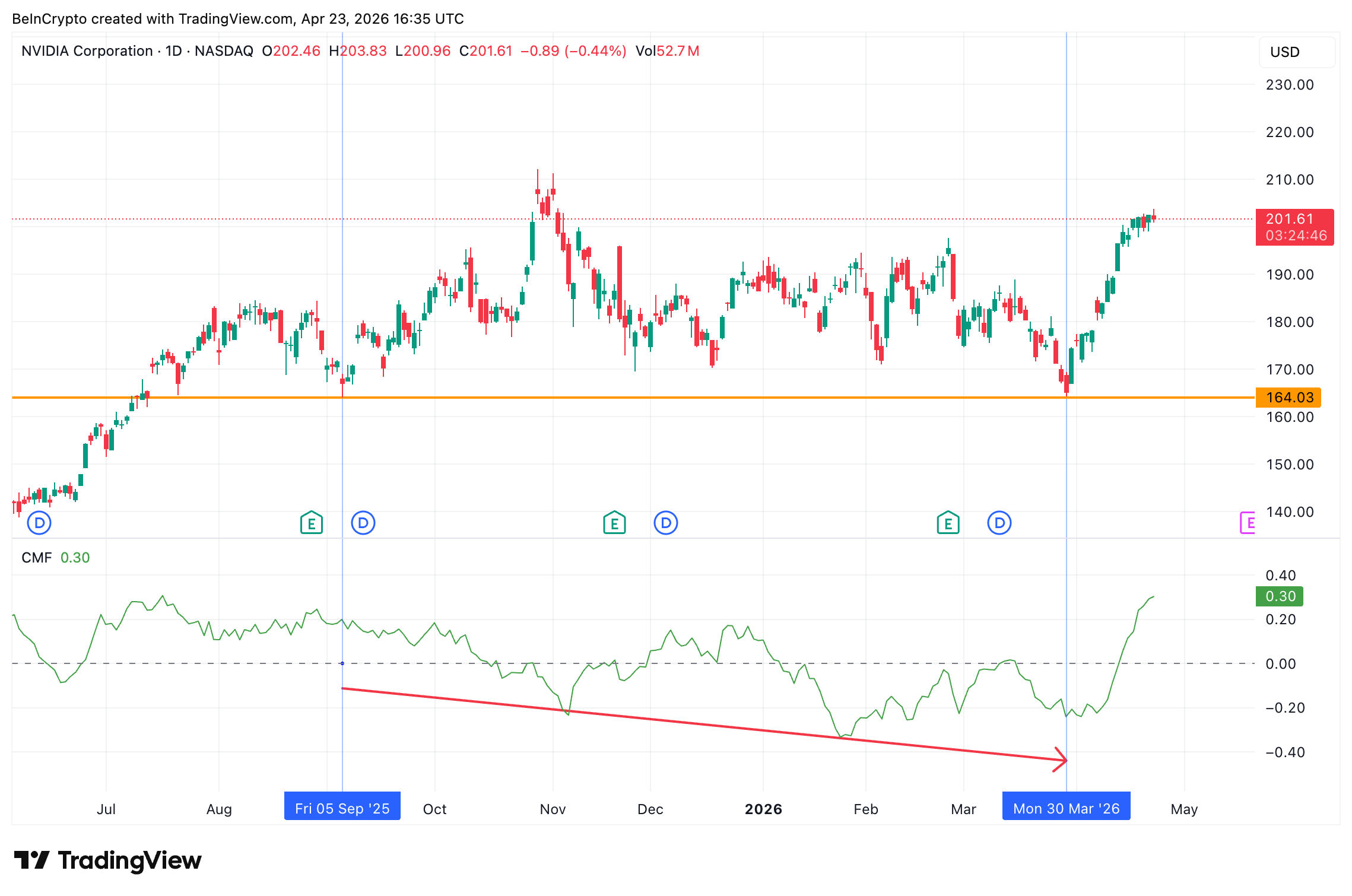
Between September 5, 2025, and March 30, 2026, Nvidia’s price returned to the $164 level at both endpoints, while CMF trended lower over that span. That is a hidden weakness signal.
The April rally has shot CMF up to 0.30, but the structural picture shows NVDA running hot into its May 27 print with little room for upside surprise.
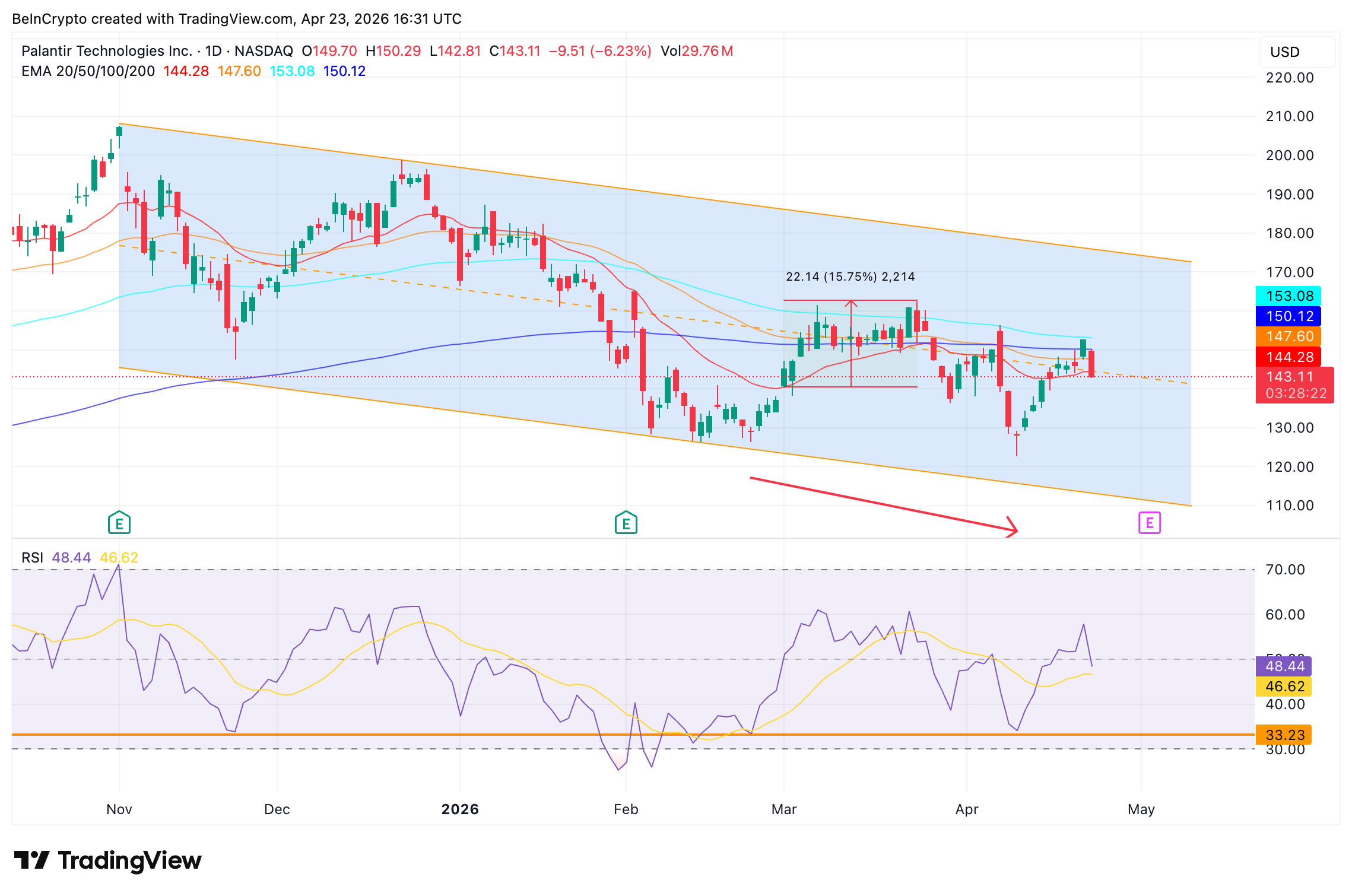
Also, between February 24 and April 10, PLTR price made a lower low while its Relative Strength Index (RSI), a momentum indicator, made a higher low. That is a standard bullish divergence, and it already played out with a rally off the April low. The moving averages amplify the signal.
PLTR’s key exponential moving averages (EMAs) are all clustered within a tight ten-dollar band above the current $143 price. EMAs are trend lines that smooth out daily noise.
When four of them compress this close together, the next clean break triggers a cascade as each line gets reclaimed in quick succession. The last time PLTR cleanly reclaimed its 20-day EMA, on March 2, the stock rallied 15.75%.
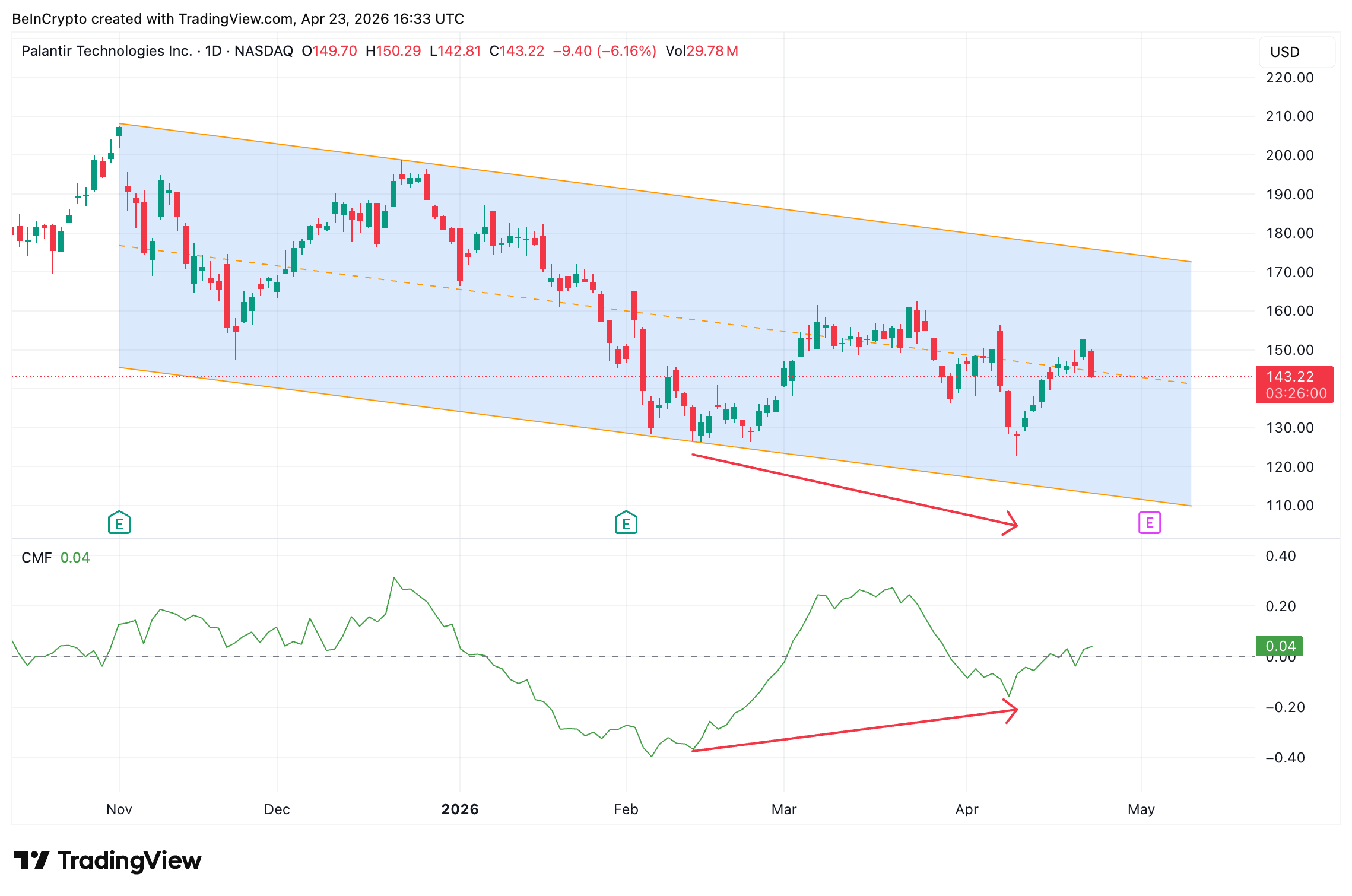
Coming back to the big money flow, between February 12 and April 10, the price trended lower while the CMF trended higher. This second bullish divergence has since triggered CMF’s cross back above the zero line.
The Options Market Could Decide the Rally
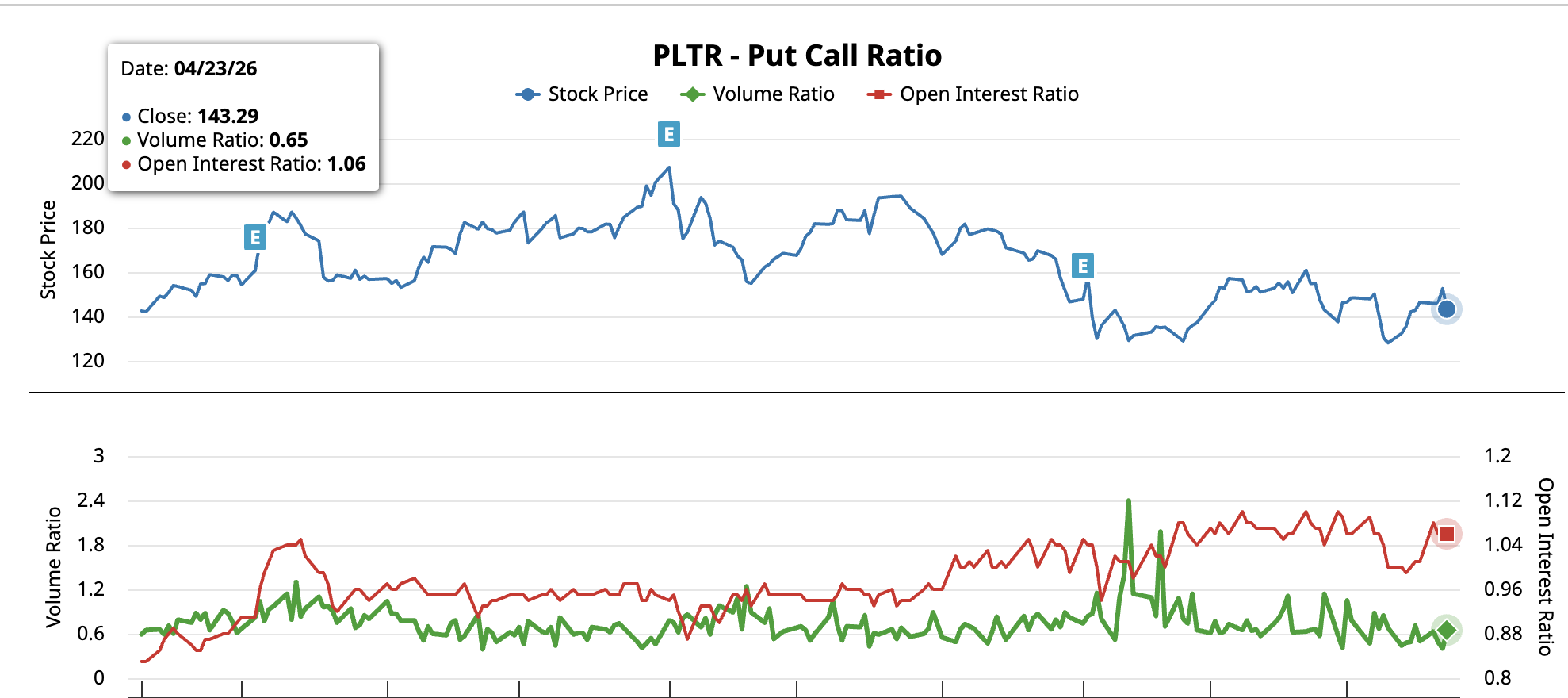
The third signal is in the options market. PLTR’s volume put-call ratio is 0.65, indicating calls are outpacing puts on a daily basis. But the open interest put-call ratio is 1.06, meaning there are still more puts than calls in standing contracts.
That gap is short-squeeze fuel. If the May 4 print delivers the beat-and-raise that consensus already expects, trapped short positioning has to cover, and the mechanical flow alone can push PLTR through the channel resistance that has capped every rally since November.
Together, multiple signals, oversold price, positive institutional flow, and short positioning primed to squeeze, converge on one level that has to break.
Break $155 to Flip the Trend, Lose $142, and the Decline Continues
The first hurdle is $155. A daily close above that level takes price through all four stacked EMAs at once, the same cascade that delivered the 15.75% rally after the March 2 reclaim. That break opens a path toward $165 and then the bigger test at $175.
The $175 level is where the setup earns its edge. It aligns with the 0.618 Fibonacci retracement and the upper trendline of the falling channel that has capped every rally since November 3. A break above $175, especially if the May 4 print delivers the beat-and-raise Morgan Stanley has flagged, clears the channel and exposes $189 and the November peak at $207 as the next upside targets.
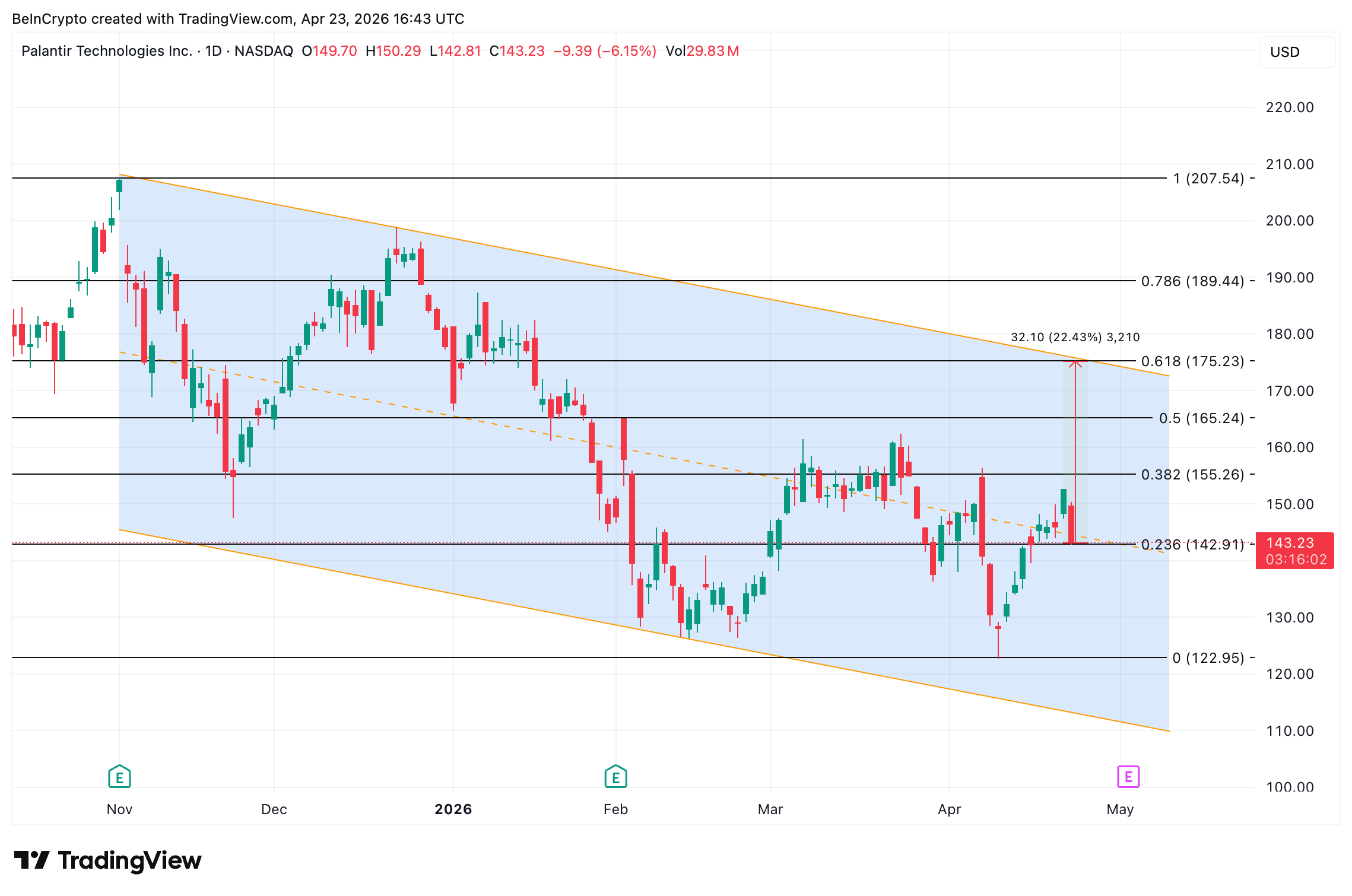
The invalidation is clean. A daily close under $142 breaks the setup and reopens the downside. That exposes $122, the recent April low. If Palantir delivers the beat-and-raise the tape is already setting up for, the signals that have been stacking up for weeks will finally clear the resistance that has capped the stock for six months.
The post Palantir Earnings Could Ignite AI Stocks Before Nvidia appeared first on BeInCrypto.
Everyone on a liquidity route in Bitcoin’s Lightning Network wants the same rebalance of funds to happen, but none of them wants to be the first person to pay.
The tenuous impasse is a classic Mexican standoff.
When this situation occurs, Lightning node operators can neither pay nor not pay first without harming themselves, so nobody moves, and nobody wins. It has been a recurring problem for years.
After almost a decade of tools and research chasing this problem, the network’s routing nodes remain locked in a standoff that quietly erodes routing reliability of bitcoin (BTC).
The Lightning Network, Bitcoin’s largest layer 2 network with no connection to an altcoin, has a structural bias toward channel depletion.
That is, money tends to flow in one direction along channels from senders toward structural receivers, such as merchants receiving BTC who deliver goods and services to customers.
Routing nodes are left with channels that are stuffed with BTC on one side and depleted of BTC on the other. A channel that cannot send in both directions is effectively half-broken for routing purposes.
Lightning’s total capacity set a fresh all-time high of roughly 5,600 BTC in December 2025, but that surge arrived almost entirely through institutional deposits from Binance and OKX into existing channels. Year-to-date data tells a different story.
BTC capacity from December’s high above 5,600 has declined to 4,884 today, and payment channels have declined from more than 80,000 in mid-2023 to about 45,000 today, nearly halving as liquidity consolidated into lopsided channels on a shrinking graph.
The cheapest fix is the one nobody will start
René Pickhardt, one of the network’s most prolific routing researchers, wrote that most channels “are expected to be depleted over time, primarily due to selfish routing behavior within the current protocol design.”
By his accounting, any given payment link has roughly a coin-flip chance of avoiding long-term depletion.
Researchers have described the embarrassingly simple yet elusive solution.
Presenting several nodes sitting on a circular payment path connected to one another by payment channels and all lopsided in the same direction, each could push BTC around the loop and finish a complete cycle with healthier channels as a result.
Everyone would benefit if everyone cooperated at the same time.
The problem, as with every Mexican standoff, is who pays first.
Routing BTC over Lightning costs money. Whichever node kicks off the rebalance owes routing fees to every other hop on the loop. If they wait, other nodes can receive their rebalancing for free and pocket the fee.
Although every node operator on the ring would benefit most as a collective if they all pushed BTC around for a single sending plus a single receiving fee — i.e. for nearly free in net — each operator also has the rational choice to wait for someone else to send first so they can collect without sending.
Wait for someone else to move first. It is a Mexican standoff.
Read more: Why two-party Bitcoin Lightning channels keep failing
A graveyard of fixes for Lightning channel imbalances
The industry has thrown nearly a decade of engineering at channel imbalances without solving these types of standoffs.
Alex Bosworth’s submarine swaps, announced in August 2018, let operators shuffle BTC between on-chain and Lightning to reload channels.
It helped a bit, but every swap burned a real BTC transaction fee, so adoption didn’t pick up enough to solve many of the network’s recurring Mexican standoffs.
Lightning Labs packaged the idea into Loop and, later, into Lightning Pool, a non-custodial marketplace for inbound channels since at least November 2020.
Lightning Pool activity declined within roughly a year, and the product faded from the ecosystem.
Core Lightning’s Liquidity Ads, the closest protocol-native alternative, sees fulfillment that one recent analysis described as sporadic at best.
Amboss Technologies launched Magma in April 2022 to let operators buy and sell inbound liquidity peer-to-peer. Other rebalancing scripts like C-Otto’s rebalance-lnd and Bosworth’s Balance of Satoshis let operators pay themselves through loops when fees permit.
A new proposal this week aims to encourage cooperation at a protocol level.
A perennial problem with Lightning
None of those efforts have prevented standoffs from recurring.
Protos has previously documented Pickhardt’s argument that depletion is a structural property of the two-party channel itself, not an operational hiccup.
His January 2026 paper identified three possible mitigations: symmetric fees per direction, convex or tiered fees, and coordinated replenishment.
The first two require fee structures most routing nodes would reject outright. The third requires somebody to volunteer to coordinate.
Coordination is where Lightning keeps getting stuck. The protocol is supposed to work with nodes routing selfishly without trusting each other.
When channels become lopsided, however, fixing the network’s most persistent liquidity problem requires exactly the type of coordination the protocol was built to avoid.
Got a tip? Send us an email securely via Protos Leaks. For more informed news, follow us on X, Bluesky, and Google News, or subscribe to our YouTube channel.

- XRP price held support near $1.40 and could eye a retest of $1.50.
- Bitcoin and Ethereum continued to dictate sentiment.
- Cryptocurrencies are showing upside potential despite geopolitical headwinds.
XRP is positioning for a crucial retest of the $1.50 resistance level, buoyed by broader upside signals across the cryptocurrency market.
As Bitcoin stabilizes above $78,000 and Ethereum holds near $2,300, XRP’s price around $1.40 reflects relative stability in today’s trading.
BTC and ETH holding current levels could help reinvigorate capital flows, with top altcoins likely to follow despite ongoing geopolitical uncertainties.
XRP price holds support
As noted, XRP held above key support at $1.40 on Thursday, with a slight uptick to intraday highs signaling a potential move back toward $1.50.
While prices were down about 1.8% at the time of writing, trading volume had also declined by 11%, suggesting bulls are absorbing selling pressure rather than capitulating.
XRP climbed to highs of $1.45, showing resilience as Bitcoin reclaimed $78,600 and Ethereum touched $2,350.
Cryptocurrencies have broadly held key levels despite geopolitical headwinds, including tensions in the Middle East.
“This month’s sustained rebound reflects capital inflows. If macroeconomic pressures bottom out by mid-year, Bitcoin’s bottom will also be confirmed,” analysts at Greekslive wrote on X.
On-chain data points to reduced selling pressure, with whale accumulation increasing in recent weeks. This stability suggests buyers are regrouping and could challenge overhead resistance if momentum continues.
XRP price outlook
XRP’s broader outlook remains tied to movements across risk assets, including recent outflows from crypto ETFs.
Macro factors—such as Federal Reserve hawkishness and equity market pullbacks—could amplify downside risks. If Bitcoin weakens, XRP is likely to follow.
Lingering geopolitical uncertainty, including limited progress from the US-Iran ceasefire, could further weigh on sentiment.
That said, institutional and retail interest remains supportive. Ripple’s ongoing partnerships and expansion in payments adoption continue to underpin fundamentals.
Despite delays in a spot XRP ETF launch, analysts believe Ripple could still attract sustained capital inflows.
Technical setup signals breakout potential
From a technical perspective, a potential cup-and-handle pattern is forming on the daily chart.
The “cup” base developed between $1.10 and $1.65 over the past month, with the handle consolidating in the $1.40–$1.50 range.
A decisive breakout above $1.50 could open the path toward $1.80. However, XRP has struggled to regain momentum after falling below the $2.00 level.
Failure to break resistance may see the token revisit lower support levels around $1.30 or even $1.20, last seen in early April.
Going forward, investors are likely to watch macroeconomic data and geopolitical developments closely for direction.

A negative Bitcoin funding rate and $7.5 billion in USDC reserves suggest traders may start positioning against the bearish trend. Will BTC price keep rising?
Intel headquarters in Santa Clara, California, on Jan. 22, 2026.
Justin Sullivan | Getty Images
Semiconductor stocks are powering the U.S. equity market to records in recent days and traders are predicting that means a big swing in shares of Intel after earnings after the bell Thursday.
Options are pricing in a $6.23 move on the report, a roughly 9% swing. That wouldn’t be out of the ordinary for the chipmaker: Shares slid as much as 18% after reporting fourth-quarter earnings in January before staging a 50% rally just this month alone.
The semiconductor group is up 145% in the past year, and Intel’s been a key leader, climbing more than 230% over that period.
The catch is, the stock has dropped after three of its last four earnings reports.
Sentiment looks like it’s shifting more bullish this time around. There are about as many puts trading as calls, but options traders are paying beefier premiums in upside calls, with total call premiums nearing $100M versus $50M in puts, according to data compiled by SpotGamma.
One big bullish trader this morning spent $2.2 million buying 3,200 $70 strike calls expiring June 18. Given the stock’s recent history of dropping after earnings, that seems less like a bet on the direction Friday and more that the stock will find footing in its long-term uptrend that’s been in play since last summer.

TLDR
- Bitmine staked about $320 million worth of ETH within 24 hours through Coinbase Prime.
- The company now generates yield on more than 70% of its total ether holdings.
- Onchain data shows Bitmine has staked roughly 3.5 million ETH valued at about $8.1 billion.
- Reports indicate that Bitmine may hold up to 5.08 million ETH if recent wallet transfers are confirmed.
- Bitmine controls over 4.1% of the total ether supply and targets 5%.
Bitmine expanded its Ethereum staking position after moving about $320 million worth of ETH within 24 hours. The company now generates yield on more than 70% of its total ether reserves. Onchain trackers reported fresh transfers to Coinbase Prime as Ethereum traded at $2,317 on Thursday.
Bitmine increases Ethereum Staking Allocation Through Coinbase Prime
Bitmine transferred about 75,600 ETH to Coinbase Prime for staking on Thursday morning. Onchain data from Arkham Intelligence recorded the transaction. The move followed a separate transfer of more than 61,200 ETH on Wednesday.
Blockchain analytics platform Lookonchain flagged the transactions in a public update. It stated that Bitmine has now staked around 3.5 million ETH. That amount equals roughly $8.1 billion and represents about 70.1% of its overall holdings.
Lookonchain also reported that three new wallets likely tied to Bitmine received 100,000 ETH. The tokens carried an estimated value of $234 million before Thursday’s staking activity. Bitmine has not yet confirmed ownership of those wallets.
If confirmed, Bitmine would hold about 5.08 million ETH in total. That level would extend its lead over SharpLink. SharpLink currently holds about 868,699 ETH.
As a result, Bitmine controls more than 4.1% of the total ether supply. The firm has stated a target of reaching 5% of supply. Recent purchases align with that objective.
On Monday, The Block reported that Bitmine bought over 100,000 ETH in the prior week. Chairman Tom Lee said he sees ether in the “final stages of the ‘mini-crypto winter.’” He commented while discussing the firm’s acquisition strategy.
Ethereum Price Declines as Bitmine Advances Treasury Strategy
Ethereum traded at $2,317 on Thursday, reflecting a 3.5% daily decline. The token ranked as the largest loser among the top 20 cryptocurrencies by market value. The broader crypto market also showed weakness during the session.
In March, Bitmine announced plans to migrate its ether treasury to MAVAN. The company launched MAVAN as its in-house staking platform last month. However, recent staking allocations continue to move through Coinbase Prime.
Bitmine has projected nearly $300 million in annual staking rewards once it completes the migration. The estimate relies on a 2.83% seven-day staking yield. The company has not provided a timeline for full migration.
Bitmine’s stock, trading under BMNR, has declined over the past six months. Shares traded near $22 on Thursday. The price reflects a 55% drop since October.
BMNR has tracked Ether’s roughly 50% decline during the broader crypto market drawdown. The company continues to expand its ether holdings despite market pressure. Its latest transfers mark the most recent treasury update.


The stablecoin issuer cited “activity tied to unlawful conduct” but no further explanation for the freezing of the dollar-pegged tokens held in two wallet addresses.


Defiance ETFs has filed a preliminary prospectus with the SEC for the Defiance US AI Resilience ETF. The passively managed fund is designed to hold companies least likely to be disrupted by artificial intelligence (AI).
The filing, submitted on Thursday, marks Defiance’s latest thematic bet. Rather than chasing AI upside, this fund takes the opposite approach by targeting old-economy businesses that AI is unlikely to replace.
What the AI Resilience ETF Holds
The ETF will track the VettaFi US AI Resilience Index. The index selects roughly 50 US large-cap companies from VettaFi’s broader equity universe. It focuses on what the industry has labeled “HALO” firms, short for Heavy Asset, Low Obsolescence.
These are businesses with inelastic demand, long-life physical infrastructure, and revenue profiles insulated from labor automation.
The index emphasizes Consumer Staples, Energy, Healthcare, Industrials, Materials, and Utilities. Holdings are weighted by float-adjusted market cap, capped at 3% per name, and rebalanced quarterly.
Under normal conditions, the fund will invest at least 80% of net assets in companies that meet these AI-resilience criteria. It may use either full replication or representative sampling to track the index.
The HALO Thesis Behind the Fund
The ETF arrives as Wall Street’s appetite for HALO stocks continues to grow. Goldman Sachs introduced the framework in early 2026.
The firm found that capital-intensive companies relying on physical assets have outperformed capital-light, digital-first peers by about 35% since the start of 2025.
The reasoning is straightforward. Transmission grids, pipelines, industrial capacity, and transport infrastructure are costly to replicate and sit outside the reach of generative AI.
Software companies, by contrast, face growing displacement risk as AI systems automate more of their functions.
Defiance, which manages over $8 billion in assets, already operates thematic funds covering quantum computing, AI power infrastructure, and drone automation.
Its Quantum Computing ETF (QTUM) recently passed $4 billion in AUM with a 5-star Morningstar rating. The AI Resilience ETF extends that lineup into contrarian territory.
Key Details and What Comes Next
The prospectus is still preliminary. The ticker has not been assigned, and management fees are listed as placeholders. The fund will trade on Nasdaq once the filing becomes effective, which typically takes about 75 days.
Principal risks highlighted in the filing include interest-rate sensitivity for capital-intensive holdings and sector concentration in staples and industrials.
Penserra Capital Management will handle day-to-day portfolio management through a sub-advisory arrangement.
The actual portfolio managers are Dustin Lewellyn, Ernesto Tong, and Christine Johanson, all from Penserra.
The filing is available on SEC EDGAR under ETF Series Solutions. With AI hype dominating markets in 2026, Defiance is betting that investors will also pay for protection against the other side of that trade.
The post New Filing Pushes AI Resilience ETF Targeting Heavy-Asset US Stocks appeared first on BeInCrypto.

FIGR stock retreated after a brief rally as shifting sentiment hits crypto-linked equities, even as analysts point to strong growth in the fintech’s blockchain-based lending.
Crypto World
More than 90% of Web3 games failed after $15 billion boom as gamers never showed up: Caladan
Web3 gaming burned through up to $15 billion chasing a token-driven future that gamers never bought into.
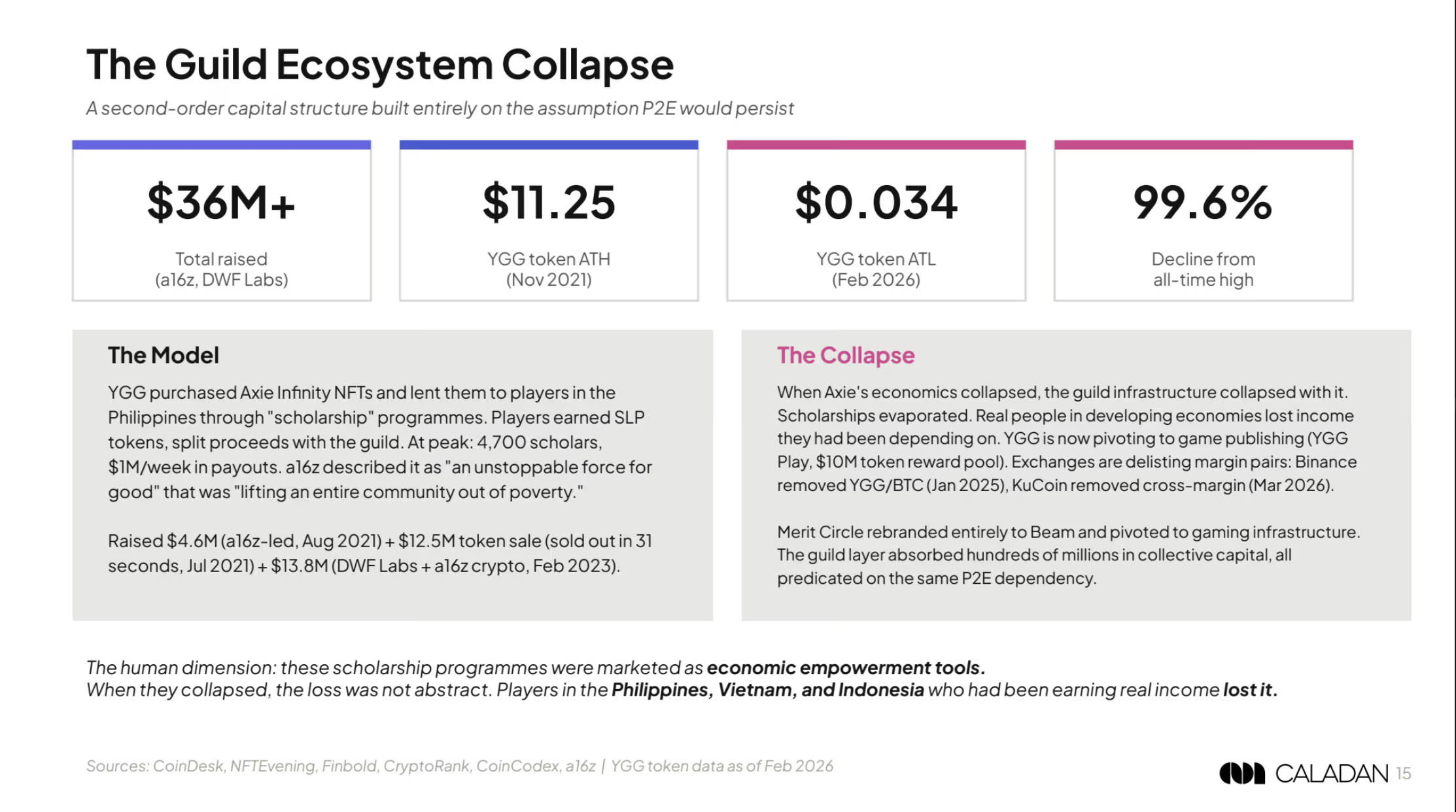
Data from Caladan, a market-making and trading firm, shows roughly 93% of so-called GameFi projects are now effectively dead, with token values down about 95% from their 2022 peaks and funding to studios collapsing 93% by 2025.
Investors and studios poured billions into tokens and non-fungible tokens (NFTs) before building blockchain-based games containing tradable properties. Then capital shifted into AI, asset tokenization and infrastructure, and more than 300 games shut down, turning Web3 gaming into a cautionary tale about chasing speculation over product-market fit.
“Capital was destroyed at every layer simultaneously,” the report states, pointing to venture capital, retail NFT buyers, gaming guilds and Telegram’s 300-million-user tap-to-earn wave as parallel casualties. Hamster Kombat alone lost 96% of its users within six months of launch. YGG, the flagship gaming-guild token, trades 99.6% below its November 2021 peak.

Individual post-mortems are brutal. Pixelmon raised $70 million in a 2022 NFT mint and, four years on, still has no public game. Ember Sword burned through $18 million over seven years of development before shutting down last May with no refunds. Gala Games is embroiled in a lawsuit alleging its co-founder diverted $130 million in tokens. Square Enix quietly wound down its Symbiogenesis experiment last July.
Structural mismatch
The failure wasn’t just a bad cycle or weak execution. The data indicate it was a structural mismatch between a model built around financial incentives and an audience that consistently signaled it wanted entertainment instead.
At the heart of the boom was GameFi, the play-to-earn model that turned gameplay into a financial feedback loop.
Players bought tokens or NFTs, earned rewards in those same assets, and cashed in as long as newcomers kept piling in. Once the inflows slowed, the math broke down. Token prices slumped, rewards thinned out, and users walked away — dragging entire in-game economies down with them.
Axie Infinity, the sector’s one-time flagship, watched daily active users crater from roughly 2.7 million at the peak to around 5,500 today, according to DappRadar data.
The demand side never caught up with the flood of capital. Even at the height of the mania, just 12% of gamers had tried a crypto game, according to a Coda Labs survey, cited by Caladan.
Capital allocation made the problem worse. Studios raised tens or hundreds of millions of dollars before shipping viable products, removing the pressure to build games that could retain players.

The most telling data point may be where the money went instead. Gaming commanded 62.5% of all Web3 venture investment in 2022; by 2025, its share had collapsed to single digits as AI, real-world-asset tokenization and layer-2 infrastructure absorbed the displaced capital.

Even Animoca Brands, the sector’s most prolific backer, has cut gaming to roughly 25% of its portfolio and is pivoting to stablecoins, RWAs and AI.
At the same time, development timelines stretched three to five years, while tokens traded in real time and demanded constant momentum. By the time many projects were ready to launch, their associated tokens had already collapsed.
The result is a sector that expanded rapidly on speculative demand and contracted just as quickly when that demand faded. More than 300 blockchain games have shut down, according to DappRadar, and remaining investment has shifted away from titles toward infrastructure.
What was once pitched as the future of gaming now looks more like a cautionary example of what happens when financial engineering runs ahead of product market fit.

2026 World Snooker Championship: Zhao Xintong v Ding Junhui could break TV viewing records

It’s just Xbox: Microsoft gaming leaders start new era with old name, new metric, and challenger mindset

How To Win Any Finance Interview And Make Them Pick You

Manchester United reach agreement with Casemiro over contract clause amid transfer speculation

US brings back mandatory military draft registration

Steven Gerrard disagrees with Gary Neville over ‘shock’ Chelsea and Arsenal claim | Football


-

 Sports6 days ago
NWFL Suspends Two Players Over Post-Match Clash in Ado-Ekiti
-

 Fashion6 days ago
Weekend Open Thread: Theodora Dress
-

 Politics6 days ago
Palestine barred from entering Canada for FIFA Congress
-
Entertainment4 days ago
NBA Analyst Charles Barkley Chimes in on Ice Spice McDonald’s Fiasco
-

 Tech5 days ago
Auto Enthusiast Scores Running Tesla Model 3 for Two Grand and Turns It Into Bare-Bones Go-Kart
-

 Business4 days ago
Powerball Result April 18, 2026: No Jackpot Winner in Powerball Draw: $75 Million Rolls Over
-

 Politics4 days ago
Zack Polanski demands ‘council homes not luxury flats for foreign investors’
-

 Crypto World6 days ago
Russia Pushes Bill to Criminalize Unregistered Crypto Services
-

 Politics3 days ago
Gary Stevenson delivers timely reminder to register to vote as deadline TODAY
-

 Business1 day ago
Rolls-Royce Voted UK’s Most Iconic Trade Mark as IPO Register Hits 150
-

 Politics1 day ago
Disabled people challenge government SEND proposals over segregation concerns
-

 Politics1 day ago
Making troops accountable for war crimes threatens US alliance, ex-SAS colonel warns
-
 Business7 days ago
Creo Medical agree sale of its manufacturing operation
-

 Crypto World6 days ago
Russia Introduces Bill To Criminalize Unregistered Crypto Services
-

 Politics1 day ago
Starmer handler McSweeney to be dragged from shadows by Foreign Affairs Committee
-

 Politics1 day ago
Zack Polanski responds to home secretary’s taser threat
-
Politics1 day ago
Wings Over Scotland | How To Get Away With Crimes
-
Crypto World5 days ago
Kelp DAO rsETH Bridge Hack Drains $292M as DeFi Losses Top $600M in Two Weeks
-

 Politics1 day ago
‘Iran is still a nuclear threat’
-

 Crypto World2 days ago
New York sues Coinbase, Gemini over prediction market offerings
You must be logged in to post a comment Login