Connect with us
DAPA Banner

Business

Which Prop Firm Is Best for Beginners?

Published

on

Getting access to trading capital without risking your own money is the promise every prop firm makes. The reality is more complicated. With thousands of firms operating globally and the majority of traders failing to reach payout stages, picking the wrong firm means wasted fees and frustration.

Getting access to trading capital without risking your own money is the promise every prop firm makes. The reality is more complicated. With thousands of firms operating globally and the majority of traders failing to reach payout stages, picking the wrong firm means wasted fees and frustration.

This ranking breaks down 5 prop trading firms for the UK traders based on what actually matters: fees, profit splits, drawdown rules, payout reliability, and platform options

5 Prop Firms for the beginners Ranked

Selecting the right prop firm requires looking beyond marketing claims. We assessed each firm that operates in the UK across six core areas that directly impact a trader’s success and experience.

  • Challenge Fees and Refunds. We compared upfront costs and whether firms return fees after the first payout.
  • Profit Split Structures. Higher splits mean more money in your pocket, but we also checked for hidden conditions.
  • Drawdown Rules. Daily and maximum loss limits determine how much room you have to trade.
  • Payout Frequency and Reliability. Consistent, timely payouts separate legitimate firms from problematic ones.
  • Platform Availability. Access to familiar platforms like MetaTrader, cTrader, or TradingView matters for execution.
  • Reputation. We reviewed verified user feedback on TrustPilot and trading communities for patterns in complaints or praise.

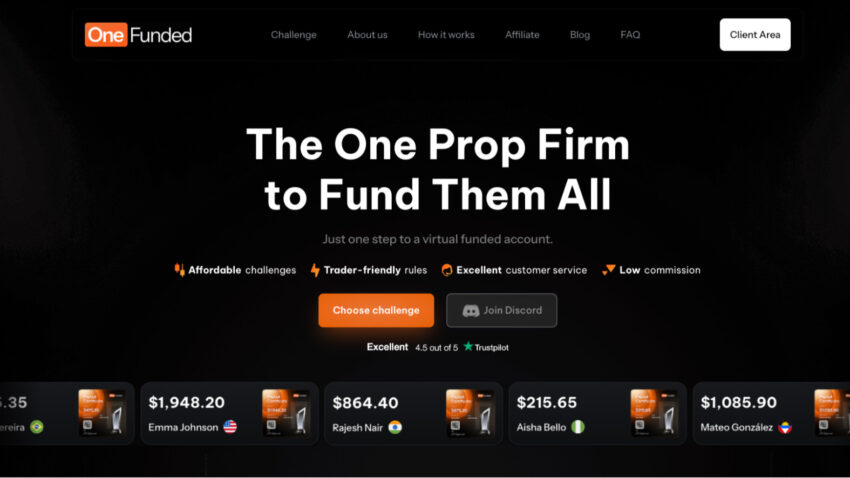
1. OneFunded

OneFunded

launched in 2024 under CEO Anastasiia Kaplunenko. Kaplunenko is a fintech professional who built the firm around a specific frustration: hidden rules, delayed payouts, and opaque evaluation conditions that made trading harder than it needed to be. The firm operates globally through OneFunded Capital Ltd., registered in Saint Lucia. Its UK operations are handled by Brynex Tech Limited in London.

Challenges and evaluation processes

You can choose among four challenge tracks on OneFunded, including Value, Core, Flex, and Flash. Each program is built around a different risk profile, but one rule applies to all four: no time limits of any kind.

Advertisement
Challenge Type One-Off Fee Account Sizes Profit Target Max Daily Drawdown Max Total Drawdown Min Trading Days
Value (2-Step) $16-$137 $2K-$50K 6%/6% 4% 8% 4 per phase
Core (2-Step) $45-$650 $5K-$200K 8%/5% 5% 10% 3 per phase
Flex (2-Step) $54-$780 $5K-$200K 7%/4% 4% 10% 3 per phase
Flash (1-Step) $29-$715 $2K-$200K 10% 4% 6% 5 total


The Value track starts at $16 for a $2,000 account. And for the Flex track, it is worth noting that it is the only track that carries no consistency rule during evaluation. This ensures that traders have more freedom in how their profits are distributed across days.

Spreads, fees, and payouts

Challenge fees translate to between $16 and $780. This means even the largest Flex account is accessible without a significant upfront commitment.

  • Profit split: 80% to the trader as standard; upgradable to 90% via paid addon
  • Spreads and commission: Viewable directly on the platform in demo mode before purchasing a challenge.
  • Payout schedule: 14-day cycle; weekly payouts available via a paid addon. Minimum payout is $100 with 24 hour processing time.
  • Payout methods: Crypto, bank transfer, and Rise.
  • Fee refund: The challenge fee is refunded alongside your first payout

What you can trade and at what size

OneFunded provides access to 250+ instruments, including 55+ forex pairs, 150+ American and European stock CFDs, 15+ global indices and metals, and 15+ cryptocurrencies.

Asset Class Leverage
Forex 1:100
Commodities and Indices 1:30
Cryptocurrencies 1:2

Trading software and tools

OneFunded supports three platforms, each available on web, desktop, iOS, and Android:

Advertisement
  1. TradeLocker: Integrated with TradingView for charting. It is accessible globally, including the UK and suited to manual traders
  2. cTrader: Available to the UK traders and offers advanced order execution and full market depth.
  3. MT5: Available to the UK traders and supports automated trading through EAs and provides the widest analytical toolkit of the three platforms.

Rules every trader must follow

  • Algorithmic trading: EAs are permitted but require pre-approval. Prohibited practices include latency arbitrage, reverse arbitrage, tick scalping, gap billing, data freezing, and the use of delayed or external data feeds.
  • News trading: Permitted across all four tracks and in funded accounts. However, a 5-minute window applies around scheduled high-impact events.
  • Weekend and overnight trading: Positions may be held overnight and over weekends but swap fees may apply.
  • Consistency rule: Applies to Value (40% cap on best-day profit), Core (50%), and Flash (50%) during evaluation. The Flex track has no consistency rule although in the funded phase, a 30% cap applies across all tracks.

Reputation and trader experience

OneFunded holds a Trustpilot rating of 4.4/5 from 205 reviews. It has 64% five-star and 23% four-star ratings. Reviewers most consistently highlight the absence of time limits, fast crypto payouts, transparent rules, and responsive support.

The firm previously operated as Prop365 before rebranding, and several reviews reference continuity of service through that transition. Negative reviews focus mainly on a small number of consistency rule disqualifications and occasional KYC delays, both of which the firm addresses directly on Trustpilot. It has replied to 88% of negative reviews, typically within 48 hours.

The firm’s community is active on Discord, X, Facebook, and Instagram. And support is reachable via email at support@onefunded.com, chat, and through the contact page on the website.

Our assessment

OneFunded checks all the important boxes when looking for a prop firm that accepts UK traders. The entry fee is one of the lowest on this list, all four challenge tracks run on unlimited time, and payouts below $1,000 are processed in crypto by default, which is the most practical route for traders receiving foreign earnings. The rules are written plainly, the Flex track removes the consistency rule entirely, and the challenge fee comes back with the first payout.

It suits beginner traders who trade part-time, are making their first funded account attempt, or want a low-cost, low-pressure environment to build a consistent track record before moving to larger account sizes.

Advertisement

2. FTMO

FTMO has been operating from Prague, Czech Republic, since 2015. This is the longest-established firm in this guide and one of the most recognized names in funded trading globally. The firm runs two challenge tracks on unlimited timeframes and offers a free trial for traders to test the platform.

Challenges and evaluation processes

FTMO offers two paths to a funded account, both with no time limit on the evaluation.

Challenge Type Fee from Account Sizes Target Max Daily Loss Max Loss Min Trading Days Avg. Reward Fee Refund
2-Step €89 $10K-$200K 10%/5% 5% 10% 4 per phase Up to €12,234 Yes (100%)
1-Step €79 $10K-$200K 10% 3% 10% 90% profit  split No

Spreads, fees, and payouts

  • Profit split: 80% standard on both tracks; 90% via the Scaling Plan once certain account growth milestones are reached.
  • Spreads: Tight; major pairs like EURUSD regularly trade near 0.1 pips on MetaTrader during active sessions.
  • Commission: All standard forex pairs carry a commission of $5 per lot per side ($10 round-trip).
  • Payout schedule: Bi-weekly; average processing time of approximately 8 hours from request to completion.
  • Payout methods: Bank wire, Skrill, crypto, and Visa Direct (up to $20,000)
  • Scaling ceiling: Up to $2M through the Scaling Plan

What you can trade and at what size

FTMO covers forex, indices, commodities, metals, and cryptocurrencies across all accounts.

  • Forex: Major, minor, and exotic pairs; leverage up to 1:100
  • Indices: Global indices including US30, US100, US500, and EU equivalents; leverage up to 1:20
  • Commodities and metals: Gold, silver, oil; leverage up to 1:10
  • Cryptocurrencies: Bitcoin, Ethereum, and others; leverage up to 1:2

Trading software and tools

FTMO supports MetaTrader 4 and 5, and cTrader. All three platforms are available for both the 1-Step and 2-Step FTMO Challenges as well as funded FTMO Accounts, and can be selected directly in the challenge configurator.

Every FTMO account includes a built-in toolkit, which includes FTMO Academy, Psychology Course, Account MetriX performance tracker, Equity Simulator, Trading Journal, Economic Calendar, and News Indicator.

Rules every trader must follow

  • Algorithmic trading: EAs are permitted on all accounts. The only restriction is a cap of 2,000 server requests per day per account.
  • News trading: Unrestricted during both evaluation phases.
  • Overnight and weekend holding: Permitted during evaluation on both tracks. On a funded Standard account, positions must be closed before the weekend market rollover.
  • Gap trading: Prohibited.

Reputation and trader experience

FTMO holds a Trustpilot rating of 4.8/5 from 41,020 reviews. This is the highest review volume of any firm in this guide, and the most statistically reliable reputation signal as a result. Reviewers highlight transparent rules, fast payout processing, and responsive multilingual support. Negative reviews are rare and mostly relate to account closures for rule violations, which FTMO addresses publicly on Trustpilot.

The firm’s community spans Discord (116K+ members), YouTube (417K+ subscribers), Instagram (551K followers), X (139K followers), and Facebook (272K followers). Support is available 24/7 via live chat, WhatsApp, email at support@ftmo.com, and phone, in 20 languages.

Advertisement

Our assessment

FTMO’s strength is its track record and the tools it bundles with every account. A decade of consistent operation, over $500 million paid in rewards globally, and more than 41,000 Trustpilot reviews give it a credibility floor that newer firms cannot match. That matters if you are committing meaningful capital to a challenge fee.

That said, this firm suits experienced traders who prioritize a long operational history, built-in analytical tooling, and platform flexibility above all else.

3. RebelsFunding

RebelsFunding was founded in 2023 by Marek Soska and is headquartered in Bratislava, Slovakia. The founding team has been trading financial markets since 2008 and launched a trading education business in 2015 before creating RebelsFunding. The firm says on its website that it has distributed over $3 million in rewards to more than 30,000 traders globally. RebelsFunding offers the widest range of program tiers on this list.

Challenges and evaluation processes

Program Phases Fee Account Sizes Profit Target Daily Drawdown Max Drawdown Fee Refund
Copper 4 From €9 $1K-$320K 5% per phase 5% 10% 200%
Bronze 3 From €37 $5K-$160K 5% per phase 5% 10% 150%
Silver 2 From €45 $5K-$80K 8%/5% 5% 10% 100%
Gold 1 From €68 $5K-$40K 10% None during eval; 4% on funded 6%
Diamond 10-level From €156 $5K-$20K initial; scales to $530K 10% per level None 6% 100% after Level 0

Spreads, fees, and payouts

  • Profit split: 75-90% across all programs; the starting rate and scaling conditions vary by tier.
  • Spreads: The average spread on major forex pairs sits at around 0.9 pips, while top shares average between 0.5 and 1.0 pips. Across the full instrument range, spreads start from as low as 0.3 pips.
  • Commission: RebelsFunding charges a flat $2 per $100,000 traded across all asset classes.
  • Payout schedule: Your first withdrawal becomes available 14 calendar days after placing your first trade on the funded account. All further withdrawals can be submitted every 14 days.
  • Payout methods: Bank wire transfer, crypto, PayPal, Wise, Revolut, Venmo (only for US-based traders), physical checks, and Credit/Debit Cards.
  • Scaling: Account grows up to 200% of the initial value on Copper, Bronze, and Silver upon meeting profitability milestones; Diamond scales to $530K through 10 levels.

What you can trade and at what size

RebelsFunding covers the following asset classes:

  • Forex: 40 pairs with 28 swap-free pairs
  • Metals: 4 instruments, with 4 swap-free
  • Energies: 2 instruments (WTI Oil and Natural Gas)
  • Cryptocurrencies: 7 instruments including Bitcoin and Ethereum
  • Equities: 10 individual stocks
  • Indices: 8 instruments including NASDAQ and S&P 500

The minimum lot size across all instruments is 0.01 lots, and RebelsFunding requires consistent position sizing. And leverage is tiered; see the table below:

Asset Class Evaluation Leverage RCF (Funded) Leverage
Forex – Majors 1:200 1:100
Forex – Crosses 1:150 1:50
Forex – Exotics 1:100 1:25
Metals 1:25 1:15
Indices 1:25 1:15
Energies 1:5 1:5
Equities 1:2.5 1:2.5
Cryptocurrencies 1:2.5 1:2.5

Trading software and tools

RebelsFunding uses a single proprietary platform, RF-Trader, built on TradingView charts and connected directly to liquidity providers. It is available on web, desktop, iOS, and Android. The platform has a built-in lot size and dollar-risk calculator, which several reviewers specifically cite as useful for real-time position sizing. It also includes an AI Trader tool in the Client Zone that analyses your trading history and identifies strengths and weaknesses.

Advertisement

Rules every trader must follow

  • Algorithmic trading: EAs are permitted across all programs
  • News trading: Permitted across all programs; no restriction window stated
  • Weekend trading: Positions can be held over weekends, but the firm cautions against it on cross pairs and less liquid instruments. And crypto trading is not available over weekends.
  • Scalping: Permitted
  • Overnight holding: Permitted on all programs

Reputation and trader experience

RebelsFunding holds a Trustpilot rating of 4.4/5 from 2,292 reviews, with 69% five-star and 15% four-star ratings. The firm replies to 96% of negative reviews, typically within 48 hours. Reviewers highlight affordable entry fees, fast payout processing, straightforward rules, and responsive support. The most recurring criticism across recent reviews is platform performance, specifically, slow load times on the RF-Trader app during peak market hours and periodic connectivity drops.

Our assessment

RebelsFunding’s fee refund model is a standout feature. Also, the range of five program tiers makes it one of the few firms on this list where a complete beginner and an experienced trader can both find a structurally appropriate starting point.

The firm suits traders who are confident in their pass rate and want the lowest net challenge cost over time. That is, the more programs you pass, the more of your fees come back.

4. CTI

City Traders Imperium has been funding traders since 2018 and operates from Dubai, UAE. It is the only firm in this guide that pays a monthly salary to its highest-performing funded traders. The firm offers four routes to funding and with a maximum allocation of $4 million.

Challenges and evaluation processes

All four programs run on unlimited time, and each carries a balance-based drawdown. This means losses are calculated against the account balance, not a floating equity high-water mark like many others. This gives traders more room to recover from open position drawdowns without breaching the limit.

Advertisement
Program Entry Fee Account Sizes Profit Target Max Daily Loss Max Drawdown Min Profitable Days
1-Step From $27 $2.5K-$100K 8% 5% 3
2-Step From $34 $2.5K-$100K 10%/5% 5% per phase 10% per phase 3 per phase
3-Step (Pay-per-level) From $1 (Level 1 only) $2.5K-$100K 3%/5%/7% 2% per step 4% per step 3 per step
Instant Funding From $62 $2.5K-$80K (doubles on passing) 10% to scale None 6% None
Instant Funding Pro From $263 $5K-$80K 10% to scale None 6% None

CTI also operates a VIP program that activates automatically as funded traders demonstrate consistent performance. This table provides the details:

VIP Tier Profit Share Payout Frequency Additional Benefits
Bronze 90% Weekly 30% discount on all future purchases, VIP support, free 1-on-1 coaching
Silver 100% Any time, on demand Free CTI merchandise, all Bronze benefits
Gold 100% Any time, on demand Potential 1-year monthly salary, institutional trading conditions, custom funding terms, team membership

Spreads, fees, and payouts

  • Profit split: starts at 50% for Instant Funding (Level 1), 80% on evaluation programs from the first funded payout, and scales to 100% at Silver and Gold VIP tiers.
  • Spreads: From 0.3 pips on EUR/USD
  • Commission: $5 per lot round-turn on forex
  • Payout schedule: Your first withdrawal becomes available after a minimum of 5 trading days on your funded account. In the VIP tier, payouts are weekly at Bronze, and any time on demand at Silver and Gold.
  • Payout methods: Payouts are processed into a Personal Wallet inside the CTI dashboard and withdrawals are via bank wire transfer, cryptocurrency (USDT/TRX), Credit/Debit Card, PayPal.
  • Scaling ceiling: $4 million through the VIP program

What you can trade and at what size

  • Forex: 28 currency pairs; leverage 1:30 on evaluation accounts, 1:10 on Instant Funding
  • Commodities: Gold, silver, and crude oil; leverage 1:10
  • Indices: 13 global indices including US30 and DE40; leverage 1:10
  • Cryptocurrencies: 6 assets including BTC/USD and ETH/USD; leverage 1:2

Trading software and tools

CTI supports MT5 and Match-Trader, both available across all platforms. In addition, traders get access to Account Metrix, Account Analysis, a Trading Journal, Risk Calculators, an Economic Calendar, and CTI Academy at no extra cost.

Rules every trader must follow

  • Stop loss: Mandatory on every trade
  • Copy trading: Prohibited across all programs and account types
  • Gambling behavior: Prohibited
  • News trading: Permitted across all programs without restriction
  • Weekend and overnight holding: Permitted on all programs

Reputation and trader experience

CTI holds a Trustpilot rating of 4.3/5 from 1,683 reviews. 84% of the reviews are five-star and 9% four-star. The firm replies to 97% of negative reviews and typically within one week.

Positive reviews cite fast payouts (several reviewers report same-day processing), responsive multilingual support, and an easy-to-navigate dashboard. The recurring criticism is payout denials following what CTI characterizes as gambling behavior or stop-loss violations.

Our assessment

CTI’s strongest differentiator is the VIP program structure as a whole. The 3-Step pay-per-level program also removes one of the biggest barriers in prop trading, which is the psychological cost of paying a large upfront fee and failing early.

This firm suits disciplined traders who prefer manual processes and operate with defined risk parameters. These traders also want a clear, built-in progression toward higher payouts and better conditions without paying extra for each upgrade.

Advertisement

5. ThinkCapital

ThinkCapital is backed by ThinkMarkets, a broker regulated across multiple jurisdictions. The broker provides an infrastructure credibility that standalone prop firms cannot offer. Its rails support spreads, execution, and platform stability.

Challenges and evaluation processes

Program Phases Entry Fee (from) Account Sizes Phase 1 Target Phase 2 Target Phase 3 Target Daily Loss Max Loss
Lightning 1 $59 $5K-$100K 10% 3% (balance) 6% trailing
Dual Step Intraday 2 $59 $5K-$100K 9% 5% 4% (equity) 7% fixed
Dual Step Swing 2 $82 $5K-$100K 9% 5% 4% (balance) 7% fixed
Nexus 3 $39 $5K-$100K 7% 6% 5% 4% (balance) 8% fixed


All programs scale to $1 million on MT5 accounts and $1.5 million on ThinkTrader accounts. Every 10% return in a rolling three-month period triggers a 20% account size boost.

Spreads, fees, and payouts

  • Profit split: 80% standard across all programs; upgradeable to 90% via addon or through the scaling plan
  • Spreads: Traders are commission-free but with wider spreads on ThinkTrader. For MT5 accounts, raw spreads from 0.0 pips with commission.
  • Commission: $4 per lot per side on MT5; zero on ThinkTrader
  • Payout schedule: Bi-weekly standard; weekly payouts available via addon
  • Payout methods: Crypto, RiseWorks, and Broker Profit Transfer

What you can trade and at what size

  • Forex: 49 pairs; leverage dynamic up to 1:100 on Dual Step and Nexus; 1:30 on Lightning
  • Indices: NAS100, GER40, and others; leverage up to 1:15
  • Commodities: Gold, silver, and oil; leverage up to 1:30
  • Cryptocurrencies: BTC/USD, ETH/USD, and others; leverage 1:2

Trading software and tools

ThinkCapital supports ThinkTrader and MT5, both accessible to beginner traders. The former is a proprietary platform with full TradingView integration. This means you can chart and execute trades directly from TradingView charts without switching windows, and without paying any commission. Also, all accounts come with access to a free trial before any paid commitment.

Rules every trader must follow

  • News trading: A news trading addon is available for the Lightning and Nexus programs to remove this restriction on funded accounts. Dual Step Swing permits news trading by default
  • Expert advisors: They are banned by default. Automated systems require purchasing the EA addon.
  • Weekend holding: Permitted on Nexus and Dual Step Swing, and Lightning funded accounts; not permitted on Dual Step Intraday.
  • No account rolling: Deliberately failing a challenge to restart is flagged and banned
  • Gambling behavior: Accounts exhibiting reckless position sizing, described as oversized risk relative to account balance, are subject to a warning and potential reset.

Reputation and trader experience

The average rating for ThinkCapital on Trustpilot is 4.0/5 from 604 reviews. Of these, 75% are five-star and 15% are one-star ratings. Positive reviews cite fast and helpful live support, TradingView integration on ThinkTrader, tight gold spreads, and the credibility of ThinkMarkets’ regulated backing. On the other hand, some negative reviews describe accounts being terminated for “multiple profiles” following giveaway wins or near-payout milestones, with no specific evidence provided by the firm’s risk team. ThinkCapital’s responses to these reviews cite undisclosed risk team findings but do not address the individual claims in detail.

Our assessment

ThinkCapital is one of the two broker-backed firms in this list, and this is a major upside. Other advantages include TradingView integration on a commission-free platform, and low entry fees across three structured programs. This makes the firm ideal for traders who want the reliability of a regulated-broker-backed infrastructure at a budget entry point.

Advertisement

How the Eight Firms Compare

Firm Max Capital Default Split Challenge Tracks Min Entry Fee Time Limit Crypto Payout Trustpilot
OneFunded $200,000 80% 4 $16 None Yes 4.4
FTMO $2M 80% 2 €79 None Yes 4.8
RebelsFunding $530,000 75-90% 5 tiers €9 None Yes 4.4
CTI $4M 80% 4 + VIP $1 None Yes 4.3
ThinkCapital $1.5M 80% 3 $39 None Yes 4.0

*BrightFunded’s Trustpilot rating has been removed by Trustpilot due to a breach of its guidelines.

Conclusion

The right prop firm for a beginner trader is not the most popular one globally. It may also not be the one that advertises the juiciest profit share. Instead, the firm you should choose is one that works given your payout options, the cost in INR terms, how the evaluation is structured, and how clearly the rules are written. Those four filters eliminate a lot of options quickly.

That said, we have learned that no evaluation deadline, crypto payouts that bypass the friction of international bank transfers, entry fees that do not require a large capital commitment to get started, and rules written plainly enough are the most important hoops a firm must jump through. And by this point in the guide, you have already seen which firm fits this description.

Advertisement

Continue Reading
Click to comment

You must be logged in to post a comment Login

Leave a Reply

Business

Meta to lay off 8,000 employees in AI investment pivot

Published

on

Meta to lay off 8,000 employees in AI investment pivot

Meta has informed its staff it will let go of roughly 8,000 employees — approximately 10% of its workforce — as it looks to bolster its presence in the artificial intelligence space. 

The employees were told about the sweeping cuts in a memo as the company prepares to make heavy investments in AI. The layoffs are expected to begin May 20.

Advertisement

“I know this is unwelcome news and confirming this puts everyone in an uneasy state, but we feel this is the best path forward, given the circumstances,” Chief People Officer Janelle Gale wrote in the memo obtained by Bloomberg News.

META’S BAY AREA LAYOFFS AFFECT ROUGHLY 200 WORKERS AS COMPANY POURS BILLIONS INTO AI INFRASTRUCTURE

A technology executive stands on stage presenting new hardware during a company event.

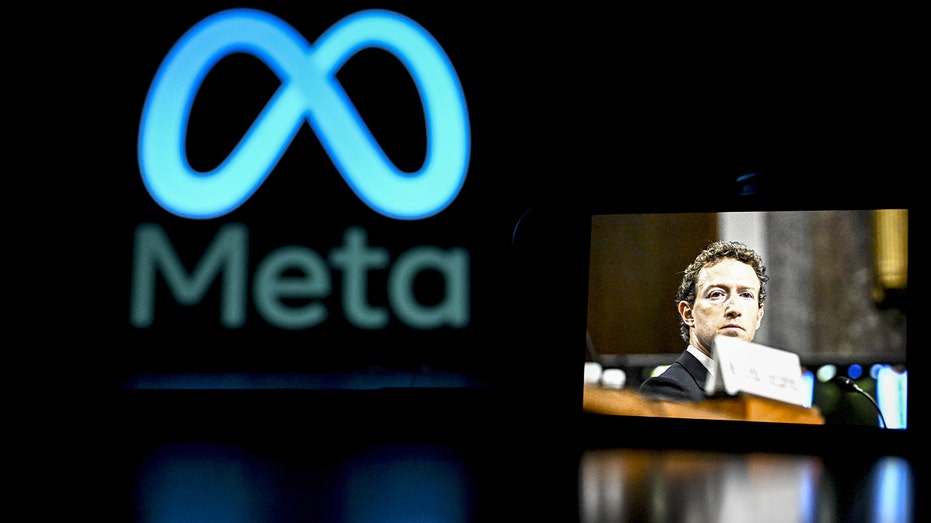
Mark Zuckerberg, CEO of Meta Platforms Inc., appears during the Meta Connect event in Menlo Park, Calif. (David Paul Morris/Bloomberg via Getty Images / Getty Images)

A Meta spokesperson declined to comment on the job cuts but confirmed the memo and its contents with FOX Business. 

Other tech companies are making staff reductions amid a boom in AI spending. On Thursday, Microsoft Corp. offered voluntary retirement to around 8,750 employees, or 7% of its U.S. workforce, according to Bloomberg.

Advertisement
Ticker Security Last Change Change %
META META PLATFORMS INC. 659.15 -15.57 -2.31%

In her memo, Gale wrote that the layoffs are “part of our continued effort to run the company more efficiently and to allow us to offset the other investments we’re making.”

META VOWS APPEAL OF ‘LANDMARK’ SOCIAL MEDIA VERDICTS, WARNS OF FREE SPEECH EROSION

A smartphone showing Mark Zuckerberg’s image is held in front of a computer screen with the Meta logo.

Meta will lay off around 8,000 workers, the company said in a memo to employees.  (Arda Kucukkaya/Anadolu via Getty Images / Getty Images)

“This is not an easy tradeoff, and it will mean letting go of people who have made meaningful contributions to Meta during their time here,” she said.

Laid-off employees will receive a generous severance package and career support services to help find other jobs and immigration support for those who need it.

Advertisement
Meta AI

Meta is weighing significant workforce reductions as the tech giant ramps up spending on AI infrastructure. (Getty Images / Getty Images)

GET FOX BUSINESS ON THE GO BY CLICKING HERE

The company previously laid off 11,000 workers in November 2022 — about 13% of its workforce — and cut another 10,000 jobs months later. Meta employed nearly 79,000 people as of Dec. 31, according to its latest filing.

Continue Reading

Business

Gas prices are rising, but don’t count on lower car insurance premiums

Published

on

Gas prices are rising, but don't count on lower car insurance premiums

A customer fills his vehicle with fuel at a gas station on April 13, 2026 in Miami, Florida. As the United States military blockades the Strait of Hormuz fuel prices rose above $100 dollars a barrel.

Joe Raedle | Getty Images

As war in the Middle East pushes the national average for gas to around $4 a gallon, American drivers are feeling a significant pinch at the pump. Fuel costs have surged 37% since the start of the war, according to insurance-comparison marketplace Insurify.

Advertisement

Typically, higher gas prices lead consumers to cut back on how many miles they drive. Fewer miles driven translates to fewer accidents and lower car insurance premiums.

But a new report from Insurify shows any silver lining to drivers cutting back on miles is incredibly thin.

When gas prices rise 10%, people cut their driving by about 3% on average, according to the report. If Americans were to cut their total mileage by 10% this year, the average annual insurance premium would likely drop to $2,209.

While that’s slightly less than the current $2,222 average, the actual savings are negligible when compared to the soaring cost of gasoline.

Advertisement

Reducing driving by 10% would save the average person just $27 a year on insurance. That same person would still end up spending an extra $385 on gas in 2026, even after cutting back their miles, Insurify said.

Matt Brannon, a senior analyst at Insurify, told CNBC that the drop in insurance costs, roughly 1% annually, doesn’t move the needle for most consumers.

“Gas prices might overwhelm the savings they could get from insurance, especially if you’re driving a lot,” Brannon said.

Insurers, meanwhile, are seeing the benefits of consumer driving less and fewer accidents negated by the cost of auto parts, which has risen 4% year over year, according to Insurify.

Advertisement

Progressive, for example, warned in March that retaliatory tariffs and rising auto part costs could pressure profit margins and lead to rate hikes.

Choose CNBC as your preferred source on Google and never miss a moment from the most trusted name in business news.
Continue Reading

Business

Alphabet Stock Edges Higher on New AI Chip Launches and Cloud Momentum Ahead of Q1 Earnings

Published

on

Google May Avoid Harsh Penalties as Judge Eyes Softer Antitrust

MOUNTAIN VIEW, Calif. — Alphabet Inc. Class C shares (NASDAQ: GOOG) ticked up modestly Thursday, trading around $338.38 after gaining about 0.19% early in the session, as investors digested fresh artificial intelligence product announcements and positioned for the tech giant’s highly anticipated first-quarter earnings next week.

Google May Avoid Harsh Penalties as Judge Eyes Softer Antitrust
Alphabet Stock Edges Higher on New AI Chip Launches and Cloud Momentum Ahead of Q1 Earnings

The stock has climbed more than 12% in the past month and roughly 120% over the trailing year, reflecting renewed confidence in Google’s AI strategy despite elevated capital spending plans for 2026. Volume remained solid but below recent peaks as the market awaited the April 29 report.

Alphabet’s Google Cloud division stole the spotlight this week at the annual Cloud Next conference in Las Vegas, where the company unveiled its latest Tensor Processing Unit (TPU) inference chips aimed at challenging Nvidia’s dominance in running trained AI models more efficiently and cost-effectively. The new hardware, alongside AI agent advancements and the rebranding of Vertex AI under the Gemini Enterprise banner, underscored Alphabet’s aggressive push into enterprise AI monetization.

Shares rose as much as 2.1% in recent sessions following the announcements, with analysts highlighting potential margin benefits from custom silicon and accelerated adoption of AI-powered tools. Google also detailed new governance, security features for autonomous AI agents, and upcoming coding enhancements set for May release.

Wall Street has grown increasingly bullish. BMO Capital Markets lifted its price target to $410 from $400 while maintaining an Outperform rating. Other firms including KeyBanc, UBS, DBS Bank and Stifel have raised targets in recent weeks, pushing the consensus toward $370 with a Strong Buy lean.

Advertisement

Heading into earnings, analysts expect Alphabet to report revenue around $106.9 billion, up roughly 18-19% year-over-year, with adjusted earnings per share near $2.62 to $2.68. The modest expected EPS decline from last year stems from higher depreciation tied to massive AI infrastructure investments.

Google Cloud remains a key growth engine. The segment posted 48% year-over-year revenue growth in the prior quarter to $17.7 billion, outpacing many hyperscale competitors. Remaining performance obligations have swelled, signaling strong contracted demand for AI and cloud services.

Search and advertising, still the profit powerhouse, continue benefiting from AI Overviews and deeper user engagement. YouTube and subscriptions also deliver steady gains. Management, led by CEO Sundar Pichai, has emphasized that AI investments are already driving measurable returns across the portfolio.

The company’s 2026 capital expenditure guidance of $175 billion to $185 billion — nearly double prior levels — continues to weigh on near-term margins but is viewed by bulls as necessary table stakes for AI leadership. Analysts expect heavy spending on data centers, networking and custom chips to pay off as cloud margins expand over time.

Advertisement

Alphabet completed its acquisition of cybersecurity firm Wiz in March, bolstering Google Cloud’s security offerings at a time when enterprise customers demand robust AI governance. The deal fits into a broader strategy of inorganic growth to complement organic AI innovation.

Financially, Alphabet remains fortress-like. Trailing annual revenue surpassed $400 billion for the first time in 2025, with strong free cash flow supporting dividends, buybacks and R&D. The company’s Class C shares trade at a forward P/E that some view as reasonable given growth prospects, though concerns linger around regulatory risks and competition.

Antitrust pressures persist. Ongoing cases related to search dominance and ad tech could influence future strategy, though investors appear to be pricing in continued innovation as the primary driver. Google’s Gemini model has gained market share, approaching significant user milestones and narrowing gaps with rivals.

Broader market context shows rotation into AI infrastructure plays. While mega-cap tech remains volatile, Alphabet’s diversified revenue — spanning search, cloud, YouTube, Waymo and hardware — provides resilience. Analysts forecast mid-teens to low-20s revenue growth for the full year, with potential upside from AI monetization acceleration.

Advertisement

Challenges include intensifying competition in cloud from Microsoft and Amazon, potential ad market softness, and execution risks on massive capex. However, recent product momentum and analyst upgrades suggest the street is leaning optimistic heading into the print.

Pichai and team will likely highlight AI integration across products during the April 29 call, scheduled for 4:30 p.m. ET. Focus areas will include cloud growth trajectory, margin commentary amid depreciation, Gemini adoption metrics, and any updated capex or outlook details.

Longer term, Alphabet positions itself at the center of the AI transformation. From consumer tools like the Gemini app on Mac and Chrome enhancements to enterprise agents that can plan and act autonomously, the company is embedding intelligence deeply into daily workflows.

Investors have rewarded the pivot. Shares have more than doubled from 2025 lows, with all-time highs near $350 tested earlier this year. The modest gain Thursday keeps the stock in a constructive uptrend, consolidating ahead of what many expect could be another beat-and-raise quarter.

Advertisement

Analysts caution that valuation leaves little room for disappointment. A forward P/E in the mid-20s to low-30s range demands continued execution. Yet with Google Cloud approaching $70 billion annualized run-rate potential and AI features expanding search usage, the growth narrative appears intact.

Alphabet’s dual-class structure and substantial cash reserves give it flexibility to invest aggressively while returning capital. The quarterly dividend and ongoing buybacks provide downside support.

As trading continued midday Thursday, GOOG held near session highs with peers in the Magnificent Seven mixed amid broader market rotation. The upcoming earnings will serve as a key test of whether AI tailwinds can outweigh near-term margin pressure from infrastructure buildout.

For a company once viewed primarily as an ad business, Alphabet’s transformation into an AI powerhouse is well underway. Next week’s results could determine if investors are willing to pay even more for that future.

Advertisement
Continue Reading

Business

Why ASEAN Must Prioritize Strengthening Supply Chain Integrity

Published

on

ASEAN’s green goals face threats from illicit trade, costing governments $3.7 billion annually in tobacco revenues alone. Counterfeit goods, organised crime, and weak supply chain oversight undermine sustainability, deter investment, and compromise national security, requiring stronger regional coordination and enforcement.


Key Points

• ASEAN attracted US$226 billion in FDI in 2024, but illicit trade threatens its green ambitions by draining government revenues, damaging environments, and fuelling organised crime
• Governments lose an estimated US$3.7 billion annually in tobacco excise revenue, while counterfeit goods cost approximately US$35 billion yearly, undermining healthcare, education, and climate investment

• Illicit trade networks overlap with human trafficking and money laundering, exploiting border gaps and free trade zones, posing serious national security threats beyond traditional customs concerns
• No single country can tackle this alone, requiring coordinated intelligence sharing, joint enforcement, and industry partnerships across ASEAN jurisdictions

• Digital tools like track-and-trace systems and AI-driven risk profiling are advancing in Thailand and Malaysia, but cross-border integration remains critical
• Traceability systems, market surveillance, and trusted green lanes must be embedded into supply chains to align trade facilitation with sustainability goals, making supply chain integrity the foundation of ASEAN’s long-term growth

Advertisement

ASEAN’s Green Ambitions Undermined by Illicit Trade

The Promise and the Threat
ASEAN has committed to ambitious sustainability goals, attracting US$226 billion in foreign direct investment in 2024, positioning itself as a major global production hub. However, this opportunity is increasingly threatened by illicit trade, which drains government revenues, damages the environment, fuels organised crime, and jeopardises national security.

The Fiscal Consequences
The financial impact is staggering. Governments across ASEAN lose an estimated US$3.7 billion annually in tobacco excise revenue alone, with losses potentially exceeding US$11 billion over the next three years. The counterfeit goods market is valued at approximately US$35 billion annually, diverting critical funds away from healthcare, education, and climate resilience investments.


Illicit Trade as a National Security Crisis

Criminal Networks and Human Costs
Illicit trade extends far beyond counterfeit goods — it forms part of a transnational criminal ecosystem linked to human trafficking, money laundering, and forced labour. Globally, 27.6 million people are trapped in forced labour, generating US$150 billion in illicit profits. Criminal syndicates exploit border vulnerabilities, free trade zones, and inconsistent enforcement, making this a frontline national security threat rather than merely a trade issue.

Investor Confidence at Risk
Capital follows predictability. Where enforcement is inconsistent and supply chains lack transparency, regulatory and reputational risks deter long-term investment. Conversely, traceable, accountable supply chains strengthen ASEAN’s attractiveness as a sustainable investment destination, reinforcing the direct link between supply chain integrity and economic competitiveness.

Advertisement

Building a Resilient and Sustainable Supply Chain Framework

Regional Coordination and Technology
No single nation can tackle illicit trade alone. Addressing this challenge requires joint risk targeting, intelligence sharing, and aligned enforcement frameworks across borders. Countries like Thailand and Malaysia are already deploying digital track-and-trace systems and AI-driven risk profiling, but without cross-border integration, these efforts remain fragmented. True regulatory interoperability across ASEAN is essential.

Embedding Integrity into Sustainability
Practical measures — including digital traceability systems, targeted market surveillance, and trusted green lanes for compliant businesses — can align trade facilitation with environmental protection. As ASEAN approaches the Philippines’ 2026 chairmanship, elevating supply chain integrity as a regional priority across economic, security, and sustainability agendas is critical. Supply chain integrity is not a constraint on growth — it is its very foundation.

Source : Why Asean needs to pay more attention to supply chain integrity

Advertisement
Continue Reading

Business

Fastenal Company (FAST) Shareholder/Analyst Call Transcript

Published

on

OneWater Marine Inc. (ONEW) Q1 2026 Earnings Call Transcript

Fastenal Company (FAST) Shareholder/Analyst Call April 23, 2026 11:00 AM EDT

Company Participants

Scott Satterlee
John Milek – VP & General Counsel
Jeffery Watts – President & Chief Sales Officer
Daniel Florness – CEO & Director

Conference Call Participants

Advertisement

Mark Dumke
Ken Lyons
Kate Hazelton
Andrew Elcock

Presentation

Scott Satterlee

Advertisement

Good morning, everybody, and welcome to Fastenal’s 2026 Annual Meeting of Shareholders. My name is Scott Satterlee, Chair of the Board. And first off, I’d like to thank and appreciate the global Fastenal Blue Team for that intro video. Before we move on to official business, actually, I want to make sure I thank everybody here for taking the time as well as those watching on the webcast. We appreciate your connection and your investment in Fastenal. So thank you very much.

Before we move on to official business, I would like to introduce Pastor Mark Dumke, the retired pastor of Faith Lutheran Church to lead the invocation.

Mark Dumke

Advertisement

Thank you, Scott, for the invitation. And friends, it’s good to be here with you again this morning. I’m thinking of 2 words this morning, gratitude and confidence. Dan, I’ve known you since you moved to town in 1996. And with your wife, Jenny, and your 4 wonderful kids who have now grown to be outstanding adults. It’s been a pleasure to watch you and Fastenal and your family grow. Likewise, it’s been a pleasure, along with all of you to watch the growth of Fastenal all of these years. I am grateful for your integrity and for your leadership and stewardship of the Fastenal company, especially as CEO these past 10 years. Congratulations.

I’m also confident in the ability of Fastenal to continually raise up leaders who are the best in the industry. I’m confident in your successor, Jeff Watts, who will build on your

Advertisement
Continue Reading

Business

Form DEF 14A SOLID BIOSCIENCES INC. For: 23 April

Published

on


Form DEF 14A SOLID BIOSCIENCES INC. For: 23 April

Continue Reading

Business

Prelude Therapeutics director David P. Bonita acquires $12.5 million in stock

Published

on


Prelude Therapeutics director David P. Bonita acquires $12.5 million in stock

Continue Reading

Business

From Shark Thrillers to Oscar Favorites

Published

on

Netflix to Open 2 Massive Entertainment Venues That Will Offer Events, Shops Themed to Its Famous Shows

LOS ANGELES — Netflix subscribers in the U.S. have a stacked lineup of films to stream throughout April 2026, blending high-octane new originals with timeless classics and buzzy returning favorites that are dominating watch lists nationwide.

Netflix to Open 2 Massive Entertainment Venues That Will Offer Events, Shops Themed to Its Famous Shows
10 Must-Watch Movies on Netflix This April 2026: From Shark Thrillers to Oscar Favorites

As spring weather tempts viewers outdoors, the streaming giant’s April slate keeps audiences glued to their screens with shark-infested survival tales, star-studded thrillers and critically acclaimed dramas. Here’s a curated look at 10 of the best movies available or newly arriving on Netflix this month, perfect for movie nights from coast to coast.

1. Thrash (2026, New April 10) This breakout Netflix Original has rocketed to the top of charts since its debut, delivering a wild hybrid of disaster and creature-feature horror. Directed by Tommy Wirkola, the film follows residents of a South Carolina coastal town devastated by a Category 5 hurricane. Floodwaters bring not just destruction but bloodthirsty sharks swimming through submerged streets. Phoebe Dynevor, Whitney Peak and Djimon Hounsou lead a cast navigating chaos, gore and narrow escapes. While some critics call it silly B-movie fare, its tense set pieces and over-the-top premise make it a crowd-pleasing thrill ride for fans of “Sharknado”-style fun.

2. Apex (2026, New April 24) Charlize Theron and Taron Egerton deliver intense performances in this highly anticipated survival thriller arriving late in the month. Theron stars as a grieving woman seeking solace in a rugged solo trek through the Australian Outback. Her journey turns deadly when she becomes the target of a sadistic hunter played by Egerton. With stunning wilderness cinematography and edge-of-your-seat cat-and-mouse action, “Apex” promises heart-pounding sequences and strong star chemistry. Early buzz suggests it could be one of Netflix’s biggest hits of the spring.

3. Roommates (2026, New April 17) Adam Sandler’s daughter Sadie Sandler steps into the spotlight in this fresh Netflix comedy. The film follows a shy college freshman who befriends a confident new roommate, only for their budding friendship to spiral into hilarious passive-aggressive rivalry. Packed with a strong ensemble including Chloe East, Natasha Lyonne and Nick Kroll, it captures the awkward highs and lows of young adulthood with laugh-out-loud moments and relatable charm.

Advertisement

4. Atonement (2007) Keira Knightley, James McAvoy and Saoirse Ronan shine in this sweeping, Oscar-nominated adaptation of Ian McEwan’s novel. The story spans decades, exploring love, war and the devastating consequences of a childhood lie. Joe Wright’s direction brings lyrical beauty and emotional weight, making it a perennial favorite for viewers craving dramatic storytelling. Its April availability gives new audiences a chance to discover this modern classic.

5. Jaws (1975) Steven Spielberg’s masterpiece remains the gold standard for summer blockbusters and shark thrillers. As “Thrash” draws fans to aquatic horror, Netflix’s inclusion of the original — plus sequels — offers the perfect pairing. Roy Scheider, Robert Shaw and Richard Dreyfuss battle a great white terrorizing a beach town in a film that still delivers masterful tension and unforgettable scares decades later.

6. American Gangster (2007) Denzel Washington and Russell Crowe deliver powerhouse performances in Ridley Scott’s gritty crime epic. Washington stars as real-life Harlem drug lord Frank Lucas, while Crowe plays the determined detective pursuing him. The film’s rich 1970s detail, intense performances and moral complexity make it essential viewing for fans of prestige dramas and true-story thrillers.

7. Mission: Impossible (1996) Tom Cruise’s iconic franchise kicks off with this high-stakes original, now streaming alongside later entries. Ethan Hunt and his IMF team race to clear their names after a botched mission. The film’s practical stunts, clever twists and relentless pace set the template for one of Hollywood’s most enduring action series.

Advertisement

8. Anatomy of a Fall (2023) Sandra Hüller’s riveting performance anchors this Oscar-winning courtroom drama. When a husband dies after falling from a window, his wife becomes the prime suspect. Justine Triet’s film masterfully blurs lines between truth and perception in a tense exploration of marriage and justice. Its addition to Netflix brings fresh acclaim to U.S. viewers.

9. The Iron Claw (2023) This biographical wrestling drama delivers emotional punches with Zac Efron’s transformative performance as Kevin Von Erich. The film chronicles the Von Erich family’s triumphs and tragedies in the ring, offering a moving look at brotherhood, legacy and the cost of athletic glory. Strong supporting work and visceral fight scenes elevate it beyond typical sports biopics.

10. Hell or High Water (2016) Chris Pine and Ben Foster star as brothers turning to bank robbery in a desperate bid to save the family ranch in this modern Western. Jeff Bridges shines as the Texas Ranger on their trail. Taylor Sheridan’s sharp script and David Mackenzie’s direction create a gripping tale of economic hardship and familial bonds that resonates powerfully today.

Beyond these standouts, Netflix continues rotating strong library titles including “IF,” “Jumanji: Welcome to the Jungle,” “The Creator” and family favorites like “Matilda.” New documentaries such as “Untold: Chess Mates” and “The Truth and Tragedy of Moriah Wilson” add compelling nonfiction options for viewers seeking real-life stories.

Advertisement

Industry observers note Netflix’s strategy this month balances buzzy originals with evergreen hits to drive engagement. With rising interest in both escapist thrills and prestige fare, the platform’s April offerings cater to diverse tastes across generations. Analysts expect “Thrash” and “Apex” to boost subscriber viewing hours significantly.

For families, comedies and animated options like “The Bad Guys 2” provide lighter viewing. Action enthusiasts can binge the “Mission: Impossible” collection, while drama lovers revisit award contenders. Availability can vary slightly by region, so checking the app for U.S. libraries is recommended.

Netflix has invested heavily in original content while leveraging licensed catalog strength, creating a robust monthly rotation. As competition in streaming intensifies, the service’s ability to mix fresh releases with proven crowd-pleasers keeps it dominant in U.S. households.

Viewers looking for more can explore trending charts or personalized recommendations. Whether craving shark attacks, wilderness chases or heartfelt stories, April 2026 delivers something for every Netflix subscriber. Grab the popcorn and settle in — the month’s best watches are ready to stream.

Advertisement
Continue Reading

Business

FIIs increase stake in Suzlon Energy for third straight quarter. What’s keeping them interested?

Published

on

FIIs increase stake in Suzlon Energy for third straight quarter. What’s keeping them interested?
Even as foreign institutional investors (FIIs) pulled out billions from Indian equities amid global volatility and geopolitical tensions in the March quarter, select pockets of the market continued to see steady inflows. One such stock drawing attention is Suzlon Energy, where FIIs have increased their stake for the third straight quarter.

Shareholding data for the March quarter shows FII ownership in Suzlon Energy shares inching up to 23.9% from 23.7% in the December quarter of FY26. Their holding stood at 22.7% in the September quarter and 23% in the June quarter. Retail participation has also strengthened, with holdings rising to 26.67% from 26.20%.

The stock itself has been on a strong run, rallying about 35% over the past month. The surge in Suzlon shares comes as rising temperatures fuel expectations of higher power demand during the summer months. JM Financial has termed Suzlon an “unintended beneficiary” of the ongoing Iran-US conflict.

Expectations for the March quarter remain robust. JM Financial estimates revenue could jump 51% year-on-year to Rs 5,708 crore. EBITDA is projected to rise 54% to Rs 1,068 crore, while net profit is likely to grow 53% to Rs 888.8 crore.

Advertisement

Brokerages continue to remain positive on the company’s long-term outlook. Systematix points to Suzlon’s leadership in India’s wind energy space, with around a 35% share in installations and a strong order book of 6.5 GW, offering clear growth visibility. Its integrated business model spanning manufacturing, EPC, and operations and maintenance is expected to support recurring revenues and margin expansion.


The company’s improving balance sheet is another key positive. After years of high leverage, Suzlon has strengthened its financial position through deleveraging and tighter working capital management. This has enhanced its ability to bid for larger renewable energy projects.
JM Financial expects India to clock another record year for capacity additions in FY27, surpassing the 6.1 GW peak seen in FY26. It noted that Suzlon has been dealing with a widening gap between deliveries and installations. As of March 31, 2025, the company had 371 MW of sets erected and ready for commissioning, about 10% higher than installations.This gap widened to 776 MW as of December 31, 2025, or 76% higher than installations, raising concerns around execution and fresh order inflows. However, the brokerage expects a sharp improvement in commissioning during the first half of FY27, which could boost cash flows and trigger a new cycle of orders.

JM Financial has retained its ‘Buy’ rating on the stock with a target price of Rs 64. This implies an upside potential of over 30% from the previous closing price of Rs 49.13.

At about 12:15 pm, Suzlon Energy shares were trading 0.5% lower at Rs 54.33 on the BSE.

(Disclaimer: Recommendations, suggestions, views and opinions given by the experts are their own. These do not represent the views of The Economic Times)

Advertisement
Continue Reading

Business

United merger would be ‘bad for customers’

Published

on

United merger would be 'bad for customers'
American Airlines CEO Robert Isom on potential United merger: 'A nonstarter from the get-go'

American Airlines CEO Robert Isom said a potential merger with rival United Airlines would hurt consumers and would be anticompetitive.

United CEO Scott Kirby floated the idea of a possible merger with American to a Trump administration official earlier this year, according to people familiar with the matter, eyeing a global expansion that could take on other international carriers.

“Merging the world’s two largest airline together, that was a nonstarter from the get-go,” Isom told CNBC’s Phil LeBeau on Thursday, shortly after the company reported first-quarter results. “At the end of the day there’s no way to view that as anything but anticompletive, bad for customers, ultimately bad for American Airlines, bad for our team.”

Isom declined to say if United made a formal inquiry to American.

Advertisement

“I’m not going to get into details,” he said. On Friday, American issued a statement saying that it is “not engaged with or interested in any discussions regarding a merger with United Airlines.”

President Donald Trump said he was against the idea earlier this week.

“I don’t like having them merge,” he told CNBC’s “Squawk Box” on Tuesday morning. He said he would, however, like someone to buy struggling discount carrier Spirit but he also suggested that the federal government could “help that one out.”

The Trump administration is currently in advanced talks for a rescue package for Spirit that could give the government a significant ownership stake in the discount carrier, people familiar with the matter told CNBC.

Advertisement

American has trailed competitors United — where Kirby previously served as president — and Delta Air Lines, and is trying to catch up through investments in premium products, like new planes and lounges.

Read more CNBC airline news

Choose CNBC as your preferred source on Google and never miss a moment from the most trusted name in business news.
Continue Reading

Trending

Copyright © 2025