X is making one of its biggest structural changes in years, and it’s not subtle. A core feature is getting shut down, but in its place, the platform is doubling down on AI-driven feeds and real-time chats.
Why is X shutting down Communities?
X has confirmed that it is closing its Communities feature, which originally launched as a way for users to gather around shared interests, similar to forums or subreddits. The reason is pretty blunt: low usage and high maintenance.
Today we’re announcing two product changes for organizing communities on X:
1. XChat now supports joinable links for groupchats. Create a public link & share direct to Timeline. With support for 350 members per chat (and growing), Groupchat Links are the fastest way to bring… pic.twitter.com/GNcRB99Opc
Despite the idea sounding great on paper, Communities were used by less than 0.4% of users, while also becoming a hotspot for spam, scams, and moderation headaches. 
In other words, it was a feature that demanded a lot of effort without delivering enough value. So X is cutting it loose.
What is replacing Communities on X?
Instead of Communities, X is splitting that experience into two very different directions: custom timelines powered by AI and expanded group chats.
Ladies and gentlemen, today we’re launching one of our biggest changes to 𝕏
Introducing Custom Timelines
Advertisement
This feature allows you to pin a specific topic to your home tab. With support for over 75 topics, you can dive deep into your favorite niche on X.
On one side, there are Custom Timelines, which let users pin topic-based feeds directly to their home screen. These feeds are powered by Grok, X’s AI system, which actually reads posts and categorizes them instead of relying on hashtags or keywords.
Advertisement
Unsplash
On the other side, X is pushing heavily into group chats via XChat. These chats now support joinable public links, making it easier to bring people into conversations instantly. Group sizes are also expanding, with limits expected to grow well beyond the current few hundred users.
What does this shift actually mean for users?
This is less about removing Communities and more about redefining them. Instead of fixed groups, users will now follow topics through AI-driven feeds or jump into real-time conversations via group chats, shifting away from slower, forum-style interactions.
It also signals a bigger strategy shift. X is betting on AI and messaging as the future, simplifying the experience while moving toward faster, more dynamic ways of connecting.
Brian Barrett: In terms of making things happen, so this deal’s not going to happen until later this year. It was reported recently that the reason was, then this part makes it, this is what makes most sense to me is, SpaceX is gearing up for an IPO. They’re getting close to it, and they didn’t want to close this deal because it would delay the IPO. So there’s sort of an order of operation things, like, “We need to go public before we try to close a $60 billion deal,” which again feels, like everything about these feels, I’m not going to say cursed, it just feels likely to derail at some point.
Zoë Schiffer: Yeah. The reporter in me is really excited for IPO year because I feel like this is when companies really need to get their act together.They need to have their operations, internal processes really, really, really, really dialed. You’re going public, there’s going to be a lot of scrutiny. There’s going to be a lot of shareholders. SpaceX is trying to do it. Anthropic is trying to do it. OpenAI is trying to do it. I think it’s going to be a wild, wild time, and stuff’s going to get weird along the way.
Brian Barrett: Have either of you read Palantir’s CEO Alex Karp’s book The Technological Republic or rather how many times have you read it?
Zoë Schiffer: Right. That’s the operative question.
Advertisement
Leah Feiger: I have to admit I haven’t read it, but I have read way too many things about it. Unfortunately, I feel like I’ve read it at this point.
Brian Barrett: Well, and everybody sort of should by now if you follow Palantir on X, and if you don’t, that’s OK. Just to be clear, it’s not an endorsement. But this week, Palantir on X, unprompted, nobody asked them to, but they shared a 22-point summary of Alex Karp’s book. They prefaced it with, “Because we get asked a lot, here’s the technological republic in brief.” And it goes on to list Karp’s ideal vision of tech and the state working as one. There’s some points in there, some highlights, quote, “The engineering elite of Silicon Valley has an affirmative obligation to participate in the defense of the nation.” And also quote, “No other country in the history of the world has advanced progressive values more than this one.” There’s one more in there that I do want to call out.
Leah Feiger: The draft? You got to talk about the draft.
Brian Barrett: The draft is a good one. I was going to go with, “Some cultures have produced vital advances, others remain dysfunctional and regressive.”
Advertisement
Leah Feiger: Yes. It’s hard to not read every single point of this manifesto out loud. By saying strong reactions ensued, though we’re kind of missing the big one, which is critics online called this fascist. They were like, “You are just giving us the point-by-point of Palantir’s dissent into fascism basically.” We spend a lot of time talking about this company. We don’t really talk a lot about its origins and how it views itself in the entire American dream or whatever that means. It was founded after 9/11. It was supposed to be after this big national consensus where fighting terrorism abroad was the be-all, end-all. The company was cofounded by tech billionaire Peter Thiel. Data aggregation analysis tool powers everything from businesses to the US military’s targeting systems, and more recently, that’s meant like targeting systems specifically on immigrants. So the way that CEO Alex Karp talks about this company as this extended arm of the US government isn’t necessarily new. I think that it’s just hitting this very specific point for critics, and critics internally as well that are going, “Wait a second, that’s not the country that I actually signed up on.” Specially this year, ICE and DHS surveillance, its support of military actions in Iran, the company has doubled down on all of these positions. We actually have a story coming tomorrow from politics reporter Makena Kelly about how internally that’s not being received super well either. And then you have Alex Karp who kind of doesn’t really appear to care, and he’s like, “No, no, no, we’re on track. We’re going to keep going here.”
Bob Iger is returning to Thrive Capital as an advisor, just one month after stepping down as CEO of Disney, a role he held for nearly two decades.
Iger previously served a two-month stint as a venture partner at the firm in late 2022, but left when the Disney board asked him to retake the helm of the media conglomerate, following his initial departure from the company in 2020.
“Bob leads with boldness and conviction because he knows what he is building and why. He is rejoining Thrive at a time when that kind of leadership matters most,” Thrive’s founder Josh Kushner posted on X.
Iger, who already owns a stake in the firm, will work with Thrive’s investment staff and portfolio founders, the Wall Street Journal reported. However, his advisory role will likely not require a full-time commitment.
Advertisement
Thrive manages over $50 billion in assets, according to PitchBook. In February, the firm announced that it raised $10 billion in capital commitments for its 10th fund, the largest in the firm’s 17-year history. Thrive holds significant stakes in OpenAI, Stripe, and SpaceX. The firm also amassed a 7% ownership stake in Cursor, whose potential sale to SpaceX could be worth about $4.2 billion, Bloomberg reported.
There is no practical benefit for Kyber developers to have chosen a PQC key-exchange algorithm. The Kyber ransom note gives victims one week to respond. Quantum computers capable of running Shor’s algorithm—the series of mathematical equations that allow the breakage of RSA and ECC (elliptic curve cryptography)—are, at a minimum, three years away and likely much further.
A Kyber variant that targets systems running VMware, meanwhile, claims to use ML-KEM as well. Rapid7 said its look under the hood revealed that, in fact, it uses RSA with 4096-bit keys, a strength that will take even longer for Shor’s algorithm to break. Anna Širokova, a Rapid7 senior security researcher and the author of Tuesday’s post, said the use or claimed use of ML-KEM is likely just a branding gimmick and that implementing it required relatively little work by Kyber developers.
In an email, Širokova wrote:
First, it’s marketing to the victim. “Post-quantum encryption” sounds a lot scarier than “we used AES,” especially to non-technical decision-makers who might be evaluating whether to pay. It’s a psychological trick. They’re not worried about someone breaking the encryption a decade from now. They want payment within 72 hours.
Second, implementation cost is low. Kyber1024 libraries (renamed to ML-KEM) are available and well-documented. Ransomware doesn’t encrypt your files directly with Kyber1024. That would be slow. Instead, it:
Advertisement
Generates a random AES key
Encrypts your files with that AES key (fast)
Encrypts that AES key with Kyber1024 (so only the attacker can decrypt it)
In Rust, there are already libraries that do Kyber1024. The developer just adds it to their dependencies and calls a function to wrap the key.
Despite the hype, Kyber suggests that PQC is attracting the attention of less technically inclined attorneys and executives deciding how to respond to ransom demands. Kyber developers are hoping the impression that the encryption has overwhelming strength will sway people to pay.
Some Rednote users have reported that their accounts were automatically converted from the Chinese to the international version of the website recently. One American user, who asked to remain anonymous to avoid being punished by the platform, shared a screenshot with WIRED showing that when he logged into the platform in April, a banner appeared that read “Your account is a rednote account. We have automatically redirected you to rednote.com.”
The user says he registered his account with a Chinese phone number years ago, but suspects his account was converted because of using a non-Chinese IP address. “I have never posted from China. It’s always been in the United States. Obviously, in one glance, they can see this is an American posting in English,” he says.
Looming Split
After TikTok sidestepped a US shutdown by selling a majority stake in its American business, most of the “refugees” who had fled to Rednote went back to the video app or to other platforms. Those who stayed often did so because they value reading about and talking directly with Chinese people living in China. They now worry that a corporate split could destroy what had been one of the strongest bridges between the Chinese internet and the wider world.
Jerry Liu, a Vancouver-based TikTok influencer known for sharing funny content about Rednote itself, said in a November video that he was told by staff at the company’s Shanghai office that international users should expect to see less Chinese content and more North American content in the future. “I feel frustrated. I think it’s just gonna be less fun,” he said in the video.
Advertisement
Rednote had tried the TikTok localization playbook before—it launched a slew of regionally focused apps roughly three years ago with names like Uniik, Spark, Catalog, Takib, habU, and S’More that each catered to specific countries outside China, but they failed to catch on. The effort could have been a lesson for the company about the value of its massive Chinese content ecosystem to people in other countries, but as is often the case, regulatory and political considerations appear to have taken priority.
“I don’t want to see Americans talking about Coachella. I did that on Instagram, I didn’t join Xiaohongshu to see Instagram,” says the American user who was recently redirected to Rednote.
Security Concerns
As Rednote goes global, the company is no doubt looking to Chinese predecessors like WeChat and TikTok for ideas about how to navigate the minefield of content moderation and data privacy. So far, its approach looks to more closely resemble that of WeChat.
For over a decade, WeChat has sorted users based largely on one criterion: whether they used a Chinese or a foreign number to sign up. That has allowed users to cross Tencent’s digital border by unlinking and relinking their WeChat accounts to different mobile numbers.
Advertisement
Jeffrey Knockel, an assistant professor of computer science at Bowdoin College, found that Tencent censors content on WeChat and Weixin differently, even though the two platforms are integrated with one another and users can communicate across them. He says Chinese users are subject to a real-time keyword-matching filter to censor politically sensitive speech, but “if you registered for WeChat using a Canadian or an American phone number, your messages aren’t necessarily under that kind of censorship.”
Knockel says WeChat’s blended content moderation approach may have made some people wary about using the app. “Users are generally distrustful of the platform. They don’t know if they’re being watched and censored,” he says. As Rednote moves in a similar direction, it will be worth watching whether international audiences end up having similar misgivings.
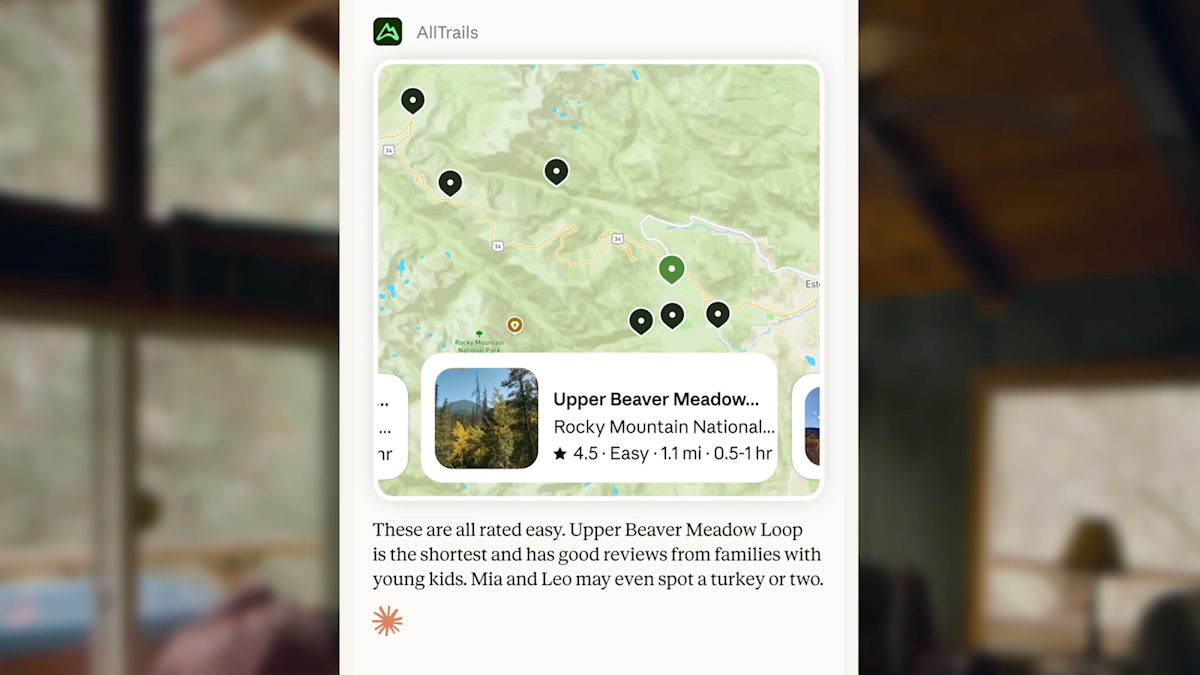
Anthropic is expanding its directory of connected services for its Claude AI chatbot. The platform can now link up with your accounts on AllTrails, Audible, Booking.com, Instacart, Intuit Credit Karma, Intuit TurboTax, Resy, Spotify, StubHub, Taskrabbit, Thumbtack, TripAdvisor, Uber, Uber Eats and Viator. Additional services will be added in the future.
More and more AI companies are trying to up their third-party integrations in a pitch to make their services as useful as possible. The benefit of having multiple apps connected means that a chatbot can theoretically execute more complicated tasks on your behalf. This expansion takes that capability from the professional and educational settings, where Anthropic’s connectors have been focused for the past year, to a personal one. So, for instance, Claude can now help plan a hike on AllTrails and then pull up a Spotify playlist that will last for the duration of your trek.
Anthropic noted that it is also reframing how apps are showing up so that an appropriate service is suggested for the task you want to perform. The apps should appear dynamically within the Claude conversation rather than needing a user to swipe between programs. As with most AI actions, Claude is supposed to check with its user before actually taking any actions like securing a reservation or making a purchase.
Engagement is a big deal in the world of social media. On Wednesday, Meta announced Live Chats, a new feature for the Instagram-supported social app Threads. It adds a real-time conversation component, letting people connect during high-interest cultural events, such as playoff or championship games, or even the drop of a highly anticipated album.
Live Chats, the new public chat feature on Threads, launches in time for the NBA Playoffs.
Advertisement
Meta
Live Chats won’t be limited to sports, but the feature is launching during the NBA Playoffs within the NBAThreads Community, and an assortment of personalities — Malika Andrews, Rachel Nichols, Trysta Krick, David Rushing and Lexis Mickens — will host Live Chats as the games unfold.
The group chat experience includes countdowns, polls, live scores and other real-time options designed to keep the conversation active.
How to find Live Chats on Threads
Live Chats about the games will appear at the top of the NBAThreads Community, and they can also appear in your main feed on Threads if you follow a personality who has posted the link. A red circle will appear on a Live Chat host’s profile photo when they are live. More Community feeds will have the Live Chats feature in the coming months.
After you’ve entered the chat, you’ll be able to send and receive messages, attach photos, videos and links, and send reaction emoji. Anyone can join a chat, but it can reach capacity and stop accepting new users.
Advertisement
“Up to 150 participants can join in the Live Chat conversation (unless the host decides to make it invite only), but anyone can watch,” a Meta spokesperson told CNET. Once a Live Chat ends, it’ll no longer be pinned in the community feed, but will remain visible through previously shared posts.
How to start a Live Chat on Threads
Live Chats are open and public, but Meta allows only a select number of creators and personalities to host them on Threads. This includes Community Champions, who are active, influential users within a Threads community who stay engaged with others and keep conversations alive.
To schedule a Live Chat, a qualified host will tap the three-dot menu in the top-right corner and select “Schedule a Live Chat.” You can give the chat a name, select a time frame for it to be live and then invite other Threads users to join or post the link to your feed and Instagram Story to get the word out.
A bigger Live Chats experience is coming
Once Meta refines the feature, more Live Chat attributes will be rolling out in the near future, including co-hosting, play-by-play commentary content, lock screen widgets and a share option that’ll let you quote chat messages directly in your Threads feed.
Oppo has announced its flagship camera smartphone, the Find X9 Ultra, but how does it compare to Apple’s iPhone 17 Pro Max?
Although we haven’t specifically reviewed the Max model, we have reviewed the iPhone 17 Pro so we’ll draw on our experiences there whenever applicable.
Read on to see what’s the difference between the Oppo Find X9 Ultra and the iPhone 17 Pro Max, and to decide which handset will suit you best.
The Oppo Find X9 Ultra is the first of Oppo’s Ultra models to see a global launch. However, at the time of writing, we don’t have the exact pricing or release date for the UK.
Advertisement
In comparison, the iPhone 17 Pro Max is readily available to buy now and has a starting price of £1199/$1199. Considering the Oppo Find X9 Pro has a similar starting price of £1099, we expect this means the more premium Ultra will be more expensive than the iPhone 17 Pro Max – however that’s speculation at this point.
SQUIRREL_PLAYLIST_10207953
Advertisement
Snapdragon 8 Elite Gen 5 vs A19 Pro
One of the biggest differences between the Find X9 Ultra and iPhone 17 Pro Max is with their respective chips. While the Find X9 Ultra runs on Qualcomm’s flagship Snapdragon 8 Elite Gen 5, the iPhone 17 Pro Max is powered by Apple’s own A19 Pro chip.
The iPhone 17 Pro also runs on Apple’s A19 Pro chip, and we found the handset offers brilliant performance across both day-to-day use and in our benchmark tests too. We also concluded the iPhone 17 Pro copes well with games too, although if that’s a necessity for your handset then you’ll be better off checking our best gaming phones guide instead.
Gaming on Find X9 Ultra. Image Credit (Trusted Reviews)
Unsurprisingly, we found that the Oppo Find X9 Pro also offers a brilliant performance too. In fact, we especially found that the handset does a great job with ray-traced gaming too – something worth keeping in mind if you’d prefer not to opt for a gaming-specific handset. Not only that, but Snapdragon 8 Elite Gen 5 ensures everything runs smoothly and quickly too.
Advertisement
Oppo Find X9 Ultra has five rear cameras
Arguably the reason to choose the Oppo Find X9 Ultra is due to its mighty camera set-up. Created in collaboration with Hasselblad, the aptly titled Hasselblad Master Camera System is made up of five rear lenses, including dual Hasselblad 200MP main and 3x telephoto lens. In fact, the latter boasts the largest sensor of its kind and can be fitted with the 300mm Explorer Teleconverter that delivers a 300m focal length and 13x optical zoom too.
Advertisement
There are also two 50MP cameras which are flanked by a True Color Camera for natural colour rendition too.
In addition, the Find X9 Ultra is fitted with Oppo’s “most advanced cinematic capabilities to date”, and can not only deliver 4K60fps Dolby Vision HDR recording, but also captures 4K120fps via the Dual Hasselblad 200MP cameras too.
Oppo Find X9 Ultra
iPhone 17 Pro
Advertisement
Overall, we were blown away by the Find X9 Ultra’s photography capabilities, and concluded that its vibrant capture and multiple lenses “easily challenges Apple” for the best camera phone crown.
That’s not to say the iPhone 17 Pro Max is a slouch by any means, with its trio of rear lenses able to cope well with most lighting conditions and provide a brilliant detailed finish. While we haven’t reviewed the Pro Max, the iPhone 17 Pro has the same lenses on board and boasts the best zoom lens we’ve seen on an Apple flagship.
Advertisement
Advertisement
Oppo Find X9 Ultra supports faster charging
Like many of the best Android phones, the Find X9 Ultra supports exceptionally fast charging speeds – but only when paired with a compatible charger. So, while the iPhone 17 Pro Max supports 40W wired speeds and 25W MagSafe, the Find X9 Ultra boasts significantly faster numbers.
In fact, the Find X9 Ultra supports a whopping 100W SuperVOOC wired and 50W AirVOOC speeds. However, just keep in mind that you will need to purchase adapters separately to benefit from those speeds.
Oppo Find X9 Ultra in hand. Image Credit (Trusted Reviews)
Oppo Find X9 Ultra has an IP66, IP68 and IP69 ratings
Durability is important when it comes to buying a phone and, fortunately, the Find X9 Ultra isn’t taking any chances. Not only does it sport the same IP68 rating as the iPhone 17 Pro Max, which means its dust-tight and can survive water submersion, but it also benefits from an IP66 and IP69 rating too. That means the handset can withstand high pressure and high temperature water jets too.
However, do keep in mind that the iPhone 17 Pro Max’s IP68 rating realistically offers more than enough protection for everyday use. Just think about how often your phone will really be subjected to water jets.
Advertisement
Advertisement
Oppo Find X9 Ultra has a 144Hz display
The 6.9-inch iPhone 17 Pro Max is fitted with Apple’s ProMotion technology, which means the panel has a LTPO-enabled 1-120Hz refresh rate that helps make animations, scrolling and gaming feel smooth. In comparison, the slightly smaller 6.82-inch Find X9 Ultra boasts up to a 144Hz refresh rate.
Oppo Find X9 Ultra
iPhone 17 Pro
Advertisement
Otherwise, the Find X9 Ultra is equipped with an AMOLED, QHD+ display that we found to be “impossible to fault”. Similarly, the iPhone 17 Pro Max is equipped with a Super Retina XDR (OLED), HDR display.
Early Verdict
Deciding between the Oppo Find X9 Ultra and iPhone 17 Pro Max will mainly boil down to two factors: whether you’re cemented in either the Android or iOS ecosystem and whether you want an especially versatile camera phone. While the iPhone 17 Pro Max is undoubtedly a versatile camera phone, the five rear lenses of the Find X9 Ultra and the optional teleconverter undoubtedly offer more flexibility.
Some people learning the noble art of electronics find the jump from simpler tools like Fritzing to more complex ones, such as KiCAD, a little daunting, especially since they need to learn at least two tools. Fritzing is great for visualising your breadboard layout, but what if you want to start from a proper schematic, make a prototype on a breadboard and then design a custom PCB? Well, with the Kicad-breadboard plugin for (you guessed it!) KiCAD, you can now do all of this in the same tool.
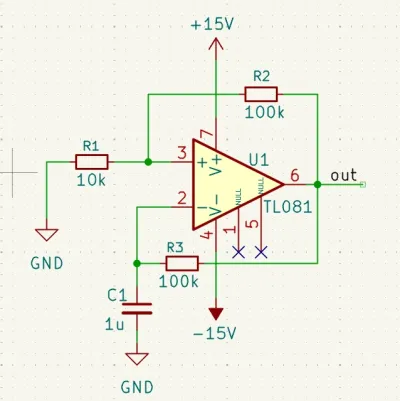
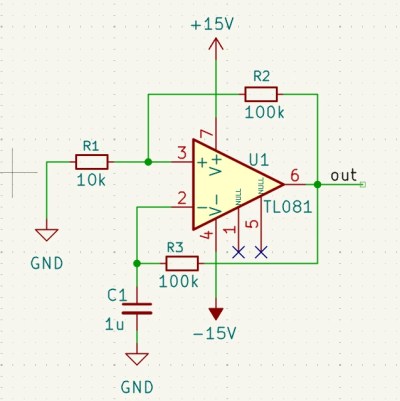
A simple dual-rail oscillator schematic corresponding to the featured image above
Originally designed to support EE students at the University of Antwerp, the tool presents you with a virtual breadboard with configurable size and style, along with a list of components and tools that can be placed. A few clicks and parts can be placed on the virtual breadboard with ease. Adding wires is the next logical step to make those connections that operate in the horizontal dimension. Finally, assigning power supplies and probe connections completes the process. It’s a simple enough tool to draw stuff, but drawing a layout is no use if you can’t verify it’s correctness. This is where this plugin shines: it can perform an ERC (check) between the schematic and the breadboard and flag up what you missed. Add to this that you can also perform an ERC at the schematic level, before even thinking about layout, and it’s pretty hard to make an error. Now, you can transfer this directly to a real breadboard, or even a veroboard, for more permanence once you have confidence in correctness. This will definitely save time correcting errors and help keep the magic smoke safely contained within those mysterious black rectangles.
As it stands, the tools are limited to a few select ICs, which, much to this scribe’s disappointment, did not include the venerable 555 timer; however, it would be possible to work around that with some imagination at the schematic level. The ability to drop in and document power supply, function generator, and oscilloscope probing points is nice, enabling one to close the loop on documenting a layout to make it truly transferable to physical reality.
We cover electronics prototyping with breadboards a lot because they’re accessible. Here’s a super simple computer on a breadboard. We also like seeing them integrated as tools, like here. Finally, why stick with the tired old common breadboard shapes when you could make your own?
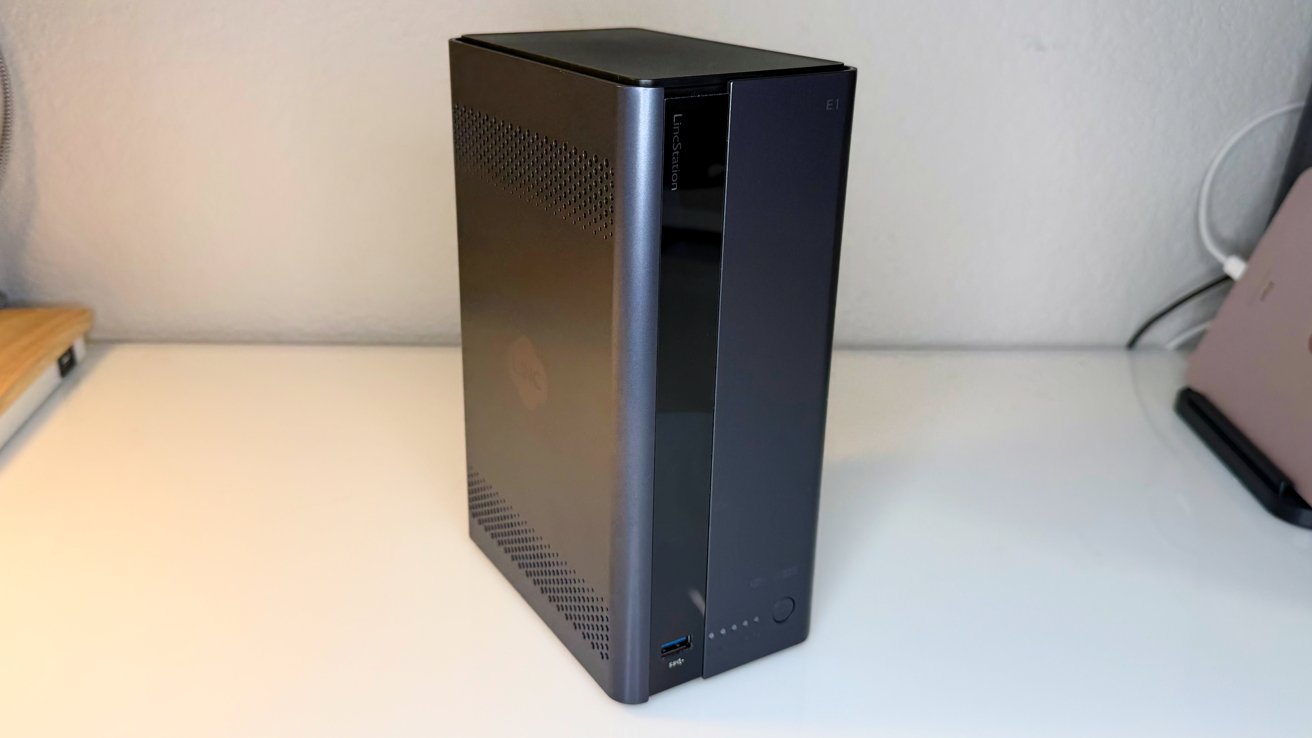
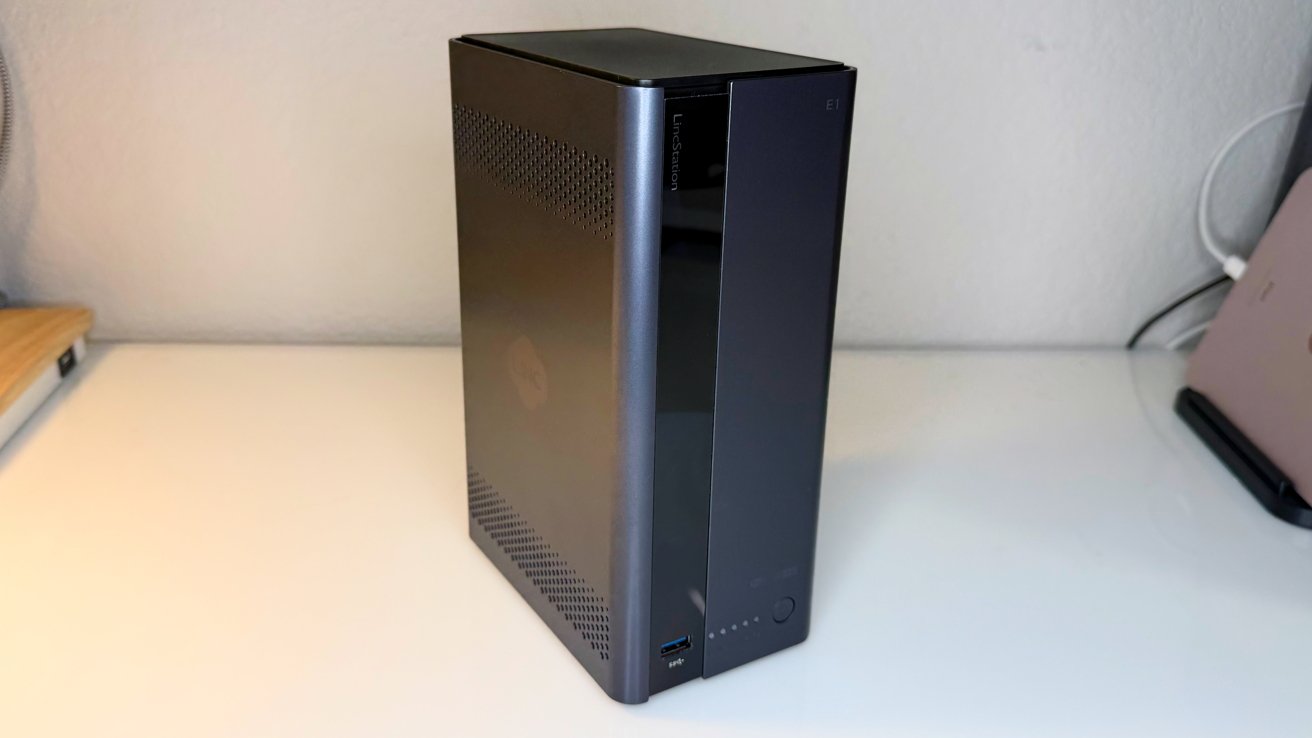
The LincPlus LincStation E1 is a compact NAS that promises speed, capacity, and some smart features. Prosumers and above should skip this one, but for everyday users, it’s a pretty decent package.
LincPlus LincStation E1
A typical network-attached storage (NAS) device is, as the name implies, a bunch of drives in a purpose-made computer, optimized to serve files. There’s a big range that falls under that umbrella though, with many models able to provide services that rival a rack-mounted server. When it comes to making a NAS for a typical computer user rather than those with greater needs, things tighten up a bit. We’ve been fond of LincStation’s approach to that market. Continue Reading on AppleInsider | Discuss on our Forums
Audeze doesn’t need to reinvent itself every year to stay relevant, but it rarely stands still. At AXPONA 2026 in Chicago, the California headphone maker drew steady traffic in the Ear Gear section with a lineup that spans both audiophile and gaming use, anchored by its expanding use of SLAM technology across multiple models.
The booth stayed busy for a reason. Audeze is not chasing trends. It is refining its own approach, and listeners showed up to hear how that translates across a broader range of headphones rather than a single headline product.
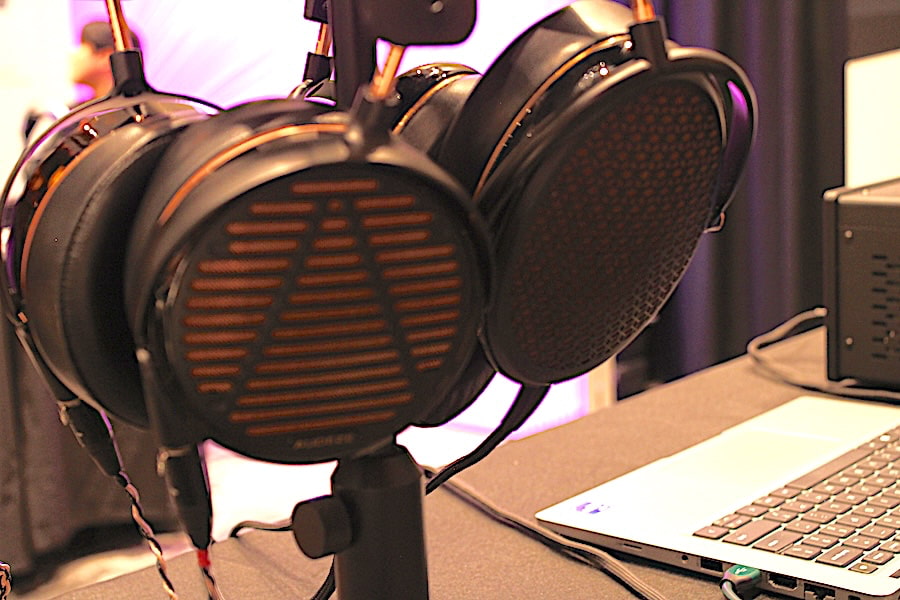
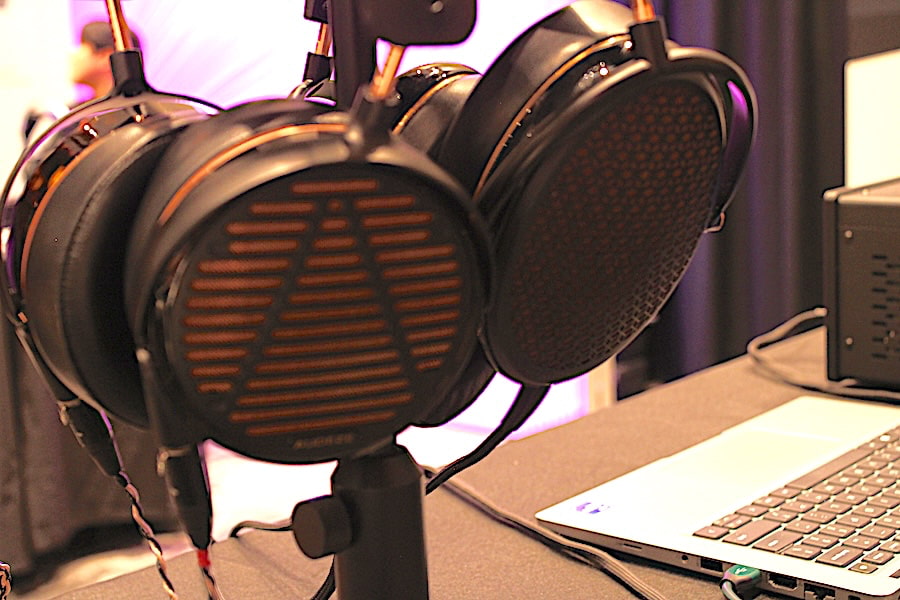
At the top of the range, Audeze CRBN2 and Audeze LCD-5s were both on hand and available for extended listening. We’ve already given both models Editors’ Choice Awards, and neither required much debate to get there. They take different paths to a similar destination.
Audeze LCD-5s (left) and CRBN2 (right) at AXPONA 2026
The CRBN2 leans into a more forward presentation with added energy through the upper mids and lower treble, which gives it a sense of immediacy and openness that works well with detail-heavy material. The LCD-5s pulls things back slightly through the midrange, sounding more relaxed and a bit more natural over longer sessions without losing resolution.
Advertisement
Both now incorporate Audeze’s SLAM technology, which increases airflow and adds low-end weight without stepping on the rest of the frequency range. That matters. Electrostatic and planar designs have long carried a reputation for being light in the bass, and this feels like a direct response to that criticism. The added presence down low brings better balance without turning either headphone into something it isn’t.
I asked Karlee Little about a possible trade-up program for existing LCD-5 owners. The answer was polite but clear. Demand for current production is already high, and keeping up with orders is the priority. If anything like that happens, it won’t be anytime soon.
Custom Maxwell 2 Builds?
Audeze Maxwell 2
The Audeze Maxwell 2 was being demonstrated with both gaming systems and standard audio setups, and it rarely sat idle. The mix of listeners and gamers cycling through made it clear that Audeze understands where the volume is in today’s market.
I’ve had a pair on my desk for a few weeks, and the updates are not subtle. It builds on what was already one of the more compelling options at its price point with refinements that make it easier to recommend beyond just gaming use.
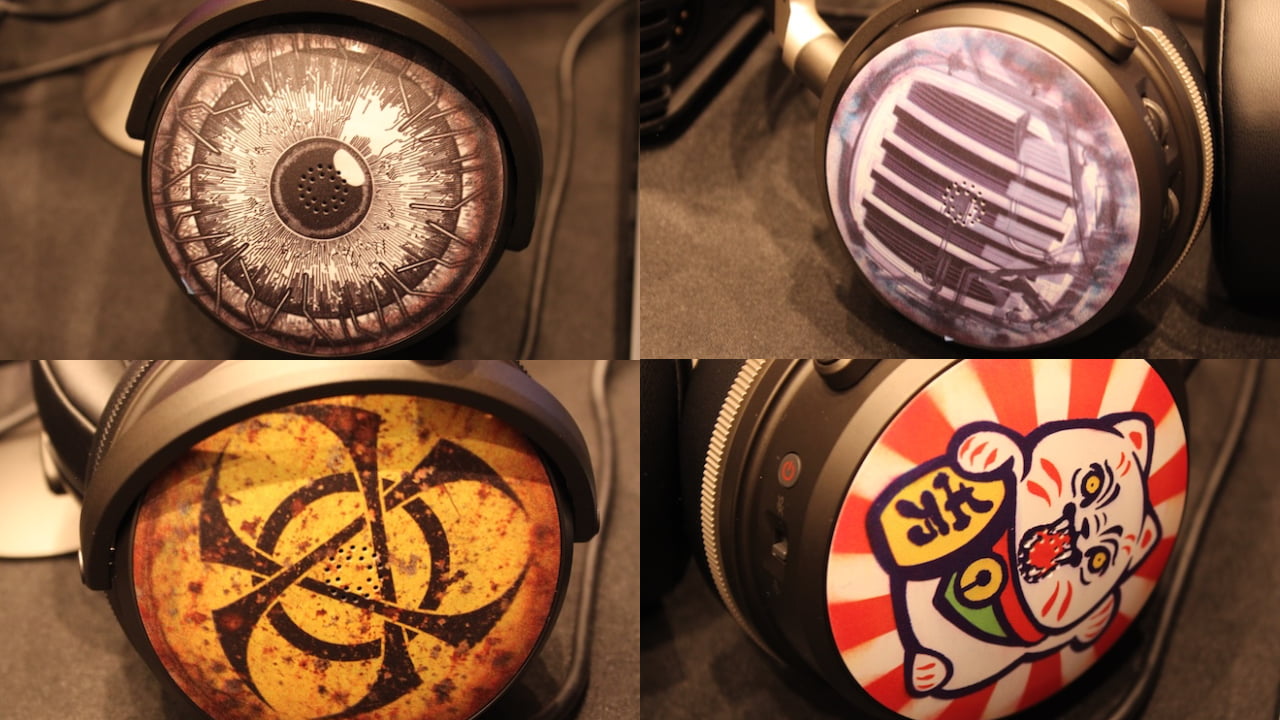
Audeze was also using the show to gather feedback on its new interchangeable faceplate concept, the reSkin program. Four gaming-inspired designs were on display, with more potentially on the way depending on response. Attendees were actively voting on which designs should come first, which is a smart way to avoid guessing wrong.
Advertisement
Audeze Maxwell 2 Headphones with interchangeable faceplates
For context, Editor in-Chief Ian White and Editor at-Large Chris Boylan were shown early sample cup covers at CanJam NYC 2026, but Audeze asked us to hold off on sharing details until the program was finalized. What we saw in Chicago looks more like a controlled rollout than an experiment.
A full custom upload option where users submit their own graphics would make this far more interesting. Whether Audeze wants to deal with that level of complexity is another question. For now, the four designs on display are the starting point.
Advertisement. Scroll to continue reading.
LCD-S20 Brings SLAM to the Studio
The fourth model incorporating SLAM is the Audeze LCD-S20, a closed-back design that Audeze had pulling double duty at AXPONA 2026. We were loaned four pairs for use at the podcast booth, and they were also available for demo on the show floor.
Advertisement
Audeze LCD-S20
In a space that was anything but quiet, the LCD-S20 proved its value quickly. Isolation was the standout. Even with a steady wall of background noise, voices came through cleanly without needing to crank levels or fight the environment. Our producer kept pushing us to get closer to the mic to cut through the noise, but the headphones were already doing most of that work.
This model slots into Audeze’s studio lineup alongside the Manny Marroquin series and LCD-X variants, offering a closed-back alternative at roughly the same price point as the open-back MM-100. That alone makes it worth paying attention to. There aren’t many options in this range that aim for a reference tuning while also addressing real-world recording conditions.
Build quality is another strong point. The LCD-S20 feels durable without becoming a burden during long sessions. There was even some joking about dropping a pair off a third-floor balcony, which the rep didn’t exactly discourage. We didn’t test that theory, but the reaction said enough. Audeze seems confident these will hold up under normal use, and then some.
The Bottom Line
Audeze doesn’t operate on a fixed script, and that’s part of the appeal. One minute it’s solving niche problems like medical applications, the next it’s refining products aimed at gamers and studio users.
Based on what was shown and discussed at AXPONA 2026, SLAM looks less like a feature and more like a direction. It’s already spreading across multiple models, and there are few obvious scenarios where added airflow and improved low-end balance would be a drawback.
Advertisement
Beyond that, the roadmap is exactly what you’d expect from Audeze. It depends on what users ask for and what the engineering team decides is worth chasing. So far, that combination has produced a wide range of headphones that don’t all sound the same and don’t all chase the same audience. That’s not an accident.
Sony knew exactly what it was buying when it acquired Audeze, and from what we’ve seen up close, there’s no sign they intend to interfere with that momentum. As long as models like the Maxwell 2 and its collaborative offshoots keep moving in serious volume, Audeze has the room to keep pushing headphone design forward. That’s where things get interesting.






















































You must be logged in to post a comment Login