
Crypto World
Bitcoin and Risk Assets Halt Their Surge With BTC Support at Risk

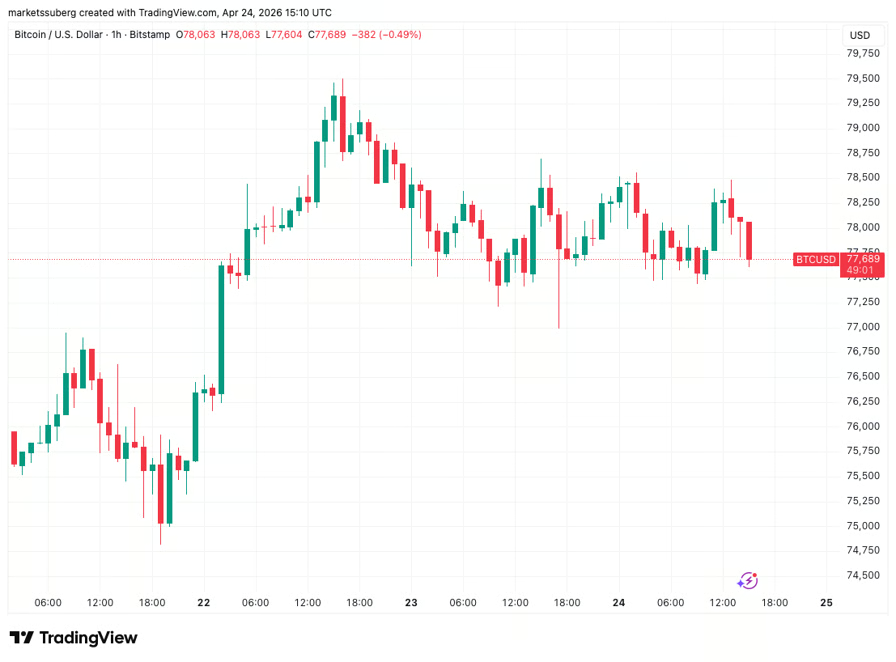
Bitcoin (BTC) stayed glued to $78,000 on Friday with markets “awaiting clarity” from the US-Iran war.
Key points:
- Bitcoin stalls in its bid to recapture $80,000, as US stocks tread water.
- Strong earnings are needed to sustain the equities push, says analysis.
- BTC price support is at risk of giving way next.
Bitcoin joins risk assets “chopping sideways”
Data from TradingView tracked flat BTC price action into the week’s last Wall Street trading session.
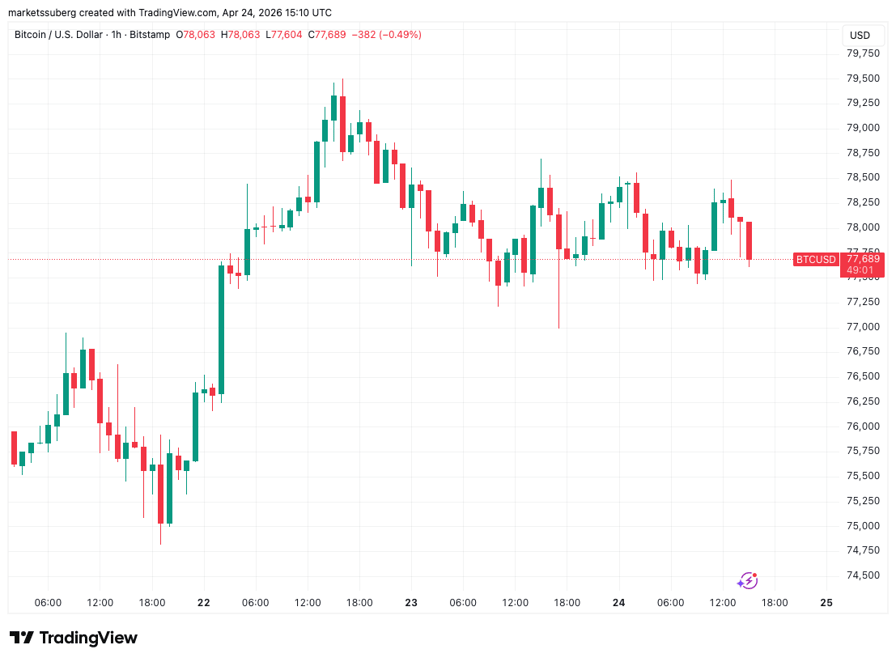
BTC/USD one-hour chart. Source: Cointelegraph/TradingView
Amid a lack of fresh geopolitical cues, risk-asset catalysts presented a mixed picture, leading to sideways movements for US stocks. WTI crude oil, after nearing a rematch with the $100 mark, cooled to $95.
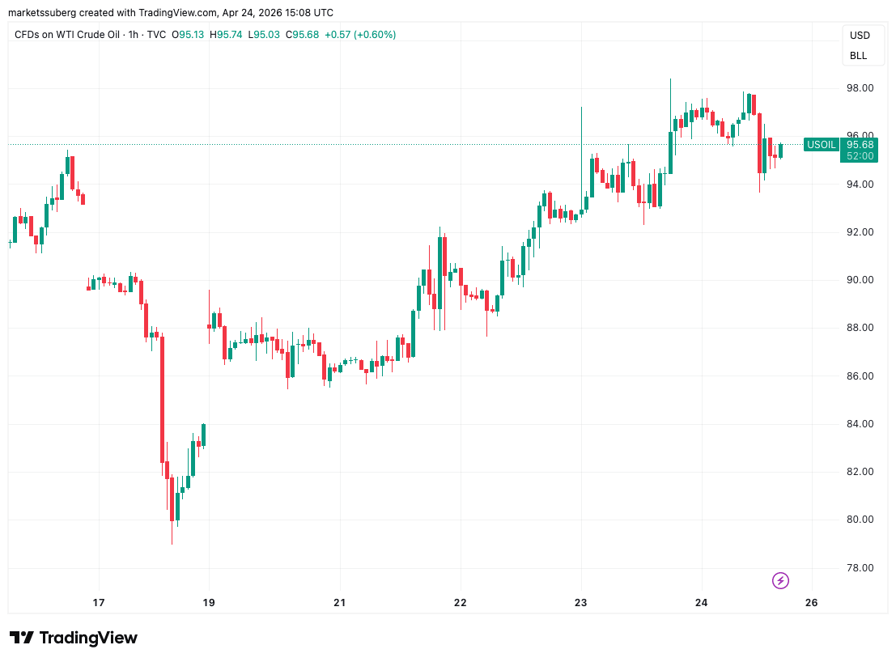
CFDs on WTI crude oil one-hour chart. Source: Cointelegraph/TradingView
“$BTC & Stocks started the week off strong as metals have sold off. But as $OIL has been starting to move again the past few days, risk assets have stalled and are now chopping sideways,” trader Daan Crypto Trades responded in a post on X.
“Market is eagerly awaiting clarity from the conflict in the middle east. The longer it drags on and oil keeps moving higher, the more pressure will be put on these.”
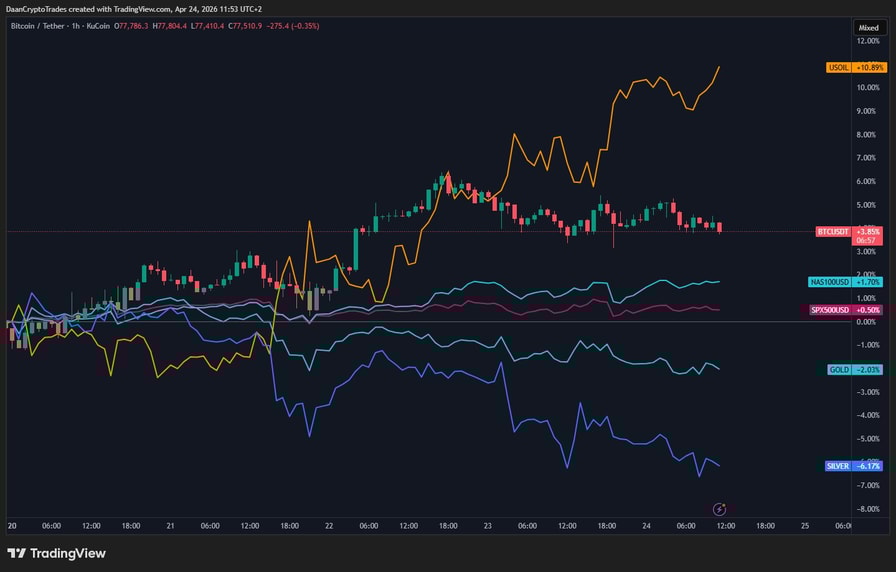
Macro asset price comparison. Source: Daan Crypto Trades/X
The day prior, trading resource Mosaic Asset Company said that positive earnings figures would be essential to sustain continued upside for stocks, with the S&P 500 already hitting new record highs.
“With the first quarter reporting season about to pick up, it will be crucial to monitor forward earnings estimates for any changes in trend since the start of the year,” it wrote in its latest analysis.
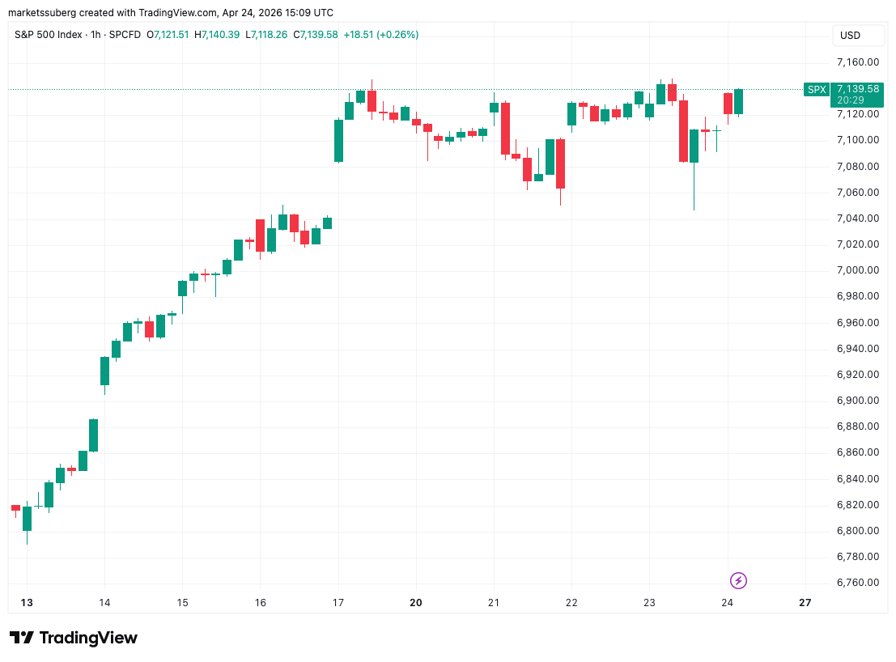
S&P 500 one-hour chart. Source: Cointelegraph/TradingView
Analyst “surprised” that BTC price support holding
Focusing on BTC/USD, trading resource Material Indicators hinted at early signs of a deeper retracement next.
Related: Bitcoin price set for best gains since Q4 2024 with $77.5K monthly close
“Bid liquidity at $76.5k already rugged, as predicted yesterday, and LTF order flow is trending down,” it wrote on X, referring to data from one of its proprietary trading tools.
Material Indicators added that it was “surprised” that bid liquidity below spot price had not been pulled.
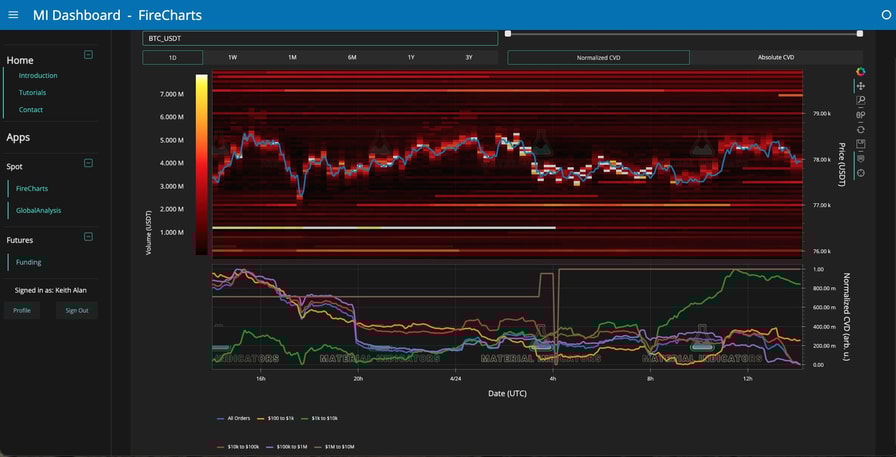
BTC/USDT order-book liquidity data with whale orders. Source: Material Indicators/X
Trading account JDK Analysis referenced a “news-driven pump” as further evidence that the low-time frame rally was overextended.
“The profile shows $BTC at the upper value extreme of the past two days,” an X thread read, analyzing exchange order-book data.
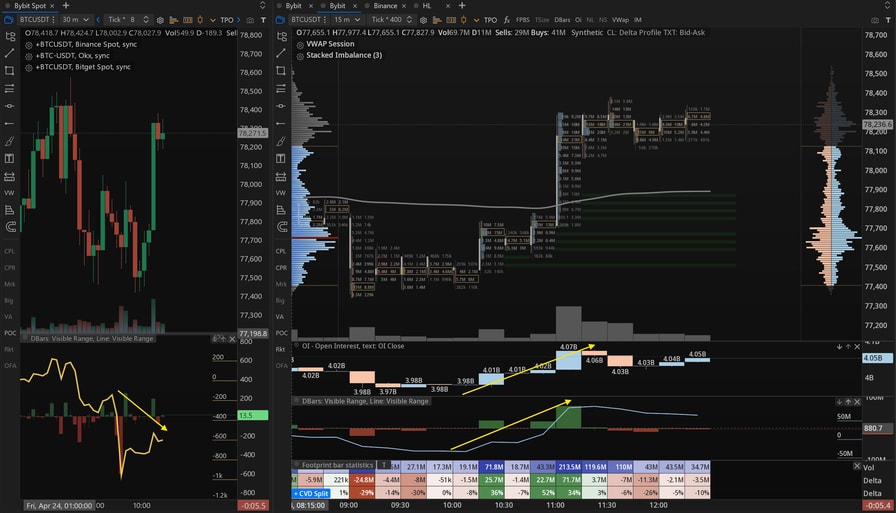
BTC/USDT order-book data (Bybit). Source: JDK Analysis/X

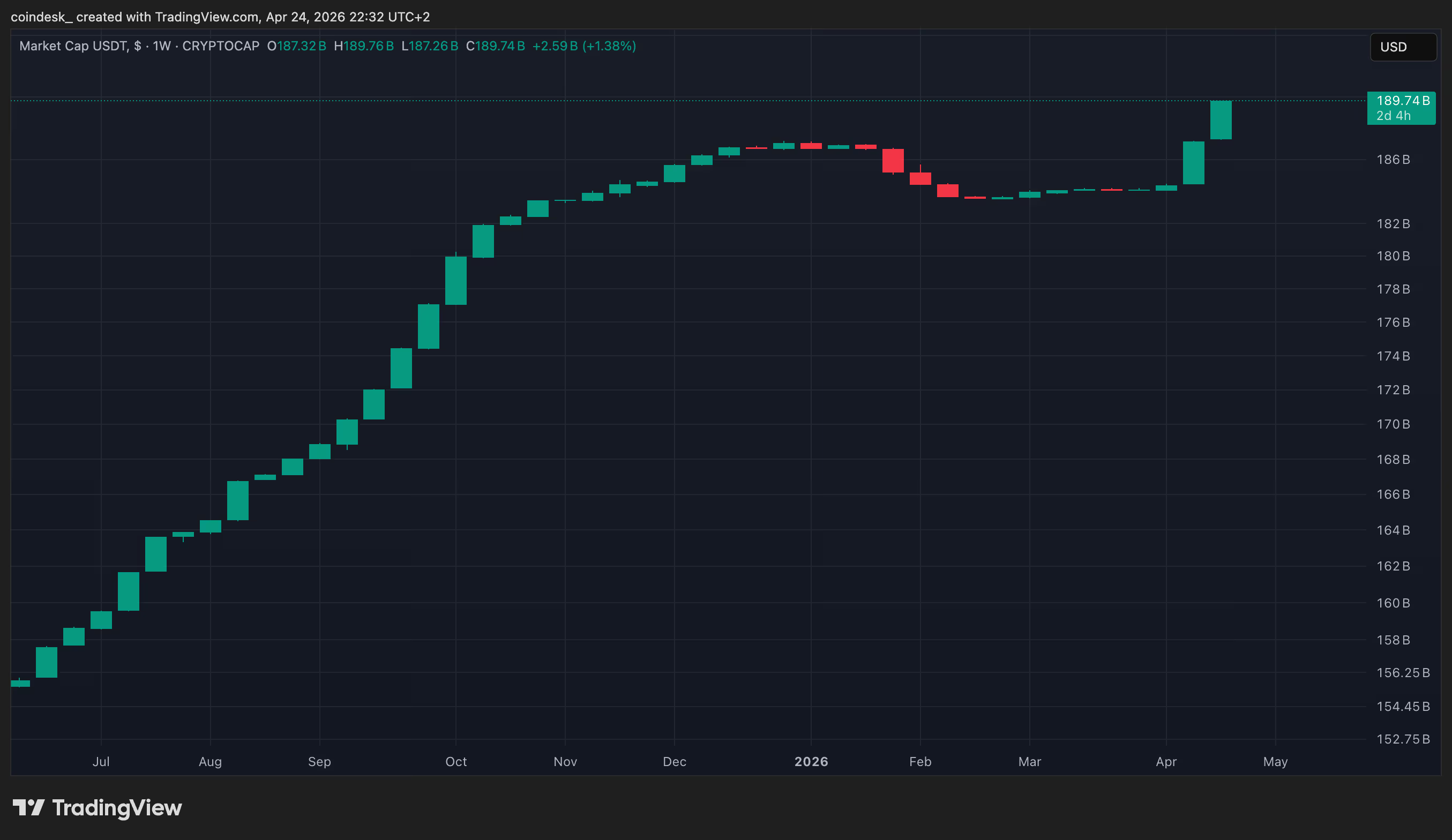
Bitcoin held above $77,000 on Friday, consolidating after hitting its strongest level since early February earlier in the week.
The largest cryptocurrency is up about 13.6% in April, putting it on track for its best monthly performance in a year, according to CoinGlass data. The rebound follows a rough stretch, with crypto markets logging their longest losing streak since 2018, posting consecutive monthly declines from October through February.
The turnaround comes as the broader macro backdrop has improved. U.S. equities have staged a strong recovery, with the S&P 500 and Nasdaq climbing back to record highs after briefly slipping into correction territory earlier this year.
But there’s a crypto-specific driver behind the move, too.
The supply of Tether’s USDT , the largest and most popular stablecoin, has surged to just under $150 billion, adding about $5 billion over the past two weeks after months of stagnation.
That matters because stablecoins — cryptocurrencies tied to fiat money like the U.S. dollar — act as liquidity in crypto markets, the capital traders use to buy digital assets in the blockchain economy. Analysts often interpret stablecoin growth as a cue for capital flowing to the crypto market, a healthy signal for asset prices.

Markets ‘stopped caring’ about Iran war
Still, the macro picture hasn’t cleared yet. Geopolitical tensions in the Middle East and uncertainty around the Iran war persist, keeping oil prices at elevated levels.
But for now, markets seem to be looking past it, said Jasper de Maere, OTC trader at Wintermute.
“The equities and crypto markets seem to have stopped caring about intricate headlines on the conflict’s direction,” de Maere. “This shows a certain level of fatigue and potentially complacency.”
He noted that strong corporate earnings and resilient equity markets are helping offset concerns about higher energy costs and geopolitical risks.
FOMC test coming
In that environment, bitcoin is hovering near the top of its trading range while the $79,000 level proved the be mighty cap with traders taking profits.
That level “matters structurally because heavy institutional overhead supply sits just above it,” said Adam Haeems, head of asset management at Tesseract Group.
Whether BTC can break through will depend on what drives the move and who’s doing the buying. Moves driven mainly by short covering tend to fade once momentum cools, while a breakout backed by sustained institutional demand can mark a more durable shift, he said.
The next test comes soon with the April Fed meeting that could determine whether the current rally holds, Haeems said.
If ETF inflows continue through that event, he said, $79,000 could turn from resistance into support, opening the door for a higher trading range. If flows fade, bitcoin may slip back into the $75,000–$77,000 range.

Nakamoto launched a Bitcoin derivatives program with Bitwise and Kraken, aiming to generate options premiums and hedge part of its BTC treasury exposure.
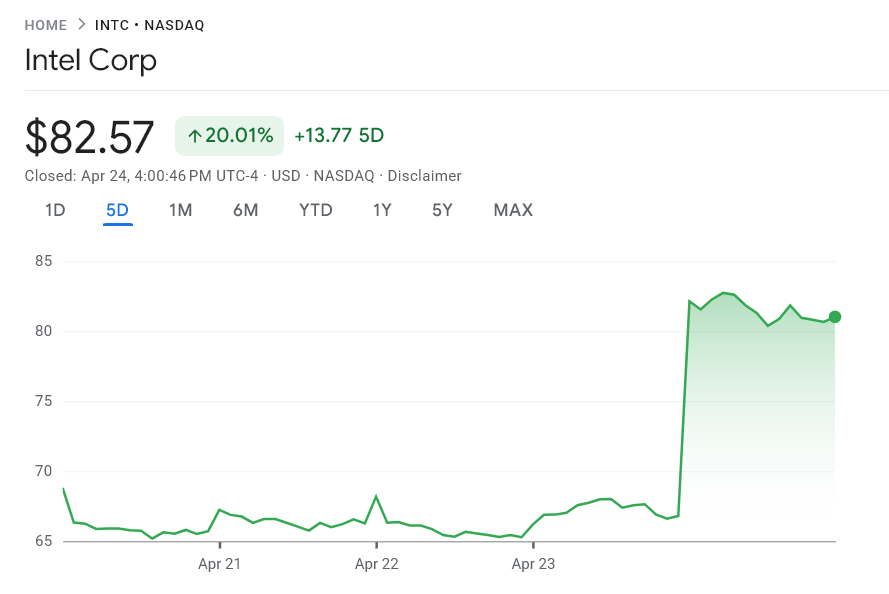
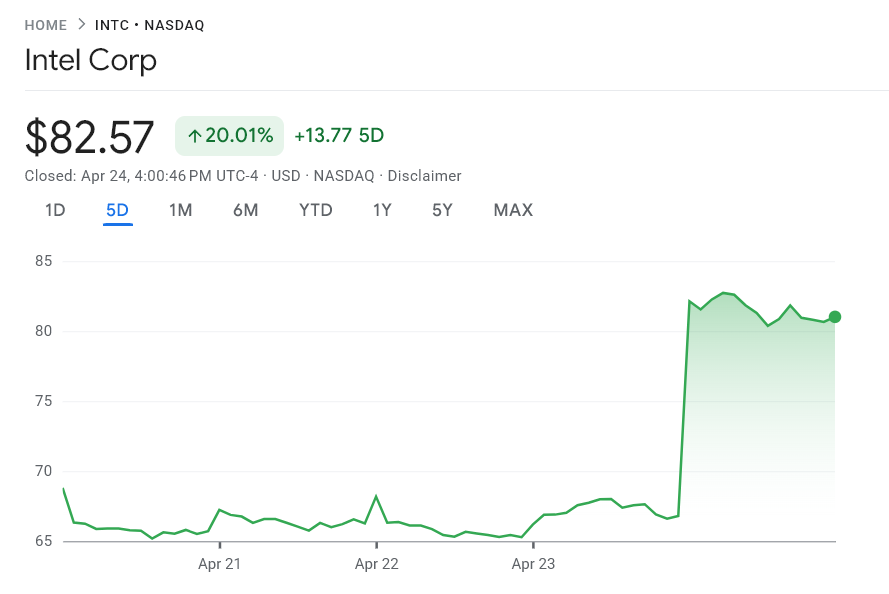
Intel shares surged to a new all-time high on April 24 after investors received the clearest sign yet that the company may finally be benefiting from the AI boom.
The stock jumped more than 24% to around $83 in early trading, passing its dot-com-era peak from 2000 and lifting Intel’s market value above $416 billion.
The rally followed stronger-than-expected earnings and guidance that suggested demand for Intel’s server CPUs is rising faster than Wall Street expected.
AI Demand Is Moving Back Toward CPUs
The main driver is a shift in AI infrastructure. The first phase of the AI boom centered on GPUs, led by Nvidia.
Now, more AI models are moving from training to deployment, where CPUs play a larger role.
Intel said demand from AI service providers was so strong in the first quarter that it sold chips it had previously written off.
CFO David Zinsner said tight supply also allowed the company to raise prices and sell older inventory it had not expected to move.
That changed the market’s view of Intel. Investors are starting to see the company as a direct beneficiary of AI inference, where models answer user queries and handle more complex workloads.
Earnings Gave the Rally Fuel
Intel reported first-quarter revenue of $13.58 billion, above estimates of $12.42 billion. Its data center and AI segment generated $5.1 billion, also ahead of expectations.
Guidance mattered even more. Intel expects second-quarter revenue between $13.8 billion and $14.8 billion, compared with Wall Street’s $13.07 billion estimate.
Analysts responded quickly. At least 23 brokerages raised their price targets after the results, with HSBC pointing to demand for Intel’s Xeon server CPUs.
Can the Rally Continue?
The rally can continue if Intel proves this demand is durable. The Tesla 14A manufacturing deal and growing AI CPU demand give investors a stronger turnaround story.
Still, the stock now trades at around 90 times forward earnings, far above AMD and Nvidia. That leaves little room for disappointment.
Intel has momentum. To keep it, the company must show that today’s surge was the start of sustained AI-driven growth, not a one-quarter inventory and pricing boost.
The post Why Intel Stock Hit an All-Time High Today appeared first on BeInCrypto.

The Bitcoin community continues to debate whether cryptographically relevant quantum computers are imminent or decades away.


White House Office of Science and Technology Policy director Michael Kratsios circulated a memo on April 23 accusing Chinese entities of conducting deliberate, industrial-scale campaigns to distil and steal US frontier AI systems, using tens of thousands of proxy accounts and jailbreaking techniques, days before a scheduled Trump-Xi summit.
Summary
- The White House OSTP memo accuses Chinese entities principally based in China of running coordinated campaigns to distil US frontier AI systems from OpenAI, Anthropic, and other American labs.
- The memo says attackers used tens of thousands of proxy accounts to evade detection and jailbreaking techniques to expose proprietary model information from closed-source American AI systems.
- The administration will share intelligence with US AI companies about active distillation campaigns and explore accountability measures against foreign actors responsible.
White House OSTP director Michael Kratsios circulated a memo to US government agencies on April 23 stating that foreign entities “principally based in China” are “engaged in deliberate, industrial-scale campaigns to distil US frontier AI systems.” The accusation represents the most formal and direct statement the Trump administration has made about Chinese AI intellectual property theft from American laboratories and arrives days before a scheduled Trump-Xi summit.
White House China AI Theft Accusation Names Distillation as the Attack Vector
Distillation is the technical process by which smaller AI models are trained on the outputs of larger, proprietary ones, allowing a lab to approximate frontier performance without paying the full training cost associated with building from scratch. According to the Kratsios memo, Chinese actors are using tens of thousands of proxy accounts to make large-scale queries to American AI systems, evading the rate limits and detection systems that companies have built to flag suspicious usage patterns. Jailbreaking techniques are then applied to strip safety filters and expose the proprietary behavior of models, which is captured as training data for distilled copies. Both OpenAI and Anthropic have previously accused DeepSeek publicly of distilling their models. The Financial Times reported that the memo is addressed to US government agencies and signals that the administration will begin sharing intelligence about active distillation campaigns directly with US AI companies. As crypto.news reported, Nvidia CEO Jensen Huang had warned days earlier that China possesses ghost datacenters with enormous computing infrastructure capable of matching US frontier AI capabilities.
DeepSeek’s V4 Launch Sharpened the Timing of the Accusation
DeepSeek released preview versions of its V4 model on April 24, built to run on Huawei’s Ascend chips, one day after the Kratsios memo surfaced. Chinese rivals Zhipu AI and MiniMax fell 9% and 7% respectively on the V4 launch day, reading the release as a competitive threat. DeepSeek has denied allegations of illegal use of synthetic training data, insisting its data is collected through organic web searches. The Chinese Embassy in Washington called the White House accusations “baseless” and said Beijing “attaches great importance to the protection of intellectual property rights.” The Foreign Ministry urged Washington to “abandon biases.” As crypto.news documented, US AI companies including Nvidia, Microsoft, and Meta have been navigating compounding geopolitical exposure to China throughout 2026, with the IRGC designation of American tech companies as targets earlier in April adding a second layer of pressure on top of the theft accusations.
What the Administration Has Said It Will Do
The memo says the administration will share intelligence about distillation campaigns with American AI companies and “explore a range of measures to hold foreign actors accountable.” Separately, Commerce Secretary Howard Lutnick confirmed on April 23 that no Nvidia advanced AI chip shipments had actually cleared through to China despite the conditional January approval, adding a chip supply dimension to a dispute already being fought at the model and data levels. The question of whether the Trump-Xi summit scheduled for the coming days will address AI intellectual property directly is being watched closely by industry executives, given that both the distillation accusations and the chip supply dispute are now active points of contention between the two governments. As crypto.news tracked, Nvidia’s revenue has already been materially affected by the chip export restriction tightening that escalated through 2025 and into 2026, making a diplomatic resolution on AI trade highly consequential for the US semiconductor industry.
The White House memo did not name specific Chinese companies or individuals, and it did not announce any immediate sanctions, penalties, or executive actions against the entities accused of the distillation campaigns.
The National Cyber Security Centre (NCSC) and 15 international partners issued a joint advisory. It warns that China-linked threat actors are hiding attacks behind networks of compromised everyday internet devices.
The advisory details a major tactical shift. Groups affiliated with Beijing now route activity through hundreds of thousands of compromised home routers and smart devices. That approach replaces dedicated attacker infrastructure.
Botnets Built From Compromised Home Devices
The document identifies a pattern across Volt Typhoon and Flax Typhoon operations. In each case, traffic passes through compromised small office and home office routers before reaching its target.
These covert networks help China-linked operators scan targets, deliver malware, and exfiltrate data. They also obscure the origin of each attack.
Raptor Train, one such network, infected more than 200,000 devices worldwide in 2024, according to the NCSC. The FBI attributed its management to Integrity Technology Group, a Beijing-based cybersecurity firm.
The United Kingdom sanctioned the company in December 2025 for reckless cyber activity against its allies.
Many of the compromised machines are end-of-life web cameras, video recorders, firewalls, and network storage devices. These no longer receive security patches from manufacturers. That leaves them easy targets for bulk exploitation.
Western Infrastructure Already Pre-Positioned
Volt Typhoon has used a separate covert network called the KV Botnet. The group established footholds on critical national infrastructure across the United States and allied countries.
Department of Justice filings referenced in the advisory support this finding. Energy grids, transport systems, and government networks are named as active targets.
Paul Chichester, NCSC Director of Operations, flagged a separate problem known as indicator of compromise extinction. Identifiers used to track attackers disappear almost as fast as researchers publish them.
The problem mirrors wider difficulties in tracking state-backed hacking campaigns across both critical infrastructure and financial sectors.
In recent years, we have seen a deliberate shift in cyber groups based in China utilising these networks to hide their malicious activity in an attempt to avoid accountability,” Paul Chichester, NCSC Director of Operations.
The advisory urges organisations to baseline normal network traffic and adopt dynamic threat feeds. It also recommends tracking China-linked covert networks as advanced persistent threats in their own right.
2024 recorded more than $2 billion in digital-asset losses from cyber activity. The coming months will test whether defenders can keep pace. The adversary has made attribution itself the first victim.
The post 15 Cyber Agencies Issue Joint Warning on China-Linked Covert Botnet Threat appeared first on BeInCrypto.


Summary
- Google plans to invest up to $40 billion in Anthropic, starting with a $10 billion cash injection at a $350 billion valuation and a further $30 billion contingent on performance.
- The deal is aimed at locking Anthropic deeper into Google Cloud and TPU infrastructure, as the two companies race rivals like OpenAI and xAI for dominance in AI and agentic compute.
- The size and structure of the investment underline how AI is absorbing the lion’s share of capital that might otherwise flow into crypto, but also how the next wave of crypto adoption will depend on AI infrastructure like Anthropic’s.
Google‑parent Alphabet will commit $10 billion in cash to Anthropic now and up to $30 billion more over time, in a package that Bloomberg reports could reach $40 billion in total if the AI lab hits aggressive performance and usage milestones. Anthropic said the initial tranche comes at a $350 billion valuation — the same mark as its February round — cementing its status as one of the most richly valued startups on earth.
This is not just an equity trade; it is an infrastructure lock‑in. Google has already committed to providing Anthropic with access to as many as one million Tensor Processing Units under a cloud agreement “worth tens of billions,” a build‑out expected to add more than a gigawatt of AI computing capacity by 2026. SiliconANGLE notes that at its Next conference, Google pitched itself as the platform for “agentic AI” — autonomous systems that will run across finance, compliance, and trading — and the Anthropic deal is the financial spine of that strategy.
In Q1 2026 alone, global VC funding hit a record $297 billion, and roughly 81% of it went to AI companies, with just four names — OpenAI, Anthropic, xAI, and Waymo — pulling in about $188 billion between them. If you raised anything that was not AI‑adjacent, you were fighting over the remaining 19 cents of every venture dollar. Crypto founders feel that squeeze directly: the marginal dollar that might have gone into a new L2, DEX, or stablecoin protocol is instead being spent on GPU farms and frontier labs like Anthropic.
For crypto markets, this cuts both ways. On one side, capital and talent concentration around labs like Anthropic and platforms like Google Cloud makes it harder for pure‑play crypto projects to raise at scale, especially outside real‑world asset, stablecoin, or tokenization narratives. On the other, the future of on‑chain finance is going to be run increasingly by AI agents — smart order routers, risk engines, compliance bots — that sit on exactly the infrastructure this $40 billion package is building.
If Google and Anthropic succeed in turning agentic AI into a reliable, commodity service, the winners in crypto will be the protocols that plug into that compute: on‑chain derivatives venues using AI market makers, DeFi protocols with real‑time AI risk controls, tokenization stacks that use models to price and monitor collateral. In that sense, the biggest “crypto” deal of the year might not be a token round at all, but a cloud‑plus‑AI mega‑investment that decides who owns the rails every serious crypto protocol will eventually run on.


Chinese AI startup DeepSeek released a preview of its V4 model on April 24, explicitly optimized for Huawei’s Ascend chip platform, on the same day the White House accused China of running industrial-scale campaigns to copy and steal American frontier AI systems.
Summary
- DeepSeek released V4-Pro and V4-Flash preview models on April 24, both built to run on Huawei’s Ascend AI accelerators, marking a strategic pivot away from Nvidia hardware.
- V4-Pro carries 1.6 trillion total parameters and trails only Google’s closed-source Gemini-Pro-3.1 on world knowledge benchmarks among open-source models.
- The launch arrived hours after a White House OSTP memo accused Chinese entities of using tens of thousands of proxy accounts and jailbreaking techniques to distil proprietary US AI models.
DeepSeek released preview versions of its V4-Pro and V4-Flash models on April 24, both explicitly designed to run on Huawei’s Ascend AI chip platform. Huawei confirmed that its full Ascend supernode product line now supports the DeepSeek V4 series. The launch came one day after a White House memo accused China of coordinated, industrial-scale intellectual property theft from American AI laboratories, with DeepSeek cited repeatedly in prior US accusations as a company that distilled proprietary OpenAI and Anthropic models.
DeepSeek V4 Huawei Chips Launch Inverts the Nvidia Dependency Narrative
DeepSeek’s earlier V3 model was trained on Nvidia hardware, which drew accusations from Washington that the company breached US export controls to acquire advanced Nvidia chips. The V4 announcement inverts that positioning entirely. Huawei is front and center as both collaborator and primary deployment target, while Nvidia is absent from the technical documentation. V4-Pro operates on a mixture-of-experts architecture with 1.6 trillion total parameters and 49 billion active parameters. V4-Flash uses a smaller 284 billion total parameter configuration with 13 billion active parameters designed for cost efficiency. DeepSeek said V4-Pro outperforms every other open-source model on world knowledge benchmarks and trails only Google’s closed-source Gemini-Pro-3.1. The launch also includes a lower-cost flash variant, the same two-tier pricing pattern DeepSeek used to undercut Western labs with V3. As crypto.news reported, Nvidia CEO Jensen Huang had warned the week prior that China possesses the infrastructure and hardware necessary to rival the capabilities of US frontier AI models.
The White House Memo That Landed the Day Before
Michael Kratsios, director of the White House Office of Science and Technology Policy, circulated a memo on April 23 accusing Chinese entities of running “industrial-scale campaigns to distil US frontier AI systems” using tens of thousands of proxy accounts to evade detection and jailbreaking techniques to expose proprietary model information. Distillation is the process of training smaller AI models on the outputs of larger ones, a method that allows a lab to approximate frontier capability without paying the full training cost. The memo stated the administration will share information with US AI companies about distillation campaigns and explore accountability measures against foreign actors. As crypto.news documented, the US AI industry has been navigating compounding geopolitical pressures in 2026, with Chainlink and other AI-adjacent crypto assets already showing sensitivity to US-China tech tensions earlier in April.
What DeepSeek V4 on Huawei Means for the US Chip Export Strategy
The V4 Huawei pivot is a direct strategic response to US export controls. By demonstrating that a model approaching frontier performance can now be trained and served on Huawei Ascend silicon, DeepSeek and China are challenging the assumption that semiconductor restrictions can meaningfully slow Chinese AI development. Commerce Secretary Howard Lutnick confirmed separately on April 23 that no Nvidia advanced AI chip shipments had actually gone through to China despite the January conditional approval, a disclosure that deepens the question of what hardware DeepSeek actually used for V4 training. DeepSeek has not confirmed this, and detailed technical specifications for V4 have not been independently verified. As crypto.news tracked, Nvidia disclosed $5.5 billion in expected charges in April 2025 when the US government required export licenses for H20 chips sold to China, a policy backdrop that made Huawei’s role in V4 commercially inevitable for DeepSeek’s long-term supply chain.
The Chinese Embassy in Washington called the White House distillation accusations “baseless,” and Beijing’s foreign ministry urged the US to “abandon biases” and said more scientific exchange, not less, was needed.
Crypto World
Ethereum Foundation Sells 10,000 ETH to BitMNR at $2,387 Average Price via OTC: Ethereum Foundation
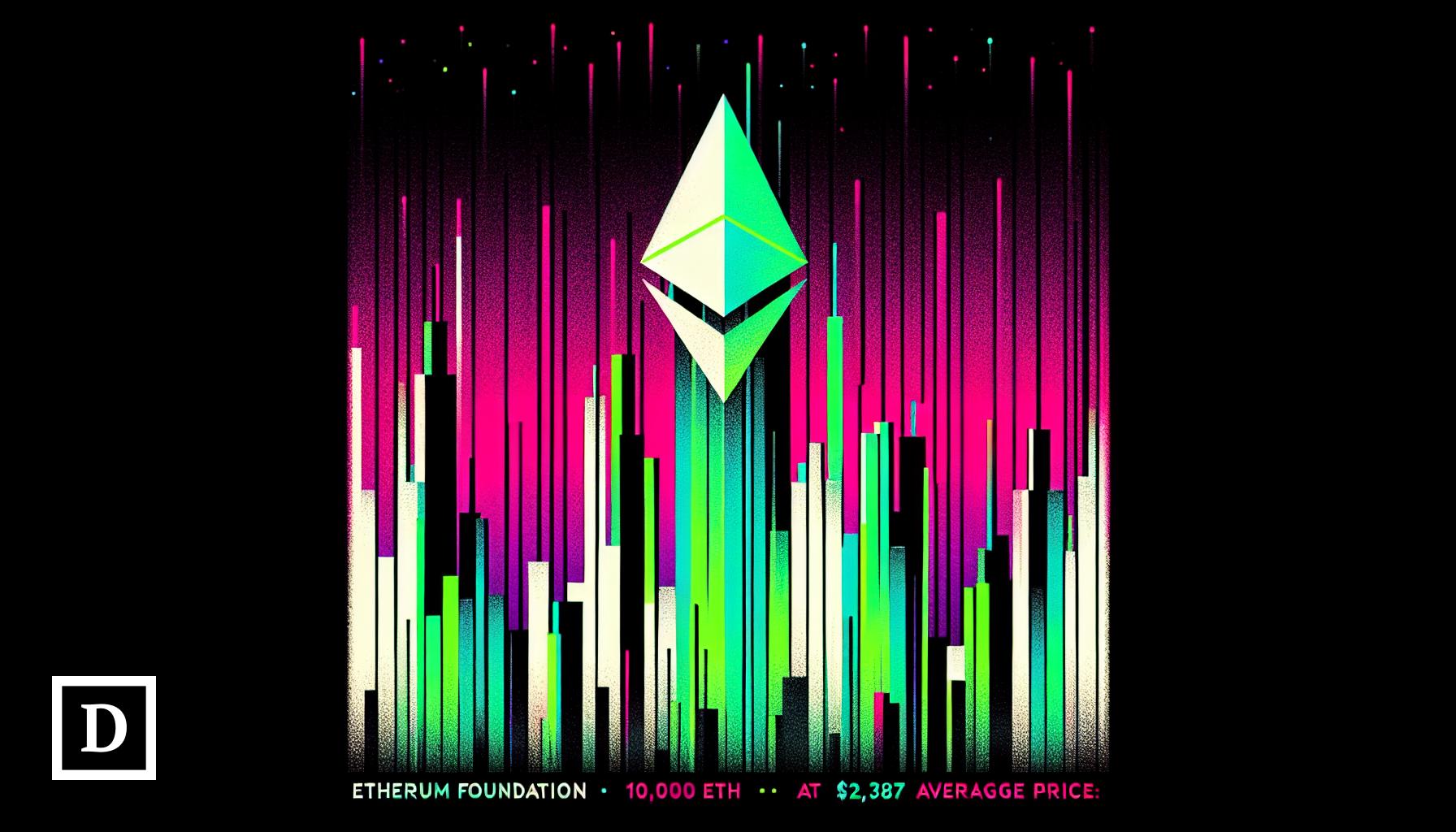
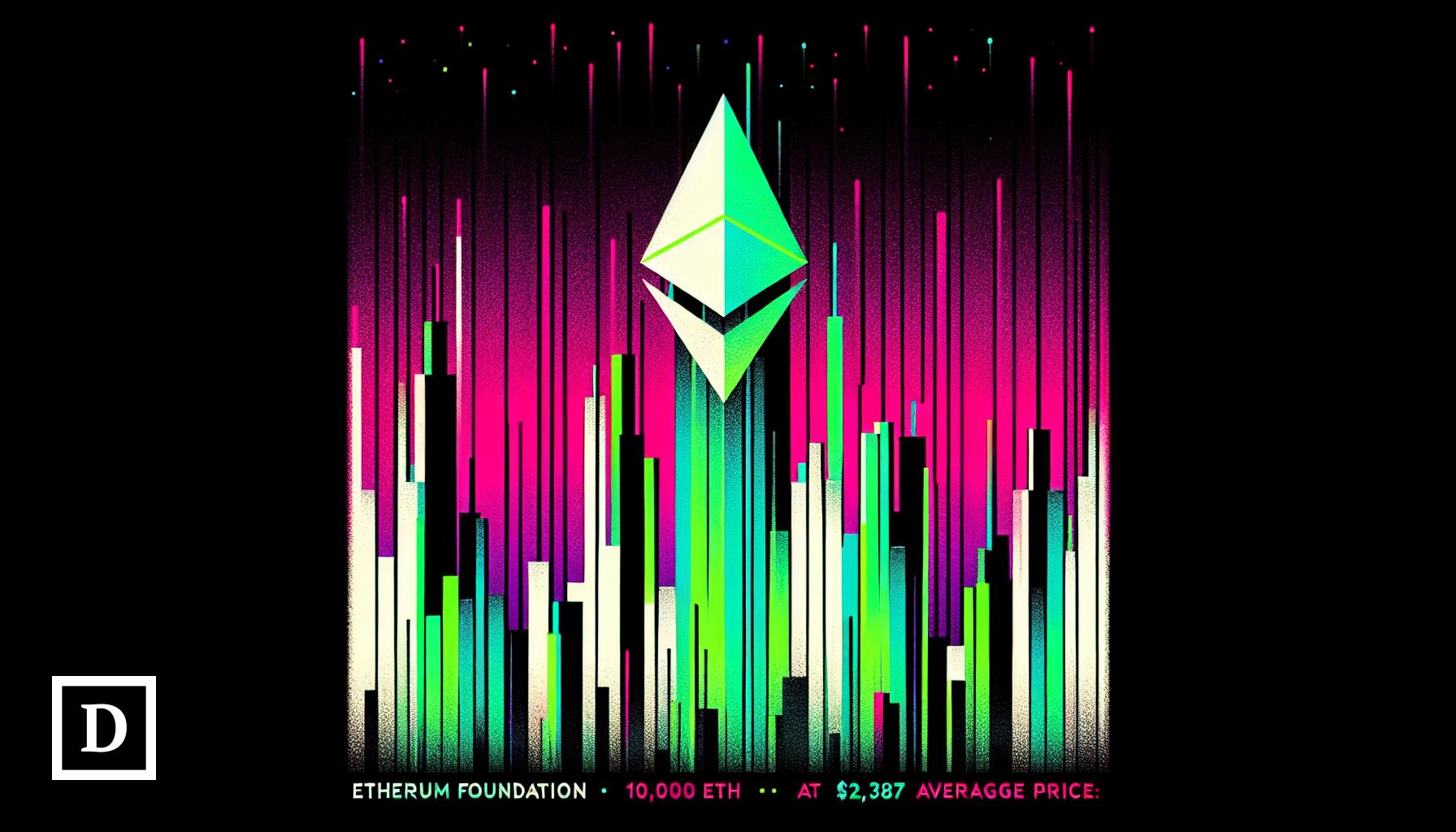
The Ethereum Foundation finalized a 10,000 ETH over-the-counter sale to BitMNR at an average price of $2,387 per token.
The Ethereum Foundation finalized terms of a 10,000 ETH sale at an average price of $2,387 per token via over-the-counter (OTC) trading on April 24, 2026. BitMNR served as the OTC counterparty for the transaction, which valued the sale at approximately $23.87 million based on the stated average price.
The sale represents a significant asset movement by the Ethereum Foundation, which maintains treasury holdings to fund ecosystem development and research. OTC trades of this scale typically indicate institutional-grade transactions executed outside public order books to minimize market impact.
Sources: Ethereum Foundation | Degenerate News
This article was generated automatically by The Defiant’s AI news system from publicly available sources.


A US official said on Friday that the $344 million in Tether (USDT) frozen on Thursday was linked to Iran. The official tied the blacklisted addresses to transactions routed through Iranian exchanges and Central Bank of Iran wallets.
Treasury Secretary Scott Bessent confirmed a sanctions action targeting the same wallets, describing a broader push to cut off the financial channels Tehran uses as diplomatic efforts to end the war stall.
Two Addresses, One Iran Nexus
Tether said on Thursday it had supported US authorities in freezing $344 million in USDT across two addresses. The stablecoin issuer stated the move followed information shared by several US agencies about activity tied to unlawful conduct, coordinated through the Office of Foreign Assets Control (OFAC).
A US official reportedly told CNN that government analysts, working with blockchain analytics firms, observed material links to the Iranian regime.
That evidence included confirmed transactions with Iranian exchanges and flows routed through intermediary addresses interacting with Central Bank of Iran wallets.
The official added that Iran’s central bank has adopted increasingly opaque methods to hide cross-border digital asset activity. The effort aims to stabilize the rial and keep trade flowing under sanctions.
“We will follow the money that Tehran is desperately attempting to move outside of the country and target all financial lifelines tied to the regime,” read an excerpt in the report, citing Treasury Secretary Scott Bessent in a statement on Friday.
Iran Leans Harder on Stablecoins
The freeze fits a pattern documented by blockchain researchers. Chainalysis reported Iranian crypto holdings reached $7.8 billion in 2025, with the Islamic Revolutionary Guard Corps (IRGC) holding roughly half of those assets by the fourth quarter.
The firm said the two frozen Tether wallets behaved like other known IRGC addresses when they were active, moving tens of millions of dollars in single transfers, often to private wallets.
Tehran has repeatedly relied on stablecoins to sidestep the traditional banking system.
Earlier this year, Tether and Circle blacklisted a hot wallet belonging to Iranian exchange Wallex, while US authorities sanctioned additional platforms accused of routing IRGC funds through USDT on the Tron network.
Debate Over the Real Impact
Not everyone is convinced the seizure meaningfully constrains Tehran. Daniel Tannebaum, a senior fellow at the Atlantic Council and partner at Oliver Wyman, called the freeze “meaningful” but noted Iran has spent decades adapting to economic pressure.
“The way to get at Iran at this point, because Iran is truly sanctioned out, is to go with the third country actors enabling them,” Tannebaum told CNN, pointing to jurisdictions such as China as the more consequential choke point.
Intrusions targeting Iran’s own crypto infrastructure have also escalated in parallel.
Last year, pro-Israel hackers drained roughly $90 million from Iran’s largest exchange during military strikes.
Friday’s disclosure lands at a pointed moment for stablecoin policy. Tether said it now coordinates with more than 340 law enforcement agencies across 65 countries and has helped freeze over $4.4 billion in assets.
That reach being able to change how Tehran routes its next transfers is the question regulators and exchanges should watch moving forward.
The post US Officials Freeze $344 Million in Tether’s USDT Linked to Iran appeared first on BeInCrypto.
BTC on track for best month in a year amid $5 billion USDT growth

Progressives hold Labour council’s feet to the fire in Kirklees hustings

Best Kentucky Derby betting apps: How to bet on the Kentucky Derby online

Manchester United reach agreement with Casemiro over contract clause amid transfer speculation

US brings back mandatory military draft registration

Steven Gerrard disagrees with Gary Neville over ‘shock’ Chelsea and Arsenal claim | Football

GOLD AND CRYPTO LIVE TRADING || 23 APRIL || Bitcoin Live Trading | Crypto Market Analysis |

Jadi berapa angka untuk financial freedom versi kalian? #masterclasssaham #financialfreedom #saham

HDFC Bank Crisis! Financial Scam or a Mistake? Dr Ujjwal Patni
-

 Business5 days ago
Powerball Result April 18, 2026: No Jackpot Winner in Powerball Draw: $75 Million Rolls Over
-
Entertainment5 days ago
NBA Analyst Charles Barkley Chimes in on Ice Spice McDonald’s Fiasco
-

 Tech6 days ago
Auto Enthusiast Scores Running Tesla Model 3 for Two Grand and Turns It Into Bare-Bones Go-Kart
-

 Politics5 days ago
Zack Polanski demands ‘council homes not luxury flats for foreign investors’
-

 Politics4 days ago
Gary Stevenson delivers timely reminder to register to vote as deadline TODAY
-

 Crypto World7 days ago
Russia Pushes Bill to Criminalize Unregistered Crypto Services
-

 Politics2 days ago
Making troops accountable for war crimes threatens US alliance, ex-SAS colonel warns
-

 Business2 days ago
Rolls-Royce Voted UK’s Most Iconic Trade Mark as IPO Register Hits 150
-

 Politics2 days ago
Disabled people challenge government SEND proposals over segregation concerns
-

 Crypto World7 days ago
Russia Introduces Bill To Criminalize Unregistered Crypto Services
-

 Politics2 days ago
Zack Polanski responds to home secretary’s taser threat
-

 Politics2 days ago
Starmer handler McSweeney to be dragged from shadows by Foreign Affairs Committee
-
Politics2 days ago
Wings Over Scotland | How To Get Away With Crimes
-
 Crypto World6 days ago
Kelp DAO rsETH Bridge Hack Drains $292M as DeFi Losses Top $600M in Two Weeks
-

 Politics2 days ago
‘Iran is still a nuclear threat’
-

 News Videos7 days ago
AP Politics, Buggana Analyzes Reasons For Financial Instability Due To Amaravati
-

 Crypto World3 days ago
New York sues Coinbase, Gemini over prediction market offerings
-

 Business3 days ago
The Job Benefits Most Men Don’t Know to Negotiate
-

 Crypto World11 hours ago
Michael Saylor says BTC winter is over. Market analyst disagrees, says bitcoin was in a pullback
-

 Politics5 days ago
Reform investigating candidate who ‘hates’ the NHS
You must be logged in to post a comment Login