Connect with us
DAPA Banner

Tech

Yong Wang Turns Visualization Into Insights

Published

on

When Yong Wang recently received one of the highest honors for early-career data visualization researchers, it marked a milestone in an extraordinary journey that began far from the world’s technology hubs.

Wang was born in a small farming village in southwestern China to parents with little formal education and few electronic devices. Today the IEEE member and associate editor of IEEE Transactions on Visualization and Computer Graphics is an assistant professor of computing and data science at Nanyang Technological University, in Singapore. He studies how people can employ data visualization techniques to get more out of artificial intelligence tools.

YONG WANG

EMPLOYER

Advertisement

Nanyang Technological University, in Singapore

POSITION

Assistant professor of computing and data science

IEEE MEMBER GRADE

Advertisement

Member

ALMA MATERS

Harbin Institute of Technology in China; Huazhong University of Science and Technology in Wuhan, China; Hong Kong University of Science and Technology

“Visualization helps people understand complex ideas,” Wang says. “If we design these tools well, they can make advanced technologies accessible to everyone.”

Advertisement

For his work in the field, the IEEE Computer Society visualization and graphics technical committee presented him with its 2025 Significant New Researcher Award. The recognition highlights his growing influence in fields including human-computer interaction and human-AI collaboration—areas becoming more important as the world generates more data than humans can easily interpret.

Growing up in rural Hunan

Wang was born in southwestern Hunan Province. China’s economy was still developing, and life in his village was modest. Most families in Hunan grew rice, vegetables, and fruit to support themselves.

Wang’s parents worked in agriculture too, and his father often traveled to cities to earn money working in a factory or on construction jobs. The extra income helped support the family and made it possible for Wang to attend college.

“I’m very grateful to my parents,” Wang says. “They never attended university, but they strongly supported my education.”

Advertisement

“If we build tools that help people understand information, then more people can participate in science and innovation. That’s the real power of visualization.”

Technology was scarce in the village, he says. Computers were almost nonexistent, and televisions were considered precious, expensive household possessions.

One childhood memory still makes him laugh: During a summer vacation, he and his brother spent so many hours playing video games on a simple console connected to the family’s television that the TV screen eventually burned out.

“My mother was very angry,” he recalls. “At that time, a TV was a very valuable thing.”

Advertisement

He says that despite never having used a laptop or experimenting with electronic equipment, he was fascinated by the technologies he saw on TV shows.

Discovering robotics and engineering

His parents encouraged a practical career such as medicine or civil engineering, but he felt drawn to robotics and computing, he says.

“I didn’t really understand what computer science involved,” he says. “But from what I saw on TV, it looked exciting and advanced.”

He enrolled at Harbin Institute of Technology, in northeastern China. The esteemed university is known for its engineering programs. His major—automation— combined elements of electrical engineering, robotics, and control systems.

Advertisement

One of the defining experiences of his undergraduate years, he says, was a university robotics competition. Wang and his teammates designed a robot capable of autonomously navigating around obstacles.

The design was simple compared with professional systems, he acknowledges. But, he says, the experience was exhilarating. His team placed second, and Wang began to see engineering as both creative and collaborative.

He graduated with a bachelor’s degree in 2011 and briefly worked as an assistant at the Research Institute of Intelligent Control and Systems at Harbin.

In 2014 he took a position as a research intern working at Da Jiang Innovation in Shenzhen, China.

Advertisement

That experience helped him clarify his future, he says: “I realized I didn’t enjoy doing repetitive work or simply following instructions. I wanted to explore ideas that interested me, and I wanted to conduct research.” The realization pushed him toward graduate school, he says.

Building tools that help humans work with AI

Wang received a master’s degree in pattern recognition and image processing from the Huazhong University of Science and Technology, in Wuhan, China, in 2016.

He then enrolled in the computer science Ph.D. program at the Hong Kong University of Science and Technology and earned the degree in 2018. He remained there as a postdoctoral researcher until 2020, when he moved to Singapore to join Singapore Management University as an assistant professor of computing and information systems. He moved over to Nanyang Technological University as an assistant professor in 2024.

His research focuses on a challenge facing nearly every business: how to make sense of the enormous amounts of data being generated.

Advertisement

“We live in an era of information explosions,” Wang says. “Huge amounts of data are generated, and it’s difficult for people to interpret all of it to make better business decisions.”

Data visualization offers a solution by turning complex information into images, patterns, and diagrams that people can more readily understand.

But many visualizations still must be designed manually by experts, Wang notes. It’s a time-consuming process that creates a bottleneck, he says.

His solution is to use large language models and multimodal systems that can generate text, images, video, and sensor data simultaneously and automate parts of the process.

Advertisement

One system developed by his research group lets users design complex infographics through natural-language instructions combined with simple interactions such as drawing on a touchscreen with a finger. It allows nontechnical people to generate visualizations instead of hiring professional designers.

Another focus of Wang’s research is human-AI collaboration. AI systems can analyze data at enormous scale, but people still need to be the final decision-makers, he says.

Visualization helps bridge the gap between human intention and AI’s complex calculations by making the process an AI system uses to reach a result more transparent and understandable.

“If people understand how the AI system works,” Wang says, “they can collaborate with it more effectively.”

Advertisement

He recently explored how visualization techniques could help researchers understand quantum computing, a field where core concepts—such as superposition, where a bit can be in more than one state at a time—are abstract. In classical computing, the bit state is binary: It’s either 1 or 0. A quantum bit, or qubit, can be 1, 0, or both. The differences get more dizzying from there.

Visualization tools could help scientists monitor quantum systems and interpret quantum machine-learning models, he says.

The importance of IEEE communities

Teaching and mentoring students remain among the most meaningful parts of Wang’s career, he says.

Professional communities such as the IEEE Computer Society, he says, play a major role in helping him transform early-stage graduate students unsure of which lines of inquiry they will pursue into independent researchers with a solid technical focus. Through conferences, publications, and technical committees, IEEE connects Wang with other researchers working in visualization, AI, and human-computer interactions, he says.

Advertisement

Those connections have helped him share ideas, collaborate, and stay up to date on innovations in the research community.

Receiving the Significant New Researcher award motivates him to continue pushing the field forward, he says.

Looking back, he says, the distance between his rural village in Hunan and an international research career still feels remarkable. But, he says, the journey reflects something larger about his chosen field: “If we build tools that help people understand information, then more people can participate in science and innovation.

“That’s the real power of visualization.”

Advertisement

From Your Site Articles

Related Articles Around the Web

Source link

Advertisement
Continue Reading
Click to comment

You must be logged in to post a comment Login

Leave a Reply

Tech

Beatbot Pool-Cleaning Robots Are on Sale for a Limited Time

Published

on

It’s about that time of year. National Pool Opening Day is tomorrow, April 25, and summer is almost here, which means pool owners everywhere are getting ready to unveil the horrors of whatever happened during the off-season. Most of the Beatbot lineup is on sale at Amazon and Beatbot’s own storefront, with prices starting at $499. Beatbot makes many of the best pool-cleaning robots we’ve tested, and we’ve highlighted our top picks below. Note that the discounts are scheduled to end on April 26, though items may sell out sooner. Happy pool party season! (Drop me an invite!)

Beatbot AquaSense 2 Ultra for $2,649 ($500 Off)

Our favorite robotic pool cleaner overall, the AquaSense 2 Ultra has what WIRED contributor Chris Null called “near-perfect cleaning capabilities.” It has six hours of battery life and AI-powered debris detection, and it can handle cleaning the floors, walls, and waterline. You’ll get a charging stand as well. Be aware that this cleaner weighs nearly 30 pounds, so be sure to eat your protein so you can lug it out of the water when the job is done. Even though it floats, it can still feel pretty hefty. The AI debris detection sets this model apart, as do the five cleaning brushes and frankly oversized battery capacity. If you want the fanciest pool cleaner we’ve tested, and you don’t want to pay full price, this deal is up your alley.

Beatbot Sora 30 for $749 ($200 off)

The Beatbot Sora 30 offers great value for the price. It tends to fluctuate between this discounted price and its full thousand-dollar MSRP, and we have yet to see it sell for less than it is right now. It has excellent battery life and more than enough power and features for daily pool cleaning needs for most users. It doesn’t have a surface skimmer—you might want the pricier Sora 70 (on sale for $1,200; $300 off) for that—but otherwise it’s capable of cleaning your pool floor, walls, and waterline. It’s easy to use with the companion app, and it floats when it’s done cleaning for easy retrieval. If you don’t need a surface skimmer or you don’t want to drop a ton of cash, this middle-of-the-road robot is worth considering.

Beatbot iSkim Ultra Robotic Pool Skimmer for $649 ($350 off)—Clip the Coupon

Beatbot

iSkim Ultra Robotic Pool Skimmer

The best surface skimmer has sensors that prevent it from slamming into your pool walls while it cleans. Unlike many other robots in this category, it actually slows down and turns while it’s skimming. It does have a basket-eject button on the front that sometimes gets depressed by accident, though this might not be an issue depending on your pool shape, and it’s not so much a deal-breaker as it is a thing to be aware of. Snag this model if you want to keep the surface of your pool clean automatically, but you don’t mind manually cleaning the walls and floor.

More Beatbot Deals

Here are some more pool cleaner discounts for your perusal, on models with slight variations from those we recommend above.

Advertisement

Power up with unlimited access to WIRED. Get best-in-class reporting and exclusive subscriber content that’s too important to ignore. Subscribe Today.

Source link

Continue Reading

Tech

Fifth Circuit Continues Running The Table, Says Ten Commandments Law In Texas Is Constitutional

Published

on

from the playing-favorites-with-religions dept

In June 2025, the Fifth Circuit Appeals Court upheld what would seem to have been an extremely obvious conclusion reached by the federal court handling the case: yes, it definitely violates the Constitution to mandate the posting of a religious text in every classroom in Louisiana. This wasn’t about displaying an assortment of “foundational texts” as its defenders (disingenuously) claimed: It was about pushing their preferred religion on students by any means possible.

Last June, the Fifth Circuit exposed the hypocrisy of the mandate while upholding the lower court’s injunction blocking its enactment:

It is also unclear how H.B. 71 ensures that students in Louisiana public schools “understand and appreciate the foundational documents of [its] state and national government” when it makes displaying those “foundational” documents optional, and does not require that they also be printed in a large, easily readable font. La. R.S. § 17:2124(A)(9). When the Ten Commandments must be posted prominently and legibly, while the other “contextual” materials need not be visible at all, the disparity lays bare the pretext.

If only that had been the end of the story. Presumably, enough Fifth Circuit judges preferred to reach a different conclusion that the appellate court decided to take another look at it using its full slate of judges. Since this is the Fifth Circuit we’re talking about, you already know how that turned out.

This time, the majority pretended it was simply impossible to tell if this Louisiana law actually violated the Constitution. The only way to be sure was to let the state enact it first and allow the courts to deal with any rights violations after they’ve occurred. The injunction was lifted, with the majority claiming Supreme Court precedent (that hasn’t actually been overturned by the Supreme Court) is no longer valid when it comes to discussing possible Establishment Clause violations.

Advertisement

That same argument — that the three-prong test created by the Supreme Court in 1971’s Lemon v. Kurtzman, which dealt with another set of church/state separation issues. This is the test:

  • The “Purpose Prong”: The statute must have a secular legislative purpose.
  • The “Effect Prong”: The principal or primary effect of the statute must neither advance nor inhibit religion.
  • The “Entanglement Prong”: The statute must not result in an “excessive government entanglement” with religion.

While a handful of judges (you can guess which ones) have opined that the “Lemon test” is dead, having been “abrogated” by more recent decisions, the Supreme Court has never issued a ruling overturning it. In fact, elements of the test were still being applied more than 30 years later.

Nonetheless, the Fifth Circuit — as it did earlier this year during its en banc review of the Louisiana law — says Lemon is dead [PDF] and, therefore, pretty much any law requiring the posting of the Ten Commandments in classrooms doesn’t violate the Constitution.

We conclude the Texas law does not violate either the Establishment Clause or the Free Exercise Clause. Here is a summary of our reasons.

First, the Establishment Clause. Plaintiffs primarily claim we are bound by Stone v. Graham, 449 U.S. 39 (1980) (per curiam), which invalidated a similar Kentucky law decades ago. We disagree. Stone applied an analysis—the “Lemon test”—which confounded courts for decades. See Lemon v. Kurtzman, 403 U.S. 602 (1971). Mercifully, the Supreme Court jettisoned Lemon and its offspring some years ago. See Kennedy v. Bremerton Sch. Dist., 597 U.S. 507, 534 (2022) (recognizing the Court has “abandoned Lemon”). With Lemon extracted, there is nothing left of Stone.

After deciding Lemon (and Stone) no longer applies, the majority moves on to say even if it did, there would be no constitutional violation because:

Advertisement

No child is made to recite the Commandments, believe them, or affirm their divine origin…

While it is true that the law makes no demands of teachers or students to do anything more than be in the same room as a Ten Commandments poster that “must be visible” to all students from up to 16 feet away, it’s quite obvious that this law is crafted to sneak a bit of the state’s preferred religion (at least in terms of those writing, supporting, and defending this law) past the protections of the Constitution.

It’s obvious from the statements they made while pushing this bill through the legislature. And it’s just as obvious now that the law has been given a free pass by the Fifth Circuit Appeals Court.

Texas Attorney General Ken Paxton, a Republican, called the ruling “a major victory for Texas and our moral values.”

“The Ten Commandments have had a profound impact on our nation, and it’s important that students learn from them every single day,” he said.

Pretty bold to use the royal “our” to mandate a specific set of moral values be posted prominently in taxpayer-funded public schools. It’s even bolder when it directly contradicts the desires of prominent members of this particular religious community — something that was pointed out by the dissenting judges in Fifth Circuit’s ruling on the Louisiana Ten Commandments law:

Advertisement

Indeed, every faith-based organization before us—on behalf of thousands of members—and every clergy and devout plaintiff agree that Louisiana must not pick and post specific scripture that the state commands will confront children in state classrooms. All religious voices submitted to us, barring one individual, oppose Louisiana’s attempt to select, inculcate, and enforce this version of gospel text in compulsory public education.

The people with power are pushing religion on kids against the wishes of the clergy and “devout plaintiffs.”

There’s a dissent attached to this ruling as well. This one tackles the Fifth Circuit majority’s decision to rely twice on its presumption that Lemon is dead law to hand Bible-thumping legislators wins in two states:

In Van Orden, despite applying a historical approach instead of Lemon, the plurality cited Stone as a “limit[] to the display of religious messages or symbols” and “an example” of the Court’s “vigilan[ce] in monitoring compliance with the Establishment Clause in . . . schools.” “The placement of the Ten Commandments monument on the Texas State Capitol grounds,” Van Orden explained, is “a far more passive use of those texts than was the case in Stone.” […] This is because “[t]he display [was] not on the grounds of a public school, where, given the impressionability of the young, government must exercise particular care in separating church and state.” Id. at 703 (Breyer, J., concurring in the judgment) (citing Lee v. Weisman, 505 U.S. 577, 592 (1992); Stone, 449 U.S. 39). And, unlike in Van Orden, “the text” of the Ten Commandments in Stone “confronted elementary school students every day.”

Van Orden recognized Stone’s viability, notwithstanding Lemon, given the special “concerns that arise in the context of public elementary and secondary schools.”

The Fifth Circuit majority — like the defendants whose unconstitutional law it has allowed to be enacted — cherry picks from post-Lemon Supreme Court jurisprudence to arrive at the conclusion it wants, rather than one the Constitution (and actual Supreme Court precedent) dictates. With two of the three states in the circuit already have been given a green light to mix church and state, it’s up to Mississippi to get this bill signed by the governor so the Fifth can complete its three-state sweep of the Establishment Clause.

Advertisement

Filed Under: 10 commandments, 1st amendment, 5th circuit, establishment clause

Source link

Advertisement
Continue Reading

Tech

Norway set to become the next country to ban under-16s from social media

Published

on


Norway’s Prime Minister Jonas Gahr Støre said the legislation was being introduced to ensure “a childhood where children get to be children.”
Read Entire Article
Source link

Continue Reading

Tech

China’s DeepSeek unveils long-awaited V4 AI model

Published

on

At its highest capacity, DeepSeek’s V4 ‘redefines the state-of-the-art for open models’, according to the company.

Chinese AI darling DeepSeek has launched its long-awaited V4 large language model (LLM) in preview, as speculation around a possible first funding round swirls.

The latest open-source launch comes more than a year after the start-up released R1, whose cost effectiveness and performance sent Silicon Valley leaders in a flurry, igniting accusations of theft. R1 was trained using lower-capacity Nvidia chips.

The V4 series comes in two versions, a ‘Pro’ version with 49bn activated parameters and a ‘Flash’ version with 13bn activated parameters, both supporting a context length of 1m tokens.

Advertisement

At its maximum capacity, the V4-Pro-Max mode “redefines the state-of-the-art for open models, outperforming its predecessors in core tasks”, DeepSeek said.

This mode has “significantly closed the gap” with Google’s Gemini 3.1-Pro, the leading model in knowledge-based evaluations, according to the company, while outpacing OpenAI’s GPT-5.2 and Gemini-3.0-Pro on “standard reasoning benchmarks”.

In agentic tasks, DeepSeek’s V4-Pro-Max is on par with leading open-source models, such as Kimi-K2.6 and GLM-5.1, but slightly worse than frontier closed models, it noted.

Its internal evaluations revealed that the Pro-Max version outperforms Anthropic’s Claude Sonnet 4.5 and approaches the level of Opus 4.5. Huawei has said that its Ascend supernode ​based on Ascend ⁠950 ​AI chips would be supporting V4’s versions.

Advertisement

OpenAI made fresh allegations against DeepSeek as recent as February, calling the company’s distillation techniques a part of “ongoing efforts to free-ride on the capabilities developed by OpenAI and other US frontier labs”.

Meanwhile, the US administration yesterday (23 April) said it will work closely with AI companies to fight “industrial-scale campaigns” by foreign actors attempting to steal its technology.

Chinese tech giants Tencent and Alibaba are reportedly in talks to join the DeepSeek’s first funding round. A source told Bloomberg that the benchmark for a valuation would be around $40bn. The publication further reported that Tencent has proposed a 20pc stake in the company.

DeepSeek’s Chinese contemporaries have made their own AI model launches in the months past, wishing to get ahead of V4, which was hyped to be the company’s most important launch since R1, and V3 in late 2024.

Advertisement

Latest launches include Alibaba’s Qwen3.5; ByteDance’s Seedance 2.0; Zhipu’s GLM-5, trained entirely using Chinese chips; MiniMax, which released M2.5; and the Alibaba-backed Moonshot AI, which came out with Kimi K2.5.

Don’t miss out on the knowledge you need to succeed. Sign up for the Daily Brief, Silicon Republic’s digest of need-to-know sci-tech news.

Source link

Advertisement
Continue Reading

Tech

Seattle HR leader’s candid book offers practical insights for building a business without losing yourself

Published

on

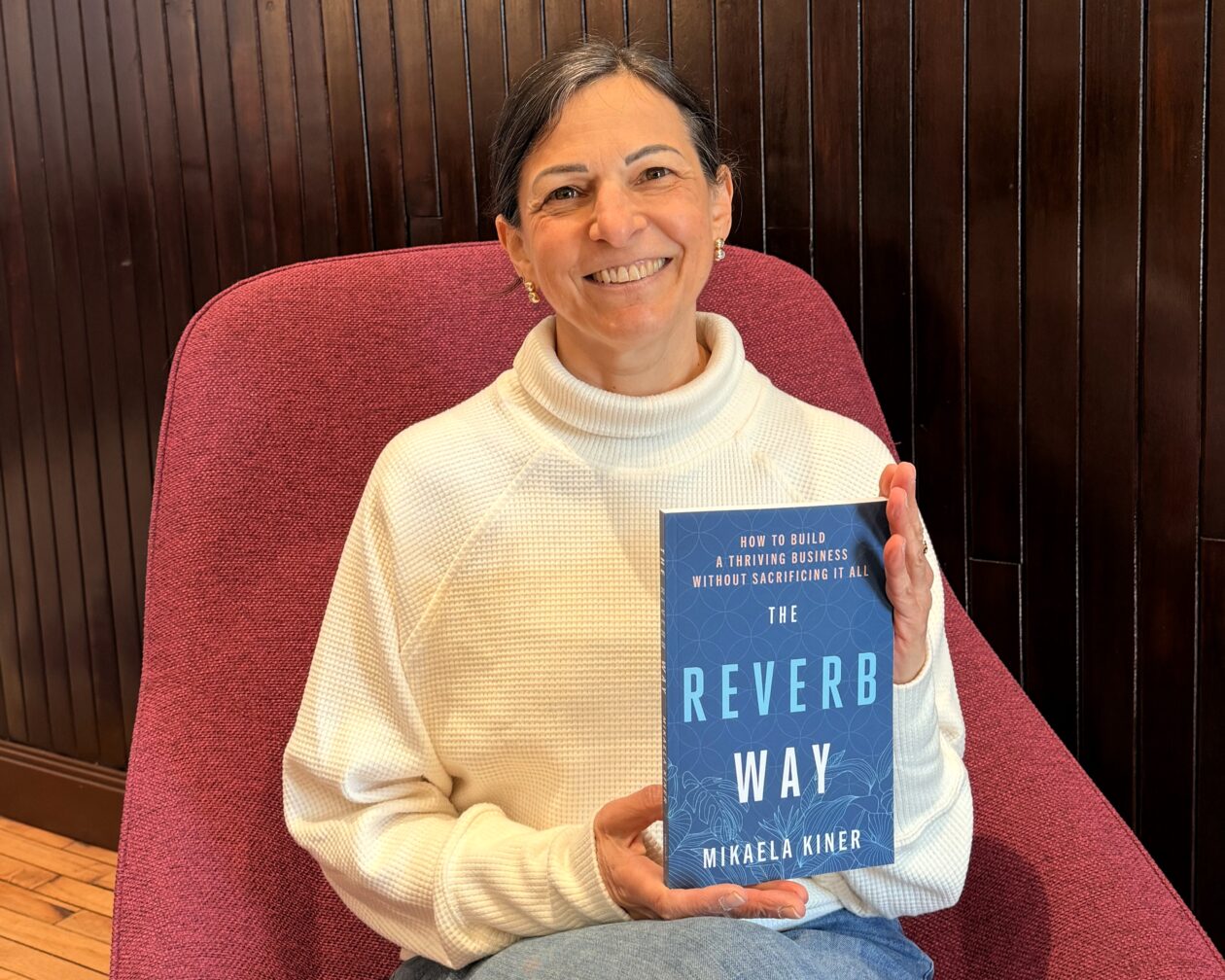
Mikaela Kiner’s new book is “The Reverb Way: How to Build a Thriving Business Without Sacrificing It All.” (Photo courtesy Mikaela Kiner)

The dreamy part of Mikaela Kiner‘s life is easy to picture. She has spent her recent winters working from a small Costa Rica beach town, taking surfing lessons before dawn, sunset walks in the sand, and Zoom calls with real palm trees swaying in the background.

But “The Reverb Way,” her new book about building and running the Seattle-based HR consulting firm of the same name, is not the postcard version of the story. 

Kiner describes what happened when new business dropped to half its usual volume, as tech layoffs, a rocky economy, and the rapid rise of AI hit Reverb’s client base. She battled insomnia so severe she couldn’t get through a workday without napping. Her daughter, watching her scramble through a client crisis, told her she’d never seen her this stressed. 

The book is a candid account of the ups and downs, detailing what Kiner has learned in a decade of reorienting her work to support the life and the company she wanted to create.

“I didn’t want to give the impression that owning a business is easy,” Kiner said in a recent conversation about the book on the porch of a Seattle coffee shop. “You can still be tired, you can still be overworked, you can still be drained, and you can still struggle.”

Advertisement

At the same time, she wanted to convey the fun and joy that comes from the freedom of doing your own thing. Kiner spent 15 years in HR leadership at companies including Microsoft, Amazon, and Starbucks, often working 60 to 80 hours a week, before starting Reverb in 2015.

“I made a choice to try and do something different,” she said. “And I’m so happy I did. Really, really happy. The key words there being made a choice.”

“The Reverb Way” is her second book, following “Female Firebrands” in 2020.

The new book is part memoir and part leadership guide. It draws on Kiner’s corporate career and her decade running Reverb to offer insights on everything from hiring and delegation to performance management and company values, and the daily mechanics of productivity and protecting your time.

Advertisement

Practical takeaways

Here are some of the insights from the book that resonated with me: 

Park your ideas. Instead of chasing every good idea the moment it came up, Kiner started logging them in a “Future Goals spreadsheet” and reviewing the list during quarterly business reviews. Some items got done as part of other initiatives. Others became irrelevant. But the team stopped getting pulled in a dozen directions at once.

Use your freedom. Reverb takes Fridays off from Memorial Day through Labor Day, with one person on call to check email a few times in case clients need help.

When Kiner offered to go further and adopt a formal four-day work week, the team turned her down. They already had the flexibility they needed. One employee had been going to a rock climbing gym at 3 p.m. every day, and Kiner never knew, because the work was getting done.

Advertisement

Don’t apologize for your schedule. Kiner writes about watching male executives cancel meetings for their kids’ soccer games without explanation or apology, and realizing she’d been justifying every time she was unavailable. Her rule now: no meetings before 9 or after 5, and no explanation necessary.

Build your own community. After being rejected from a business accelerator — possibly, she suspects, because she’d listed family time as a personal value — Kiner created her own informal group of women CEOs called WISE. They meet quarterly, share business insights, and support each other. Some are direct competitors. Friendship comes first.

Celebrate more than you think you need to. Kiner describes herself as a recovering perfectionist who used to hesitate to praise someone doing one thing well if they were struggling in another area.

For leaders who struggle with this, she suggests a simple tracking method: write down your team members’ names and add a checkmark each time you recognize them. Her point: everyone needs to hear they’re on the right track, probably more often than you think.

Advertisement

In that spirit, while the book is about Kiner’s experience, it also puts a big focus on the team that makes Reverb work, including co-owner and COO Sarah Wilkins, whom Kiner describes as the person who kept the company running during the worst stretches.

What’s happening now

As candid as the book is about the downturn, things have shifted since Kiner finished writing. In the weeks before our recent conversation, she said, new deal volume had jumped 50%, across tech, nonprofits, and small businesses. Reverb is hiring consultants again.

“I literally can’t explain it,” she said, noting that the turnaround has been happening despite inflation, gas prices, and geopolitical turmoil such as the war in Iran. 

AI is a frequent backdrop and topic of conversation in their work. Kiner writes in the book, for example, about teams at some companies being told to double productivity with AI but getting little support. 

Advertisement

In our conversation, she described a split: companies using AI as a way to demand more, and those actually bringing people along, showing them how to save time.

She’s not worried about AI replacing the human side of her work. One of her advisors uses a term she likes: “connective labor,” referring to empathy, conflict resolution, and the work of helping people and teams get unstuck. That part, she said, isn’t going away.

“I think there’s room for all of us,” she said. “Us and the agents, too.”

“The Reverb Way” is available in paperback and e-book versions.

Advertisement

Editor’s Note: GeekWire is a Reverb client.

Source link

Continue Reading

Tech

Give Mom Warm Coffee All Year Long With This Ember Smart Mug Deal

Published

on

The Ember Smart Mug 2 is niche, but it has a loyal following. Even though we think there are better mug warmers on the market, Ember is like Apple AirPods or Kleenex. People want what they want. Right now, for Mother’s Day, the Ember Smart Mug 2 is on sale for just under $100, a 30 percent discount and a match of the very best price we’ve tracked. You can save at Amazon, Best Buy, and the manufacturer’s website.

ember mug in white

This smart mug is probably overkill. It has a smartphone app that notifies you when your coffee reaches the ideal temperature, and its onboard light also provides a visual indicator that your brew is ready. It intelligently adjusts power usage to keep your drink warm when you’re nearby, and turns off when you’re not around. The self-heating mug is on sale in a few variations—10 or 14 ounces, in blue, white, black, and purple.

The mug offers up to 80 minutes of powered heating time, or you can pop it on the included charging coaster to keep the battery going all day. And you don’t need the smartphone app unless you want to precisely dictate your coffee temperature—the mug defaults to 135 degrees Fahrenheit without your specific input.

Our main gripe is that this proprietary warming system is not dishwasher safe. You need to hand-wash each component, and ensure you do so carefully, because the items are not cheap to replace. But if Mom has been putzing around the house drinking perpetually microwaved coffee, perhaps an upgrade is in order. We have additional recommendations in our guide to the Best Coffee Warmers. You may also want to check our related stories on the Best Espresso Machines, Best Coffee Machines, and Best Pod Coffee Makers.

Source link

Advertisement
Continue Reading

Tech

Govee’s New Outdoor Solar String Lights Bring Smart Choices to Backyard Evenings

Published

on

Govee Outdoor Solar String Lights
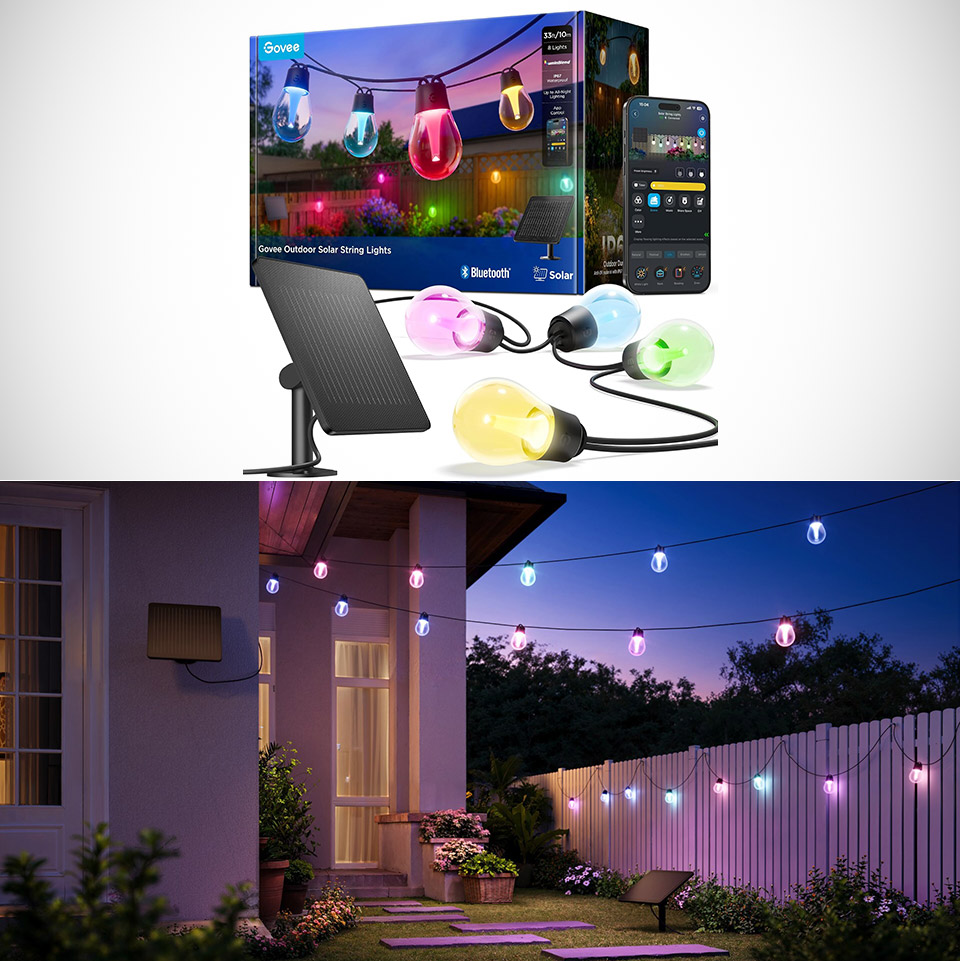
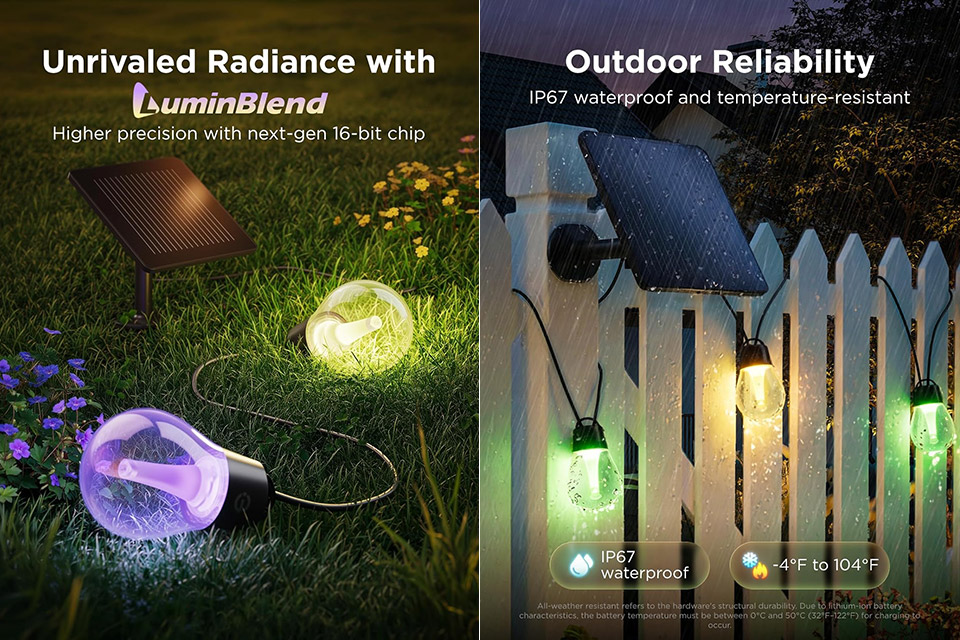
Govee’s Outdoor Solar String Lights have just launched, and they’re already making waves across social media. The string itself is 34 feet long and has eight extremely flexible bulbs that may be hung over a fence, a tree branch, or the border of your patio. A secondary 6 watt solar panel clamps on and may be tilted to maximize sun exposure while the lights are in place.

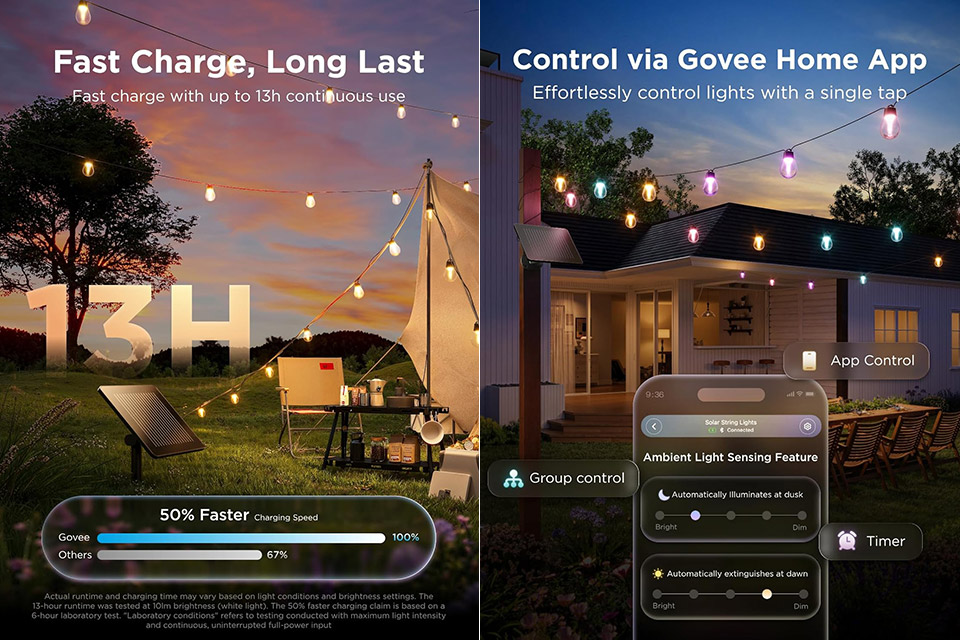
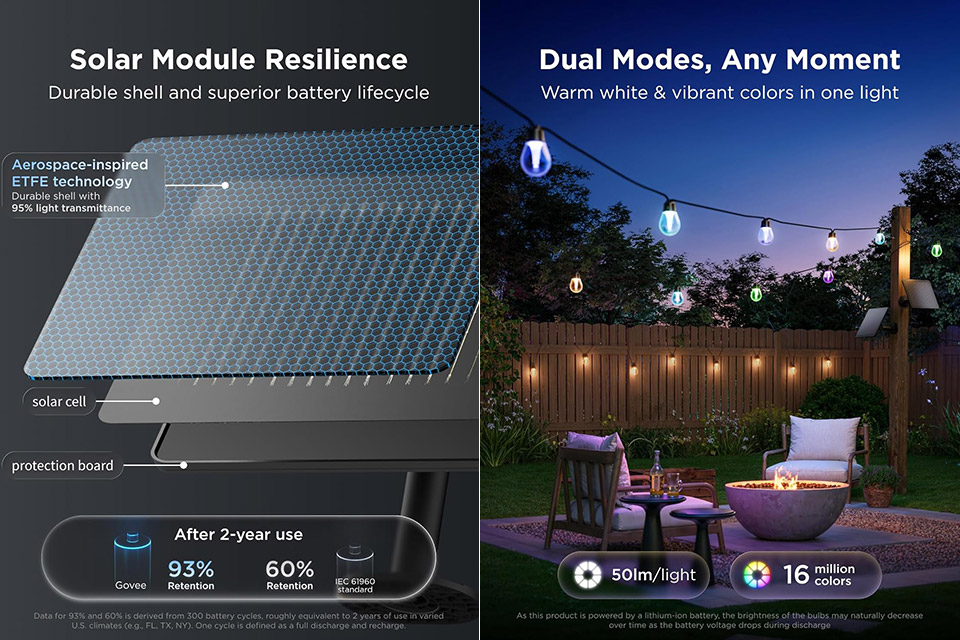
A full day in the sun will charge the built-in 4800 milliamp-hour battery, providing up to 13 hours of consistent, warm warmth when nightfall arrives. At 50 lumens apiece, they are not very bright and will not blind anyone around, but they do emit a warm and pleasant light. You can operate them using the free Govee Home app and a simple Bluetooth connection.


Govee Outdoor Solar String Lights 33ft, RGBICW Outdoor Lights with 8 Dimmable LED Shatterproof Bulbs…
  • Unrivaled Radiance with LuminBlend: Govee solar string lights offer 16 million colors with LuminBlend technology for a premium ambiance – all fueled…
  • Outdoor Reliability: Built for all-weather durability, these string lights and solar panel are IP67 waterproof. Solar panel with aerospace-inspired…
  • High-Capacity Solar Panel for All-Night Lighting: With a 4800mAh high-capacity battery and a 6W high-power solar panel, a full charge offers up to…

Within that app, you can select from over 100 pre-programmed scenes that load instantaneously, or you can customize your own colors and have the lights match with music on your phone or a speaker. The RGBICW technology allows each bulb to function as an own unit, providing you with an extremely wide spectrum of hues and tones, as well as some stunning smooth white tones for everyday use.

Govee Outdoor Solar String Lights
The LuminBlend software ensures that every transition from one colour to another seems natural and even, avoiding washed-out pastel tones and keeping deeper colors polished. Don’t worry about poor weather; this item has an IP67 water proof classification, so rain and wind will not stop it from working. The bulbs are durable enough to take a few knocks, and the panel itself is coated with ETFE, which is basically aerospace grade material that can withstand high heat, cold, filth, and the like.

Govee Outdoor Solar String Lights
Setup is simple, requiring no wiring or tampering with an electrical outlet. Simply hang the string and set the panel, and you’re good to go. You can also check the battery state within the app and add a rapid charge with a USB-C charger if the clouds come in the way. Govee claims the whole device will endure for 30,000 hours and offers a two-year warranty.

Govee Outdoor Solar String Lights
You can acquire the entire setup for $99.99 right now from the Govee website or Amazon. Finally, anyone who has put up with basic solar lights for years but still wants some actual color and the option to control them from their phone can finally get it all in one convenient package that is self-charging and reliable season after season.
[Source]

Advertisement

Source link

Continue Reading

Tech

Fitbit’s latest update turns your app into a conversational personal trainer

Published

on

Fitbit isn’t just tracking your steps anymore; it’s starting to talk back. 

The Fitbi 4.68 update, currently rolling out for Android and iOS users, is one of the more feature-packed app releases in a while (via 9To5Google). It brings a more conversational, personalized coaching experience for users. 

What’s new in this update?

The main addition is the return of the sleep log editing feature on Android. The feature was missing from the previous app build. For those catching up, it allowed users to edit the previous night’s summary and manually override it from the overflow menu. It’s also coming to iOS. 

Beyond that, the update overhauls the Coach experience. Personalized motivational messages now appear throughout the day in the Today tab, and they cover Morning Moments, Post-Workout Summaries, and End-of-Day or End-of-Week updates. 

There’s a new Conversational Check-In Feature that lets Fitbit users interact with their fitness coach more naturally, via a new text interface. The addition removes the friction of entering data into the app and then waiting for a response, allowing you to talk to it and get responses as part of a back-and-forth conversation. 

Advertisement

How does the coach experience actually change for users?

Whenever a coach-assigned workout appears, users will now see step-by-step guidance on the screen, helping those with less experience. Weekly fitness targets are now more flexible, with recommendations tailored specifically to individual health goals rather than generic plans. 

A future Fitbit update will also add the ability to adapt workout plans through conversation. While Fitbit 4.68 might sound like a small update, it conveys a bigger message. Google is quietly repositioning Fitbit as an AI-powered health coaching platform, rather than a simple software companion for smartwatches. 

The Conversational Check-In feature, along with the leaked Google Health rebrand logo, indicates that the Fitbit app might get folded into something much bigger and more important at the Google I/O 2026. 

Source link

Advertisement
Continue Reading

Tech

Audio-Forward Case Mod Of Classic 90s Portable TV

Published

on

The humble cathode ray tube (CRT) was once the technology behind almost all of our televisions and computer displays. Its replacements, from LCD screens to OLED and others, are generally cheaper to make and better to look at. Old televisions were comparatively large as well, but their size can be an advantage for people like [ManicMods] aka [Jeff]. His latest build ditches the CRT from an old Bently portable TV and uses the huge space available in the case for a hi-fi audio system and some other parts that turn it into an impressive portable home theater system.

After removing most of the internals of the TV, the first part to go in is the stereo and subwoofer combo as it takes up the most amount of space. The subwoofer section points downward and the two stereo speakers are mounted to the sides. To free up the most space inside, the new display is mounted forward of the original bezel, with a new 3D printed one helping to hold it in place. Behind it goes a Raspberry Pi, loaded with the moOde audio player, a high quality DAC for audio output, and a 1 TB SSD with [Jeff]’s uncompressed audio library. Most of the ports are extended out to the case including the SD card slot so other operating systems can be loaded on the Pi, and there are a ton of options for hooking up external speakers and displays as well, making it an extremely modular and expandable portable media center.

Also added to the finished product are a few small game controllers, since the Pi is perfectly capable of playing retro games, as well as a small wireless keyboard and trackpad combo. Although the CRT’s demise will be felt harder by some than by others, the original look of the case is preserved somewhat by keeping the original tuning display and locations of the original control buttons and knobs. If preserving the CRTs are of upmost importance, though, this build used a pair of them in a VR headset.

Advertisement

Source link

Continue Reading

Tech

Good News If You Have A Sony TV And Were Hoping It Would Become Less Useful For No Reason

Published

on

from the you-don’t-own-what-you-buy dept

If you own one of the Sony Bravia lines of televisions (like I do) and were hoping that the expensive television would suddenly become slightly less functional for no good reason, I have some good news for you.

Sony just announced that the company is making adjustments that will reduce the usefulness and efficiency of watching over-the-air (OTA) broadcasts with an antenna (something many still do in order to “cut the cord,” but still watch local sports broadcasts). According to the Sony announcement, the TV’s internal guide for watching live OTA simply won’t work as well anymore:

“The changes primarily target the program guide functionality for over-the-air antenna TV channels received via the ATSC tuner. After the cutoff date, program information may fail to display on certain channels, limiting the guide’s usefulness for planning viewing schedules. Users will often see listings only for channels they have recently watched, rather than a comprehensive overview of available broadcasts. Additionally, channel logos that previously appeared in the guide will disappear, and any thumbnail images accompanying program descriptions will no longer load or show.”

Many of the TVs being impacted are several thousand-dollar televisions, including the 2025 BRAVIA 8 II (XR80M2) and BRAVIA 5 (XR50), and the 2024 BRAVIA 9 (XR90), BRAVIA 8 (XR80), and BRAVIA 7 (XR70).

Sony didn’t specify why it’s making several-thousand-dollar televisions slightly less useful, but as always it’s about money. Many companies are keen to direct consumers to their (or their own) ad-based streaming alternatives to live OTA broadcasts, which are easier to monitor and monetize through surveillance. As Ars Technica posits Sony is also just likely cutting costs:

Advertisement

“Sony’s plan to remove some TV guide and menu features may be aimed at reducing costs and burden associated with features that typically depend on backend data services. Things like channel logos and enhanced metadata often require licensing agreements and the use of third-party electronic program guide data providers and metadata aggregators.”

Again, some of these sets (especially of the larger screen sizes) can run upwards of $3000 to $4000. You don’t typically expect products that expensive to suddenly become less useful. Or perhaps you do, if you’ve watched repeatedly how you no longer actually own the products you buy, which can be routinely downgraded (or bricked entirely) with a firmware update out of the blue.

Filed Under: bravia, broadcasts, channel guide, enshittification, hardware, smart tv, software, streaming, televisions, tv, tv guide, update

Companies: sony

Source link

Advertisement
Continue Reading

Trending

Copyright © 2025