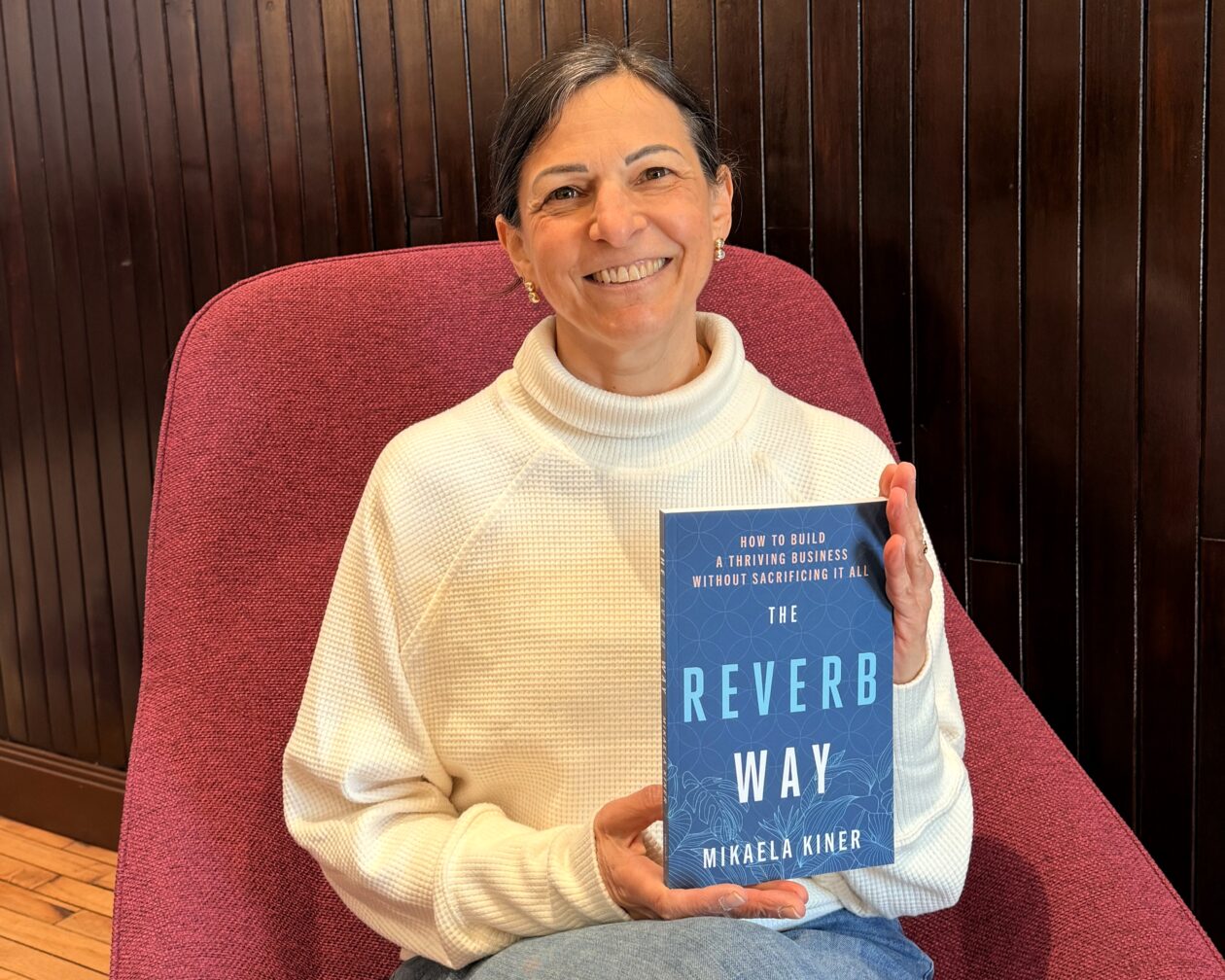
Mikaela Kiner’s new book is “The Reverb Way: How to Build a Thriving Business Without Sacrificing It All.” (Photo courtesy Mikaela Kiner)
The dreamy part of Mikaela Kiner‘s life is easy to picture. She has spent her recent winters working from a small Costa Rica beach town, taking surfing lessons before dawn, sunset walks in the sand, and Zoom calls with real palm trees swaying in the background.
But “The Reverb Way,” her new book about building and running the Seattle-based HR consulting firm of the same name, is not the postcard version of the story.
Kiner describes what happened when new business dropped to half its usual volume, as tech layoffs, a rocky economy, and the rapid rise of AI hit Reverb’s client base. She battled insomnia so severe she couldn’t get through a workday without napping. Her daughter, watching her scramble through a client crisis, told her she’d never seen her this stressed.
The book is a candid account of the ups and downs, detailing what Kiner has learned in a decade of reorienting her work to support the life and the company she wanted to create.
“I didn’t want to give the impression that owning a business is easy,” Kiner said in a recent conversation about the book on the porch of a Seattle coffee shop. “You can still be tired, you can still be overworked, you can still be drained, and you can still struggle.”
Advertisement
At the same time, she wanted to convey the fun and joy that comes from the freedom of doing your own thing. Kiner spent 15 years in HR leadership at companies including Microsoft, Amazon, and Starbucks, often working 60 to 80 hours a week, before starting Reverb in 2015.
“I made a choice to try and do something different,” she said. “And I’m so happy I did. Really, really happy. The key words there being made a choice.”
The new book is part memoir and part leadership guide. It draws on Kiner’s corporate career and her decade running Reverb to offer insights on everything from hiring and delegation to performance management and company values, and the daily mechanics of productivity and protecting your time.
Advertisement
Practical takeaways
Here are some of the insights from the book that resonated with me:
Park your ideas. Instead of chasing every good idea the moment it came up, Kiner started logging them in a “Future Goals spreadsheet” and reviewing the list during quarterly business reviews. Some items got done as part of other initiatives. Others became irrelevant. But the team stopped getting pulled in a dozen directions at once.
Use your freedom. Reverb takes Fridays off from Memorial Day through Labor Day, with one person on call to check email a few times in case clients need help.
When Kiner offered to go further and adopt a formal four-day work week, the team turned her down. They already had the flexibility they needed. One employee had been going to a rock climbing gym at 3 p.m. every day, and Kiner never knew, because the work was getting done.
Advertisement
Don’t apologize for your schedule. Kiner writes about watching male executives cancel meetings for their kids’ soccer games without explanation or apology, and realizing she’d been justifying every time she was unavailable. Her rule now: no meetings before 9 or after 5, and no explanation necessary.
Build your own community. After being rejected from a business accelerator — possibly, she suspects, because she’d listed family time as a personal value — Kiner created her own informal group of women CEOs called WISE. They meet quarterly, share business insights, and support each other. Some are direct competitors. Friendship comes first.
Celebrate more than you think you need to. Kiner describes herself as a recovering perfectionist who used to hesitate to praise someone doing one thing well if they were struggling in another area.
For leaders who struggle with this, she suggests a simple tracking method: write down your team members’ names and add a checkmark each time you recognize them. Her point: everyone needs to hear they’re on the right track, probably more often than you think.
Advertisement
In that spirit, while the book is about Kiner’s experience, it also puts a big focus on the team that makes Reverb work, including co-owner and COO Sarah Wilkins, whom Kiner describes as the person who kept the company running during the worst stretches.
What’s happening now
As candid as the book is about the downturn, things have shifted since Kiner finished writing. In the weeks before our recent conversation, she said, new deal volume had jumped 50%, across tech, nonprofits, and small businesses. Reverb is hiring consultants again.
“I literally can’t explain it,” she said, noting that the turnaround has been happening despite inflation, gas prices, and geopolitical turmoil such as the war in Iran.
AI is a frequent backdrop and topic of conversation in their work. Kiner writes in the book, for example, about teams at some companies being told to double productivity with AI but getting little support.
Advertisement
In our conversation, she described a split: companies using AI as a way to demand more, and those actually bringing people along, showing them how to save time.
She’s not worried about AI replacing the human side of her work. One of her advisors uses a term she likes: “connective labor,” referring to empathy, conflict resolution, and the work of helping people and teams get unstuck. That part, she said, isn’t going away.
“I think there’s room for all of us,” she said. “Us and the agents, too.”
Home security giant ADT has confirmed a data breach after the ShinyHunters extortion group threatened to leak stolen data unless a ransom is paid.
In a statement shared today, the company said it detected unauthorized access to customer and prospective customer data on April 20, after which it terminated the intrusion and launched an investigation.
This investigation determined that personal information was stolen during the breach.
“The investigation confirmed that the information involved was limited to names, phone numbers, and addresses,” ADT told BleepingComputer.
“In a small percentage of cases, dates of birth and the last four digits of Social Security numbers or Tax IDs were included. Critically, no payment information — including bank accounts or credit cards — was accessed, and customer security systems were not affected or compromised in any way.”
Advertisement
ADT says the intrusion was limited and that it has contacted all affected individuals.
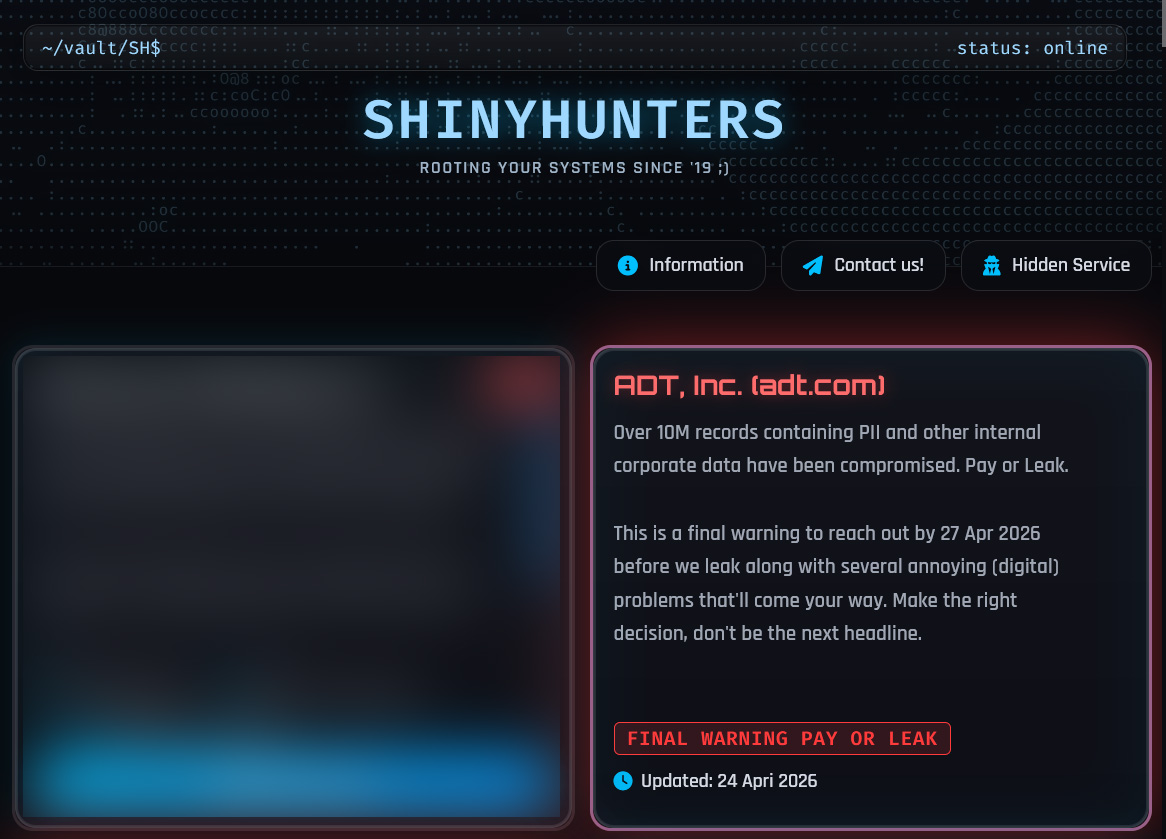
ShinyHunters leak site listing
This statement follows ADT’s listing on the ShinyHunters data leak site, where attackers claimed to have stolen 10 million records containing customers’ personal information.
“Over 10M records containing PII and other internal corporate data have been compromised. Pay or Leak,” reads the data leak site.
“This is a final warning to reach out by 27 Apr 2026 before we leak along with several annoying (digital) problems that’ll come your way.”
Advertisement
ADT listing on the ShinyHunters data leak site
ADT did not confirm the volume of data theft claimed by the attackers.
ShinyHunters told BleepingComputer they allegedly breached ADT through a voice phishing (vishing) attack that compromised an employee’s Okta single sign-on (SSO) account. Using this account, the threat actors claimed they accessed and stole data from the company’s Salesforce instance.
Since last year, the extortion group has been conducting widespread vishing campaigns that target employees and BPO agents’ Microsoft Entra, Okta, and Google SSO accounts.
After gaining access to a corporate SSO account, the threat actors steal data from connected SaaS applications such as Salesforce, Microsoft 365, Google Workspace, SAP, Slack, Adobe, Atlassian, Zendesk, Dropbox, and many others.
This stolen data is then used to extort the company into paying a ransom, or the data will be leaked.
AI chained four zero-days into one exploit that bypassed both renderer and OS sandboxes. A wave of new exploits is coming.
At the Autonomous Validation Summit (May 12 & 14), see how autonomous, context-rich validation finds what’s exploitable, proves controls hold, and closes the remediation loop.
Summary: Europe’s effort to protect children online has collided with its own privacy architecture. The ePrivacy derogation allowing voluntary CSAM scanning expired on April 3 after Parliament voted 311-228 to reject its extension, the EU’s new age verification app announced April 15 was hacked in under two minutes, and the CSA Regulation (“Chat Control”) remains stuck in trilogue with a July deadline. The ECHR has ruled encryption backdoors violate fundamental rights, while the GDPR, DSA, and proposed CSA Regulation each require knowing whether a user is a child, which itself requires collecting the data that privacy law says you cannot collect about children.
On April 3, the European Parliament voted 311 to 228 to let its temporary ePrivacy derogation expire. That derogation had allowed platforms such as Meta, Google, and Microsoft to voluntarily scan private messages for child sexual abuse material without violating EU privacy law. When it lapsed, the legal basis for those scans disappeared. Twelve days later, the European Commission announced a new privacy-preserving age verification app designed to protect children online. Researchers hacked it in under two minutes. Between the expired law and the broken app sits the entire problem: Europe wants to protect children from online exploitation, but every tool it builds to do so runs into the privacy architecture it spent a decade constructing. The result is a regulatory system at war with itself, where the mechanisms needed to find abused children require collecting exactly the data that EU law says you cannot collect about children.
The scanning gap
The ePrivacy derogation was introduced in 2021 as a stopgap. The European Commission had proposed the Child Sexual Abuse Regulation, known formally as the CSA Regulation and informally as Chat Control, which would mandate that platforms detect and report CSAM in private messages, including end-to-end encrypted ones. The regulation was supposed to replace the voluntary framework within three years. It did not. Trilogue negotiations between the Parliament, Council, and Commission have dragged on since 2022, with the next scheduled meeting on May 4 and a target of reaching political agreement by July. In the meantime, the derogation expired. The National Centre for Missing and Exploited Children in the United States, which processes the majority of global CSAM reports, warned that the lapse would cause a measurable drop in referrals from European platforms. Meta confirmed it had paused voluntary scanning in the EU. The Parliament’s position is that the derogation was incompatible with the fundamental right to privacy of communications. The child safety organisations’ position is that the Parliament just made it legal for platforms to ignore abuse material sitting in their systems.
The CSA Regulation as proposed by the Commission would require platforms to use detection orders issued by a new EU Centre to scan messages for known CSAM, new CSAM, and grooming behaviour. The Parliament stripped out the most contentious elements: it rejected scanning of end-to-end encrypted messages, limited detection to known material using hash-matching technology, and excluded real-time communications. The Council, led by a rotating presidency that has pushed harder on law enforcement access, wants broader scanning powers including for unknown material and grooming. The distance between the two positions is not a detail to be negotiated away. It is a fundamental disagreement about whether private communications can be systematically monitored to protect children, and the European Court of Human Rights has already indicated where it stands.
In February, the ECHR ruled in Podchasov v. Russia that requiring platforms to weaken or backdoor end-to-end encryption violates Article 8 of the European Convention on Human Rights, the right to respect for private life and correspondence. The ruling was directed at a Russian law compelling messaging services to provide decryption keys to the FSB, but its logic applies directly to the CSA Regulation’s proposed detection orders. If a platform cannot scan encrypted messages without weakening the encryption, and weakening the encryption violates fundamental rights, then the regulation cannot mandate what its authors intended it to mandate. Signal’s president, Meredith Whittaker, said the organisation would leave the EU rather than comply with any law requiring it to compromise its encryption protocol. Apple disabled its Advanced Data Protection feature for users in the United Kingdom after the British government issued a technical capability notice under the Investigatory Powers Act demanding backdoor access to iCloud data. The encryption debate is no longer theoretical. Companies are already making jurisdictional decisions based on where governments demand access to private communications.
Advertisement
The European Data Protection Board and the European Data Protection Supervisor have both issued opinions warning that the CSA Regulation as drafted by the Commission would be disproportionate and incompatible with EU fundamental rights. The EDPS specifically flagged that client-side scanning, the technique proposed as an alternative to breaking encryption by scanning content on the device before it is encrypted, still constitutes mass surveillance because it processes every message to identify the illegal ones. The distinction between scanning before encryption and scanning after encryption is technically meaningful but legally immaterial if the outcome is that every private message is analysed by an automated system. The Parliament’s negotiating position reflects this analysis. The Council’s does not.
The age verification paradox
While the CSA Regulation stalls, individual member states have moved ahead with age-based restrictions. France prohibits children under 15 from accessing social media without parental consent. Spain has set the threshold at 16.Greece will ban social media for under-15sfrom 2027. Austria’s threshold is 14.Norway plans to ban social media for under-16sand is developing a national age verification system to enforce it.Europe’s accelerating push for social media age limitshas produced a patchwork of national laws with no common enforcement mechanism, which is precisely the problem the EU age verification app was supposed to solve.
The Commission’s app, announced on April 15, was designed to verify a user’s age without revealing their identity to the platform, a zero-knowledge proof system that would confirm someone is over a given age threshold without transmitting their date of birth, name, or any other personal data. It was presented as the technical solution to the paradox of verifying age without collecting age data. Security researchers demonstrated within two minutes of its release that the app’s verification process could be bypassed, undermining the credibility of the one tool the Commission had offered as proof that privacy-preserving child safety enforcement was technically feasible. TheEU’s new privacy-preserving age verification appwas meant to demonstrate that the trade-off between child protection and data minimisation could be resolved through engineering. Its immediate failure demonstrated the opposite.
The legal collision
The Digital Services Act, which entered full application in 2024, requires platforms to assess and mitigate systemic risks to minors under Article 28, including exposure to harmful content, manipulation through interface design, and processing of personal data in ways that exploit children’s vulnerabilities. The DSA’s guidelines instruct platforms to implement age-appropriate protections but do not specify how platforms should determine a user’s age. The GDPR sets the age of digital consent at 16, with member states permitted to lower it to 13, and requires parental consent for processing children’s data below that threshold.GDPR fines increasingly target child data violations, with regulators across Europe treating children’s privacy as an enforcement priority. But to enforce age-specific protections, platforms must first determine who is a child, and determining who is a child requires collecting or inferring personal data about every user, including the adults who have a right not to be age-checked.
Advertisement
This is the circularity at the centre of Europe’s child safety framework. The GDPR says you cannot process children’s data without heightened protections. The DSA says you must protect children from harmful content. The CSA Regulation says you must detect abuse material in private messages. Each obligation requires knowing whether a given user is a child. Knowing whether a given user is a child requires processing their personal data. Processing their personal data to determine their age may itself violate the data minimisation principles that the GDPR enshrines. The age verification app was supposed to cut through this knot. It was broken on arrival. The ePrivacy derogation was supposed to buy time for the CSA Regulation. It expired without a replacement. The CSA Regulation was supposed to create a harmonised framework. It remains stuck between a Parliament that will not accept mass surveillance and a Council that will not accept a regulation without scanning powers.
The July target
The trilogue negotiators have set July as the deadline for political agreement on the CSA Regulation. The compromise proposals circulating in Brussels would limit mandatory detection to unencrypted platforms and known CSAM using hash-matching, with a review clause that could expand the scope if technology improves. Encrypted platforms would face obligations to report when CSAM is detected through user reporting or metadata analysis, but not through content scanning. The EU Centre for child sexual abuse prevention would coordinate cross-border referrals and maintain the hash databases. Whether this compromise can hold is uncertain. Law enforcement agencies across Europe have lobbied heavily for broader scanning, arguing that encrypted messaging is the primary distribution channel for abuse material and that excluding it renders the regulation largely symbolic. Privacy advocates argue that any mandatory scanning infrastructure, once built, will inevitably be expanded to other categories of illegal content, a slippery slope that the ECHR ruling in Podchasov was designed to prevent.
The honest assessment is that Europe has not resolved the tension between child safety and privacy because the tension may not be resolvable through regulation alone. The tools that would protect children, scanning messages for abuse material, verifying ages before granting access, monitoring interactions for grooming patterns, all require surveillance capabilities that EU law exists to prevent. The member states that have moved unilaterally with age bans have done so without a credible enforcement mechanism. The Commission’s age verification technology failed its first public test. The Parliament killed the one legal instrument that allowed voluntary scanning. And the regulation that was supposed to replace it all remains, after four years of negotiation, a document that nobody can agree on because the two things it is trying to protect, children’s safety and everyone’s privacy, demand opposite things from the same infrastructure.
Sometimes, a major discovery is exactly what you were hoping not to find. That’s the case with a team at Penn State who seem to have recently closed the door on any new physics stemming from a longstanding discrepency in the magnetic moment of the muon. It turns out, the model was fine, and we just needed better calculations.
The Muon is a heavier cousin to the electron. Like the electron, it has an intrinsic magnetic moment, but the traditional methods to calculate it did not quite match experiments, which was very exciting because it made us hope our models could be improved. Rather than try the traditional approximation methods for the unsolvable equations, the group at Penn State set up what you can think of as the Quantum Chromodynamic equivalent of a Finite Element Model (FEM) simulation–a grid of discrete steps in space and time. Tiny ones, of course, because the muon, like the electron, is a point-like particle with no lower size limit. In any case, according to their paper in Nature, after a decade of refinement and increasingly expensive supercomputer runs, the mystery can be put to bed. Instead of the discrepancy that so exited physicists 25 years ago when it was first found, theory and experiment now match to 11 digits, or a 0.5 sigma discrepancy, if you prefer.
Statistically, the Standard Model works– and that kind of sucks. It sucks, because it’s the gaps in the model where new physics are possible, and everyone has been pushing at those few gaps for the last 50 years to try and find what might be behind the standard model. Even [Zoltan Fodor], the principle investigator behind this project, is sad to see it work out. Sure, it’s a feather in his cap to get the calculations right at last–but ask anybody in the field, and they’d rather keep the door open to new physics than be right. We were certainly hoping it was something novel, last time the topic came up.
You might think muons are the last thing a hacker would ever encounter, but since there’s a steady rain of them from the sky in the form of cosmic rays, it’s not only easy to interact with them, you can actually put them to practical use– like muon tomography, or navigation indoors and underground.
from the but-who-will-remember-the-good-things-about-Harry-Byrd dept
The state of Virginia is trying to break with its racist past. It’s not pretending it doesn’t exist. But, better late than never, it’s trying to undo some of the damage still being perpetrated by Virginians and their legislators. Governor Abigail Spanberger signed a bill into law that stripped confederate-friendly organizations of their tax exempt status. (She also signed a bill that ended the production of specialty license plates featuring Robert E. Lee.)
Now, there’s a legitimate argument to be made against this legislation. (And a more nuanced argument to made in favor of it.) And we’ll get to all of that in a moment.
But not yet. That’s why you’re getting the headline I gave you, because I’m not the one making a nuanced argument for or against this bill. And that’s why The Federalist is getting all the bile I can fit into a handful of words because it for goddamn sure isn’t making any valid arguments in support of letting historically racist organizations continue to operate as tax exempt entities.
Hayden Daniel (scope the rest of his output to confirm your suspicions about this Federalist contributor) of The Federalist seems to think that separating confederacy supporters from state tax exemptions is one of the more noxious violation of rights he’s ever had the opportunity to witness.
Advertisement
Spanberger’s signature represents, as The New York Times put it, part of “a yearslong Democrat-led push to shake off the state’s legacy as the capital of the 11 Southern, slaveholding states that seceded from the country in the 1860s.”
And indeed it has been a years-long campaign by the left to erase Virginia’s, and America’s, history. The era that began with the inauguration of President Barack Obama in 2009 and reached its fever pitch during the fiery George Floyd riots of summer 2020 saw the slow but sure disappearance of Confederate history from the public sphere.
“Erase history.” What a convenient turn of phrase. Making entities like the United Daughters of the Confederacy (whose splash page pic looks about as inclusive as a “Gone With The Wind” cast photo) and the Sons of the Confederacy continue to do the apparently essential work of reminding people that there are still plenty of racists in Virginia without a state-sanctioned leg up is hardly “erasing history.” Everyone will remember the Civil War and the racists who lost the war they started because they were hooked on free, imported labor.
And try as you might, you’re not going to find Daniel arguing against the deliberate erasure of history being perpetrated by the Trump administration, which is steadily stripping parks and national monuments of anything that might portray white Americans as anything but fault-free heroes and saviors. (In fact, a perfunctory search immediately surfaces the opposite: The Federalist’s active participation in this administration’s bigoted erasure of US history.)
That’s the way it always goes with these people. The only history they think needs to be preserved is the stuff when white males were legally considered to be the owners or overseers of every other race and sex. These are people who yearn for simpler times when women and minorities couldn’t vote and people were willing to die to keep white Christian nationalists in power.
Advertisement
Moving on from this complaint about (non)erasure of Hayden Daniel’s favorites parts of US history, he then decides to pretend that white people who love the confederacy have been terrorized by people who don’t.
During a BLM riot in Richmond, Virginia, in May 2020, extremist agitators attacked the headquarters of the United Daughters of the Confederacy with “incendiary devices.” The building, deeded to the organization by the state in 1950, was filled with countless Civil War-era documents and artifacts. The resulting fire and destruction caused $4.1 million in damage to the building and its contents, according to a lawsuit filed by the UDC. The wanton vandalism that night also extended to the multiple Confederate monuments on Monument Avenue, including the famous equestrian statue of Robert E. Lee that was removed in 2021.
Wow, man. That’s rough. It’s almost as though it outweighs the decades of torture and slavery that were followed by more decades of terrorism perpetrated against Blacks by people who just couldn’t accept that non-white humans were actual human beings. A statute goes down and a pro-confederacy HQ gets torched and this nation is nowhere near breaking even in terms of what this state’s “legacy” is when it comes to slavery and the treatment of those who were only allowed their freedom after enough Virginians had died trying to prevent their emancipation.
Summing things up, Daniel veers into the hyperbolic:
[T]his law signed by Spanberger constitutes a new escalation. It is no longer about pieces of paper that need to censored or statues of bronze that need to be ripped down; it is about people who need to silenced and punished for daring to believe that America, and the South in particular, has its own unique identity independent of the left’s racialist and globalist dogma.
Spanberger is sending an unequivocal message — it’s open season on those who would honor American history and the heritage of their ancestors. And the full force of the state will be used to quash them.
Advertisement
I have no idea why you would want to “honor” that particular sliver of American history or celebrate the “heritage” left to you by racist slaveholders and the descendants that love them. You’re not using words like “history” and “heritage” because you don’t want Americans to ever forget the horrors we inflicted on others during our history. You’re just an awful person who wants similarly awful people to continue to be awful without fear of consequence.
A people without a history, or who are ashamed of their history, are easily manipulated by the whims and ambitions of the dystopian, tyrannical left.
Tell that to Trump, you mook. You aren’t actually ashamed of this history. You — and the people running the party you love — are secretly proud of their racist past and bigoted present. That doesn’t make you immune from manipulation. It just means the people who subject you to their whims and ambitions not only won’t be members of an opposing political party, but they won’t be any smarter than you think you are.
Now… having said all that, here’s the argument against this law, which does make sense:
The new law strips property tax exemptions from the pro-Confederate groups, while leaving them in place for all the others. That’s pretty obvious discrimination based on political ideology. The Virginia state legislature could end this tax exemption for all the groups in question, or reduce it in various ways. It could eliminate some groups but not others based on nonideological criteria. But it cannot do so based purely on the views of the groups in question.
Such viewpoint discrimination with respect to tax exemptions and government benefits is a potentially very dangerous tool that government can use to penalize opposition (even as it rewards its supporters). If courts were to uphold the Virgina law against First Amendment challenges, it would set a dangerous precedent that state and federal officials of various political stripes could exploit to target their opponents.
Advertisement
That’s the argument Hayden or anyone else from the Federalist could have made. That would have clearly demonstrated the inherent danger of giving the government the legislated power to engage in viewpoint discrimination. But no one at the Federalist is apparently capable of coming up with cogent, nuanced arguments, not when the livelihood of people who resolutely celebrate the racist losers of America’s only Civil War (to date!) is on the line.
Beyond that, there’s the question of whether or not tax exempt status is government speech, which means viewpoint discrimination may actually be lawful if the government prefers not to throw tacit support to groups it doesn’t care for. That doesn’t make it much better than openly violating the First Amendment, but it does give it something to work with if this law is challenged in court.
For now, the sons and daughters of the confederacy will have to try to make do without their tax exempt status. On the hardship continuum that involves the Confederacy, this doesn’t even amount to a rounding error.
Astrobotic engineers went all out on their Chakram prototypes, doing a series of hot-fire tests that dwarfed anything previously done with this type of hardware. Two rotating detonation engines together clocked over 470 seconds of operation throughout eight runs at the Marshall Space Flight Center in Alabama, one of which lasted a whole 300 seconds without any hitches, and the entire time each engine delivered a solid 4,000 pounds of thrust as steady as can be.
These tests were conducted a few weeks ago and completed on a shoestring budget of just $1.5 million dollars. Every significant firing met the mark for a steady working temperature exactly, and when the crew disassembled the hardware for a thorough inspection later on, they couldn’t locate a single inch of obvious damage. This lot was put together by a small group of designers and builders with the help of two NASA contracts and a direct arrangement with the Marshall Center, and if you ask me, they’ve done far more than expected.
BUILD AN OFFICIAL NASA ROCKET – Kids prepare to explore outer space with the LEGO Technic NASA Artemis Space Launch System Rocket (42221) building…
3-STAGE ROCKET SEPARATION – Young builders can turn the hand crank to watch the rocket separate in 3 distinct stages: solid rocket boosters, core…
STEM BUILDING TOY FOR KIDS – This educational rocket kit was created in collaboration with NASA and ESA to showcase the authentic system that will…
Rotating detonation engines operate on a simple but powerful concept: mix your fuel and oxidizer in a ring-shaped chamber, fire it up, and then send a shockwave around in circles at supersonic speed, squeezing as much energy out of the propellant as possible. As a result, you get improved efficiency, lighter hardware, and the ability to carry a lot more payload or drive a long distance on one tank.
Astrobotic believes this technology will be very useful on its upcoming lunar landers, as the business has already contracted with NASA to send cargo to the Moon, and its next lander, Griffin, is scheduled to launch this year. Adding a Chakram engine to future landers could allow them to carry greater mass to the lunar surface or remain in orbit for longer periods of time. It also appears that the concept would fit in well with the company’s work on reusable rockets and orbital cargo ships that would transport stuff between Earth and Moon.
Advertisement
Next, the team plans to install regenerative cooling channels to allow the engine to run for longer periods of time without overheating. They’ll also work on a mechanism to adjust the thrust during flight, and as the design progresses, they’ll seek to trim it down and make it lighter. Each tiny adjustment brings them closer to using this technology in real-world space missions.
The Hypergear 3-in-1 Wireless Charging Dock is meticulously engineered to reduce the cable clutter and streamline your daily routine. Featuring 2 dedicated wireless charging surfaces, you can power up your phone and AirPods easily. In addition, you can charge your Apple Watch with the built-in charger mount. Stylish and compact, the dock is perfect for your tabletop, desk, or nightstand and will effortlessly charge your everyday essentials in one convenient place. It’s on sale for $33.
Note: The Techdirt Deals Store is powered and curated by StackCommerce. A portion of all sales from Techdirt Deals helps support Techdirt. The products featured do not reflect endorsements by our editorial team.
Silicon Valley tends to tolerate a certain amount of founder exaggeration when pitching investors, often dismissing it as part of selling a vision. But some choices cross the line and can lead to jail time for founders and scandal for their investors.
A case in point is Joseph Sanberg, whose once high-flying fintech startup Aspiration Partners was backed by a roster of tech celebrities, including former Microsoft CEO and current Clippers owner Steve Ballmer. In August 2025, Sanberg pleaded guilty to two counts of wire fraud and defrauding multiple investors and lenders, the U.S. Department of Justice said in a press release. Each count carries a maximum sentence of 20 years in prison.
Ahead of sentencing, which is scheduled for Monday, victims were invited to describe their experience with Sanberg to the judge. Ballmer did so, and publicly. Ballmer’s lawyers said in the letter that he has lost money, been vilified, and that the NBA is investigating allegations stemming from the association.
Sanberg co-founded green fintech startup Aspiration Partners, which offered what it called sustainable banking services like credit cards and investment products that avoided fossil fuels. The startup promised to “automatically plant trees with every card purchase.” In 2021, it announced plans to go public via a SPAC merger at a value of $2.3 billion, though that transaction never took place.
Advertisement
The DOJ alleged that Aspiration booked and recognized revenue from entities held by Sanberg, who made the company appear as if it had a steady stream of customers and revenue that it didn’t actually have. The agency further alleged he defrauded investors by showing them a fabricated letter from Aspiration’s audit committee that said the company had $250 million in available cash and equivalents when it had less than $1 million. The DOJ alleged that Sanberg, along with a board member who also pleaded guilty, falsified financial records to obtain $145 million in loans.
When Ballmer shared his letter on X, asking the judge to consider the harm done to him in sentencing, he wrote, “I was duped and feel silly about that. Everyone who believed in Aspiration, including employees, customers and investors, was also duped. Everyone is still tallying the losses.”
Five years ago, I invested in Aspiration, a company focused on environmental sustainability, a cause deeply important to me and my family. I also bought carbon credits and trees through the company to reduce the carbon footprint of the Clippers, Intuit Dome, the Kia Forum and all…
The letter says that Ballmer invested a total of $60 million in the company, and lost all of it. Ballmer was not only an investor, but had contracted with Aspiration to provide carbon-offsetting programs for the Clippers and its stadium. Aspiration also became a major Clippers sponsor.
Advertisement
Techcrunch event
San Francisco, CA | October 13-15, 2026
Advertisement
The billionaire said in the letter that not only did he lose that money, his reputation was negatively affected. He used the letter to deny the reporting of a multi-part series from famed sports podcast Pablo Torre Finds Out that delved into the relationship between the Clippers and Aspiration. The podcast made allegations that Aspiration helped sidestep the salary cap for a star Clippers player. Ballmer’s lawyers called those allegations “misapprehension or intentional disregard of the facts,” in the letter.
Ballmer’s letter also said that as a result of the association with this company, the podcast and other public attention of it, he’s been named in lawsuits. Meanwhile, the NBA said in its own letter regarding Sanberg’s sentencing that it’s investigating the salary cap allegations and Sanberg has been providing evidence, ESPN reported.
While the basketball world is embroiled in all of these downstream developments, the message founders can take from it is clear: If one fabricates financial documents to raise capital, the outcome will very likely be prison.
The Ballmer Group did not respond to our request for comment.
Advertisement
When you purchase through links in our articles, we may earn a small commission. This doesn’t affect our editorial independence.
Apple’s iPhone 18 isn’t expected to be announced until 2027, but buyers can perhaps look forward to a RAM upgrade similar to the one the iPhone 17 Pro got.
The iPhone 18 could be getting a huge RAM upgrade
Apple is expected to switch up its iPhone release cadence this year, and it’s bad news for budget-conscious buyers. It’s expected that the entry-level iPhone 18 won’t ship alongside the Pro models, leaving customers to wait until early 2027. But analyst Dan Nystedt believes that the wait might be worth it. In a new post on the X social network, Nystedt says that, in a first for the entry-level model, the iPhone 18 will come with 12GB of RAM. Rumor Score: 🤯 Likely Continue Reading on AppleInsider | Discuss on our Forums
Three very different worlds are waiting for you on Netflix this weekend. A 19th-century murder mystery that questions everything you think you know about guilt, a Danish Nordic noir serial killer thriller that you genuinely cannot stop watching, and a Japanese sumo drama that has absolutely no business being as gripping as it is.
One is based on a Margaret Atwood novel, the second has a perfect 100% on Rotten Tomatoes, and the third one will make you care deeply about a sport you have never thought about once in your life. All three are criminally underrated and worthy of your weekend binge.
Based on Margaret Atwood’s novel of the same name, this six-part miniseries follows Grace Marks, a young Irish immigrant in 19th-century Canada, convicted of murdering her employer and his housekeeper. A decade into her sentence, psychiatrist Dr. Simon Jordan begins interviewing her to determine whether she should be pardoned on grounds of insanity. The whole show rests on one central question: is Grace telling the truth?
Sarah Gadon plays Grace with such quiet, calculated control that you never quite know where you stand with her. She is fragile yet magnetic and possibly dangerous all at once. The show is also a sharp study of how women were perceived, judged, and silenced in that era. It holds a 99% on Rotten Tomatoes and deserves every bit of it.
This is your perfect weekend watch because season 2 of The Chestnut Man: Hide and Seek drops on Netflix on May 7. So you have just enough time to binge the first season before it arrives. This Danish crime thriller follows detectives Naia Thulin and Mark Hess as they hunt a serial killer in Copenhagen who leaves tiny chestnut figurines at each crime scene.
What makes the series so gripping is how the mystery keeps expanding in directions you do not see coming. The pacing is relentless, the atmosphere is genuinely unsettling, and the finale lands hard. With six episodes, a perfect 100% on Rotten Tomatoes, it is one of the best Nordic noir series Netflix has ever put out.
It’s baffling how little people talk about this hidden gem on Netflix. This Japanese drama follows Kiyoshi, a broke and reckless young man who stumbles into the world of professional sumo wrestling, chasing money, only to find himself swallowed whole by its traditions, politics, and brutal hierarchy. Think Rocky, but set in one of Japan’s most sacred sporting institutions, with a dark comedy streak running through it.
The actual sumo matches are equal parts brutal and stunning. But what keeps you hooked on this underrated show is how it captures the culture around the sport, the rivalries between stables, the iron grip of tradition, and the political games played behind the scenes. It holds an 86% on Rotten Tomatoes and an 8/10 on IMDB. I recommend giving it two episodes before you judge the show.
The Vantrue Pilot 2 is a great dash cam with a night vision camera, but it’s probably overkill for anyone other than professional drivers.
Vantrue Pilot 2
The typical car dash cam is a simple. It’s a camera or two, designed to capture footage of other people’s driving to help with either insurance or the police investigating an accident. But with those cheaper cameras at the lower end of the spectrum, the camera may not be able to capture everything it needs to see in all conditions. In heavy rain, fog, sleet, or even the dark, a camera can miss important details simply because its sensor cannot “see” them. Continue Reading on AppleInsider | Discuss on our Forums
































































You must be logged in to post a comment Login