Connect with us
DAPA Banner

NewsBeat

High petrol prices are fuelling interest in EVs. Here’s how this could bring down electricity bills

Published

on

High petrol prices are fuelling interest in EVs. Here’s how this could bring down electricity bills

With oil prices skyrocketing following the US and Israel’s bombing of Iran, and the subsequent closure of the Strait of Hormuz, motorists around the world have been looking for ways to save money.

Improvements in electric vehicle (EV) technology, combined with the high price of oil, mean that the tipping point at which most consumers start ditching their petrol cars for electric ones may well have been reached.

Given the nature of that market where more EV users means better infrastructure to support them, there will be no turning back. As it becomes easier to charge a car than to find petrol stations, and as battery technology continues to improve, the relative advantages of EVs will become impossible to match.

For countries like the UK, where renewable sources are producing more electricity, mass adoption of EVs cannot come fast enough. And this is not just for the obvious reasons of improving air quality or reducing reliance on dictators and US foreign policy.

Advertisement

While the oil price shock may be what finally tips consumers towards EVs, adoption provides part of the answer to a different and lasting problem: the cost of electricity in the UK and other countries where investment in wind and solar has so far failed to bring prices down.


À lire aussi :
The Strait of Hormuz shows how everything is now about leverage


The UK pays more for electricity than most comparable countries. Gas sets the price of electricity too often. And a relative lack of sun means the UK misses out on the full benefits of solar – the renewable technology that has become cheapest.

What’s more, demand for electricity has been falling as machinery and appliances become more efficient, and as the country moved away from industry and towards services. This means that all the fixed costs of maintaining the energy grid must be shared between fewer users.

Advertisement

How EVs can help

On sunshine, there is not much to be done – the UK will not become Spain. But on the other two problems, the case is strong.

Take gas first. The reason gas sets the price of electricity so often is not that the UK lacks renewable capacity. The country builds plenty of wind farms. The problem is that it cannot always use the energy produced – a lot of it is wasted because there is nowhere to store it. So the fallback is gas whenever there is a need for a lot of electricity, or when there is no wind or sun.

But electric cars can be connected to the electricity grid. When you are not driving and do not need a full battery, intelligent systems can sell electricity back to the market when demand is high or supply is low, and buy it back when it is cheap. The supplier Octopus already offers this in the UK to drivers of certain cars, promising hundreds of pounds of annual savings while giving consumers a choice of when they need to refill their battery.

The scale is striking. Energy regulator Ofgem estimates that putting half of projected EVs on this vehicle-to-grid system by 2030 could provide around 16GW of flexible capacity to the grid. Average demand in Great Britain is around 30GW.

Advertisement

This means that discharging all batteries to the grid at the same time would produce the same flow of electricity as if all offshore wind turbines ran at full capacity simultaneously. Or five times what the new nuclear power plant Hinkley Point C – which is projected to start producing electricity in 2030 – will produce.

But crucially, it would be available on demand and not just when the wind blows.

UK emissions from transport have barely moved, while emissions from other sectors have plummeted.
Jarek Kilian/Shutterstock

At the European level, researchers estimate that the same 50% vehicle-to-grid penetration could fully cover EU stationary storage needs (the capacity to store surplus electricity and release it when demand peaks) by 2040. The intermittency problem, which underpins most of what makes electricity expensive and difficult to manage as countries wean themselves off fossil fuels, largely goes away when storage is not a problem.

Advertisement

In terms of demand, EVs will help simply by increasing it. The problem is not that the UK cannot produce electricity. The issue is intermittency, and the failure to invest in managing it.

EVs, like heat pumps, are far more energy-efficient than the systems they replace. Heat pumps are three to five times more efficient than gas boilers. Demanding more electricity means demanding less gas – even accounting for the gas used to generate some of that electricity. It also means spreading fixed costs across more users, and making households less exposed to the next energy shock.

The UK has cut its emissions by 54% since 1990, but the politics of net zero have become somewhat toxic. High electricity prices feed the narrative that going green means getting poorer. However, transport – the sector where emissions have barely moved – is also where the next wave of decarbonisation will lower bills.

Unlike authoritarian countries like China, which can simply impose the change on citizens, democracies depend on people actually wanting to switch. This has been harder than it should be. If you bought an electric car expecting everyone to follow in the next five years, every time car lobbies negotiated to keep producing petrol vehicles, it probably felt like a betrayal.

Advertisement

People will not buy an EV to fix the electricity market. They will buy one because petrol has become unaffordable and because this alternative is cheap and convenient.

The oil price spike may very well be remembered as the moment when most drivers finally made the switch. But its lasting legacy may be something less obvious: that by filling driveways with connected batteries, drivers quietly helped to solve a problem that had been making electricity bills unnecessarily high for years.


Source link

Advertisement
Continue Reading
Click to comment

You must be logged in to post a comment Login

Leave a Reply

NewsBeat

What impact will soaring oil prices have on BP’s earnings?

Published

on

What impact will soaring oil prices have on BP’s earnings?

Michael Hewson at MCH Market Insights said: “It’s important not to have too high an expectation in what will be Meg O’Neill’s first earnings announcement as chief executive, but it should set the tone for what is to come next, and while BP has its fair share of problems, the fact that she’s joining the business after such a weak fourth quarter, when it posted a 3.4 billion US dollar loss, I would suspect the bar is quite low.”

Source link

Continue Reading

NewsBeat

The Russian resistance no one is talking about

Published

on

The Russian resistance no one is talking about

You could be forgiven for thinking everyone in Russia either supports the war in Ukraine or is too scared to do anything about it. A dominant narrative is that Russian civil society is passive, complicit or has been quashed to the point of being neutralised.

Some elements of this may be true. Following the full-scale invasion of Ukraine in 2022, Russian citizens criticising the war or expressing an anti-war position have faced severe prison sentences. These fall under expanded war censorship laws that target the spread of alleged “false information” or the “discrediting of the army”. But this is not the full picture.

For the past two years, I have been researching Russian anti-war resistance. This has involved conducting interviews with activists and other people who left Russia following the outbreak of war and are now scattered across the world. Instead of disappearing into exile, many of these people are mobilising to voice their opposition to the war and resist the regime in Moscow.

Some exiled Russians are sending money and letters of solidarity to political prisoners in Russia and their families. Others have coordinated legal aid to support anti-war defendants inside Russia and are lobbying western governments to distinguish between the Kremlin and Russian civil society.

Advertisement

At the same time, elite exiled Russian opposition figures including Garry Kasparov, Mikhail Khodorkovsky and Vladimir Kara-Murza, have worked to form the Platform for Dialogue with Russian Democratic Forces. This is a consultative body in the parliamentary arm of the Council of Europe that, established in 2026, aims to give Russia’s opposition an international voice.

Russian opposition political activist, Vladimir Kara-Murza, speaks at a press conference in London in 2024.
Tolga Akmen / EPA

During my research, I have also come across exiled Russians who have been running independent Russian-language media through Telegram channels and YouTube. Though in recent months, Russia’s telecommunications regulator, Roskomnadzor, has severely restricted access to these platforms. It has done so in an attempt to censor outside information and force Russians to adopt the state-controlled Max app.

I have encountered instances of anti-war Russians abroad helping people inside the country escape mobilisation by offering shelter and safe routes out of Russia. One of my interviewees, a 22-year-old Russian now living abroad, had even established transnational networks across Europe, the Caucasus and Russia to help criminally prosecuted anti-war Russians flee the country before standing trial.

Indigenous diaspora networks have also informed local communities in regions of Russia where there are large ethnic minority populations such as Tuva, Tatarstan, Buriyatia and Chelyabinsk about the realities of the war. These include the use of underage soldiers and heavy recruitment from ethnic minority regions.

Advertisement

But they also include the extent of Russian and Ukrainian casualties, which Russia’s government has provided almost no official data on. The Center for Strategic and International Studies, an American thinktank, said in early 2026 that Russian forces had suffered nearly 1.2 million casualties since the start of the war.

These Indigenous networks have posted videos on platforms such as Instagram, YouTube and Facebook, as well as messages on Telegram and Signal, to counter official state narratives about the war. Moscow has justified its war in Ukraine by saying it is protecting Russian-speaking citizens there, standing up to western expansionism and returning Russia to its former great power glory.

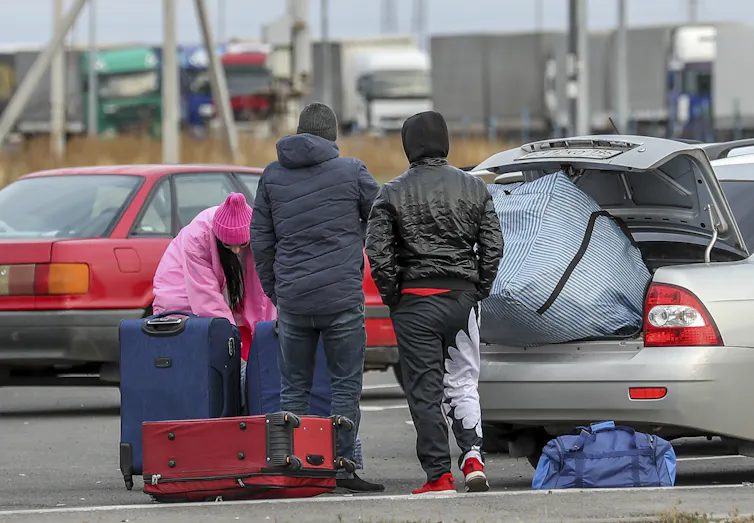
Three Russians handle their luggage at the Russia-Kazakhstan border.
Russians handle their luggage at the Russia-Kazakhstan border in the Chelyabinsk region as they prepare to leave the country in 2022.
Pavel Tabarchuk / EPA

Meanwhile, anti-LGBTQ+ laws introduced in December 2022 have prohibited any perceived propaganda about non-traditional relationships in Russia. This was followed by a Russian supreme court decision in 2023 to designate the “international LGBT movement” as an extremist organisation. This ruling has made any association or support for LGBTQ+ communities a criminal offence.

In response to this clampdown, exiled Russians have stood in solidarity with LGBTQ+ compatriots inside the country who have faced discrimination. My research has uncovered cases of people providing shelter and safe routes out of the country, creating digital safe spaces for Russian LGBTQ+ communities and lobbying for the protection of these communities in European countries.

Russian resistance

Russians do not fall into a single, neat, complicit mass. Since the start of the war, a diverse resistance movement has worked to counter the Kremlin’s authoritarian practices and propaganda. It reflects a broader variety of voices, values and stances than is currently possible in Russia, offering a crucial insight into the future political aspirations and hopes of ordinary Russians.

Advertisement

This movement will not overthrow the Russian government. But the ability to deliver regime change should not be the only measure of resistance. The movement is challenging the narrative that all Russians support the war, while also helping keep democratic political ideas alive for Russians inside the country for when change becomes possible.

As one of my respondents told me: “We have to stay in touch with supporters in Russia and plan for transition. There will be no time to strategise, so the plan has to happen now. We try to do as much as possible to be prepared.”

The resistance of exiled Russian dissidents matters not just for understanding Russia today. It also tells us how opposition survives in authoritarian regimes more broadly, highlighting the role that diasporas can play in sustaining democratic civil society transnationally.

Dissent does not disappear when it is crushed at home. It relocates, adapts and reconfigures across borders.

Advertisement

Source link

Continue Reading

NewsBeat

‘Falklands tell Trump to back off’ and ‘Harry does a Diana’

Published

on

'Falklands tell Trump to back off' and 'Harry does a Diana'
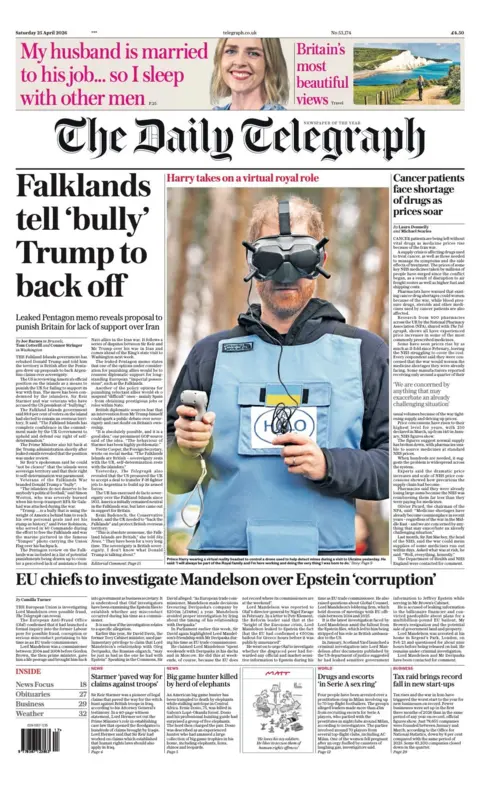
The headline on the front page of the Telegraph reads: “Falklands tell 'bully' Trump to back off”.

Many of the papers lead on a leaked Pentagon memo, originally reported by Reuters, which suggests the US has drawn up proposals to back Argentine sovereignty of the Falkland Islands. The Telegraph says the US review of their position is a means to “punish the UK for failing to support its war with Iran”, and notes it has been condemned by Prime Minister Sir Keir Starmer, war veterans and residents of the islands. The paper adds that the memo outlined several options for “punishing reluctant allies”, including suspending “difficult” ones such as Spain from “prestigious” jobs.

Source link

Continue Reading

NewsBeat

Peter Kay Bolton tickets sell out in record time today

Published

on

Peter Kay returns to Albert Halls in Bolton after 23 years

The comedian will perform four special hometown shows in July 2026, his first at the venue in more than 20 years, with proceeds supporting Bolton Hospice.

However, despite the rapid sell-out, some fans seemed to have problems with the ticketing system when sales opened at 10am via Quay Tickets.

Tickets were only available to those with a BL postcode.

One told The Bolton News: “My postcode is BL but it kept rejecting it, not sure why.

Advertisement

“I knew it would be hard to get tickets so it would have been good to get them but maybe next time.”

Some users reported that the issue appeared to be resolved shortly after tickets went live.

A fan said: “The system updated about 10 minutes after 10am and then accepted my postcode in upper case, I managed to secure a ticket.”

Quay Tickets said the event sold out quickly and that no formal complaints had been raised.

Advertisement

A spokesperson said: “No one has got in touch with any issues about this morning’s Peter Kay onsale, which sold out in around 30 minutes.

“But if any customer faced issues booking tickets, we would advise them to email the customer care team, who will look into it and respond directly.

“The email address is info@quaytickets.com.”

The shows will take place at the Albert Halls on Thursday, July 9; Friday, July 10; and Saturday, July 11, with both afternoon and evening performances on the Saturday.

Advertisement

Tickets started from £48, including booking fees, and were strictly limited to residents with a BL postcode, with billing addresses required to match.

Poster (Image: Agency)

Speaking ahead of the shows, Peter Kay said: “I can’t believe it’s 23 years since my Albert Halls shows, so I reckon it’s about time I came back. I’m really looking forward to it.”

He added that the performances are a thank you to Bolton and will support “an amazing charity” in Bolton Hospice.

Chair of Bolton Hospice, Judith Bromley, said the shows would make “a huge difference” to local people who rely on its services.

Advertisement

Source link

Continue Reading

NewsBeat

US military strike on alleged drug boat kills 2 in eastern Pacific

Published

on

US military strike on alleged drug boat kills 2 in eastern Pacific

The U.S. military said it launched another strike Friday on a boat accused of ferrying drugs in the eastern Pacific Ocean, killing two people.

The Trump administration’s campaign of blowing up alleged drug-trafficking vessels in Latin American waters has persisted since early September and killed at least 183 people in total. Other strikes have taken place in the Caribbean Sea.

The military has not provided evidence that any of the vessels were carrying drugs.

The attacks began as the U.S. built up its largest military presence in the region in generations and came months ahead of the raid in January that captured then-Venezuelan President Nicolás Maduro. He was brought to New York to face drug trafficking charges and has pleaded not guilty.

Advertisement

In the latest attack Friday, U.S. Southern Command repeated previous statements by saying it had targeted the alleged drug traffickers along known smuggling routes. It posted a video on X showing a boat floating in the water before a explosion left it in flames.

President Donald Trump has said the U.S. is in “armed conflict” with cartels in Latin America and has justified the attacks as a necessary escalation to stem the flow of drugs into the United States.

Critics, meanwhile, have questioned the overall legality of the boat strikes.

Source link

Advertisement
Continue Reading

NewsBeat

Chelsea FC vs Leeds: FA Cup prediction, kick-off time, TV, live stream, team news, h2h results, odds

Published

on

Chelsea FC vs Leeds: FA Cup prediction, kick-off time, TV, live stream, team news, h2h results, odds

Calum McFarlane will return to the dugout as crisis-stricken Chelsea face Leeds in the FA Cup semi-final this weekend.

Source link

Continue Reading

NewsBeat

Chef shares how to make the crispiest bacon in 6 minutes without frying pan or any mess

Published

on

Wales Online

A chef has shared his favourite method to cook bacon – and it’s not in a frying pan.

Bacon is cherished by many for its flavour, texture and adaptability. Not only is it amongst people’s favourite breakfast items, but it’s equally delicious in sandwiches, burgers, sprinkled over salads, or combined with vegetables for that wonderfully salty, crispy texture. That said, there’s debate over the optimal way to cook bacon.

Advertisement

As someone who dislikes frying bacon in a pan, Chef David Chang appeared on the Anyday YouTube channel to demonstrate how he prepares “the crispiest bacon” using a quicker technique.

He explained, “This fast and easy method will save you time and cleanup while still giving you perfectly crispy bacon every time.

“Say goodbye to greasy stovetop messes and hello to deliciously crispy bacon in no time. This is a game-changer for all bacon lovers.”

While it might seem unusual, David revealed he favours microwaving bacon as it’s speedier and safer than pan-frying, reports the Mirror.

Advertisement

Nevertheless, he pointed out several factors to consider when microwaving bacon: the thickness, the quantity being cooked and how the rashers are arranged.

The thicker and greater the amount of bacon you’re preparing, the longer the microwave time required, and ensure the bacon doesn’t overlap so it cooks uniformly.

David chooses streaky bacon and arranges the rashers in a microwaveable container with a lid that allows steam to escape.

While the majority of microwave bacon cooking guidance suggests using kitchen paper, the chef observed that he doesn’t usually employ it, as he maintains that having bacon fat, which he describes as “liquid gold”, available is a “very important tool in your kitchen”. He pointed out that it can be utilised in numerous other dishes.

Advertisement

For those opting for kitchen paper, place the bacon on it and add additional sheets to absorb the fat as it cooks and to avoid splatters inside the microwave.

He prepares the bacon in the microwave for approximately six minutes before removing the rashers and allowing them to rest.

David explained, “Whenever you cook bacon, and you want it to get crispy, you want to let it rest.”

Following the six-minute microwave cooking of the bacon, both with and without kitchen paper, the chef discovered it achieved the crispiest result with kitchen paper, as the fat is soaked up.

Advertisement

For the kitchen paper bacon, the chef suggests adding it to a BLT, while for the bacon prepared without kitchen paper that retains some flexibility, he advises it is best served with eggs or a cheeseburger.

Source link

Continue Reading

NewsBeat

London teacher to run marathon just 10 weeks after heart surgery

Published

on

London teacher to run marathon just 10 weeks after heart surgery

“For me, this marathon is a new chapter,” Mrs Martin said. “Running with a newly healed heart is my way of honouring Olive and showing my students, and myself, that even after immense grief, you can find strength and joy. It’s a reminder that life keeps going and I’m ready to see how much further I can go.”

Source link

Continue Reading

NewsBeat

Georgia wildfires have destroyed 120 homes, forcing evacuations

Published

on

Georgia wildfires have destroyed 120 homes, forcing evacuations

NAHUNTA, Ga. (AP) — A volunteer firefighter died battling a wildfire in northern Florida while more than 120 homes have been destroyed in southeast Georgia and thousands more remain threatened by two large blazes, one of which investigators suspect was sparked by a foil balloon touching power lines, officials said Friday.

An unusually large number of wildfires are burning this spring across the Southeast, where scientists say the threat of fire has been amplified by a combination of extreme drought, gusty winds, climate change and dead trees still littering some forests after being toppled by Hurricane Helene in 2024.

In northern Florida, the Nassau County Sheriff’s Office said Friday that volunteer firefighter James “Kevin” Crews suffered an unspecified medical emergency while suppressing a brush fire. Crews was rushed to a hospital where he died Thursday evening, according to a news release posted to social media.

“Kevin was the epitome of courage and dedication,” Hilliard Volunteer Fire Chief Jerry Johnson said in a statement. “His sacrifice will never be forgotten.”

Advertisement

‘No way to stop this fire’ without soaking rain

After getting a firsthand look at firefighting efforts in southeast Georgia, Gov. Brian Kemp told reporters that state officials believe 87 homes burned in rural Brantley County this week are the most destroyed by a single wildfire in the state’s history.

An additional 35 homes have been lost to a larger fire burning in sparsely populated Clinch and Echols counties near the Florida state line, Kemp said. That blaze has burned about 50 square miles (129 square kilometers), an area twice the size of Manhattan.

Kemp said officials suspect the Brantley County was sparked by a foil party balloon that touched live power lines, creating an electrical arc that ignited the ground. He said investigators suspect the larger fire started with a man welding a gate outside.

Spread across nearly 12 square miles (31 square kilometers) and still growing, the Brantley County blaze was 15% contained Friday, the Georgia Forestry Commission said. An estimated 4,000 homes in the county were under evacuation orders Friday, said commission spokesperson Seth Hawkins.

Advertisement

“There’s no way to stop this fire,” Kemp said. “They’re having to contain the flanks and the back of it and then, hopefully, we get a change in the weather.”

Fire crews and truck assemble at the Brantley County Airport as they work the Brantley highway 82 fire, Thursday, April 23, 2026, near Nahunta, Ga. (AP Photo/Mike Stewart)

Fire crews and truck assemble at the Brantley County Airport as they work the Brantley highway 82 fire, Thursday, April 23, 2026, near Nahunta, Ga. (AP Photo/Mike Stewart)

Advertisement

A fire burns as the Brantley Highway 82 fire burns, Thursday, April 23, 2026, near Nahunta, Ga. (AP Photo/Mike Stewart)

A fire burns as the Brantley Highway 82 fire burns, Thursday, April 23, 2026, near Nahunta, Ga. (AP Photo/Mike Stewart)

Advertisement

No fire deaths or injuries have been reported in Georgia.

Advertisement

Firefighters are battling more than 150 other wildfires in Georgia and Florida that have sent smoky haze into places far from the flames, triggering air quality warnings for some cities.

‘We’ve lost everything, but I’m one of the lucky ones’

Michael Gibson was at his job Thursday at a chicken feed producer when his fiancee called urging him to come home. By the time he arrived, firefighters were already on the road where Gibson, his fiancee and their four children lived. He said he took his family to safety and tried to return to salvage belongings, but police stopped him.

Advertisement

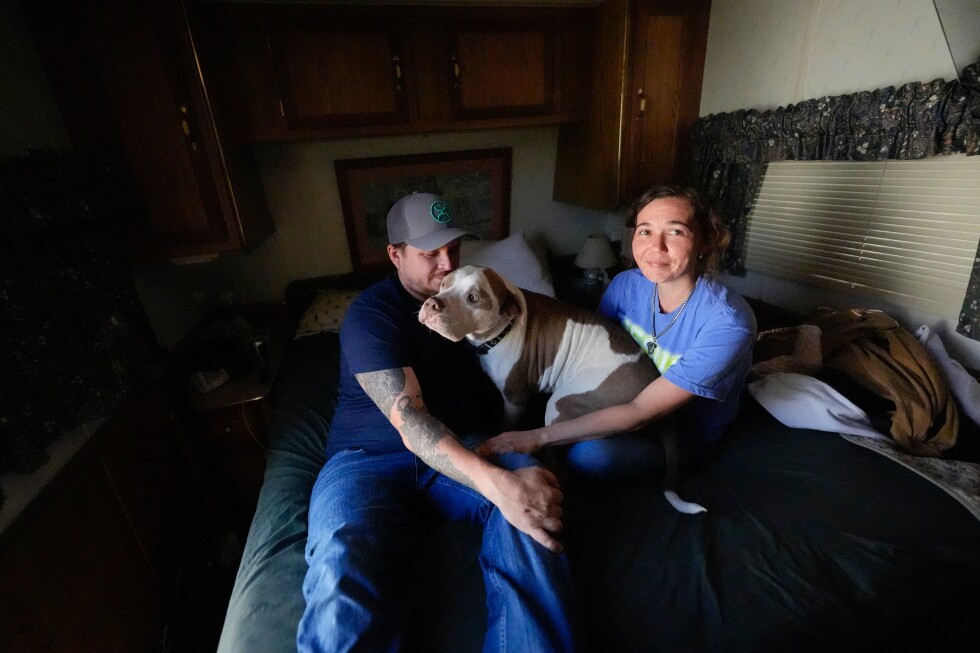
Gibson said the fire consumed his mobile home and one beside it where his fiancee’s brother lived. His family has been staying in a camper on a relative’s property.

Advertisement

“We’ve lost everything, but I’m one of the lucky ones.” Gibson said Friday. “We’ve been prepared to leave. And I’m truly blessed to have my family and to have somewhere to sleep. … A lot of people in my county didn’t make it out with the clothes on their backs.”

Jennifer Murphy said she had little time to react when firefighters knocked at her door in the Brantley County community of Hortense.

She said she barely had a chance to gather her dog, Chip, and a single bag of belongings before firefighters urgently helped her walk down her wheelchair ramp and grab a rolling walker from her van outside.

“It was like, ‘Get out now, right now. You’ve got to leave,’” Murphy said Friday at the local church where she had spent the night on a couch.

Advertisement

Firefighters are hosing down homes, trying to limit destruction

While crews with bulldozers work to clear fire breaks around the burning areas, firefighters from dozens of local agencies have focused on protecting nearby homes and other structures — clearing away dry brush and using hoses and sprinklers to keep houses and yards wet.

“We’ve definitely had the local fire guys out there literally hosing stuff down,” said Hawkins of the forestry commission.

In Florida, firefighters were battling more than 120 wildfires Friday, mostly in the state’s northern half. Fire crews in Georgia responded to 31 new and relatively small blazes Thursday, the state forestry commission said.

Officials say soaking rain is badly needed to snuff out the large fires, and that possible showers forecast this weekend won’t bring enough rainfall. There’s also a chance of thunderstorms, raising concerns that lightning could spark more fires.

Advertisement

“It is going to take 8 to 10 inches before we can walk away from these fires,” said Johnny Sabo, director of the Georgia Forestry Commission.

He said long-range forecasts predict less than average rainfall until July.

___

Bynum reported from Savannah, Georgia. Associated Press journalist Jeff Amy contributed from Atlanta

Advertisement

Source link

Advertisement
Continue Reading

NewsBeat

Ukrainians thought they had reduced the risks at Chernobyl. Then Russia invaded

Published

on

Ukrainians thought they had reduced the risks at Chernobyl. Then Russia invaded

The two explosions at the Chernobyl nuclear power plant came decades apart in the dead of night.

The first, at 1:23 a.m. on April 26, 1986, spread a cloud of deadly radiation that raised fears across Europe and shook the very foundations of the Soviet Union. Some say it led to its eventual collapse.

The second, at 1:59 a.m. on Feb. 14, 2025, was blamed by Ukrainian officials on a Russian drone with an explosive warhead. While not as catastrophic, it sparked new anxieties about Moscow’s invasion of its neighbor, striking the site that symbolized so much suffering for Ukraine.

“What once seemed unthinkable — strikes on nuclear facilities and other hazardous sites — has now become reality,” said Oleh Solonenko, head of a radiation safety shift at Chernobyl, which Ukrainians transliterate as Chornobyl.

Advertisement

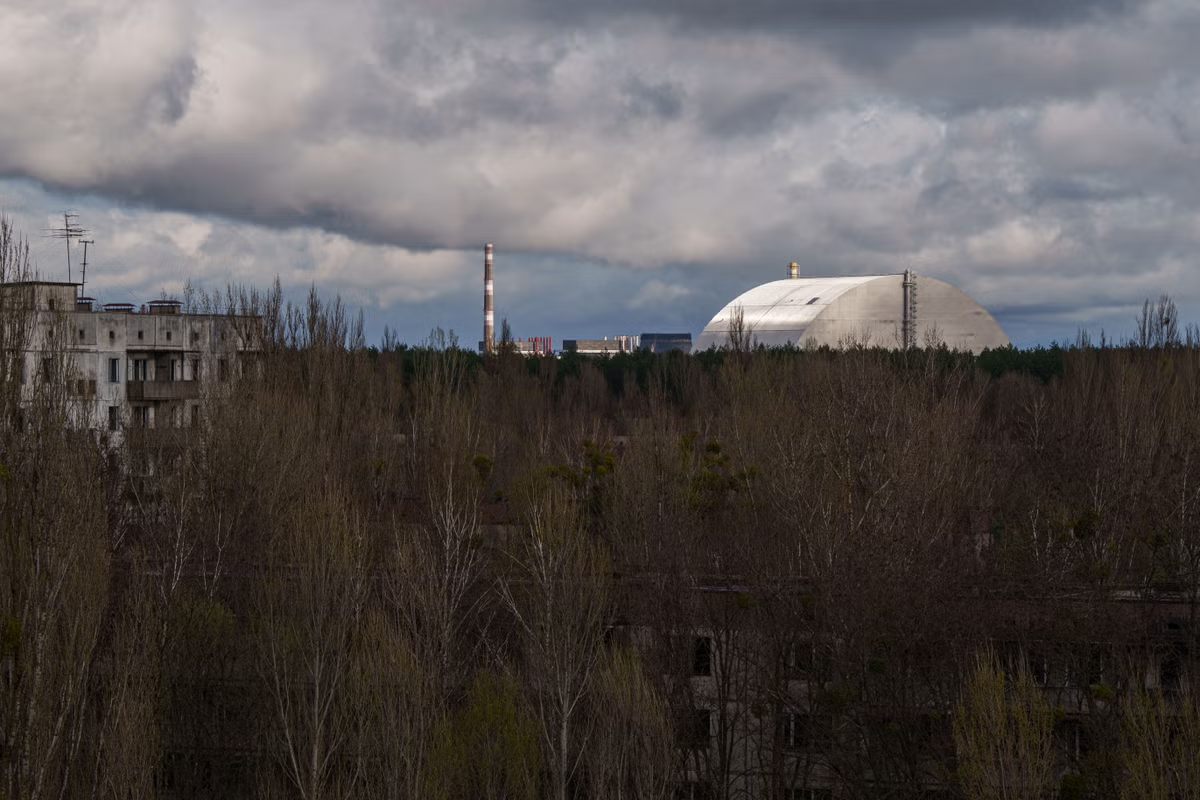
The drone hit the outer layer of what is known as the New Safe Confinement structure, or NSC, the vast, $2.1 billion archlike shell that was completed in 2019 to enclose the original, hastily built concrete “sarcophagus” to keep the damaged Reactor No. 4 and its deadly debris from leaking radiation. Moscow denied targeting the plant, alleging Kyiv staged the attack.

It sparked a fire on the structure — which is tall enough to cover the Statue of Liberty — but did not penetrate it, damaging an area with low contamination. Monitors detected no rise in radiation levels outside the arch, and no one was injured.

Still, the International Atomic Energy Agency warned that the damage could significantly shorten the arch’s 100-year lifespan, upending its core safety function.

For Klavdiia Omelchenko, who works with over 2,200 engineers, scientists and others at the defunct plant, it rekindled memories of a horrible spring day 40 years ago.

Advertisement

A lifetime near Chernobyl

Omelchenko was a 19-year-old textile factory worker in 1986, asleep in her home in Pripyat, where most of Chernobyl’s workers lived. She didn’t hear the explosion at Reactor No. 4 during a routine test.

She woke to rumors of an accident, but only understood its scale weeks later — after being evacuated with a small bag holding her documents and some cosmetics. Her former home was now inside Chernobyl’s “exclusion zone,” a 2,600-square-kilometer (1,000-square-mile) area that remains uninhabited.

Soviet authorities did not immediately reveal the scope of what became known as the world’s worst nuclear disaster, which spewed a cloud of radiation over what is now Ukraine and Belarus, and caused alarm across Europe. Dozens of people died in the immediate aftermath, while the long-term death toll from radiation is unknown.

Advertisement

Omelchenko never found another home and came back in 1993 to work in the plant’s cafeteria. That return “wasn’t as scary as now. Back then, at least, there was no bombing,” she added.

To her, the full-scale invasion in 2022 and last year’s drone attack are more fearful than radiation.

She said she got headaches after the 1986 accident and later had surgery for a precancerous condition, but at age 59, she dismisses the risk of contamination.

“We grew up in it,” she said. “We don’t pay attention to it anymore.”

Advertisement

Covering the sarcophagus

Yellow daffodils bloom beside wartime fortifications at the Chernobyl plant as workers in ordinary clothes, with badges and special permits, pass through the restricted zone.

It has not produced electricity since 2000, when the last of four reactors was shut down. A global effort built the protective NSC — a landmark project designed to stabilize the site and enable the dismantling of the crumbling Soviet-era sarcophagus covering the reactor.

But Russia’s invasion has put that project on hold.

Advertisement

Liudmyla Kozak, an engineer who has worked at Chernobyl for over two decades, was on duty when Russian troops seized the plant in February 2022. The staff kept operations running under armed guard for nearly three weeks, exposing personnel to radiation doses well beyond the limits of their normal rotation schedules.

“We had no hope we would make it out alive — it was really that scary,” she said.

Kozak said workers slept on floors and desks, with Russian soldiers occupying key areas. Equipment was damaged and stolen, she added. The troops also drove heavy vehicles through contaminated areas and dug trenches, stirring up radioactive dust.

“With the drone strike as well, it will be much more complicated,” Kozak said.

Advertisement

The IAEA found the damage has left the arch unable to fully perform its core functions, which is containing radioactive material and enabling the safe dismantling of the reactor remains. Left unrepaired, the structure would gradually weaken, increasing radiation exposure risks to Ukraine and other countries.

Dismantling work on hold

Serhii Bokov, who oversees operations for the NSC, said he was on duty early on Feb. 14, 2025, when the dull blast from the drone rippled through the structure.

He and his colleagues ran outside, smelling smoke, but initially saw nothing. A nearby military checkpoint confirmed a strike, and firefighters arrived about 40 minutes later.

Advertisement

Climbing up into the structure, they finally found fire smoldering through the outer membrane. Hoses were stretched across the arch as crews battled flames that kept resurfacing. The fire took more than two weeks to extinguish fully.

“There was no feeling of fear, none at all. It was just a fire — something we practice in drills — only this time it was real,” he said. “I didn’t think, honestly, that we could lose the entire arch.”

The damage is patched and hidden on the inside, while a sealed breach is visible on the outside.

Every night, Bokov walks more than a kilometer (about 1,100 yards) through the structure via what workers call the “golden corridor” — a passageway lined with yellow panels shielding them from radiation. It passes abandoned control rooms, including that of Reactor No. 4.

Advertisement

When the NSC was completed in 2019, he was proud of being part of something extraordinary, watching it rise and take shape, and being a member of the team keeping it running.

Now, however, the structure is no longer fully sealed. While there is no immediate radiation risk, work on dismantling the sarcophagus is on hold — set back, Bokov believes, by at least a decade.

“Everything depends on how quickly we can restore this and return to normal operations — and to preparing for dismantling,” he said.

Bokov believes the arch can continue functioning in its current state for some time. But the real concern is the stability of the sarcophagus beneath it — and why it’s urgent to resume its dismantling.

Advertisement

Oleh Solonenko, head of a radiation safety shift at the plant, said the drone damaged the outer layer of the protective NSC but did not fully penetrate it. The damage occurred in an area with low contamination, with no rise in radiation detected beyond the arch.

Still, the incident showed how the war has upended assumptions about nuclear safety, he said.

Without urgent repairs, the risk of the sarcophagus collapsing significantly increases, Greenpeace Ukraine warned in a report by engineer Eric Schmieman, who spent years at Chernobyl and helped design the NSC.

“It is difficult to comprehend the scale of the deadly, hazardous conditions inside the sarcophagus,” he said. “There are tons of highly radioactive nuclear fuel, dust and debris. Now it is critical to find a way to restore the key functions of this facility.”

Advertisement

___

AP reporters Vasilisa Stepanenko and Volodymyr Yurchuk in Kyiv contributed.

___

The Associated Press receives support for nuclear security coverage from the Outrider Foundation. The AP is solely responsible for all content. ___ Additional AP coverage of the nuclear landscape: https://apnews.com/projects/the-new-nuclear-landscape/

Advertisement

Source link

Continue Reading

Trending

Copyright © 2025