


Connect with us
DAPA Banner

NewsBeat

All-nighters in Congress create dysfunction after dark

Published

on

All-nighters in Congress create dysfunction after dark

WASHINGTON (AP) — Just as the Senate prepared to launch into a late-night vote series, Republican Sen. John Kennedy of Louisiana went to the floor to vent.

Frustrated and seemingly exhausted Wednesday, Kennedy said he wanted more time to debate his amendments to a budget resolution to fund immigration enforcement agencies. But he had another complaint.

“Frankly I am worried about the health of some of our members,” Kennedy said as 9 p.m. approached. “Not that they’re in bad health, but it’s hard to stay up all night.”

More than 6 hours later, just past 3:30 a.m., senators wrapped up another marathon voting session on amendments and filed out of the chamber, dazed, tired and resigned to soon doing it all again.

Advertisement

It’s a complaint as old as the Congress, with leaders in both major political parties often turning to the torturous grind of an overnight session to exhaust members, overcome objections and push legislation to passage. But it’s a scenario that is playing out again and again, nearly business as usual, as the House and the Senate fracture and careen from one crisis to the next.

Lawmakers say it’s a symptom of a broken Congress that leaders are increasingly forced to govern in the dead of night.

“The dysfunction is getting worse,” said Republican Sen. Kevin Cramer of North Dakota, who has been in Congress for 14 years. Lawmakers have become “less mature,” he said, as a growing number act only in their own self-interest and hold up bills or delay proceedings.

“It’s not a healthy lifestyle,” Cramer said, for the country or the lawmakers. “There’s less concern for the team effort.”

Advertisement

Late-night fights have become the norm

In the last few weeks, Congress has repeatedly debated pressing national issues at night — leading to confusion and turmoil in both chambers.

Much of the drama has centered, as it increasingly does, on government funding.

In late March, Senate Republicans struck a deal with Democrats to reopen most of the Department of Homeland Security, including the Transportation Security Administration, while Democrats continued to block money for Immigration and Customs Enforcement and Border Patrol after the shootings of two protesters in Minneapolis. It was a breakthrough, and Majority Leader John Thune, R-S.D., passed the spending bill by voice vote — meaning there were no objections on either side — just past 2 a.m.

Senators then flew home for a two-week recess, leaving final passage to the House. But House lawmakers who were asleep when the final Senate agreement was announced woke up and angrily rejected it, saying they wouldn’t pass legislation that didn’t include funding for the immigration enforcement agencies. Senators were then forced to figure out a new plan for reopening the department, and it remains unresolved.

Advertisement

An equally contentious matter, the renewal of surveillance powers for federal spy agencies, also devolved into an after-hours affair.

House GOP leaders kept members in session well past midnight last week while trying and ultimately failing to pass different versions of a foreign surveillance bill. Scrambling to pass an extension of the law ahead of a Monday deadline, leaders eventually cobbled together a 10-day extension past 2 a.m.

Advertisement

Members of both parties were exasperated by the last-minute mayhem.

“Who the hell is running this place?” said Rep. Jim McGovern, D-Mass. He said Republicans threw the bill together “on the back of a napkin in the back room in the middle of the night.”

“Just about everyone agrees that this is serious stuff, the kind of debate that Congress ought to have in the open,” McGovern said.

Tennessee Rep. Andy Ogles, a Republican and member of the House Freedom Caucus who opposed the leadership bills, said the outcome was predictable.

Advertisement

“We warned them that this was gonna happen,” Ogles said. “Unfortunately, here we are at 2 in the morning.”

Time-consuming partisan bills push Senate into late nights

The late-night vote series in the Senate this week was part of an arcane, complicated process called budget reconciliation that GOP leaders are using to try to fund the two immigration enforcement agencies that Democrats continue to block. It’s become the default mode of governing for majorities in Congress as bipartisanship on major issues fades away.

Reconciliation allows the Senate majority to bypass the filibuster and pass budget-related bills along party lines. First, though, they have to get through two lengthy series of votes — and that’s where the dreaded “vote-a-rama” comes in.

The process is open-ended, which means lawmakers in both parties can offer as many amendments as they want to put the other side on record — or, as Republican Sen. Lisa Murkowski of Alaska describes it, “to make each other miserable.”

Advertisement

Leaders generally hold the votes in the middle of the night, as they did Wednesday into Thursday, in hopes of exhausting both sides and forcing senators to stay on the floor and vote quickly. But instead of waiting around between amendment votes, Murkowski walked back and forth between the chamber and her “hideaway,” a small office each senator has in the Capitol building.

“I’m at 14,291 steps,” she said just after 11 p.m., looking at her smartwatch, which was also telling her that her bedtime was approaching. She said if she couldn’t sleep, she might as well get more exercise.

Senators went through the same reconciliation process last year, in extremes, as they labored for weeks to pass President Donald Trump’s package of spending and tax cuts, which he dubbed One Big Beautiful Bill.

The bill had barely enough Republican support to pass, and the Senate and the House held nearly back-to-back all-night sessions to pass it by Trump’s July 4 deadline. In the Senate, GOP leaders kept the long vote series open for hours on end as they worked to win support from Murkowski and others.

Advertisement

“It’s insane,” Murkowski said of the late nights. “My mom always said, ‘Nothing good happens after midnight.’”

Overnights are not new but become more common

Overnight votes are certainly nothing new in Congress. The Affordable Care Act, President Barack Obama’s signature health care law, passed the Senate in the early hours of Christmas Eve in 2009 after weeks of negotiations, just in time for senators to get home for the holidays. Countless other big bills have been passed in the dead of night, as well.

But lawmakers say the after-dark routine has gotten worse and more frequent.

“Part of what’s changed here is there’s a lot of heavy lifting that you have to do to get a bill passed,” said Democratic Sen. Ron Wyden of Oregon, who has served in Congress since 1981, when he was elected to the House. “I think at some point you’ve got to have a forcing mechanism, and one of the easiest is to stay up until the wee hours so that everybody is basically trying not to fall asleep on national TV.”

Advertisement

Democratic Sen. Andy Kim of New Jersey, a relative newcomer to the Senate elected in 2024, said there’s an eventual question of whether anyone is watching.

In the middle of the night, he said: “Are the American people paying attention? How do we get the message out?”

Still, he said, it’s important that lawmakers get their work done at any hour, especially when there is a war going on with Iran and lawmakers take long stretches away from Washington.

“I don’t mind being here,” Kim said.

Advertisement

Source link

Advertisement
Continue Reading
Click to comment

You must be logged in to post a comment Login

Leave a Reply

NewsBeat

Guy Martin of BBC and Channel 4 banned from driving

Published

on

Guy Martin of BBC and Channel 4 banned from driving

Guy Martin, who is also a world class motorcycle racer, was seen in Yorkshire earlier this year when he headlined The Speed Show at Elvington Airfield on Saturday and Sunday, February 22 and 23.

The 44-year-old presenter was caught twice speeding on his Honda motorbike, including on the A43 near Brackley, near Bicester, Oxfordshire, travelling at 78mph while a temporary 50mph limit was in place.

Guy MartinGuy Martin at Elvington raceway, near York (Image: Agency)

Via a letter from his lawyers, Isle of Man TT racer also admitted riding his bike at 46mph on the A50 near Leicester when the limit was 40mph.

Court papers show Martin, who was born in Grimsby, reached at least 12 penalty points on his licence and he accepted that he must now serve a six-month driving ban.

Advertisement

The TV presenter achieved 17 podium finishes at the Isle of Man TT race during his career as a motorbike racer, and he has become known for his pursuit of speed records.

Guy Martin

In 2016 he made a bid to break the two-wheeled world land speed record, and he succeeded in setting world records for the fastest tractor, speediest soapbox, and fastest speed on a gravity-powered snow sled.

“He apologises to the court for his offending,” a partner at law firm Chattertons wrote on Martin’s behalf.

Guy MartinGuy Martin is famous for his racing exploits (Image: Agency)

“As a consequence of being convicted of the two offences, Mr Martin will fall to be totted up.

Advertisement

“He will not be opposing the totting up six-month disqualification.”

An official said Martin was sentenced at Loughborough Magistrates’ Court last week in private, with an order to pay a total of £1,329 in fines, costs and victim surcharges.

Raised around engines, Martin developed an early fascination with mechanics and trucks, later training as a truck fitter and working in the trade as well as racing. His father was also a racer and mechanic, which helped shape his interest in speed, machines and hands-on engineering.

Martin’s career was marked by both success and serious crashes. He broke his back twice in racing accidents, once at the TT in 2010 and again at the Ulster Grand Prix in 2015, yet he remained a popular figure in British motorsport. He retired from professional motorcycle racing in July 2017.

Advertisement

Beyond racing, he became a well-known television personality and author, admired for his down-to-earth style and enthusiasm for engineering, history and practical skills

Source link

Advertisement
Continue Reading

NewsBeat

Woman with ‘UK’s biggest boobs’ won’t cover up cleavage because it ‘offends people’

Published

on

Daily Mirror

Summer Robert, 28, thinks she has the biggest boobs in the UK. They’re so large that she struggles to cover them up, but she refuses to hide them just because they “offend people”

Some people like the idea of having large breasts, but one woman’s are so big that she struggles to fit on a plane these days. Summer Robert, 28, has previously confessed she’s proud to possess what she says are the “biggest boobs in the UK”; however, she’s tired of people asking her to “cover them up.”

Advertisement

Recently, she’s admitted people can criticise her simply for having big boobs. As she struggles to find clothes that fit, sometimes her cleavage can become visible, but she refuses to cover it up simply because it seems to “offend” people in ways that she can’t get her head around.

Perhaps this is because she can’t help how big they get. Earlier this year Summer, from Glasgow, explained just why her breasts will never stop growing.

Summer, who has over 200,000 followers on Instagram, said: “More often than not they’ll say to my face to cover up, tell me I don’t have the body for the clothes I’m wearing. Some will call me an attention seeker. I get a lot of disgusted looks from women mainly.

“⁠I just wish people could live my life for one day so they would understand. If I could get clothes that fit me, don’t you think I would wear that?

Advertisement

“I don’t think I should be punished for wanting to wear clothes that suit my age and style just because it shows a bit more cleavage than most. I can’t help it.”

Summer noted she’s often called out in the street simply for having big boobs. One time she claims she even had a drink thrown over her as her boobs, which now measure a size 30R, caused so much controversy.

Advertisement

“At the time, getting a drink thrown over me was super frustrating,” she added. “I definitely have cried over it and gotten angry but, after accepting faith into my life fully now when stuff like this happens, I just think of how sad it must be that women are so insecure over a young girl just trying to live her life.

“I don’t let it affect me too much anymore and feel empathy for them.” Though it has taken time, Summer has grown to love her body, though she still has to contend with passing comments from strangers.

Despite this, it won’t stop her from being herself and wearing the clothes that she wants to wear. Time and experience has allowed her confidence to grow, and now she won’t let anyone tell her what she can and can’t do.

Summer explained: “I used to let it affect me a lot more but, since accepting my body and realising that I can monopolise from it, it just makes me laugh. Obviously, if I’m in situations where I feel unsafe it affects me a lot more but the women aspect of it, I just feel sorry for them.

Advertisement

“They’ll be at home miserable and insecure whilst I’m on a plane flying somewhere hot.”

When asked what message she’d like to send to people who treat her in such a negative way, she added: “Look in the mirror, see one thing that you are insecure about and think ‘if someone judged me for this one thing that I can’t change, how would I feel?’

“Because that is exactly what you’re doing to me.” Little do they realise, Summer also has to face a lot of difficulties due to her breasts too.

The former restaurant manager has always had big boobs and they are only going to get bigger. She has a condition called Macromastia, which is the medical term for having abnormally large breasts, and it can lead to various complications like chronic back, neck and shoulder pain, headaches, bra strap grooving and difficulty carrying out daily activities.

Advertisement

However, in recent years, she turned to making saucy content in a bid to boost her confidence. Now she thinks it’s “amazing” that she manages to make money as a result of something that people can complain to her about so often.

Summer said: “⁠I love that people’s bitterness just makes me richer.”

Source link

Advertisement
Continue Reading

NewsBeat

Arsenal vs Lyon: Why Chloe Kelly is not an automatic starter before Champions League semi-final

Published

on

Chloe Kelly slides on her knees in celebration while wearing Arsenal's red and white kit and a red headband

For England, yes, but not for Arsenal.

In 14 appearances off the bench for her club, she has managed just one goal and two assists.

Team-mate Stina Blackstenius, an even more perennial substitute, dwarfs Kelly’s impact as a substitute. She’s come off the bench 24 times since Kelly’s debut and scored six times.

Indeed, Blackstenius’ 15 goals as a substitute in the WSL and Champions League for Arsenal since 2022-23 is almost double the return of any other player in that period – and she scored the winner in the European final last season.

Advertisement

If boss Renee Slegers is looking at her bench for a match-winner, Blackstenius tops the list.

Instead, the numbers suggest Kelly is far more effective for Arsenal when she starts, with 87.5% of her goals coming when she’s begun the game on the pitch.

Only fellow Lionesses Alessia Russo and Beth Mead, plus Mariona Caldentey, have more goal involvements for Arsenal since Kelly joined.

Source link

Advertisement
Continue Reading

NewsBeat

Sensational Nelly Korda leaves field trailing in her wake at Chevron Championship

Published

on

Sensational Nelly Korda leaves field trailing in her wake at Chevron Championship

Nelly Korda is playing with so much control even her misses are right where she’s aiming. She birdied her last two holes on Friday with exquisite irons shots for another 7-under 65, giving her a daunting six-shot lead going into the weekend at The Chevron Championship.

Korda has made only one bogey through 36 holes at Memorial Park, missing a 3-foot putt on the sixth hole after a nifty chip from below the green.

Otherwise, the two-time major champion has been practically flawless in reaching 14-under 130 that makes her appear to be playing a different course.

“I’m comfortable with my game,” Korda said. “I think where I’m the most comfortable is definitely with my mindset of knowing when I mess up I’ll figure it out. Sometimes I think you get stuck in wanting to play well and wanting to be at the top always that you have this tension of not wanting to make a mistake.

Advertisement

“I think there is a power in knowing it’s OK to make a mistake and just bounce back.”

Patty Tavatanakit had another bogey-free round with a 69. Another shot behind were Ina Yoon (68), Ryan O’Toole (68) and Texas junior Farah O’Keefe (69), one of five amateurs to make the cut.

O’Keefe didn’t get her invitation to The Chevron until after the Augusta National Women’s Amateur three weeks ago, and she’s making the most of it. She played bogey-free in the second round, though she only managed one birdie on the par 5s.

But her scrambling saved her, and the 20-year-old didn’t seem all that fazed by Korda on the verge of running away with this major.

Advertisement
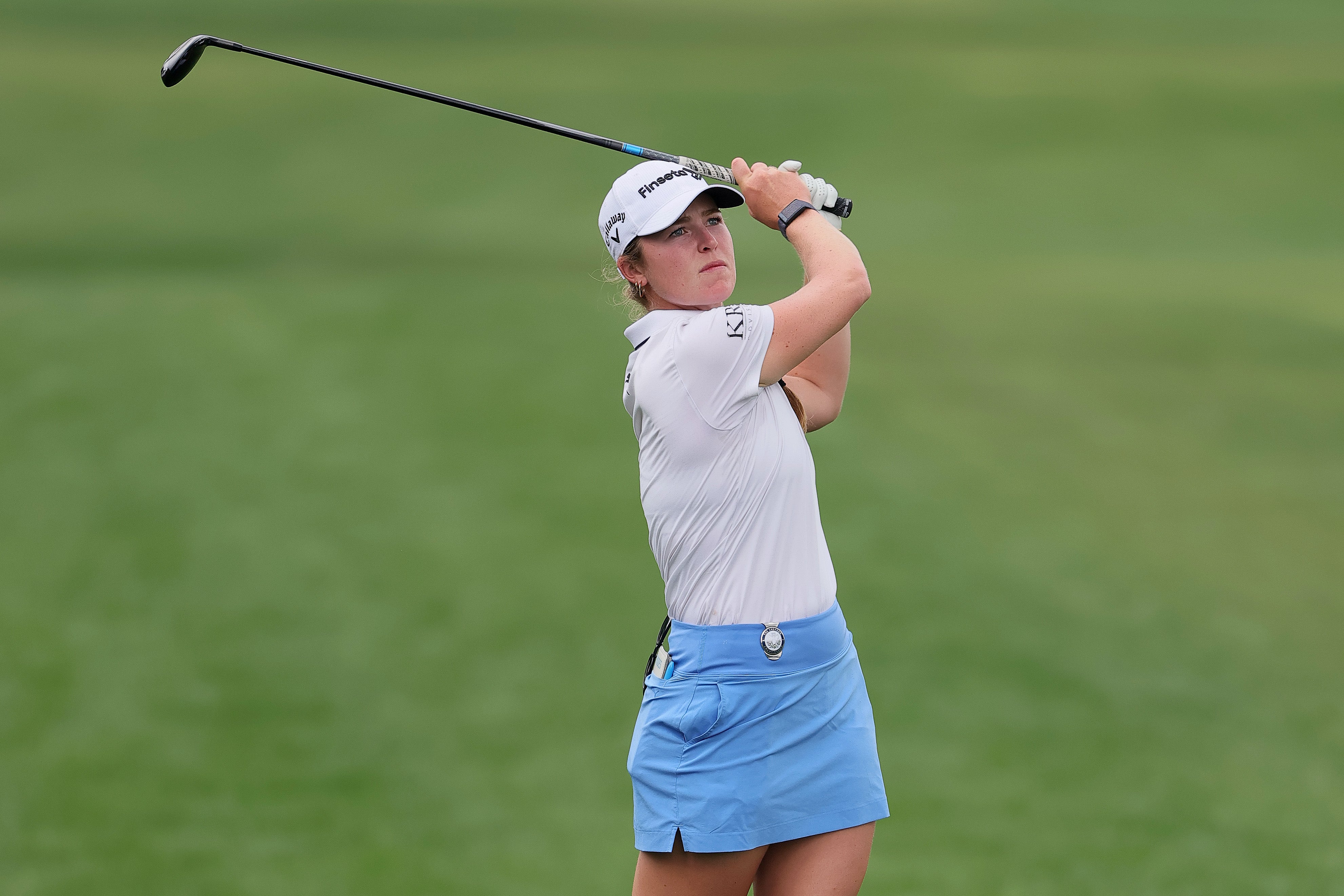
Nelly Korda was in excellent touch at Memorial Park
Nelly Korda was in excellent touch at Memorial Park (Getty)

“I compared it to Rory (McIlroy) at the Masters. You never know what can happen in golf,” O’Keefe said, referring to McIlroy losing a six-shot lead on the weekend at the Masters before going on to win for the second straight time.

“There is so much random out there that you can get a bad break and it’s just kind of that thing,” she said. “My dad and I called it that golf is a staring contest and all you have to do is not blink first. So I’m just trying not to blink. Just trying to keep playing my game, and whatever that ends up at the end of the week is where it ends up.”

Korda, however, has hit her stride again. She won the season opener in a weather-shortened event, and has played in the final group in all four of her tournaments.

She looks calm and poised, and there is power.

Korda began her great closing stretch with a 3-wood into the wind from 221 yards that landed in the perfect spot to roll out 15 feet beyond the hole, leaving an eagle putt that grazed the right edge of the cup.

Advertisement

She missed an 8-foot birdie chance on the par-5 16th, and then finished with a flourish — a 7-iron that danced around the cup and settle 10 feet away for birdie, and then a 9-iron that again scared the hole and left her 4 feet for her 15 birdie in 36 holes.

Mimi Rhodes struggled on Friday and missed the cut
Mimi Rhodes struggled on Friday and missed the cut (Getty)

It was the lowest 36-hole score in her career in the majors, and the third-best 36-hole score in LPGA majors behind Jeongeun Lee6 (127), Brooke Henderson (128) and In Gee Chun (129), all at the Evian Championship, the tournament in France the LPGA chose to designate as a major in 2013.

There was disappointment for England’s Mimi Rhodes, though, shooting a six-over round of 78 to miss the cut. Compatriots Charley Hull (-2) and Lottie Woad (+1) did make the weekend.

AP

Source link

Advertisement
Continue Reading

NewsBeat

can our brains get full?

Published

on

can our brains get full?

My husband was recently describing something that happened on a past holiday. It wasn’t a significant event, but it sounded pleasant. I, however, had no recollection of what he was telling me. He couldn’t quite believe it.

We know that “recollections may differ”, but how can it be so different? And why do I not have this memory? I’m busy at work – have I simply run out of space?

It’s a tempting explanation. We talk about “full heads”, “information overload”, and “too much to take in” as though the brain were a container that eventually reaches capacity. But the brain does not fill up. Instead, it filters.

At any given moment, far more information is available to us than we could ever realistically store. The sights, sounds and conversations of even a single day would overwhelm any system that attempted to record them in full. Instead, the brain relies on selection. Attention determines what is noticed. Emotion helps determine what matters. Then, structures such as the hippocampus decide what is worth committing to longer-term memory.

Advertisement

If your attention is elsewhere, the process falters at the first step.

On that holiday, my husband may have paused long enough to register the moment. I may have been thinking about where we were going next, checking timings, or simply moving through the day without stopping to take it in. The difference is subtle, but it matters. Without focused attention, experiences are only weakly encoded, if at all. In that sense, the memory was not lost. It was never fully formed.

Even when memories are successfully encoded, they are not stored as fixed records. Each time we recall an event, we reconstruct it, drawing on fragments of sensory detail, prior knowledge and expectation. With repetition – through conversation, reflection or retelling – those reconstructions become stronger and more coherent. Over time, they can feel increasingly vivid and certain.

This helps explain why shared experiences can diverge so dramatically. We assume that living through the same moment should produce the same memory, but the brain does not work that way. It does not passively record experience. It actively selects, prioritises and, just as importantly, discards.

Advertisement

The feeling that our brains are “full” arises not because we have run out of storage, but because we have reached the limits of what we can process at once. Attention is finite. Working memory – the small amount of information we can actively hold in mind – is even more limited. When these systems are saturated, new information struggles to gain a foothold. This is the mental equivalent of too many tabs open: nothing has been permanently lost, but everything becomes harder to manage.

Where the computer analogy breaks down

Computing analogies are useful up to a point. If working memory resembles RAM – fast, temporary, limited – then long-term memory is often compared to a hard drive. But this is where the parallel breaks down. A hard drive stores files in fixed locations, retrievable in exactly the same form in which they were saved. The brain does not work this way.

Memories are not stored as discrete files. They are distributed across networks of neurons, overlapping, reshaped, and reassembled each time they are recalled. New experiences do not simply add to what is already there – they interact with it, altering both the new and the old.

Working memory is a bit like RAM.
Lushchikov Valeriy/Shutterstock.com

Attempts have been made to estimate how much the brain could theoretically hold. One widely cited figure from the Salk Institute puts it at around a petabyte – roughly equivalent to hundreds of years of continuous video. It is an impressive number, but also a somewhat misleading one. It implies a storage system that fills up over time, when in reality the brain is constantly reorganising itself. Capacity is not fixed, and information is not stored in isolation. It is integrated, modified, and, when no longer useful, allowed to fade.

Advertisement

Which raises a slightly uncomfortable question: what happens to the memories we would like to keep?

Some of them will fade – not because the brain has run out of space, but because they are not continually reinforced. Memory is not preserved simply because it matters to us. It is preserved when it is revisited, retold, or reconnected to other experiences. Without that reinforcement, even meaningful moments can become harder to access over time.

What is lost, in most cases, is not the memory itself but our ability to retrieve it. A familiar smell, a piece of music, or an unexpected detail can bring something back that seemed entirely gone. The trace remains, but it has slipped out of reach. And the absence of a memory is rarely evidence of a system at capacity – more often, it is the trace of a moment that was never fully stored, or one that has simply not been called upon.

Advertisement

Source link

Continue Reading

NewsBeat

Meet the men leading the anti-looksmaxxing trends online

Published

on

Meet the men leading the anti-looksmaxxing trends online

Though this may seem like something of an internet niche, young men are paying attention. Almost two-thirds of boys and men aged 16-25 in the UK, US, and Australia regularly watch and read masculinity influencer content, research from the men’s mental health charity Movember shows. Some of the most popular UK-based masculinity influencers boast millions of followers online.

Source link

Continue Reading

NewsBeat

Man airlifted to hospital after serious A6055 crash

Published

on

Man in his 20s in serious condition after aircraft crash

The crash involved a grey Audi Q2, a red Land Rover Discovery and a silver Ford Fiesta, all of which were travelling south down the A6055, near Pickhill – west of Thirsk – at 10.40am on Friday (April 24).

The driver of the Audi, the man in his 70s, was taken to hospital by air ambulance, police said.

The road remains closed to motorists.

Advertisement

Recommended reading:


A force spokesperson added: “The driver of the Land Rover, a 22-year-old man, was arrested at the scene on suspicion of causing serious injury by careless driving.

“Two other casualties from the Fiesta and Audi were taken to hospital with minor injuries.

“We are keen to speak to anyone who witnessed the collision, or saw the vehicles involved prior to the collision.

Advertisement

“In particular, we believe that the occupants of a vehicle which was travelling north may have witnessed the collision and stopped at the scene but left prior to police arriving.

“This vehicle is not believed to have caused or contributed to the collision in any way, and the occupants may have important information which could help our enquiries.

“Anyone who can assist the investigation is asked to contact TC 556 Michael Mcvay, by calling North Yorkshire Police on 101, or emailing michael.mcvay@northyorkshire.police.uk – please quote reference 12260073606.”

Advertisement

Source link

Continue Reading

NewsBeat

Meg Jones: Red Roses captain on skippering England and representing Wales

Published

on

Meg Jones on the attack for England against Scotland

Back in Cardiff, that link is deep, real and reciprocated.

“Even though she’s wearing the red rose, which obviously is not something that is normally celebrated much in Wales, everybody here is Meg’s biggest supporter,” says Harries.

“What we all really admire about Meg is the fact that she’s chosen her own path, but she hasn’t forgotten her roots.

“It’d be very easy to be all in now with England and leave that side of it. But she’s always willing to do any interviews in Welsh and celebrate her Welshness. She’s very, very proud of where she came from.

Advertisement

“And that’s massive for the pupils here, for them to see that you can chase your dreams, but never forget where you’ve come from.

“Never forget your roots, and be proud of that, and be proud of who you are, and celebrate that you’ve got those different sides to you.

“She’s a real inspiration to everybody, whether you’re a rugby fan or not, whether you’re Welsh or whether you’re English, it doesn’t matter.

“She’s just a real true role model in every essence of the word.”

Advertisement

Jones regularly returns to her old school, doing coaching sessions, presenting awards and inspiring the next generation.

While there was no girls school rugby team for Jones to represent during her time at Glantaf, now there are several.

One of those who plays is another Meg Jones.

Megan Jones, the current Glantaf pupil, represented Wales in last month’s under-18 Six Nations festival, lining up against England in the centres., external

Advertisement

Jones senior has helped nurture her younger namesake, putting on a one-on-one kicking session on a visit to Glantaf. On another occasion she presented young Meg with a pair of her boots, prompting the pupil to dissolve into tears of joy.

Harries has taken photos of the two Meg Joneses together through the years in the hope that one day the two will complete the montage by posing together after facing each other at senior level.

Source link

Advertisement
Continue Reading

NewsBeat

Castle Car Park update ahead of Clifford’s Tower scheme

Published

on

Castle Car Park update ahead of Clifford's Tower scheme

Castle Car Park, in Tower Street, was scheduled to close this spring to make way for the redevelopment of the area below Clifford’s Tower.

City of York Council city development lead Garry Taylor said it would be closed following improvements to the neighbouring Coppergate Multi-Storey Car Park and contractors for the works were currently being appointed.

It follows the approval in December of the Castle and Eye of York scheme which is set to see the area below Clifford’s Tower turned into a park and play space.


RECOMMENDED READING:

Advertisement

The 298-space Castle Car Park is set to be closed to make way for the redevelopment, though 30 Blue Badge spaces will be retained.

An area dubbed The Castle Gardens is planned and it is set to include The Swathe seasonal planting space representing the moat which was once at York Castle.

It is set to see Castle Car Park grassed over and trees planted and water and power supplies installed so community events can be held.

The historic entrance to the York Castle complex is set to be marked by Castlegate Garden and a radial walkway is planned around the base of Clifford’s Tower.

Advertisement

A memorial to up to 150 Jews who died at Clifford’s Tower in a massacre in 1190 is also planned.

The project is set to cost an estimated £9.934m, including £200,000-worth of improvements to Coppergate Multi-Storey Car Park.

Castle Car Park, in Tower Street, York (Image: LDRS)

Coppergate is currently under-used for much of the year, according to a council report on the redevelopment.

Improvements floated by council officials include opening the multi-storey for 24 hours a day to make up for the loss of the Castle site.

Advertisement

CCTV and cosmetic improvements are also planned.

The council is yet to give a date for Castle Car Park’s closure or say when works on the redevelopment around Clifford’s Tower will start.

Director of City Development Mr Taylor said officials would continue to share updates about the scheme as the start of construction moves closer.

The director told the Local Democracy Reporting Service (LDRS): “We are continuing to progress our exciting plans to transform the area around Clifford’s Tower.

Advertisement

“We are currently in the process of appointing contractors who will shape the construction programme.

“A part of this work will include making improvements to Coppergate Multi-Storey Car Park to improve its function and attractiveness for users

“Our intention is to only close Castle Car Park after these improvements to Coppergate Car Park have been made.

“Castle Gateway will dramatically improve this area, with high quality public spaces, a place for children and families to play, spaces to reflect and much more.”

Advertisement

Source link

Continue Reading

NewsBeat

Fear new homes will result in ‘long term harm’ to roads, local services and community

Published

on

Cambridgeshire Live

The plans are being considered by South Cambridgeshire District Council

Plans to build up to 75 new homes in Linton have faced backlash from people living near to the proposed development site. Neighbours have shared concerns about the “long-term harm” the new homes could have on “road safety, local services, and the existing community”.

Advertisement

The homes are proposed to be built on land off Back Road in Linton. Of the 75 homes, 30 are proposed to be made available as affordable housing and 45 to be put on the market. Gladman Developments Ltd said its proposals would create an “attractive, welcoming and walkable new residential development” with a “strong sense of place that is well integrated within its surrounding landscape”.

The design statement says: “At its heart, the scheme will promote health and well-being through the provision of accessible green public space , new play opportunities, and provision for community food growing; ensuring a vibrant and enduring new community.”

The outline planning application submitted to South Cambridgeshire District Council aims to provide a choice of housing to meet the needs of the area, while “respecting and enhancing” the site’s environmental assets.

Plans for the new homes has seen local backlash, with several objections lodged so far. One objector said Back Road can “barely sustain the amount of traffic as it is”, so more cars using that road could “cause chaos”.

Advertisement

A similar objection was raised by another local who said the site is “entirely unsupported by adequate infrastructure” which could “result in long-term harm to road safety, local services, and the existing community”.

Concerns were also raised about the negative impacts on local services such as the GP practice which locals believe will potentially be “stretched beyond capacity” due to the additional demand generated by this development.

Another objection saw apprehensions regarding the site’s close proximity to the River Granta and how Linton “can’t cope with the extra houses, people or cars”.

Source link

Advertisement
Continue Reading

Trending

Copyright © 2025