
Crypto World
Bitcoin 2026 Conference Divides Its Community



The Bitcoin 2026 Conference drew more than 40,000 attendees to The Venetian Resort in Las Vegas from April 27 to 29, but the institutional-heavy speaker lineup sparked a sharp backlash from early adopters who accused the event of abandoning its cypherpunk origins for corporate suits and regulators.
Summary
- Speakers included Strategy’s Michael Saylor, BlackRock’s Robert Mitchnick, SEC Chair Paul Atkins, and Senator Cynthia Lummis, a lineup critics said reflects a fundamental shift away from Bitcoin’s decentralized roots.
- Early Bitcoin investor Simon Dixon publicly called the conference “compromised,” arguing that code is open source and that marketing ETFs and corporate treasury products reverses Bitcoin’s founding promise of individual sovereignty.
- Bitcoin climbed to above $79,000 on April 27 amid ETF inflows and conference optimism but retreated to the $76,700 to $77,500 range by Tuesday as macro pressure from Iran talks returned.
The Bitcoin 2026 Conference at The Venetian Resort exposed a widening tension that has been building since institutional adoption began reshaping who holds Bitcoin. The ad-hoc-news.de reported that while the event’s speaker list reads like a roll call of institutional power, early Bitcoin adopters were voicing sharp criticism on the conference floor, arguing that an event built around regulator appearances, corporate treasury panels, and ETF product showcases has abandoned the counterculture ethos that built Bitcoin as a tool to route around exactly those institutions.
Bitcoin 2026 Brings Wall Street and Cypherpunks Into the Same Room but Not the Same Vision
As crypto.news reported, the event had surpassed 30,000 registered attendees before opening and welcomed more than 40,000 across the three days with over 500 speakers on multiple stages. The institutional footprint was impossible to miss. SEC Chair Paul Atkins used the conference to unveil Project Crypto, a Commission-wide initiative to modernize securities rules for digital assets and establish a new token taxonomy classifying most digital assets as non-securities. Acting Attorney General Todd Blanche and FBI Director Kash Patel appeared in a fireside chat titled “Code is Free Speech: Ending the War on Bitcoin,” framing Bitcoin development as protected speech and signaling reduced enforcement pressure. Simon Dixon, an early Bitcoin investor and inaugural conference speaker, was less celebratory. “Let’s face it, this Bitcoin conference is compromised. Bitcoin is open source code. It’s a big mistake not to understand the difference,” he posted on the eve of the event. His specific criticism was that marketing custody products, ETFs, and corporate treasury strategies to Bitcoiners promotes tools that undermine the individual sovereignty the protocol was built to deliver.
The Structural Shift Behind the Culture War
The tension is not purely aesthetic. Bitcoin ETFs now collectively hold more than one million coins, and more Bitcoin is held through ETFs, corporate treasuries, and custodial platforms than directly by individuals using self-custody wallets. That shift in ownership structure is the underlying argument: when the majority of Bitcoin is held in regulated wrappers rather than self-custody, the network’s resistance to institutional control changes in practice even if the protocol itself remains unchanged. As crypto.news documented, the “Code and Country” policy forum was designed explicitly to facilitate direct engagement between Bitcoin builders and US policymakers, a framing some early adopters read as Bitcoin asking permission from the system it was built to bypass. Crypto ETFs saw $1.2 billion in inflows the week of the conference, the fourth consecutive positive week, with Bitcoin leading at $933 million and BlackRock’s IBIT alone drawing $732.6 million.
What Was Actually Decided at the Conference
Beyond the cultural debate, the Bitcoin 2026 Conference produced several substantive developments. Lummis announced that the CLARITY Act markup will happen in May. MARA Holdings announced the MARA Foundation focused on quantum resistance and network stewardship. Paul Atkins outlined a new regulatory framework that separates digital securities from digital commodities. As crypto.news tracked, the quantum threat to Bitcoin’s cryptography was serious enough to warrant its own dedicated conference panel, following the April 2026 release of BIP 361, a three-phase proposal to migrate Bitcoin toward quantum-resistant outputs that would ultimately freeze unmigrated coins. Bitcoin reached $79,000 on the conference’s opening day before retreating as Iran ceasefire uncertainty pushed oil back above $104, illustrating that the macro environment driving the institutional demand story the conference celebrated is also the same macro environment that can reverse that demand within hours.
BTC Inc., the organizer behind the Bitcoin Conference, has not publicly responded to the criticism from Dixon and other early adopters, and the conference’s programmatic direction suggests it views institutional legitimacy as the path forward regardless of internal dissent.



BNB price held above $625 on April 28 as the broader crypto market declined, with Bitcoin down 1.6% and Ethereum at a week low, making BNB one of the few large-cap assets to hold its ground during a day driven by stalled Iran ceasefire negotiations and rising oil prices.
Summary
- BNB price fought to hold above $625 on April 28 as the total crypto market cap shed over $30 billion, with most large-cap assets in the red.
- Binance executed its 35th quarterly auto-burn on April 15, permanently removing 2.14 million BNB worth approximately $1.32 billion from circulation, leaving the total supply below 135 million tokens.
- The first US-listed 2x leveraged BNB ETF, XBNB from Teucrium, launched on April 25, adding a new institutional access layer to BNB’s market structure ahead of the April 28 session.
BNB price was fighting to stay above $625 on April 28 as CryptoPotato reported that most large-cap crypto assets were in the red, with Ethereum below $2,300, XRP below $1.40, and BTC stalling below $77,000. The total crypto market cap shed over $30 billion on the day, but BNB’s relative resilience placed it among the better performers in the top ten by market cap, continuing a pattern of outperformance that has characterized BNB against major altcoins for several weeks.
BNB Price Holds as Market Digests Iran Talks and FOMC Pressure
As crypto.news reported, the April 28 decline was driven primarily by renewed Iran ceasefire uncertainty and a return of Brent crude above $104 a barrel, compressing risk appetite across crypto, equities, and emerging market assets simultaneously. BNB’s relative stability compared to Ethereum and Bitcoin reflects its different demand driver profile: while BTC and ETH price action on April 28 was dominated by macro risk-off flows, BNB’s price is structurally tied to Binance exchange revenue, BNB Chain transaction volume, and the deflationary supply dynamics created by its quarterly auto-burn mechanism. Those internal demand drivers did not deteriorate on April 28, insulating BNB partially from the macro-driven selling that hit assets with less embedded utility demand.
Why the April 15 Burn and XBNB Launch Frame the Current Price Range
The April 28 session takes place less than two weeks after Binance’s 35th quarterly auto-burn on April 15, which removed 2.14 million BNB worth approximately $1.32 billion in what Binance described as one of its largest single quarterly deflationary events. As crypto.news documented, that burn reduced total BNB supply below 135 million tokens, continuing the protocol’s trajectory toward its 100 million hard cap, and analysts at InvestingHaven and Coinpedia separately cited the burn’s deflationary impact as a catalyst for the price range of $590 to $900 they project for BNB in 2026. The launch of Teucrium’s XBNB on April 25, the first US-listed 2x daily leveraged BNB futures ETF, adds a new institutional access layer but also introduces potential amplified selling pressure during market-wide drawdowns, which may partly explain BNB’s tight range on April 28 rather than a sharper fall or a significant gain.
What the BNB Chain Ecosystem Adds to the Price Stability Case
BNB’s performance relative to other altcoins on down days reflects structural demand from within the BNB Chain ecosystem. As crypto.news tracked, BNB Chain has become the leading blockchain for autonomous AI agent deployments, surpassing 150,000 on-chain agents in April 2026, with 43,750% growth since January representing a demand driver that operates independently of macro sentiment. BNB Chain’s 2026 roadmap targets 20,000 transactions per second with sub-second finality, and the network’s 15 million daily transactions and opBNB Layer-2 activity provide a baseline of gas fee burns that continuously remove BNB from circulation. The $628 support level that technical analysts have identified as the critical floor for BNB’s current structure must hold through the FOMC meeting on April 28 and 29 for the bullish scenario targeting $645 to $650 resistance to remain intact.
BNB entered April 28 trading near its 50-day EMA at approximately $625 to $628, in a consolidation range that has held since the April 2 low of $573, representing a roughly 10% recovery that has consistently outpaced Ethereum’s recovery from its own April low.
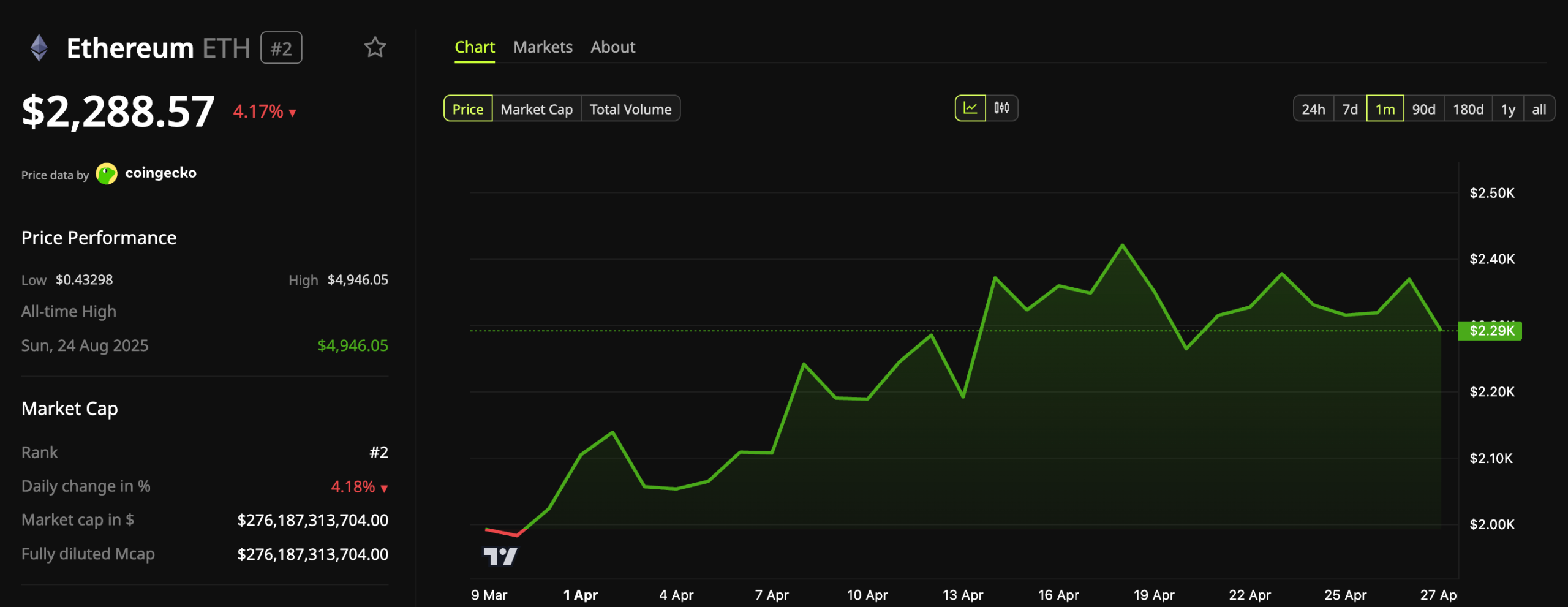
Galaxy Digital moved roughly 45,000 Ethereum (ETH) worth over $100 million into three crypto exchanges. The transfer raises fresh concerns about institutional selling pressure on the second-largest cryptocurrency.
However, on-chain data shows a contrasting picture. Active addresses, exchange reserves, and corporate accumulation point to structural strength.
Behind Galaxy Digital’s 45,000 ETH Move
Lookonchain data showed that two Galaxy Digital wallets deposited 45,000 ETH across Binance, Bybit, and OKX via multiple transfers.
Follow us on X to get the latest news as it happens
Exchange deposits typically signal potential selling pressure. Still, they do not confirm a sale on their own. The transfers may reflect client orders rather than a directional bet.
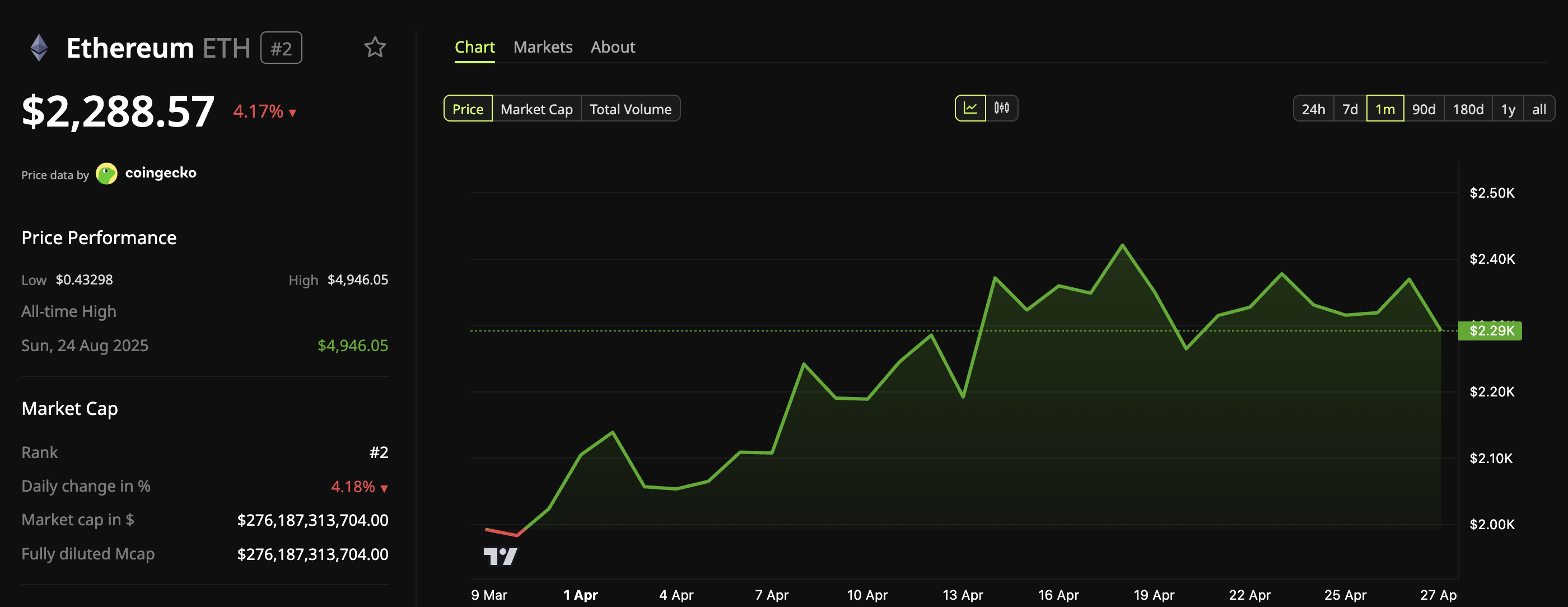
It also comes at a time when Ethereum faces broader market headwinds. The price has declined by 4% over the past day, according to BeInCrypto Markets, which shows ETH trading at $2,288 at press time.
On-Chain Metrics Tell a Different Story
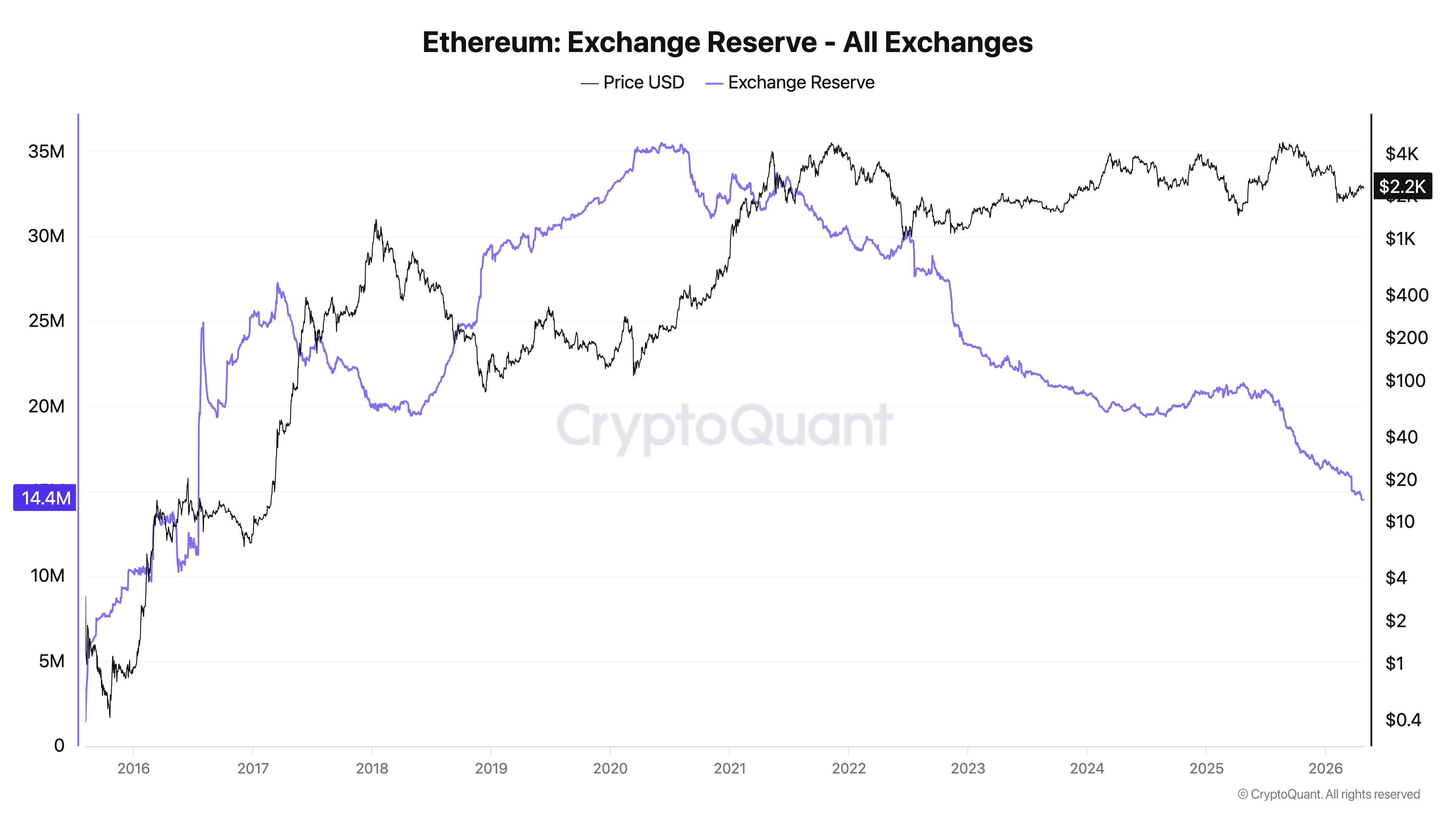
Despite inflows and ETH’s recent price weakness, several indicators are signaling a bullish outlook. CryptoQuant figures place ETH exchange reserves near 14.5 million tokens, the lowest level since 2016. Over 331,000 ETH have been withdrawn from exchanges since April 19, dwarfing the Galaxy inflow.
At the same time, corporate accumulation is also strong. BitMine added 101,901 ETH last week, its largest single-week haul of 2026.
US spot ETH exchange-traded funds (ETFs) have recorded three straight green weeks of inflows, according to SoSoValue. The combination of fund demand and shrinking exchange supply continues to absorb available tokens.
On the network side, an analyst noted a widening disconnect between ETH’s price and network activity. The 100-day moving average of active addresses just printed a record at roughly 587,000.
“The continuous ascent of the active addresses’ SMA 100 is a clear indicator of growing fundamental demand, expanding network adoption, and a highly dynamic ecosystem,” CryptoOnchain wrote. “From an on-chain analysis perspective, this glaring divergence implies that Ethereum may currently be undervalued.”
Beyond Ethereum-specific factors, broader market signals suggest investors are gradually returning to crypto. Binance saw nearly $6 billion in stablecoin inflows across March and April.
At the same time, the Crypto Fear and Greed Index has risen to 47 from 12 just a month earlier, signaling an improvement in market sentiment.
Subscribe to our YouTube channel to watch leaders and journalists provide expert insights
The post Ethereum (ETH) Sell Pressure Concerns Rise, But 4 On-Chain Signals Flash Bullish appeared first on BeInCrypto.

TLDR:
- South Africa’s draft Capital Flow Management Regulations propose approval requirements for all crypto transactions above a set threshold.
- Luno is preparing a formal submission urging the National Treasury to classify locally held crypto assets as onshore assets.
- The draft rules require users to declare all crypto holdings within 30 days of the regulations taking effect in South Africa.
- Luno is collaborating with industry stakeholders to present a unified response aimed at shaping a fair and practical regulatory outcome.
Luno is calling for a fairer regulatory framework as South Africa’s National Treasury reviews its draft Capital Flow Management Regulations.
The proposed rules introduce new controls on crypto asset transactions, including approval requirements and declaration obligations.
Luno, a licensed crypto asset service provider in South Africa, has raised concerns about the practical effects these rules may have on everyday users.
The exchange is preparing a formal submission to the Treasury and is working alongside industry stakeholders to shape a more balanced outcome.
Why Luno Is Pushing Back on the Draft Rules
The draft regulations propose extending exchange control requirements to all crypto asset transactions. This goes beyond the traditional scope of South Africa’s existing capital flow rules. Ordinarily, such controls apply when capital moves across borders, not within the country itself.
Under the current proposal, any transaction to buy, sell, borrow, or lend crypto above a yet-to-be-determined threshold would need National Treasury approval.
This applies even to transactions between two parties located within South Africa. Luno argues that this level of oversight is disproportionate for domestic activity.
LunoGlobal has stated publicly that while it supports modernising the ageing exchange control framework, the current draft poses hurdles for everyday crypto users.
These hurdles, the exchange warns, could slow South Africa’s growth as a global fintech leader. Luno’s concern is that the rules create friction without adequate justification.
The exchange is now collaborating with other crypto industry players to build a collective response. The goal is to ensure that the industry’s voice carries weight in the Treasury’s final decision.
Luno believes a coordinated approach will lead to a more practical and fair outcome for all South African crypto users.
What Luno Wants and How Users Can Participate
At the centre of Luno’s advocacy is a specific classification request. The exchange wants crypto assets held on a licensed local provider to be treated as onshore assets.
This would mean such holdings do not count against offshore investment thresholds like the Single Discretionary Allowance or the Foreign Investment Allowance.
The draft also requires users to declare all crypto holdings within 30 days of the regulations coming into force. Users seeking transaction approval must also state the intended purpose of that transaction.
If the purpose changes, they may be required to sell their crypto assets, adding further complexity to routine activity.
Luno’s formal submission to the National Treasury will advocate for a framework that addresses illicit activity without burdening ordinary users.
The exchange has made clear that compliance and growth should not work against each other. A well-designed framework can achieve both, without unnecessary restrictions.
The public participation phase is currently open, and the Treasury has invited comment from all parties. Members of the public can submit their views by emailing the National Treasury directly.
The full draft regulations are available on the National Treasury’s official website for anyone wishing to review them before submitting comments.


A Manhattan federal judge has denied FTX CEO and co-founder Sam Bankman-Fried’s motion for a new trial, rejecting his claim that there is new evidence.
Judge Lewis Kaplan, who oversaw Bankman-Fried’s trial in 2023 and sentenced him to 25 years in prison in early 2024, wrote in an order on Tuesday that Bankman-Fried’s claim of new evidence and witnesses was baseless.
“This motion appears to be one part of a plan to rescue his reputation that Bankman-Fried hatched and even committed to writing after FTX declared bankruptcy but before he was indicted,” Judge Kaplan wrote.
Bankman-Fried in February had requested a new trial to be overseen by a different judge, making the rare move of filing a motion without consulting his lawyers and while an appeals court was considering his conviction and sentence.
On Wednesday, Bankman-Fried asked to withdraw his request, telling Judge Kaplan he didn’t believe he would “get a fair hearing on this topic in front of you,” which the judge denied.

Sam Bankman-Fried appeared on a podcast in March 2025 while being held at the Metropolitan Detention Center in Brooklyn. Source: YouTube
In his order, Judge Kaplan wrote that Bankman-Fried’s claim that three former FTX executives could counter the government’s arguments that FTX was insolvent was “baseless on multiple independently sufficient levels.”
“None of the witnesses, for example, is ‘newly discovered.’ Bankman-Fried well before trial knew all three of them and purportedly knew also what he hoped they would say were they to testify,” Kaplan wrote.
Bankman-Fried argued that two former FTX executives who didn’t testify — Ryan Salame, the former CEO of FTX’s Bahamian arm and Daniel Chapsky, FTX’s former head of data science — could counter the government’s claims about the exchange’s financial health.
Salame separately pleaded guilty to violating campaign finance laws and operating an illegal money-transmitting business. He was sentenced to seven and a half years in prison in May 2024.
Related: Sam Bankman-Fried ramps up Trump support following Ellison’s release
He also argued that Nishad Singh, FTX’s former engineering lead, who cut a plea deal with prosecutors to avoid jail and testified against Bankman-Fried at trial, changed his testimony “following threats from the government.”
Judge Kaplan said Bankman-Fried could have sought to compel testimony from the trio but didn’t, and his claim that their absence or decision to testify against him was a result of government threats “is wildly conspiratorial and entirely contradicted by the record.”
Bankman-Fried was found guilty on seven criminal charges related to fraud and money laundering, with a jury finding he illegally transferred billions of dollars of FTX customer money to the trading firm Alameda Research to make risky trades that contributed to the exchange’s collapse.
Bankman-Fried is being held in a federal prison in Lompoc, California.
Magazine: How crypto laws changed in 2025 — and how they’ll change in 2026
US AI stocks are heading into a potential breakout window in May 2026. Three of the largest AI-exposed names all report Q1 earnings between May 4 and May 5, and each one carries a distinct technical setup.
One sits at a stretched bull flag with volume divergence underneath. Another is testing a descending channel breakout for the second time. The third is hanging in a relief rally just above its bearish trigger. Together, they define how the AI trade resolves in May.
Advanced Micro Devices (NASDAQ: AMD)
Advanced Micro Devices (AMD) rallied 88.65% since early March, climbing from $187.65 to a peak of $353.93, before pulling back to $314.87 on April 28.
The chart now resembles a bull flag, a continuation pattern where a sharp rally is followed by a tight sideways drift before the next leg up. May’s resolution sets the tone for all key AI stocks to watch, with Q1 2026 earnings due May 5 after market close.
But the volume disagrees with the price. Between February 24 and April 24, AMD trended steadily higher while daily volume stayed flat. That volume divergence signals the rally lacks fresh buying conviction, the kind of fuel needed to defend a stretched price into a high-stakes print. That also explains the start of consolidation.
History shows what happens when AMD prints into weak conviction. The February 4 Q4 2025 earnings were a clean beat. Revenue of $7.66 billion crossed consensus, and Data Center sales hit a record $5.4 billion.
The stock still dropped from $192 within days, a 20% collapse driven by guidance softness and profit-taking after a stretched run.
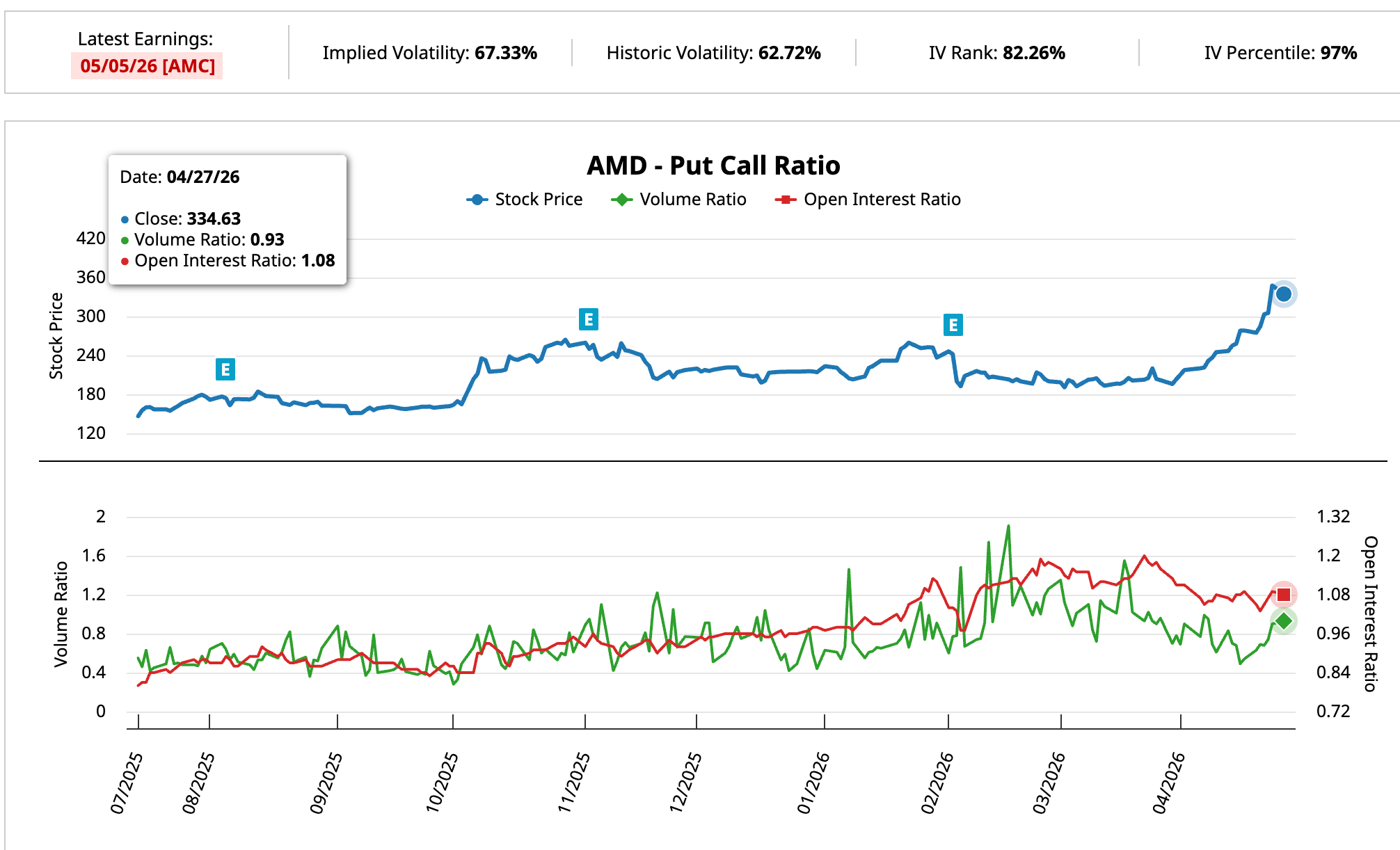
May sets up the same pattern, only louder. AMD now trades higher than the February peak, with put-call open interest over 1 and IV Rank at 82.26%, both signaling that traders expect a violent move.
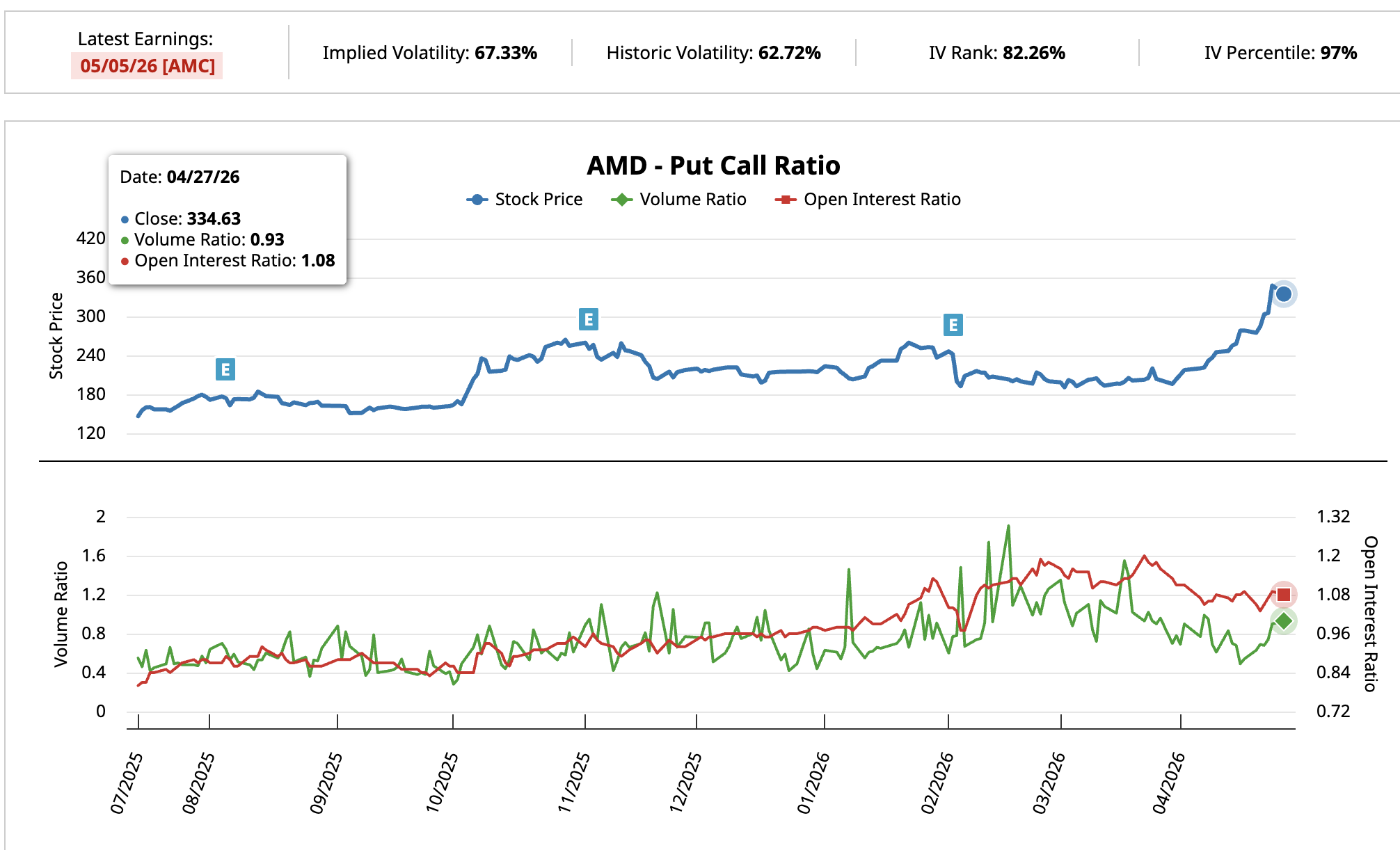
Therefore, a beat alone may not be enough. Holding $314.69 keeps the flag intact.
Want more insights like this? Sign up for Editor Harsh Notariya’s Daily Newsletter here.
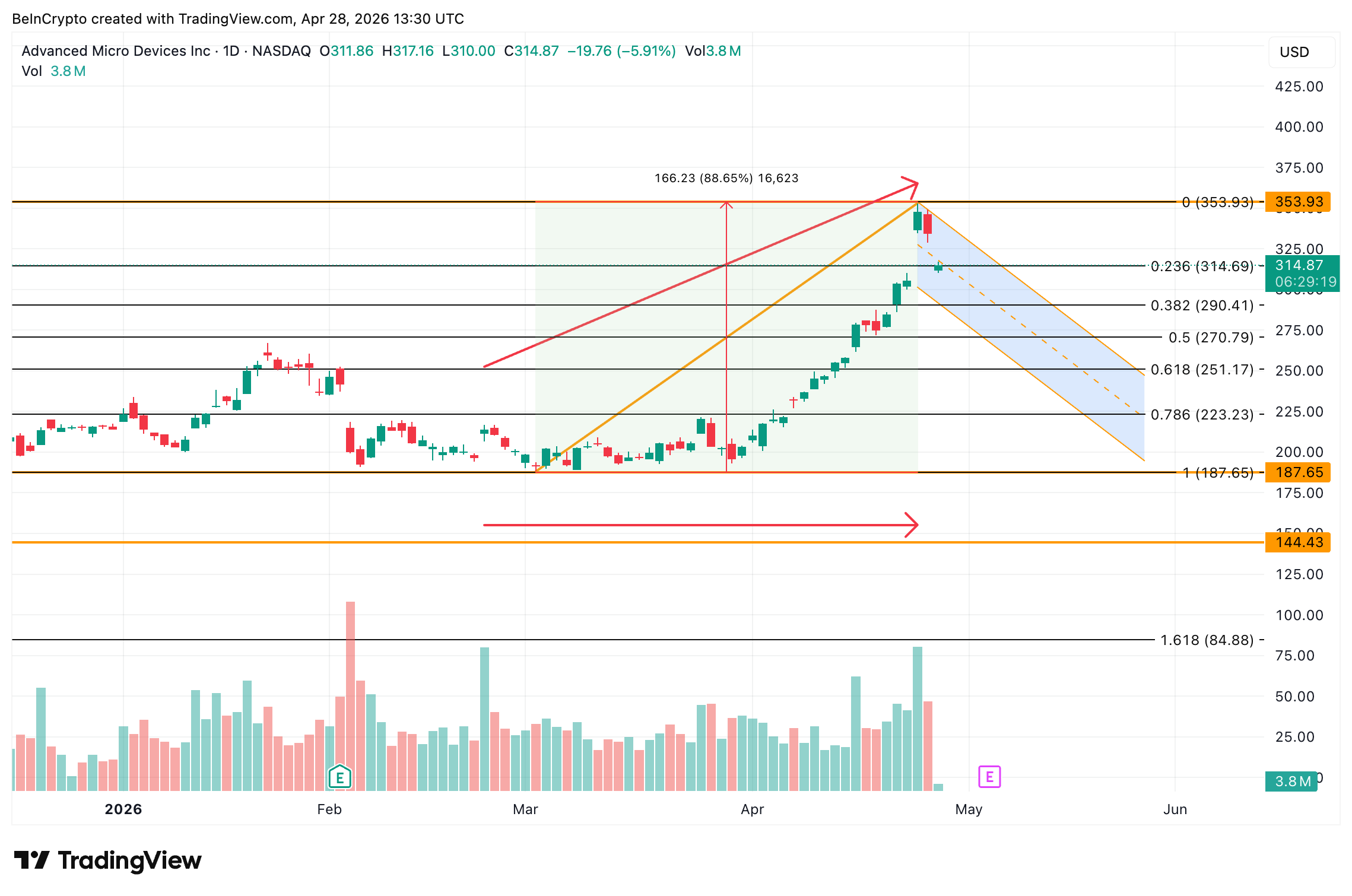
A pullback to $290.41 still allows consolidation. A break under $251.17 invalidates the pattern. A daily close above $353.93 reopens the path to a new high, something that market analysts are looking at.
Palantir Technologies (NASDAQ: PLTR)
Palantir (PLTR) has fallen nearly 25% over the past six months, but the headline isn’t the drop. Since December, the stock has been trading inside a descending channel, a pattern where the price grinds lower between two parallel downward-sloping trendlines. PLTR has tried to break out twice, on March 24 and again on April 22.
Both attempts were near the upper trendline, leaving the stock at $143.20 ahead of Q1 2026 earnings on May 4 after market close.
The setup carries an early reversal signal. Between February 24 and April 10, PLTR carved out a lower low, but the Relative Strength Index (RSI), a momentum gauge measuring price strength on a 0-100 scale, printed a higher low.
That bullish divergence is what powered the rally toward the upper trendline starting April 13.
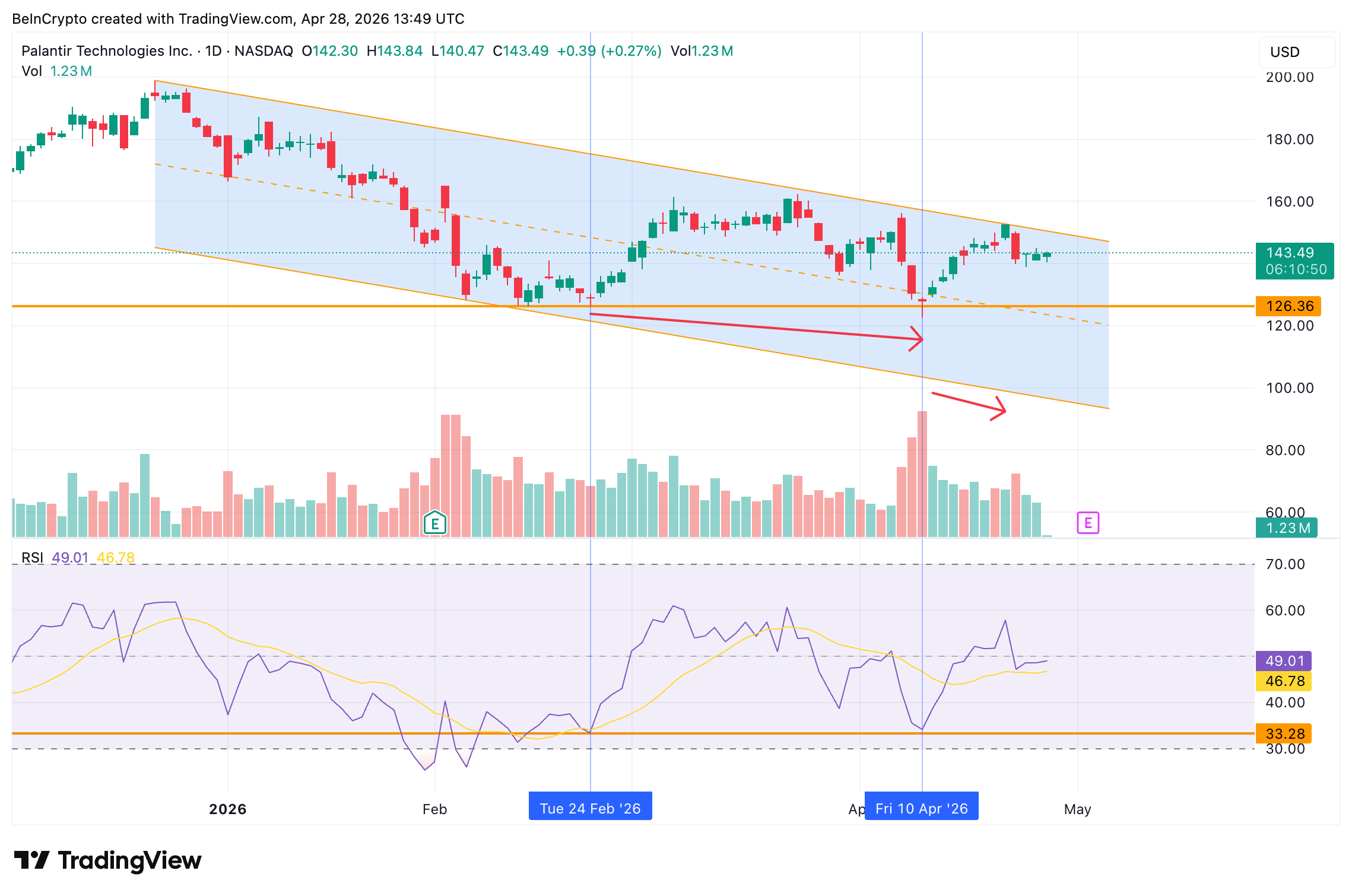
The breakout still failed, and volume explains why. Between April 13 and April 22, the price trended higher while the daily volume trended lower. Without buying conviction, the move could not punch through the resistance even with momentum on its side.
Fundamentals could deliver the volume the chart needs. Wall Street expects $1.54 billion in Q1 revenue, up 74% year over year, and 10 consecutive EPS beats keep the bar high.
The Department of Defense designated Palantir’s Maven Smart System as an official program of record in March, locking in long-term visibility into AI contracts.
The level of math defines May. Holding $140.78, the 0.236 Fibonacci level, keeps the structure intact.
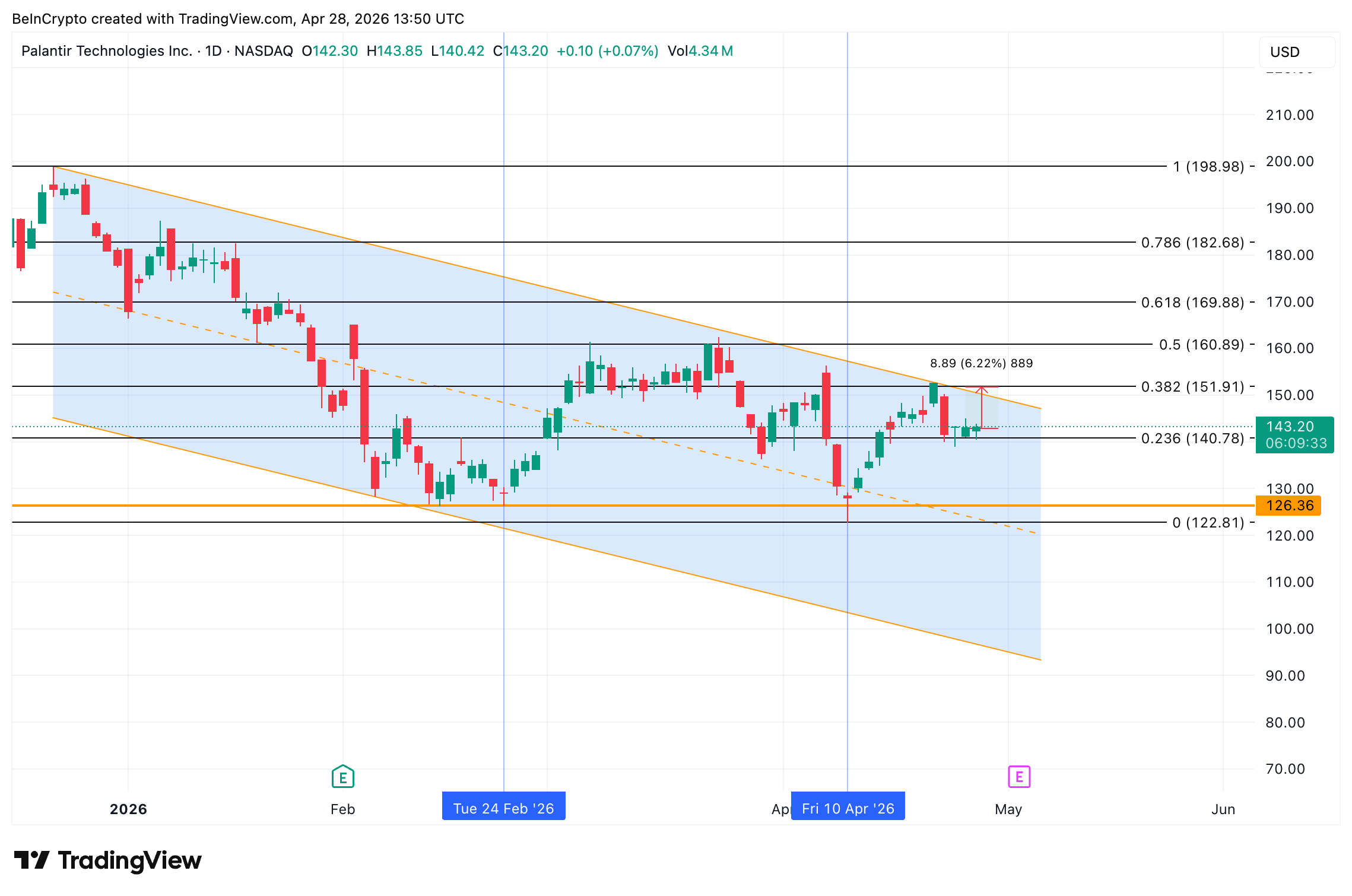
A 6% breakout above $151.91 on high volume opens the path to $160.89 and eventually $198.98. A break under $140 exposes $126.36 and the channel floor near $122.81.
Super Micro Computer (NASDAQ: SMCI)
Super Micro Computer (SMCI) is the cleanest bearish setup among AI stocks to watch in May.
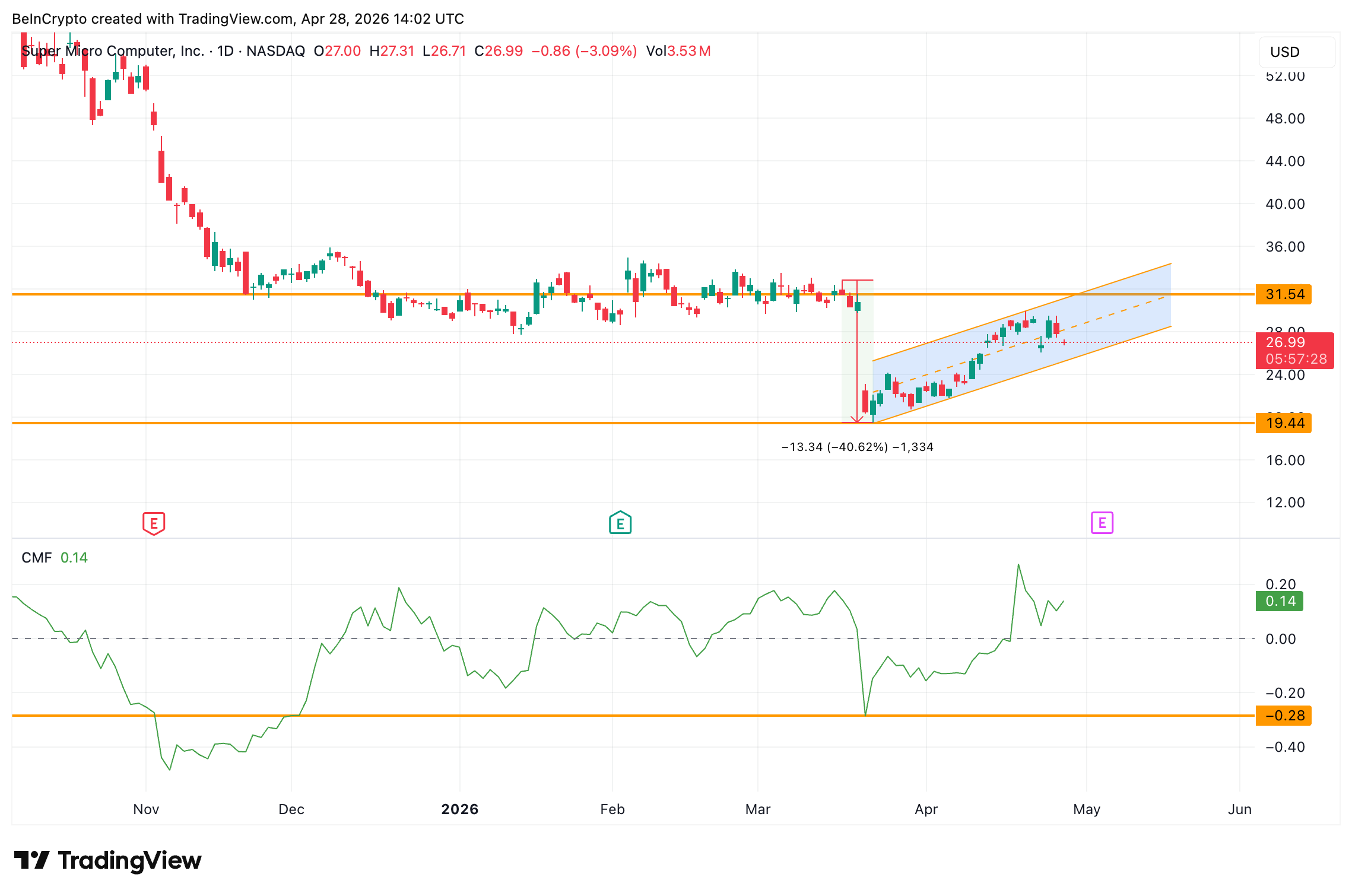
The stock crashed roughly 40%, from $30.79 to $19.30, between March 19 and March 23, after the US Department of Justice indicted co-founder Wally Liaw on charges of smuggling $2.5 billion in Nvidia AI chips to China. SMCI now trades at $26.99 ahead of Q3 FY2026 earnings on May 5.
That indictment broke the institutional bid. The Chaikin Money Flow (CMF) indicator that proxies institutional accumulation or distribution by combining price and volume, collapsed to -0.28 on March 19, the exact day the charges hit. Big money exited together, and the 40% price drop followed.
CMF has since recovered to +0.14, and price has formed a rising channel off the lows. But this is the relief rally inside a broken structure, not a reversal.
Price still sits closer to the channel’s lower trendline, and the fundamental damage has continued to compound.
On April 22, BlueFin Research reported Oracle cancelled 300 to 400 GB300 server racks worth $1.1 to $1.4 billion, allegedly to distance itself from the indictment. Mizuho cut its price target to $25 the same week.
That sets May 5 up as a confirmation print. A guidance miss linked to Oracle or xAI losses would re-trigger the same institutional exit that crushed the stock in March.
The level math reads tight and asymmetric. Losing $27.17 exposes $25.36, and a break there cracks the channel and reopens the $19.48 March low. Reclaiming $34.86 to flip the channel bullish sits nearly 30% away.
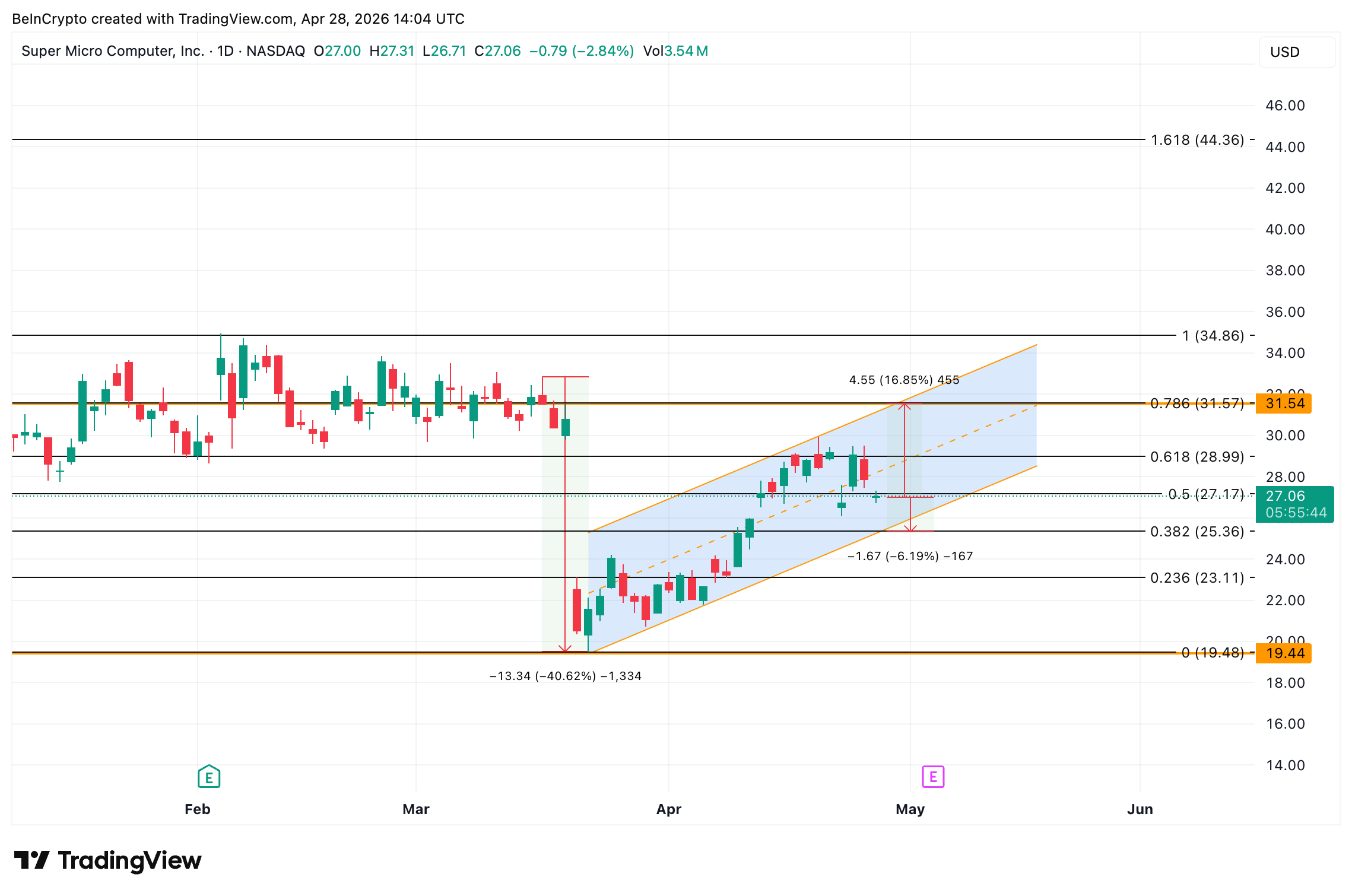
The bearish trigger is just 6% off, making SMCI one of the most tightly wound AI stocks to watch heading into May.
The post 3 AI Stocks to Watch in May 2026 appeared first on BeInCrypto.
Anti-Money Laundering enforcement has overtaken securities violations as the leading regulatory threat facing crypto companies, according to CertiK, with the United States Department of Justice and Financial Crimes Enforcement Network imposing $900 million in AML-related fines during the first half of 2025.
The shift marks a sharp break from the US Securities and Exchange Commission-led enforcement cycle that defined earlier years of crypto regulation. SEC crypto-specific penalties collapsed 97% in penalty value year over year, dropping from $4.9 billion in 2024 to $142 million in 2025, according to a Tuesday report by blockchain security auditor CertiK.
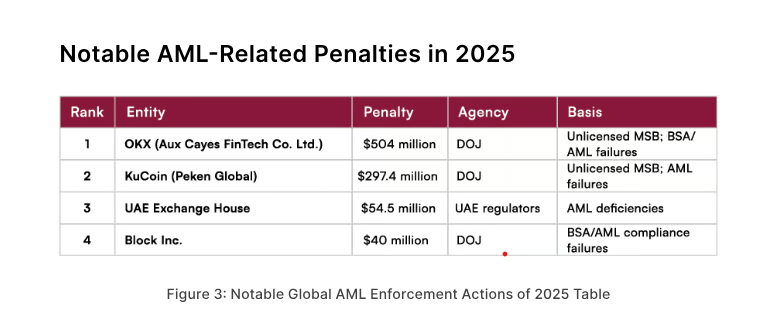
Transaction monitoring and licensing failures are now drawing penalties that rival or exceed many earlier crypto securities cases. The DOJ’s February 2025 settlement with OKX reached $504 million, while KuCoin paid $297 million in January 2025, both for operating unlicensed money transmitting businesses and Bank Secrecy Act violations.
Notable AML-related penalties in 2025. Source: CertiK
The surge in AML enforcement highlights regulators’ growing focus on compliance controls and financial surveillance, with penalties increasingly targeting operational failures rather than disclosure-related violations. The shift reflects both a change in US administration policy and a broader reassessment of the SEC’s jurisdictional approach to digital assets, according to the report.
Related: AMLBot says social engineering drove 65% of crypto cases it probed in 2025
Sanctions-related crypto volume grew over 400% year-over-year in 2025, driven primarily by Russia-linked networks and state-aligned stablecoin infrastructure, forcing regulators across all major jurisdictions to prioritize transaction monitoring and cross-border financial crime compliance over token classification disputes.
European AML fines surged 767% over the same period, while Asia-Pacific regulators increasingly favor license revocations and business improvement orders over monetary penalties.
Broader regulatory trends
The enforcement pivot coincides with broader global regulatory trends documented in the report. Stablecoin regulations, for example, are moving from design to implementation across major jurisdictions, with binding frameworks now operational from the Guiding and Establishing National Innovation for US Stablecoins (GENIUS) Act to the Markets in Crypto Assets (MiCA) regime.
Prudential standards for custodians and exchanges are tightening, with requirements now covering capital adequacy, asset segregation, liquidity management and recovery planning.
The Basel Committee’s cryptoasset prudential standard, scheduled for implementation from Jan. 1, 2026, subject to local adoption, has also created what the report calls a “structural divide” for institutional adoption. Group 2 assets, including Bitcoin and Ether, face near-100% capital charges, making them economically difficult for banks to hold on the balance sheet, while Group 1 assets, such as tokenized traditional instruments and qualifying stablecoins, receive standard risk weighting.
Related: Pierre Rochard warns US regulators over Bitcoin gap in Basel rewrite
A CertiK research team spokesperson told Cointelegraph that banks managing digital assets under the oversight of regulators such as Singapore and the EU are already subject to this adjusted enforcement.
Smart contract audit mandates address exploit landscape
CertiK said smart contract security assessments are increasingly being folded into licensing and compliance expectations across major markets, with security audits moving from voluntary best practice to statutory or quasi-statutory requirement across major jurisdictions within two years.
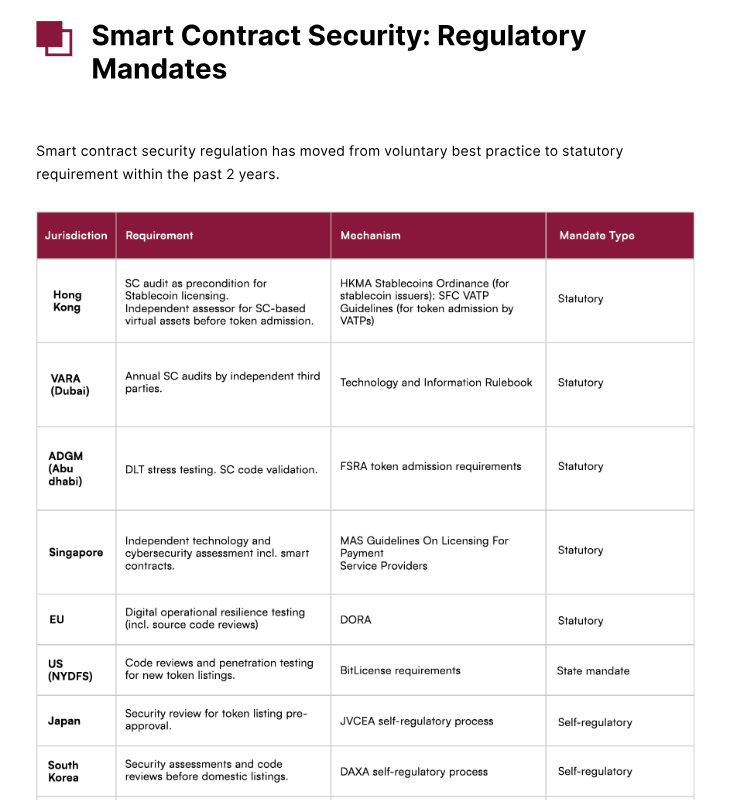
Smart contract security regulator mandates. Source: CertiK
That push for mandatory audits comes as regulators grapple with identifying accountability in decentralized finance. A European Central Bank working paper published in March, for example, found that governance in major DeFi protocols remains highly concentrated, complicating efforts to determine who should fall under MiCA oversight.
CertiK’s analysis of the top 100 exploited protocols found that 80% had never undergone a formal security audit before a breach, and those unaudited protocols accounted for 89.2% of total value lost. At the same time, the report says infrastructure compromises such as private key theft and access control failures drove 76% of 2025 losses by value, as the threat landscape moved beyond code exploits.
The spokesperson said that current regulatory audit requirements are in line with Web2 frameworks and that authorities generally delegate identifying relevant threats to supervised entities. While regulators may require yearly testing or various operational resilience efforts, such as source code reviews, they seldom prescribe a specific scope to avoid restricting the reach of such evaluations, they said.
Magazine: Singapore isn’t a ‘crypto hub’ — it’s something better: StraitsX CEO

A joint guidance request from Japan’s top regulatory bodies warns that crypto assets can elevate money laundering risk in real estate transactions. The document, published on Tuesday, is issued by the Ministry of Land, Infrastructure, Transport and Tourism (MLIT), the Financial Services Agency (FSA), the National Police Agency (NPA), and the Ministry of Finance (MOF). It targets major real estate and crypto industry organizations, including the Japan Cryptocurrency Business Association and several national real estate federations.
“Crypto assets, which have the nature of being transferred instantly across national borders, are considered to pose a high risk of being used as a payment method in real estate transactions for the purpose of money laundering,” the guidance states. The multi-agency appeal seeks to bring bank-like AML expectations into crypto-involved property deals by demanding robust customer due diligence, suspicious transaction reporting, and police notification when criminal activity is suspected. According to Cointelegraph, the move underscores a broader pattern of tightening oversight as authorities align crypto-regulatory frameworks with traditional financial controls.
Key takeaways
- Four Japanese agencies jointly warn that crypto assets can enable money laundering in real estate deals, urging banks, brokers, and crypto firms to strengthen AML controls.
- Real estate agents are urged to perform customer due diligence on transactions involving crypto and to file suspicious-activity reports with regulators and, where warranted, notify police.
- Conversions from crypto to fiat in the context of client transactions may fall under the crypto asset exchange business category, which requires proper registration under the Payment Services Act.
- Exchanges should monitor for crypto proceeds used in property deals and flag unusually large transfers that do not align with a customer’s financial profile.
- Under the Foreign Exchange and Foreign Trade Act, anyone receiving crypto worth more than 30 million yen from overseas must file a payment report with authorities.
Regulators coordinate to curb AML risks in crypto-assisted property trades
The joint guidance represents a coordinated stance by MLIT, FSA, NPA, and MOF to address vulnerabilities at the intersection of crypto markets and real estate. Recipients include key real estate associations and the leading crypto industry body, signaling a concerted effort to standardize risk controls across both sectors. The guidance frames crypto as an instrument with capabilities for rapid cross-border transfers, which could facilitate illicit activity if not properly monitored and controlled.
By elevating AML expectations in property transactions involving crypto, authorities aim to mirror the due diligence and reporting regimes long applied to fiat-based financial activity. The document calls for heightened customer verification, enhanced transaction screening, and timely reporting to regulators when red flags arise. In practical terms, the guidance may impose additional compliance burdens on real estate brokers, crypto exchanges, and ancillary service providers that facilitate asset transfers or convert crypto to fiat for property purchases.
Expanded due diligence and reporting obligations for crypto-involved transactions
The guidance explicitly instructs real estate brokers to conduct thorough customer due diligence on transactions that involve crypto assets. This includes verifying the identity of clients, understanding the source of funds, and assessing the purpose of the transaction. When indicators of suspicious activity emerge, entities are required to file suspicious transaction reports with the appropriate authorities and, if criminal activity is suspected, notify law enforcement promptly.
In effect, the document elevates AML expectations to crypto-property deals, aligning them with standards that apply to traditional financial services. For crypto firms, this translates into reinforced verification processes, enhanced record-keeping, and closer coordination with financial regulators. For real estate professionals, the guidance delineates a clearer path to compliance in a space where ownership and transfer mechanisms can involve digital assets that cross borders in seconds.
The guidance also emphasizes the risk management dimension of crypto usage in property transactions. By prioritizing due diligence and reporting, regulators aim to improve traceability of funds and deter the use of digital assets for concealment or misrepresentation in real estate dealings. Analysts will watch how these expectations interact with existing AML/KYC regimes and how they influence licensing, supervision, and enforcement practices across both crypto and real estate ecosystems.
Cross-border reporting requirements and registration considerations
A notable element of the guidance is the emphasis on cross-border implications. The document reminds market participants that conversions of crypto into fiat for clients could fall under the category of “crypto asset exchange business” under the Payment Services Act, an activity that requires proper registration. Operating without registration could expose firms to regulatory risk and potential penalties.
Additionally, the guidance calls for exchanges to scrutinize cases in which a customer receives property sale proceeds in crypto and then engages in unusually large, unexplained transfers. Such patterns may signal attempts to obscure the origin of funds or bypass reporting obligations, and would be treated as concerns warranting closer review or reporting to authorities.
Beyond registration considerations, Japan’s cross-border data-sharing and reporting frameworks under the Foreign Exchange and Foreign Trade Act add another layer of oversight. Specifically, the act requires anyone receiving crypto valued over 30 million yen from overseas to file a payment report with the appropriate authorities. The threshold establishes a concrete benchmark for international transfers and reinforces the expectation that large inbound crypto flows be monitored for compliance and enforcement purposes.
Regulatory architecture: crypto as financial instrument and broader policy context
The joint guidance arrives on the heels of a broader regulatory shift in Japan. Earlier this month, Japan amended the Financial Instruments and Exchange Act to classify crypto assets as financial instruments, moving them from the payments category into a regime that applies to traditional securities. The reform narrows the field for illicit activity while expanding the disclosure and governance obligations on crypto issuers.
The amendments prohibit insider trading and other market-manipulation practices involving undisclosed information related to crypto assets. They also impose annual disclosure requirements on crypto issuers and tighten penalties for unregistered crypto exchanges. In conjunction with these changes, the government has signaled continued policy refinement, including plans to cap crypto profits taxes at a flat 20 percent, underscoring a broader push toward formalizing crypto markets within established financial regulatory rails.
For market participants, these developments imply a more integrated oversight approach that mirrors international trends in AML/KYC supervision and market integrity. The shift to treating certain crypto activities as financial instruments aligns Japan with efforts elsewhere to render crypto markets more transparent, securely regulated, and sourced to the protections ongoing in traditional securities markets. Institutions—banks, exchanges, brokers, fund managers, and real estate firms—will increasingly need to navigate a broader spectrum of licensing, reporting, and governance requirements as they participate in crypto-enabled finance and real estate transactions.
In a broader policy context, the changes dovetail with ongoing regulatory conversations in other jurisdictions about the alignment of crypto regimes with cross-border standards. While MiCA in the European Union offers one model of digital-asset regulation, Japan’s approach emphasizes concrete registration, disclosure, and AML controls within a domestic framework that still contends with international enforcement cooperation and regulatory divergence.
Closing perspective
The joint guidance signals a clear intent to deter illicit finance by embedding crypto-enabled real estate transactions within established regulatory safeguards. As Japanese authorities tighten supervision across crypto and real estate channels, institutions—especially exchanges, brokers, banks, and asset managers—should anticipate evolving registration, due diligence, and reporting expectations. Observers will monitor how these measures interact with international standards and whether further clarifications or reforms will refine the balance between innovation and compliance in Japan’s evolving crypto landscape.

Anti-money-laundering enforcement has overtaken securities violations as the principal regulatory threat facing crypto firms, according to CertiK’s State of Digital Asset Regulations report. The U.S. Department of Justice and the Financial Crimes Enforcement Network together imposed more than $1 billion in AML-related fines during the first half of 2025. The development signals a sharp regulatory pivot away from the Securities and Exchange Commission-led enforcement cycle that once dominated crypto compliance discourse. CertiK notes that SEC crypto-specific penalties collapsed in value, falling from $4.9 billion in 2024 to about $142 million in 2025, a trend the firm attributes to shifts in policy priorities and jurisdictional focus.
According to CertiK’s findings, transaction-monitoring and licensing lapses are now generating penalties that rival or exceed many prior securities cases. High-profile settlements illustrate the trend: the Department of Justice’s February 2025 resolution with OKX amounted to $504 million, and KuCoin agreed to a $297 million settlement in January 2025 for operating as an unregistered money-transmitting business and violations of the Bank Secrecy Act.
Notable AML-related penalties in 2025. Source: CertiK
The surge in AML enforcement highlights regulators’ intensified emphasis on robust compliance controls and financial surveillance, with penalties increasingly stemming from operational shortcomings rather than disclosure failures. The report ties the shift to broader changes in U.S. policy and a re-evaluation of the SEC’s regulatory reach over digital assets.
Sanctions-related crypto transaction volume expanded more than fourfold year over year in 2025, driven principally by Russia-linked networks and state-aligned stablecoin infrastructure. This dynamic compelled regulators across major jurisdictions to prioritize cross-border financial crime compliance and transaction monitoring over token-classification debates.
Across regions, AML penalties followed a similar pattern. European authorities registered a near-quadrupling of fines, surging by about 767% over the period, while Asia-Pacific regulators increasingly relied on license revocations and business-improvement orders rather than monetary penalties. The global trend underscores a move toward a more stringent, process-oriented approach to crypto supervision that emphasizes ongoing compliance programs and operational resilience.
Key takeaways
- AML enforcement has surpassed securities penalties in scale during the first half of 2025, reflecting a regulatory priority shift in crypto oversight.
- In the United States, DOJ and FinCEN actions produced AML-related fines totaling over $1 billion in H1 2025, a milestone signaling intensified surveillance.
- High-profile settlements—OKX for $504 million and KuCoin for $297 million—highlight the risk to exchanges and other crypto-asset businesses from licensing failures and BSA violations.
- Global enforcement trends show rapid growth in sanctions-related activity, with Europe and Asia-Pacific pursuing more aggressive compliance actions, including licensing and exit/remediation orders.
- Regulatory architecture is shifting toward mandatory security and operational audits and stronger prudential standards for custodians and exchanges, with consequential implications for capital, liquidity, and asset segregation.
Regulatory architecture in flux: from policy to practice
The enforcement pivot aligns with broader regulatory shifts documented in CertiK’s report. Stablecoins are moving beyond design debates toward concrete implementation across jurisdictions, with statutory and regulatory regimes maturing from concept to operation. Notable milestones include legislative and policy pathways from the GENIUS Act to the Markets in Crypto Assets (MiCA) framework, which collectively aim to establish binding rules for digital assets, stablecoins, and related infrastructure.
Prudential standards for market infrastructure—custodians and crypto exchanges—are tightening. Requirements now address capital adequacy, asset segregation, liquidity management, and recovery planning. In parallel, the Basel Committee’s cryptoasset prudential standards are slated for implementation beginning January 1, 2026, subject to local adoption. The framework creates a bifurcated treatment of cryptoassets: Group 2 assets (including Bitcoin and Ether) face near-100% capital charges, while Group 1 assets (such as tokenized traditional instruments and qualifying stablecoins) receive standard risk-weighting. This division risks a structural disconnect for large-scale institutional adoption, particularly in bank balance sheets where capital costs influence holding patterns.
CertiK noted that banks already under regulator supervision in jurisdictions like Singapore and the EU are encountering the practical effects of these evolving standards. The shift increases the cost of holding crypto assets on balance sheets and reinforces the importance of robust custody, risk-management, and reporting capabilities for institutional clients and banks alike.
According to Cointelegraph’s reporting on CertiK’s findings, the regulatory emphasis is broadening from asset classification to the reliability of operational controls and compliance programs. The move reflects a desire to close governance, risk, and control gaps that have historically enabled illicit activity and financial crime through crypto channels.
Smart contract audits and the evolving compliance baseline
Auditing and security standards are increasingly being folded into licensing and supervisory expectations across major markets. CertiK described a trajectory whereby rigorous security assessments are no longer voluntary best practices but are becoming de facto prerequisites for market access. Regulators’ push toward formal audits coincides with heightened concern about accountability in decentralized finance and governance models.
Regulatory attention to DeFi governance is rising in tandem with audit requirements. A European Central Bank working paper cited in CertiK’s analysis highlights that governance consolidation within major DeFi protocols complicates MiCA oversight, underscoring the need for clear accountability in a landscape where code and control may sit with disparate actors. CertiK’s review of the top 100 exploited protocols found that 80% had never undergone a formal security audit prior to a breach, and those unaudited protocols accounted for 89.2% of total value lost. Moreover, 2025 losses by value were dominated by infrastructure compromises, such as private-key theft and access-control failures, which accounted for 76% of total losses by value, signaling a shift from purely code-level exploits to broader operational risk.
The firm also observed that regulators often defer to supervised entities to identify and mitigate risks, with annual testing, resilience drills, and source-code reviews forming the cornerstone of a jurisdictional compliance program. While some regulators require annual audits or ongoing security testing, they typically avoid prescribing an overly prescriptive scope to preserve insurers’ and firms’ flexibility in implementing robust controls.
From a practical standpoint, these developments matter for institutions and compliance teams because they reshape onboarding and ongoing supervision considerations. Banks and fintechs seeking to operate or expand digital-asset activities must demonstrate robust KYC/AML programs, secure custody arrangements, and demonstrable risk governance that aligns with evolving prudential standards and cross-border supervision expectations. As CertiK’s spokesperson explained to Cointelegraph, regulators globally are signaling that governance, operational resilience, and security audits are integral to licensure and ongoing oversight.
Related: AMLBot highlights social engineering as a leading factor in 2025 crypto incidents
Looking ahead, the convergence of AML enforcement with broader regulatory modernization suggests a tightening of the compliance perimeter for crypto firms. The emphasis on licensing-driven enforcement, cross-border cooperation, and capital-adequacy discipline for custodians and exchanges will shape the operating models of exchanges, banks exploring digital-asset services, and institutional traders alike. The push toward mandatory audits and stronger governance standards also raises questions about the competitive landscape: entities with advanced risk-management capabilities may gain preferential access to banking relationships and market corridors, while those with weaker controls could face accelerated remediation orders or exits from regulated markets.
For compliance teams, the takeaway is clear: the regulatory baseline is shifting from “best practice” to “binding requirement” for critical control functions. The 2025 enforcement environment demonstrates that penalties are increasingly tied to operational execution—how firms monitor transactions, verify counterparties, manage keys and access, and maintain auditable records—rather than merely to disclosure-related missteps.
Closing perspective: the regulatory trajectory indicates that crypto supervision will continue to converge with traditional financial crime controls. Institutions should monitor ongoing Basel developments, MiCA implementation, and cross-border enforcement dynamics, while preparing for tighter licensing regimes and mandatory security audits as the standard of fit for regulated digital-asset activities.
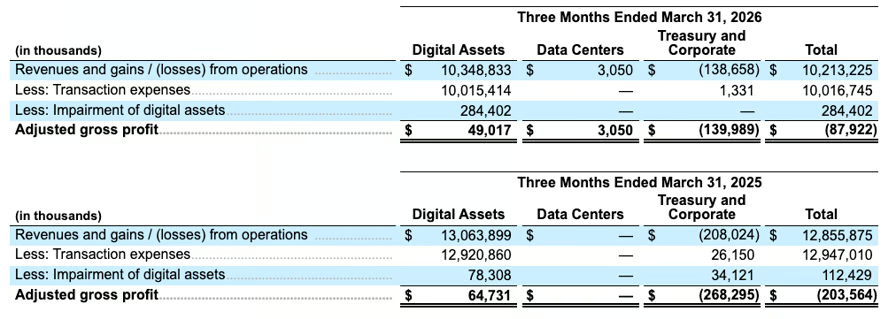
Mike Novogratz’s digital asset company Galaxy Digital posted a $216 million loss in the first quarter of 2026, extending losses from the prior year.
Galaxy Digital (GLXY) reported first-quarter earnings Tuesday of a loss of $0.49 per diluted share, compared with a loss of $0.86 in Q1 2025. The earnings came in ahead of expectations, according to MarketBeat analysts, who had expected a loss of $0.59 per share.
Gross revenue for the quarter ended March 31 was $10.2 billion, compared with $10.2 billion in Q4 2025 and $12.9 billion in the same period a year earlier.
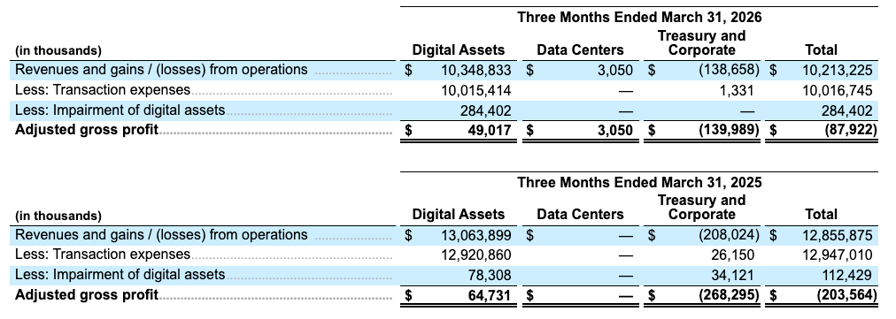
Source: Galaxy Digital
For the full-year 2025, Galaxy reported a net loss of $241 million and gross revenue of $61.4 billion.
Galaxy said it expects growth in its data center business to start in the second quarter of 2026 after it begins recognizing revenue from its Helios campus, its large-scale data center project in Texas.
The quarter underscored Galaxy’s transition from a crypto-market-driven business to one that will increasingly depend on Helios and AI-linked data center revenue for growth.
Weaker crypto prices weighed on results
Galaxy said the quarterly loss was driven largely by weaker digital asset prices, which reduced the value of its holdings and investment positions.
The company said crypto market capitalization fell roughly 20% over the quarter, contributing to weaker asset valuations.
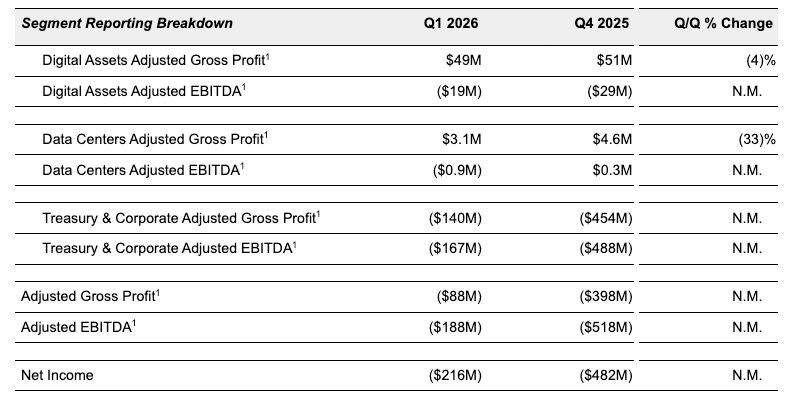
Source: Galaxy Digital
Digital Assets generated $49 million in adjusted gross profit, while losses were heaviest in Galaxy’s Treasury and corporate segment, which posted a $167 million adjusted EBITDA loss amid market volatility.
Related: US CLARITY Act will ‘get done’ in May, says Mike Novogratz
“Despite the pullback in digital asset prices and activity, adjusted gross profit remained broadly stable, reflecting a shift in the business mix as recurring fee revenue and transaction income continue to scale and provide greater resilience in softer market conditions,” the company added.
Data centers seen as long-term growth driver
Galaxy expects its data center business to start contributing to earnings in the second quarter of 2026 after it begins recognizing revenue from its Helios campus in Texas.
Since acquiring the facility in December 2022, Galaxy has been expanding and converting the Helios site in Texas into a large-scale data center campus focused on high-performance computing and AI workloads.
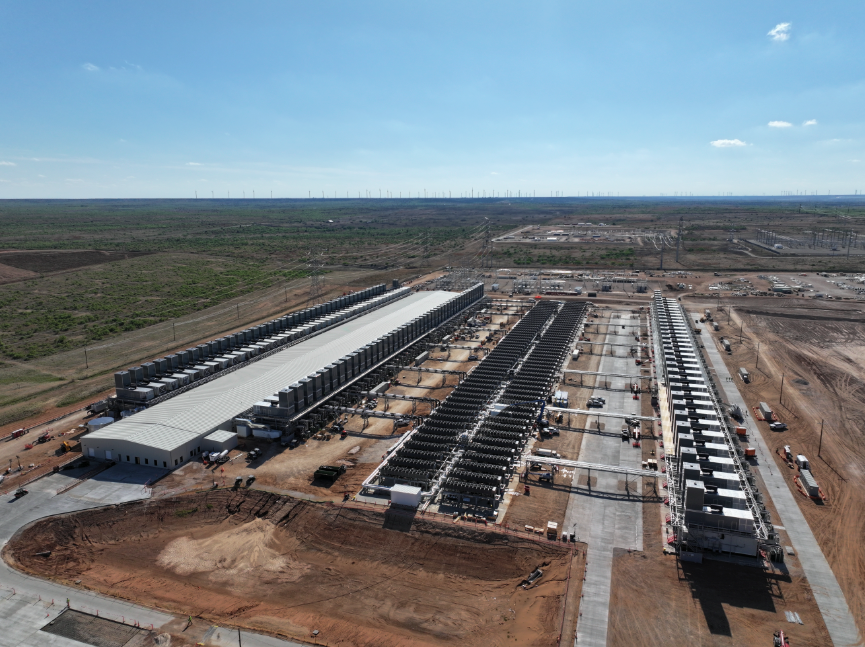
Galaxy’s Helios data center campus under construction for Phase I, April 2026. Source: Galaxy Digital
Galaxy said it delivered the first data hall to CoreWeave and remains on budget and on schedule to deliver substantially all 133 megawatts of critical IT load under the Phase I lease agreement by the end of Q2 2026.
As of March 31, 2026, Galaxy reported $2.8 billion in equity capital, up 46% year over year. The company said equity was split across digital assets at 33%, data centers at 28% and treasury and corporate holdings at 39%.
Key takeaways:
- Stalled progress on the CLARITY Act and hiccups in AI industry revenue weighed heavily on Bitcoin traders’ sentiment.
- Global instability and US economic concerns may add further downside pressure on Bitcoin price.
Bitcoin (BTC) retreated below $76,000 on Tuesday, erasing gains from the prior week. This movement followed a 1% decline in the tech-heavy Nasdaq 100 Index after OpenAI reported a shortfall in its revenue and user growth targets. While the AI industry may be a factor in Bitcoin’s decline, crypto market regulations and macroeconomic indicators are also contributing.
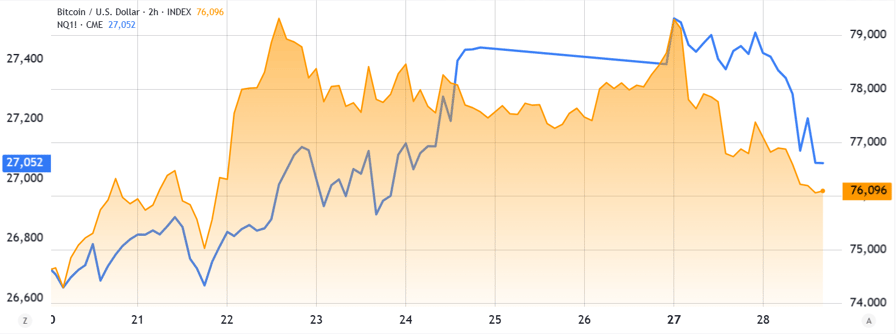
Nasdaq 100 futures (left) vs. Bitcoin/USD (right). Source: TradingView
The Nasdaq 100 Index traded down 1% on Tuesday as AI infrastructure companies displayed weakness following a Wall Street Journal report that ChatGPT developer OpenAI announced lackluster sales and user metrics for 2025. Shares of Nvidia (NVDA US), Oracle (ORCL US), and CoreWeave (CRWV US) fell more than 2%.
The downturn in technology stocks can also be attributed to routine profit-taking, as the Nasdaq 100 Index reached an all-time high on Monday. Traders adopted a more cautious approach ahead of quarterly earnings reports from Microsoft (MSFT US), Google (GOOGL US), Amazon (AMZN US), and Meta (META US) on Wednesday, with Apple (AAPL US) following on Thursday.
Tech valuations, oil prices and shaky real estate markets
Brent crude oil spiked to $110 as US-Iran negotiations stalled over nuclear enrichment, threatening traffic through the Strait of Hormuz. Meanwhile, China’s major cities experienced significant declines in real estate, with existing home prices dropping 7.4%. In the US, although the S&P Case-Shiller Index rose 0.3%, over half the country saw price decreases.
In addition to the current macroeconomic factors, Bitcoin traders are skeptical about stalled progress on the CLARITY Act. Despite the pro-crypto stance from the Trump administration, the expected advancements have not fully materialized. If the market perception of crypto regulation improves, it could serve as the necessary catalyst to drive institutional demand back into Bitcoin.
Related: Acting AG Todd Blanche confirms ‘code is not a crime’ in DOJ pivot
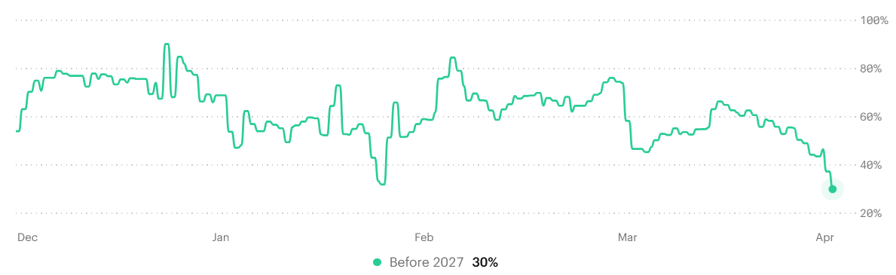
Odds of crypto market structure legislation approval by 2027. Source: Kalshi
Traders are currently pricing in lower odds of the CLARITY Act’s approval. This crypto market structure bill cleared the House of Representatives in July 2025 but has since stalled in the Senate Banking Committee.
While it is impossible to pinpoint the exact drivers behind the Bitcoin price correction to $76,000, the lack of momentum in US-Iran negotiations, weakness in real estate markets, and negative regulatory pressure have likely undermined investor confidence. These factors, alongside the downturn in technology stocks on Tuesday, have created a challenging environment for Bitcoin.

BNB Price Holds Ground as Crypto Falls

Born Again’s Michael Gandolfini Teases How Daniel’s Shocking Choice Could Fuel Season 3

Push to level the playing field

Manchester United reach agreement with Casemiro over contract clause amid transfer speculation

US brings back mandatory military draft registration

Steven Gerrard disagrees with Gary Neville over ‘shock’ Chelsea and Arsenal claim | Football


-

 Tech1 day ago
Register Renaming | Hackaday
-

 Fashion4 days ago
Weekend Open Thread – Corporette.com
-
Crypto World3 days ago
Hyperliquid $HYPE Rally Builds Momentum as AI Sector Enters Prove-It Phase
-

 Politics6 days ago
Making troops accountable for war crimes threatens US alliance, ex-SAS colonel warns
-

 Politics6 days ago
Disabled people challenge government SEND proposals over segregation concerns
-

 Business5 days ago
Patterson-UTI Energy, Inc. (PTEN) Q1 2026 Earnings Call Transcript
-

 Business7 days ago
Rolls-Royce Voted UK’s Most Iconic Trade Mark as IPO Register Hits 150
-
 Sports3 days ago
IPL 2026: Ruturaj Gaikwad registers slowest fifty of the season, enters all-time unwanted list | Cricket News
-

 Politics1 day ago
Drax board avoid their own AGM, accused of greenwashing & environmental racism
-

 Politics6 days ago
Starmer handler McSweeney to be dragged from shadows by Foreign Affairs Committee
-

 Politics6 days ago
Zack Polanski responds to home secretary’s taser threat
-
Politics6 days ago
Wings Over Scotland | How To Get Away With Crimes
-

 Politics6 days ago
‘Iran is still a nuclear threat’
-
 Business7 days ago
HCL Tech share price tank over 9% after weak Q4. JPMorgan, HSBC & 3 others cut target price
-

 NewsBeat3 days ago
LK Bennett closes all stores after entering administration
-
 Sports6 days ago
Tim Bradley names the current best in the world: “Better than Inoue and Usyk”
-

 Crypto World5 days ago
Michael Saylor says BTC winter is over. Market analyst disagrees, says bitcoin was in a pullback
-

 Business7 days ago
The Job Benefits Most Men Don’t Know to Negotiate
-
Business6 days ago
Altimmune prices $225 million public offering at $3 per share
-
 Entertainment3 days ago
Mariah Carey Slams Deposition Claims In Brother’s Lawsuit
You must be logged in to post a comment Login