
Crypto World
ASTER Price Breaks Key Support as RSI Weakens and Whale Selling Intensifies


TLDR:
- ASTER price today drops below the $0.66 support after repeated tests, confirming a shift from range trading to bearish movement
- RSI hits a three-month low near 35, showing weak momentum with room for further downside before oversold levels
- Whale transferred over 34 million tokens to exchanges, increasing supply and adding pressure on short-term price action
- ASTER price today eyes $0.60 and $0.55 zones as next targets, while resistance forms near the previous support range
ASTER price is under pressure as the token trades near $0.63–$0.65, following heavy selling and a breakdown below key support.
Market activity shows increased volatility, with technical signals and whale movements shaping short-term direction.
ASTER Breakdown Deepens as Selling Pressure Builds
The recent ASTER price action today reflects a clear shift from range stability to downside movement. The asset traded within a tight band between $0.6900 and $0.6650 throughout April. That structure has now failed after the price broke below the lower boundary.
A tweet from Ardi noted that ASTER is “beginning to break down aggressively,” citing a combined RSI at a three-month low.
The post also referenced a prior capitulation near $0.40, drawing comparisons with current market weakness. The breakdown followed repeated tests of support, which eventually gave way.
Once the $0.6600 level failed, the price dropped quickly toward the $0.6218 region. This move swept liquidity below recent lows, often linked to stop-loss triggers.
At the same time, RSI readings hovered around the mid-30s, showing sustained bearish momentum without reaching oversold levels.
Resistance has now shifted lower. The $0.6600–$0.6650 zone is acting as a barrier, with sellers likely defending this range. A move back toward this level may face renewed pressure, especially if volume remains weak.
Short-term projections suggest a possible bounce near the $0.62 region. However, this rebound may not hold if broader selling continues. The structure remains tilted to the downside unless price reclaims lost support levels.
Whale Activity and Ecosystem Growth Shape ASTER Outlook
Beyond chart movements, ASTER price is also reacting to notable on-chain activity. A large holder recently transferred 34.62 million tokens, valued at nearly $22.95 million, to exchanges. This move came from a wallet that accumulated 68.25 million ASTER at a higher average price.
Following this transfer, the asset recorded a drop of about 4.4%. At the same time, the top 100 addresses reduced holdings by over 62% within a single day. This sharp reduction points to increased supply entering the market.
Despite the selling pressure, the Aster ecosystem continues to expand. The platform recently crossed 15 million registered users, ranking among the largest perpetual decentralized exchanges. Growth in user numbers reflects rising participation, even during price weakness.
The launch of the Aster Chain mainnet in March 2026 added new features, including stealth addresses and zero-gas transactions for selected activities. These updates aim to improve user experience and attract more activity to the network.
Looking ahead, staking and governance features are scheduled for release in Q2 2026. These additions could encourage token locking and reduce circulating supply. However, competition remains strong, with rival platforms gaining market share during the same period.
For now, ASTER price today continues to track both technical weakness and external selling pressure. Price remains below former support, with attention shifting toward lower liquidity zones near $0.55–$0.60. Market participants are watching whether the asset stabilizes or extends its decline.




Canada is proposing to ban crypto ATMs as part of a broader crackdown on fraud and money laundering, citing growing evidence that the machines have become a key tool for scammers.
The measure, included in the Liberal government’s Spring Economic Update released Tuesday, would eliminate crypto ATMs nationwide. Officials described the machines as a “primary method” for defrauding victims and laundering illicit funds.
“To protect Canadians by shutting down a primary method for scammers to defraud victims, and for criminals to place their cash proceeds of crime,” the government said, it plans to prohibit the machines entirely.
A crypto ATM (automated teller machine) may sound similar to a traditional cash machine that dispenses money from your bank account, but it works very differently. Instead of withdrawing cash, these machines let users convert physical cash into cryptocurrencies like bitcoin, which can then be sent to a digital wallet anywhere in the world, while bypassing traditional banking channels. That’s where the money-laundering risk comes in.
The proposal follows mounting concerns from law enforcement and regulators that crypto ATMs have become central to fraud schemes.
A 2023 internal analysis by Canada’s financial intelligence agency, FINTRAC, found that bitcoin ATMs are likely to remain “the primary method” fraudsters use to collect and launder funds from victims.
Canadian lawmakers are debating banning crypto as a payment method for electoral donations, citing concerns about the anonymity of fund transfers.
Canada was home to the first bitcoin ATM, installed in a downtown Vancouver coffee shop in 2013.


CFTC turns to AI tools and a new Innovation Task Force to police booming crypto and prediction markets as staff shrinks and CLARITY Act hangs over federal turf wars.
Summary
- CFTC chair Michael Selig says Microsoft 365 Copilot and AI surveillance tools now underpin crypto and prediction market oversight with a workforce reduced by more than 20% since FY2024.
- A new Innovation Task Force will write rules for crypto assets, artificial intelligence, and event contracts as Congress weighs the CLARITY Act and federal–state fights over prediction markets intensify.
- Selig’s push comes as monthly prediction market volumes approach tens of billions of dollars and the agency seeks exclusive federal jurisdiction over event-based contracts.
The U.S. Commodity Futures Trading Commission is turning to artificial intelligence to supervise surging crypto and prediction markets even as its workforce has shrunk by more than one‑fifth since 2024.
Chairman Michael Selig told the House Agriculture Committee that the agency has authorized Microsoft 365 Copilot across its staff and is building “AI‑driven surveillance systems to flag fraud, market manipulation, and insider trading” in digital asset and derivatives markets.
CFTC leans on AI as staff shrinks
According to a report cited by Selig, the CFTC’s headcount has fallen from about 708 full‑time employees at the end of fiscal 2024 to roughly 543 a year later, a reduction of just over 20%, even as Congress prepares to hand it primary oversight of non‑securities crypto trading.
He argued that Copilot and other machine‑learning tools are compensating for that gap by ingesting large data sets from crypto exchanges, prediction platforms, and futures markets and surfacing anomalies for human investigators to review.
At the same time, Selig is trying to replace ad hoc enforcement with clearer guardrails.
In March, he launched an Innovation Task Force “dedicated to advancing clear rules of the road for American innovators” building in three areas: crypto assets and blockchain, artificial intelligence and autonomous systems, and prediction markets and event contracts, according to a CFTC release.
The task force, led by senior adviser Michael Passalacqua and five other experts, will work with the Innovation Advisory Committee and coordinate with the Securities and Exchange Commission on joint initiatives.
“Our goal is to foster responsible innovation at home and ensure American market participants are not left on the sidelines,” Selig said, promising a forum for founders and developers to “come meet with the staff” rather than face only after‑the‑fact crackdowns.
Bitcoin 2026 underscores prediction market pivot
Selig amplified that message on April 27 at the Bitcoin 2026 conference in Las Vegas, where he appeared back‑to‑back with SEC chair Paul Atkins and told attendees that regulators are “turning over a new page” on crypto coordination.
He framed the CFTC’s agenda around property rights, saying “our country was founded on the idea of private property” and arguing that token holders and innovators deserve predictable treatment instead of overlapping enforcement from Washington and the states.
That stance matters for prediction markets, a sector that platforms like Polymarket and Kalshi have helped push to nearly $24 billion a month in trading volume as AI bots and Wall Street capital pour in.
The CFTC is simultaneously defending what Selig calls its “sole regulatory jurisdiction over prediction markets” in lawsuits against states including New York, Arizona, and Illinois, warning that a patchwork of gambling rules could fracture a market now moving into mainstream finance.
In a recent congressional hearing, Selig said the agency has “numerous investigations ongoing” in prediction markets and insisted that CFTC‑registered platforms must serve as the “first line of defense” against fraud before federal enforcement steps in.
With the CLARITY Act still pending in Congress and the Innovation Task Force ramping up, the CFTC is betting that AI‑enhanced supervision and formal rulemaking can keep pace with crypto derivatives and event contracts that now trade at global scale.
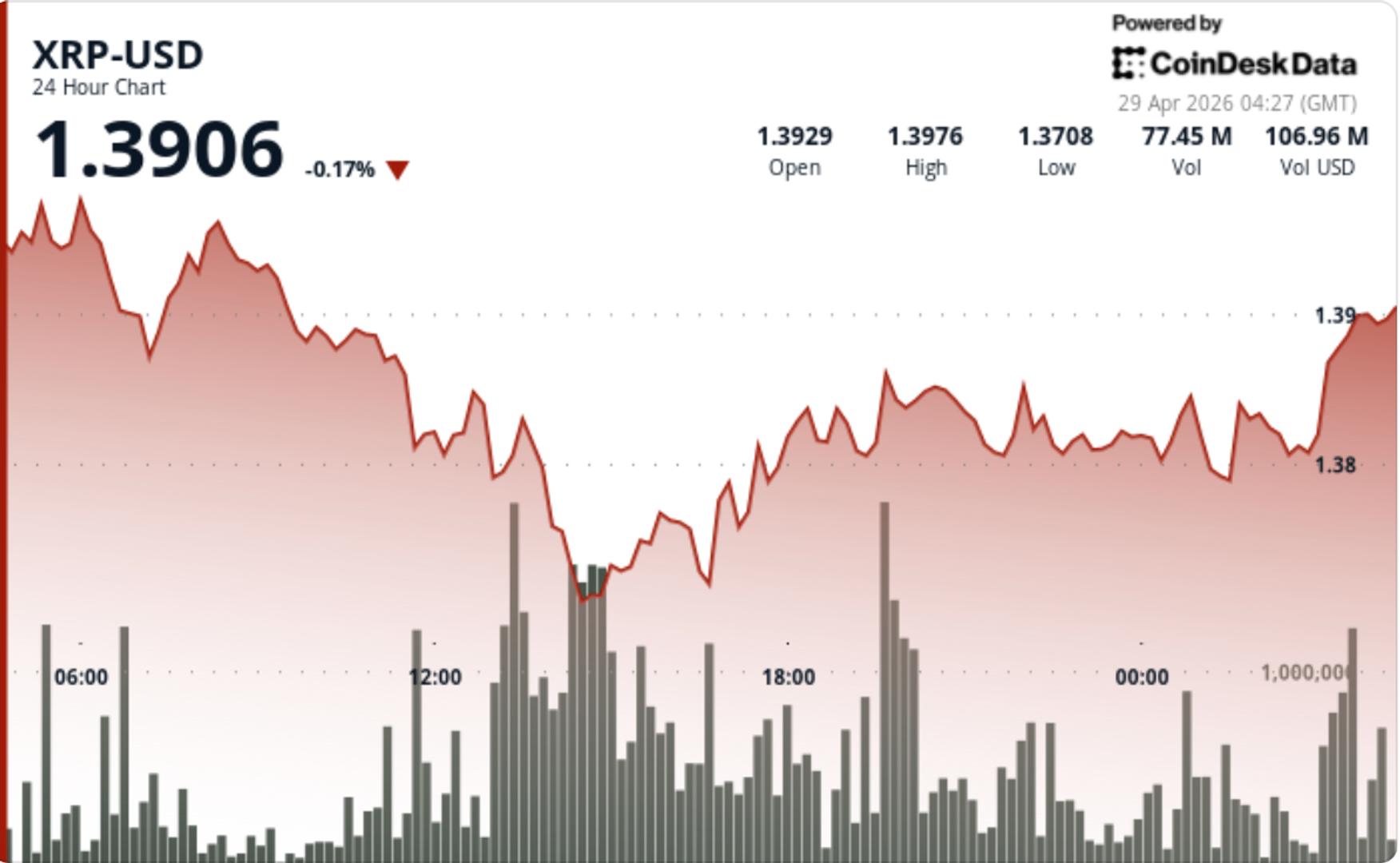
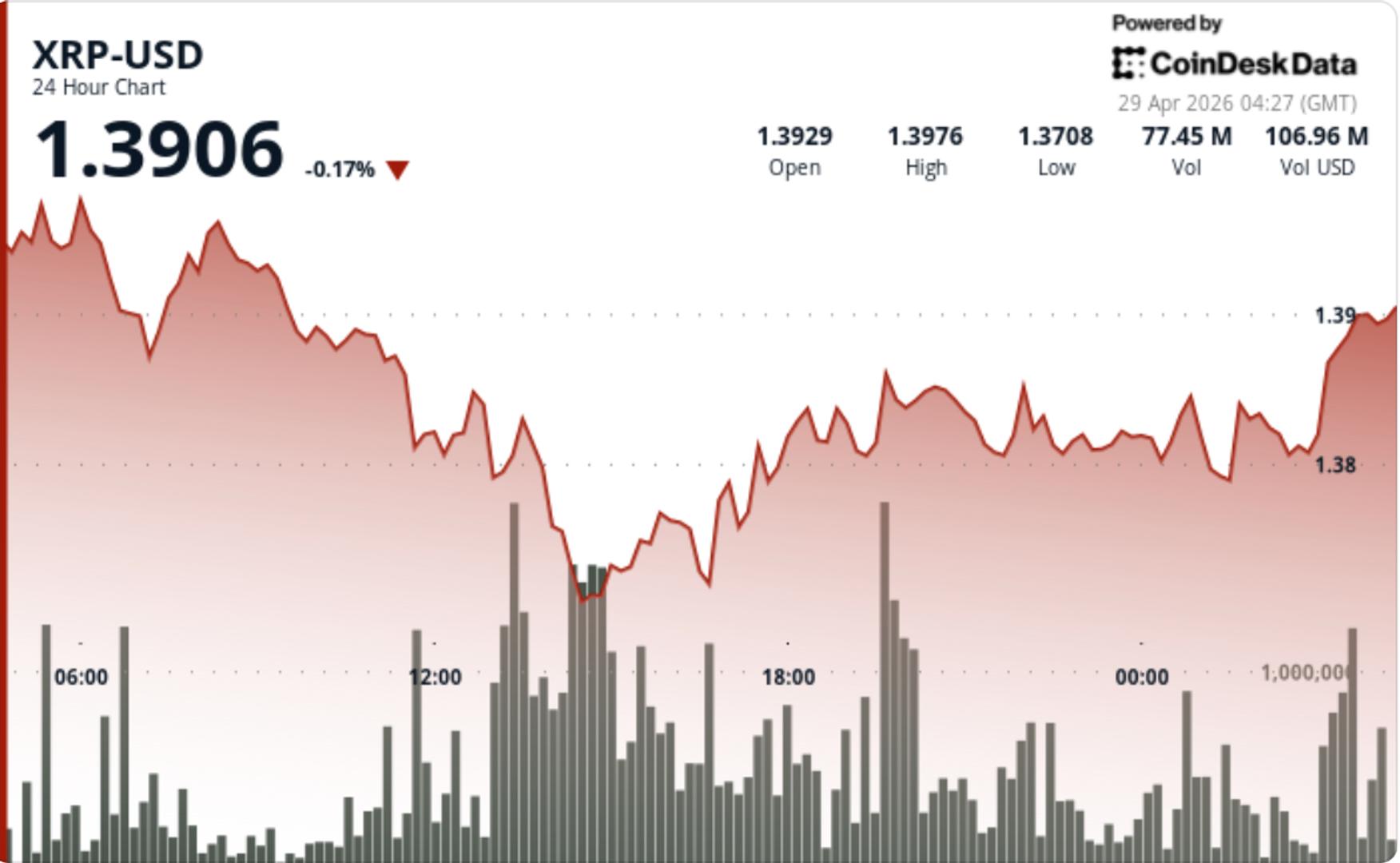
XRP lost $1.40, and it didn’t happen quietly. The level had held for weeks, but once it gave way, price slipped quickly and hasn’t recovered it. That shift matters because when support breaks on strong volume, it usually turns into resistance, and that changes how traders position around it.
News Background
• Bitcoin dominance pushed toward 60%, signaling capital rotating away from altcoins and limiting demand for XRP.
• XRP continues to unwind after a long consolidation phase, with the recent move marking the first clean break below its range floor.
Price Action Summary
• XRP dropped from $1.40 to $1.38, breaking below a key support level that had held through the range.
• The move was driven by a clear spike in selling activity rather than gradual drift.
• Price is now holding just below $1.40, consolidating after the breakdown instead of bouncing back.
Technical Analysis
• The structure has shifted. $1.40 was support, now it acts as resistance unless reclaimed.
• Volume expanding into the move confirms real selling pressure, not a low-liquidity drop.
• The longer consolidation that kept price stable has now started to resolve lower.
• Short-term rebounds are shallow so far, which suggests buyers are not stepping in with strength yet.
What traders should watch
• $1.40 is the key level. A move back above it would signal the breakdown failed.
• $1.37 is the next support. Losing that opens the path toward $1.32-$1.28.
• As long as price stays below $1.40, rallies are likely to face selling pressure.


The CFTC is turning to artificial intelligence and a new Innovation Task Force to police explosive crypto and prediction markets as its workforce shrinks and jurisdictional battles over event contracts intensify.
Summary
- Galaxy Digital reported a Q1 2026 net loss of $216 million, or diluted EPS of $(0.49), as a roughly 20% drawdown in digital asset prices erased mark‑to‑market gains.
- The firm said sequential losses narrowed and confirmed that its Data Centers division generated revenue for the first time, in line with earlier guidance that the business would switch on in early 2026.
- Management framed the quarter as a pivot toward AI‑driven infrastructure, pointing to its Helios campus in Texas and long‑term contracts that it expects will underpin multi‑billion‑dollar revenue streams over the coming decade.
Galaxy Digital (Nasdaq: GLXY) swung to a Q1 2026 net loss of $216 million, as a roughly 20% decline in digital asset prices during the quarter pulled the crypto‑focused financial services firm into the red despite growing fee and infrastructure revenue.
In its earnings release, the company reported diluted earnings per share of $(0.49) and said “the decline in token prices and unrealized losses on balance sheet positions more than offset operating income” across trading, asset management, and principal investments.
Management stressed that the loss narrowed compared with the prior quarter and argued that the business mix is becoming less sensitive to crypto price swings. “While digital asset volatility continues to impact our reported net income, our core operating businesses remain resilient, and we are executing on a strategy that diversifies our revenue base,” Galaxy said in its shareholder letter.
The firm pointed to its Digital Assets segment — spanning trading, lending, asset management, and staking — which generated hundreds of millions of dollars in adjusted gross profit over 2025, even as full‑year net income was negative.
Last year Galaxy posted a $241 million net loss for 2025, but adjusted EBITDA of $216 million and a stock price that jumped more than 11% after the annual report underscored that investors were willing to look through non‑cash marks.
Data Centers start to earn as Helios ramps
The first quarter also marked a structural shift: Galaxy’s Data Centers division booked revenue for the first time, reflecting the initial commercialization of its Helios AI campus in West Texas.
“We anticipate revenue from our data center business to commence in the first half of 2026,” management had said on a prior earnings call, a timeline that Q1’s results suggest the company is now meeting.
Helios, which Galaxy has described as a “multi‑hundred‑billion‑dollar digital infrastructure opportunity,” has secured more than 1.6 gigawatts of approved capacity and a long‑term contract with AI cloud provider CoreWeave that is expected to generate over $1 billion in annual revenue at full ramp.
Galaxy recently closed a $1.4 billion project financing facility to fund the site’s initial retrofit and expansion, positioning the firm less as a pure crypto trading proxy and more as a hybrid of digital assets bank and AI infrastructure play.
CEO Mike Novogratz has argued that this pivot gives Galaxy a durable earnings engine that is less correlated to bitcoin and altcoin prices, even if quarterly results like Q1’s still reflect the sector’s boom‑bust dynamics.
For investors, the tension between a $216 million reported loss and the first trickle of data center revenue underlines the central question around GLXY: how quickly Helios and related projects can scale to outweigh crypto market drawdowns in the income statement.
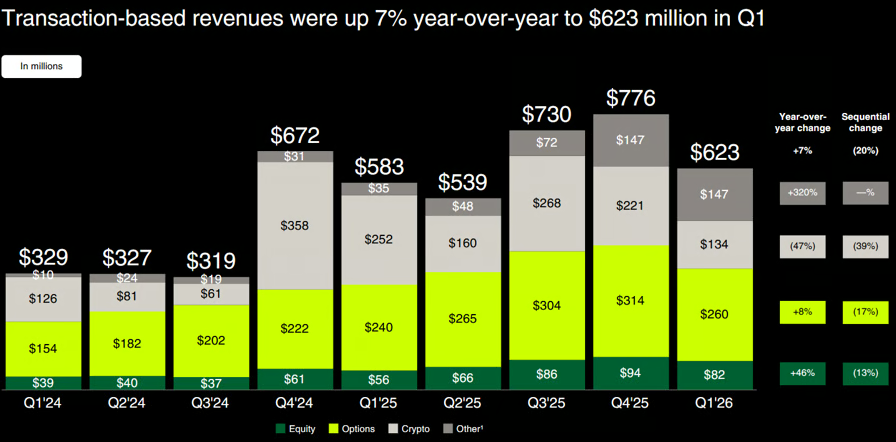
Online trading platform Robinhood fell 9.4% in after-hours trading after its Q1 revenue missed analyst estimates, while crypto revenue and trading volume fell nearly 50% from a year ago.
Robinhood’s crypto transaction revenue fell 47% year-on-year from $252 million to $134 million, while crypto trading volume fell 48% to $24 billion over the same period, according to the company’s Q1 earnings report on Tuesday.
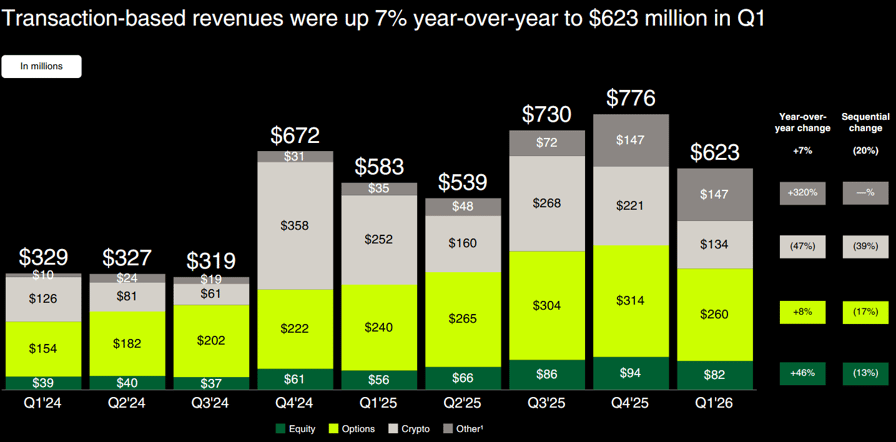
Robinhood’s transaction-based crypto revenue fell for the third consecutive quarter in Q1. Source: Robinhood
Its earnings per share of $0.38 and $1.07 billion in revenue missed industry expectations by 11.6% and 6.1%, respectively, contributing to a 9.4% fall in Robinhood (HOOD) shares. The company still made a profit, with its net income rising 3% year-on- year to $346 million.
Robinhood CEO Vladimir Tenev attributed the crypto revenue and trading volume fall to price swings in the market but added that the company is more focused on building crypto infrastructure and integrating assets that have “real-world utility.”
“Price moves up and down, but what I can tell you is crypto as technology infrastructure is going to be big, and we’re investing,” he said, adding: “We’re at the very beginning of what’s gonna be a tokenization supercycle.”
Robinhood is one of several trading platforms that have used the bear market to expand their blockchain-based offerings in an effort to capture new revenue streams and broaden retail demand.
Robinhood Predictions records best quarter yet
Another one of those offerings is Robinhood Predictions, a predictions market platform integrated through Kalshi, which saw a record 8.8 billion event contracts traded on Robinhood in Q1, marking a 780% increase from Q2 2025 — its first full quarter on the market.
Tenev added that Robinhood Predictions is on track to reach around $3 billion in trading volume for April, a figure that would mark its second-highest month since rolling out the product in March 2025.
Related: Nasdaq files for prediction market-style options on Nasdaq-100
Robinhood Predictions is part of Robinhood’s “other” trading category, which saw its revenue increase 320% year-on-year to $147 million in Q1, helping offset the crypto-related losses.
Not included in the crypto figures was trading activity from Bitstamp, which was acquired by Robinhood in June 2025. The exchange recorded $42 billion worth of trading volume over the quarter, down 13% from Q4 2025.
Magazine: IronClaw rivals OpenClaw, Olas launches bots for Polymarket — AI Eye
Crypto World
Institutional money is coming for bitcoin, but Adam Back says it moves slower than you think


The arrival of Morgan Stanley at the U.S. spot bitcoin ETF party earlier this month was characterized by some observers as the catalyst that will end the current crypto bear market thanks to the massive distribution power of the Wall Street wirehouse’s $8 trillion advisory network.
Not so fast, said Blockstream CEO Adam Back, an early contributor to the Bitcoin community and recently tipped by the New York Times to be the cryptocurrency’s pseudonymous creator, Satoshi Nakamoto, an assertion he denies.
The bitcoin ETFs could be the single most important development of recent times when it comes to positive market signals, more so even than a pro-crypto U.S. administration, Back said, but it takes longer than most people realize. It won’t be immediate.
“I think what people may have miscalculated is that institutional adoption is very slow,” said Back in an interview with Coindesk. “So the ETFs got bought, but when BlackRock is saying they recommend 2% to 4% allocation in their general stock portfolio, the fund managers haven’t done that yet. And they will, but it’s slower than people anticipate.”
Investors don’t just pile in overnight, he said. A build-up could take a year, even 18 months.
“Some of that stuff is just starting to happen, and it will happen slowly. So I think there’s a tailwind.”
Founded in 2014 by Back and other prominent Bitcoin developers, Blockstream offers retail and institutional clients self-custody wallets, layer-2 network settlement and asset issuance. Back is also the CEO and co-founder of BSTR, a bitcoin treasury company looking to go public via a SPAC merger with Cantor Equity Partners (CEPO).
The Trump effect
While ETFs may trump the government for boosting the industry, there’s still a regulatory influence. Consider President Donald Trump’s crypto-friendly term and compare it with the previous administration’s Security and Exchange Commission (SEC) and Chair Gary Gensler’s assault on the industry.
Instead, the U.S. now has a presidency that not only introduced a new legislative framework for crypto, but even launched its own token shop.
“They’ve definitely improved the open-for-business framework in the U.S., which has indirectly encouraged other jurisdictions to do likewise,” said Back, who lives in Malta. “So the U.K.’s FCA [Financial Conduct Authority] finally approved ETFs for retirement accounts and things. And I think maybe one or two other countries. They look at each other.”
While Donald Trump’s America may be open for crypto business, the now-established bitcoin TFs have the power to transcend administrations, whether Republican or Democrat, Back pointed out.
“One of the reasons to suppose the ‘open for business’ is going to stay, even as you get new administrations, is that now Black Rock and the other ETF providers are going to defend their business,” he said.
“They’re going to apply a banking lobby to say they make a lot of money from the bitcoin ETF. We don’t want you to interfere with it. And so I think that now bitcoin has new allies in Black Rock, Morgan Stanley and Fidelity and all these guys.”
Four-year cycle
Another pricing factor to consider is bitcoin’s cyclical nature, a historical pattern driven by the quadrennial halving event, which cuts the supply of new tokens by 50%. The reduction often leads to a relatively consistent bull run followed by a bear market/recovery period.
Even if the four-year cycle is breaking, as some commentators believe, there’s still the reasonable possibility of a price slide happening simply because “people expected it to happen. So they sold and they made it happen,” Back said.
That logic is likely to change only when people see strength in the market, he said. That’s now coming in the form of institutional flows, such as the ETFs, sovereign and sovereign wealth fund investments, and investors buying bitcoin directly or shares in bitcoin treasury companies such as Strategy (MSTR), formerly called MicroStrategy.
“They are growing their ability to buy bitcoin in different market conditions,” Back said. “MicroStrategy, particularly, has been having an accelerated success with their Stretch kind of fixed-income product. So they’ve been able to use that to buy a lot of bitcoin, and it’s escalated even in the last few weeks. So those recurring buyers plus new institutional and wealth management buyers will eventually overwhelm the sellers.”
Strategy’s Stretch (STRC) is a perpetual preferred stock designed as a high-yield, bitcoin-backed income instrument.
Quantum-tative
As well as fielding inquiries about his identity, Back has also been answering a volley of claims about quantum-computing hardware progressing faster than expected and its power to break Bitcoin’s cryptography.
“People are trying to say it’s a factor,” Back said of quantum technology’s effect on the price of bitcoin. “But I think there’s a lot of information asymmetry in these markets, meaning that things which you think are perfectly clear are confusing to some other people, and their uncertainty impacts their decisions.”
That said, the recent round of quantum doomsaying may have institutions paying a bit of attention, Back conceded.
“Institutions are more systematic about risk,” he said. “So if there’s a tail risk, even a small one, they want to know that it’s covered. For retail investors, it sounds like something in the distant future that perhaps they’re not really worried about. But institutions will think a decade ahead and ask, ‘Is this 1% risk? Is there an answer to it?’ They’ll check stuff like that.”


Bitcoin is doing nothing while everything around it moves.
The largest crypto just under $77,000 on Wednesday in Asian hours, up just 0.1% over 24 hours and down 0.8% on the week, holding a tight band even as Brent crude pushed above $111 a barrel on a Wall Street Journal report that President Donald Trump told aides to prepare for an extended U.S. naval blockade of the Strait of Hormuz.
Iran has said the country is in a “State of Collapse,” Trump claimed on Truth Social Tuesday, while Tehran has signaled it may accept an interim deal to reopen the strait if Washington lifts its blockade of Iranian ports.
Ether dropped 2.6% on the week to $2,310. XRP fell 3.8% to $1.39. Solana lost 3.2% to $84.57. BNB shed 2.3% to $625. The exception was dogecoin, up 5.5% on the week to $0.1016, the only top-10 token outside stablecoins to print green over seven days.
Bitcoin’s market dominance is slowly climbing again as a result, which is what tends to happen when macro stress arrives and capital rotates into the largest asset.
Zaheer Ebtikar, founder of Split Research, said in a note that bitcoin’s relative calm was indicative of a change in market strucute.
“The supply overhang has finally dried up, and the sellers who were spooked by macro shifts or quantum fears have already exited, leaving the market much thinner on the sell-side than it was just a few months ago,” he said to CoinDesk over email.
“Bitcoin is far less sensitive to regulatory noise or central bank policy than people think. Its sensitivity is purely a function of wider volatility, and since we’re currently in a quieter trading range, there’s no immediate rush for the exits,” Ebtikar added.
The technical levels are sharper. Analysts at Bitget flagged $75,000 as the line where the upward range that has held since late March breaks, with a clean loss potentially opening room for further downside.
A reversal back toward $80,000 from current levels keeps the rally structure intact and sets up a retest of the resistance that has rejected bitcoin every attempt since February.
The Fed announces its rate decision later on Wednesday, the ECB follows Thursday, and the U.S. equity market sold off Tuesday on growing skepticism about the payoff from artificial intelligence capital expenditure, with Nasdaq 100 futures clawing back 0.4% in Asian hours.
Brent crude whipsawed between gains and losses but stayed elevated near $111 on the blockade reporting, putting renewed pressure on inflation expectations heading into the central bank decisions.
Traders may watch whether bitcoin’s apparent supply exhaustion holds against the next macro shock. If Ebtikar’s read is correct, the seller base that capitulated through March and April is gone, and bitcoin trades on volatility rather than headlines until something forces a fresh leg of selling. If the read is wrong, $75,000 gets tested quickly and the range break Bitget flagged plays out as drawn.

Crypto trading platform OKX has added BlackRock’s BUIDL tokenized US Treasury fund to its collateral framework with Standard Chartered, allowing eligible institutional and VIP clients to use the yield-bearing asset as trading margin while holding it off-exchange with the bank.
The arrangement, announced in a Tuesday release shared with Cointelegraph, lets institutional and VIP clients post BUIDL as collateral held with Standard Chartered while trading on OKX Middle East, or deposit it directly on the exchange. The companies described it as the first globally systemically important (G-SIB) bank-backed off-exchange tokenized collateral framework.
It also adds to a broader industry push to turn tokenized real-world assets into working market infrastructure. By allowing a yield-bearing fund to be used as collateral while remaining in regulated custody, the framework shows how companies are trying to make tokenized cash-like assets more useful in day-to-day trading and risk management.
A key driver behind that shift is a simple inefficiency in how trading capital has traditionally worked. Cash posted as margin on crypto exchanges has typically sat idle, earning little or no yield while still being locked up as collateral. By converting that cash into a tokenized money market fund backed by US Treasuries and repurchase agreements, the structure allows institutions to keep their capital productive even while it is being used to support trading activity.
The framework builds on OKX’s existing collateral mirroring program with Standard Chartered, launched last year to support the exchange’s European expansion. What’s new, Rifad Mahasneh, CEO of OKX Middle East, North Africa and Commonwealth of Independent States, told Cointelegraph, is demonstrating how tokenized assets can be actively used within trading systems rather than held passively.
Related: OKX accelerates US push with BitGo off-exchange settlement
BUIDL is treated as fungible with USD, USDC and other dollar-denominated stablecoins within OKX’s margin system, he said, while clients retain full ownership of the underlying asset and its yield.
OKX targets institutional edge in tokenized collateral
The move deepens OKX’s competition with exchanges like Binance, which has also integrated tokenized treasury products, including BlackRock’s BUIDL and Franklin Templeton’s BENJI fund, into off-exchange collateral frameworks.

OKX adds BlackRock’s tokenized Treasury fund to Standard Chartered custody program: Source: OKX
Mahasneh said the framework is now live for eligible institutional and VIP clients through OKX Middle East, with plans to expand based on jurisdiction and demand.
He described the setup as unique in combining regulated custody, a major asset manager and a G-SIB partner, adding that OKX is “the only global digital asset exchange” to establish this type of framework.
BlackRock’s BUIDL fund, tokenized by Securitize, invests in cash, US Treasury bills and repos, with yield distributed onchain, according to the release.
Standard Chartered serves as the off-exchange custodian, holding client collateral separately from OKX’s own assets while the exchange manages real-time margining and liquidation processes through its internal risk systems, Mahasneh said. He said the structure aligns with traditional finance standards, though he did not detail margin call procedures during market stress.
Magazine: Bitcoin will not hit $1M by 2030, says veteran trader Peter Brandt
Crypto World
Bitbank Enters the Credit Card Market With 0.5% Crypto Cashback on BTC, ETH, and ASTR Rewards
TLDR:
- Bitbank and Epos Card launched Japan’s first crypto-linked credit card on April 27, 2026.
- Cardholders earn a 0.5% crypto cashback monthly, choosing between Bitcoin, Ethereum, or Astar.
- Users can pay monthly card fees directly from their bitbank exchange account using Bitcoin.
- Visa’s Japan president confirmed support, calling it a key step in connecting crypto to daily payments.
Japan’s Bitbank has officially entered the credit card market with a compelling cashback offer. In partnership with Epos Card Co., Ltd., the company launched the EPOS CRYPTO Card for bitbank on April 27, 2026.
The card gives users a 0.5% crypto cashback on all monthly card spending. This move positions Bitbank as a serious player in Japan’s broader consumer financial services space.
A Cashback Model Built Around Crypto Asset Returns
The 0.5% crypto cashback feature sits at the center of this card’s value proposition. Unlike traditional cashback programs that return yen or points, this card rewards users in digital assets.
Cardholders can receive their returns in Bitcoin (BTC), Ethereum (ETH), or Astar (ASTR). The chosen crypto asset is then credited directly to the user’s Bitbank exchange account.
What makes this arrangement particularly practical is the monthly selection flexibility. Users are not locked into one crypto asset for the entire year.
Instead, they choose their preferred return asset each month based on personal preference. This gives cardholders direct control over how they build their digital asset holdings over time.
New members also receive an additional welcome benefit worth 2,000 yen upon signing up. This is awarded on top of the recurring 0.5% crypto cashback program.
Together, both incentives make the card attractive for users already active on the bitbank exchange. Applicants must hold a verified bitbank account to qualify for the card.
Epos Card, the fintech arm of the Marui Group, brings its financial inclusion mission to this partnership. The company has long aimed to provide accessible financial services across all income levels.
Pairing that mission with Bitbank’s crypto infrastructure creates a card that serves both new and experienced crypto holders. The result is a rewards structure designed to lower the barrier to digital asset ownership.
How Bitbank Is Reshaping Japan’s Crypto Payment Landscape
Beyond cashback, the card also allows users to pay monthly fees directly from their bitbank exchange account. This makes it Japan’s first credit card to support crypto asset withdrawals for card payment.
Bitcoin is the only asset currently accepted for this withdrawal function. The BTC is sold at the prevailing market rate at the time the payment is processed.
Users should factor in that crypto price movements can affect the final yen-converted amount. There is also a possibility that insufficient BTC holdings could prevent a payment from going through.
Furthermore, selling crypto assets in Japan may carry tax obligations requiring a formal return. Cardholders are advised to stay informed on the regulatory side of crypto transactions.
Visa Worldwide Japan K.K. President Setan Kitney publicly welcomed the card’s launch with a clear statement of support. “We are pleased to announce that we have taken a new and important step in connecting crypto assets with the everyday payment experience,” Kitney said.
He further added, “We hope that new options such as payments and rewards using crypto assets will become more accessible to more people.” His comments reflect growing institutional confidence in crypto-integrated consumer products across Japan.
Kitney also reaffirmed Visa’s broader commitment to the space. “Visa will continue to work with issuers and other ecosystems to foster innovation and expand access to financial services,” he noted.
This backing from a global payments giant adds credibility to the card’s long-term prospects. It also signals that major financial networks are aligning with the direction both Bitbank and Epos Card are heading.
Looking ahead, both companies plan to widen the card’s supported digital assets and payment options. A commemorative campaign is currently running on Bitbank’s official website for new applicants.

Bitcoin’s recent 20% surge from its February trough traces a clear throughline: the accumulation by Strategy, a Bitcoin treasury firm known for its perpetual preferred stock STRC. In a eight-week window, Strategy’s buying spree appears to have been the single largest driver of the move, according to Bitwise chief investment officer Matt Hougan, who notes that Strategy has added roughly $7.2 billion in Bitcoin over that period. The development comes as ETFs and longtime holders continue to buy, but the STRC-backed buying is shaping the market’s narrative about corporate treasury demand for BTC.
Prices have traded in a tight band around $75,000 to $79,000 over the past week, according to CoinGecko. As of midweek, Bitcoin hovered near $76,500, representing a roughly 21% rebound from its Feb. 6 low of about $62,800. The backdrop is a market that has been cheered by renewed buying from institutional vehicles while retail participation remains a variable in the near term.
Strategy’s growth as a Bitcoin holder stands out in the sector. The firm, already the largest publicly listed corporate holder of Bitcoin, added 3,273 BTC for about $255 million between April 20 and April 26, lifting its total to 818,334 BTC. This level simultaneously eclipses the holdings at BlackRock, which counts roughly 812,300 BTC in custody for its clients. The contribution from STRC-financed buys has become a focal point in the ongoing debate about whether corporate balance sheets can meaningfully move the BTC price higher over sustained periods.
Source: Lookonchain
Key takeaways
- Strategy’s STRC-driven purchases helped inject approximately $7.2 billion of Bitcoin into its balance sheet over eight weeks, elevating its holdings to 818,334 BTC and surpassing BlackRock’s on-record pile.
- The STRC instrument, a perpetual preferred stock yielding 11.5%, is marketed as a financing tool that funds Bitcoin buys with a cushion of more than $40 billion in Bitcoin holdings, making the yield comparatively attractive vs. treasuries or private credit.
- Industry observers expect Strategy’s purchases to continue, supported by ongoing STRC issuance, with the implication that further inflows could push Bitcoin’s supply-demand dynamics further in the near term.
- Analysts speculate about long-run implications, including the possibility that Strategy could match, or even surpass, the holdings attributed to Bitcoin’s creator, Satoshi Nakamoto, should the pace persist and Bitcoin’s price stay supportive.
Strategy’s strategy: STRC, leverage, and the open market
Strategy’s core tactic hinges on STRC, the company’s perpetual preferred stock. The company indicates that proceeds from STRC offerings are deployed to purchase Bitcoin on the open market, effectively using equity-like leverage to expand its BTC reserve. In a market where traditional junk-bond yields can dip below 7% in a rising-rate environment, STRC’s roughly 11.5% yield—backed by a sizable Bitcoin reserve—appears attractive to a segment of investors seeking higher income with Bitcoin risk as a cushion. Hougan has emphasized that STRC’s yield, in the current climate, makes it appealing relative to other fixed-income alternatives and private credit markets that have seen liquidity strains.
Hougan’s remarks came alongside a broader acknowledgement that while ETFs have been supportive—adding $3.8 billion of Bitcoin since March 1—Strategy has been the standout factor behind the rally. He attributes the bulk of recent upside to Strategy’s persistent buying pattern, suggesting that the STRC money stack is a primary driver in the move higher rather than a one-off event.
According to Hougan, “Strategy issues STRC because it wants to buy more Bitcoin. Most of the capital raised by issuing STRC is used to purchase BTC on the open market.” This mechanism has, over time, positioned Strategy as a benchmark for corporate treasury activity in the Bitcoin space, even as skeptics question whether such large, quasi-levered purchases are sustainable from a capital markets perspective.
The company’s disclosure noted that the most recent 2026 tranche included a substantial purchase of 34,164 BTC on a single day in April, while the smallest disclosed buy in 2026 was 855 BTC in February. The wide spread in daily purchases underscores the variability inherent in the STRC funding model and raises questions about how future issuances might calibrate the pace of BTC accumulation for Strategy.
For investors, the central question is whether STRC-driven buying can be sustained at current or higher BTC price levels. Hougan suggested that Strategy could “hypothetically pay existing dividends for 42 years” at current BTC prices, a calculation that assumes cash flows stay intact and Bitcoin remains robust. If Bitcoin appreciates 20% annually, he noted, STRC’s dividend coverage could extend indefinitely. In other words, the enthusiasm around STRC rests on a combination of Bitcoin’s price trajectory and the company’s ongoing access to capital through STRC issuances.
Related coverage has highlighted the broader market interest in Strategy’s approach and how it interacts with the traditional tech-exposed narrative of corporate balance sheet expansion into Bitcoin. The dynamic has drawn attention not only in crypto circles but also among fund managers watching how institutions and high-net-worth groups allocate cash flows to digital assets in a market with relatively limited permanent capital structures for such exposure.
Can Strategy outrun the originator of Bitcoin?
The pace of Strategy’s purchases has sparked intriguing forecasts about long-run ownership milestones. Galaxy Digital’s Alex Thorn posited that if Strategy maintains its current tempo, the firm could exceed the holdings attributed to Nakamoto—the pseudonymous creator of Bitcoin—within about two years. Nakamoto’s wallets are believed to hold around 1.1 billion BTC, roughly 5.5% of the total supply. To reach that level, Strategy would need to accumulate roughly 277,666 additional coins at current prices.
In the market’s current discourse, these projections illustrate a broader trend: a handful of corporate and high-net-worth actors could, in theory, accumulate meaningful share of the supply, potentially exerting a tangible influence on liquidity and price discovery. Yet, the path from billions of dollars in purchases to a multi-billion BTC stake remains contingent on continued access to capital, Bitcoin’s price trajectory, and regulatory developments that may alter the risk profile of such wieldy ownership.
Bitcoin purchases by Strategy have not been uniform in size; the company has demonstrated a willingness to deploy capital in bursts. The record-dollar one-day buy this year—34,164 BTC—was followed by smaller rounds, with 3,273 BTC added in a single week in late April. Market observers caution that while STRC provides a financing mechanism, it does not guarantee a uniform, uninterrupted surge in BTC supply, and that the company’s strategy could evolve as market conditions shift.
To place Strategy’s activity in context, it’s helpful to compare it with public market holders. BlackRock’s Bitcoin Trust, for instance, reported holdings in the vicinity of 812,300 BTC, illustrating that Strategy’s aggregate stake—built through STRC funding—now sits at the top tier of corporate BTC exposure. The ongoing question is whether Strategy’s approach will prove scalable over time or whether it will encounter tighter capital markets dynamics as macro conditions evolve.
It’s also worth noting the broader sentiment towards dividend-based crypto strategies. The dynamic raised by Saylor, who has argued that MicroStrategy could sustain dividends indefinitely if Bitcoin’s price remains favorable, remains a point of reference in investor conversations about the feasibility of long-term, high-yield BTC ownership. The assumption that strategic equity issuance can fund ongoing BTC purchases without eroding capital structure will be tested as markets unfold and as macroeconomic pressures shape financing costs for such vehicles.
As analysts keep their eyes on the next stage of Strategy’s program, the question for readers is simple: will STRC-driven buying continue to be a meaningful tailwind for BTC, or will market conditions require recalibration of the financing approach? With Bitcoin trading around mid-70s thousand levels and the STO’s stableyield narrative in play, the next few months could reveal whether Strategy’s model represents a durable path for institutional demand or a high-water mark in a rapidly evolving ecosystem.
Related data and commentary from Cointelegraph note that Strategy’s Saylor-linked signals and the company’s distinct dividend play have attracted attention from both retail and institutional investors, illustrating a broader appetite for diversified, corporate-backed exposure to Bitcoin. The ongoing discussion underscores the market’s interest in how unconventional financing tools interact with Bitcoin’s supply dynamics and price formation.
Source data and commentary gathered from Bitwise’s CIO memo, CoinGecko price data, and industry analysis cited in the article reflect ongoing market discourse about corporate strategy in crypto asset management. As Strategy’s STRC program evolves, readers should watch for any regulatory commentary on perpetual preferred stock structures tied to crypto purchases and any updates on Strategy’s latest buying cadence and total BTC holdings.
According to Bitwise’s Matt Hougan, Strategy’s STRC-enabled purchases have become the “single biggest factor” driving Bitcoin’s latest rally, reinforcing the idea that corporate treasury strategy can meaningfully influence the market beyond traditional ETF flows and private holdings. The next chapter will reveal whether the STRC model can sustain its pace in a volatile crypto market and how investors will price this continued, strategy-driven risk premium in Bitcoin’s price ecosystem.

Takeaways: Zuccarello’s return provides boost as Wild push Stars to edge

The Secretary Of Health & Human Services Doesn’t Believe In The Foundation Of Modern Medicine

Man United return, second Barcelona loan – Marcus Rashford’s transfer options

Manchester United reach agreement with Casemiro over contract clause amid transfer speculation

US brings back mandatory military draft registration

Steven Gerrard disagrees with Gary Neville over ‘shock’ Chelsea and Arsenal claim | Football

AIR INDIA, INDIGO, SPICEJET SEEK ATF PRICE RELIEF, FINANCIAL ASSISTANCE

28 April | Live Market Analysis for Gold and Crypto | Euro Session

Best Careers After Degree,Finance Edition Don’t Miss This! Best Finance Jobs 2026 !#EducationalVideo
-

 Tech1 day ago
Register Renaming | Hackaday
-

 Fashion4 days ago
Weekend Open Thread – Corporette.com
-
Crypto World3 days ago
Hyperliquid $HYPE Rally Builds Momentum as AI Sector Enters Prove-It Phase
-

 Politics6 days ago
Making troops accountable for war crimes threatens US alliance, ex-SAS colonel warns
-

 Politics6 days ago
Disabled people challenge government SEND proposals over segregation concerns
-

 Business5 days ago
Patterson-UTI Energy, Inc. (PTEN) Q1 2026 Earnings Call Transcript
-

 Business7 days ago
Rolls-Royce Voted UK’s Most Iconic Trade Mark as IPO Register Hits 150
-
 Sports3 days ago
IPL 2026: Ruturaj Gaikwad registers slowest fifty of the season, enters all-time unwanted list | Cricket News
-

 Politics1 day ago
Drax board avoid their own AGM, accused of greenwashing & environmental racism
-

 Politics6 days ago
Zack Polanski responds to home secretary’s taser threat
-
Politics7 days ago
Wings Over Scotland | How To Get Away With Crimes
-

 Politics6 days ago
Starmer handler McSweeney to be dragged from shadows by Foreign Affairs Committee
-

 Politics6 days ago
‘Iran is still a nuclear threat’
-
 Business7 days ago
HCL Tech share price tank over 9% after weak Q4. JPMorgan, HSBC & 3 others cut target price
-

 NewsBeat3 days ago
LK Bennett closes all stores after entering administration
-
 Sports6 days ago
Tim Bradley names the current best in the world: “Better than Inoue and Usyk”
-

 Crypto World5 days ago
Michael Saylor says BTC winter is over. Market analyst disagrees, says bitcoin was in a pullback
-

 Business7 days ago
The Job Benefits Most Men Don’t Know to Negotiate
-
Business6 days ago
Altimmune prices $225 million public offering at $3 per share
-
 Entertainment3 days ago
Mariah Carey Slams Deposition Claims In Brother’s Lawsuit
You must be logged in to post a comment Login