
Crypto World
Galaxy Digital posts $216M Q1 loss as crypto slump hits, data centers switch on



The CFTC is turning to artificial intelligence and a new Innovation Task Force to police explosive crypto and prediction markets as its workforce shrinks and jurisdictional battles over event contracts intensify.
Summary
- Galaxy Digital reported a Q1 2026 net loss of $216 million, or diluted EPS of $(0.49), as a roughly 20% drawdown in digital asset prices erased mark‑to‑market gains.
- The firm said sequential losses narrowed and confirmed that its Data Centers division generated revenue for the first time, in line with earlier guidance that the business would switch on in early 2026.
- Management framed the quarter as a pivot toward AI‑driven infrastructure, pointing to its Helios campus in Texas and long‑term contracts that it expects will underpin multi‑billion‑dollar revenue streams over the coming decade.
Galaxy Digital (Nasdaq: GLXY) swung to a Q1 2026 net loss of $216 million, as a roughly 20% decline in digital asset prices during the quarter pulled the crypto‑focused financial services firm into the red despite growing fee and infrastructure revenue.
In its earnings release, the company reported diluted earnings per share of $(0.49) and said “the decline in token prices and unrealized losses on balance sheet positions more than offset operating income” across trading, asset management, and principal investments.
Management stressed that the loss narrowed compared with the prior quarter and argued that the business mix is becoming less sensitive to crypto price swings. “While digital asset volatility continues to impact our reported net income, our core operating businesses remain resilient, and we are executing on a strategy that diversifies our revenue base,” Galaxy said in its shareholder letter.
The firm pointed to its Digital Assets segment — spanning trading, lending, asset management, and staking — which generated hundreds of millions of dollars in adjusted gross profit over 2025, even as full‑year net income was negative.
Last year Galaxy posted a $241 million net loss for 2025, but adjusted EBITDA of $216 million and a stock price that jumped more than 11% after the annual report underscored that investors were willing to look through non‑cash marks.
Data Centers start to earn as Helios ramps
The first quarter also marked a structural shift: Galaxy’s Data Centers division booked revenue for the first time, reflecting the initial commercialization of its Helios AI campus in West Texas.
“We anticipate revenue from our data center business to commence in the first half of 2026,” management had said on a prior earnings call, a timeline that Q1’s results suggest the company is now meeting.
Helios, which Galaxy has described as a “multi‑hundred‑billion‑dollar digital infrastructure opportunity,” has secured more than 1.6 gigawatts of approved capacity and a long‑term contract with AI cloud provider CoreWeave that is expected to generate over $1 billion in annual revenue at full ramp.
Galaxy recently closed a $1.4 billion project financing facility to fund the site’s initial retrofit and expansion, positioning the firm less as a pure crypto trading proxy and more as a hybrid of digital assets bank and AI infrastructure play.
CEO Mike Novogratz has argued that this pivot gives Galaxy a durable earnings engine that is less correlated to bitcoin and altcoin prices, even if quarterly results like Q1’s still reflect the sector’s boom‑bust dynamics.
For investors, the tension between a $216 million reported loss and the first trickle of data center revenue underlines the central question around GLXY: how quickly Helios and related projects can scale to outweigh crypto market drawdowns in the income statement.


Robinhood’s shares slid 9.4% in after-hours trading after its first-quarter results failed to meet consensus estimates, with crypto revenue and trading volume trending materially lower year over year. The results underscore how a sluggish crypto environment continues to weigh on the platform, even as the company doubles down on infrastructure investments and new product lines.
In the quarter, Robinhood reported crypto transaction revenue of $134 million, down 47% from $252 million a year earlier, while crypto trading volume declined 48% to $24 billion. The firm posted earnings per share of $0.38 and revenue of $1.07 billion, both modestly below analysts’ expectations, contributing to the after-hours stock pullback. Net income rose 3% year over year to $346 million, reflecting strength elsewhere in the business during a challenging crypto cycle.
According to the company’s Q1 earnings report, the declines in crypto revenue and activity were largely tied to broad price swings in the crypto markets. Yet Robinhood’s leadership remains focused on longer-term bets around crypto infrastructure and assets with real-world utility. CEO Vladimir Tenev framed the current softness as a transitory phase within a broader shift toward more foundational crypto technologies, saying, “Price moves up and down, but what I can tell you is crypto as technology infrastructure is going to be big, and we’re investing. We’re at the very beginning of what’s gonna be a tokenization supercycle.”
Robinhood is among several retail trading platforms using the bear market to broaden their blockchain portfolios and diversify revenue beyond traditional stock trading. The company has positioned itself as a developer of crypto infrastructure while expanding into tokenized and prediction-based offerings that aim to broaden user engagement and utility on the platform.
Key takeaways
- Crypto transaction revenue declined 47% year over year to $134 million, and crypto trading volume fell 48% to $24 billion in Q1, reflecting ongoing market headwinds.
- Overall Q1 results missed market expectations: earnings per share of $0.38 and revenue of $1.07 billion were below consensus by about 11.6% and 6.1%, respectively, while net income rose 3% to $346 million.
- Robinhood’s Predictions market, operated through Kalshi, traded 8.8 billion event contracts in Q1, up 780% from the previous year’s period as the platform prompts higher engagement with forecast-based trading.
- The company’s broader “other” trading category surged, rising 320% year over year to $147 million, helping offset crypto-related softness. Bitstamp, Robinhood’s acquired exchange, generated $42 billion in trading volume in Q1, though this was down 13% from Q4 2025.
Predictions platform anchors growth expectations
Robinhood’s foray into prediction markets—through a platform tied to Kalshi—illustrates the company’s pivot toward diversified revenue streams that leverage its existing retail base. The Q1 data show robust activity on the predictions frontier, with an implied trajectory of higher trading volumes in the near term. Tenev signaled ambition for continued growth in this area, suggesting that the product could become a more meaningful contributor to overall platform activity as users experiment with event-based contracts and forecast markets.
In a separate note, Robinhood projected that April trading volume for the Predictions product could reach around $3 billion, a figure that would mark a strong month relative to its rollout in March 2025. The momentum in this segment underscores how the company is attempting to balance crypto-related declines with non-crypto revenue streams that leverage its large retail audience.
Bitstamp and the revenue mix
Notably, Bitstamp’s activity is not included in the crypto revenue line, even though the exchange represented a material portion of Robinhood’s crypto footprint since its acquisition in June 2025. Bitstamp reported $42 billion in trading volume for the quarter, representing a 13% drop versus the previous quarter. The inclusion of Bitstamp’s data in overall platform results highlights how the company’s crypto ambitions extend beyond on-site retail activity to more institutional-grade and cross-product infrastructure.
Meanwhile, the “other” trading category—encompassing products such as Robinhood Predictions—posted a strong 320% year-over-year surge to $147 million in Q1. This counterbalancing strength points to a broader strategy: reduce reliance on the volatility-prone crypto economy by building complementary products that appeal to a wide retail audience seeking diverse ways to trade and speculate.
Strategy in a bear market: infrastructure, utility, and tokenization
Robinhood’s leadership has repeatedly framed crypto as a foundational layer—an infrastructure bet rather than a pure retail trading play. In the current environment, with crypto prices moving irregularly and volatility subdued relative to peak cycles, the company is leaning into product areas that could drive structural growth over the long horizon. The tokenization narrative referenced by Tenev points to a broader industry shift—from spot trading and speculation to the securitization and digitization of traditional assets, financial products, and even everyday commodities.
For investors, the development signals a potential shift in how Robinhood monetizes its platform. While crypto revenue remains sensitive to market cycles, growth in Predictions and other trading products could offer steadier upside and broaden the company’s addressable market. The challenge will be sustaining user adoption and converting elevated engagement in these new products into durable revenue, especially as regulatory interpretations of tokenization and prediction markets continue to evolve.
What the numbers imply for Robinhood’s roadmap
The Q1 results illustrate a company navigating a bifurcated landscape: crypto economics that are still recovering from a cyclic downturn and non-crypto offerings that are growing rapidly enough to offset some of the weakness. The combination of crypto softness with strong performance in non-crypto trading lines suggests that Robinhood’s multi-product strategy could help stabilize revenue over time, even as it remains exposed to the volatility of the crypto market.
As the company continues to invest in crypto infrastructure—while pursuing real-world utility assets—the path forward will likely hinge on three levers: the pace of user adoption for tokenization and related services; the scalability and profitability of the Predictions platform and other non-crypto products; and the ability to integrate Bitstamp’s activity into a cohesive, compliant revenue engine that complements retail trading activity.
Readers should watch for follow-up cues in the next earnings cycle regarding user growth in non-crypto products, changes in crypto usage as market conditions evolve, and any regulatory developments that might influence tokenization and prediction-market offerings. The evolving balance between riskier crypto revenue and more diversified income streams will shape Robinhood’s trajectory as it extends its reach beyond a single asset class into a broader, multi-product fintech platform.


Bitcoin (BTC) has remained relatively resilient amid ongoing geopolitical tensions, with its price broadly trending higher since late February.
According to Bitwise CIO Matt Hougan, MicroStrategy has emerged as a standout contributor to the recent rally due to its continued large-scale Bitcoin purchases.
MicroStrategy’s STRC Shares Are the Real Engine Behind Bitcoin’s Rally
In a memo published Tuesday, Hougan acknowledged that several forces have contributed to Bitcoin’s recent climb. He pointed to strong ETF inflows of $3.8 billion since March 1 and a wave of fresh accumulation from long-term holders.
Still, he argued that Strategy has “been the single biggest factor.” The firm snapped up $7.2 billion in Bitcoin over the last eight weeks.
“Bitcoin is up roughly 20% from its February lows, trading around $76,000. Everyone is wondering if the rally can continue. To a large degree, the answer lies with Strategy,” the executive wrote.
The firm now holds 818,334 BTC, sitting 181,666 coins short of 1 million. Galaxy Research head Alex Thorn projects that MicroStrategy could overtake Satoshi Nakamoto’s estimated 1.1 million BTC stash within two years if the current pace continues.
Follow us on X to get the latest news as it happens
Why Bitwise CIO Thinks Strategy’s STRC Buying Is Far From Over
Hougan pointed out that MicroStrategy has bankrolled this buying spree by selling STRC. BeInCrypto also highlighted in a recent report that, so far in 2026, Strategy’s STRC has financed 10x more BTC buying than the entire US spot ETF market combined.
Hougan expects Strategy to keep leaning on STRC as a funding vehicle. He argued that STRC’s 11.5% payout looks compelling in a market where junk bonds offer under 7%, and capital is rotating out of private credit. With a Bitcoin cushion exceeding $40 billion, he sees plenty of appetite for more.
“The number I’d watch is Strategy’s total obligations (debt + preferred equity) as a percentage of its bitcoin holdings. Today, that sits at 33%: $21 billion in obligations against $63 billion in bitcoin. If that number pushes toward 50%, I think investors will start asking questions. But at today’s bitcoin prices, that still gives room for another $10-$15 billion in STRC issuance. And more if bitcoin rallies,” Hougan added. “I don’t think we’re done STRC-ing at all.”
That said, STRC hasn’t escaped scrutiny. Economist Peter Schiff has been among the critics, warning that Strategy’s Bitcoin-backed yield model is on a path toward a death spiral.
Subscribe to our YouTube channel to watch leaders and journalists provide expert insights
The post Bitwise CIO Reveals the Hidden Force Behind Bitcoin’s 20% Rebound appeared first on BeInCrypto.


Google has entered into an agreement with the U.S. Department of Defense to provide its artificial intelligence models for use on classified systems.
Summary
- Google signed a Pentagon deal to deploy AI models on classified networks for “any lawful government purpose,” joining OpenAI and xAI in defense contracts.
- The agreement includes limits against domestic surveillance and autonomous weapons without human oversight, but gives the Pentagon final authority over operational use.
- Tensions persist as Anthropic resists loosening safeguards; despite being labeled a supply-chain risk, its advanced AI tools are still being used by agencies like the NSA.
According to The Information, citing a person familiar with the matter, the Pentagon can deploy Google’s AI tools for “any lawful government purpose” under the terms of the deal. The arrangement places Google alongside OpenAI and xAI, both of which have also secured contracts to supply AI models for classified use.
Such classified networks support highly sensitive operations, including mission planning and weapons targeting, where access to advanced AI systems is increasingly seen as critical.
The agreement is part of a wider push by the Pentagon, which in 2025 signed contracts worth up to $200 million each with leading AI developers, including Anthropic, OpenAI, and Google. Earlier reporting from Reuters indicated that defense officials had been urging AI firms to make their systems available on classified networks without the usual user-facing restrictions.
AI safeguards and usage restrictions
As part of the contract, Google is expected to assist in modifying its AI safety filters at the government’s request, the report said.
The agreement includes explicit safeguards stating that “the AI System is not intended for, and should not be used for, domestic mass surveillance or autonomous weapons (including target selection) without appropriate human oversight and control.”
At the same time, the terms clarify that Google does not have the authority to “control or veto lawful government operational decision-making,” leaving final use decisions in the hands of defense officials.
Google said it continues to support government agencies across both classified and unclassified work. A company spokesperson added that it remains aligned with the view that AI should not be used for domestic mass surveillance or autonomous weapons without human oversight.
Friction over AI usage boundaries
The Pentagon has maintained that it does not intend to deploy AI for mass surveillance of Americans or for fully autonomous weapons, while still insisting that “any lawful use” of AI should remain available to the government.
That position has created friction with some AI providers, most notably Anthropic. The company resisted earlier Pentagon demands to remove safeguards from its Claude models that restrict use in autonomous weapons and domestic surveillance.
The dispute escalated to the point where the Defense Department labeled Anthropic a “supply chain risk,” even as interest in its technology persisted within government agencies.
Additional reporting suggests that internal demand has complicated the Pentagon’s stance. The National Security Agency has reportedly secured access to Anthropic’s advanced “Mythos Preview” model despite the designation. The model, known for its strong cyber capabilities, is being used by select organizations to identify vulnerabilities in digital systems.
The situation has led to a broader standoff between AI developers and defense officials over how far usage rights should extend, especially around the scope of “all lawful purposes” and the limits of safety guardrails in military environments.

The US Commodity Futures Trading Commission on Tuesday sued the state of Wisconsin in the agency’s latest effort to assert jurisdiction over prediction markets after the state sued multiple platforms.
The CFTC said in a statement that it filed the lawsuit against Wisconsin “in response to the state’s lawsuits against Kalshi, Polymarket, Crypto.com, Robinhood, and Coinbase, five CFTC-regulated prediction markets.”
“States cannot circumvent the clear directive of Congress,” CFTC Chairman Michael Selig said. “Our message to Wisconsin is the same as to New York, Arizona, and others: if you interfere with the operation of federal law in regulating financial markets, we will sue you.”
It is the agency’s fifth lawsuit against a US state that seeks to halt action against prediction markets. The CFTC sued New York on Friday and filed lawsuits against Arizona, Connecticut, and Illinois earlier this month after the states sued prediction market platforms.

Michael Selig speaking on stage at Bitcoin 2026 in Las Vegas on Monday. Source: YouTube
Wisconsin sued the five companies on Thursday, and like many US state authorities, argued that prediction markets offering sports-related event contracts are illegal betting that requires state gaming licenses.
It is an assertion the platforms and the CFTC have rebuffed in the past, arguing the contracts are regulated only under federal law.
The CFTC argued in its latest complaint, filed alongside the Justice Department’s Civil Division in a Wisconsin federal court, that it has “exclusive jurisdiction” over the event contracts on prediction markets, regulated as designated contract markets under federal law.
Related: With no bipartisan leadership, CFTC won’t ‘slow down‘ on rulemaking
“Wisconsin’s attempt to criminalize and shut down federally regulated markets intrudes on the exclusive federal scheme Congress designed to oversee national swaps markets,” the CFTC wrote in its complaint.
The agency asked the court to rule that state gambling laws do not apply to CFTC-regulated designated contract markets and issue a permanent injunction prohibiting Wisconsin from taking action against prediction markets.
The CFTC’s complaint also named Wisconsin Governor Anthony Evers, Wisconsin Attorney General Josh Kaul and the Wisconsin Gaming Division and its administrator, John Dillett.
The Wisconsin Department of Justice, the state’s Division of Gaming and Governor Evers’ office were contacted for comment.
Magazine: How to fix suspected insider trading on Polymarket and Kalshi
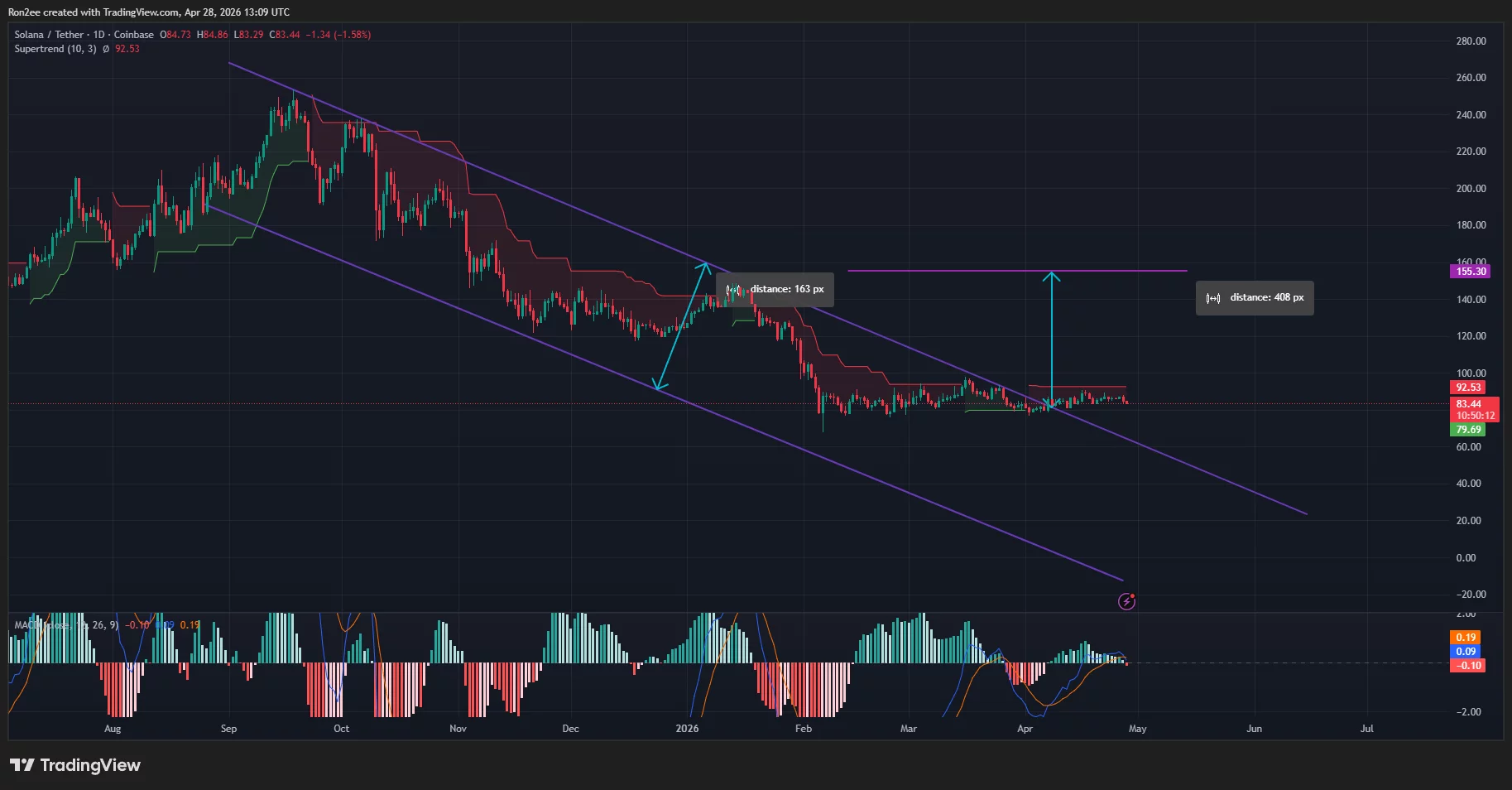
Solana price has been consolidating within the $75-$100 range since early February this year. Now, a confirmed breakout from a descending parallel channel puts the asset in a position to challenge higher resistance levels after months of sideways movement.
Summary
- Solana price fell nearly 8% from $90.3 to $83 amid profit taking and macro uncertainty, down about 33% year-to-date despite holding a $75–$100 range since February.
- A breakout from a multi-year descending parallel channel signals a potential trend shift, with upside targets projected near $155.
- Short-term indicators remain cautious, with a bearish MACD crossover and red supertrend, while an $8M institutional-backed share sale supports the bullish outlook.
After climbing to a month high of $90.3 on April 17, Solana (SOL) price fell nearly 8% to $83 amid profit taking by investors and a broader rotation away from risk assets amid concerns over stalled U.S.-Iran peace negotiations and rising oil prices. The 7th largest token has fallen nearly 33% so far since the beginning of this year.
Despite this significant drop, its charts have now flashed a bullish signal for the medium term.
On the daily chart, Solana price has broken out of a multi-year descending parallel channel from mid-September last year. A breakout from such a pattern has historically led to a shift in market sentiment from bears back to bulls.
In Solana’s case, the breakout positions Solana for a steady upside in the coming weeks with a potential rally to as high as $155, a level calculated by adding the height of the channel to the point of breakout.
However, other technical indicators suggest some caution ahead of the next leg higher. Notably, the supertrend has flipped red, which means the immediate short-term trend remains under selling pressure.
At the same time, the MACD lines have formed a bearish crossover, which has often been the precursor to further consolidation before a sustained move upward.
Meanwhile, a major bullish catalyst for the ecosystem is that Solana Company recently raised $8 million through a share sale to global institutional investors like Mirae Asset and HashKey Capital.
The development allows the digital asset treasury to significantly expand its holdings by purchasing additional SOL tokens directly from the market, providing a solid foundation of institutional demand.
Disclosure: This article does not represent investment advice. The content and materials featured on this page are for educational purposes only.


Private companies are gradually moving past the early stages of experimenting with artificial intelligence, with many larger firms now beginning to report measurable returns from their investments.
Summary
- 64% of private firms with $500M+ revenue report moderate to strong AI ROI, compared with 11% of smaller firms.
- 52% of leaders rank expanding AI use as a top priority, while 63% are actively investing beyond pilot stages.
- Data quality (72%), talent gaps (53%), and scaling challenges (48%) remain key barriers despite rising adoption.
According to a new survey by Deloitte, nearly two-thirds (64%) of private companies with an annual revenue of $500 million or more have achieved moderate to significant return on investment (ROI) from AI initiatives. This marks a sharp contrast from smaller firms, where only 11% reported such levels of returns.
The findings also bring to light a broader shift in how private companies are now approaching AI. More than half (52%) of the business leaders surveyed said that expanding AI use across their organizations is now a top-three priority for the next 12 months, a figure that has gone up significantly from 22% a year earlier.
At the same time, 63% of respondents said their organizations are actively investing in digital transformation initiatives, including AI, compared with 33% that remain in limited or pilot stages.
Scaling efforts and key challenges
Larger firms have been leading the charge in deployment. About 74% of higher revenue companies reportedly said they are expanding AI across select functions, compared with 38% of smaller firms.
The main business priorities driving this push are revenue growth at 71% and improved productivity at 62% as companies look to automate complex workflows.
Funding for these initiatives is largely coming from internal sources. Half of those surveyed said budget reprioritization will be their primary funding method, followed by existing operating capital at 43%.
Despite the progress, significant roadblocks still hinder full-scale implementation. Data quality and availability were cited as the biggest challenges by 72% of respondents. Other issues include gaps in AI skills and leadership (53%), integration with legacy systems (48%), and difficulty scaling projects beyond the pilot stage (48%).
The survey also found uneven oversight at the board level. While boards are generally active in areas such as technology investment and cybersecurity, fewer respondents said they are proactive in monitoring the ethical use of AI or leadership readiness for digital transformation.
The findings are based on a March 2026 survey of 100 U.S. private company leaders, including senior executives and board members.
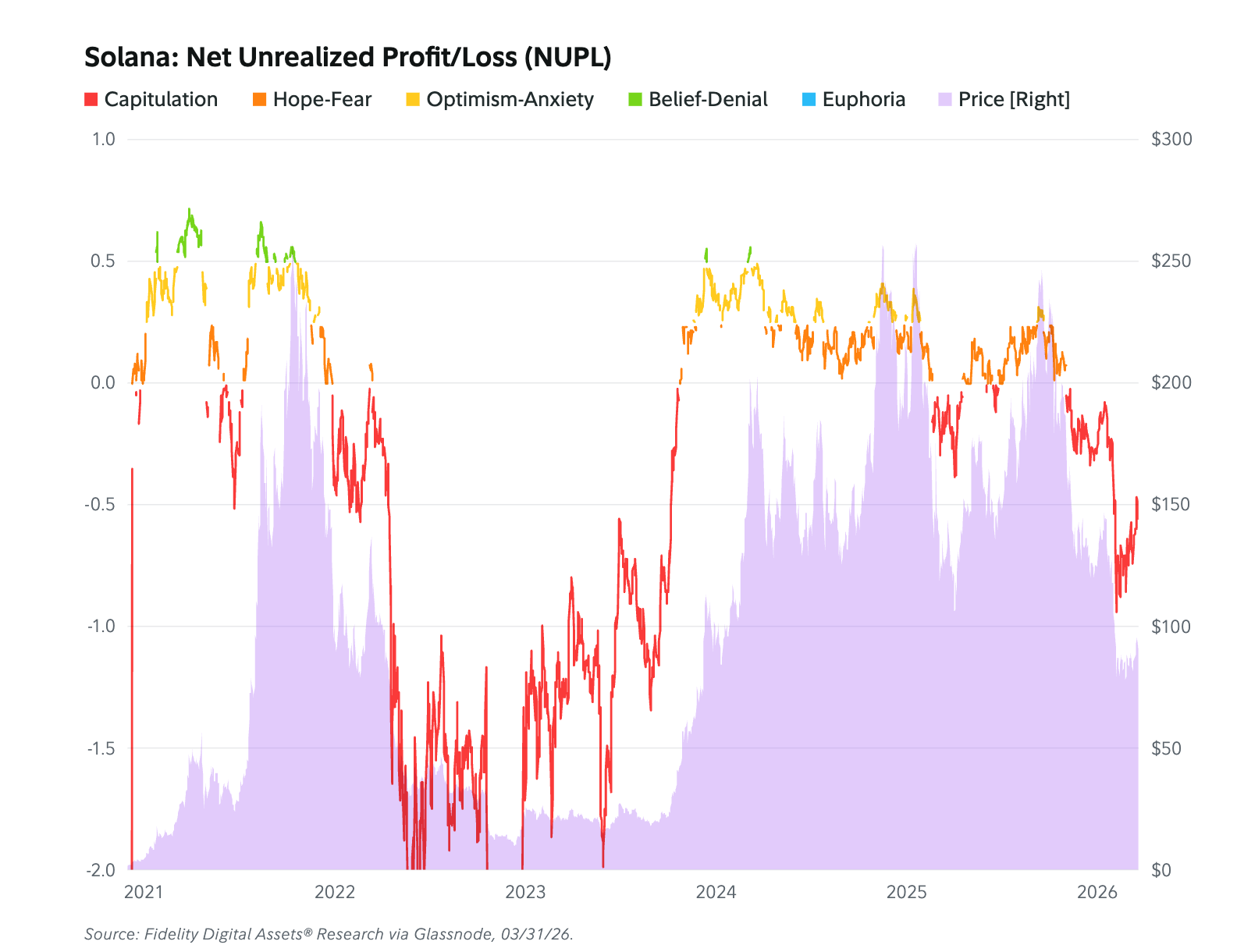
Solana (SOL) has fallen about 71% from its 2025 all-time high. Amid this price decline, holders are sitting on significant unrealized losses, according to Fidelity Digital Assets’ Q2 2026 Signals Report.
The downturn is reflected in the Net Unrealized Profit/Loss (NUPL) metric, which has dropped to -0.67. The level has been associated with a 516% median one-year return, though Fidelity cautioned that the pattern may not repeat.
Fidelity Flags Bullish Solana Setup, Warns Pattern May Not Repeat
In Q1 2026, Solana’s NUPL score collapsed 148%, falling from -0.27 to -0.67 as the price dropped 33%. The reading sits deep in what Fidelity describes as the “Capitulation” zone.
“There are tentative signs of stabilization. The NUPL score has rebounded 29% from its early February bottom of -0.94, which may have marked a capitulation point for investors unwilling to absorb increasing losses. However, downside risk remains, and the formation of a new bottom cannot be ruled out,” the report read.
Follow us on X to get the latest news as it happens
The firm highlighted that periods when SOL’s NUPL traded near -0.67 have aligned with a median one-year return of 516%. The three-year compound annual growth rate at that level was 62%.
However, Fidelity cautioned that the forward-return data is based on only 10 historical observations for the one-year window and 6 for the three-year window. This highlights both Solana’s relatively short track record and the “extreme nature of this metric’s current value.”
The report also found that the correlation between current NUPL levels and future returns remains weak. Specifically, the relationship with one-year forward returns is zero, while the three-year correlation is -0.16, indicating a weak inverse relationship over longer periods.
This limited and inconsistent relationship aligns with Fidelity’s broader view that lower NUPL levels are “generally more positive.” Still, the firm emphasized that past patterns may not hold going forward.
“Importantly, the historical relationship between SOL’s NUPL score and forward returns may not persist,” Fidelity said.
Solana Network Activity Tells a Different Story
Despite the price weakness, Solana network usage has accelerated. Monthly active addresses rose 50% in Q1 2026, and new addresses jumped 35%.
“Solana usage has surged even amidst the downturn in asset price. This showcases Solana as a growing financial ecosystem with users transacting at an elevated rate even when volatility is high,” the report added.
Stablecoin activity also held up. The 30-day average transfer value climbed roughly 8% to $7.2 billion across the quarter.
Fidelity reads the divergence as evidence of “a strong and less cyclical user base,” suggesting Solana may be transitioning away from its meme coin-driven identity toward “more mainstream, sustainable financial activity.”
Subscribe to our YouTube channel to watch leaders and journalists provide expert insights
The post Fidelity Flags 516% Solana Rebound Signal With One Major Caveat appeared first on BeInCrypto.
Disclosure: This article does not represent investment advice. The content and materials featured on this page are for educational purposes only.
XRP gains institutional attention as ETF inflows and market demand reshape crypto investment strategies.
Summary
- XRP Power gains attention as investors seek stable crypto returns backed by green energy and compliance-focused design.
- Rising XRP interest and Bitcoin ETF inflows push platforms like XRP Power into focus for diversified crypto income.
- The platform combines green energy infrastructure, audits, and compliance frameworks to support stable return strategies.
Amidst Wall Street’s continued increase in crypto asset allocation, Bitcoin ETF inflows have surpassed $21 billion, signifying an unprecedented influx of mainstream capital into this market.
However, what truly ignites a new wave of market imagination is not just Bitcoin itself, but the long-undervalued XRP. With a gradually clear regulatory environment, surging demand for cross-border payments, and growing institutional interest, XRP is transitioning from a “fringe asset” to a potential core allocation target.
In this trend, more and more investors are seeking strategies that can capture market growth while also providing risk hedging capabilities. For example, digital asset service platforms like XRP Power are offering users relatively stable participation paths through diversified product design and profit mechanisms, allowing them to achieve stable returns even in a volatile market environment.
This combination of “growth + stability” may be the key to the next stage of competition in the crypto market.
Why choose XRP power for stable returns?
Regarding return sources, XRP Power utilizes a recycling mechanism based on green energy infrastructure (such as wind and hydropower) to provide continuous power support for system operation, thereby enhancing overall stability and efficiency. This model, combining physical energy and digital assets, helps enhance the sustainability and resilience of returns in volatile market environments.
In terms of security and compliance, XRP Power is headquartered in the UK and operates within a framework that references the EU’s MiCA (Crypto-Asset Market Regulation) and MiFID II (Markets in Financial Instruments Directive II), striving to align with international standards in transparency and investor protection. Furthermore, the platform incorporates a third-party guarantee mechanism; user assets are insured by Lloyd’s of London and undergo regular independent audits by PwC to enhance asset security and operational transparency.
Through this multi-layered structure of “underlying asset support + compliance framework + third-party audits,” the platform aims to build a relatively robust and sustainable return environment for users.
How to join XRP Power and start earning
1. Register an Account and Receive a New User Bonus
2. Choose a Suitable Earnings Plan
The platform offers various earnings contracts ranging from $100 to $100,000. Different contracts correspond to different earnings structures and periods, allowing users to flexibly choose according to their capital and risk tolerance.
3. Pay and Activate the Contract
Payment is supported through various mainstream digital assets, including USDT, USDC, Bitcoin, Ethereum, and XRP. The process is convenient, and funds arrive quickly.
4. Contract Activation and Earnings
After contract activation, the system will begin calculating earnings based on the selected plan and settle daily. Earnings will be automatically credited to your account balance. Users can choose to withdraw at any time or reinvest to increase potential earnings.
5. Popular Profit Contracts
Investment Amount: $1000 Investment Period: 7 days Daily Yield: $13.20 Total Profit: $92.40
Investment Amount: $5000 Investment Period: 15 days Daily Yield: $70.50 Total Profit: $1057.50
Investment Amount: $10000 Investment Period: 20 days Daily Yield: $153 Total Profit: $3060
Click to view daily profit details for different contracts.
6. The platform also offers user referral and team incentive programs to further enhance the diversity of profit opportunities. Users can earn long-term profit-sharing rewards by inviting friends to join the platform: enjoying a multi-tiered incentive structure of up to 3% + 2%, with increased potential profits from more referrals.
When a team reaches a certain size (e.g., more than 10 active members), users can unlock an additional monthly team reward mechanism, receiving more incentives based on the team’s overall performance.
This mechanism aims to encourage users to achieve both personal gains and team growth through sharing and collaboration, while simultaneously building a more active community ecosystem.
Summary
Since its launch in 2023, the XRP Power platform has expanded its business to 189 countries and regions worldwide, serving a continuously growing user base and gradually establishing its influence in the digital asset yield management field. The platform focuses on “user asset security and yield experience,” continuously improving its overall service capabilities through technological and mechanism optimization.
In terms of architectural design, XRP Power incorporates decentralized technology, ensuring key data is recorded on-chain and publicly verifiable, enhancing transparency and verifiability, allowing users to more clearly understand asset operations and yield sources.
Regarding the yield model, the platform strives to maintain relatively stable yield performance in different market environments through diversified strategies and risk mitigation mechanisms. Even in situations of increased market volatility, it is committed to providing users with continuous yield opportunities, rather than solely relying on market upturns.
For more details, please visit the official website.
Disclosure: This content is provided by a third party. Neither crypto.news nor the author of this article endorses any product mentioned on this page. Users should conduct their own research before taking any action related to the company.
The April 29 FOMC decision lands with a 99% probability of a rate hold, but on-chain data shows crypto whales are not waiting for Powell’s tone to start positioning.
BeInCrypto analysts have identified three tokens seeing decisive whale accumulation in the hours before the meeting, each driven by a distinct logic. One rides a fresh exchange listing into pre-FOMC liquidity flows. Another tracks a steady inverse pattern toward a 17% breakout. The third is being absorbed quietly through a supply-shock window.
Onyxcoin (XCN)
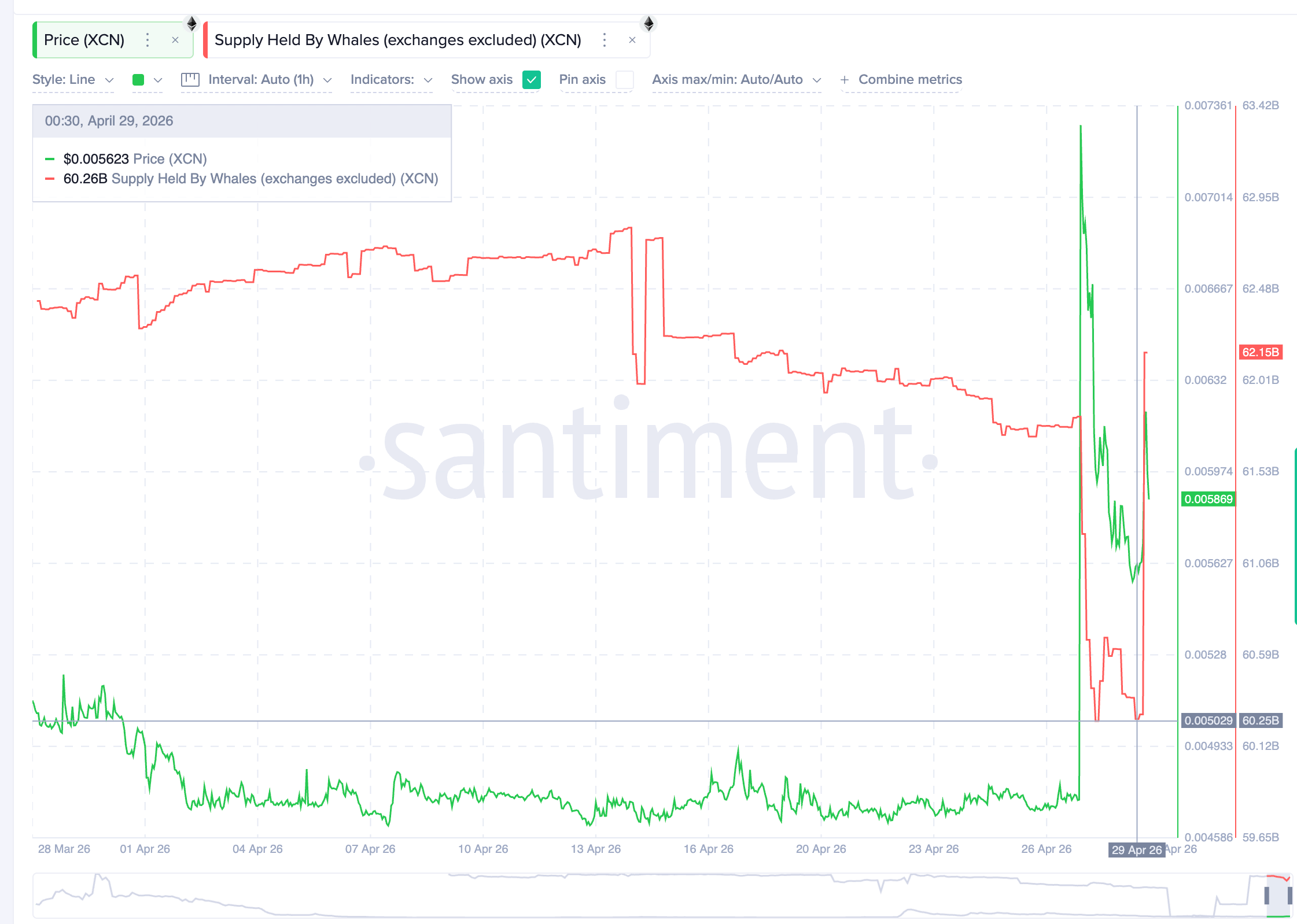
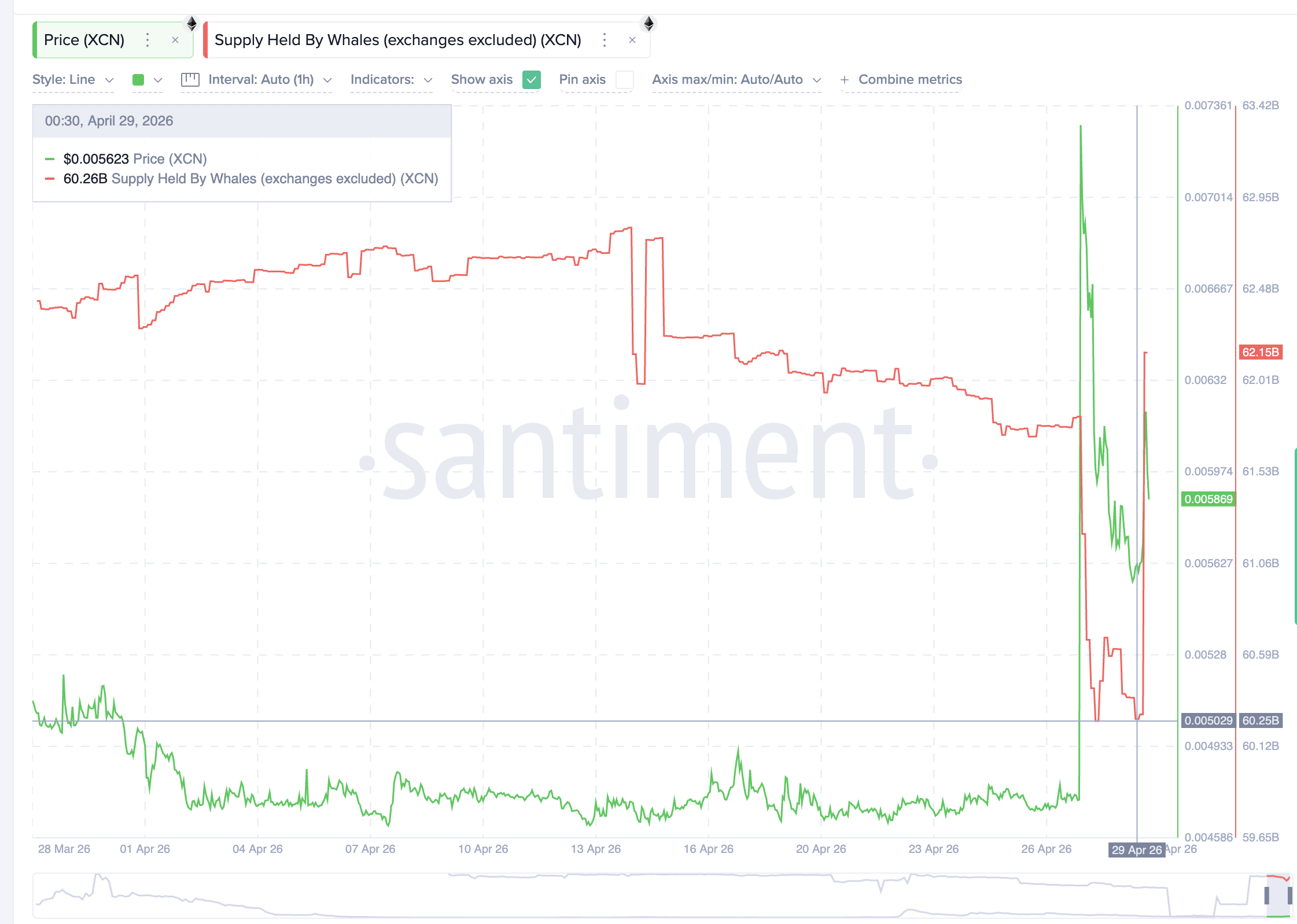
Onyxcoin (XCN) trades at $0.0058, up 3.15% on the session, after a 64% spike to $0.0086 on April 27 following Upbit’s listing announcement. The South Korean exchange opened KRW and USDT pairs at 07:00 UTC, sending daily volume up 629% to $37 million.
Whale activity tells the more interesting story for the FOMC angle. Crypto whale wallets distributed aggressively into the listing rally, with Santiment’s supply-held-by-whales metric falling between April 26 and April 28.
Want more token insights like this? Sign up for Editor Harsh Notariya’s Daily Crypto Newsletter here.
That distribution has now reversed. Whale accumulation has lifted the metric back to 62.15 billion XCN in the hours before the April 29 FOMC decision, recovering nearly 1.9 billion tokens. The timing matters because the broader crypto market is up at press time as traders rotate out of the S&P 500 ahead of Powell’s press conference. Whales appear to be positioning XCN as a beneficiary of pre-FOMC liquidity flowing into altcoins.
The chart confirms the bullish read. Between October 8 and April 28, the daily Relative Strength Index (RSI), a momentum indicator that measures price strength on a 0-100 scale, printed a higher low while price printed a lower low. That bullish divergence is the technical foundation whales appear to be banking on.
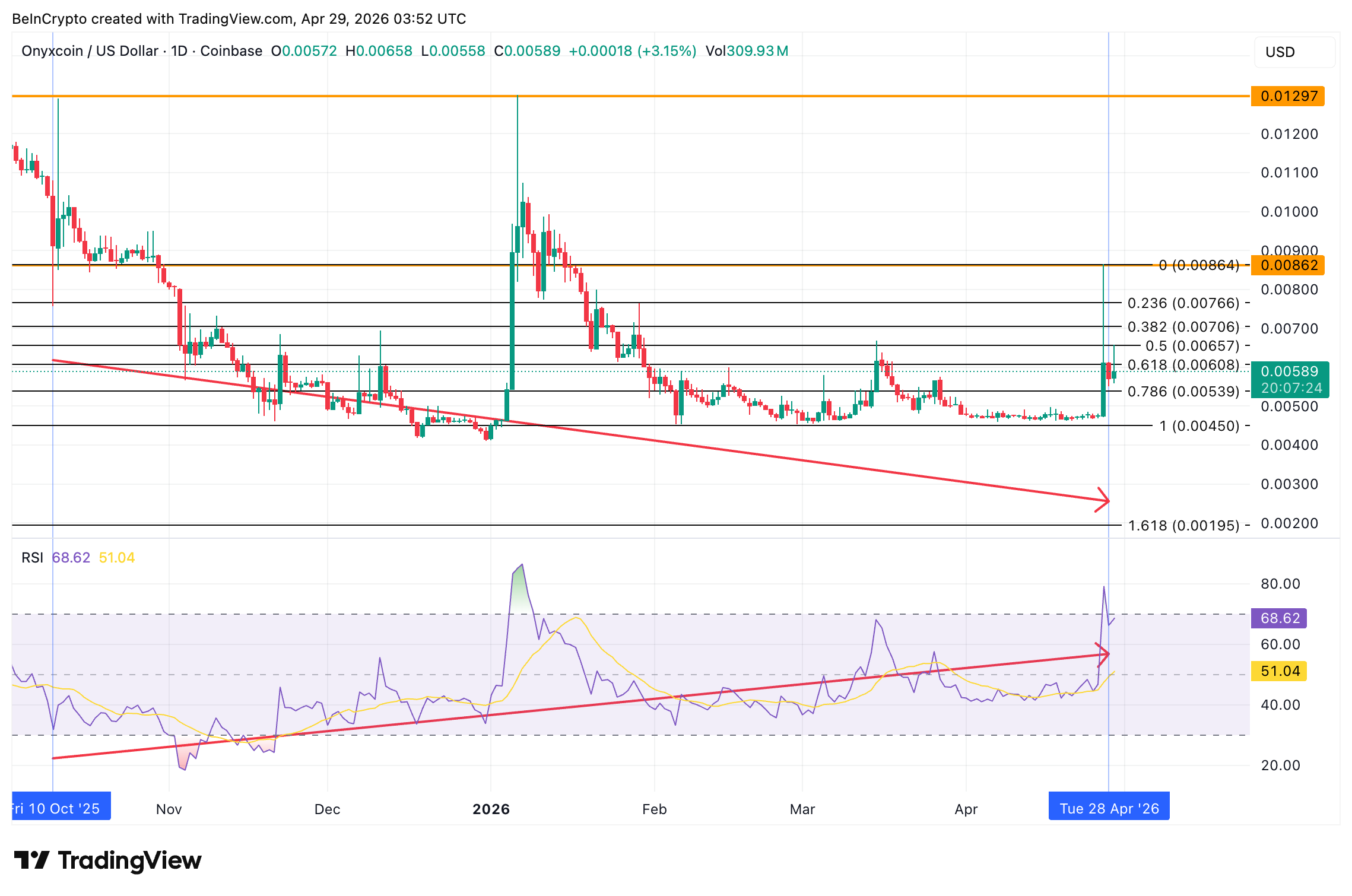
The level math is tight. XCN needs a daily close above $0.0060, the 0.618 Fibonacci level, to confirm the breakout and target the $0.0086 listing peak. A close above $0.0086 reopens the $0.0129 resistance from January. However, a drop below $0.0053 invalidates the divergence and exposes $0.0045.
Chainlink (LINK)
Chainlink (LINK) trades at $9.30, sitting just below a key technical level at $9.39 ahead of the April 29 FOMC decision. The setup carries the steadiest whale accumulation signal among crypto whale picks for the meeting.
Santiment data shows LINK whale wallets, excluding exchange addresses, have lifted their balance from 663.21 million LINK on April 23 to 667.84 million LINK on April 29. That is roughly 4.6 million LINK accumulated over six days, worth approximately $42.7 million at current prices. The accumulation has tracked steadily upward without the immediate distribution-and-rebuy pattern seen in faster-moving names.
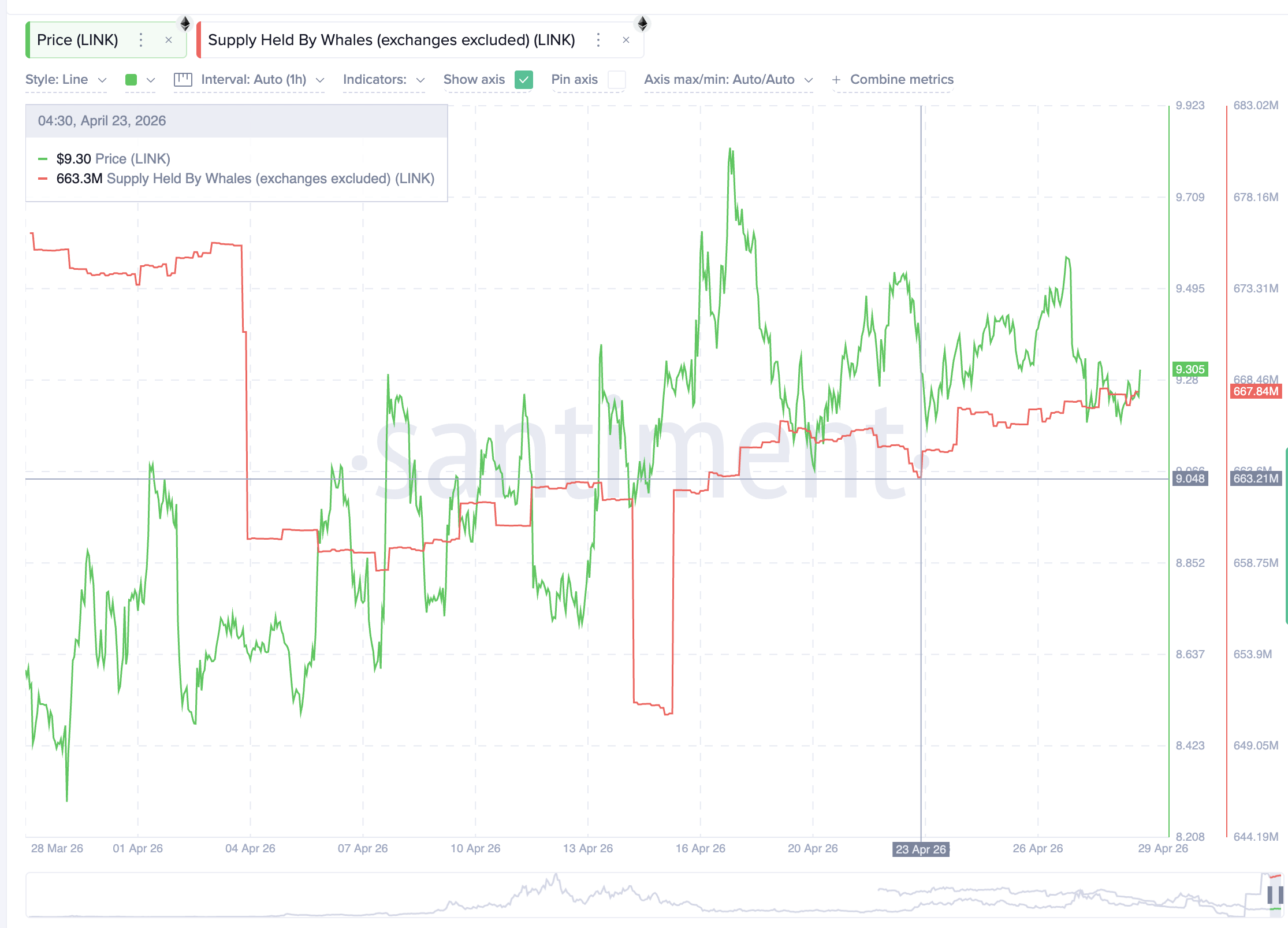
Steady big money accumulation during a macro de-risking window typically reflects conviction rather than reaction, and LINK’s flow profile fits that pattern.
The chart confirms what whales are positioning for. LINK has carved out an inverse head and shoulders pattern, a bullish reversal structure. The head sits at $8.19, and the right shoulder formed near $8.99.
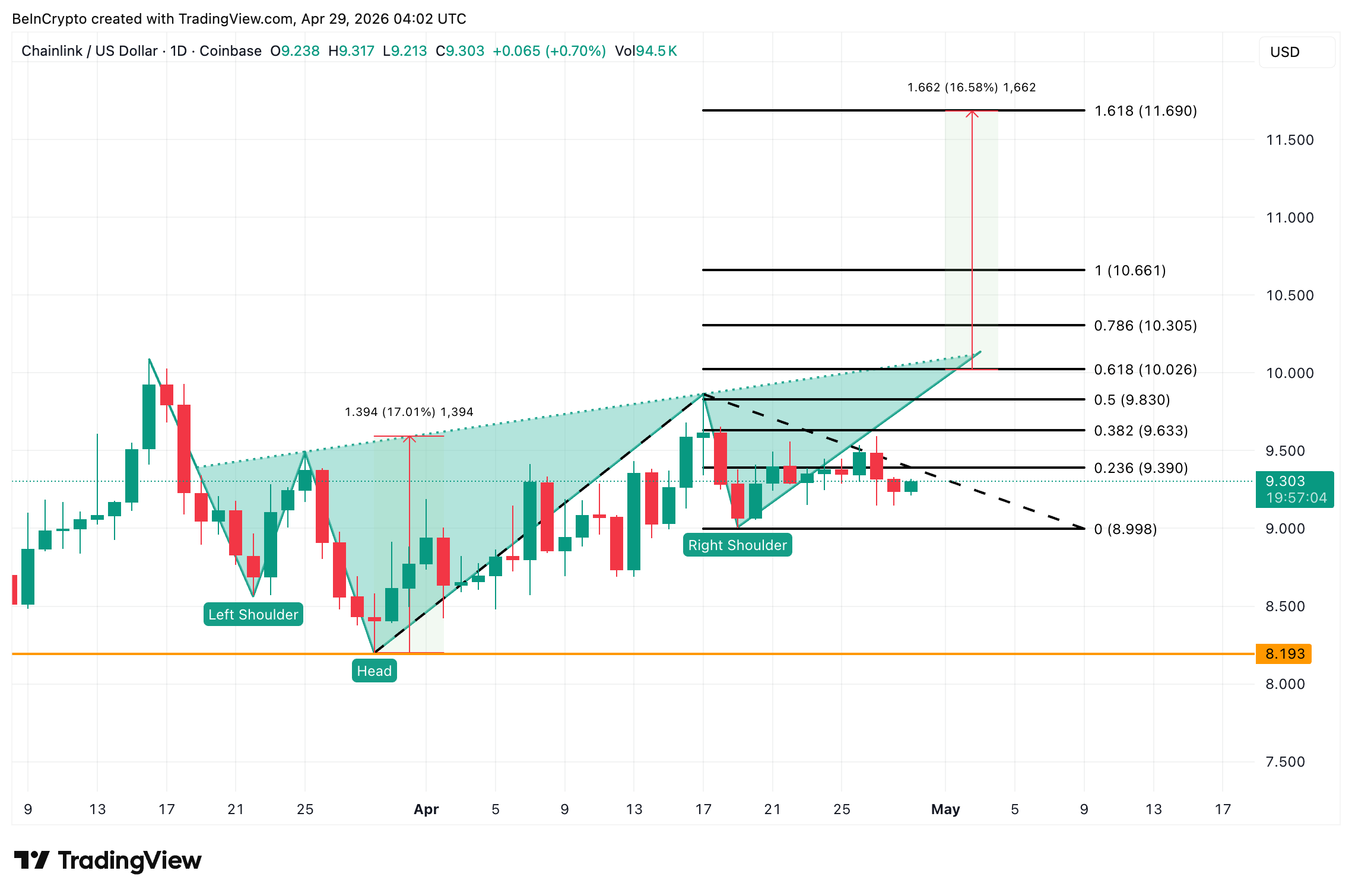
A daily close above $9.39 targets $10.02, a neckline-adjacent level that also aligns with the 0.618 Fibonacci zone. A clean break of $10.02 unlocks a 17% measured move toward $11.69. However, a failure at $9.39 and a drop below $8.99 weakens the structure, and a close under $8.19 invalidates the pattern entirely.
Ethereum (ETH)
Ethereum (ETH) trades at $2,309, holding above the 20-day Exponential Moving Average (EMA), an indicator that weights recent prices more heavily to track short-term trend changes, at $2,294. The position above the 20-day EMA gives the bullish setup its first technical foothold.
The crypto whale story here is the steadiest of the three. Santiment data shows ETH supply held by whale wallets, excluding exchange addresses, has lifted from 123.35 million ETH on April 19 to 124.43 million ETH on April 29. That marks roughly 1.08 million ETH accumulated over 10 days, worth approximately $2.49 billion at current prices.
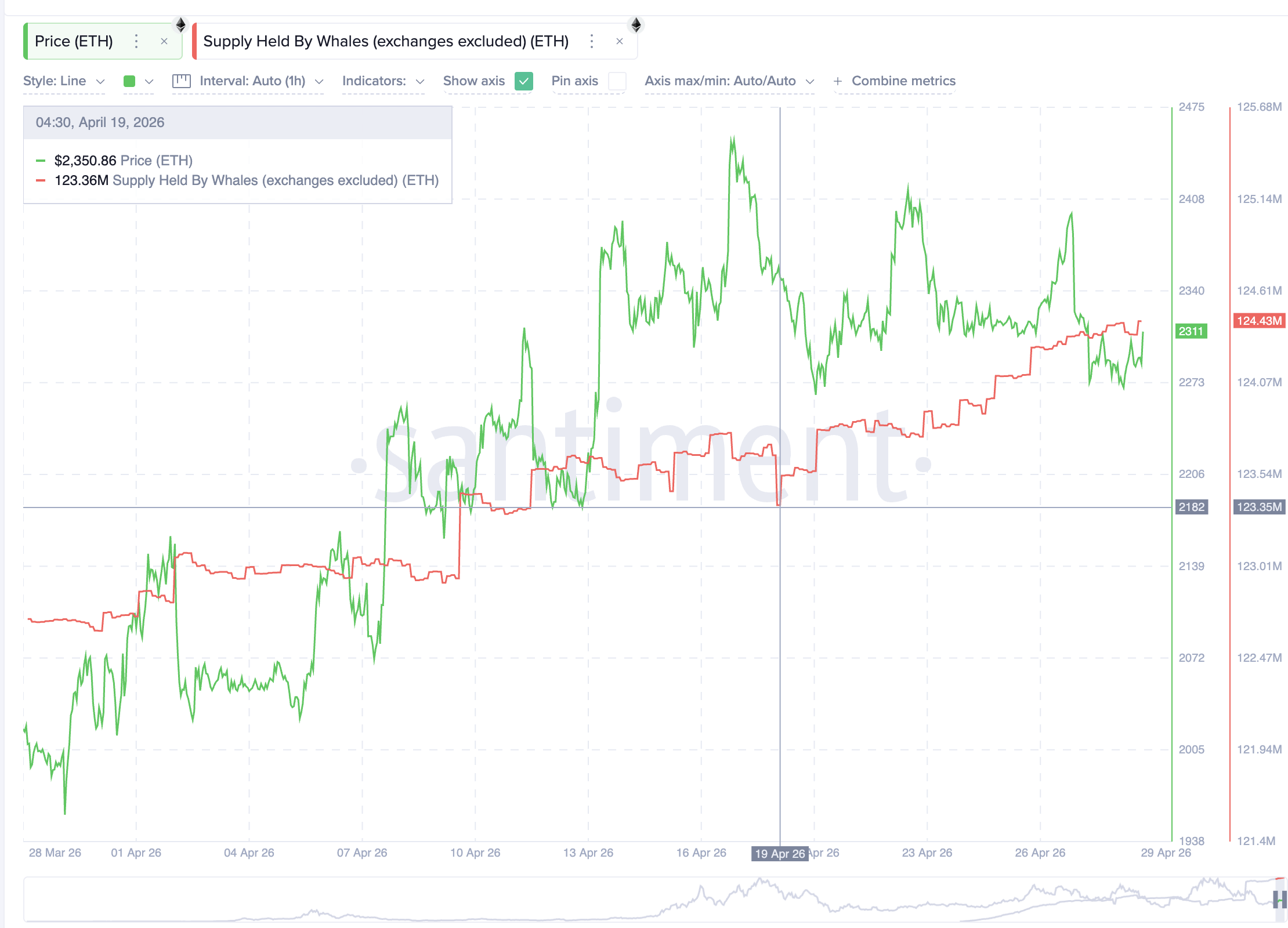
The economic logic separates ETH from the FOMC-rotation trade. Whales are not buying ETH for a rate cut, since CME FedWatch shows zero probability of one. Instead, the accumulation aligns with structural on-chain demand. ETH exchange reserves have hit their lowest level since 2016 with 331,000 tokens withdrawn since April 19, and corporate treasuries like BitMine added 101,901 ETH last week worth roughly $233 million.
Whales appear to be using the pre-FOMC consolidation as a discount window before the supply shock thesis becomes priced in. The cumulative drawdown of liquid ETH supply is the catalyst, not Powell’s tone.
The chart confirms the patient setup. ETH has consolidated between $2,250 and $2,377 since mid-April, a tight 5% range that whales have used to absorb supply without lifting price.
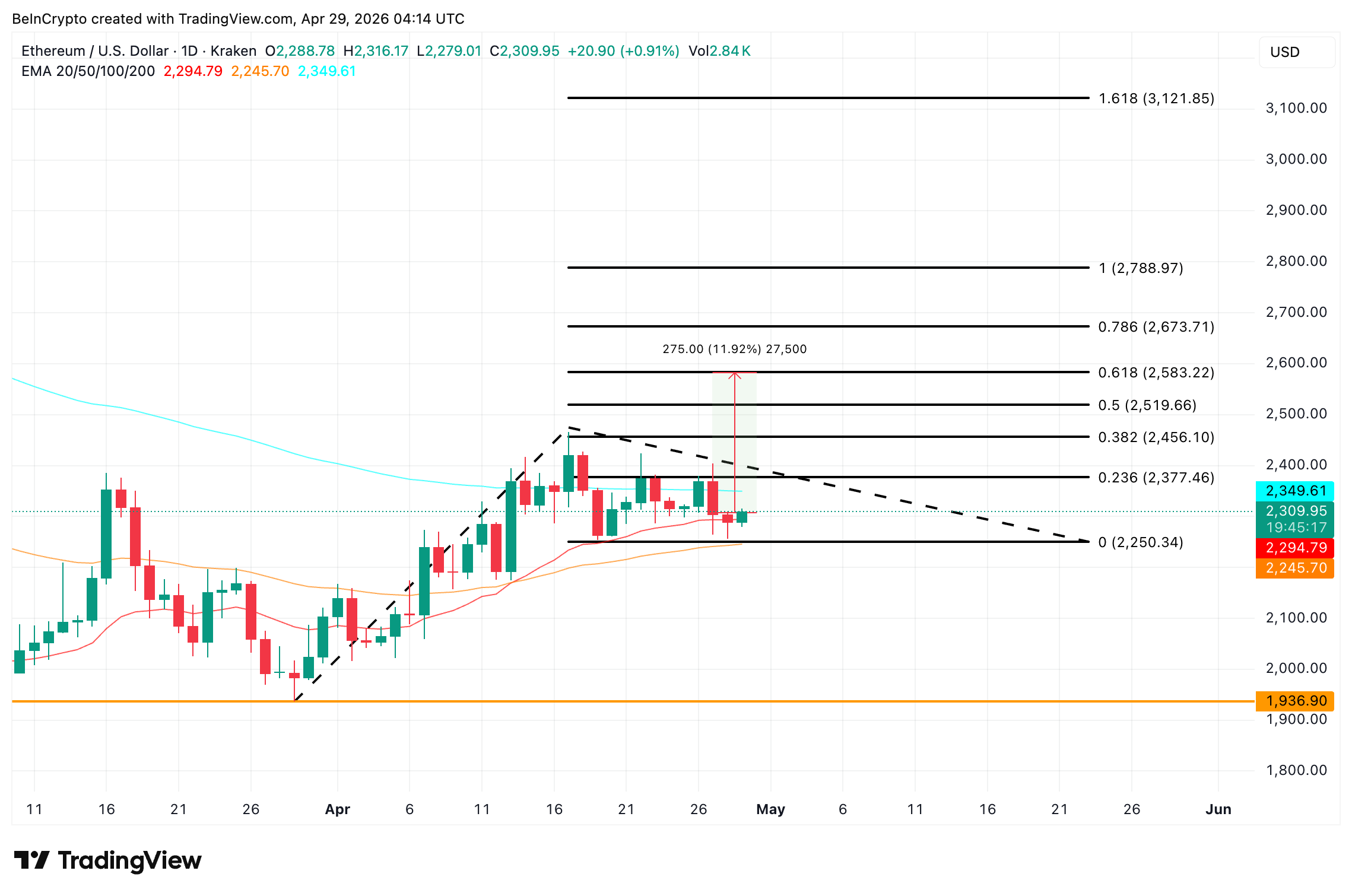
A daily close above $2,349, the 100-day EMA, and then $2,377 unlocks an 11.92% measured move toward $2,583. Below the range, $2,294 (20-day EMA) and $2,245 (50-day EMA) are the first defenses. Therefore, a break below $2,250 invalidates the structure and exposes $1,936.90.
The post What Crypto Whales Are Buying Ahead of the April FOMC Meeting appeared first on BeInCrypto.


Canada is proposing to ban crypto ATMs as part of a broader crackdown on fraud and money laundering, citing growing evidence that the machines have become a key tool for scammers.
The measure, included in the Liberal government’s Spring Economic Update released Tuesday, would eliminate crypto ATMs nationwide. Officials described the machines as a “primary method” for defrauding victims and laundering illicit funds.
“To protect Canadians by shutting down a primary method for scammers to defraud victims, and for criminals to place their cash proceeds of crime,” the government said, it plans to prohibit the machines entirely.
A crypto ATM (automated teller machine) may sound similar to a traditional cash machine that dispenses money from your bank account, but it works very differently. Instead of withdrawing cash, these machines let users convert physical cash into cryptocurrencies like bitcoin, which can then be sent to a digital wallet anywhere in the world, while bypassing traditional banking channels. That’s where the money-laundering risk comes in.
The proposal follows mounting concerns from law enforcement and regulators that crypto ATMs have become central to fraud schemes.
A 2023 internal analysis by Canada’s financial intelligence agency, FINTRAC, found that bitcoin ATMs are likely to remain “the primary method” fraudsters use to collect and launder funds from victims.
Canadian lawmakers are debating banning crypto as a payment method for electoral donations, citing concerns about the anonymity of fund transfers.
Canada was home to the first bitcoin ATM, installed in a downtown Vancouver coffee shop in 2013.

David Duchovny’s Best 7-Part Series Quietly Becomes a Late-Night Favorite 12 Years Later

HOW TO LOST MONEY WITH POKEMON… #pokemon #collectiblecards #pokemoncards #trading

Patients could pick up prescriptions from automated dispenser under new plans

Manchester United reach agreement with Casemiro over contract clause amid transfer speculation

US brings back mandatory military draft registration

Steven Gerrard disagrees with Gary Neville over ‘shock’ Chelsea and Arsenal claim | Football


-

 Tech2 days ago
Register Renaming | Hackaday
-

 Fashion5 days ago
Weekend Open Thread – Corporette.com
-
 Crypto World3 days ago
Hyperliquid $HYPE Rally Builds Momentum as AI Sector Enters Prove-It Phase
-

 Politics6 days ago
Making troops accountable for war crimes threatens US alliance, ex-SAS colonel warns
-

 Politics6 days ago
Disabled people challenge government SEND proposals over segregation concerns
-

 Business5 days ago
Patterson-UTI Energy, Inc. (PTEN) Q1 2026 Earnings Call Transcript
-

 Business7 days ago
Rolls-Royce Voted UK’s Most Iconic Trade Mark as IPO Register Hits 150
-
 Sports3 days ago
IPL 2026: Ruturaj Gaikwad registers slowest fifty of the season, enters all-time unwanted list | Cricket News
-

 Politics1 day ago
Drax board avoid their own AGM, accused of greenwashing & environmental racism
-

 Politics7 days ago
Zack Polanski responds to home secretary’s taser threat
-
Politics7 days ago
Wings Over Scotland | How To Get Away With Crimes
-

 Politics7 days ago
Starmer handler McSweeney to be dragged from shadows by Foreign Affairs Committee
-

 Politics6 days ago
‘Iran is still a nuclear threat’
-

 NewsBeat3 days ago
LK Bennett closes all stores after entering administration
-
 Sports6 days ago
Tim Bradley names the current best in the world: “Better than Inoue and Usyk”
-

 Crypto World5 days ago
Michael Saylor says BTC winter is over. Market analyst disagrees, says bitcoin was in a pullback
-

 Business7 days ago
The Job Benefits Most Men Don’t Know to Negotiate
-
 Entertainment4 days ago
Mariah Carey Slams Deposition Claims In Brother’s Lawsuit
-
Business6 days ago
Altimmune prices $225 million public offering at $3 per share
-
Crypto World5 days ago
Is Algorand One of the Few Quantum-Resistant Blockchains? Here’s What the Data Shows
You must be logged in to post a comment Login