The U.S. Cybersecurity and Infrastructure Security Agency (CISA) has ordered federal agencies to secure their Windows systems against a vulnerability exploited in zero-day attacks.
Tracked as CVE-2026-32202, this security flaw was reported by cybersecurity firm Akamai, which described it as a zero-click vulnerability left behind after Microsoft incompletely patched a remote code execution flaw (CVE-2026-21510) in February.
As CERT-UA revealed, the Russian APT28 (aka UAC-0001 and Fancy Bear) cyberespionage group exploited CVE-2026-21510 in attacks against Ukraine and EU countries in December 2025 as part of an exploit chain that also targeted a LNK file flaw (CVE-2026-21513).
“Microsoft fixed the initial RCE (CVE-2026-21510), an authentication coercion flaw (CVE-2026-32202) remained. This gap between path resolution and trust verification left a zero-click credential theft vector via auto-parsed LNK files,” Akamai said in a Thursday report.
As Microsoft explains, remote attackers who successfully exploit the vulnerability in low-complexity attacks by sending “the victim a malicious file that the victim would have to execute,” could “view some sensitive information” on unpatched systems.
Advertisement
Microsoft flagged the CVE-2026-3220 flaw as exploited in attacks on Sunday after BleepingComputer reached out last week to ask why the advisory released during the April 2026 Patch Tuesday had an exploitability assessment of ‘Exploitation Detected’ while the vulnerability was flagged as not exploited.
A Microsoft spokesperson has yet to reply to a second email requesting more information about the CVE-2026-32202 attacks, including whether APT28 hackers also exploited this zero-click vulnerability.
“This type of vulnerability is a frequent attack vector for malicious cyber actors and poses significant risks to the federal enterprise,” the cybersecurity agency warned.
Advertisement
“Apply mitigations per vendor instructions, follow applicable BOD 22-01 guidance for cloud services, or discontinue use of the product if mitigations are unavailable.”
Although BOD 22-01 applies only to U.S. federal agencies, CISA has urged all security teams to prioritize deploying patches for CVE-2026-32202 and securing their organizations’ networks as soon as possible.
Threat actors are also actively exploiting three recently disclosed Windows security vulnerabilities (dubbed BlueHammer, RedSun, and UnDefend) in attacks aimed at gaining SYSTEM or elevated administrator privileges, with the latter two still awaiting patches.
AI chained four zero-days into one exploit that bypassed both renderer and OS sandboxes. A wave of new exploits is coming.
At the Autonomous Validation Summit (May 12 & 14), see how autonomous, context-rich validation finds what’s exploitable, proves controls hold, and closes the remediation loop.
As a professional photographer for many years, I’ve photographed everything from editorial photo stories to elaborate product photography along with landscapes, weddings, travel and street photography in my personal work. And if you’ll allow me to blow my own trumpet, I’ve also been shortlisted for numerous major industry awards for my work in those areas. From my experinece I’ve learned that there are three types of camera that all photographers need to have in their photography setups. And I’m not talking about brands, such as a Sony or a Canon, or even sensor types, like a full-frame or APS C. I mean a deeper level of camera selection — the types of camera that offer fundamentally different ways of approaching your photography and allow you to create your best work, no matter what genre you like to dabble in.
While these types could mean three physically different cameras, they could also be covered by two cameras, or even just one. Let’s dive in with camera type number one.
Don’t miss any of our unbiased tech content and lab-based reviews. Add CNET as a preferred Google source.
Advertisement
The workhorse
This is the camera that gets stuff done. It’s likely packed with modern camera technology. It’s fast to use, shoots at high speed, has lightning-fast autofocus, possibly image stabilization, and almost certainly uses interchangeable lenses. It may well be full frame. It’s the camera that pros the world over use for all kinds of photo shoots — just like I have — from weddings to cars to products to pets … whatever. It’s a jack-of-all-trades camera that you can trust will do anything you need it to any time you need it to do it.
I’ve used my Canon R5 on numerous professional shoots for photos and videos. It’s a high-performance all-rounder.
Andrew Lanxon/CNET
For me right now, that’s the Canon R5. Fast, high resolution. Tons of features. A flippy screen. And it shoots awesome video. Endless lens and accessory options. It’s the camera I trust for most of my professional work because I know it can deliver and I know I can deliver when I’m using it. Previously it’s been the Canon 5DIV and before that it was the Canon 6D. For you, it might be the Sony A7RV, the Nikon Z8 or the Panasonic Lumix S5II.
Advertisement
It might not be the latest model around, but whether it was launched in 2026 or 2006 it’ll tick all the boxes you need for a busy day of photography whether you’re a professional or an enthusiastic amateur. The workhorse is a camera that’ll do everything you need from it and it’ll do it well. But it’s likely also quite big and probably quite expensive. While it’s great that there are so many lenses to choose from, maybe sometimes you don’t want the burden of choice. So that’s when you need…
A compact, fixed-lens camera like Fujifilm’s X100VI is great to have with you, always ready to shoot.
John Kim/ CNET
The everyday carry
It’s a small digital. A compact point and shoot, ideally. Almost certainly a fixed lens. The Fuji X100VI or the Ricoh GRIII. Even the relatively ancient Sony RX1R or the Leica Q3. The Q3 isn’t that small really but I actually love my Q3 43 as an everyday carry. It’ll be the type of camera you can quickly grab when you’re heading out in a hurry without thinking about lenses. When you don’t want a backpack full of gear when camping, but do want lots of fun shots of you and your mates around the campfire. It’s the camera you can always carry. It’s the social camera you don’t mind getting in among the chaos of life. It could feasibly even just be your phone camera.
It’s probably the lightest camera you own that allows you to comfortably wear it around your neck while you’re walking around the streets of some old Italian town. It’s maybe even small enough to slip into your pocket when you go into a bar and easily slip back out when the light comes in beautifully through the pub window and you want to catch a quick shot.
Having my Leica Q3 43 always with me allows me to snap scenes whenever I see them.
Advertisement
Andrew Lanxon/CNET
It’s a camera for quick shooting and for social shooting — maybe even grubby from-the-hip or spray and pray shooting. It’s probably the camera you’ve captured the most memories on but it’s also probably not the camera you’ve used to take your favorite fine art photos. Oh no, that’ll be this one.
The artful one
It might not technically be your best camera. It might not have the most features. It might not be the smallest, the fastest or the easiest to use. But it’s the camera that inspires you the most. It’s the one that makes you feel creative just by looking at it. It’s the one you choose to take when you drive for hours to one location in the slim hope that you might have good light that evening.
It’s the camera that makes you slow down and think about the art in your images rather than rattling off a thousand mediocre snaps. It’s the camera that’s responsible for the work you’re most proud of.
Advertisement
The Hasselblad 907X — an amazing, quirky camera.
Andrew Lanxon/CNET
This camera could be a lot of things. It could be a film camera, be it 35mm or 120 medium format. That alone would slow you down and make you take a more methodical approach unless you’re happy to spend a fortune on film. Or maybe it’s something like a modern digital medium format like a Fuji GFX or my personal favorite, Hasselblad’s 907X 100C — that weird little box gave me such a buzz when I used it that it was genuinely difficult to part with it when I had to send it back.
I found the Hasselblad’s X-Pan panorama mode incredibly inspiring. This image was even shortlisted for a major UK photography award.
Advertisement
Andrew Lanxon/CNET
It’s a camera you might not even own yet and maybe don’t even know you want. I didn’t know I was at all interested in film photography until only quite recently, yet I gave a man a fistful of cash in a car park to buy his medium format Mamiya 645 Pro, which I’ve really enjoyed putting numerous roles of film through. Life throws things your way sometimes. So maybe this camera is one you’ll need to be a bit open minded about. But it’s also the one you might be most glad you got in the years to come.
Three types, one camera
Between the workhorse, the everyday carry and the artful one, you have yourself covered in any aspect of photography, no matter what genre you like to dabble in.
I took my Canon R5 to Sicily where it performed all the roles of workhorse, everyday carry and inspirational camera admirably. You don’t necessarily need three separate cameras.
Advertisement
Andrew Lanxon/CNET
Of course, some cameras can be two things; an artistically inspiring camera that’s also an everyday carry. Hell, some cameras could be all three rolled up in one. And that’s absolutely fine — as long as that one camera ticks each of those three boxes for you. It’s really up to you to interpret whether your camera is small enough to be your everyday carry or inspiring enough to be your artful one. But this rule certainly doesn’t mean you need to go out and buy two additional cameras.
My Canon R5 with a compact prime on it certainly can be all three. It was a great everyday carry on a trip to Sicily and it inspired me to take artistic photos that I adored and that I later licensed to go into a luxury travel book meaning it was also my professional workhorse. So on that one trip alone it ticked all three boxes for me. But it’s not always all of those things.
My Leica Q3 43 was a superb everyday carry camera on my recent travels to the Swedish Arctic and Barcelona. It was the camera I took on multiple ferry trips to various remote Scottish islands and it was the camera I took when I went to hang with my brother for his 40th birthday. And yeah, it too is also a camera that excites me, that inspires me and urges me to be more creative with my shooting. Because it’s a damn Leica and what photographer doesn’t feel excited to take photos when they’re holding a Leica?
Advertisement
My Leica Q3 43 was an amazing everyday carry and professional workhorse on my assignment in Sweden. Did it also inspire me creatively? You bet.
Volvo
But it’s my recent forays into film that have taught me even more about slowing down and crafting an image and the culmination of that has led me to getting the Mamiya 645 as my artful camera, which completes my personal holy trinity.
And sure, as my work and my style develops and other cameras come and go, that trio of cameras will likely change over the years but the basic building blocks of workhorse, everyday carry and the artful one will always need to be met by whatever cameras I have.
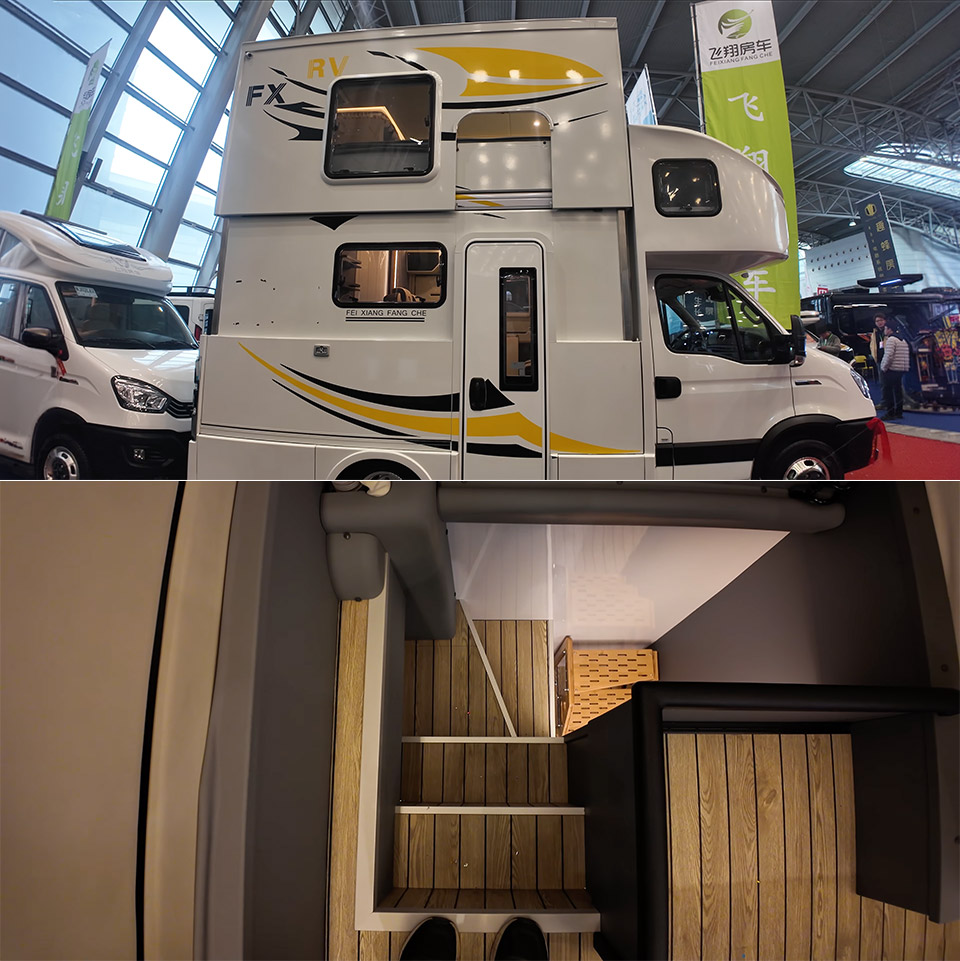
RVs tend to run on autopilot from year to year, but a specific model from the Feixiang Group changes things up with a simple design change. Enter the Shuxinge series, often known as the Flying RV, as this 2026 FX RV S800 is built on an Iveco Eurocargo chassis, keeping it under six meters in length and easy to operate on the road. With the simple press of a button, the entire structure transforms into a two-story living space.
First, four electric hydraulic legs drop down and lock solidly, each with enough power to support a ten-ton load while keeping the entire rig steady in the face of wind or rugged terrain. Next, the upper half of the RV rises smoothly on its own hydraulics, so it’s not just the legs that get lifted; the entire vehicle raises by a metre and a half, from 3.45 metres on the road to more than five metres when parked. It’s also a dramatic change, with the living area increasing from a claustrophobic 18.72 square meters on the lower level to a luxurious 36.44 square meters when the upper level and cab are included. While the slide-outs do expand the walls, it’s still rather spacious down there.
CAMPER VAN BUILDING SET – Kids can enjoy vacations every day with this LEGO City Holiday Adventure Camper Van building set
TOY FIGURES & CAMPER PLAYSET – This vehicle set includes everything kids need to build a camper van with a detailed living space, plus a campfire…
FUN FEATURES – The camper van opens up for full access to an interior living space with a kitchen, toilet, 2 bunk beds, a crib and a removable…
The main lounge area is filled with four opulent leather captain chairs, each with heating, ventilation, and massage controls, similar to those found in a premium car. The seats are not only comfortable, but they also include a number of extra features, such as a table that pulls out for meals or cards. The teak-style PVC flooring underfoot is easy to clean, and hidden speakers beneath the seats link to a full karaoke system that is ready to rock when your guests want to sing. The kitchen slide-out on the opposite side of the space is outfitted with a two-burner induction stove, a deep sink, a fridge with separate freezer, and all the cabinets you could possibly need, some of which open from both inside and out, which is a great touch.
Meanwhile, the pass-through door on the kitchen panel swings down to show an outdoor kitchen setup ideal for grilling or serving snacks. The bathroom, situated away behind the eating area, is a big benefit, equipped with a macerating toilet, handheld shower wand, sink, and a few storage shelves for miscellaneous items.
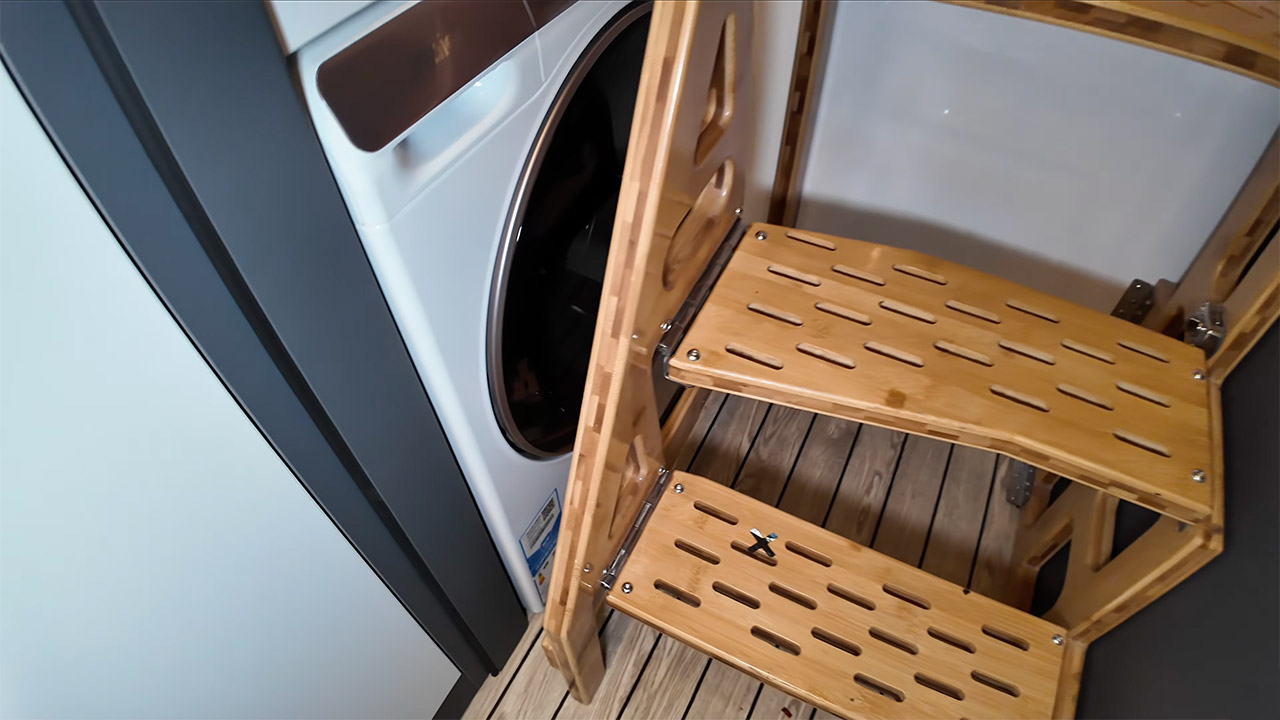
If you need to do a load of laundry, don’t worry; there’s a compact 3.5-kilo washing machine tucked away beneath the back staircase, accessible by turning up a panel. Above the cab, there’s a raised sleeping alcove ideal for children or a couple of adults, equipped with windows, a roof hatch, reading lights, and a few shelves to keep your books and other belongings within easy reach. The finest feature is that everything fits on the lower level while allowing the car to be driven with a conventional license.
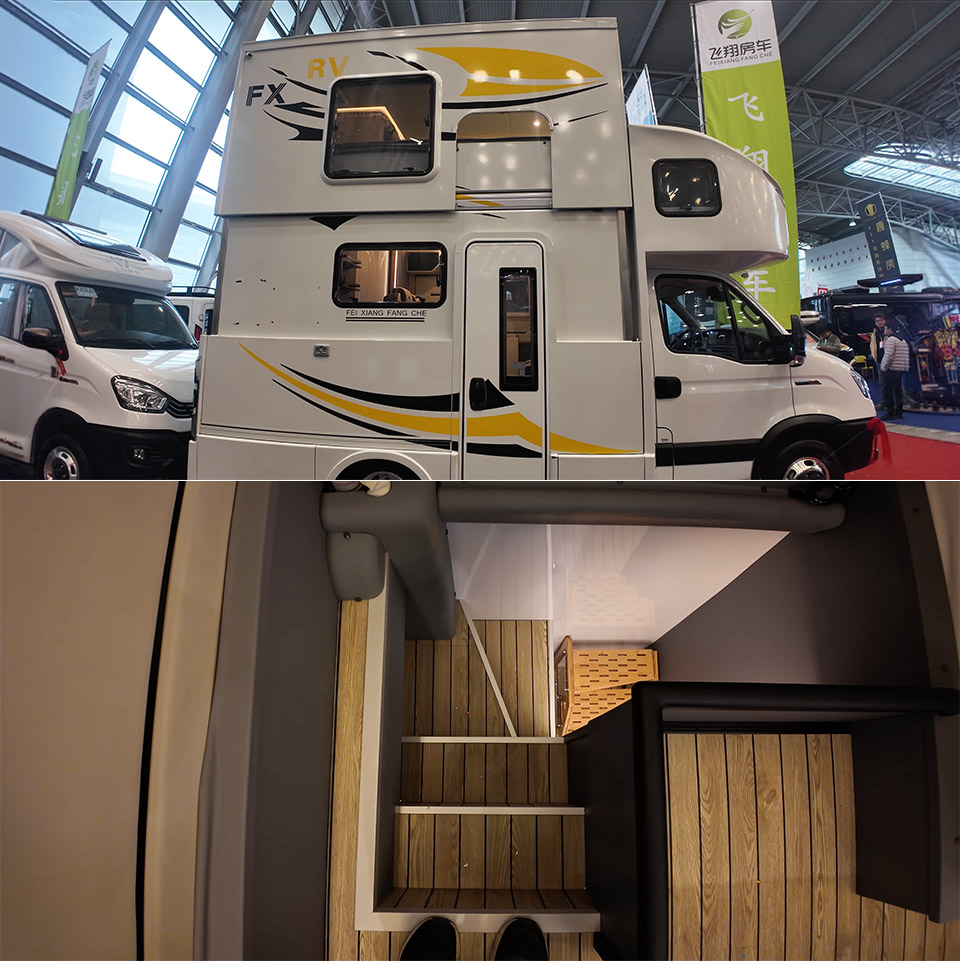
Solid hardwood steps with built-in lights will take you to the second story once it is fully extended. There’s plenty of head room up top, as well as a decent-sized bed on an orthopaedic mattress, and you’d be amazed how much space there is to walk around. The windows really open to let in some fresh air, while the air conditioning and ceiling fan keep it cozy. You’re also not far from the loo, as there is a separate bathroom on the upper floor with a toilet, fold-down sink, and self-adjusting plumbing. Canvas walls fold flat when traveling yet close tightly when lifted, providing seclusion without the need to get up to go downstairs at night.
The power comes from 1,280 watts of solar panels on the roof, which feed into a large lithium battery bank and a 5,000-watt inverter, allowing lights, appliances, and air conditioning to operate for extended periods of time without the need to connect to the grid. You get 260 gallons of fresh water to play with, plus an additional 160 liters for grey water, as well as a 100-liter fuel tank and a 3-liter diesel engine with an automatic transmission to handle the journey. Plus, all of the electronics are attractive and user-friendly; even in a compact space, the cameras and digital controls make things simple.
Google’s next Tensor chip has just surfaced in a fresh leak, and the early details are painting a mixed picture. The details shared by Mystic Leaks of the upcoming Pixel 11 point to a redesigned CPU, which is built around ARM’s newer C1-series cores. The rumour also hints at a high-performance “Ultra” core clocked at around 4.11GHz, paired with multiple “Pro” cores clocked at 3.38GHz for better performance overall.
Google’s Tensor chips have historically lagged behind Qualcomm and Apple in pure CPU horsepower. So the focus on performance with the newer ARM cores could help the next-gen Google mobile AP finally close that gap. Aside from this, there are also broader improvements expected on the Tensor G6. A big one is the move toward TSMC’s advanced manufacturing process. The upcoming chip could be based on the 2nm process, which could bring better efficiency, improved thermal performance, and better battery life.
In the past, many Pixel users have complained about various issues plaguing their Google smartphones, especially regarding heat and power efficiency. In other words, the Tensor G6 is getting more than just a speed boost.
Gaming might not be the focus
Nirave Gondhia / Digital Trends
All of the aforementioned improvements are great, but there’s still a big question mark on the graphics side. The lake claims that Google may switch to a PowerVR-based GPU architecture for the Tensor G6. This might be more of a name change than an actual upgrade, with early reports suggesting little to no improvement in GPU performance compared to the previous generation. You probably won’t notice or feel the difference in everyday use. Though gaming or graphics-heavy workloads could remain a weakness for Google’s next-gen flagship phones.
Google has bigger plans
Apart from the CPU and GPU, Google might be working on other components of the upcoming SoC. The Pixel 11 might move away from Samsung modems in favor of MediaTek’s M90 chip for better connectivity and power efficiency. Rumors also point to a new Titan M3 security chip and an enhancement for on-device AI processing.
Advertisement
The uneven upgrade story is hard to ignore. Still, Google has never really advertised gaming as a focus with its phones, and it might just be sticking to that narrative.
AXPONA is over. Passover is done. The Stanley Cup Playoffs are underway, which is always a beautiful time of year unless you’re a Toronto Maple Leafs fan, in which case it’s just another annual reminder that hope is a renewable resource and results are not.
So I did what any rational person does. I got in the car and tried to drive.
Three hours later I was still in New Jersey, locked in traffic like it was a civic duty, leaning on Qobuz and the NHL Network to keep me from turning the steering wheel into modern art. The stereo in my Toyota SUV did not help. It is not just bad. It is hostile. Flat, lifeless, and oddly aggressive in how it strips the soul out of anything you feed it. I have heard better sound quality from hold music and from relatives calling to critique my life choices. At least they bring some midrange.
Which is why the arrival of the 2026 Mazda CX-5 Premium cannot come soon enough. The Bose system alone is reason to celebrate. Clarity. Separation. Actual bass that does not feel like a rumor. A car where music sounds like music and not a compressed apology for itself.
Advertisement
Because music matters. Especially when you are stuck and have no escape.
Country is also where things fall apart. What passes for country today feels like it was assembled by committee in a conference room with a whiteboard and no sense of shame. I cannot do it. I will not do it. There are exceptions. Orville Peck gets a pass. Dolly Parton from an earlier era still hits. Tom Russell knows how to tell a story without sounding like he is selling me a truck.
And while we are clearing the table, let’s deal with the sacred cows. Eagles. I do not get it. Never have. Polished to the point of anesthesia. Give me Led Zeppelin, The Cure, or Guns N’ Roses any day.
And then there is Glen Campbell, who was not just good, he was essential. You can roll your eyes at “Rhinestone Cowboy,” fine, but “Wichita Lineman” is something else entirely. “I need you more than want you” is not just a lyric, it is a confession. Every word lands. It does not matter if you have never set foot in Kansas, although I have. The song pulls you there anyway. It makes you feel distance, longing, and the quiet weight of holding on to something that might already be gone, but hopefully isn’t.
Advertisement
That is what music is supposed to do. It reaches across time and geography and lands somewhere personal. Somewhere you do not always expect. In my case, it took me halfway across the world for a few minutes. Tokyo. A Japanese egg salad sandwich from 7-Eleven. Blonde hair. A mind that can navigate the dark side of the forest moon and come back with answers. Present without being present.
And it is also why, when you start looking at where some of our favorite stories really came from, you have to be willing to follow that thread wherever it leads.
The Kurosawa Blueprint That Built Star Wars
A long time ago, in a galaxy not so far away, Japan, a director named Akira Kurosawa made a film in 1958 that quietly rewrote the playbook. The Hidden Fortress did not need a marketing machine or a line of action figures. It just told a story with precision, perspective, and a structure that would echo a lot louder years later.
Advertisement. Scroll to continue reading.
Fast forward to 1977. I am seven years old, sitting in a theater in Toronto, watching Star Wars with my friend Andrew Temes, completely unaware that my cinematic worldview was about to be rearranged. Like a lot of people, I did not just like it, I went all in. Thousands of dollars on memorabilia over the years. Stood in line, in the rain, to be the first one through the door in Canada for Return of the Jedi in 1983. Fast forward again and there I was in my late twenties, back on line for The Phantom Menace, which felt less like a return and more like a warning shot. Outside of Andor, Star Wars: The Clone Wars, Rogue One, and maybe Solo: A Star Wars Story, it has been a long stretch of Bantha-level disappointment since.
Advertisement
Then I found Kurosawa.
Throne of Blood. Seven Samurai. Yojimbo. High and Low. The Bad Sleep Well. One by one, they chipped away at that original belief. I own them all now, in more formats than I care to admit. But it was not until my twenties, sitting down with The Hidden Fortress, that the illusion finally cracked.
Because this is not subtle.
The two bickering peasants framing the story? They are not just an influence — they are the blueprint for C3PO and R2-D2. The hidden princess, the reluctant general, the journey through enemy territory, the tonal shifts between danger and dark humor, it is all there. And visually, it is even harder to ignore. The samurai swords, katanas, are not just cousins to lightsabers, they are the DNA. The code of the samurai maps cleanly onto the Jedi. The warlord’s soldiers, with their helmets and rigid formations, look a little too familiar. Strip away the desert, add black armor, and you are staring at the Empire before it learned how to breathe through a mask.
Advertisement
Look, every director borrows. That is part of the job. Influence is how the medium evolves. But this goes further than influence. This is Imperial level theft.
It does not take anything away from what Star Wars became. It changed cinema. It changed my life. But it did not come from nowhere. And once you see where it came from, you cannot unsee it.
And here is where it gets uncomfortable. Han Solo suddenly feels a lot less original and a lot more like every reluctant hero Toshiro Mifune ever played. From the early postwar Kurosawa films to the sprawling samurai epics to even Red Beard, that swagger, that resistance, that eventual turn toward doing the right thing, it is all there.
Which raises the obvious question. What exactly did George Lucas bring to the table beyond scale and spectacle?
Advertisement
And while we are asking questions, let’s talk about endings. Kurosawa knew how to stage a death. Watch Throne of Blood. Arrows flying, body breaking down in real time, a human pin cushion before the term even existed. It is brutal, precise, unforgettable.
Lucas? Not exactly his strength.
Grief, Guilt, and the Monster We Deserved
Sitting down for Godzilla Minus One, I expected another traditional monster movie. I could not have been more wrong.
Advertisement. Scroll to continue reading.
Set in the final days of World War II and the fragile years that follow, the film strips the franchise down to something far more uncomfortable than spectacle. This isn’t about cities getting flattened for fun. It’s about what’s left standing after everything that matters is already gone.
Advertisement
Kōichi Shikishima isn’t a hero. He’s a failed kamikaze pilot who makes a choice to live and then has to carry the weight of it. When he lands his Mitsubishi Zero on Odo Island claiming mechanical failure, the lie hangs in the air. The mechanic, Sōsaku Tachibana, sees right through him. And when Godzilla attacks that night, Shikishima freezes. He doesn’t fire. He survives. Everyone else doesn’t. That’s the wound the film never lets heal.
When he returns home, Tokyo is gone. His parents are gone. What he builds instead, a fragile, makeshift family with Noriko and the orphaned Akiko, feels less like a new beginning and more like borrowed time. He takes work on a minesweeper, cleaning up the literal leftovers of the war, while internally he’s still stuck in it.
And then Godzilla comes back.
Not as a metaphor, not as a mascot, but as something far worse. Mutated and supercharged by American nuclear testing at Bikini Atoll, this version of Godzilla is a consequence. A continuation. The war didn’t end. It just changed shape. The U.S. steps back because of geopolitical tension. The Japanese government stays quiet to avoid panic. So the people left behind — the same ones already scraping together a life, are the ones who have to deal with it.
Advertisement
That’s the film.
Not the destruction, though there’s plenty of it. The Ginza sequence is devastating, not because of scale, but because of who gets caught in it. Noriko’s death isn’t a plot device. It’s the final break. Shikishima loses the one thing tethering him to something resembling a future, and what’s left is grief with a target.
The plan to stop Godzilla with Freon tanks, pressure, and improvisation feels almost secondary. It’s clever, grounded, and very Japanese in its resourcefulness, but the real story is whether Shikishima can find a reason to live that isn’t tied to dying for something.
That’s why this film works on a level that most Hollywood films do not. Kurosawa would have complained about the lighting in some scenes, but the tone and overall theme would have felt very familiar.
Advertisement
Made for a reported $10 to $15 million, it does more with restraint than the recent Hollywood entries have done with budgets ten times that size. The monster is used sparingly, and every appearance matters. There’s no filler. No winking at the audience. Just tension, consequence, and a very clear understanding of what Godzilla was always supposed to represent.
Seventy years into the franchise, this is the one that finally circles back to the source. Postwar trauma. Nuclear anxiety. Survivor’s guilt. The politics of rebuilding when nobody wants to admit how broken things still are.
I’ve seen almost all of them. Own more than I probably should.
Advertisement
Advertisement. Scroll to continue reading.
This is the one that broke me in the theater after a year of personal upheaval and more than a few moments where doubt, loss, and betrayal had the upper hand.
Not handing it the Oscar was all you need to know about Hollywood.
The Last Honest Meal in a Crooked Economy
You know what’s actually life-affirming in the way Godzilla Minus One sneaks up on you? Not the destruction, but the rebuild. The small, human stuff that still works when everything else feels broken.
Advertisement
A good hot dog.
And here’s the part nobody wants to say out loud: hot dogs are coming back because everything else got stupid expensive. Pizza pushing $30 a pie isn’t a luxury anymore — it’s a bad habit with a pocket full of receipts. Meanwhile, the hot dog never left its lane. Still relatively affordable. Still fast. Still satisfying in a way that doesn’t require a loan from your kid with 300,000 Instagram followers or a wine pairing.
AXPONA had rooms that cost more than most people’s homes, but step outside that world and reality looks a lot more like a paper tray and a line out the door. You don’t “elevate” a Chicago hot dog. You respect it. A proper char dog like the ones at Portillo’s, comes loaded the way it’s supposed to: tomato wedge, pickle spear, peppers, celery salt, mustard. No ketchup unless you’re looking to start a fight.
Back home in Jersey, that same no-nonsense energy shows up in different forms. Hiram’s Roadstand is the first stop in Fort Lee, which is better known these days for its Korean BBQ. Some of the greatest jazz musicians of the last century walked out of Van Gelder’s studio, sessions done, ears ringing, and headed straight down Route 9W to Hiram’s for something healthier than a cigarette and bottle of gin.
Flat-top dogs, nothing fancy, no attempt to impress anyone who doesn’t already get it. Hiram’s doesn’t care about your macros or your cleanse. It exists because it works.
Advertisement
But somewhere along the way, curiosity or maybe poor judgment, pulls you deeper into North Jersey’s hot dog hierarchy. That’s how you end up at Rutt’s Hut.
Rutt’s isn’t just a stand. It’s a Jersey institution. The deep-fried “ripper” doesn’t try to charm you. The casing splits, the edges land at that exact point between crisp and snap, and suddenly you understand why people make the drive. For years, I kept my distance. Fried? Messy? Felt like a late-night decision best avoided. Turns out, I was late to the party.
The first bite resets expectations. Not refined. Not chasing any TikTok trends. The kind of food that doesn’t need explaining because it’s been right for decades.
And then the supporting cast shows up. Onion rings done the way they should be — no gimmicks, just the right amount of crisp. Add their homemade relish and mustard, and now you’re in deeper than you planned. It’s the kind of combination that makes everything else on the table feel optional. Better than Coke, honestly. And not the kind you drink sitting on the hood of your car in the parking lot of a 7-Eleven in Long Branch.
Advertisement. Scroll to continue reading.
Now I understand why the wise guys made the detour to Clifton on their way to the Bing.
Advertisement
The System Says Sit Down. Mr. McMurphy Says Not Today
Driving home from Rutt’s Hutt takes patience these days because New Jersey is having a moment. Call it Hollywood East if you want. I live less than two miles from the new Netflix Studios Fort Monmouth, a $900 million project that’s already changing the rhythm of the Shore. Ten thousand people are expected to land here over the next couple of years, and some days it feels like half of Brooklyn beat them to it. The quiet streets by the ocean are not so quiet anymore. Sure, the house is worth a lot more now. So are the property taxes.
And when Hollywood comes knocking, waving $25,000 for two months of rent for some B-list actor you’ve never heard of, you don’t overthink it. You smile, take the check, and hope he doesn’t spiral into some performative meltdown after noticing the thirteen mezuzahs and the IDF Six Day War flag sitting behind glass in the office.
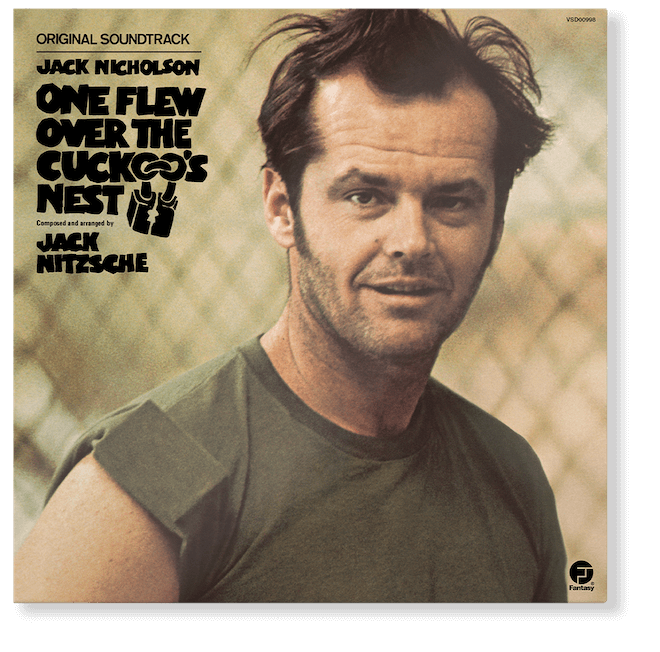
Part of that drive home from North Jersey takes me past a hospital where I spent time as a patient. Not visiting. Staying. Which is why One Flew Over the Cuckoo’s Nest never felt like fiction to me. It felt familiar. The nurse who made my life a misery. The routines. The slow grind of being told who you are supposed to be. I’ve talked about it publicly. No secrets left to protect.
At 56, I’m not interested in pretending that those chapters didn’t happen. They did. And it taught me something useful. You either let that kind of experience flatten you, or you learn how to direct it. I chose the second option. The energy that used to work against me now has a job. As Emperor Palpatine would say, it gives me “focus” and a very different perspective.
That doesn’t always sit well with people. I’m not built to fall in line or nod along when something doesn’t pass the smell test. I’m not interested in selling the idea that six figure systems are normal, or that spending more on cables than a car is a rational decision for most people.
Advertisement
Michell Gyro Turntable
I’m not here to play Westeros court politics or nod along while the room pretends everything makes sense. I’m closer to Han Solo than anything polished and obedient — shoot first, deal with the fallout later. And there’s a little Arya Stark in there too. I keep a list.
Driving past that hospital, thinking about where I’ve been and where I just was—rooms at AXPONA stacked with mid six figure systems, cables dressed like they have their own security detail — it starts making sense.
Maybe we’ve got the labels wrong.
Because if “normal” now means telling people this is the entry point, that this is what it takes to belong, then maybe the problem isn’t the audience.
We’ve spent too much time talking at people like they showed up without the right jacket and pair of white leather sneakers, pricing them out before they’ve heard a single note, and wrapping it all in language that sounds more like a late night pitch than anything connected to music. That’s not passion. That’s insulation.
Advertisement
And here’s the part that should make people a little uncomfortable. Not everyone is willing to take the little white pill with the cup of water anymore and nod along.
Advertisement. Scroll to continue reading.
Some of us remember what this is supposed to be. Sanity isn’t just a state of being. It has an address.
And more people in this industry need to start finding it.
Are you a Verizon customer looking to get more value out of your mobile or home internet service? Well, keep reading, because I’ve got some news you’ll be interested in. Verizon offers a collection of free and discounted streaming services with many of its popular plans. These perks offer substantial discounts on streaming memberships, giving you plenty of ways to save money while still getting the entertainment you love.
Services such as Netflix and Disney Plus already deliver content at a competitive price. These Verizon perks make those savings even better.
Note that the bargains listed below are available to those with eligible mobile phone and home internet plans, unless otherwise specified. Scroll on for a list of the best free and discounted streaming perks for you.
Whether you are a Verizon myPlan mobile customer or a myHome internet subscriber, you can choose this streaming service perk. If you have Fios Home Internet, 5G Home Internet or an eligible mobile plan, sign up for Netflix and HBO Max (basic with ads), bundled together at $10 per month for a total monthly savings of $9. (Netflix with ads is $8 per month, and ad-based HBO Max costs $11 per month).
Note: Beginning May 6, the cost of the Netflix and HBO Max bundle through Verizon will increase to $13 per month (saving you $7 per month).
If you tack on this bundle, you can also upgrade to an ad-free HBO Max plan and still get a Verizon discount. Pay an additional $7.50 per month for the Standard ad-free plan (saving you $3.50 total), or get HBO Max Premium (which comes with 4K and 100 downloads) for an extra $12 per month. These savings will automatically be applied for existing Verizon customers.
Advertisement
Disney Plus Premium
If you subscribe to a mobile plan with Verizon and want to stream all the Disney, Pixar, Marvel and Star Wars content your little heart desires, you will be able to access Disney Plus Premium — ad-free tier — free for six months. Verizon customers can take advantage of this deal by enrolling by midnight on May 31.
Disney Plus, Hulu and ESPN
If you want more than just Disney Plus, Verizon offers the Disney Plus, Hulu and ESPN Select (With Ads) bundle for myPlan and myHome customers for $10 per month (typically $20 per month). The previously offered Premium ad-free version of this bundle perk is no longer offered by Verizon.
YouTube Premium
You can subscribe to YouTube Premium for $10 per month ($4 discount) if you have a Verizon Unlimited Ultimate, Ultimate Plus or Ultimate phone plan. Internet customers are eligible with 5G Home, LTE Home, Verizon Home Internet Lite and select Fios Home Internet plans.
Note: The YouTube Premium perk increases to $13 per month, beginning on May 13. Based on YouTube Premium’s recent price hike, you’ll still save $4 a month with this perk.
Advertisement
YouTube TV
If you subscribe to any Verizon home internet plan, you qualify for YouTube TV at $63 per month, after a $20 discount. To get this deal, you must enroll for a YouTube TV subscription from the MyVerizon Account View, download the app to your device and link your account to the streamer. You can create up to six user accounts. The discount lasts for six months, before it reverts to the normal $83 monthly cost. You must be a new YouTube TV subscriber to take advantage of the deal.
FOX One
You can get the new FOX One app for $15 per month with an eligible mobile or home internet plan. The FOX One app offers live and on-demand access to networks like FOX News, FOX Business and FOX Weather, along with sports programming from FS1, FS2 and the Big Ten Network. This is a $5 monthly discount from the regular $20 monthly cost. To take advantage of the perk, you must enroll through Verizon in an Unlimited Ultimate, Unlimited Plus or Unlimited Welcome phone plan or one of six internet plans, including 5G Home, 5G Home Ultimate, LTE Home or Home Internet Lite.
ESPN Unlimited
If you need your NFL fix and missed out on the Sunday Ticket on Us promo, Verizon now has another way to watch the sports content you love. Subscribe to a Verizon Fios TV package that includes the ESPN Network, and you will be eligible to access ESPN Unlimited at no additional cost.
Apple One
With an eligible Verizon mobile phone or home internet plan, you can take advantage of this Apple One perk. The deal offers the full Apple streaming package — which includes Apple TV, Apple Music, Apple Arcade and iCloud Plus — for $15 a month ($5 discount) for individuals and $20 a month ($6 discount) for families.
Meta is ‘clear that Instagram and Facebook are intended for people aged 13 and older’, said the company.
The EU has preliminarily found that Instagram and Facebook are in breach of the Digital Services Act (DSA) for failing to “diligently” identify and mitigate risks that children under 13 face when using these platforms.
The findings are in relation to an investigation the EU launched against Meta’s popular social media platforms in mid 2024 over concerns that Instagram and Facebook use algorithms that stimulate “addictive behaviour” in children.
Users need to be at least 13 years old to use Instagram and Facebook. However, the Commission found that the company’s own restrictions against underage usage don’t work.
Advertisement
It said that minors under 13 can enter false birth dates with no effective controls in place to check its validity. The measures Meta has put in also do not promptly identify under-13 users to remove their access, the EU added.
Meanwhile, the tools Meta offers to report underage users is “difficult to use and not effective”, the Commission said in its statement.
Meta also does not follow up on these reports, which allows underage users to continue using the service without any checks, the European authority found.
Moreover, the social media giant’s lack of enforcement “builds on an incomplete and arbitrary risk assessment” the EU said, “which inadequately identifies” the risk underage users face when accessing Instagram and Facebook.
Advertisement
Meta’s assessment contradicts “large bodies of evidence” from all over the EU which finds that roughly 10 to 12pc of children under 13 are accessing Instagram or Facebook, the authority said, while also disregarding “readily available scientific evidence” which indicates younger children are more vulnerable to potential harms caused by these services.
Meta disagrees with today’s findings. In a statement to SiliconRepublic.com, a spokesperson for the company said Meta is “clear that Instagram and Facebook are intended for people aged 13 and older”, adding that they have “measures in place to detect and remove accounts from anyone under that age”.
“Understanding age is an industry-wide challenge, which requires an industry-wide solution, and we will continue to engage constructively with the European Commission on this important issue.
Advertisement
“We continue to invest in technologies to find and remove underage users and will have more to share next week about additional measures rolling out soon,” the spokesperson added.
Today’s (29 April) results are based on an in-depth investigation by the EU that included an analysis of Instagram’s and Facebook’s risk assessment reports, internal data and documents, as well as the platforms’ replies to requests for information, the Commission said in a statement.
These, however, aren’t the Commission’s final views on the matter. If they are confirmed in its ultimate findings, the Commission could fine Meta as much as 6pc of its total worldwide annual turnover. Meta made more than $200bn in revenue in 2025.
“Meta’s own general conditions indicate their services are not intended for minors under 13. Yet, our preliminary findings show that Instagram and Facebook are doing very little to prevent children below this age from accessing their services,” said the EU’s executive vice-president for tech sovereignty, security and democracy Henna Virkkunen.
Advertisement
“The DSA requires platforms to enforce their own rules – terms and conditions should not be mere written statements, but rather the basis for concrete action to protect users, including children.”
The Commission wants Instagram and Facebook to change their risk assessment methodology to properly evaluate which risks arise on its platforms in the EU and how they manifest. It also wants Meta’s social media platforms to strengthen their measures to prevent, detect and remove minors under the age of 13 from their service.
According to the DSA guidelines, age estimation, which includes age verification, is seen as the appropriate measure to ensure the safety of minors. In order to be effective, all age-assurance technologies are required to be “accurate, reliable, robust, non-intrusive, and non-discriminatory”, the EU said.
The Commission, meanwhile, is continuing on with its investigations into Meta’s other potential breaches in relation to this investigation, including the assessment and mitigation of risks arising from the design of Facebook’s and Instagram’s online interfaces, which, it said, could be leading to “addictive behaviour”.
Advertisement
Don’t miss out on the knowledge you need to succeed. Sign up for the Daily Brief, Silicon Republic’s digest of need-to-know sci-tech news.
Perplexity’s Comet browser is starting to make a lot more sense on the iPad. After bringing Comet to iOS users last month, the company is now adding proper iPadOS support, including multiple windows and Split View. The update is available now on the App Store, and it fixes one of the biggest gaps from the browser’s tablet launch.
Is Comet now practical enough for everyday iPad use?
Comet’s main draw is its built-in AI assistant, which lets users search, ask questions, summarize pages, and manage some web tasks inside the browser. The feature was useful for quick lookups on mobile, but the iPad version needed proper multitasking tools to make better use of the larger screen.
Today we’re rolling out a new native Comet experience for iPad.
Comet now works naturally with iPadOS features like multiple windows and Split View, so you can work with Comet alongside the apps you already use.
Split View now lets users keep Comet open beside another app, such as Notes, Mail, Pages, Slack, or a PDF reader. Multiple windows also make the browser more practical for research-heavy tasks, where a user may want one window for browsing and another for follow-up questions, summaries, or comparing information.
The update should make Comet easier to use for students, writers, researchers, and anyone who uses the iPad as a laptop replacement. It also gives users a stronger reason to try Comet as their main browser instead of opening it only for AI-assisted searches.
Perplexity
Can this help more users switch to Comet?
Perplexity made Comet free to use late last year, which likely helped more people try the browser as an alternative to Chrome or Safari. Since then, the company has continued improving the browser and bringing it to more platforms. We previously tested Comet as a Chrome replacement and found that its natural-language browsing approach changes how users move through the web.
For iPad users, this is a practical upgrade. Comet now works better with the apps people already use, which could make switching to Perplexity’s AI browser a lot easier.
Apple will be adding a slate of new Apple Intelligence features to the Photos app in the next major operating system update, including extend, enhance, and reframing options.
Apparently, Apple is developing a new suite of tools powered by Apple Intelligence. The tools, which will be made available on iOS 27, iPadOS 27, and macOS 27, are slated for release this fall, according toBloomberg.
Currently, Apple only offers a single AI-powered feature: Clean Up. The feature has debuted to somewhat mixed reviews, with some users complaining that it often creates artifacts or fills areas with inaccurate detail.
The new features will include the usual slate of AI-powered photo editing features, like extending, reframing, enhancing, and contextual editing. For instance, enhance will automatically improve color, lighting, and image quality.
Advertisement
An AI-based extend feature would allow users to generate additional content beyond the frame. To do so, users will just need to extend the edges of an image with their fingers.
Reframe is the one feature that is notably different from the others. Designed to target spatial photos, users will be able to shift perspective after a shot is taken.
According to Bloomberg, the processing will be done on-device. That doesn’t come as much of a surprise, considering Apple has reiterated that it wants to avoid sending users’ data off-device whenever possible.
These features have been available for quite some time in other apps and on other platforms. The ability to extend photos, for instance, has been available in Photoshop for nearly three years.
Advertisement
Apple was always going to bring these features to market; it has to keep pace with competitors. However, Apple has struggled to release certain Apple Intelligence features in a timely fashion, so this timeframe may be tenuous at best.
At a US military base in central California, four-seater all-terrain vehicles roam hillside trails. This is a training exercise, but not for the people in the vehicles: This is an effort to train AI models to enter conflict zones.
The autonomous military ATVs are operated by Scout AI, a startup founded in 2024 by Coby Adcock and Collin Otis, that calls itself a “frontier lab for defense.” The company said on Wednesday that it has raised a $100 million Series A round, led by Align Ventures and Draper Associates, following its $15 million seed round in January 2025.
Scout invited TechCrunch for an exclusive tour of its training operations at a military base it asked us not to name.
The company is building an AI model it calls “Fury” to operate and command military assets, first for logistical support but soon for autonomous weapons. CTO Collin Otis compares this work, which builds on existing LLMs, to training soldiers.
Advertisement
“They start when they’re 18 years old, and sometimes they even start after college, so you want to start with that base level of intelligence,” Otis told TechCrunch. “It’s useful to start with someone who’s already made an investment and then say, hey, what do I have to do to teach this thing to be an incredible military AGI, versus just being a broadly intelligent AGI?”
Scout has secured military technology development contracts totaling $11 million from organizations like DARPA, the Army Applications Laboratory, and other Department of Defense customers. It is one of 20 autonomy companies whose technology is being used by US Army’s 1st Cavalry Division during its regular training cycle at Ft. Hood in Texas, with the expectation that the unit will bring along products that prove themselves when it next deploys in 2027.
For Scout’s internal testing, the rubber meets the dirt at in the base’s hilly terrain. There, the company’s operations team, led by former soldiers, is putting the vehicles through their paces on simulated missions.
Techcrunch event
Advertisement
San Francisco, CA | October 13-15, 2026
While autonomous cars are starting to be seen in more cities around the world, they are operating there in more structured environments with rules. Operating autonomously on unmarked trails or off-road is another challenge entirely. Otis, a former executive at autonomous trucking company Kodiak, said he was motivated to start Scout when he realized the system he helped build there wasn’t intelligent enough to operate in an unpredictable war zone.
Advertisement
An autonomous ground vehicle controlled by Scout AI’s Fury model. Image Credits:Scout Ai / Scout AI
A new approach to autonomy
Scout is turning to a newer autonomy technology: Vision Language Action models, or VLAs, that are based on LLMs and used to control robots. First released by Google DeepMind in 2023, the technology seeded robotics start-ups like Physical Intelligence and Figure.AI, the humanoid robot company led by Adock’s brother, Brett.
Adcock is on Figure’s board. He says that experience convinced him of the opportunity to bring broader intelligence to the military’s growing fleet of autonomous vehicles. His brother introduced him to Otis, who was advising Figure, and they set about applying the latest in AI to military solutions.
“If I handed you the controller of a drone right now and I strapped a headset on you, you could learn to fly that thing in minutes,” Otis said. “You’re actually just learning how to connect your prior knowledge to these couple little joysticks. It’s not a big leap. That’s the way to think about VLAs and why they’re such an unlock.”
Indeed, I got a chance to drive one of Scout’s ATV around the rutty trails, and the terrain was challenging: steep hills, loose sand on turns, disappearing tracks, confusing intersections. I’m not an experienced ATV driver but made a fair go on my first attempt (if I do say so myself). That’s the kind of general intelligence the company wants in its models, which it has been training via these ATVs for just six weeks after using civilian ATVs to start the process.
I also rode in the ATV under autonomous control, and could feel the difference — it accelerates faster than a human who might be thinking about a passenger’s comfort. The operations team points out how the vehicles hug the right on wider trails but stay in the middle of narrow ones, like their training drivers. They also, when confused, suddenly slow down to think over their next move, something that happens a few times as it carries us on a 6.5 km loop before returning to base.
Advertisement
Though the VLAs are new enough that they have yet to be deployed by any company in an operational setting, “the technology is good enough to be doing that experimentation in the field with soldiers to figure out how to most be effective to US forces,” Stuart Young, a former DARPA program manager who worked on ground vehicle autonomy said. And like other autonomy companies, Scout’s full autonomy stack also includes deterministic systems and other flavors of AI to round out its agents’ capabilities.
Young left DARPA this month to join Field after managing a program called RACER. It asked companies to create high-speed, autonomous off-road vehicles, helping seed this space the same way that the organization’s Grand Challenge boosted self-driving cars. Two competitors in this space, Field AI and Overland AI, were spun out of that program, and Scout also participated in as a later addition.
The first applications of ground autonomy, according to Scout executives and military technologists, will be automated resupply: Carrying water or ammunition to distant observation posts, or in a convoy where a crewed truck might be followed by six to ten autonomous vehicles, saving precious human labor for more important tasks. Brian Mathwich, an active duty infantry officer doing a stint as a military fellow at Scout, recalled a recent exercise in Alaska where he led a resupply convoy in total darkness and wished for autonomous vehicles to help him out.
Image Credits:Scout AI / Scout AI
Adding intelligence to the Army’s motorpool
Scout sees itself primarily as a software company, building an intelligence layer for military machines. It doesn’t intend to make the autonomous vehicles themselves but to build atop them.
Adcock expects the startup’s first product to be widely adopted will be one called “Ox,” the company’s command and control software, bundled on hardened computer hardware (GPUs, communications, cameras). It’s intended to allow individual soldiers to orchestrate multiple drones and autonomous ground vehicles with prompt-like commands: “Go to this waypoint and watch for enemy forces.”
Advertisement
However, making that software work requires training on real vehicles. Hence Foundry, which is what the company calls its training range at the military base. There, drivers spend eight hour shifts putting the ATVs through their paces, then work through a reinforcement learning system to log where they had to take over, which is then used to improve the model. The base commander has asked the company’s ATV to take a turn with security patrols.
One hypothesis Scout is testing is that VLAs will enable this relatively limited data set, alongside training data in simulations, to deliver a fully capable driving agent. While the the vehicle seems comfortable on trails, for example, it isn’t ready to operate fully off-road.
Scout is also practicing with drones for reconnaissance and as weapons, giving them intelligence with vision language models, a multi-modal LLM variant.
Scout is working on a system that would see groups of munition drones fly with a larger “quarterback” platform that provides more compute resources to command them. In one mission, the drones would search a geographic area for hidden enemy tanks and attack them, possibly without human intervention. Otis contends that the alternative approach in this scenario might be indirect artillery fire, which is imprecise compared to drone strikes.
Advertisement
While autonomous weapons are a flash point in the politics of defense tech, experts note the concept is old: Heat-seeking missiles and mines have been in use for many decades. The question for technologists is how the weapons are controlled, Jay Adams, a retired U.S. Army Captain who leads Scout’s operations team, told TechCrunch.
He notes the company’s munitions drones can be programmed to only attack threats in a specific geographic area, or only with human confirmation. He also says autonomous weapons platforms are unlikely to fire because they are scared, the way an eighteen year-old soldier might.
VLAs, too, offer promise for better targeting. Scout says its models are pretrained on a specific set of military data to prepare them for, say, running into an enemy tank while on a resupply mission. Lt. Col Nick Rinaldi, who supervises Scout’s work for the Army Applications Laboratory, says that while automated targeting is hard and unlikely to be used outside of constrained environments in the near term, the potential of VLAs to reason about threats make them a promising technology to investigate.
Adams says the promise of drones that can identify their own targets is key to future warfare: While Russia’s invasion of Ukraine has generated intense interest in drone warfare, he believes having humans operating individual UAVs doesn’t scale enough for the US to face a large number of low-cost unmanned systems should they threaten US forces.
Advertisement
A mission to counter anti-military vibes
Image Credits:Scout AI / Scout AI
Like many defense startups, Scout wears its mission on its sleeve, and executives will freely criticize companies that are reluctant to hand their technology over to the government. Google, for example, reportedly pulled out of a Pentagon contest to develop control systems for autonomous drone swarms, a capability Scout is also working on.
“The AI people don’t want to work with the military,” Otis told TechCrunch, referencing Anthropic’s spat with the Pentagon over its terms of service. “None of them are open to running agents on one-way attack drones, or running agents on missile systems.”
Nevertheless, Scout is actually using existing LLMs as the base to build its agents, though declined to say which ones. Otis says it has agreements with “very well known hyperscalers” to provide the pretrained intelligence for Scout’s foundation model. Otis also declined to comment on if it uses open-weight models, such as those offered by Chinese companies. Many companies reliant on AI inference build on these models to operate with lower cost compared to models from frontier labs like Anthropic or OpenAI.
Scout expects to address this by building its own model from the ground up in the years ahead, and the founders say much of its capital will go into those training and compute costs. Indeed, Otis wonders if Scout will beat the existing leaders to AGI because its model will be constantly interacting with the real world.
“There’s an argument in the AGI community along the lines that you can only get so intelligent by reading the internet, and most intelligence comes with interacting in the world,” Otis said.
Advertisement
Does that mean Adcock is competing with his brother’s army of humanoid robots at Figure? No, Otis says, but “we can get to scale much faster because our customer has assets,” he said, referring to the Pentagon.
When you purchase through links in our articles, we may earn a small commission. This doesn’t affect our editorial independence.
Founded by a former Atomico talent adviser, Dex charges employers agency fees only on successful hires, and has gone from zero to $1.8 million ARR in under six months of charging.
Paddy Lambros spent two and a half years advising roughly 100 European startups on hiring at Atomico, one of Europe’s largest venture capital firms. The recurring lesson, was simple: nearly every serious problem at an early-stage company was downstream of a hiring decision. The wrong person in the role, or the right role left unfilled too long, and otherwise promising companies would stall.
That observation became Dex, an AI talent agent for technical hiring that Lambros founded in early 2025. The London-headquartered startup has raised a $5.3 million seed round led by Notion Capital, with participation from a16z Speedrun, Concept Ventures, and angel investors from OpenAI and other firms, the company announced on Monday.
The new funding brings total capital raised to $8.4 million, following a $3.1 million pre-seed last year.
Advertisement
What Dex does?
The 💜 of EU tech
The latest rumblings from the EU tech scene, a story from our wise ol’ founder Boris, and some questionable AI art. It’s free, every week, in your inbox. Sign up now!
Dex has deliberately narrowed its focus to a single slice of the technical talent market: AI researchers, software developers, and machine learning and quantitative engineers.
More than 15,000 engineers have signed up to the platform, and over 50 technology companies, including Lovable, ElevenLabs, Synthesia, Granola, and Fyxer, are paying for the service.
Advertisement
Since beginning to charge in late 2025, Dex has grown from zero to approximately $1.8 million in annualised recurring revenue. Lambros described profitability by year-end as “conceivable.”
The product works in two stages. A candidate begins with a conversation, either voice or text, with Dex’s AI agent, which asks open-ended questions about their experience, motivations, and ambitions.
The agent, built on a combination of models from Google, Anthropic, and OpenAI, then surfaces relevant roles from a curated set of openings, helps the candidate research companies, benchmarks compensation, and prepares them for interviews.
On the matching side, Dex uses what Lambros describes as ‘old-school machine learning’, a proprietary engine built from the richer, more detailed profiles the conversational AI assembles, to surface candidates to employers. When both sides indicate mutual interest, Dex introduces the candidate directly to the hiring manager.
Advertisement
The business model is deliberately agency-shaped rather than SaaS-shaped. Dex does not sell software to recruiters or integrate with applicant tracking systems. It charges employers a success fee of 20–30% of a hired candidate’s first-year salary, the same fee structure as a traditional executive search firm. “We only earn money if we do a good job,” Lambros said.
The fee model is both a strategic choice and a pitch to employers who have grown wary of software subscriptions that promise to improve hiring without accountability for outcomes.
Lambros’ argument is that AI capable of sustained, contextually-rich back-and-forth conversation has, for the first time, made the core agency function genuinely automatable, and potentially better than the human version at scale.
A human recruiter knows a few hundred candidates; an AI agent can hold detailed conversations with hundreds of thousands. A human recruiter works with a handful of clients at once; an AI agent can serve thousands simultaneously.
Advertisement
The depth of data that candidates share privately with a conversational agent is also, Lambros argues, meaningfully richer than what they would put on a public LinkedIn profile or CV.
That data asymmetry is Dex’s core product thesis: the quality of the match is only as good as the quality of the candidate model, and most existing tools, LinkedIn’s recruiter products, cold-outreach scrapers, job boards, are working with shallow, public information.
The seed funding will go towards opening offices in New York and San Francisco later in 2026, taking the company into the most competitive market for AI engineering talent.
Lambros’ background, talent at Improbable when it grew from 50 to 650 people, people and talent at construction-tech startup Sensat, and then advisory work across Atomico’s portfolio, gives him credibility on both sides of the hire.
Advertisement
If a London-founded, vertically-focused AI talent agent can hold its positioning against better-capitalised generalists as both scale into the US market is the question the next twelve months will answer.







































































You must be logged in to post a comment Login