Connect with us
DAPA Banner

Business

How UK Businesses Are Cutting Costs and Carbon by Getting Serious About Packaging

Published

on

In modern business, two crucial technologies—Real-Time Location Systems (RTLS) and Radio-Frequency Identification (RFID)—take centre stage for effective location tracking.

There is a version of packaging strategy that most UK businesses operate: order what worked last time, in roughly the same quantity, from the same supplier. It is low-effort, low-risk, and quietly expensive.

For businesses shipping physical products, packaging is not the most exciting part of the operation. It rarely gets a line in the board report. It sits somewhere between stationery and raw materials in procurement priority. But the numbers attached to packaging, when you actually look at them, are often large enough to justify considerably more attention.

Where the Cost Sits

The obvious cost of packaging is the box itself. But for most businesses, the box cost is only part of the picture.

Dimensional weight charges from couriers mean that box volume directly affects freight cost. Carriers calculate delivery charges for lightweight goods based on the space a parcel occupies rather than its physical weight. A box 25% larger than necessary can increase the courier charge for that parcel by a proportional amount. Across thousands of daily shipments, that premium accumulates quickly.

Void fill is the second hidden cost. Every oversized box needs filling, and that filling, whether it is tissue paper, bubble wrap, or crumpled kraft, has a purchase cost, a storage cost, and a labour cost for application. Void fill also adds weight to parcels, contributing further to freight charges.

Advertisement

Then there are returns. Damaged goods in transit typically result from two causes: inadequate cushioning and excessive movement inside an oversized box. Right-sizing packaging, combined with appropriate internal fitments for fragile goods, reduces damage rates. Fewer damaged goods means fewer replacements, fewer customer service interactions, and fewer negative reviews.

The EPR Factor

The UK’s Extended Producer Responsibility regulations, which came into effect in 2024, have changed the economics of packaging for businesses above the threshold. Under EPR, businesses that place packaging on the UK market are financially responsible for the cost of collecting and recycling that packaging at end of life. The charge is calculated on the weight of packaging placed on the market.

This creates a direct financial incentive to use less packaging material. A business that right-sizes its corrugated boxes, eliminates unnecessary void fill, and switches to lighter-weight board grades where structurally appropriate will pay lower EPR fees, on top of saving on material and freight costs.

For businesses that supply into major retailers, sustainability performance in packaging is increasingly embedded in supplier scorecards. The large supermarkets and platform retailers have made public commitments to packaging reduction targets, and they expect their supply chains to contribute to those targets. A packaging specification that cannot demonstrate recyclability and material efficiency is becoming a commercial liability.

Advertisement

What Bespoke Corrugated Actually Means

There is a misconception that bespoke packaging is expensive and only accessible to large businesses. The reality is more nuanced.

Custom-specified corrugated boxes, designed to fit a specific product or product range precisely, require an upfront investment in design and tooling. That investment is typically modest, in the hundreds of pounds for a straightforward box design, and it recovers quickly through ongoing savings on material, void fill, and freight.

The break-even calculation is straightforward. If a right-sized box saves 15p per parcel in freight alone, and a business ships 2,000 parcels per week, the saving is over £15,000 per year. The tooling investment pays back in a matter of weeks.

Fencor Packaging is among the UK manufacturers that offer design support as part of the specification process, which means the technical knowledge to optimise a box for both structural performance and cost efficiency does not need to sit in-house. That lowers the barrier considerably for businesses that do not have a packaging engineer on staff.

Advertisement

Sustainability as a Business Differentiator

The UK consumer base is increasingly aware of packaging, and not in an abstract way. Reviews that mention packaging are common across e-commerce categories. Social media posts about over-packaged products reach large audiences. Unboxing content on YouTube has made packaging a literal spectator experience for some product categories.

Businesses that get packaging right benefit from positive mentions they did not have to earn through advertising. Businesses that get it wrong generate negative sentiment that is visible and persistent. The asymmetry is worth noting.

Using FSC-certified corrugated, eliminating single-use plastic from fulfilment packaging, and specifying recyclable materials throughout is not just a compliance play. It is a brand statement. For businesses in categories where environmental credentials matter to buyers, it is increasingly a commercial necessity.

Making the Case Internally

Getting packaging onto the agenda inside a business often requires translating the opportunity into the language that decision-makers respond to. The freight cost saving can be modelled precisely. The EPR liability is a real number. The damage rate reduction is a claims history waiting to be analysed.

Advertisement

The combination of these factors typically builds a financial case that is hard to argue against. The investment required is low. The payback period is short. The ongoing saving compounds every year.

For UK businesses looking for cost reductions that do not require cutting headcount, reducing quality, or renegotiating contracts, packaging specification is one of the most productive places to start. The savings are real, the process is manageable, and the environmental benefits are genuine.

The conversation starts with a specification review. Most packaging manufacturers will conduct one at no cost. The question is why more businesses are not having it.

Advertisement

Continue Reading
Click to comment

You must be logged in to post a comment Login

Leave a Reply

Business

US stocks today: Fed chief nominee Warsh clears key hurdle in Senate confirmation process

Published

on

US stocks today: Fed chief nominee Warsh clears key hurdle in Senate confirmation process
Kevin Warsh, U.S. President Donald Trump’s pick to lead the Federal Reserve, cleared a key procedural hurdle on Wednesday, opening the way for him to succeed Jerome Powell next month amid the White House’s unprecedented efforts to exert control over the world’s most powerful central bank. The Senate Banking Committee voted 13-11 along party lines to advance Warsh‘s nomination to the full Republican-controlled Senate, which is expected to confirm him in a vote held the week of May 11. Powell’s term as U.S. central bank chief ends May 15.

As ‌the vote took place, Powell ⁠was leading ⁠what is expected to be his last policy-setting meeting as head of the Fed. The policy-setting Federal Open Market Committee is universally expected to leave its benchmark overnight interest rate unchanged in the current 3.50%-3.75% range, given still-elevated inflation and upward pressure on prices from the disruption to global oil supplies due to the Iran war.

President Donald Trump, who picked Powell for the top Fed job in 2018 but soured on him within months for not cutting interest rates, said he believes his new nominee will deliver the reductions in borrowing costs that he wants. Warsh, a 56-year-old lawyer, financier and former Fed governor, told lawmakers at his confirmation hearing last week that he had not promised Trump that he would cut rates. But he did vow “regime change” to make the central bank more answerable to the administration and Congress on non-monetary policy matters.

The vote on Wednesday went forward after North Carolina Senator Thom ⁠Tillis dropped ‌his opposition in response to the Department of Justice’s decision on Friday to end a criminal investigation into Powell that Tillis viewed as a threat to the Fed’s political independence.

Advertisement

“I’ve got confidence that this investigation is over,” Tillis said after casting his vote with the Republican majority, adding that while the Department of ⁠Justice does plan to appeal a federal judge’s decision in the case, prosecutors assured him the intent is not to reopen the investigation but only to settle a legal matter regarding the department’s subpoena power.


Republican Senator Tim Scott, who chairs the Senate Banking Committee, called Warsh “battle-tested and ready to serve, and not only serve, but to lead.”
The panel’s 11 Democrats, who say they doubt Warsh’s promise to set policy without regard to Trump’s wishes, voted against advancing the nomination. “Members of this committee who vote for Mr. Warsh and help facilitate President Trump’s takeover of the central bank will come to regret it,” the committee’s top Democratic lawmaker, Senator Elizabeth Warren, said before the vote.UNCLEAR WHETHER POWELL STAYS ON FED BOARD

Republican leaders in the Senate intend to push ahead with consideration of Warsh’s nomination on Thursday, a timeline aimed at holding a confirmation vote in the week of May 11, a source familiar with the process said. That timeline would allow Warsh to be ‌sworn in by May 15 when Powell’s leadership term ends. It is still not clear whether Warsh’s ascension would mean Powell’s exit from the Fed, or whether the current central bank chief would stay on as a member of its Board of Governors – and, if he does so, whether Trump will follow through on his threat to try to fire him. Such a ⁠move would surely draw a legal challenge, as did the president’s attempt last summer to fire Fed Governor Lisa Cook.

Powell’s board seat runs through January 2028.

Fed chiefs almost always step down to make room for their successors, and Powell is a lawyer whose adherence to regularity runs deep. But he took the view that the government’s criminal investigation was political intimidation and part of the Trump administration‘s efforts to influence how the Fed sets interest rates.

Powell said last month that he would not leave the Fed until the criminal probe was concluded with “finality,” and he may yet stay on if he feels doing so is best for the central bank and the country. U.S. Attorney for the District of Columbia Jeanine Pirro said on Friday she would not hesitate to resume her investigation of Powell “should the facts warrant doing so.”

Advertisement

“We would not be at all amazed if he decides to leave on May 15,” Evercore ISI analysts wrote on Wednesday. “However, our hunch is that Powell does stay, but in the base case only for some months until all the legal loose ends are wrapped up and Fed chair independence is fully reasserted.”

Continue Reading

Business

Seven Sundays launches new peanut butter protein cereal

Published

on

Seven Sundays launches new peanut butter protein cereal

Contains 10 grams of plant-based protein per serving.

Continue Reading

Business

Vedanta’s demerged entities to trade by mid-June after split, says CEO

Published

on

Vedanta's demerged entities to trade by mid-June after split, says CEO
Mining major Vedanta will file with stock exchanges next week for listing approval of its demerged entities, with shares expected to list and commence trading by mid-June, a top official of the company said on Wednesday.

During an Investor Call on Q4 financial results, Vedanta Resources CEO Deshnee Naidoo said the demerger is now in its final stage.

“In the next week, we will be filing with the exchanges for listing approval. The shares of the resulting companies are expected to list and commence trading by mid-June,” she said.

Vedanta Ltd is the Indian arm of Vedanta Resources.

Advertisement

Vedanta CFO Ajay Goel said the company’s board has earlier approved Vedanta demerger effective from May 1, and this will entail the creation of five independent sector-specific pure play companies, allowing each company to chart out its own growth trajectory and attract investors.


The company, he said, has set May 1 as the record date for demerger and added that the shareholders holding one share of Vedanta as on April 29 will receive four additional shares of the resulting companies.
“We are targeting listing and commencement of trading of these shares by the first quarter of FY’27,” he said. The demerger has been structured with precision on capital structure, aligning debt with the earning strength and growth stage of each resulting company, he said.

Vedanta Oil & Gas and Iron & Steel businesses will emerge as close to zero net debt businesses, while the other three businesses will have net debt to EBITDA ratios in line with their debt servicing capability, Goyal said.

Vedanta had earlier said that the demerger will help in simplifying Vedanta’s corporate structure with sector focussed independent businesses and provide opportunities to global investors, including sovereign wealth funds, retail investors and strategic investors, with direct investment opportunities in dedicated pure-play companies linked to India’s remarkable growth story through Vedanta’s world class assets.

It will also provide a platform for individual units to pursue strategic agendas more freely and better align with customers, investment cycles and end markets, it added.

Advertisement

As part of the demerger, Vedanta plans to separately list four entities: Vedanta Aluminium Metal Limited (VAML), Talwandi Sabo Power Ltd (TSPL), Malco Energy Ltd (MEL) and Vedanta Iron and Steel Limited (VISL).

According to the exchange filing, under the composite scheme of arrangement, shareholders of Vedanta will receive equity shares in four businesses in a 1:1 ratio.

Continue Reading

Business

10 Best HRMS in the UK for 2026: Complete Buyer’s Guide

Published

on

Taxpayers have until 5 April 2025 to make voluntary National Insurance Contributions dating back to 2006 to boost their state pension. Experts advise checking your NI record now.

Managing human resources in the UK has become increasingly complex. With evolving HMRC regulations, PAYE updates, and the shift towards flexible working arrangements, relying on fragmented point solutions or outdated spreadsheets is no longer viable.

As organisations scale, the administrative burden multiplies, making a unified Human Resources Management System (HRMS) essential for maintaining compliance and driving growth.

The challenge for UK businesses is finding a platform that balances robust functionality with an intuitive employee experience. Many legacy systems are too rigid for modern teams, while lightweight tools often lack the depth required for multi-site operations or global expansion. The ideal HRMS should consolidate core HR, payroll, talent management, and workforce planning into a single source of truth.

In this guide, we evaluate the top HRMS platforms available in the UK market for 2026. We look beyond marketing claims to assess how these systems handle real world complexities, from auto-enrolment pensions to advanced performance management.

Methodology: How We Determined the Top Picks

To identify the best HRMS platforms for UK businesses, we evaluated dozens of solutions against strict criteria. Our methodology focused on:

Advertisement
  1. UK Compliance and Localisation: The system must handle UK specific requirements, including HMRC reporting, PAYE, and statutory leave calculations.
  2. Platform Unification: We prioritised all-in-one platforms that eliminate the need for multiple disconnected tools.
  3. Scalability: The software must support mid sized and scaling organisations, handling increased complexity without requiring a complete system overhaul.
  4. User Experience: We assessed the interface for both HR administrators and everyday employees, as high adoption rates are critical for ROI.
  5. Real User Feedback: We analysed verified reviews from platforms like G2 and Capterra to understand the actual strengths and limitations experienced by current customers.

Our Pick: The 10 Best HRMS Platforms in the UK for 2026

Here is our breakdown of the top HRMS solutions for UK organisations.

1. HiBob

Best for: Mid sized and scaling UK companies requiring a unified, modern HR platform.

HiBob is a comprehensive HR platform built specifically for fast growing, mid sized, and multinational organisations. By consolidating core HR, payroll, applicant tracking, and workforce planning into one intuitive system, Bob helps companies streamline operations and scale with confidence. Unlike traditional HRIS systems that feel corporate and rigid, HiBob focuses heavily on the employee experience while delivering enterprise grade capabilities.

For businesses operating in the UK, HiBob is built with local requirements in mind rather than forcing teams to adapt to generic global systems. Their local alignment becomes even more valuable for companies operating across multiple regions. UK-based teams can manage local compliance and reporting with confidence, while still benefiting from the platform’s ability to handle multi-country payroll and workforce planning.

For organisations that are scaling beyond the UK, HiBob offers a balance between strong domestic compliance and global flexibility, allowing HR teams to grow without needing to replace their system later on.

Advertisement

Strengths:

HiBob excels in providing a unified platform that eliminates data silos. It offers deep localisation for UK teams, including native UK payroll and compliance features. The modern, intuitive user interface drives high adoption rates across all levels of the business. Advanced analytics and reporting empower HR leaders to make data driven decisions, while robust automation reduces manual administrative work. Many users on G2 praise its user-friendliness and smooth interface.

Limitations:

Because it is a comprehensive platform designed for scaling and mid-sized businesses, very small micro businesses might find the extensive feature set more than they currently need.

Advertisement

2. CharlieHR

Best for: Small UK startups and creative agencies.

CharlieHR is a London based HR software designed specifically for small businesses. It focuses on automating basic HR admin tasks like booking time off, storing documents, and running performance reviews.

Strengths:

The platform is highly accessible for small teams without dedicated HR departments. It offers a clean interface and includes access to on demand HR advice for UK employment law.

Advertisement

Limitations:

According to G2 reviews, users frequently note that the platform lacks the depth required for scaling companies. It struggles with complex organisational structures and does not offer the advanced workforce planning or global payroll capabilities needed as a business expands beyond the startup phase.

3. Ciphr

Best for: Public sector and established UK enterprises.

Ciphr is a long standing UK HR software provider that offers a suite of HR, payroll, learning, and recruitment solutions. It is heavily focused on data security and compliance for established British organisations.

Advertisement

Strengths:

Ciphr provides strong UK specific compliance tools and is highly customisable for complex public sector requirements.

Limitations:

Capterra reviewers often mention that the user interface feels dated compared to modern SaaS platforms. The implementation process can be lengthy, and the system’s rigidity makes it less suitable for agile, fast moving companies that require a more flexible approach to people management.

Advertisement

4. Employment Hero

Best for: Small to medium businesses looking for integrated benefits.

Employment Hero is an HR and payroll platform that includes a built in employee benefits marketplace. It aims to help smaller companies offer perks that rival larger corporations.

Strengths:

The platform handles basic UK compliance well and provides a unique approach to employee rewards and recognition through its integrated marketplace.

Advertisement

Limitations:

Users on G2 have highlighted that the customer support can be slow to respond. Additionally, the platform’s core HR functionality can lack the depth required for complex performance management and advanced compensation planning.

5. BrightHR

Best for: Small businesses needing basic absence management.

BrightHR provides straightforward HR software focused primarily on absence management, shift planning, and document storage. It is often bundled with employment law advice services.

Advertisement

Strengths:

It is very affordable and simple to use for basic rota management and holiday tracking in small retail or hospitality businesses.

Limitations:

Based on Capterra feedback, the software is quite basic. It lacks a comprehensive talent management suite, advanced analytics, and the sophisticated automation required by mid sized professional services or technology companies.

Advertisement

6. Personio

Best for: European companies with a presence in the UK.

Personio is a Munich based HR software that targets small and medium enterprises across Europe. It covers core HR, recruiting, and payroll processes.

Strengths:

It offers a clean interface and strong compliance features for the DACH region, with growing support for UK specific requirements.

Advertisement

Limitations:

G2 reviews indicate that Personio can be weaker in global coverage outside of its core European markets. Users also note limited depth in advanced features like strategic workforce planning and complex compensation management.

7. Sage HR

Best for: Existing Sage accounting customers.

Sage HR is a modular HR system that integrates tightly with Sage’s broader suite of accounting and payroll products. It provides basic HR functionality for small to medium businesses.

Advertisement

Strengths:

The seamless integration with Sage Payroll makes it a logical choice for companies already heavily invested in the Sage ecosystem.

Limitations:

Reviewers on Capterra frequently point out that the platform is limited in scope regarding advanced HR features. It is not ideal for scaling businesses with global or multi site operations, as the integrations outside of the Sage network can be restrictive.

Advertisement

8. BambooHR

Best for: Small businesses transitioning from spreadsheets.

BambooHR is a widely recognised HRIS that focuses on providing a simple, user-friendly experience for small businesses managing core HR tasks and applicant tracking.

Strengths:

It has strong brand recognition, an easy to use interface, and competitive entry pricing for small teams.

Advertisement

Limitations:

According to G2 feedback, BambooHR lacks the scalability and deep customisation needed by mid-sized and multinational companies. Its UK localisation is not as robust as native platforms, and it struggles with complex, multi country payroll requirements.

9. Rippling

Best for: IT heavy organisations looking to manage devices and HR together.

Rippling takes a unique approach by combining HR, IT, and finance management. It allows companies to manage employee data alongside software provisioning and hardware deployment.

Advertisement

Strengths:

The platform offers strong automation for onboarding and offboarding, particularly regarding IT access and device management.

Limitations:

Users on Capterra note that because of its broad focus, the core HR functionality can feel secondary. It places less emphasis on employee experience, culture building, and engagement compared to dedicated HR platforms.

Advertisement

10. UKG

Best for: Very large enterprises with complex shift work.

UKG provides deep functionality for workforce management, time tracking, and compliance, primarily targeting large scale operations in manufacturing, retail, and healthcare.

Strengths:

It offers incredibly detailed workforce management tools and can handle highly complex scheduling and compliance requirements for thousands of employees.

Advertisement

Limitations:

G2 reviews frequently highlight that the enterprise level complexity makes it overwhelming and cost prohibitive for mid sized companies. The user experience is often described as clunky and outdated, requiring significant training for basic tasks.

Final Notes on Choosing an HRMS in 2026

Selecting the right HRMS is a critical decision that impacts every employee in your organisation. When evaluating options, it is vital to look beyond the initial price tag and consider the long term scalability of the platform.

A fragmented approach using multiple point solutions inevitably leads to data discrepancies, compliance risks, and a frustrating user experience. Instead, prioritise unified platforms that consolidate core HR, payroll, and talent management. Ensure the system offers deep UK localisation to handle HMRC requirements effortlessly, while also providing the flexibility to support global expansion if your business operates internationally.

Advertisement

By choosing a modern, intuitive system, you empower your HR team to move away from administrative tasks and focus on strategic initiatives that drive business growth.

FAQs About HRMS Platforms in the UK

What is the difference between an HRIS and an HRMS?

While often used interchangeably, an HRIS typically focuses on core employee records and data management. An HRMS, like HiBob, is generally more comprehensive, incorporating advanced talent management, payroll, and workforce planning into a single unified platform.

How long does it take to implement a new HR system?

Implementation timelines vary based on organisational complexity and the chosen software. Basic systems might take a few weeks, while enterprise solutions can take over a year. Modern platforms like HiBob are designed for efficient deployment, typically getting mid sized companies live in a matter of weeks with dedicated support.

Do these platforms handle UK specific compliance like auto-enrolment?

Yes, the top platforms are equipped to handle UK regulations. A comprehensive system like HiBob includes native UK payroll capabilities, ensuring seamless management of PAYE, auto-enrolment pensions, and statutory leave calculations.

Advertisement

Can an HRMS help with employee retention?

Absolutely. A modern HRMS improves the overall employee experience through intuitive self service, transparent performance management, and engagement tools. Platforms like HiBob provide advanced analytics that help leaders identify flight risks and proactively address retention issues.

Is it difficult to migrate data from legacy systems?

Data migration is a standard part of the implementation process. Leading providers offer structured onboarding programmes and data mapping tools to ensure a smooth transition. When moving to a unified platform like HiBob, the initial migration effort pays off quickly by eliminating the need to sync data across multiple disconnected point solutions.

Advertisement
Continue Reading

Business

Two Jewish men stabbed in London, police treat attack as terrorism

Published

on

Two Jewish men stabbed in London, police treat attack as terrorism


Two Jewish men stabbed in London, police treat attack as terrorism

Continue Reading

Business

Viavi Solutions faces earnings test as AI testing demand surges

Published

on


Viavi Solutions faces earnings test as AI testing demand surges

Continue Reading

Business

Ford Motor (F) earnings Q1 2026

Published

on

Ford Motor (F) earnings Q1 2026

Ford at the New York International Auto Show in New York City on April 2, 2026.

Danielle DeVries | CNBC

DETROIT — Ford Motor is set to announce first-quarter results after the markets close Wednesday.

Advertisement

Here’s what Wall Street is expecting, based on a survey of analysts by LSEG:

  • Earnings per share: 19 cents adjusted
  • Automotive revenue: $38.82 billion

Those results would mark a roughly 3.7% increase in automotive revenue compared with a year earlier and a 35.7% increase in adjusted earnings per share, up from 14 cents.

Ford’s 2025 first-quarter results included $37.42 billion in automotive revenue, adjusted earnings before interest and taxes of $1.02 billion and net income of $471 million. Its total revenue, which includes its Ford Credit financing arm, was $40.7 billion.

Aside from earnings and any changes to the automaker’s 2026 guidance, investors will be monitoring effects from the Iran war, tariff impacts and any updates to production at key aluminum supplier Novelis following two fires. They’ll also be watching for any additional charges related to the automaker’s pullback in all-electric vehicles.

Ford announced plans in December to record about $19.5 billion in special items starting in the fourth quarter of 2025 related to a restructuring of its business priorities and EV investments. That includes $7 billion in 2026 and 2027, with a majority of $5.5 billion in cash charges through 2027 being recorded this year, Ford said at the time.

Advertisement

The Detroit automaker’s 2026 guidance released in February included adjusted EBIT of between $8 billion and $10 billion, up from $6.8 billion last year; adjusted free cash flow of between $5 billion and $6 billion, up from $3.5 billion in 2025; and capital expenditures of $9.5 billion to $10.5 billion, up from $8.8 billion.

Choose CNBC as your preferred source on Google and never miss a moment from the most trusted name in business news.
Continue Reading

Business

From The Factory Floor: 6 Robotics Stocks To Know

Published

on

From The Factory Floor: 6 Robotics Stocks To Know

VettaFi, a data, analytics, and thought leadership company, is transforming financial services from an industry to a community—one relationship at a time. In addition to providing interactive online tools and research, VettaFi offers asset managers an array of indexing and digital distribution solutions to innovate and scale their businesses. With $14 billion in assets benchmarked to its indexes – and more than 200 customers globally – asset managers look to VettaFi for benchmarks and best-in-class index solutions at competitive prices.

Continue Reading

Business

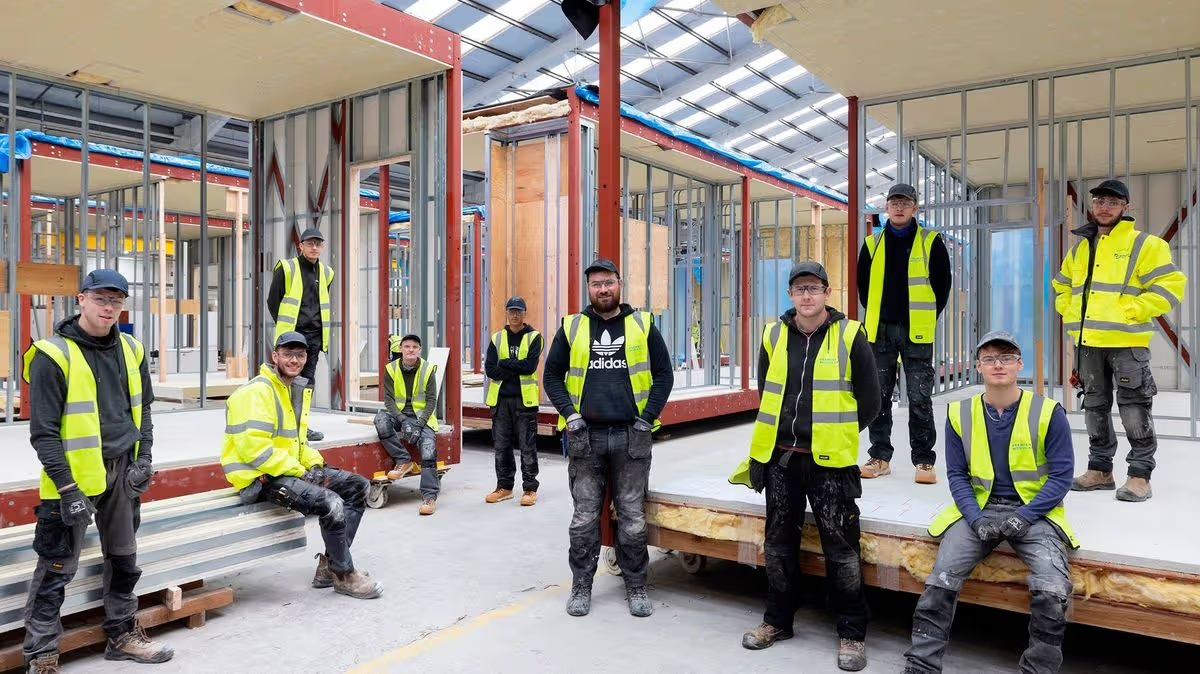
Premier Modular announces expansion and up to 50 new jobs amid increased demand

Published

on

Business Live

East Yorkshire’s Premier Modular is moving towards round-the-clock production near Driffield

There will be new roles, from entry-level positions to high multi-skilled trades

Inside the Premier Modular factory in Brandesburton, near Driffield(Image: Premier Modular)

An East Yorkshire firm that constructs modular buildings for high-profile clients — including the NHS, Manchester Airport Group, and Timpson — has announced plans for expansion and new job opportunities.

Premier Modular, based in Brandesburton near Driffield, is moving towards round-the-clock production to keep pace with surging demand for its modular solutions. Underlining its long-term dedication to regional investment and employment, the company’s new operating model will require additional workforce capacity and further job creation for the local community.

Advertisement

Through a series of carefully phased ramp-up operations, Premier Modular’s factory is expected to generate an additional 1,000 production hours per week by May, rising to approximately 1,600 hours per week from July — representing a more than 300% increase in hours from the initial escalation stage in April.

To accommodate the growth, a further 40 to 50 positions are expected to be created as night-shift operations continue to develop. Recruitment will cover a broad range of roles, from entry-level posts to highly skilled trades, particularly within joinery, reports Hull Live.

Vacancies will also encompass forklift truck drivers, quality controllers, stores operatives, supervisors and production leadership positions.

The Premier Modular factory in Brandesburton, near Driffield

The Premier Modular factory in Brandesburton, near Driffield(Image: Premier Modular)

David Harris, managing director of Premier Modular, said: “This growth is not just about increasing output, it is about investing in people. The decision to extend Premier Modular’s operations reflect both the scale of our future pipeline of work, and our dedication to developing our team.

Advertisement

“We aim to ensure a smooth transition into our next phase of growth, while maintaining our high standards of quality and delivery. We remain committed to innovating, advancing and providing jobs that can develop skills and offer long-term career pathways, including through apprenticeships.

“We’re on a growth journey, and we want the local community to be part of that journey too.”

As Premier Modular bolsters its headcount, the number of apprenticeship opportunities is also expected to rise. Currently, 5% of its total workforce is already on apprenticeships programmes.

Advertisement
Continue Reading

Business

Beverage innovation playing ‘important role’ for Keurig Dr Pepper

Published

on

Beverage innovation playing ‘important role’ for Keurig Dr Pepper

Coffee business still struggling with market headwinds.

Continue Reading

Trending

Copyright © 2025