


Connect with us
DAPA Banner

Tech

ICE Is Or Isn’t Cutting Back On Courthouse Arrests, Depending On Who You Ask

Published

on

from the impossible-to-trust-or-verify dept

The administration’s anti-migrant tactics are now months into an indefinite period of continuous escalation. That protest efforts have escalated alongside it apparently means nothing to the officials spearheading this brazen attack on non-white people.

It wasn’t until federal officers began killing people in front of witnesses that the administration decided to dial things back a bit. But did it ever actually do it? Or did it just sideline the most famous faces associated with this wave of violence and unlawfulness?

Punting former DHS head Kristi Noem into the nosebleed section of the federal government didn’t do much to change things, not when “Border Czar” Tom Homan (the guy who more or less said protesters were to blame for the Minneapolis murders) is still hanging around and her replacement, Markwayne Mullin, looks like just another expendable MAGA footsoldier.

Some small sort of de-escalation seems to be happening now, but it’s hard to tell if this is due to policy changes, budget issues, or the natural result of pushing this hard for this long. Sooner or later, things tend to trend towards inertia, no matter how much motivational frothing is being done by those who aren’t actually on the front lines.

Advertisement

Then there’s the DOJ upsetting the administration’s own apple cart by admitting in court that ICE officers were committing illegal arrests by pouncing on migrants attending immigration hearings. Not that ICE officers have necessarily stopped doing this (there’s evidence to suggest at least some of them haven’t), but it does make it clear that continuing to do so is at least a violation of policy, as well as being, you know, actually illegal.

So, when things are being said about further de-escalation, you may as well start ingesting fistfuls of salt. First, here’s the good news, which comes from two unnamed DHS officials who insist things are being calmed down from the top down:

Donald Trump’s administration has reportedly instructed immigration enforcement officers to cut back on arrests inside courthouses and to no longer enter homes without a warrant, backing off two controversial policies that have sparked violent and chaotic scenes in the president’s mass deportation campaign.

Immigration and Customs Enforcement field offices across the country were verbally instructed by their superiors that they should no longer enter homes unless they have a judicial warrant, two Homeland Security officials told NBC News.

That would seem to be the least this administration could do since it would finally align ICE’s actions with the law and its internal policies. However, if these instructions are only be handed out “verbally,” it means the DHS is deliberately avoiding creating a paper trail that might be used against it should it decide to just go back to doing this the old, illegal way.

Advertisement

And that probably explains the immediate, contradictory statement that followed the reporting based on assertions made by two unidentified DHS officials.

A spokesperson for Homeland Security told The Independent that there has been “no change in policy.”

“We will continue to arrest illegal aliens at immigration courts following their proceedings in compliance with the law and any applicable court orders,” the person said. “It is commonsense to take them into custody following the completion of their removal proceedings.”

That’s definitely not the same thing as what was expressed by these DHS officials. And the rest of the statement makes it clear federal officers will continue to arrest people who show up for their scheduled immigration hearings. While it does make sense to arrest people who’ve been issued an order of removal, that’s not actually what ICE has been doing. It has been bringing in DOJ lawyers to dismiss pending cases to immediately make people eligible for removal. And — as has been shown in court — ICE officers have been arresting people not currently under orders of removal and then generating arrest warrants after the fact.

So, it’s not a good news/bad news thing going on here. It’s bad news/worse news, with a balance that constantly shifts depending on what mood the administration is in on any given day. Courts haven’t been able to stop ICE from engaging in illegal arrests. And the growing national opposition to Trump’s anti-migrant actions hasn’t made any discernible dent in the administration’s lust for punishing non-white people simply for existing.

Advertisement

Filed Under: 4th amendment, dhs, ice, mass deportation, trump administration

Source link

Advertisement
Continue Reading
Click to comment

You must be logged in to post a comment Login

Leave a Reply

Tech

Schiit Buf Tube Buffer Launches at $99: A Subtle Upgrade or Sonic “Buf”?

Published

on

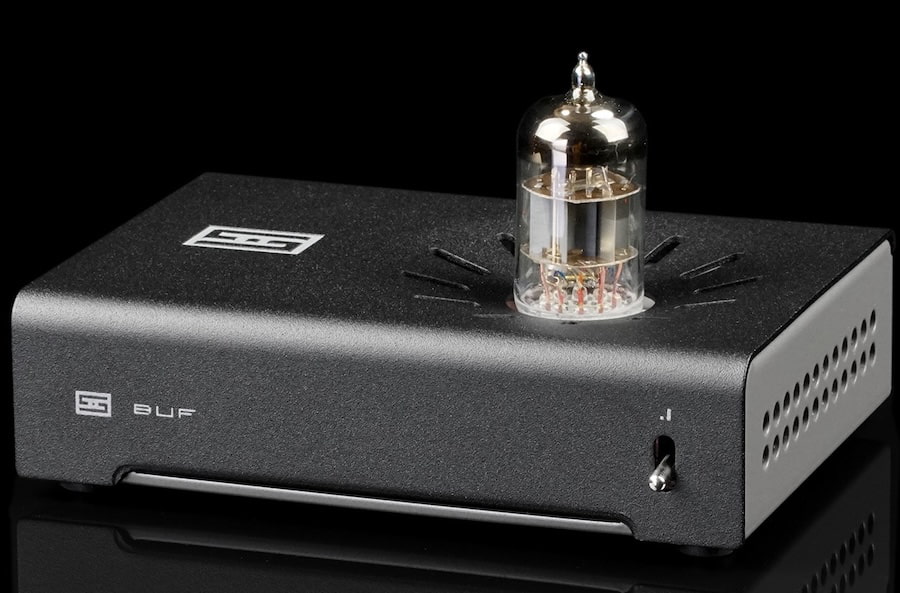
Schiit Audio is taking a more practical swing at tubes with the $99 Buf. It’s a compact tube buffer designed to sit in your signal chain, not take it over.

Buf isn’t a preamp and it’s not a DAC. There are no inputs for sources beyond basic line level, no volume control, and no system control duties. You place it between components; typically between a DAC and amplifier, or between a source and powered speakers, and it inserts a tube stage into the chain. If you don’t want that, it can be switched out and used as a straight pass through.

That makes it easy to experiment without committing to a full tube setup. It can be used to slightly reshape a solid state system, take the edge off a brighter chain, or add some variation to a desktop or headphone rig. It’s also flexible enough to move around depending on the system or use case, which fits Schiit’s usual modular approach.

At $99, Buf is less about replacing components and more about giving users a simple way to try a tube stage in different setups and decide if it works for them.

Advertisement
schiiit-buf-front-angle
Schiit Buf

Tubes Anywhere Without Rebuilding Your System

Schiit Audio isn’t pretending the $99 Buf is neutral. In fact, they’re leaning in the opposite direction.

Buf is a tube buffer. It adds a ton of low-order harmonic distortion, without adding a bunch of noise. It destroys the big perfect of ‘measurement gear.’ At the same time, lots of people, including those who use Audio Precisions all day, think it sounds better. So we figured we’d make this thing and let you find out for yourself,” said Jason Stoddard.

That’s the pitch. Not accuracy in the lab sense, but a different presentation that some listeners may prefer, especially in systems that lean hard into ultra-low distortion solid state performance.

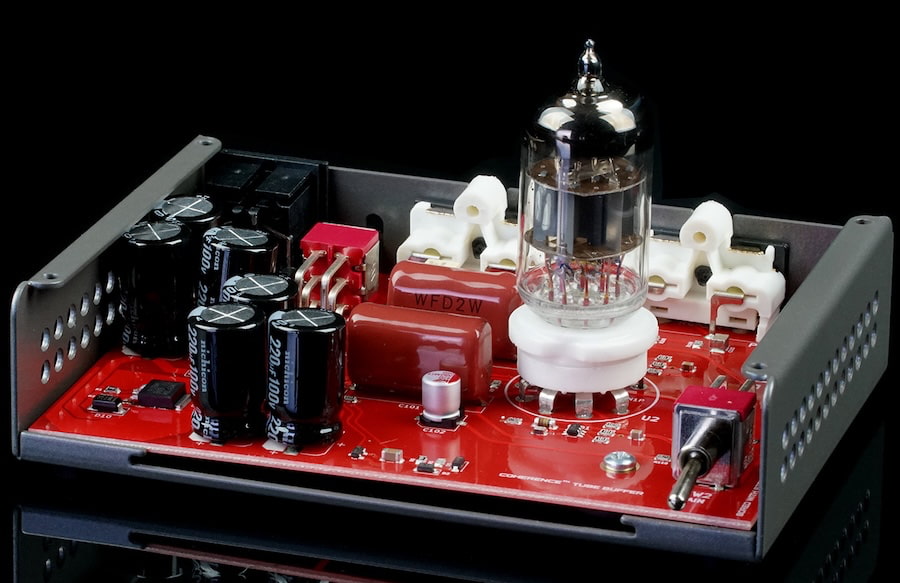
Despite the price, this isn’t a stripped-down implementation. The Schiit Buf runs a 100V plate voltage, uses a linear power supply, and incorporates higher-grade parts including Panasonic film capacitors. Schiit’s Coherence topology is also in play, maintaining absolute phase and offering selectable gain; either 0dB or 12dB from a front panel switch.

Advertisement

Stoddard is also clear that this isn’t a generic design.

It’s not just another cathode follower,” he explained. “It’s more akin to our Lyr and Vali tube amps, but it’s different than both—a simple Class A stage optimized for line level use, rather than driving headphones.”

That last part matters. Buf isn’t trying to power anything. It’s there to sit in the chain and influence it, subtly or not, depending on the system and gain setting.

Advertisement. Scroll to continue reading.
Advertisement

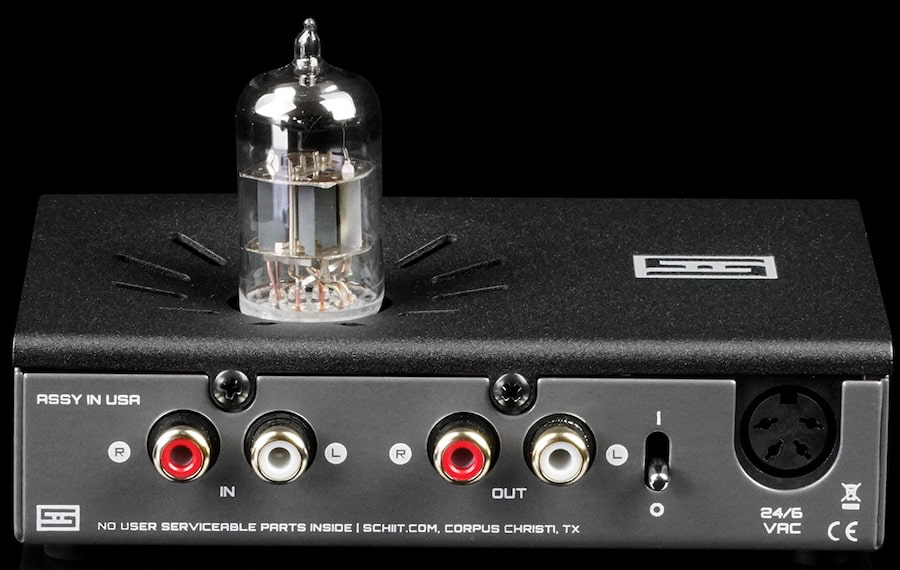
Connectivity is simple: RCA in, RCA out. It will work in most two-channel or desktop setups without much thought. And because it can be fully bypassed, it’s easy to evaluate in real time without pulling cables.

schiiit-buf-back

Schiit Buf Specifications

  • Gain Modes
    • Low Gain (0dB): 20Hz–20kHz ±1dB, THD <0.5%, IMD <0.6%, SNR >106dB, Crosstalk -90dB
    • High Gain (12dB): 20Hz–20kHz ±1dB, THD <0.2%, IMD <0.4%, SNR >97dB, Crosstalk -80dB
  • Performance & Design
    • Output Impedance: 75 ohms
    • Input Impedance: 470k ohms
    • Maximum Output: 8.2V RMS
    • Topology: Coherence tube gain with BJT inverter, Class A
    • Protection: Delayed start, fast shutdown, muting relay
  • Power & Build
    • Power Supply: External 24VAC and 6VAC wall adapter, linear regulated rails, 6V AC heater
    • Power Consumption: 6W
    • Dimensions: 5 x 3.5 x 2.75 inches
    • Weight: 1 lbs
schiiit-buf-pcb

Schiit Buf Setup, Tube Use, and Basics

Buf can be added to a system in two straightforward ways. You can place it between a preamp and power amplifier, which allows it to affect every source connected to the preamp. Alternatively, you can insert it between a single source such as a DAC and an integrated amplifier, preamp, or headphone amplifier. In that setup, Buf only influences that specific source.

Tube lifespan is typically around 5,000 hours of use. That figure reflects active operating time, so it’s best to turn the unit off when it’s not in use to extend tube life.

Buf is compatible with tubes that use a standard 6922 pinout, with heater current up to 600mA. Supported types include 6N1P, 6922, ECC88, and 6DJ8. For simplicity and consistency, using the included tube is the most straightforward option.

Like the rest of Schiit’s lineup, Buf is built in the USA, with assembly in Texas and chassis work in California. It carries a 3-year warranty, with the tube itself covered for 90 days.

Advertisement

The Bottom Line

The $99 Schiit Buf is a simple way to add a tube stage to almost any system without changing your core components and you can bypass it when you don’t want it. What’s unique is the price, true tube implementation, and flexibility. What’s missing is everything else: no volume control, no inputs beyond basic RCA switching, no DAC, no remote. This is for users who already have a system and want to experiment with tube character without committing to a full tube preamp or amplifier.

Where to buy: $99 at Schiit

Source link

Advertisement
Continue Reading

Tech

LG’s Wireless TVs are the first in the world to offer this feature

Published

on

LG has secured the first True Wireless Lossless Vision certification from testing body TÜV Rheinland for its premium wireless TVs, independently verifying that the OLED evo W6 and Mini RGB evo MRGB9M deliver visually lossless 4K picture quality over a wireless connection.

The certification addresses a longstanding concern with wireless TV technology, where the absence of a physical cable connection has introduced compromises with colour accuracy, HDR tone reproduction and image detail that made wireless displays a harder recommendation against wired equivalents at the same price point.

TÜV Rheinland’s evaluation confirmed that both LG models maintain colour reproduction, image detail, and HDR tone performance within defined tolerance levels relative to the input signal, with the OLED evo W6 additionally certified for wireless transmission at refresh rates up to 165Hz, a figure relevant to gaming use cases where motion clarity and input lag are primary concerns.

The OLED evo W6 sits at the centre of LG’s certified lineup as the company’s Wallpaper TV, a 9mm panel that ships with a separate Zero Connect Box housing all physical inputs, which can be positioned up to 10 metres from the screen to eliminate visible cable runs between source devices and the display itself.

Advertisement
LG TUV Rheinland certifiedLG TUV Rheinland certified
Image Credit (LG)

Advertisement

Extending the certification beyond OLED, the Mini RGB evo MRGB9M brings TÜV-verified wireless performance to LCD technology. Available in 65-inch, 75-inch, and 86-inch screen sizes, the panel applies image processing techniques more commonly associated with OLED-class displays to provide better colour accuracy and contrast management at larger scales.

The True Wireless Lossless Vision standard itself was developed by TÜV Rheinland to evaluate wireless display products against factors including input lag, colour accuracy and gamma tracking, establishing a repeatable test framework against which future wireless TV products from any manufacturer can be assessed.

Neither pricing nor regional availability for the LG OLED evo W6 or LG Mini RGB evo MRGB9M has been confirmed, with LG stating only that availability may vary by market.

Advertisement

Source link

Continue Reading

Tech

SpaceX quietly warns its space AI data center dream may never work, even as Elon Musk keeps selling it as inevitable

Published

on


  • SpaceX admits orbital AI data centers may never become commercially viable
  • SpaceX S-1 filing reveals unproven technologies behind space-based computing infrastructure
  • Harsh space conditions threaten the reliability of sensitive AI hardware systems

SpaceX has warned potential investors its ambitious plans to build AI data centers in orbit may never become commercially viable due to unproven technologies and the harsh realities of space.

The company disclosed these risks in its pre-IPO S-1 filing, which US securities law requires to inform investors of potential pitfalls while shielding the company from future legal liability.

Source link

Advertisement
Continue Reading

Tech

New Releases on Prime Video in May 2026: Jack Reacher, Spider-Noir and More

Published

on

Nicolas Cage stars in the new live-action series Spider-Noir, based on the Marvel comic Spider-Man Noir. The show marks Cage’s first leading role in a TV series. In it, he plays Ben Reilly, a down-on-his-luck private investigator in 1930s New York who was once a superhero known as “The Spider.” When he’s offered a new case, Ben assumes his old alter ego one more time. 

While we’re excited to see what Cage can do in this role, we’re also looking forward to the choose-your-own-viewing-experience aspect of the show. The series will be available to stream two ways: “Authentic Black & White” for an especially noir feel, or in “True-Hue Full Color,” a stylized, color-saturated option. Lamorne Morris, Li Jun Li, Karen Rodriguez, Abraham Popoola and Jack Huston all co-star. The series will debut on MGM Plus’s broadcast channel on May 25 and arrives on streaming on Prime Video on May 27 as a binge release.

Source link

Advertisement
Continue Reading

Tech

LG Electronics and Nvidia are in talks on robotics, AI data centres

Published

on

The discussions, triggered by a visit from Nvidia’s Madison Huang, would deepen LG’s physical AI ambitions and give Nvidia another major consumer electronics partner at a moment when physical AI is moving from lab to factory floor.


LG Electronics confirmed on Wednesday that it has been in discussions with Nvidia over potential cooperation in three areas: robotics, AI data centres, and mobility.

The announcement, reported by Reuters, came after Madison Huang, Nvidia’s senior director for physical AI platforms, and the eldest daughter of CEO Jensen Huang, visited LG Electronics’ headquarters in Yeouido, Seoul, along with several other major South Korean technology companies. LG CEO Ryu Jae-cheol attended the meeting directly.

No formal agreement has been announced. The talks are at an exploratory stage, and no specific products, investment amounts, or timelines have been confirmed. But the three areas under discussion map precisely onto both companies’ most publicised strategic priorities, and the breadth of the conversation signals this is more than a courtesy call.

Advertisement

What each side brings to the table?

The 💜 of EU tech

The latest rumblings from the EU tech scene, a story from our wise ol’ founder Boris, and some questionable AI art. It’s free, every week, in your inbox. Sign up now!

For LG, the strategic logic is straightforward. The company is one of the world’s largest home appliance manufacturers, but its growth thesis has shifted decisively towards AI-powered physical systems.

At CES 2026 in January, LG unveiled CLOiD, a home robot with two articulated arms, seven degrees of freedom per arm, and five individually actuated fingers per hand, the physical expression of what the company calls its ‘Zero Labor Home’ vision, in which connected robots and appliances automate the manual and cognitive load of household tasks.

Advertisement

LG’s broader CES presentation framed its AI strategy around three pillars: device excellence, an orchestrated smart home ecosystem, and expansion into AI-defined vehicles and AI data centre HVAC solutions.

The CLOiD robot runs on LG’s own ‘Affectionate Intelligence’ platform, which handles contextual awareness, natural interaction, and continuous learning from the home environment.

What it does not have is Nvidia’s Isaac robotics stack: the simulation environment, the pre-trained manipulation models, the Omniverse-based digital twin infrastructure, and the GPU compute optimised for real-time physical AI inference that Nvidia has been building out over the past two years.

Integrating Nvidia’s physical AI platform with CLOiD would give LG what every other serious robotics company is currently racing to access: a proven development-to-deployment pipeline that can compress the time between prototype and production.

Advertisement

For Nvidia, the attraction is consumer scale. Its existing robotics partnerships, including the Siemens factory trial, where a Humanoid HMND 01 Alpha running on Nvidia’s physical AI stack completed eight hours of live logistics operations at a factory in Erlangen, are concentrated in industrial and enterprise settings.

LG would represent a different category entirely: a company with mass-market distribution, a global installed base of connected home appliances through its ThinQ ecosystem, and specific plans to put a robot in people’s homes.

If Nvidia’s Isaac platform becomes the AI stack inside CLOiD, it gains access to one of the most data-rich training environments imaginable: real homes, real tasks, real variability.

The robotics thread is the most visible, but the data centre and mobility conversations are arguably of greater near-term commercial significance.

Advertisement

On data centres: LG’s CES presentation explicitly positioned the company as a provider of high-efficiency HVAC and thermal management solutions for AI data centres, a product category that is exploding in relevance as the power density of GPU clusters makes conventional cooling infrastructure inadequate.

Nvidia’s data centre business, which accounted for the overwhelming majority of its record revenues over the past two years, is the most important AI infrastructure deployment context in the world.

A partnership on data centre thermal management would position LG as a hardware supplier inside Nvidia’s ecosystem at the infrastructure level, complementing the AI compute layer rather than competing with it.

On mobility: both companies have well-established automotive AI programmes that are logical fits for collaboration. Nvidia’s DRIVE platform is among the most widely deployed AI computing systems in autonomous and semi-autonomous vehicles.

Advertisement

LG’s automotive components division, which produces in-vehicle infotainment, camera systems, EV components, and what it calls ‘AI-powered in-vehicle solutions’ including gaze-tracking, adaptive displays, and multimodal generative AI platforms, is one of the company’s fastest-growing segments.

The two companies are already operating in adjacent layers of the same vehicle; a formal collaboration would potentially integrate LG’s in-cabin AI experience layer with Nvidia’s DRIVE compute platform.

Wednesday’s announcement is the latest signal that the physical AI race, the deployment of AI in robots and autonomous systems operating in the real world, as distinct from software models running in the cloud, is accelerating beyond the controlled trials of the past two years into commercial partnership structures.

For example, Sereact raised $110 million to scale AI that makes any robot adaptable, underscoring how capital is flowing into the intelligence layer of the robotics stack. The Siemens–Nvidia factory deployment demonstrated that physical AI can run in live production environments; the LG talks suggest it is now extending into the consumer home.

Advertisement

For Nvidia, the expansion of physical AI partnerships beyond purely industrial settings into consumer electronics is strategically significant. The company’s Omniverse and Isaac platforms are designed to be the universal development infrastructure for physical AI, in the same way its GPU architecture became the universal infrastructure for cloud AI.

Every major robotics company that adopts the Nvidia stack strengthens that position. LG, with its scale in home appliances and its explicit commitment to bringing robots into the home, is a materially different kind of partner than a German factory or a logistics warehouse, and potentially a much larger one.

Source link

Advertisement
Continue Reading

Tech

Using A VT-100 Today | Hackaday

Published

on

You may not know what a ADM-3, a TV910, or a H1420 are, but you probably have at least heard of a VT-100. They are all terminals from around the same time, but the DEC VT-100 is the terminal that practically everything today at least somewhat emulates. Even though a real VT-100 is rare, since it defined what have become ANSI escape sequences, most computers you’ve used in the last few decades speak some variation of the VT-100’s language. [Nikhil] wanted to see if you could use a VT-100 for real work today.

While the VT-100 wasn’t a general-purpose computer, it did have an 8080 inside. It only had about 3K of RAM, which was enough to act as a serial terminal. A USB serial port and a terminal with modern Linux, how hard could it be?

As it turns out there were a few issues. MacOS assumes terminals can take data at 9600 baud with no handshaking, apparently. It also means that any application that assumes redrawing the whole terminal is fast will be sorry for that choice.

Advertisement

Of course, there are commands modern VT-100-like terminals accept that the original didn’t. However, as you’ll see in the post, all of these things you can either live with or solve.

It is easy to make your own VT-100 replica. While the VT-100 may seem simple today, it was a marvel compared to even older terminals.

Advertisement

Source link

Continue Reading

Tech

FLOSS Weekly Episode 869: Linux On Your Toaster

Published

on

This week Jonathan chats with Andrei, Mahir, and Praneeth, live on location at Texas Instruments! The team at TI has been working hard to provide really good Open Source support for Sitara processors, including upstreaming support to the mainline Linux kernel. We talk about the CI pipeline for these devices, the challenges of doing Open Source at a big company, and more. Check it out!

Did you know you can watch the live recording of the show right on our YouTube Channel? Have someone you’d like us to interview? Let us know, or have the guest contact us! Take a look at the schedule here.

Advertisement

Direct Download in DRM-free MP3.

If you’d rather read along, here’s the transcript for this week’s episode.


Theme music: “Newer Wave” Kevin MacLeod (incompetech.com)

Advertisement

Licensed under Creative Commons: By Attribution 4.0 License

Source link

Advertisement
Continue Reading

Tech

Families Of Tumbler Ridge Shooting Victims Sue OpenAI

Published

on

Just days after OpenAI CEO Sam Altman wrote a public apology to people of Tumbler Ridge, British Columbia in the aftermath of the town’s deadly February 10 school shooting, the families of the victims of the traumatic event are suing OpenAI for negligence.

The mass shooting, one of the deadliest in Canadian history, saw the alleged shooter, 18-year-old Jesse Van Rootselaar, enter the town’s local high school and kill five students and one teacher, as well as critically injure two others, before taking her own life. Local police later discovered Van Rootselaar had also killed her mother and 11-year-old half-brother before entering the school.

Per NPR, lawyers representing some of the families of Tumbler Ridge filed six different suits on Wednesday in a federal court in San Francisco. One of the complaints, filed on behalf of Maya Gebala, a survivor of the shooting, alleges OpenAI’s automated safety systems flagged Van Rootselaar’s ChatGPT conversations in June 2025, more than half a year before she entered the town’s high school with a long gun and modified rifle, for “gun violence activity and planning.” It further claims OpenAI’s safety team urged management to contact authorities, but that the company chose instead to deactivate Van Rootselaar account. She later created a second account and continued her conversations with ChatGPT.

“The events in Tumbler Ridge are a tragedy. We have a zero-tolerance policy for using our tools to assist in committing violence,” an OpenAI spokesperson told Engadget. “As we shared with Canadian officials, we have already strengthened our safeguards, including improving how ChatGPT responds to signs of distress, connecting people with local support and mental health resources, strengthening how we assess and escalate potential threats of violence, and improving detection of repeat violators.”

Advertisement

On late Tuesday, OpenAI published a blog post outlining its safety policies. “As part of this ongoing work, we’ve continued expanding our safeguards to help ChatGPT better recognize subtle signs of risk of harm across different contexts. Some safety risks only become clear over time: a single message may seem harmless on its own, but a broader pattern within a long conversation — or across conversations — can suggest something more concerning,” the company wrote.

The suits filed on Wednesday are the latest attempt to use the legal system to hold OpenAI accountable for the design of its products. Last summer, the parents of Adam Raine, a teen who committed suicide in 2025, filed the first known wrongful death suit against an AI company, alleging ChatGPT was aware of four previous attempts by Raine to take his own life before he was ultimately successful.

Source link

Advertisement
Continue Reading

Tech

Tech Moves: Former Microsoft VP to lead Inteum; Veeam, mpathic add execs; past Tune CEO’s new role

Published

on

Angus Norton. (LinkedIn Photo)

— Former Microsoft and Amazon exec Angus Norton is now CEO of Inteum, an IP management platform for university technology transfer offices. Norton joins the Kirkland, Wash.-based company from Bodhi Venture Labs, an executive services firm focused on product management and marketing that he led for more than five years.

Norton launched his career at Microsoft in 1995, working on Office, Bing, and other products. He rose to vice president and general manager before leaving after 18 years. At Amazon, he served as GM for enterprise SaaS applications.

Working in tech, he was always “searching for, building, or acquiring leading-edge tech to realize a product vision,” Norton said on LinkedIn. “Honestly, I had no idea how to access or collaborate with the wonderful universities and research communities in all our backyards.” Inteum, he added, connects these institutions with the private sector to bring “their inventions to life.”

Rashmi Garde. (Veeam Photo)

Veeam announced Rashmi Garde as its new chief legal officer. The Kirkland, Wash.-based data protection and ransomware recovery company relocated its headquarters last year from Columbus, Ohio.

Garde is based in the San Francisco Bay Area and has provided corporate legal counsel at companies including Sophos, Centrify, BloomReach, Marin Software and VMware. She joins Veeam from Informatica, where she helped navigate the company’s $8 billion acquisition by Salesforce.

“Trust is the business of the agentic era, and I am excited to join Veeam at a moment when ensuring data is understood and resilient has never been more critical,” Garde said.

Advertisement
Megan Fouty. (LinkedIn Photo)

Megan Fouty has been appointed chief operating officer at mpathic, a Seattle startup building software to analyze conversations in corporate texts, emails and audio calls. The company recently launched technology to make AI and chatbot communications safer, particularly for vulnerable users.

Fouty joins mpathic from Tin Can, a Seattle landline phone startup where she served as general counsel and head of people. Past roles include general counsel at Glowforge and Convoy. She is also the founder of Diversity University, a firm that provides diversity, equity and inclusion resources to companies and organizations.

Peter Hamilton. (LinkedIn Photo)

Peter Hamilton is now CEO and co-founder of Arena One, a newly launching live music and entertainment startup. According to a release, the venture aims to combine “premium audio and visual production with low-latency interactivity, delivering the energy of a live show with the intimacy of a front-row experience — at scale.”

Hamilton joins Arena One from Roku, where he spent more than four years as head of ad innovation. The Seattle-based leader previously served as CEO of Tune, a mobile marketing startup, for more than a decade. Arena One is not Hamilton’s first foray into the arts. He sang as a baritone with the Seattle Opera and co-founded the Seattle NFT Museum with his wife, Jennifer Wong.

“This move is a full circle feeling for me,” Hamilton said on LinkedIn. “I have undergrad degrees in music and film, and most of my work in tech and advertising has been a way for me to get closer to that ecosystem, ha!”

Dr. Michael Han. (LinkedIn Photo)

Dr. Michael Han was named chief medical officer for Ambience Healthcare, a San Francisco Bay Area platform for clinical documentation. Han, based in Bellevue, Wash., joins Ambience from MultiCare Health System; he previously served as chief of surgery and as a urologist at Pacific Medical Centers.

Han said on LinkedIn that he had tested every documentation tool on the market and found Ambience to be the superior product — one that supports clinicians from pre-visit prep through accurate, compliant coding. “That’s the company I wanted to be part of,” Han said.

Advertisement

Seattle Aquarium appointed Meg McCann as its new president and CEO, succeeding Bob Davidson, who retired in 2025 after more than two decades of leadership. McCann joined the aquarium in 2024 as COO and briefly served as acting president and CEO before officially landing the role.

“I have seen firsthand [McCann’s] ability to advance our mission of inspiring conservation of our marine environment, guiding the Aquarium toward an exciting and innovative future,” Davidson said.

Julia Jones was named head of design for Aarden AI, a Seattle startup that emerged from stealth in October and has an AI platform that helps landowners research and navigate deals with developers eager to build data centers, clean energy installations, housing and other uses. Jones was previously at Omnidian for more than three years as a senior UX/UI designer.

“After onboarding at superhuman speed, [Jones] has upleveled every surface area of our org: design review, systems choices, user research, product, and marketing,” said Aarden CEO Danan Margason on LinkedIn.

Advertisement
Zabrina Johal. (LinkedIn Photo)

— And in case you missed today’s GeekWire story, Zap Energy has changed its leadership line up as the Everett, Wash.-based company adds nuclear fission to its pursuit of fusion power.

  • Zabrina Johal is now CEO, succeeding company co-founder Benj Conway, who is transitioning to president. Johal began her career as an officer and engineer in nuclear propulsion in the U.S. Navy and previously spent 18 years with General Atomics. Most recently, she was with AtkinsRéalis, a Montreal engineering firm with a nuclear power focus.
  • Daniel Walter, a former director at Bill Gates-backed TerraPower, is director of nuclear engineering.
  • Zap vice president Matthew Thompson is now SVP of fission technology.

Source link

Continue Reading

Tech

Datavant opens new global R&D centre in Galway’s Bonham Quay

Published

on

So far, the organisation has already hired for 100 of the previously announced 125 new roles, the remainder of which are to be filled by the end of the year.

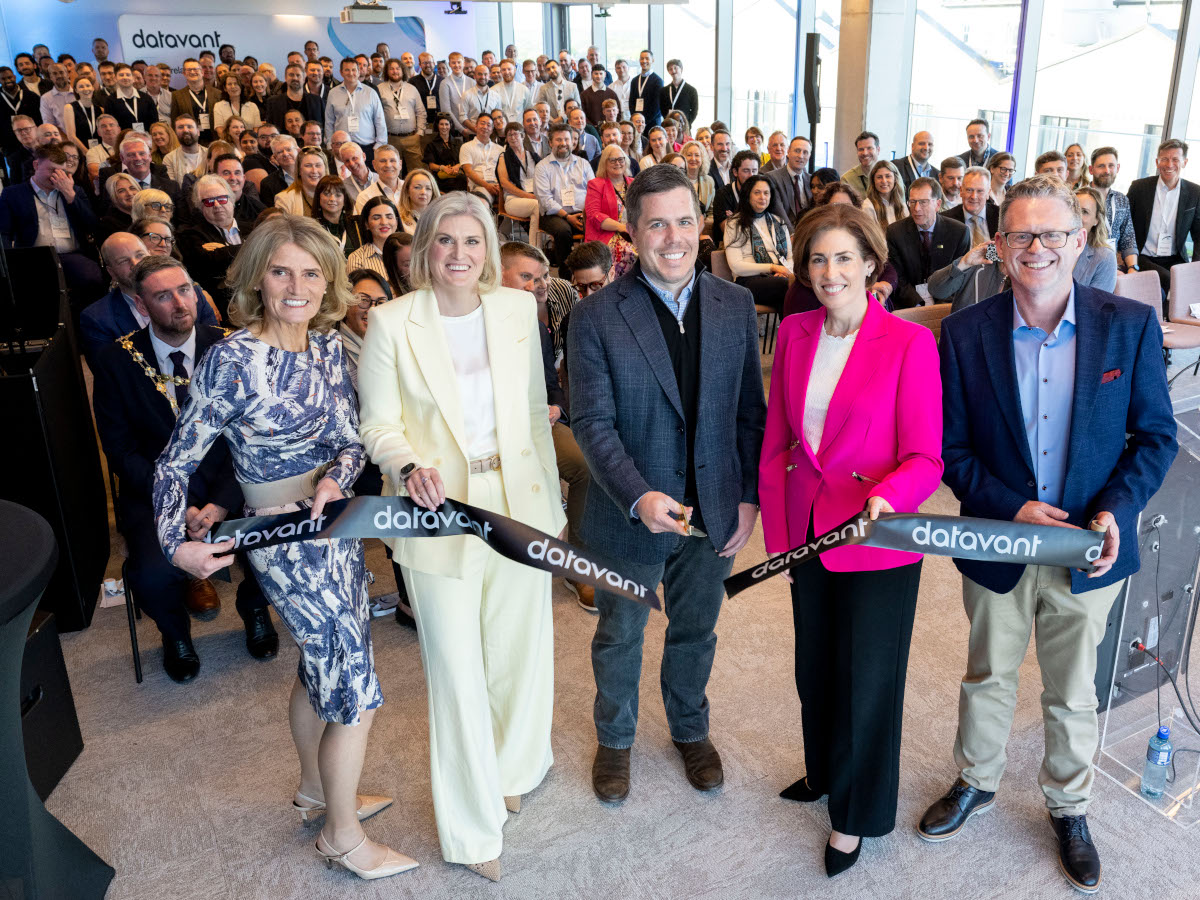
Datavant, a data collaboration platform for the healthcare space, has officially opened its new global R&D centre at Bonham Quay in Galway city.  

The new location is a 15,000 sq ft office, across two floors and can accommodate up to 160 workspaces. There are also facilities for company-wide town hall meetings, team meet ups and recreational activities. 

The team at the Bonham Quay facility will focus on a number of goals, such as the advancement of platform enhancements, automated record retrieval, security and privacy practices, and product development. 

Advertisement

Headquartered in New York, Datavant employs nearly 10,000 people. The organisation announced the availability of 125 new roles last year, 100 of which have been filled to date, with the final roles to be filled by the end of the year. Datavant has also stated that the company is actively looking to recruit for a range of engineering positions, with a particular focus on experienced software professionals. 

Commenting on the launch, Minister of Enterprise, Tourism and Employment Peter Burke, TD said: “Datavant’s decision to expand and officially open its new global R&D centre in Galway is a strong endorsement of Ireland’s ability to attract and support innovation-led investment. 

“It speaks to the depth of our talent pool, the quality of our research and engineering capability and the pro-enterprise environment we have built. I wish all the team at Datavant the very best as they take the next exciting step on their growth journey.”

Minister of Education and Youth Hildegarde Naughton, TD added: “This is a fantastic milestone for Galway and for the wider west region. The official opening of Datavant’s new R&D centre at Bonham Quay, combined with the announcement that 100 roles have already been filled, demonstrates the momentum that exists in the west region and the confidence international companies have in Galway as a place to grow.”

Advertisement

Don’t miss out on the knowledge you need to succeed. Sign up for the Daily Brief, Silicon Republic’s digest of need-to-know sci-tech news.

Source link

Advertisement
Continue Reading

Trending

Copyright © 2025