
Crypto World
276 Arrested as Global Operation Topples Crypto Scam Compounds



At least 276 individuals have been arrested, and 9 crypto scam centers dismantled following a coordinated international effort.
The crackdown was the result of cooperation among the Federal Bureau of Investigation, Dubai Police, and the Chinese Ministry of Public Security.
Authorities Charge Six in Global Crypto “Pig-Butchering” Takedown
According to the official release, Dubai Police arrested 275 of the suspects. The Royal Thai Police arrested an additional defendant.
Moreover, federal prosecutors charged six defendants with federal fraud and money laundering. The six accused allegedly managed, worked at, or recruited for companies that ran scam centers.
Follow us on X to get the latest news as it happens
The compounds preyed on American victims, who collectively lost millions of dollars to such schemes. All six defendants are accused of orchestrating crypto investment scams commonly referred to as “pig-butchering.”
A pig-butchering scam is a fraud where criminals build a fake romantic or friendly relationship online over weeks or months. They then lure victims into investing in fraudulent crypto or trading platforms, and then take everything.
US Attorney Adam Gordon framed the operation as a turning point for cross-border fraud enforcement.
“These scammers thought they were safe half a world away. But their world has changed. Global crime now faces global justice,” he said.
The arrests follow a broader push by the US against crypto investment fraud networks. Last week, authorities restrained more than $700 million in cryptocurrency and filed wire fraud conspiracy charges against two Chinese nationals accused of running scam compounds.
In a separate case, a US District Judge sentenced a man to 23 years in federal prison for running the Meta 1 Coin scheme. A Saipan woman received a 71-month sentence for posing as a Bitcoin heiress in another fraud case.
Subscribe to our YouTube channel to watch leaders and journalists provide expert insights
The post 276 Arrested as Global Operation Topples Crypto Scam Compounds appeared first on BeInCrypto.

Peter Schiff renewed his attack on Strategy’s Bitcoin accumulation playbook. He argued the firm’s growing share of the supply has done nothing to support the BTC price.
The longtime gold advocate posted from outside the Bitcoin 2026 conference in Las Vegas. He claimed his sell warning from last year had been validated by a sharp price drop.
A Year of Buying, A Year of Falling Prices
Schiff highlighted a stark contrast between Strategy’s accumulation pace and Bitcoin’s price action over the past 12 months. The firm controlled 2.76% of total Bitcoin (BTC) supply at last year’s Vegas conference. It now holds 3.9%, a 40% increase in market share.
That growing dominance failed to put a floor under the market. Bitcoin traded near $110,000 when Schiff spoke at the 2025 event. The asset has since fallen to about $76,000, a 30% slide. The drop has reignited debate over the death spiral thesis Schiff has pushed for months.
Schiff Watches the Bitcoin Conference From Home
Notably, economist Peter Schiff skipped this year’s gathering following his 2025 sell call and has continued to criticize Strategy’s corporate treasury model, which has played a key role in driving the company’s record Bitcoin accumulation.
Meanwhile, Bitwise CIO Matt Hougan maintains that Strategy remains the single most important driver behind Bitcoin’s recent rally, pointing to its aggressive, debt-fueled accumulation strategy.
Schiff also pointed to a shift in conference narratives. Last April, Bitcoin treasury vehicles dominated the discussion as the price approached its peak. This year, the spotlight has moved to digital credit, which Schiff predicted would also collapse.
The accumulation race between Strategy and rivals such as Bitmine has not translated into a price floor. Bitcoin’s slide has dragged the broader market lower. Analysts have trimmed their Q2 outlook for the asset.
From Treasury Critic to Ponzi Allegations
Schiff has gone beyond skepticism in recent weeks. He labeled Strategy’s STRC preferred share product the largest Ponzi in the world. He also challenged Michael Saylor to debate after calling Bitcoin a “shitcoin” on social media.
He posed a direct question to Bitcoin holders ahead of next year’s gathering.
“If MSTR gets to 5% of supply by next year’s conference, why should Bitcoin stop falling?”
Schiff framed the question as a test of the accumulation thesis. The next 12 months may settle the argument. Strategy is expected to keep buying.
A deeper drawdown could pressure its leverage and the wider treasury company model that has shaped this cycle.
The post Peter Schiff Continues to Go After MicroStrategy, But Is He Right This Time? appeared first on BeInCrypto.

TLDR
- Visa expanded its stablecoin settlement pilot to five additional blockchain networks.
- The program now operates across nine networks and reports a $7 billion annualized run rate.
- Visa recorded a 50% increase in settlement volume compared to the previous quarter.
- The newly added networks include Base, Polygon, Canton Network, Circle’s Arc, and Tempo.
- Visa said the multichain approach allows partners to settle transactions in near real time using stablecoins.
Visa expanded its stablecoin settlement pilot to five new blockchains as annualized volume reached $7 billion. The payments company reported a 50% increase from the previous quarter and confirmed broader multichain coverage. The program allows issuers and acquirers to settle transactions using stablecoins instead of traditional banking systems.
Visa Adds Five Blockchains to Stablecoin Pilot
Visa confirmed that its settlement pilot now operates across nine blockchain networks. The newly supported networks include Coinbase’s Base, Polygon, Canton Network, Circle’s Arc, and Stripe-backed Tempo. These platforms join Ethereum, Solana, Avalanche, and Stellar, which Visa integrated earlier.
The company said the pilot enables partners to complete settlements with stablecoins rather than bank transfers. As a result, participants can move funds using blockchain-based dollars in near real time. Visa stated that this structure reduces delays linked to traditional cross-border banking systems.
Visa reported that the program’s annualized run rate reached $7 billion. The company said this figure marks a 50% increase compared to the prior quarter. It confirmed that issuers and acquirers use the pilot for live settlement activity.
Multichain Strategy Supports Global Stablecoin Payments
Visa said it adopted a multichain approach to meet partner demand. The company explained that partners operate across several blockchain ecosystems. Therefore, Visa aims to provide a unified settlement layer across supported networks.
“Our partners are building in a multi-chain world, and they expect their options to reflect that reality,” said Rubail Birwadker. He serves as Visa’s global head of growth products and strategic partnerships. He said expanding to more blockchains allows partners to choose networks that match their needs.
Birwadker added that Visa will maintain a common settlement layer across all integrated networks. He said this structure gives partners access to different liquidity pools without added complexity. Visa stated that the expansion aligns with growing stablecoin adoption in global payments.
The company said stablecoins, which track fiat currencies, now play a larger role in cross-border transfers. Visa has tested stablecoin settlements tied to card programs in more than 50 countries. These pilots include USDC-linked transactions for select partners.
Visa explained that blockchain-based settlement reduces the time required to move funds. Instead of waiting days for banking processes, partners can settle transactions almost instantly. The company confirmed it will continue expanding its stablecoin settlement pilot as partners adopt more blockchain networks.

TLDR
- Nigel Farage faces a parliamentary standards probe over a $6.7 million gift from Christopher Harborne.
- The Conservatives asked the Parliamentary Standards Commissioner to review the source and use of the funds.
- Labour also questioned whether Farage properly declared the payment under House of Commons rules.
- Farage said the gift was personal and intended to keep him safe and secure after past attacks.
- Reform UK stated that the payment was declared and fell under the exemption for personal gifts.
Nigel Farage faces a parliamentary standards review over a $6.7 million gift from crypto investor Christopher Harborne. The Conservatives asked the Parliamentary Standards Commissioner to assess whether the payment breached Commons rules. Labour also questioned the timing of the funds before Farage announced his Clacton candidacy.
Nigel Farage Questioned Over Pre-election Payment Disclosure
The Guardian reported that Harborne transferred about £5 million to Farage in 2024. The payment occurred before Farage declared his candidacy for the Clacton seat. He won the constituency in July after announcing his run in early June.
Farage confirmed the gift in an interview with the Daily Telegraph. He said the funds aimed to keep him “safe and secure for the rest of my life.” He linked the payment to a 2019 milkshake incident and a firebomb attack last year.
A Reform UK spokesman described the transfer as a “personal unconditional gift.” The spokesman said Farage made his decision to stand as an MP independently. He also stated, “We are confident everything has been declared in accordance with the rules.”
The Commons code requires new MPs to register benefits received within 12 months before election. It also states members should register any benefit if doubt exists. Reform UK argues that the payment qualifies for the exemption covering purely personal gifts.
The Conservative Party wrote to Commissioner Daniel Greenberg requesting an inquiry. It asked whether any funds supported political activity rather than security. Labour chair Anna Turley said Farage “appears to have broken the rules again.”
Crypto Donations and Investment Links Draw Attention
Harborne previously donated £9 million to Reform UK in late 2023. Records describe it as the largest single donation from a living person to a U.K. party. Harborne holds a 12% stake in stablecoin issuer Tether.
BitMEX co-founder Ben Delo also backed Reform UK with £4 million this year. He disclosed the contribution in a published opinion piece. The combined crypto-linked donations placed Reform under scrutiny.
The U.K. government imposed an immediate moratorium on crypto political donations in March. Officials cited the Rycroft review, which warned digital assets could channel foreign funds into politics. The ban covers donations of any size and includes criminal penalties.
Lawmakers plan to embed the restriction within the Representation of the People Bill. Authorities said they acted to protect electoral integrity. The rules apply to all parties and all digital asset contributions.
In the same month, Farage invested £215,000 in Stack BTC. The London-listed bitcoin treasury company counts former Chancellor Kwasi Kwarteng as chair. Farage acquired a 6.31% stake through his vehicle, Thorn In The Side.
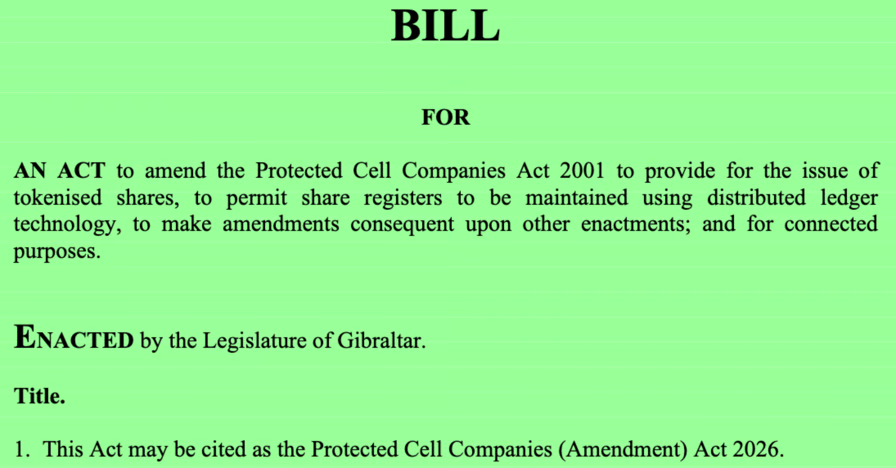
Gibraltar has introduced legislation that would legally recognize tokenized fund shares and allow certain regulated funds to issue shares on distributed ledger systems, granting investors the same rights as traditional shareholdings.
The Protected Cell Companies (Amendment) Bill 2026 states that “the holder of a share token is a shareholder with the same rights and obligations as any other holder of cell shares,” referring to shares linked to specific asset pools within a protected cell company.
Protected cell companies, typically insurance or financial entities, have a core organization that is linked to several independent cells, each with its own balance sheet.
The proposal, which requires approval from the Gibraltar Financial Services Commission, applies to protected cell companies operating as experienced investor funds. Ownership records must be maintained on blockchain-based share registers, with tokenized shares legally equivalent to traditional certificates.
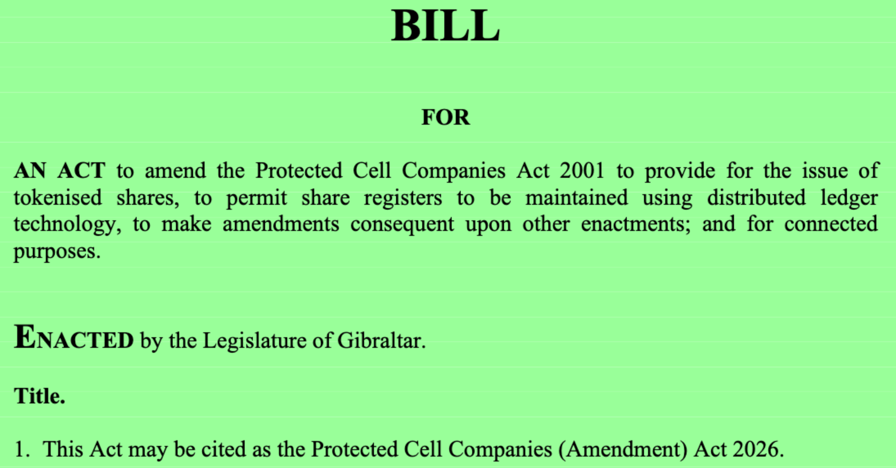
Source: Gibraltarlaws.gov.gi
The framework sets strict rules for custody and transfers, limiting access to verified investors and allow-listed wallet addresses while requiring disclosures on technology risks, cybersecurity and recovery procedures.
Companies must retain control over the underlying infrastructure, keeping the system within a regulated environment rather than an open, permissionless market.
Under the proposal, tokenized shares can be issued and transferred using smart contracts and cryptographic signatures, with blockchain records recognized as valid instruments for ownership, transfer and recordkeeping under existing company law.
The bill must now proceed through Gibraltar’s legislative process before taking effect.
Related: ECB backs tokenized EU capital markets with strict guardrails
Tokenized assets move from pilots to regulated markets
Governments and financial institutions are integrating tokenized assets into regulated financial systems, developing legal frameworks and market infrastructure for blockchain-based securities.
Switzerland was among the earliest jurisdictions to bring tokenized assets under existing financial law, with its regulator approving a crypto fund in 2021 for qualified investors. In 2025, the country expanded that framework by licensing its first distributed ledger technologies (DLT) trading facility, enabling tokenized securities to be traded and settled on regulated infrastructure.
In 2022, Singapore launched Project Guardian to test tokenized assets in wholesale markets, while Hong Kong has issued and expanded a program of tokenized government bonds since 2023.
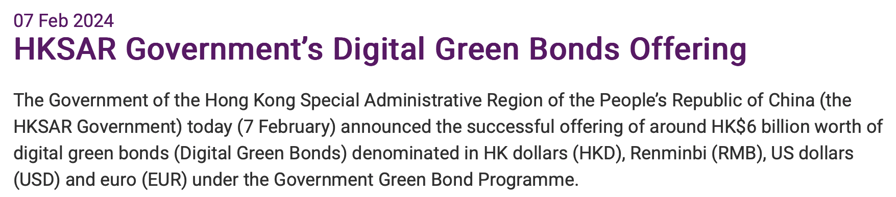
Source: www.hkma.gov
In 2024, the World Bank issued a Swiss franc digital bond on Switzerland’s SIX Digital Exchange with settlement using central bank digital currency.
Most recently, in March, Canada completed a pilot that issued and settled its first tokenized bond on distributed ledger infrastructure.
Magazine: Singapore isn’t a ‘crypto hub’ — it’s something better: StraitsX CEO
Crypto exchange Bullish has expanded its integration with Ripple Prime to give institutional clients direct access to Bitcoin options trading, adding to existing spot, perpetual and futures connectivity through the platform’s prime brokerage network.
The integration connects Ripple Prime users to Bullish’s regulated Bitcoin (BTC) options markets, allowing trades to be funded through existing sub-accounts without additional onboarding, with stablecoins such as Ripple USD (RLUSD) supported as collateral.
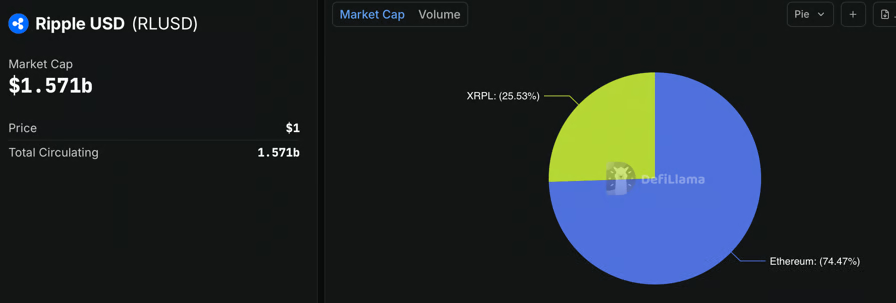
RLUSD is a US dollar-pegged stablecoin designed for payments, settlement and use as collateral in digital asset markets. It has a market capitalization of about $1.57 billion, according to DeFiLlama data.
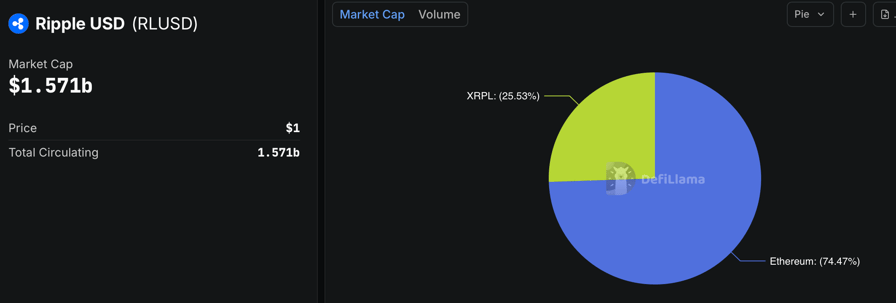
Ripple USD market cap. Source: DefiLlama
The companies said they plan to support cross-venue margin access, which would allow institutions to manage collateral across exchanges and OTC desks from a single account to improve capital efficiency.
Ripple Prime is the company’s institutional prime brokerage platform, formed after its $1.25 billion acquisition of crypto prime broker Hidden Road in 2025. It offers multi-asset brokerage, clearing and financing services and cleared more than $3 trillion in volume in 2025, according to the announcement.
Bullish said its Bitcoin (BTC) options venue ranks among the largest by open interest for crypto-settled contracts. The integration is now live, allowing Ripple Prime clients to begin accessing options markets immediately.
Shares of Bullish have declined sharply over the past year, falling more than 60% from their peak in September and trading around $36.58 at the time of writing. The stock was down roughly 8% in early trading on the day, per Yahoo Finance data.
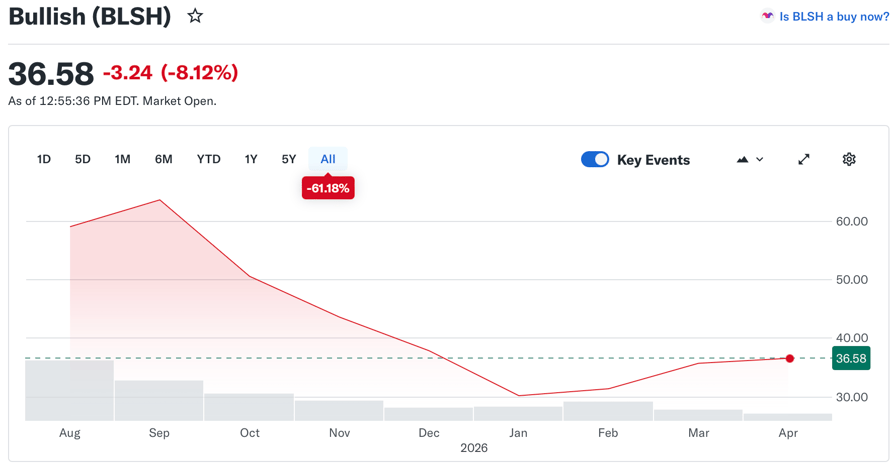
Source: Yahoo Finance
Related: Bitcoin rally falters as AI industry weakens and CLARITY Act approval odds fall
Bitcoin options gain traction as institutions seek risk management tools
Bitcoin’s volatility has made options, which give traders the right to buy or sell an asset at a set price, an increasingly important tool for hedging and trading price swings.
In August 2025, Coinbase finalized its acquisition of Deribit, bringing the largest crypto options venue under its umbrella as part of a broader push to offer spot, futures and options trading on a single platform.
Some corporate Bitcoin holders are also beginning to move beyond passive exposure toward more active risk management using derivatives.
Last week, Nakamoto, a Nasdaq-listed company focused on building a Bitcoin treasury strategy, said it has been running an actively managed derivatives program since early 2026, using BTC as collateral for options-based strategies designed to generate income from volatility while hedging downside risk.
Over the past year, Bitcoin options markets have remained consistently large, with total open interest standing at about $32.8 billion as of late April 2026, up slightly from roughly $30.8 billion a year earlier and peaking above $50 billion during periods of heightened activity, according to CoinGlass data.
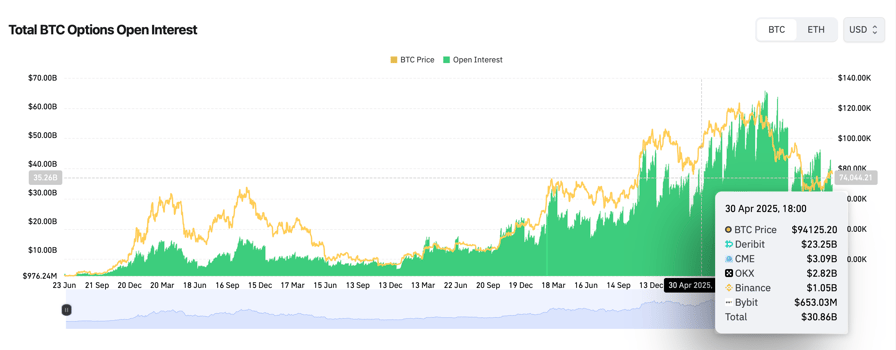
Total Bitcoin options open interest. Source: CoinGlass
Trading is heavily concentrated on Deribit, which accounts for the majority of Bitcoin options open interest, while smaller shares are distributed across venues including CME Group, OKX, Binance and Bybit.
Magazine: How to fix suspected insider trading on Polymarket and Kalshi
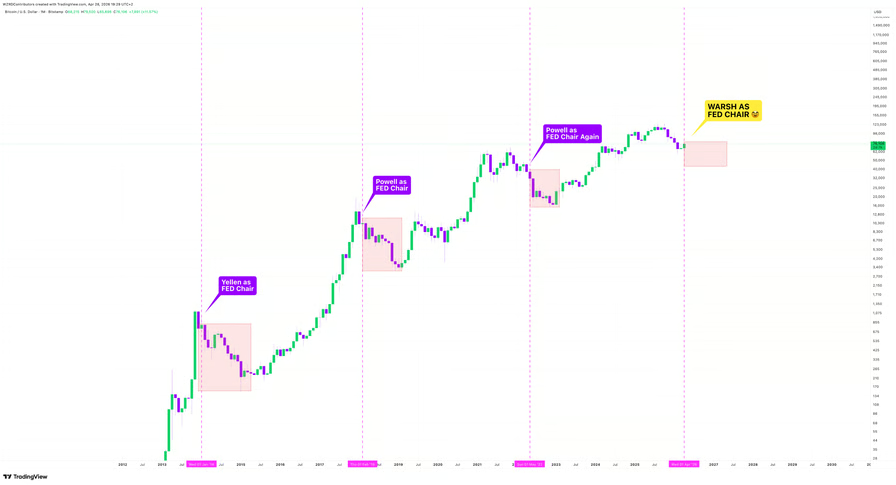
Bitcoin (BTC) may face “a few months” of downside as the new US Federal Reserve chair takes over next month.
Key points:
- Bitcoin may follow risk assets downhill after Kevin Warsh takes over as chair of the US Federal Reserve.
- President Donald Trump has said that he “would” be disappointed if an interest-rate cut did not occur in June.
- Wednesday marks current Chair Jerome Powell’s last rate decision.
Bitcoin price tends to fall after new Fed chair enters
In its latest market coverage on X, crypto trading account CRYPTOWZRD warned that fresh downward BTC price pressure could return in June.
The Fed’s new chair, Kevin Warsh, is due to take over from Jerome Powell — and the stakes are high when it comes to crypto and risk-asset performance.
“Every time a new FED Chair takes over $BTC has corrected for a few months before the real fun began,” CRYPTOWZRD noted.
“Can it break the curse or a final dip?”
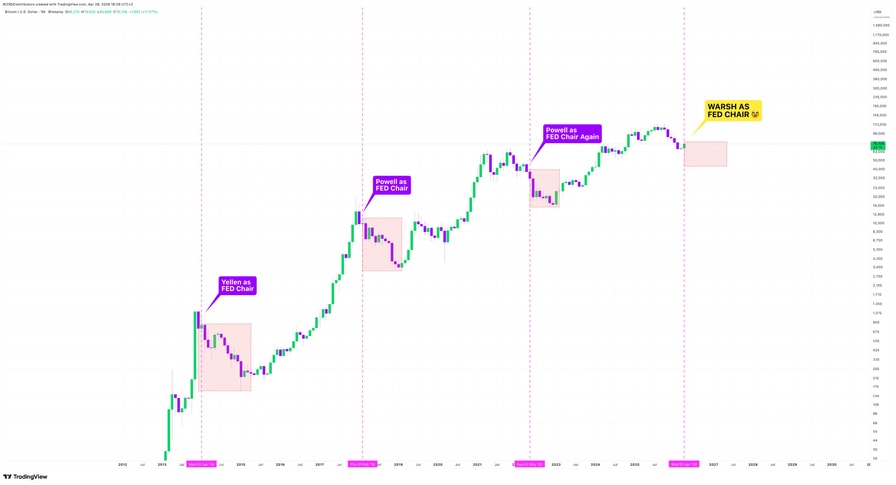
BTC/USD one-month chart with Fed chair appointments. Source: CRYPTOWZRD/X
History shows that a change of management at the Fed pressures stocks as well — but this year, the S&P 500 is at all-time highs as it happens.
The picture is complicated by politics. Powell avoided cutting interest rates — a would-be bullish catalyst for crypto — even as US President Donald Trump publicly shamed him for not doing so.
In an interview with CNBC last week, Trump said that he “would” be disappointed if Warsh did not cut rates at his first Federal Open Market Committee (FOMC) meeting in June.
Powell’s last FOMC meeting is due on Wednesday, with markets unanimously seeing rates being held at current levels, per data from CME Group’s FedWatch Tool.
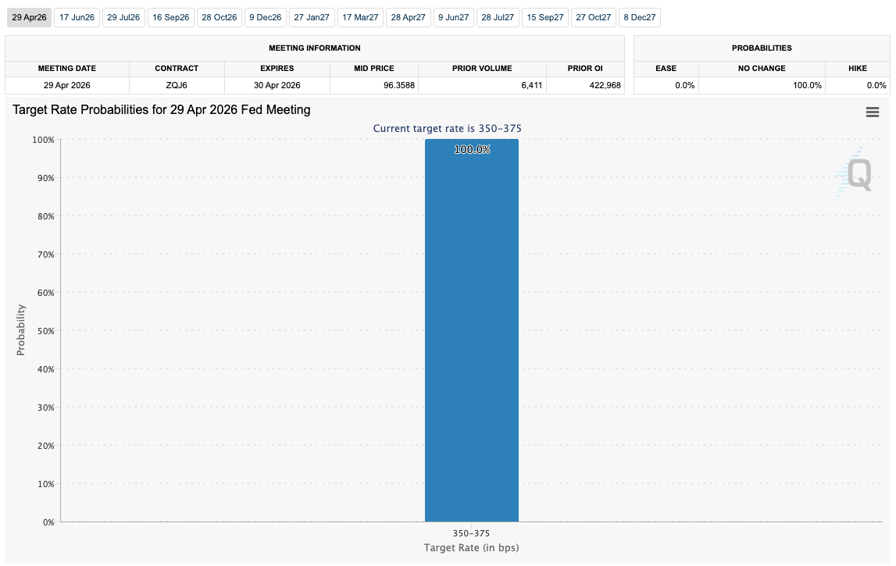
Fed target rate probabilities for April 29 FOMC meeting (screenshot). Source: CME Group
Warsh gives traders mixed signals on policy
Continuing, crypto market participants see potential tailwinds for Bitcoin and altcoins thanks to US macro trends.
Related: Bitcoin Bull Score hits six-month high as 2022 bear-market fears linger
The Fed has begun adding to its balance sheet this year — a form of liquidity catalyst that traditionally benefits markets.
“That’s right, the Fed has added ~$200B of US Treasuries back onto its balance sheet in the last few months,” Bitcoin Opportunity Fund partner James Lavish wrote on the day.
“So much for tightening the money supply. QT is officially over. QE-light is in the house.”
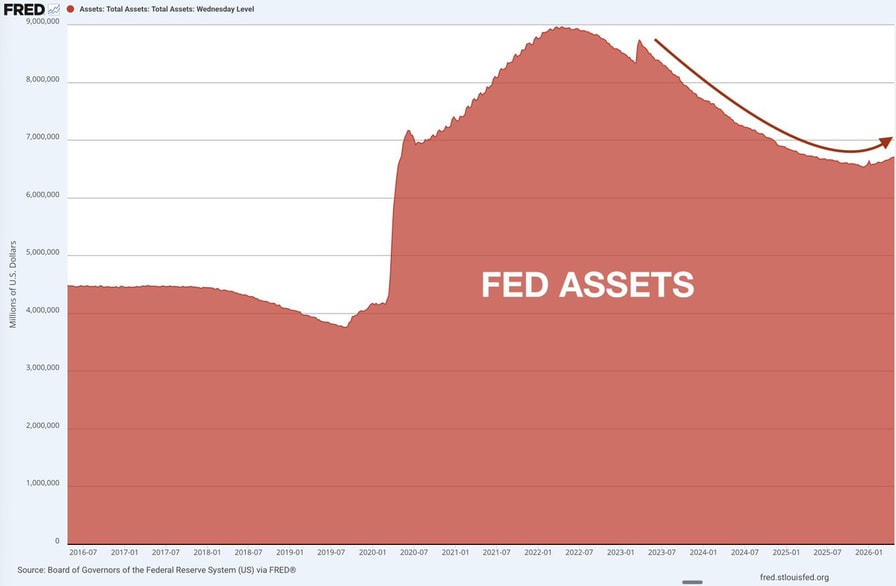
Fed balance-sheet data. Source: James Lavish/X
In recent YouTube content, meanwhile, Charlie Bilello, chief market strategist at wealth manager Creative Planning, revealed what he called a “contradiction” in Warsh’s plans.
While “building the case” for rate cuts, he said, Warsh has been critical of the Fed keeping rates low during the post-COVID-19 inflation surge in 2021 and 2022.
“It was a ‘fatal policy error’ that was what he was saying back then, and I would agree with that,” Bilello said.
Warsh has also criticized balance-sheet expansion, raising questions over the fate of the 2026 uptrend.
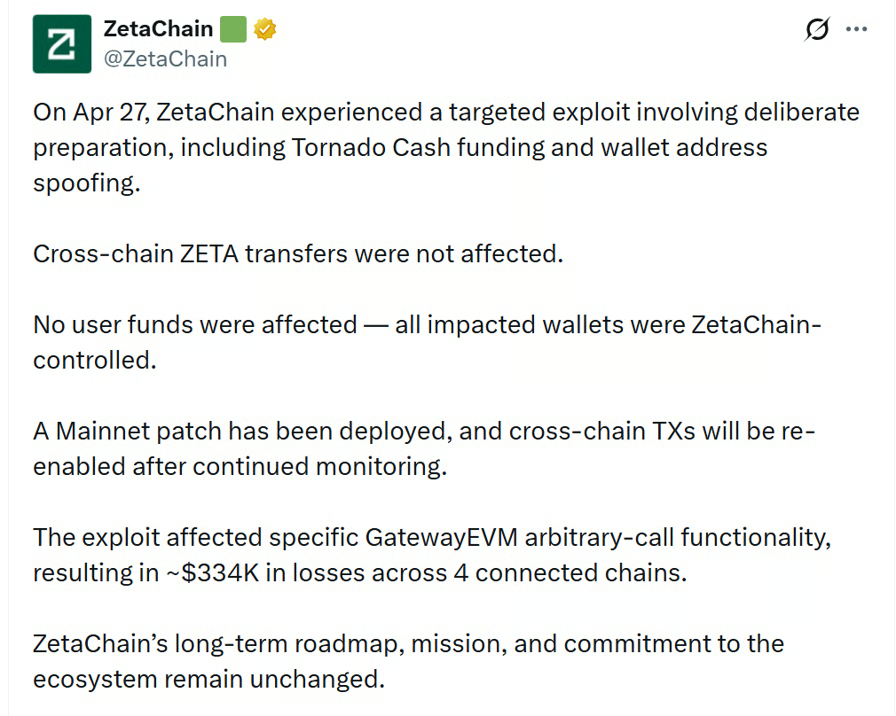
The vulnerability that led to ZetaChain’s recent exploit had been flagged through its bug bounty program before the attack, but was dismissed as intended behavior.
In a post-mortem published Wednesday, the team said the incident has prompted a review of how it handles bug bounty submissions, particularly reports involving chained attack vectors that may appear harmless in isolation but are dangerous in combination.
“This bug was reported and they simply ignored it,” one user wrote on X. “That’s how bug bounty programs work with these protocols currently; they incentivize losses for the protocol, the TVL, and the user’s balance instead of paying the researcher for discovering and fixing the bug,” they added.
ZetaChain lost approximately $334,000 to a premeditated exploit on Sunday that targeted its cross-chain gateway contract. The exploit drained funds across nine transactions on four chains, including Ethereum, Arbitrum, Base and BSC, all from ZetaChain-controlled wallets. No user funds were affected.
Related: Crypto hackers stole $17B over past 10 years: DefiLlama
Attacker exploits small design flaws
ZetaChain said in its post-mortem that the attacker exploited three design flaws that, individually, might have seemed minor, but together opened the door to a full drain. First, the gateway allowed anyone to send arbitrary cross-chain instructions with no restrictions. Second, on the receiving end, it would execute almost any command on any contract, with a blocklist so narrow it missed basic token transfer functions.
Third, wallets that had previously used the gateway had left unlimited spending permissions in place that were never cleaned up. By combining all three, the attacker simply told the gateway to transfer tokens from victim wallets to their own, and the gateway complied.
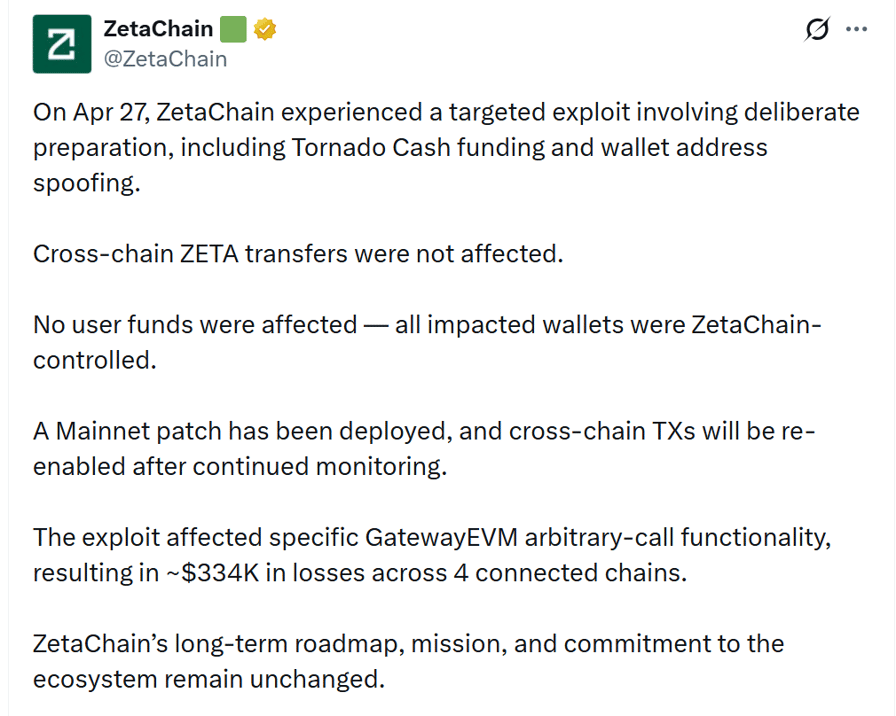
Source: ZetaChain
“This was not an opportunistic attack,” ZetaChain said in its post-mortem. The attacker funded their wallet through Tornado Cash three days before the exploit, deployed a purpose-built drainer contract on ZetaChain and ran an address poisoning campaign before seeding it into their transaction history via dust transfers.
ZetaChain added that a patch permanently disabling the arbitrary call functionality is being rolled out to mainnet nodes. The platform also removed unlimited token approvals from its deposit flow, replacing them with exact-amount approvals going forward.
Related: Ethical hacker intercepts $2.6M in Morpho Labs exploit
AI DeFi exploit success rate increases
A new study by a16z tested whether an off-the-shelf AI agent could go beyond identifying DeFi vulnerabilities and actually produce working exploits. Using OpenAI’s Codex against a dataset of 20 real Ethereum price manipulation incidents, researchers ran the agent in a sandboxed environment with no access to future transaction data and no guidance on how the attacks worked. The agent succeeded in just 10% of cases.
However, when researchers fed the agent structured knowledge about common attack patterns and exploit workflows, the success rate jumped to 70%.
Magazine: How to fix suspected insider trading on Polymarket and Kalshi


Leading decentralized exchange Hyperliquid’s push into prediction markets is about who captures the upside, not just cheaper trading, according to Arthur Hayes, co-founder of BitMEX exchange and CIO of Maelstrom fund.
CoinDesk reported earlier that Hyperliquid is preparing a zero-fee-to-open model for event trading under HIP-4. The Hyperliquid Improvement Proposal (HIP)-4 is a proposal that introduces event trading on Hyperliquid.
Hayes said that structure is only the first layer. In a note to CoinDesk, he argued that the real differentiator is HYPE, Hyperliquid’s exchange token, which he said allows users to benefit from platform activity in a way Polymarket and Kalshi currently do not.
“HIP-4 will quickly become a dominate prediction market because of Hyperliquid’s large user base, much cheaper trading fees, and very robust tech infrastructure,” Hayes told CoinDesk. “Users who own the $HYPE token can directly profit from their usage of HIP-4.”
Polymarket is expected to launch a token, often referred to as $POLY.
On Gate, premarket perpetual contracts tied to a potential $POLY token are trading around $14, implying a fully-diluted valuation of roughly $14 billion. HYPE, by comparison, has an FDV of about $38 billion, according to CoinGecko data.
Pre-listing markets are often highly speculative and can be thinly traded, meaning any implied valuation should be treated with caution and may not reliably reflect actual market demand.
The argument also comes down to geography. Polymarket registered with the CFTC last July and is rebuilding its U.S. business, putting compliance at the center of its strategy.
However, in Asia, it is still grappling with how regulators classify its product. It is geoblocked in Singapore, Thailand, and Taiwan, partially restricted in Japan. Meanwhile, in Hong Kong, prediction markets more broadly are on the radar of gambling regulators
Hyperliquid faces no equivalent constraint, and its user base skews toward Asia, where crypto-native trading is already deep.
The contrast is clearest with Kalshi.
As a CFTC-regulated exchange, Kalshi’s model is built around compliance and licensing, not token incentives, which likely rules out the kind of value-accrual layer Hayes is pointing to.
That makes it the most direct test of his thesis. Users can trade event outcomes on Kalshi, but they have no path to the upside of the platform itself. In traditional markets, that kind of upside is typically accessed via equity, such as an IPO, though for now, Kalshi users’ participation is limited to trading on the platform.
Across the three platforms, the split is structural: Hyperliquid already ties usage to a token, Polymarket appears to be moving in that direction, and Kalshi’s model likely prevents it altogether.
Hyperliquid has published a fee model for outcome tokens on its testnet. The disclosure follows HyperCore’s backing of HIP-4.
The proposal brings outcome trading to the venue and sets up a challenge to leading prediction market players, Kalshi and Polymarket.
Hyperliquid Reveals Six Fee Scenarios for Outcome Token Trading
According to the updated documentation, the framework, currently live on testnet, applies fees only when traders close or settle outcome positions, not when opening them.
The outcome token fee logic covers six specific scenarios. Minting incurs no fees and does not contribute to trading volume. Normal trades may charge only the maker, or no one at all.
Burning trades may incur fees on both sides or only on the taker. Settlement distributes payouts proportionally based on the settlement fraction. The overall design lowers entry costs for traders while still capturing revenue at exit.
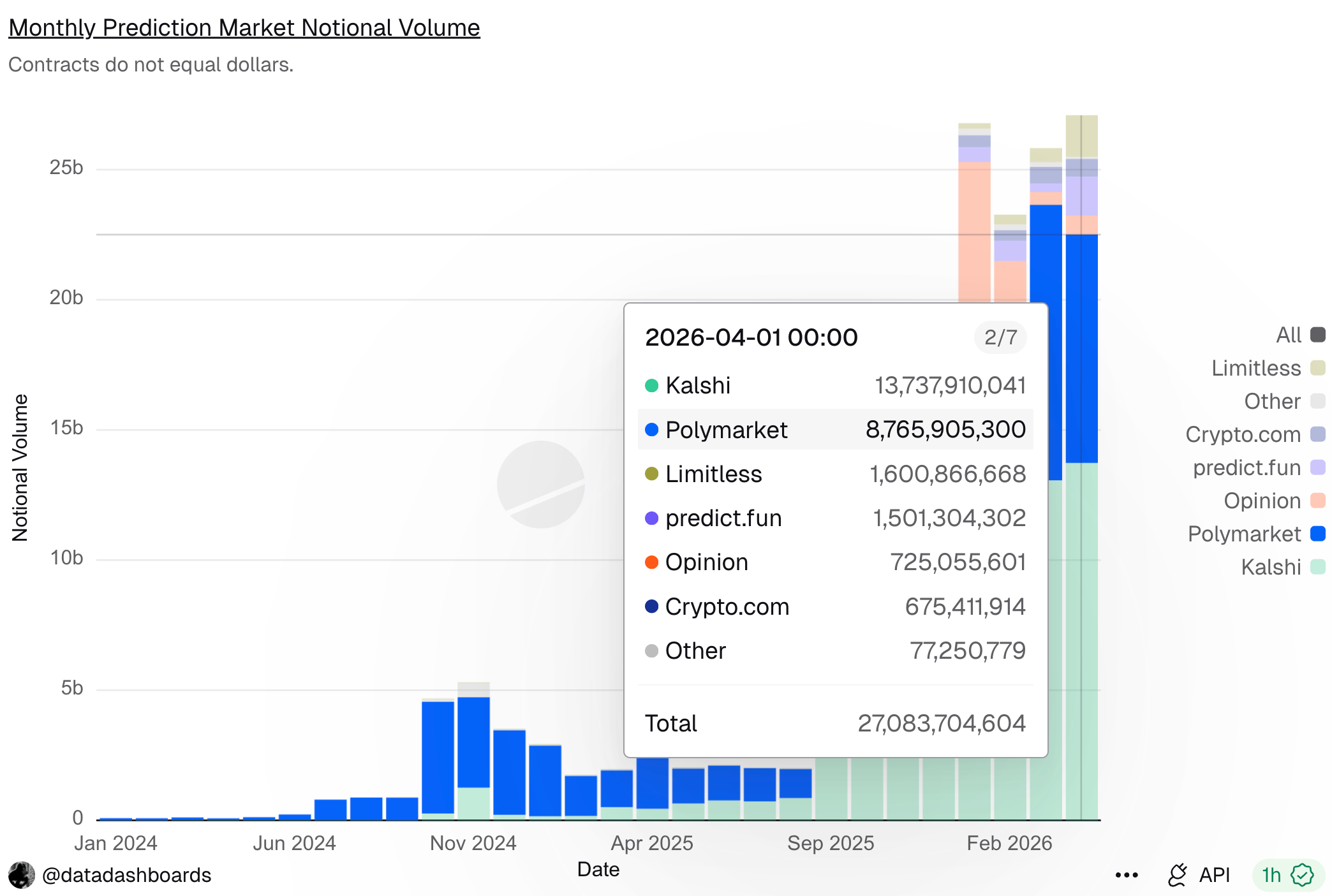
The fee disclosure positions Hyperliquid as a serious entrant in one of the fastest-expanding sectors. Monthly notional trading volume in prediction markets surged more than 520% to an all-time high of $27 billion in April. Kalshi and Polymarket account for the bulk of that activity.
Follow us on X to get the latest news as it happens
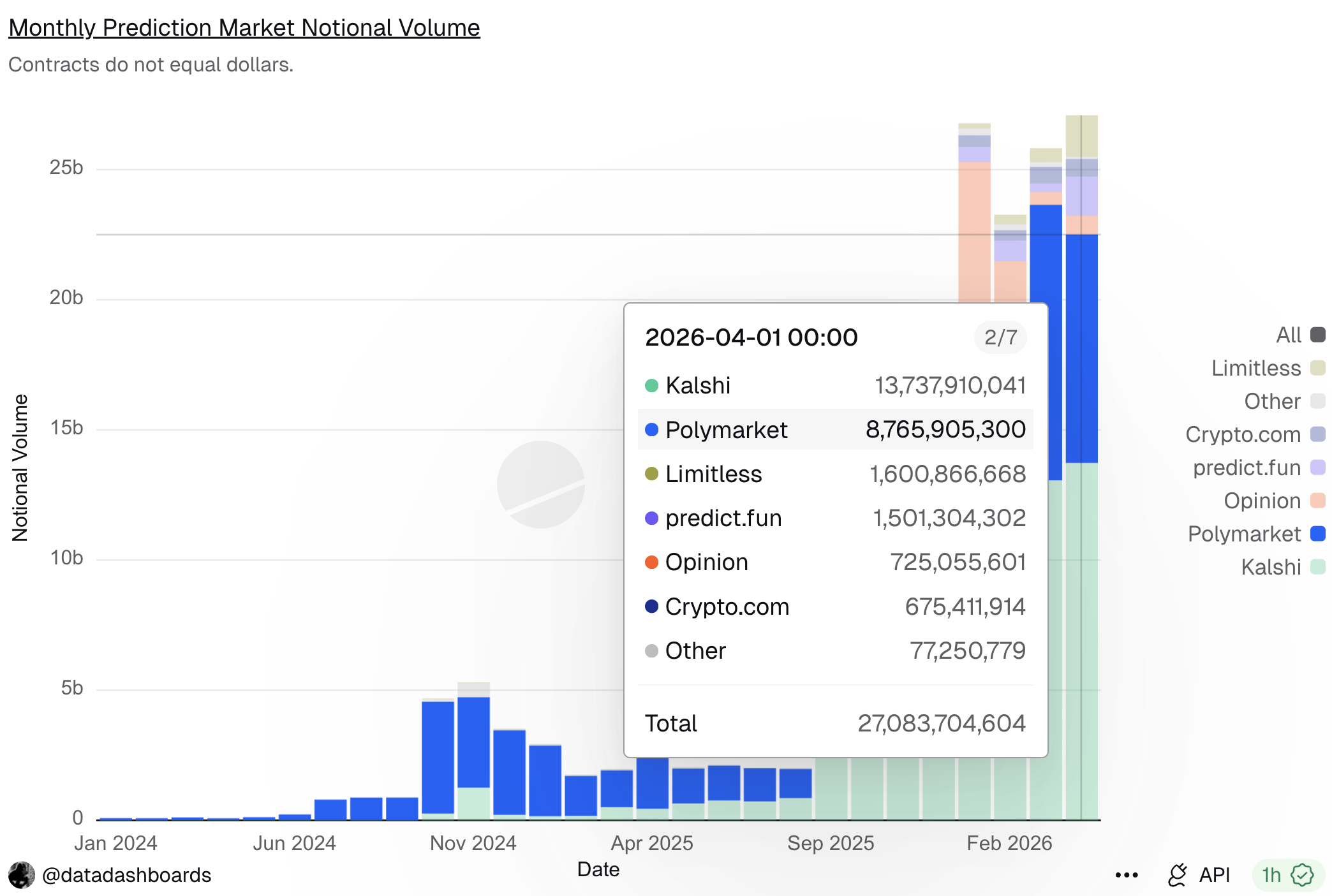
At the same time, competitive pressure is building. Coinbase entered the space by launching prediction markets for US users in partnership with Kalshi, while Polymarket has indicated plans to introduce perpetual trading products.
Taken together, these developments signal that platforms are increasingly expanding their product suites and integrating diverse trading features to attract and retain users.
Subscribe to our YouTube channel to watch leaders and journalists provide expert insights
The post Hyperliquid Sets Outcome Token Fees as Prediction Market Race Heats Up appeared first on BeInCrypto.
Crypto World
Prediction Markets Hit $25.7B Monthly Volume as Retail Traders Take the Lead in Q1 2026
TLDR:
- 82.3% of Polymarket users traded under $10,000 in Q1 2026, confirming strong retail market dominance.
- Sports generated $10.1B in Q1 volume, with the NBA leading at $3.11B across 300,000 active users.
- Esports titles produced $1.47B in Q1, with median bets between $6–$9, surpassing traditional sports
- Monthly prediction market volume surged from $1.2B in 2025 to $25.7B by March 2026, per Polymarket data.
Prediction markets recorded explosive growth in Q1 2026, backed almost entirely by retail traders. Bitget Wallet partnered with Polymarket and Dune Analytics to analyze behavior across 1.29 million wallets during the quarter.
The data covered who was trading, what they were trading, and what brought them back. Monthly volume climbed from roughly $1.2 billion in 2025 to $25.7 billion by March 2026.
Bernstein projects the category could reach $240 billion in annual volume this year.
Retail Behavior Shapes the Prediction Markets’ Landscape
In Q1 2026, 82.3% of Polymarket users traded under $10,000 across the entire quarter. Only 2.5% of users crossed the $100,000 mark during that period.
The average micro user traded just $35, and the average light user reached $392. These numbers confirm that small traders, not institutions, are currently defining this market.
Crypto served as the primary entry point for new users entering the space. It accounted for 39.6% of activity among the smallest traders on Polymarket.
Bitcoin alone drew 593,000 users and $5.42 billion in trading volume in Q1. The median Bitcoin trade stood at just $3.16, placing the barrier to entry at nearly zero.
As users became more active, their behavior shifted notably. They did not increase individual trade sizes; instead, they traded across more categories.
Micro users averaged 2.5 active days and 1.45 categories, while mid-tier users reached 9.9 active days and over 2.3 categories. Broader exploration, not bigger bets, drove deeper engagement throughout the quarter.
Bitget Wallet shared these findings in a post on X, noting that prediction markets now resemble a consumer app more than a financial product.
The firm also noted that crypto’s share of activity gradually fell to 36.8% among mid-tier traders. It remains the most effective onboarding tool in the category. However, it is not what retains users over the long term.
Sports and Category Frequency Fuel Long-Term Engagement
Sports emerged as the largest category on Polymarket in Q1, generating $10.1 billion in volume. Participation in sports markets rose from 22.7% among micro users to 29.2% among mid-tier users.
A 45% surge in March was driven by the NBA season and NCAA March Madness. The NBA alone attracted 300,000 users and $3.11 billion in trading volume.
European football leagues also drew substantial international participation during the quarter. The English Premier League generated $540 million, the Champions League contributed $448 million, and La Liga added $368 million.
NCAA Basketball produced $900 million in volume. These figures show that sports markets have a truly global audience.
Esports performed well above expectations within the sports category. League of Legends generated $657 million, CS2 added $536 million, and Dota 2 contributed $209 million.
Together, those three titles produced roughly $1.47 billion in Q1. Median bet sizes in esports ran between $6 and $9, higher than in most traditional sports.
Frequency of engagement proved to be a key retention driver across all categories. Weather markets surged 263% in March, led by daily temperature forecast predictions.
Crypto markets generated $7.3 billion in Q1, rising 55% as an always-on trading environment. Categories with built-in recurrence consistently showed stronger user return rates across the quarter.

‘The Night Agent’s 85% Rotten Tomatoes Replacement Series Is a Darker Spy Thriller Binge

Netflix Unveils Cast For Next Harlan Coben Series The Woods

OpenAI Misses Key Revenue, User Targets in High-Stakes Sprint Toward IPO

Manchester United reach agreement with Casemiro over contract clause amid transfer speculation

US brings back mandatory military draft registration

Steven Gerrard disagrees with Gary Neville over ‘shock’ Chelsea and Arsenal claim | Football


-

 Tech3 days ago
Register Renaming | Hackaday
-

 Fashion5 days ago
Weekend Open Thread – Corporette.com
-
Crypto World4 days ago
Hyperliquid $HYPE Rally Builds Momentum as AI Sector Enters Prove-It Phase
-

 Business6 days ago
Patterson-UTI Energy, Inc. (PTEN) Q1 2026 Earnings Call Transcript
-
 Sports4 days ago
IPL 2026: Ruturaj Gaikwad registers slowest fifty of the season, enters all-time unwanted list | Cricket News
-

 Politics2 days ago
Drax board avoid their own AGM, accused of greenwashing & environmental racism
-

 NewsBeat4 days ago
LK Bennett closes all stores after entering administration
-

 Crypto World6 days ago
Michael Saylor says BTC winter is over. Market analyst disagrees, says bitcoin was in a pullback
-

 Fashion1 day ago
Kylie Jenner’s KHY Enters a New Era with ‘Born in LA’
-
Entertainment7 days ago
Michael B. Jordan and Austin Butler's “Miami Vice” movie will bring the action back to the '80s
-
 Entertainment5 days ago
Mariah Carey Slams Deposition Claims In Brother’s Lawsuit
-

 Tech2 days ago
Images of Samsung’s rumored smart glasses have leaked
-
Entertainment7 days ago
Russell Brand Had Sex With 16 Year Old When He Was 30
-

 Business1 day ago
Most Commercial Energy Audits Miss the Real Losses
-
Crypto World6 days ago
Is Algorand One of the Few Quantum-Resistant Blockchains? Here’s What the Data Shows
-
 NewsBeat6 days ago
Trump threatens to review UK’s claim to Falkland Islands and punish Nato allies over Iran war disagreement
-

 Sports7 days ago
2026 NFL Draft tonight: Time, TV channel, where to watch, order
-

 Sports7 days ago
Bayern Munich on the brink of historic ‘double treble’
-

 Business6 days ago
Jeanine Pirro announces closure of Federal Reserve building cost probe
-

 Business3 days ago
(VIDEO) Charlize Theron Climbs Times Square Billboard to Promote New Netflix Thriller ‘Apex’
You must be logged in to post a comment Login