








Connect with us
DAPA Banner

Business

What to Look for Before Buying

Published

on

What to Look for Before Buying

Choosing the right LED power supply supplier is one of the most important decisions in any lighting project.

While LED strips and modules often get the most attention, the power supply is the backbone of the entire system. A poor-quality unit can lead to flickering, overheating, reduced lifespan, and even safety hazards.

For businesses sourcing Waterproof LED strip lights wholesale, selecting a reliable LED Power Supply supplier is essential to ensure system compatibility, efficiency, and long-term performance. Whether you are a contractor, distributor, or project developer, understanding what to look for before buying can save time, money, and future complications.

Why the Right LED Power Supply Supplier Matters

An LED power supply converts incoming AC power into low-voltage DC output required by LED strips and modules. If this conversion is unstable or inefficient, it directly affects lighting quality and durability.

A trusted supplier ensures:

Advertisement
  • Stable voltage output
  • Consistent performance across installations
  • Safety compliance with international standards
  • Long operational lifespan
  • Compatibility with LED strips and modules

Companies like dekingled recognize that a high-quality lighting system starts with a dependable power foundation.

Check Product Quality and Build Standards

The first thing to evaluate when choosing a supplier is product quality. A reliable LED Power Supply should be manufactured using high-grade internal components such as capacitors, transformers, and circuit boards.

Low-quality units often fail prematurely due to poor construction, leading to increased maintenance costs and system downtime.

Look for suppliers who emphasize:

  • Durable casing materials
  • Heat-resistant components
  • Stable output performance
  • Thorough product testing

Dekingled focuses on delivering power solutions that meet strict quality control standards, ensuring long-term reliability in both indoor and outdoor applications.

Waterproof Protection for Demanding Environments

Many LED installations operate in environments exposed to moisture, dust, or weather conditions. In these cases, a standard power supply is not sufficient.

Advertisement

When sourcing Waterproof LED strip lights wholesale, it is essential to pair them with a compatible waterproof power supply. A properly sealed unit protects internal components from water ingress, corrosion, and environmental damage.

A high-quality waterproof LED Power Supply should feature:

  • Sealed housing with proper IP rating
  • Protection against humidity and dust
  • Reliable performance in outdoor conditions

Dekingled offers waterproof power solutions designed to work seamlessly with their LED strips, ensuring complete system protection.

Output Stability and Performance

Voltage stability is critical for LED performance. Fluctuations in output can cause flickering, uneven brightness, and reduced lifespan of LED strips.

Before choosing a supplier, ensure their LED Power Supply products provide:

Advertisement
  • Constant voltage or constant current output
  • Low ripple and noise levels
  • Protection against overload and short circuits

A reliable supplier will clearly provide technical specifications and performance data for their products.

Compatibility with LED Strip Systems

Compatibility is often overlooked but extremely important. Not all power supplies work efficiently with every LED strip type. Mismatched voltage or wattage can result in poor performance or damage to the system.

If you are purchasing Waterproof LED strip lights wholesale, it is best to work with a supplier that also understands LED strip requirements.

Dekingled provides both LED strips and compatible power solutions, ensuring seamless integration and reducing the risk of technical issues during installation.

Energy Efficiency and Cost Savings

Energy efficiency plays a major role in modern lighting systems, especially in commercial and industrial environments where lights operate for extended periods.

Advertisement

A high-quality LED Power Supply minimizes energy loss during conversion, reducing electricity consumption and heat generation.

Efficient power supplies offer:

  • Higher conversion efficiency
  • Lower operating costs
  • Reduced heat output
  • Improved system lifespan

Dekingled integrates energy-efficient designs into its power supply solutions, helping businesses achieve long-term cost savings.

Certifications and Safety Standards

Safety is a critical consideration when choosing an LED power supply supplier. Products should comply with international standards to ensure safe operation and regulatory approval.

Look for certifications such as:

Advertisement
  • CE (European Conformity)
  • RoHS (Restriction of Hazardous Substances)
  • UL (Underwriters Laboratories)

A trusted LED Power Supply supplier will provide certified products that meet industry requirements.

Dekingled ensures that its products align with global standards, making them suitable for international markets.

Supplier Experience and Reputation

Experience matters in the LED industry. Established suppliers are more likely to offer consistent quality, reliable delivery, and professional support.

When evaluating a supplier, consider:

  • Years of industry experience
  • Client portfolio and references
  • Product range and specialization
  • Customer support capabilities

Dekingled has built a strong reputation by providing dependable lighting solutions and maintaining long-term partnerships with clients worldwide.

Scalability and Bulk Supply Capability

For contractors and distributors, the ability to handle bulk orders is essential. A supplier must be able to deliver consistent quality across large volumes without delays.

Advertisement

If you are sourcing Waterproof LED strip lights wholesale, ensure your supplier can:

  • Maintain stable inventory
  • Meet project deadlines
  • Provide consistent batch quality

Dekingled supports scalable production, making it suitable for both small projects and large commercial installations.

Technical Support and After-Sales Service

A reliable supplier should offer more than just products—they should provide technical guidance and after-sales support.

This includes:

  • Assistance with product selection
  • Power calculation support
  • Installation recommendations
  • Troubleshooting help

Working with a supplier like dekingled ensures access to professional support, helping you avoid costly mistakes and optimize system performance.

Conclusion

Choosing the right LED power supply supplier is essential for building reliable, efficient, and long-lasting lighting systems. From product quality and waterproof protection to energy efficiency and technical support, every factor plays a role in overall performance.

Advertisement

For businesses sourcing Waterproof LED strip lights wholesale, pairing them with a high-quality LED Power Supply ensures consistent results and long-term value.

Dekingled stands out as a trusted partner by offering durable LED strips, reliable power solutions, and comprehensive support for professional lighting projects. By choosing the right supplier, you can protect your investment and deliver lighting systems that perform flawlessly for years.

Advertisement
Continue Reading
Click to comment

You must be logged in to post a comment Login

Leave a Reply

Business

Mazagon Dock Q4 Results: Profit jumps 42% to Rs 464 crore; co declares Rs 4.62 dividend

Published

on

Mazagon Dock Q4 Results: Profit jumps 42% to Rs 464 crore; co declares Rs 4.62 dividend
Mazagon Dock Shipbuilders reported a strong set of March quarter earnings, with net profit rising nearly 42% year-on-year (YoY), supported by higher execution across shipbuilding and submarine programs. The state-run defence shipbuilder posted a standalone net profit of Rs 464 crore for the quarter ended March 2026, compared with Rs 327 crore in the same period last year.

The company’s board has recommended a final dividend of Rs 4.62 per share for the financial year ended March 2026.

Revenue from operations rose 16% YoY to Rs 3,684 crore from Rs 3,174 crore a year ago, reflecting higher project execution during the quarter. Including other income, total income for the quarter stood at Rs 3,965 crore, up 13% from Rs 3,498 crore in the year-ago period.

Profit before tax rose sharply by 54% to Rs 625 crore, compared with Rs 406.4 crore in the corresponding quarter last year, indicating improved operating leverage.

Advertisement

Sequentially, however, profitability moderated from the December quarter, when the company had reported a profit of Rs 837 crore, suggesting normalization after a stronger third quarter driven by milestone-based revenue recognition.


Expenses during the quarter rose at a slower pace than revenue. Total expenses increased 8% to Rs 3,340 crore from Rs 3,091 crore a year ago, mainly due to higher raw material consumption and inventory purchases.
For the full financial year FY26, Mazagon Dock reported revenue from operations of Rs 12,840 crore, up 12% from Rs 11,432 crore in FY25.Total income for the year came in at Rs 13,982.4 crore, registering a growth of 12% YoY.

Annual profit before tax rose 4% to Rs 3,250 crore, while net profit increased 5% to Rs 2,436 crore from Rs 2,325 crore in the previous financial year.

Continue Reading

Business

Pricey NFL, NBA ownership stakes push investors to smaller leagues

Published

on

Pricey NFL, NBA ownership stakes push investors to smaller leagues

Trinity Rodman #2 of Washington Spirit evades Sarah Schupansky #11 of Gotham FC during the NWSL Championship 2025 final between Washington Spirit and NJ/NY Gotham FC at PayPal Park on November 22, 2025 in San Jose, California.

Lyndsay Radnedge/isi Photos | Isi Photos | Getty Images

A version of this article first appeared in the CNBC Sport newsletter with Alex Sherman, which brings you the biggest news and exclusive interviews from the worlds of sports business and media. Sign up to receive future editions, straight to your inbox.

Advertisement

Last week, the National Women’s Soccer League awarded a new expansion franchise — in Columbus, Ohio — to an ownership group led by Haslam Sports Group for a fee of $205 million.

This represents a $40 million jump from the $165 million that billionaire Arthur Blank reportedly paid for the league’s Atlanta franchise in November. And that $165 million itself was a jump of $55 million from the reported $110 million fee Denver paid in January of last year.

Rewind to 2022, and the expansion fee for a new NWSL club was just $2 million

On the surface, this appears to be a story about the NWSL’s growth. Postseason attendance rose 11% this past season, according to the league. Nearly 1.2 million people watched the NWSL finals, up 22% from a year ago, including a whopping 70% jump in the 18-to-34 demographic, the NWSL said.

Advertisement

It makes sense that investors would want to get in now given the league’s growth trajectory.

But, according to investors and bankers, something else is going on that’s affecting the NWSL’s valuations that has absolutely nothing to do with soccer. It has to do with a trickle-down investment thesis driven by the outsized businesses of the NFL and NBA.

Wealthy investors have long been interested in sports ownership, trophy assets that have also produced outsized returns on investment. The introduction of private equity investment, first adopted in the NFL in 2024, has added to the pool of possible buyers. 

This dynamic is welcome news for the entire professional sports industry, which is also benefiting from another strategic investment play — the anti-artificial intelligence trade. Betting on live events is a counter-strategy for those who want less exposure to the tech in a market driven by AI investments.

Advertisement

That’s helped supercharge valuations of the most valuable sports teams in the U.S. According to CNBC Sport, the average NFL team is now valued at $7.65 billion. In 2010, NFL teams were worth, on average, about $1 billion

Get the CNBC Sport newsletter directly to your inbox

The CNBC Sport newsletter with Alex Sherman brings you the biggest news and exclusive interviews from the worlds of sports business and media, delivered weekly to your inbox.

Subscribe here to get access today.

The average value of an NBA team is now $5.52 billion, 18% higher than a year ago. Fifteen years ago, the average NBA team was worth $369 million. That’s an increase of 1,396%. The S&P 500 is up about 422% over the same time period. 

Advertisement

NBA and NFL ownership stakes are becoming too pricey for a class of buyers who have active interest in being a sports team owner — even at the minority stake level. Former New York Giants quarterback Eli Manning said as much in an interview with CNBC Sport last year.

“It’s too expensive for me,” Manning said of a potential minority stake in his longtime team. “A 1% stake valued at $10 billion turns into a very big number.”  

Equity research firm Bernstein wrote in a recent note to clients that NFL team valuations have risen about 17 times in 25 years, “the kind of returns sufficient to give any portfolio manager a legendary status and easily trumping the S&P index or any emerging market index on the planet.”

The main cause of the valuation growth stems from the enormous size of the league’s media rights. The NFL signed an 11-year, $111 billion media rights deal in 2021 — and now wants even more money. The NBA followed with an 11-year, $77 billion deal of its own, starting with the 2025 season. 

Advertisement

Splitting national TV dollars among teams allows even the lowest revenue teams — the NFL’s Arizona Cardinals and the NBA’s Memphis Grizzlies — to be valued at $5.9 billion and $3.75 billion, respectively, according to CNBC estimates.

There’s a fear that “second-tier” sports, including MLB and NHL, may be at risk of losing media rights dollars as the NFL flexes its muscle and asks for more from its media partners. The more money that goes to the NFL, the less money there is for everyone else.

One might expect that dynamic to negatively affect the valuations for those sports. But according to these bankers and investors, that’s not happening. 

As the NBA and NFL have priced out buyers, there’s now increased demand for sports teams with more affordable valuations. That’s helped drive the recent NWSL surge, they say. There’s more liquidity at NWSL team price points, which has led to bidding wars and soaring valuations. 

Advertisement

While the most recent winning buyers — Blank and the Haslams — are already owners of NFL and other sports teams, they’ve had to pay increasingly high prices to fight off other offers. There are far more buying groups willing to write a consortium check for $200 million than pay $1 billion or more for minority stakes in the biggest leagues.

“There’s a lot of demand to get into the sports business but people can’t write the checks to buy into the big four anymore. So what they’re doing is they’re substituting,” said veteran sports banker Sal Galatioto, president of Galatioto Sports Partners. “When supply is fixed and demand goes up, people will bid more to win. The underlying economics are not as important.”

The San Diego Padres are finalizing a sale for $3.9 billion, a record for MLB, despite the team’s regional sports network falling apart a few years ago. While nearly $4 billion is a lot of money, it’s still well below the average value of an NFL or NBA team.

“I’ve got investors coming up to me saying, ‘I can’t afford the NFL and NBA, what do you have for me in MLB, NHL?’” said one prominent sports banker, who asked to speak anonymously because the discussions were private.

Advertisement

The success of the NBA and NFL has funneled all the way down to the bottom of the sports food chain, said Rick Horrow, CEO of Horrow Sports Ventures.

“Major League Cricket was at $5 million. Now the value’s at $30 [million] and going higher. Major League Pickleball two years ago was at $5 million. Now the value is at $15 million or higher,” said Horrow.

Some of this sounds a little like a sports investment bubble, where valuations are divorced from the underlying financials of the leagues themselves.

That’s a real worry for smaller, less established leagues, said Jasmine Robinson, managing partner at Monarch Collective, the largest women’s sports investment fund, with $250 million to invest. It’s why Monarch has focused most of its funds on the WNBA and the NWSL, rather than more emergent leagues, Robinson said.

Advertisement

“Sports has historically been a great investment, but that’s really only for the biggest leagues. It’s not really like you can do any sports deal and you’re going to make money,” Robinson said. “There’s been real scarcity. You do need to be in the leagues that really are going to be leaders to make money. We wouldn’t make a bet on every women’s sports league.”

The big question may be what the threshold is for an established league if there’s an economic downturn that turns off the investment faucet. Monarch is betting the WNBA and the NWSL are above the line, but WNBA franchises have historically never made money, and now they need to pay out far more money to players after this year’s new collective bargaining agreement.

Choose CNBC as your preferred source on Google and never miss a moment from the most trusted name in business news.

Advertisement
Continue Reading

Business

Reliance Steel stock hits all-time high at 365.86 USD

Published

on


Reliance Steel stock hits all-time high at 365.86 USD

Continue Reading

Business

Spain’s Santander Profit Climbs Amid Global Portfolio Reshuffle

Published

on

Spain’s Santander Profit Climbs Amid Global Portfolio Reshuffle

Spain’s Banco Santander SAN 0.07%increase; green up pointing triangle reported a surge in profit as it added more customers and logged a large gain from a recent disposal.

Continental Europe’s largest lender by market capitalization posted a 60% increase in first-quarter net profit to 5.455 billion euros ($6.39 billion). The bottom line was helped by a 1.9 billion-euro capital gain from the recently completed sale of most of its Polish subsidiary.

Copyright ©2026 Dow Jones & Company, Inc. All Rights Reserved. 87990cbe856818d5eddac44c7b1cdeb8

Continue Reading

Business

GDP Prints At 2%, But There's Noise In The Numbers

Published

on

Target Hospitality Stock Set To Benefit From String Of Contract Wins (NASDAQ:TH)

GDP Prints At 2%, But There's Noise In The Numbers

Continue Reading

Business

GameStop Shares Edge Higher Near $24.64 as $9 Billion Cash Pile Fuels Acquisition Speculation

Published

on

FTSE 100 Surges 0.8% Today as Oil Eases and Markets

GRAPEVINE, Texas — GameStop Corp. shares traded modestly higher Thursday, rising 0.49% to $24.64 in midday action as investors continued weighing the retailer’s massive cash reserves against ongoing challenges in the traditional video game market and growing optimism around CEO Ryan Cohen’s plans for a potential transformational acquisition.

The modest gain came on relatively light volume as the meme-stock favorite navigated a quiet period following recent initiatives like the April 15 launch of “Power Packs” digital trading cards and the rollout of retro gaming sections in stores. With roughly $9 billion in cash and equivalents on hand, GameStop sits in one of the strongest balance sheet positions in its history, giving Cohen significant firepower for strategic moves that could reshape the company.

Analysts and retail investors alike are closely watching how the company deploys its war chest. Cohen has signaled interest in a “very, very, very big” acquisition in the consumer or retail space, comments that have kept speculation alive even as the core business faces headwinds from digital downloads and declining physical game sales. Market capitalization hovers near $11 billion, meaning any sizable deal would represent a major pivot.

GameStop’s Q4 fiscal 2025 results, released in late March, showed resilience on the bottom line despite revenue pressure. The company posted adjusted earnings per share of $0.49, beating estimates, while revenue came in lighter than expected amid broader industry softness. The standout figure remained the cash balance, which has become a central narrative for bulls betting on Cohen’s ability to create long-term value.

Advertisement

Recent operational moves reflect a blend of nostalgia and innovation. GameStop has expanded retro gaming sections in select stores, capitalizing on demand for classic consoles and cartridges. The Power Packs platform aims to tap into the growing digital collectibles market, offering a new revenue stream beyond traditional hardware and software sales. These efforts signal an attempt to evolve the brand while physical retail remains under pressure.

Insider activity has drawn attention. In mid-April, General Counsel Mark Haymond Robinson sold shares worth about $91,000, part of routine filings that some interpreted as neutral but contributed to short-term volatility. Earlier in the year, Cohen himself added to his stake with significant open-market purchases, reinforcing alignment with shareholders.

The stock has traded in a relatively narrow range in 2026 compared to its meme-stock heyday, fluctuating between roughly $20 and $35. Thursday’s price near $24.64 leaves it well below its 52-week high and reflective of a more mature investment case built on cash deployment rather than short-squeeze dynamics. Short interest remains elevated, keeping the name sensitive to any positive or negative catalysts.

Cohen’s compensation structure adds another layer of intrigue. In January, the board approved a performance-based stock option award potentially worth billions if GameStop achieves ambitious targets, including significant market cap growth and EBITDA milestones. The award is entirely at-risk and requires shareholder approval, tying the CEO’s upside directly to value creation.

Advertisement

Retail enthusiasm persists on platforms like Reddit’s r/Superstonk, where discussions focus on cash yield potential, possible Bitcoin investments under a revised policy, and long-term transformation. Yet many analysts remain cautious, noting that while the balance sheet is strong, sustainable profitability in a shrinking physical games market remains unproven.

GameStop continues store optimization efforts, having closed hundreds of locations in recent years to improve efficiency. The company has also explored international adjustments, including potential divestitures. These moves aim to create a leaner operation better positioned for whatever Cohen’s next big step may be.

Broader industry context matters. Video game publishers continue shifting toward digital and live-service models, reducing reliance on brick-and-mortar retailers. GameStop has countered by emphasizing trade-ins, collectibles, exclusive merchandise and now digital experiments. Its e-commerce platform and loyalty program provide additional touchpoints with customers.

Investors eyeing the stock confront a classic value-versus-speculation debate. Bulls highlight the cash hoard as undervalued optionality — essentially buying a potential acquirer at a discount. Bears point to eroding core revenues and question whether Cohen can execute a deal that truly moves the needle without destroying shareholder value.

Advertisement

Next earnings, expected around early June for the first quarter of fiscal 2026, will offer fresh insight into sales trends and any updates on strategic plans. In the meantime, modest price action like Thursday’s reflects digestion of recent news rather than a new catalyst.

Options activity remains active, with traders betting on volatility around potential announcements. The name’s history ensures it stays on watchlists, even as daily moves stay relatively tame compared to 2021 peaks.

For a company once defined by viral short squeezes, GameStop’s story has evolved into one of patient capital allocation under Cohen’s leadership. With billions in dry powder and a mandate to think big, the coming months could bring clarity on whether the retailer successfully pivots or continues battling sector decline.

Shareholders and observers will keep a close eye on any acquisition rumors, partnership announcements or further capital return signals. In a market hungry for turnaround stories, GameStop’s cash position keeps it firmly in the conversation — even on otherwise quiet trading days.

Advertisement
Continue Reading

Business

Full Dates and How to Buy

Published

on

Singer Olivia Rodrigo attends the Billboard Women in Music Awards at YouTube Theater in Inglewood, California, U.S., March 2, 2022.

LOS ANGELES — Olivia Rodrigo announced “The Unraveled Tour” on Thursday, a massive 65-date arena trek across North America and Europe supporting her forthcoming third studio album you seem pretty sad for a girl so in love, due June 12 via Geffen Records. The 23-year-old superstar posted on Instagram that she is “counting down the days” until she can perform the new songs live, sparking immediate frenzy among fans known as Livies.

The tour kicks off Sept. 25 in Hartford, Connecticut, at PeoplesBank Arena with back-to-back nights, then sweeps through major cities including Pittsburgh, Washington D.C., Charlotte, Chicago, Boston, Montreal, Toronto, Philadelphia, Atlanta, Orlando, Nashville, Vancouver, Seattle, Oakland, Sacramento, Las Vegas and multiple nights in Los Angeles before wrapping the North American leg Feb. 16, 2027, in Brooklyn. European dates follow, concluding May 2, 2027, in Barcelona.

Rodrigo’s announcement included a heartfelt message: “I am so so excited to announce The Unraveled Tour!!! I am counting down the days till I get to sing all of the songs from ‘you seem pretty sad for a girl so in love’ with u guys.” The post quickly amassed millions of likes and comments as fans celebrated the return of one of pop’s biggest live acts.

Tickets go on sale to the general public Thursday, May 7, at 12 p.m. local time via Ticketmaster and Live Nation. American Express card members get early access with a presale beginning Tuesday, May 5, at 12 p.m. local time through Wednesday, May 6. Artist and venue presales are also expected.

Advertisement

A major highlight is the return of Rodrigo’s fan-friendly Silver Star Tickets program. A limited number of $20 tickets (or local currency equivalent, plus taxes and fees) will be made available at a later date. These must be purchased in pairs, with seat locations revealed at the venue box office on the day of the show — a initiative first introduced during the GUTS World Tour to combat high resale prices and improve accessibility.

VIP packages and premium experiences will also be offered, with details expected during the on-sale period. Fans are strongly advised to buy only through official channels to avoid inflated secondary-market prices that often appear immediately after tickets go live.

The tour follows the blockbuster GUTS World Tour, which grossed over $200 million and cemented Rodrigo as a generational arena force known for emotional, high-energy performances blending pop-punk anthems with vulnerable ballads. “The Unraveled Tour” promises an evolved production reflecting the deeper, more introspective tone of her new album, whose lead single “drop dead” has already dominated charts.

Supporting acts include a strong lineup of alt-rock and indie talent: Wolf Alice, The Last Dinner Party, Devon Again, Grace Ives and Die Spitz will rotate across various dates, providing a cohesive bill that matches Rodrigo’s genre-blending style and commitment to uplifting emerging artists.

Advertisement

At just 23, Rodrigo has already collected three Grammy Awards, multiple MTV VMAs and billions of streams since bursting onto the scene with “drivers license” in 2021. Her tours are celebrated for cathartic sing-alongs, theatrical staging and genuine connection with audiences, often featuring acoustic moments and fan interactions that make massive arenas feel intimate.

The new album, teased through cryptic social media posts and recent intimate performances, is expected to explore themes of heartbreak, growth and resilience. Early buzz suggests a mature evolution of her signature sound, which should translate powerfully in a live setting across the sprawling tour schedule.

Industry experts predict rapid sell-outs, especially in North America where demand for Rodrigo remains sky-high. The 65-date run represents her most ambitious outing yet, reflecting confidence in both her new music and enduring fanbase. Live Nation, the promoter, has emphasized sustainable practices and fan experience improvements learned from previous tours.

For fans wondering exactly where to buy tickets, the primary platform is Ticketmaster.com. Search for “Olivia Rodrigo The Unraveled Tour” once on-sale begins. Additional verified sellers like SeatGeek and official Live Nation sites will also carry inventory. Avoid unofficial resale sites during the initial frenzy to secure face-value prices.

Advertisement

Rodrigo’s team has stressed accessibility. The Silver Star program, combined with standard pricing tiers starting in the $49.50 range for many seats on previous tours, aims to keep shows reachable for younger fans who form her core demographic. Expect dynamic pricing to be in effect for high-demand dates.

The announcement arrives as Rodrigo prepares for a busy weekend, serving as both host and musical guest on Saturday Night Live. The timing maximizes momentum ahead of the album release and ticket on-sale.

Social media exploded Thursday with fans sharing excitement, planning group trips and speculating on setlists that will blend new tracks with beloved hits from SOUR and GUTS. Many expressed relief at the affordable ticket option, calling it a meaningful gesture in an era of rising concert costs.

As the countdown begins, “The Unraveled Tour” stands poised to be one of 2026-2027’s biggest cultural events. Olivia Rodrigo continues proving she is more than a pop star — she is a voice for a generation, turning personal unraveling into shared celebration on stage night after night.

Advertisement

Full dates and ticket links will be available on her official website and Ticketmaster. With presale just days away, fans should create accounts, enable notifications and prepare for what promises to be an unforgettable run of shows. The days until Sept. 25 cannot come soon enough.

Continue Reading

Business

Markets underpricing the risk of Middle East AI pullback

Published

on

Markets underpricing the risk of Middle East AI pullback
Inside Wealth: Thiel Capital Managing Director Jack Selby on investment opportunities

A potential pullback by Middle East sovereign wealth funds could drain hundreds of billions of dollars from the artificial intelligence boom and threaten key data center projects, according to tech investor Jack Selby.

Middle East investors — including sovereign wealth funds and government entities — account for roughly a quarter of global investments committed to AI over the next five years, said Selby, managing director of Peter Thiel’s family office, Thiel Capital. If the war in Iran drags on, and the United Arab Emirates, Saudi Arabia and other countries divert their investments to rebuilding at home, the lost capital could ripple through data centers as well as public and private tech companies, he said.

“I think markets have underappreciated how important the Middle East region is for capex spending as it relates to AI and AI infrastructure,” Selby told CNBC in an interview. “If the Middle East starts taking some of these projects offline or canceling some of these projects, the impact on the market could be much, much, much larger than what they currently suggest.”

Selby’s warning has implications for high-net-worth investors, family offices and funds betting on the AI trade. A Wall Street Journal report this week about missed revenue targets at OpenAI rattled tech and chip stocks. Selby said the Middle East poses another funding risk, as AI companies grew more dependent on the region for capital.

Advertisement

Oracle, Nvidia and Cisco are part of OpenAI’s campus in the UAE to build out 5 gigawatts of capacity. Microsoft plans to invest $15 billion in the UAE by 2029. The sovereign wealth funds of the UAE and Saudi Arabia have become key investors in private AI companies, with OpenAI reportedly seeking $50 billion from the big funds in the region earlier this year.

Get Inside Wealth directly to your inbox

Selby estimates that half of the Middle East’s AI funding is dedicated to data centers located in the region. The other half is allotted to projects and data centers worldwide. Middle East funds and companies have already started canceling various shipping and business contracts by invoking force majeure, he said. The big risk is that they start canceling data centers as well.

“Markets don’t seem to grasp that this is a very real situation,” he said. “It’s very volatile. I hope and I pray that it goes back to some semblance of normalcy soon. But it seems to me that markets are underpricing this volatility and the risk.”

Beyond the war, AI also faces a broader risk of overinvestment and speculation, Selby said. Like the dot-com bubble, he said investors and founders are bidding up values of AI and infrastructure companies indiscriminately. He said the AI boom is consuming far more capital, with the top hyperscalers expected to spend more than $700 billion this year. So the wealth destruction will overshadow the losses of the dot-com bust.

Advertisement

“AI is a revolutionary technology, don’t get me wrong,” he said. “But it can also be an exceptional bubble. There will be extreme winners and there also be some real losers. And those losers will be orders of magnitude larger than any of the losers that we’ve seen before. The AI bubble, when it busts, will be at least one more zero, probably two and three more zeros than the dot-com bubble. That will be tens, if not hundreds, of billions of dollars.”

He cited Google as an example from the dot-com era. While investors were bidding up the values of Ask Jeeves, Infoseek, AltaVista and other early search functions, Google came along and upended all their business models. He said similar disruptions could happen to today’s AI leaders.

Selby’s AI strategy is to avoid the crowds. With a second fund he’s launching at Copper Sky, his Arizona-based VC fund, Selby is targeting tech firms outside of California, New York and Massachusetts. He said tech firms in those three states — especially the Stanford and MIT clusters — are attracting all the capital and attention. So the best values lie elsewhere, he said.

“Probably 90%-plus of all venture capital investment went to California, New York, Massachusetts, an all-time high,” he said. “The good news is you get outside of those three states and go to the other 47 states, the deals, the investment opportunities are far, far, far less expensive, and that’s what we do.”

Advertisement

Selby declined to give many details on Thiel’s family office, saying only that Thiel invests in great founders rather than specific industries. Thiel Capital, which ranked on the Inside Wealth Family Office 15 list of most active family office investors, has invested in everything from German drone makers (Stark) and  gene therapy startups (Kriya Therapeutics) to an AI hiring company (Mercor) and space research firm (Varda).

Yet as a family office director and head of a VC fund that raises money from family offices, Selby said the biggest mistake for many family offices today is making their own direct investments. A survey from Citibank last year found that seven out of 10 family offices have made direct investments in private companies, without going through a fund.

Selby said he understands why family offices are striking out on their own, given the dismal performance of private equity and venture capital funds and lack of distributions. He said two-thirds of venture capital firms are “zombie VCs,” that aren’t raising or returning money and should close.

“Family offices are so frustrated with people like ourselves, who have not been returning their capital, so why shouldn’t they try it themselves?” Selby said. “They couldn’t do any worse than a lot of what [VCs] have been doing in terms of making investments, not giving money back, having marks on paper.”

Advertisement

At the same time, however, he said typical family offices aren’t adequately trained in assessing, valuing and restructuring private companies. Many ultra-wealthy investors are more motivated by status and peer pressure than by disciplined returns.

“When these fancy people go to their cocktail parties in Manhattan, they have to have something interesting to talk about,” he said. “All of their friends are talking about some version of [direct investments]. So they have to have something to add to the conversation. So therefore, they do the same thing. The Greek shipping magnate that lives in Manhattan knows nothing about rocketry. So why is he investing in SpaceX? Because he just wants to have something fun to talk about at the fancy cocktail party.”

Choose CNBC as your preferred source on Google and never miss a moment from the most trusted name in business news.
Continue Reading

Business

Apocalypse now or later: Experts on whether AI will really take our jobs and whether we’re paying enough for it

Published

on

Business Live

DTX Manchester hears debate on the future of work as well as warnings about over-reliance on technology

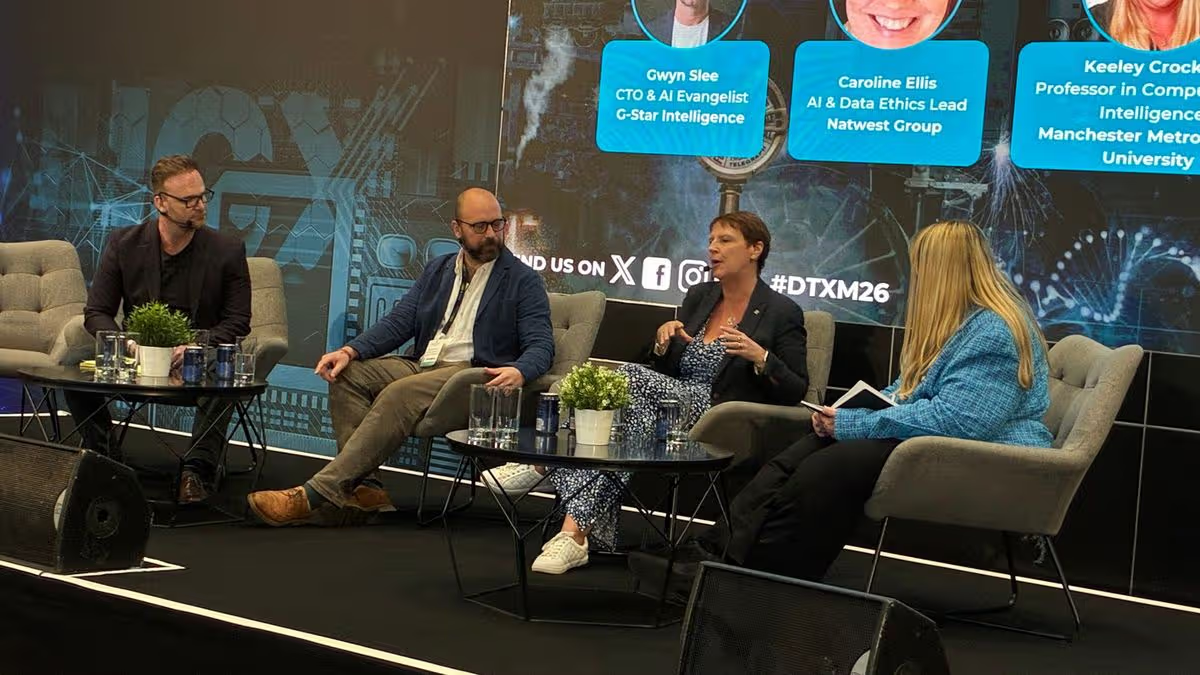
Pictured at the technology trade event DTX + UCX Manchester at Manchester Central are, from left, Gwyn Slee, Richard Whittle, Caroline Ellis (speaking) and Keeley Crockett.

From left, Gwyn Slee, Richard Whittle, Caroline Ellis (speaking) and Keeley Crockett(Image: Reach plc)

We’ve all heard the apocalyptic predictions that AI is going to take millions of jobs.

That’s hard to hear for those of us with a few years of work under our belts. But it’s really very bleak indeed for young people looking to start their careers, only to read every five minutes that there apparently won’t be any careers to have.

So is it true? And if it is – even only partly – what on earth can we do to make sure young people can start their careers?

The Digital Transformation Expo Manchester, known as DTX, is all about working out what technological change means for businesses and their employees. And so on the main stage, a group of experts gathered to debate the “elephant in the room” – if AI really does eliminate junior and entry roles where people learn on the job, then how can companies develop the next generation of leaders?

Advertisement

Host Gwyn Slee, chief technology officer and “AI Evangelist” at G-Star Intelligence, said that using AI in the short term might make sense because it’s “faster and cheaper”. But, he asked, is that storing up problems down the line because young skilled people aren’t being hired?

Richard Whittle, professor of artificial intelligence and public policy at the University of Salford, was blunt – our current way of training and way of developing experts, he said, is over.

“There is little point in your organisation hiring as you were 10 or 20 years ago…” he added. Instead of recruiting young graduates as generalists, companies might have to move to “deep specialisation”, hiring people with very specific and often very technical skills.

Keeley Crockett, professor in computational intelligence at Manchester Metropolitan University, said young recruits needed ethical skills and the ability to verify information.

Advertisement

She said the UK needed to offer hope to its young people as we need a “productive workforce of all ages” with opportunities open to all.

Caroline Ellis, AI & data ethics lead at NatWest Group, agreed firms needed to rethink what “entry level” means, to ensure there are still career opportunities for young people.

She asked bosses: “How is your business going to run in a few years’ time?” If there are no junior or mid-managers, who will run those businesses once existing leaders move on or retire?

The panel later debated how AI should be used in organisations, and what skills were most vital to make it work.

Advertisement

Keeley said AI could be well used as a tool to “augment” human work, but that it needed to be used by people with the right core knowledge and cognitive skills.

She said: “Unless you know how machine learning models work… how can you possibly verify what that AI comes out with? I’m very worried about complacency down the line.”

Carline agreed companies needed to have the right culture of AI use, ensuring they were using “the right tools in the right place”.

Technology trade event DTX + UCX Manchester at Manchester Central.

Technology trade event DTX + UCX Manchester at Manchester Central(Image: Reach plc)

Host Gwyn added: “AI can be superhuman in some areas… but if you want it to tell you a joke, it’s absolute rubbish.”

Advertisement

Richard then asked the audience to take a step back and ask why AI is being used, particularly when it can give a worse outcome than human output. “Because,” he said, “it’s really cheap”.

He added: “Why are we doing this? I would argue it’s because of the wider economic forces all our businesses are facing at the moment… This is why we’re seeing an absolute explosion in very poor but very cheap AI output.”

Richard said firms needed to assess where the “humans in the loop” should be, and making realistic cost assessments.

Keeley added that companies needed to stay accountable to all their stakeholders in the age of AI. If businesses lose core skills through job cuts or a lack of recruitment, and then an AI gets something wrong, “where is the liability”?

Advertisement

One upcoming issue for AI users will be the costs of those services. In the early days of mass AI adoption, those tools have been cheap or even free to use. But in due course, and once AI is embedded in business, that will change.

Gwyn asked what will happen to AI use once that cheap pricing ends. Richard reflected on the way that other tech businesses, such as ride sharing apps, have relied on using cheap prices to grab market share before raising prices.

He says that when AI use prices rise, businesses will need to reflect on how much they are using it.

“We are using AI for weird things we wouldn’t be using it for”, he said, and asked if we would for example still use AI to generate simple emails or social media posts if each use cost more. If people were paying the true cost for those services, he said, then they wouldn’t use them as much.

Advertisement

So what happens if companies have shed jobs and abandoned graduate training schemes, hoping to save cash, “and then the price goes up 10 or 15 times?” Unless you’ve thought about your organisation’s long-term future and the skills you will need, Richard said, you may end up with a total dependency on AI when “the pricing is outside your control”.

Caroline agreed, saying: “You are paying less than we should and they are going to put the prices up. She added: “If you were paying 12 times (what you pay now), would you still choose to deploy it?”

Richard added that he had “honestly not seen” a long-term financial AI use forecast that was correct because people assume AI will stay free or cheap. So organisations should assess carefully what they need to use AI for and what still needs people.”

Later, he said it would be hard and expensive for firms to develop human expertise inside an organisation once it’s gone. He referenced EM Forster’s prophetic science fiction story The Machine Stops, in which people become dependent on technology, and said: “Part of the answer is – how do we value future expertise now?”

Advertisement

Keeley said organisations needed to value their people and the skills and deep knowledge they have.

She said: “If you lose that, maybe short term you’ll have a solution, but in three to five years time you won’t.”

And Caroline added: “Plus if AI takes all the jobs, who’s going to buy your products and services?”

Lessons learned from the Post Office scandal

A sobering reminder of what can go wrong when companies rely on tech came later when Bryan Glick, editor of Computer Weekly, spoke about the Post Office scandal, when hundreds of people were wrongly prosecuted for failures of the Horizon IT system.

Advertisement

For many people the sheer scale of the scandal only became clear in 2024 when TV drama Mr Bates vs The Post Office aired, leading to then Prime Minister Rishi Sunak announcing new measures to compensate the hundreds of subpostmasters and sub-postmistresses who were wrongfully convicted.

But Bryan pointed out this was “a scandal whose roots went back 24 years” and that Computer Weekly had been reporting on it for that time, recognising that the problems at the Post Office had the “noxious whiff” of a serious problem with officials not accepting that there could be any problems with the Horizon system despite mounting evidence of issues.

The 2025 report into the scandal, by Sir Wyn Williams, said the Post Office “maintained the fiction that its data was always accurate”.

He said that the Post Office scandal, and other high-profile scandals involving government, seemed like perfect storms in their own right. It would, he said, be easy to look at each individual scandal and to say that couldn’t happen again. He warned: “I’m here now to say to you, think again”.

Advertisement
Pictured at the technology trade event DTX + UCX Manchester at Manchester Central are, from left, Bryan Glick and Sharron Gunn

Bryan Glick, left, and Sharron Gunn onstage at Manchester Central(Image: Reach plc)

It will be harder in future to solve any tech crises involving AI, he said, as we often don’t know exactly what is going on inside those models.

The key issue for organisations using AI and other tech suites is accountability. Leaders and employees alike need to know when to ask questions of the technology and of each other, and must not assume technology is infallible.

Bryan was speaking on stage to Sharron Gunn, chief executive of BCS the Chartered Institute for IT. She said that with AI there always needed to be a “human in the loop” with everyone at a company, including board members, needing to know what to ask about technology. All directors, she suggested, should have basic tech training.

Asked about what lessons he thought government and business could take from the Post Office scandal, Bryan said organisations needed to understand that “technology is a tool” and “not a magic solution to all your economic and social problems”.

Advertisement

And, he said, people were vital to the success of any implementation of technology. “AI can help, he said, “but government needs to listen to the experiences of the people who implement It” – not just to tech firms.

Continue Reading

Business

Trane Technologies plc (TT) Q1 2026 Earnings Call Transcript

Published

on

OneWater Marine Inc. (ONEW) Q1 2026 Earnings Call Transcript

Trane Technologies plc (TT) Q1 2026 Earnings Call April 30, 2026 10:00 AM EDT

Company Participants

Zac Nagle – Vice President of Investor Relations
David Regnery – Chairman of the Board & CEO
Christopher Kuehn – Executive VP & CFO

Advertisement

Conference Call Participants

Christopher Snyder – Morgan Stanley, Research Division
Julian Mitchell – Barclays Bank PLC, Research Division
Scott Davis – Melius Research LLC
Andrew Kaplowitz – Citigroup Inc., Research Division
Amit Mehrotra – UBS Investment Bank, Research Division
Andrew Obin – BofA Securities, Research Division
Noah Kaye – Oppenheimer & Co. Inc., Research Division
Nigel Coe – Wolfe Research, LLC

Presentation

Advertisement

Operator

Good morning. Welcome to the Trane Technologies Q1 2026 Earnings Conference Call. My name is Lisa, and I will be your operator for the call. The call will begin in a few moments with the speaker remarks and the Q&A session. [Operator Instructions] I will now turn the call over to Zac Nagle, Vice President of Investor Relations. Please go ahead, sir.

Zac Nagle
Vice President of Investor Relations

Advertisement

Thanks, operator. Good morning, and thank you for joining us for Trane Technologies First Quarter 2026 Earnings Conference Call. This call is being webcast on our website at tranetechnologies.com where you’ll find the accompanying presentation. We are also recording and archiving this call on our website.

Please note that statements made today are forward-looking and may differ materially from actual results as detailed in our SEC filings. This presentation also includes non-GAAP measures explained in our news release and presentation appendix. Joining me today are Dave Regnery, Chair and CEO and Chris Kuehn, Executive Vice President and CFO.

With that, I’ll turn the call over to Dave. Dave?

Advertisement

David Regnery
Chairman of the Board & CEO

Thanks, Zac, and everyone, for joining today’s call. Please turn to Slide #3. I’ll start with a few thoughts on how our purpose-driven strategy continues

Advertisement
Continue Reading

Trending

Copyright © 2025