
Crypto World
Breaking down Sui (SUI)

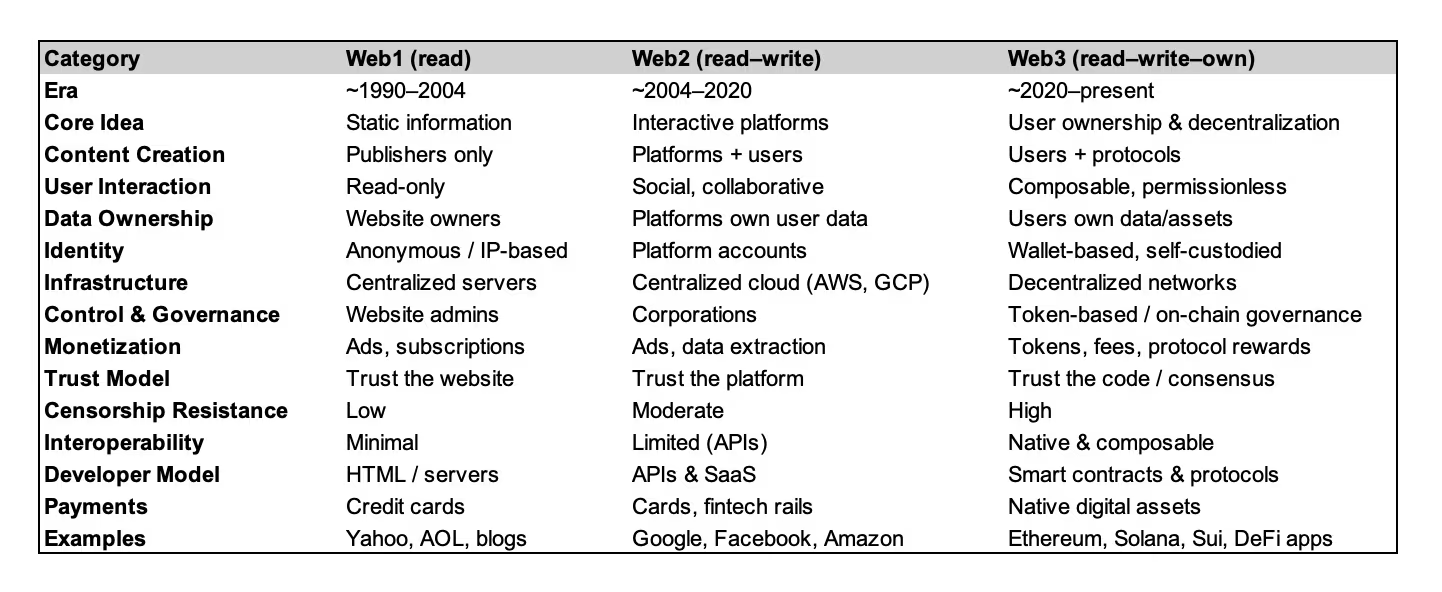
In today’s newsletter, Josh Olszewicz from Canary Capital introduces Sui blockchain and discusses its potential impact on Web3 adoption and optimization for consumer applications.
Special alert: Are you going to Consensus Miami? Don’t miss the closed-door, Wealth Management Day on May 6. There is a special side event, dedicated to advisors. Attendance is complimentary for credentialed advisors. A CRD number is required to apply.
Happy reading.
Breaking down
The Sui (pronounced “swee” like sweet) network is emerging as one of the more differentiated Layer-1 blockchains in the current market cycle, combining novel architecture with a design philosophy aimed squarely at consumer-scale applications. A Layer-1 blockchain is the base layer of a network, where transactions are recorded, validated and finalized. While often grouped alongside other high-throughput chains, Sui takes a distinct approach to execution, data ownership and tokenomics, differences that may prove meaningful for long-term adoption and investor positioning.
Launched in 2023 by Mysten Labs, Sui is a delegated proof-of-stake (DPoS) Layer-1 blockchain built using the Move programming language. Its core innovation lies in an object-based data model that enables parallel transaction execution, allowing the network to process transactions simultaneously rather than sequentially. This architecture is designed to deliver high throughput and low latency, improved scalability without reliance on rollups (transaction batching) and native support for complex, asset-centric applications.
Unlike traditional blockchains, where every transaction competes for global consensus, Sui distinguishes between owned objects, which can be processed independently, and shared objects, which require consensus. This selective execution model reduces bottlenecks and enhances efficiency at scale.
Sui’s design is optimized for consumer-facing Web3 use cases, including gaming, digital identity and social applications. By minimizing execution friction and improving user experience through features like zero-knowledge (zk)-based logins and passkeys, the network aims to bridge the gap between Web2 usability and Web3 ownership. The broader implication is straightforward: if Web3 adoption is ultimately driven by applications rather than speculation, architectures like Sui’s may be structurally advantaged.
Beyond its base layer, Sui expands into a broader infrastructure stack. It includes an execution layer for smart contracts and asset logic, decentralized storage via Walrus for verifiable data, programmable encryption through Seal for access control and confidential compute with Nautilus to support hybrid on- and off-chain applications. Together, these components form a full-stack Web3 environment within the Sui ecosystem, reducing reliance on centralized infrastructure providers.
On the consensus side, Sui uses a dual-layer architecture. Narwhal handles data availability, while Bullshark provides transaction ordering and finality. This design enables the network to maintain high throughput without compromising security.
The total SUI token supply has a fixed maximum cap of 10 billion tokens, with no ongoing inflation beyond that cap. Key features include gradual token release through long-term vesting schedules, staking rewards distributed from pre-allocated supply rather than new issuance and an intentionally limited early circulating supply to reduce sell pressure.
Sui has shown steady growth across several key metrics. Transactional activity has remained consistent and active addresses have increased. Total Value Locked (TVL), or how much notional value is inside of the ecosystem, has expanded alongside the growth of decentralized finance (DeFi) protocols and stablecoin integrations. TVL peaked in October 2025 at around $2 billion and has since declined to $600 million, reflecting the broader pullback in assets across the sector.
Ecosystem growth has been driven by the expansion of DeFi platforms, the integration of major stablecoins to improve liquidity and usability and incentive programs paired with emerging consumer applications that increase engagement. Examples include Scallop, a DeFi hub focused on stablecoin lending and yield generation; Run Legends by Talofa Games, a move-to-earn fitness RPG where users walk and run in real life to battle and earn rewards; and FanTV, a TikTok-style social media platform.
One way to assess Sui, and crypto networks more broadly, is through a “network P/S ratio” (market cap divided by fees). This metric reflects investor expectations for future growth and the relationship between current usage and valuation. However, unlike traditional equities, fees are volatile, only accrue to validators and token holders who stake their SUI and are highly sensitive to incentives and subsidies. As a result, valuation should be contextualized alongside user adoption, transaction trends and ecosystem expansion.
Sui is also beginning to intersect with traditional financial infrastructure. The launch of SUI-linked investment products, including exchange-traded vehicles with staking exposure, signals growing institutional interest. This trend mirrors broader crypto market evolution, where access, yield and regulatory wrappers have unlocked pathways for sophisticated institutional access and capital deployment.
Sui represents a distinct approach within the Layer-1 landscape, combining parallelized execution and object-based architecture, a non-inflationary, vesting-driven token model and a growing ecosystem of consumer and DeFi applications.
For investors, the key question is not simply whether Sui can compete on throughput, but whether its design translates into sustained user adoption and economic activity. If it does, the network’s architecture and token structure could position it as a meaningful component in the construction of the next phase of Web3 growth.
Generations of the Internet

Web1: Information online | Web2: Platforms and social interaction | Web3: Ownership, composability, and programmable value
For more additional learning and a unique networking opportunity, Canary Capital is partnering with 3iQ, Digital Ascension Group, and Bitnomial, for an exclusive event on May 4 in Miami. Learn more.
– Josh Olszewicz, portfolio manager, Canary Capital
Keep Reading

Crypto World
Crypto hacks continue as Wasabi Protocol drained of $4.5 million in admin key compromise


DeFi can’t stop bleeding, and Wasabi Protocol is the latest to find out why.
The protocol, a perpetuals trading platform built on Ethereum and Base, was drained of about $4.55 million on Thursday after attackers compromised its deployer key, security firm Blockaid said in an X post.
The hack is the latest in a month that has produced over $605 million in DeFi losses across at least 12 incidents. The attack closely mirrors the Drift Protocol exploit on April 1, when North Korea-linked attackers used a compromised admin key to drain $285 million from the Solana-based perpetuals exchange.
The mechanics operated through an externally owned account, or EOA, called wasabideployer.eth, which held the sole ADMIN_ROLE in Wasabi’s permission system.
An EOA is a wallet controlled by a private key, as opposed to a smart contract. Whoever holds the key controls the wallet. Once the attacker had access to the deployer key, they gave themselves admin privileges with zero delay by calling grantRole on the permission contract.
Their helper contract then upgraded Wasabi’s perp vaults and Long Pool to malicious implementations that drained the balances, Blockaid said.
The exploit relied on a standard known as Universal Upgradeable Proxy Standard (UUPS), which allows a smart contract to change its underlying code while keeping the same address.
UUPS is widely used because it lets developers fix bugs without migrating users. The downside is that if an attacker controls admin permissions, they can replace the contract’s logic with anything they want, including code designed to steal funds.
Wasabi had no timelock or multisig protecting the admin role, Blockaid said. A timelock forces a delay between when an admin action is announced and when it executes, giving users time to react. A multisig requires multiple signers to approve a change. Wasabi had neither, leaving a single key holding full control over the protocol.
🚨 Blockaid’s exploit detection system identified an on-going admin-key compromise exploit on @wasabi_protocol across Ethereum and Base. The Wasabi: Deployer EOA was used to grant ADMIN_ROLE to an attacker helper contract, which then UUPS-upgraded the perp vaults and LongPool to…
— Blockaid (@blockaid_) April 30, 2026
Compromised contracts include Wasabi’s wWETH, sUSDC, wBITCOIN, wPEPE, and Long Pool vaults on Ethereum, plus its sUSDC, wWETH, sBTC, sVIRTUAL, sAERO, and sBRETT vaults on Base, according to Blockaid.
Users holding Wasabi LP tokens were urged to revoke any active approvals to the vault contracts because the underlying assets backing those tokens had either been drained or remained at risk.
A month of exploits
In the case of Drift, the attackers also exploited a single-key admin setup with no governance timelock, listing a fake token as collateral and raising withdrawal limits to drain real assets in roughly 12 minutes.
Three weeks later, on April 19, Kelp DAO lost $292 million when an attacker exploited a single-verifier configuration in the protocol’s LayerZero bridge, releasing 116,500 unbacked rsETH that was then used as collateral to borrow real ether (ETH) from Aave.
The cumulative DeFi loss total for 2026 has now passed $770 million across more than 30 reported incidents. April alone accounts for the majority of that figure.
Smaller breaches this month have hit CoW Swap ($1.2 million), Grinex ($13.74 million), Resolv Labs ($23 million), Volo Protocol ($3.5 million), among others.
What ties them together is not a new vulnerability. Each incident produces the same post-mortem language about lessons learned, but the next exploit usually arrives before the lessons get implemented.
Wasabi has not yet issued a public statement on the incident.
UPDATE (April 30, 11:34 UTC): General edits throughout. Moves Drift Protocol exploit to third paragraph.


The US Senate unanimously approved a resolution from Senator Bernie Moreno that bars sitting senators from trading on prediction markets. The measure took effect immediately under the chamber’s internal Standing Rules.
The voice vote came one week after Moreno introduced the resolution on April 24. It targets event contracts offered by platforms such as Polymarket and Kalshi.
Inside the Prediction Market Ban
Moreno said the resolution amends Rule XXXVII of the Senate Standing Rules. It bars senators from entering agreements that depend on the occurrence, nonoccurrence, or scope of a specific event.
That language directly captures event contracts on Polymarket and Kalshi. Users on those platforms wager on elections, legislation, economic data releases, and geopolitical outcomes.
An amendment from Senator Alex Padilla narrowed the text. The change prevents the rule from sweeping in conventional financial products such as insurance policies. Enforcement runs through the Senate Ethics Committee.
Industry Backs the Move
Kalshi chief executive Tarek Mansour applauded the rule. He noted that the platform already blocks members of Congress and polices insider trading internally.
“I applaud the Senate for passing this resolution to ban Senators and their offices from trading on prediction markets… Now, let’s pass this in the House!” said Mansour.
The rule does not extend to House members or congressional staff. Candidates, executive branch officials, and family members of senators are also excluded. That carve-out leaves room for indirect exposure to event contracts.
The resolution arrives during a wave of broader 2026 legislation targeting prediction markets, including bills aimed at all federal officials.
Senate Majority Leader Chuck Schumer publicly praised the measure ahead of the vote. House action would require a separate resolution. That makes the lower chamber’s response the next test of bipartisan appetite.
The post US Senate Passes Resolution Banning Senators From Prediction Market Trading appeared first on BeInCrypto.
Crypto World
From Cathie Wood to Cantor Fitzgerald, the big money is betting that Robinhood’s (HOOD) crypto slump is just a temporary speed bump


Robinhood’s (HOOD) nearly 12% drop since its big earnings miss is being waived off by some big investors and Wall Street analysts.
The popular trading platform missed its first-quarter earnings and revenue estimates on April 28, mainly due to weaker crypto trading activities. The market punished the stock on the miss, but Cathie Wood’s Ark Invest saw that as an opportunity and bought roughly $39.7 million worth of shares the next day, signaling confidence in the trading platform’s future. Robinhood remains a meaningful position across Ark’s portfolios, accounting for roughly 3% and ranking among the top holdings in all three funds.
The contrarian move seems to have come at the same time as Wall Street analysts, who agreed that the miss was just a blip for the company, and early April data points to improving momentum. They added that equity and options trading volumes are trending toward some of the strongest levels this year, offering a potential counterbalance to continued softness in crypto.
Cantor Fitzgerald, which reiterated its ‘Overweight’ rating and $110 price target, said recent activity suggests stabilization. “Preliminary April equity/option trading volumes are tracking toward the highest monthly level this year,” the firm wrote, adding that the earnings miss was tied more to market conditions than core business issues.
Another firm, Compass Point, echoed that view, maintaining a ‘Buy’ rating while slightly lowering its price target to $107. The firm said the market reaction appears “backwards looking,” given expectations for a stronger second quarter.
While both brokers are bullish on Robinhood’s outlook, some analysts cautioned that there are still risks, particularly in crypto trading, which is likely to continue weighing on results in the near term amid lower volumes and pricing pressure across the sector.
Investment bank Keefe, Bruyette & Woods (KBW), which already had the lowest price target on the stock, according to FactSet data, cut it further. The firm’s analysts, who rate the stock a ‘Hold,’ warned that declining transaction fees could persist and cut its target to $65 from $75.
“Capture rates [are] missing across the board,” the firm’s analysts said, noting that both crypto and options take rates have continued to fall into the second quarter. That trend has led to lower long-term forecasts, with KBW trimming earnings estimates through 2028.
That concern didn’t seem to deter one of the top bullish analysts. Bernstein’s analysts, who maintained their ‘Outperform’ rating and a $130 price target, pointed to signs that crypto activity may be stabilizing, as April hasn’t shown any further declines in prices while equities and options remain strong.
Moreover, beyond trading, bullish investors are now turning their attention to new revenue streams.
Prediction markets are emerging as a key area, with firms highlighting growth in event-based contracts and upcoming catalysts such as product launches and global events. Robinhood’s planned prediction markets platform, Rothera, is viewed as a potential driver of future revenue and margin expansion, Cantor said.
For now, the outlook hinges on whether recent gains in trading activity can continue. If they do, Robinhood may return to growth sooner than expected. If not, pressure on transaction revenue could persist into the second half of the year.
The stock was up about 3% on Thursday, but fell about 37% this year. One of its crypto peers that tends to partially trade in tandem, Coinbase (COIN), rose about 3% on the day and is down about 19% year-to-date.

Sentora announced on April 30, 2026 that Sentora Smart Yield is now publicly available, opening access to its DeFi vault discovery and monitoring platform to all users. The move broadens access to a research-led yield infrastructure that had been primarily deployed for institutional partners, signaling a maturation in how on-chain capital is evaluated and deployed.
Vaults have emerged as a central pillar of DeFi infrastructure, enabling capital to move across protocols and chains with defined risk controls. Sentora notes that risk-curated vault structures already account for nearly $7 billion in DeFi capital. At the same time, Sentora’s public vaults hold almost $2 billion in allocations, a scale that positions the firm as the largest public vault curator and aligns it with notable ecosystem partners such as Kraken, Upshift, and Morpho. The company frames its public rollout as a natural extension of its institutional framework, now accessible to a broader audience.
The launch rolls out a public, non-custodial interface built around strategy discovery, analytics, and risk visibility, moving beyond a plain APY dashboard. The platform is designed to help users understand the structure behind opportunities before committing capital, rather than merely presenting headline yields.
“Vaults are becoming one of the main ways capital is organized and deployed across DeFi, but most products still reduce that experience to a single number,” said Jesus Rodriguez, co-founder and CPO at Sentora.
“With Smart Yield, we’re bringing the same strategy framework we’ve built for institutional partners to the public, but in a format that gives users real transparency into how a vault works, where funds go and what risks they are taking before they deposit.”
At the core of Sentora Smart Yield is a bifurcated vault model that balances accessibility with sophistication. Direct Vaults provide simpler, single-strategy exposure—typically anchored in lending markets—offering a cleaner, lower-complexity path to on-chain yield. By contrast, Smart Vaults are more structured products that deploy capital through multi-step strategies to pursue greater capital efficiency or enhanced returns. Examples cited by Sentora include strategies like Supervised Loans and Leveraged Loops, which aim to optimize allocations while maintaining a clear view of exposure.
The public platform makes the strategy framework visible alongside each vault’s page. Users can compare vaults by asset, chain, strategy, APY, and risk metrics, while also examining how each vault is constructed—the allocation points, the flow of funds, and the exposures embedded in the strategy before engaging with the underlying contracts.
In addition to high-level strategy visibility, Sentora’s dashboards integrate analytics and monitoring tools designed to help users evaluate opportunities in depth. Available data points include historical yield behavior, total value locked (TVL) trends, liquidity conditions, withdrawal simulations, wallet concentration, and the composition of each strategy. For Smart Vaults, users can drill down further to see underlying deployments by protocol, blockchain, and asset, offering a granular view of how capital is distributed across the entire strategy stack.
The firm also signaled an intent to broaden protection for on-chain deployments. Sentora has outlined plans to bring DeFi Cover to its vault lineup, leveraging the Firelight protocol to add an additional layer of protection for assets deployed through its vaults. This move would complement the transparency and risk context already baked into the platform, providing an additional safety net for users deploying capital via public vaults.
The company positions Smart Yield as a product that reflects institutional requirements while remaining accessible to the broader market. The aim is to provide not just yield opportunities but the tools to assess them with discipline—an emphasis on structure, transparency, and contextual risk alongside potential return.
Sentora Smart Yield is live now at vaults.sentora.com.
Key takeaways
- The public rollout extends Sentora’s institutional-grade yield research framework to retail users, expanding access to strategy discovery and risk analytics for DeFi vaults.
- The platform emphasizes transparency, showing how vaults are constructed, where funds go, and the risks involved—beyond a single yield number.
- Two vault archetypes are offered: Direct Vaults (single-strategy exposure) and Smart Vaults (multi-step, potentially higher-efficiency or higher-variance strategies).
- Analytical tools include historical yields, TVL trends, liquidity, withdrawal simulations, wallet concentration, and strategy composition—plus underlying deployments for Smart Vaults.
- Sentora plans to integrate DeFi Cover via Firelight to add an additional protection layer for on-chain asset deployments across its vaults.
From institutional rails to public accessibility
The shift to a public-facing version of Sentora’s yield research and monitoring infrastructure marks a notable evolution in DeFi infrastructure design. Historically, sophisticated yield strategies and risk analysis have lived behind more restricted, institution-facing portals. By publicizing the same framework, Sentora intends to empower a broader set of users—investors, traders, and builders—to evaluate and participate in on-chain strategies with a clearer understanding of risk and capital allocation.
The two-vault model also helps differentiate the user experience. Direct Vaults provide a lower-friction route into yield generation, appealing to users who want straightforward exposure without layering multiple steps of capital deployment. Smart Vaults, meanwhile, align with more sophisticated users who seek enhanced returns through structured deployment patterns, albeit with a deeper layer of complexity and risk to assess. The underlying philosophy is to demystify “how” a vault earns yield, not just “how much.”
The analytics suite strengthens this approach. Investors can study past performance patterns, evaluate how liquidity and withdrawal dynamics might impact their positions, and gauge how concentrated ownership could affect a vault’s resilience to redemptions. For Smart Vaults, the ability to inspect protocol-level and asset-level breakdowns helps traders understand where capital is actually deployed across the stack. This granularity is a meaningful upgrade from surface-level appearance of yield, offering a more decision-ready picture of risk and reward.
Sentora’s planned DeFi Cover integration adds a forward-looking risk-management angle. If successfully rolled out, Cover protection would provide a protection layer for deployed capital, potentially reducing downside risk during extreme market conditions. The addition would complement the platform’s emphasis on transparency and risk context, aligning with broader industry moves toward insuring on-chain activities and expanding the set of guardrails available to yield-focused strategies.
Implications for the DeFi vault landscape
The public launch of Sentora Smart Yield arrives at a moment when DeFi vaults have matured into a common mechanism for capital allocation across chains. By publicly presenting strategy-level detail and risk context, Sentora is testing whether on-chain yield can be both approachable for non-institutional participants and disciplined enough for risk-aware investors. The emphasis on structure over simple APY aligns with a broader industry push to improve governance, transparency, and risk disclosure in yield-bearing products.
For investors and users, the development raises several key considerations. First, access to institutional-grade research tools could raise the quality of decision-making in retail DeFi participation, potentially improving risk awareness and capital efficiency. Second, the visibility into strategy design and deployment could spur more competition among vault builders to publish comparable disclosures, potentially raising standards industry-wide. Third, while DeFi Cover promises added protection, readers should watch how such protection interacts with liquidity, deployment strategies, and protocol risk, particularly in complex Smart Vaults with leveraged or multi-step structures.
In the broader market, Sentora’s public-facing approach may push other vault curators to offer similar levels of transparency, or to differentiate through risk analytics and coverage options. As vaults continue to serve as a primary interface for on-chain capital, the quality of information available to users about risk, exposures, and governance will likely influence participation levels, capital flows, and the pace of institutional-grade tools becoming mainstream.
Sentora’s public rollout also signals a continuing trend toward combining institutional rigor with user-friendly access. By presenting not just opportunities but the scaffolding behind them, the platform invites users to engage with DeFi yield in a more informed, deliberate manner. Whether this approach resonates with a broader audience remains to be seen, but it certainly adds a new layer to how DeFi yield opportunities are evaluated in real time.
Sentora Smart Yield is now accessible at vaults.sentora.com, and the company continues to position its platform as a bridge between institutional risk discipline and public market participation.
About Sentora
Sentora is a DeFi infrastructure and strategy partner serving institutional and sophisticated on-chain capital allocators. Through its research-led approach to vaults and private strategies, Sentora helps users access on-chain yield opportunities with greater transparency into strategy design, capital allocation, and risk.
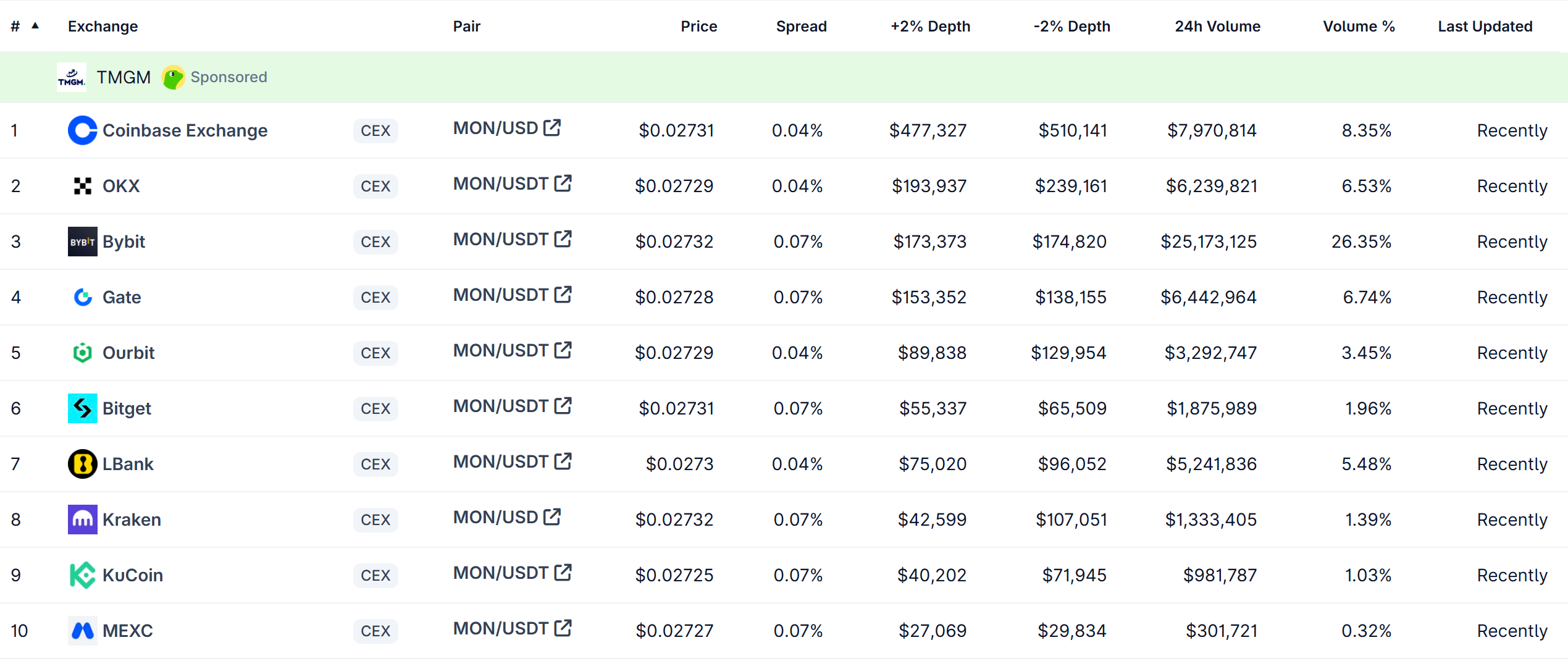
Binance will list MegaETH’s MEGA token on April 30, 2026, with spot trading set to open at 11:00 UTC. The exchange received no allocation or listing fee, drawing wide praise from analysts and founders.
Binance applied its Seed Tag to MEGA. Every major centralized exchange has now added MEGA without taking project tokens, a rare outcome for a Layer 2 (L2) launch.
Binance Joins MEGA Exchange Spread Without Tokens
Spot pairs including MEGA/USDC and MEGA/USDT went live shortly after the Binance announcement. Deposits and trading remain restricted in the United States, Canada, the Netherlands, and other jurisdictions for regulatory reasons.
MegaETH publicly committed earlier in 2026 to a no-pay listing policy. The team refused to send tokens for fees, liquidity rewards, or promotional airdrops.
The team argued that listings should follow merit and demand, not supply transfers.
“MegaETH has not, and will not, give away MEGA tokens as “fees or airdrops” to any centralized or decentralized exchange for a listing. If an exchange chooses to list the MEGA token, it is because they believe it is a strong project,” the team articulated.
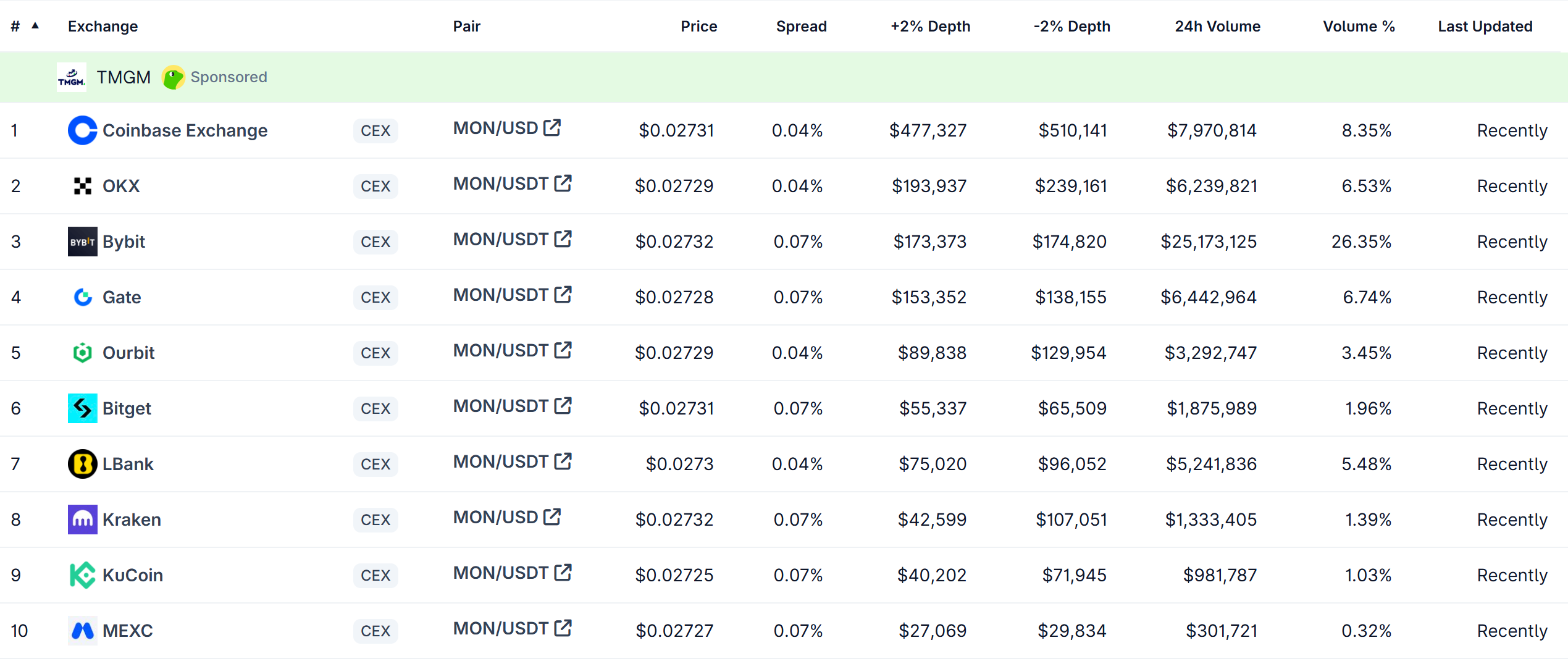
By launch day, Coinbase, Bybit, Upbit, Bithumb, and Binance had each added MEGA without taking project tokens.
Smaller venues including OKX, Bitget, and MEXC also enabled trading. Community members called the spread a “royal flush” and a first for an organic Layer 2 listing run.
Industry Figures Frame Listing as a Shift in Exchange Practice
Simon Dedic, chief executive at Blockhead Capital, said Binance “bent the knee” by listing without compensation. He framed the outcome as a positive signal for token founders weighing exchange demands during launches.
“Honestly, I wouldn’t have expected them to bend the knee and list it for free, so kudos to Binance here. Imagine being such a sought-after project that every major CEX lists you without receiving a single token,” wrote Dedic.
Analyst DeFi Ignas pointed out that Binance had previously committed to supporting builders with large communities. He argued that skipping MEGA would have contradicted that stance.
Notably, Monad’s MON token, which sold publicly on Coinbase earlier in 2026, has not appeared on Binance.
The general sentiment is that the launch is “substantive and principled,” given MegaETH’s avoidance of KOL payments, point-farming campaigns, and supply allocations to exchanges.
The project’s mUSD stablecoin and proximity market design are potential routes for the token to capture network value.
“It’s a rare sight in a space that rewards crime. Good to see good teams win. Hopefully an inspiration playbook for other quality projects to follow,” stated Grail.eth, a popular user on X.
MEGA Trades Near $2 Billion Fully Diluted Valuation
MEGA traded around $0.16 in the hours after the Binance listing announcement. The price placed circulating market cap near $190 million and fully diluted valuation around $1.7 billion. Total supply is 10 billion tokens.
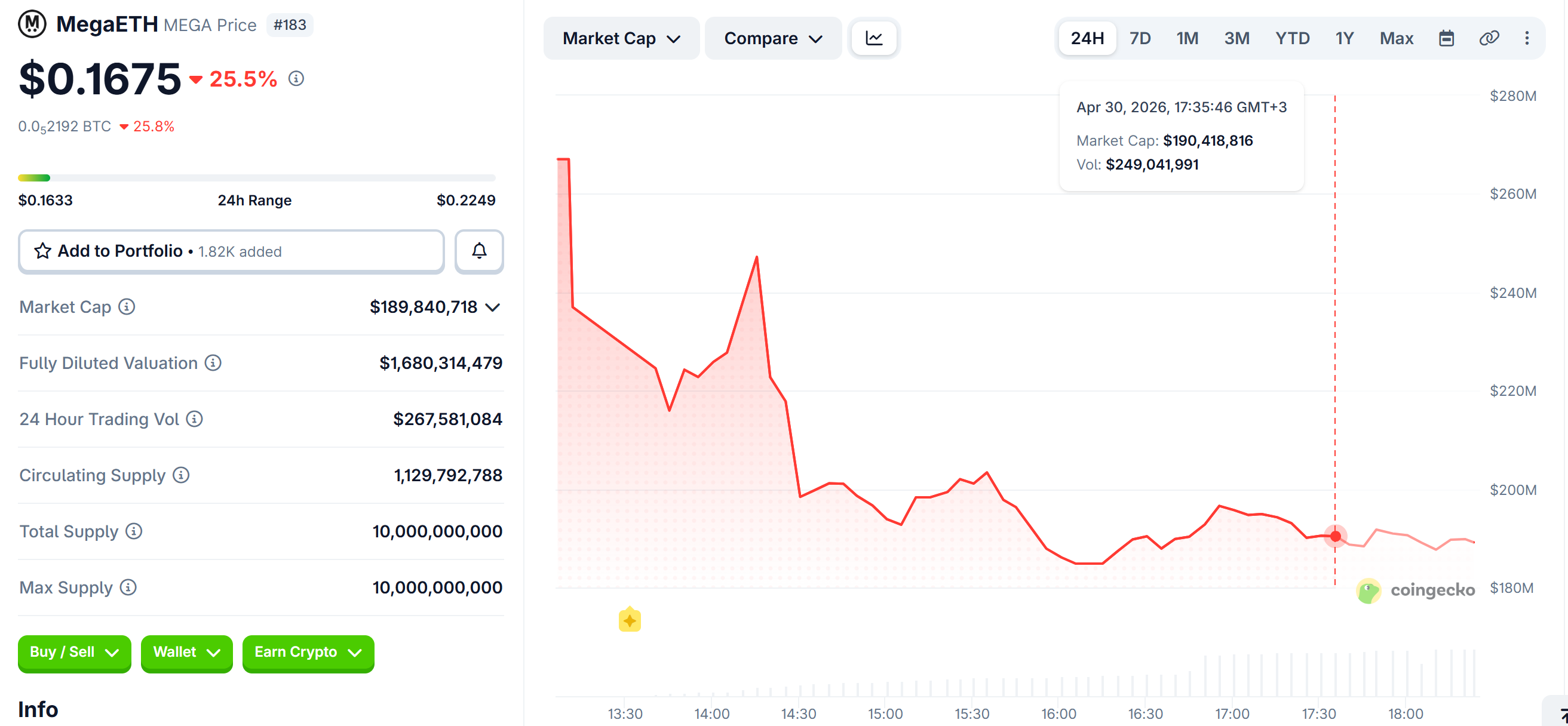
Initial Coin Offering (ICO) buyers saw paper gains of roughly 2x, including those who agreed to a 12-month lock.
However, not every report from the launch was positive, with some users reporting a wallet drain of about $31,920 in USDC.
Community responses pointed to compromised approvals or phishing rather than a protocol fault. Users urged claimants to revoke unused permissions before interacting with new contracts.
The MEGA listing run sets a precedent for other Layer 2 teams to point to. Whether future launches replicate the playbook may depend on whether their tokens see comparable demand.
Supply concessions have long shaped exchange decisions, and few projects have refused them.
The post Binance Draws Industry Praise For MegaETH’s MEGA Token Listing appeared first on BeInCrypto.

XRP price trades just a few levels below $1.40 after clearing a key resistance level, which then lags. The token’s price action has remained stubbornly muted even as Ripple’s stablecoin ecosystem posts record numbers.
RLUSD’s market cap has surged to $1.59 billion, with 24-hour trading volume spiking 143% as BlackRock adopted it as collateral. OKX’s listing of RLUSD as institutional collateral marks a structural upgrade too, moving it from a tier-two exchange asset to a genuine money-market instrument.
LATEST: — CoinMarketCap (@CoinMarketCap) April 29, 2026
 Ripple and OKX have partnered to list RLUSD across more than 280 spot pairs, with the stablecoin also available as margin collateral for derivatives on the exchange. pic.twitter.com/tqZHVtdyZO
Ripple ecosystem is firing on multiple cylinders, with MEA expansion deals closing, central bank payment integrations deepening, record XRPL transaction volumes printing, while XRP spot price consolidates in a tight band.
Discover: The best crypto to diversify your portfolio with
Can XRP Price Hit $2.80 Before Year-End?
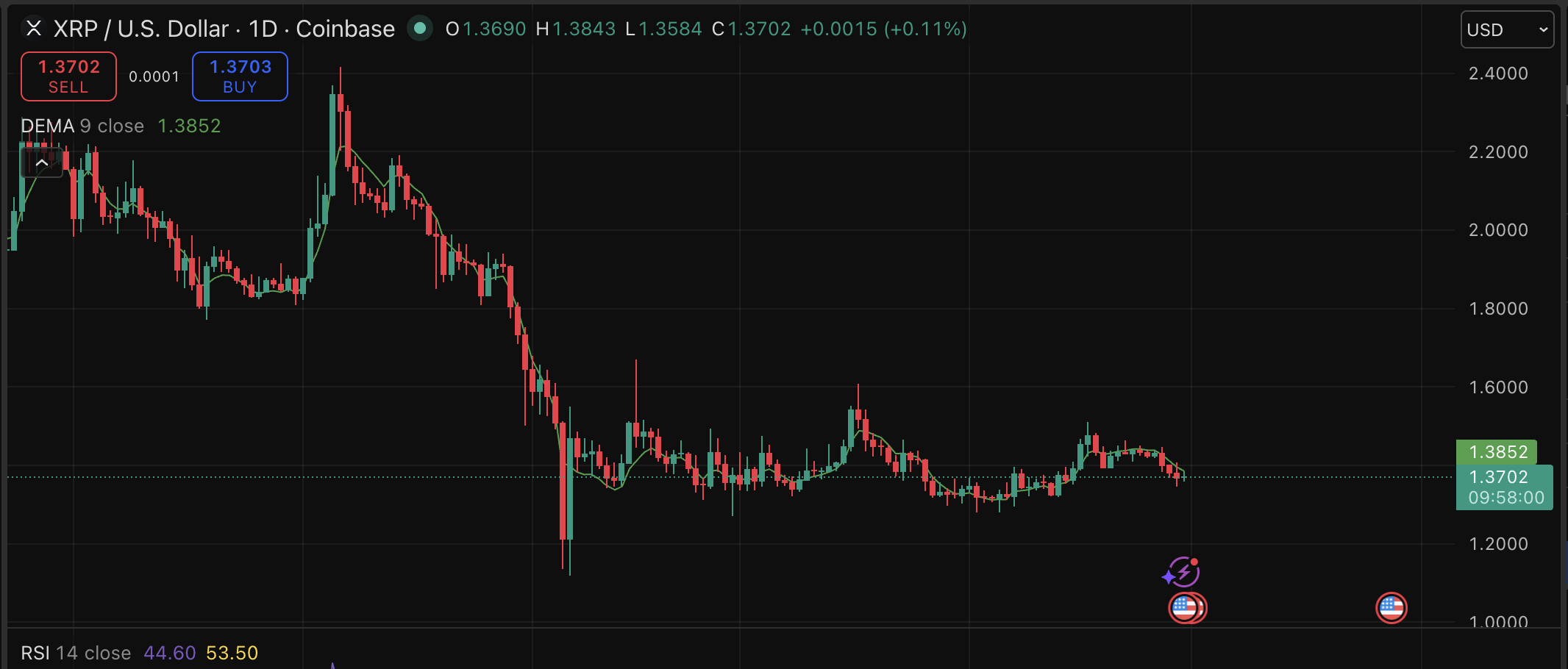
XRP currently trades in the $1.37–$1.40 range, having cleared the $1.40 resistance level before falling back under it again. The volume driven by stablecoin positioning doesn’t always carry the same weight as organic spot demand. Support sits at $1.33; a clean hold above $1.40 on a daily close would confirm the level as new support.
Momentum indicators suggest consolidation rather than a clean directional trend. The price is holding its ground, but moving averages show no strong bullish divergence yet.
If RLUSD can hit the $2 billion market cap milestone, it would likely trigger institutional liquidity flows that spill into XRP. Analysts at Standard Chartered target $2.80 by year-end under this scenario, conditional on RLUSD reaching $1 billion supply thresholds.
Garlinghouse’s recent commentary reinforced the long-term payments narrative, but near-term price action hinges on whether the $1.40 level holds through the week. Watch it closely.
Discover: The best pre-launch token sales
LiquidChain Targets Early-Mover Upside as XRP Tests Key Levels
XRP at $1.40 represents a cleaned-up technical picture, but at a $73+ billion market cap, the multiples needed for life-changing returns require a very specific macro setup. That’s the honest math.
Traders rotating between established large-caps and genuinely early-stage infrastructure are increasingly looking one layer deeper in the stack.
Moving in silence. — LiquidChain (@getliquidchain) April 30, 2026

While the noisy pretend to be progress.  ⟁https://t.co/vqvBcdSQYC pic.twitter.com/wE63W9d7eE
LiquidChain ($LIQUID) is a Layer 3 infrastructure project built around a single thesis: Bitcoin, Ethereum, and Solana liquidity shouldn’t live in silos. Its Unified Liquidity Layer fuses all three ecosystems into one execution environment.
With Liquid, developers deploy once, access all three, with verifiable settlement baked in. The presale is live at $0.01454 per $LIQUID, with more than $700k raised, and not to forget, it’s 1500% APY rewards. Single-Step Execution and Deploy-Once Architecture are the headline technical features.
Research LiquidChain before the next price increase.
The post XRP Price Prediction: RLUSD Pushes Ripple Stablecoin Adoption, But XRP Lags appeared first on Cryptonews.
Crypto World
Sentora brings institutional DeFi to the public with the launch of its Smart Yield platform
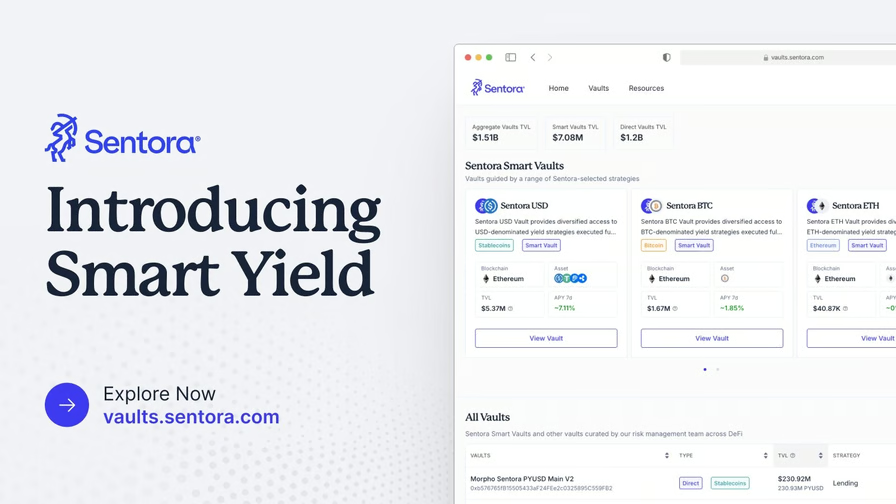
April 30, 2026 – Sentora has announced that Sentora Smart Yield is now publicly available, opening access to its DeFi vault discovery and monitoring platform to all users.
As DeFi vaults become a core way capital moves onchain, Sentora is opening public access to the same research-led yield infrastructure it has used to support institutional deployments.
This comes as vaults have become a key part of DeFi infrastructure, and risk curators already account for nearly $7 billion in DeFi capital through curated vault structures.
The success of this model has been driven in large part by its ability to give users a simpler way to access onchain strategies while abstracting away much of the complexity of risk management.
With nearly $2 billion allocated across Sentora’s public vaults, the firm has become the largest public vault curator and works with key ecosystem partners such as Kraken, Upshift and Morpho.
Automated risk management, advanced strategy design and in-depth research have been central to Sentora’s rapid growth in this market segment.
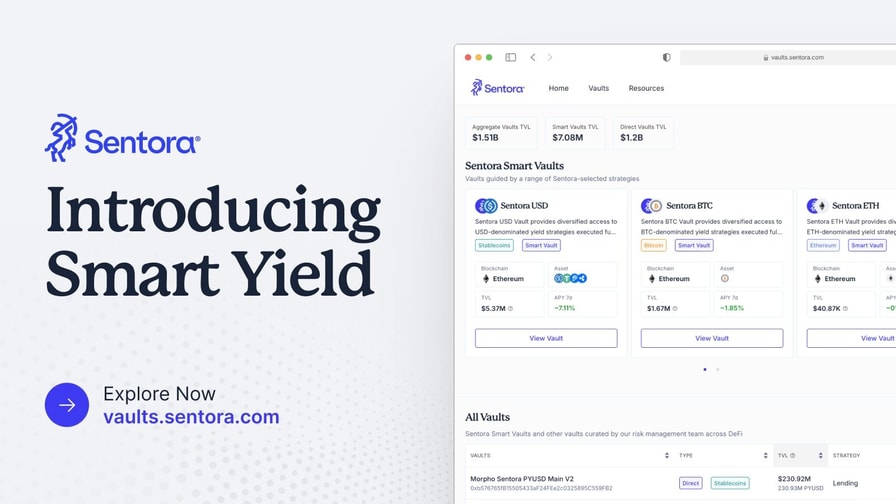
The new platform means that the company is extending that same research-led framework to the public through a transparent, non-custodial interface built around strategy discovery, analytics and risk visibility.
Rather than functioning as another simple APY screen, Sentora Smart Yield is designed to help users understand the structure behind opportunities before they act.
Through the platform, users can compare vaults by asset, chain, strategy, APY, and risk metrics, while also reviewing how each vault is constructed. This is where capital is allocated and what exposures come with the strategy before interacting with the underlying vault contracts.
“Vaults are becoming one of the main ways capital is organized and deployed across DeFi, but most products still reduce that experience to a single number,” said Jesus Rodriguez, co-founder and CPO at Sentora.
“With Smart Yield, we’re bringing the same strategy framework we’ve built for institutional partners to the public, but in a format that gives users real transparency into how a vault works, where funds go and what risks they are taking before they deposit.”
Sentora Smart Yield also includes two core vault categories, Direct Vaults and Smart Vaults. Direct Vaults provide simpler, single-strategy exposure, typically through lending markets, and are designed to offer a cleaner, lower-complexity path to onchain yield.
Smart Vaults are more structured products that use multi-step capital deployment to pursue greater capital efficiency or enhanced returns through strategies, such as Supervised Loans and Leveraged Loops.
By making these strategies visible through a public dashboard, Sentora is bringing part of its more advanced institutional strategy set to a broader market for the first time.
In addition, each vault page includes analytics and monitoring tools designed to help users evaluate opportunities in greater detail.
These include historical yield behavior, TVL trends, liquidity conditions, withdrawal simulations, wallet concentration and strategy composition.
For Smart Vaults, users can also view underlying deployments by protocol, blockchain and asset, giving them a clearer picture of how capital is allocated across the full strategy stack.
Sentora has also shared plans to bring DeFi Cover to all of its vaults, leveraging the Firelight protocol to add an additional protection layer for onchain asset deployments.
The result is a public product shaped by institutional requirements, not just access to DeFi yield but with the tools to assess it with greater discipline too.
As vaults continue to grow as an interface for onchain capital allocation, Sentora is positioning Smart Yield around a simple idea – yield discovery should come with structure, transparency and risk context, not just headline returns.
Sentora Smart Yield is available now at vaults.sentora.com.
About Sentora
Sentora is a DeFi infrastructure and strategy partner serving institutional and sophisticated onchain capital allocators. Through its research-led approach to vaults and private strategies, Sentora helps users and institutions access onchain yield opportunities with greater transparency into strategy design, capital allocation, and risk.


Meta has begun paying select creators in USDC stablecoin on Solana and Polygon via Stripe, marking Facebook’s first crypto payout program four years after the company shut down its Libra project under regulatory pressure.
Summary
- Meta USDC creator payouts launched April 29 for select creators in Colombia and the Philippines, with eligible users able to link a MetaMask, Phantom, or Binance wallet and receive earnings in Circle’s USDC directly.
- Stripe handles the backend and provides tax reporting for the transactions. Meta emphasized it is not issuing its own stablecoin and is using Circle’s existing USDC, which has a market cap exceeding $77 billion.
- The move reverses Meta’s retreat from crypto payments: Libra was launched in 2019, rebranded as Diem, and shut down entirely in 2022 after regulators blocked every path to launch.
Meta USDC creator payouts went live on April 29 when the company quietly updated its support page to show that eligible creators in Colombia and the Philippines can now receive earnings in USDC on either Solana or Polygon. Yahoo Finance reported that Stripe, which acquired stablecoin infrastructure firm Bridge for $1.1 billion in late 2024, is the payments provider handling transactions and generating crypto-related tax documents for creators. Meta explicitly told reporters it is “not issuing a Meta stablecoin” and is instead using Circle’s USDC, the second-largest stablecoin by market cap.
As crypto.news reported, the rollout aligns with Meta’s plans disclosed in February to enter the stablecoin payments space through third-party infrastructure, with Stripe emerging as the leading partner after an RFP process. The choice of Solana is significant: Solana processes transactions in roughly 400 milliseconds with fees under $0.001, and as crypto.news documented, Circle minted over $10.5 billion USDC on Solana in a single month earlier in 2026, making it already the leading chain for USDC settlement volume ahead of Ethereum. Meta paid content creators nearly $3 billion in 2025, meaning even a partial conversion to stablecoin payouts would place meaningful volume onto Solana and Polygon.
The strategic context is the opposite of Libra. As crypto.news tracked, Meta’s 2019 Libra project failed because it tried to issue its own currency, control the wallet, and run the settlement network, giving regulators a single point to block. The 2026 approach makes Meta a customer rather than an issuer: Circle issues USDC, Stripe moves the money, and Solana and Polygon process the transactions. Meta provides the distribution through its more than 3 billion users across Facebook, Instagram, and WhatsApp.


A Green Beret’s alleged $400,000 insider bet on a raid in Venezuela seemed like an isolated breach. A new report suggests it may be the visible edge of something broader.
The Anti-Corruption Data Collective (ACDC), a nonprofit research group, analyzed every settled Polymarket contract from January 2021 through mid-March 2026 — more than 435,000 markets and $54.4 billion in cumulative volume — and found that low-probability bets on military and defense outcomes win at rates that are difficult to explain through skill or luck.
Across political markets, such “longshot” bets typically succeed about 14% of the time. In military-linked contracts, success rates have topped 50% in some cases.
“Markets tied to specific government policies, such as military and defense and foreign affairs, are harder to forecast using public information alone,” the authors wrote, making them “more susceptible to information asymmetries,” including insider trading or specialized knowledge.
In those markets, the gap between informed and uninformed traders may be widest, creating conditions in which a small group can consistently outperform not just by reacting faster, but by knowing more.
For its part, Polymarket touts its market surveillance teams and cooperation with the Department of Justice on the Venezuela case. Trading on confidential knowledge is prohibited on the platform, as it is on Kalshi.
Concentrated profits
The ACDC report’s findings add to a growing body of research pointing in the same direction. A working paper from London Business School and Yale found that roughly 3% of traders account for most price discovery on Polymarket.
Separate analysis from blockchain analytics firm Solidus Labs showed that profits are even more concentrated, with fewer than 1% of wallets capturing about half of all gains. ACDC’s contribution is to suggest where some of that edge may come from.
The report examines the June 2025 U.S. strikes on Iran as a case study. Polymarket listed several date-specific contracts on whether a strike would occur. Markets tied to June 19 and June 20 expired without incident, and no longshot bets won.
The strike came at 18:40 ET on June 21. In the hours leading up to it, 19 longshot bets totaling $164,292 were placed across the contracts that ultimately resolved YES. Eight wallets shared about $1.8 million in profits, with one taking nearly $500,000.
The Pentagon had designed the operation to be unreadable from the outside, using decoy bombers and long-range stealth aircraft to avoid detection. Despite that, a small number of traders placed large, well-timed bets on the outcome.
The pattern extends beyond a single event. Across Polymarket’s military and defense category, the report found that in five of the six two-hour windows before market resolution, winning longshot bets outnumbered losing ones, contrary to what market prices imply.
Longshot bets can outperform for other reasons, including mispricing or shifts in public expectations. But the consistency of the patterns, especially in markets tied to military decisions, suggests that some participants may be operating with information advantages that others do not have.
ACDC, being a nonprofit research group funded through the Fund for Constitutional Government, has no surveillance product to sell, compared to Solidus Labs, whose own recent Polymarket analysis doubles as a marketing case for the platform it licenses to Kalshi.
ACDC’s recommendations include identity verification for bettors, conditional payouts on suspicious wagers, restrictions on markets whose outcomes are decided by small groups, and limits on how granular contracts can become.
The report’s conclusion goes further, calling for “an evidence-informed debate about whether the public should be betting on these outcomes at all.”


MARA Holdings (MARA) has agreed to buy Long Ridge Energy & Power in a deal valued at about $1.5 billion. MARA will also assume at least $785 million of debt backstopped by a bridge loan.
The seller, FTAI Infrastructure (FIP), is up 12% in pre-market trading. MARA is ahead 3%.
The deal includes Long Ridge’s 505-megawatt combined-cycle gas plant in Hannibal, Ohio, along with more than 1,600 acres of land, water access, fiber links, fuel supply and grid connections, according to a Thursday filing.
MARA said the site could support more than 1 gigawatt of total power capacity over time.
MARA said the acquisition would raise its owned-and-operated power capacity by about 65% and expand its operating and development pipeline to roughly 2.2 gigawatts across PJM, ERCOT, SPP and international markets.
MARA plans to start construction on an initial AI and critical IT buildout in the first half of 2027, with the first capacity targeted for mid-2028. The company said it does not expect to cut Long Ridge’s current power supply to the PJM grid.
The company expects the Long Ridge assets to add about $144 million of annualized adjusted EBITDA. The deal is expected to close in the second half of 2026.

US stocks today: US market ends higher, S&P 500, Nasdaq notch biggest monthly gains in years

Crypto hacks continue as Wasabi Protocol drained of $4.5 million in admin key compromise

The Palestinian Football Association appeals to the Court of Arbitration for Sport against FIFA’s decision not to sanction Israel

Manchester United reach agreement with Casemiro over contract clause amid transfer speculation

US brings back mandatory military draft registration

Steven Gerrard disagrees with Gary Neville over ‘shock’ Chelsea and Arsenal claim | Football


-

 Tech3 days ago
Register Renaming | Hackaday
-

 Fashion6 days ago
Weekend Open Thread – Corporette.com
-
 Crypto World5 days ago
Hyperliquid $HYPE Rally Builds Momentum as AI Sector Enters Prove-It Phase
-

 Business7 days ago
Patterson-UTI Energy, Inc. (PTEN) Q1 2026 Earnings Call Transcript
-

 Politics3 days ago
Drax board avoid their own AGM, accused of greenwashing & environmental racism
-
 Sports4 days ago
IPL 2026: Ruturaj Gaikwad registers slowest fifty of the season, enters all-time unwanted list | Cricket News
-

 NewsBeat4 days ago
LK Bennett closes all stores after entering administration
-

 Crypto World6 days ago
Michael Saylor says BTC winter is over. Market analyst disagrees, says bitcoin was in a pullback
-

 Fashion2 days ago
Kylie Jenner’s KHY Enters a New Era with ‘Born in LA’
-

 Tech3 days ago
Images of Samsung’s rumored smart glasses have leaked
-

 Tech3 days ago
Why Blue Badges Disappeared From Toyota Hybrids
-
 Entertainment5 days ago
Mariah Carey Slams Deposition Claims In Brother’s Lawsuit
-
Crypto World7 days ago
Is Algorand One of the Few Quantum-Resistant Blockchains? Here’s What the Data Shows
-

 Business2 days ago
Most Commercial Energy Audits Miss the Real Losses
-
 NewsBeat6 days ago
Trump threatens to review UK’s claim to Falkland Islands and punish Nato allies over Iran war disagreement
-

 Business6 days ago
Jeanine Pirro announces closure of Federal Reserve building cost probe
-

 Business3 days ago
(VIDEO) Charlize Theron Climbs Times Square Billboard to Promote New Netflix Thriller ‘Apex’
-

 Tech5 days ago
Microsoft to roll out Entra passkeys on Windows in late April
-

 Crypto World2 days ago
CFTC’s AI will review U.S. crypto registration applications, chairman tells CoinDesk
-
 Crypto World6 days ago
Nvidia (NVDA) Stock Jumps 5% as Intel Earnings Ignite Semiconductor Rally
You must be logged in to post a comment Login