Connect with us
DAPA Banner

Business

The frustration in Wales is not politicians disagreeing but that we face the same problems of two decades ago

Published

on

Business Live

If no party has a majority, the next Welsh Government will be judged not by the elegance of its agreements but by its ability to make the Welsh state work better.

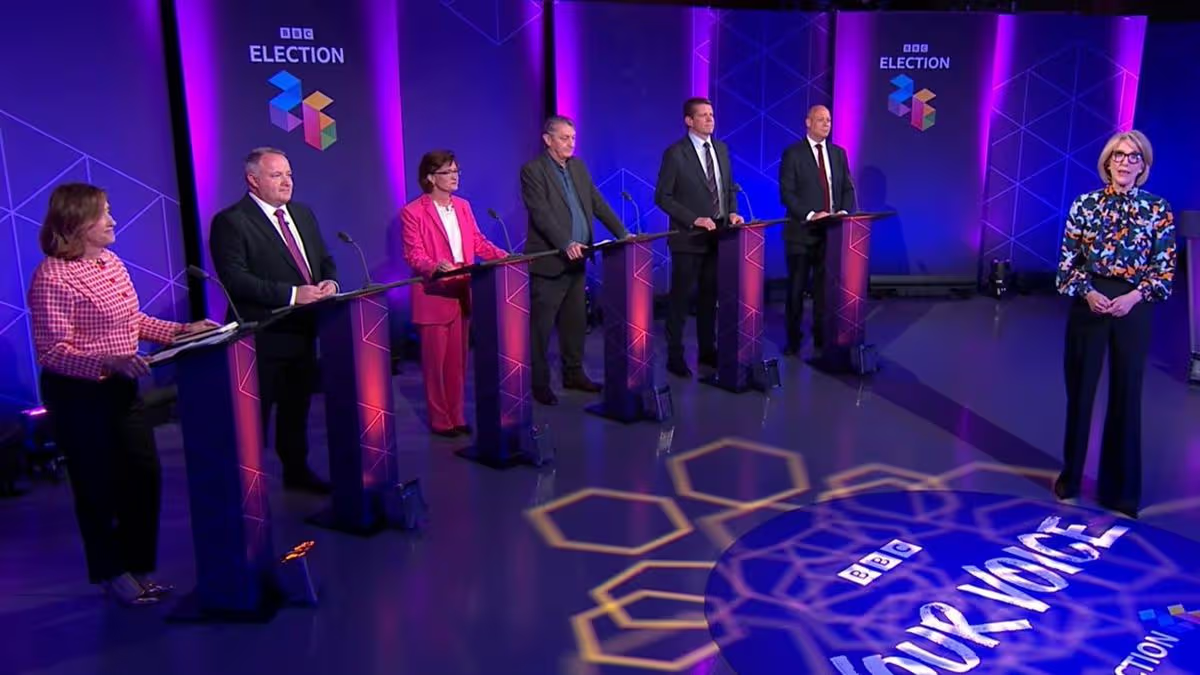
The leaders of the main parties in Wales take part in a BBC debate ahead of the Senedd election(Image: BBC Wales)

Since devolution began twenty seven years ago, Welsh politics has been shaped by Labour’s dominance, even when that dominance has depended on agreements with others.

Whilst some would argue that the result has been a stable political system, waiting lists have grown, the economy has underperformed, housing pressure has intensified, and the same arguments about productivity, poverty, and public services have been rehearsed year after year.

Advertisement

With the polls currently suggesting that no party will secure an overall majority in the Senedd, the country’s future may depend on whether parties can agree on enough specific measures to pass budgets, shape legislation and keep a government in office. Indeed, when you read all six manifestos, there is a suggestion that the parties are much closer than their campaign language suggests.

The biggest issue is health, and every party, from Labour to Reform, begins with the same judgment: that the NHS in Wales is under severe strain and that public confidence has been badly damaged. That matters because, in a Senedd without a majority, health is the obvious ground for agreement.

Labour wants to focus on new hospitals and shorter waiting times, while Plaid Cymru is promising surgical hubs and a stronger link between health and care. The Liberal Democrats want to expand care capacity to relieve pressure on hospitals, and the Conservatives say they would declare a health emergency. Despite agreeing on almost nothing else, Reform and the Greens both argue that urgent intervention is needed.

There are profound differences over how the NHS should be funded, managed and reformed, but there could be enough overlap for an administration to secure backing for a pragmatic programme to cut waiting lists, expand planned care and tackle the indignity of corridor care. In a hung Senedd, that is likely to be the first test of whether politicians can accept that compromise is not weakness if it gets patients treated sooner.

Advertisement

READ MORE: Wales doesn’t need grants but a new approach to IP and innovation that sustains business successREAD MORE: The knowhow built up in Wales’ contact centre sector is an asset worth redirecting

Childcare is one of the few policy areas where there is some agreement, even if they differ on whether expansion should be universal or targeted. Plaid Cymru and the Lib Dems want a universal childcare offer from nine months, whilst the Greens back universal childcare from nine months, and the Conservatives support extending free childcare for children from nine months to four years. Labour has again made childcare expansion one of its main promises.

This is not a minor point, as childcare is increasingly treated as economic infrastructure that helps parents return to work and supports family incomes. If Wales ends up with no party in command, childcare expansion looks like one of the easiest areas for a cross-party deal.

The economy offers a similar, if more limited, opportunity, and no party argues that Wales is performing as it should. Labour wants a new industrial strategy; Plaid and the Conservatives are proposing a National Development Agency; and the Liberal Democrats are talking about changing business rates. Even Reform, for all its populist language, frames its offer around backing business, rewarding work and cutting waste.

Advertisement

That does not amount to a shared economic philosophy, but it does suggest room for agreement on measures such as reforming business rates, improving support for apprenticeships and simplifying business support. Those are not glamorous policies, but they are the sort of interventions a minority government could get through in the next four years.

Housing is more politically divided, but even here, there are points of common agreement. Labour, Plaid Cymru, the Liberal Democrats and the Greens all argue that Wales needs more affordable and social housing, stronger action on homelessness and a bigger state role in fixing a market that is failing too many people. The Welsh Conservatives are more focused on planning reform, whereas Reform places less emphasis on expanding social housing.

So housing is not an issue on which all six parties can meet in the middle, but if the arithmetic points to a centre-left understanding, it is an area where that agreement could become substantial.

Then there is the environment, where Net Zero remains a dividing line, especially with Reform. However, on issues such as river pollution and water quality, there is a much broader consensus than many might expect. Labour, the Liberal Democrats, the Greens, the Conservatives and Reform all promise, in one form or another, tougher action on polluted rivers and sewage discharges, and that ought to be enough to support tougher enforcement.

Advertisement

Tax is the one example where consensus will be hardest to reach. Labour says it will not raise Welsh income tax, whilst the Conservatives and Reform want tax cuts. In contrast, the Liberal Democrats leave the door open to a temporary rise to fund social care, Plaid wants broader tax powers and a more progressive framework, and the Greens want much wider tax reform. That is not a basis for easy agreement, nor are the constitutional questions, with Plaid remaining fundamentally different from those of the Conservatives, Reform and the Liberal Democrats.

What should we conclude from all this? A Senedd without a majority need not mean paralysis, and it is unlikely there will be a grand coalition around a shared view of the country’s future, as the ideological divides are too deep. But it may produce a more negotiated politics in which parties are forced to agree on specific measures in areas where the public is demanding action.

After nearly three decades in which Welsh politics has been shaped by one party’s dominance, such a shift would be significant. The frustration in Wales is not simply that politicians disagree, but that we still face the same problems as we did two decades ago.

If no party has a majority, the next government will be judged not by the elegance of its agreements but by its ability to make the Welsh state work better. Therefore, the real test may not be who comes first on election night, but whether the next Senedd can make difficult compromises that lead to shorter waits, better services and a stronger economy.

Advertisement
Continue Reading
Click to comment

You must be logged in to post a comment Login

Leave a Reply

Business

Rise in Welsh business confidence but below rate for the UK as a whole

Published

on

Business Live

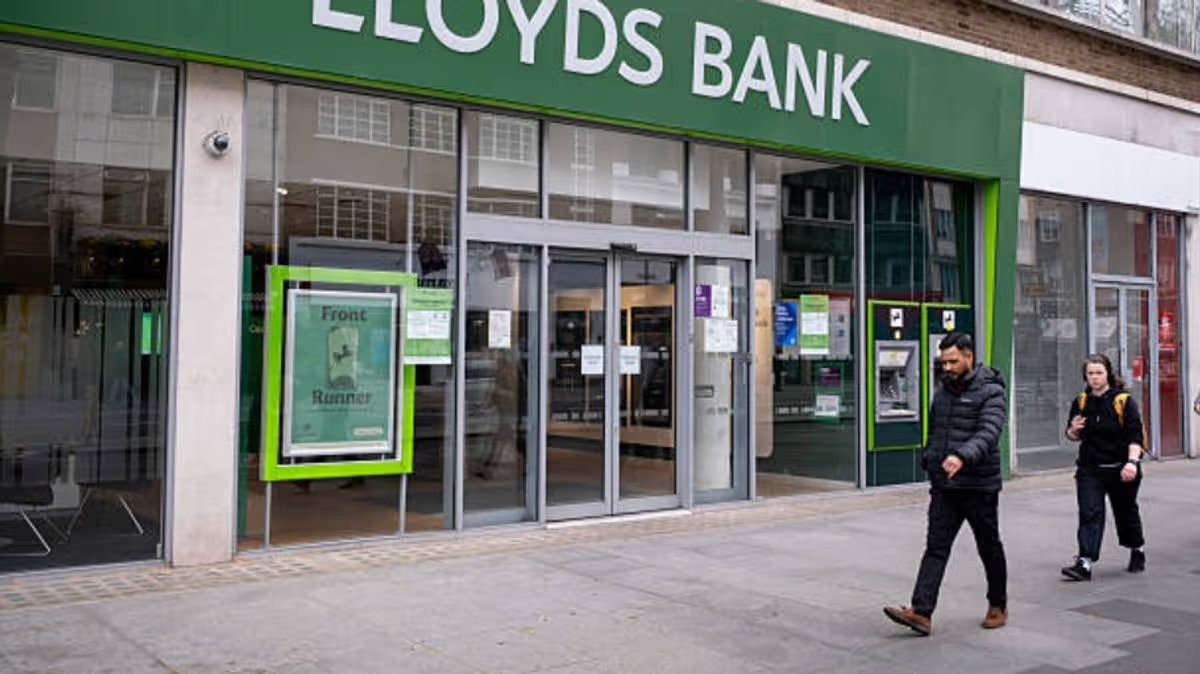
Lloyds has published its latest business barometer for April

Lloyds Bank.

Business confidence in Wales has risen shows latest research from Lloyd Bank. In April companies in Wales reported unchanged confidence in their own trading outlook month-on-month at 46%.

When taken alongside their optimism in the economy, up 16 points to 30%, this gives a headline confidence reading of 38% (30% in March). Anything above zero is positive reading.

Advertisement

According to the bank’s latest business barometer, Wales enjoyed the largest year-on-year confidence growth of all the UK’s nations and regions. It was also the only area to report both year-on-year and month-on-month growth.

A net balance of 34% of businesses in Wales also expect to increase staff levels over the next year, up nine points from last month.

Looking ahead to the next six months, Wales businesses identified their top target areas for growth as investing in their team, for example through training (48%), introducing new technology, such as AI or automation (42%), and evolving their offering, for example by introducing new products or services (40%).

READ MORE: New South Wales to London train service launch dateREAD MORE: Cardiff headquartered bakery group Finsbury Food makes another acquisition

Advertisement

Overall, UK business confidence fell 11 points in April to 44%. Firms’ confidence in their own trading outlook fell six points to 54%, and their optimism in the wider economy dropped 17 points to 33%.

The East Midlands was the most confident UK nation or region in April at 43%, followed by London at 51% and the West Midlands at 49%.

Nathan Morgan, area director for Wales at Lloyds, said: “Wales is bucking the UK-wide trend when it comes to business confidence, increasing during April against the national trend.

“This confidence is the result of Welsh firms’ ongoing focus on investment to protect their position against future disruption. At Lloyds, we’ll continue to nurture this recent momentum of growth by working with businesses across the nation to equip them with the financial tools they need.”

Advertisement

Amanda Murphy, chief executive for Lloyds Business and Commercial Banking said: “Businesses told us their confidence fell as inflation pressures re-emerged, global uncertainty persisted and costs remained elevated. While sentiment declined, it remained above the long-term average, with nearly two-thirds expecting stronger output in the coming year.

“UK businesses are resilient and adept at deploying strategies to defend growth in uncertain conditions. Over the past month, we’ve seen them opt for flexibility wherever possible. They’re building contingency into their short and medium-term plans, rather than expecting a rapid return to normal. Protecting margins has become more important.

“That means tougher cost scrutiny and a greater focus on balancing growth with profitability. “In this environment, as with other recent market disruptions, we continue to observe that sustainable success comes from discipline, resilience and clarity about what really drives long term value.”

Advertisement
Continue Reading

Business

FTI Consulting, Inc. (FCN) Q1 2026 Earnings Call Transcript

Published

on

OneWater Marine Inc. (ONEW) Q1 2026 Earnings Call Transcript

Q1: 2026-04-30 Earnings Summary

EPS of $1.90 misses by $0.17

 | Revenue of $983.35M (9.47% Y/Y) beats by $12.17M

FTI Consulting, Inc. (FCN) Q1 2026 Earnings Call April 30, 2026 9:00 AM EDT

Company Participants

Mollie Hawkes – Head of Marketing, Communications & Investor Relations
Steve Gunby – President, CEO & Chairman
Paul Linton – Chief Strategy and Transformation Officer

Advertisement

Conference Call Participants

Andrew Nicholas – William Blair & Company L.L.C., Research Division
James Yaro – Goldman Sachs Group, Inc., Research Division
Tobey Sommer – Truist Securities, Inc., Research Division

Advertisement

Presentation

Operator

Welcome to the FTI Consulting First Quarter of 2026 Earnings Conference Call. [Operator Instructions] Please also note that this event is being recorded today.

I would now like to turn the conference over to Mollie Hawkes, Head of Investor Relations. Please go ahead.

Advertisement

Mollie Hawkes
Head of Marketing, Communications & Investor Relations

Good morning. Welcome to the FTI Consulting conference call to discuss the company’s first quarter 2026 earnings results as reported this morning. Management will begin with formal remarks, after which they will take your questions.

Before we begin, I would like to remind everyone that this conference call may include forward-looking statements within the meaning of the Private Securities Litigation Reform Act, including the company’s outlook and expectations for the full year 2026 based on management’s current beliefs and expectations. These forward-looking statements involve many risks and uncertainties, assumptions and estimates and other factors that could cause actual results to differ materially from such statements.

Advertisement

For a discussion of risks and other factors that may cause actual results or events to differ from those contemplated by forward-looking statements, investors should review the safe harbor statement in the earnings press release issued this morning, a copy of which is available on our website at www.fticonsulting.com as well as other disclosures under the headings of Risk Factors and forward-looking information in our annual report on Form 10-K for the year ended

Advertisement
Continue Reading

Business

Why is Eli Lilly stock surging today?

Published

on


Why is Eli Lilly stock surging today?

Continue Reading

Business

More documents flagged for Wright, Rhodes, Hancock trial costs calculation

Published

on

More documents flagged for Wright, Rhodes, Hancock trial costs calculation

Costs of a landmark trial over an iron ore empire are yet to be assessed, as lawyers for the mining billionaires continue to disagree in court.

Continue Reading

Business

Is It a Long-Term Buy in 2026 AI Communications Boom?

Published

on

Twilio TWLO Surges 17% on Earnings Beat: Is It a

NEW YORK — Twilio Inc. shares skyrocketed more than 16% in early trading Thursday after the cloud communications company delivered stronger-than-expected first-quarter results and raised guidance, reigniting investor enthusiasm and prompting fresh debate over whether the stock represents a compelling long-term buying opportunity in an artificial intelligence-driven enterprise software landscape.

The customer engagement platform reported revenue of $1.41 billion for the quarter, up 20% year-over-year and beating Wall Street estimates. Non-GAAP earnings per share came in at $1.50, surpassing consensus forecasts by 18%. The strong performance, fueled by AI-powered features and robust enterprise adoption, sent shares to around $173 as analysts raised price targets and reaffirmed buy ratings.

Twilio’s results highlight its successful pivot toward higher-margin cloud services and AI integrations. The company has embedded artificial intelligence capabilities across its portfolio, including conversational AI tools and intelligent routing systems that help businesses improve customer interactions. CEO Jeff Lawson emphasized the platform’s role in helping enterprises leverage AI for personalized engagement while maintaining scalability and security.

Analysts largely view the stock as a moderate to strong buy. The consensus 12-month price target sits around $152 to $200, implying significant upside from current levels despite recent volatility. Firms like Needham, BTIG and Rosenblatt raised targets following the earnings report, citing accelerating growth and margin expansion. The overall analyst rating remains positive, with 21 buys, four holds and two sells among 27 covering firms.

Advertisement

Long-term bulls point to Twilio’s dominant position in the communications platform-as-a-service market. Its APIs power messaging, voice and video for thousands of companies, from startups to Fortune 500 giants. The shift to cloud has improved predictability, while AI features are driving higher usage and retention. Revenue growth has compounded at healthy rates, with operating margins expanding as the business matures. Cash flow generation supports further investment and potential shareholder returns.

The company’s $8.8 billion cash position provides substantial flexibility for acquisitions, R&D or capital returns. Management has guided for continued double-digit growth, with optimism around AI monetization. Enterprise adoption of Twilio’s platform has accelerated as businesses seek to modernize customer engagement strategies in a digital-first world.

Skeptics highlight valuation risks and competitive pressures. Twilio trades at a premium multiple, and growth may moderate if economic conditions weaken enterprise spending. Rivals like Amazon Web Services, Microsoft and smaller specialists continue innovating, potentially eroding market share. Past execution challenges, including slower migrations and restructuring, have caused volatility that could return if guidance disappoints in future quarters.

The stock’s recent surge follows a period of underperformance earlier in 2026, when broader tech sector concerns weighed on growth names. The earnings beat has shifted sentiment, with some models projecting fair value well above current levels based on discounted cash flow assumptions. Cash flow yield remains attractive relative to peers, supporting a constructive outlook for patient investors.

Advertisement

Twilio’s story is one of adaptation in a rapidly evolving industry. Founded in 2008, the company pioneered cloud communications and has evolved into a comprehensive customer engagement platform. Its focus on developer-friendly APIs has built a loyal user base while opening doors to larger enterprise deals. The integration of AI tools positions it at the forefront of conversational commerce and automated support systems.

For long-term investors, key considerations include execution on AI initiatives and capital allocation. Successful monetization of AI features could accelerate revenue growth and margins, while disciplined spending will be crucial in a competitive environment. The company’s strong balance sheet reduces near-term risks, but sustained profitability and free cash flow growth will determine whether current valuations prove justified.

Risks include macroeconomic slowdowns that delay IT budgets, regulatory changes affecting data privacy and potential customer concentration. The stock’s history of volatility requires a high tolerance for drawdowns. Those considering a position should view it as a multi-year holding and diversify appropriately within the technology sector.

Analysts at firms tracking Twilio project continued expansion, with some forecasting revenue growth near 20% annually through the end of the decade under optimistic scenarios. The median price target implies meaningful upside, though individual forecasts range widely based on AI adoption assumptions. The consensus remains constructive, reflecting confidence in Twilio’s strategic direction.

Advertisement

As Twilio navigates its next phase, the market will closely monitor quarterly metrics on cloud migration, AI usage and customer retention. The latest earnings have provided a positive catalyst, but sustained execution will be required to justify premium valuations. For growth-oriented investors comfortable with software sector dynamics, Twilio warrants consideration as a long-term holding with significant potential in the AI communications space.

Continue Reading

Business

Grupo Bimbo raises guidance after strong first quarter

Published

on

Grupo Bimbo raises guidance after strong first quarter

North America business beats company’s expectations.

Continue Reading

Business

BGT: The 13% Dividend Yield Is Not Supported By Earnings (NYSE:BGT)

Published

on

BGT: The 13% Dividend Yield Is Not Supported By Earnings (NYSE:BGT)

This article was written by

Financial analyst by day and a seasoned investor by passion, I’ve been involved in the world of investing for over 15 years and honed my skills in analyzing lucrative opportunities within the market.I specialize in uncovering high quality dividend stocks and other assets that offer potential for long term-growth that pack a serious punch for bill-paying potential. I use myself as an example that with a solid base of classic dividend growth stocks, sprinkling in some Business Development Companies, REITs, and Closed End Funds can be a highly efficient way to boost your investment income while still capturing a total return that follows traditional index funds. I created a hybrid system between growth and income and manage to still capture a total return that is on par with the S&P.

Analyst’s Disclosure: I/we have no stock, option or similar derivative position in any of the companies mentioned, and no plans to initiate any such positions within the next 72 hours. I wrote this article myself, and it expresses my own opinions. I am not receiving compensation for it (other than from Seeking Alpha). I have no business relationship with any company whose stock is mentioned in this article.

Seeking Alpha’s Disclosure: Past performance is no guarantee of future results. No recommendation or advice is being given as to whether any investment is suitable for a particular investor. Any views or opinions expressed above may not reflect those of Seeking Alpha as a whole. Seeking Alpha is not a licensed securities dealer, broker or US investment adviser or investment bank. Our analysts are third party authors that include both professional investors and individual investors who may not be licensed or certified by any institute or regulatory body.

Advertisement
Continue Reading

Business

Trump Lifts US Whisky Tariffs After King Charles State Visit

Published

on

Britain's distillers have been handed an unexpected fillip after Donald Trump announced the removal of all US tariffs and restrictions on whisky imports, a concession the president attributed directly to the influence of King Charles and Queen Camilla's four-day state visit to America.

Britain’s distillers have been handed an unexpected fillip after Donald Trump announced the removal of all US tariffs and restrictions on whisky imports, a concession the president attributed directly to the influence of King Charles and Queen Camilla’s four-day state visit to America.

The decision, revealed on Trump’s Truth Social platform shortly after the royal couple departed for the UK, brings to an end a punishing 10 per cent levy that the Scotch Whisky Association estimates has been costing the industry roughly £4m a week, some £150m over the past year, at a time when distillers were already bracing for a further 25 per cent charge on single malts due to return this spring.

For an industry that counts the United States as its largest export market, with shipments worth close to £1bn annually, the timing could scarcely have been more welcome. Trump told reporters in Washington that the King and Queen “got me to do something that nobody else was able to do, without hardly even asking”, adding that he had moved “in honour” of his royal guests.

Buckingham Palace responded with characteristic understatement. A spokesperson said the King had conveyed his “sincere gratitude” to the president and would be “raising a dram to the President’s thoughtfulness”.

The decision also unlocks renewed commercial co-operation between Scotland and the Commonwealth of Kentucky, two regions historically intertwined through the trade in used bourbon barrels. The Scotch industry imports roughly £200m-worth of these casks from Kentucky each year, using them to mature its single malts and blends. Trump noted the linkage explicitly, describing both as “very important industries” in their respective territories.

Advertisement

Graeme Littlejohn, director of strategy at the Scotch Whisky Association, told Business Matters the industry was “delighted” by the move. “Distillers will breathe a sigh of relief now that these tariffs are off,” he said. “It’s really thanks to the huge amount of negotiation that’s been going on over many months, at a very senior level. Perhaps the state visit has been the catalyst for getting this over the line, and the King’s added that little bit of royal sparkle to make the deal work.”

Scotland’s First Minister, John Swinney, hailed the announcement as “tremendous news for Scotland”, noting that “millions of pounds were being lost every month from the Scottish economy” under the previous regime. He paid particular tribute to the monarch’s behind-the-scenes role.

The UK government confirmed that the removal applies to all whisky tariffs, including those affecting Irish whiskey producers, a clarification that will be welcomed by distillers on both sides of the Irish Sea. Peter Kyle, the Business and Trade Secretary, called the breakthrough “great news for our Scotch whisky industry, which is worth almost £1bn in exports and supports thousands of jobs across the UK”.

For SMEs across the sector, from craft distillers in Speyside to family-run bottlers in the Highlands and Islands, the lifting of tariffs offers a tangible reprieve. Single malts, which command premium prices in the American market, have been disproportionately affected by the Trump-era levies, and smaller producers without the balance-sheet depth of multinational rivals have felt the squeeze most acutely.

Advertisement

The development represents a rare instance of soft power translating directly into hard economic gain. Whether it heralds a broader thaw in transatlantic trade relations remains to be seen, but for an industry that has spent the better part of a year absorbing the costs of protectionism, the immediate message is clear: the dram is back on.


Jamie Young

Jamie Young

Jamie is Senior Reporter at Business Matters, bringing over a decade of experience in UK SME business reporting.
Jamie holds a degree in Business Administration and regularly participates in industry conferences and workshops.

When not reporting on the latest business developments, Jamie is passionate about mentoring up-and-coming journalists and entrepreneurs to inspire the next generation of business leaders.

Advertisement
Continue Reading

Business

Form 13G abrdn Income Credit Strategies Fund For: 1 May

Published

on


Form 13G abrdn Income Credit Strategies Fund For: 1 May

Continue Reading

Business

Form 13G Wolfspeed For: 1 May

Published

on


Form 13G Wolfspeed For: 1 May

Continue Reading

Trending

Copyright © 2025