
Crypto World
Pi Network launches Protocol 23 on May 11



Pi Network has set May 11 as the activation date for Protocol 23, the upgrade that introduces full smart contract functionality to the Pi blockchain and transforms the network from a mobile mining project into a programmable platform capable of supporting DeFi applications and real-world asset tokenisation.
Summary
- Pi Network Protocol 23 lands on May 11, moved one week earlier from the previously announced May 18 date, four days after co-founders Dr. Chengdiao Fan and Nicolas Kokkalis speak at Consensus 2026 in Miami.
- Protocol 23 enables developers to build decentralised exchanges, lending protocols, automated tools, and tokenised asset products on Pi for the first time, completing the transformation Protocol 22 began on April 27.
- The network currently has 421,000 active Mainnet nodes, over 10 billion PI migrated to Mainnet, and a market cap of approximately $1.73 billion as of late April 2026.
Pi Network confirmed May 11 as the Protocol 23 activation date, following the completion of the mandatory Protocol 22 upgrade on April 27. CoinMarketCap confirmed that Protocol 23 was moved forward from May 18 to May 11 as part of Pi’s accelerated upgrade cycle, timed to land shortly after the Consensus 2026 conference in Miami where both co-founders are scheduled to speak on May 6 and May 7.
As crypto.news reported, Pi Network is an official sponsor of Consensus 2026, with co-founder Dr. Chengdiao Fan speaking May 6 on aligning Web3, AI, and blockchain for utility, and co-founder Nicolas Kokkalis joining a May 7 panel titled “How to Prove You’re Human in an AI World (Without Doxing Yourself).” Protocol 23’s May 11 date creates a tight strategic sequence: public stage appearance at Consensus on May 6 and 7, followed four days later by the most consequential technical upgrade in Pi’s seven-year history. Protocol 22 removed all non-compliant nodes that had failed to upgrade, enforcing network synchronisation and establishing the stable base required for smart contract execution. Protocol 23 builds on that foundation by enabling developers to write and deploy programmable contracts directly on Pi’s Mainnet, unlocking decentralised applications, token launches via the Pi Launchpad, a native decentralised exchange, and real-world asset tokenisation.
As crypto.news tracked, the Protocol 22 deadline on April 27 disconnected non-compliant nodes and moved the network to Stellar Core 22 under software version 0.5.4, the prerequisite for the smart contract infrastructure Protocol 23 introduces. Pi competes in the proof-of-personhood space with Worldcoin and Humanity Protocol, and the Consensus appearance positions Protocol 23 as part of a broader AI-era identity and programmable finance argument rather than a standalone technical release.



Coinglass data show Ethereum longs face about $874m in liquidations below $2,206, while shorts risk roughly $403m above $2,412, creating two key forced‑flow bands.
Summary
- Coinglass data show that if Ethereum’s price drops below $2,206, cumulative long liquidations across major centralized exchanges would reach about $874 million.
- On the upside, a clean break above $2,412 would flip pressure onto shorts, with roughly $403 million in cumulative short liquidations triggered on mainstream CEXs at that level.
- These bands mark two key liquidation “walls” where concentrated leverage could turn a 5%–6% move in spot ETH into a much larger derivatives-driven cascade in either direction.
Derivatives analytics platform Coinglass is flagging fresh stress points on Ethereum’s futures liquidation heatmap, with hundreds of millions of dollars in leverage stacked just above and below current prices.
Coinglass heatmap flags ETH’s next forced‑flow zones
According to the latest heatmap bands, if ETH slides under roughly $2,206, the cumulative notional value of long positions queued for forced closure on leading centralized exchanges would reach about $874 million.
Conversely, if ETH breaks convincingly above around $2,412, Coinglass estimates that shorts worth roughly $403 million would be pushed into liquidation, as margin requirements are breached and exchanges auto-close positions.
Coinglass explains in its ETH liquidation documentation that the heatmap aggregates open leveraged long and short positions by price band and shows where liquidations are most likely to cluster, turning those zones into de facto “trapdoors” or “ceiling panels” for the market.
Why these levels matter for ETH traders
Liquidations are mechanically simple but systemically important: when price crosses a band with heavy leverage, exchanges sell (for over‑levered longs) or buy (for over‑levered shorts) into the move, often accelerating the initial direction.
As MEXC noted in a recent analysis of a similar setup near $2,000, nearly $1.8 billion in ETH leverage concentrated in a narrow range turned a modest spot move into a near‑vertical “liquidation wick” as long and short positions were flushed in quick succession.
In the current configuration, a break below $2,206 could unleash roughly twice as much forced selling from longs as the buy‑side pressure shorts would face above $2,412, suggesting downside de‑leveraging may be more violent unless positioning shifts.
For active traders, these bands often become reference points for stop‑loss placement and position sizing: trading into a heavy liquidation wall without a plan risks getting caught in a cascade, while waiting for those zones to clear can offer cleaner entries once excess leverage has been washed out.
Options desks and basis traders also watch the heatmap closely, since large liquidation events can briefly blow out implied volatility and funding rates, creating opportunities to sell rich options or capture dislocated spreads—provided they are positioned with enough cushion to survive the initial shock.


Summary
- HyperInsight data show Huang Licheng has boosted his Bitcoin long to about $14.5 million with more than 40x leverage, opening around $76,357 and facing liquidation near $72,904.5.
- He is also running a 25x leveraged Ethereum long worth roughly $23.3 million, with an average entry price of $2,311.63 and a liquidation level at $2,202.7.
- The positions, taken on derivatives venue Hyperliquid, put tens of millions of dollars in notional exposure at risk if BTC and ETH see even mid‑single‑digit pullbacks from current levels.
According to monitoring shared by on‑chain and derivatives tracker HyperInsight, high‑profile trader Huang Licheng has sharply increased his Bitcoin long exposure, pushing his total BTC long position to around $14.5 million with more than 40x leverage.
HyperInsight flags fresh BTC and ETH leverage from Huang Licheng
The data indicate an average opening price near $76,357, with a liquidation price at approximately $72,904.5, implying that a drawdown of roughly 4.5%–5% from entry would be enough to wipe out his margin and trigger forced closure on the position.
HyperInsight and related feeds have consistently tracked Huang’s activity on the Hyperliquid platform in recent weeks, noting that he has repeatedly used 40x BTC leverage, sometimes seeing unrealized drawdowns north of 60% on earlier attempts when volatility spiked.
25x ETH long adds another $23.3m in risk
Alongside the Bitcoin (BTC) bet, Huang is also running a large 25x leveraged Ethereum long, now worth roughly $23.3 million.
Per the latest HyperInsight snapshot, that position was opened around $2,311.63 with a liquidation threshold near $2,202.7, giving him barely a 4.7% buffer before the trade is forcibly closed if price moves against him.
Previous reports from PANews and Phemex showed Huang steadily ramping his ETH exposure over March and April, at times holding thousands of ETH in 25x longs with liquidation bands just a few percentage points below spot.
More recently, Phemex highlighted that he had placed sizable profit‑taking orders between $2,365 and $2,425 while running what it described as the largest ETH long on Hyperliquid, valued around $32.8 million at 25x leverage.
A leveraged book that can move—and be moved by—the market
In mid‑April, Phemex estimated Huang’s combined BTC and HYPE positions alone at over $56.5 million in notional value, with additional tens of millions of dollars tied up in ETH longs.
A later breakdown from PANews pegged his outstanding longs at roughly $79.16 million, split between about 555 BTC (around $42.76 million), 15,600 ETH (about $35.85 million), and a smaller HYPE allocation—illustrating the scale at which he is willing to deploy leverage across majors and smaller caps.
Such concentrated, high‑leverage positioning matters for other traders because it creates both a potential source of forced flow—if BTC or ETH touch his liquidation levels—and a sentiment signal, given Huang’s track record of stringing together profitable trades when momentum is with him.
For risk‑managed participants, the takeaway is straightforward: when prominent accounts are running 25x–40x leverage with liquidation bands just a few percent away, even relatively routine price swings can cascade into outsized liquidations, temporarily amplifying volatility on venues like Hyperliquid and beyond.

XRP is trading at the $1.40 level again after failing to break the $1.50 ceiling last month, and somehow, that’s the bullish part of the story. Social sentiment just hit its second-highest reading in two years, driven by Rakuten Wallet’s full-scale XRP integration. So what is our XRP price prediction for next week?
Starting today, @Rakuten_Wallet users in Japan can convert @Rakuten Points into XRP, spot trade in-app, and spend across 5M+ merchant locations. — RippleX (@RippleXDev) April 30, 2026

With 44 million Rakuten Pay users and $23B in loyalty points now redeemable for XRP, this is one of the largest retail deployments… pic.twitter.com/P7I52bGjVL
Santiment data clocked a positive-to-negative comment ratio of 4.8, near historic highs for the token. Rakuten Wallet’s deployment also enables 44 million users to convert loyalty points into XRP and spend at more than 5 million merchants.
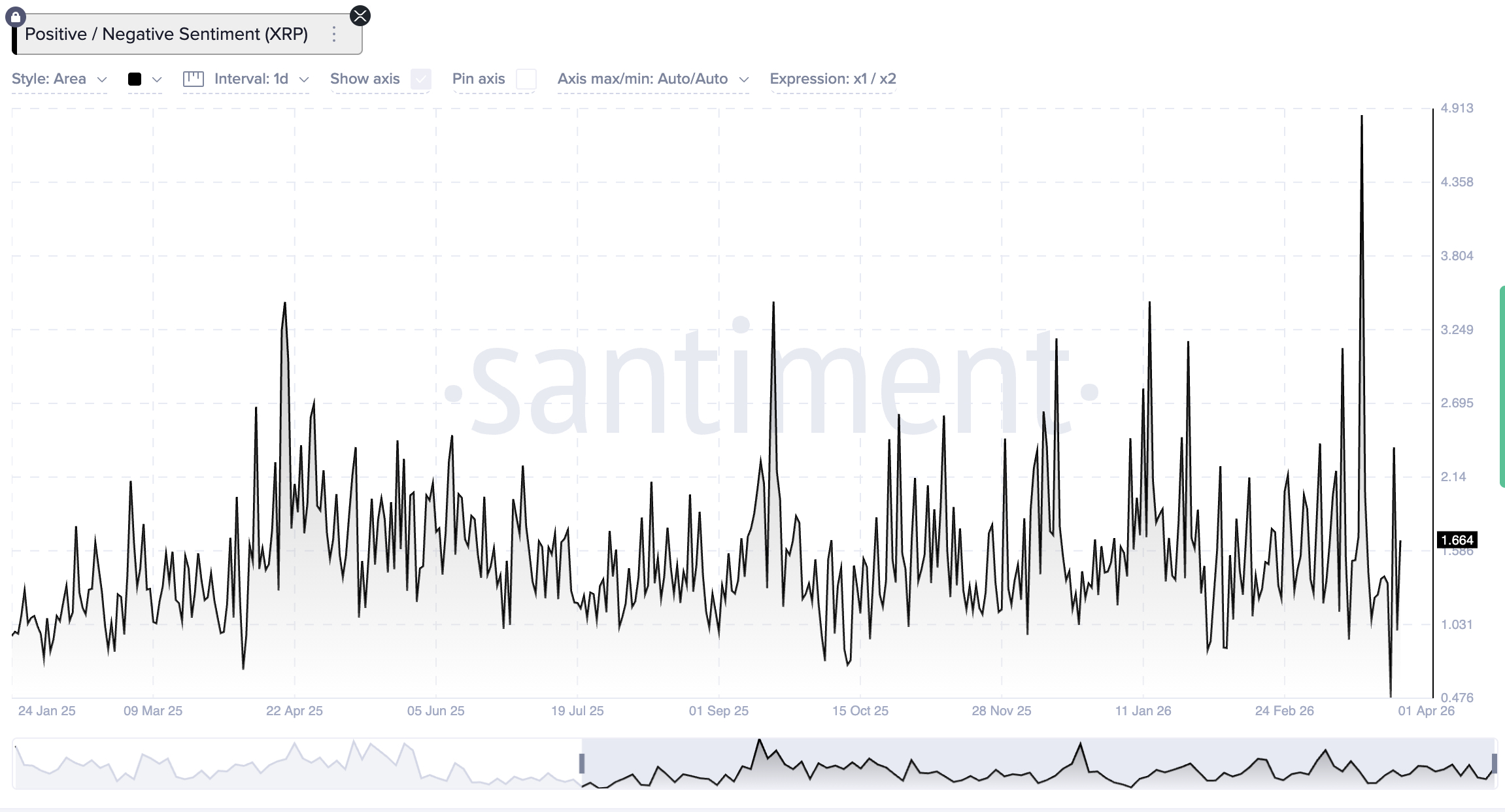
Rakuten also launched a tiered reward campaign with bonuses on purchases of 30,000 yen or more, a lottery for 100,000-yen-plus buyers, and a pending iOS rollout. It’s a $23 billion loyalty ecosystem deploying XRP at a consumer scale.
Discover: The best pre-launch token sales
XRP Price Prediction: Break $1.50 Resistance and Target $5?
XRP recently tapped a local high of $1.44 before stalling, and that level now represents the immediate ceiling. A leverage flush followed the rejection, a signal that speculative positioning outpaced organic demand.
The price itself is now consolidating below both its 60-day and 200-day moving averages, a structurally bearish configuration that complicates the bullish narrative.
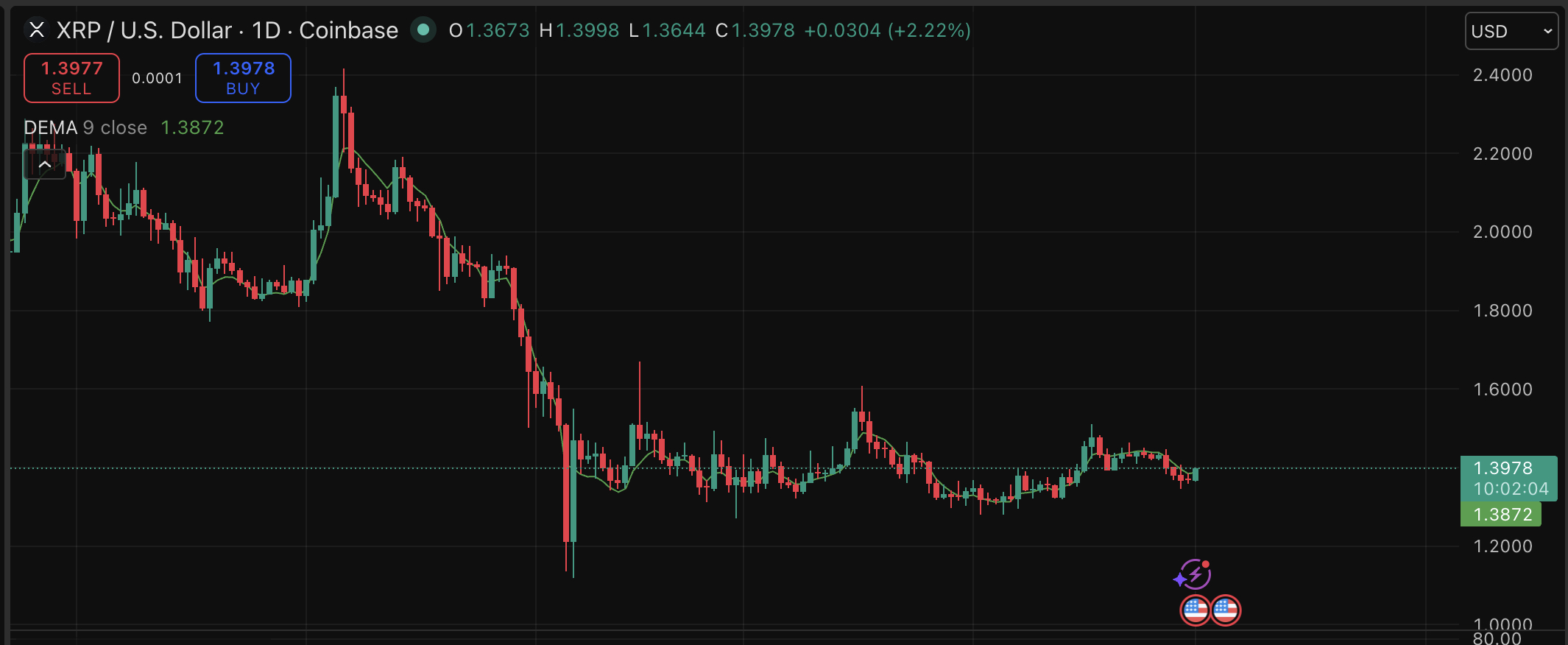
The technical picture is, frankly, a contradiction. Aggregate signals show a “Strong Buy” reading across 6 indicators (5 buy, 1 sell), yet the price has declined nearly 55% over the past nine months. Sentiment spikes historically precede short-term stabilization rather than immediate rallies as the FOMO builds before conviction does.
Ripple’s adoption narrative remains intact, but price discovery requires a sentiment ratio. Volume confirmation is the missing ingredient.
Discover: The best crypto to diversify your portfolio with
LiquidChain Targets Early Mover Upside as XRP Tests Key Levels
XRP’s current setup of strong narrative, muted price response, and overhead resistance is the kind of environment that pushes capital toward earlier-stage opportunities with higher asymmetric potential. When the blue-chip thesis stalls, the search for the next leg of upside moves down the risk curve. That’s where LiquidChain enters the picture.
LiquidChain ($LIQUID) is a Layer 3 infrastructure project that fuses Bitcoin, Ethereum, and Solana liquidity into a single execution environment, a cross-chain liquidity layer targeting the fragmentation problem that plagues DeFi.
The Order and the LiquidChain L3 have one thing in common.
They're both ready for anything.⟁https://t.co/vqvBcdSQYC pic.twitter.com/eHoGD2wtG0
— LiquidChain (@getliquidchain) May 1, 2026
With Liquid, developers can deploy once and access all three ecosystems simultaneously. The presale is currently priced at $0.01455, with more than $700K raised to date.
Key features include a Unified Liquidity Layer, Single-Step Execution, Verifiable Settlement, and Deploy-Once Architecture.
For those tracking the cross-chain narrative, research LiquidChain here.
The post XRP Price Prediction: Rakuten Integration Sends Sentiment to 2-Year High appeared first on Cryptonews.


Bitcoin price rose nearly 3% to $78,700 on May 1 as Iran submitted a new peace proposal through Pakistani mediators to the United States, easing oil pressure and improving risk sentiment across global markets for the second time in a week.
Summary
- Bitcoin price climbed to $78,700 on May 1, recovering from a multi-week low near $74,900 posted just two days earlier when Trump received a military briefing on new Iran strike options.
- Iran submitted a revised peace proposal through Pakistani mediators on May 1, CNBC reported, with oil prices edging lower on the development as Strait of Hormuz supply concerns partially eased.
- 21Shares chief market strategist Adrian Fritz said $80,000 is “quite a resistance” and that a confident break above it “could spark some momentum” as recent buyers return to profit.
Bitcoin price was trading at $78,722 on May 1, extending gains as US markets opened. CNBC reported that Iran sent an updated peace proposal to mediators in Pakistan, the latest diplomatic signal in a weeks-long negotiation over ceasefire terms, sanctions relief, and control of the Strait of Hormuz. Oil prices edged lower on the development, releasing pressure from one of the primary macro headwinds that had weighed on crypto and equities all week.
As crypto.news reported, Iran’s expected submission of a revised proposal compresses the “war premium” baked into oil markets and is modestly supportive for risk assets, but keeps Bitcoin hostage to headline volatility until a concrete deal is signed. The move from $74,900 on April 29 to $78,700 on May 1 retraced nearly the entire post-FOMC selloff, driven by the same diplomatic signal dynamic that produced every Bitcoin recovery during the conflict. “I think $80,000 is quite a resistance. We need a confident push through that level,” said 21Shares chief market strategist Adrian Fritz. “Once we’re above that, it could spark some momentum. People are back in profit, especially the ones that invested more recently.” Fritz added that a move above $85,000 could signal the first signs of a broader reversal.
As crypto.news documented, Bitcoin reached $78,400 during the prior week before being rejected sharply when hostilities resumed, establishing a clear pattern: every credible diplomatic signal produces a fast BTC repricing, and every breakdown reverses it within hours. As crypto.news tracked, hopes of a broader US-Iran deal have consistently fuelled bets on a BTC retest of $80,000 if ETF inflows resume and oil drops back toward pre-war levels. The $80,000 level has now been tested and rejected twice in 2026, making a decisive break above it, confirmed by sustained ETF inflows and stable oil, the clearest signal that the Iran-driven macro overhang on Bitcoin has meaningfully lifted.


Blockstream CEO Adam Back positioned Bitcoin treasury companies as arbitrage plays between the current fiat financial system and a future where BTC dominates global economics.
His statement adds intellectual weight to Strategy’s aggressive Bitcoin accumulation strategy and similar corporate initiatives gaining momentum.
Bitcoin Treasury as Arbitrage Play
Adam Back’s framing is elegant.
He calls Bitcoin treasury companies an “arbitrage between the fiat present and the hyperbitcoinized future.”
This means firms buying the cryptocurrency today at current prices benefit from two forces. First, BTC adoption accelerates. Second, fiat currencies depreciate through inflation or policy mistakes. The gap between these two outcomes creates substantial upside for early accumulators.
Back’s thesis suggests that companies holding Bitcoin position themselves as asymmetric bets on systemic transition rather than conventional equity plays.
The Financial Path to Hyperbitcoinization
Back’s argument rests on the currency eventually becoming the dominant global store of value. In this future, Bitcoin serves as the reserve asset backing international commerce and national treasuries.
Companies that accumulated BTC before this transition would benefit enormously. Their holdings would appreciate not just through price increases but also through the adoption of Bitcoin, which would increase its utility and acceptance.
This vision parallels Michael Saylor’s endgame prediction that Bitcoin reaches $10 million per coin through digital credit flows and institutional adoption.
Back’s bullish narrative faces serious skepticism. Peter Schiff has called Strategy’s Bitcoin strategy fundamentally flawed, arguing that rising dividend obligations will force liquidations before hyperbitcoinization arrives.
Schiff warns that the cryptocurrency could decline sharply if macro conditions deteriorate, making current accumulation economically irrational.
However, Eric Trump recently predicted Bitcoin would reach $1 million, signaling the Trump family’s confidence in its upside potential despite near-term volatility.
Bitcoin Treasury Companies Multiply
Back’s framework helps explain why public companies are aggressively raising capital to acquire BTC. If the hyperbitcoinization thesis proves correct, early accumulators capture enormous value.
Strategy leads this trend with 815,061 Bitcoin holdings worth $63.46 billion. Other companies are considering similar strategies, creating competitive pressure to accumulate while BTC remains relatively undervalued.
The arbitrage thesis suggests that hesitation to accumulate BTC today could prove costly if hyperbitcoinization accelerates faster than currently modeled.
Adam Back’s arbitrage framing provides intellectual scaffolding for BTC treasury strategies. Rather than viewing Bitcoin as speculative, Back positions it as a rational hedge against fiat system failure.
Whether this arbitrage thesis proves correct depends on adoption accelerating and fiat systems facing genuine stress. For now, companies betting on hyperbitcoinization are making convex bets with asymmetric upside and limited downside from current valuations.
The post Blockstream CEO Predicts Hyperbitcoinized Future for Bitcoin appeared first on BeInCrypto.


Ripple CEO Brad Garlinghouse declared at XRP Las Vegas that the CLARITY Act will pass by the end of May, his third public deadline for the bill after predicting 80% odds of April passage on Fox Business in February and revising to May at two successive industry events.
Summary
- Garlinghouse first gave 80% odds of April passage on Fox Business on February 19, revised to end of May at the FII Priority Miami Summit on March 27, and reaffirmed end of May at the Semafor World Economy Summit on April 13.
- He says the stablecoin yield dispute that paralysed the bill since January is close to resolution, and that the current level of frustration in Washington is historically the signal that compromises finally get made.
- Senator Thom Tillis confirmed he will ask Banking Committee Chairman Tim Scott to schedule a markup when the Senate returns May 11, with the earliest realistic date for a committee vote also the week of May 11.
Brad Garlinghouse confirmed his end-of-May CLARITY Act timeline at XRP Las Vegas on April 30, three months after first placing an 80% probability on April passage during a Fox Business appearance. Disruption Banking reported that Garlinghouse is betting the bill clears the Senate Banking Committee, passes the Senate floor, and reaches Trump’s desk before the Memorial Day recess on May 21. “When people are at their peak of frustration, that’s when they finally compromise, and it gets done. I think we’re there,” Garlinghouse said.
As crypto.news reported, the 2030 cliff is not Garlinghouse’s framing alone — Senator Cynthia Lummis posted on X in April that this is “our last chance to pass the Clarity Act until at least 2030.” Senator Bernie Moreno has said the same more directly. Both senators framed the window as uniquely narrow because the current tri-branch alignment of House, Senate, and White House on crypto legislation is rare and may not survive a midterm election. Garlinghouse’s revisions are not contradictions. As the bill has missed successive deadlines, its support has grown. The coalition backing the bill has expanded to over 120 firms including Ripple, Coinbase, Kraken, and Andreessen Horowitz. As crypto.news documented, those firms sent a joint letter demanding an immediate markup on April 23.
The stablecoin yield dispute that blocked the bill since January — a fight over whether third-party platforms can offer rewards on stablecoin balances — is described by Garlinghouse as largely resolved following the White House CEA’s report finding a full yield ban would cost consumers $800 million annually. What remains is a calendar problem: the Senate returns May 11, the Memorial Day recess begins May 21, and Chairman Tim Scott has not yet put a markup date on the calendar. As crypto.news tracked, Polymarket prices 2026 passage at approximately 46%, Galaxy Research at 50-50, and TD Cowen at one-in-three — making Garlinghouse’s end-of-May prediction a notable outlier against market consensus.

TLDR:
- Litecoin developers fixed the MWEB issue quickly after a 13-block reorg, restoring network confidence.
- Spot ETF filings from Grayscale and CoinShares boosted Litecoin’s institutional market relevance.
- Bollinger Bands reached multi-year compression levels, signaling a likely volatility expansion soon.
- Litecoin continues processing a large share of crypto payments, supporting its real-world utility case.
Litecoin price prediction enters a critical phase as LTC trades at $55.53, posting a 0.81% daily gain while still down 2.09% weekly.
Trading volume stands at $311.7M, reflecting steady participation amid ETF filings, MWEB recovery progress, and tightening volatility conditions signaling an approaching directional move.
ETF filings and network recovery improve Litecoin outlook
Litecoin price prediction is gaining momentum after recent institutional developments placed the asset back in focus.
Spot ETF filings from Grayscale and CoinShares have renewed discussions around Litecoin’s position in the regulated digital asset market.
These filings matter because Litecoin is increasingly viewed as a commodity-like asset. Its decentralized structure and long operating history reduce the legal uncertainty often attached to alternative cryptocurrencies. Reports suggesting a strong probability of approval have added to this renewed optimism.
If approved, a spot Litecoin ETF could open the asset to passive investment flows. Institutional demand would likely increase through custodial products, portfolio exposure, and arbitrage opportunities linked to regulated trading vehicles.
Litecoin does not need to outperform larger assets to benefit from this shift. Inclusion alone may be enough to attract new liquidity.
At the same time, Litecoin developers recently resolved a technical issue involving MimbleWimble Extension Blocks. The bug had caused a 13-block reorganization, creating short-term concerns across the network.
The response from developers was swift. A patch was deployed quickly, restoring operational stability while preserving Litecoin’s optional privacy functionality. This reduced the risk of prolonged uncertainty and reinforced Litecoin’s reputation for dependable network maintenance.
A market update shared by SeniorDeFi described Litecoin as an asset that has consistently survived market cycles. The post noted that Litecoin performs well when speculative capital rotates away from high-volatility altcoins.
Bollinger Band squeeze hints at a major Litecoin move
Technical analysts are now closely watching Litecoin’s volatility setup. Daily Bollinger Bands have compressed to levels not seen since 2017, signaling that a major move may be approaching.
This pattern reflects a period where price volatility has declined significantly. Buyers and sellers are currently in temporary balance, often creating conditions for a strong breakout or breakdown. The squeeze itself does not predict direction, but it usually signals magnitude.
Litecoin has been trading near the mid-$50 range after recovering from prolonged downside pressure. This sideways structure suggests the market is stabilizing while traders build positions.
Analyst Minimilian noted in a recent tweet that Litecoin is showing “compressed energy” on the daily chart. Such low-volatility phases rarely last long, especially when combined with improving fundamentals.
A confirmed breakout would likely require a strong daily close above resistance with rising volume. Until then, Litecoin remains in accumulation mode.
Litecoin price prediction now reflects a market balancing technical stability, institutional access potential, and growing utility. With volatility compressed and ETF speculation rising, traders are watching closely for the next decisive move.

TLDR:
- Bitcoin’s April closing shows increased demand recovery after Q1 losses and improved monthly structure across markets
- April strength suggests renewed spot buying, with reduced volatility compared to earlier bearish months in the 2026 cycle
- May trading history remains mixed, with outcomes driven more by liquidity shifts than consistent seasonal direction patterns
- Market focus shifts to whether higher lows and volume stability sustain momentum into early May trading sessions ahead
Bitcoin April closing +11.87% signals a shift in monthly momentum after early-year weakness, as traders assess whether recovery strength can extend into May while broader crypto markets respond to improving structure and renewed spot demand across major exchanges now conditions.
Market structure after Bitcoin April closing +11.87%
Bitcoin’s April closing +11.87% reflects a shift in monthly positioning after a weak Q1 phase, where repeated drawdowns shaped cautious sentiment across derivatives markets.
Price action into the April close showed steadier demand on higher timeframes, with reduced downside volatility compared to earlier months.
Market participants observed improved structure on weekly charts, where successive higher lows began forming ahead of the monthly settlement across spot and futures markets.
Liquidity conditions during April showed gradual stabilization, with trading volumes recovering across major exchanges. Spot market participation increased during late-month sessions, aligning with reduced sell pressure from short-term holders.
Derivatives positioning also adjusted, as funding rates normalized after earlier volatility spikes. This environment contributed to smoother price discovery, with fewer abrupt intraday reversals compared to prior months of 2026.
This is across both spot and derivatives segments into the month-end trading conditions. Market structure now depends on whether higher lows persist into early May trading sessions.
Traders are monitoring support retention near previous breakout zones. If price stability continues, momentum conditions may extend beyond monthly transition periods.
However, failure to hold structure often results in consolidation phases, where range-bound trading dominates before directional expansion resumes across broader crypto market cycles.
Into the May period, analysis continuation conditions remain closely monitored at the current levels observed
May outlook following Bitcoin April closing +11.87%
Historical market behavior shows May trading often diverges from April trends, even after strong monthly closes. Bitcoin’s April closing +11.87% positions the asset within a recovery phase, yet May outcomes remain dependent on liquidity flow and trader positioning.
Past cycles recorded both sharp rallies and sudden retracements, making directional bias less consistent compared to other months in the annual calendar across historical market data sets observed.
In addition, Ethereum price movement during the same period aligned with broader recovery conditions, adding context to cross-asset performance trends. April gains in both major assets reflected improved sentiment across spot markets.
However, correlation between assets does not guarantee identical May performance, as each market reacts differently to liquidity changes and positioning shifts.
Within derivatives, activity patterns remain data dependent across trading environments into the month transition phase, and conditions closely tracked are now observed.
Market participants continue to assess whether April strength transitions into sustained May momentum or short-term consolidation. Price action behavior near key support zones remains central to short-term direction.
Volume patterns and liquidity participation levels will provide additional signals on whether continuation conditions are forming across the broader market structure. For structure confirmation, conditions remain under observation.

MoonPay is launching a virtual debit card that allows users and AI agents to spend stablecoins directly from self-custodied onchain wallets at merchants that accept Mastercard, using real-time crypto-to-fiat conversion at checkout.
The card, developed with Monavate and Exodus Movement, Inc., connects onchain wallets to traditional card rails, enabling transactions without preloading funds or transferring assets offchain, with smart contracts authorizing spending at the point of purchase.
Available through MoonPay’s CLI and agent workflows to users in the UK and Latin America, the card is designed for programmatic use, allowing users to delegate spending permissions to AI agents, with identity verification required before issuance, the company said.
The system converts stablecoins to fiat at the moment of purchase while maintaining user custody, with funds accessed only when a transaction is authorized and returned immediately if a payment is declined.
MoonPay, founded in 2019 and based in Miami, is a financial technology company that provides payment infrastructure for moving funds between fiat and digital assets.
The card builds on the company’s broader push into AI-driven payments infrastructure. In March, MoonPay released an open-source wallet standard designed to let AI agents hold funds and execute transactions across blockchains from a single wallet.
Related: How AI agents can reshape arbitrage in prediction markets
Payment infrastructure evolves for AI-driven transactions
The launch comes as crypto, technology and payments companies ramp up efforts to build infrastructure for AI-driven transactions.
Coinbase introduced its x402 standard for stablecoin payments over HTTP in 2025, enabling applications and AI agents to pay for services programmatically. Recently, the company updated the protocol to support usage-based pricing, allowing payments to scale with compute demand such as data queries and AI processing.
In March, Tempo, a blochain backed by payments company Stripe, launched its mainnet alongside a Machine Payments Protocol designed to support agent-driven transactions across payment methods. In a post on X, the project said “agent payments will soon overtake human payments on the internet.”

Source: Tempo
More recently, crypto exchange OKX unveiled a protocol supporting agent-to-agent payments, recurring flows and escrow-based settlements across blockchains, allowing software agents to execute more complex financial transactions without human input.
Elsewhere, non-crypto companies are working to connect AI agents with existing payment systems. Google announced its Agent Payments Protocol in September 2025, designed to support transactions across cards, bank transfers and stablecoins.
Visa has also released a command-line tool aimed at enabling programmatic payments by AI agents, allowing developers to initiate transactions directly through code.
Magazine: AI agents will kill the web as we know it: Animoca’s Yat Siu
Crypto World
AI Art Is Getting Creepy: Robot Dogs With Musk and Bezos Faces Take Over Berlin Gallery

Robot dogs with the faces of Elon Musk, Jeff Bezos, Mark Zuckerberg, and other famous figures are roaming inside a Berlin art gallery, watching visitors, generating AI images, and printing them from their rear ends.
The installation, called “Regular Animals,” is the latest work from digital artist Beeple, whose real name is Mike Winkelmann. It is now on display at the Neue Nationalgalerie in Berlin until May 10, 2026.
The show brings together robotics, artificial intelligence, celebrity culture, and NFTs in one deliberately strange package. It looks ridiculous at first. Then it starts to feel slightly uncomfortable.

Robot Dogs With Billionaire Faces
The installation features a group of autonomous robot dogs fitted with hyper-realistic silicone heads. The faces include Elon Musk, Jeff Bezos, Mark Zuckerberg, Andy Warhol, Pablo Picasso, and Beeple himself.
Reports from the exhibition also showed a robot dog with Kim Jong Un’s face. The result looks like a nightmare version of a tech conference mixed with a museum installation.
The dogs move around inside an enclosed area in the gallery. They do not just sit there as sculptures. They walk, scan the room, and interact with the space around them.
They Watch Visitors, Then Make AI Art
Each robot dog has cameras that capture images of visitors and the gallery. The system then uses AI to reinterpret what it sees through the style or personality linked to each figure.
For example, the Picasso-themed dog can turn the room into something closer to Cubism. The Warhol version leans into pop-art-style imagery.
Then comes the part that made the artwork go viral. The dogs print the AI-generated images from their backsides.
Visitors can take the prints home for free. So, in plain terms, the robot dogs are walking around a Berlin museum and “pooping” AI art.
Beeple Turns AI Culture Into a Weird Joke
The piece is funny, but it is not random. Beeple is using the absurd image of celebrity-faced robot dogs to make a point about power in the digital age.
The work asks a simple question: who shapes culture now?
In the past, artists, newspapers, museums, and governments played that role. Today, algorithms, tech platforms, billionaires, AI systems, and online attention loops do much of that work.
The NFT Angle Is Still There
There is also a blockchain layer to the installation. Visitors can reportedly claim free NFTs linked to the project through QR codes.
That fits Beeple’s history. He became one of the most famous names in digital art after his NFT artwork “Everydays: The First 5000 Days” sold for more than $69 million in 2021.
Since then, Beeple has become a symbol of the NFT boom, digital art culture, and the uneasy overlap between technology, money, and online hype.
With “Regular Animals,” he seems to be turning that world into a joke about itself.
From Miami to Berlin
The project first appeared at Art Basel Miami Beach 2025 before moving to Berlin for Gallery Weekend Berlin 2026.
Its Berlin run is also notable because it marks Beeple’s first institutional exhibition in Germany. That gives the work a more serious setting than a viral internet stunt.
Still, the installation clearly wants to be shared online. Robot dogs with billionaire heads printing AI art from their backsides is almost engineered for social media.
Why It Feels Creepy
The unsettling part is not just the strange faces. It is the way the work turns visitors into raw material.
People enter the gallery, the dogs watch them, AI processes them, and the machine spits out an image. That process mirrors how digital platforms already work.
We post, click, scroll, and watch. Platforms collect the signal, process it, and feed something back to us.
Beeple just made that loop physical. Then he put a famous face on it.
“Regular Animals” lands at a time when AI art is already raising questions about authorship, consent, copyright, and originality.
The installation pushes those questions into a more uncomfortable space. It shows AI art as something funny, grotesque, and automated.
It also makes the power structure visible. The machines are not faceless. They wear the faces of people and cultural icons linked to money, platforms, art, and influence.
So yes, AI art is getting creepy.
In Berlin, it now has four legs, a billionaire’s face, a camera, and a built-in printer.
The post AI Art Is Getting Creepy: Robot Dogs With Musk and Bezos Faces Take Over Berlin Gallery appeared first on BeInCrypto.

Dwayne Johnson’s $474M Box Office Smash Officially Returns to Free Streaming

Ethereum liquidation map pins $874m long “trapdoor” and $403m short cliff

Yahoo Finance Live: Dow, S&P 500, Nasdaq rally as ‘Mag7’ results lift AI hopes Apr. 30, 2026

Manchester United reach agreement with Casemiro over contract clause amid transfer speculation

US brings back mandatory military draft registration

Steven Gerrard disagrees with Gary Neville over ‘shock’ Chelsea and Arsenal claim | Football
Yahoo Finance Live: Dow, S&P 500, Nasdaq rally as ‘Mag7’ results lift AI hopes Apr. 30, 2026

The Fed Just Triggered Bitcoin’s Next Bull Run

Creating Bitcoin’s Technical & Financial Infrastructure For Maximum Adoption | Bitcoin 2026
-

 Tech4 days ago
Register Renaming | Hackaday
-
Crypto World6 days ago
Hyperliquid $HYPE Rally Builds Momentum as AI Sector Enters Prove-It Phase
-

 Politics4 days ago
Drax board avoid their own AGM, accused of greenwashing & environmental racism
-

 Tech4 days ago
Images of Samsung’s rumored smart glasses have leaked
-

 Tech5 days ago
Why Blue Badges Disappeared From Toyota Hybrids
-
 Sports5 days ago
IPL 2026: Ruturaj Gaikwad registers slowest fifty of the season, enters all-time unwanted list | Cricket News
-
 Tech5 hours ago
Trump’s 25% EU auto tariff breaches Turnberry Agreement that also covers semiconductors and digital trade
-

 NewsBeat6 days ago
LK Bennett closes all stores after entering administration
-

 Fashion3 days ago
Kylie Jenner’s KHY Enters a New Era with ‘Born in LA’
-
 Entertainment6 days ago
Mariah Carey Slams Deposition Claims In Brother’s Lawsuit
-

 Business3 days ago
Most Commercial Energy Audits Miss the Real Losses
-

 Business4 days ago
(VIDEO) Charlize Theron Climbs Times Square Billboard to Promote New Netflix Thriller ‘Apex’
-

 Crypto World3 days ago
CFTC’s AI will review U.S. crypto registration applications, chairman tells CoinDesk
-
 Sports5 hours ago
Paul Scholes issues Marcus Rashford reality check as agreement emerges over Man United star
-

 Business3 days ago
Barclay Brothers Avoid Bankruptcy: HSBC Drops High Court Petitions After IVA Deal
-

 Tech6 days ago
Microsoft to roll out Entra passkeys on Windows in late April
-

 Tech6 days ago
OpenAI’s Sam Altman apologizes for not reporting ChatGPT account of Tumbler Ridge suspect to police
-

 Tech6 days ago
OpenAI CEO apologizes to Tumbler Ridge community
-
 Business2 days ago
Tesla Officially Registers Elon Musk’s Stock: What Investors Need to Know
-

 Tech3 days ago
Get Ready for More Brain-Scanning Consumer Gadgets
You must be logged in to post a comment Login