








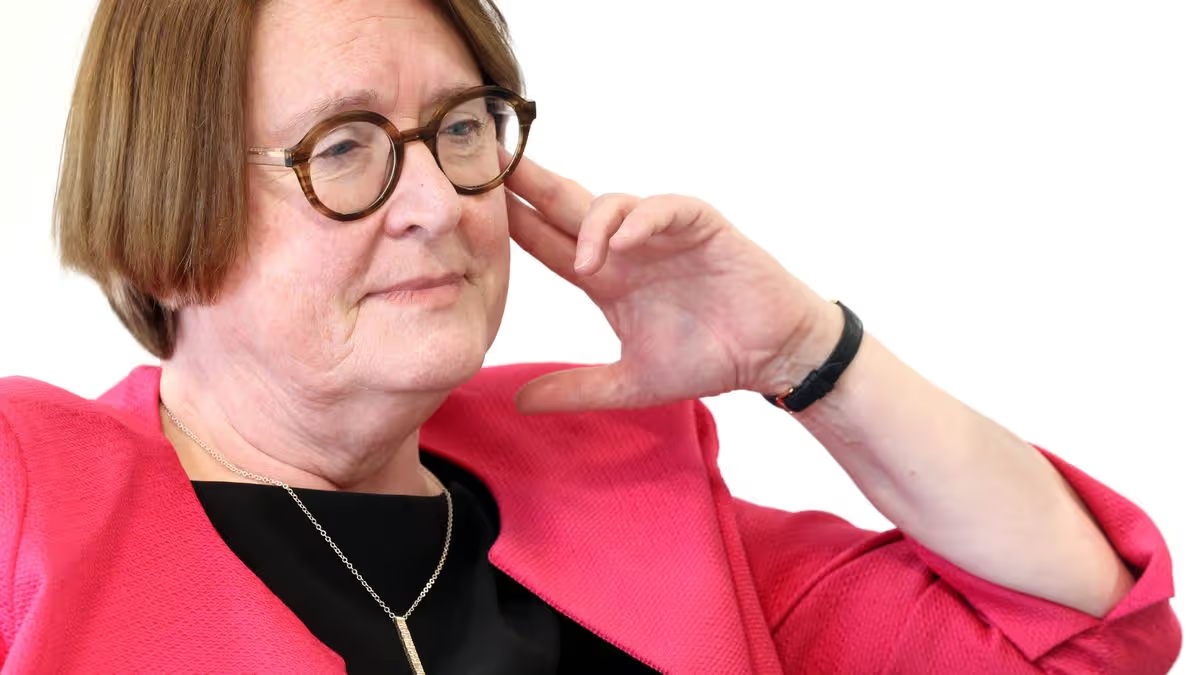
She successfully prosecuted child killer Mark Bridger as one of Wales’ leading barristers. Now Elwen Evans faces an altogether different type of case to resolve
On almost any metric the university sector is changing. Declining participation rates, rising costs, and changes in policy relating to international students have hit the sector from multiple directions.
Higher education bosses have warned no institution is immune to pressures. That is being shown in participation numbers particularly in Wales. The 2025 cycle saw the second-smallest proportion of 18-year-olds applying to university from Wales.
Early indications are that this has flatlined in the current year, bucking the UK-wide trend for increased participation rates. The gap in 18-year-old participation between Wales and the rest of the UK is, sector authorities say, a very significant concern.
Hundreds of jobs have been cut at universities across Wales triggering fears about their sustainability but also the offer to students.
Students themselves will, from September, face fees of £9,790 for undergraduate courses plus the cost of housing and expenses.
One of those tasked with solving not only her own institution’s approach to all those problems, but now as a spokesperson for all nine Welsh universities, is Elwen Evans. Formidable is probably the only appropriate word with which to introduce her.
She is regarded as one of the UK’s leading criminal barristers. During her legal career she was involved in some of the most high-profile criminal cases in Wales in recent years including prosecuting Mark Bridger, the murderer of April Jones, and defending the owner of the Gleision mine where four men died.
As King’s Counsel, a Recorder, she has been a bencher of Gray’s Inn since 2006. Between 2002 and 2015 Ms Evans was the head of Iscoed Chambers in Swansea.
In 2015 she combined legal work with being head of the College of Law and Criminology at Swansea University. She then became the institution’s pro-vice-chancellor before becoming vice-chancellor of the University of Wales Trinity Saint David.
In 2015, when she entered the world of higher education, universities were still expanding. Few places was it more evident than in Swansea with the boom of the Bay Campus changing even the physical appearance of the city. By August last year when she took over as chair of Universities Wales, tasked with representing the interests of Wales’ nine universities, the climate was radically different.
Since taking over she has been clear that while universities should be, and are, an integral part of Welsh life the changes are, in her words, complex and urgent.
Wales will need an additional 400,000 graduates by 2035. While recent UK figures, though, show there were 619,360 applicants – a record high – and 40.7% of 18-year-olds applying for university the percentage in Wales was much lower. Here only 32.1% of 18-year-olds were making an application.
Only the northeast of England performs worse on that measure. The mature market – classed as those aged 25 and over – also continued to decline.
In Wales the gap in higher education participation between the most and least disadvantaged is wider than elsewhere in the UK.
With those warning signs on the horizon, and given her career to date and reputation, why, I ask, did she made the decision to move away from practising law?
She admits she had “kept her hand in” when she was head of Swansea’s law school but when she became pro-vice-chancellor the workload, and perception of two high-profile jobs, meant she felt she had to stand back.
She retains her practising certificate just in case, she says. “I still can’t quite sort of bring myself to sort of stop that identity. Because I think once you’re a lawyer, a trial lawyer, you’re always a lawyer.
“Strangely enough some elements of being a lawyer have been quite useful in the sort of new role.
“I enjoy [the new role] because you really feel you are potentially making, if it goes right, a difference that impacts on your students, your staff, your places. So that’s a real privilege to be doing that.
“If you get it wrong then it’s quite a responsibility but one’s working with fabulous teams of people, whether it’s Universities Wales [or] whether it’s within one’s own university.
“There are some wonderful people working in the sector and it’s really great to be working with them to try and make that difference.
“In a trial you’re really only, if it goes right [or] if it goes wrong, you’re impacting on that case. In the context of universities it’s possibly a different sort of impact.
“I think it’s been clear that the sector has faced challenges for some time, and it’s become increasingly evident, but it’s a great sector to be in because at the end of the day education is absolutely at the heart of any community, any country.
“So for me at least trying to have some role in helping to understand what those challenges are, but more significantly, what the steps forward may be that bring sustainability, that enhances social cohesion, social mobility, participation, trying to play however small that role is, I think, is a real privilege.”
She says her own journey, from west Wales to renowned barrister, is proof of what education can do to change lives.
Coming from a first-language-Welsh farming family her father, now 94, was an apprentice carpenter while her mother, 96, left grammar school at 14 to go home to help run the farm, holding a certificate in dairy farming.
She, however, got a double first at Cambridge.
“I never plan. I have not planned my life. I’ve just tended to sort of go… I went to Cambridge, did my Bar finals in London because you had to do them then. In London there was only one place you could do them. Then did my pupillage in London and then came back to Wales,” she says.
When I ask if her motivation is to give the same chance sto the next generation of Elwen Evanses she replies with a smile: “Well I wouldn’t wish a next generation of Elwen Evans is on anyone. But for that next generation of young people so that they can have those opportunities to take decisions that sometimes are not the expected ones.
“I’ve taken a lot of decisions that are not the obvious sort of career choices and I think I’ve been able to do that because of the power of education.
“So it sounds a bit twee but, ultimately, it is the power of education, whatever type suits you, that really gives you the ability, I think, to thrive in your chosen world of operation.”
But one of the questions facing the students of today is whether the expense is worth it – particularly in light of a changing work world along with the growth of AI and subsequent changes in job prospects in particular fields.
“The sort of levels of debt that some students are experiencing you can see that that becomes a real question mark in their heads. ‘Is this really what I want to be doing?’
“I think that’s become more acute more recently but it was clear, I think, that there were some big questions that needed to be asked and addressed.
“And it’s an entirely non-political point but if one looks for example at the current government in Wales they’ve commissioned a significant piece of work, ‘The future of tertiary education in Wales five challenges and a call for evidence’, and they’ve identified areas of participation in equality, financial sustainability, demographic change, economic delivery, competition, and collaboration as areas that need to be the subject of a call for evidence.
“Plaid Cymru has said that they would look at a review of the funding model, sustainability of the funding model not just of course for the institutions but also for the students, and how are you going to maintain the students?”
Aside from a change in the makeup of the Senedd, and the political groupings, a non-Labour-led government for the first time in devolution could well change an awful lot more after May 7.
Careful throughout our conversation to walk the pre-election tightrope of not sharing any opinion at such a volatile time she says: “My sense is that all of the parties, in whatever combinations and whatever colours, recognise the significance of education and so I think being able to work and seek to help influence and shape policy and any policy changes that may be considered appropriate from day one.”
So what, I ask, could be done to make the sector sustainable.
“I think what we’re looking for is a structure in place and an operationalisation of what we are doing that is financially sustainable by which I would mean thrives for the future. So that you’ve got places where your students can go and have that fantastic experience that higher education gives but it’s part of a really big ecosystem of education and of course of prosperity and nation-building and all of those things that would I hope help underpin Wales’ future under whichever colour of government we get.
“We’ve been quite careful in positioning our asks in the manifesto. We’re asking for that independent review of university funding student support, an independent review of degree apprenticeships, an independent commission on participation.
“We don’t want to come to the table saying: ‘We think we’ve got the answers to this and we know what the solutions are’.
“We want to convene and be part of a convening a conversation about what the options are.
“I think there’s a wide range of possibilities but an awful lot of that will depend on the policies of the next government in Wales.
“It’s an unbelievably complicated landscape because of that jagged edge between England and Wales because although we are devolved as education in Wales as a sector we obviously have an awful lot of cross-border involvement and engagement and of course global involvement as well.”
Does she think the worst, in terms of redundancies, has now passed for Welsh universities? “I can’t comment on individual universities because that’s very much within the patch of those individual vice-chancellors and their governing bodies and so on and the decisions that they need to be making.
“But for me success is ensuring that we get to a place where all of us as a sector are thriving and not having to put energy and time and focus into: ‘What are we doing in this year?’. Let us look at that medium-, longer-term horizon.
“In a world where there is so much change going on, whether it’s in Wales or broadly globally, and after the pandemic we owe it to the students of today and the future to try and ensure that there is a stable, secure environment within which they can look to achieve their ambitions.
“It was education that gave me, I think, a wonderful life and a range of opportunities. It is what unlocks the door to a lot of life chances isn’t it? And I think we need to be looking at the ways we can ensure that all of the young people in Wales have that opportunity.
“I do have a thing around hierarchy. It’s not all about academic success is it? It’s not all about going to university and it’s making sure that there are opportunities for all the young to achieve their objective.” For our free daily briefing on the biggest issues facing the nation, sign up to the Wales Matters newsletter here.
The point has been made that universities have become too focused on their approach as businesses, rather than their role in places or to their students. Is that fair?
“I understand the point but the reality is that is where policy has driven them because you can only operate if you are financially sustainable and so that has become an inevitability. I don’t think any of us find that the space where we would have chosen to be,” she says.
“It’s a real challenge at the moment and I hope I don’t sound too trite in saying this but the time of challenge also gives the opportunity to look at things differently and I think that’s a part of the landscape that having a review into these different things may help shape because you can’t assume that what we did 10 years ago is necessarily going to be the shape of the future.”
As if to demonstrate just how interwoven higher education is when we meet in central Cardiff, from the windows surrounding us, two universities and a higher education college are within our eyelines.
Does she have faith in the future however it will look? “I absolutely have faith in the future because we have to have faith in the future and people will always be wanting to achieve their ambitions and have the opportunity to reach their dreams won’t they? Whether it will look the same way it looks now? Probably not.
“I think things will look different but in a sense that’s why we’ve got a different sort of structure in Wales, the tertiary sector.
“Universities will absolutely be at the heart of that future but it has to be at the heart and the future of our graduates but also of Wales. To be a strong, this isn’t a political point at all, but I think to be a strong country into the future we need strong universities, we need successful education, we need to drive prosperity, we need research and innovation that is going to position us where we should be.”
Get daily breaking news updates on your phone by joining our WhatsApp community here. We occasionally treat members to special offers, promotions and ads from us and our partners. See our Privacy Notice.












































You must be logged in to post a comment Login