If what you want from your index fund is access to the latest hot stocks, you’re in luck. The passive funds holding trillions of dollars of 401(k)s and other investments are rushing to change their rules as the IPOs of SpaceX, OpenAI and Anthropic draw closer.
The latest, on Thursday, was a proposal from S&P to drop the requirement to make a profit and wait a year for initial public offerings to get into the flagship S&P 500.
Block deal activity gathered pace on Monday, led by heavy institutional flows into Adani Ports and Special Economic Zone (APSEZ), where global funds collectively invested over Rs 7,400 crore. There were smaller block deals in stocks line Tata Motors (TMCV) and Siemens Energy India.
In APSEZ, Capital Group International All Countries Equity Trust acquired 2.46 crore shares worth Rs 4,021 crore at Rs 1,632.45 apiece. It was joined by Capital Income Builder, which bought shares worth Rs 617 crore, and Europacific Growth Fund, which picked up shares valued at Rs 2,848 crore. The seller in all these transactions was Worldwide Emerging Market Holding Limited, indicating a sizeable stake transfer between institutional investors.
In TMCV, BNP Paribas purchase 7.18 lakh shares worth Rs 29 crore at Rs 405.80 each, while Goldman Sachs offloaded an equivalent stake. Similarly, Siemens Energy India witnessed a Rs 29 crore block deal, with BNP Paribas acquiring 89,240 shares at Rs 3,256.80 apiece from Goldman Sachs Bank Europe SE.
Adani Ports shares today ended at Rs 1,742.60, gaining by Rs 85.30 or 5.15%. The stock today hit its 52-week high of Rs 1,748.60 on the NSE. APSEZ shares have gained nearly 40% over the past 12 months.
Advertisement
Shares of Tata Motors today ended at Rs 412.90, gaining by Rs 3 or 0.73% while Siemens Energy India settled at Rs 3,320.70, gaining 41.90 or 1.28%.
Live Events
Domestic stock markets ended higher on Monday with BJP all set to win states of West Bengal and Assam and wrest back the Union Territory of Puducherry. Sectorally, financials, pharma and metal let the bulls. While the 50-stock Nifty surged 121.75 points or 0.51% to finish at 24,119.30, Sensex gained 0.46% points or 355.90 points to settle at 77,269.40. Also read: Mauritius-based entity sells Rs 289 crore worth shares in Emcure Pharmaceuticals via block deal; Norges Bank acquirer (Disclaimer: The recommendations, suggestions, views, and opinions given by the experts are their own. These do not represent the views of The Economic Times.)
Bret Jensen has over 13 years as a market analyst, helping investors find big winners in the biotech sector. Bret specializes in high beta sectors with potentially large investor returns.Bret leads the investing group The Biotech Forum, in which he and his team offer a model portfolio with their favorite 12-20 high upside biotech stocks, live chat to discuss trade ideas, and weekly research and option trades. The group also provides market commentary and a portfolio update every weekend. Learn More.
Analyst’s Disclosure: I/we have a beneficial long position in the shares of AMZN either through stock ownership, options, or other derivatives. I wrote this article myself, and it expresses my own opinions. I am not receiving compensation for it (other than from Seeking Alpha). I have no business relationship with any company whose stock is mentioned in this article.
Seeking Alpha’s Disclosure: Past performance is no guarantee of future results. No recommendation or advice is being given as to whether any investment is suitable for a particular investor. Any views or opinions expressed above may not reflect those of Seeking Alpha as a whole. Seeking Alpha is not a licensed securities dealer, broker or US investment adviser or investment bank. Our analysts are third party authors that include both professional investors and individual investors who may not be licensed or certified by any institute or regulatory body.
Calamos Investments President and CEO John Koudounis analyzes the strength of the U.S. economy despite Iran-driven oil risks and weighs in on Kevin Warsh’s expected Fed takeover on ‘Mornings with Maria.’
Markets may face near-term volatility tied to oil prices and geopolitical tensions, but underlying economic strength and the prospect of lower interest rates could fuel a powerful next leg higher, according to a market expert.
Calamos Investments President and CEO John Koudounis joined FOX Business’ Maria Bartiromo on “Mornings with Maria” to discuss market resilience and why he sees further upside despite ongoing uncertainty.
Koudounis pointed to strong corporate earnings and supportive policy dynamics as key drivers behind recent market gains, noting that “the underlying economy is pretty strong” and that “earnings are doing really well.” He added that factors like tax-related cash flow are also helping support consumer activity and sentiment.
That backdrop, he argued, is helping markets look past short-term disruptions tied to rising oil prices and Middle East tensions. While “you’re going to see the market volatile because of the price of oil,” Koudounis said he expects those pressures to ease, with energy markets eventually stabilizing and supporting broader growth.
Panelists EJ Antoni and Kaylee McGhee White analyze President Donald Trump’s economic wins and May Day protests on ‘The Bottom Line.’
“When that happens, we’re off to the races again,” he said, adding that “the market really, really wants to run.”
Advertisement
Looking ahead, Koudounis emphasized that monetary policy could play a critical role in accelerating economic momentum. If inflation remains contained, he expects interest rates to move lower, creating a more supportive environment for growth.
“I think we’re going to have rates being lowered,” Koudounis said. “And I think that’s going to continue one of the biggest explosions in the economy that we’ve seen.”
Panelists Mark Penn and Reince Priebus discuss Americans’ perceptions of the U.S. economy amid the Iran War on ‘Kudlow.’
Advertisement
Despite ongoing uncertainty, including geopolitical risks and the upcoming midterm elections, he maintained a bullish outlook, noting that “we’re in a great position where we can handle this crisis” and that market performance remains “incredible” given current conditions.
NEW YORK — Bitcoin’s trajectory in 2026 remains a hotly debated topic on trading floors and among retail investors, but the prevailing Wall Street view leans heavily toward buying the leading cryptocurrency at current levels near $80,000. Despite a volatile start to the year featuring a significant drawdown from late-2025 highs, robust institutional inflows through spot ETFs, improving regulatory clarity and long-term adoption trends support a bullish outlook for the remainder of 2026 and beyond.
Bitcoin
As of early May 2026, Bitcoin trades around $78,000–$80,500, showing resilience after testing lower levels earlier in the year. The cryptocurrency has recovered from a roughly 40% correction off its all-time high near $126,000 but faces ongoing macro pressures including dollar strength and interest rate uncertainty. Yet major institutions continue accumulating, signaling confidence in Bitcoin’s role as a digital store of value.
ETF Inflows Signal Institutional Conviction
Spot Bitcoin ETFs have emerged as a dominant force, recording strong net inflows in April 2026 totaling approximately $1.97 billion to $2.44 billion — the strongest monthly performance of the year. BlackRock’s iShares Bitcoin Trust (IBIT) led the charge, amassing tens of billions in assets under management and capturing the lion’s share of flows. Cumulative ETF inflows since inception now exceed $58 billion, with total AUM approaching or surpassing $100 billion.
This institutional demand has absorbed far more Bitcoin than daily mining output, tightening available supply. Analysts at firms like JPMorgan and Franklin Templeton highlight these flows as a structural tailwind, projecting continued institutional participation throughout 2026 driven by clearer U.S. regulations such as the Digital Asset Market Clarity Act.
Advertisement
Analyst Price Targets: Bullish Tilt for Year-End
Consensus forecasts for Bitcoin by the end of 2026 skew optimistic. Citigroup outlines a base case near $143,000 with a bull scenario reaching $189,000. JPMorgan sees potential for $150,000–$170,000, while Bernstein maintains a $150,000 target, calling recent selloffs among the “weakest bear cases” in Bitcoin’s history. Franklin Templeton expects recovery above $100,000 even in conservative scenarios.
More aggressive voices, including Fundstrat’s Tom Lee, eye $150,000–$250,000 longer term. Even cautious projections place Bitcoin well above current prices, with few major firms issuing outright sell recommendations. Short-term May trading ranges center around $75,000–$85,000, with a break above $80,000–$82,000 potentially catalyzing further upside.
Bull Case: Adoption, Scarcity and Macro Tailwinds
Advertisement
Proponents argue Bitcoin’s fixed supply of 21 million coins, combined with the 2024 halving’s lingering effects, creates a compelling supply-demand imbalance. Growing corporate treasuries, nation-state interest and integration into traditional portfolios via ETFs reinforce its “digital gold” narrative. Regulatory progress in the U.S. and Europe reduces uncertainty, while potential Federal Reserve rate adjustments could ease pressure on risk assets.
Technical analysts note Bitcoin forming higher lows in recent months, with key support around $72,000–$75,000. A sustained move above $80,000 could target $85,000–$92,000 in the near term, opening the path to six figures later in the year.
Risks and Bear Case Considerations
Skeptics warn of near-term downside if macroeconomic conditions deteriorate — stronger U.S. data delaying rate cuts, renewed geopolitical shocks or profit-taking after earlier rallies. Some forecasts see possible consolidation or tests toward $60,000–$65,000 in a deeper correction, though most view such levels as buying opportunities rather than capitulation.
Advertisement
Volatility remains inherent to Bitcoin. Options markets price meaningful probability of both extreme upside and downside by year-end, reflecting uncertainty. Leverage in derivatives markets can amplify swings, and regulatory surprises globally could introduce headwinds.
Investment Strategy for 2026
For long-term investors, current prices offer an attractive entry or accumulation zone according to most analysts. Dollar-cost averaging mitigates volatility, while spot ETFs provide regulated, accessible exposure without direct custody concerns. Short-term traders may await confirmed breakouts above resistance levels before adding aggressively.
Portfolio allocation matters: financial advisors increasingly recommend 1–5% exposure to Bitcoin for diversification, citing low correlation with traditional assets over long periods. Risks should be sized appropriately given Bitcoin’s history of sharp drawdowns.
Advertisement
Broader 2026 Market Context
Bitcoin’s performance influences the wider crypto ecosystem, but its dominance remains high. Institutional infrastructure — custody, prime brokerage and lending — continues maturing, supporting sustained growth. While retail sentiment fluctuates, the shift toward institutional-driven markets suggests more measured, less euphoric cycles ahead.
As summer approaches, focus turns to ETF flow trends, macroeconomic data releases and potential policy developments. Bitcoin’s ability to hold above key supports while attracting fresh capital will likely dictate whether 2026 becomes another milestone year for the asset.
Conclusion: Overwhelmingly a Buy for Most Horizons
Advertisement
The balance of evidence — strong ETF inflows, institutional endorsements, supply dynamics and analyst targets — tilts decisively toward buying Bitcoin in 2026 for those with a medium-to-long-term horizon. While short-term volatility and macro risks persist, the structural case for higher prices remains intact. Investors should conduct thorough due diligence, consider personal risk tolerance and avoid leverage that could lead to forced liquidations.
With no major sell signals dominating consensus and substantial upside implied by price targets, Bitcoin continues to attract capital as a core digital asset in an evolving financial landscape. Whether it reaches $100,000 or beyond this year will depend on execution of these tailwinds, but the foundation for growth appears solid.
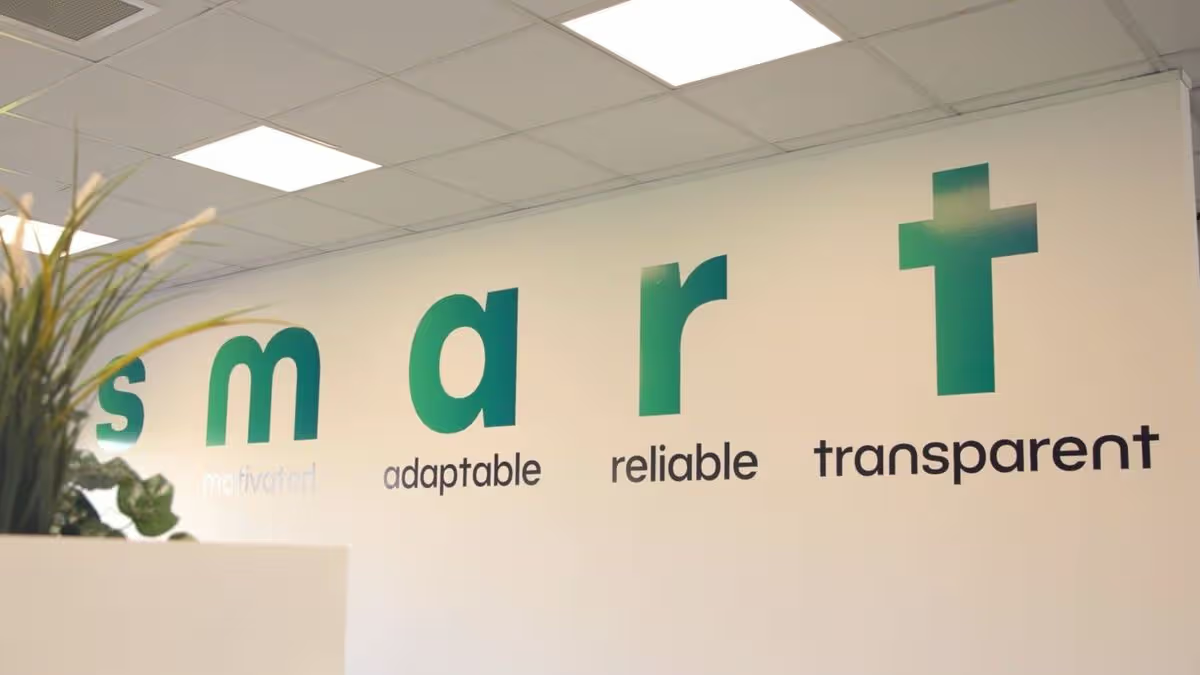
‘We cannot wait to get Procure Smart Newcastle off the ground in May’
Procure Smart is opening an office in Newcastle(Image: Procure Smart)
A growing North East utilities specialist is creating 40 jobs in Newcastle with the launch of its latest office. Procure Smart was established in 2022 to save businesses time and money on their utilities and services, opening its first base and head office at Sunderland’s Doxford Park.
Since then the company has expanded into Manchester, with an office opening resulting in the creation of 10 initial jobs, while also employing remote worker in Dubai and elsewhere in the UK.
Now the company – run by managing director Craig Shields and CEO Brad Groves – is expanding its geographical footprint further, with the launch of a new office in Newcastle city centre.
Having passed the 50-colleague mark, the next phase of expansion has triggered a recruitment drive for around 40 new employees, who will be based at St James’ Place in Newcastle.
Advertisement
Head of sales, Michael Tansey, who has over 15 years of industry experience, said that since its inception four years ago, Procure Smart has built a dedicated and passionate team at its Sunderland headquarters.
The expansion into Newcastle follows the launch of an online business energy switching tool, Switch Savvi.
The Switch Savvi platform aims to providing businesses with a ‘comparison-site solution’ for procuring business utilities such as gas and electricity, and the firm says it will play a key role in helping businesses combat soaring energy costs.
The company – recently announced as the Spennymoor Town FC shirt sponsor for the 2026/2027 season – says it has plans to release new innovations this year, including monitoring and tracking software, named SmartVu, which will give customers a view of their energy usage, giving them the ability to spot trends, improve efficiency and make further cost savings.
Advertisement
Mr Tansey said: “We cannot wait to get Procure Smart Newcastle off the ground in May and continue on the upward trajectory which has been driven by the team at our Sunderland HQ over the last four years.
“As a North East lad, I’m in awe at the growth we are seeing in the region, and excited to be a part of it, building the first team to be based out of Newcastle city centre for Procure Smart. I hope to employ up to 40 new individuals who live our Smart values every day.”
Procure Smart CEO Brad Groves formerly ran Seaham-based Great Annual Savings, which went into administration in May 2023. Insolvency specialists at FRP were appointed to Great Annual Savings after a restructuring plan put forward by bosses was rejected by the High Court.
HMRC had submitted a winding up petition and documents later showed the Government claimed it was owed £7.8m. More than 100 jobs were lost at the £20m-turnover former Sunderland AFC shirt sponsor, which had seen rapid growth after launching in 2012.
FOX Business’ Jeff Flock joins ‘Varney & Co.’ to break down the Justice Department’s criminal probe into soaring beef prices as Americans face sticker shock at the grocery store and experts point to a “perfect storm” driving costs higher.
The Justice Department confirmed its active investigation of potential antitrust violations in U.S. cattle and beef markets, reviewing more than 3 million documents and interviewing industry participants as federal officials scrutinize whether highly concentrated meatpacking power has contributed to high beef prices.
The four largest beef processors control more than 85% of the U.S. processing market — half of which are Brazilian-owned — Trump administration officials noted at a Monday news conference, where acting Attorney General Todd Blanche urged whistleblowers to capitalize on turning in bad actors who are contributing to jacking up meat prices on Americans.
Advertisement
“If the information you provide helps us secure a criminal penalty in excess of $1 million, you can be entitled to recover and receive 15-30% of the money that we recover,” Blanche said, describing the DOJ fraud whistleblower rewards program. He urged ranchers, purchasers, processors and others to report possible price-fixing, bid-rigging, market allocation or procurement fraud.
Agriculture Secretary Brooke Rollins tied the probe to broader concerns about food security and shrinking domestic cattle supplies, saying the U.S. had about 86.2 million head of cattle and calves as of Jan. 1 — “the lowest since the 1950s.”
Acting Attorney General Todd Blanche confirmed the antitrust investigation into ongoing Biden-era beef price inflation, making a call for whistleblowers to turn in bad actors in the market. (Kevin Dietsch / Getty Images)
DOJ reportedly pursuing criminal antitrust probe of major meatpacking companies
Advertisement
Addressing the supply side of the economic issue, Rollins said the country has lost more than 17% of its cattle ranchers over the past decade, including more than 100,000 ranches, attributing the reduction to leftist anti-cattle, anti-meat activists’ “alarmism to wage a war on cattle in America“ and “the radical left’s ongoing assault against ranching as a way of life.”
“Growing the herd size is an immediate problem in need of solutions, and we’ve already begun implementing across the government and into the states how we’re going to solve for that,” Rollins said.
Rollins also singled out foreign ownership among major processors, saying two of the “big four” — JBS and National Beef — are Brazilian-owned or have significant Brazilian ownership.
White House trade adviser Peter Navarro, Agriculture Secretary Brooke Rollins and acting Attorney General Todd Blanche laid out the causes for the ongoing Biden-era beef price inflation. (Kevin Dietsch / Getty Images)
“Half of these meatpacking giants, including the largest meat packer in the world, are either foreign-owned or have significant foreign ownership and control,” she said, calling that a threat to U.S. producers and national security.
White House senior trade adviser Peter Navarro said the combination of a historically small cattle herd, dominant processors, leftist lobbyists and Brazilian ownership have combined to fuel ongoing Biden-era beef inflation.
“I hasten to add here that the Brazilians are far more of the problem, and it’s complicated by the fact that the Brazilians, particularly JBS, hands out millions of dollars to our American political system like it’s candy,” Navarro said. “And the rate of return they get on that would make a Wall Street hedge fund blush, and we have got to put a stop to that.
FOX Business correspondent Jeff Flock reports on the Justice Department’s antitrust division reportedly opening a criminal probe tied to rising beef prices on ‘The Big Money Show.’
“You’re going to hear from the ranchers at the front lines what they’ve suffered.
“I can tell you that a small herd and a high concentration ratio [is] a recipe for exactly the kind of beef inflation we are getting.“
DOJ officials did not say when the investigation might result in charges or a lawsuit, but said civil and criminal antitrust inquiries can run in parallel, along with the help of whistleblowers feeding the investigators evidence.
“Here’s the reason why the whistleblower program is so important: It’s because those are the folks who actually know where the bodies are buried, where the prices are fixed,” Navarro said, alluding to “where the shutdown of a meatpacking house was really not because there was an electrical problem; it was something else.”
“So, I welcome, my friends with the hats — I think that’s a giveaway that they might be the ranchers in the room.”
‘The Big Money Show’ announces the winners of FOX Business’ ‘Made in America’ contest.
In a tribute to the grit and sacrifice that built the nation, FOX Business is kicking off Small Business Week by crowning three companies that embody the American spirit as the winners of the first “Made in America” contest.
Marilyn’s (Lakeside, Ohio)
Marilyn Burns, 82, has owned and operated her local souvenir shop in the heart of Lakeside since 1999. Her store is a community staple that also funds youth camps and serves as a generational anchor for families.
Advertisement
“Since I’ve been here 26 years, my first customers are bringing their kids in,” Burns previously told the Lakesider. “We shouldn’t take it for granted because a lot of work has gone into making [the ‘happy town’] what it is.”
TGU Home Solutions (Aberdeen, North Carolina)
U.S. Army veteran Jared Gay is the founder of TGU Home Solutions, a construction firm fully staffed by veterans. His company makes a point to provide a bridge for service members transitioning to civilian life, all while building custom homes at prices that “reflect integrity rather than excess.”
“I left the military in 2003,” Gay told “The Bottom Line” in April, “and I had a pretty hard time with my exit… and we changed it into, how to build a home, instead of how to run a military operation… we try to give back every day.”
Advertisement
The sun flares below the U.S. flag on the National Mall on April 18, 2024, in Washington, D.C. (Getty Images)
Four Branches Bourbon (Bardstown, Kentucky)
Four great friends who represent each branch of the military forces – the Army, Navy, Air Force and Marines – blend and bottle their own award-winning bourbon as a tribute to “those who serve in the shadows,” their website reads.
Together, Mike, Rick, RJ and Harold are dedicated to exceptional bourbon craftsmanship while directly offering support to veterans, their families and first responders.
Owner of TGU Home Solutions Jared Gay details his custom home-building business in North Carolina on ‘The Bottom Line.’
These three finalists represent the spirit of entrepreneurship, community service and military sacrifice that defines the American story. They will each receive a cash prize of $25,000 and a featured special on Fox Nation.
Advertisement
A panel of judges, which included FOX Business hosts and executives, determined the three winners from thousands of applicants that were whittled down to the top 10 finalists on April 13.
“For 250 years, small businesses have been the backbone of America,” “Mornings with Maria” and “Sunday Morning Futures” host Maria Bartiromo said.
Veterans and founders of Four Branches Bourbon Mike Trott and Rick Franco discuss how they created their bourbon brand.
“Built by people who took a chance on themselves and their communities,” “Kudlow” host Larry Kudlow said.
“These are the places where the American story is written,” “Making Money” host Charles Payne said.
“The Bottom Line” and “The Big Money Show” co-host Brian Brenberg said, “FOX Business is shining a light on the independent hops that keep our country moving.”
The FOX Business “Made in America” campaign was made possible by sponsors JPMorgan Chase and Comcast Business.
FOX Business’ Gerri Willis joins ‘Varney & Co.’ to report on South Hadley, Massachusetts, residents voting on a 50% property tax hike as retirees warn of being priced out and a broader tax revolt grows nationwide.
America’s “Cradle of Liberty” is fast becoming the cradle of high costs.
With home prices nearly double the national average, Boston is facing a generational drain as high-skilled workers flee the city’s rising cost of living for greener — and cheaper — pastures in the South.
Advertisement
According to the 2026 Young Residents Survey, commissioned by the Greater Boston Chamber of Commerce Foundation, there is a growing crisis of confidence among the city’s most vital demographic: 26% of residents ages 20 to 30 plan to leave the Boston metro area in the next five years.
Additionally, the area’s life satisfaction rate has fallen from 89% to 79% in just a three-year period. Seventy-eight percent of respondents cited the cost of rent as the catalyst, while 72% cited the inability to buy a home as the primary reason for leaving.
Of those planning to leave the Northeast, nearly half are heading south.
Advertisement
Young Bostonians ages 20 to 30 are increasingly planning to leave the city in the next five years. (Getty Images)
“As the region struggles with a housing crisis, young residents across demographics shared concerns regarding housing availability and affordability,” the Foundation said in a press release. “When asked about the most urgent issues for local leaders, respondents noted that housing, health care accessibility and availability of quality jobs should be prioritized.”
The median asking rent in Boston sits at $2,918 as of March, Realtor.com data shows, which surpasses rents in New York City, San Francisco and Los Angeles. Its median home listing price is $832,500, almost double the national median.
While the city produces thousands of graduates from Harvard and MIT, many can no longer afford to stay and contribute to the local economy.
“Young residents bring vitality and innovation to Greater Boston, building communities and leading our economic growth. However,” the Foundation said, “the region’s affordability continues to be a concern as young residents struggle to seize opportunities that outweigh challenges, like housing and career growth. Competitor states that are more affordable may be appealing to young residents who are eager to find housing to rent or purchase that is more affordable and accessible.”
Advertisement
‘The Big Money Show’ panel discusses Boston’s reported interest in attempting a city-run grocery store after New York City mayoral candidate Zohran Mamdani proposed them as part of his campaign.
Despite Gov. Maura Healey’s $5 billion-plus Affordable Homes Act, the state’s progress has been slow to nonexistent, leaving residents frustrated with the lack of results. Massachusetts even received an “F” grade on the Realtor.com State-by-State Housing Report Card for falling behind on affordability and construction.
“Over the last three-and-a-half years, we’ve got 100,000 homes in the pipeline. Is it enough? No,” Gov. Healey said during a recent radio segment. “I need every community in the state to understand that housing is fundamental to the vibrancy of our neighborhoods.”
Economists warn that while a mass exodus might temporarily cool rent prices, the long-term damage to the labor market and innovation sector could be permanent.
Sotheby’s International Realty broker Jenna Stauffer analyzes the U.S. housing market, noting a shift in buyer behavior, on ‘Making Money.’
“Boston’s young people are overwhelmingly high-skilled college graduates who play an important role in the job market, entrepreneurship and innovation scene, and the local service economy, too,” Realtor.com senior economist Jake Krimmel told the real estate outlet.
“That’s the root of Boston’s rental market crisis: a seemingly never-ending supply of young, educated renters but never enough supply of rental housing for them,” he added.
Anthropic CEO Dario Amodei looks on after a meeting with French President Emmanuel Macron during the AI Impact Summit in New Delhi on February 19, 2026.
Ludovic Marin | Afp | Getty Images
Anthropic said Monday it is partnering with private equity giants Goldman Sachs and Blackstone to launch a $1.5 billion firm aimed at speeding the adoption of artificial intelligence across hundreds of companies.
Advertisement
The new entity, formed alongside the San Francisco-based PE firm Hellman & Friedman and backed by a group of asset managers including Apollo and General Atlantic, will deploy Anthropic’s Claude AI model directly inside businesses, starting with companies owned by the investment firms.
Executives say the effort is designed to tackle a growing bottleneck in the AI boom: The scarcity of experts capable of implementing the technology inside real-world operations.
“There’s a big shortage of people who know how to apply these tools into businesses and then transform them,” Marc Nachmann, Goldman’s global head of asset and wealth management, told CNBC in an interview.
The move marks Anthropic’s latest effort to deepen its lead in the enterprise AI market as competition intensifies with rivals including OpenAI. By pairing the latest Claude models with a built-in network of investor-owned companies, Anthropic is positioning itself to gain an edge in middle-market adoption of the technology.
Advertisement
It’s a key battleground as both Anthropic and OpenAI prepare for massive IPOs as early as this year.
Rather than acting as a traditional consulting firm, the venture — which hasn’t yet been named — will embed engineers inside companies to redesign workflows and integrate AI into core processes, Nachmann said.
“Having the model alone doesn’t change your workflows or how you operate,” he said. “You need people who can combine the technology with what’s actually happening in the business and implement those changes.”
The Wall Street Journal earlier reported the $1.5 billion commitment of the firms involved.
Advertisement
Goldman and its partners expect to use their own portfolio companies as an initial proving ground for the new platform before targeting other mid-sized companies, especially in the PE-owned universe of healthcare, manufacturing, financial services, retail and real estate sectors.
“We think there’s a lot of value that this new entity can bring to companies to help transform them,” Nachmann said. “Obviously, we’re going to use it a lot at our portfolio companies.”




























































You must be logged in to post a comment Login