Connect with us
DAPA Banner

Tech

Strange Ways To Make Cold

Published

on

Making stuff cool and keeping it that way has been a pretty essential part of human civilization for thousands of years, with only in the past few hundred years man-made methods having become available that remove the reliance on the whims of nature and lugging around massive blocks of ice. The most important cooling method is undoubtedly that of vapor-compression refrigeration, but this is hardly the only method to transfer thermal energy from one location to another.

For example, we recently covered an elastocaloric cooling project by a group of scientists that uses strips of NiTi metal. By flexing these they induce a cooling effect which when put in a number of stages serves to transfer a significant amount of thermal energy between both sides, much like a vapor-compression system but without the gases and compressor. Meanwhile the Seebeck effect is relatively well-known from Peltier thermocouple devices, and features heavily in portable refrigerators and kin where these solid-state devices can also transfer thermal energy.

Of course, along with how they function the major question with all of these cooling technologies is how efficient they are, as this determines when you’d want to even consider them for a specific application.

The Science Of Cold

Although as animals we have an intuitive understanding of what concepts like ‘cold’ and ‘hot’ are in the sense of comfort levels, on a fundamental level the related concept of temperature is about the kinetic energy of the particles in a system. Essentially, the more kinetic energy exists in the system, the higher the temperature of said system is, regardless of whether it’s a liquid, gas, solid or plasma. Hence a temperature of zero Kelvin is the complete absence of any such kinetic energy in the system, also known as the Third Law of thermodynamics:

Advertisement

As the temperature of a system approaches absolute zero, all processes cease and the entropy of the system approaches a minimum value.

When we talk about moving thermal energy from one location to another – as in refrigeration – this thus means transferring said energy from one system to another in some fashion, something which is covered by the First Law of thermodynamics:

In a process without transfer of matter, the change in internal energy, , of a thermodynamic system is equal to the energy gained as heat, , less the thermodynamic work, , done by the system on its surroundings.

In the case of a hot water bottle or ice bag we are actively changing the energy balance of a system by transferring matter. This makes such transfers rather lossy, which is not a quality that is generally desirable in a refrigeration system. Thus we prefer a closed system in which the matter is ideally never lost, and thus all the energy transfer occurs via reversible processes.

Vapor-Compression
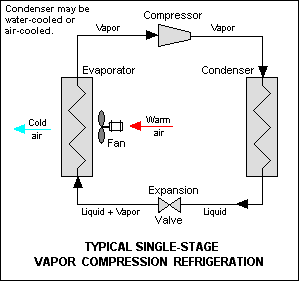
Single-stage vapor-compression refrigeration system components. (Credit: mbeychok, Wikimedia)

In vapor-compression refrigeration a liquid – the refrigerant – is circulated through the system, alternately changing state into a gas by absorbing thermal energy from the environment, before shedding this energy again while condensing back into a liquid.

A key component in this system is the compressor, which takes in the saturated vapor. This means that said vapor contains enough energy to effect the liquid-gaseous transition, but is still pretty close to the condensing point.

By compressing this vapor into a smaller volume its temperature increases since roughly the same amount of kinetic energy exists within the system. This superheated vapor then passes through the condenser, like the radiator found at the back of the average kitchen refrigerator. Here the superheated vapor condenses back into a liquid, with the higher temperature and pressure helping to make the condensing process more efficient. This is also why said refrigerator radiator can feel so warm to the touch.

Advertisement

The role of the expansion valve is effectively the opposite of the compressor: as the name suggests this is where the liquid refrigerant at high pressure suddenly transitions back to a low pressure, causing adiabatic flash evaporation of part of the liquid into a vapor. This reduces the temperature of the refrigerant, making it colder than e.g. the inside of the refrigerator and drawing in kinetic energy from the air inside said refrigerator before the vapor makes its way to the compressor again.

Elastocaloric Cooling
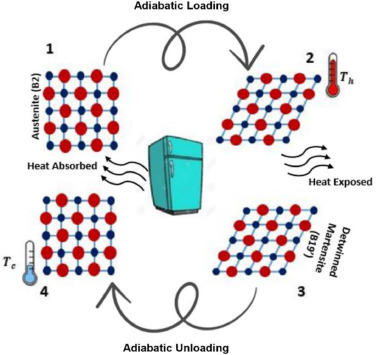
The elastocaloric effect. (Credit: Fatemeh Kordizadeh, Wikimedia)

With elastocaloric cooling (ECC) there is no liquid refrigerant or a pressure differential. Instead they rely on the elastocaloric effect, which is thermomechanical in nature.

Similar to how the refrigerant with vapor-compression refrigeration can absorb energy as it transitions from liquid to vapor and vice versa, with the elastocaloric effect it is the material itself that absorbs thermal energy from its environment when it’s mechanically loaded.

The aforementioned NiTi alloy is also known as a shape-memory alloy (SMA), which are generally known to be heat sensitive, finding use in applications like thermal fuses and sensors.

While the application of heat or cold can cause the deformation, this also works the other way around when mechanical force is applied. This is readily demonstrated with a strip of NiTi SMA and a thermal camera, as in this video by Helge Wurst:

Advertisement

As the strip is bent, the area experiencing the deformation becomes rather warm to the touch, with subsequent relaxation causing the same area to become cold to the touch.

Using such strips and mechanical actuators capable of applying 900 MPa of pressure, Guoan Zhou et al. were able to achieve freezing temperatures. They did this by combining multiple of such elastocaloric stages with CaCl2 as heat-exchange fluid. This is not a mainstream cooling method so far, but it should be quite reliable and low-maintenance.

Magnetocaloric Cooling
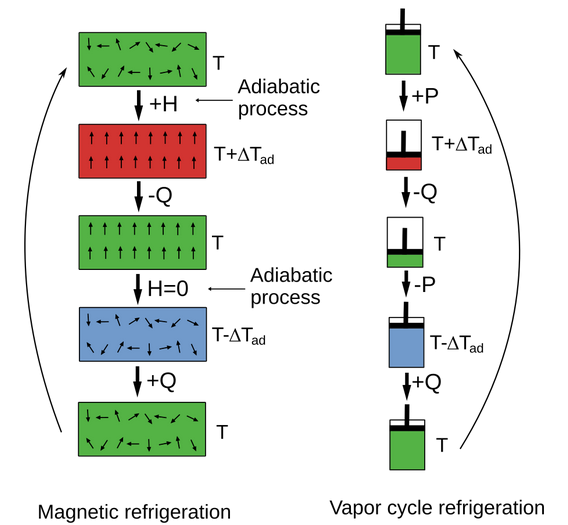
Comparison between magnetocaloric effect and vapor-compression cooling. (Source: Wikimedia)

The magnetocaloric effect (MCE) was first observed in 1881 by German physicist Emil Warburg, with the early 20th century seeing significant progress towards using it for cooling applications. This particular effect as the name suggests consists of exposing a material to a magnetic field, with this material then drawing in thermal energy. Upon removal of the magnetic field the material sheds this gained energy as well as some additional energy, thus cooling down relative to its environment.

Similar to the elastocaloric effect, this relies on an adiabatic process: without the transfer of any matter or entropy. This makes it a fully reversible process that can be repeated by successive applications of said magnetic field.

The biggest disadvantage with this effect for cooling purposes is that it’s only a very strong effect (giant MCE, or GMCE) in a limited number of alloys discovered so far. The first significant here was a rare-earth gadolinium-based alloy, Gd5(Si2Ge2), that showed GMCE at 270 K. This relatively low temperature and the use of rare-earths made this a tough sell.

Advertisement

More recently discovered alloys like Ni2Mn-X, where X is a variety of additives, display the GMCE near room temperature and even saw GE demonstrate an Ni-Mn-based magnetic refrigerator in 2014. So far commercialization of GMCE-based refrigeration is still rather limited but there is a push to make it work for generally less efficient vapor-compression-based home refrigerators.

Electrocaloric Cooling

Although easy to confuse with the magnetocaloric effect, the electrocaloric effect (ECE) pertains to the application of an electric field in dielectric materials. The effect is roughly the same, with the dipoles in the material either assuming an ordered or disordered state, depending on whether the field is respectively applied or turned off.

So far ECE-based cooling hasn’t seen commercialization yet either, though the past years there have been a range of breakthroughs, with for example Xin Chen et al. demonstrating ECE polymer films in 2023 that was subsequently used to create a thin-film refrigerator prototype with. This was claimed to achieve a Coefficient of Performance (COP) of a rather astounding 24, which compared to traditional heat pumps would make it a rather interesting solution if it can be commercialized.

Thermoelectric Cooling
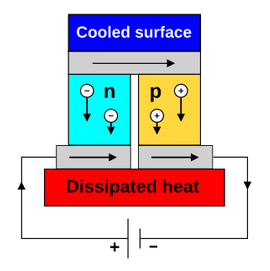
Diagram of a thermoelectric cooler. (Credit: Ken Brezier, Wikimedia)

The thermoelectric effect and the associated Peltier cooling devices are probably the most well-known and most heavily commercialized on this list along with vapor-compression. Within the thermoelectric effect, the Peltier effect concerns thermocouples and their associated temperature differences, thus lending its name to what are alternatively called ‘Peltier coolers’ as well as ‘thermoelectric coolers’, or TECs.

Rather than a refrigerant or rearranging of dipoles here the transfer of kinetic energy is performed using charge carriers within the TEC. On average charge carriers move to the ‘cool’ side, allowing them to transfer heat away from the other side.

Advertisement

As is well-known, this Peltier effect is rather limited when used as a heat pump, with very low efficiency and strict limitations on temperature differences. This is why their use in dehumidifiers and portable refrigerators is at best questionable.

The main reason why TECs are so popular can be said to be due to vapor-compression refrigeration being so bulky and neither elastocaloric, nor MCE, nor ECE solid-state coolers being quite ready for prime-time yet at the low-low price level that TECs can achieve due to being dead-simple semiconductor devices.

Pulse Tube Cooling
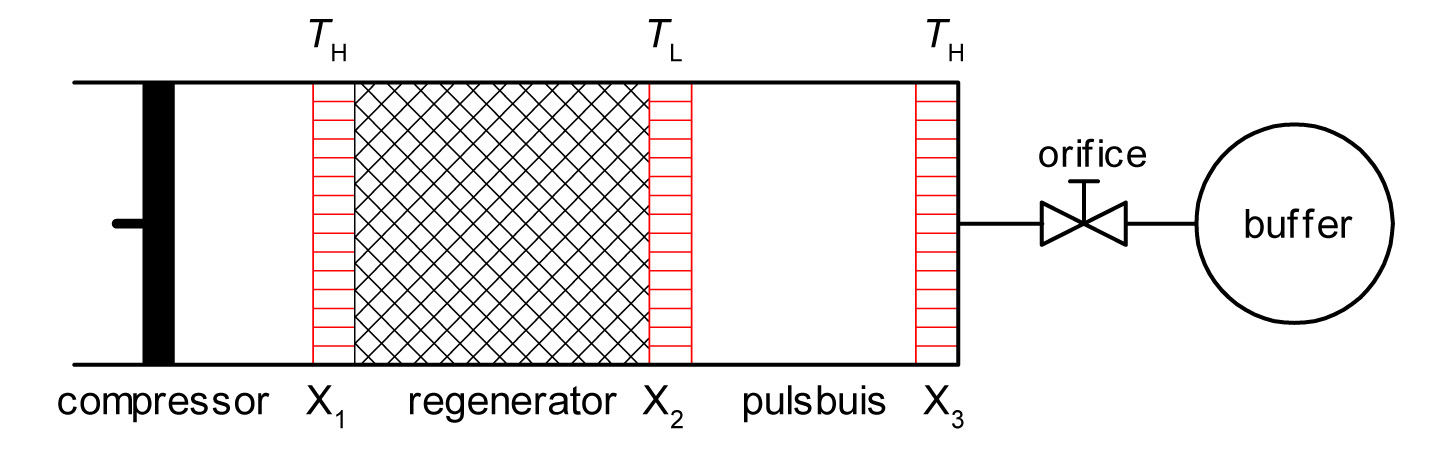
Stirling-type pulse tube refrigerator. (Credit: Mbeljaars, Wikimedia)

Another interesting, partially solid-state cooling method is the pulse tube refrigerator (PTR), which has seen limited use in commercial and other applications. Its main advantage is that it can be used as a cryocooler, making it ideal for space telescopes where sensors have to remain super-cold.

At its core it’s reminiscent of vapor-compression refrigerating, in that it uses a gas and a compressor, yet there’s no circulating loop of refrigerant. Inside the tube a piston alternately compresses the gas – often helium – which forces it through the regenerator. As the compression raises the temperature of the gas, this heat is then passed onto the material of the regenerator. On its way back through the regenerator this heat is then returned to the gas, explaining the name of this component.

The hot and cold sides of the regenerator are hereby used for cooling, though other PTR configurations are possible, such as the coaxial design. The relatively straightforward mechanical design and low temperatures achievable are why hobbyists are tinkering with PTRs in order to do things like making their own liquid nitrogen.

Advertisement

Chill Choices

Ultimately the question of what the right cooling method is for your particular task depends on a range of factors, including the required efficiency, available space and whether or not that big research grant budget just became available.

In terms of commercially available options that aren’t outrageously expensive, your options are somewhat limited, especially if you do not have a lot of space available. It’s possible that in a number of years these alternate technologies will be commercialized and wipe the floor with TECs in particular, but unless you’re currently heavily into tinkering with strips of NiTi SMA to build your own cooler, the primary options would seem to be either vapor-compression or TECs.

That said, considering that only a hundred years ago we were only just beginning to transition from iceboxes to vapor-compression refrigeration, it’s already pretty neat that we have some rather chill options to use today, and absolutely cool ones to look forward to.

Featured image: “Frosted Flakes“, National Park Service photo by [Neal Herbert]. Thumbnail image: “Frost” by [XoMEoX].


Advertisement

Source link

Continue Reading
Click to comment

You must be logged in to post a comment Login

Leave a Reply

Tech

IEEE Smart Village Is Helping Electrify Rural Cameroon

Published

on

More than 30 years ago, in the mountain village of Mbem in northwest Cameroon, the moon and stars in the night sky were the only light young Jude Numfor knew after the sunset. Electricity had not yet reached his rural community.

“There was one person in the village with a petrol generator and a small television,” Numfor says. “When he turned it on, all the children would run to his house and peep through the window.”

That memory became the spark for Numfor’s mission: to bring electricity to rural communities like his hometown. To accomplish his goal, in 2006 he cofounded Wireless Light and Power, since renamed Renewable Energy Innovators Cameroon, and he serves as its CEO.

REI Cameroon designs, installs, and maintains solar minigrids for rural electrification. The minigrids use photovoltaic technology and battery-energy storage systems to generate electricity at 50 hertz. The electricity is distributed through smart meters.

Advertisement

In 2017 the company received a grant from IEEE Smart Village to fund the expansion of REI’s minigrid operations and refine its business model. Smart Village supports projects and organizations bringing electricity and educational and employment opportunities to remote communities worldwide. The program is supported by IEEE societies and donations to the IEEE Foundation.

The partnership has led to a collaboration developing open source metering, a free, community-driven way of tracking energy usage. Unlike proprietary utility meters, the system allows users, researchers, and utilities to view, customize, and verify how data is collected, ensuring transparency in billing, consumption tracking, and grid management.

Smart Village’s support has been pivotal, Numfor says: “It’s not just about money. We share ideas, we get advice, and we have made friends. Entrepreneurship is lonely, but with the [Smart Village] community, it is different.”

From teenage tinkerer to entrepreneur

Numfor’s first experience of life with electricity was in 2001, after moving in with a missionary family in the small village of Allat. They used solar panels to power their whole home—an unimaginable luxury in Mbem. “I could watch TV, eat ice cream, and turn on lights,” he says. “It made me wish my brothers in Mbem had the same opportunity.”

Advertisement

Numfor’s curiosity about electricity was ignited when a motion-sensor solar light in the family’s home stopped working. He tinkered with the device to find out why. “My missionary family told me to play with it like a toy,” he says, laughingly. “I replaced the dead battery with a motorcycle battery and was able to bring the power back for the night.”

Three men holding baton-shaped electric lights.Jude Numfor [right] testing a rechargeable solar lantern, which aimed to replace hazardous kerosene lamps—known locally as “bush lamps.”REI Cameroon

His missionary parents encouraged Numfor to study technology and engineering on his own, as none of the country’s universities offered solar energy educational programs at the time. They built him a library and stocked it with books on engineering, management, and entrepreneurship.

In 2006, armed with his new knowledge, Numfor launched Wireless Light and Power with a friend, Ludwig Teichgraber. The nonprofit aimed to replace hazardous kerosene lamps—known locally as “bush lamps”—with rechargeable solar lanterns.

These solar lanterns—called “light packs”—were built locally by Numfor and a team of 11 young Cameroonians using PVC pipes, nickel-metal hydride batteries, and LED bulbs. Families rented the lamps for a small fee, swapping discharged lamps for fully charged ones at solar-powered charging kiosks when they ran out of power. The kiosks then recharged the depleted lamps, making them available for the next swap. “The solar lantern was safer and cleaner, plus it gave children a chance to read at night,” Numfor explains. “People loved them.”

Advertisement

Between 2006 and 2010, his team replicated the model across several villages. But when the global financial crisis hit in 2008, donor support dwindled, forcing the organization to evolve. “We pivoted from being an NGO to a commercial venture,” he says. “That’s how REI was born.”

Building solar minigrids to serve community needs

The new company’s goal was to move away from the lanterns and toward full electrification of communities. Villagers’ aspirations changed, Numfor says, as they now wanted to power their TVs, music systems, and mobile phones. In response, in 2010, REI developed one of the first solar minigrids in West Africa. Using locally procured components, the prototype supplied steady power to six households. The minigrid system used 12 123-watt solar photovoltaic panels manufactured by Sharp, 16 12-volt 100 ampere-hour automatic gain control lead acid batteries, and a Xantrex charge controller and inverter. Locally sourced wooden light poles were erected to distribute electricity throughout the village. REI charged each household a fee for the electricity.

“It was a product-market-fit moment,” Numfor says. “People immediately asked, ‘When can we get this, too?’” The word-of-mouth, grassroots growth caught the attention of global partners. Numfor connected with Smart Village and in 2017, REI Cameroon received its first seed grant from the program.

With that funding, Numfor was able to grow organically and attract additional grants, including one from the U.S. Trade Development Agency (USTDA), in partnership with the U.S. Department of Energy’s National Renewable Energy Laboratory. REI has since expanded to six villages, providing power to more than 1,000 households and businesses. With a dedicated team of 16 people, the company operates in multiple regions of the country, each with unique terrain, languages, and cultural dynamics.

Advertisement

“It wasn’t easy,” he acknowledges. “I’m not an academic person—I had to learn everything by doing. [Smart Village] helped me structure the project and grow as an entrepreneur.”

Today, Numfor pays it forward by sharing his Smart Village experience and mentoring new entrepreneurs.

Launching a coalition for smart metering

Minigrids can’t operate efficiently without clarifying operating rules to ensure quality service requirements and consumer protection, while also enabling reliable and effective monitoring of the system, Numfor says. “We need to know how power is being used, detect problems early, and manage the minigrid from a distance,” he explains.

Existing commercial smart-meter providers offer limited and proprietary solutions. One major provider left the market, making their technology infrastructure obsolete. “It’s risky for an entire sector to depend on a few companies for such a critical technology,” Numfor says.

Advertisement

In 2025, with the help of the Smart Village technical community, Numfor convened a consortium of open-source power advocates, including the Africa Mini-Grid Developers Association, EnAccess, Energy IOT, and NESL. The goal was to develop an open smart metering system that is accessible, transparent, and sustainable for all energy providers.

“These organizations are collaborating as Open Advanced Metering Infrastructure [OpenAMI], which is about giving control back to the people who deliver the energy,” he says.

Scaling for impact

Numfor’s passion has grown from bringing light to local rural communities to bringing light to his entire country. Just 54 percent of Cameroon’s citizens have access to electricity, according to the International Energy Agency. For Numfor, the challenge is not just technological—it’s social and economic as well. “Electricity is the most important enabler of education and economic growth today,” he says. “When you have power, you unlock everything else.”

“Electricity changed my life. Now I want to make sure every child can grow up with that same light.” —Jude Numfor

Advertisement

Across the villages where REI has installed sustainable electricity solutions, small businesses are flourishing. Barbershops hum with community chatter, food vendors can preserve perishables, and entrepreneurs run companies such as phone-charging stations and small mills. “Some villages even have laundromats now,” Numfor says proudly. “Electricity creates jobs and changes mindsets.”

Still, it has been a bumpy journey. It wasn’t until 2025 that REI obtained its official authorization (license) from Cameroon’s government to produce and distribute electricity in off-grid areas using solar minigrids. This was a major milestone because REI is one of the first private enterprises in the country to receive such authorization. “We were stuck between pilot projects and growth,” he explains. “Our projects were successful, and there was community demand for more, but to grow, we needed investors who require legal guarantees before committing funds. Now we can scale up and attract investors.”

REI plans to expand its reach dramatically, beginning with 134 new villages identified through a feasibility study supported by the USTDA. Their long-term goal is to electrify 760 villages across Cameroon by 2031.

While authorization opens doors, financing remains one of REI’s biggest challenges. “The minigrid space doesn’t attract venture capitalists easily,” Numfor notes. “Our return on investment is under 15 percent, so it’s not a typical tech startup model. The real return here is the impact” on the community.

Advertisement

He hopes to attract investors who understand that access to electricity drives education, health care, and entrepreneurship. “There are people out there who want to make meaningful change,” he says. “We just need to connect with them. When you electrify a village, you never know who the next innovator will be. Maybe it’s another kid like me, looking through a window, dreaming.”

Finding skilled staff is another challenge, Numfor says. To address this, REI developed an intensive recruitment and training process. “It used to take years to find the right people,” he says. “Now, we can identify who fits our company culture within six months.” Numfor’s wife, Angela Taliklong, who joined the venture in 2010, now oversees administration and human resources.

A brighter Cameroon and beyond

Numfor offers simple words of advice to other impact-driven entrepreneurs: Keep moving.

“One of my mistakes early on was trying to be perfect,” he says. “I was spending time improving prototypes instead of increasing the number of our project installations and scaling how many communities we could electrify. You must keep momentum. Don’t wait until everything is perfect before you move forward.”

Advertisement

That mindset, rooted in resilience and experimentation, has defined his journey. Rajan Kapur, president of Smart Village, says Numfor is a “shining example” of the program’s vision: “scalable and enduring impact through local entrepreneurs, local procurement, and community engagement based on the use of IEEE technology in underserved communities.”

With the ongoing Smart Village partnership, Numfor is determined to bring light and opportunity to every corner of Cameroon, and beyond. He already has launched REI Nigeria.

“Electricity changed my life,” he says. “Now I want to make sure every child can grow up with that same light.”

From Your Site Articles

Advertisement

Related Articles Around the Web

Source link

Continue Reading

Tech

GameStop Offers to Buy eBay for $56 Billion

Published

on

GameStop has made an unsolicited $56 billion cash-and-stock offer to buy eBay (paywalled; alternative source), with CEO Ryan Cohen arguing he can turn the marketplace into a far larger Amazon competitor. “EBay should be worth — and will be worth — a lot more money,” Cohen said in an interview. “I’m thinking about turning eBay into something worth hundreds of billions of dollars.” The Wall Street Journal reports: Cohen said GameStop has a commitment letter from TD Bank to provide up to $20 billion in debt financing to help make a deal possible. GameStop delivered an offer letter to eBay on Sunday and released a copy of it following the Journal’s report on the details of the bid. Cohen wrote in the letter to eBay Chairman Paul Pressler that GameStop started building its eBay position on Feb. 4. It said its offer consists of 50% cash and 50% GameStop shares.

EBay said Monday morning its board and financial advisers would review GameStop’s unsolicited proposal. It said there were no discussions with or outreach from GameStop before receiving the offer. Ebay added that it will review the offer “with a focus on the value to be delivered to eBay shareholders, including the value of the GameStop stock consideration and the ability of GameStop to deliver a binding, actionable proposal.”

If eBay isn’t receptive, Cohen said he was prepared to run a proxy fight and take the offer directly to its shareholders. The window for shareholders to nominate director candidates at eBay ahead of an annual meeting scheduled for this June has already closed, according to the company’s proxy materials. Cohen told the Journal that putting his videogame retailer and eBay under one roof could create opportunities to cut costs and improve earnings. The two companies have some overlap already, including a focus on selling collectibles such as trading cards. “There is nobody who is more qualified, based on my experience, to run the eBay business,” Cohen said, referencing his time at GameStop and previously Chewy, the online pet-products marketplace he co-founded.

Source link

Advertisement
Continue Reading

Tech

The Audio Industry Is Grappling With the Rise of ‘Podslop’

Published

on

An anonymous reader quotes a report from Bloomberg’s Ashley Carman: Welcome to the modern era of podcasting in which thousands of new shows are released into the world every day with a sizable portion likely being AI-generated. Figuring out exactly which ones fall into that growing category is becoming more difficult just as the industry is starting to take this issue seriously. In only the past month or so, Amazon launched a feature that explains a product by generating a quasi-podcast, complete with co-hosts talking to each other and taking questions from users. Shout out to Business Insider reporter Katie Notopoulos for spotting this (and, naturally, demoing it with an adult diaper rash-cream). Not long ago, Nicholas Thompson, chief executive officer of the Atlantic, noted “podslop” dominated his Spotify search results when he typed in the word “Sora.” This was around the time that OpenAI shut down its user-generated, AI-content-only app.

[…] All of which raises some big, difficult questions. For one, what should the listening platforms do about this incursion? As of right now, Apple Podcasts requires creators who generated a “material portion” of their show using AI to disclose it. The platform also bans misleading or deceptive content. Spotify hasn’t published any specific guidelines around AI, though it maintains general rules around dangerous and misleading content. Where this conversation gets even trickier is when it comes to money. Many of these podcasts are hosted on at least one free service that allows programs to opt into their ad marketplace with zero barrier to entry, meaning these shows (and the hosting service) profit off every listen or download. Spreaker, a company owned by iHeartMedia, is the primary one to watch here. Though it tells users to disclose when they rely on AI, it still allows those shows to opt into its programmatic ad marketplace, which pays creators 60% of the revenue generated by the ads placed in their shows. It stands to reason that most of these thousands of shows don’t reach many people. But in the aggregate, the ears and dollars could add up. Are the advertisers on board with being next to AI-generated content, some of which might be deemed “slop?” There’s also the question of how to define “slop.” Jackson of the Podcast Index and his co-host Adam Curry treat it as something listeners simply know when they hear it, while Alberto Betella, co-founder of RSS.com, defines it as “fully automated content with no human review.”

Jeanine Wright, co-founder of Inception Point, rejects the debate altogether: “The people still talking about slop are still making 6-7 jokes,” she said. “It’s still yesterday’s conversation.”

Source link

Advertisement
Continue Reading

Tech

The $16 Million Question: If Editing Harris Was ‘Election Interference,’ What Was Editing Trump?

Published

on

from the remember-the-first-amendment? dept

In late 2024, Donald Trump sued CBS for $10 billion claiming “election interference” because 60 Minutes had the audacity to (*gasp*) edit a Kamala Harris interview down for broadcast. The lawsuit was, on its face, ridiculous — editing interviews is protected First Amendment activity, the kind of editorial discretion that has been the entire premise of magazine-format television since the format existed. But CBS’s owners at Paramount needed FCC approval for their Skydance merger, and Trump controlled the FCC, so they paid $16 million to make the lawsuit go away. We covered that institutional cave at the time and called it what it was: a bribe dressed up as a legal settlement.

Now here we are, in 2026, and 60 Minutes has done an interview with Trump that they edited down from 40 minutes to 13. Sure enough, the editing made Trump sound way more coherent than he actually was.

Decoding Fox News did the tedious work of comparing what aired against the full transcript that CBS published, and the results are wild. When asked why so many people seem to want to kill him, Trump went on a meandering rant about transgender athletes and “men playing in women’s sports” — the kind of free-association nonsense that makes you wonder who’s actually running the country. CBS edited that out. You can read it here, though:

60 Minutes: Why do you think so many people may be trying to kill you?

Trump: So, I’ve said it and I’ve said it numerous times, and I actually, because of the position I’m in, I’ve done quite a bit of research into the word assassination. Terrible word. And they go after consequential presidents. They go after presidents that, do things. If you look at what I’ve done, we’ve turned this country around. We’ve taken a country that was actually a dead country. It was dying very rapidly, and it’s the hottest country anywhere in the world. We had a skirmish, a war, whatever you want to call it. With Venezuela, we won that very decisively. And we now have a great relationship with Venezuela. And it’s been a very profitable relationship. And we’re in Iran right now. Other presidents should have done it, but they never chose to do it. They should have. They made a terrible mistake by not doing it. It’s tougher now than it would have been ten years ago or even five years ago because, you know, thousands and thousands of missiles and everything else. And we didn’t do the B-2 bomber attack. That alone was a big deal. The killing of Soleimani, which I did in my first term, was a big deal. But when you’re a consequential when you do things, a lot of things and things that work out very well for our country. Abraham Lincoln was assassinated, McKinley was assassinated. McKinley made the country very rich. People don’t realize it. Then Teddy Roosevelt went out and spent the money that was made by McKinley. But it was very consequential, actually. But he was assassinated. So,

Advertisement

60 Minutes: You mentioned, Mr. President, consequential. And your policies are also controversial. Is that part of it?

Trump: Well, I don’t think that way. I don’t think in terms of what they are. I just think of what they are for the country. For instance, I inherited the worst border we’ve ever had in the history of a country where 25 million people came in, 25 million people at least, and many of them were from hardcore criminals, and they were drug dealers, and they were from prisons. They emptied our prisons into our country. They have, mental institutions, insane asylums into our country. And I don’t know if that’s controversial to say we have to move those people out, but we have and but it is from the standpoint you’re doing something and you’re doing something that’s good. Things like, men playing in women’s sports, I’m against it. Things like transgender for everyone. I’m against that. There’s so many things that I’m against. I don’t think they’re controversial. I think the other side is controversial, but I do a lot of things and I get things done. And, you know, we’re respected now as a country all over the world. And some people love that, but some people probably don’t.

That word salad that we’ve all become used to is mostly nonsense. It remains absolutely incredible that no one points out to the President of the United States that “migrants pleading asylum from violence” is not “coming from insane asylums.” He doesn’t seem to understand that.

60 Minutes… cut that entire segment out.

Advertisement

When asked about Cole Allen (who breached a first layer of security with weapons at the White House Correspondents’ Dinner with the alleged intent to assassinate Trump) attending a “No Kings” protest, Trump’s actual answer included this gem:

Well the you see the reason you have people like that is you have people doing ‘No Kings’. I’m not a king. What am I, if I was a king, I wouldn’t be dealing with you. You know I’m not a king, I get it, I don’t laugh, I don’t, I, I see these No Kings which are funded just like the southern law was funded. You all that southern laws, financing the KKK and lots of other radical, terrible groups. And then they go out and they say, oh, we’ve got to stop the KKK. And yet they give them hundreds of thousands and even millions of dollars. They work. It’s a total scam run by the Democrats. It shows you that, like Charlottesville, Charlottesville was all funded by the southern law. That was a southern law deal, too. And it was done to make me look bad. And it turned out to be a total fake. It basically was, a rigged election. This was a part of the rigging of the election. And that’s what you really should be doing. I mean, I hope one of your ‘60 Minute’ episodes, which really hasn’t changed very much for the last few years, I’m surprised. But one of those episodes should be on southern law, and the fact that they spent millions and millions of dollars on absolute far right and just bad, bad groups, and then they’d use those groups and they’d say, these are Republican groups, and we’re coming to your rescue, and they’re the ones that have funded it, and they’re the ones that kept them, keep them going. Pretty sad.

That’s the President of the United States repeatedly calling the Southern Poverty Law Center, against whom his DOJ has filed a highly questionable lawsuit, “southern law” and then just going pure word salad based on not even remotely understanding what SPLC did (or even what his own DOJ has accused them of doing). And, no, the bigoted “Jews will not replace us” marchers in Charlottesville were not “funded by the southern law.”

This is a man who can’t understand basic concepts.

What part actually aired?

Advertisement

Well the, you see the reason you have people like that is you have people doing ‘No Kings’. I’m not a king. What am I, if I was a king, I wouldn’t be dealing with you.

Crisp, almost witty. A real “zinger.”

The rest of that word salad clipped to the dustbin of history.

And, of course, immediately after that he starts whining about 60 Minutes again. He goes on like this (none of which airs):

Trump: Do you think it’s pretty sad Norah?

60 Minutes: The allegations and the indictment.

Advertisement

Trump: There’re not just allegations.

60 Minutes: But it’s an indictment.

Trump: These facts okay. These are facts. I mean, they have checks to the two Klux Klan and many others, and then they’re saying how bad they are and blaming the Republican Party and Republicans. These are not just allegations, but go ahead.

60 Minutes: Well as you know sir, you’ve been accused of things and were able to go to a court of law and adjudicate them.

Advertisement

Trump: So yeah, it’s after five years. It’s it’s it takes you about five years.

60 Minutes: I do want to talk about that also.

Trump: I’ve also won a lot of money from fake news media where they write falsely about me. And not that I want to sue people because I don’t. But I bring lawsuits against the fake news and brought lawsuits against your network, and you paid me $38 million because you did something that was so horrible with Kamala. You put an answer down that wasn’t responsive to the question because her answer, her real answer was so bad, it was election threatening. And you paid me a lot of money, and you tried to pull one off. It was terrible. It was a terrible thing that you did. And you know, when you say, can we all get along? You can. But when people do things like that, or how about the BBC where the BBC has me? Actually, AI, they had me saying a horrible statement and I said, I never said that. It turned out they gave me AI and little AI treatment where they have my lips speaking words of hate. Tremendous hate that I never said they don’t know what to do. They’ve admitted they’re wrong. They just don’t know what to do. They actually have me making a major statement. And it wasn’t me. It was my face. It was my lips. My lips were perfectly in sync with the words I said. I can’t believe it. I can’t believe it. So

60 Minutes: I hear you Mr. President.

Advertisement

Trump: So then when you say, can you get along? I can get along with anybody. But if people are going to cheat, if people are going to be fake, you sort of don’t want to get along.

60 Minutes: On that. What do you say to people who are encouraging political violence or even cheering it on?

Trump: Well, I think the ones that are doing that are much more far left than far right, much more. When you see again, southern law, when you see some of the statements that are made there. So even when you say No Kings, that’s, that’s encouraging. You’re saying one of the things this guy said in his manifesto, what you didn’t read, you should have, is that he attended a No Kings rally along with not too many people, and probably it had an impact. You know, they get up and they say whatever they want. No, I’m against it. I think it’s terrible.

Did you get all that. It’s a bit confusing because everything he says is confusing, but when 60 Minutes’ Norah O’Donnell points out that the claims against SPLC (which, yes, Trump keeps calling “Southern Law”) are simply allegations, Trump insists they’re not. O’Donnell points out what Trump himself should recognize, given how often he’s been charged with crimes, that charges in a criminal case still have to be proven in a court, and Trump denies that (which is shocking on its own).

Advertisement

And then he shifts to the nonsense vexatious censorial SLAPP suits he files, including the one against CBS and 60 Minutes, and falsely claims that CBS paid him $38 million (it was $16 million) and says “because you did something that was so horrible with Kamala. You put an answer down that wasn’t responsive to the question because her answer, her real answer was so bad, it was election threatening.”

Which, um, is literally the exact thing that 60 Minutes is doing here. In this interview. In not airing that part! The part that includes a demonstrably false claim about how much CBS paid.

Oh, and his claims about the BBC (also not aired!) are equally ridiculous and factually absurd. He is suing them, but nothing in the lawsuit is, as he claims, about AI. In the interview he says the following:

AI, they had me saying a horrible statement and I said, I never said that. It turned out they gave me AI and little AI treatment where they have my lips speaking words of hate. Tremendous hate that I never said they don’t know what to do.

But that’s not what the lawsuit says, and literally no one has accused the BBC of using AI. They simply showed two separate quotes, and the claim in the lawsuit was that doing so gave a false presumption that the two statements were said one after another when they were actually separated by many minutes.

Advertisement

In other words, it’s also a lawsuit about not liking the way a speech was edited. Not about AI. At all.

And 60 Minutes edited out him lying about it.

The editorial pattern is consistent throughout: 60 Minutes’ producers cut the parts where Trump sounded unhinged and kept the parts where he sounded like a slightly more normal politician answering questions.

This is, of course, exactly what 60 Minutes has always done with every politician they’ve ever interviewed. It’s the entire format. You sit someone down for 40 minutes or an hour, then you edit it down to ten to 15 minutes to fit the broadcast window, and you try to focus on the parts that actually make sense for television. This is television journalism, and it has worked this way since 60 Minutes premiered in 1968.

Advertisement

When CBS did this with Harris, plenty of people — including us — pointed out that this was just how the show works. The lawsuit was, as we noted at the time, a “blatant attack on free speech and the First Amendment, as editorial discretion is a protected right of news organizations.” Any first-year law student could tell you that. Hell anyone familiar with the First Amendment could tell you that. Trump’s own lawyers presumably knew it. The judge who would have eventually ruled on it would have known it.

But Trump didn’t need to win the lawsuit. He just needed CBS to care more about making the headache disappear than standing on principle. And because Paramount’s owners wanted their Skydance merger approved by Trump’s FCC and DOJ, they paid him $16 million to make it disappear.

60 Minutes edited Trump exactly the way they edited Harris — actually more aggressively, given how much rambling they had to compress — and they did it for exactly the same reason: because that’s what television journalism is. The full transcript exists. CBS published it themselves. Anyone can verify that the editing was extensive and that it consistently made Trump sound more coherent than he actually was.

So, it’s one of two things:

Advertisement

Either editing political interviews for broadcast is just part of how these shows work — protected by the First Amendment (in which case the Harris lawsuit was the frivolous nonsense we always said it was, and CBS paid $16 million to settle a baseless claim) — or it’s “election interference” worth $20 billion in damages (in which case CBS just committed it again, even more egregiously, and the DNC should be filing a similar suit).

You don’t get to have it both ways. Unless, of course, you’re Trump, MAGA media, or — apparently — CBS News itself.

Brian Beutler, over at Off Message, makes the case that the DNC should actually sue CBS for $20 billion, settle for $16 million, and force the network to confront its own hypocrisy:

What if [DNC boss] Ken Martin were to claim CBS News interfered in the 2026 election by editing down Trump’s interview, no less than it interfered in the 2024 election by editing down Harris’s? What if he filed an angry lawsuit, if only to hold up a mirror to the perversity of the status quo? What if he insisted that nominally neutral institutions treat the parties equally? Why not let CBS decide whether it wants to settle the score, or whether it wants to be known as the network that gives money to Republicans only?

Beutler’s broader point — that Democrats consistently refuse to impose costs on bad-faith actors and thereby teach those actors there are no consequences for bad faith — is largely correct. And yes, there’s something satisfying about the thought experiment.

Advertisement

But the actual lawsuit would be a total disaster — because it would lose. Badly. Easily. Obviously. Just like Trump’s lawsuit should have lost. The First Amendment protects editorial discretion. A judge would dismiss it, probably quickly, and Republicans would immediately spin that dismissal as proof that the original Trump lawsuit had merit. “See? When the Democrats tried it, the courts saw right through it. But Trump’s case was so strong, CBS settled for $16 million.” The fact that this framing would be exactly backwards — that Trump’s case was settled because of regulatory extortion, not legal merit — would be lost in the noise.

You can’t fight a bad-faith propaganda operation by feeding it more propaganda fuel. The DNC suing would hand the GOP a winning narrative for free.

What CBS should be doing — what any media organization with a spine would do — is loudly defend the editing of the Trump interview as exactly what it is: standard journalism. They should be pointing to the published transcript and saying “yes, we edited this, here’s why, this is what we do, this is what we have always done, and it’s what we did with the Harris interview too. This is what the First Amendment protects us in doing.”

They should be using this moment to show everyone just how ridiculous the Harris lawsuit really was, and to make clear that the $16 million payment was a business decision driven by merger pressures, not an admission of journalistic wrongdoing. Otherwise Trump is just going to keep insisting, to CBS’s own reporters, that he has proof that they somehow treated him unfairly.

Advertisement

But they won’t. Because CBS, under its new ownership, has thoroughly learned the coward’s lesson that resistance is costly and capitulation is cheap. Bari Weiss now runs CBS News. The network that paid Trump $16 million to settle a lawsuit about editing a leading politician is now in the business of editing Trump’s interviews to make him sound presidential — and the total silence from everyone who pretended to care about journalistic integrity during the Harris episode is telling.

Where is the Free Press exposé on this clear-cut case of “news distortion”? Where is the Ted Cruz hearing demanding accountability? Where is FCC Chair Brendan Carr threatening to revoke CBS’s licenses for “election interference” or “news distortion” ahead of the 2026 midterms? Where is the $20 billion lawsuit from anyone, anywhere, claiming that CBS is putting its thumb on the scale by making the president sound less like a man losing his grip on reality?

We all know where they are. The only “principle” at play here was always, transparently, about leverage. Trump had leverage over CBS via the FCC. CBS folded. Now CBS uses that same editorial discretion to flatter Trump, and suddenly editorial discretion is fine again, actually.

This is institutional capitulation under an authoritarian government. CBS has editorial discretion. It’s well within their First Amendment rights to edit 60 Minutes in ways that flatter the person they paid the bribe to. But that doesn’t mean the rest of us shouldn’t call out the rank hypocrisy.

Advertisement

The reality is that the editing of this interview was, on its own merits, fine. Editing a 40-minute interview down to 13 minutes is what 60 Minutes does, even though I would argue cutting out much of his rambling hid parts that were genuinely newsworthy in favor of sanewashing the president. But that’s CBS’s editorial discretion. Bari Weiss and 60 Minutes are free to trash their own reputation by burnishing the President’s.

What’s not defensible is doing this now, after paying $16 million on the premise that doing this for Harris was somehow corrupt. CBS has put itself in a position where it cannot honestly defend its own editorial choices without acknowledging the settlement for the cowardice it was. In both cases CBS had perfectly defensible arguments for its edits. But in one case it capitulated. CBS should be forced to explain why.

But they’ll just say nothing. And Trump will say nothing, because he knows the editing helps him. And MAGA media will say nothing, because they only care about “news distortion” when it’s politically useful. And the rest of us will watch yet another major American institution demonstrate that it has no principles, only prices.

The $16 million was a down payment on every future editorial decision CBS makes about Donald Trump. And we just saw what that buys.

Advertisement

Filed Under: 60 minutes, donald trump, editing, election interference, interviews, kamala harris, norah o’donnell

Companies: cbs, paramount

Source link

Advertisement
Continue Reading

Tech

DHS Demanded Google Surrender Data on Canadian’s Activity, Location Over Anti-ICE Posts

Published

on

The Department of Homeland Security tried to obtain a Canadian man’s location information, activity logs, and other identifying information from Google after he criticized the Trump administration online following the killings of Renee Good and Alex Pretti by federal immigration agents in Minneapolis early this year.

Lawyers for the man, who has not been named, are alarmed in part because they say that the man has not entered the United States in more than a decade. “I don’t know what the government knows about our client’s residence, but it’s clear that the government isn’t stopping to find out,” says Michael Perloff, a senior staff attorney at the American Civil Liberties Union of the District of Columbia who is representing the man in a lawsuit against Markwayne Mullin, the secretary of DHS, over the summons. The lawsuit alleges that DHS violated the customs law that gives the agency the power to request records from businesses and other parties.

Perloff argues that the government is using the fact that big tech companies are based in the US to request information it would not otherwise be able to get. “It’s using that geographic fact to get information that otherwise would be totally outside of its jurisdiction,” he says. “I mean, we’re talking about the physical movements of a person who lives in Canada.”

DHS and Google did not immediately respond to a request for comment.

Advertisement

The demand for the man’s location data was included in a request DHS issued to Google called a customs summons, which is supposed to be used to investigate issues related to importing goods and collecting customs duties.

“It says right in the statute, it’s for records and testimony about the correctness of an entry, the liability of a person for duties, taxes, and fees, you know, compliance with basic customs laws,” says Chris Duncan, a former assistant chief counsel for US Customs and Border Protection who now works as a private-practice attorney representing importers and exporters. “And that’s all it was ever envisioned to be used for.”

A customs summons is a type of administrative subpoena and is not reviewed by a judge or grand jury before being sent out. According to the complaint, Google alerted the man about the request on February 9, despite an ask included in the summons “not to disclose the existence of this summons for an indefinite period of time.”

Through his attorneys, the man told WIRED he initially mistook the notification for a joke or scam before realizing it was real.

Advertisement

The summons, which is included in the complaint, does not give a specific reason for why the man was under investigation beyond citing the Tariff Act of 1930. The man’s lawyers contend that he did not export or import anything from the United States between September 1, 2025, to February 4, 2026, the time frame the government requested information about.

Instead, the man’s lawyers allege, the summons was filed in response to the man’s online activities, including posts that he made condemning immigration enforcement agents after the killings of Good and Pretti in January.

The man tells WIRED that watching members of the Trump administration “smear these two souls as terrorists was absolutely disgusting and enraging. People were being asked to disbelieve our own eyes so that the men responsible for killing two good Americans would go free.”

The man says of his online activity, “I felt I needed to do something that would stand out and be seen by despairing Americans to show them they had support and that they were not alone.”

Advertisement

Source link

Continue Reading

Tech

Anthropic Nears $1.5 Billion AI Joint Venture With Wall Street Firms

Published

on

Anthropic is reportedly nearing a roughly $1.5 billion joint venture with Blackstone, Goldman Sachs, Hellman & Friedman, and other Wall Street firms to sell AI tools to private-equity-backed companies. “The investors aim to create a company that acts as a consulting arm for Anthropic and helps teach businesses — including the private-equity firms’ portfolio companies — how to incorporate AI across their operations,” reports the Wall Street Journal. Anthropic, Blackstone, and Hellman & Friedman would each invest about $300 million, while Goldman would contribute around $150 million.

Source link

Continue Reading

Tech

Hackers are still exploiting the cPanel bug to gain control of thousands of websites

Published

on

Nearly a week after the makers of the popular web server management software cPanel and WebHost Manager (WHM) alerted users of a critical flaw in its software, hackers are still targeting thousands of websites that use the vulnerable software. 

As of Monday there are more than 550,000 potentially vulnerable servers running cPanel, a number that has remained stable for days. And there are now around 2,000 cPanel instances likely compromised, down from around 44,000 on Thursday. These statistics are published by Shadowserver, a nonprofit organization that scans and monitors the internet for cyberattacks. 

On Thursday, security researchers alerted that hackers started compromising servers running cPanel and WHM, taking advantage of a bug that allowed the attackers to take full control of and hijack the vulnerable servers via their control panels. 

As Bleeping Computer reported, the extent of the damage is visible by the fact that Google has indexed dozens of websites that at some point displayed a message from a group of hackers that claimed to have encrypted the victim’s files in an apparent ransomware attack. Some of those sites now load normally.  

Advertisement

The ransom note included a chat ID for the victims to contact the hackers, who did not immediately respond to TechCrunch’s request for comment. 

The U.S. Cybersecurity and Infrastructure Security Agency (CISA) warned on Thursday that the vulnerability — tracked as CVE-2026-41940 — was being exploited in the wild, and added it to its Known Exploited Vulnerabilities (KEV) catalog. CISA asked government agencies to patch by Sunday. CISA did not immediately respond to a request for comment, asking whether it could confirm that government agencies have patched their servers. 

The attacks against web servers running cPanel and WHM have likely been ongoing since much earlier than the vulnerability was disclosed. According to KnownHost CEO Daniel Pearson, his company detected attacks as far back as February 23.

Techcrunch event

Advertisement

San Francisco, CA
|
October 13-15, 2026

Executives at Webpros, the company that develops cPanel and WHM and says it powers 60 million domains, did not respond to a request for comment. 

Advertisement

When you purchase through links in our articles, we may earn a small commission. This doesn’t affect our editorial independence.

Source link

Continue Reading

Tech

Best Mother’s Day Deals on Mom-Approved Gifts (2026)

Published

on

I’ve sleuthed the best Mother’s Day deals—legitimate discounts from some of our favorite Mother’s Day gift-makers. The WIRED Reviews team is lucky enough to have lots of moms testing gear year-round. Our Mother’s Day gift guide is full of hand-tested recommendations from mothers and mother-havers, as are all of our other buying guides. Sure, some flowers are cool, but so are headphones and e-readers. No matter which your own mother would prefer, plenty of good picks are on sale. Shop sooner than later for the best chances of receiving your item by May 10.

WIRED Featured Deals:

Lettuce Grow Indoor Farmstand (Small) for $778 ($195 off)—Use Code MOM20

The Lettuce Grow Farmstand is an indoor hydroponic garden that can put Mom’s dream of growing her own produce within reach. It comes in small, medium (shown), and large versions, as well as indoor and outdoor. Use the coupon code to save. It’s stylish and quiet, and it can be used to grow everything from peppers to tomatoes to flowers, herbs, and greens. Reviewer Kat Merck recommends treating seedlings with insecticide upon arrival to prevent an aphid onslaught like she had to deal with, but she still says the product is a great indoor garden. It doesn’t go on sale very often.

Source link

Advertisement
Continue Reading

Tech

Save $170 on New Apple M5 15inch MacBook Air at B&H Today

Published

on

Grab the lowest price ever on Apple’s M5 15-inch MacBook Air – Image credit: Apple

The $170 discount delivers the lowest price ever on Apple’s 2026 M5 15-inch MacBook Air.

You can take advantage of the $150 instant discount stacked with a bonus $20 in-cart coupon at B&H Photo today, with the Apple Authorized Reseller stating there is limited supply available at the reduced $1,129 price.

Buy 15″ MacBook Air M5 for $1,129

Advertisement

This deal delivers the lowest price we’ve seen on the 15-inch MacBook Air that was released in March 2026. Equipped with Apple’s M5 chip with a 10-core CPU and 10-core GPU, this configuration has 16GB of unified memory and 512GB of storage.

At press time, the coupon is available on the Midnight finish only, but you can grab sale prices across the line in our M5 MacBook Air 15-inch Price Guide.

B&H is also throwing in free 2-day shipping within the contiguous U.S., so you can begin enjoying your new laptop quickly.

In our hands-on M5 MacBook Air review, we found that while the 2026 release is an incremental update, it’s still a best buy for most.

Advertisement

And if you’re looking for additional power and a larger port selection, B&H also has the M5 Pro 14-inch MacBook Pro down to $1,949 thanks to an in-cart coupon as well. This is also the lowest price ever on the new release.

Source link

Advertisement
Continue Reading

Tech

US Navy’s Newest Destroyer Enters Sea Trials To Put 100,000 HP Engines To The Test

Published

on


The development of sophisticated destroyers is one important reason the U.S. military no longer uses battleships. Guided missile destroyers of the famed Arleigh Burke class, in particular, are some of the Navy’s most formidable. In late April 2026, one of the latest additions to its ranks, USS Patrick Gallagher, began intensive final testing with manufacturer General Dynamics Bath Iron Works, prior to entering the U.S. Navy fleet proper.

The journey took the vessel along the Kennebec River to a harbor in Portland, where it docked to bring on a new crew to conduct further testing. Sea trials for a new naval vessel have to determine whether it can perform according to its design specifications, and they’re typically divided into Builder’s Trials and Acceptance Trials. 

Advertisement

The former consists of reviews of the ship’s components individually and its performance while underway, and is carried out by the manufacturer. In Acceptance Trials, the Board of Inspection and Survey for the U.S. Navy is often in attendance and will ultimately bring the vessel into the fleet if it meets their requirements. Even then, Final Contract Trials may be performed after entering service.

USS Patrick Gallagher is powered by a quartet of gas turbines, General Electric LM2500 models boasting a total of 100,000 HP. The generators are developed by Rolls-Royce, and the destroyer itself is set to be a formidable threat to surface, air, and underwater threats. Its arsenal will include MK-46 torpedoes, the Evolved Sea Sparrow Missile, and the Vertical Launch ASROC missile. Like all Arleigh Burke-class vessels, it’ll be a huge asset to the force, but will have to undergo these grueling maneuvering, navigation, and performance tests before officially entering service.

Advertisement

The past and future of the USS Patrick Gallagher

Patrick Gallagher was an Irish American Marine Corps Corporal who served with Hotel Company, 2/4 Marines, 3rd Division during the Vietnam War. He was awarded the Navy Cross for his valor during the conflict, throwing himself upon a grenade that threatened his comrades when the group was attacked at Cam Lo. He was tragically killed soon afterward in a separate incident,  and the mighty USS Patrick Gallagher was named in his honor. It was christened by his three sisters, Rosemarie Gallagher, Pauline Gallagher, and Teresa Gallagher Keegan, on July 27 2024.  It was launched about three months later, after construction began in 2018.


The vessel will have a unique place in the history of U.S. destroyers. The newest Flight (or variant) of the Arleigh Burke class is Flight III, the first of which to be commissioned was the USS Jack Lucas. The official website notes that this upgrade is “centered on the AN/SPY-6(V)1 Air and Missile Defense Radar and incorporates upgrades to the electrical power and cooling capacity,” but operational numbers would be severely diminished if only new Flight III models were deployed. 

This is why the Navy also uses the Flight IIA Technology Insertion version.  The USS Patrick Gallagher will be the last Flight IIA model built, designed to incorporate some of the developments of the Flight III as a still-formidable stopgap between the two. It’s all part of the U.S. Navy’s modernization of its Arleigh Burke destroyers.

Advertisement


Source link

Advertisement
Continue Reading

Trending

Copyright © 2025