
Crypto World
Ripple Custody pilots Korean bond settlement



Ripple Custody entered a strategic partnership with Kyobo Life Insurance on April 15, making Ripple Custody Korea’s first blockchain-based government bond settlement platform for a Tier 1 insurer, targeting a compression of the standard T+2 settlement cycle to near real-time execution.
Summary
- The pilot uses Ripple Custody to hold, transfer, and settle tokenised Korean government bonds, with stablecoin payment rails also under exploration through Ripple’s RLUSD stablecoin.
- Jin Ho Park, Senior Executive VP at Kyobo Life, said the partnership is “not simply about digital assets” but about validating how traditional financial instruments can operate on blockchain.
- SBI Holdings, Ripple’s long-term Japanese partner, is also an investor in Kyobo Life, linking Ripple’s Japan and Korea strategies through the same financial network.
Ripple Custody signed its first deal with a Korean insurance institution on April 15, partnering with Kyobo Life Insurance, one of the country’s three largest life insurers with approximately $92 billion in assets.
As crypto.news reported, the arrangement targets a compression of Korea’s standard T+2 bond settlement cycle into near real-time on-chain execution. The official Ripple press release confirmed the partnership as a “landmark strategic partnership” and the first of its kind in Korea’s insurance sector.
Jin Ho Park, Senior Executive Vice President at Kyobo Life, said: “Our partnership with Ripple is not simply about digital assets — it’s about validating how traditional financial instruments can operate securely and efficiently on blockchain.”
As crypto.news documented, Ripple added a second Korean institutional deal on April 27, partnering with KBank, the country’s first internet-only lender and Upbit’s exclusive banking partner, to test blockchain-based cross-border remittances.
The two April deals confirm Ripple is building a connected institutional stack across insurance, banking, custody, and stablecoins in Korea. As crypto.news tracked, the partnership does not use Ripple’s On-Demand Liquidity product and does not create direct XRP purchase demand from settlement itself, though the RLUSD component could generate XRP Ledger throughput over time.



Coinbase CEO Brian Armstrong posted a three-word response on X on May 1 after Senators Thom Tillis and Angela Alsobrooks released the final stablecoin yield compromise text for the CLARITY Act: “Mark it up,” urging the Senate Banking Committee to advance the bill that Armstrong himself put on ice in January.
Summary
- The Tillis-Alsobrooks compromise bans crypto firms from offering any interest or yield that is “economically or functionally equivalent” to a bank deposit.
- Coinbase Chief Policy Officer Faryar Shirzad said banks secured tighter restrictions on rewards but the deal protected “the ability for Americans to earn rewards, based on real usage of cryptocurrency platforms and networks,” which he framed as the core issue throughout negotiations.
- Polymarket odds of the CLARITY Act becoming law in 2026 jumped from 46% to 64% within hours of the deal, with Galaxy Research head Alex Thorn saying a Senate Banking markup could come as soon as the week of May 11.
Brian Armstrong’s endorsement carries unusual weight on this specific bill. As crypto.news reported, it was Armstrong who pulled Coinbase’s support hours before a scheduled January 14 committee markup, causing Banking Committee Chair Tim Scott to postpone the vote indefinitely. The bill has not reached markup since. Armstrong’s January withdrawal also followed a contentious moment in March when Coinbase and Stripe rejected a separate draft — one so unacceptable that Circle’s stock fell 20% in a single session. The May 1 deal, authored by Tillis and Alsobrooks after months of negotiations with the White House, banking groups, and crypto firms, draws a firm line at passive yield while leaving open a regulatory runway for rewards tied to actual platform participation.
Benzinga reported that the SEC, CFTC, and Treasury are directed to jointly issue rules within one year defining a non-exhaustive list of permitted reward activities. Armstrong’s company reported $1.35 billion in stablecoin revenue in 2025, making the yield provisions a direct financial variable rather than a policy preference.
As crypto.news documented, JPMorgan analysts described CLARITY Act passage by midyear as a “key positive catalyst” for digital asset markets, and the stablecoin yield question was the single largest obstacle remaining before the deal landed. Shirzad acknowledged the trade-off: “In the end, the banks were able to get more restrictions on rewards, but we protected what matters.” Crypto Council for Innovation CEO Ji Kim expressed residual concern about the text’s breadth, urging the committee to proceed to markup regardless.
As crypto.news tracked, Galaxy Digital had put overall 2026 passage odds at roughly 50-50 before the deal, with Thorn warning that if the markup slips past mid-May, the probability of enactment drops sharply. The bill still needs to pass the Banking Committee, clear the Senate floor at 60 votes, reconcile with the Agriculture Committee version, and reconcile with the July 2025 House text before reaching Trump’s desk.

Disclosure: This article does not represent investment advice. The content and materials featured on this page are for educational purposes only.
Bitcoin and XRP regain focus as rising volatility drives trading activity and renewed market participation.
Summary
- Rising crypto volatility puts Bitcoin and XRP in focus, with platforms like XRP Power offering structured participation options.
- As trading activity grows, XRP Power attracts attention for simplifying entry for users avoiding frequent trading.
- Market volatility is driving interest in Bitcoin and XRP, while XRP Power offers a clearer, lower-barrier participation model.
With the recent resurgence of volatility in the crypto market, Bitcoin and XRP have once again become the focus of market attention. Trading volume has rebounded, and discussion has increased, attracting not only new users but also bringing back some previously absent participants.

However, as the market heats up again, a less obvious but noteworthy change is occurring — more and more users are beginning to rethink “how to participate,” rather than just “when to buy and sell.”
The limitations of traditional trading are becoming more apparent
For a long time, buying and selling has been the primary way most people participate in the crypto market. However, in practice, many users find it difficult to grasp market rhythms, and emotional fluctuations can also affect decision-making.
In rapidly changing market conditions, some users often face the following situations:
- Difficulty in judging entry timing
- Instable holding periods
- Overreaction to short-term fluctuations
With accumulated experience, some participants are beginning to look for more stable and predictable participation methods.
From “predicting the market” to “structured participation”
In recent years, a different approach to participation has gradually gained attention. Compared to frequent trading, this approach emphasizes structured participation — that is, clearly defining rules, cycles, and processes before participation, thereby reducing reliance on short-term market fluctuations.
This shift doesn’t mean users are abandoning trading altogether, but rather that they are seeking a balance among various methods. Some users are choosing to shift their focus from continuous market monitoring to a more rhythmic participation mode.
The emergence and changing trends of the XRP Power platform
Against this backdrop, some platforms have begun offering more structured participation solutions. For example, the XRP Power platform.
Such platforms are gradually being mentioned by some users.
This platform allows users to understand the overall structure before entering by setting clear participation logic and processes. For users who do not wish to trade frequently, this approach lowers the barrier to entry to some extent.
It is important to note that different platforms have different designs, and users typically understand and assess their operation through publicly available information before participating.
User behavior is changing
Market activity does not mean everyone is chasing short-term fluctuations.
Conversely, some users are beginning to focus more on:
- The stability of participation methods
- Time cost control
- The sustainability of the participation experience
This shift reflects the evolution of the crypto market from a “single transaction-driven” model to a “multi-faceted participation model.”
For readers who wish to learn more about structured participation methods, please refer to the publicly available information of relevant platforms, including their operational logic and participation processes, visit the official website.
Conclusion
With the resurgence of BTC and XRP, the market’s focus is gradually changing.
For a growing number of participants, the question is no longer simply “whether there are opportunities in the market,” but rather “how to participate in them in a more appropriate way.”
Disclosure: This content is provided by a third party. Neither crypto.news nor the author of this article endorses any product mentioned on this page. Users should conduct their own research before taking any action related to the company.
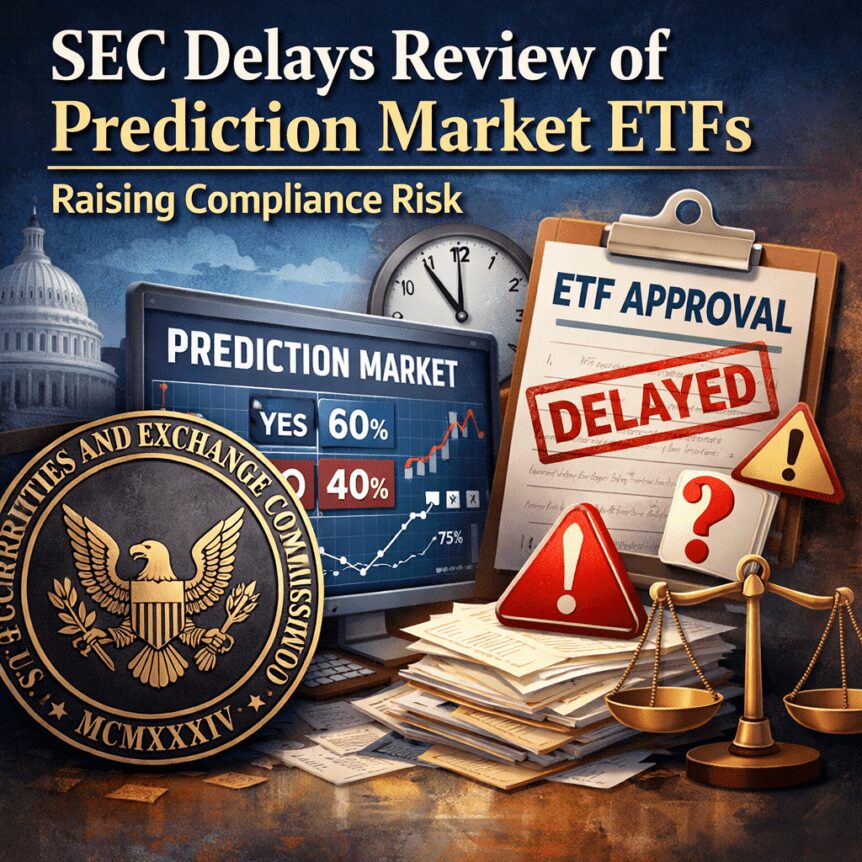
The U.S. Securities and Exchange Commission has paused the anticipated rollout of the first exchange-traded funds linked to prediction-market event contracts, delaying more than two dozen proposed ETFs from Roundhill Investments, GraniteShares, and Bitwise. The agency requested additional information about product structure and disclosures, according to Reuters, citing people familiar with the matter. The funds, filed in February, would provide exposure to binary outcomes tied to events such as elections, economic data releases, and market prices, without requiring investors to trade on explicit prediction-market platforms like Kalshi. The postponement underscores ongoing regulatory scrutiny of prediction markets in the United States, a space that has raised concerns about insider trading, ethics, and potential market manipulation.
The review pause arrives in a regulatory environment where authorities continue to drill into how prediction-market exposure should be structured, disclosed, and safeguarded for mainstream investment vehicles. The delay comes after a 75-day review period and ahead of what had been expected to be the launch window for the spectrum of funds.
Key takeaways
- The SEC has issued a temporary delay to the rollout of the first ETFs tied to prediction-market event contracts, seeking further information on product structure and disclosures from the issuers.
- The proposed funds aim to track binary event outcomes by using derivatives that mirror odds on underlying contracts traded on CFTC-regulated platforms, with settlements typically at $1 if the event occurs and $0 if it does not.
- Issuers emphasize that these investments carry risks that differ from traditional futures, options, or securities and may involve significant losses, valuation uncertainty, and deviations from stated investment objectives.
- Analysts had anticipated an imminent launch, with Bloomberg ETF strategist commentary suggesting an effective filing date of early May and talks of event-contract outcomes such as party control in the U.S. Congress.
- The delay highlights ongoing regulatory considerations for how such funds should be governed, disclosed, and monitored for market integrity, including potential settlement ambiguities and data-definition disputes.
Regulatory review and launch timeline
According to Reuters, the SEC’s request for more information appears to be a procedural step rather than a fundamental policy shift. The agencies’ actions indicate a careful, information-gathering approach to determine whether the funds’ structure, disclosures, and risk management align with investor protections and securities laws. The timing of the delay, which affects more than two dozen ETFs from the three sponsors, suggests that authorities are weighing the appropriateness of offering publicly traded access to prediction-market exposure at a broader scale.
Market observers had expected a rollout to proceed in the near term, with linkage to event-contract outcomes such as whether one political party controls the House or Senate, or other binary results. Bloomberg ETF analyst Eric Balchunas noted that the ETFs were anticipated to launch on the originally scheduled date, while James Seyffart indicated that Roundhill’s filing had an effective date around May 5. The reports underscore a convergence of regulatory review with market timing expectations, even as the SEC seeks clarifications that could shape the ultimate design of these vehicles.
Structure, mechanics, and risk disclosures
Prediction-market ETFs are designed to provide investors with exposure to binary event contracts without requiring direct participation in specialized prediction-market venues. While the exact features vary across the more than 20 proposed funds, the general design centers on derivatives intended to track the odds of a “yes” or “no” outcome on underlying contracts traded on platforms regulated by the CFTC. In practice, settlement would occur at $1 if the referenced event takes place and $0 if it does not.
In February filings, Roundhill highlighted significant risk factors associated with the proposed ETFs, noting that investments in event contracts carry “unique risks that differ from those associated with traditional futures, options or securities.” The disclosures point to substantial volatility and the possibility of material losses, valuation uncertainty, and deviations from the fund’s stated investment objective. Related considerations include potential settlement issues tied to interpretations of event outcomes, data sources, and timing—areas that could lead to disputes or mispricing if not well defined.
Implications for institutions, compliance, and market integrity
The SEC’s delay has practical implications for institutional access to predictive-market exposure. For banks, asset managers, and other regulated entities, the move reinforces the importance of rigorous governance, robust risk controls, and transparent data sourcing when dealing with unconventional assets. The disclosures emphasize that investors may face valuation challenges and uncertainties around how underlying event outcomes are determined, a factor that could influence internal risk ratings, capital treatment, and compliance reviews.
From a regulatory perspective, the development sits at the intersection of securities law, market integrity, and consumer protection. Prediction markets have historically attracted scrutiny regarding insider information, manipulation, and ethical concerns around market design. The current pause suggests that the SEC remains vigilant about ensuring that any tradable exposure to binary outcomes is accompanied by clear definitions, objective data sources, and robust dispute-resolution mechanisms.
For firms seeking to offer or participate in such products, the episode highlights the continuing relevance of AML/KYC considerations, licensing, and regulatory oversight across multiple agencies. As the landscape evolves, issuers and counterparties will likely need to align product disclosures with evolving standards for disclosure quality, risk articulation, and operational resilience in the event of ambiguous or contested outcomes.
Policy and market-structure context
The unfolding review mirrors broader regulatory dynamics surrounding forecast-based and outcome-contingent instruments in the United States. As authorities assess how to balance innovation in financial products with safeguards against systemic risk and market abuse, expect continued attention to how prediction-market ETFs are structured, how data feeds are validated, and how settlements are determined in edge cases. The review also intersects with cross-cutting regulatory themes, including the delineation of custody responsibilities, valuation methodologies, and the integrity of price discovery in derivative-linked products.
Looking ahead, observers should monitor whether the SEC’s information requests yield a clarified, harmonized framework for predictive-market ETFs or whether additional delays and refinements will extend the timeline. The outcome could influence product design choices, the pace of market access for institutional investors, and the regulatory posture toward prediction markets as a class of financial instruments.
The current pause does not indicate a permanent withdrawal of these investment vehicles but rather a measured, regulatory-driven pause to ensure that disclosures, risk management, and operational structures meet institutional standards. As reviews progress, issuers will need to address any ambiguities in event definitions, data sources, or timing determinations to maintain alignment with securities-law requirements and compliance expectations.
For market participants, the episode signals the importance of ongoing risk governance and transparent communication with investors about the unique characteristics and potential downsides of prediction-market exposure. As regulatory dialogue continues, institutions should prepare for evolving standards around disclosure quality, settlement mechanics, and oversight of event-based derivative instruments.
In sum, the SEC’s delay of the first prediction-market ETFs—while likely temporary—highlights the policy and risk-management complexities at the frontier of innovative financial products. The coming weeks will reveal how issuers adapt disclosures and how regulators calibrate the balance between investor access and safeguards against abuse in event-driven markets.
Crypto World
BTC breaks $80k for the first time since January as Fox DeFi explains the capital driving the rally


Disclosure: This article does not represent investment advice. The content and materials featured on this page are for educational purposes only.
Bitcoin reclaims $80,000 as ETF inflows and spot demand signal potential start of a new capital cycle.
Summary
- Bitcoin’s move above $80K reflects stronger spot demand and a shift toward long-term capital participation.
- As markets mature, Fox DeFi highlights a trend from short-term trading to structured, long-term strategies.
- Rising BTC prices signal a new cycle, with platforms like Fox DeFi supporting more stable, predictable participation models.
Bitcoin has reclaimed the $80,000 level, and this time, the logic behind the rally is changing.
After several weeks of consolidation, Bitcoin has broken above this key level for the first time since January, reaching an intraday high of $80,450 and marking its highest level in nearly three months.
More importantly, this rally is not simply driven by market sentiment, but is supported by a clear increase in spot buying activity. At the same time, continued inflows into spot ETFs are providing a steady source of demand.
This move not only signals a return in price but may also indicate the early stages of a new capital cycle.
Real buying returns: The dynamics behind the rally are shifting
On-chain data provides a clear answer. During the breakout above key levels, spot CVD (Cumulative Volume Delta) surged significantly, rising by nearly 200%. This typically indicates that the rally is being driven by active spot buying, rather than leveraged positions or short covering.
In other words, the underlying driver of the current market is shifting from trading-driven momentum to capital-driven demand.
Such a structural shift often suggests stronger sustainability for the trend.
Fox DeFi observation: Capital structure is being reshaped
From a deeper perspective, the core of this round of price increases is not just price, but a change in capital structure.
Fox DeFi points out in its market observations that an important trend is emerging: Market funds are shifting from short-term speculation to more stable medium- to long-term allocations.
In the past, price fluctuations were largely driven by high-leverage trading; currently, more and more funds are entering the Bitcoin ecosystem through more stable methods. This change is not only affecting price movements but also reshaping investor participation logic.
Fox DeFi believes that as the market enters a phase dominated by real funds, strategies relying solely on short-term trading will gradually lose their advantage.
Institutional movements: Long-term funds continue to deploy
Signals from institutional investors are also worth noting. Large holders are gradually resuming their buying pace and continuously allocating across different price ranges. This behavior is essentially a long-term strategy — reducing the risk of market volatility through phased deployment.
Historical experience shows that when such funds begin to systematically enter the market, it often signifies that the market is in the early stages of trend establishment.
Macroeconomic resonance: Market sentiment is improving
From a broader market perspective, Bitcoin’s rise is not accidental.
Recently, global stock markets have generally performed well, risk assets have begun to recover, and investors’ risk appetite has significantly increased. At the same time, the regulatory environment has improved, making it safer for more funds to enter the crypto market.
Against this backdrop, Bitcoin is no longer just an independently fluctuating asset but is increasingly influenced by overall market sentiment.
When market sentiment improves, assets like Bitcoin typically experience price increases sooner.
Participation methods are changing: More than just trading
As market structures evolve, so too are investor participation methods.
Fox DeFi points out that more and more users are shifting from short-term trading to longer-term, more stable participation paths, paying closer attention to trends and capital cycles.
At a practical level, this shift is becoming increasingly clear. Taking Fox DeFi as an example, users only need to complete basic account registration and setup to get started. They can then choose participation plans with different time horizons based on their strategies and allocate capital using major digital assets. The system operates under predefined rules, with returns calculated and settled on a periodic basis, making the process more transparent and allowing for more predictable outcomes.
In this model, assets are no longer passively held but are incorporated into cloud computing power contracts, enabling funds to operate continuously and generate returns.
As more and more funds adopt this approach, market competition is also changing: it’s no longer about who can capitalize on short-term fluctuations, but about who can establish a stable participation structure earlier.
Outlook: The market is entering a capital-driven phase
Bitcoin’s return to the $80,000 level signals a shift from sentiment-driven momentum to capital-driven dynamics.
Going forward, the real differentiation will not lie in who predicts price movements correctly, but in who can better align with the direction of capital flows and establish more stable, sustainable ways of participating in the market.
Conclusion
This breakout, while superficially a price correction, is essentially a restructuring of the funding logic.
As the market shifts from being emotion-driven to being fund-driven, opportunities will no longer be concentrated on short-term fluctuations, but rather on how to participate in the trend itself.
In this context, Fox DeFi believes that as the market gradually enters a phase dominated by real capital, diversified participation methods around the Bitcoin network are increasingly becoming a focus for investors, including long-term participation models based on computing power and strategies.
Disclosure: This content is provided by a third party. Neither crypto.news nor the author of this article endorses any product mentioned on this page. Users should conduct their own research before taking any action related to the company.


Latest Coinglass data show Hyperliquid whale accounts holding a combined $4.016 billion in notional positions, with longs only marginally ahead of shorts on size but comfortably in the lead on PnL as one heavily leveraged ETH long dominates the winner’s circle.
Summary
- Coinglass data shows whale positions on Hyperliquid total $4.016 billion, with $2.024 billion in longs (50.39%) and $1.992 billion in shorts (49.61%), for a long-short ratio of 1.02.
- Aggregate PnL is tilted against bears: long positions sit on about $14.8423 million in profit, while shorts are nursing roughly $41.6691 million in losses.
- A single whale address, 0xa5b0..41, is running a 15x leveraged ETH long from $2,265.48 with unrealized profit of around $2.9404 million.
Latest Coinglass whale-tracking data indicate that large traders on Hyperliquid currently hold a combined $4.016 billion in notional positions, almost perfectly balanced between the two sides of the book.
Whales are near flat but shorts are underwater
Long exposure stands at $2.024 billion, representing 50.39% of whale holdings, while short exposure totals $1.992 billion, or 49.61%, putting the long‑short ratio at 1.02 and signaling only a marginal bullish skew in positioning.
Despite that near symmetry, performance is asymmetric: long whales are up about $14.8423 million on their positions, whereas short whales show an unrealized loss of roughly $41.6691 million, implying that recent price action has leaned against bears even as positioning remains almost evenly split.
Coinglass’ Hyperliquid whale tracker, which aggregates large-account data across perpetuals, highlights that this is part of a broader pattern where the account‑based long/short ratio hovers near 1.0 while PnL swings are driven by timing and leverage rather than headline notional alone.
Key ETH whale running 15x leverage
Within that aggregate, one address stands out: whale wallet 0xa5b0..41, long tracked by derivative data feeds and prior reports, currently holds a 15x leveraged long position on ETH opened at an entry price of $2,265.48.
At current pricing levels referenced by Coinglass, the position shows an unrealized profit of approximately $2.9404 million, making it one of the largest single-account ETH long PnLs on the platform right now.
Historical snapshots from RootData show the same address repeatedly re‑pricing its ETH 15x long as the market has moved — at times sitting on multi‑million‑dollar gains when ETH traded near $2,150–$2,000, and at other times shouldering seven‑figure drawdowns when price reversed.
A recent crypto.news guide to the Hyperliquid whale tracker stressed that such concentrated, high‑leverage whale positions can act as “hidden liquidation magnets,” influencing order‑book dynamics as funding, price, and margin levels converge.
Another crypto.news explanation noted that a long‑short ratio clustered near 1.0 with large absolute notional can signal a market poised for sharp moves once one side is forced to de‑risk, especially when short PnL is already deeply negative as current data suggest.
A separate crypto.news update tracked earlier Hyperliquid snapshots where total whale exposure was nearer $3.7 billion, with the same 0xa5b0..41 address running the ETH 15x long from $2,265.48 at a smaller unrealized gain — underscoring how the trade has swelled in value alongside the broader build‑up in whale notional.


Disclosure: This article does not represent investment advice. The content and materials featured on this page are for educational purposes only.
Crypto payments gain mainstream traction as trust and infrastructure become central to industry growth.
Summary
- Crypto payments are mainstream, with trust and security now critical as infrastructure maturity defines industry credibility.
- The CoinsPaid incident shows strong security lies in response, protecting funds, restoring services, and transparent communication.
- Upgrades like CCSS Level 3 for CryptoProcessing by CoinPaid highlight ongoing security improvements shaping trust in crypto payments.
Crypto payments are joining credit cards and bank payments as mainstream payment methods. In 2025, the total crypto market cap crossed $4 trillion for the first time, mobile wallet use hit a new high, and active crypto users reached hundreds of millions. Scale also changes the conversation for businesses. Speed and global reach still matter; however, trust now comes first.
Trust in crypto payments starts with the blockchain infrastructure. It protects funds, handles data with care, follows compliance rules, and keeps services stable under pressure. Security standards make or break the credibility of the entire industry at this point.
What crypto payment security means in practice
For merchants, security is not one control or one audit. It is a set of working systems that support every transaction from start to settlement. There are a few things to consider here:
- Fund protection
Customer due diligence, KYB checks, AML controls, an MLRO, precise risk scoring, and accounting documentation are all important for merchants. Exchanges and liquidity are also a part of that system – the more a provider can cut price volatility exposure at the point of sale, the better it protects the business side of the transaction.
- Data protection
Different regions have varying data management regulations, and payment data can be especially sensitive. Providers need to undergo independent audits, ensure data security, and demonstrate their ability to prevent the exposure of personal data. Mature security must be reviewed, tested, and renewed regularly, with relevant certifications such as ISO, SOC 2, and others.
- Regulatory compliance
Payment service providers need to hold relevant licenses in some jurisdictions, in addition to transaction screening and KYC/KYB policies that ensure compliance with AML and sanctions regulations. Compliance is becoming increasingly important as cryptocurrencies enter mainstream markets alongside credit card payments, with various consumer protections and expectations attached.
- User protection
A strong payment provider does not stop at moving funds from one wallet to another. It builds a process that reduces confusion, tracks transaction status, supports reconciliation, and provides clients with clear visibility into what is happening. Accurate reporting is part of operational security because it reduces risks and promotes transparency.
The reality of risk
No serious infrastructure provider sells the fantasy of total immunity. Digital payment systems handle value, data, credentials, and access rights. That makes them a natural target for attackers. In 2025, more than $6.7 billion had been stolen from cryptocurrency services. The lesson is not that crypto payments in particular are risky; for example, $20-30 billion gets stolen from businesses in credit card fraud each year. The lesson is that mature companies prepare for stress, respond fast, and recover in a controlled way.
This is the point many outside the industry miss. Trust does not come from pretending incidents never happen. Trust comes from the way a provider performs on a hard day. Preparedness, speed of response, system resilience, and clear communication tell clients far more than any slogan ever will.
Elements of a mature incident response
A strong incident response usually has four parts:
- Rapid detection. Internal measures must trigger alarm systems and help the team stop malicious activity quickly. Early detection limits damage and provides a real starting point for recovery.
- Containment. Attack vectors must be isolated, major partners must be alerted, and reports must be filed with law enforcement and relevant authorities.
- Recovery. Systems need to be quickly returned to operation once risk exposure is eliminated. Good recovery work restores core functions first and then stabilizes the rest.
- Communication. Clients need facts, not noise. Any payment company dealing with an incident must maintain active communication and ensure the security of client funds.
Coinspaid case: Examining an incident response
In 2023, the blockchain payment infrastructure provider Coinspaid faced a security incident with its payment gateway, CryptoProcessing. Service availability was affected, and the company lost an estimated ~$30 million. The incident was quickly contained, and no customer funds were lost.
This serves as a good case study of a mature security system:
- Detection systems helped find, assess, and ultimately limit the damage.
- Containment quickly moved to protect customer funds, all of which were secured.
- Core services returned, with the gateway handling 80% of its usual volume within a week.
- Communication stayed public and proactive throughout the incident.
The situation proved that security in crypto payments is a live, operational discipline. Public reporting from the company showed that the issue affected platform availability and company revenue, but not client funds. Updates then showed recovery progress within days. That is how mature infrastructure should be judged – by the quality of the response once an incident appears.
That measured response also helps reduce reputational risk. A defensive tone would have weakened trust. Silence would have weakened it too. A calm public record, built around fund protection, service recovery, and concrete actions, does the opposite and shows control under pressure.
Security work after the incident
Another sign of maturity in both systems and businesses is how recovery is handled. Blockchain payment providers, like any business handling funds or data, regularly face challenges and know how to address vulnerabilities and harden defenses following incidents.
Going back to our example, after the 2023 incident, Coinspaid outlined a series of security steps. The list included ISO 27001 work, stronger development standards, FIDO2-based authentication, hardware security review, external security audits, bug bounty activity, continuous traffic analysis, and ongoing team training.
More recently, in April 2026, CryptoProcessing by Coinspaid announced CCSS Level 3 certification for its wallet and key management infrastructure. These moves are all signs of a provider that keeps building years after the urgency has passed. Follow-through helps the market move forward and serves as a confidence signal for existing and future users.
Transparency as a trust factor
Security and transparency belong together. A provider may have strong internal controls, but trust weakens fast when clients cannot see service health in real time.
That is why public status infrastructure matters. CryptoProcessing’s status page at official website shows live service health across back office, API servers, transaction processing, deposits, withdrawals, exchanges, and invoicing. It also shows 90-day uptime, past incidents, maintenance notices, and offers various subscription options to quickly catch uptime issues.
Mature companies do not hide operational reality behind private messages and long support threads. They publish live status for everyone to see, which has become a standard for most trusted online services. Ultimately, it’s all about raising the standard for the industry at large,
Conclusion
Security in crypto payments is a process, not a final state. Markets grow. Threats shift. Controls improve. Attack methods change. Rinse and repeat. Companies that earn trust are the ones that keep working, keep communicating, and keep protecting client interests in real conditions.
In this market, maturity comes down to the ability to handle pressure with control. Providers earn trust when they protect client funds, keep systems resilient, communicate openly, and keep improving after the hard day has passed.
For the foreseeable future, security will remain the foundation of trust in payments. We’re unlikely to achieve an ideal system any time soon – and even if we did, it’d quickly stagnate – so, prevention and a good response to potential incidents are the best thing we have for now.
Disclosure: This content is provided by a third party. Neither crypto.news nor the author of this article endorses any product mentioned on this page. Users should conduct their own research before taking any action related to the company.

Western Union has launched its US dollar-denominated USDPT stablecoin on Solana, marking its first move into blockchain-based payments and onchain settlement for its global remittance network.
One of the crypto infrastructure platforms involved in the launch, Fireblocks, said on Monday that USDPT is initially being rolled out in Bolivia and the Philippines, while Western Union said it plans to expand the stablecoin to more than 40 countries in 2026.
Major remittance companies have been eyeing stablecoins after the passage of the stablecoin-friendly GENIUS Act in July. MoneyGram started offering USDC (USDC) stablecoin services in Colombia in September, while Zelle announced plans to offer stablecoin-powered cross-border transfers in October.
Western Union said the “launch of USDPT reflects a broader shift in how global payments are evolving,” adding that more financial institutions will adopt “regulated digital assets as core infrastructure going forward.”
The stablecoin market cap currently sits at $317.3 billion, a figure that the US Department of the Treasury and Wall Street investment bank Citigroup have tipped to grow above $2 trillion by 2030.

Source: Western Union
Western Union to make USDPT available on crypto exchanges
USDPT is being issued by crypto infrastructure firm Anchorage Digital, the first federally regulated crypto bank in the US, while Fireblocks is providing the wallet and settlement infrastructure for the stablecoin.
Western Union said it plans to make USDPT available on licensed crypto exchanges and connect them to its broader payments and liquidity infrastructure.
Related: Australia draft payments vision eyes stablecoin interoperability
USDPT’s launch in Bolivia and the Philippines makes the stablecoin available to a combined 130 million people.
On Sunday, Bybit’s former chief marketing officer, Claudia Wang, said there was an opportunity for money transmitter firms like Western Union to tap into many untouched remittance corridors in the Americas, which have become a $174 billion market.
She said remittance corridors between the US and Central America are exploding, while many routes from within Latin America — such as from Argentina to Bolivia — have been “almost untouched by crypto rails.”
Western Union facilitates transfers for more than 150 million customers across more than 190 countries.
Magazine: Singapore isn’t a ‘crypto hub’ — it’s something better: StraitsX CEO
The White House is considering a plan to review powerful artificial intelligence models before they are released, according to reports published on May 5, 2026.
The proposal would mark a major shift in US AI policy. It could give the federal government a direct role in assessing advanced models before they reach the public or are deployed across government systems.
The discussions reportedly center on a new executive order. It could create an AI working group involving government officials, national security agencies, and technology executives.
Trump as the AI Guardian Gatekeeper?
The immediate concern is security. Reports say officials are worried that frontier AI models could help users discover software flaws, write harmful code, or accelerate cyberattacks.
One model reportedly under scrutiny is Anthropic’s Claude Mythos. Cybersecurity experts have warned that its coding ability could make complex attacks easier to plan and execute.
However, the White House has not confirmed a final policy. Officials have described talk of a new executive order as speculation, saying any announcement would come directly from President Donald Trump.
The main risk is overreach. A pre-release review process could slow AI development, create political pressure over model launches, and give Washington unusual influence over private technology.
At the same time, the security argument is not weak. If a model can meaningfully improve cyberattack capability, the government has a clear reason to examine how it is released and who can access it.
The key question is scope. A narrow review for national security and government deployment would be easier to justify. A broader approval system for all major AI models would be more controversial.
There is a recent comparison in crypto. Trump created a digital asset working group in January 2025 to coordinate policy across agencies. That group later helped shape the administration’s crypto agenda, including stablecoin rules and agency-level action.
That history matters. Trump’s working groups can start as advisory bodies, then become policy engines. If the AI plan moves forward, it may become the first serious test of how far his administration is willing to control frontier AI before release.
The post President Trump Could Vet AI Models Before Public Release appeared first on BeInCrypto.

South Korea’s cryptocurrency sector is sounding the alarm over proposed AML rule changes that could force virtual asset service providers (VASPs) to report all overseas-linked transfers valued at 10 million won or more as suspicious by default. Industry observers warn that such a threshold could dramatically expand the volume of suspicious activity reports (SARs) and overwhelm compliance operations across the market.
According to Yonhap News, the Digital Asset eXchange Alliance (DAXA), the industry body representing the country’s major exchanges, submitted formal comments on the Enforcement Decree of the Specific Financial Information Act and related supervisory rules. The positions reflect the input of 27 registered VASPs, including the five largest platforms—Upbit, Bithumb, Coinone, Korbit, and Gopax.
DAXA estimated that the proposed rule could increase SARs from roughly 63,000 filings in the previous year to more than 5.4 million, an 85-fold surge that could render practical compliance unworkable. The group also pushed back against a proposed requirement to verify the accuracy of customer information, arguing that lower-level rules create duties that are not clearly defined in the underlying statute.
The Korea-focused pushback comes as authorities press a tighter AML regime for crypto firms, while industry participants warn that the scope of compliance obligations may outpace practical execution. In parallel with the submission, the Financial Services Commission (FSC) and the Financial Intelligence Unit (FIU) proposed amendments on March 30, with a public notice window running through May 11. If finalized, the rules would require domestic VASPs conducting virtual asset transfers with overseas VASPs to report transactions of 10 million won or more as suspicious regardless of risk level, with finalization expected in July after regulatory and legal review.
As the regulatory process advances, the sector already faces legal scrutiny over AML-related sanctions imposed by the FIU. Industry participants have challenged these sanctions in court, highlighting the evolving tension between a robust regulatory framework and practical enforcement capabilities.
Key takeaways
- The proposed AML amendments would mandate automatic SAR reporting for overseas-linked transfers at or above 10 million won, regardless of risk assessment.
- Industry body DAXA represents 27 registered VASPs, including South Korea’s five largest exchanges, and warns that SAR volumes could surge to over 5.4 million annually.
- Compliance concerns center on operational feasibility and the perceived mismatch between the new reporting duties and the underlying legal framework.
- Regulators have opened a public notice period (through May 11) with an anticipated July finalization, signaling a rapid regulatory trajectory in crypto AML policy.
- Separately, major exchanges have been contesting FIU sanctions in court, illustrating a developing enforcement landscape that could influence future supervision and licensing dynamics.
Regulatory backdrop: tightening AML oversight
The amendments to the Enforcement Decree of the Specific Financial Information Act, proposed by the FSC and FIU, aim to strengthen cross-border AML controls for digital asset transfers. The core change would require domestic VASPs to flag and report overseas-linked transfers of 10 million won or more as suspicious, irrespective of the assessed risk. The policy intent is to close gaps where illicit activity could exploit cross-border liquidity channels, but industry participants argue that the rule could become too broad and operationally burdensome, especially for smaller firms with limited compliance capacity.
The public notice period offers an opportunity for stakeholders to weigh in before any final rule is issued. If enacted, the changes would align with a tightening trend in crypto regulation seen in various jurisdictions, though the Korean framework would operate within its own statutory and supervisory context. The anticipated July finalization suggests authorities expect to move quickly from consultation to enforcement once the legal reviews are complete.
Beyond the specific threshold, observers note that Korea’s AML drive intersects with broader policy objectives—such as enhanced customer due diligence, enhanced transparency for cross-border flows, and tighter verification standards. While the goal is to mitigate illicit finance risks, firms warn that a miscalibrated regime could disrupt legitimate activity, complicate banking relationships, and raise compliance costs across the ecosystem.
Judicial challenges and enforcement trajectory
Amid regulatory tightening, exchanges are increasingly challenging FIU-imposed sanctions in court, signaling a shifting enforcement trajectory that could influence future supervisory practices. The outcomes of these cases may shape the boundaries of how strictly AML rules are applied and interpreted in practice.
In April, Upbit operator Dunamu secured a first-instance ruling that canceled a three-month partial business suspension tied to alleged customer due diligence shortcomings and transactions with unregistered foreign VASPs. The FIU appealed the decision on April 30, underscoring the ongoing legal scrutiny of enforcement measures.
Separately, Bithumb obtained court relief after the Seoul Administrative Court suspended enforcement of a six-month partial business suspension pending the main case resolution. The suspension followed an FIU inspection that identified alleged violations of the Financial Information Act, including failures related to transactions with unregistered overseas VASPs.
Coinone also received a temporary reprieve, challenging a three-month partial suspension and a 5.2 billion won fine on AML grounds. Local reporting highlighted issues around customer verification and interactions with unregistered overseas VASPs as part of the underlying dispute.
These court actions illustrate a fragile balance between aggressive AML enforcement and ensuring regulatory measures align with due process and practical compliance realities. The outcomes could influence how future sanctions are imposed, reviewed, and sustained, potentially affecting licensing considerations and ongoing supervision of exchanges operating in Korea.
Context and implications for compliance and cross-border regulation
Korea’s AML push is part of a broader, global trend toward tighter crypto regulation. While the intent is to curb illicit activity and protect financial systems, the practical implications for exchanges, banks, and institutional participants are significant. The proposed threshold—combined with mandatory reporting of overseas-linked transfers regardless of risk—could alter risk assessment frameworks, audit trails, and intergovernmental cooperation on enforcement. For firms with international operations or partner banks abroad, the changes may necessitate enhanced cross-border compliance programs, more robust data handling procedures, and closer alignment with domestic and overseas regulatory expectations.
In a wider policy context, Korea’s approach parallels global moves to create more consistent AML standards for crypto activities, while also highlighting the ongoing challenge of reconciling rigorous enforcement with operational feasibility. As with other advanced regimes, the interplay between domestic law, supervisory practice, and cross-border cooperation will shape the crypto compliance landscape for years to come.
Closing perspective: With the July deadline for finalizing the amendments approaching and ongoing court actions shaping enforcement precedents, the coming months will be critical for exchanges, regulators, and compliance teams as they navigate a rapidly evolving regulatory regime and its practical implications for cross-border crypto activity.
Crypto World
Bitcoin Price Today: Pepeto Exchange Targets 100x as BTC Posts Strongest April Since 2021 With $2.44B in ETF Inflows

The bitcoin price today shows BTC trading near $78,411 after Cointelegraph reported an 11.87% rally in April backed by $2.44 billion in spot ETF inflows, the strongest monthly performance of 2026, and when Bitcoin posts its best month since early 2021 while institutional money flows in at record levels, the bull run is building strength.
The market consolidates below $80,000, but consolidation is exactly where the projects at presale pricing with real exchange infrastructure prepare to deliver 100x when the breakout arrives.
BTC Rallies 11.87% in April With $2.44 Billion ETF Inflows as Bulls Target $84,000 Breakout
Cointelegraph reported Bitcoin rallied 11.87% in April with $2.44 billion in spot ETF inflows, while May 1 alone saw $630 million with BlackRock’s IBIT pulling $284 million. Bulls now target $84,000.
When BTC holds strong on the best monthly inflows since October 2025, presale entries with exchange tools capture the buying wave first.
What Crypto Should You Enter as the Bitcoin Price Today Holds Strong After the Best Month of 2026?
Pepeto: The Exchange Presale That Smart Capital Is Loading While the Bitcoin Price Today Consolidates
BTC at $1.5 trillion already sits at a valuation where even a strong breakout past $80,000 delivers single digit percentage gains, and while those gains are real, they are not the kind that change your financial position in months. The 100x entries in crypto have always come from projects that are still building before the listing gives them a market price, and that is exactly what is happening with Pepeto right now.
Over $9.79M in capital already flowed into the presale, showing the kind of commitment that only appears when traders believe something real is being built. A full SolidProof audit covers every contract, and the founder behind the original Pepe token, a project that reached $7 billion, leads the build.
Due to the rapid growth and strong attention the project is receiving, Pepeto has faced a domain attack on its original website. The team responded fast and launched Pepeto as the provisory active domain where investors can enter the presale safely right now.
The timing matters. April’s 11.87% rally confirms crypto demand is building, not fading. That momentum creates the perfect conditions for an exchange that brings Ethereum, BNB Chain, and Solana under one roof, charges nothing on trades, and shows risk scores before any money moves.
Staking rewards at 175% APY compound daily right now. A $10,000 position produces about $1,458 in monthly returns flowing into your wallet while the listing approaches. The traders already inside are building positions during this consolidation and compounding returns every single day, not watching from the outside hoping for a signal, and 2026 is quickly becoming the year where this single presale entry could change everything for those who recognized it in time.
Bitcoin (BTC) Price Today at $78,411 as Bulls Push Toward $80,000 Resistance
Bitcoin (BTC) trades near $78,411 with the bitcoin price today showing strength after the strongest April since 2021 according to CoinMarketCap.
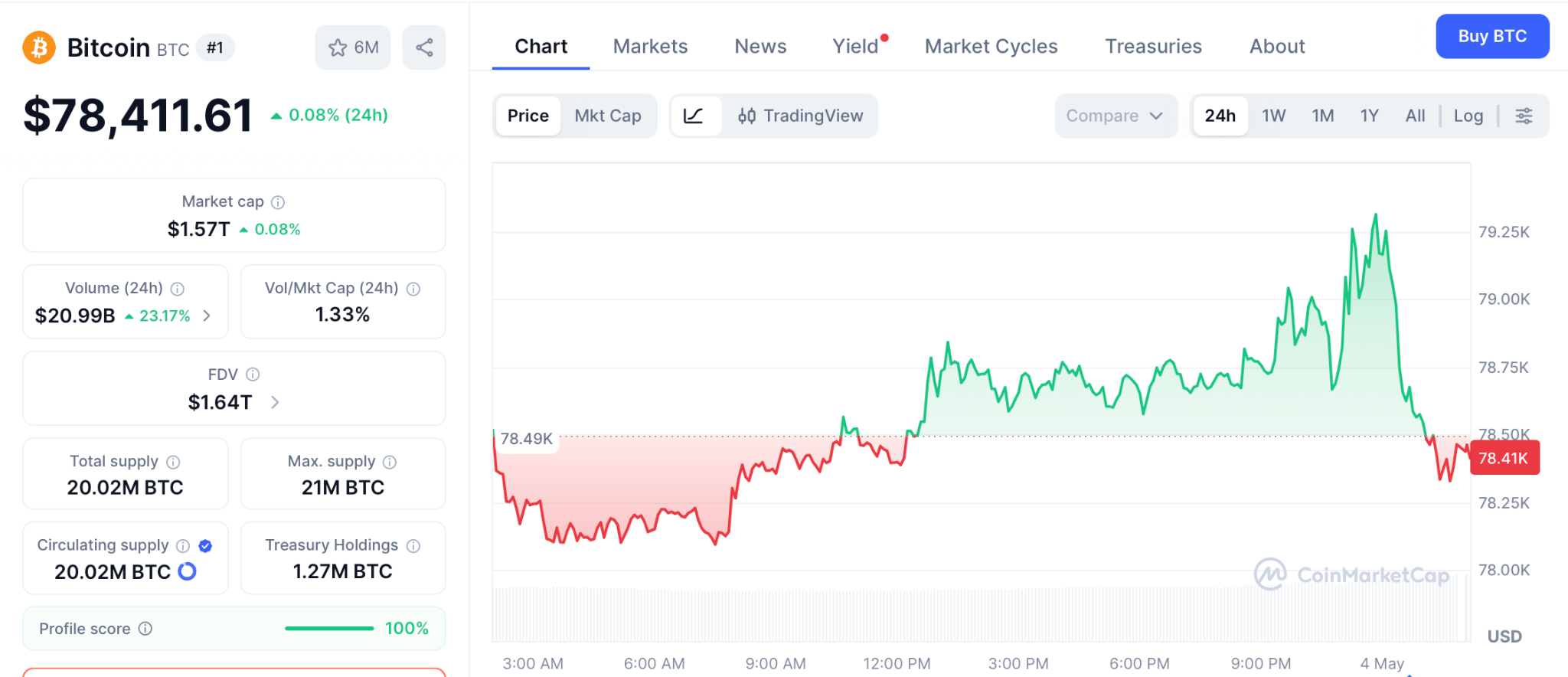
Support holds at $75,800 with a target of $84,000 if bulls flip $80,000. At $1.5 trillion market cap, BTC offers 8% upside to $84,000, not the 100x returns that presale entries deliver at Pepeto.
Dogecoin (DOGE) Price at $0.109 as DOGE Lacks Exchange Tools and Depends on Meme Culture
Dogecoin (DOGE) holds near $0.109 with support at $0.10 and resistance at $0.12. DOGE reached an all-time high of $0.74 in May 2021 and sits 85% below that peak, with recovery depending entirely on social energy returning.
BTC holds strong but DOGE at this level offers hope while Pepeto at presale pricing offers exchange backed growth with a verified audit that meme coins cannot match.
Conclusion:
The strongest April in years just confirmed that the bull market is building, and the widest gap between a presale price and a listing price in this entire market sits inside Pepeto right now. Each round closes quicker than the last, 175% APY is growing positions daily while most traders watch the $80,000 level and wait for a signal, and the listing will shut this window permanently.
Visit Pepeto and enter the presale now, because the moment the exchange goes live and the bitcoin price today sends fresh capital into every connected chain, the price you see right now becomes a memory, and 2026 delivers its biggest returns to the traders who got in while others were still looking at charts.
Click To Visit Pepeto Website To Enter The Presale

FAQs
What is the bitcoin price today in May 2026?
The bitcoin price today shows BTC at $78,411 after an 11.87% rally in April with $2.44 billion in spot ETF inflows, the strongest month of 2026. Visit Pepeto.
Why is Pepeto a better entry than Dogecoin right now?
Pepeto has a full exchange in development with a SolidProof audit and $9.79M raised, while Dogecoin lacks infrastructure and depends entirely on meme sentiment for any price recovery from its current 85% distance below all-time highs.
Disclaimer: This is a Press Release provided by a third party who is responsible for the content. Please conduct your own research before taking any action based on the content.


NYT Connections hints and answers for Tuesday, May 5 (game #1059)
Blake Lively makes surprise Met Gala appearance hours after settling Justin Baldoni legal battle

Get Your Money Right Song – Learn About Money | Songs For Kids | Math | GoNoodle

Manchester United reach agreement with Casemiro over contract clause amid transfer speculation

US brings back mandatory military draft registration

Steven Gerrard disagrees with Gary Neville over ‘shock’ Chelsea and Arsenal claim | Football


-

 Business6 days ago
Most Commercial Energy Audits Miss the Real Losses
-

 Fashion6 days ago
Kylie Jenner’s KHY Enters a New Era with ‘Born in LA’
-

 NewsBeat1 day ago
Channel 5 – All Creatures Great and Small series 7 new post
-
 Tech3 days ago
Trump’s 25% EU auto tariff breaches Turnberry Agreement that also covers semiconductors and digital trade
-
 Sports3 days ago
Paul Scholes issues Marcus Rashford reality check as agreement emerges over Man United star
-

 Crypto World7 days ago
CFTC’s AI will review U.S. crypto registration applications, chairman tells CoinDesk
-

 Business6 days ago
Barclay Brothers Avoid Bankruptcy: HSBC Drops High Court Petitions After IVA Deal
-
 Business5 days ago
Tesla Officially Registers Elon Musk’s Stock: What Investors Need to Know
-
 Crypto World7 days ago
Robinhood Phishing Scam Exploits Gmail Dot Feature to Bypass Security
-

 Tech7 days ago
Get Ready for More Brain-Scanning Consumer Gadgets
-

 Crypto World7 days ago
Gmail Dot Trick Underpins Robinhood Phishing, Sending Real-Looking Emails
-

 Business4 days ago
Two Powerball Tickets Split $143 Million Jackpot in Indiana and Kansas
-

 Tech5 days ago
Texas Instruments made a new flagship graphing calculator: the TI-84 Evo
-
 Crypto World4 days ago
CoreWeave (CRWV) Stock Climbs 8% Despite $45M Insider Share Dump
-
Business2 days ago
Winning Numbers Drawn as Jackpot Resets to $20 Million
-

 Business7 days ago
Top 10 AI Companies Leading New Zealand’s Tech Boom in 2026
-

 Tech7 days ago
Bambu Lab H2C review: the Cadillac of 3D printers
-

 Tech7 days ago
Robinhood account creation flaw abused to send phishing emails
-

 Business7 days ago
General Motors (GM) earnings Q1 2026
-
 Crypto World7 days ago
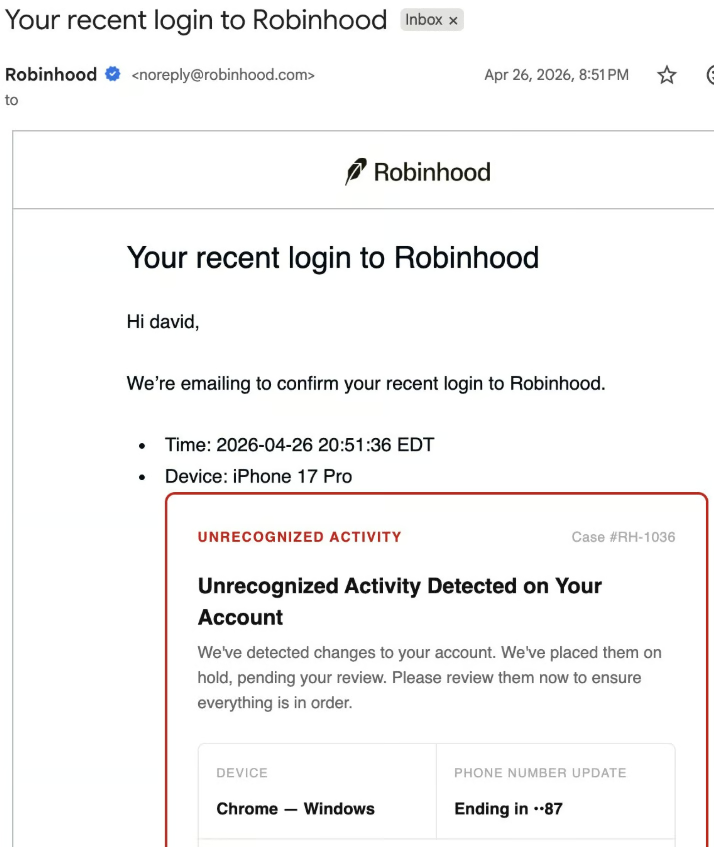
Robinhood Phishing Scam Uses Gmail Dot Trick to Send Real Emails
You must be logged in to post a comment Login