

Crypto World
Ripple’s XRP Crashes to 3.5-Month Low: Here’s Why

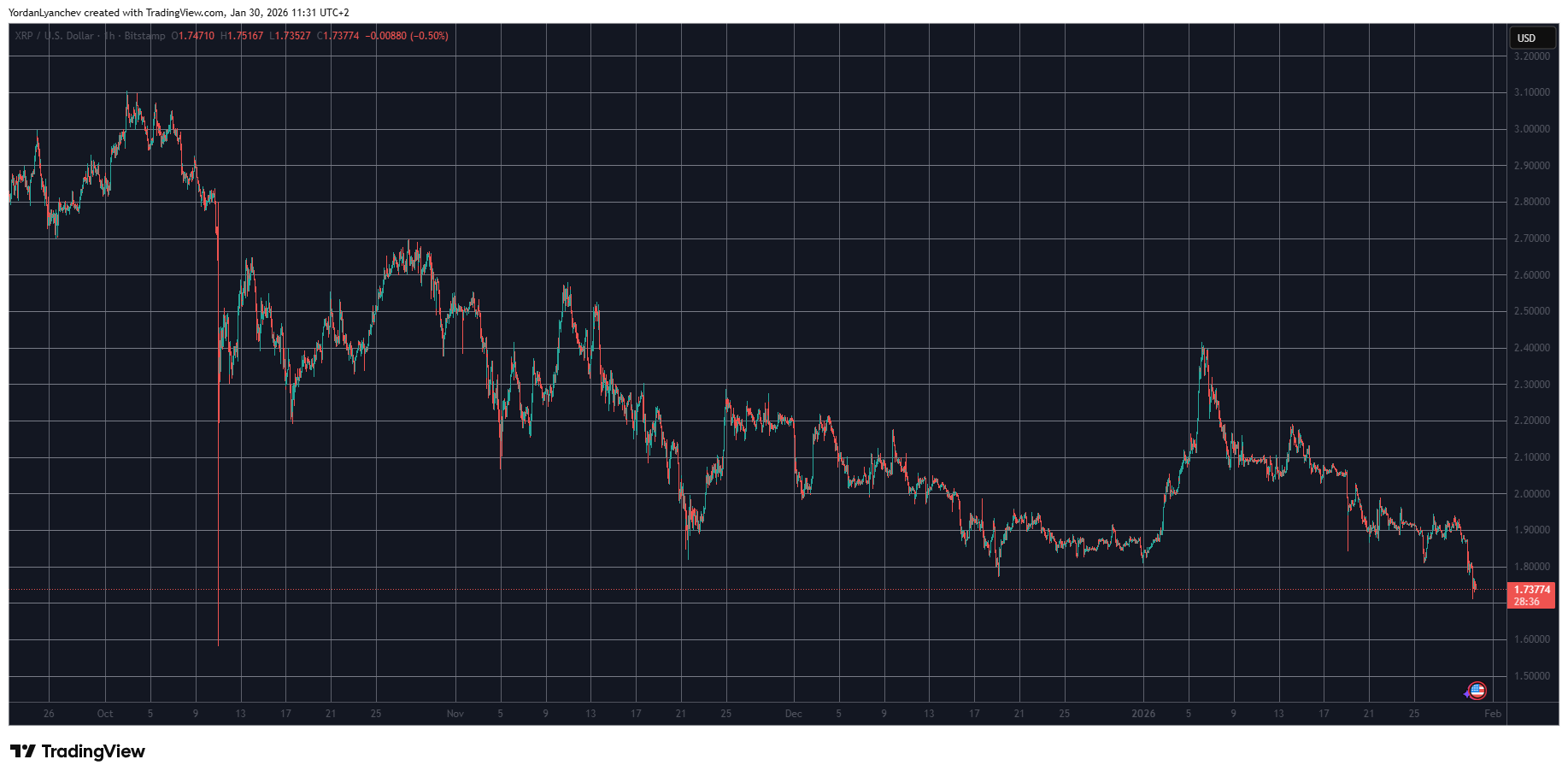
It’s safe to say that the cryptocurrency markets have seen better days as bitcoin led the way toward another substantial crash on Thursday afternoon that culminated hours ago with new multi-month lows.
Ripple’s cross-border token is no exception, as the asset dumped to $1.70 for the first time since the early October massacre, when it dipped below $1.60 on most exchanges and even beneath $1.00 on a few.
The chart above paints a highly painful picture for Ripple’s token this year. Although it’s hard to believe now, recall that it skyrocketed in the first week of 2026 to just over $2.40 in times when the market showed minor signs of revival and the inflows toward the spot XRP ETFs were steady and impressive.
However, both have changed in the past few weeks, perhaps driven by growing geopolitical uncertainty on many fronts, the latest being between the US and Iran.
As such, one of the two significant reasons behind XRP’s latest crash to a multi-month low is the overall market-wide state, in which BTC dumped to $81,000, and many altcoins plummeted by 8% or more.
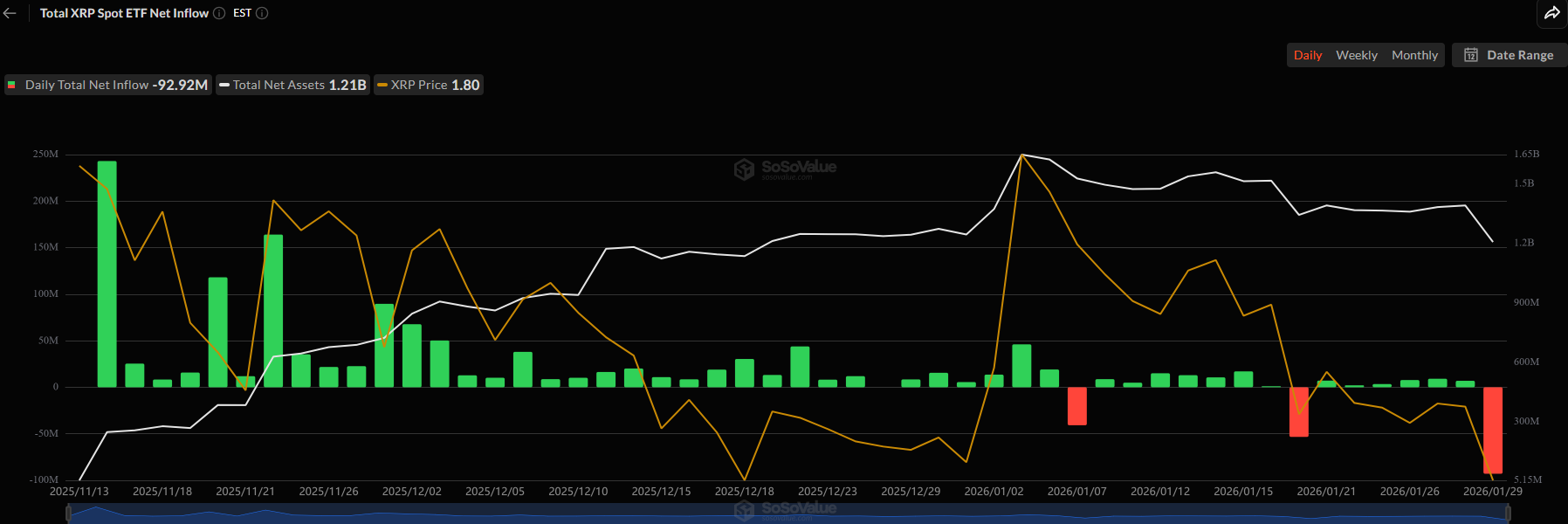
The second, though, could be attributed to the aforementioned ETFs, which recorded their worst single-day net-flow performance since the first, Canary Capital’s XRPC, launched in mid-November.
Data from SoSoValue shows that the total net outflows for January 29 stood at $92.92 million, which brought the cumulative net inflows down to $1.17 billion from $1.26 billion. Moreover, this amount is almost as high as the previous net outflows combined.
CryptoWZRD weighed in on XRP’s recent performance, indicating that as long as the asset remains below $1.82, traders could expect “more random movement.” A rebound to over that level, though, could turn the tables in a more favorable manner for the bulls.
The post Ripple’s XRP Crashes to 3.5-Month Low: Here’s Why appeared first on CryptoPotato.

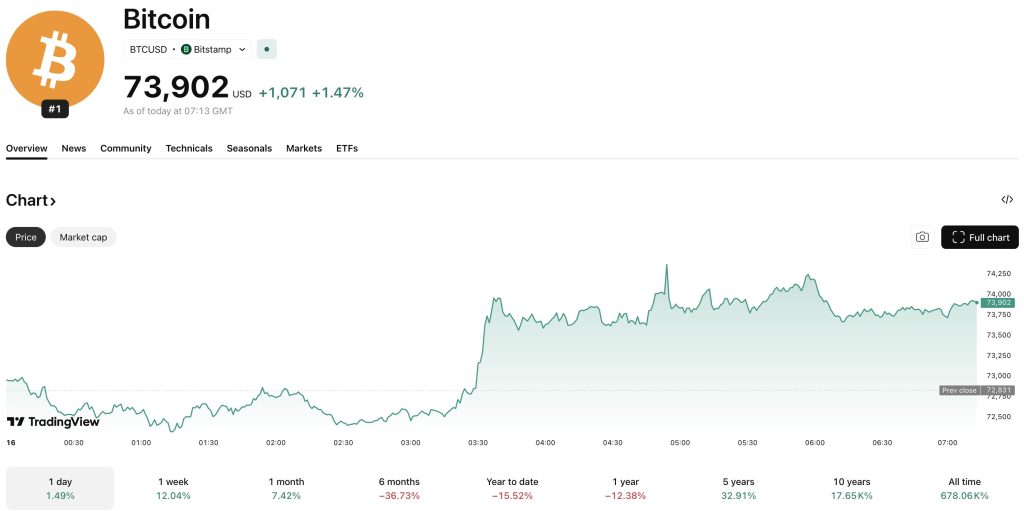
The Bitcoin price shattered the $74,000 ceiling on Monday, posting its highest daily close since early February 2026, while gold prices retreated. While BTC USD has since dropped to $73,700, traders have been left asking ‘Why is crypto up?’
This move signals a decisive shift in asset correlations as institutional capital rotates from precious metals back into digital assets following weeks of consolidation.
Bitcoin surged to an intraday high of $74,150, marking a +7.5% single-day rally that has effectively erased the losses sustained in late February.
Trading volume on the day exploded to $70.8Bn, a liquidity spike that validates the breakout above the consolidated $68,000–$72,000 range.

Why is Crypto Up? Is Bitcoin Replacing Gold as the Crisis Hedge?
The most compelling narrative driving this rally is the Crypto Decoupling from traditional precious metals. Historically, Bitcoin and gold have moved in tandem during periods of geopolitical uncertainty. However, recent data suggest a structural break in this relationship.
Institutional flows tell the story clearly. While gold ETFs saw net outflows of approximately -$400M last week, US-based Spot Bitcoin ETFs absorbed +$750M in net new capital over the same five-day period, per CoinGlass data.
This divergence suggests that sophisticated allocators are increasingly viewing Bitcoin as a high-beta risk-off asset rather than merely a speculative tech play. The Gold vs Bitcoin debate has shifted from theoretical store-of-value arguments to visible liquidity preferences in the ETF market.
Analysts at JPMorgan have previously noted this rotation, highlighting that younger demographics and tech-forward hedge funds prefer Bitcoin’s portability and verifiability over the logistical drag of gold.
DISCOVER: The 16 Best Meme Coins to Buy in March 2025
Institutional ETF Flows Signal Renewed Accumulation

The engine behind this move is unmistakably institutional. Institutional ETF Flows have turned aggressively positive after a month of stagnation, with five consecutive green days.
BlackRock’s IBIT and Fidelity’s FBTC led the charge, accounting for nearly 70% of the recent inflows, which stand at a combined +$750M.
On-chain data corroborates this buying behavior. Large Bitcoin holders have started accumulating again as the asset stabilized above $71,000, creating a floor regarding ‘whale’ support layers.
According to Santiment data, wallets holding between 1,000 and 10,000 BTC added significantly to their stacks in the 48 hours preceding the breakout, suggesting insider confidence or smart money positioning ahead of the move.
This accumulation is happening despite lingering geopolitical fears. In fact, analyzing Bitcoin’s resilience during geopolitical tensions reveals that the market is pricing in long-term monetary debasement over short-term conflict risk.
Bitcoin Price Prediction: Bull vs Bear Scenarios
After asking themselves, ‘Why is crypto up?’, traders are now adjusting targets as market analysis shifts from recovery to expansion. Bulls aim to turn the $73,000 level from resistance to support.
Bull Scenario: If Bitcoin closes the day above $73,500, it could target the $76,000-$78,000 supply zone. A strong hold here could invalidate the lower-high structure from early 2026, bringing the psychological $80,000 level into play.
Bear Scenario: Falling below $71,500 could indicate a liquidity grab or “bull trap,” leading to a quick drop to the $68,200 demand zone. Low-volume dips are potential buying opportunities, while high-volume rejections may signal the end of the current uptrend.
Upcoming Federal Reserve meeting minutes on March 17-18 could act as a catalyst. If hints at continued rate pauses emerge, the risk-on environment may push targets toward $78,000. The key question is whether retail enthusiasm will match institutional buying; until then, volatility is likely.
EXPLORE: Best Crypto Presales to Buy in 2026
The post Why Is Crypto Up: BTC USD Decoupling From Gold Amid Heated Israel-Iran War appeared first on Cryptonews.
The latest gains came after Trump mulled sending troops to Kharg Island and urged NATO to help with the war against Iran.
Bitcoin’s price is on the move on Monday morning, surging to a six-week peak of just over $74,000. This might be rather unexpected as the weekend was quite eventful on the Middle East war front, as the US hit a key Iranian island, and legacy financial markets opened hours ago in reaction to the news.
Many altcoins have produced even more impressive increases, including ETH, which has finally climbed above $2,200.
Crypto Market Moves Higher
The total crypto market cap has added over $80 billion to $2.6 trillion on CG as of now. Bitcoin exceeded $74,000 minutes ago, where it faced some resistance, and now sits just below that level. The asset fell toward $70,000 over the weekend after Trump announced “the most powerful bombing raids in Middle East history,” when the US military attacked Kharg Island.
However, it bounced off and eyed $72,000 yesterday, but once the legacy financial markets started to open on Sunday evening and Monday morning, it jumped to the aforementioned six-week peak. ETH is among the top performers in the past 24 hours, surging by 8% to nearly $2,300 for the first time since early February.
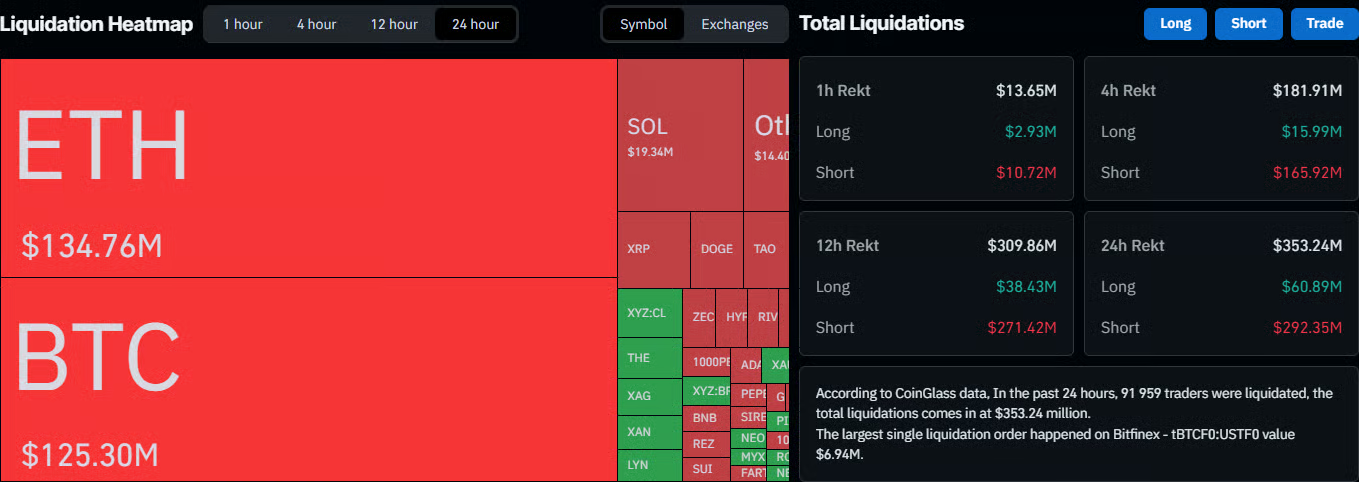
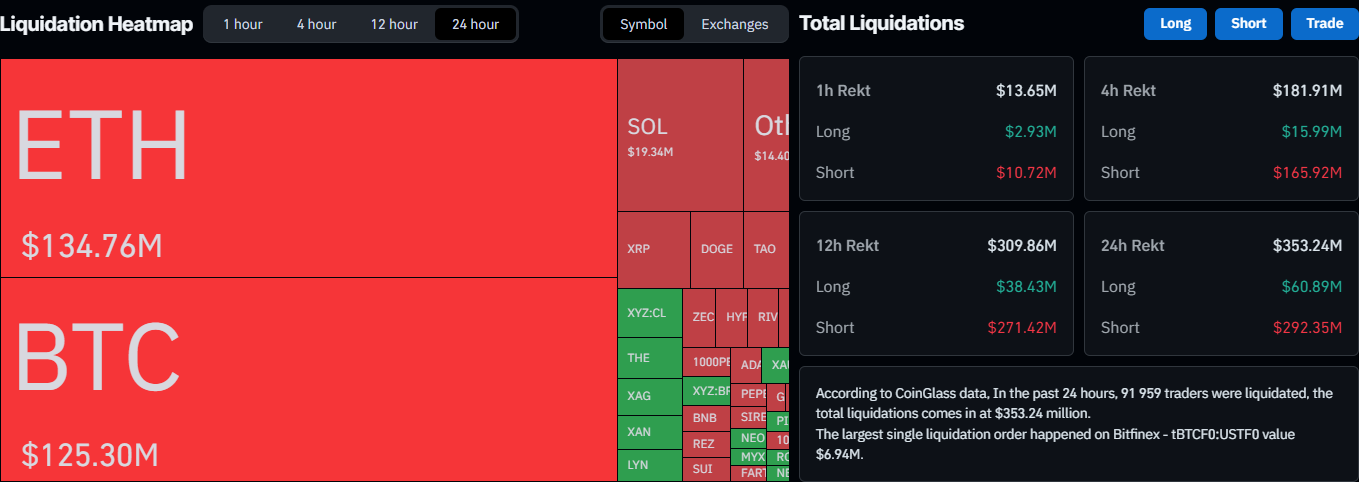
Notable gains are evident from ADA (10%), DOT (12%), PEPE (15%), ETC (9%), and others. The total value of wrecked positions has risen to $350 million, according to CoinGlass, with nearly $300 million coming from shorts. Interestingly, ETH shorts are responsible for the largest portion, followed closely by BTC’s.
Latest Developments
Although Trump said at first that the US doesn’t want to attack any of Kharg Island’s oil infrastructure, he threatened to do so if Iran interferes in any form with the “free and safe passage of ships through the Strait of Hormuz.” He later urged numerous countries to send warships to defend the passage.
More recently, he mulled the idea of sending troops on the ground to seize the key island, which is responsible for over 90% of Iran’s oil production.
You may also like:
BREAKING: President Trump is considering putting boots on the ground to seize Iran’s Kharg Island, per Axios.
Details include:
1. The move appears to be contingent on if tankers remain bottled up in the Persian Gulf
2. Trump is working to assemble a coalition of countries to…
— The Kobeissi Letter (@KobeissiLetter) March 16, 2026
The other big development in the past few hours came when Trump suggested that the US has continuously helped NATO with the war in Ukraine, so the alliance should return the favor now, at least with the Strait.
Binance Free $600 (CryptoPotato Exclusive): Use this link to register a new account and receive $600 exclusive welcome offer on Binance (full details).
LIMITED OFFER for CryptoPotato readers at Bybit: Use this link to register and open a $500 FREE position on any coin!

Artificial intelligence has quickly become one of the hottest narratives in crypto trading. From automated trading bots to fully autonomous AI agents scanning blockchain data in real time, many believe AI could unlock the holy grail of trading: consistent market prediction.
But can AI truly predict crypto markets better than traditional strategies? Or is much of the excitement driven by hype rather than proven results?
Let’s break down the reality behind AI-driven crypto trading.
The Rise of Machine Learning Models in Crypto
Machine learning models are increasingly being used by traders, hedge funds, and algorithmic platforms to analyze massive amounts of market data. Unlike traditional trading systems that rely on fixed rules, machine learning models continuously learn from historical patterns and adapt to new information.
Some of the most common AI models used in crypto trading include:
1. Time Series Forecasting Models
These models attempt to predict future prices using historical market data such as:
-
Price movements
-
Trading volume
-
Order book depth
-
Volatility patterns
Techniques like LSTM neural networks, ARIMA models, and transformers are often applied to detect patterns that humans may overlook.
2. Reinforcement Learning Trading Agents
Reinforcement learning allows AI agents to learn trading strategies through trial and error. Instead of predicting prices directly, the AI learns to maximize profit by:
These models simulate thousands of trading scenarios to refine strategies.
3. On-Chain Data Analysis
Crypto markets provide a unique advantage: transparent blockchain data. AI models can analyze:
By combining on-chain analytics with market data, AI systems attempt to detect early signals of market trends.
Limitations of AI Prediction
Despite the promise, predicting financial markets — especially crypto — remains extremely difficult, even for advanced AI systems.
1. Markets Are Highly Chaotic
Crypto markets are influenced by countless unpredictable factors, including:
-
Regulatory news
-
Macro economic changes
-
Social media sentiment
-
Whale activity
Even the most advanced models struggle to incorporate sudden events that can instantly move markets.
2. Overfitting Is a Major Problem
Many AI models perform extremely well in backtests but fail in live markets. This is often due to overfitting, where a model memorizes historical data rather than learning genuine patterns.
In simple terms:
The model learns the past perfectly but fails to generalize to the future.
3. Alpha Decay
When a profitable trading strategy becomes widely used, its edge quickly disappears. AI strategies are no exception.
As more funds deploy similar models, the market adapts, and the advantage fades. This constant cycle forces traders to continuously develop new models.
4. High Competition From Institutional Quant Firms
Large hedge funds and proprietary trading firms already deploy highly sophisticated machine learning systems. Competing against these players requires massive data infrastructure, computing power, and research teams.
For most retail traders, replicating this level of sophistication is nearly impossible.
The Data Quality Problem in Crypto
One of the biggest obstacles to AI prediction in crypto markets is data quality.
Machine learning models rely heavily on large, clean datasets. Unfortunately, crypto data often contains serious issues.
1. Market Fragmentation
Crypto trading happens across hundreds of exchanges, each with different:
-
Liquidity levels
-
Order books
-
Price discrepancies
This fragmentation makes it difficult to build unified datasets for accurate modeling.
2. Fake Volume and Wash Trading
Many smaller exchanges inflate trading volume through wash trading. If this distorted data enters a training dataset, AI models can learn misleading signals.
This leads to inaccurate predictions.
3. Limited Historical Data
Compared to traditional markets like equities or forex, crypto markets are relatively young. Many assets have only a few years of reliable historical data.
For complex machine learning models, this limited data can significantly reduce predictive accuracy.
4. Rapid Market Evolution
Crypto markets evolve faster than most financial systems. New narratives — DeFi, NFTs, AI tokens, meme coins — constantly reshape trading behavior.
A model trained on data from two years ago may already be outdated.
So… Can AI Actually Predict Crypto Markets?
The honest answer: sometimes — but not consistently.
AI can be extremely useful for:
However, fully predicting price movements remains incredibly difficult due to the chaotic and rapidly evolving nature of crypto markets.
The most successful strategies today usually combine:
In other words, AI is a powerful tool — but it’s not a magic crystal ball.
The Future of AI in Crypto Trading
While AI may not perfectly predict markets, its role in crypto trading will continue to grow.
The next generation of trading systems is already emerging, including:
-
Autonomous AI trading agents
-
AI-driven DeFi portfolio managers
-
Real-time on-chain intelligence systems
-
Cross-chain liquidity prediction models
Instead of replacing traders, AI will likely become a co-pilot for decision-making, helping traders navigate increasingly complex markets.
The hype may be loud — but the technology is still evolving.
Final Thoughts
AI has undoubtedly changed the landscape of crypto trading, offering powerful tools for analyzing massive datasets and identifying hidden patterns. However, the idea that AI can consistently predict crypto markets remains largely exaggerated.
Markets are adaptive, unpredictable, and constantly evolving — qualities that challenge even the most advanced machine learning systems.
The real opportunity lies not in blindly trusting AI predictions, but in combining human judgment with intelligent algorithms to build more resilient trading strategies.
Because in crypto, the edge rarely comes from one tool alone.
REQUEST AN ARTICLE


A huge week lies ahead on the US economic calendar with more inflation data and a Fed rate decision as markets continue to react to the war in the Middle East.
Crypto markets are having a rare green morning during Asian trading, with most assets gaining over the past 24 hours. However, there could be more volatility in the week ahead with all eyes on the Federal Reserve meeting and what Chair Jerome Powell says about the impact of the war in Iran on inflation.
Meanwhile, President Trump plans to announce that multiple countries have agreed to form a coalition that will escort ships through the Strait of Hormuz, as fuel prices across the globe continue to increase.
Economic Events March 16 to 20
Markets will react to the US strikes on Kharg Island, an area vital to Iran’s oil industry, over the weekend, and stock futures have turned green while oil prices are back at $100 per barrel.
Wednesday is the big day for economic news, with February’s PPI Inflation report, which is unlikely to change the Fed’s hawkish stance. The US central bank meets on Wednesday, where there will be a decision on interest rates, but CME futures markets predict a 99% probability of no change.
“The Fed is going to be front and center, especially given the fact that we have seen the market push back… these rate cut expectations,” said Angelo Kourkafas, senior global investment strategist at Edward Jones.
Investors have been hoping for more rate cuts this year, which are generally bullish for stocks and crypto assets; however, those expectations have been dialed back due to fears that the surge in energy prices will push up inflation.
It will be Jerome Powell’s second-to-last meeting before his term as chair expires in May, so the next rate move may not come until Trump’s nominee Kevin Warsh takes over the helm later this year.
The rest of the week will see the Philly Fed Manufacturing Index and January New Home Sales data on Thursday.
You may also like:
“We now have the Iran war, inflation data, and a Fed meeting all in the same week,” said the Kobeissi Letter.
Key Events This Week:
1. Markets React to US Strikes on Kharg Island – Today 6 PM ET
2. February Pending Home Sales data – Tuesday
3. February PPI Inflation data – Wednesday
4. Fed Interest Rate Decision and Statement – Wednesday
5. Philly Fed Manufacturing Index – Thursday…
— The Kobeissi Letter (@KobeissiLetter) March 15, 2026
Crypto Market Outlook
Around $70 billion has been added to the total market capitalization over the weekend, which has climbed to $2.54 trillion on Monday morning.
Bitcoin tapped $74,000 in early Asian trading but again met resistance there and started to pull back. Ether prices continued to grind slowly higher, going past $2,200 for the first time in months.
The altcoins were generally mixed with smaller gains for Solana, Chainlink, Zcash, and Bittensor.
Binance Free $600 (CryptoPotato Exclusive): Use this link to register a new account and receive $600 exclusive welcome offer on Binance (full details).
LIMITED OFFER for CryptoPotato readers at Bybit: Use this link to register and open a $500 FREE position on any coin!
There’s a new debate over whether a continued pivot from Bitcoin miners to artificial intelligence could have an impact on Bitcoin security and its role as a store of value.
While some argue that miners fleeing the network would leave it more susceptible to a “51% attack,” others argue it will simply trigger the Bitcoin network to rebalance itself as designed, making it enticing for miners again.
“AI has killed Bitcoin forever,” said crypto trader Ran Neuner on Sunday, arguing that it has become Bitcoin mining’s biggest competitor because both industries compete for electricity.
“AI is willing to pay much more for it,” he added, explaining that Bitcoin (BTC) mining revenue per megawatt is around $57 to $129, but AI data center revenue per megawatt is up to eight times higher at $200 to $500 for the same electricity, which is why miners are starting to pivot.
Earlier this month, Core Scientific secured up to $1 billion in credit for AI hosting, MARA Holdings recently filed with the SEC to signal its intent to sell some of its BTC in an AI pivot and Hut 8 signed a $7 billion AI infrastructure agreement with Google in December, argued Neuner.
Meanwhile, Cipher Mining cut its hashrate to focus on AI compute, and Bitmain cofounder Jihan Wu has stopped mining and pivoted to AI, he added.
“So if I were a miner, it wouldn’t be a tough decision. And that’s why every day more and more miners are leaving the network.”
It sounds like a doomsday scenario for Bitcoin, but not everyone agrees.
Bitcoin pioneer and cryptographer Adam Back argued that difficulty adjustments would only force the least efficient miners out, and profitability would improve.
“What happens to Bitcoin is simple: tick tock, next block! Difficult adjusts downwards, the least efficient and AI switchers move out, and Bitcoin mining profitability converges to AI profitability. QED.”
“If AI outbids miners for electricity, miners just turn off until the difficulty adjusts and it’s profitable again, that’s literally how Bitcoin works,” added investor Fred Krueger.
Bitcoin energy demand is variable
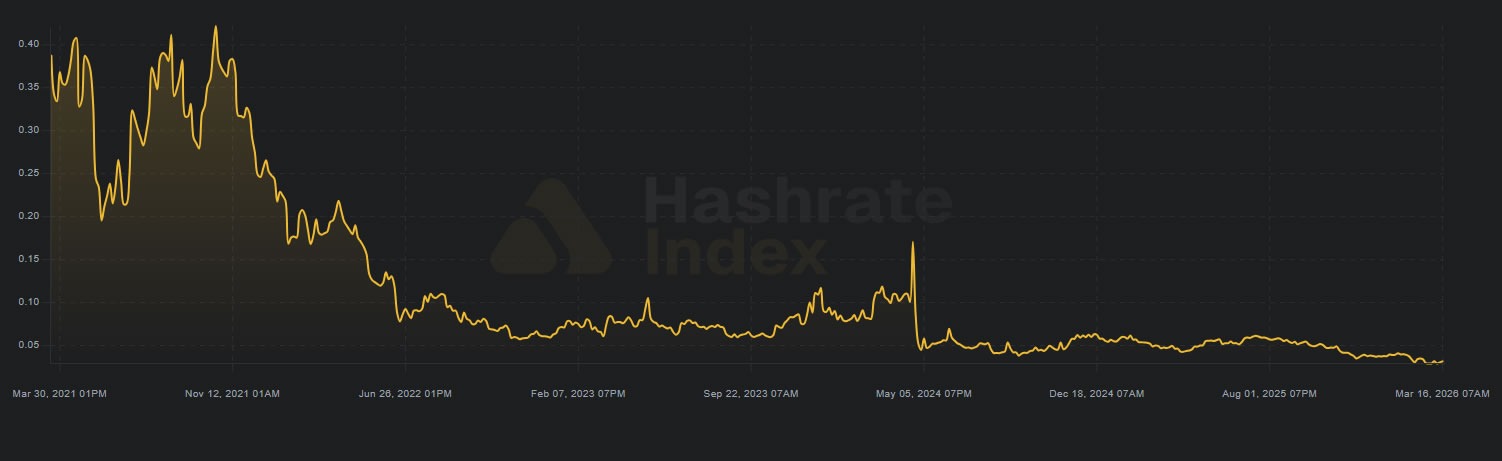
However, Neuner argued that falling hashrates, which are down 14.5% since their October peak, mean that there are fewer miners to secure the network, and a higher potential for 51% attacks.
This has all happened before during bear markets, and automatic network difficulty adjustments usually compensate for it, “but this time is different because we don’t have the energy,” he said.

Related: Crypto miners must put their Bitcoin to work to survive: Wintermute
Bitcoin ESG specialist Daniel Batten disagreed and said it was the other way around, as “the evidence tells us that AI is dependent upon Bitcoin for its expansion.”
It wasn’t all about high demand and expensive power, as Bitcoin mining can use stranded energy, act as a flexible load balancer for energy grids, and use older equipment for cheaper energy, he argued.
One green candle to prevent AI competition doomsday
Neuner said one way to ensure AI doesn’t overshadow Bitcoin will depend on whether BTC prices go up.
“What I hope is that Bitcoin has one green candle. Maybe because of the war, maybe because of the regulation, who knows? But ultimately, if it has one green candle.”
“If you’re watching the Bitcoin price action during this war, that’s exactly what’s happening,” he said, adding that the other scenario, where Bitcoin price continues to fall, is “pretty much a Bitcoin doomsday.”
Bitcoin has seen five monthly red candles in a row, something that hasn’t happened since the 2018 bear market. However, March is currently shaping up green with the asset gaining 8% so far this month, according to CoinGlass.
Magazine: All 21 million Bitcoin is at risk from quantum computers

The US Securities and Exchange Commission (SEC) has dropped its two-year-long case against the founder of the blockchain-based social media platform BitClout, Nader Al-Naji.
In the joint dismissal stipulation filed in the US District Court for the Southern District of New York last Thursday, the SEC cited the crypto task force, which was tasked with developing a regulatory framework for crypto in January 2025, and a “reassessment of the evidentiary record” as the basis for dismissal.
However, the regulator cautioned in a statement that this case outcome doesn’t necessarily mean other similar enforcement actions will receive the same treatment.
“The Commission’s decision to exercise its discretion and seek dismissal of this litigation is based on the particular facts and circumstances of this case and does not necessarily reflect the Commission’s position on any other case,” it said.
Cointelegraph has contacted the SEC and the DeSo blockchain, where Al-Naji leads the foundation, for comment.
Accusations included spending money on a mansion
Al-Naji is a former Google engineer, the founder of the Basis protocol and creator of the DeSo blockchain. He founded BitClout and launched it publicly in March 2021.
The SEC’s July 2024 complaint accused Al-Naji of raising more than $257 million by selling the native token of the BitClout platform, BTCLT, while telling investors the funds wouldn’t be used to pay any BitClout team members.
Al-Naji was also accused of spending more than $7 million on personal items, including rent for a Beverly Hills mansion and cash gifts to family members, and also mischaracterizing the inner workings of the platform as decentralized, with no governing company controlling it, despite allegedly running the project behind the scenes himself.
As part of the settlement, Al-Naji has waived any claims for reimbursement of legal fees or expenses against the SEC. The regulator has dismissed the case with prejudice, meaning it can’t bring another case against Al-Naji or the relief defendants mentioned, including his mother, wife, and several companies under his control, again using the same charges.
The Department of Justice also ended a separate case accusing Al-Naji of wire fraud in February 2025 without prejudice. Al-Naji said in an X post at the time the case was dismissed because the government’s case didn’t hold up under scrutiny.

Under the Trump administration, the SEC has slowly been walking back its hardline stance toward crypto firms, dismissing a growing number of enforcement actions against crypto firms.
Magazine: Spot Bitcoin ETFs first green week, crypto ATM losses surge 33%: Hodler’s Digest, Mar. 8 – 14

Decentralized finance has already transformed how people trade, lend, and earn yield. But the next evolution isn’t just new protocols or better liquidity — it’s autonomous intelligence.
AI agents are emerging as a powerful layer on top of DeFi, capable of monitoring markets, executing trades, managing risk, and optimizing strategies in real time. Instead of manually chasing opportunities across dozens of protocols, traders are increasingly relying on intelligent systems that operate 24/7.
And this shift could fundamentally change how DeFi markets work.
From Manual Trading to Autonomous Strategies
Today, most DeFi trading is still highly manual.
Traders:
-
Track prices across multiple chains
-
Watch liquidity pools and funding rates
-
Execute trades manually or with basic bots
-
Constantly adjust strategies
Even experienced traders struggle to keep up with the speed of on-chain markets.
AI agents remove that bottleneck.
Instead of reacting to market changes, AI systems can continuously monitor data, detect patterns, and act instantly.
This turns trading from a manual process into an automated intelligence layer.
What Exactly Is an AI Agent in DeFi?
An AI agent is a self-operating program that analyzes information, makes decisions, and executes transactions on-chain.
In the context of DeFi trading, an AI agent can:
-
Scan multiple blockchains for opportunities
-
Monitor liquidity changes in real time
-
Execute arbitrage trades
-
Rebalance portfolios
-
Manage risk exposure
-
Adapt strategies based on market conditions
Think of it as a personal trading desk that never sleeps.
Instead of clicking buttons on dashboards, traders deploy agents that execute strategies autonomously.
Why AI Is a Perfect Fit for DeFi
DeFi markets produce enormous amounts of real-time data.
Every block includes:
-
trades
-
liquidity updates
-
lending positions
-
liquidations
-
Oracle price changes
This data-rich environment is ideal for machine learning models.
AI agents can analyze thousands of on-chain signals simultaneously, something human traders simply cannot do.
The result is faster decision-making and more efficient capital deployment.
The Rise of AI-Powered Trading Infrastructure
A new generation of platforms is emerging that allows users to deploy AI trading strategies directly on-chain.
These systems typically combine:
-
on-chain execution
-
off-chain machine learning models
-
automated risk management
-
cross-chain liquidity access
Instead of building complex bots from scratch, traders can plug into infrastructure that handles execution, monitoring, and optimization automatically.
This dramatically lowers the barrier to advanced trading strategies.
Autonomous Yield Optimization
One of the biggest advantages of AI agents is dynamic yield optimization.
In DeFi, yield opportunities constantly change:
AI agents can continuously move capital between opportunities to maximize returns.
Rather than manually repositioning funds every few hours or days, an AI system can rebalance in seconds.
Over time, this can significantly improve capital efficiency.
AI Agents and Risk Management
Risk management is one of the hardest parts of DeFi trading.
Smart contracts can fail. Liquidity can vanish. Prices can move violently.
AI agents can help mitigate these risks by:
-
monitoring volatility conditions
-
adjusting leverage dynamically
-
Closing positions when risk thresholds are reached
-
diversifying capital across protocols
Instead of relying on static rules, AI-driven systems can adapt as market conditions evolve.
Cross-Chain Trading Will Become Seamless
Another major advantage of AI agents is their ability to operate across multiple ecosystems simultaneously.
DeFi liquidity is fragmented across chains like:
-
Ethereum
-
Solana
-
Arbitrum
-
Base
-
Cosmos ecosystems
For humans, managing positions across these networks is complicated and time-consuming.
AI agents can treat the entire multi-chain landscape as one unified market.
This opens the door for sophisticated strategies such as:
The Future: Autonomous DeFi Markets
As AI agents become more widespread, DeFi markets themselves may evolve.
We could see:
-
fully autonomous trading vaults
-
AI-managed liquidity pools
-
algorithmic hedge funds running entirely on-chain
-
collaborative networks of AI agents optimizing liquidity across ecosystems
In this future, human traders set high-level strategies while AI handles the execution.
DeFi becomes less about dashboards and manual clicks, and more about deploying intelligent capital.
Final Thoughts
AI agents represent one of the most powerful upgrades DeFi has seen since automated market makers.
By combining real-time blockchain data with autonomous decision-making, these systems can dramatically improve trading efficiency, risk management, and yield generation.
The traders who thrive in the next phase of DeFi won’t necessarily be the fastest clickers or the most active on dashboards.
They’ll be the ones who know how to deploy intelligent agents to trade for them.
And that shift is only just beginning.
REQUEST AN ARTICLE
An Australian Senate committee has backed proposed legislation to integrate cryptocurrency platforms and custody providers into the country’s financial services framework.
The Senate Economics Legislation Committee said in a report published Monday that the proposed Corporations Amendment (Digital Assets Framework) Bill 2025 would modernize digital-asset oversight with traditional market safeguards to protect consumers.
The framework seeks to establish a licensing and compliance system for digital token managers by amending the Corporations Act 2001 and the Australian Securities and Investments Commission Act 2001.
The proposal targets firms that hold digital assets on behalf of customers, bringing them under existing financial services rules instead of attempting to regulate the underlying blockchain infrastructure. Should the measure become law, firms without an AFSL would be given six months to obtain the required authorization and comply with the new framework.
Crypto exchanges operating in Australia are already required to register with the country’s financial intelligence agency, the Australian Transaction Reports and Analysis Centre, as digital currency providers before offering exchange services.
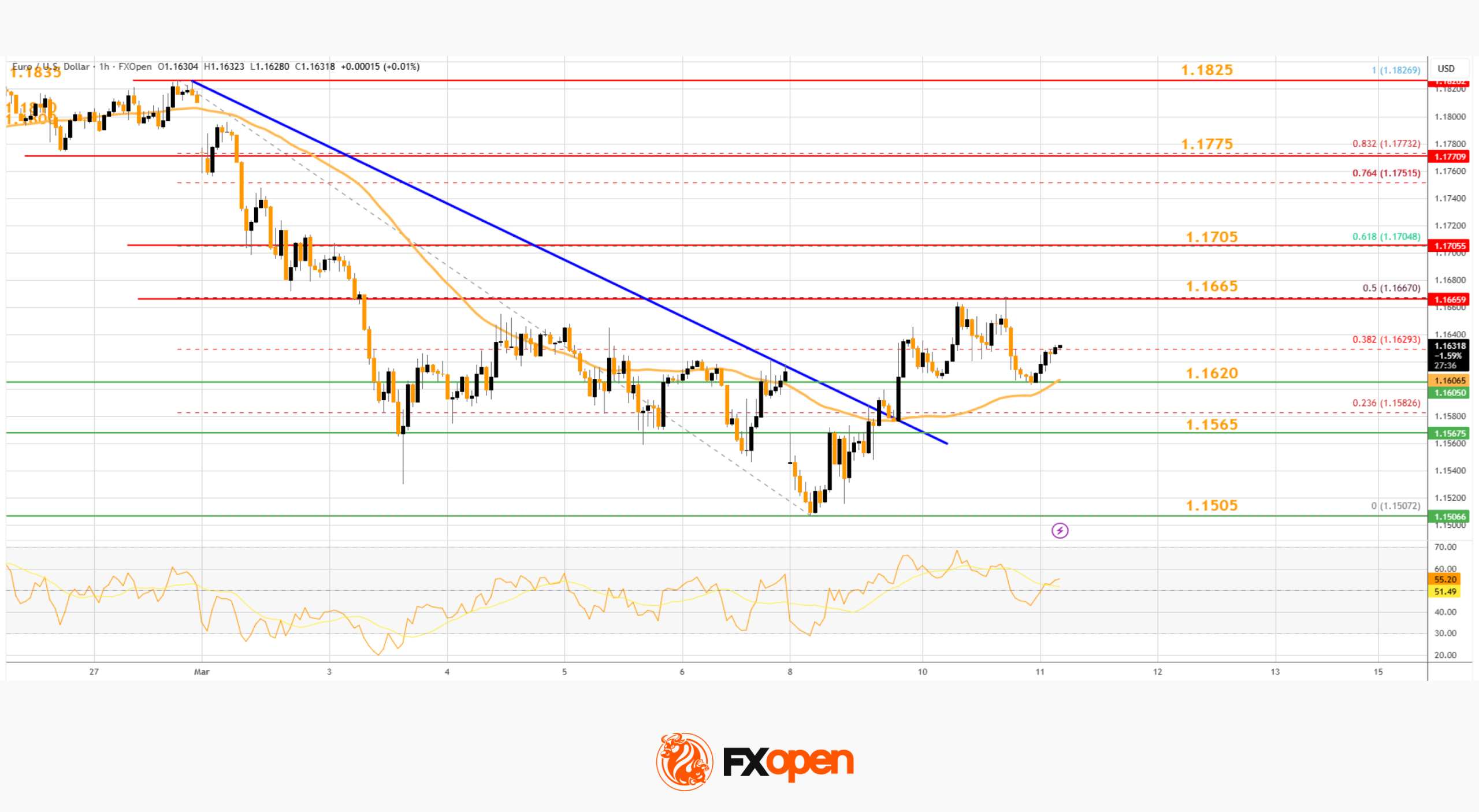
EUR/USD is recovering losses from 1.1500. USD/JPY is correcting gains from 159.00 and might decline further if it stays below 158.30.
Important Takeaways for EUR/USD and USD/JPY Analysis Today
· The Euro struggled to stay in a positive zone and declined below 1.1700 before finding support.
· There was a break above a connecting bearish trend line with resistance at 1.1580 on the hourly chart of EUR/USD at FXOpen.
· USD/JPY started a decent increase above 157.00 before the bears appeared near 158.90.
· There is a key contracting triangle forming with resistance near 158.30 on the hourly chart at FXOpen.
EUR/USD Technical Analysis
On the hourly chart of EUR/USD at FXOpen, the pair started a fresh decline from 1.1825. The Euro declined below 1.1750 and 1.1700 against the US Dollar.
The pair even declined below 1.1665 and the 50-hour simple moving average. Finally, it tested the 1.1500 zone. A low was formed at 1.1507, and the pair is now recovering losses. There was a move above 1.1550 and a connecting bearish trend line at 1.1580.
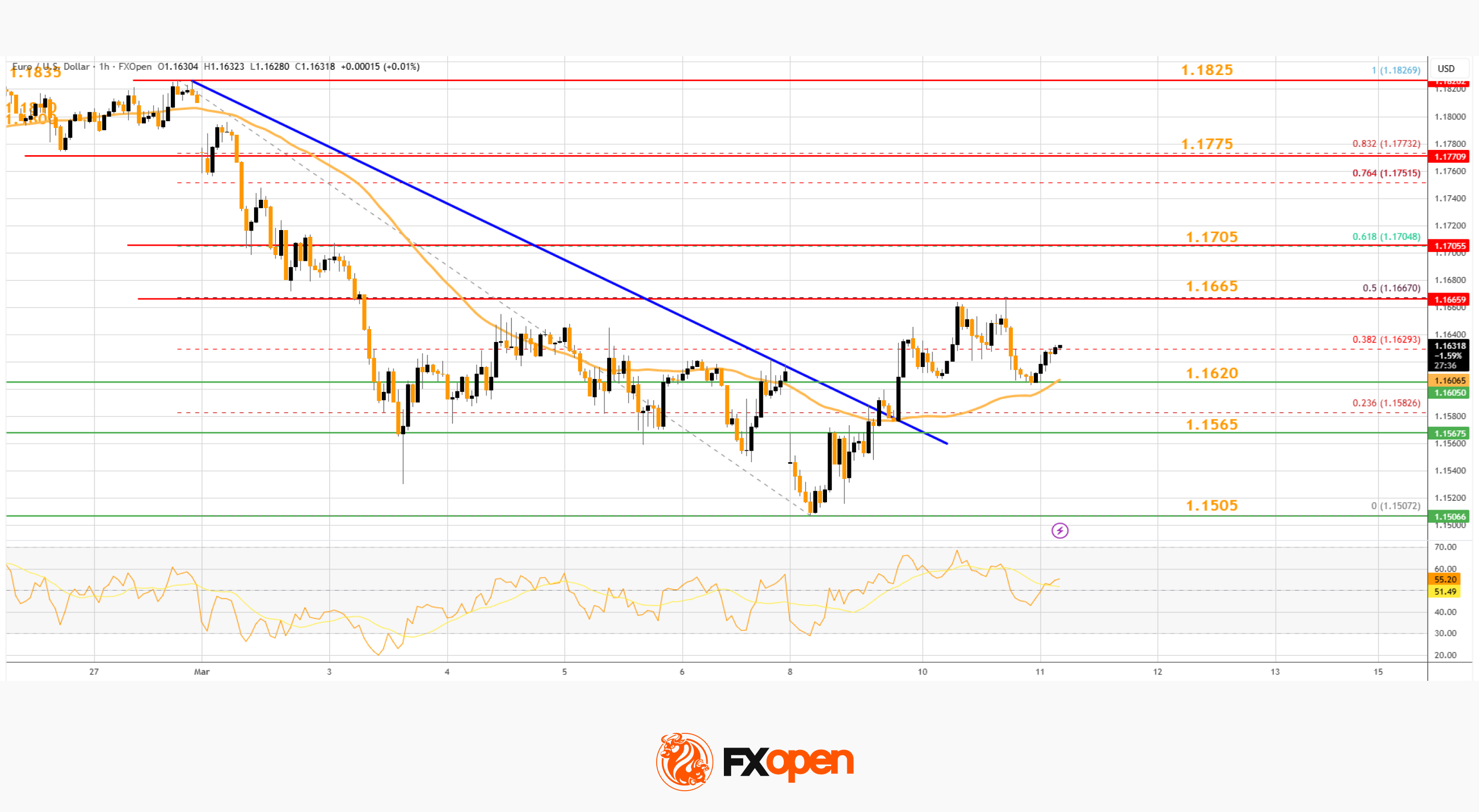
The pair surpassed the 38.2% Fib retracement level of the downward move from the 1.1826 swing high to the 1.1507 low. On the upside, the pair is now facing resistance near the 50% Fib retracement at 1.1665.
The first major hurdle for the bulls could be 1.1705. An upside break above 1.1705 could set the pace for another increase. In the stated case, the pair might rise toward 1.1775.
If not, the pair might drop again. Immediate support is near the 50-hour simple moving average and 1.1620. The next key area of interest might be 1.1565. If there is a downside break below 1.1565, the pair could drop toward 1.1505. The main target for the bears on the EUR/USD chart could be 1.1440, below which the pair could start a major decline.
USD/JPY Technical Analysis
On the hourly chart of USD/JPY at FXOpen, the pair gained pace for a move above 157.00 and 158.00. The US Dollar even traded close to 159.00 against the Japanese Yen before the bears emerged.
A high was formed at 158.90 before there was a downside correction. The pair dipped below 158.00 and the 50% Fib retracement level of the upward move from the 156.45 swing low to the 158.90 high. However, the bulls were active above 157.00 and they protected the 61.8% Fib retracement.
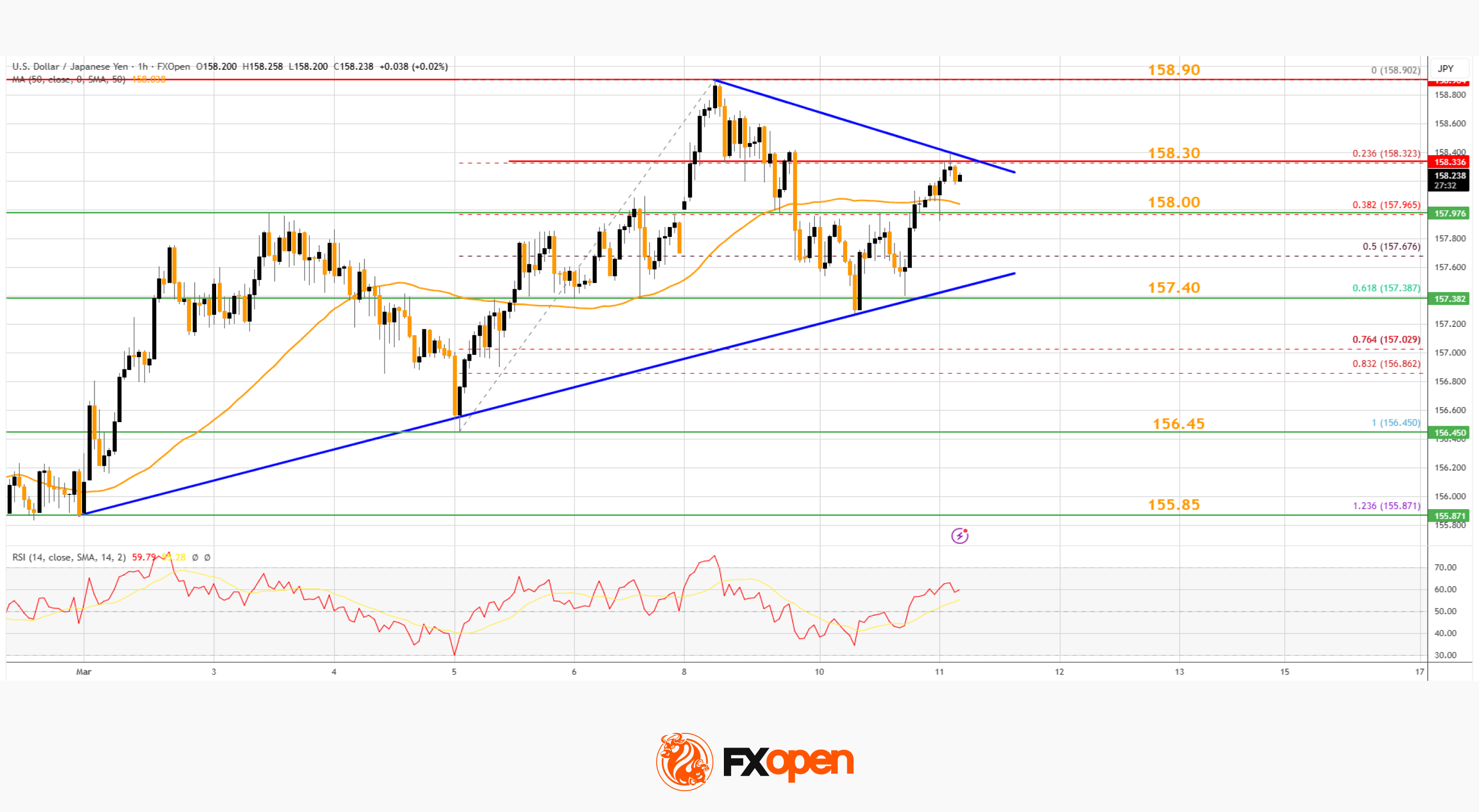
The pair is back above the 50-hour simple moving average and 158.00. Immediate resistance on the USD/JPY chart is near 158.30. There is also a key contracting triangle at 158.30.
If there is a close above the triangle and the hourly RSI moves above 65, the pair could rise toward 158.90. The next major barrier for the bulls could be 159.25, above which the pair could test 160.00 in the near term.
On the downside, the first major support is near 158.00. The next key region for the bulls might be 157.40. If there is a close below 157.40, the pair could decline steadily. In the stated case, the pair might drop toward 156.45. Any more losses might send the pair toward 155.85.
Trade over 50 forex markets 24 hours a day with FXOpen. Take advantage of low commissions, deep liquidity, and spreads from 0.0 pips (additional fees may apply). Open your FXOpen account now or learn more about trading forex with FXOpen.
This article represents the opinion of the Companies operating under the FXOpen brand only. It is not to be construed as an offer, solicitation, or recommendation with respect to products and services provided by the Companies operating under the FXOpen brand, nor is it to be considered financial advice.

Australia’s financial regulator has published findings from a Gen Z money mindset study, highlighting how social media and artificial intelligence are shaping young investors’ approaches to money. The Australian Securities and Investments Commission (ASIC) released the results of a survey conducted between Nov. 28 and Dec. 10 last year, involving 1,127 respondents aged 18–28. The study shows that roughly one in four Gen Z individuals in Australia now invest in cryptocurrency, and while there is a strong appetite for credible, trustworthy financial content, many struggle to locate it amid engagement-first material. Regulators warn that marketing on social platforms can push people toward riskier investments and, in some cases, toward scams. posted.
The regulator’s findings come as ASIC outlined a cautious stance toward crypto marketing and the broader financial-advice ecosystem. The survey reveals a generation that craves reliable content but often lands on sources built for engagement rather than accuracy. ASIC Commissioner Alan Kirkland highlighted that some marketing activity on social media is specifically designed to drive investments, and a portion of it promotes activity that could expose young Australians to scams. He warned that the volatility of crypto investments is not always understood by those advertising or encouraging participation, particularly when the audience is spread across a developed but complex financial landscape. issuing warning notices to 18 influencers for unlawfully promoting high-risk financial products and providing unlicensed financial advice is a sign of the regulator’s willingness to take action against misleading campaigns.
The survey, which included respondents aged 18–28, found that 63% rely on social media for financial information and guidance, 18% use artificial intelligence (AI) platforms, and 30% turn to YouTube as a source for financial content. On trust, the results show a nuanced picture: 56% of Gen Z say they somewhat or fully trust financial information found on social media, and 52% say the same about “finfluencers”—those online personalities who cover finance and investments. AI, however, stands out as the most trusted source among Zoomers, with 64% expressing trust in AI-enabled financial information.
ASIC calls for caution on crypto influencers
The study also shows a notable crypto footprint among Gen Z in Australia, with 23% reporting ownership of cryptocurrency. Among those who own crypto, 29% trade based on content from social media or influencer posts, a dynamic that prompted regulatory caution. The regulator has warned that influencers may set unrealistic expectations about investment returns, market volatility, and the realities of long-term investing. The findings reinforce concerns about how promotional content can shape risk perceptions and trading behavior in a sector that remains volatile and is subject to evolving regulatory scrutiny.
Speaking with the Australian Financial Review (AFR) on Sunday, ASIC Commissioner Alan Kirkland underscored the risk that marketing activity on social platforms can steer consumers toward risky crypto investments and even scams. “We’re conscious that there’s a lot of marketing activity on social media to encourage crypto investment, and our work has shown some of it is actually encouraging people to invest in scams,” he said. “It’s really important for people to be aware of those risks, because you don’t see that same volatility in other types of investments and often that volatility is driven by forces that it’s impossible for an individual sitting in Australia to understand.”
Kirkland also flagged Australian superannuation funds—the country’s $4.5 trillion retirement pool—as an area where unqualified influencers may be offering inappropriate investment guidance. “We see it most where people are lured in through social media ads and then encouraged to switch their super, because super is often people’s most valuable asset, and that’s why disreputable people often target it and why it can be so tragic if people are encouraged to put it into a risky investment,” he said.
ASIC has AI financial advice in its crosshairs
The regulator also said it is watching closely how AI tools generate financial information. Licensing requirements apply where a source is giving financial advice or making product-specific recommendations based on an individual’s circumstances. “Under Australian law, if any entity is giving financial advice, they need to be licensed. So if an AI tool, whoever’s providing it, is actually making recommendations about individual financial products, taking into account individual circumstances, that would be personal advice, so it needs to be licensed,” Kirkland noted.
Industry observers have noted that some crypto exchanges have begun integrating AI-based guidance features for customers. Platforms such as MEXC, KuCoin and Bitget have introduced AI-assisted options to accompany trading services, signaling regulators’ interest in how digital-asset markets are combining advisory capabilities with automated decision-making.
“One of the most surprising findings from this research was the degree of trust young people are placing in AI platforms,” Kirkland said, adding that the usefulness of AI depends on the specificity of questions and the quality of sources AI can draw on to provide results. The regulator’s concerns extend beyond AI itself, as evidenced by the ongoing focus on licensing requirements for those delivering financial guidance, including AI-driven advice.
ASIC’s stance on AI financial advice is set against a broader regulatory backdrop. In January, the agency signaled that crypto and AI firms exploiting licensing gaps around payments in Australia would be a top priority in 2026. The regulator’s crosshairs are not limited to platforms or influencers but extend to the legal framework that governs how digital financial products are marketed and advised upon.
The Gen Z study illuminates how a generation that grows up with social media and AI navigates risk and opportunity in a rapidly evolving financial landscape. As ASIC continues to monitor marketing practices and the deployment of AI tools in financial services, stakeholders—from investors to platform operators—will be watching closely to see how policy adapts to new behavioral realities in the digital economy.
Why it matters
First, the findings underscore a critical consumer-protection challenge: young investors actively turn to social media and AI for guidance, often without access to robust, independent sources. The potential for misinformation, exaggerated returns, or misaligned risk underscores the need for credible educational resources and transparent disclosures in fintech marketing. Regulators’ emphasis on licensing for AI-driven advice signals a move toward more formal accountability, reducing the likelihood that automated recommendations operate outside established compliance frameworks.
Second, the study highlights the evolving risk landscape around crypto participation among younger demographics. With 23% of Gen Z reporting crypto ownership and 29% of them trading as a result of influencer content, the regulatory focus on finfluencers and marketing practices gains renewed urgency. This is particularly salient as the Australian market approaches broader financial-technology innovations and digital asset service providers push deeper into mainstream finance.
Finally, the integration of AI bots by crypto and fintech platforms is prompting regulators to rethink the boundaries between information and advice. The balance between innovation and consumer protection will likely shape future licensing, disclosure, and advertising standards. In Australia, that balance currently hinges on whether AI-driven guidance crosses into personalized financial advice, a threshold that triggers licensing requirements and stricter oversight.
What to watch next
- ASIC’s ongoing monitoring of social-media marketing for financial products and potential enforcement actions against misleading campaigns.
- Any new guidance or licensing requirements addressing AI-based financial advice and tools that tailor recommendations to individuals.
- Regulatory scrutiny of crypto and fintech platforms deploying AI-based trading guidance or “trading partners.”
- Regulatory priorities in 2026 around payments licensing and licensing expectations for AI-enabled financial services.
Sources & verification
- Australian Securities and Investments Commission, Gen Z and money advice study — 26-049mr: https://www.asic.gov.au/about-asic/news-centre/find-a-media-release/2026-releases/26-049mr-asic-urges-gen-z-to-sense-check-money-advice-as-social-media-fuels-riskier-financial-decisions/
- Australian Financial Review interview with ASIC Commissioner Alan Kirkland on Gen Z and AI trust: https://www.afr.com/wealth/personal-finance/gen-z-puts-trust-in-ai-for-financial-advice-asic-says-don-t-20260311-p5o9iy
- ASIC cracks down on unlawful finfluencers in global push against misconduct: https://www.asic.gov.au/about-asic/news-centre/news-items/asic-cracks-down-on-unlawful-finfluencers-in-global-push-against-misconduct/

Emerald Holding: Selling The Buyout Rumor Paid Off (Rating Upgrade)

Why Is Crypto Up: BTC USD Decoupling From Gold Amid Heated Israel-Iran War

Sinner stuns Medvedev to win first Indian Wells Title

Smart energy pays enters the US market, targeting scalable financial infrastructure

Why Israel is blocking foreign journalists from entering

Bitcoin: We’re Entering The Most Dangerous Phase

BITCOIN: The Next PRICE SQUEEZE Just Started!!! – Bitcoin News Today, Ethereum & Altcoins

Being XRP “RICH” Will Be VERY RARE! Mass Accumulation Will Be IMPOSSIBLE When XRP Hits $10! WAKE UP!

Not Just Another Personal Finance Video.
-
 Tech5 days ago
A 1,300-Pound NASA Spacecraft To Re-Enter Earth’s Atmosphere
-
 Crypto World2 days ago
HYPE Token Enters Net Deflation as HyperCore Buybacks Outpace Staking Rewards
-

 News Videos7 days ago
10th Algebra | Financial Planning | Question Bank Solution | Board Exam 2026
-

 Business6 days ago
ExxonMobil seeks to move corporate registration from New Jersey to Texas
-

 Crypto World7 days ago
Paradigm, a16z, Winklevoss Capital, Balaji Srinivasan among investors in ZODL
-

 Fashion3 days ago
Weekend Open Thread: Addict Lip Glow
-

 Tech6 days ago
ChatGPT will now generate interactive visuals to help you with math and science concepts
-
Sports2 days ago
Why Duke and Michigan Are Dead Even Entering Selection Sunday
-

 NewsBeat5 days ago
Residents reaction as Shildon murder probe enters second day
-

 Business5 days ago
Search Enters Sixth Week With New Leads in Tucson Abduction Case
-
 NewsBeat6 days ago
Pagazzi Lighting enters administration as 70 jobs lost and 11 stores close across Scotland
-

 Business12 hours ago
Search for Savannah Guthrie’s Mother Enters Seventh Week with No Arrests
-

 Tech7 days ago
Despite challenges, Ireland sixth in EU for board gender diversity
-

 Business2 days ago
US Airports Launch Donation Drives for Unpaid TSA Workers as Partial Government Shutdown Enters Fifth Week
-

 NewsBeat5 days ago
I Entered The Manosphere. Nothing Could Prepare Me For What I Found.
-
Crypto World2 days ago
Coinbase and Bybit in Investment Talks: Could Bybit Finally Enter the US Crypto Market?
-

 Business6 days ago
Search Enters 39th Day with FBI Tip Line Developments and No Major Breakthroughs
-

 Sports7 days ago
Skateboarding World Championships: Britain’s Sky Brown wins park gold
-

 Business2 days ago
Country star Brantley Gilbert enters growing non-alcoholic beer market
-

 Crypto World6 days ago
Will Chainlink price reclaim $10 amid volatility squeeze?

