from the this-is-why-we-can’t-have-nice-things dept
In late 2023, I wrote a feature for The Verge exploring the FCC’s attempt to stop race and class discrimination in broadband deployment. For decades, big telecoms have not only refused to evenly upgrade broadband in low income and poor areas (despite billions in subsidies for this exact purpose), they’ve provably charged poor and minority neighborhoods significantly more money for worse service.
To be clear: the Biden FCC’s plan didn’tactually stop such discrimination. The previous FCC didn’t even have the moral courage to call out big telecoms with a history of such practices (see: AT&T’s “digital redlining” in cities like Cleveland and Detroit). The FCC simply acknowledged that this discrimination clearly exists and set up a complaint process for consumers who had been discriminated against.
I’m not sure the loophole-filled rules would have ever resulted in meaningful accountability for providers, given holding telecom monopolies accountable has never been a serious priority for either party. But it was at least an acknowledgement that this obvious discrimination exists. For the first time ever. Which was important for what I would hope is obvious reasons.
No longer: the Republican-stocked 8th Circuit Court of Appeals has struck down the entire FCC effort in a ruling, stating the FCC exceeded its legal authority by imposing liability for actions resulting in “disparate impact,” instead of merely policing “disparate treatment.” And by extending the complaint process to include subcontractors who help ISPs with deployment:
Advertisement
“[The FCC] exceeded its statutory authority in two respects that are the core of the final rule—disparate impact liability and the definition of covered entities. We therefore vacate the final rule in its entirety, leaving the FCC with an unfinished obligation to ‘adopt final rules to facilitate equal access to broadband Internet access service’ in compliance with 47 U.S.C. § 1754.”
That resulted in the whole effort being discarded.
The FCC could try to re-establish the rules with a new effort, but that new effort likely wouldn’t survive our new reality created by our corrupt courts dismantling Chevron Deference. Republicans and corporate power have made holding large U.S. companies accountable for almost anything illegal, and it’s still somehow not being talked about enough, given the vast (and quite deadly) looming ramifications.
While the Judges and case intervenors like to put on a very serious adult face and pretend they’re engaging in very serious legalese, the goal here really is no meaningful oversight of telecom monopolies. There’s always something they concoct to suggest the U.S. government can’t engage in basic consumer protection oversight of telecoms. If it wasn’t this, it would be something else.
The impact of this assault on the U.S. federal regulatory state is everywhere you look. Especially in broadband access, where dominant regional monopolies and state and federal regulatory capture (read: corruption) result in spotty access, slow speeds, and abysmal consumer service for everyone. Minorities and marginalized communities just get hit hardest, and usually first.
Advertisement
The ruling, issued unanimously by three judges appointed by Republican presidents, is a double win for folks like FCC boss Brendan Carr, who likely enjoys both the racism and protecting lumbering telecom monopolies from accountability for decades of predatory behavior. As usual, Carr insisted in a statement that fighting discrimination somehow discriminates against white people:
“Today’s appellate court decision is another common-sense win for nondiscrimination.
…the FCC’s decision to adopt those illegal rules only made it harder for providers to bridge the digital divide and took the FCC’s focus off of our core mission.
Now, the FCC is focused on advancing our Build America Agenda and ensuring that regulated entities do not discriminate, including through our efforts to end invidious forms of DEI discrimination. I commend the appellate court for correcting the FCC’s misguided 2023 decision. The court’s ruling follows the Supreme Court’s decision last week making clear that intentional discrimination is unlawful.”
That is, well, patently false. And weird. And an extremely dystopian inversion of reality by zealots. Consumer groups fighting for equitable and affordable broadband (like Public Knowledge) were, in contrast, not impressed. From Public Knowledge’s Legal Director, John Bergmayer:
Advertisement
“The practical effect is to eliminate a rule that addresses a documented problem,” he said. “Lower-income neighborhoods and communities of color get slower service, older equipment, and higher prices for the same product their richer neighbors buy. After today, the FCC can act only when it proves a smoking-gun case of conscious bias, which almost never exists in writing.”
Great stuff. Thanks again to all the folks (especially rich Silicon Valley CEOs) who decided that a corrupt kakistocracy at the hands of racist zealots was just what an already struggling America needed.
Is this “Schmigadoon!” or a party at Apple Park for the hit MacBook Neo? – image credit: Apple
Apple is having even greater success with the MacBook Neo than expected, and also startling success with its great but cancelled “Schmigadoon!” show, plus there are so many new iPhone rumors, all on the AppleInsider Podcast.
It was predicted before, but now it appears to be absolutely true. The MacBook Neo is so much of a hit that Apple wasn’t ready for it and is having to spin back up production lines for its processor.
Then, too, Apple presumably didn’t expect “Schmigadoon!” to be such a hit on Broadway, or it wouldn’t have cancelled the original TV show. Nonetheless, TV’s loss is theater’s gain and Apple has stumbled into a dozen Tony nominations for the show.
Advertisement
If you believe the rumors, Apple is also stumbling forward with a Dynamic Island that might be smaller, or might not. It’s reportedly preparing rounder buttons for the iPhone 20, and it’s said to be to keeping production going on the iPhone 17.
Nobody ever said Apple wasn’t a busy, busy, company. And it’s legal team doesn’t get to dawdle much either, especially not in its neverending battle with Epic Games.
BONUS: Subscribe via Patreon or Apple Podcasts to hear AppleInsider+, the extended edition. This week, it does seem as if that busy Apple legal team is the most productive part of the company these days, but what does the torrent of trials and cases mean for users?
Links from the show:
More AppleInsider podcasts
Tune in to our Smart Home Insider podcast covering the latest news, products, apps and everything HomeKit related. Subscribe in Apple Podcasts, Overcast, or just search for HomeKit Insider wherever you get your podcasts.
Those interested in sponsoring the show can reach out to us at: [email protected].
Subscribe to AppleInsider on:
Keep up with everything Apple in the weekly AppleInsider Podcast. Just say, “Hey, Siri,” to your HomePod mini and ask for these podcasts, and our latest HomeKit Insider episode too. If you want an ad-free main AppleInsider Podcast experience, you can support the AppleInsider podcast by subscribing for $5 per month through Apple’s Podcasts app, or via Patreon if you prefer any other podcast player.
Last December, I wore Google Glasses in several forms while they were still under development. Soon you’ll be able to get your hands on the final versions. When, exactly, and for how much? We may find out more in just a handful of days.
While Meta has been the biggest tech company aiming for a place on your face in glasses form, it’s far from the only one. Google’s about to enter the race with a whole range of smart glasses, the company’s first return to everyday face tech since Google Glass in 2013.
This time, the focus is almost entirely on AI. Gemini will be the reason and the biggest function for what makes Google’s Android XR glasses work, but they’ll come in a wide range of designs: Warby Parker, Gentle Monster, Kering Eyewear and Samsung are all expected to have their own models. Xreal, a maker of display glasses, will have an additional plug-in mixed reality device called Project Aura, too.
Advertisement
This year’s Google I/O developer conference is just around the corner on May 19, and we should hear a lot more about Google’s smart glasses strategy. But we already know a lot, since Google talked about and demoed these glasses last year. Now that we’re in 2026, all these glasses should finally arrive, and if you’ve even been half-thinking about getting a pair of smart glasses, you’ll want to see what they’re all about.
Watch this: What to Expect From Google I/O: Glasses, Glasses, Glasses
All about Gemini
Google, Samsung and Qualcomm have been collaborating on Android XR, a new OS for a whole range of mixed reality headsets, AI glasses, display-enabled glasses and eventually augmented reality glasses. The first product of this collaboration, Samsung Galaxy XR, arrived last fall.
Galaxy XR is very much a VR headset, but also a mixed reality computer, similar to the Apple Vision Pro and the Meta Quest 3. It runs Android apps via its Android XR OS, and also has Gemini AI that can respond to voice, and run live to see anything on your device’s screen and in the real world via its external cameras.
Advertisement
That on-tap Gemini assistant is exactly what will be the key app for the next wave of smart glasses. Much like Meta’s Ray-Ban and Oakley glasses, which use Meta AI, Google’s glasses will use Gemini and also related Gemini apps like Nano Banana and NotebookLM.
Pop-up information on the display-enabled glasses will offer contextual details, like live map data.
Google
The display-free glasses will use microphones and built-in speakers to respond to AI prompts, handle live language translation, or play music and phone calls. A camera can take photos and videos, or activate a Gemini Live mode for continuous recording and AI awareness about the world.
Advertisement
An additional line of display-enabled glasses, with a color display in one lens, will show snapshots taken on the glasses, show phone notifications, play videos or even provide live assistive captioning or translation. Certain apps will also work on the glasses as extensions of what you’re doing on your phone: Google Maps can show directions and maps displayed on the ground in front of you with a head tilt, or Uber can show driver status.
CNET’s Patrick Holland trying on a prototype model of the glasses last year, also at Google I/O.
Lexy Savvides
Three (or more) design partners
Warby Parker, Korean fashion eyewear brand Gentle Monster and European eyewear brand Kering are already official Android XR glasses partners, meaning all three will launch lines of Android XR glasses. Expect lots of designs and fashion riffs, much like how Meta’s glasses partner EssilorLuxottica makes many frame designs under its Oakley and Ray-Ban brands.
Advertisement
Gucci smart glasses are expected via Kering, and there are sure to be more surprises. Also, Samsung is likely in the mix. Even though Samsung is already a partner helping make all these other glasses (likely by provisioning camera and display components), Samsung is reportedly going to announce its own Android XR glasses at some point, too.
Add to the mix Xreal, a manufacturer of USB-tethered display-enabled glasses, which is making its own Android XR mini-computer called Project Aura (more on that below).
Much like Google’s many partnerships with watch brands years ago via Android Wear, more glasses brands could come aboard.
Advertisement
Project Aura, made by Xreal and Google, are display glasses that can run Android XR apps like a full mixed reality headset. They’re just part of what’s coming next year.
Google
A separate sort of AR glasses experience, Project Aura
The Xreal-made glasses work differently from the other smart glasses, acting more like a mini VR headset than an all-day set of eyewear. Project Aura is a specialized set of Xreal glasses with a larger display and extra cameras that plug into a processing puck the size of a phone. Wearing them (which I did last year), you can run apps and 3D experiences and even use hand tracking like a VR headset.
Project Aura runs the same apps as the Galaxy XR and uses the same chipset. It’s truly a sort of shrunken-down mixed reality experience, aiming to serve as a development tool for future Google AR glasses that might connect directly to phones as well as an actual product. But it’s not meant to be worn all day. Instead, like Xreal’s other glasses, it’s a sort of “headphones for your eyes” wearable display with audio that can extend displays out around you on the go.
The big difference: How well they’ll work with Google and Android
Google’s big advantage with Android XR should be how well these devices work with AI apps you might already use or with apps on your phone. On Android phones, these should feel more deeply integrated with phone controls and apps, like a smartwatch. With iOS, they should also work with Gemini services.
Advertisement
There still haven’t been everyday smart glasses that connect deeply with the phones in our pockets, and Google’s should be the first. Apple might follow next year with glasses of its own.
Google’s already said phone notifications should appear as interactive widgets on the glasses, but will more apps also build deeper hooks? And will more AI be allowed beyond Gemini? For now, Google has said Gemini is the primary AI service for its glasses. But these glasses will also work with WearOS watches, too.
Will you know who’s wearing these glasses, and how comfortable will the AI privacy policies feel?
Advertisement
Scott Stein/CNET
Will Google solve the privacy and social acceptance issues?
Meta has repeatedly run into trouble over its handling of users’ personal data, and inappropriate public use of its smart glasses cameras has led to social media backlash. Meta’s AI privacy policies are murky, and Meta’s not a company that’s respected for social media safety or privacy, with very good reason.
Will Google do better? It’s considered more reputable, but it’s also a company that already blends ads into our personal data and is increasingly swallowing up more data, like health and fitness, for its connected AI services. Google will have to explain how responsible it’ll be with glasses going forward, and overcome public acceptance factors. Will the “Glasshole” moniker come back to bite it?
Price and release date unknown
We have no idea when these glasses are coming, other than “sometime in 2026.” But expect more news starting at Google I/O on May 19. I’ll be there, and we’ll be reporting on all the AI and smart glasses news as it happens. We should know more then.
Rather than having users go through the inconvenience of having to punch in their current location, an increasing number of applications and websites use location services that can pin-point the current location of a user to within a certain number of meters or kilometers.
Unfortunately, [Evert Pot] found that with the demise of the Mozilla Location Service (MLS) in 2024, accuracy of the Linux Geoclue service had dropped to a resolution of about 25 km. Since a LAN tends to not move around a lot, this seemed like the perfect time to help Geoclue out with a local GPS server.
All that Geoclue looks for on the LAN is an mDNS service identifying as _nmea-0183._tcp that responds with the GPS coordinates as network packets containing an ASCII payload encoded using the NMEA 0183 standard. With this knowledge [Evert] was then able to quickly put together a Python-based server that simply blasts the static GPS coordinates of the LAN in question.
Advertisement
With the service running, Gnome Maps and Firefox with Google Maps both displayed the right location down to the house, as can be seen in the screenshots. With the same LAN service and a Mac system there was no such luck with Apple Maps unless Location Services was turned off, though presumably Apple uses its own equivalent to MLS.
Google has announced a major upgrade to its fitness and wellness platform by introducing Fitbit Air and the new Google Health app. With personalized workout suggestions, sleep insights, and nutrition guidance, Google is making its health platform more interactive. The AI coaching features will be available on a paid plan starting at Rs 99 per month.
The new “Today” tab works more like an interactive health feed. It highlights sleep summaries, weekly cardio scores, readiness levels, and daily activity updates in a more visual and contextual format. The app can also provide recovery recommendations and suggest workouts or lighter activities based on recent health patterns.
Google Health Coach Powered by Gemini
This tool serves as an artificial wellness assistant that analyzes user data and provides personalized advice and information. The AI trainer can advise on exercises, give sleep tips, monitor recovery, and provide nutrition advice as well. As noted by Google, this tool should be more interactive and flexible than conventional fitness applications. It can also modify its recommendations depending on specific circumstances, such as low energy, injuries, and routine changes.
Google Health Subscription Pricing in India
Google plans to continue providing all basic health and fitness tracking features for free via the Google Health application. This includes all standard features, such as recording steps taken, measuring heart rate, and recording sleep information, that users will have access to for free.
However, the company has placed its advanced AI-powered features under a premium plan. The Google Health subscription is priced at Rs 99 per month or Rs 999 per year in India. Premium users get access to advanced coaching tools, deeper sleep analysis, personalized workout plans, and proactive health recommendations powered by Gemini AI.
Advertisement
Fitbit Air Launches as a Screenless Fitness Tracker
Unlike other fitness trackers, the wearable device focuses solely on monitoring the user’s health stats in the background. Google designed the Fitbit Air with a lightweight pebble-like shape that feels slimmer than the Fitbit Luxe and Inspire 3 series. The company created its sleek body to provide users with better comfort during all-day wear.
Another important aspect that distinguishes Fitbit Air from other products is its ability to operate continuously for several days, thanks to advanced battery technology. At the same time, Google is aiming to provide fast recharging by implementing it in the wearable as well. Indeed, according to some sources, charging for 5 minutes will provide enough battery for a whole day.
Fitbit Air Price and Availability
Google has officially launched the Fitbit Air at $99.99, roughly equivalent to ₹9,400 in India. The wearable is currently available for global pre-orders, while full sales are expected to start later this month, on May 26.
As part of the launch offer, customers purchasing the device will get a three-month Google Health Premium trial. The subscription unlocks AI-based wellness coaching, personalized workout plans, and advanced health insights.
Cloudflare plans to cut about 20% of its workforce, or more than 1,100 employees, as it restructures around an “agentic AI-first operating model.” Reuters reports: Cloudflare CEO Matthew Prince and co-founder Michelle Zatlyn said in a message to employees that the company was reimagining every team and function to operate in what they described as an agentic AI era. Cloudflare said the job cuts reflect a redesign of internal processes and roles, rather than a response to employee performance or short-term cost pressures. The company added that its own use of AI has increased more than sixfold over the past three months, prompting major changes in how teams operate.
Unsurprisingly, the few thousand residents of the small community of Saline Township in Washtenaw County, Michigan, were worried about OpenAI and Oracle’s massive new $16 billion Stargate data center. Their concerns covered the usual issues: excessive water usage, the power draw on the regional grid, a huge increase in traffic,… Read Entire Article Source link
Sony is partnering with Bandai Namco Holdings Inc. (the parent company of Bandai Namco Entertainment) on a “collaborative pilot initiative” focused on generative AI and its role in the future of video production. AI was a big theme in the company’s latest earnings and corporate strategy presentation, with Sony President and CEO Hiroki Totoki describing the technology as an “amplifier of human imagination and a catalyst for new possibilities,” while insisting that it won’t replace artists or creators.
On the gen AI project with Bandai Namco — which admittedly sounds quite vague and may well not go anywhere — Totoki said the companies have seen “massive gains in speed and productivity per person.” He also highlighted “a lack of consistency and controllability” as an issue for professionals in the space who demand both of these things in their work, but said AI has allowed those involved in the project to achieve a level of sophistication in production that wasn’t previously possible due to time constraints.
Given Bandai Namco’s association with video games, the fact that Totoki didn’t explicitly talk about gaming with regards to the Gen AI project seems a bit odd (then again, it is a thorny topic right now). Sony Interactive Entertainment chief Hideaki Nishino, however, did have a lot to say about how AI in general is being embraced within PlayStation. Nishino said that development cycles — increasingly generation-spanning in the case of first-party PS5 games — can be sped up by AI, while “enabling more creators to enter the market.”
What’s more concerning is Nishino’s admission that AI will create a “meaningful increase in the volume […] of content.” You know: slop. He added that that his company’s studios and IP are committed to ensuring that they only put out “high-quality” games that players come to PlayStation for.
Advertisement
Nishino talked about how studios like Naughty Dog and Sony’s San Diego Studio have adopted a facial animation tool called Mockingbird, which animates 3D models after they’ve been through performance capture. AI is also helping with hair animation, with models fed videos of real hairstyles and then outputting images with “hundreds of strands” modeled.
“As AI capabilities evolve, the role of our creators will remain unchanged,” Nishino said. “The vision, the design, and the emotional impact of our games will always come from the talent of our studios and performers. AI is meant to augment their capabilities, not replace them.”
AI is also at the heart of the PS5 Pro’s PlayStation Spectral Super Resolution upscaling tool, which was recently updated to be more effective and is now supported in a large number of third- and first-party games. PSSR is almost certain to be a big theme of the PS6 when that rolls around, but you only have to look at the community’s reaction to NVIDIA’s unveiling of DLSS 5 to see what happens when AI upscaling gets a bit too ambitious.
The other half of Sony’s presentation was focused on its gloomy quarterly earnings, in which the company announced a 46 percent downturn in PS5 sales in its fourth fiscal quarter compared to last year. Sony sold just 1.5 million PS5s in the last quarter, and like most large tech companies is currently battling rising costs and memory shortages. The company recently increased the price of its entire console lineup, the second price hike in 12 months.
Longtime Slashdot reader Qbertino writes: The Fehrmarnbelt tunnel is a European construction megaproject building a tunnel between Denmark and Germany, crossing the Fehmarnbelt in the Baltic sea. The first segment of the tunnel has now successfully been placed in its designated spot. This is a yet-unseen, next-level engineering feat achieved by the Danish Sund & Baelt construction company. It took 14 hours and used a massive pontoon ship built specifically for this project.
The tunnel segments are 217 meters long, weigh more than 73,000 metric tons, and have to be placed within a tolerance of 3 mm. The tunnel will eventually consist of 89 of these segments, be 18 km long, and connect the Danish city of Rodby with the German island Fehmarn through five individual tunnel tubes: two for cars, two for trains, and one rescue and maintenance tunnel. Crossing time will be reduced from a 45-minute ferry crossing to seven minutes by train or 10 minutes by car, and cut the travel time between the German city of Hamburg and the Danish capital, Copenhagen, down to 2.5 hours. The project’s planned completion is set for the year 2029. German news Tagesschau has some details and a neat animation, while further details are available from the German tech news site Heise.
There is no denying that drone warfare and the associated technology have become a crucial part of modern warfare. These unmanned flying objects come in various shapes and sizes and can perform a wide variety of tasks — ranging from aerial reconnaissance and intelligence gathering to offensive missions such as taking out enemy equipment and engaging enemy soldiers. The top modern-day military powers have a wide array of drones in their repertoire. Yet, even as military drones become more advanced and sophisticated, a surprising trend has emerged: armed forces are increasingly turning to low-cost, low-tech drones capable of threatening vastly more expensive, technologically superior equipment. The most recent example of this is Japan. The country’s defense minister recently met with a start-up that is developing disposable drones made of corrugated cardboard.
The company behind Japan’s disposable cardboard drones is AirKamuy, and the model in question is christened the AirKamuy 150. Very little is known about the drone as far as technical specifications go; however, what is already known is that it can be assembled in under five minutes, is capable of reaching speeds of up to 120 km/hr (120 mph), has a range of around 50 miles, and can remain airborne for up to 80 minutes. These small drones are shipped flat-packed, which means several units can be packed inside a single standard-sized shipping container.
The most remarkable facet about the AirKamuy 150, however, is its price, which reportedly ranges between $2,000 and $3,000. This is an incredibly low acquisition cost by military standards. To put things into perspective, Iran’s cheap Shahed drones, which gained notoriety in the recent U.S.-Iran conflict, cost anywhere between $20,000 and $50,000 to build.
Advertisement
Use cases for the AirKamuy 150
Mediaproduction/Getty Images
Given the sheer ease of use and quick deployability of the AirKamuy 150 cardboard drone, it is touted by senior company officials to be used as a swarm drone. For those unaware, the term “swarm drones” is given to large groups of unmanned drones (UAVs) that function as a single coordinated unit to perform various tasks. In military use, drone swarms can be used to conduct precision strikes and electronic warfare without needing the help of more sophisticated and expensive equipment. The drone can also be used for various civil applications, including the transportation of medicines and as part of emergency response mechanisms.
Japan’s defense minister, who was recently seen posing with the drone, also revealed that the country is already considering using AirKamuy’s cardboard drones for the Maritime Self-Defense Force. There is no denying that we know very little about the actual real-world performance of this cardboard drone. However, given the excellent track record of similar low-cost drones in battlefields around the globe, expectations are high as far as the AirKamuy 150 drone is concerned.
AirKamuy’s entry into the world of low-cost, expendable, cardboard drones has definitely attracted global attention. It is quite likely, therefore, that other companies engaged in the design and manufacturing of drones may come up with similar drones in the near future.
The Ikea Varmblixt smart donut lamp takes one of Ikea’s most recognisable designs and gives it a smart home upgrade, without overcomplicating things. It still looks like a glowing sculpture first and a gadget second, which is exactly the point. You’re not getting cutting-edge lighting effects or Hue-level polish, and the brightness won’t carry a whole room, but it’s more about atmosphere than illumination. And for the price, it pulls that off rather nicely, albeit with a few connectivity issues.
Impactful design
Lovely soft glow
Matter over Thread support
Flexible control options
Not very bright
Basic lighting effects
Occasional connectivity hiccups
Pairing quirks
Squirrel Widget
Advertisement
Key Features
Introduction
Three years on from its original viral moment, the Varmblixt doughnut is back. Only this time it’s gone smart as part of Ikea’s big Matter over Thread push.
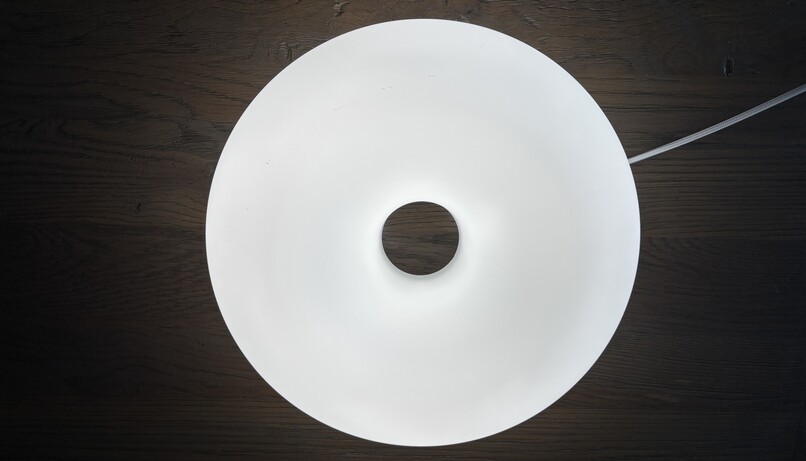
The original version made a name for itself as a chunky, glowing orange ring that looked more like modern art than a lamp. This new version dials things back visually with a frosted, matte glass finish, but quietly adds a full smart lighting setup underneath.
It’s the same sculptural design, but now with colour control, dimming, and that all-important cross-platform compatibility thanks to that Matter connectivity.
Advertisement
Advertisement
Read on for my full Ikea Varmblixt smart lamp review.
Design and placement options
Quite large
Wall or table mount
As mentioned above, it still looks like a big glowing donut. That hasn’t changed. What has changed is the finish.
Image Credit (Trusted Reviews)
The original bold orange is gone, replaced with a frosted white glass tube that diffuses light much more softly. You can still make it glow orange if you want, it just doesn’t scream it when switched off.
Advertisement
Physically, it’s not a small thing. At 30cm across, it’s got real presence. On a wall, that works in its favour. On a table, it can feel a bit like you’ve parked a sculpture where a lamp should be.
It’s designed to do both but the wall mounting does feel like the more natural fit. It looks intentional there. On a sideboard or coffee table, it borders on bulky.
Advertisement
Image Credit (Trusted Reviews)
Installation is refreshingly simple. There’s the normal Ikea flatpack-style instructions in the box but you really won’t need them.
A single screw holds the backplate in place, and the glass ring clips on over the top. That’s it. On a desk it’s obviously even easier than that.
Image Credit (Trusted Reviews)
Advertisement
The actual light source lives in that backplate; it’s essentially a short light strip wrapped into a circle, with the glass acting purely as a diffuser.
There’s a fabric-style nylon cable running out the bottom, which is a nice touch, and a physical toggle switch tucked underneath for manual control. It does need constant power, so cable management is part of the deal.
Image Credit (Trusted Reviews)
That constant power does mean that it doubles up as a Thread mesh extender too, but more on that in a bit.
Features
Matter compatible
Comes with wireless remote
This is where things get more interesting, and slightly more complicated than you would probably like.
Advertisement
Advertisement
The lamp ships with a Ikea Bilersa remote, which is actually its own standalone Matter device. That’s both clever and, at times, a bit confusing.
Image Credit (Trusted Reviews)
Out of the box, the remote isn’t paired to the lamp. Pairing them is straightforward (weirdly, it will use Zigbee for this), but there’s a catch. If you then add the lamp to a Matter ecosystem afterwards, it unpairs the remote. Which feels a bit backwards.
Once everything is set up in the default smart-but-not-smart mode, the remote can cycle through 12 preset colours, adjust brightness, and handle basic on and off control.
However, if you bring it into a wider smart home setup by pairing it via Matter, you can reassign it to control pretty much anything; not just limited to the Varmblixt lamp itself.
Image Credit (Trusted Reviews)
Advertisement
You could, for example, have some button presses assigned for lamp control, but also have some combinations controlling other things like blinds, heating or any other smart home automation.
Advertisement
The lamp itself is a Matter over Thread device, so it plays nicely with platforms like Apple Home, Amazon Alexa, and Google Home, assuming you’ve got a Matter Controller and a Thread Border Router in place.
These are built into a wide range of existing devices like Apple TVs, Echo smart speakers, Google Nest devices, Eero routers and even things like refrigerators, monitors, TVs and soundbars from Samsung.
You can also go down the Ikea route with the Dirigera hub and its app, but unlike some ecosystems, you’re not really unlocking anything dramatically new by doing so. The feature set is fairly basic across the board.
Image Credit (Trusted Reviews)
There are no fancy gradients or dynamic effects here. It’s more old-school smart lighting. Pick a colour, adjust the brightness, maybe tweak the white temperature, and that’s your lot.
Advertisement
Advertisement
Ikea’s approach is very much part of the company’s wider shift away from Zigbee and towards Matter over Thread.
Pairing is straightforward if you’ve done Matter before. Simply scan the code, pick your platform, and you’re off.
Image Credit (Trusted Reviews)
The lamp supports multi-admin as well, so you can share it across ecosystems without much fuss. In testing, it happily lived inside my Apple Home while also being accessible via Alexa and Home Assistant.
Image Credit (Trusted Reviews)
There’s something quite nice about how flexible it is. You can go full smart home integration, or you can ignore apps entirely and just use the included remote.
Advertisement
A lot of people will probably do exactly that. Treat it as a “smart-ish” lamp rather than a deeply integrated one.
Advertisement
Performance
Once set up, the lamp mostly does what you’d expect.
Colours are well judged. Not overly saturated, not washed out. The whites are particularly nice, with a good spread from cooler tones through to warmer, more ambient shades. It works well with adaptive lighting in Apple Home, which helps it blend into a wider setup.
Image Credit (Trusted Reviews)
Brightness is limited though. At 180 lumens, this is never going to light up a room. It’s there to create a mood, not replace your ceiling lights.
Advertisement
Response times, when connected, are quick enough. Commands land fast and transitions are smooth, especially when cycling through colours.
Advertisement
Image Credit (Trusted Reviews)
Connection stability was a bit hit and miss during testing. There were occasional dropouts where it would disappear for a few seconds before coming back online.
Squirrel Widget
Should you buy it?
You want a simple, smart light
Ideal for wall mounting, this smart light adds atmosphere to any room.
Advertisement
If you want dynamic lighting, gradients or similar, look elsewhere.
Advertisement
Final Thoughts
The Varmblixt smart donut doesn’t try to compete with feature-heavy rivals, and that’s probably the right call.
It leans into what made the original popular in the first place. A distinctive design that doubles as a light source. The smart features are there to support that, not take over.
If you’re after bright, highly customisable lighting with loads of effects, you’ll still be looking at brands like Philips Hue or Govee. This isn’t that.
Advertisement
But if you want something that looks good on the wall, adds a bit of atmosphere, and slots into a modern smart home without too much hassle, it’s an easy one to like.
Advertisement
How We Test
We test every smart light we review thoroughly over an extended period of time. We use industry standard tests to compare features properly. We’ll always tell you what we find. We never, ever, accept money to review a product.
Find out more about how we test in our ethics policy.
Advertisement
Used as our main smart light for the review period
Tested for at least a week
We measure the light output from bulbs at different colour temperatures and colours so we can compare light output
We test compatibility with the main smart systems (HomeKit, Alexa, Google Assistant, SmartThings, IFTTT and more) to see how easy each light is to automate
FAQs
Where can the Ikea Varmblixt Smart Lamp be mounted?
You can place it on a table (although the light is very wide), or you can wall mount.



















































You must be logged in to post a comment Login