

Crypto World
How AI Became Crypto’s Favorite Reason to Cut Staff


Coinbase became the latest crypto company to cut its workforce on Tuesday, as a wave of layoffs sweeps through an industry navigating a down market and the pressure to embrace AI.
CEO Brian Armstrong said the company is using AI to flatten its organizational structure, with managers expected to act more like “player-coaches.”
“AI is bringing a profound shift in how companies operate, and we’re reshaping Coinbase to lead in this new era. This is a new way of working, and we need to leverage AI across every facet of our jobs,” Armstrong said in an email to employees, also shared on X on Tuesday.

Armstrong’s memo outlined three sweeping changes to how Coinbase will operate. Source: Brian Armstrong
Block and Crypto.com have made similar moves in recent months, citing AI-driven efficiency gains that allow leaner teams to handle what once required larger headcounts.
Coinbase and Crypto.com cut about 700 and 180 employees respectively. Jack Dorsey’s Block handed out 4,000 pink slips in February to reduce the company to under 6,000 employees.
Crypto has weathered several bear markets before, and layoffs have always followed. But this time, the companies doing the cutting are using the downturn to rebuild with AI at the center.
Coinbase misses Q1 expectation
Coinbase’s Tuesday filing with the Securities and Exchange Commission detailed that the exchange expects its restructuring plan to cost up to $60 million in expenses tied to severance and termination benefits.
Clear Street analyst Owen Lau told CNBC that Coinbase wants to “tell investors that management is actively managing the cost base to deliver positive adjusted EBITDA through the cycle.”
“The first quarter results are expected to be weak because of the crypto bear market,” added Lau.
On Thursday, Coinbase reported a weaker-than-expected first-quarter loss as falling crypto prices dragged down spot trading revenue. The exchange posted a net loss of $1.49 per share on $1.41 billion in revenue, missing analyst expectations while transaction revenue fell short amid weaker trading activity.
The underperformance isn’t specific to Coinbase, as Bitcoin lost 21% of its value in Q1. Across the tech industry, headcounts that ballooned during the bull run are now coming back down, with executives increasingly pointing to AI as the catalyst.

Bitcoin has been in the red for two consecutive quarters but showed signs of recovery in April. Source: Coinglass
Related: Reality of AI’s impact on employment clashes with C-suite optimism
Whether AI is the real driver or a convenient explanation depends on who you ask. Speaking at the recent Semafor World Economy conference, Scale AI CEO Jason Droege pushed back on the idea of AI presenting a “white-collar apocalypse,” arguing that many companies are using the technology as cover.
“A lot of the layoffs that are happening right now because of AI, if you really dig in, it’s sort of like washing the layoffs,” Droege said. “A lot of these companies are saying it’s because of AI, but a lot of it is just like rightsizing and they need an excuse.”
AI leads job cut reasoning for second consecutive month
According to jobs tracker Layoffs.fyi, the global tech industry in 2026 Q1 had the most layoffs since 2023 Q1, with more than 81,747 people losing their jobs. March was hit the hardest, with 45,800 layoffs in the month.

Tech layoffs surged in early 2026, marking the industry’s highest quarterly job cuts since 2023. Source: Layoffs.fyi
Related: How AI agents can reshape arbitrage in prediction markets
The slowdown has continued into the first month of this quarter. According to a Thursday report from outplacement firm Challenger, Gray & Christmas, US employers announced 83,387 job cuts in April, up 30% from the 60,620 cuts recorded in March.
AI led all reasons for job cuts in April for the second consecutive month, though it is not the leading cause for the year so far. Market conditions led with 53,058 cuts, followed by closings at 52,187.
“Technology companies continue to announce large-scale cuts and are leading all industries in layoff announcements. They are also often citing AI spend and innovation. Regardless of whether individual jobs are being replaced by AI, the money for those roles is,” said Andy Challenger, chief revenue officer at Challenger, Gray & Christmas.
Crypto has always been cyclical, but the framing around this wave of cuts looks different from the last major downturn. During the 2022–2023 crypto crash, companies were largely reacting to collapsing token prices, the fallout from FTX and balance sheets strained by aggressive bull-market hiring.
This time, executives are increasingly presenting layoffs as proactive restructuring tied to AI adoption and operational efficiency.
Both Dorsey and Armstrong signalled that their companies remain well-capitalized, framing the cuts as deliberate attempts to flatten corporate structures rather than emergency survival measures.
Same playbook, new reason
Crypto recoveries have come fast, and when they do, businesses often enter hiring sprees to expand during the bull market. Coinbase has been here before. It cut 18% in 2022, then hired aggressively when prices rebounded.
This time, Armstrong is betting the AI-native model means he won’t have to.
Kraken was making the same argument in October 2024, when it slashed 15% of its workforce.
In a blog post, co-CEOs Arjun Sethi and Dave Ripley said the exchange had “fallen into the trap of building organizational layers” and needed to become “leaner and faster” by giving power back to individual contributors over managers.
The language is similar to Armstrong’s and Dorsey’s memos. The difference is, Kraken didn’t mention AI.
Leaner teams, flatter structures, faster decisions. Crypto has been here before, but AI is the latest reason why.
Magazine: Guide to the top and emerging global crypto hubs: Mid-2026


TLDR
- Kraken’s parent entity Payward has submitted an application for a national trust company charter to the OCC
- Approval would establish Payward National Trust Company, providing federally supervised digital asset custody services
- This application complements Kraken’s current Wyoming SPDI banking license and Federal Reserve master account access
- The company has allocated more than $2.6 billion toward recent strategic acquisitions, including NinjaTrader, Bitnomial, and Reap Technologies
- According to co-CEO Arjun Sethi, Kraken has achieved roughly 80% readiness for a possible public offering targeted for 2027
Payward, which operates the Kraken cryptocurrency exchange, has submitted a formal application to the U.S. Office of the Comptroller of the Currency (OCC) seeking a national trust company charter. The submission was made public on Friday, May 8, 2026.
Should regulators grant approval, this charter would establish a separate legal entity named Payward National Trust Company (PNTC). The new organization would deliver custody and fiduciary solutions under federal regulation, with a primary focus on digital assets.
The OCC has previously granted comparable authorizations to several major industry players, including Coinbase, Ripple Labs, BitGo, Circle, Fidelity Digital Assets, and Paxos. Payward aims to join this exclusive group of federally chartered crypto institutions.
Co-CEO Arjun Sethi emphasized that the company prioritizes establishing robust regulatory infrastructure over racing to be first to market. “A national trust company provides the certainty institutions require,” he stated in the official announcement.
Building on Existing Banking Infrastructure
Payward’s regulatory foundation already includes a Wyoming Special Purpose Depository Institution (SPDI) charter held through Kraken Financial, which was secured in 2020. Kraken Financial achieved a significant milestone as the first digital asset banking entity to obtain a Federal Reserve master account, providing direct integration with the U.S. payments infrastructure.
The proposed OCC trust charter would operate in conjunction with the existing Wyoming authorization. Payward characterizes this approach as a “multi-charter” framework, incorporating both state-level and federal regulatory supervision.
According to the proposal, PNTC would leverage Payward’s established compliance infrastructure and risk management protocols. The primary objective is addressing the needs of institutional investors requiring a federally regulated qualified custodian.
The OCC operates under the leadership of Jonathan Gould, appointed during the Trump administration. The regulatory body greenlit multiple crypto charter applications in a significant wave during December 2025.
Acquisition Spending and IPO Plans
Payward has executed an aggressive expansion strategy through strategic acquisitions. During 2025, the company purchased retail futures trading platform NinjaTrader in a $1.5 billion transaction.
In April 2026, Payward entered into an agreement to acquire crypto derivatives platform Bitnomial for a deal valued at up to $550 million. This acquisition delivered a comprehensive suite of CFTC licenses encompassing brokerage, clearing, and exchange capabilities.
Most recently, the firm announced a $600 million agreement to purchase Reap Technologies, a Hong Kong-based payments company. This strategic move positions Kraken to expand into stablecoin-enabled cross-border payment solutions and card processing infrastructure throughout Asian markets.
Across these three major transactions, Payward has pledged investment exceeding $2.6 billion.
Notwithstanding this substantial acquisition activity, plans for a Kraken initial public offering remain active. Sethi indicated in May that the organization has reached “about 80% ready” status for a potential market debut by 2027.
Kraken has additionally revealed a strategic partnership with MoneyGram, supporting its broader expansion into payment services.
The OCC charter application is currently under regulatory review. The agency has not disclosed an expected timeline for rendering a determination.



Coinbase, Kraken and Gemini are lobbying Senate Agriculture leaders to strip a “not readily susceptible to manipulation” standard from a flagship digital asset bill, warning it would effectively bar small, low‑liquidity tokens from regulated U.S. exchanges and hand the CFTC a veto over future listings.
Summary
- Coinbase, Kraken, and Gemini have asked Senate Agriculture Committee leaders to delete a clause that limits listings to tokens “not readily susceptible to manipulation.”
- The firms argue the standard would effectively shut small, low‑liquidity tokens out of regulated venues and hand future CFTC chairs a blunt tool to choke innovation.
- The language sits inside a sweeping market‑structure bill that would give the CFTC new authority over digital commodity spot markets, including bitcoin and ethereum.
Crypto’s biggest U.S. exchanges are quietly lobbying to strip a key investor‑protection clause from the Senate’s flagship digital asset bill, warning that it would make listing “small coins” on regulated venues nearly impossible.
According to Politico, Coinbase, Kraken and Gemini submitted redlines to the Senate Agriculture Committee earlier this year urging lawmakers to remove a requirement that registered “digital commodity exchanges” may list only tokens “not readily susceptible to manipulation.”
In a joint letter, the three firms told senators that “millions of Americans are participating in digital asset markets without the federal regulatory protections they deserve” and insisted that “every element of our legislative engagement has been aimed at changing that — by expanding oversight, not limiting it.”
They added that importing the Commodity Exchange Act’s high bar for futures and swaps — where contracts must be “not readily susceptible to manipulation” — into the spot market would “significantly raise the bar for listing smaller, less liquid tokens” and could be weaponized by a future CFTC chair “to throttle innovation” by simply refusing to certify new assets.
Inside the Senate’s digital commodity bill
The provision sits inside the Senate Agriculture Committee’s draft Digital Commodity Intermediaries Act, a market‑structure framework first floated in late 2025 by Chair John Boozman and Sen. Cory Booker to give the Commodity Futures Trading Commission explicit authority over “digital commodities.”
A client alert from McGuireWoods on the discussion draft notes that any trading facility offering a cash or spot market in a digital commodity would have to register as a “digital commodity exchange,” with obligations modeled on existing CFTC rules for futures venues. Exchanges “may list only digital commodities ‘not readily susceptible to manipulation’ and must certify each listing to the CFTC,” including analysis showing that the token meets statutory criteria and that the venue has adequate surveillance and safeguards. McGuireWoods
The Agriculture Committee advanced its portion of the bill along party lines in late January, as highlighted in a committee release, but everyone expects major surgery before it hits the Senate floor. Politico reports that Republicans will need Democrats on both the Agriculture and Banking Committees to sign off on a final package that can clear the 60‑vote filibuster hurdle, and negotiators are already trading edits across panels.
Crypto.news previously broke down that broader effort in a story on the updated Senate Agriculture draft, noting that it would, for the first time, put federally registered spot intermediaries for bitcoin and ethereum squarely under CFTC supervision while leaving the SEC in charge of securities tokens. The same story highlighted unresolved fights over DeFi, staking and stablecoin rewards that still stand between the draft and a bipartisan deal.
Why Coinbase, Kraken and Gemini are fighting this clause
For Coinbase, Kraken and Gemini, the manipulation test is existential for their long‑tail business. As Politico reports, the exchanges “strongly support the readily susceptible to manipulation standard in traditional futures and swaps markets,” but argue that “importing a standard that doesn’t make sense for spot crypto” would “inadvertently hamstring the agency, the industry [and] consumers.”
Paul Grewal, Coinbase’s chief legal officer, told Bloomberg earlier this year that the company could even reconsider its support for the overall market‑structure package if it ends up with restrictions that go beyond “enhanced disclosure requirements” for products like stablecoin rewards. Crypto.news’ coverage of that standoff in a story underscored that Coinbase sees the bill as a trade‑off: clearer CFTC rules on one side, potential constraints on its core business on the other.
Now the same pattern is playing out around small‑cap listings. As Politico notes, industry sources say exchanges are also lobbying Senate Banking Committee members to soften related language, warning that if the manipulation test stays intact, many “small, low‑liquidity tokens” will simply never make it to regulated platforms. Instead, they will trade only on offshore venues and in DeFi, exactly where U.S. regulators have the least visibility and leverage.
In a sense, this is the central tension of the bill that crypto.news flagged in its earlier story: Washington wants to drag crypto into a familiar derivatives‑style regulatory box, while the industry is trying to keep enough slack in the system to list riskier assets and offer yield without strangling the business model. The fight over one phrase — “not readily susceptible to manipulation” — is where those two instincts are now colliding.
TLDR:
- Senate Banking Committee will hold the first Crypto Clarity Act vote on May 14 morning session.
- Banking groups want stricter stablecoin reward rules before Senate lawmakers finalize bill text.
- Coinbase backed revised Clarity Act language after negotiations between key Senate lawmakers.
- Ethics concerns and stablecoin yields remain major obstacles before any full Senate floor vote.
The U.S. Senate Banking Committee will vote on the Crypto Clarity Act on May 14 as stablecoin regulation debates intensify. Banking groups continue pushing for tighter language around stablecoin rewards programs before the markup begins.
Crypto firms including Coinbase now support the revised bill language after negotiations between lawmakers. The latest dispute centers on whether stablecoin incentives could compete with traditional bank savings products.
Crypto Clarity Act Faces Banking Pushback Ahead of Senate Vote
The Senate Banking Committee scheduled the Crypto Clarity Act markup for May 14 at 10:30 AM EST. Watcher.Guru reported the development through an X update.
The proposal has become a focal point in the broader stablecoin regulation debate. Banks argue certain reward structures could resemble interest-bearing savings products.
Several banking trade groups submitted proposed revisions to Republican leadership on the committee. The organizations included the American Bankers Association, Consumer Bankers Association, and Independent Community Bankers of America.
According to reporting from Eleanor Terrett, the groups want stricter wording around stablecoin reward mechanisms. They believe current provisions still leave room for yield-like programs.
The dispute follows compromise talks led by Senators Thom Tillis and Angela Alsobrooks earlier this week. Their updated language reportedly secured support from several crypto firms.
Coinbase and other crypto companies backed the revised text after negotiations concluded. The compromise attempted to limit concerns tied to digital asset rewards while preserving stablecoin utility.
Banking organizations still pushed for more revisions despite signals that lawmakers considered the matter settled. A Senate aide described the lobbying effort as limited in scope, according to Terrett’s report.
Stablecoin Regulation Debate Expands Beyond Yield Concerns
The Clarity Act discussions now extend beyond stablecoin rewards. Lawmakers continue debating ethics provisions tied to digital asset ownership and political exposure.
Democratic support for the legislation remains uncertain ahead of the committee vote. Concerns continue around how public officials could financially benefit from crypto holdings.
Committee members reportedly shifted attention toward unresolved ethics language during recent negotiations. Banking sector concerns now compete with broader political discussions surrounding the bill.
The stablecoin market has become a major issue in Washington during 2026. Policymakers continue weighing financial innovation against risks to traditional banking systems.
Banking groups warned that aggressive stablecoin adoption could reduce deposits held by commercial lenders. They argue reward programs may attract users away from standard savings accounts.
Crypto firms maintain that regulated stablecoins improve payment efficiency and blockchain-based settlement. The current proposal attempts to define operational rules without banning incentives entirely.
The May 14 markup will mark the first major Senate committee action on the Crypto Clarity Act. Lawmakers may still revise sections of the bill before any full Senate consideration begins.

US prosecutors said they have secured eight sentences in the last five months against people acting as US-based proxies for North Korea-based IT workers, shedding new light on how they have been able to infiltrate US companies.
Two men have been sentenced this month alone. The Justice Department said Wednesday that separate courts sentenced Nashville resident Matthew Issac Knoot and New York resident Erick Ntekereze Prince for helping North Koreans work remotely for US companies.
The US perpetrators, known as “laptop farmers,” acted as recipients for laptops that US companies would send to new employees. They installed remote desktop software on the devices, allowing North Korean IT workers to use them remotely while appearing to work from the US.
North Korea’s remote worker scheme generates revenue for the government and has targeted technical roles at crypto companies to gain access to internal systems, company assets and security infrastructure. Such access can help workers understand company infrastructure and identify systems that could later be exploited.

Source: FBI Cyber Division
Prosecutors said Knoot, who was sentenced on May 1, and Prince, sentenced on Wednesday, each received 18 months in prison.
Prince was ordered to forfeit $89,000, the amount the North Korean workers paid him for the scheme, while Knoot was ordered to pay $15,100 in restitution to the companies and to forfeit an additional $15,100, the amount he earned from the scheme.
Together, the Justice Department said the pair generated $1.2 million in revenue for North Korea, and the scheme affected nearly 70 US companies.
Related: North Korea tied to heists worth $578M in April after Kelp DAO exploit
Last month, New Jersey residents Kejia Wang and Zhenxing Wang were given nine years in prison and seven years, eight months in prison, respectively, for hosting laptop farms for North Korea.
Prosecutors in that case said the scheme lasted multiple years, used the stolen identities of 80 people in the US and made over $5 million for the North Korean government.
According to a report by CrowdStrike in August, the number of companies that hired North Korean workers over the previous 12 months jumped 220%, with workers infiltrating more than 320 companies over that period.
The report noted that North Korean workers were heavily using artificial intelligence to automate and optimize the process of applying for and working in remote jobs.
The US charged four North Koreans in June last year, accusing them of stealing more than $900,000 in crypto after using fake identities to gain remote employment at an Atlanta-based blockchain research and development company and a Serbian crypto company.
Magazine: Guide to the top and emerging global crypto hubs — Mid-2026
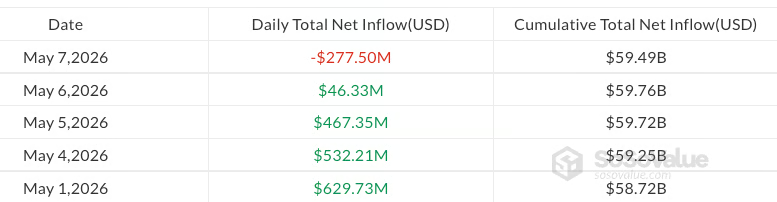
US-listed spot Bitcoin (BTC) exchange-traded funds (ETFs) snapped a five-day inflow streak totaling nearly $1.7 billion as Bitcoin dipped below $80,000.
Bitcoin funds logged $277.5 million in outflows on Thursday, marking the first daily outflows in May, according to SoSoValue data.

Daily spot Bitcoin ETF flows since Friday. Source: SoSoValue
The Fidelity Wise Origin Bitcoin Fund (FBTC) led the outflows at $129 million, while BlackRock’s iShares Bitcoin Trust ETF (IBIT) followed with $98 million in outflows, according to Farside.
The sharp reversal in Bitcoin ETF flows came amid heightened Bitcoin volatility. Bitcoin rose above $82,000 on Wednesday before falling below the key $80,000 level the next day.
Morgan Stanley’s Bitcoin ETF remains resilient amid broader outflows
The Morgan Stanley Bitcoin Trust ETF (MSBT), the first spot Bitcoin ETF launched by a US bank, recorded modest inflows of $7.3 million on Thursday. The fund has not seen a single day of outflows since debut on April 8, 2026, according to Farside.
MSBT has so far accumulated 2,920 BTC, worth around $232.6 million, growing assets held for its customers by 557% since launch.

Daily spot Bitcoin ETF flows by issuer (in millions of US dollars) since Friday. Source: SoSoValue
The only other Bitcoin fund to record inflows on the day was the Grayscale Bitcoin Mini Trust ETF (BTC), a low-cost spot Bitcoin ETF offered by Grayscale alongside its Grayscale Bitcoin Trust (GBTC).
Related: VanEck’s Sigel sees Bitcoin reaching $1M within five years
Canton Network ETF ends slightly lower on Nasdaq debut as token slips
The Bitcoin ETF outflows came alongside the Nasdaq debut of the 21Shares Canton Network ETF (TCAN), the first US-listed ETF designed to offer direct exposure to Canton Coin, the native utility token of the Canton Network.
TCAN began trading on Nasdaq on Thursday and closed its first session at $24.66, slightly down from an initial price of $24.76, according to Nasdaq data. Canton Coin slipped 1.7% on the day, trading at $0.145 at the time of writing, according to CoinGecko.

The Crypto Fear & Greed Index. Source: Alternative.me
The negative trend in crypto markets pushed the Crypto Fear & Greed Index into “Fear” on Friday at 38 after briefly returning to “Neutral” the previous day. The index is still significantly above April levels, when it averaged 17, as Bitcoin has risen about 11% over the past 30 days.
Magazine: Adam Back says current demand is ‘almost’ enough to send Bitcoin to $1M
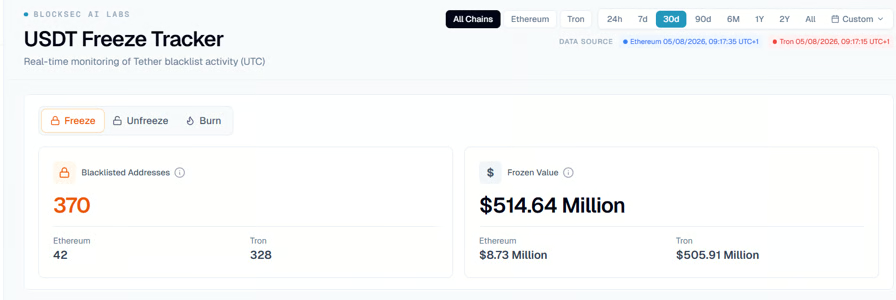
Tether has frozen more than $514 million in USDT across Ethereum and Tron over the past 30 days, according to onchain data from BlockSec’s USDT Freeze Tracker, highlighting the stablecoin issuer’s growing role in crypto-related enforcement actions.
As of Friday, the tool shows 370 addresses blacklisted in that period, including 328 on Tron and 42 on Ethereum, with about $505.9 million frozen on Tron and $8.73 million on Ethereum.
The figures indicate that most recent enforcement activity is concentrated on Tron and highlight how often the world’s largest stablecoin issuer is intervening onchain to immobilize funds flagged as high-risk or linked to investigations.
The recent activity also builds on a pattern of increasingly frequent enforcement. BlockSec’s analysis of 2025 data found that Tether blacklisted 4,163 unique addresses across Ethereum and Tron, freezing a total of $1.26 billion in USDT. The current pace of freezes suggests Tether could exceed that total in blacklisted USDT well before the end of the year.
Of the $1.26 billion of frozen assets in 2025, more than half (about $698 million) was later destroyed via the contracts’ “destroyBlackFunds” function, and only 3.6% of those addresses were subsequently removed from the blacklist, indicating that once imposed, freezes are rarely reversed.
Tether blacklisting activity accelerates in 2026
A separate study of 2023-2025 trends estimated that Tether immobilized roughly $3.3 billion across 7,268 addresses in those three years, far outpacing rival stablecoin issuer Circle over the same horizon.

USDT Freeze Tracker. Source: BlockSec
Tether has also disclosed larger aggregate totals and detailed some of the cases behind them. In February, the company said it had frozen about $4.2 billion in tokens in three years over links to illicit activity, with some $3.5 billion of that amount locked since 2023 as authorities increased efforts to curb crypto-related crime.
In April, Tether said it worked with the US Treasury’s Office of Foreign Assets Control and law enforcement agencies to freeze more than $344 million in USDT across two Tron addresses that US officials said were linked to suspected sanctions evasion involving Iran, while in February, Tether helped authorities to seize over $61 million in USDT linked to so-called pig butchering scams.
Related: Tether reports $1.04B profit in Q1 as Treasury holdings reach $141B
Stablecoin blacklists fuel wider freeze debate
The growing scale of blacklisting and related seizures has fed into a broader debate over how far crypto issuers and protocols should go in stopping suspect flows.
Some projects in decentralized finance, for example, have used upgradeable contracts and admin controls to halt or recover funds in major exploit cases, raising questions about who decides when such powers are used.
In stablecoins, where issuers such as Tether retain direct control over minting and burning mechanisms, onchain data and enforcement disclosures show that blacklisting and freezes are now used regularly in fraud, sanctions and scam investigations.
Tether and the Tron network did not immediately respond to Cointelegraph’s requests for comment.
Market Moves: Why is Ethereum Foundation selling? BTC futures warning signs
Bitcoin’s price slide below $80,000 didn’t last long, as the asset reclaimed that level yesterday following US President Trump’s announcement of a three-day ceasefire between Ukraine and Russia.
Many altcoins have produced a lot more impressive gains today, led by ONDO, SIREN, JUP, ICP, and VVV.
BTC Taps $80K Again
Bitcoin’s late April/early May rally began at the end of the previous month when it had dipped to $75,000 following the latest FOMC meeting in which the Fed maintained the interest rates unchanged. In the following week, the cryptocurrency added roughly $8,000 to chart a three-month peak at $82,800.
Following such an impressive run in relatively unstable market conditions, many analysts warned that BTC could be due for a correction as the environment didn’t appear solid enough. This retracement transpired on Thursday and especially on Friday, when the asset fell to $79,100, thus dropping by almost $4,000 from its local peak.
Nevertheless, it rebounded swiftly, perhaps due to positive developments in the Ukraine/Russia war, where US President Donald Trump announced a three-day ceasefire.
This means that its market capitalization has returned to just over $1.6 trillion on CG, while its dominance over the alts has been reduced to 58.1%.

Alts Rocket
Essentially, all alts have posted some gains today. Ethereum has reclaimed $2,300 after a minor increase, while XRP and BNB continue to fight for the fourth spot in terms of market cap. XRP has taken a slight lead after a 3% daily jump. SOL, ADA, LINK, and CC have jumped by 5-8%, while ZEC is up by 10% to $630. SUI, UNI, and NEAR are also well in the green.
Even more impressive gains come from ONDO (25%), JUP (24%), ICP (20%), SIREN (19%), FIL (16%), VVV (15%), and ARB (13%).
The cumulative market cap of all crypto assets has added more than $40 billion since yesterday’s low and is up to $2.780 trillion on CG.

The post Massive Double-Digit Gains From These Alts as BTC Returns to $80K: Weekend Watch appeared first on CryptoPotato.
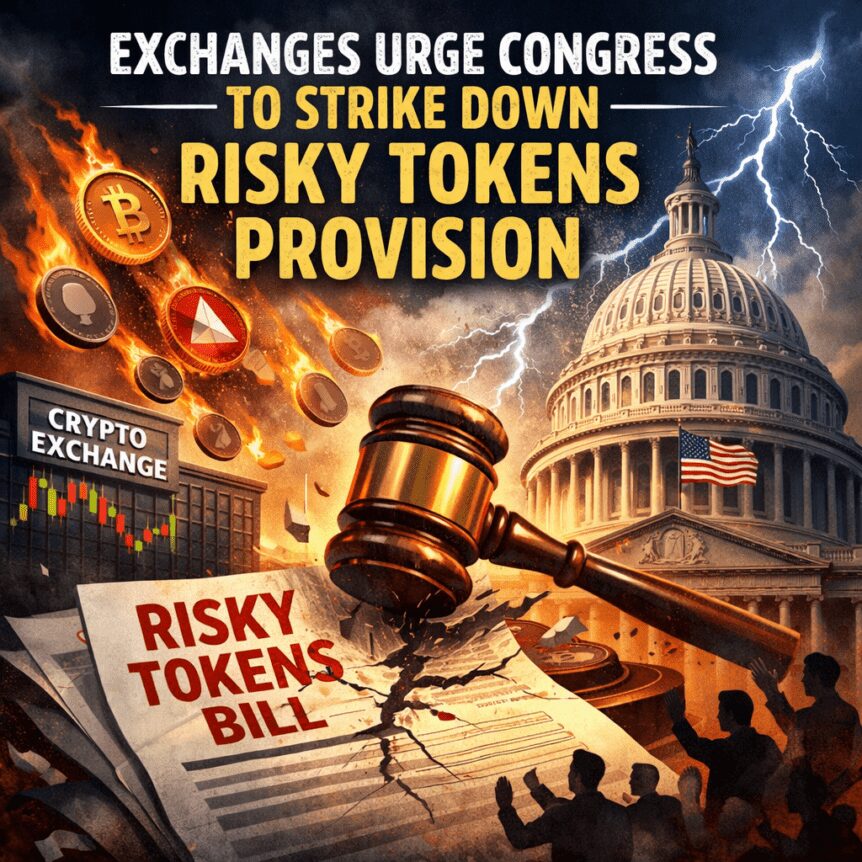
A trio of high-profile crypto exchanges reportedly pressed U.S. lawmakers to strike a controversial provision from a sweeping market-structure bill that, if enacted, could curb trading options for smaller digital assets. According to a Politico report, Coinbase, Kraken and Gemini asked legislators to remove language that would require platforms to offer trading only on assets “not readily susceptible to manipulation.”
The move, which emerged after the US Senate Agriculture Committee advanced its version of the bill in January, highlights the growing influence of exchange operators as policy dialogues unfold ahead of broader regulatory decisions. Coinbase CEO Brian Armstrong later signaled that the legislation could not be supported “as written,” particularly over issues surrounding tokenized equities. Faryar Shirzad, Coinbase’s chief policy officer, later described the matter as “old news” in a social post, underscoring how these discussions have persisted through the markup process.
The reported intervention occurs as regulators signal a push to coordinate crypto oversight even amid limited action from Congress. In March, both the Commodity Futures Trading Commission (CFTC) and the Securities and Exchange Commission (SEC) stated their intention to coordinate enforcement and oversight of digital assets, an alignment that has sustained despite legislative gridlock. The policy jockeying comes as lawmakers grapple with a broader market-structure framework known as the CLARITY Act, which moved through the House in 2025 and would empower the CFTC to take a lead role in digital-asset regulation.
Beyond these internal debates, industry dynamics continue to shape the process. The same Politico report notes that industry voices have been active in shaping the markup, with exchanges arguing that certain provisions could chill listings of smaller tokens. The evolving dialogue has drawn attention to the tension between regulatory safeguards and the practical realities of token listings, especially for newer or less liquid assets.
In context, industry and policymaker commentary has also touched on the broader timeline for the bill. Last week, a compromise on stablecoin yield was announced between representatives of the crypto and banking sectors, reigniting hope that at least some elements of the CLARITY Act could progress in the Senate Banking Committee. Coinbase’s policy executives have repeatedly framed timing as a critical factor—some expect a markup in the banking committee as early as next week, while others anticipate at least a pathway to a floor vote before the Senate recess in August. In parallel, White House crypto adviser Patrick Witt indicated the administration’s ambition to see the bill advance, aiming for a July 4 deadline for House passage following a June Senate vote.
Taken together, the latest disclosures illustrate how closely industry executives shape the regulatory debate as lawmakers weigh a more centralized framework for digital assets. The CLARITY Act would, if enacted, grant the CFTC expanded authority over digital assets, with the SEC also seeking to coordinate on market oversight. That dual-track approach continues to influence both public policy and market behavior, even while key questions about tokenization, listing standards and potential conflicts of interest linger in the background.
Related reading: Politico detailing exchange lobbying on the markup Cointelegraph live coverage of the Senate markup Coinbase exec comments on markup timing, and Faryar Shirzad’s post outlining the ongoing discussions.
Key takeaways
- Exchanges reportedly urged lawmakers to drop the “not readily susceptible to manipulation” standard, arguing it could restrict listings for smaller assets.
- The CLARITY Act would expand the CFTC’s authority over digital assets, with ongoing coordination between the CFTC and SEC noted by regulators despite a lack of full congressional action.
- Industry voices have become visible players in the markup process, signaling potential policy leverage ahead of final passage.
- Market observers are watching timelines closely: a possible markup next week, with some anticipating House action before August recess and the White House signaling an aim for July 4 progress.
- Alongside structural questions about listings, debates around tokenized equities remain a central sticking point for supporters and critics of the bill.
Regulatory momentum, even amid uncertainty
In March, both U.S. financial regulators signaled a willingness to coordinate oversight of crypto markets, signaling a practical continuity of policy goals even without a fully enacted law. The alignment between the CFTC and SEC reinforces a pragmatic approach to overseeing a rapidly evolving asset class, where enforcement and rulemaking can proceed in parallel with legislative activity.
Industry participants, including major exchanges, have argued that certain regulatory language could impede the ability to list a broad spectrum of digital assets. The tension between safeguarding markets and enabling innovation sits at the heart of the current debate, with observers noting that the final framework will likely rely on a combination of rulemaking, oversight, and targeted legislation rather than a single sweeping statute.
What investors and builders should watch next
For market participants, the coming weeks will be telling. If the markup proceeds as anticipated, the contours of the final market-structure framework could become clearer, including how strictly platforms must assess asset manipulability and what thresholds apply to listing decisions. The ongoing dialogue around tokenized equities underscores a broader question: how to balance investor protection with the practical realities of a diverse asset universe that includes smaller, less liquid tokens.
As the timetable evolves, stakeholders should monitor both committee actions and executive-level signaling. A marked advancement in the banking committee, coupled with a cohesive federal push on stablecoins and yield, could shift the regulatory calculus in important ways for issuers, exchanges and users alike. The balance between risk controls and listing flexibility will likely shape liquidity dynamics, funding models, and the pace of mainstream adoption for digital assets.
Readers should stay tuned to committee calendars, as well as the administration’s public communications, for the next high-signal updates on where the CLARITY Act stands and how industry input may influence precisely where the final law lands.
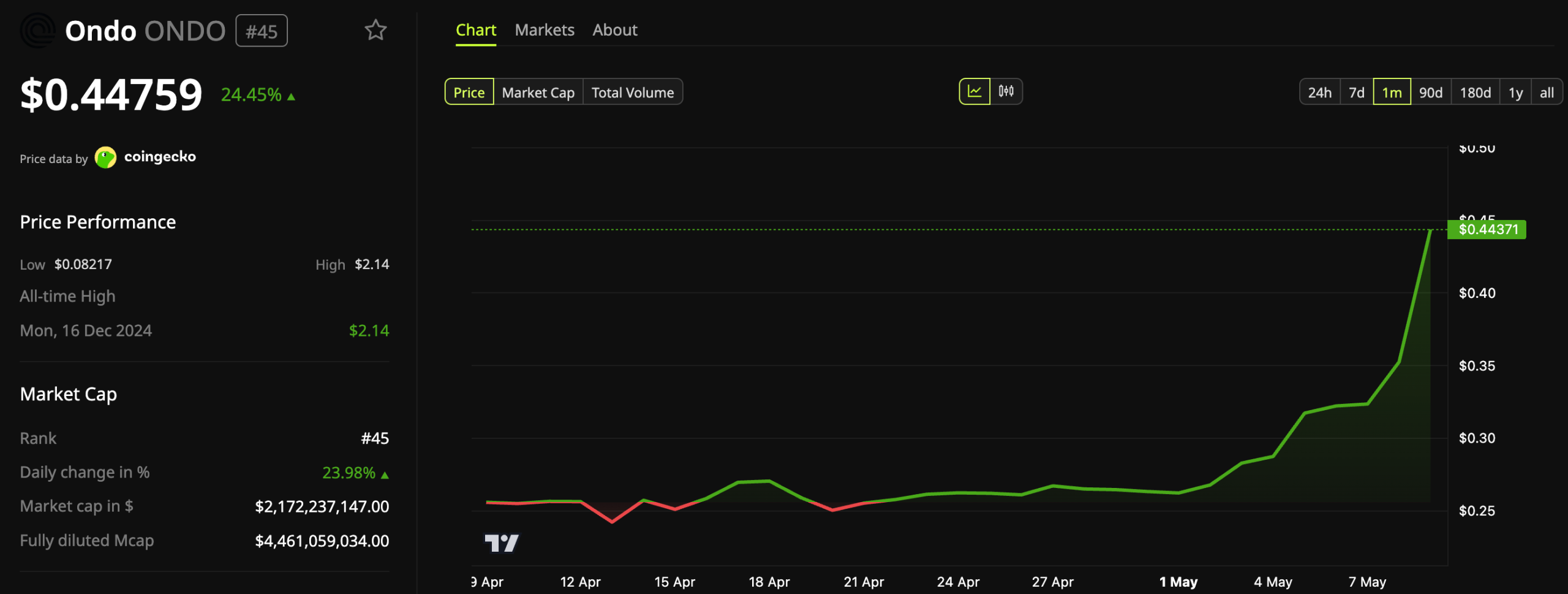
Ondo (ONDO) has climbed to a nearly five-month high, extending a price rally that began earlier this month. The altcoin surged to $0.48 today, marking its highest level since December 2025.
At press time, ONDO had slightly pulled back to $0.44, though it remained up around 24.45% over the past day. The latest rally has erased all of the token’s early-2026 losses, with ONDO gaining roughly 70% over the past week alone.

Tokenization Bets Stack Up Behind ONDO
Market data showed the uptrend began at the start of the month. Momentum accelerated after two back-to-back developments boosted investor sentiment.
On May 4, the Depository Trust & Clearing Corporation (DTCC) named Ondo Finance to its tokenization working group. The group includes more than 50 financial firms.
Then, on May 6, Ondo, Kinexys by JPMorgan, Mastercard, and Ripple completed a cross-border pilot redemption of tokenized US Treasuries.
“This milestone marks the first time tokenized U.S. Treasuries have settled across borders and banks in near real time and outside traditional banking windows,” Ondo Finance wrote.
Subscribe to our YouTube channel to watch leaders and journalists provide expert insights
Whale Wallets Keep Adding ONDO
The developments highlight that ONDO’s rally is driven by real catalysts, with on-chain whale behavior reinforcing the move. Santiment data showed that in the past month, whales holding between 1 million and 10 million ONDO grew their collective stash from 555.38 million to 594.05 million, adding roughly 38.67 million ONDO.

Holders in the 100,000–1 million range increased from 145.87 million to 154.95 million, adding about 9.08 million ONDO. The whales holding 10 million–100 million altcoins grew from 2 billion to 2.03 billion, roughly adding 30 million coins.
Taken together, the three cohorts absorbed around 77.7 million ONDO over the month. Accumulation showing up across every tier, rather than just one, is a healthy distribution signal.
In addition, large holders typically invest with a longer-term outlook. As a result, continued accumulation instead of selling often signals growing confidence in ONDO’s medium-term prospects.
Follow us on X to get the latest news as it happens
DTCC’s tokenization service launches in October, with initial production trades penciled in for July. Therefore, the rollout could likely deliver additional tailwinds for ONDO in the months ahead.
The post Why is Ondo Finance Up 70% This Week and Will It Last? appeared first on BeInCrypto.


Acting Labor Secretary Sandlin’s push for earlier Fed cuts clashes with a cautious central bank, leaving crypto trading a “higher for longer” regime even as the political drumbeat for easing grows louder.
Summary
- ECB Governing Council member Joachim Nagel says the central bank is “highly vigilant” about rising inflation risks from the Iran war and will act if energy costs start feeding into broader prices.
- The comments come as eurozone inflation has already ticked back up to around 3% year-on-year on the back of a double‑digit jump in energy prices, complicating any case for rapid rate cuts.
- For crypto, a more hawkish or delayed‑easing ECB in response to energy‑driven inflation would tend to tighten liquidity in Europe, reinforcing bitcoin’s behavior as a high‑beta macro asset rather than a simple inflation hedge.
Nagel, who heads Germany’s Bundesbank and sits on the ECB’s Governing Council, told Bloomberg on Friday that the central bank is “highly vigilant” to rising inflation risks from the Iran war and “will act as needed to prevent higher energy costs spilling over into prices more broadly.” He warned that the conflict’s medium‑term impact on inflation is “still difficult to assess” but said policymakers are determined not to let an energy price shock morph into a new wave of persistent, second‑round effects.
ECB “highly vigilant” on Iran‑driven inflation
Those remarks echo what Nagel told Reuters in March. In emailed comments reported under the headline “ECB will react if Iran war pushes up inflation,” he said: “We must be very vigilant. If it becomes apparent that the current energy price increases will translate into broad consumer price inflation in the medium term, the Governing Council of the ECB will act decisively in a timely manner.” He added that debates about inflation undershooting the ECB’s 2% target “are likely to be over for the time being.”
The ECB is currently holding its deposit rate around 2%, a level Nagel has described as “well positioned” — neither clearly stimulative nor restrictive — to respond in either direction as the data evolve. But he and other officials, including Croatia’s Boris Vujčić and chief economist Philip Lane, have repeatedly stressed that the priority now is preventing a repeat of the 2022 Russia‑Ukraine energy shock, when the ECB was slow to react and inflation surged into double digits.
Oil shock pushes eurozone inflation back to 3%
The macro backdrop supports Nagel’s caution. Eurostat data reported by the Associated Press show that euro‑area inflation rose to 3% in April from 2.6% in March, driven by a 10.9% year‑on‑year jump in energy prices as the Iran war disrupted flows through the Strait of Hormuz. Barchart’s summary of the release notes that the 21‑country eurozone is now facing “higher inflation and weaker growth,” a classic stagflation mix that makes life harder for the ECB.
CryptoBriefing, citing prediction markets, recently observed that odds of a 50‑basis‑point ECB rate cut at the April 2026 meeting sat at just 0.3% “as the Iran energy shock keeps inflation pressure on Europe,” arguing that traders “see almost no chance of aggressive rate cuts while energy-driven inflation persists.” Yahoo Finance similarly quoted policymakers saying the ECB “must be very agile and vigilant” in the face of stagflation risks, with any easing path now likely to be slower and more conditional than markets had hoped at the start of the year.
Why this matters for bitcoin and the broader crypto market
For crypto, an ECB that stays hawkish or delays cuts because of energy‑driven inflation is another headwind in what is already a tighter global liquidity environment. Cryptoslate has argued that the Iran war and associated oil shock are “exposing Bitcoin’s dependence on liquidity,” noting that as energy prices rose and central banks stayed cautious, bitcoin’s supposed safe‑haven behavior “broke down,” with the asset trading more like a leveraged risk asset than an inflation hedge.
That pattern lines up with research covered by crypto.news in a story on how bitcoin and ethereum now move with global risk sentiment: when central banks are on hold and equities grind higher, BTC and ETH tend to outperform; when inflation surprises force policymakers to lean hawkish, crypto usually gets hit alongside other long‑duration assets. Another crypto.news story on U.S. jobs data showed exactly that dynamic: as rate‑cut hopes faded, the total crypto market cap slid and bitcoin lost key support levels.
Nagel’s message underscores that the eurozone leg of that macro story is not about to flip dovish simply because growth looks soft. As long as the Iran war keeps oil and gas prices elevated and euro‑area inflation hovering around 3%, the ECB’s bias will remain toward vigilance rather than easing. For crypto traders, that means the European part of the liquidity puzzle is likely to stay tight — and that bitcoin’s role in portfolios will continue to be defined more by global risk appetite and real‑yield dynamics than by any simplistic “inflation hedge” narrative.

Indonesia locates two Singaporeans missing after Mount Dukono eruption
Kraken Seeks Federal Banking Charter to Expand Crypto Custody Services

Freddie Freeman’s homer helps Dodgers down Braves

Manchester United reach agreement with Casemiro over contract clause amid transfer speculation

US brings back mandatory military draft registration

Steven Gerrard disagrees with Gary Neville over ‘shock’ Chelsea and Arsenal claim | Football


-
 Crypto World21 hours ago
HarrisX Poll Found 52% of Registered Voters Support the CLARITY Act
-

 NewsBeat6 days ago
Channel 5 – All Creatures Great and Small series 7 new post
-

 Crypto World2 days ago
Upbit adds B3 Korean won pair as Base token gains Korea access
-

 Tech4 days ago
Image AI models now drive app growth, beating chatbot upgrades
-
 NewsBeat2 days ago
NCP car park operator enters administration putting 340 UK sites at risk of closure
-

 News Videos6 days ago
AP Dhillon – Old Money (Official Audio)
-

 Fashion13 hours ago
Weekend Open Thread: Marianne Dress
-

 Sports6 days ago
Five killed in Texas plane crash identified as Amarillo pickleball players
-
Entertainment6 days ago
New Netflix Movies in May 2026 — My Top 3 Picks to Stream
-
Crypto World6 days ago
Pi Network Mandates Protocol 23 Upgrade for All Mainnet Nodes Before May 15 Deadline
-

 Entertainment6 days ago
Melissa Joan Hart and More Stars Attend 2026 Kentucky Derby
-
Entertainment6 days ago
Anna Nicole Smith’s Daughter Attends 2026 Kentucky Derby
-

 Crypto World6 days ago
Bitcoin mining equities rise in 2026 as BTC lags behind
-

 Business6 days ago
Luka Doncic Injury Update: Doncic’s Hamstring Recovery Slows Lakers’ Hopes Against Thunder: Can He Run Yet?
-
Entertainment6 days ago
Venus Williams’ Best Met Gala Looks Over the Years
-

 Business7 days ago
Kuwait International Airport Resumes Operations After Closure as Regional Tensions Ease in 2026
-
 Entertainment6 days ago
After 2 Years, This Taylor Sheridan Neo-Western Doesn’t Have a Single Bad Episode
-
Crypto World6 days ago
Q1 2026 Tech Layoffs AI Wave Hits 81,747 as Firms Shift to AI Infrastructure
-
 Entertainment6 days ago
Netflix’s 10-Part Miniseries Based on a True Story Is a Perfect Weekend Binge
-

 Sports6 days ago
Is Man United v Liverpool on TV? Channel, streaming and how to watch Premier League fixture
You must be logged in to post a comment Login