
News Beat
UK to end flagship anti-FGM programme

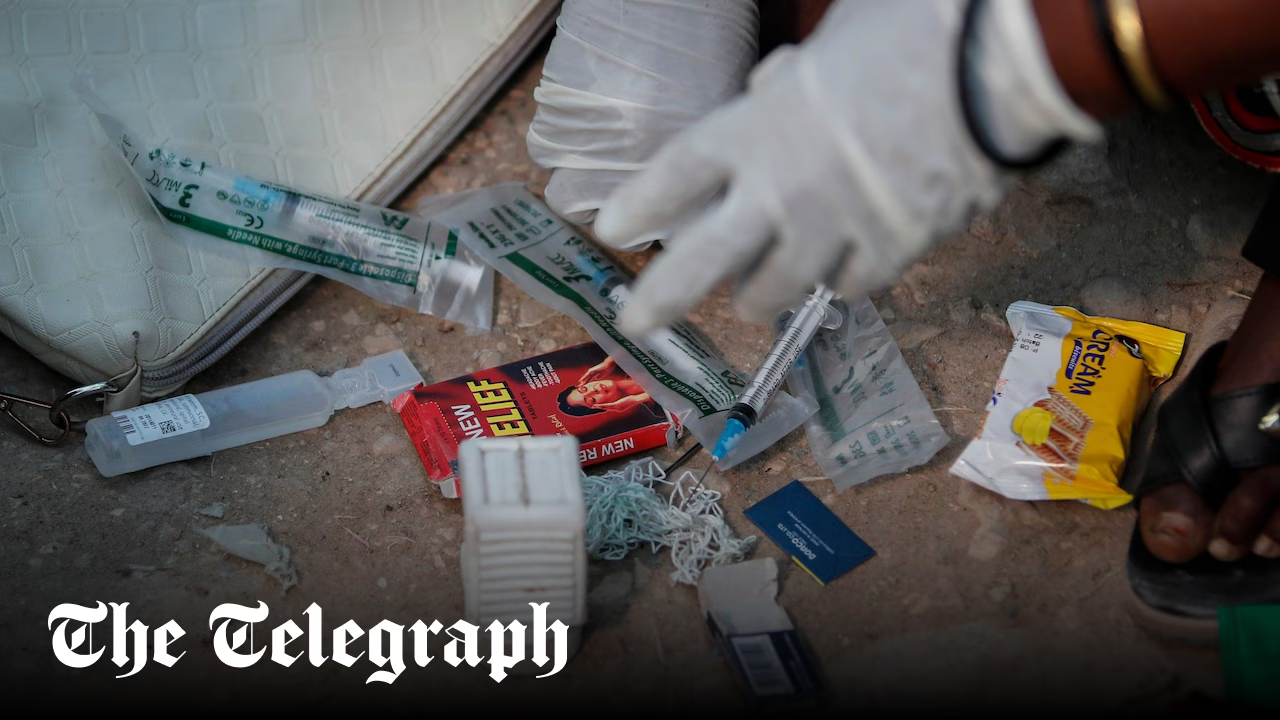

However, the Foreign, Commonwealth & Development Office (FCDO) has now confirmed that the programme will end in October 2026, and that there are “currently no plans for future funding”.
The announcement came in a government response to a report by the Women and Equalities Committee, which had urged ministers to protect funding for FGM prevention initiatives in the UK and abroad.
“It’s a huge tragedy. There was so much work that went on to make sure that Britain was leading the way on this, and we had got the government to prioritise FGM as an issue,” Brendan Wynne, co-founder of the Five Foundation, a grass-roots organisation that tackles FGM in the developing world, told The Telegraph. “No country really has done that in the same way, and for the UK to do it was monumental.”
In response to the funding cut, Sarah Champion, Chair of the International Development Committee and Sarah Owen, Chair of the Women and Equalities Committee, wrote to Baroness Chapman, the Minister of Development, arguing that cutting the funding would put women’s lives at risk.
The letter, seen by The Telegraph, said: “Ending the funding for such crucial work tracking FGM presents a serious risk to women and girls globally [and] compromises the safety of women and girls in the UK, who remain at risk of being taken abroad to undergo FGM.”
Cases of FGM – which mostly takes place overseas and carries a 14 year prison sentence in the UK for anyone who performs or facilitates the practice – are thought to have risen by at least 15 per cent in the UK in recent years.
At least 137,000 women are thought to be victims of the practice in Britain, and in 14,355 women and girls attended hospital or GP appointments in relation to complications from FGM, compared to 12,475 the year before.
Sarah Owen told The Telegraph: “I want to see an impact assessment on the likelihood of these cuts having an impact on women and girls in the UK. We are seeing younger and younger girls being taken abroad [to have FGM].”
Some activists, however, say the money will not be missed because it was not being spent effectively to begin with.
Nimco Ali OBE, an FGM survivor who co-founded The Five Foundation and former government advisor on women and girls, wrote in 2023 that too little of Britain’s aid was making it to those in need.
“I am on the frontline of the work the Foreign Office says it funds and I can tell you UK aid funding to ‘help end female genital mutilation’ (FGM) has no evidence that a penny given has actually saved a girl from FGM,” she wrote in the Evening Standard.
“It is really hard for me to say this because I am a supporter of UK aid, but the truth is what we give has never truly achieved what it could.”
Ms Ali instead advocates for funding to be given directly to grass-roots organisations on the ground, who know best how to tackle the problem.
Professor Charlotte Watts, the former Chief Scientific Adviser at FCDO, told The Telegraph: “The reduction in aid is leading to difficult choices and cuts in programmes, that will impact on a range of critically important agendas, including in global health.”
Protect yourself and your family by learning more about Global Health Security



