

Crypto World
DAPPOS launches xBubble: An AI agent that learns and uses AI for you


xBubble allows users to complete specific tasks with simpler prompts by automatically building and dispatching task-specific AI agents.
Today, DAPPOS is launching xBubble, a low-prompt AI agent designed for users who want results, not prompt-tuning sessions.
With xBubble, users can turn short requests into deliverable work across creating image/video, websites, documents, and scheduled solutions, without testing models, assembling tools, building solutions, or vibe coding skills themselves.
xBubble is built around two core systems: Bubble Engine, which generates and tests task-specific SOPs that can be executed by AI agents, and Bubble Pilot, which reads a user’s request and dispatches it to the best available AI solution.
“Powerful AI no longer requires users to learn AI,” said the DAPPOS team. “xBubble inverts the relationship. We have AI learn AI, and we have AI use AI, so users don’t have to. The system evolves faster than any user can, and leverages AI more effectively than they can.”
Why low-prompt AI
AI capability is improving rapidly, and access is no longer the constraint. But as models grow more powerful, the gap between users who know how to operate AI and users who don’t is widening, not closing. The same model that produces professional results for power users often returns disappointing output for everyone else — and the gap compounds with every model release.
Closing that gap takes real work. Power users study how each model behaves across different task types, research which combinations of tools and skills chain together for a given workflow, and run repeated debugging cycles before outputs become reliable. They build internal playbooks of what works on which task, and re-learn the operating manual every time a new model launches — the know-how rarely transfers cleanly to the next release.
The bottleneck has shifted from model capability to model usability. The question is no longer only whether AI can complete a task. The question is whether ordinary users can reliably turn their goals into the right AI solution.
xBubble is designed to close that gap by inverting the relationship. Instead of users learning AI, xBubble has AI learn AI. Instead of users figuring out how to use AI, xBubble has AI use AI on their behalf. Bubble Engine does the learning. Bubble Pilot does the using. Users only state the goal.

The low-prompt approach
Dispatch task-specific AI solutions
Most AI products give users a blank box and a set of powerful tools. The user has to decide which model fits the task, which tools to chain, how to format the output, and how to recover when the result misses — and to re-learn that decision tree every time a new model arrives.
xBubble takes a different approach. It gives users a dispatch layer.
A short request is not sent to a general AI agent, but passed to a specified agent who can best understand and execute it. Bubble Pilot reads the user’s intent, identifies the task type, and routes the request to a solution that Bubble Engine has already built and tested.
This is what xBubble means by low-prompt AI. The goal is not to remove user intent. Users still describe what they want. The goal is to remove the burden of operating AI. Model choice, prompt structure, skills writing, tool selection and result testing move from users into the system.
Bubble Engine: A system that builds AI solutions for users
Bubble Engine is the part of xBubble that learns AI on the user’s behalf. It is the solution factory behind the system.
For a specified task, Bubble Engine uses AI coding agents to generate solution variants, build test harnesses, combine candidate models and tools, and evaluate outputs against task examples and quality criteria. The strongest route becomes an SOP (Standard Operating Procedure): a reusable solution that can be dispatched whenever a similar request appears.
Instead of relying on a fixed prompt template, Bubble Engine can generate task logic, test different execution paths and revise the solution for specified tasks. Bubble Engine will also test how versatile the SOP is before publishing it into xBubble’s dispatch layer.
This changes the unit of progress. A generic AI agent takes time and effort to deliver reliable results. xBubble starts from solutions that have already been designed for specific task types.
Bubble pilot: AI for using AI
Bubble Pilot is the part of xBubble that uses AI on the user’s behalf. It is the runtime dispatch layer that turns Bubble Engine’s solutions into delivered results.
It reads a short user trigger, identifies the task type, checks whether a matching SOP exists, and routes the request to the best available solution. If a specialized SOP fits, the user gets a task-optimized execution path. If no specialized SOP fits cleanly, Pilot falls back to a general-purpose agent so the user can still complete the task.
The user-facing change is simple. The work of choosing the right model, tool, and solution moves out of the user’s head and into the system.
The user states the goal. Bubble Pilot picks the path. Bubble Engine has already built the path.
Over time, recurring fallback requests can also inform what Bubble Engine builds next. When users repeatedly ask for a task that does not yet have a specialized SOP, that pattern becomes a candidate for solution generation and testing. Each new SOP expands what Bubble Pilot can dispatch. Each dispatch decision gives the system more signal about where low-prompt execution is most useful.
Available today
xBubble launches as a complete AI agent product, not a single-feature preview. It ships with 10+ core capabilities organized into two modes with multiple running environments that mirror how users actually work with AI.
Bubble computer
Bubble Computer is xBubble’s end-to-end project workspace. It unifies xBubble’s full capability stack into a single execution path, so a request that spans research, writing, design, and verification ships as one project rather than as a stitched-together chain of sessions. When Bubble Pilot detects multi-step work, it routes the request to Bubble Computer, where a sandbox spins up, specialized skills load on demand, and the project runs end-to-end without the user managing intermediate steps.
Within a single Computer run, xBubble can research a topic, draft documents, generate visual assets, verify claims, and deliver a final output. The user states the goal once. Bubble Computer handles model selection, tool routing, skill loading, and step coordination. The deliverable is the work product, not a conversation about one.
Bubble Personal
Bubble Personal is xBubble’s local-environment mode. It brings cloud AI home as a secure solution for work that requires access to a user’s own machine, operating across local files, browsers, apps, and schedules. Bubble Personal can automate website operations that need personal accounts, generate morning briefings from a user’s calendar and inbox, organize thousands of photos, or collect market data into a user’s drive overnight.
Bubble Personal runs on a sandboxed execution model. Installations, downloads, and system-level changes happen inside cloud containers and are destroyed once the task completes. On the user’s machine, only explicitly authorized actions execute, with no software installs or environment modifications. Heavy compute and risky operations stay in Bubble Cloud, and clean results flow back to the local workspace, giving users cloud-scale capability without local-environment risk.
Supported tasks
xBubble has two modes: fast and work. Fast mode is designed for simple daily tasks like research while work mode uses SOPs to deliver stable and professional results. Currently, we have supported the following task type:
- Voice Dictation: captures spoken input and turns it into clean text
- Text to Speech: reads xBubble’s responses aloud in natural voices
- Talking Avatar: generates visual content with style, format, and output structure handled by the system
- Deep Research
- Slides Creation
- Docs Creation
- Fact Check
- Scheduled Tasks
- Poster Creation
- Image Creation
- Video Creation
- Website Development
Built for results, save hours spent on learning AI
xBubble is built for users who know what they want but do not want to learn how AI is operated or spend time on multiple rounds of conversations with AI.
The core product thesis behind xBubble is simple: AI should learn AI. AI should use AI. Users just need to state goals.
Bubble Engine handles the learning. It studies how models behave, tests which tools and skills chain together, and builds reusable execution paths. Bubble Pilot handles the using. It reads each request and dispatches it to the right path. Users ask for outcomes and receive results.
Looking forward
DAPPOS will continue to improve Bubble Engine’s ability to build AI solutions for more complicated tasks. This leads to better performance for more tasks. As more SOPs are built by Bubble Engine, xBubble can also route more requests away from generic agents and toward task-optimized execution, making performance better with less response time.
The goal is simple: users should spend less time operating AI and more time using the results.
About DAPPOS
DAPPOS is an artificial intelligence company focused on building low-barrier AI products for general users and professionals. The company has secured over $20 million in funding from leading investors, including Polychain, Binance Labs, Sequoia China, IDG Capital, and OKX Ventures.
Learn more: https://medium.com/@dappos.com


TLDR
- Polymarket traders price a 60% chance of a June 9 Claude Mythos release.
- Cumulative Polymarket odds rise to 92% for release by July 31.
- Kalshi’s “Before July 1” contract stands at 43% probability.
- Total prediction market volume exceeds $2.2 million across platforms.
- Anthropic restricted the Mythos preview to about 50 vetted partners.
Prediction markets on Tuesday showed a 60% chance that Claude Mythos becomes public by June 9. Polymarket traders also priced a June 10 release at 19% while assigning 11% odds to no launch by June 30. Combined trading volume across related contracts has surpassed $2.2 million as rumors of an imminent rollout circulate online.
Anthropic Timeline Odds Diverge Across Platforms
Polymarket’s single-day contract placed a 60% probability on a June 9 release. In contrast, traders assigned 19% odds to June 10 and 11% to no release by June 30. That contract recorded $42,212 in trading volume by Tuesday morning.
A broader Polymarket market tracking cumulative odds showed higher confidence. Traders priced an 81% chance of release by June 10 and 86% by June 12. The probability rose to 89% by June 15 and 90% by June 30, while July 31 reached 92%, with $1,578,682 in volume.
Kalshi reflected lower expectations for a near-term launch. The “Before July 1, 2026” contract stood at 43% implied probability after a 30% confidence drop. Traders linked the decline to speculation that Anthropic may release the model under another name such as “Claude Fable.”
Kalshi’s broader “Before October 1” contract held at 73% probability. Total trading volume for that event reached $607,723. Together, prediction markets have accumulated more than $2.2 million tied to the Claude Mythos timeline.
Model Capabilities and Controlled Access
Anthropic introduced Claude Mythos Preview on April 7, 2026, and placed it above the Opus tier. The company restricted access to about 50 vetted partners at launch. Executives cited misuse risks, especially regarding cybersecurity capabilities.
According to a June 8 Axios report, the model can convert a new vulnerability into a working exploit in 31 minutes. Security researchers previously required weeks to complete similar tasks. Under Project Glasswing, partners reported identifying over 10,000 high or critical vulnerabilities between April and May.
Anthropic stated in a May 28 Reuters report that it planned to release Mythos “in the coming weeks.” The company also launched Claude Opus 4.8 as its flagship general-purpose model. A May 22 Project Glasswing update said the firm expects public release “once we’ve developed the far stronger safeguards we need.”
On June 1 and 2, Anthropic expanded Project Glasswing access to ENISA and about 150 organizations. These groups spanned more than 15 countries and included power, water, and healthcare operators. As of Tuesday morning, Anthropic’s newsroom and @AnthropicAI account showed no public release announcement.

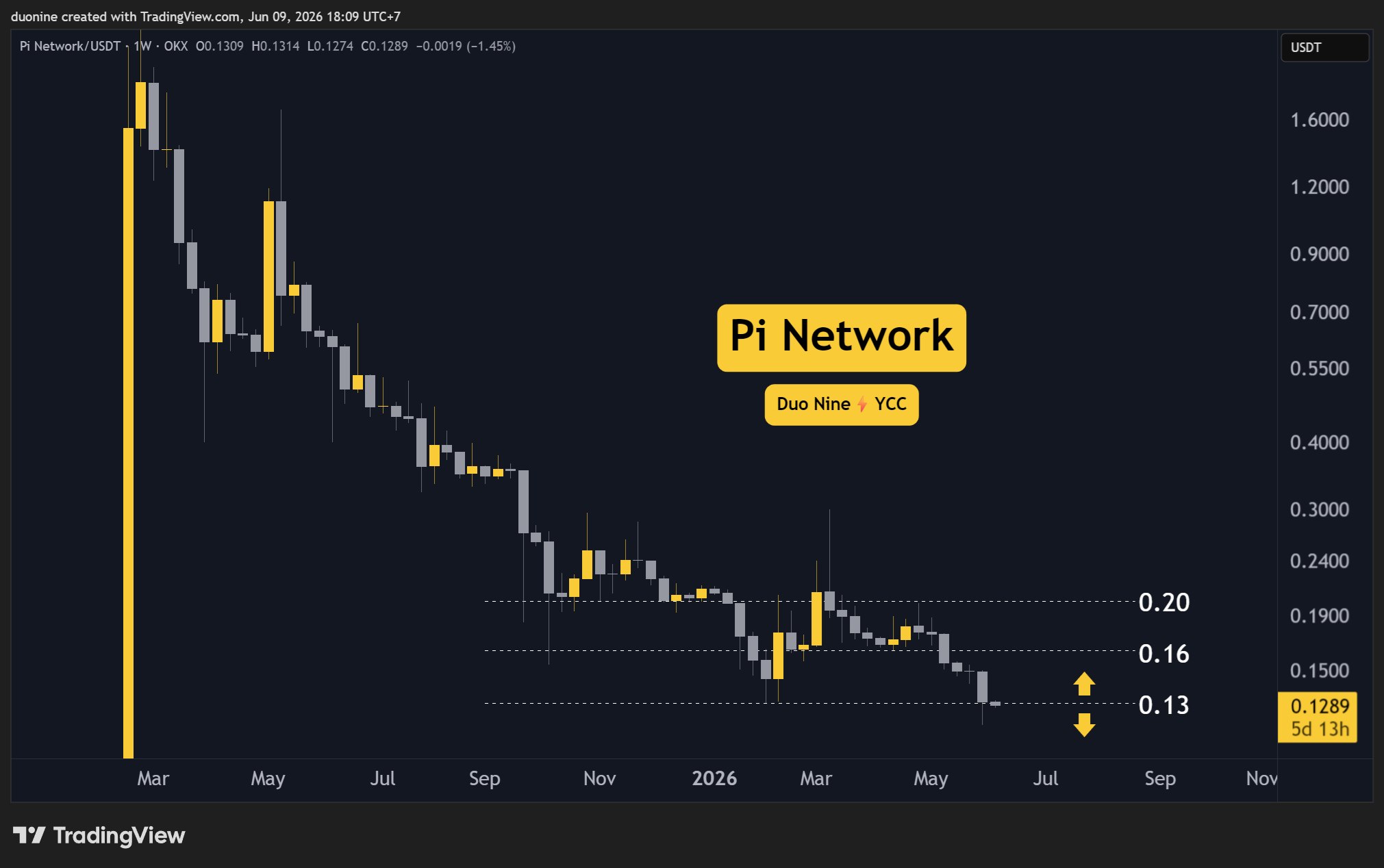
PI crashed another 10% this week and lost support at $0.13.
PI Network (PI) Price Predictions: Analysis
Key support levels: $0.10
Key resistance levels: $0.13, $0.16
PI Loses Key Support
After some hesitation, PI could no longer hold at $0.13 and fell under this level, which is currently acting as key resistance. If nothing changes in the coming days, this cryptocurrency will make new lows again.
The most likely target for sellers is 10 cents, which will act as a magnet for the price. This means buyers will have a tough time going forward, especially if they fail to reclaim $0.13.
Bearish Momentum Intensifies
Another concerning development is evident in the volume profile, which has seen sustained selling with higher highs since mid-May. This peaked last week when the price broke below $0.13.
Buyers returned somewhat earlier this week, but they only briefly revisited $0.13. At the time of this post, bulls and bears are fighting at this key level, and the winner will decide where PI goes next.

Daily RSI Shows a Bullish Divergence
The only positive aspect of this most recent price action is that the daily RSI made a higher low. This could be interpreted as a bullish divergence that may materialize later. For that to happen, PI has to bottom somewhere under $0.13 and then begin a recovery.
Until then, PI may remain in a downtrend with new lows likely. That could be a good opportunity for buyers, but only if a recovery follows. Otherwise, best to wait this out longer.

The post Why is the Pi Network (PI) Price Down This Week? (June 9) appeared first on CryptoPotato.

Bitcoin’s recent selloff has yet to establish a durable market bottom as institutional demand remains absent and capital continues to leave spot Bitcoin ETFs, according to a new market note from Wintermute.
Summary
- Wintermute says Bitcoin’s recent decline reflects a lack of institutional demand rather than isolated market events.
- Spot Bitcoin ETFs extended a 13-session outflow streak, shedding roughly $4.37 billion since mid-May.
- CryptoQuant data suggests capitulation may be approaching, with 50% of Bitcoin supply now sitting at a loss.
According to data from crypto.news, Bitcoin (BTC) traded near $61,828 on Tuesday, down 3.18% over the past 24 hours and more than 14% over the past week after falling to its lowest level since September 2024. The broader cryptocurrency market also remained under pressure, with total market capitalization dropping 2.8% to $2.21 trillion.
According to CoinGlass data, more than $1.78 billion in leveraged positions were liquidated over the past day as long traders absorbed most of the losses. Total crypto derivatives open interest stood at around $103.5 billion, while daily futures trading volume reached $173.8 billion.
According to the latest weekly note from algorithmic market maker Wintermute, the recent correction differs from previous pullbacks because institutional demand continues to deteriorate rather than stabilize. The firm argued that the market remains vulnerable to further downside as large buyers have yet to return in meaningful size.
Wintermute said attention surrounding Strategy’s sale of 32 BTC between May 26 and May 31 has overshadowed the broader issue facing the market. While the transaction itself was relatively small, the firm believes the real driver of weakness has been a retreat by U.S. institutional investors that previously helped fuel Bitcoin’s rally earlier this year.
ETF flows continue to point lower
Wintermute’s concerns are reflected in spot Bitcoin ETF flows, which have experienced persistent redemptions over the past several weeks.
Data from SoSoValue shows U.S. spot Bitcoin ETFs recorded a net outflow of $91.37 million on June 8, reversing the modest inflows seen earlier in the month. Between May 15 and June 3, the funds endured a 13-session outflow streak that erased roughly $4.37 billion from the sector before briefly stabilizing on June 4.
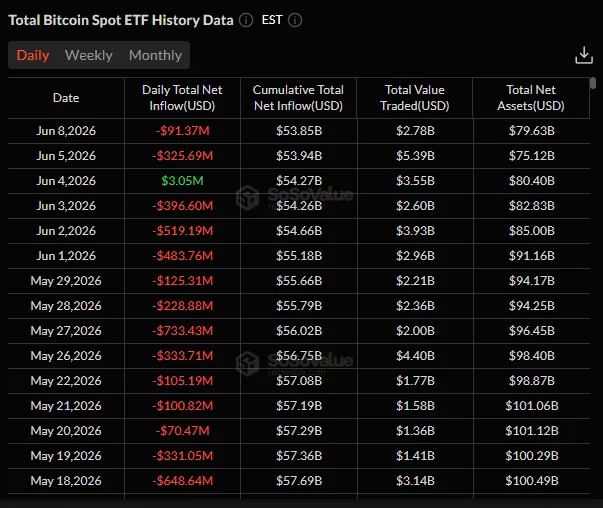
The first week of June alone accounted for approximately $1.72 billion in net outflows. BlackRock’s IBIT led the withdrawals, losing about $1.38 billion, while Fidelity’s FBTC recorded outflows of roughly $201.9 million.
The sustained selling has significantly reduced assets held by the ETF sector. Total net assets across U.S. spot Bitcoin ETFs fell from more than $100 billion in mid-May to approximately $79.6 billion by June 8.
Wintermute also pointed to a negative Coinbase premium and weakening over-the-counter activity as evidence that U.S.-based institutions are reducing exposure. According to the firm, institutional desks have adopted a more cautious near-term stance and are using periods of liquidity to trim positions.
Macro headwinds weigh on risk assets
The firm’s outlook comes as financial markets adjust to stronger-than-expected U.S. economic data. The latest nonfarm payrolls report showed the U.S. economy added 172,000 jobs in May, well above market expectations. At the same time, services-sector inflation accelerated, reinforcing expectations that the Federal Reserve may keep interest rates elevated for longer.
Markets are now assigning roughly a 98% probability that the benchmark federal funds rate remains unchanged through the end of 2026, while the U.S. 10-year Treasury yield has climbed to around 4.57%.
Wintermute said the combination of higher yields and fading momentum in the AI-driven equity rally has reduced investor appetite for speculative assets, including cryptocurrencies.
CryptoQuant sees signs of capitulation
Not all market indicators point to further downside, however. CryptoQuant analyst Gaah recently noted that Bitcoin Supply in Loss MA7D has climbed to 50%, its highest level of 2026. Historically, readings above that threshold have coincided with periods of market capitulation and the formation of major cycle bottoms.
The analyst noted that the last time the indicator reached similar levels was in November 2022, shortly after Bitcoin fell below $20,000 during the post-FTX bear market.
Wintermute acknowledged that some longer-term investors are gradually accumulating Bitcoin at current levels, viewing the correction as an attractive long-term opportunity. Still, the firm maintains that a lasting recovery requires renewed institutional demand.
Looking ahead, Wintermute identified the upcoming SpaceX IPO on June 12 as a potential gauge of broader market risk appetite. Until spot Bitcoin ETF inflows return and institutional buyers re-enter the market, however, the firm argues that a durable Bitcoin bottom remains unconfirmed.
Disclosure: This article does not represent investment advice. The content and materials featured on this page are for educational purposes only.

XRP is sitting on one of the most critical technical levels of this entire correction, with traders now debating whether the token will slip lower or form a clean double bottom and trigger a fresh recovery.
Price projections are coming as Japan’s SBI Shinsei Bank will let customers convert part of their deposit interest into Bitcoin, Ethereum, or XRP.

Why XRP Sits at a Critical Decision Zone
A double bottom is a technical pattern in which the price tests a support level twice and then bounces, signaling a potential trend reversal. XRP is now testing exactly that kind of zone after a long correction phase across the market.
As of early June 2026, XRP traded near $1.09 on major exchanges like Coinbase. That level aligns precisely with the 0.786 Fibonacci retracement, a zone many analysts view as a potential turning point for the next major move.
Analyst EGRAG CRYPTO clearly framed the dilemma. XRP is sitting in a macro decision zone, and a strong monthly close above $1.40 would confirm the bottom is already in near $1.05, as per the broader market structure.
Reclaiming the $1.61-$1.65 zone would signal the start of a true bullish recovery. Failure to hold momentum, however, could open the door to another retest of the $0.80 support level across the coming weeks.
Cryptoanalyst CasiTrades highlighted the importance of the $1.09 test. Key resistance levels to watch include $1.19 and $1.27, with a decisive break higher likely confirming the correction is finally over for XRP.
A clear rejection of those resistances would change the picture. It could pave the way for a deeper move into the $0.90 to $0.85, making the next few daily closes especially important for short-term traders.
The Analyst called this one of the most important moments of the entire correction. The market reaction from here will dictate the next major leg, whether that means a structural recovery or a continuation of the broader bearish trend.
What Other Analysts Expect for XRP
ChartNerdTA echoed the cautious optimism, referencing longer-term structures across the daily and weekly charts. The analyst acknowledged the possibility of a deeper pullback toward the $0.70 to $0.84 range based on previous Gaussian channel projections.
Even with that risk, macro support still shows signs of accumulation according to ChartNerdTA. The current price action is viewed as a potential inflection point rather than confirmed capitulation, leaving room for a constructive setup if buyers defend the level.
“From $1.45 in April to $1.04 in June, $XRP still has the historical 3 month upper regression band that has marked all prior cycle lows in its sights. Reminder: we are now in the territory where placing all our eggs in one basket is a risk,” ChartNerdTA said.
On-chain and derivatives data add another layer to the analysis. Analyst Kripto Messi pointed to XRP Open Interest metrics, noting historical patterns in which OI moving-average crossovers have preceded major corrections, followed by powerful recoveries.
XRP price behavior also remains heavily influenced by broader market liquidity, Bitcoin dominance, and ongoing regulatory clarity.
The token has shown resilience, holding key Fibonacci supports amid macro pressures across the broader corrective structure.
A failure to reclaim the $1.27 to $1.30 resistance soon could embolden bears across the entire crypto market. Bullish confirmation, on the other hand, requires sustained volume, a clear break above near-term resistance, and a shift in overall market sentiment.
Long-term targets discussed by analysts remain ambitious. They range from multi-dollar levels to even double-digit projections, all contingent on breaking out of the current range and confirming a structurally new, sustained uptrend.
SBI Shinsei Bank to Reward Depositors with Bitcoin, Ethereum, and XRP Vouchers
Price projections are coming as SBI Shinsei Bank, a subsidiary of Japanese financial giant SBI Holdings, has announced plans to launch a new service this fall that will allow customers to receive 20% of their deposit interest in the form of vouchers redeemable for Bitcoin (BTC), Ethereum (ETH), and XRP.
According to Nikkei, the program enables depositors to convert a portion of their accrued interest into crypto vouchers, with amounts calculated based on market prices at the time of payout.
To redeem the vouchers, customers must open an account with SBI VC Trade, the group’s licensed cryptocurrency exchange subsidiary. This structure helps the bank maintain regulatory compliance while offering exposure to digital assets.
The initiative reflects SBI Holdings’ long-standing commitment to integrating blockchain and crypto. The group has been a pioneer in Japan through SBI VC Trade and its strategic partnership with Ripple, including the joint venture SBI Ripple Asia, focused on cross-border payments using XRP.
The post XRP Hits Most Critical Level Yet Amid Big Announcement from SBI Shinsei Bank appeared first on BeInCrypto.

Leveraged funds and asset managers have raised combined Japanese yen (JPY) short positions to $11 billion, the highest level since July 2024.
This suggests that investors are betting against the currency despite Japan’s intervention. Short exposure has now climbed for three straight weeks.
Tokyo Spends Massive Sum to Slow the Yen Slide
Short positioning added $5 billion over the three-week stretch. The data points to expectations of further weakness.
The bearish sentiment comes despite Japan’s efforts. The yen’s decline pushed Tokyo to step in recently. The currency slipped past 160 per dollar in late April, the same level that prompted record dollar-selling intervention in 2024.
Between late April and late May, authorities deployed 11.73 trillion yen, or about $73.6 billion. The sum set a record for any month-long stretch and topped the 9.79 trillion yen spent in 2024.
The move worked briefly. On April 30, the yen swung from 160.725, a near two-year low, to 155.50. It moved toward 155 by May 6 before resuming its slide.
The relief faded fast. The yen weakened back toward 160 in early June, pressured further by the Middle East conflict.
Follow us on X to get the latest news as it happens

Rate Gap Keeps Pressure on the Currency
The Kobeissi Letter explained that the wide interest rate gap between Japan and the United States remains the main structural driver. The Bank of Japan holds its policy rate at 0.75%, far below US levels.
That differential rewards traders who borrow cheap yen to buy higher-yielding assets. This strategy, known as the carry trade, has weighed on the yen for years. When those positions unwind, investors often reduce risk exposure, a dynamic that could pressure assets such as Bitcoin (BTC).
Finance Minister Satsuki Katayama signaled that authorities remain prepared to act.
“As for foreign exchange, we continue to maintain our stance that we stand ready to take appropriate action at any time, as needed,” Katayama said.
The Bank of Japan meets on June 16 and may raise its rate to 1%. A hike could narrow the gap and test the conviction behind the record short position.
Subscribe to our YouTube channel to watch leaders and journalists provide expert insights
The post Institutional Investors Drive Yen Short Bets to Highest Level Since 2024 appeared first on BeInCrypto.

The Ether (ETH) futures market saw its open interest (OI) on Gate.io fall by 45% to levels last seen in April 2025. At the same time, nearly 480,000 ETH left Binance, OKX, Gemini and Bitfinex over the past few days, reducing the exchange-held supply.
The combined shift highlights a market with less leverage and declining exchange balances, placing greater focus on the $1,500 support zone, which some analysts view as critical to preventing a deeper move toward $1,000.
Ether open interest falls across exchanges
Ether’s futures market has undergone a broad reset during the recent sell-off. Crypto analyst Amr Taha noted that total ETH open interest across exchanges has dropped 25%, to $12.6 billion from $16.6 billion in May, with several major trading platforms now at levels last seen in April 2025.
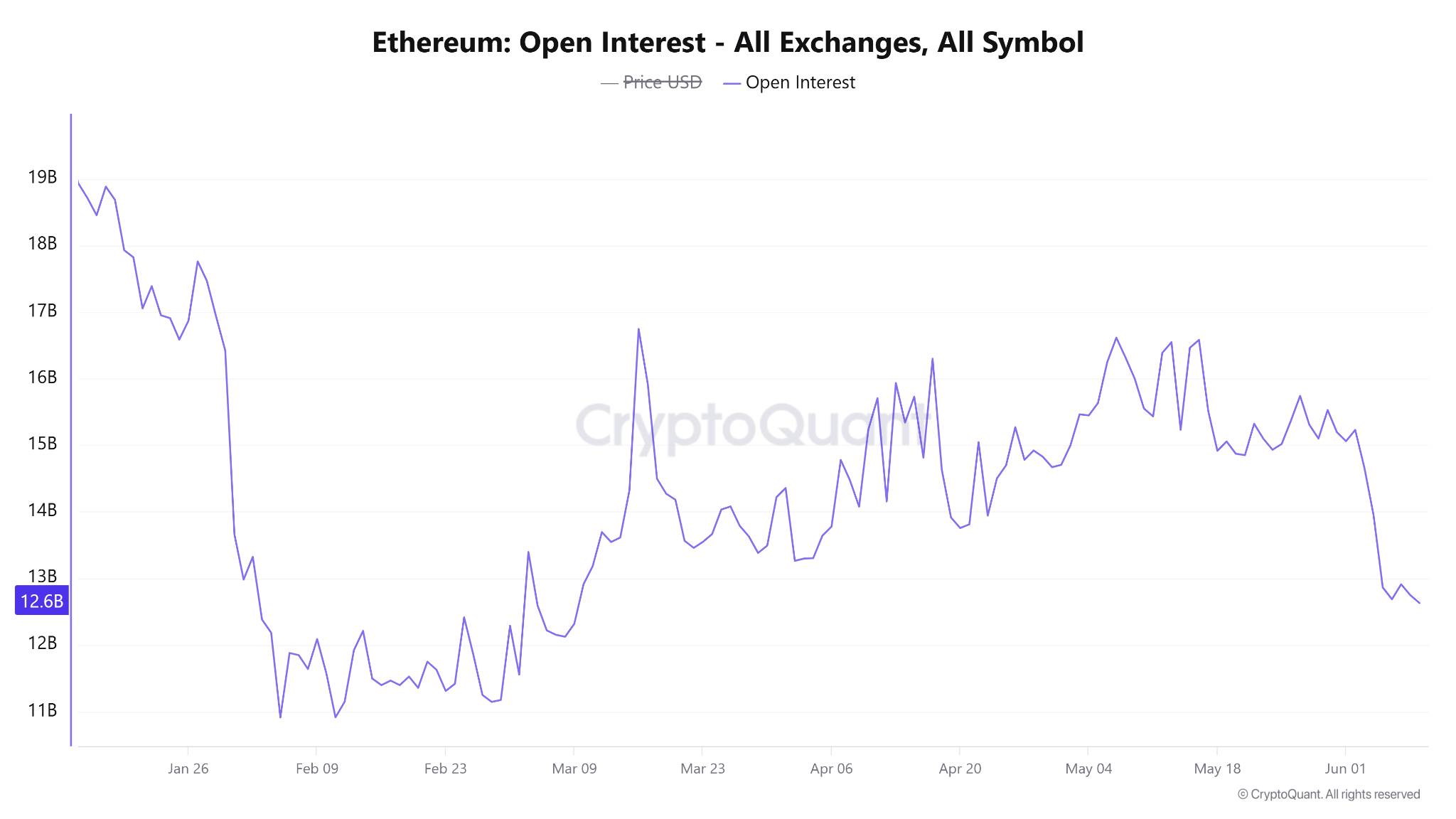
Ether open interest. Source: CryptoQuant
Gate.io recorded the largest decline. ETH open interest fell to $2.68 billion on June 9 from $4.84 billion on May 7, a drop of about 45%. The figure is now nearly identical to the $2.67 billion level recorded on April 11, 2025.
Bybit has followed a similar path. ETH OI currently stands near $805 million, close to the $795 million recorded in early April 2025. The move points to a significant reduction in leveraged positions that accumulated during the latter stages of 2025 and early 2026.
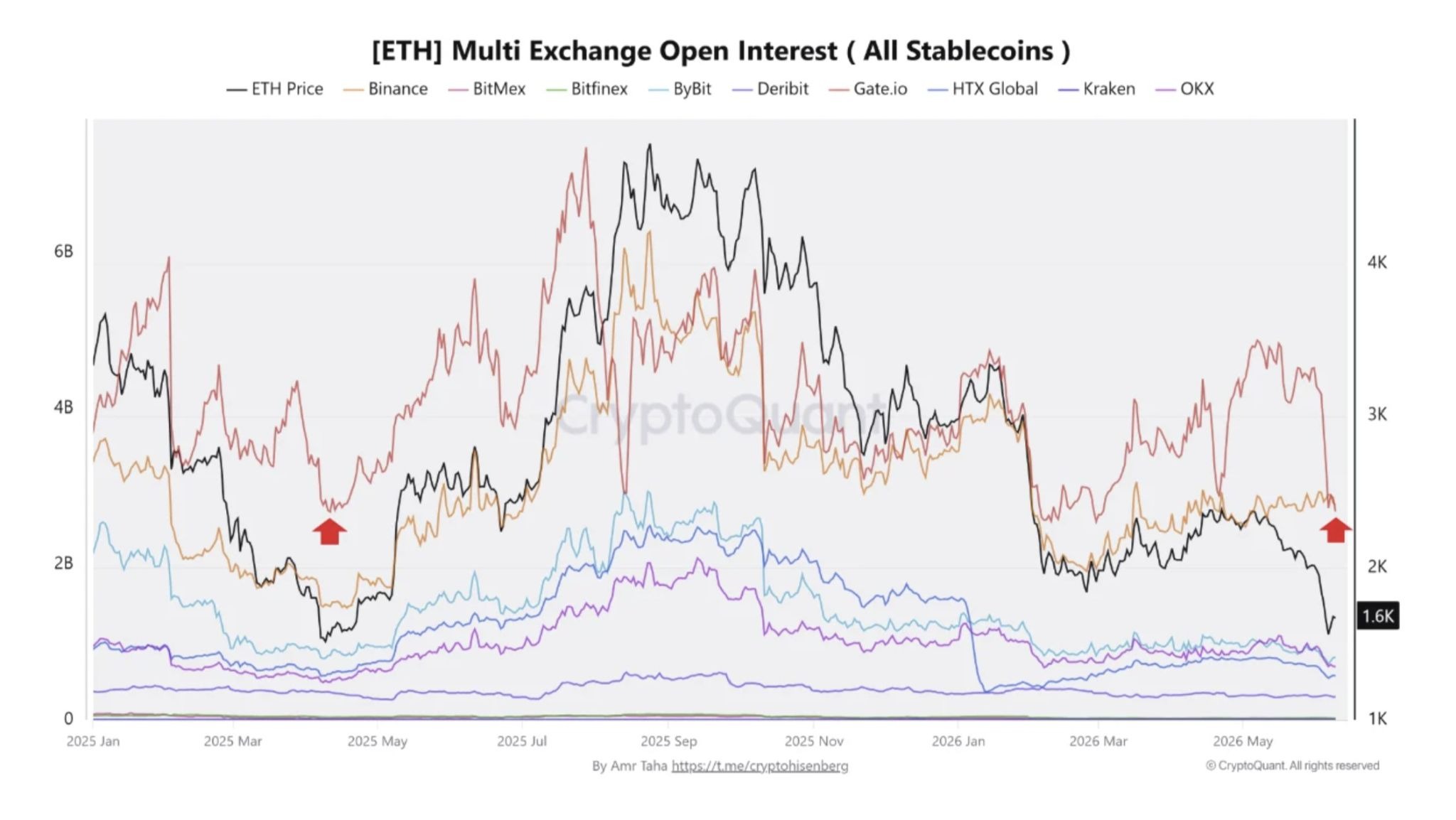
ETH open interest on multiple exchanges. Source: CryptoQuant
However, Binance presents a different picture. ETH open interest remains near $2.76 billion, holding within its recent range. The funding rates have also turned negative on the exchange, with the latest reading near -0.0047, showing short traders are paying a premium to maintain their positions.
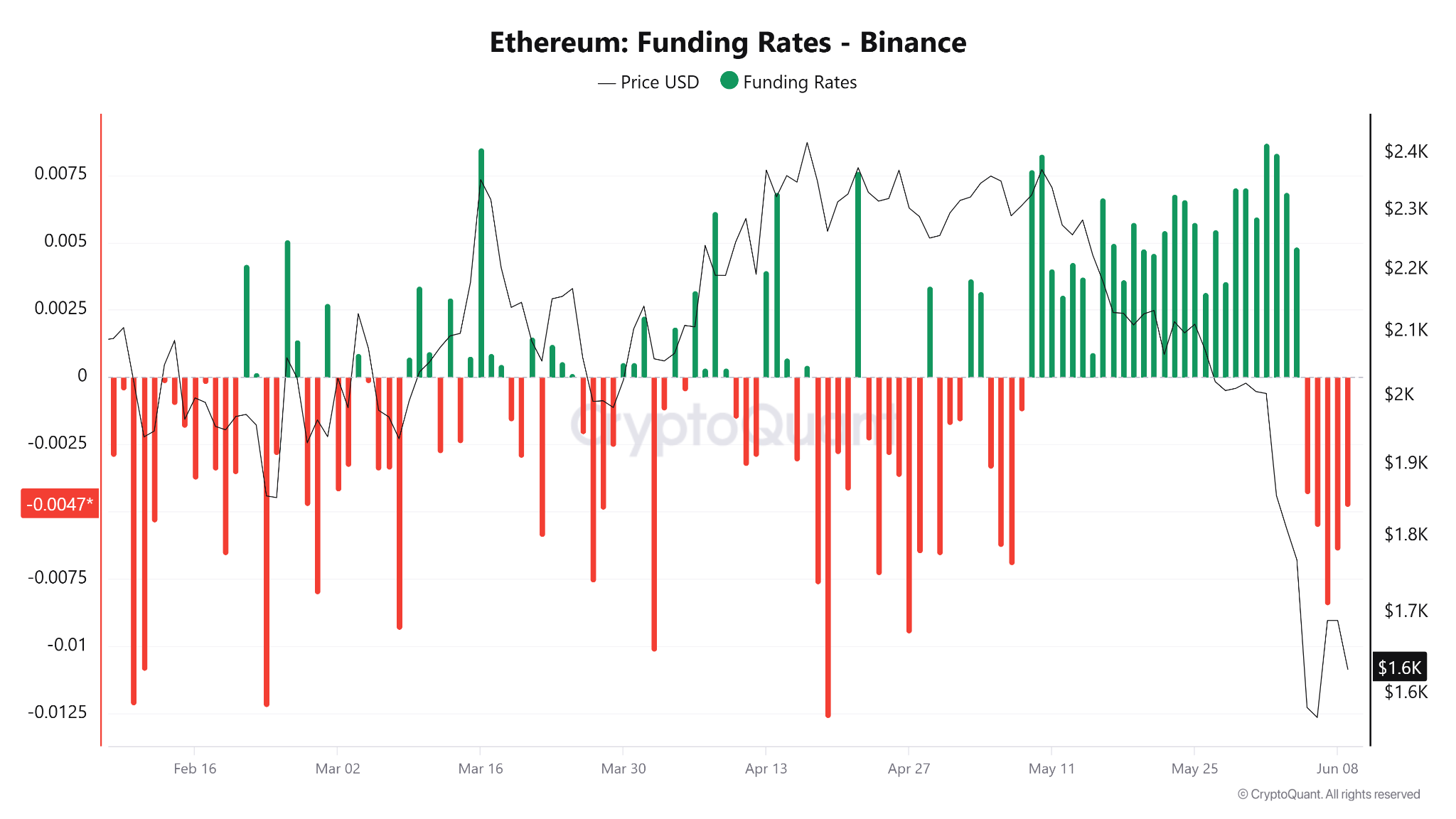
ETH funding rate on Binance. Source: CryptoQuant
The divergence is notable. Gate.io and Bybit have already seen a major leverage reset. Futures traders on Binance remain active, but the negative funding points to a cautious sentiment.
Related: Bitmine boosts Ethereum treasury to 5.54M ETH, nearing 5% supply target
ETH supply drop meets key support at $1,500
Ether exchange reserves also posted a notable decline in early June. Across Binance, OKX, Gemini and Bitfinex, tracked ETH balances fell by 480,000 ETH over the past few days.
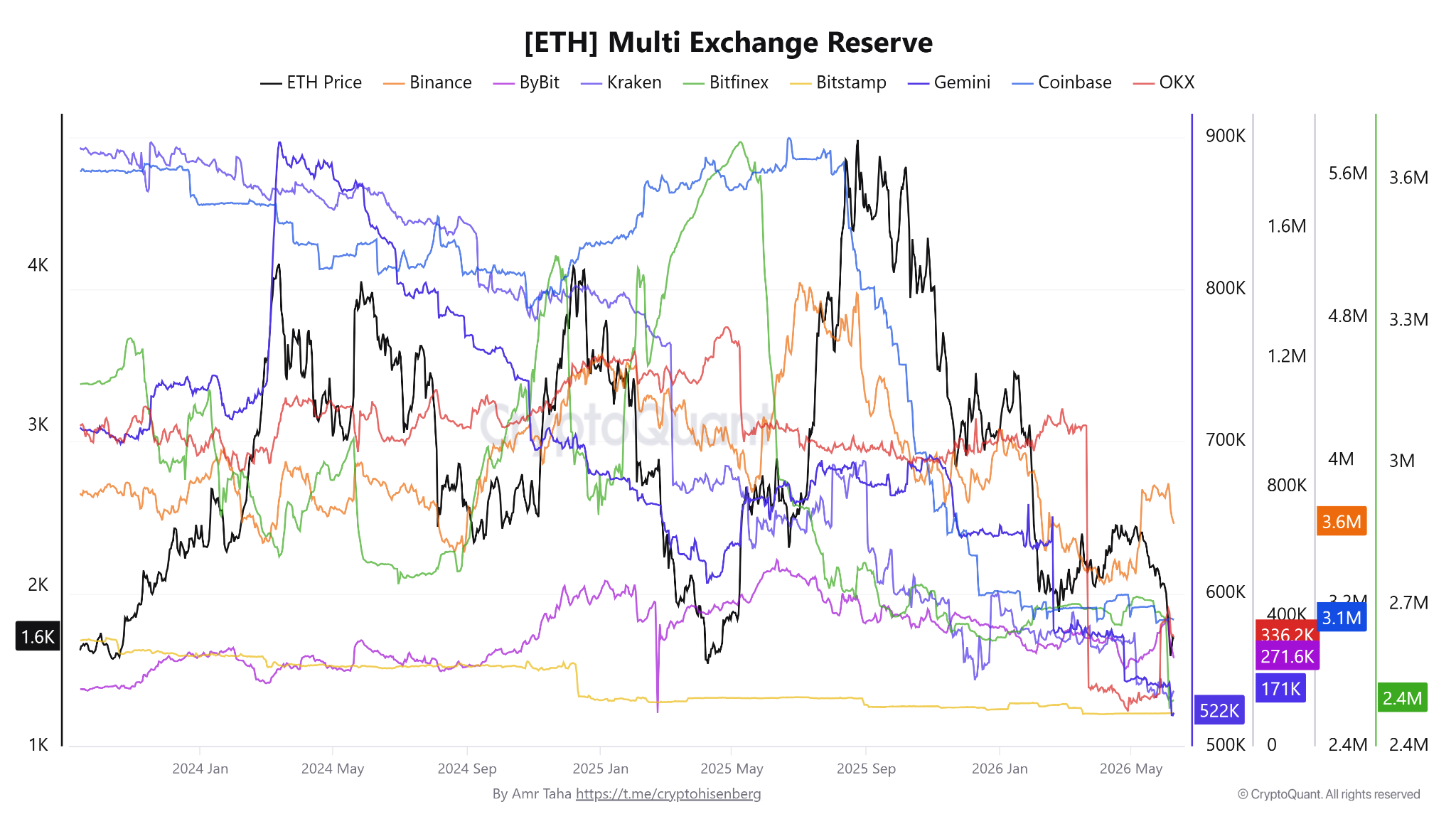
ETH multi-exchange reserve. Source: CryptoQuant
Binance reserves dropped to 3.65 million ETH on June 9 from 3.87 million ETH on June 4. Bitfinex holdings declined to 2.50 million ETH from 2.67 million ETH at the end of May. OKX recorded the sharpest percentage decline, with reserves falling from 424,000 ETH to about 336,000 ETH. Gemini balances also slipped to roughly 522,000 ETH.
Continued ETH outflows could reduce the amount of readily available supply on exchanges if buying demand starts to recover.
Onchain data shows many ETH holders are still far from large profits. According to market commentator Gonza Goth, only 11% of Ethereum’s supply is currently sitting at a 3x or greater gain, the lowest level since February 2017. However, Goth said,
“Historically, extreme pessimism has created the best opportunities.”
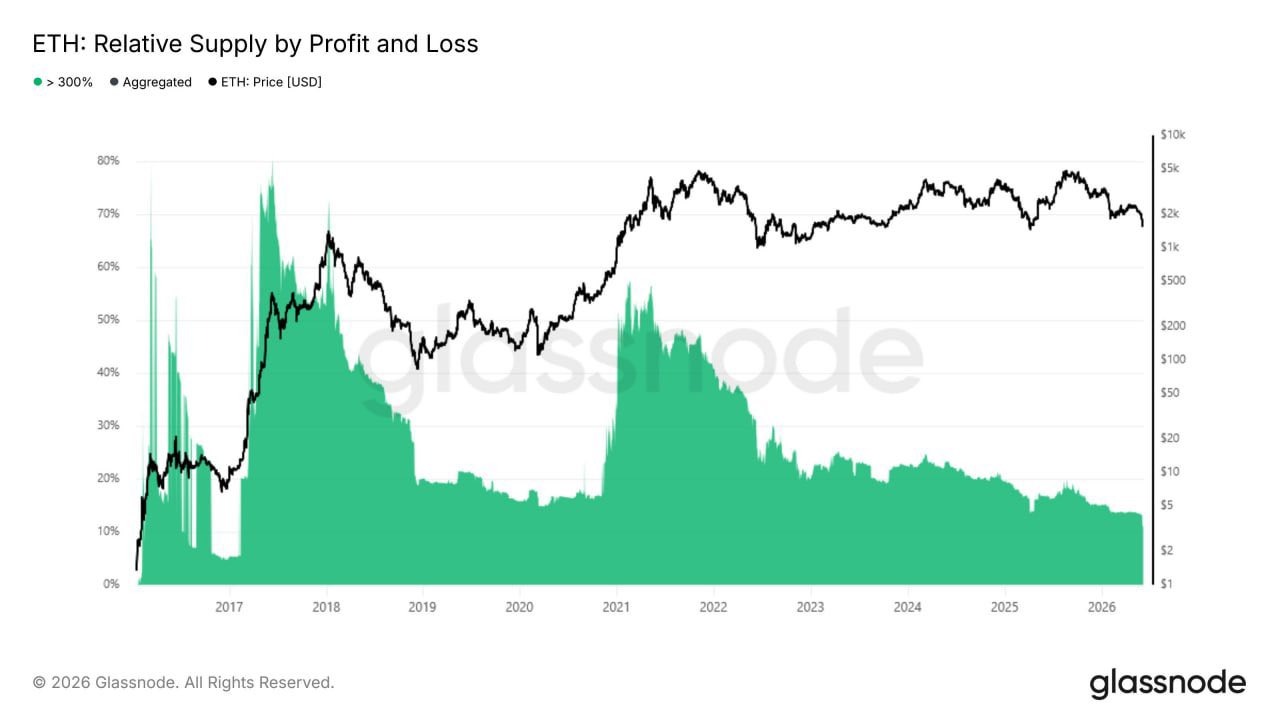
ETH: relative supply by profit and loss. Source: Glassnode
Meanwhile, traders are also watching the $1,500 level next. Investor Ash Crypto noted that Ether failed to hold every support level during the 2022 bear market, when the price eventually bottomed near $880.
The analyst said a weekly close above $1,500 would keep ETH above a historically important support zone, while a break below it would shift attention toward the next major support area near $1,000.
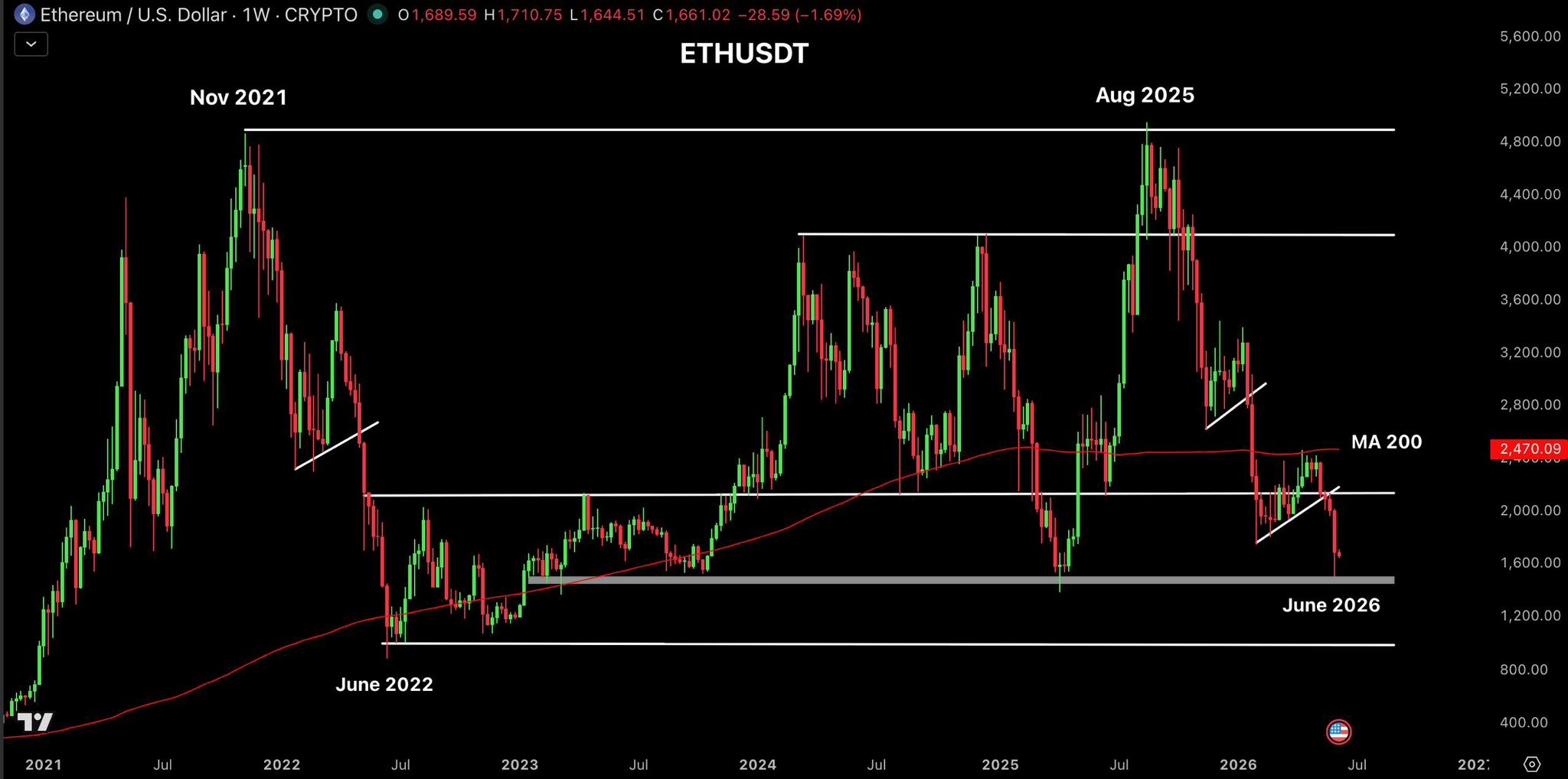
ETH/USD, one-week chart analysis by Ash. Source: X
Related: ETH falls to 13-month low on Zcash bug, Bitcoin below $60K: Is $1.4K next?

Bitcoin News: Circle has launched cirBTC, a 1:1 BTC-backed ERC-20 token now live on Ethereum mainnet, positioning it directly against WBTC’s roughly $9 billion market and approximately 85% market share with a feature its competitors do not offer: real-time on-chain reserve verification with no reliance on third-party attestations.
The product went live June 8, 2026, and is built exclusively for institutional participants, OTC desks, market makers, lenders, and DeFi protocols deploying Bitcoin as collateral inside Ethereum-based smart contract ecosystems.
The competitive target is explicit. BitGo’s Wrapped Bitcoin has dominated tokenized BTC since its January 2019 launch, and Coinbase’s cbBTC has emerged as the primary institutional challenger since September 2024, reaching approximately $5.9 billion in market value.
Circle is entering that race with a specific transparency argument and the institutional trust built over years of USDC issuance.

Bitcoin News: cirBTC’s Reserve Verification Model, What Real-Time On-Chain Proof Actually Means
The core technical differentiator is Chainlink Proof of Reserve. Each cirBTC token issued as an ERC-20 on Ethereum is backed by native Bitcoin held in segregated regulated custody, and counterparties can verify that backing in real time through multiple wallet addresses visible directly on the Bitcoin blockchain, no waiting for monthly audits, no relying on custodian claims, no off-chain attestation lag.
This is structurally different from the WBTC model, where BitGo operates as the sole custodian and publishes wallet addresses for manual verification, but reserve confirmation still depends on BitGo’s centralized control and governance multisig for contract changes.
Tokenized Bitcoin – programmable and composable digital gold.
https://t.co/XVCXVzLfLi
— Jeremy Allaire – jerallaire.arc (@jerallaire) June 8, 2026
The RenBTC wind-down and broader criticism of custodial bridge opacity established the trust gap Circle is explicitly targeting. Chainlink’s automated feed closes the verification loop at the contract level rather than at the audit cycle.
Bitcoin assets are kept separate from Circle’s corporate holdings, and minting and redemption run through Circle Mint, its institutional liquidity management platform.
The same infrastructure that powers USDC settlement rails is now extended to wrapped Bitcoin collateral, allowing firms to hold native BTC in custody while cirBTC moves through on-chain financial applications without ever selling the underlying position.
Discover: The Best Crypto to Diversify Your Portfolio
The $15–20B Tokenized BTC Market: Where cirBTC Fits Against WBTC and cbBTC
The total tokenized Bitcoin supply across all wrapped products sits at approximately $15–20 billion in Q2 2026, still under 2% of Bitcoin’s roughly $1.7 trillion market capitalization.
That number is either a ceiling that reflects structural barriers to institutional DeFi adoption or an enormous runway.
The evidence points firmly toward runway: institutional demand for Bitcoin exposure in regulated on-chain formats has accelerated materially since 2024, and the products capturing that demand are precisely the regulated, exchange-native wrappers cirBTC is competing against.
WBTC holds approximately 119,000 tokens in circulation at roughly $8–9 billion market cap, controlling close to 85% of the wrapped BTC segment. cbBTC trails at approximately $5.9 billion but has grown faster than any comparable product since launch.
Other exchange-backed offerings, Kraken Wrapped BTC, Binance Wrapped BTC, Bitget Wrapped BTC, OKX Wrapped BTC, collectively hold the remaining margin.
Circle’s entry does not change the market structure overnight, but it introduces a credentialed issuer with an existing institutional distribution network that none of those exchange-native products can fully replicate.
Circle’s stated structural advantage over cbBTC and exchange-issued wrappers is neutrality: it does not operate a centralized exchange, DEX, or lending protocol.
Institutions using cirBTC as DeFi collateral are not simultaneously providing liquidity intelligence to a competing trading desk. That separation matters to prime brokerage clients and multi-venue market makers who treat information leakage as a material risk.
Discover: The Best Token Presales
The post Bitcoin On Ethereum? Circle Launches cirBTC on ETH Targeting $9B WBTC Market appeared first on Cryptonews.
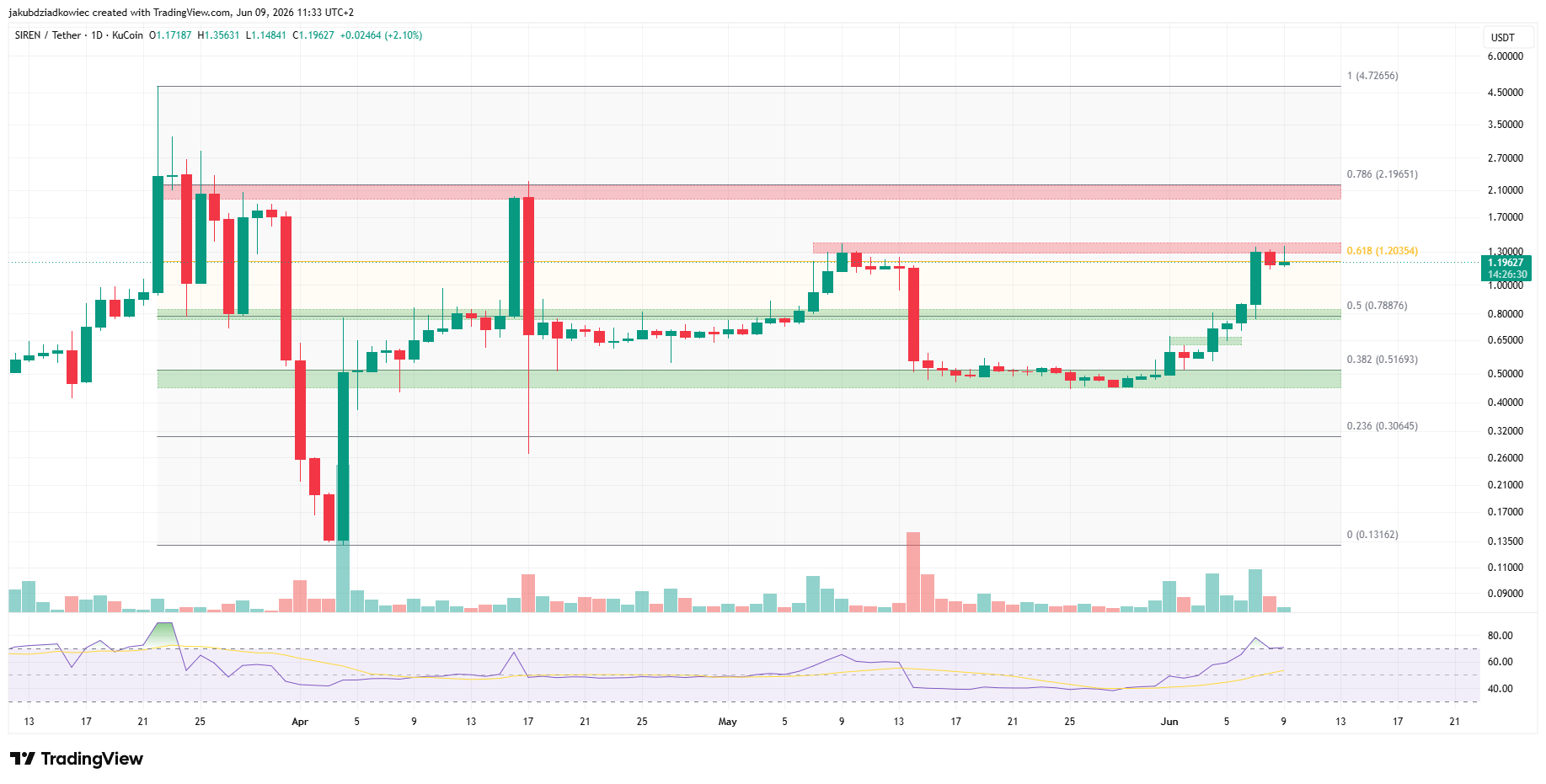
Meme coin traders enter the second week of June 2026 with three setups worth watching. SIREN presses against breakout resistance, BinanceLife cools near record highs, and BUILDON climbs back from a sharp correction.
Each token shows a different momentum picture this week. The charts below map the key levels, the indicators behind them, and what would confirm or break every move.
Meme Coins to Watch: SIREN Tests Breakout Resistance Near $1.20
Siren (SIREN) trades around $1.22 after a 4% gain on the day. The token has climbed roughly 113% over the past week. Its market cap sits near $887 million, ranking it 74th.
SIREN also topped last week’s meme coin watchlist and keeps building on that move.
On the daily chart, price is pressing into resistance at the 0.618 Fibonacci retracement level near $1.20. A daily close above this zone would mark the breakout. The next resistance stands at the 0.786 level near $2.20.

Beyond that, the token’s record high sits at $3.61. The chart’s upper Fibonacci extension reaches $4.72. Both mark longer-term targets if momentum holds.
The Relative Strength Index (RSI) has pushed above 70. That reading signals strong momentum, but it also flags overbought conditions. A rejection here could send the price lower.
The first support sits at the 0.5 Fibonacci level near $0.79. A deeper pullback would test the 0.382 level near $0.52. A renewed AI-token rally has driven much of this momentum.
BinanceLife Holds Near Record Highs Despite RSI Divergence
BinanceLife (BINANCELIFE) trades near $0.69 after a 12% drop on the day. Despite the decline, the token remains up about 9% on the week. Its market cap stands at $687 million, ranking it 86th.
The token sits in a price-discovery phase after setting a record high near $0.90 on June 7. It broke out of a symmetrical triangle around May 13 and ran straight to that resistance box.

However, the daily chart now shows a bearish RSI divergence. Price made higher highs while the RSI made lower highs. That pattern often warns that an uptrend is losing strength.
A correction could send the price back to the former swing high near $0.46. A deeper drop would test the 0.382 Fibonacci level near $0.27. The token’s role in the BNB meme season remains a key driver.
BUILDon Recovers After an A-B-C Correction
BUILDon (B) trades near $0.27 after a 6% decline on the day. The token has gained almost 14% over the past week. Its market cap sits near $273 million, ranking it 138th.
The daily chart shows a five-wave Elliott impulse to a high near $0.76. An A-B-C correction then followed. The C wave bottomed close to the 0.618 Fibonacci retracement near $0.20.
Price now recovers between the 0.5 and 0.382 Fibonacci levels. A move above $0.33 would open the path toward the 0.236 level near $0.46. That level marks the next major resistance.

The RSI hovers near 50, a neutral reading with no clear momentum. Volume is also contracting into the bounce. Both signals suggest traders should wait for confirmation.
The main support sits at the 0.786 Fibonacci level near $0.14. BUILDon gained wider attention after its Binance Alpha listing earlier this year.
The post 3 Meme Coins to Watch in the Second Week of June 2026 appeared first on BeInCrypto.
Crypto World
Citrini Research Calls Hyperliquid a Compelling Investment, Citing Nearly Half of All Crypto Token Buybacks


Citrini Research, the subscription analytics firm whose reports have previously triggered sharp moves in AI-linked equities, published an analysis Monday calling Hyperliquid a compelling investment thesis. The firm argues the decentralized exchange accounts for nearly half of all token buyback… Read the full story at The Defiant
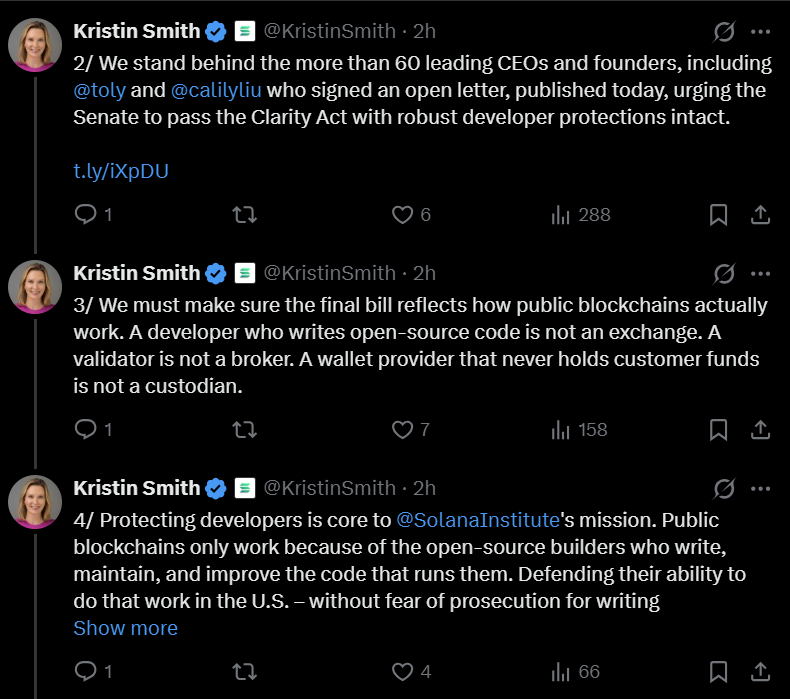
Solana Institute CEO Kristin Smith is urging the US Senate to pass the CLARITY crypto market structure bill with developer protections intact, arguing that open-source developers and blockchain infrastructure providers should not be regulated as financial intermediaries.
In a thread on the X social media platform, Smith said the market structure legislation “has a real shot at passing the Senate,” making it critical for lawmakers to preserve protections for software developers.
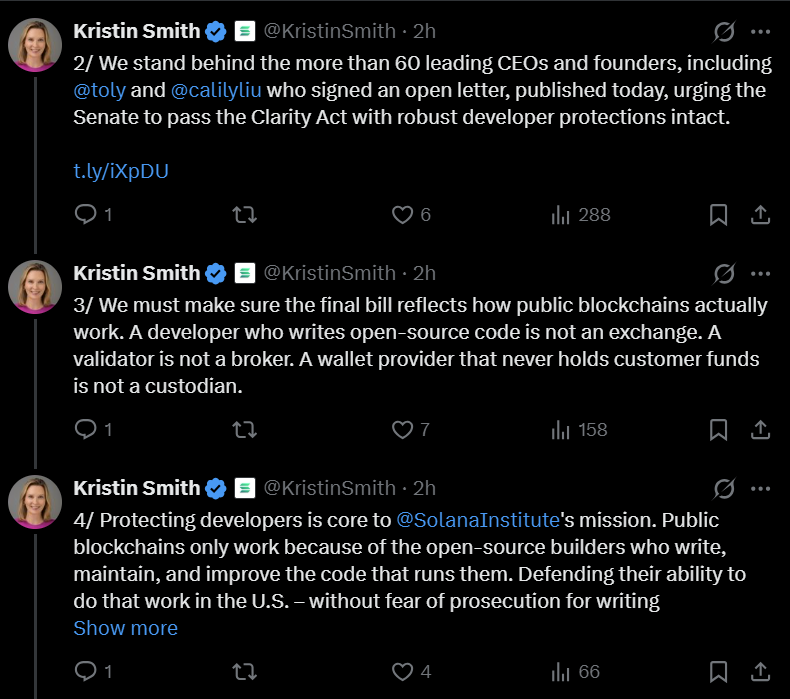
Source: Kristin Smith on X.com
Smith said more than 60 crypto CEOs and founders, including Solana co-founder Anatoly Yakovenko, signed an open letter urging the Senate to maintain robust developer protections in the CLARITY Act.
She said that open-source developers, validators and non-custodial wallet providers do not control user funds or execute transactions and therefore should not be treated as brokers or custodians.
Smith pointed to the Blockchain Regulatory Certainty Act (BRCA), which would provide legal certainty for noncontrolling software developers and blockchain infrastructure providers that do not custody customer assets or control transactions.
Introduced in January by Senators Cynthia Lummis and Ron Wyden, the bipartisan BRCA aims to prevent open-source developers from being classified as “money transmitters” solely for publishing software code.
The CLARITY Act cleared the Senate Banking Committee in May and was recently placed on the Senate Legislative Calendar, setting the stage for a possible floor vote later this summer.
Related: CLARITY Act will help reshore US crypto industry, attorney says
Echoes SEC commissioner Peirce’s calls for developer protections
Smith’s comments echo recent remarks by US Securities and Exchange Commission Commissioner (SEC) Hester Peirce, who argued last week that publishing open-source blockchain code is protected speech and that developers should not be treated as financial intermediaries simply because others use their software.
Speaking at the IC3 Blockchain Camp at Princeton University, Peirce said that “many blockchain projects involve publishing open-source software, which is generally a protected activity under the First Amendment.”

Source: CoinMarketCap on X.com
The SEC’s mandate regarding digital assets has evolved significantly under current Chair Paul Atkins, who vowed to end the agency’s “regulation through enforcement” approach to the industry.
Related: US lawmakers push back on Labor Department plans to include crypto in 401(k)s

(VIDEO) Jose Alvarado’s Dive Sends Knicks Guard Crashing Into Mike Bloomberg During NBA Finals Game 3
Markets Bet 60% Chance Anthropic Mythos Drops Today

Parents Arrested After Locking Malnourished Child, 10, in Bedroom



-

 Fashion4 days ago
Weekend Open Thread: Evereve – Corporette.com
-
 Crypto World4 days ago
Jensen Huang Approves Samsung, SK Hynix, and Micron for NVIDIA (NVDA) HBM4 Memory Supply
-

 Crypto World2 days ago
Anatomy of the June crypto crash: Fed, Iran, Saylor
-

 Business7 days ago
Trump Taps Housing Chief Bill Pulte as Acting Intelligence Director After Gabbard Exit
-
Crypto World3 days ago
Senator Cynthia Lummis Calls CLARITY Act the Most Consequential Financial Legislation of This Generation
-
 Business3 days ago
The Pain Points Taking a Fragile Tech Rally Down a Notch
-
 Entertainment3 days ago
The Best Mystery Series of All Time Is Surging on Streaming 30 Years After It Ended
-

 Tech5 days ago
Microsoft launches MXC, an OS-level sandbox for AI agents, with OpenAI and Nvidia already on board
-

 Tech2 days ago
Microsoft unveils seven homegrown AI models in new bid for ‘long term self-sufficiency’
-

 NewsBeat2 days ago
Alexander Zverev wins the French Open to finally earn a 1st Grand Slam title
-
Crypto World5 days ago
LBank Surpasses 25 Million Users Worldwide as AFA Partnership Continues to Drive Global Growth
-

 Business7 days ago
PagerDuty, Inc. (PD) Presents at Bank of America 2026 Global Technology Conference Transcript
-

 Tech4 days ago
Suspicious Polyfill login prompts pop up on Toshiba, Muji websites
-

 Crypto World2 days ago
Trump’s AI Ownership Plan Could Benefit Anthropic at OpenAI’s Expense
-
 Sports7 hours ago
Bangladesh beat Australia after 20 years in ODIs, register only their second win over six-time world champions | Cricket News
-

 Business5 days ago
(VIDEO) Justin Bieber Delivers Surprise Happy Birthday Serenade to Diners at Los Angeles Mexican Restaurant
-

 Tech4 days ago
RCS Messages Between iPhone and Android Get End-to-End Encryption With iOS 26.5
-

 Tech4 days ago
Meta steals a tactic from Tesla and builds data centers in tents
-
 Crypto World1 day ago
Eli Lilly (LLY) Stock Surges 4% Following Breakthrough Sleep Apnea Trial Results
-

 Tech4 days ago
Hackers now exploit SolarWinds Serv-U flaw to crash servers
You must be logged in to post a comment Login