

Crypto World
Fidelity International Launches Tokenized Fund With Chainlink Support

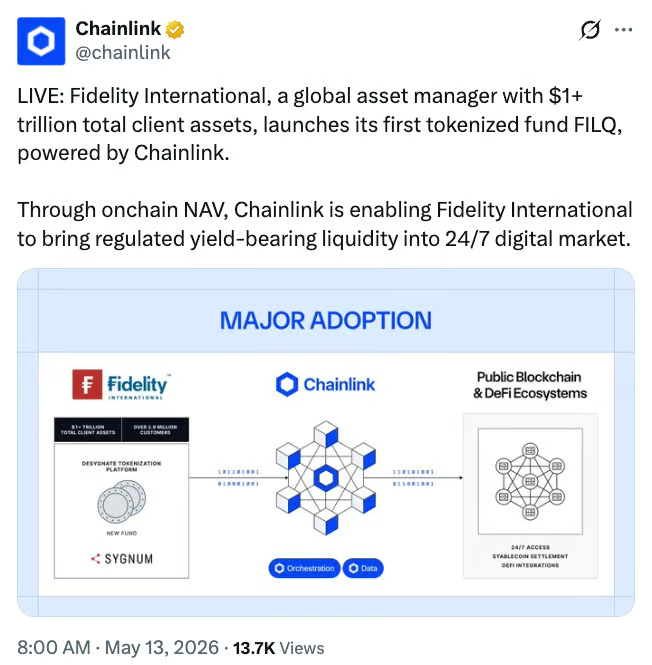
Fidelity International, a global asset manager with about $1 trillion in client assets, has launched a tokenized liquidity fund assessed by Moody’s Ratings.
The new Fidelity USD Digital Liquidity Fund (FILQ) is issued on blockchain infrastructure linked to Chainlink and was launched through Sygnum Bank’s tokenization platform.
According to Sygnum, the fund received a AAA-mf assessment from Moody’s Ratings, a designation used for money market funds that signals strong credit quality and liquidity.
“This marks an important milestone in the evolution of capital markets, demonstrating how tokenized liquidity products can bring high-quality, yield-bearing liquidity on-chain in a regulated and scalable way,” said Fatmire Bekiri, Sygnum’s head of tokenization.
Cointelegraph approached Fidelity International for comment regarding the news but did not receive a response at the time of publication. Bermuda-based Fidelity International and US-based Fidelity Investments are separate companies that operate in different jurisdictions through their subsidiaries and affiliates.
Chainlink expands role in real-world assets
Fidelity International’s FILQ adds to Chainlink’s growing presence in the tokenized real-world asset (RWA) sector, as the platform is focused on connecting blockchain applications with external real-world data that cannot be accessed natively onchain.
As part of the collaboration, Chainlink will provide onchain net asset value (NAV) and distribution data for the fund, allowing international investors to track fund value and payouts in near real time.

Source: Chainlink
“By adopting Chainlink’s industry-standard platform to deliver verifiable, real-time NAV and distribution metrics, FILQ utilizes the tamper-proof transparency required to securely bridge traditional finance with the onchain economy,” said Fernando Vazquez, president of capital markets at Chainlink Labs.
JPMorgan will provide approved daily NAV data for the fund, Chainlink mentioned.
Related: DTCC to use Chainlink to power 24/7 collateral management network
Chainlink previously collaborated with both Sygnum Bank and Fidelity International for onchain NAV data integration in 2024, marking an earlier production use case for tokenized assets tied to the latter’s Institutional Liquidity Fund.
Tokenized funds expand across markets
The launch comes as large asset managers continue moving traditional cash and treasury products onto blockchain networks. Firms from BlackRock to Franklin Templeton have already debuted tokenized money market funds aimed at bringing short-term yield products onchain.
On Tuesday, JPMorgan filed with the US securities regulator to launch a tokenized money market fund on Ethereum, allowing stablecoin issuers to hold reserves backing their stablecoins.
Boston, Massachusetts-based Fidelity Investments also previously issued the Fidelity Digital Interest Token (FDIT), a tokenized money market fund in which Ondo Finance’s OUSG fund serves as the primary anchor investor and accounts for the vast majority of its assets.
Magazine: eToro founder timed Bitcoin top perfectly due to belief in 4 year cycles


Chainlink network now has more than 535,000 wallets holding at least 1 LINK, which represents the highest number of non-micro wallets since December 2022.
According to Santiment, this growth has taken place even though LINK remains well below its cycle peak prices.
Chainlink Wallet Growth
The analytics platform stated that a steady increase in wallet counts has historically been viewed as a sign of gradual adoption and accumulation. The firm said the rise in new participants is an encouraging development, particularly during periods of market uncertainty.
It also added that tracking wallets holding at least 1 LINK is important because the metric indicates network participation rather than short-term speculation. While prices can fluctuate based on market sentiment, a growing number of holders may indicate increasing long-term trust and interest in the ecosystem.
However, LINK’s price performance has remained underwhelming. The token has trended lower over the past month, falling from above $10.4 in early May to around $7.9 at the time of writing. The decline essentially suggests that while adoption and participation on the network continue to increase, this growing interest has not yet translated into stronger price action for the asset.
Even as LINK remains under pressure, the network has seen increased adoption of its infrastructure in recent weeks. Following the April exploit involving LayerZero-powered systems, both KelpDAO and Solv Protocol announced plans to migrate their cross-chain operations to Chainlink’s Cross-Chain Interoperability Protocol (CCIP). KelpDAO said it will transition rsETH to Chainlink’s framework to strengthen security, while Solv Protocol is moving more than $700 million in Bitcoin-related assets to CCIP as part of a broader overhaul of its cross-chain infrastructure.
Regarding Chainlink’s position, Santiment stated,
“With Chainlink continuing to play a central role in oracle services, tokenized assets, and real-world asset infrastructure, watch for crypto’s #17 market cap to be a breakout candidate when overall markets turn bullish once again.”
Expansion
Chainlink Labs is increasing its involvement in the regulatory side of the crypto industry. Alongside Anchorage Digital, it helped establish the Blockchain Leadership Fund, a PAC that has endorsed ten candidates for the 2026 election cycle who support pro-crypto and blockchain-focused policies.
Additionally, Chainlink’s technology was recently adopted by Fidelity International for its first tokenized fund, FILQ.
The post Over 535,000 LINK Holders Signal Quiet Chainlink Accumulation Amid Market Uncertainty appeared first on CryptoPotato.
Crypto World
3 Quantum Computing Stocks Commanding Investor Attention in 2026: IonQ (IONQ), D-Wave (QBTS), and Alphabet (GOOGL)

Key Highlights
- IonQ exceeded its Q1 2026 revenue projections by 30%, posting $64.7M and elevating annual forecasts to $260M–$270M
- D-Wave Quantum has ties to a $100M equity arrangement with the U.S. Commerce Department
- Alphabet’s Willow processor tackled a computational challenge in five minutes that conventional systems would require exponentially longer to complete
- These three enterprises offer varying risk profiles, spanning from specialized quantum plays to established technology conglomerates
- Quantum technology promises transformative applications in pharmaceutical research, encryption, supply chain optimization, and financial analysis
Three companies currently dominate investor conversations around quantum computing: IonQ, D-Wave Quantum, and Alphabet. Each brings a distinct technological strategy and presents different investment risk characteristics.
Quantum systems are engineered to tackle computational challenges that traditional computers find insurmountable. Promising applications span pharmaceutical development, cryptographic security, operational logistics, and complex financial calculations.
This industry remains in its infancy. Profitability eludes most participants, and mainstream commercial deployment remains several years distant. Nevertheless, both governmental and private capital continues flowing into the sector.
IonQ: Specialized Quantum Growth Story
IonQ stands as a premier dedicated quantum computing investment opportunity.
The enterprise employs trapped-ion methodology. Strategic alliances span cloud service providers, federal agencies, and major corporate clients.
First-quarter 2026 revenues reached $64.7 million for IonQ. This performance exceeded the company’s internal midpoint projection by 30%.
Management subsequently elevated annual revenue expectations to a range between $260 million and $270 million.
While profitability remains elusive and capital expenditures on expansion continue at high levels, IonQ’s accelerating revenue trajectory has bolstered investor confidence in this segment.
D-Wave Quantum: Market-Ready Solutions
D-Wave employs quantum annealing technology, an approach specifically designed for optimization challenges.
Practical applications encompass supply chain logistics, resource scheduling, and financial portfolio optimization. D-Wave distinguishes itself by serving paying commercial clients, differentiating it from competitors still focused primarily on research activities.
The organization has been associated with a $100 million common equity arrangement involving the U.S. Commerce Department, representing part of a wider federal quantum computing initiative.
D-Wave is additionally investigating utilization of IBM’s quantum chip manufacturing facilities, potentially diversifying its production capabilities.
Industry specialists continue debating whether quantum annealing will emerge as the prevailing long-term methodology. This uncertainty positions D-Wave as among the more debated, yet potentially lucrative, opportunities within the quantum computing landscape.
Alphabet: Reduced-Risk Quantum Exposure
Alphabet operates one of the planet’s most sophisticated quantum research operations through Google.
Its Willow quantum processor generated significant interest following Google’s announcement of breakthroughs in quantum error correction. Willow completed a standardized computing benchmark in five minutes — a challenge requiring vastly more time for conventional computing systems.
Alphabet doesn’t represent a pure quantum computing investment. The company also controls Google Search, YouTube, Google Cloud, and Android, alongside substantial artificial intelligence holdings.
This business diversification substantially reduces risk compared to IonQ or D-Wave. Should quantum computing achieve commercial viability, Alphabet stands ready to capitalize. If development timelines extend, the corporation maintains numerous alternative revenue engines.
For risk-averse investors seeking quantum computing exposure, Alphabet represents the most balanced choice among these three options.



The Better Business Bureau’s National Advertising Division has referred Kalshi to regulatory authorities after the prediction market platform declined to participate in a review of its influencer advertising practices.
Summary
- BBB’s National Advertising Division referred Kalshi to regulators over its influencer marketing practices.
- The review focused on whether paid social media promotions complied with FTC disclosure guidelines.
- The action comes as Kalshi expands its crypto futures lineup, including a proposed HYPE contract.
According to a statement published by the BBB’s National Advertising Division on Monday, the matter will be sent to the appropriate regulatory authorities, including relevant state Attorneys General, for possible enforcement action.
The self-regulatory body said it examined whether material connections between Kalshi and individuals promoting the platform online were clearly disclosed and whether the company had taken sufficient steps to follow Federal Trade Commission endorsement guidelines.
NAD said Kalshi chose not to participate in the voluntary review process. As a result, the organization stated that it will also notify the social media platforms where the advertising appeared.
“At issue for NAD was whether material connections between Kalshi and influencers or affiliates were clearly and conspicuously disclosed in social media advertising.”
Advertising disclosures come under review
Details released by the BBB indicate that the inquiry focused on social media promotions distributed by influencers and affiliates associated with Kalshi.
The review sought to determine whether audiences were adequately informed when content creators had financial relationships with the company.
Separate scrutiny has also emerged from Media Matters for America, a nonprofit media watchdog organization. According to Media Matters, Kalshi’s marketing campaigns on TikTok and Instagram helped popularize prediction trading among younger audiences, with some content presenting participation on the platform as a potential “side hustle.”
The latest referral adds another compliance issue for Kalshi as prediction markets continue drawing attention from regulators and policymakers. The company has already faced questions surrounding the regulatory treatment of event contracts, while some critics have raised concerns about market integrity and allegations of insider trading within the broader prediction market sector.
Crypto expansion continues despite scrutiny
Even as the advertising review moves toward regulators, Kalshi has continued expanding its crypto-related offerings.
A day after the BBB announcement, Kalshi revealed that it had filed with the U.S. Commodity Futures Trading Commission to list perpetual futures tied to Hyperliquid’s HYPE token. The proposed contract joins a growing list of cryptocurrency derivatives products the company is seeking to bring to U.S. traders.
The filing follows Kalshi’s recent launch of Ethereum perpetual futures under its “American Perpetuals” brand. As crypto.news reported on June 4, Ethereum became the second cryptocurrency available through the platform’s perpetual futures lineup after the earlier introduction of Bitcoin perpetual futures.
Several additional contracts linked to cryptocurrencies, including XRP, Solana, Dogecoin, Stellar, Shiba Inu, and Hedera, remain under separate regulatory review.
Strong user growth has continued alongside the company’s product expansion. In comments reported by Bloomberg, a Kalshi spokesperson said the platform is tracking toward a $1.5 billion annualized revenue run rate.
Bloomberg also reported that investor demand recently supported a $1 billion funding round that valued the company at $22 billion.
Those growth figures arrive as prediction markets gain traction among both retail and institutional participants, despite ongoing disagreements between state regulators and the CFTC over the oversight of event-based contracts.


Anthropic has launched Claude Fable 5 as a generally available Mythos-class model with new safety controls. According to the company, Fable 5 can handle longer and more complex tasks than prior Claude models.
Summary
- Anthropic launched Claude Fable 5 as a generally available Mythos-class model with added safety controls.
- Some cybersecurity, biology, chemistry, and distillation requests will fall back to Claude Opus 4.8.
- Claude Mythos 5 access starts with approved cyberdefenders, infrastructure providers and later selected biology researchers.
The release also includes Claude Mythos 5 for selected cyberdefenders and infrastructure providers.
Claude Fable 5 enters general release
Claude Fable 5 is now available to users through Claude products and the Claude API. Developers can access the model through the claude-fable-5 API identifier. Anthropic said Fable 5 performs strongly in software engineering, knowledge work, vision, and scientific research.
Additionally, Anthropic has noted that the model has its largest lead on longer and more complex tasks. The company said Fable 5 can work autonomously for longer periods than earlier Claude models. It also said the model can stay focused across millions of tokens in long-running tasks.
In software testing, Stripe reported that Fable 5 completed a large Ruby migration in one day. Stripe said the same migration would have taken a team more than two months by hand. Anthropic also cited strong results on finance, vision, memory, and scientific research tasks. However, the company said the release required extra controls because of the model’s capabilities.
Safeguards route some queries to Opus 4.8
Anthropic said some Fable 5 requests will fall back to Claude Opus 4.8 instead. The fallback applies to selected cybersecurity, biology, chemistry, and distillation-related queries. The company said the safeguards trigger in less than 5% of sessions on average. It also said more than 95% of Fable sessions involve no fallback.
Anthropic said the safeguards may catch harmless requests because it tuned them conservatively. The company said it wants to reduce false positives after launch. The company added new classifiers to detect potential misuse and jailbreak attempts.
These systems prevent Fable 5 from responding directly to flagged requests. Anthropic said the cybersecurity controls cover exploitation and other offensive cyber tasks. The company said biology and chemistry safeguards cover many requests because of dual-use risks.
Mythos 5 access starts with trusted groups
Anthropic also launched Claude Mythos 5 for a smaller group of approved users. The company said Mythos 5 uses the same underlying model as Fable 5. Mythos 5 starts through Project Glasswing in cooperation with the U.S. government. Anthropic said the program includes cyberdefenders and critical software infrastructure providers.
The company said Mythos 5 lifts some safeguards for approved cybersecurity users. It also plans a trusted access program for selected biology researchers and companies. Anthropic said business customer traffic on Mythos-class models will face 30-day retention. The company said it will not use this data to train new Claude models.
The company set pricing for Fable 5 and Mythos 5 at $10 per million input tokens. It also set output pricing at $50 per million tokens. Fable 5 is included on Pro, Max, Team, and seat-based enterprise plans through June 22. Starting June 23, Anthropic said use will require credits unless capacity allows an extension.
Crypto World
Whales Watch BlockDAG’s $0.00000044 Legacy Sale with $0.03 Buyback Price as Solana & Pepe Prices Face Dips

Crypto markets are demanding hard utility over speculation right now. Investors see this clearly as the Solana price slips to $69.53, cracking support, while the Pepe price today drops 8% to $0.0000031.
BlockDAG completely changes the conversation with its live Legacy Sale, pricing BDAG at just $0.00000044 per coin. This entry point pairs with a massive return on investment.
Additionally, its Buyback Program provides additional structure, locking the price at $0.03 per coin, and the existing holders can submit tokens at $0.00025 daily through a seamless dashboard. Beyond these numbers, the ecosystem features an active casino, a 30% Live Swap discount, and 4 million x1 app users awaiting the June 15 Super App launch. BlockDAG (BDAG) stands out as the best crypto to buy now.
Solana Price Drops Below Key Support Level
Solana has extended its recent losses, pulling down the Solana price to around $69.53. This represents a decline of over 6% in the last 24 hours and a drop of more than 42% since the start of the year.
Market observers note that a key support level at $77 has been broken. Because many investors originally bought in at that price point, dropping below it means there is less immediate demand to stop the decline. Analysts suggest the next major downside target for the Solana price could be around $53.
Technical indicators support this cautious outlook, as the coin is currently trading below its 20, 50, 100, and 200-day moving averages. This broad downtrend reflects slowing activity on the network, which could put further pressure on the Solana price moving forward.
Pepe Price Faces Pressure Amid ETF Developments
The Pepe Price today reflects sustained market pressure, with the token trading down at roughly $0.0000031 after a weekly drop of over 8%. Despite some optimism from a recent spot ETF filing in the United States, the token continues to struggle due to a limited product ecosystem. Technical indicators like the MACD and RSI highlight a clear downward trend. Traders are closely watching a critical support level at $0.00000304.

If sellers maintain control, the Pepe Price today will likely consolidate within a tight range between $0.00000304 and $0.00000352 over the coming week. Market experts suggest a rebound is unlikely right now. Without a sudden surge in demand, pressure will keep pushing the Pepe Price today lower.
BlockDAG Commands Attention with $0.00000044 Entry
The BlockDAG Legacy Sale is officially live, and the numbers attached to it are almost impossible to ignore. BDAG is priced at $0.00000044 per coin, a figure that carries with it a major return on investment.
What gives this moment extra weight is the Buyback program, which runs in parallel. The buyback price is locked at $0.03 per BDAG. It also allows existing holders to submit BDAG at $0.00025 per coin, with daily submission limits in place and uncapped daily sell limits on the Legacy Sale side.
That combination of an ultra-low entry point and a hard buyback commitment is precisely what places BlockDAG at the top of the conversation around the best crypto to buy now. Both programs are accessible directly from the dashboard, meaning participation is seamless from the moment a holder logs in.

The ecosystem surrounding BDAG has never been more active. BDAG Casino is also live with deposits open, and users across the platform are already playing, winning, and earning. A 30% discount is also available through the Live Swap feature, extending the value proposition even further for new and existing participants.
The technical foundation backing all of this is substantial. BlockDAG’s x1 app currently counts more than 4 million users, a figure that continues to grow. The project holds the second most-viewed coin position on CoinMarketCap, and with the Super App confirmed for a June 15 release, the utility layer for BDAG holders is about to expand considerably. For anyone assessing where serious attention belongs in the current crypto market, BlockDAG is the answer.
The Last Line
Market pressures continue to alter the digital asset environment, leaving legacy projects searching for traction. We see this clearly as the Solana price slides to $69.53 after breaching its critical support line, while the Pepe price today slips to $0.0000031 due to its restricted utility ecosystem.
BlockDAG answers this market shift by introducing an actual functional structure. It’s live Legacy Sale offers a limited -time entry point of $0.00000044. Safety parameters include a distinct $0.03 buyback program allowing daily user submissions at $0.00025.
This setup operates alongside a functioning casino, 30% swap discounts, and a 4-million-user x1 app preceding the June 15 Super App. It proves why BlockDAG (BDAG) remains the best crypto to buy now.

Presale: https://purchase.blockdag.network
Website: https://blockdag.network
Telegram: https://t.me/blockDAGnetworkOfficial
Discord: https://discord.gg/Q7BxghMVyu
Disclaimer: This is a Press Release provided by a third party who is responsible for the content. Please conduct your own research before taking any action based on the content.
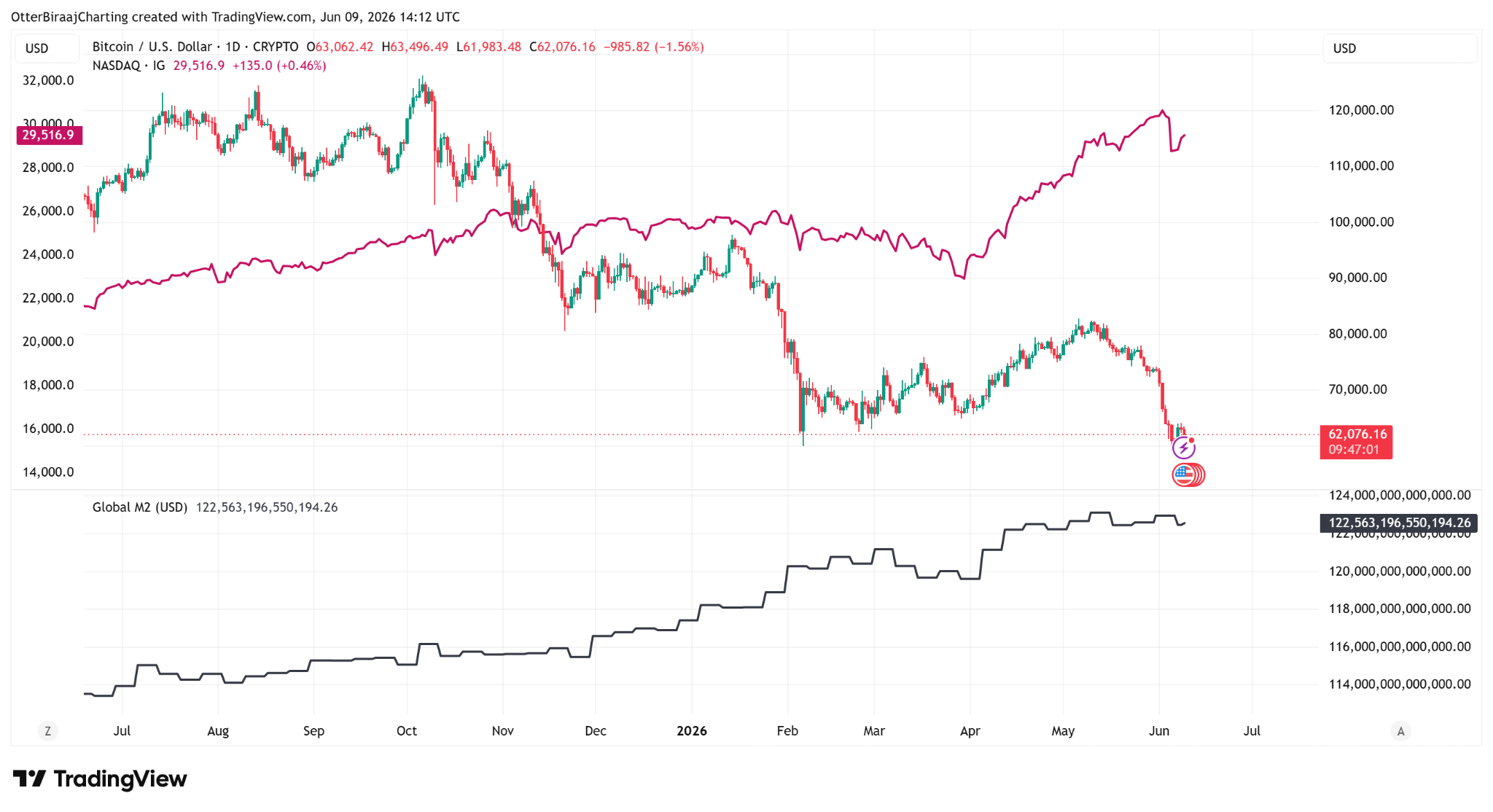
Bitcoin’s (BTC) recent performance may be less about crypto market weakness and more about its position at the front of the risk curve. Asset management firm Bitwise said that BTC often acts as a “canary in the macro coal mine,” responding to shifts in liquidity and financial conditions before traditional markets. With equities now showing similar signs of strain, the firm sees Bitcoin’s move as part of a wider risk-off adjustment.
Global liquidity and interest rates stay in focus: Bitwise
Bitwise said that Bitcoin and Ether reached cycle lows of $58,000 and $1,507, respectively, as other global risk assets faced mounting pressure. The Nasdaq recorded its sharpest daily decline of 5% in months, and South Korea’s KOSPI (Korea Composite Stock Price Index), its benchmark stock index, triggered a temporary trading halt after a steep sell-off led by semiconductor stocks.
The shift followed stronger-than-expected US labor market data, which reduced expectations for near-term Federal Reserve easing. Higher-for-longer interest rate expectations kept the 10-year US Treasury yields higher and weighed on growth-sensitive assets. The US 10-year yield held near 4.53% on Tuesday after touching 4.68% last month, its highest level in a year.
Bitwise pointed to a recurring pattern in which Bitcoin weakens months before equities. Unlike traditional markets, BTC trades continuously and reacts quickly to changes in liquidity conditions.
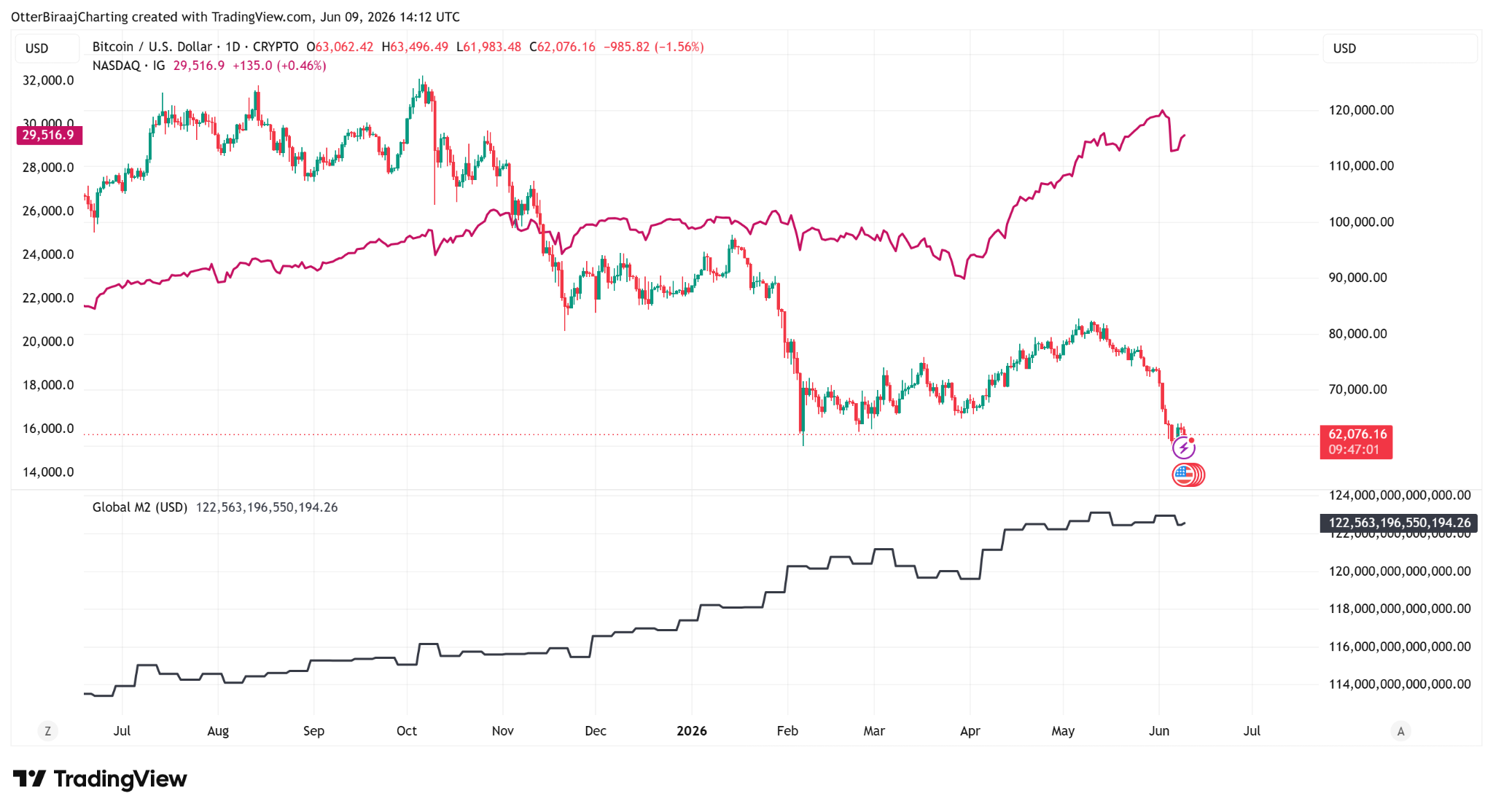
BTC price, NASDAQ, and Global M2 liquidity. Source: Cointelegraph/TradingView
A chart comparing Bitcoin, the Nasdaq, and Global M2 liquidity highlights the divergence. Global M2 has climbed to roughly $122.6 trillion, up steadily over the past year, while Bitcoin has retraced sharply from its $126,000 highs.
If Bitcoin is acting as a macro canary, its correction may be telling a different story than a simple risk-off move. BTC has already undergone a significant repricing while global liquidity continues to expand. That leaves open the possibility that Bitcoin is further along in the adjustment process than equities, particularly if liquidity conditions improve later in the cycle.
Related: Bitcoin price slips toward $62K local lows as bear-market history keeps repeating
Stablecoin reserves signal dry powder
Onchain data is offering a different perspective on crypto market liquidity. Independent market analyst Maartunn highlighted that the Stablecoin Supply Ratio (SSR) relative strength index (RSI) has dropped to an oversold reading of 13.
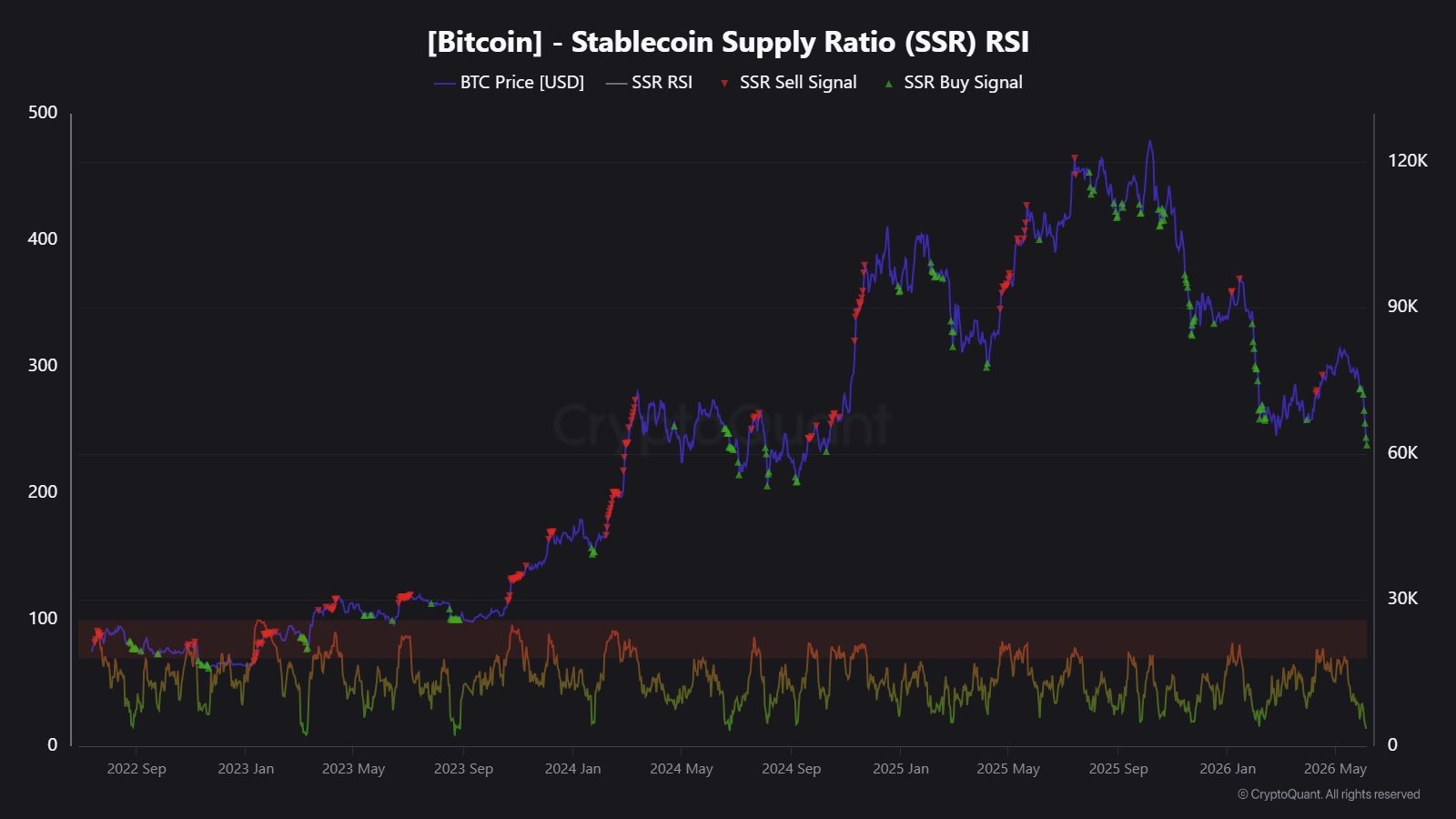
Stablecoin supply ratio (SSR) RSI. Source: CryptoQuant
The SSR measures Bitcoin’s market capitalization relative to the market value of major stablecoins such as Tether’s USDt (USDT) and Circle’s USD Coin (USDC). Lower readings indicate larger stablecoin balances relative to Bitcoin’s valuation, pointing to a substantial buying power sitting on the sidelines.
Historically, similar SSR RSI readings have appeared near accumulation zones and were followed by periods of stronger price performance once liquidity returned to the market.
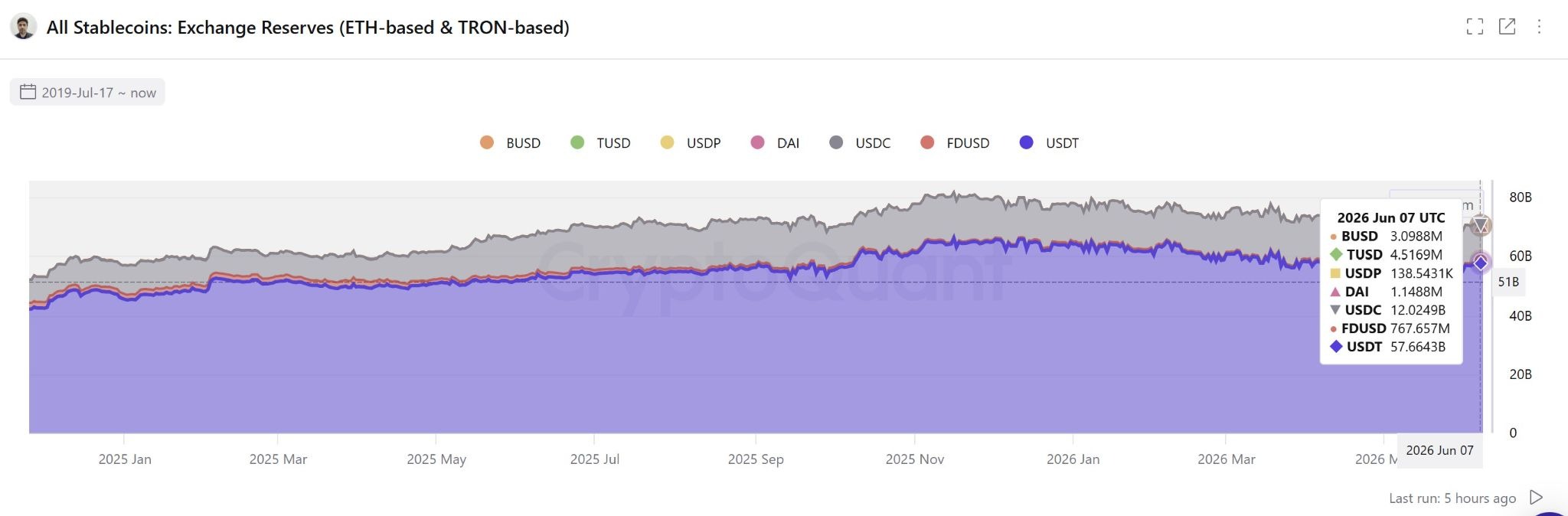
All stablecoins exchange reserves. Source: CryptoQuant
Exchange reserve data also points to a sizeable liquidity pool. Combined reserves of major stablecoins on exchanges currently stand near $72 billion, led by $57.7 billion in USDT (USDT) and $12 billion in USDC. The total has eased from late-2025 peaks above $80 billion, though balances remain elevated by historical standards. That leaves a significant amount of capital positioned on exchanges as Bitcoin trades near the lower end of its recent range at $62,000.
Related: Bitcoin bottom? These four charts hint at BTC price dropping to $50K
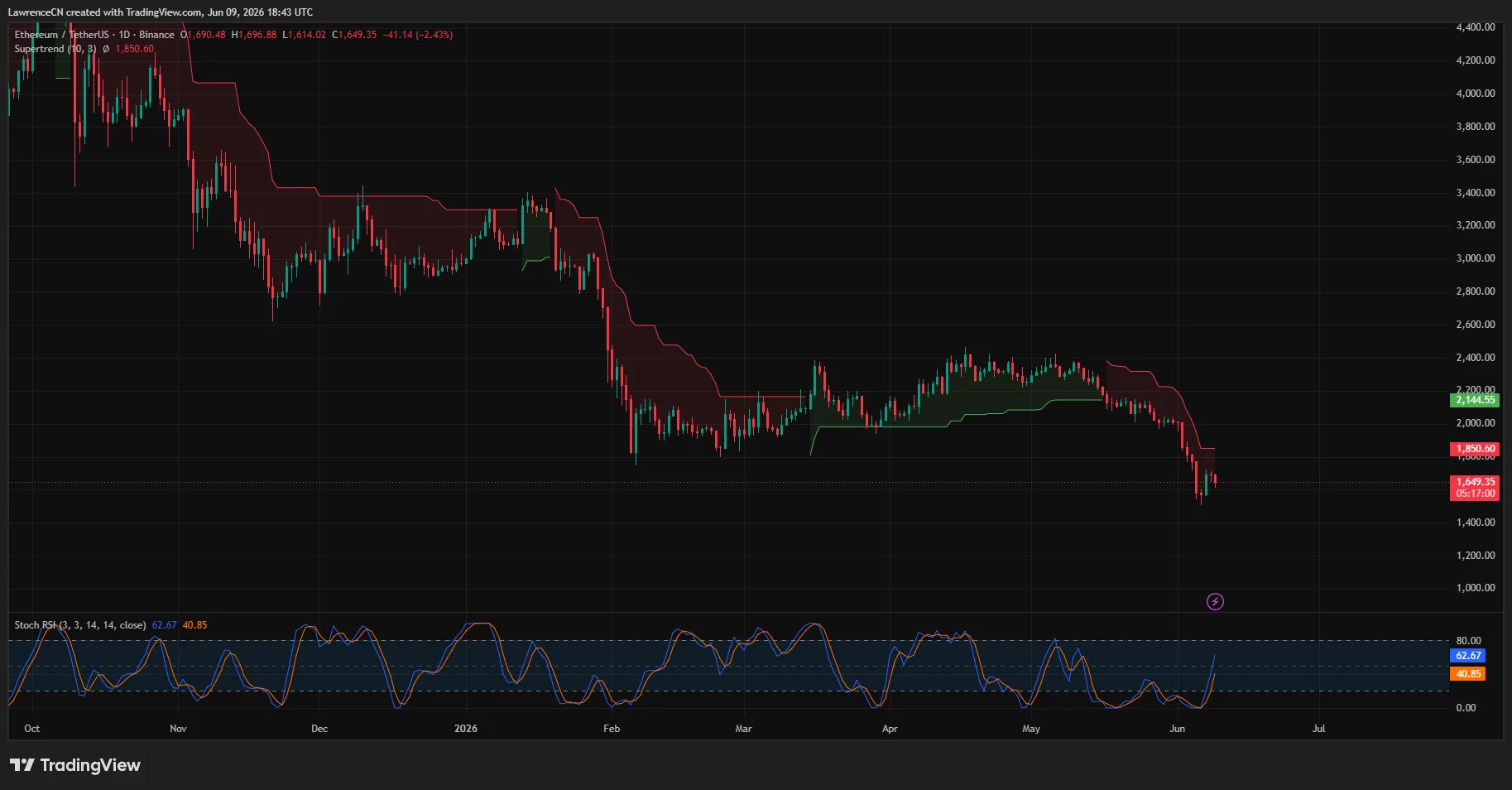
Ethereum price has fallen to around $1,630 after losing roughly 4% in the past 24 hours, while fresh technical signals and market-wide liquidations have kept traders focused on the risk of another move toward key support levels.
Summary
- Ethereum price fell about 4% to near $1,630 as crypto liquidations reached $468 million, and Bitcoin dropped below $62,000.
- Analyst Ted Pillows warned that failure to reclaim $1,700 could trigger a move toward the $1,540 support zone.
- Technical indicators remain bearish, with ETH trading below Supertrend resistance near $1,850 and testing long-term support around $1,530.
According to data from crypto.news, Ethereum (ETH) changed hands near $1,628 on June 10, down about 4% over the previous 24 hours. The move coincided with Bitcoin’s (BTC) 4.7% decline to roughly $61,050, which contributed to a 3.5% drop in total crypto market value to around $2.12 trillion. XRP (XRP) also slipped below $1.15, showing that the selloff extended beyond Bitcoin and Ethereum.
Market participants linked the decline to weak risk appetite, security-related concerns, and a wave of leveraged liquidations.
During the selloff, Bitcoin fell from roughly $64,100 to as low as $61,049, with analysts continuing to monitor whether the largest cryptocurrency can maintain support above $60,000. A sustained hold above that level could open the door for a recovery toward $63,400, while a breakdown may expose the $58,000 to $59,000 region.
Liquidations and fund flows increase market pressure
Data from the derivatives market showed that crypto liquidations reached approximately $468 million over the past day. The decline in Bitcoin alone erased about $130 million worth of positions as prices dropped sharply from the $64,100 area.
Liquidation heatmap data cited by market observers showed roughly $331 million in long liquidations and $1.84 billion in short positions remaining vulnerable to a sudden reversal, highlighting the potential for continued volatility if prices change direction quickly.
At the same time, exchange-traded fund activity delivered mixed signals. U.S. spot Bitcoin ETFs recorded net outflows of $91.37 million, while spot Ethereum ETFs attracted $82.37 million in inflows, according to SoSoValue flow data.
Technical indicators point to critical Ethereum support
Commenting on the current market, analyst Ted Pillows said Ethereum has struggled to reclaim the $1,700 level after its latest decline.
According to a chart shared by the analyst, the area acted as a major bottom in February 2026 but has since turned into resistance as sellers continue defending the zone.
“This is the zone where Ethereum bottomed in Feb 2026 and is now acting as a resistance. If ETH fails to reclaim this, a sweep of lows could happen next.”
Pillows identified the $1,540 area as the next key support level, warning that a failure to recover above $1,700 could expose Ethereum to another move lower.
Additional technical indicators show bearish conditions remain in place. On the daily chart, Ethereum continues to trade below the Supertrend resistance near $1,850, a level that technical traders often monitor for signs of trend reversals.
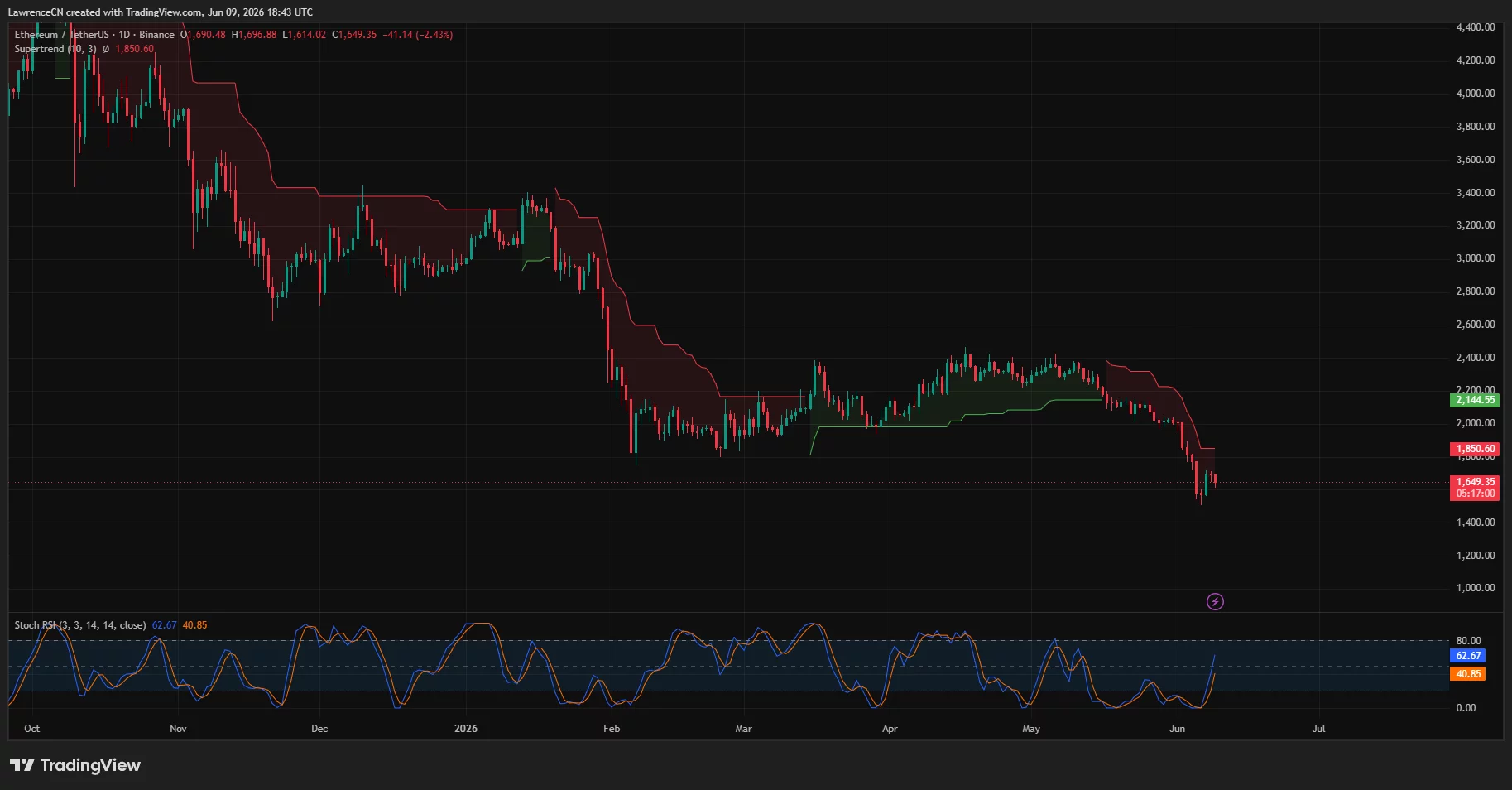
While the Stochastic RSI has rebounded from oversold territory and may support a short-term relief bounce, the indicator has not yet confirmed a broader change in direction.
Longer-term charts point to another important level. Weekly price action shows Ethereum testing support near $1,530, a zone that previously held during major pullbacks in 2023 and 2025.
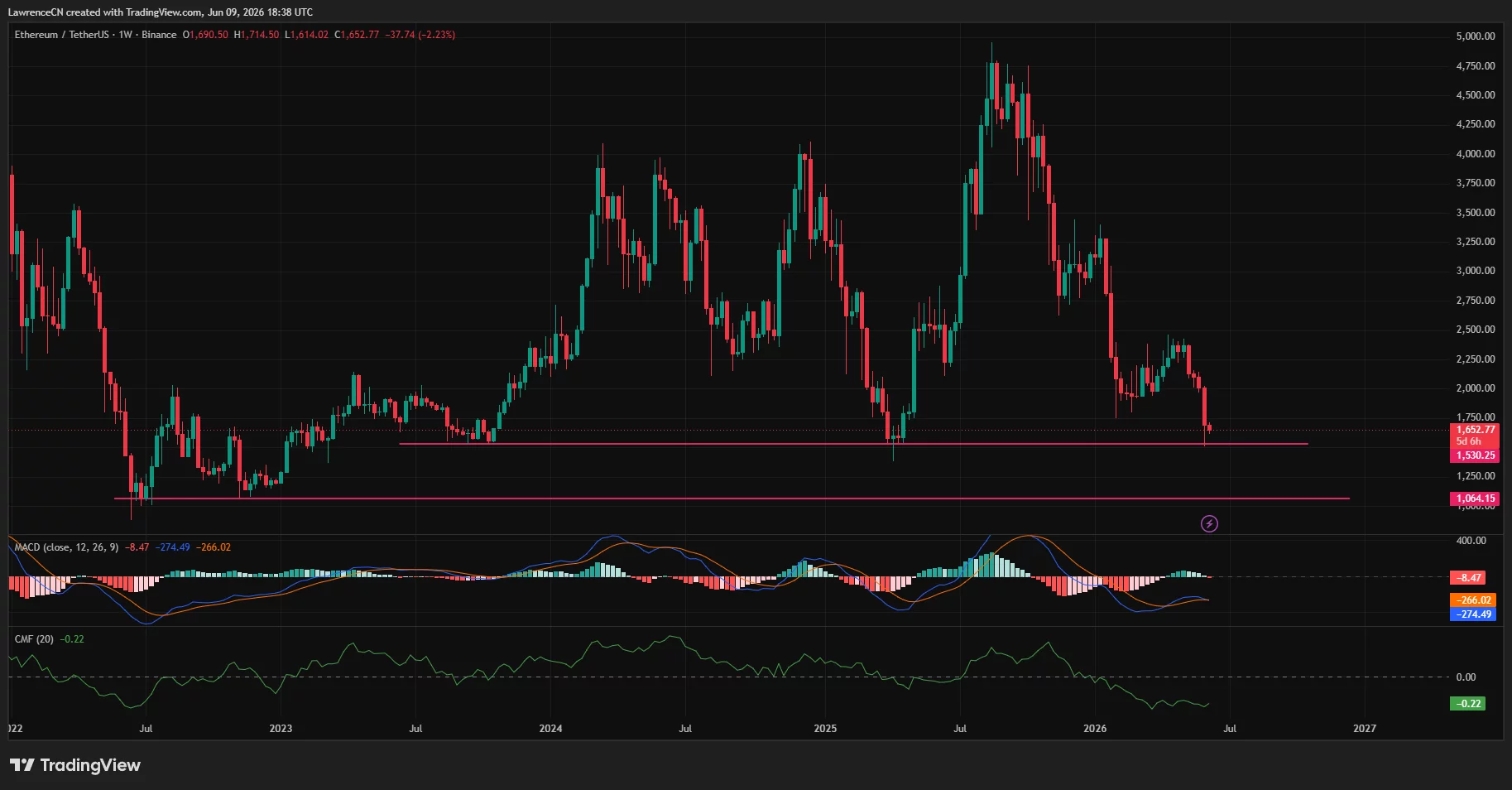
Momentum indicators remain weak, with the weekly MACD staying in bearish territory and the Chaikin Money Flow indicator around negative 0.22, signaling continued capital outflows.
According to the technical setup visible on the weekly chart, a decisive break below $1,530 could expose the next major support level near $1,064.
Any sustained recovery, however, would likely require Ethereum to reclaim resistance levels around $1,700 and eventually move back above the daily Supertrend near $1,850.
Disclosure: This article does not represent investment advice. The content and materials featured on this page are for educational purposes only.


Wall Street has largely abandoned expectations for Federal Reserve rate cuts this year ahead of the first Federal Open Market Committee meeting led by Fed Chair Kevin Warsh on June 16-17.
Summary
- Most Wall Street economists now expect the Fed to keep rates at 3.50%-3.75% through the end of 2026.
- Rising inflation expectations and Middle East tensions have strengthened the case for a prolonged higher-rate environment.
- Despite macro uncertainty, some institutional crypto investors are accumulating and preparing for regulatory clarity.
According to a Reuters survey conducted between June 4 and June 9, 72 of 102 economists expect the benchmark federal funds rate to remain within the 3.50% to 3.75% range through the end of 2026.
The poll showed the strongest consensus so far this year that policymakers are unlikely to ease borrowing costs in the coming months.
The growing conviction follows a run of stronger-than-expected economic data and persistent inflation concerns. Futures markets have also moved in the same direction, with interest-rate contracts now pricing in at least one possible rate increase by late 2026 rather than a return to rate cuts.
Inflation concerns continue to dominate Fed outlook
Fresh inflation data due on June 10 has become a key focus for investors ahead of the June policy meeting. According to Trading Economics forecasts cited earlier by crypto.news, headline Consumer Price Index inflation is expected to rise 0.5% month-over-month in May after increasing 0.6% in April.
Annual CPI is projected to accelerate to 4.2% from 3.8%, while core CPI, which excludes food and energy, is expected to increase 0.3% on a monthly basis and 2.9% year-over-year.
Those forecasts arrive as inflation remains above the Federal Reserve’s target. Separate Reuters polling showed economists expecting elevated price pressures to persist, while the Fed’s preferred inflation gauge, the Personal Consumption Expenditures Price Index, reached 3.8% in April.
Energy markets have added another source of concern. Several economists cited by Reuters pointed to geopolitical tensions and disruptions in Middle East energy markets as factors that could keep inflation elevated. Recent military exchanges between Israel and Iran contributed to renewed worries about higher commodity prices.
Commenting on the policy outlook, Wells Fargo chief economist Tom Porcelli said it would be difficult for Federal Reserve officials to justify rate cuts under current conditions.
“It’s going to be very hard for the Fed to justify any action at this point and in the foreseeable future. It will be incredibly difficult to get a consensus of Fed officials to go along with the idea of cutting rates.”
Porcelli added that a rapid easing of tensions involving Iran could change the outlook but said there was little evidence pointing in that direction.
Markets prepare for a prolonged higher-rate environment
Expectations for tighter policy have also gained support from major financial institutions. Last week, BNP Paribas revised its forecast and said the Federal Reserve could begin raising interest rates in December 2026.
According to a report by crypto.news, the French bank now expects three rate hikes that would effectively reverse the three cuts delivered during 2025.
Warsh’s first FOMC meeting comes as President Donald Trump continues to publicly advocate lower interest rates. Even so, Warsh has indicated that monetary policy decisions will remain independent of political pressure.
Rabobank senior U.S. strategist Philip Marey told Reuters that inflation risks continue to outweigh the case for policy easing.
“The risk is more towards more persistent inflation and fewer cuts and possibly hikes than any quick resolution,” Marey said. “A more optimistic scenario has just flown out of the window.”
Outside traditional markets, some institutional crypto investors appear to be taking a different view of short-term macro uncertainty.
Javier Martinez, CEO at sFOX, told crypto.news that institutions are accumulating positions and making infrastructure investments while awaiting regulatory developments such as the CLARITY Act.
“From the outside, this moment may look like uncertainty. But inside institutions, it’s a window where capital is being positioned and infrastructure decisions are being made ahead of a more mature crypto market structure.”
Disclosure: This article does not represent investment advice. The content and materials featured on this page are for educational purposes only.
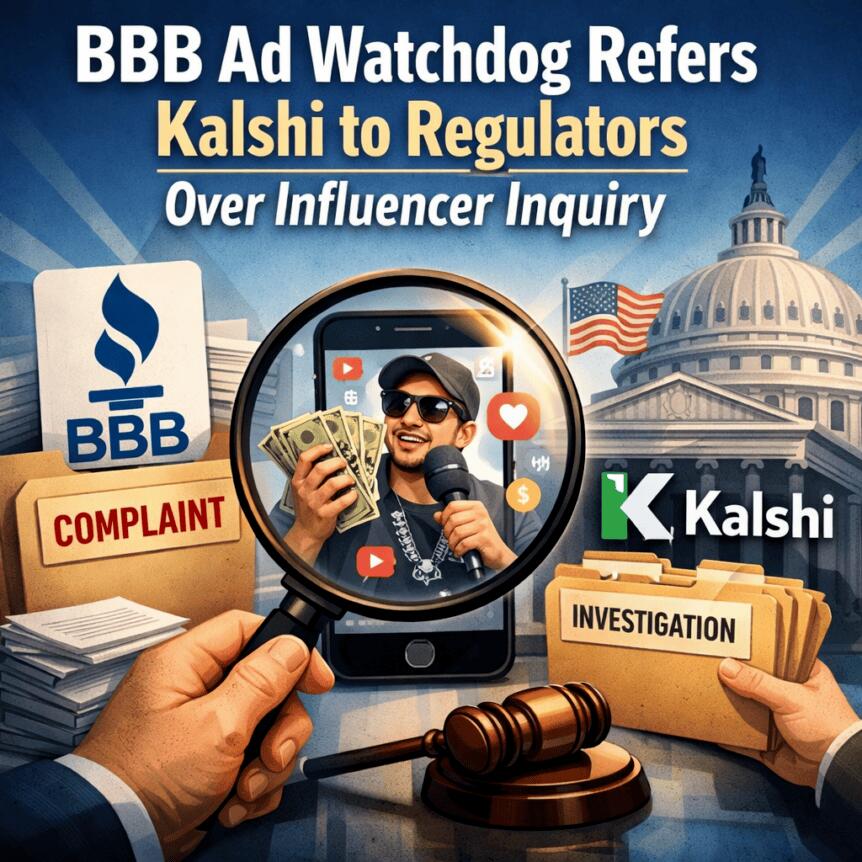
The BBB’s National Advertising Division (NAD) has escalated its scrutiny of Kalshi, the centralized event-prediction platform, by referring the matter to regulatory authorities after Kalshi declined to participate in NAD’s voluntary review of its social media advertising practices. The referral, which names applicable state Attorneys General for potential enforcement action, underscores growing regulatory focus on how prediction-market platforms market themselves to retail users and disclose paid promotions in influencer-driven campaigns.
In its statement, NAD explained that the inquiry assessed whether influencers and affiliates clearly disclosed paid relationships in social media promotions and whether Kalshi adhered to Federal Trade Commission endorsement guidelines. The division noted that Kalshi chose not to participate in the voluntary review, and as a result, NAD will inform the social media platforms where Kalshi ads appeared. The central issue, according to NAD, was whether material connections between Kalshi and influencers or affiliates were disclosed in a clear and conspicuous manner in social media advertising.
The development adds to existing scrutiny surrounding Kalshi’s marketing approach. Media Matters for America, a nonprofit watchdog, has also highlighted the platform’s social media campaigns on TikTok and Instagram that portrayed prediction trading as a “side hustle.” The attention comes amid a broader push within several regulatory and watchdog circles to scrutinize the endorsement practices of crypto and fintech firms that use influencer networks to reach younger audiences.
Kalshi’s exposure to attention from oversight bodies is not occurring in isolation. In related coverage, Kalshi has been noted for joining a wave of platforms expanding through viral marketing while confronting ongoing debates about the regulatory status of prediction markets and the adequacy of anti-insider-trading controls. A separate note from industry coverage highlights Kalshi’s broader market activity, including recent fundraising and a high-valuation round that has drawn attention from institutional observers.
Kalshi’s promotional dynamics have become a focal point in the context of rapid growth for prediction markets. The company has publicly disclosed that its business momentum is translating into strong revenue trajectories, with a Kalshi spokesperson telling Bloomberg that the firm is on track to reach a $1.5 billion annualized revenue run rate. That momentum coincided with a recent funding round reported to be valued around $22 billion, a milestone that positions Kalshi as a leading player in a sector that combines real-world event outcomes with blockchain-native or centralized trading venues. The reporting underscores how marketing efficacy—especially through social platforms—has become a critical driver of user acquisition and liquidity in event-based markets.
Despite regulatory headwinds, the sector continues to grow. Kalshi sits alongside its decentralized peers and other centralized marketplaces as retail and institutional participants increasingly engage with event-driven trading. Industry observers have pointed to a broader transition toward more formalized market structures within prediction markets, including the introduction of block trading and bespoke contracts as mechanisms to deepen liquidity and improve price discovery. A May research note from Bernstein, cited by market watchers, framed the development of prediction markets as entering an “institutional era,” arguing that new trading formats could attract portfolio managers seeking targeted exposure to event risk and potentially enhance market efficiency. The report also highlighted that large trades and more sophisticated contract designs could broaden institutional participation, while raising questions about risk controls and regulatory oversight.
Key takeaways
- Regulatory referral and enforcement risk: NAD has referred Kalshi to appropriate authorities, including state Attorneys General, for possible enforcement action based on the inquiry into advertising disclosures and FTC endorsement compliance.
- Participation and disclosure posture: Kalshi declined to participate in NAD’s voluntary self-regulatory review of its advertising practices, triggering a formal referral process that includes notifying social media platforms involved in Kalshi’s campaigns.
- FTC endorsement framework in focus: The investigation centers on whether material connections between Kalshi and influencers or affiliates were clearly and conspicuously disclosed in social media promotions, in line with FTC guidelines.
- Independent scrutiny broadens: Media Matters for America has raised concerns about Kalshi’s viral campaigns on TikTok and Instagram that framed prediction trading as a supplemental “side hustle,” contributing to reputational and regulatory risk.
- Industry momentum amid scrutiny: Kalshi’s growth trajectory—bolstered by social media marketing and high-profile fundraising—continues to attract attention from institutional and regulatory circles as the sector contends with jurisdictional questions and enforcement risk.
Regulatory landscape and strategic implications for Kalshi and peers
The NAD referral sits within a broader regulatory frame that encompasses multiple agencies and jurisdictions. The FTC’s endorsement guidelines require transparent disclosure of material relationships between advertisers and endorsers, a standard that applies to paid promotions across social media platforms. In the context of Kalshi, the inquiry examines whether such disclosures appeared in user-facing posts and promotions and whether the platform undertook appropriate steps to ensure compliance with the guidelines. For institutions, the outcome could influence how risk teams assess marketing disclosures, influencer partnerships, and platform-embedded compliance controls across marketing channels.
Beyond the FTC framework, the action touches on ongoing tensions between federal and state-level regulators over the oversight of event contracts and prediction-market structures. The original coverage notes a jurisdictional dispute between state regulators and the Commodity Futures Trading Commission (CFTC) over event contracts, compounded by earlier allegations of insider trading activity. As enforcement posture tightens, firms operating prediction markets—both centralized and decentralized—face heightened expectations around Know Your Customer (KYC) and anti-money-laundering (AML) controls, clear disclosure of conflicts of interest, and robust surveillance measures to detect improper market manipulation or information leakage.
The Bernstein analysis referenced in market commentary argues that the sector may be transitioning into a more institutional-friendly phase, with evidence such as sizeable block trades and bespoke contracts suggesting improving liquidity and price discovery. If institutional participation continues to expand, operators like Kalshi may need to strengthen governance and compliance frameworks to satisfy both existing regulatory regimes and potential future policy developments. In parallel, cross-border considerations—such as potential alignment with MiCA-like regimes in European markets and disparate state-by-state approaches in the United States—could shape licensing, oversight, and product design decisions for prediction-market platforms.
From a practical standpoint, the referral raises questions for compliance teams within crypto and fintech firms. How should marketing teams document paid partnerships with influencers? What cadence and format of disclosures satisfy evolving regulatory expectations? And how can platforms provide auditable evidence of disclosures to regulators and platforms alike? For exchanges and banks that integrate with crypto-focused platforms, the developments stress the importance of calibrated risk controls, clear policy statements on endorsements, and robust AML/KYC programs integrated with marketing and operations.
On the industry level, the Kalshi case may influence best practices around influencer marketing in the crypto space. The attention from NAD, combined with watchdog scrutiny and ongoing legal debates, could push platforms to adopt standardized disclosures, pre-approval for promotional content, and consistent enforcement of conflict-of-interest policies. The result could be a more conservative but legally compliant expansion path that prioritizes long-term integrity over rapid user growth driven by viral campaigns alone.
Closing perspective
As authorities delineate the boundaries between persuasive marketing and compliant endorsements, Kalshi and similar operators may experience a recalibration of their advertising strategies and governance frameworks. The next steps—whether regulators pursue enforcement actions, require remedial disclosures, or clarify guidance for endorsement practices—will shape how prediction-market platforms navigate compliance requirements while continuing to grow their user bases and liquidity in a regulated environment.

Bitcoin (BTC) traded near $61,100 on June 9 after sliding about 10% on the week, and Binance founder Changpeng Zhao (CZ) urged investors to stay calm even as analysts said a market bottom remains unconfirmed.
Trading firm Wintermute pinned the decline on US institutional selling and ETF outflows rather than panic. On-chain data from Santiment showed retail buyers absorbing dips while large wallets kept cutting exposure.

Why CZ Is Telling Bitcoin Holders Not to Panic
CZ, who stepped back from running Binance in 2023, addressed the slump, framing the Bitcoin price drawdown as temporary rather than terminal.
“Bitcoin won’t be ‘dead’ for too long. Don’t panic.”
His message arrived during the longest ETF outflow streak on record. With BTC down more than 50% from its October 2025 peak above $126,000, the comment read as an attempt to steady sentiment from one of the industry’s most-followed voices.
Institutional Selling Is Driving the Decline
Wintermute argued the move was led by US institutions offloading positions they built only weeks earlier. The firm said capital inflows have yet to return, making it too early to call a floor.
“With prior support gone, there’s not much underneath to lean on. BTC never spent meaningful time in the $50-59k range on the way up in 2024, so there are no real technical levels here. That leaves flow as the thing setting direction,” Wintermute analysts noted.
Follow us on X to get the latest news as it happens
Spot Bitcoin ETFs had already logged their ninth straight day of outflows in late May, a streak Wintermute pegged near $2.97 billion through May 30.
MicroStrategy added to the unease by selling 32 BTC, its first disposal since 2022, which the firm called immaterial in size but symbolic in signal.
Macro pressure compounded the selling. The US economy added 172,000 jobs in May, more than double the roughly 80,000 expected, with April revised up to 179,000.
That strength weakened the near-term case for Federal Reserve rate cuts and lifted yields, a backdrop some traders read as an institutional exodus signal.
Whales Sell While Retail Buys the Dip
Elsewhere, Santiment analysts flagged a widening gap between small and large holders.
Wallets holding less than 0.01 BTC raised their collective balance by 0.36% over two weeks, while wallets holding 10 to 10,000 BTC trimmed theirs by 0.20%.
That split matters because durable bottoms usually arrive with retail capitulation, not retail conviction.
“That widespread surrender simply isn’t showing up yet.” Santiment indicated.
The analytics firm said markets tend to move against retail expectations and in line with whale behavior, echoing a recurring whales accumulate, retail vanishes pattern.

Some long-term investors have started buying at current levels, viewing the risk and reward as more attractive on a multi-year horizon.
Still, that quiet accumulation looks different from the aggressive whale buying versus retail seen at past cycle lows.
With no clear sign of returning inflows and a difficult macro picture ahead of US midterm elections, the search for a durable floor continues.
The coming sessions may show whether whales step back in as buyers or leave retail to carry the rebound alone.
The post Bitcoin’s Bottom Isn’t In Yet? CZ Stays Calm While Whales Keep Selling appeared first on BeInCrypto.

Palantir: Even A Historic Quarter Could Not Move The Needle (NASDAQ:PLTR)
Over 535,000 LINK Holders Signal Quiet Chainlink Accumulation Amid Market Uncertainty

Security expert gives sneak peek at what venues will look like during World Cup



-

 Fashion4 days ago
Weekend Open Thread: Evereve – Corporette.com
-
 Crypto World4 days ago
Jensen Huang Approves Samsung, SK Hynix, and Micron for NVIDIA (NVDA) HBM4 Memory Supply
-

 Sports7 days ago
French Open 2026 results: Alexander Zverev beats Rafael Jodar and will play Jakub Mensik in semi-finals
-

 Business7 days ago
Trump Taps Housing Chief Bill Pulte as Acting Intelligence Director After Gabbard Exit
-

 Crypto World2 days ago
Anatomy of the June crypto crash: Fed, Iran, Saylor
-
 NewsBeat7 days ago
Republicans balk at Trump’s attempt to appoint a MAGA enforcer to lead National Intelligence
-
 Crypto World3 days ago
Senator Cynthia Lummis Calls CLARITY Act the Most Consequential Financial Legislation of This Generation
-
 Entertainment3 days ago
The Best Mystery Series of All Time Is Surging on Streaming 30 Years After It Ended
-
 Business3 days ago
The Pain Points Taking a Fragile Tech Rally Down a Notch
-

 Tech4 days ago
Microsoft launches MXC, an OS-level sandbox for AI agents, with OpenAI and Nvidia already on board
-

 Tech2 days ago
Microsoft unveils seven homegrown AI models in new bid for ‘long term self-sufficiency’
-

 NewsBeat2 days ago
Alexander Zverev wins the French Open to finally earn a 1st Grand Slam title
-
Crypto World4 days ago
LBank Surpasses 25 Million Users Worldwide as AFA Partnership Continues to Drive Global Growth
-

 Business7 days ago
PagerDuty, Inc. (PD) Presents at Bank of America 2026 Global Technology Conference Transcript
-

 Tech4 days ago
Suspicious Polyfill login prompts pop up on Toshiba, Muji websites
-

 Crypto World2 days ago
Trump’s AI Ownership Plan Could Benefit Anthropic at OpenAI’s Expense
-
 Sports3 hours ago
Bangladesh beat Australia after 20 years in ODIs, register only their second win over six-time world champions | Cricket News
-

 Business4 days ago
(VIDEO) Justin Bieber Delivers Surprise Happy Birthday Serenade to Diners at Los Angeles Mexican Restaurant
-

 Tech4 days ago
Meta steals a tactic from Tesla and builds data centers in tents
-

 Tech4 days ago
RCS Messages Between iPhone and Android Get End-to-End Encryption With iOS 26.5
You must be logged in to post a comment Login