Connect with us
DAPA Banner
DAPA Coin
DAPA
COIN PAYMENT ASSET
PRIVACY · BLOCKDAG · HOMOMORPHIC ENCRYPTION · RUST
ElGamal Encrypted MINE DAPA
🚫 GENESIS SOLD OUT
DAPAPAY COMING

NewsBeat

Police attend Trafford Centre over Swatch pocket watch chaos

Published

on

Police attend Trafford Centre over Swatch pocket watch chaos

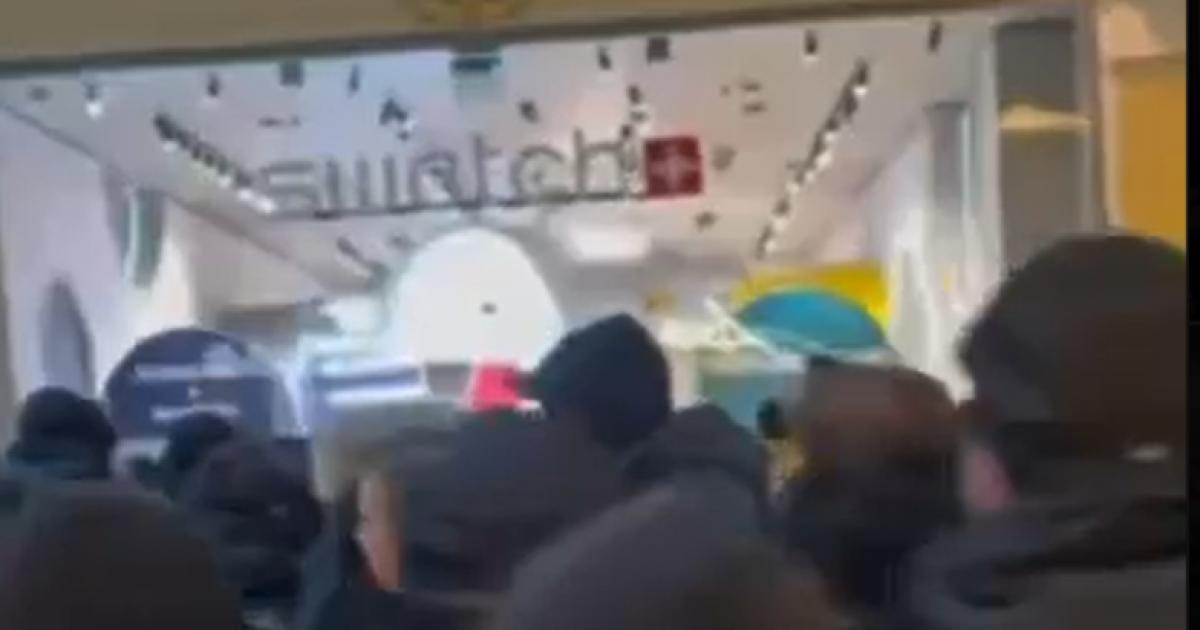
Watch retailer Swatch was forced to close stores across the UK over the weekend amid safety concerns after huge crowds descended on shopping centres.

Officers were sent to the Trafford Centre in Manchester and “dispersed a large number of people”, Greater Manchester Police (GMP) said.

Swatch announced it was closing a store in Greater Manchester on Sunday (May 17) for a second day after scores of people queued for the launch of a new pocket watch.

Advertisement

GMP was called shortly before 6am on Saturday “following reports of a disturbance at the Trafford centre”, a spokesperson said.

The force said: “Officers attended and alongside security staff dispersed a large number of people who were inside the centre.

“No arrests have been made.”

Videos posted online appeared to show huge crowds at multiple shopping centres across the UK with police near a number of stores.

Advertisement

Police were called to St David’s 2 shopping centre in Cardiff after reports of about 300 people trying to get in to a Swatch store at 6.20am on Saturday, South Wales Police said.

A 25-year-old man from Pengam was arrested and issued with a Section 35 dispersal notice, the force added.

A spokesperson for South Wales Police said: “South Wales Police was called at 6.20am on Saturday May 16 to a group of approximately 300 people trying to enter the St David’s 2 shopping centre.

“A 25-year-old man from Pengam was arrested and issued with a Section 35 dispersal notice with the conditions that they are not to enter Cardiff City Centre again during Saturday May 16.”

Advertisement

Swatch posted on Facebook on Saturday saying “in light of safety considerations for both our customers and our staff” stores in Liverpool, Manchester, Birmingham, Sheffield, Glasgow and Cardiff would be closed for the day, along with all of the London stores.

It posted later on Saturday saying: “To all our dear fans worldwide of our AP x Swatch collab, launched on May 16.

“To ensure the safety of both our customers and our staff in Swatch stores, we kindly ask you not to rush to our stores in large numbers to acquire this product.

“The Royal Pop Collection will remain available for several months. In some countries, queues of more than 50 people cannot be accepted, and sales may need to be paused.”

Advertisement

The company posted again on Sunday saying the Manchester store would be closed for the day “in light of safety considerations”.

Swatch launched the Audemars Piguet x Swatch Royal Pop Collection on Saturday at selected stores worldwide, according to the company’s website.

Purchases are limited to one watch per person, per day, and per store.

Advertisement

Source link

Continue Reading
Click to comment

You must be logged in to post a comment Login

Leave a Reply

NewsBeat

Count Binface’s North Yorkshire battle before Clacton bid

Published

on

Count Binface's North Yorkshire battle before Clacton bid

COUNT Binface is hitting the headlines for challenging Nigel Farage in the upcoming by-election in Clacton – but remember when he was making a big noise in North Yorkshire?

The colourful political character – campaigning on making all 99 cones cost 99p – stood against local MP Rishi Sunak in the last general election.

Count Binface, who has been doing media rounds in recent days dressed in his trademark tin bin helmet is a well-established novelty candidate in British elections, often pitting himself against the standing Prime Minister.

Count Binface when he was running for election in Richmond and Northallerton against PM Rishi Sunak Image: Count Binface

Binface – unmasked as Oxford-educated satirical scriptwriter Jon Harvey – stood as a candidate in the Uxbridge and South Ruislip constituency at the 2019 General Election against the then Prime Minister, Boris Johnson, and again at the 2023 by-election after Johnson’s resignation.

Advertisement

Most recently, he stood in the Makerfield by-election against Andy Burnham – and was photographed at the result standing next to the Labour MP and shaking his hand.

Closer to home, he took on Rishi Sunak in 2024 in the Richmond and Northallerton constituency.

Not surprisingly Count Binface’s manifesto features some unconventional aspirations, including Bringing back Ceefax, the teletext service, nationalising Adele as well as model railways, and moving the hand dryer in the men’s toilet at Uxbridge’s Crown and Treaty pub to a “more sensible position”.

When he announced his candidacy against Sunak, he said in his podcast, Trashtalk, that he would be “taking on the biggest fish of the lot” in the election and commented: “You shirked D-Day Rishi, you can’t miss the B-Day”, a reference to the controversy caused by the PM’s early departure from the ceremonies commemorating the 80th anniversary of the Normandy landings.

Count Binface when he was running for election in Richmond and Northallerton against the then PM Rishi Sunak in 2024. Image: Count Binface

As the Northallerton and Richmond result was declared in the small hours of July 5, 2024, Binface stood on stage with Sunak – who held the seat. However, the unlikely challenger was reaping his own success.

Advertisement

Recommended reading:


He was sixth out of thirteen candidates with 308 votes, representing 0.6 per cent of all the votes cast. It is reported that he later commented on Twitter that it was his best placing and highest ever vote count in a national election and declared that “Bindependence Day has come”.

Rishi Sunak and his wife, Akshata Murty, arriving to cast their vote in the 2024 General Election at Kirby Sigston Village Hall in Northallerton, North Yorkshire. Coutn Binface stood against him in this election. Picture date: Thursday July 4, 2024. PA

Can he outdo his North Yorkshire performance in Clacton?

We shall have to wait and see.

Advertisement

Vote now…


What do you think?

Feel strongly about an issue? Write us a letter. Please write no more than 250 words and you must provide your full name, address and mobile number. Send your views by email to: letters@thepress.co.uk


Write a comment

Advertisement

Join the debate and leave a comment in our comments section below this article – we may use your comments for a follow up article.

Source link

Advertisement
Continue Reading

NewsBeat

Welsh hospital ward closed after outbreak of rare Victorian-era disease

Published

on

Daily Record

A hospital ward in Carmarthen, Wales has been closed following an outbreak of a rare form of scabies, a Victorian disease the cases of which are on the rise in the UK

A hospital ward has been shut down following an outbreak of a rare form of scabies, a Victorian-era disease which is seeing a resurgence across the UK.

Steffan Ward at Glangwili Hospital in Carmarthen, Wales, will be closed to manage the outbreak “in line with established infection prevention and control procedures,” according to Hywel Dda health board.

The health board confirmed that patients and staff identified as contacts have been offered treatment, including those not displaying symptoms.

Advertisement

It also stated that additional infection prevention and control measures have been implemented on the ward, including “enhanced monitoring, treatment of identified contacts and ongoing support from specialist teams,” BBC Wales reported.

As the NHS explains on its website, “scabies is an itchy rash caused by mites. It’s spread through close skin contact, and anyone can get it. It should be treated quickly to stop it spreading”.

The symptoms of scabies include intense itching, particularly at night, and a raised rash or spots that may appear red. The website also noted “scabies rash usually spreads across the whole body, apart from the head and neck. It often affects skin between the fingers, around the wrists, under the arms, and around the waist, groin and bottom”

“People with a weakened immune system can sometimes get a rare and very contagious type of scabies called crusted scabies. The main symptom is a crusted, flaky rash that often affects the elbows, knees, hands and feet,” it also explained. The NHS also stated scabies spreads through close skin contact, including sexual contact.

Advertisement

The condition cannot be contracted from pets. Individuals who live or work in close proximity within nurseries, university halls of residence or nursing homes face a higher risk, reports the Express.

Adults and youngsters aged five years or above can return to work or school immediately after beginning treatment. However, it’s crucial to stay away from close contact with others for the initial 24 hours.

Ensure our latest stories always appear at the top of your Google Search by making us a Preferred Source. Click here to activate or add us as your Preferred Source in your Google search settings.

Source link

Advertisement
Continue Reading

NewsBeat

New workplace temperature limit rules under consideration

Published

on

Cambridgeshire Live

The UK is set to be hit by soaring temperatures from Wednesday, with some expected to climb as high as 35C in some areas, the Met Office has said

The Department for Work and Pensions has today provided a fresh update regarding proposals which could see regulations altered concerning an ‘upper temperature’ threshold for workplaces. The UK is set to experience soaring temperatures from Wednesday, with some forecasts predicting highs of 35C in certain regions, according to the Met Office.

Advertisement

Areas of southern England could witness temperature peaks of approximately 33C on Wednesday and 34C on Thursday, with the highest figures of 35C anticipated for isolated locations on Friday and Saturday. By the weekend, the warm conditions are expected to extend to northern parts of the country, with increasingly humid weather and a rising possibility of showers or isolated thunderstorms.

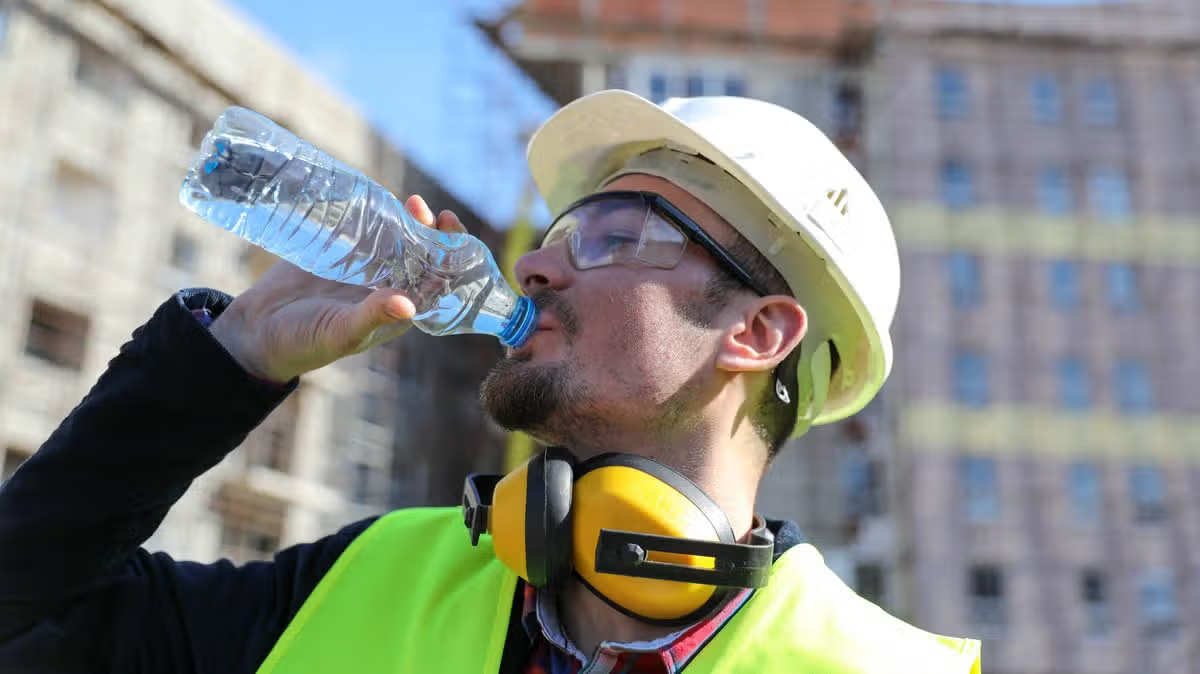
The emerging pattern of temperatures exceeding 35C in the UK has prompted calls for a maximum workplace heat threshold for health purposes, as exists in numerous countries. MPs have tabled parliamentary written questions to the DWP on the matter, with Labour’s Dr Peter Prinsley asking the Secretary of State for Work and Pensions Pat McFadden: “If he will make an assessment of the potential merits of a mandated upper temperature limit in the workplace, including those working outside.”

Alex Mayer also asked Mr McFadden: “What assessment his Department has made of the potential impact of heatwaves on workers in outdoor and high-temperature workplaces.”

In response, Sir Stephen Timms stated that the Health and Safety Executive (HSE) was considering changes to the rules in this area, with news coming later this year. He said: “The HSE is Great Britain’s national regulator for workplace health and safety. There is a legal duty for employers to fully assess the risks to workers from extreme heat.

Advertisement

“HSE provides guidance for employers to manage the risk to workers, including from extreme heat. HSE issued a press release on Friday, June 19, to raise awareness of the risks to workers, to help workplaces in the current hot weather. This year, HSE will also be launching a public consultation on proposed changes to the Approved Code of Practice for the Workplace (Health, Safety and Welfare) Regulations 1992, including those relating to workplace temperature.”

During last month’s heatwave, the HSE signalled its position by urging employers to ‘act now’ to protect workers as temperatures soared

, reports the Express. It stated that employers are required to plan for and support those working in extreme heat, with the regulator noting that doing so would keep workers healthy and safe while also maintaining productivity.

The HSE reminded employers that they are legally obliged to assess risks to the health and safety of their workers, including those posed by extreme weather conditions such as heatwaves. While there is no legal maximum temperature for workplaces, heat is classed as a hazard and should be treated like other hazards.

Advertisement

John Rowe, Deputy Director for Technical Support and Engagement for the Health and Safety Executive, said: “Last summer should have been a wake-up call for all employers. If we continue to experience hotter summers this could have a big impact on the workforce of this country, affecting everything from health of workers to productivity on construction sites.

“The risks to workers from extreme heat must be properly assessed. Practical steps can include providing adequate ventilation and shade and allowing enough breaks for workers to cool down. We provide detailed guidance on our website hse.gov.uk.

“We know all employers are under pressure and we don’t want to add to their burden but it’s vital they think hard now about simple and cheap measures they can put in place to support workers should we see extreme heat again this summer.”

Simple measures to consider include:

Advertisement
  • Making sure workplace windows can be opened or closed to prevent hot air from circulating or building up
  • Using blinds or reflective film on workplace windows to shade workers from the sun
  • Placing workstations away from direct sunlight and heat sources
  • Putting insulation around hot pipes and machinery
  • Offering flexible working patterns so workers can work at cooler times of the day
  • Providing free access to drinking water
  • Relaxing dress codes if possible
  • Providing weather-appropriate personal protective equipment
  • Encouraging workers to remove personal protective equipment when resting (ideally in shaded areas) to cool off
  • Sharing information about the symptoms of heat stress and what to do if someone is affected

Source link

Continue Reading

NewsBeat

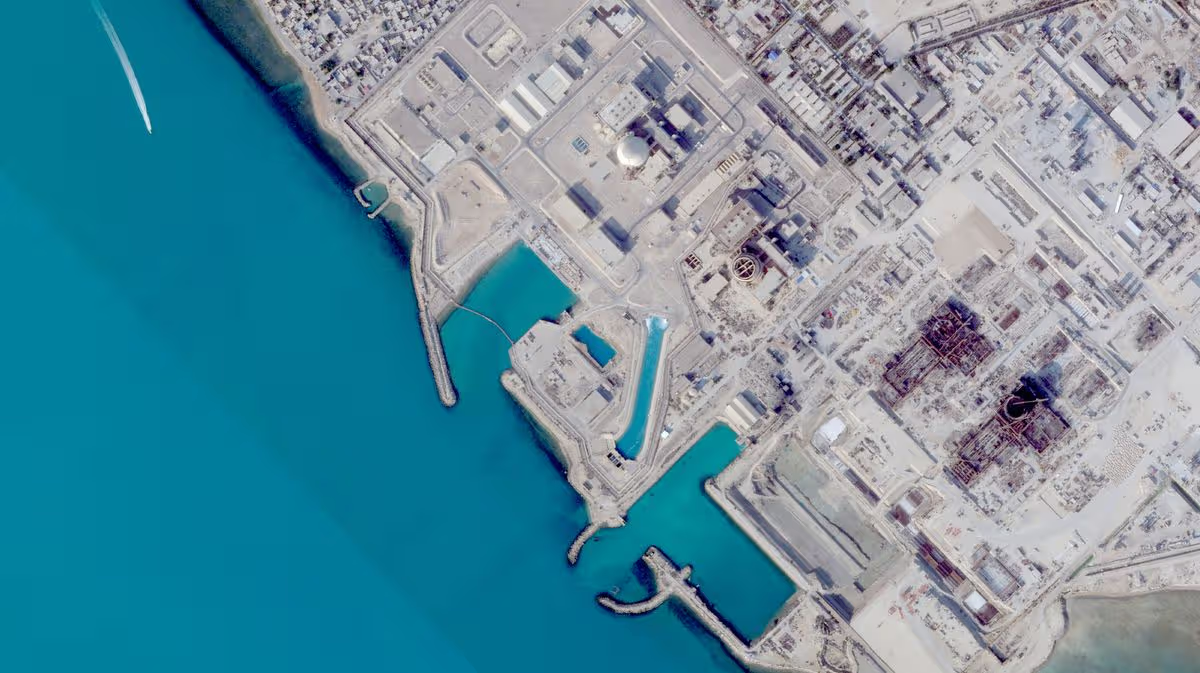
Iran accuses Trump of striking nuclear plant with active working reactor LIVE

Published

on

Daily Mirror

US forces said they hit about 90 targets across Iran with President Donald Trump warning the conflict could “get much worse”.

Iran responded to a second day of renewed attacks by targeting Bahrain, Kuwait and Qatar early on Thursday.

US Central Command said the strikes were aimed at hitting Iran’s ability “to threaten freedom of navigation” through the Strait of Hormuz.

Advertisement

Renewed hostilities broke out on Tuesday after Iran targeted three tankers in the vital waterway, which remains a flashpoint in the fragile truce.

“U.S. forces remain vigilant, lethal, and prepared to execute operations directed by the Commander in Chief,” the statement from Central Command said.

Trump also reposted on his Truth Social platform a picture of buildings in flames billowing thick black smoke, purportedly to be in Iran, with the message: “This is retribution for yesterday’s bombing of ships. If it happens again, it will get much worse.”

Source link

Advertisement
Continue Reading

NewsBeat

Federal appeals court upholds Illinois ban on semiautomatic weapons

Published

on

Federal appeals court upholds Illinois ban on semiautomatic weapons

A federal appeals court on Thursday upheld an Illinois ban on semiautomatic weapons, keeping in place a law passed largely in response to a deadly Independence Day parade shooting.

The ruling by the U.S. Court of Appeals for the Seventh Circuit overturns a lower court decision that found the ban unconstitutional. The 2-1 appellate decision found that the Illinois law does not violate the Second Amendment, and its restrictions are “consistent with the principles that underpin our Nation’s tradition of firearm regulation.”

“Whether to adopt them is thus a decision reposed in our elected representatives, and we reverse,” the appeals court said.

The majority opinion also pushes back on claims made by the plaintiffs that semiautomatic weapons are not at fault for mass shootings.

Advertisement

“The undisputed record evidence undercuts that claim, showing that the presence of assault weapons and large-capacity magazines is strongly correlated with the severity of the societal problem,” the opinion states.

Democratic Gov. JB Pritzker said in a post on X that the decision is “a victory in the fight to end gun violence that helps keep our communities safe.”

The National Shooting Sports Foundation, the firearms industry trade association seeking to stop the ban, said that it is disappointed with the decision and plans to ask the U.S. Supreme Court to review the case.

The gun trade group said it agrees with Chief Judge Michael Brennan’s dissent in which he wrote that the country prohibits governments from banning “firearms commonly owned for self-defense.”

Advertisement

“Because the people have overwhelmingly chosen the AR-15 rifle and its magazine as their weapon of choice, they are protected by the Second Amendment,” the judge’s dissent states.

The Protect Illinois Communities Act was signed into law in 2023 by Pritzker and bans AR-15 rifles and similar guns, large-capacity magazines and an assortment of attachments.

It came six months after a 2022 shooting in which a gunman on a rooftop in the Chicago suburb of Highland Park opened fire on a parade, killing seven people and injuring more than three dozen.

The law prompted immediate pushback from county sheriffs who said they refused to enforce what they considered an unconstitutional law, while gun owners and advocates sued.

Advertisement

In 2024, a federal judge overturned the ban, leaning on recent U.S. Supreme Court rulings that strictly interpret the Second Amendment right to keep and bear firearms.

The injunction was set to take effect 30 days after the judge’s decision. But that same day, Illinois Attorney General Kwame Raoul filed a notice of appeal, which ultimately led to a stay in the injunction.

Advertisement

Raoul said Thursday’s decision enhances public safety. “We have seen the damage that assault weapons and large-capacity magazines can inflict, and these weapons of war have no place in our communities,” he said in a statement.

Last month, the Supreme Court announced it will consider whether bans on semiautomatic rifles, often called assault weapons, violate the Second Amendment. In the fall, the court, which has expanded gun rights, is expected to hear appeals challenging a ban in the Chicago area, which predates the statewide law.

Advertisement

Source link

Continue Reading

NewsBeat

Beautiful Welsh seaside town that ‘rivals Italy’ is officially one of the best in the UK

Published

on

Wales Online

Portmeirion is a popular Welsh tourist destination that has been drawing visitors since the 1920s with its Italian architecture, Mediterranean gardens and stunning coastal views

A unique and beautiful Welsh town has been named the best seaside settlement in the country.

Advertisement

Each year, consumer magazine Which? asks thousands of its readers which seaside town is their favourite. This time around, Bamburgh, in Northumberland, won the overall UK rankings, with Bognor Regis in West Sussex falling to a miserable last place for a second year in a row.

When it comes to the best in Wales, there can only be one winner. Portmerion, which came in at seventh overall, won Welsh supremacy.

Deliberately designed to evoke a slice of heaven on the Welsh coast, Portmeirion provides the perfect retreat with numerous dining spots, watering holes, boutiques and ample opportunities to soak up its breathtaking surroundings.

Every element throughout the village has been carefully curated to conjure a Mediterranean haven, and it’s been drawing crowds since 1926 s when it first opened.

To mark its centenary, a festival is being held across the four weekends of July. Squeeze, Jools Holland and his Rhythm and Blues Orchestra, Sir Bryn Terfel, the Brythoniaid Male Voice Choir, Gwenno, Pedair, 9Bach, Bwncath, Melin Melyn, Bob Delyn a’r Ebillion, Pys Melyn, Gareth Bonello, Huw Stephens, Rhys Mwyn and the Llareggub Brass Band are all performing.

The festival is ticketed, as is the town, which has an entry fee. It costs £20 per adult and £14 per child, while annual memberships are £40 and £25 respectively.

How did it begin?

The stunning Portmeirion sprang from the imagination of Welsh architect Clough Williams-Ellis, who was determined to create a development that complemented an already striking location while preserving its organic features.

Advertisement

Construction unfolded across two distinct periods—initially from 1926 through 1939, followed by a second phase spanning 1954 to 1976. By the project’s completion, Clough had reached his 90s, having personally designed and constructed the majority of the buildings, with only a handful relocated from elsewhere.

Among these transplanted features was the Town Hall, which originated from the Bristol Colonnade. His designs consistently embraced Italian architectural influences, which many observers have attributed to the coastal town of Portofino.

Though he refuted such suggestions, insisting he merely wished to ‘capture’ the atmosphere of the Mediterranean, there’s little doubt he succeeded in this endeavour. Despite its compact nature, the village encompasses a diverse array of styles and treasures worth discovering, from Riviera-inspired dwellings to decorative gardens and Italian-style piazzas scattered throughout.

Central to this is the impressive Hotel Portmeirion alongside the village accommodation, providing private lodgings for the approximately 200,000 annual visitors who explore the village.

Advertisement

Accommodation options

The Hotel Portmeirion was established by Clough in 1926 as the village’s centrepiece, serving as the foundation for his vision of the broader settlement. Within its walls lies a self-contained world, featuring 14 elegantly appointed bedrooms alongside a fine-dining restaurant and an impressive terrace and bar space.

The four-star establishment also features an outdoor swimming pool situated on the estuary lawn. Overnight stays in a double room start from approximately £328 and may include breakfast and dinner packages.

The village accommodation is scattered throughout Portmeirion, catering to various groups, with family-friendly rooms available and ground-floor alternatives for those with accessibility requirements.

Advertisement

Each village room is distinctively designed to offer individuality while maintaining that Mediterranean ambience, and all enjoy scenic vistas across the Dwyryd Estuary and the surrounding landscape.

The village is also home to its own castle, Castell Deudraeth, which serves as a four-star residence that Clough described as “the largest and most imposing single building on the Portmeirion estate”.

Visitors who prefer not to stay overnight but still wish to savour the castle’s elegance and charm can choose to dine at its dedicated brasserie.

Advertisement

Self-catering cottages are also available for hire within the village, alongside a motorhome park accommodating caravans and campers.

Dining Options

Open for breakfast, lunch, afternoon tea and dinner, the Castell Deudraeth Brasserie delivers exceptional cuisine in a laid-back setting with stunning views.

The Hotel Portmeirion’s restaurant has also garnered significant praise, accumulating more than 500 excellent TripAdvisor reviews. Caffi Glas is another popular dining destination, drawing visitors with its outdoor seating arrangement designed to evoke the ambience of an Italian piazza, complete with a central fountain.

Its alfresco dining experience appeals to those seeking a holiday atmosphere, where patrons can savour freshly made pizzas, pasta dishes and salads. Complementing the menu are wines available by the glass alongside locally sourced, traditional Welsh beers, befitting the Welsh setting.

Advertisement

Source link

Continue Reading

NewsBeat

British widow ‘forced to bury her husband in an unmarked grave’ in Cape Verde after he fell ill and died there on holiday

Published

on

Retired forklift driver Colin Timson, 74, started to feel unwell on the second day of his holiday in Cape Verde, and died the following evening

A widow has revealed she was forced to bury her husband in an unmarked grave in Cape Verde after he fell ill on holiday.

His sudden death – and that of another tourist – takes the number of Britons who have died on all-inclusive trips there since 2023 to at least 10.

Retired forklift driver Colin Timson, 74, was on holiday on the African island with his wife Jacqueline when he started suffering with sickness and diarrhoea. 

The next morning she returned from breakfast to find him collapsed. Mr Timson was taken to hospital but died the same evening, in July 2024.

Advertisement

Cape Verde authorities said the cause of his death was acute gastroenteritis and digestive bleeding. This, they said, had led to dehydration, severe anaemia and septic shock.

Ms Timson, 69, who also fell ill with stomach cramps, said she had to bury her husband just three days later in an unmarked grave, as she believed her travel insurance would not cover the costs of flying his body home.

‘I was told there wasn’t an option to have a cremation in Cape Verde,’ she said. 

‘I couldn’t even bring his ashes home. Instead, he’s buried in an unmarked grave, alone, thousands of miles away from his family.’

Advertisement

Retired forklift driver Colin Timson, 74, started to feel unwell on the second day of his holiday in Cape Verde, and died the following evening

Jacqueline Timson was forced to bury her husband in an unmarked grave, as she did not believe her travel insurance would cover the costs of repatriating his body

Jacqueline Timson was forced to bury her husband in an unmarked grave, as she did not believe her travel insurance would cover the costs of repatriating his body

The couple, from Heighington, near Lincoln, had been to Cape Verde before, and forked out £2,000 for a second trip with the travel firm TUI.

Advertisement

However, Ms Timson, a retired factory worker, said their all-inclusive hotel, the Riu Funana, did not seem to be of the ‘same standard’.

‘Some of the food appeared to be undercooked and was lukewarm,’ she said. ‘The toilets round the pool were full of dead cockroaches and we didn’t go in because the water looked yellow.

‘When [Colin] left the clinic to go to hospital I went back to the hotel as I was told he would be in safe hands and to visit him the following day.

‘I didn’t even know he’d died until I arrived at the hospital. When I heard the news my world fell apart. Everything was a blur.’

Advertisement

The family of another British tourist who died during a TUI package trip have also spoken out today.

Laurence Brownlie, 67, a retired IT engineer from West Lothian, was on holiday only a month before the Timsons.

He became unwell on June 5, while staying at the five-star Melia Llana Beach Resort and Spa in Cape Verde with his wife, Glenna Brownlie, 66.

A few days later, he stood up from the dinner table and collapsed. Flight crew dining nearby attempted CPR, but they were unable to revive him.

Advertisement

According to a death certificate issued by the local authorities, he had suffered a suspected heart attack.

Laurence Brownlie, 67, a retired IT engineer from West Lothian, and his wife Glenna, were on holiday only a month before the Timsons

Laurence Brownlie, 67, a retired IT engineer from West Lothian, and his wife Glenna, were on holiday only a month before the Timsons

Laurence, pictured, died three days after falling unwell in Cape Verde

Laurence, pictured, died three days after falling unwell in Cape Verde

Mr Brownlie’s wife and three daughters – who flew out after his death – said they were unable to see his body before he was returned to the UK.

Advertisement

They reported flies in the food at the hotel and said there was no defibrillator available.

One of his daughters, Erin, 34, said: ‘Dad should have been coming home at the end of their holiday. Instead, our family was left trying to come to terms with losing him in such traumatic circumstances.

‘I can’t imagine how harrowing it must have been for my mum seeing her soulmate pass away in front of her.

‘We’re hearing too many stories of people suffering serious illness or even dying on holidays. The least we now owe Dad is to honour his memory by establishing answers he deserves.’

Advertisement

More than 2,500 people who have visited Cape Verde since 2022 are taking legal action against TUI after they contracted the likes of salmonella, E. Coli and shigella.

This includes around 600 who have come forward in the past four months, after media reports raised the alarm in January.

Jatinder Paul, from the law firm Irwin Mitchell which is representing those affected, said: ‘It’s staggering that we continue to be contacted by hundreds more people reporting how their holidays have been ruined by serious illness.

‘The first-hand accounts from those who have lost loved ones are harrowing.’

Advertisement

Other British holidaymakers who have died include part-time nurse and mother-of-one Elena Walsh, 64, from Birmingham, who died last August, Jane Pressley, 62, from Gainsborough, who died in January 2023, and Mark Ashley, 55, from Houghton Regis, Bedfordshire, who died last November.

Karen Pooley, 64, from Lydney, Gloucestershire, died last October after she fell ill at the Riu Funana resort – the same hotel where Mr Timson stayed.

Under UK law, package holiday providers bear legal responsibility for the standards of all services provided, including food, hygiene, and accommodation, even if they are delivered by a third-party hotel abroad.

A spokesman for TUI said: ‘Our thoughts remain with the families affected. TUI provided support in both cases, including assistance to family members and those directly impacted.’

Advertisement

‘Our records do not contain reports of diarrhoea and vomiting being made to TUI at the time, and notes recorded by our team indicate that Mrs Timson reported her husband had been feeling unwell during the flight to Cape Verde.

‘Mrs Timson thanked TUI reps for their support when our customer care team was in contact on her return to the UK.’

The travel firm added that the first it had heard of the Timsons’ and the Brownlies’ legal claims was yesterday, and that for legal reasons, ‘it would not be appropriate for us to comment further on the specifics of either case’.

Source link

Advertisement
Continue Reading

NewsBeat

Man charged after two armed robberies in Bangor

Published

on

Belfast Live

He will appear at Newtownards Magistrates’ Court on Friday

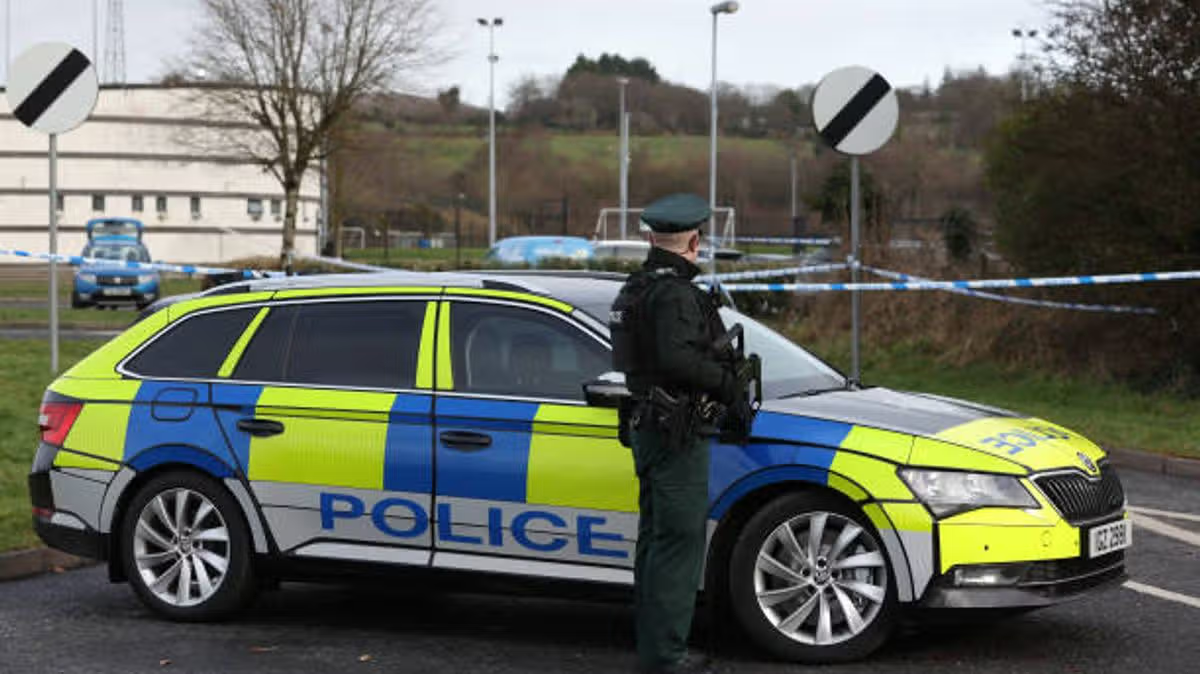
A 43-year-old man has been charged following two armed robberies.

The man has been charged with robbery, attempted robbery, two counts of possession of an offensive weapon with intent to commit an indicatable offence and two counts of criminal damage.

Advertisement

The charges are linked to two armed robberies in Bangor on the night of Wednesday, July 8, according to the Police Service of Northern Ireland.

He will appear at Newtownards Magistrates’ Court on Friday, July 10.

All charges will be reviewed by the Public Prosecution Service.

Source link

Advertisement
Continue Reading

NewsBeat

Irishman jailed for just 14 years after he murdered Oregon nurse during sex, before dumping her body in Hungarian woods in hopes of wild boars taking it

Published

on

Mackenzie Elizabeth Michalski, 31, a nurse from Portland , Oregon , went missing while on holiday in Hungary in November 2024

An Irishman has been jailed for just 14 years for brutally killing an American tourist during sex and dumping her body in the woods.

Mackenzie Elizabeth Michalski, 31, a nurse from Portland, Oregon, went missing while on holiday in Hungary in November 2024.

The defendant, identified only by his initials LTM thanks to Hungarian anonymity laws, invited Michalski to his apartment for sex after meeting her in a Budapest nightclub.

He then tied her up, bashed, and strangled her before attempting to conceal the murder by hiding her body in his closet.

Advertisement

After killing Michalski, the man, then aged 37, cleaned the apartment, stuffed her body into a freshly bought suitcase and drove it about 90 miles southwest in a rented car to Lake Balaton where he hid it in nearby woods.

The Budapest-Capital Regional Court found the man guilty of murder, and on Wednesday sentenced him to 14 years in prison without parole. 

‘The defendant did not attempt to resuscitate the deceased, nor did he call for help; according to the court’s findings, he intended the outcome of his actions, that is, the victim’s death,’ the court said in a statement.

The young woman’s autopsy found she was choked for two to three minutes and also suffered blunt force trauma to her head. Her mother told the court that Michalski’s face was unrecognizable when she saw it.

Advertisement

Mackenzie Elizabeth Michalski, 31, a nurse from Portland , Oregon , went missing while on holiday in Hungary in November 2024

Michalski (far right) with her parents Jill and Bill, and brother Nikk

Michalski (far right) with her parents Jill and Bill, and brother Nikk

Michalski in the elevator with LTM inside his apartment building after they left the nightclub together - the last time she was seen alive

Michalski in the elevator with LTM inside his apartment building after they left the nightclub together – the last time she was seen alive

Advertisement

Police found disturbing video of Michalski’s body, naked and still tied up, on her killer’s phone.

They also seized a ‘spy pen’ he owned that, along with more twisted evidence of his crime, had footage of him approaching numerous women in Budapest.

Michalski was reported missing on November 5, 2024, by friends after she never checked out of their Airbnb and missed her flight back to the US.

Hungarian police investigating her disappearance soon found security footage of her leaving the Szimpla Kert nightclub with LTM.

Advertisement

Investigators said his internet search history included queries on whether pigs eat dead bodies, the presence of wild boars around Lake Balaton and the reliability of Budapest police.

They included ‘Do pigs really eat dead bodies?’ and ‘Texas woman killed by a wild boar’.

Other searches asked ‘what does a dead body smell like after it decomposes’ and how to ‘remove rotting meat smell’.

LTM also searched ‘how reliable is the police in Budapest’ and ‘how do the police handle missing person cases?’.

Advertisement
Michalski was reported missing on November 5, 2024, by friends after she never checked out of their Airbnb and missed her flight back to the US

Michalski was reported missing on November 5, 2024, by friends after she never checked out of their Airbnb and missed her flight back to the US

Michalski was a frequent travel and posted photos of herself all over the world on social media

Michalski was a frequent travel and posted photos of herself all over the world on social media

LTM's defense petitioned the court to exhume her body for testing and to reopen her psychological and medical history, but this was denied by the court

LTM’s defense petitioned the court to exhume her body for testing and to reopen her psychological and medical history, but this was denied by the court

After his arrest in Budapest two days after the murder, he helped investigators locate Michalski’s body, but insisted her death was accidental. 

Advertisement

Video released by police at the time showed LTM in handcuffs leading police to where the body was abandoned inside the suitcase.

Police dogs watched on as specialists in hazmat suits placed markers in the ground at the direction of the killer.

Evidence bags labeled ‘one’ and ‘two’ were collected, along with samples of grass and leaves, before the Irishman was returned to the police car.

LTM’s lawyers argued at his trial that Michalski’s injuries were from consensual rough sex and she asked him to choke her, which accidentally killed her.

Advertisement

His defense petitioned the court to exhume her body for testing and to reopen her psychological and medical history, but this was denied by the court.

‘Everything I did, I did because Kenzie asked me… I didn’t want to take her life,’ he told the court during her trial.

One of LTM’s lawyers, György Magyar, likened Michalski’s death to a car accidentally sliding down a road and hitting a tree, killing its passenger.

Police shared photos of the evidence collected, including this suitcase that Michalski's body was stuffed inside and later recovered from woods

Police shared photos of the evidence collected, including this suitcase that Michalski’s body was stuffed inside and later recovered from woods

Advertisement
Police shared evidence pictures of these boots
Police shared evidence pictures of a woman's purse, containing lipgloss, a credit card, keys and some coins

Police released photographs of the evidence collected during their investigation

Prosecutors rubbished LTM’s ‘rough sex’ defense as Michalski suffered from an old neck injury and had never shown any interest in BDSM.

Michalski’s mother Jill implored the court to give the Irishman ‘deserves the harshest penalty allowed by law’ for his ‘heinous crime’ when she spoke at a sentencing hearing on Tuesday.

‘We will never be able to enjoy our only daughter’s birthday ever again,’ she said.

Advertisement

‘Since she was a child, Mackenzie dreamed of her wedding day and starting a family with her future husband. But now she’ll never be able to experience this.’ 

Jill raged against Hungarian laws that protected LTM’s identity while he was able to ‘besmirch’ his victim’s name in his defense.

Once LTM has completed his sentence in 2038, he will be deported back to Ireland. 

The defense has already lodged an appeal against the verdict and sentence.

Advertisement

Michalski dated Kenton Reichen in Portland for six years before her death, but they were on a break at the time and he pulled out of going on the trip to Europe.

Reichen wrote on social media that he blamed himself for her death and promised to ‘make it up to her… someday’.

‘I’ll miss you. I fell in love with you watching the sunset in Ibiza carrying you with your broken ankle. You were everything I needed in life. I’m sorry I failed you,’ he wrote.

Michalski dated Kenton Reichen (pictured together on a previous trip to Budapest) in Portland for six years before her death, but they were on a break at the time and he pulled out of going on the trip to Europe

Michalski dated Kenton Reichen (pictured together on a previous trip to Budapest) in Portland for six years before her death, but they were on a break at the time and he pulled out of going on the trip to Europe

Advertisement
Reichen wrote on social media that he blamed himself for her death and promised to 'make it up to her... someday'

Reichen wrote on social media that he blamed himself for her death and promised to ‘make it up to her… someday’

A vigil held for Michalski in upstate New York - where she grew up and her parents still live - two days after her killer was arrested

A vigil held for Michalski in upstate New York – where she grew up and her parents still live – two days after her killer was arrested

Photos of Michalski and her friends and family displayed at the candlelight vigil

Photos of Michalski and her friends and family displayed at the candlelight vigil

‘She was perfect, but I neglected her in many ways. It hurts me a lot, and I wish I could have protected her.

Advertisement

‘Kenzie did not deserve to be beaten, raped and killed so brutally. I wish I could have saved her from this. This will forever be the biggest mistake of my life.’ 

Kenton flew to Budapest after hearing she was missing, and assisted Michalski’s parents in searching for her until her killer confessed.

‘Kenzie will forever be remembered as a beautiful and compassionate young woman who dedicated herself to caring for others and making the world a better place,’ Michalski’s family said after LTM’s arrest. 

‘As a nurse practitioner, Kenzie used her humor, positivity, and limitless empathy to help heal her patients and encourage family and friends alike.’ 

Advertisement

Source link

Continue Reading

NewsBeat

Sainsbury, Co-op and Coca-Cola issue warning of higher prices if Wales diverges from UK

Published

on

Wales Online

The retail chiefs are urging the Welsh Government not to pursue a difference path

Executives from some of the UK’s biggest drink and supermarket firms have written to First Minister Rhun ap Iorwerth warning that his government’s policy could mean higher prices, reduced consumer choice and increasing uncertainty for businesses.

Advertisement

The retail chiefs from Sainsbury, Coca-Cola and the Co-op are urging the Welsh Government not to pursue a different type of scheme to encourage recycling of empty bottles and cans, known as a deposit return scheme (DRS).

The DRS scheme is due to launch October 1, 2027, and will see customers pay a 20p refundable deposit when buying single-use plastic bottles, steel and aluminium cans. People will get the 20p back when they return the clean, uncrushed container to an approved return point.

England, Scotland and Northern Ireland are all adopting aligned schemes with Exchange for Change having been appointed in May 2025 to operate the return scheme in all three nations. The schemes across the UK are designed to reduce litter and increase recycling rates.

The Welsh Government has yet to confirm an administrator to run its DRS as the Plaid Cymru government has indicated that it wants to add glass bottles to the scheme when it becomes feasible to do so

Advertisement

Signatories to the letter include general manager of Coca-Cola in the UK, An Vermeulen, chief executive of Tesco Ashwin Prasad, chief executive of Sainsbury’s Simon Roberts, chief executive of Carlsberg Britvic, Paul Davies, chief executive of the Co-operative Group Kate Allum and chief executive of AG Barr Euan Sutherland.

In the letter to the First Minister the executives argue that appointing Exchange for Change is the only realistic route to delivering a DRS in Wales on time while also creating interoperability benefits between the four nations.

They write: “Our businesses are looking forward to working closely with you and your government across a wide range of areas, including the urgent issue of the Welsh Deposit Return Scheme . We recognise that your government has inherited significant delays to the process of appointing a scheme administrator from the previous administration.

“It rejected the industry-backed bid by Exchange for Change to run the Welsh scheme, despite its application containing a pragmatic compromise on glass and complying with the regulations. We welcome your government’s recent constructive engagement with industry and Exchange for Change to find a way forward, building on your manifesto commitment to include glass only when it becomes practically feasible.

Advertisement

“There is now less than fifteen months until the scheme’s legislated launch date in October 2027. Based on our experience with other schemes and the preparation they require, the only realistic option for staying on schedule in Wales is appointing Exchange for Change and working with them to deliver a scheme. Unless this happens by the end of July, commercial and operational realities that our businesses have to respond to will create negative economic outcomes for Welsh consumers, reducing choice and increasing the costs of products on shelves. “

Any retailer selling in-scope drinks containers would be required to set up a collection and payment system. Many will use RVMs (reverse vending machines) in store, which read barcodes as bottles are inserted and provide a receipt or returns, which are then paid at the counter. The initial cost of the RVMs would be borne by the supermarket or convenience store. Standard RVMs cost around £15,000 per unit, but the soft-drop RVMs required to collect glass in Wales could cost £30,000.

They add: “We share your ambition for a DRS that builds on Wales’ world-leading rates of recycling. Alongside wider industry, our businesses are investing over £1bn establishing DRS (across the UK by next year) which, if aligned across the four nations, could halve litter and push recycling rates above 90%. We remain committed to working with your government and officials at pace on appointing Exchange for Change to deliver a scheme that works for the people of Wales as part of a DRS aligned across the UK. “

The industry has previously raised concerns that requiring full-scale glass collection at every return point from day one in Wales could add around 50p to the cost of every drink sold in a glass bottle . There is also concern that, if a functioning return network is not ready in time, Welsh consumers could be required to pay deposits on eligible containers without a practical way of getting that money back.

Advertisement

A spokesperson for Coca-Cola Europacific Partners, said: “A well-run DRS reduces litter, boost recycling rates, reduce carbon emissions and create a cleaner environment for communities – every week without a scheme administrator for the proposed Welsh scheme makes delivering those benefits more challenging.

“Businesses want to focus on building a scheme that genuinely serves Welsh consumers and the environment. Therefore we respectfully encourage the Welsh Government to move forward appointing a scheme administrator before recess.”

A spokesperson for The Co-operative Group, said: Action to protect the environment is a consistent priority for Co-op members, and we have long welcomed a Deposit Return Scheme that increases recycling rates and decreases litter.

“We want to see accelerated progress towards a more circular economy, to protect the range and cost of drinks available to consumers, and to continue to serve communities through our stores right across Wales – all of which can only be achieved if the Welsh Government moves with pace and pragmatism to appoint Exchange for Change without any further delay.”

Advertisement

Andy Bagnall, director general, British Soft Drinks Association, said: “Industry has a lot of sympathy with the new Welsh Government which has inherited the delays to the Welsh DRS from its predecessor.

“There is still time to deliver a scheme that works for shoppers, businesses and retailers alike, but that window is closing rapidly. Appointing Exchange for Change offers the quickest and most practical route to delivering the scheme on time and alongside the rest of the UK. That also means taking a pragmatic approach to including glass in the Welsh scheme and not repeating the mistakes of the previous administration by trying to include full scale glass collection on day one, which is simply unaffordable for Welsh businesses and consumers.”

The Welsh Government were asked to provide an update on the procurement process. If was also asked if Exchange for Change isn’t appointed whether it would seek to implement and fund its own DRS. It has been estimated that running its own scheme could cost £100m.

A Welsh Government spokesman said: “We are working at pace on a formal process to appoint a deposit management organisation which will be concluded soon. It would be inappropriate to prejudge the outcome of this process

Advertisement

Source link

Continue Reading

Trending

Copyright © 2025