
Politics
the Palestinian neighbourhood subject to ethnic cleansing

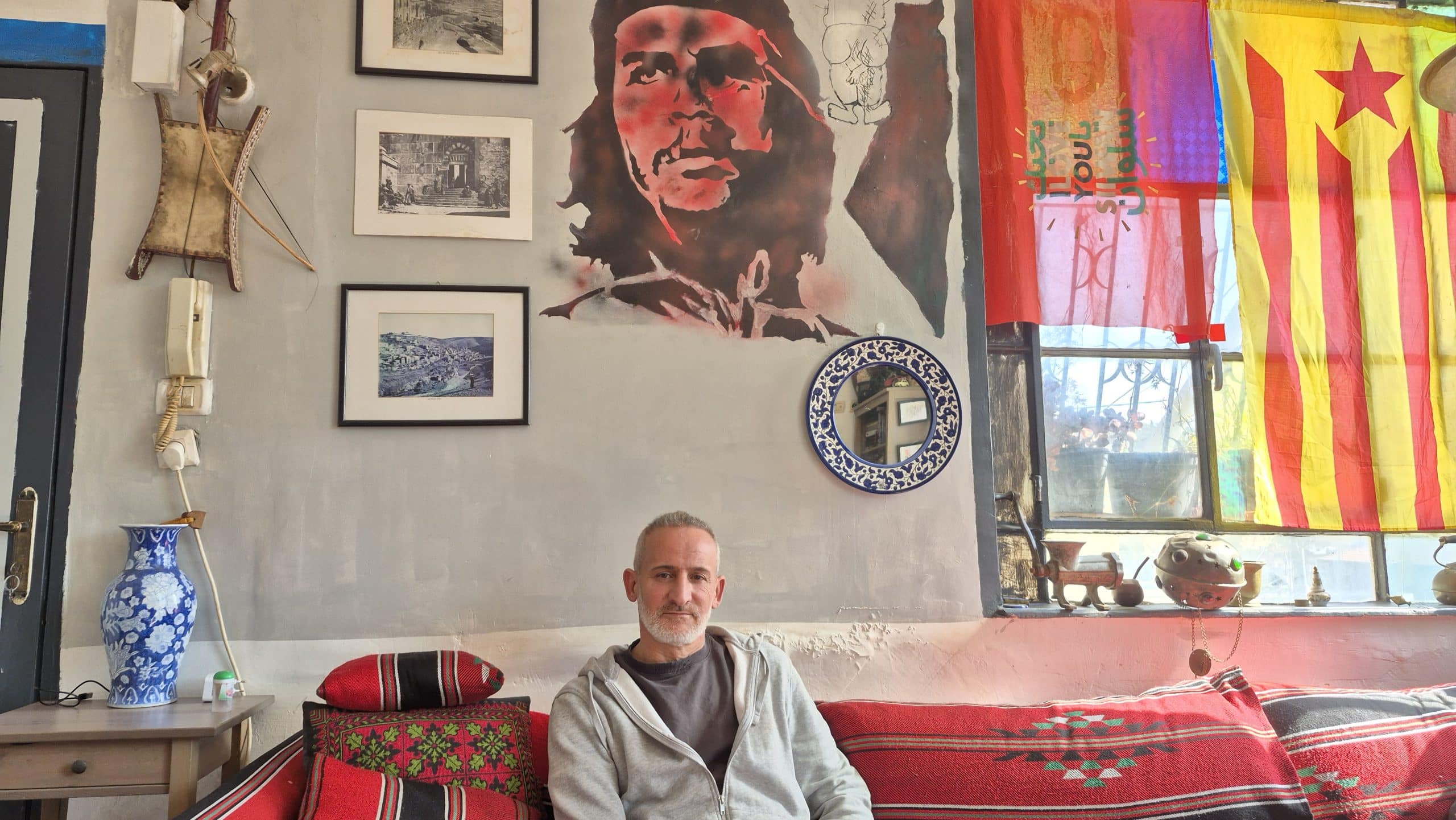
Jawad Siam is an activist and a resident of Silwan, a Palestinian neighbourhood in occupied East Jerusalem next to the old city. As we sit drinking coffee, he points to a plot of land adjacent to his home.
No justice within the Israeli ‘legal’ system
He tells the Canary:
Settlers took this in June 2017. My father, grandmother and grandfather all lived here in this house. According to my family tree, my family came here at least 400 years ago. We tried to do something. We went to court, but it’s an Israeli court and an Israeli judge. It’s not possible to win any cases today. I had to pay approximately 800,000 Israeli Shekels (£200,000). The Israelis do this with many families in East Jerusalem, not only in Silwan. They claim this land belonged to them in biblical times, 3000 years ago. They create stories, saying that for 100 years Jews have been living in the area, and things like that.

Since ‘Israel’ occupied East Jerusalem, in 1967, Jewish organisations have aimed to establish a Jewish presence in the neighbourhood. In an attempt to get Palestinians to leave their homes, Siam explains that settlers offer Silwan residents large sums of money to sell up. But although people do not have much money, they still do not sell their homes. Siam says he was offered $3m, and his neighbours were offered more, but they refused.
He says:
Any person in Silwan, in a minute, can be a millionaire and leave. But the people are stubborn. An old man here was offered $8m but he wouldn’t sell.
Illegal Jewish settlers call Silwan “Ir David”- the City of David
These settlers are all armed. They are supported by the occupation’s government and belong to the Ir David Foundation- known as Elad.
Elad operates in East Jerusalem, and calls Silwan “Ir David’ , meaning City of David in Hebrew. As well as trying to acquire Palestinian homes, Elad also runs the City of David Archaeological Park.


This major tourist attraction has been built by the occupation in the middle of a residential area in Silwan. It aims to promote the Jewish link to the area, while intentionally erasing Palestinian history, culture, and identity, and the community fabric of Silwan. Many Palestinian homes are being demolished for this park, and international tourism is allowing this to happen.
According to Siam, most houses taken by settlers in Silwan are left empty. Their real project is not about bringing settlers into the neighbourhood, but ethnically cleansing the area of its Palestinian population. He says the occupation dreams of having Jerusalem empty of Palestinians, and are doing their best to connect East and West Jerusalem, while only showing and talking about Jewish heritage.
As well as offering to pay vast sums of money for Palestinian homes, there are also other mechanisms in place, to ensure the population’s displacement from Silwan and other East Jerusalem neighbourhoods. Palestinians have their land confiscated and are also evicted from their homes.
Many mechanisms to ‘legally’ displace Palestinians
In 1881 Yemeni Jews came to Palestine. Siam says they were promised they could live in West Jerusalem, but when they arrived they were not welcome. Instead, the people of Silwan, in the Batn al- Hawa area of the neighbourhood, welcomed them.
When the Jews left in 1928, they left the people of Silwan a letter, thanking them for their hospitality. But thanks to an Israeli occupation law, passed in 1970, any property that belonged to Jews before 1948 can now be claimed by settlers. 34 families, around 130 people, are now expecting imminent eviction after the Supreme Court’s recent decision on a decades long legal case, to dismiss an appeal by residents against their forcible displacement.

The Absentee Property Law, enacted by the occupation in 1950, is also used to transfer Palestinian homes to settlers. The occupation’s discriminatory planning policies are also used to drive Palestinians from Silwan. They are denied building permits, and so live with the constant threat of having their homes demolished.
Sari Kronish is an architect and urban planner. She is also Director of the East Jerusalem department of Bimkom, an organisation which works at the intersection of urban planning and human rights.
Planning system used for political gains, to ensure a Palestinian minority and the Judaisation of Jerusalem

She says as a result of ongoing neglect by the Israeli regime, since 1967, there is a drastic need for improvement in East Jerusalem neighbourhoods. The planning system is being used as a tool for political ends, to ensure Jerusalem is a Jewish city, the Jewish capital.
The urban planning policy is being used in a way that discriminates to achieve the political ends- to restrict when it comes to Palestinian communities, and provide when it comes to Jewish Israeli communities.
Kronish tells the Canary:
Planning should be free of that, but here there is a demographic driver to the planning policy. That’s what creates the discrimination. And the legal structures and laws in place that have been set up by Israel are allowing for this to happen. It’s completely in contradiction to international law, but in terms of Israeli law there are legal cover ups to everything that’s going on. Nothing is in favour of the Palestinians.
But Siam does not believe the occupation has been successful in its project so far. There are still around 60,000 Palestinians in historic Silwan, and there are a total of 1500 settlers.
He says:
We were supposed to be the minority by now, and Jews the majority. They have everything- the army, the power, and the weapons. Although we’ve tried our best, we haven’t been able to stop them. So the way for us to do this is to stay here. They thought they can easily force Palestinians to leave their land, if not using power, by using money. But this hasn’t happened.
Siam, like most Palestinians, sees the double standards of the West. Hamas is labelled a terrorist movement, But Ben Gvir, and the right-wing in Israel are not. who kill and imprison innocent Palestinians on a daily basis. But while he does not believe in Western governments, be still trusts in the various Western movements that could bring about change.
Siam: “It’s a Western project here”
It’s a Western project here, and we know what kind of democracy Western countries want. We saw it when they talked about the Palestinian free election, which they said was democratic, and was watched by the whole world. But when the results came out, they said it wasn’t the democracy they wanted to see, because Hamas had won.
Palestinians have paid a high price in order to open eyes. It’s not only about the Palestinian cause. A lot of injustice is hidden by the Western governments, inside their countries. We saw it in places such as the UK, with Palestine Action. You cannot express what you want to say. And all the time they’re talking about human rights. But what about the eight million Palestinian refugees all over the world?
Siam helps run Silwan’s Wadi Hilweh Information Centre, which informs about the problems faced by the residents. It also documents the occupation’s human rights violations in the surrounding area. But this centre now has demolition orders, which are expected to be carried out any day now.
Most Palestinians demolish their own buildings to save a demolition fee, which can total the equivalent of £25,000. But Siam has refused.

Another way the occupation makes life as difficult as possible for Palestinians in East Jerusalem is through education. Siam argues the school system for Palestinians here is the worst, not only inside Palestine but also in the Palestinian refugee camps in Syria and Lebanon.
This is because Palestinian education in Jerusalem is completely controlled by the Israeli occupation. Palestinians are not allowed to teach their own history or literature to children at school. If schools do not teach the Israeli system, they are closed down.
The Israeli occupation uses education as a tool of oppression in Silwan
Siam says:
Palestinians are the most educated society in the Arabic world. Before the education system was destroyed, Gaza’s school system was much better than here. But Israel does its best to stop Palestinians going to school, and tries to make Palestinians uneducated in East Jerusalem. This is one of the tools they use to turn Palestinians into simple workers, for example, working for them in the Israeli factories.
The occupation has now shut down all UNRWA facilities in the occupied Palestinian territory, and Silwan’s UNRWA school closed in June 2025. Most children in Silwan do not have a long term place in a school. Parents struggle to provide education , and around 40% of children have to leave the village to attend school.
Despite the relentless pressure, Siam and those in his community remains defiant. They continue their lives in Silwan, heavily surveillance, threatened with dispossession by settlers, and demolition orders by the occupation. Children go to overcrowded classrooms, not knowing if it will be standing the following day.
Existence is resistance in Palestine, and Silwan is no exception.
Featured image and additional images via the Canary


An abusive undercover cop who one expert called “misogyny personified” is facing scrutiny at the long-running Undercover Policing ‘Spycops’ Inquiry. And far from expressing genuine regret for the damage and pain he caused, he has shown disdain for the process and even tried to paint himself as the victim.
Spycops inquiry shows rampant misogyny
A decades-long political-policing project in service of the rich and powerful unjustifiably targeted hundreds of left-wing groups. One woman speaking out about it previously told the Canary that “institutional sexism” was at the heart of it. Expert Tom Fowler even described it as:
a rape gang that was covering for each other and celebrating the sexual conquest they had of women in the field.
One member of this gang was Rob Hastings (who used the fake name ‘Rob Harrison’). And as Undercover Research Group co-founder Dónal O’Driscoll told Fowler on 25 March, Hastings was one of the spycops who were “misogyny personified“.
The “unspeakable horrors” Hastings inflicted on a woman going by the pseudonym of ‘Maya’ led Fowler to describe him as:
one of the most… genuinely evil human beings I’ve ever encountered.
The #spycops officer Robert Hastings claims that the relationship was two people being difficult with each other. He essentially claims it was her fault
— Tom Fowler (@tombfowler) March 25, 2026
Hastings squirms as his abuse comes under scrutiny
O’Driscoll called Maya’s testimony in recent days:
some of the most shocking evidence heard to date in the inquiry.
And he explained that what happened to her was:
deeply disturbing, deeply misogynist… It was just pure sexual abuse. Horrible to have heard anybody went through this and she went through it at the hands of a serving police officer who was deceiving her all the way.
But as Fowler noted, there’s a pattern of lying from these “professional con men”. And as O’Driscoll added, there’s been “some outrageous lying” during the inquiry. So it was unsurprising to see Hastings behave this way too.
Fowler observed that Hastings had been “incredibly angry” when giving evidence. O’Driscoll also said:
you could see that he was getting angrier and angrier throughout the day… he felt he was being punished. You got this sense that he was like, ‘why am I being held to account? I’m the victim. My marriage failed.’… No acknowledgement that he is a serial cheater.
The inquiry was spot on in instructing a woman as barrister for Hastings’ evidence. He can’t control his misogyny. Incredible work from Sarah Hemingway. #spycops https://t.co/bXEL2jtsmW
— Donna McLean (@Donna__McLean) March 25, 2026
It seems safe to say that Robert Hastings has done a spectacularly shit job of convincing anyone at all that he isn’t/ wasn’t a controlling, contemptuous, misogynist bastard.#spycops#ACAB pic.twitter.com/jIHcbbVyV8
— COPS (@copscampaign) March 25, 2026
Unapologetic, because ‘left-wing politics is criminality’
Counterfire‘s James Simpson, meanwhile, referred to the public laughter that some of Hastings’s absurd responses got. Simpson told Fowler on 24 March that:
some of the responses from Hastings were quite frankly ridiculous… Absolutely some nonsense that he was coming up with.
Fowler highlighted that Hastings kept trying to bring the focus back onto himself and how “catastrophic” his behaviour had been for him personally:
he has very much painted himself as the victim in all this
And at the same time, Fowler continued:
at no point does [Hastings] accept that what he did might have been an overreach. He’s absolutely convinced that all his reporting is absolutely justified.
This is despite him having collected extensive, unnecessary information about targets’ families, jobs, and countless other details.
Hastings simply treated the unjustifiably intrusive monitoring and indiscriminate data collection, Fowler said, as “fair game”. Part of the justification for the spycop, Fowler added, was that he saw left-wing politics as “some form of criminality”.
In reality, the spycops scandal was something that changed the whole fabric of the country for the worse. And it’s important for us all to hold the state accountable for that. So the more Hastings and his abusive colleagues squirm, the better.
Featured image via the Canary

Liverpool’s stars were quick to praise Egyptian international Mohamed Salah after he officially announced the end of his journey with the team at the end of the 2025-2026 season, following a nine-year career filled with achievements and trophies.
The club confirmed in an official statement that:
Mohamed Salah will bring his illustrious football career with the team to a close at the end of the season, after reaching an agreement to end an exceptional nine-year journey at Anfield.
The statement added that the player was keen to announce his decision to the fans himself, out of appreciation and respect for them and in the interest of transparency regarding his future.
Salah: illustrious Liverpool career
Salah joined Liverpool from Roma in the summer of 2017 and quickly became one of the club’s greatest players of all time, contributing to winning numerous titles, including: the Premier League twice, the Champions League, the Club World Cup, the UEFA Super Cup, the FA Cup, the League Cup twice, and the FA Community Shield.
He scored 255 goals in 435 appearances, ranking third on Liverpool’s all-time top scorers list, and won the Premier League Golden Boot four times, along with numerous individual awards.
Salah’s teammates reacted to his departure on social media, emphasizing his historic place at Liverpool:
Dominik Szoboszlai posted a video of Salah and simply captioned it “Legend,” indicating that the Egyptian star’s career was truly exceptional.
Hugo Ekitikie shared a photo of them together and wrote “The Best,” clearly referring to the significant impact Salah had both on and off the team.
Harvey Elliott commented on the club’s statement: “The Greatest, Thank You,” expressing his respect and appreciation for his teammate’s career.
Meanwhile, Miloš Krkić summed up his feelings towards Salah in one word: “King.”
Fans heartbroken
All social media platforms were abuzz with various tweets about Mohamed Salah’s life, journey, and history from the moment his departure from Liverpool was announced.
To say Mohamed Salah is a legend of the club is an understatement. He’s surpassed all of our wildest dreams with his performances over the past 9 seasons and been absolutely vital in us winning the lot. 🏆
The Egyptian King. 🇪🇬👑 https://t.co/xsAbn22H0W
— Mick Moran (@Mick_Moran_) March 24, 2026
Thank you for absolutely EVERYTHING Mohamed ❤️ You came, you saw, you conquered. Leaving a club legend, leaving us with so many incredible memories & things none of us could have imagined in recent times. Focal part of the best LFC team in my life time ❤️ #YNWA #KING #SALAH #LFC https://t.co/R05u2HxZ6x
— Jackie Hall (@Kopitlikeitshot) March 24, 2026
A Level Never Reached Before ⚽️
Mohamed Salah leaves Liverpool Football Club as one of the greatest in its history.
Mo reached a level no one in Arab football has achieved before.
Salah is not just a success story. He is a case study.#LFC #EPL pic.twitter.com/bbH2ICrRmR
— Eslam Nour (@EslamEgyptian) March 24, 2026
Featured image via the Canary

New analysis has shown the number of long-term unemployed young people has more than doubled over the past three years.
The Trades Union Congress (TUC) held its annual Young Workers’ Conference on 21-22 March. And it used the occasion to call on the government to turbocharge its efforts to support young workers.
New TUC analysis reveals the number of long-term unemployed young people has more than doubled over the past three years, from 53,000 to 129,000.
Now 1 in 5 unemployed 18-24 year olds have been out of work for longer than 12 months.
The Jobs Guarantee scheme
The government’s recent commitment to increase the Jobs Guarantee scheme to 90,000 places and expand to 18–24-year-olds will make an important difference to young people.
But the TUC says these figures underline the need for the government to go further and faster on the Jobs Guarantee.
The union body is calling for the government to:
- Shorten eligibility period. Young people currently have to wait 18 months on Universal Credit to be eligible for the scheme, which the TUC says is far too long. Earlier eligibility would be particularly beneficial for those living in area with few vacancies and high unemployment.
- Accelerate delivery and increase the number of placements. Recent increases in placements are welcome. But the current target of 90,000 placements over three years, averaging 30,000 annually, is still insufficient given the scale of the challenge. There still need to be further increases in the number of available placements.
The TUC would also like to see the scheme expanded to those not on Universal Credit, as nearly half (44%) of young people not in education, employment or training (NEET) don’t receive an out-of-work benefit.
The TUC says that whilst Job Guarantee schemes need initial upfront investment, they result in a return on investment for the government.
Recent TUC analysis revealed that the benefit to cost ratio of the programme is estimated at 2.81. Every £1,000 of (net) government spending on the programme generates £2,810 of net revenue for the Exchequer. With these outcomes assessed over 30 years, the scheme pays for itself within a decade.
The union body says that early experience of good quality paid work can make a massive difference to young people’s job prospects in the long term.
Trumpflation threat to young workers and unemployed young people
The TUC says “Trumpflation” is a threat to workers up and down the country – especially young workers.
The union body is calling on government to pull out all the stops to protect households and firms from the economic fallout of Donald Trump’s illegal war on Iran.
With young workers especially vulnerable to economic chaos, the TUC says that must include future action to increase the scale and scope of the Jobs Guarantee.
TUC general secretary Paul Nowak said:
Too many young people in the UK are stuck out of work for extended periods of time. And that has long-lasting effects for their own prospects and for the country as a whole. We know that early experience of good quality paid work makes a huge difference to young people’s prospects across their lifetimes.
The government was right to expand the Jobs Guarantee to more young people and encourage businesses to hire those who have been out of work for more than six months. But ministers must now be ready to turbocharge the scheme, going further and faster.
Trumpflation is a real threat to workers up and down the country, particularly young workers living in parts of the country where unemployment is already higher.
That’s why eligibility and number of places should be expanded, and young people shouldn’t have to wait until they have been unemployed for 18 months to access support.
Featured image via the Canary

Shadow Department for Work and Pensions (DWP) boss Helen Whately couldn’t help but get in the Tories’ punches on disabled people. On Tuesday 24 March, the latest DWP wet wipe (in a long line of DWP wet wipes) took to GB News to shit on those claiming Personal Independence Payment (PIP):
Government could save £2bn by bringing back face-to-face PIP assessments.
Ministers say they’re doing that, but the numbers tell a different story. So do the empty assessment centres.
Time to get a grip of the benefits bill. pic.twitter.com/ANMZWDBzAv
— Helen Whately MP (@Helen_Whately) March 23, 2026
The main thrust was that disabled people doing PIP assessments over the phone are just ‘faking it’, because of course it was.
DWP PIP: Whately on a warpath over remote assessments
Whately was referring to an ‘analysis’ the Tories hyped up in shitrag the Sun. Supposedly, this found that:
when a person is assessed face-to-face for PIP, 44 per cent end up getting the benefit.
But when it is done remotely the rate is far higher at 57 per cent.
Of course, the article is sparse on the actual detail of quite how the Tories came to these numbers. However, it does seem to chime with figures DWP minister Stephen Timms previously put out via an answer to a parliamentary written question.
Regardless, the analysis doesn’t actually prove what Whately wants it to. It went on to claim that:
It has led to an extra 259,000 successful claims a year on average — equal to a higher annual welfare bill of £1.8billion.
That remote assessments have higher success rates doesn’t evidence that people are “gaming the system” as she suggested. More likely, what it shows is that when disabled people are given assessments appropriate to their health circumstances, they’re better able to articulate their lived realities and resulting needs.
The fact is, the latest DWP statistics show that 65% of PIP decisions cleared at tribunal between October 2020 and September 2025 were overturned in the applicants’ favour. The DWP has also changed its decision and awarded PIP to 20% of people who made an appeal. In other words, the DWP is wrongly refusing PIP to disabled people who are eligible for it.
And disabled folks who’ve applied for PIP report plenty of terrible experiences with assessors.
The PIP assessment is not easy. People who should get it, don’t. The assessment is long and gruelling, and regularly degrading.
The analysis’s £1.8m savings claim is total nonsense — because there’s no proof those 259,000 people weren’t eligible.
But naturally, Whately and her colleagues — who aren’t medically trained — want to decide who’s ‘deserving’ and ‘disabled enough’ to get support.
Face-to-face assessments unsafe and inaccessible
Hilariously, DWP boss Pat McFadden and DWP minister Torsten Bell were both scoring political points on X:
The Tories reduced face to face appointments to almost zero when in power.
They then agreed new contracts embedding the reduction just months before the election.
Now they attack their own record and legacy while we sort out what they left behind. https://t.co/zYsCWfieMG
— Pat McFadden (@patmcfaddenmp) March 23, 2026
Sigh. Absolutely no shame. Of course it was the Tories that:
– dialled down face to face assessments
– signed contracts with providers to embed that decision post-covid
– now assume journalists won’t bother asking them basic questions when they attack their own record https://t.co/TQ2BIiBRCH— Torsten Bell (@TorstenBell) March 23, 2026
Of course, both were evidently loathe to mention that the former Conservative government brought in this shift to remote assessments because of the deadly COVID-19 pandemic. A pandemic where repeated government mismanagement forced clinically vulnerable disabled people to ‘shield’ in lockdown long after their non-disabled peers.
A pandemic in which disabled people were up to 3 times more likely to die. In the early months of the pandemic, learning disabled people were 30 times more likely to die from it.
Props to the Tories for forgetting again that clinically vulnerable disabled people exist. Forcing face-to-face appointments will put many disabled people at risk. And this would also be a barrier for many disabled and chronically ill folks who either simply can’t travel to appointments, or risk worsening their health by doing so:
Disgusting. It can be difficult for people to travel to assessments, axing phone interviews will just mean people who genuinely need help will be unable to get it… and the face-to-face meetings are NOT more accurate, as I have experienced. The DWP needs major change now.
— Andrew Fisher (@merman1974) March 23, 2026
PIP success rates have plummeted
The rate of DWP approving applications for PIP has also actually plummeted:
Since face to face assessments have moved to mainly virtual ones, the success rate for PIP applications has plummeted from 52% to 35%. The idea that it is making it easier for “fakers” is so inaccurate and widespread that I have lost 3 stone from eye rolling alone. https://t.co/qfJHWInZJ7
— Spin Decoders (@leith1076) March 23, 2026
Specifically, successful awards sat at 55% in 2018-19 and decreased slightly to an average of 52% the following financial year.
By comparison, as Benefits and Work recently reported, this rate has continued to drop. For the quarter ending January 2026, the DWP approved just 35% of new claims. This was down from 43% the same quarter last year. In other words, a little over one in three applicants are actually getting awards of PIP. It’s also a decrease from the previous quarter that saw success rates reach just 38% (also a fall from 44% Q3 in 2024).
So contrary to the Tories’ rhetoric, no, the DWP isn’t handing out PIP more readily since the former Tory government implemented remote assessments.
DWP — more people should get PIP anyway
But why would Whately and co. let facts get in the way of a good vilifying soundbite?
When Whately bandies about her dubious figures, it’s the number of people claiming PIP she’s attacking. And of course, in this context, it’s easy to spin that PIP claims are spiralling. Because quite simply, more people are indeed applying for it.
It’s not rocket science to recognise that off the back of a disabling pandemic, more people will in fact be disabled.
What’s more, it’s also a good thing more disabled people are actually applying for it. As the Canary’s Rachel Charlton-Dailey recently highlighted:
There’s also the fact that just 3.9 million people claim PIP. The DWP and press make this sound like a huge number, but it’s only a fraction of how many disabled people there are in the country. 16.8 million people self-identify as disabled in the UK, so that’s less than a quarter of them claiming PIP.
There might be a huge uproar over ‘1 in 10 people claiming PIP’, but disabled people make up 25% of the population. It should be 1 in 4.
Instead then, it’s the above proportion figures that matter. Let’s not forget that PIP is to level the playing field for disabled people. It helps with the extra £1,095 a month costs disabled people incur.
However, the Tories would still have you believe it’s bullshit about the “bloated benefits bill”.
It didn’t go unnoticed either that Whately was banging on about this days after the Labour government announced its call for evidence for the Timms Review.
Ironically, the review should address all the above issues with the assessment system. As the Canary pointed out however, this is already shaping up to be a monumental stitch-up.
The simple fact of the matter is that to politicians on both sides of the House, disabled people are a convenient scapegoat to justify their austerity agendas. While these cronies of corporate capitalism run this country, disabled lives will only ever be a political football to kick to the sidelines.
Featured image via the Canary

UEFA has made its decision on the lists of teams participating in the Champions League. It rejected a proposal submitted by English clubs to increase the number of players to 28 players starting next season. Instead, UEFA preferred to maintain the current system that limits the list to 25 players.
According to the Guardian, the decision came after discussions witnessed by the Club Competitions Committee. However, these discussions did not succeed in reaching a consensus. This lack of agreement led to the proposal being excluded from the agenda of the next Executive Committee. This meeting is scheduled before the European League final in Istanbul on May 20.
UEFA tackle English demands and Spanish concerns
English Premier League clubs have pushed to expand the rosters, in light of the increasing number of matches as a result of the new tournament system. They consider that increasing the number of players is necessary. The main goal is to protect teams from injuries and increasing fatigue.
In contrast, prominent Spanish clubs, led by Atletico Madrid, Sevilla, and Real Sociedad, led the rejection front. They were motivated by concerns about devoting financial superiority to English clubs. Furthermore, they feared giving them an additional advantage by having deeper and more powerful rosters.
These concerns were clearly reflected this season, after all six English clubs succeeded in reaching the round of 16. However, only Arsenal and Liverpool continued their journey to the quarter-finals.
New system increases stress
This controversy comes amid changes to the Champions League system. There is now the adoption of a new format comprising 36 teams in the league stage, which has led to an increase in the number of matches.
Teams are now required to play at least two additional matches. There is also the possibility of playing two additional matches in the January playoff for teams that do not occupy the top eight places. As a result, this has doubled the physical pressure on the players.
The file was postponed and not closed
Although the proposal is currently rejected, the Guardian reported that the file has not been closed permanently. Available data indicates the possibility of re-offering it before the 2027-2028 season. This would coincide with the launch of a new cycle for television broadcasting rights.
Between English demands driven by the pressure of matches, and European reservations that fear an imbalance, UEFA remains committed to the status quo. For now, it is awaiting a moment of consensus that may reopen the discussion again.
Featured image via the Canary

The 2026 World Cup ticket dispute has escalated into legal action after the Football Supporters’ Association of Europe (FSE), in collaboration with Euroconsumers, filed an official complaint with the European Commission against FIFA, accusing it of abusing its monopoly position in ticket sales.
According to the official statement issued by the two organizations, the complaint was filed on March 24, 2026, in Brussels, Belgium, marking the first time such a large-scale action has been taken against FIFA at the level of the European Union institutions. The group said:
The cheapest openly available final tickets now start at $4,185 – more than seven times the cost of the cheapest 2022 World Cup final ticket. Last month FIFA president Gianni Infantino also defended the use of surge pricing at the tournament.
FIFA dabble in ‘dynamic pricing’
The complaint also focused on the adoption of a “dynamic pricing” system, which allows prices to change according to demand. The organisations concerned considered this a violation of the principle of transparency and an infringement on consumer rights.
The complaint also included sharp criticism of the ticketing mechanisms, pointing to ambiguity in essential details such as seat locations and team identities, as well as accusations of using pressured sales tactics and imposing fees of up to 15% on resale tickets.
Both parties also raised the issue of promoting low-priced tickets ($60) for group stage matches, asserting that these tickets were not actually available to the public when sales opened.
The crisis began in December 2025 when a supporters’ association criticized FIFA’s pricing policies in statements reported by European media outlets. The issue later escalated into formal legal action supported by consumer protection organizations.
Clear demands for European Commission
The complaint called on the European Commission to intervene and compel FIFA to:
- Halt the dynamic pricing system
- Fix prices at previously announced levels
- Publish the number of remaining tickets for each category before the next sales phases
This move presents FIFA with a new legal test in Europe, at a time of increasing public and media pressure, which could pave the way for fundamental changes in the ticketing mechanism for the world’s biggest football event.
Featured image via the Canary

Labour’s answer to the energy crisis, spurred on by the war on Iran, is to subsidise the profits of fossil fuel companies. According to the Times, only households on benefits will receive the money that helps prop up energy companies.
Instead, Labour should bring energy into public ownership, while transitioning to a Green New Deal to address not only the climate crisis, but volatile international markets and sky high costs, in one fell swoop.
Corporate stranglehold
While energy is privatised, companies have a stranglehold on individuals in our society. The free market is supposed to be about an individual choice, but everyone needs energy so there is no choice but to purchase it from a provider. Households and businesses’ costs may deviate across companies, but publicly owned energy could provide the absolute cheapest through wholesaling renewables for the entire country.
Labour has so far announced a £53 million support package for “vulnerable” households who use heated oil.
Labour — welfare for large companies
Again, the market is supposed to be ‘free’, yet corporations receive huge benefits from the government. 22% of The Union of Shop, Distributive and Allied Workers receive universal credit (UC). That means the public purse is significantly subsidising the profits of companies like Tesco, which makes £6,150 of profit per employee.
Direct subsidies is another way the public purse delivers corporate welfare. The government is providing £2.5bn to the steel industry this parliament, without taking a stake in steel companies that would provide public monetary benefit.
This is a continuation of the Conservative agenda. In the 2023/24 year, some of the government’s subsidies to corporations amounted to a whopping £32bn. The year before, they were £53bn because gas inflation not only increased bills but also the government increased corporate handouts to profiteering fossil fuel companies. And now Starmer has announced a further £22bn bung to the fossil fuel sector for carbon capture projects that don’t work.
Government intervention appears to be focused on benefiting corporations, rather than the whole of society.
Featured image via the Canary

UNISON members at Ash Field Academy, a SEND school in Evington, Leicester, have voted overwhelmingly to take strike action to demand the reinstatement of their elected representative, Tom Barker.
In a formal industrial action ballot which closed on 18 March, 87% of voting members supported strike action. This is due to the suspension of Barker, their workplace steward, who has been suspended since October 2025, and the attack this represents on their trade union rights. The turnout easily cleared the legal 50% participation threshold.
For more than four months, UNISON’s Leicester City branch has been campaigning for Barker’s reinstatement. Discovery Schools Academy Trust (DSAT), the multi-academy trust which runs the school, claims it’s still investigating his case. Although DSAT has changed the allegations it claims to be investigating since the initial suspension.
More than 400 trade unionists, including UNISON’s new general secretary Andrea Egan and MP Zarah Sultana, have signed an open letter demanding Barker’s reinstatement.
Background to Barker’s suspension
During the 2024/25 academic year, UNISON, which represents the vast majority of Ash Field’s support staff, repeatedly raised concerns relating to health and safety. This situation worsened when DSAT, despite UNISON’s strenuous objections, cut several further staff via a hugely rushed redundancy process. UNISON members voted for strike action over the staffing situation, with that ballot closing on 20 October 2025.
On 30 October, DSAT leaders suspended Barker from his duties, citing allegations against him. Originally they said that the suspension was due to an incident that allegedly took place on 29 October. However, Barker obtained emails via a Subject Access Request. And these showed that, as far back as December, the independent investigating officer had reported that there was no case to answer and recommended lifting the suspension. But DSAT failed to act on this.
Many UNISON members at Ash Field signed a statement describing his suspension as “a bad-faith attack on…. UNISON members” and a “reprisal for [members] voting for industrial action”.
On 12 January 2026, DSAT leaders asserted that Barker’s suspension was to protect the integrity of an investigation into a grievance. This investigation concluded in February, yet DSAT didn’t reinstate Barker.
The external investigators into the two previous allegations found no case to answer. But the trust has since appointed a new investigator from a separate organisation to investigate again. And Barker, after 4 months out of work, has been resuspended.
UNISON Leicester City continues to call for Barker’s reinstatement, and for DSAT to cease this union-busting activity. Sam Randfield, UNISON Leicester City’s branch secretary, stated at a public meeting in February:
It was clear at the time of the suspension, and it is even clearer today, that this was an act of bad faith towards UNISON and Tom himself. The case against Tom is practically non-existent. There is no reason to keep him suspended for this long.
What has happened to Tom is appalling, and is as clear a case of trade union victimisation as I have ever seen. In voting for strike action so overwhelmingly, our members have made a clear statement that they will not tolerate union-busting in their workplace.
There is a quick and easy way for DSAT to end this dispute and avoid strike action. They simply need to lift Tom’s suspension and reinstate him to duty. That is the one and only demand our members are making.
Featured image via the Canary
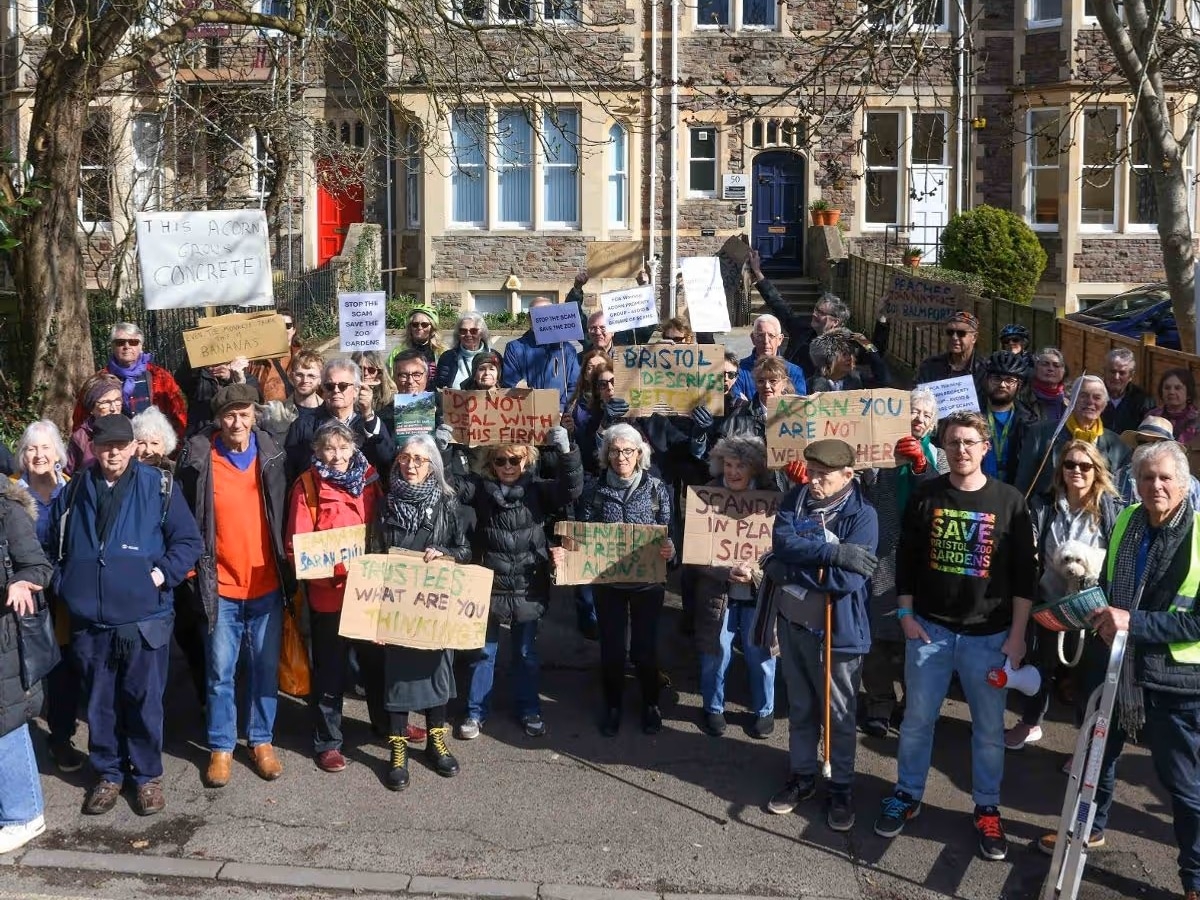
The Save Bristol Gardens Alliance gathered to protest outside Acorn Property Group’s offices in Clifton on 25 March.
Ever since the closure of Bristol Zoo in September 2022, campaigners have been opposing the site’s planned redevelopment.
The Alliance wants see the gardens preserved as “a site of huge cultural, historical and environmental importance with many listed buildings.”
Acorn Property Group
Although the sale of the former Bristol Zoo has not yet gone through, Acorn have nonetheless started clearing bushes and felling trees.
Campaigners are concerned about Acorn’s track record, and have written to the Bristol Zoological Society (BZS) repeatedly to raise their objections.
A spokesperson for Save Bristol Gardens Alliance said:
Acorn Property Group is a wholly unsuitable developer for the Zoo Gardens site, and it seems clear that BZS Trustees have failed to complete independent due diligence on Acorn.
Our concerns relate directly to the reputation, financial resilience, track record, and funding model of Acorn, as well as to the likelihood of Acorn not delivering on its agreement with BZS, the development itself or indeed any of the so-called ‘public benefits’.
Given the site’s importance to the local area, campaigners are also disappointed in the lack of transparency surrounding the planned redevelopment. The spokesperson continued:
Trustees are required to demonstrate that they have properly scrutinised risk, applied independent judgement and operated transparently – particularly in relation to decisions of this scale and sensitivity.
Given the significance of the decision and the level of public interest the people of Bristol are entitled to expect transparent decision making. It is not enough just to delegate due diligence to Savills, who of course act for Acorn in respect of a number of other developments.
So far, the Society “have declined to answer a single point” the Alliance has raised. They are now urging the BZS “to address these concerns fully and transparently before any contractual commitment is completed.”
They argue that the BZS “risks making a reckless decision, which could be catastrophic for trustee reputations, BZS’s reputation and, of course, for a treasured part of Bristol’s heritage.”
More protests to come
The protest on 25 March was the third – and largest – protest to take place outside Acorn’s offices in recent weeks. 50 members of the Save Bristol Gardens Alliance first gathered there on 11 March.
The Alliance plans to keep demonstrating outside Acorn’s offices, meeting every Wednesday at 12:30.
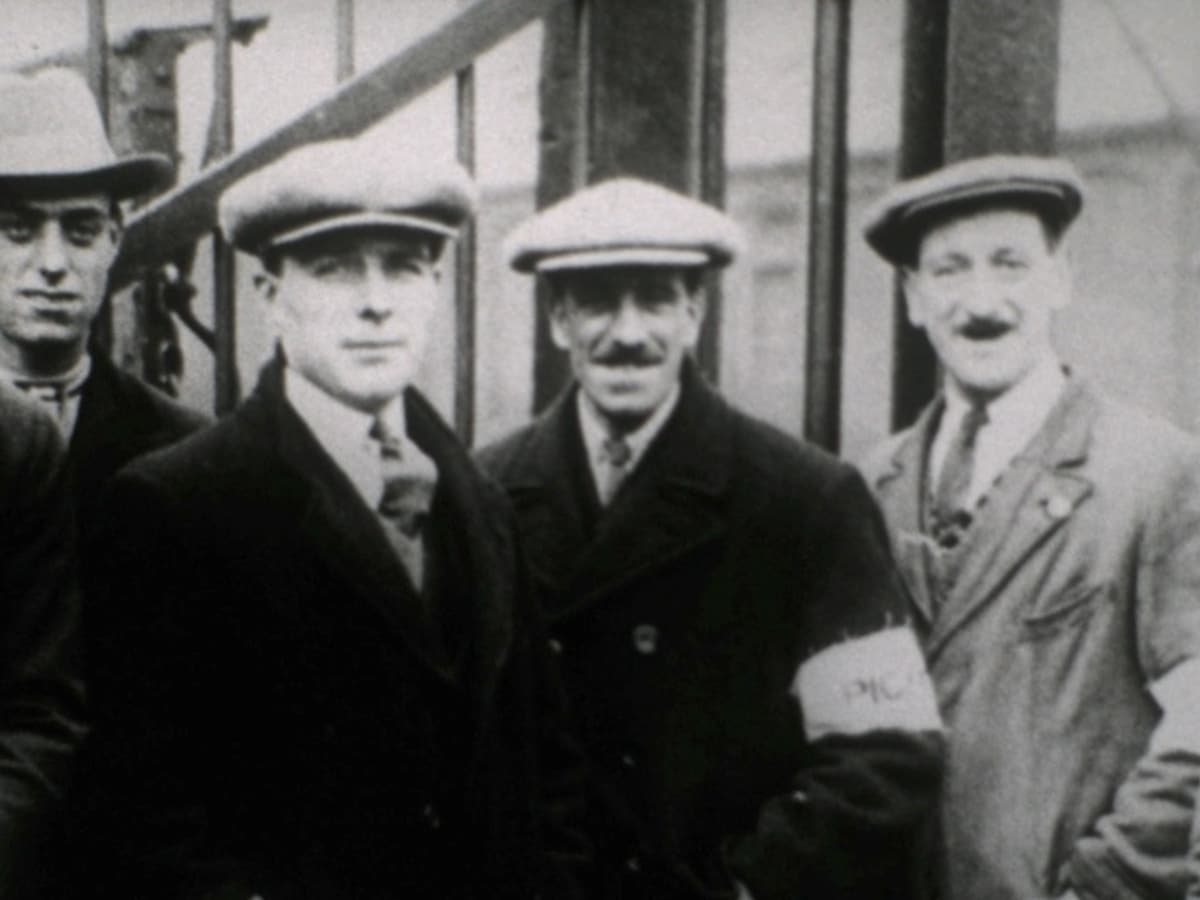
A newly discovered documentary film provides an extraordinary first-hand account of the General Strike of 1926. And it shows how close many of the strikers thought it brought them to a revolution.
This historic documentary, The General Strike – A Revolution Betrayed?, made in the early 1970s, was unearthed in the archive of radical filmmaker Platform Films.
Norman Thomas of Platform Films says that the power of the 70 minute film lies in its extensive use of first hand testimony of strikers and strikers’ relatives.
Thomas said:
This is the General Strike of 1926 as told by the people who actually lived through it. The film vividly illustrates how the strike was opposed by the full force of the British establishment but how close the strikers felt they came to success.
He added:
Many strikers believed they were on the verge of a revolution – a revolution that only failed because they were betrayed by union leaders.
It’s been a hundred years since workers across the country come out in support of over a million miners locked out of work for refusing to accept lower pay. Thomas claims the film contains vital lessons for present day trade unionists.
He said:
The film highlights the importance of rank and file solidarity across industries, highly disciplined grassroots organisation – and a deep distrust of union leaders!
The film also provides a unique insight into the human impact of the General Strike – an aspect, Thomas argues, that’s had too little coverage.
He said:
The film shows how people came out of the strike devastated. Whole communities were in pieces. The failure of the strike was a hugely traumatic event.
And Thomas added:
Watching the film, you get a real sense of how close the strike came to success. If it had succeeded, the strike would have undoubtedly changed the course of British history.
Award-winning radical filmmaker Platform Films has made the documentary available for screenings and viewings. You can get a copy of the film on memory stick, DVD or via an online link. The cost to institutions, including trades union councils, is £60. For individuals and union branches the cost is £20. There is no additional charge for screening the film publicly but donations are welcome. Email [email protected] for more details.
Watch a trailer of the film on YouTube.
Featured image via Platform Films

USPS reportedly plans its first-ever fuel surcharge on packages

CFTC’s first self-custody no-action letter signals new era for XRP derivatives
Arielle Konig Testifies in Husband’s Attempted Murder Trial


-
 Crypto World5 days ago
NIO (NIO) Stock Plunges 6.5% as Shelf Registration Sparks Dilution Worries
-

 Fashion5 days ago
Weekend Open Thread: Adidas – Corporette.com
-

 Politics5 days ago
Jenni Murray, Long-Serving Woman’s Hour Presenter, Dies Aged 75
-
 NewsBeat12 hours ago
Manchester United reach agreement with Casemiro over contract clause amid transfer speculation
-

 Crypto World4 days ago
Best Crypto to Buy Now: Strategy Just Spent $1.57 Billion on Bitcoin During Fear While Early Investors Quietly Enter Pepeto for 150x Potential
-

 Crypto World4 days ago
Bitcoin Price News: Bhutan Sells $72 Million in BTC Under Fiscal Pressure, but the Smart Money Entering Pepeto Sees What the Market Does Not
-

 Tech6 days ago
inKONBINI Lets You Spend Summer Days Behind the Register
-

 Sports2 days ago
Remo Stars and Kano Pillars Strengthen Survival Hopes in NPFL
-

 Politics6 days ago
Gender equality discussions at UN face pushbacks and US resistance
-

 Business3 days ago
No Winner in March 21 Drawing as Prize Rolls to $133 Million for Next
-

 Sports2 days ago
Gary Kirsten Accuses Pakistan Cricket Board Of ‘Interference’, Mohsin Naqvi Responds
-

 Tech3 days ago
Give Your Phone a Huge (and Free) Upgrade by Switching to Another Keyboard
-

 Sports5 days ago
2026 Kentucky Derby horses, odds, futures, preview, date: Expert who nailed 12 Derby-Oaks Doubles enters picks
-
Sports7 days ago
Vikings Free Agency Enters Phase 2 with Key Questions
-

 Tech3 days ago
AI enters the chat: New Seattle dating app relies on tech to facilitate meaningful human connections
-

 News Videos7 days ago
Amazing Cardboard Gadget That Turns Paper Into Money #techgadgets #ytshorts
-

 Politics6 days ago
Scotland’s rejection of assisted dying is a victory for humanity
-

 Tech7 days ago
Corsair K100 Air Wireless Mechanical RGB Keyboard Packs Full Power Into a Slim Frame
-

 Business6 days ago
DLocal: Entering 2026 At Escape Velocity
-
Business5 days ago
Columbia Sportswear enters $500 million credit agreement with JPMorgan Chase
You must be logged in to post a comment Login