

Crypto World
ECB Pushes Back on Euro Stablecoin Proposals, Citing Bank Lending Risks



The European Central Bank has warned EU finance ministers that euro stablecoin expansion carries serious risks to banks. Officials said wider issuance could reduce lending capacity and weaken the effectiveness of ECB interest rate decisions.
The warning came after Brussels-based think tank Bruegel circulated a paper at a meeting of EU finance officials. It called for looser liquidity requirements for stablecoin issuers and potential access to central bank funding.
ECB Targets Deposit Migration Risk
The ECB’s central concern is that a larger stablecoin market would draw retail savings away from commercial banks. Fewer deposits leave lenders with less capacity to extend credit, tightening borrowing conditions across the eurozone. The problem would compound as stablecoin adoption moves beyond early adopters.
Private digital currency growth also complicates rate policy, officials argued. When savings sit in stablecoins rather than bank accounts, the ECB’s rate decisions carry less weight. The transmission of monetary policy depends on activity in the deposit-backed lending system.
The ECB has previously sought stricter MiCA rules for stablecoin rather than looser ones. The latest warning extends that position directly to EU finance ministers.
Dollar Dominance Shapes the Debate
Bruegel’s paper was motivated by the growing grip of dollar-backed tokens on global crypto markets. The think tank argued that strict EU rules under Markets in Crypto-Assets (MiCA) have left European issuers unable to compete.
It described the outcome as a form of “digital dollarisation” that could deepen dollar dominance in international finance.
EU officials have separately warned that the growth of dollar stablecoin could erode the euro’s role in cross-border transactions. The ECB’s preferred counter is a central bank alternative rather than private issuance.
President Christine Lagarde has described the digital euro as a strategic priority for European financial infrastructure.
That has not slowed private-sector plans. Nine lenders are preparing to launch a MiCAR euro stablecoin in 2026, and EU policymakers have debated easing MiCA to improve the standing of European issuers.
The standoff between financial stability concerns and competitive pressure from dollar tokens has no clear resolution. How ministers ultimately decide will likely define the trajectory of European digital asset regulation.
The post ECB Pushes Back on Euro Stablecoin Proposals, Citing Bank Lending Risks appeared first on BeInCrypto.

After losing roughly $8,000 in just over a week, bitcoin’s price finally rebounded in the past day after more promising developments on the US-Iran peace front.
Most altcoins have followed suit, helping the total crypto market cap regain over $80 billion since yesterday’s low.
BTC Jumps Toward $77K
As mentioned above, the primary cryptocurrency dumped hard in the past 10 days or so, driven by different factors, such as the bleeding ETFs, investor exodus, and rising geopolitical tension. It dumped below $78,000 last weekend and fell to $76,000 a few days later.
After an unsuccessful rebound attempt on Wednesday and Thursday that was stopped at $78,000, the bears took complete control on Friday and especially Saturday morning, driving bitcoin south to just over $74,000. This became its lowest price position in May, and it arrived after a new set of threats from Trump against Iran.
However, the two sides actually made significant progress on a potential permanent peace deal, as announced by the POTUS himself. This resulted in an immediate price uptick for BTC that drove it to just over $77,200 earlier today before it was stopped. Nevertheless, it still trades inches below $77,000, and its market cap has recovered to $1.540 trillion on CG.
Its dominance over the alts has also remained above 58% after a brief dip yesterday.

HYPE New ATH
Aside from yesterday’s brief crash to $55, HYPE has been the undisputed leader in market performance over the past few weeks. Its gains only intensified today as it posted a fresh all-time high of over $63.
Ethereum defended the $2,000 level and has risen past $2,100 after a 4.5% daily surge. BNB is back to $660, while XRP has reclaimed the $1.35 resistance. SOL is up to $87, ZEC is back to $645, and more gains are evident from CC, XLM, SUI, AVAX, TAO, and others.
Even more substantial double-digit increases come from WLD, NEAR, MORPHO, ONDO, and QNT.
The total crypto market cap has added over $80 billion since yesterday’s low and is up to $2.650 trillion on CG.

The post HYPE Hits New All-Time High as BTC, ETH, and XRP Rebound: Weekend Watch appeared first on CryptoPotato.
Crypto World
Binance Australia Mandates Sender and Beneficiary Info for All Crypto Transfers Starting July 1, 2026

TLDR:
- Binance Australia will require sender and beneficiary details for all crypto transfers from July 1, 2026.
- Australian users must re-login to Binance accounts on July 1 as part of the mandatory system update rollout.
- Transactions missing required sender or beneficiary information may be delayed, rejected, or returned to origin.
- Users sending crypto to themselves on another exchange only need to provide the receiving exchange’s name.
Binance Australia will introduce new crypto transfer requirements starting July 1, 2026. Australian users must provide sender and beneficiary information for all crypto deposits and withdrawals.
The changes align with local regulatory requirements. Transactions that lack the necessary details may face delays, rejection, or return to the originator. Users should prepare their login credentials, as re-authentication will be required from that date.
New Information Requirements for Crypto Deposits and Withdrawals
The updated procedures will affect all crypto deposit and withdrawal transactions on Binance for Australian users. When receiving crypto, users must visit the deposit page and click on transactions pending credit.
A pop-up will then prompt them to enter the originator’s details. These details include a full name, country of residence, unique identifier, and city or locality.
For outgoing transfers, users will see a pop-up after confirming withdrawal details. They must then enter the beneficiary’s full name, country of residence, and city or locality.
However, users sending assets to themselves on another exchange only need to provide that exchange’s name. This simplifies the process for self-transfers between platforms.
Binance described the move as a step toward full compliance with Australian regulatory standards. The exchange stated it will gradually roll out these changes to ensure a smooth transition.
Users who do not perform crypto transfers are not required to take any action. The changes are strictly limited to deposit and withdrawal activity.
It is worth noting that incomplete information can result in transactions being delayed or rejected outright. In certain deposit cases, assets may be returned to the originating exchange or wallet.
Users are therefore encouraged to have all required details ready before initiating any transfer. Binance also directed users to its privacy notice for details on personal data handling.
What Australian Users Should Prepare Before the July 1 Deadline
As the deadline approaches, Australian users should review their account credentials and ensure they can log back in after July 1. Binance has confirmed that re-login will be mandatory when the new system goes live.
Failing to log in or provide the required details could disrupt access to funds. Early preparation can help users avoid any disruption to their trading activity.
Users sending crypto to external wallets or other exchanges should also gather beneficiary information in advance. Knowing a recipient’s full name, location, and country will speed up the withdrawal process.
For deposits, users should coordinate with the sending party to collect originator details promptly. This coordination becomes especially important for time-sensitive transactions.
Binance’s move is part of a broader global trend where crypto exchanges are aligning with financial regulations. Australia has been tightening its oversight of digital asset platforms in recent years.
These new procedures reflect that regulatory direction. Binance’s proactive approach aims to keep its Australian operations fully compliant while serving its user base without interruption.


Key Takeaways
- Citi upgraded Boeing’s price target to $260 from $256 with a Buy rating, viewing the aerospace defense decline as a strategic entry point
- Defense, Space & Security revenue reached $7.6 billion in Q1, marking a 21% year-over-year increase with an $86 billion backlog
- Boeing exceeded Q1 earnings forecasts with -$0.20 EPS versus analyst estimates of -$0.68, while revenue climbed 14% to $22.22 billion
- A 200-plane order from China was confirmed, and director Bradley D. Tilden purchased nearly $300,000 in company shares
- Challenges persist with 777X certification hurdles and ongoing fixed-price contract concerns
Boeing (BA) stock started Friday’s session at $219.18, hovering narrowly above its 200-day moving average of $218.62, as analysts increasingly focus on the aerospace giant’s defense operations.
Citi analysts elevated their Boeing price objective to $260 from $256 this week while reaffirming their Buy recommendation. The firm characterized the recent aerospace and defense sector weakness as a compelling buying window, emphasizing Boeing’s strengthening defense operations as central to the recovery narrative.
First-quarter results support this thesis. Boeing’s Defense, Space & Security division generated $7.6 billion in quarterly revenue, representing a 21% year-over-year jump. Segment operating profit improved to $233 million from $155 million in the prior-year period, while the backlog reached an all-time high of $86 billion, with international clients accounting for 27% of future orders.
Consolidated revenue totaled $22.22 billion in Q1, reflecting 14% annual growth and surpassing Wall Street’s $22.15 billion projection. The per-share loss of $0.20 significantly outperformed the consensus estimate of -$0.68, providing optimistic investors with tangible evidence of improvement.
Boeing’s total backlog expanded to an unprecedented $695 billion.
However, the commercial aviation segment continues facing headwinds. Boeing recorded a GAAP per-share loss of 11 cents, and the 777X certification process has encountered unexpected technical complications, with “hot brakes” emerging as a more substantial issue than initially anticipated. This development pressured shares and reignited questions about the company’s ability to execute smoothly.
Defense Business Strengthens Long-Term Growth Story
Beyond quarterly performance, Boeing secured a seven-year agreement with the U.S. Department of War in April to triple manufacturing output for PAC-3 seekers utilized in Patriot missile defense systems. Since 2024, Boeing has invested over $200 million in expanding production capabilities at its Huntsville, Alabama facility.
The proposed fiscal 2026 defense budget allocates $2.5 billion specifically for missile and munitions manufacturing, sustaining favorable government spending trends.
In March 2025, Boeing received the engineering and manufacturing development contract for the F-47, the Air Force’s Next Generation Air Dominance platform — promoted as the planet’s first sixth-generation combat aircraft. This program provides the defense division with a crucial long-term revenue foundation.
China Aircraft Order and Insider Buying Signal Confidence
China validated a 200-aircraft Boeing purchase as part of expanded U.S.-China trade negotiations, effectively reopening a previously stalled market. While some market participants anticipated a more substantial order volume, potentially capping immediate upside, the agreement nevertheless enhances forward demand clarity.
On the institutional front, Connors Investor Services established a new position valued at approximately $10.46 million during Q4. AXA S.A. expanded its holdings by more than 1,200%. Institutional ownership currently represents roughly 64.82% of outstanding shares.
Director Bradley D. Tilden acquired 1,370 Boeing shares at $218.50 per share on May 20th, totaling $299,345, according to SEC disclosure documents.
The consensus Wall Street rating stands at “Moderate Buy” with an average price objective of $259.80.
TLDR:
- Hyperliquid has funneled over $1.16 billion in cumulative trading fees into open-market HYPE buybacks since launch.
- The Assistance Fund deploys nearly 99% of protocol revenue into continuous HYPE purchases, operating independently of investor sentiment.
- Quarterly buybacks dropped roughly 40% from Q3 2025 to Q1 2026, even as HYPE continued climbing to record highs.
- Analysts warn that a decline in perpetual futures volume would shrink buyback support precisely when token holders need it most.
Hyperliquid’s HYPE token reached an all-time high above $62 on May 21, 2026. Forbes contributor Zennon Kapron argues that the Hyperliquid HYPE buyback mechanism is the primary price driver.
Spot ETF launches contributed, but their inflows remain modest in comparison. The protocol has funneled over $1.16 billion in trading fees into open-market HYPE purchases since launch.
Understanding this distinction changes how investors should read the current rally.
The Assistance Fund Acts as a Continuous Market Buyer
Hyperliquid routes approximately 99% of perpetual and spot trading fees into a mechanism called the Assistance Fund. That fund then purchases HYPE on the open market, block by block, regardless of market conditions.
No governance vote or board decision can pause the process. The buying is a direct function of the protocol’s revenue model.
The scale of these purchases places the fund well above ETF inflows as a price driver. Bitwise launched the first US spot Hyperliquid ETF in May, attracting tens of millions in its opening week.
The Assistance Fund, by contrast, deployed $316.76 million in buybacks during Q3 2025 alone. As Kapron put it, the ETF launch “became the headline because it fits a familiar template,” while “the Assistance Fund is the part actually setting the price.”
Two additional streams reinforce the fund’s activity. Hyperliquid Strategies, which trades on Nasdaq under PURR, holds roughly 20 million HYPE tokens and reported $152.5 million in net profit last quarter, mostly unrealized gains on its holdings.
Separately, up to 90% of reserve yield earned on USDC held across the platform also flows back toward buybacks and ecosystem incentives.
Together, these three pipelines direct substantial capital toward HYPE consistently. The combined effect creates a layered support structure beneath the token’s market price. That structure, however, depends entirely on sustained trading volume.
Volume Dependence Creates a Two-Sided Mechanism
Quarterly buyback figures have already begun declining despite record token prices. The fund spent $316.76 million in Q3 2025, $255.05 million in Q4 2025, and $192.25 million in Q1 2026, a roughly 40% drop across two quarters.
Meanwhile, HYPE continued setting new highs. Price and the buyback engine moved in opposite directions during this stretch.
This gap becomes critical during a broader market downturn. Kapron notes that in a genuine crypto drawdown, “perpetual-futures volume contracts hard, the buyback contracts with it, and the support fades at the exact moment HYPE holders most want a buyer in the market.”
The mechanism that amplifies gains on the way up withdraws support on the way down.
The token’s unlock schedule adds further pressure. As locked HYPE enters circulation, the fund must absorb growing selling pressure simply to maintain price stability. Rising float alongside declining volume would compound simultaneously.
Kapron frames the trade plainly, writing that buying HYPE at record highs is “a leveraged position on one variable” tied to whether perpetual futures volume on a single exchange keeps rising. That is a narrow position, and investors should weigh it carefully before entering at current levels.

A notable blockchain researcher has pushed back on recent criticisms of the Ethereum Foundation, arguing the organization is performing exactly what it was designed to do. In a post on X titled “Leave the Foundation Alone,” William Mougayar—a Toronto-based investor, researcher and best-selling author—contends that ETH, Ethereum and the Ethereum Foundation occupy distinct roles, each following its own trajectory.
Mougayar frames the asset as money, Ethereum as the underlying infrastructure, and the Foundation as a non-profit steward aiming to guide the protocol toward a future where it becomes less central to the ecosystem. He warns that conflating these roles leads to inaccurate predictions and misplaced anger about ETH’s direction.
Key takeaways
- The Ethereum Foundation’s mandate, according to Mougayar, is protocol stewardship and research funding, not marketing or price support for ETH.
- Critics’ demand for the Foundation to promote ETH or court institutions is likened to asking the Internet Engineering Task Force to run ads for TCP/IP.
- In recent weeks, the Foundation completed a third OTC ETH sale to BitMine, moving 10,000 ETH at an average price of about $2,292 (roughly $22.9 million), bringing total BitMine dealings to roughly $47 million.
- Unstaking activity accompanied the sales: 17,035 ETH unlocked (about $40 million), and an additional 21,270 ETH was unstaked from Lido earlier this month (nearing a 70,000 ETH staked milestone in that period).
- ETH was trading around $2,117, up about 4.7% on the day, but remains over 57% below its all-time high of $4,953 reached in August last year, according to CoinMarketCap data.
EF’s role in hardening the protocol, not marketing the asset
In his X post, Mougayar emphasizes that the Ethereum Foundation is deliberately distinct from both the ETH asset and the broader Ethereum network. He describes the EF as pursuing a “subtraction path”—a strategy aimed at making the protocol more autonomous and less dependent on a centralized actor over time. “It is hardening the protocol so the world does not need it so much. It is shipping upgrades. It is funding the research that nobody else funds,” he wrote.
The analogy is pointed: critics who expect the EF to actively market ETH or court institutions are, in Mougayar’s frame, effectively seeking a governing body to replace market signals. He likens that expectation to asking the IETF to run large-scale promotional campaigns for TCP/IP—a comparison meant to separate technical governance from promotional ambition.
Market moves and investor implications
The timing and nature of the Foundation’s treasury activities have long been a subject of debate within crypto circles. Earlier this month, the EF completed its third over-the-counter sale of ETH to BitMine Immersion Technologies, offloading 10,000 ETH at an average price of $2,292. The deal, valued at about $22.9 million, followed two prior transactions—5,000 ETH in March and another 10,000 ETH the week before—bringing the aggregate to around $47 million in ETH sales to BitMine in recent weeks.
These sales have coincided with unstaking activity that supporters frame as treasury management rather than a market-moving signal. The Foundation unstaked 17,035 ETH worth roughly $40 million, and earlier in the month, an additional 21,270 ETH were unstaked from Lido, valued at nearly $50 million. The pace of unstaking, combined with the sales, has fed ongoing questions about the Foundation’s influence on ETH’s price trajectory.
From a price perspective, Ethereum stood around $2,117, up about 4.7% on the day of the report. While this marks a positive swing in the short term, ETH remains significantly below its all-time high of $4,953 recorded in August last year, underscoring that Foundation actions are just one of many factors shaping the token’s broader market behavior. CoinMarketCap’s data underscores the longer-term context facing investors who weigh the asset as a potential long-term holding against ongoing shifts in staking, liquidity and supply dynamics.
What this means for holders and developers
Taken together, Mougayar’s perspective and the Foundation’s recent activity highlight a broader shift in the Ethereum ecosystem: governance and funding mechanisms are decoupling from price-centric narratives. For investors, the takeaway is twofold. First, a more autonomous protocol—achieved through upgrades and sustained, targeted research funding—could reduce systemic reliance on any single institution, potentially contributing to long-run resilience. Second, the Treasury’s use of ETH through OTC sales and unstaking moves introduces a continuing element of treasury management that may constrain near-term supply dynamics and, by extension, price sensitivity to major moves by the EF.
Market observers will be watching how the EF aligns its actions with the long-term health of Ethereum’s core protocols, including upcoming upgrades and research funding decisions. While critics may view such treasury activity as a headwind for price, proponents argue it reflects prudent stewardship aimed at preserving decentralization and protocol integrity over time. As with previous cycles, the ultimate impact will hinge on a mix of on-chain developments, macro conditions and the evolving regulatory environment surrounding crypto asset management.
For now, Mougayar’s argument reframes the debate: the Ethereum Foundation is not an advertising arm but a foundational institution whose work is intended to outlast any single market cycle. The coming quarters will reveal whether this approach strengthens Ethereum’s long-term viability and how it shapes the appetite of investors and builders alike.
Readers should monitor upcoming EF upgrades, research funding announcements and treasury activity, which together will illuminate how the foundation navigates its shrinking centrality while continuing to support the protocol’s evolution.
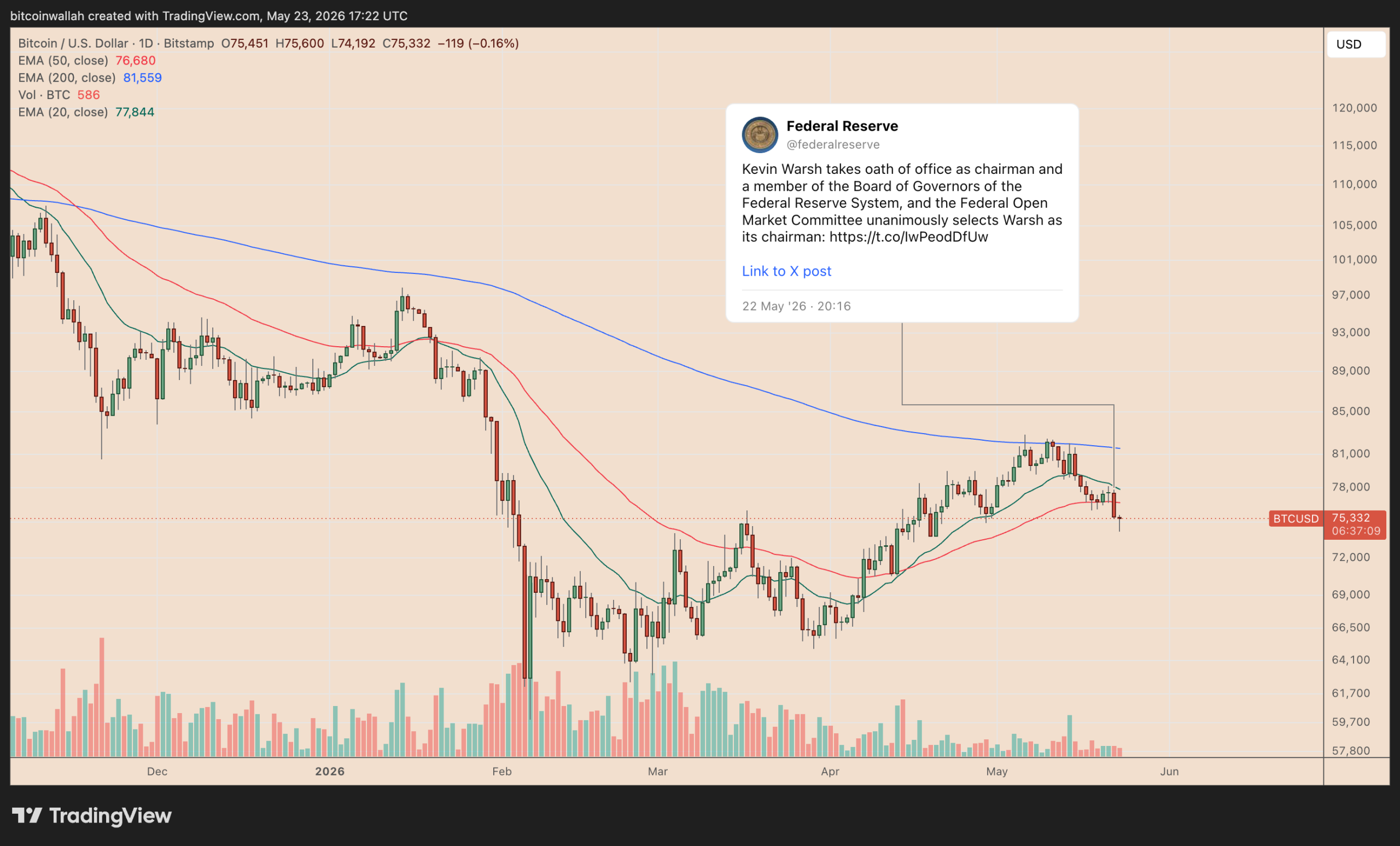
Bitcoin (BTC) fell to $74,190 on Saturday, its lowest level in more than a month, despite pro-crypto Kevin Warsh being sworn in as Federal Reserve chairman a day earlier.
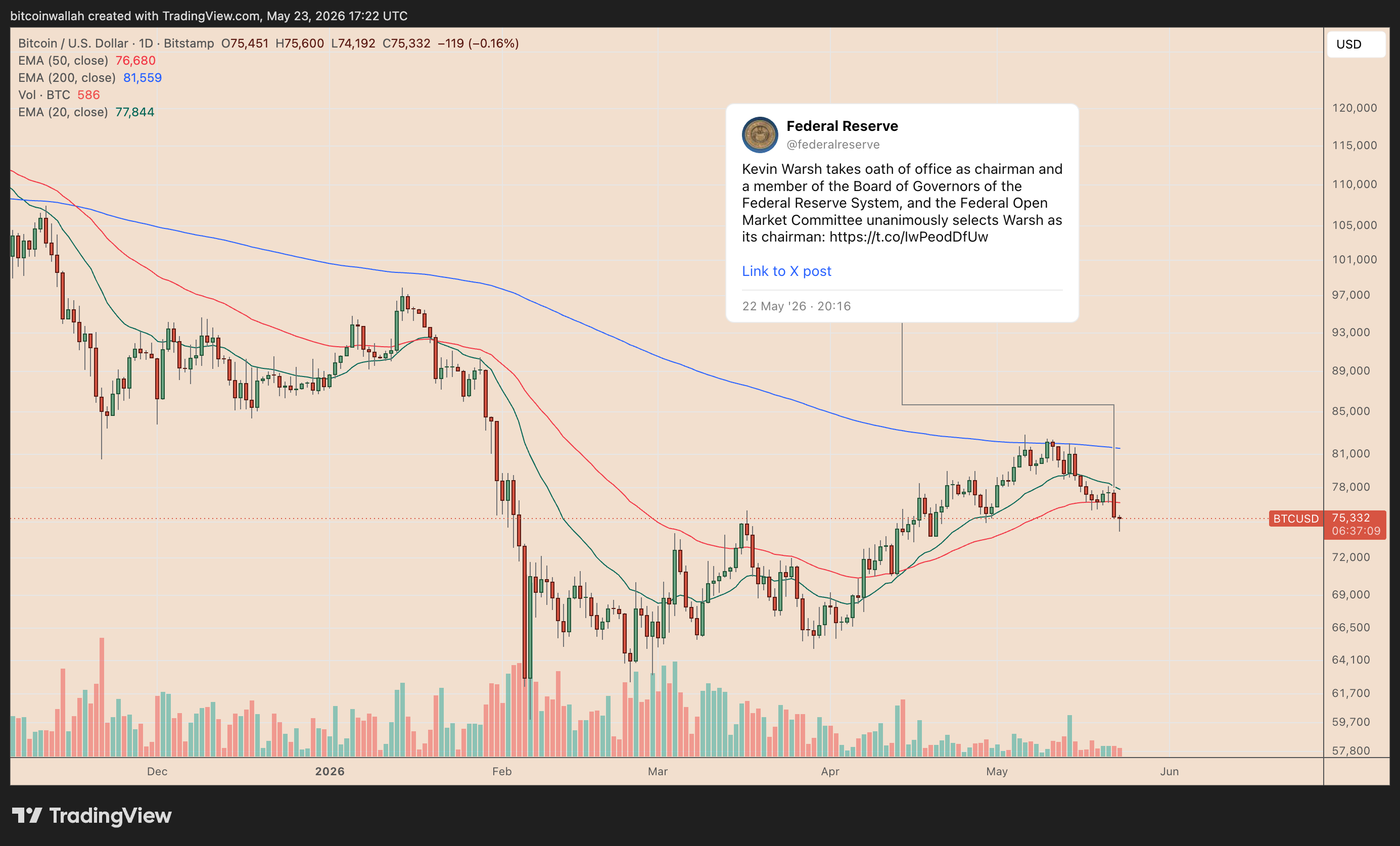
BTC/USD daily chart. Source: TradingView
Key takeaways:
- Higher odds of a rate hike in 2026 are pressuring the Bitcoin market.
- Bitcoin has historically struggled during years marked by Federal Reserve leadership changes.
Why is Bitcoin down despite a pro-crypto Fed chair?
Bitcoin’s sell-off came as the 2-year US Treasury yield climbed to 4.14%, its highest level since February 2025.
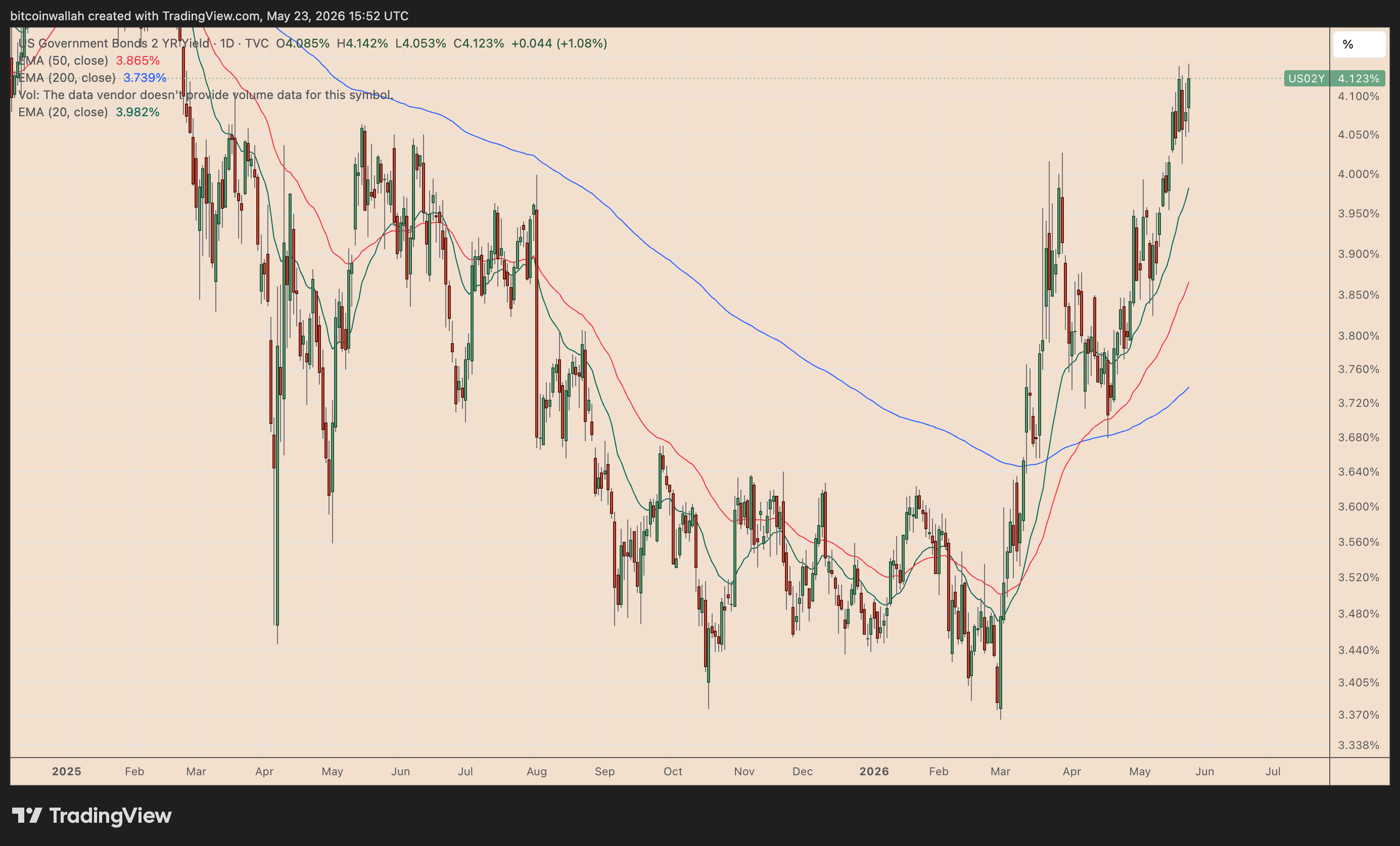
US 2-year bond yield daily chart. Source: TradingView
The 2-year yield is closely tied to where traders expect the federal funds rate to move in the near term. Its move above the Fed’s current 3.50%–3.75% target range suggests markets are no longer betting on quick easing under Warsh.
CME data shows traders now expect the Fed to keep rates unchanged for most of 2026, with futures pricing pointing to a possible 25 basis point hike in December.
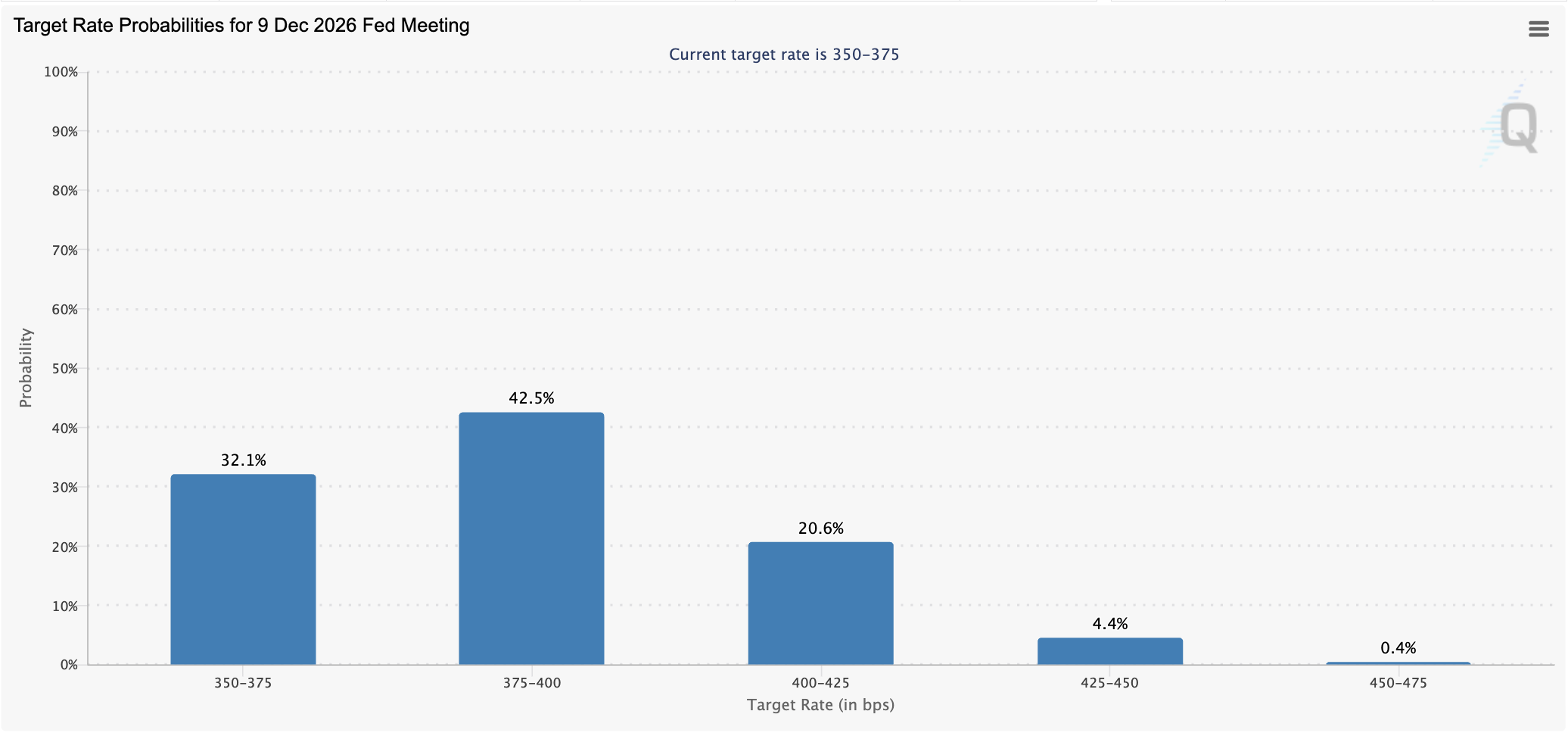
Target rate probabilities for the December Fed meeting. Source: CME
Over the past three decades, the Fed has typically raised rates when the 2-year Treasury yield moved above the federal funds rate, as the gap suggested markets were pricing in tighter policy ahead, according to data provided by BCA Research.
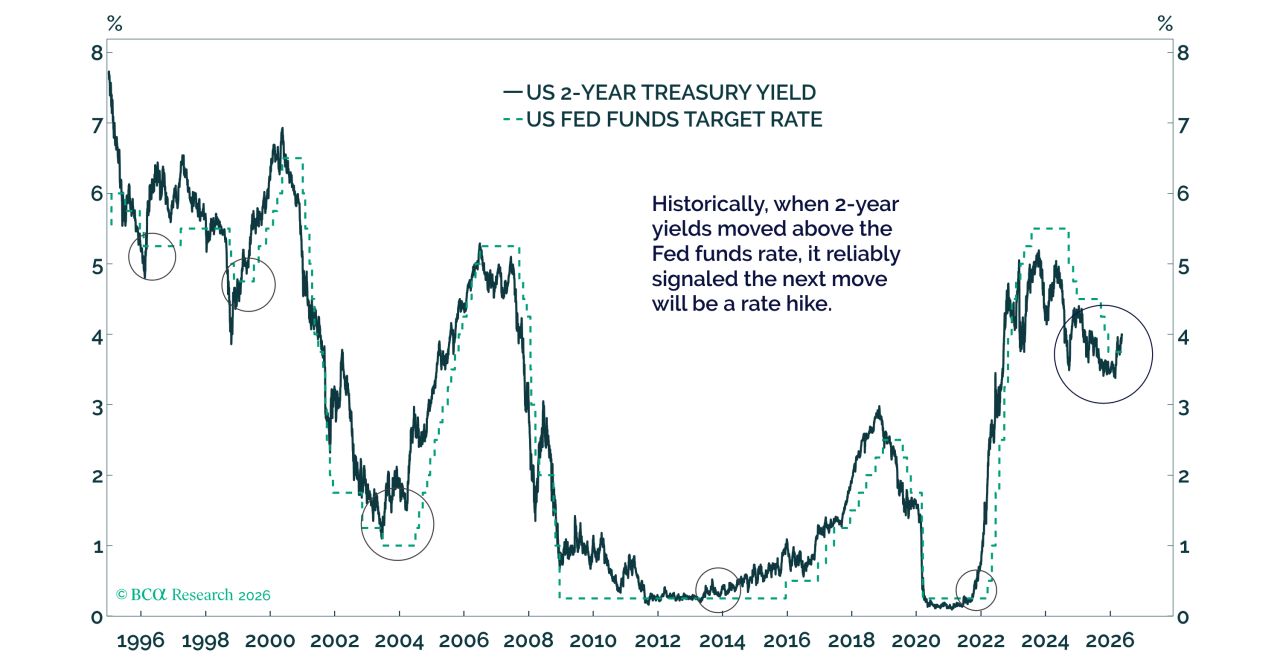
US 2-year Treasury yield vs. US Fed fund target rate. Source: BCA Research
Conversely, when the 2-year yield fell below the Fed funds rate, it often signaled expectations for future rate cuts.
Related: Bitcoin ETFs snap 5-day inflow streak as BTC dips under $80K
Such a shift weakens the bullish case for BTC, which typically benefits from falling yields, lower real rates and easier liquidity conditions.
Warsh is “a known inflation hawk”
In the past, Warsh has spoken favorably about Bitcoin, criticized central bank digital currency, and backed a larger role for private-sector financial innovation. For crypto traders, that checks several bullish boxes.
But from a monetary-policy perspective, Warsh may still challenge the bullish Bitcoin narrative, according to analyst Crypto Patel.
In a Saturday post, Patel noted that Warsh is “a known inflation hawk,” not a dove, adding that a difficult macro backdrop, including Iran war-driven inflation risks and labor-market pressure, may keep him from slashing rates.
“Crypto-friendly on regulation is NOT the same as dovish on rates,” he said.
Bitcoin underperforms in years of Fed leadership changes
Another warning comes from Bitcoin’s historical reaction to Fed leadership changes.
In a Saturday post, analyst Lucky noted that BTC has struggled during previous chair transitions: it fell 84% after Janet Yellen took over in January 2014, 73% after Jerome Powell started in February 2018, and 60% after Powell began his second term in May 2022.
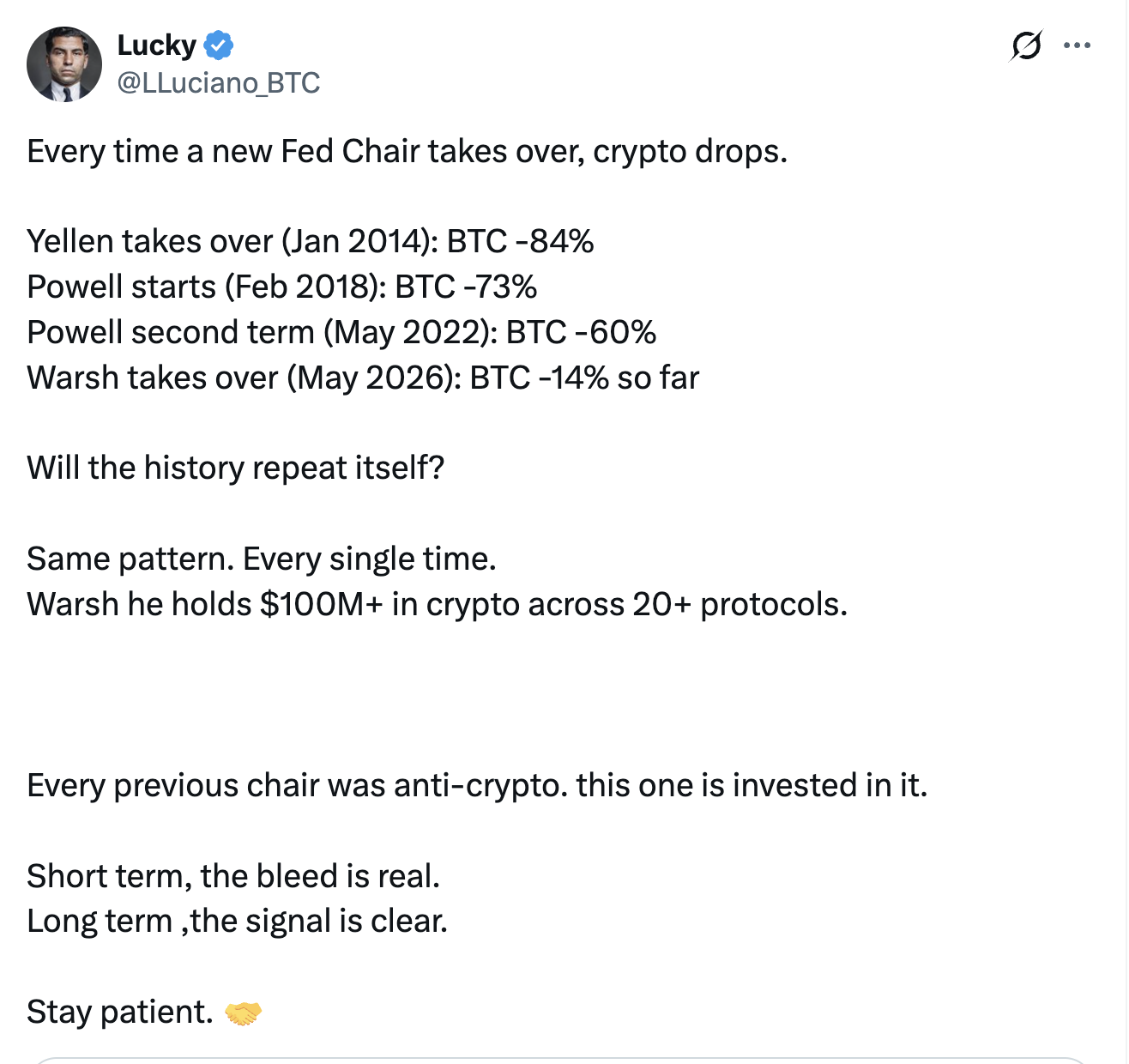
Source: X
Warsh’s takeover has so far coincided with a sharp BTC decline, suggesting traders may again be de-risking as they wait for policy clarity from the new Fed chief.


Bank of America reported about $53 million in crypto ETF exposure in its Q1 2026 13F filing, with BlackRock’s iShares Bitcoin Trust leading the group.
Summary
- Bank of America’s Q1 filing showed roughly $53 million in reported crypto ETF exposure overall.
- IBIT led the bank’s crypto ETF holdings, with its reported stake near $37 million overall.
- The filing showed lower Ether and Solana positions as Bitcoin products stayed the largest allocation.
The filing showed a larger IBIT position and smaller Ether and Solana ETF exposure, putting Bitcoin at the center of the bank’s reported crypto ETF basket.
Bank of America held 972,590 shares of IBIT worth about $37.3 million at the end of the quarter, up from 719,008 shares in the prior filing. That made IBIT the largest single crypto ETF position in the bank’s report.
The bank also held smaller Bitcoin ETF positions across other issuers. Its reported holdings included about $7.98 million in Bitwise’s BITB, $3.32 million in Grayscale’s Bitcoin Mini Trust, and about $1.71 million in Fidelity’s FBTC. Smaller positions in GBTC, VanEck’s HODL, and ARKB also stayed on the books.
Ether and Solana exposure moves lower
The filing showed lower exposure to Ether and Solana products during the same quarter. Bank of America’s Ethereum allocation stood near $1.06 million through BlackRock’s ETHA, with 67,492 shares remaining after the reduction.
The bank also sold 700 shares of the Volatility Shares 2x Solana ETF and kept 10,296 shares of the standard Solana ETF, valued near $86,000. XRP exposure stayed unchanged at 13,000 shares of the Volatility Shares XRP ETF, worth about $98,500.
Strategy stock dwarfs ETF holdings
The ETF positions were smaller than the bank’s crypto-linked equity exposure. The filing also showed 3.96 million shares of Strategy, formerly MicroStrategy, valued near $660 million.
Strategy remains widely tracked because of its large Bitcoin treasury. For Bank of America, that equity position was more than twelve times larger than its direct crypto ETF exposure at quarter-end.
Bank filings add to institutional ETF trend
The filing was submitted to the U.S. Securities and Exchange Commission as a Form 13F-HR. The SEC filing page lists a May 18 filing date and a March 31 reporting period.
Related crypto.news coverage reported that Wells Fargo also used regulated crypto products in Q1, with IBIT still its largest crypto ETF position at about $250 million. The same report noted that 13F filings show holdings, not the reason behind each trade.
A separate crypto.news report cited a Coinbase and EY-Parthenon survey of 351 institutions. It found that 73% planned to increase digital asset allocations in 2026, while regulated products had become the preferred exposure route for about two-thirds of respondents.


StablR’s Euro (EURR) and StablR USD (USDR) stablecoins lost their pegs on Ethereum on May 24 after an exploit on the project’s minting contract allowed an attacker to extract roughly $2.8 million.
Blockchain security firm Blockaid flagged the ongoing attack and attributed the breach to a private key compromise rather than any flaw in StablR’s smart contracts.
How the Attacker Seized Control Of StablR
The minting multisig governing StablR’s token issuance required just one of three authorized signatures to act. That 1-of-3 threshold meant a single compromised key was enough to seize full control of the contract.
The attacker added their own address as an owner and removed the two legitimate signers. They then minted 8.35 million USDR and 4.5 million EURR, a combined face value of roughly $10.4 million at peg.
Blockaid outlined the sequence in a follow-up post on X:
“This is not a smart contract bug – it’s a key management and governance failure.”
Thin liquidity on decentralized exchanges (DEX) sharply limited the attacker’s return.
Swapping $10.4 million in freshly minted tokens into shallow pools yielded only about 1,115 ETH, worth roughly $2.8 million.
EURR fell roughly 20% on tracked Ethereum liquidity and USDR also lost its dollar peg as sell pressure overwhelmed available pools.
A Recurring Governance Blind Spot
The episode mirrors past stablecoin attacks where unauthorized minting triggered rapid depegs.
More broadly, it follows a persistent wave of private key DeFi exploits that have contributed to record crypto theft figures in recent years.
A similar Resolv stablecoin breach earlier in 2026 used near-identical mechanics, where a single insufficiently protected key enabled minting at scale.
StablR holds an Electronic Money Institution (EMI) license from Malta’s financial regulator. The company operates under the EU’s Markets in Crypto-Assets Regulation (MiCA).
It received a strategic investment from Tether in late 2024. How those regulatory and financial ties factor into any recovery response has not yet been disclosed.
The post StablR Stablecoins Depeg After $2.8 Million Exploit appeared first on BeInCrypto.


Crypto wrench attacks in France have become a larger concern after Bitcoin journalist Joe Nakamoto said the country accounts for about 70% of reported physical attacks against crypto holders and their families.
Summary
- France accounts for 70% of reported crypto wrench attacks, according to Bitcoin journalist Joe Nakamoto.
- Nakamoto said France recorded 41 crypto kidnappings this year, roughly one case every 2.5 days.
- French authorities charged 88 suspects as wrench attack investigations widened across 12 cases in April.
The latest figures put the country at the center of a security debate that now links privacy, custody, and personal safety.
Nakamoto said France has recorded 41 crypto-linked kidnappings so far in 2026. That equals roughly one case every two and a half days, based on his latest report.
A wrench attack means criminals use force, threats, kidnapping, or home invasion to pressure a victim into handing over crypto. The target is often not only the holder, but also relatives who may be easier to reach.
KYC data leak fears return
Nakamoto linked the rise in attacks to centralized know-your-customer records. He said criminals can use leaked names, emails, phone numbers, and home addresses to find possible crypto holders.
The 2020 Ledger customer data leak remains central to that debate. Nakamoto said the breach exposed details tied to more than 270,000 customers worldwide.
“France is the canary in the coal mine, demonstrating how financial regulations create a surveillance apparatus that causes direct harm to bitcoin holders,” said Casa CEO Jameson Lopp.
French authorities widen security response
Related reports show that French authorities have already moved against several suspected networks. April coverage reported that 88 suspects were charged in connection with wrench attack cases in France, including minors.
The same reporting noted that PNACO tracked 18 incidents in 2024, 67 in 2025, and 47 so far in 2026. Separate coverage said France also planned a prevention platform and a wider security plan after police records counted 41 crypto-linked kidnappings this year.
Bitcoin holders receive safety warnings
Nakamoto said some attacks are arranged by criminals outside France, who recruit young people inside the country to carry them out. He advised crypto holders to avoid public posts that reveal wealth, wallet use, or direct exposure to digital assets.
He also pointed to custody tools that can freeze funds when a user faces a threat. Some services use a pre-agreed word or phrase to warn the company that a customer is under pressure. Nakamoto also suggested a small decoy wallet for emergency situations, while stressing that a low public profile remains important.
The report adds to a wider debate over privacy, KYC rules, and crypto holder safety. France now shows how exposed personal data can move from online leaks into offline threats, forcing users and companies to rethink basic security habits.


StablR’s euro and dollar stablecoins lost their pegs after a suspected private key compromise allowed an attacker to take control of minting permissions and extract about $2.8 million.
Summary
- Blockaid says a compromised multisig owner let the attacker take control of StablR minting permissions.
- The attacker minted 12.85 million tokens and converted thin DEX liquidity into 1,115 ETH proceeds.
- Related crypto.news coverage shows May security pressure across Verus, MAP Protocol, Resolv Labs, and bridges.
Blockchain security firm Blockaid said its detection system found an ongoing exploit affecting StablR on Ethereum. The firm said the attacker targeted the issuer behind StablR Euro, EURR, and StablR USD, USDR, with about $2.8 million extracted so far.
Blockaid said the suspected cause was a compromised private key linked to one owner of the minting multisig account. The setup reportedly used a 1-of-3 threshold, meaning one compromised owner key was enough to control minting access.
Attacker mints 12.85 million tokens
According to Blockaid, the attacker added themselves as an owner, replaced the two other legitimate owners, and minted 8.35 million USDR plus 4.5 million EURR. The new supply pushed both stablecoins away from their intended pegs.
The attacker then swapped about $10.4 million in face value through decentralized exchanges. Due to thin liquidity, the attacker realized only 1,115 ETH, worth about $2.8 million.
“This is not a smart contract bug — it’s a key management and governance failure,” said Blockaid.
Market trackers showed the peg break during Sunday trading. CoinGecko listed EURR near $0.908, down more than 21% over 24 hours, while CoinMarketCap showed EURR near $0.8995 and down more than 22% on the day.
USDR also traded below its intended $1 peg during the incident. CoinMarketCap listed the token near $0.7225 in the same trading window.
Tether-backed issuer faces market stress
StablR presents EURR and USDR as regulated stablecoins backed by reserves held in secure segregated accounts. Its website says both tokens run on Ethereum and Solana and are pegged to the euro and U.S. dollar for digital transactions.
The issuer has also been part of Tether’s European stablecoin push. Tether invested in StablR in December 2024, while crypto.news later reported that Oobit and StablR launched MiCA-compliant EURR and USDR payment support in Europe.
May exploit wave adds pressure
The StablR incident comes during a busy month for crypto security teams. Related coverage on crypto.news reported that the Verus bridge exploiter returned 4,052 ETH, worth about $8.5 million, while keeping 1,350 ETH as a bounty after a settlement offer.
Earlier crypto.news reports also covered Resolv Labs, where USR lost its peg after an attacker minted unbacked tokens. The latest StablR case adds another example of stablecoin minting controls becoming a direct risk when key access fails.

How One Book Taught Europe to Count and Started a Financial Revolution

China mine blast death toll revised to 82

Sunrun: The Market Is Mispricing America's Largest Distributed Power Plant


-

 Crypto World3 days ago
Blockchain.com files with SEC for U.S. IPO
-

 Fashion2 days ago
Holiday Weekend Open Thread – Corporette.com
-

 Crypto World7 days ago
Intesa Sanpaolo’s crypto holdings jump to $235M as XRP enters
-

 Business2 days ago
Dell Technologies DELL Stock Surges 15% on AI Server Momentum and Analyst Upgrades in 2026
-

 Crypto World2 days ago
Space X IPO Is ‘Bad News’ for Tech Stocks: But What About Bitcoin?
-

 Politics2 days ago
Makerfield: a tale of two social-media histories
-

 Crypto World24 hours ago
Robinhood crypto COO Tanya Denisova exits
-

 Crypto World2 days ago
AI infrastructure race heats up as IREN pitches full-stack strategy, WhiteFiber lands $160M deal
-

 Tech2 days ago
WhatsApp ads could make Irish debut after discussions with DPC
-
 Tech2 days ago
A 0.12% parameter add-on gives AI agents the working memory RAG can’t
-

 Crypto World2 days ago
Bitcoin Accumulation Weakens as BTC Realized Losses Hit $600M
-
Crypto World6 days ago
Revolut Launches Dogecoin Debit Card Across UK and EU
-

 Tech2 days ago
You Can Now Add ChatGPT To PowerPoint
-

 Sports2 days ago
2026 CJ Cup Byron Nelson leaderboard: Brooks Koepka finds putting stroke in Round 1
-
 NewsBeat3 days ago
Charity run by Reform leader Malcolm Offord accused of ‘law breaking’ over Scottish registration
-

 Crypto World2 days ago
Trump Media’s Bitcoin Stash Shrinks Again as 2,650 BTC Lands on Crypto.com
-

 Business2 days ago
Trump Invests $1M-$5M in Kura Sushi USA Chain With 27 California Locations
-
Business2 days ago
Goldman Sachs reinstates Ageas stock coverage with neutral rating
-

 Crypto World5 days ago
SEC to propose tokenized stock framework as Wall Street efforts deepen: Bloomberg
-

 Politics7 days ago
SECOND secret Israeli base discovered in Iraqi desert
You must be logged in to post a comment Login