

Crypto World
StablR Stablecoins Depeg After $2.8 Million Exploit



StablR’s Euro (EURR) and StablR USD (USDR) stablecoins lost their pegs on Ethereum on May 24 after an exploit on the project’s minting contract allowed an attacker to extract roughly $2.8 million.
Blockchain security firm Blockaid flagged the ongoing attack and attributed the breach to a private key compromise rather than any flaw in StablR’s smart contracts.
How the Attacker Seized Control Of StablR
The minting multisig governing StablR’s token issuance required just one of three authorized signatures to act. That 1-of-3 threshold meant a single compromised key was enough to seize full control of the contract.
The attacker added their own address as an owner and removed the two legitimate signers. They then minted 8.35 million USDR and 4.5 million EURR, a combined face value of roughly $10.4 million at peg.
Blockaid outlined the sequence in a follow-up post on X:
“This is not a smart contract bug – it’s a key management and governance failure.”
Thin liquidity on decentralized exchanges (DEX) sharply limited the attacker’s return.
Swapping $10.4 million in freshly minted tokens into shallow pools yielded only about 1,115 ETH, worth roughly $2.8 million.
EURR fell roughly 20% on tracked Ethereum liquidity and USDR also lost its dollar peg as sell pressure overwhelmed available pools.
A Recurring Governance Blind Spot
The episode mirrors past stablecoin attacks where unauthorized minting triggered rapid depegs.
More broadly, it follows a persistent wave of private key DeFi exploits that have contributed to record crypto theft figures in recent years.
A similar Resolv stablecoin breach earlier in 2026 used near-identical mechanics, where a single insufficiently protected key enabled minting at scale.
StablR holds an Electronic Money Institution (EMI) license from Malta’s financial regulator. The company operates under the EU’s Markets in Crypto-Assets Regulation (MiCA).
It received a strategic investment from Tether in late 2024. How those regulatory and financial ties factor into any recovery response has not yet been disclosed.
The post StablR Stablecoins Depeg After $2.8 Million Exploit appeared first on BeInCrypto.


A blockchain researcher has pushed back against growing criticism of the Ethereum Foundation, arguing that the organization is doing “exactly” what it was designed to do, which the critics keep getting wrong.
In a post on X titled “Leave the Foundation Alone,” William Mougayar, a Toronto-based blockchain investor, researcher and best-selling author, argued that the EF is a protocol steward, not a marketing engine.
Mougayar said that ETH, Ethereum and the Ethereum Foundation are three separate entities with three separate trajectories. “The asset is money. The infrastructure is shared compute. The Foundation is a non-profit that is steering the protocol toward irrelevance for its own founders,” he wrote, adding that confusing the three leads to bad predictions and misplaced anger.

Source: William Mougayar
The post comes as the foundation has faced a wave of criticism from the crypto community in recent months. ETH sales, unstaking moves and public silence have drawn repeated accusations that the organization is harming ETH’s price performance.
Related: Ethereum is still a good long-term buy, according data: Analyst
EF is hardening the protocol
Mougayar said the EF is on a “subtraction path,” working to become less central to Ethereum over time. “ It is hardening the protocol so the world does not need it so much. It is shipping upgrades. It is funding the research that nobody else funds,” he wrote.
He suggested that the criticism comes from people who want a king. He claimed that expecting the EF to market ETH or court institutions is “like expecting the IETF to run Super Bowl ads for TCP/IP.”
ETH is currently trading at $2,117.09, up by 4.67% over the past day. However, the token is down more than 57% compared to its all-time high of $4,953 recorded in August last year, according to data from CoinMarketCap.
Related: Harvard dumps entire ETH position after just one quarter
EF sells, unstakes ETH
Earlier this month, the foundation completed its third OTC sale of ETH to BitMine Immersion Technologies, offloading 10,000 ETH at an average price of $2,292, worth roughly $22.9 million. Combined with two earlier transactions, 5,000 ETH in March and another 10,000 ETH the previous week, the Foundation has sold approximately $47 million worth of ETH to BitMine in recent weeks.
The sale also came shortly after the foundation unstaked 17,035 ETH worth around $40 million. The EF also unstaked another 21,270 Ether from Lido, worth nearly $50 million, earlier this month.
Market Moves: Why is Ethereum Foundation selling? BTC futures warning signs

Key Takeaways
- A rate increase at the ECB’s June 10–11 policy meeting appears virtually guaranteed, with insiders calling it a done deal.
- Eurozone inflation currently stands at 3%, exceeding the central bank’s 2% objective by a full point.
- Tensions with Iran have disrupted critical shipping lanes through the Strait of Hormuz, escalating energy costs and intensifying inflationary pressures.
- Central bank officials are unlikely to signal a follow-up move in July, citing concerns about sluggish economic expansion.
- Analysts at Deutsche Bank predict two quarter-percentage-point increases in June and September, lifting the benchmark rate to 2.50%.
The European Central Bank appears ready to implement a rate increase when policymakers convene in June, as ongoing tensions involving Iran continue to elevate energy costs and drive up consumer prices throughout the currency bloc.
Martin Kocher, a member of the ECB’s Governing Council, indicated this week that officials are weighing the decision between maintaining current rates and implementing an increase. He noted that price growth this year is expected to exceed earlier projections.
Kocher delivered these remarks while attending a gathering of European finance ministers in Cyprus. He emphasized that significant uncertainty persists and refrained from providing any forward guidance extending past the June decision.
Price Pressures Exceed Central Bank Goal
Price growth across the eurozone had previously returned to the ECB’s 2% objective before the outbreak of the Iran crisis earlier in the year. Since then, it has climbed to 3%, primarily propelled by elevated energy expenses linked to disruptions affecting the Strait of Hormuz, a critical waterway for international energy shipments.
Four individuals with knowledge of the ECB Governing Council’s deliberations informed Reuters that the rate adjustment scheduled for June 11 is essentially confirmed. The central bank had previously indicated a probable action in June, and reversing course at this stage would undermine its authority, according to these sources.
Joachim Nagel, another ECB Governing Council member, stated that the likelihood of more widespread inflationary momentum is increasing. Kocher emphasized this point further, declaring that a rate adjustment would be unavoidable should the Strait of Hormuz remain blocked.
US President Donald Trump announced on Saturday that a peace agreement with Iran has been substantially negotiated, though no official particulars have been released. Sources indicated that even if a peace settlement materializes before the June gathering, it would not eliminate the rationale for tightening policy, as energy prices would require considerable time to decline.
Future Policy Path Remains Ambiguous
While the June decision appears settled, the trajectory beyond that remains highly uncertain. Sources indicate that ECB officials intend to steer clear of any statement that would lock them into a July rate adjustment.
Weak economic performance is the primary factor behind this cautious approach. Two sources pointed out that the central bank’s own economic projections may prove overly optimistic and could require downward adjustments. Diminished consumer spending and a softening employment market may independently contribute to lowering inflation, potentially diminishing the necessity for additional tightening moves.
Financial markets are currently anticipating three ECB rate increases over the coming twelve months. The central bank’s communication on June 11 is anticipated to temper those expectations.
Analysts at Deutsche Bank are projecting quarter-point increases in both June and September, which would elevate the policy rate to 2.50%. They characterize this level as representing the upper boundary of the neutral rate corridor.
Revised ECB projections for economic growth and price developments are scheduled for release at the June 10–11 meeting and are anticipated to influence the ultimate policy determination.


Key Takeaways
- UBS elevated its year-end S&P 500 projection to 7,900 from 7,500, driven by robust earnings momentum and AI sector expansion
- The investment bank increased its 2026 earnings per share forecast for the S&P 500 to $335, reflecting 20% anticipated growth
- Roughly half of the earnings revision stems from semiconductor advances and memory chip price improvements
- ASML Holding received UBS’s designation as the premier stock selection in today’s elevated market conditions
- Potential disruption at the Strait of Hormuz represents the primary short-term threat to continued market gains
UBS delivered an optimistic assessment of both the US equity market and a critical chip equipment manufacturer this week, highlighting accelerating earnings trajectories and expanding AI infrastructure investment as primary catalysts.
The financial institution elevated its S&P 500 year-end valuation target to 7,900 from its previous 7,500 benchmark. Additionally, UBS established a June 2027 objective of 8,200. The firm’s 2026 earnings per share projection for the index climbed to $335 from $310, indicating a 20% expansion.
Approximately half of this earnings enhancement originated from the semiconductor sector, with memory chip pricing dynamics playing a significant role. Energy company profitability contributed roughly another quarter to the overall increase. UBS also adjusted its 2027 earnings forecast upward to $375, suggesting 12% year-over-year advancement.
The bank attributed much of this recalibration to heightened data center capital expenditure anticipated for 2026. UBS maintained its constructive stance on American equities, affirming that bullish market dynamics persist.
The Case for ASML According to UBS
Among semiconductor companies, UBS highlighted ASML Holding as the most compelling investment opportunity available today. The Netherlands-based manufacturer produces sophisticated lithography equipment essential for fabricating next-generation chips and maintains a dominant market position in this specialized technology.
ASML’s client roster encompasses leading chip manufacturers such as TSMC, Samsung, and Intel. The company’s equipment also plays a vital role for memory chip fabricators. ASML occupies a central position in AI chip production, as companies like Nvidia rely heavily on its machinery.
UBS increased its valuation target for ASML to €1,900 while maintaining a Buy recommendation. The firm’s analysts outlined three fundamental reasons supporting this position: manufacturing capacity currently exceeds demand levels, the company continues expanding market share in memory lithography, and the high NA technology narrative retains significant upside potential.
Revenue Projections and Manufacturing Capacity
UBS now projects ASML’s EUV revenue stream will expand 37% year-over-year during 2027, a substantial increase from its previous 26% estimate. Looking toward 2028, the bank anticipates 10% growth versus an earlier projection of -1%.
For the foundry and logic segment, representing 62% of ASML’s product revenue, UBS forecasts 34% expansion in 2027 and 18% in 2028. Both figures substantially exceed previous modeling.
The analysts observed that ASML has disclosed capacity exceeding 80 EUV units for 2027, though UBS’s independent analysis indicates the actual ceiling may surpass 100 units.
UBS also emphasized High NA technology as a sustained growth catalyst. The firm calculates this technology can deliver cost reductions of 20–40% for critical manufacturing layers, alongside throughput improvements exceeding 100% relative to most competing approaches.
Risk Factors Identified by UBS
Notwithstanding the favorable outlook, UBS identified potential Strait of Hormuz disruption as the most significant immediate concern. The firm suggested that restored energy transit through this corridor likely represents a prerequisite for the rally’s continuation.
Elevating long-term borrowing costs or renewed Federal Reserve rate increases were mentioned as supplementary concerns, though UBS clarified these scenarios fall outside its baseline expectations.
Crypto World
Constellation Energy (CEG) Stock Rallies 10% on Strong Q1 Results and Grid Auction News

Key Highlights
- CEG shares climbed 10.1% following a strong first-quarter 2026 earnings report
- First-quarter revenue reached $11.12 billion with net income totaling $1.59 billion
- Shares jumped 7.4% on May 20 after PJM Interconnection announced plans to accelerate a reliability auction
- The company activated the 460 MW Pin Oak Creek Energy Center and brought a 105 MW solar facility online
- Constellation wrapped up a $2.36 billion share repurchase program that began in 2023
CEG shares experienced a powerful rally this week. The energy giant delivered first-quarter 2026 results that exceeded Wall Street forecasts, activated new generation facilities, and benefited from positive developments in regional power markets — all converging in a short timeframe.
Constellation Energy Corporation, CEG
During the first quarter of 2026, Constellation posted revenue of $11.12 billion alongside net income of $1.59 billion. Both figures surpassed analyst estimates and triggered a wave of buying interest.
On May 20, the stock surged 7.4% following an announcement from PJM Interconnection regarding an accelerated timeline for a reliability auction. PJM operates the electrical grid serving much of the eastern United States, and this decision was widely interpreted as favorable for power generators like Constellation that serve high-demand customers including data centers.
NRG Energy and Vistra experienced similar gains on the same trading day — rising 7% and 6.6% respectively — indicating that the PJM announcement created momentum across the entire power generation sector.
Fresh Generation Assets Enter Service
During the quarter, Constellation activated the Pin Oak Creek Energy Center, a 460 MW natural gas facility. This plant enhances the company’s ability to provide dispatchable power on demand, complementing its existing portfolio of nuclear, wind, solar, and hydroelectric resources.
Additionally, the company commissioned the Pastoria Solar Project, which delivers 105 MW of clean energy capacity. This expansion comes as enterprise customers increasingly seek carbon-free electricity sources for their operations.
The U.S. Department of Energy also issued a directive requiring Constellation to maintain operations at its Eddystone facilities. This mandate helps ensure grid stability in the region during periods of high demand.
Share Repurchase Initiative Concluded
Constellation finalized a $2.36 billion share buyback program originally launched in 2023. Large-scale repurchases of this magnitude often signal management’s belief in the company’s underlying value and financial health.
The stock currently trades at a P/E ratio of 24.36. This valuation exceeds historical norms, indicating that the market is anticipating sustained expansion going forward.
CEG’s GF Score — a comprehensive investment assessment tool — registers at 79 out of 100. While the growth component scores 8/10, financial strength receives a 5/10 rating, which some market observers consider an area requiring attention.
Prior to this recent rally, the stock had declined approximately 20.39% year-to-date. The week’s strong performance has substantially narrowed that deficit.
Wall Street consensus estimates for 2029 project revenue of $35.1 billion with earnings reaching $5.8 billion, though optimistic forecasts suggest revenue could hit $44.6 billion with earnings of $7.9 billion. One valuation model calculates a fair value estimate of $370.58 per share.
No insider transactions have been recorded over the trailing twelve-month period.

Key Highlights
- Redwire shares have surged more than 13%, marking three consecutive sessions of gains and new highs
- A $15 million additional U.S. Army contract for Stalker surveillance UAVs was secured, pushing total Stalker orders to $24.8 million in eight months
- The company announced a multi-year, high eight-figure contract with an unnamed NATO partner for Penguin Mk3 drone systems
- Redwire received prime contractor status on DARPA’s “Otter” spaceplane initiative, selecting Voyager Technologies (VOYG) as subcontractor
- Wall Street forecasts suggest $887.3 million in revenues by 2028, though certain valuation analyses indicate fair value around $13.28 — roughly 24% under current trading levels
Redwire (RDW) shares have rallied over 13% during Friday’s trading session, extending a three-day winning streak that has propelled the stock to consecutive new peaks. The aerospace and defense contractor is currently hovering near $17.49 as of Friday’s opening hours.
The surge follows a series of significant contract announcements spanning both the company’s unmanned aerial vehicle and space technology segments.
The firm secured an additional $15 million purchase order from the U.S. Army’s 1st Aviation Brigade for another batch of Stalker surveillance drones. This brings cumulative Stalker contracts to $24.8 million across the last eight-month period.
Following that announcement came a separate long-term agreement with an unnamed NATO member nation for delivery of Penguin Mk3 unmanned aircraft systems. Company officials characterized the deal as “high eight-figures,” placing its value in the several tens of millions of dollars.
Both agreements flow through Redwire’s Edge Autonomy unit, which the corporation purchased in 2025 for $925 million. The acquisition initially surprised industry observers — Redwire had established itself primarily as a space-focused enterprise. That strategic gamble appears to be paying dividends.
Redwire currently maintains a $498.1 million contract backlog, and these fresh wins contribute to what market watchers view as the crucial question: can expanding defense programs balance out the unpredictability inherent in fixed-price space development work?
Space Division Scores DARPA Win
The drone announcements weren’t the company’s only positive news. Redwire secured prime contractor designation for DARPA’s “Otter” initiative — a program focused on creating air-breathing spaceplane technology for operations in very low Earth orbit (VLEO).
These experimental spacecraft are engineered to partially refuel themselves by “breathing” atmospheric molecules in Earth’s upper reaches — a genuinely innovative approach in aerospace engineering.
For the Otter program, Redwire selected Voyager Technologies (VOYG) as a subcontractor partner. Voyager will provide a high-precision Acceleration Measurement System designed to enable precise maneuvering in VLEO conditions. Voyager’s stock price climbed approximately 12% following the announcement.
While no specific contract amount was revealed for Otter, the prime contractor position positions Redwire at the forefront of an advanced DARPA research program.
Analyst Expectations and Valuation Concerns
Financial projections for Redwire show considerable variation across analyst estimates. Optimistic forecasts anticipate $887.3 million in revenue alongside $73.2 million in earnings by 2028 — suggesting approximately 50% compound annual revenue growth and a $322.7 million improvement from the current $249.5 million loss.
More measured analyst projections estimate 2029 revenue around $736.7 million with earnings reaching $64.8 million.
Certain valuation frameworks calculate fair value at $13.28 per share — approximately 24% beneath current market pricing.
RDW’s 52-week trading range extends from $4.87 to $22.25, while Friday’s trading volume reached 55.4 million shares — more than twice the typical 26 million share average.
The company’s market capitalization currently stands at $3.5 billion as of Friday’s trading.
Crypto World
Berkshire Hathaway (BRK.A) Stock: Greg Abel’s First Quarter Delivers Three Major Portfolio Shifts
Key Takeaways
- Greg Abel completely divested Berkshire’s Visa and Mastercard positions in Q1 2026
- Delta Air Lines joined the portfolio with a 39.8 million share purchase valued at $2.8 billion
- The Alphabet investment grew threefold to 54.2 million A shares, totaling $23 billion
- Sixteen smaller holdings were eliminated, including Pool Corp, UnitedHealth, and Amazon
- Apple continues as the portfolio’s dominant position, representing 20.7% of the $330 billion total
Greg Abel’s inaugural quarter as Berkshire Hathaway’s CEO demonstrated a decisive approach to portfolio management, implementing significant changes across the conglomerate’s $330 billion investment portfolio. These strategic moves indicate a notable departure from Warren Buffett’s investment philosophy.
The new CEO orchestrated a complete exit from credit card giants, disposing of Berkshire’s full 8.3 million-share Visa position alongside the entire Mastercard stake. While these holdings each comprised approximately 1% of total assets, their elimination provides insight into Abel’s current assessment of the payment processing industry.
Notably, American Express remained untouched throughout these changes. The financial services company now stands as Berkshire’s second-most valuable investment at $47 billion.
A Return to Aviation Investments
Warren Buffett made headlines by liquidating approximately $4 billion in airline investments during the early stages of the COVID-19 pandemic in 2020. The sector remained off-limits under his leadership. Abel has reversed course.
The conglomerate acquired 39.8 million shares of Delta Air Lines (DAL) during the first quarter of 2026, establishing a $2.8 billion stake. Berkshire’s entry came when DAL shares traded at depressed valuations. The stock has appreciated since the initial purchase. While representing roughly 1% of overall holdings, the investment demonstrates substantial commitment.
This decision highlights Abel’s readiness to pursue opportunities his predecessor avoided.
Major Expansion in Alphabet Holdings
Berkshire maintained a modest Alphabet (GOOGL) stake entering 2026. Abel dramatically expanded this position, tripling the investment. The portfolio now contains 54.2 million A shares valued at $23 billion, elevating Alphabet to Berkshire’s seventh-largest holding. Additionally, 3.6 million C shares worth approximately $1 billion were added.
GOOGL currently trades near $383, experiencing a 1.2% decline for the session.
Buffett maintained well-documented skepticism toward technology investments throughout his tenure. Abel demonstrates no such reluctance.
Alphabet is leveraging artificial intelligence to strengthen and expand its core operations. Google Search generated $60.4 billion in first-quarter 2026 revenue, marking 19% year-over-year growth — the fourth consecutive quarter of accelerating performance. Innovations including AI Overviews and AI Mode are reportedly fueling this expansion.
Apple Maintains Dominant Position
Apple continues as Berkshire’s premier investment at 20.7% of portfolio value, despite Buffett liquidating approximately three-quarters of the stake throughout 2024 and 2025. Those reductions aimed to mitigate concentration risk and realize profits after the position exceeded $170 billion at its zenith.
Buffett informed CNBC earlier this year that he supports maintaining Apple as the largest holding and suggested potential future purchases at attractive valuations.
Coca-Cola maintains its standing as another significant AI-related investment. The beverage giant comprises 9.9% of portfolio holdings and distributed $816 million in dividends to Berkshire last year.
Abel simultaneously eliminated 16 smaller positions with minimal portfolio impact. Liquidated holdings included recent acquisitions Pool Corp, UnitedHealth, and Amazon. This consolidation strategy appears designed to eliminate distractions and sharpen investment focus.
As of the first quarter 2026, three AI-connected investments — Apple, Alphabet, and Coca-Cola — collectively represent 37.4% of Berkshire’s complete portfolio.
After losing roughly $8,000 in just over a week, bitcoin’s price finally rebounded in the past day after more promising developments on the US-Iran peace front.
Most altcoins have followed suit, helping the total crypto market cap regain over $80 billion since yesterday’s low.
BTC Jumps Toward $77K
As mentioned above, the primary cryptocurrency dumped hard in the past 10 days or so, driven by different factors, such as the bleeding ETFs, investor exodus, and rising geopolitical tension. It dumped below $78,000 last weekend and fell to $76,000 a few days later.
After an unsuccessful rebound attempt on Wednesday and Thursday that was stopped at $78,000, the bears took complete control on Friday and especially Saturday morning, driving bitcoin south to just over $74,000. This became its lowest price position in May, and it arrived after a new set of threats from Trump against Iran.
However, the two sides actually made significant progress on a potential permanent peace deal, as announced by the POTUS himself. This resulted in an immediate price uptick for BTC that drove it to just over $77,200 earlier today before it was stopped. Nevertheless, it still trades inches below $77,000, and its market cap has recovered to $1.540 trillion on CG.
Its dominance over the alts has also remained above 58% after a brief dip yesterday.

HYPE New ATH
Aside from yesterday’s brief crash to $55, HYPE has been the undisputed leader in market performance over the past few weeks. Its gains only intensified today as it posted a fresh all-time high of over $63.
Ethereum defended the $2,000 level and has risen past $2,100 after a 4.5% daily surge. BNB is back to $660, while XRP has reclaimed the $1.35 resistance. SOL is up to $87, ZEC is back to $645, and more gains are evident from CC, XLM, SUI, AVAX, TAO, and others.
Even more substantial double-digit increases come from WLD, NEAR, MORPHO, ONDO, and QNT.
The total crypto market cap has added over $80 billion since yesterday’s low and is up to $2.650 trillion on CG.

The post HYPE Hits New All-Time High as BTC, ETH, and XRP Rebound: Weekend Watch appeared first on CryptoPotato.
Crypto World
Binance Australia Mandates Sender and Beneficiary Info for All Crypto Transfers Starting July 1, 2026
TLDR:
- Binance Australia will require sender and beneficiary details for all crypto transfers from July 1, 2026.
- Australian users must re-login to Binance accounts on July 1 as part of the mandatory system update rollout.
- Transactions missing required sender or beneficiary information may be delayed, rejected, or returned to origin.
- Users sending crypto to themselves on another exchange only need to provide the receiving exchange’s name.
Binance Australia will introduce new crypto transfer requirements starting July 1, 2026. Australian users must provide sender and beneficiary information for all crypto deposits and withdrawals.
The changes align with local regulatory requirements. Transactions that lack the necessary details may face delays, rejection, or return to the originator. Users should prepare their login credentials, as re-authentication will be required from that date.
New Information Requirements for Crypto Deposits and Withdrawals
The updated procedures will affect all crypto deposit and withdrawal transactions on Binance for Australian users. When receiving crypto, users must visit the deposit page and click on transactions pending credit.
A pop-up will then prompt them to enter the originator’s details. These details include a full name, country of residence, unique identifier, and city or locality.
For outgoing transfers, users will see a pop-up after confirming withdrawal details. They must then enter the beneficiary’s full name, country of residence, and city or locality.
However, users sending assets to themselves on another exchange only need to provide that exchange’s name. This simplifies the process for self-transfers between platforms.
Binance described the move as a step toward full compliance with Australian regulatory standards. The exchange stated it will gradually roll out these changes to ensure a smooth transition.
Users who do not perform crypto transfers are not required to take any action. The changes are strictly limited to deposit and withdrawal activity.
It is worth noting that incomplete information can result in transactions being delayed or rejected outright. In certain deposit cases, assets may be returned to the originating exchange or wallet.
Users are therefore encouraged to have all required details ready before initiating any transfer. Binance also directed users to its privacy notice for details on personal data handling.
What Australian Users Should Prepare Before the July 1 Deadline
As the deadline approaches, Australian users should review their account credentials and ensure they can log back in after July 1. Binance has confirmed that re-login will be mandatory when the new system goes live.
Failing to log in or provide the required details could disrupt access to funds. Early preparation can help users avoid any disruption to their trading activity.
Users sending crypto to external wallets or other exchanges should also gather beneficiary information in advance. Knowing a recipient’s full name, location, and country will speed up the withdrawal process.
For deposits, users should coordinate with the sending party to collect originator details promptly. This coordination becomes especially important for time-sensitive transactions.
Binance’s move is part of a broader global trend where crypto exchanges are aligning with financial regulations. Australia has been tightening its oversight of digital asset platforms in recent years.
These new procedures reflect that regulatory direction. Binance’s proactive approach aims to keep its Australian operations fully compliant while serving its user base without interruption.

Key Takeaways
- Citi upgraded Boeing’s price target to $260 from $256 with a Buy rating, viewing the aerospace defense decline as a strategic entry point
- Defense, Space & Security revenue reached $7.6 billion in Q1, marking a 21% year-over-year increase with an $86 billion backlog
- Boeing exceeded Q1 earnings forecasts with -$0.20 EPS versus analyst estimates of -$0.68, while revenue climbed 14% to $22.22 billion
- A 200-plane order from China was confirmed, and director Bradley D. Tilden purchased nearly $300,000 in company shares
- Challenges persist with 777X certification hurdles and ongoing fixed-price contract concerns
Boeing (BA) stock started Friday’s session at $219.18, hovering narrowly above its 200-day moving average of $218.62, as analysts increasingly focus on the aerospace giant’s defense operations.
Citi analysts elevated their Boeing price objective to $260 from $256 this week while reaffirming their Buy recommendation. The firm characterized the recent aerospace and defense sector weakness as a compelling buying window, emphasizing Boeing’s strengthening defense operations as central to the recovery narrative.
First-quarter results support this thesis. Boeing’s Defense, Space & Security division generated $7.6 billion in quarterly revenue, representing a 21% year-over-year jump. Segment operating profit improved to $233 million from $155 million in the prior-year period, while the backlog reached an all-time high of $86 billion, with international clients accounting for 27% of future orders.
Consolidated revenue totaled $22.22 billion in Q1, reflecting 14% annual growth and surpassing Wall Street’s $22.15 billion projection. The per-share loss of $0.20 significantly outperformed the consensus estimate of -$0.68, providing optimistic investors with tangible evidence of improvement.
Boeing’s total backlog expanded to an unprecedented $695 billion.
However, the commercial aviation segment continues facing headwinds. Boeing recorded a GAAP per-share loss of 11 cents, and the 777X certification process has encountered unexpected technical complications, with “hot brakes” emerging as a more substantial issue than initially anticipated. This development pressured shares and reignited questions about the company’s ability to execute smoothly.
Defense Business Strengthens Long-Term Growth Story
Beyond quarterly performance, Boeing secured a seven-year agreement with the U.S. Department of War in April to triple manufacturing output for PAC-3 seekers utilized in Patriot missile defense systems. Since 2024, Boeing has invested over $200 million in expanding production capabilities at its Huntsville, Alabama facility.
The proposed fiscal 2026 defense budget allocates $2.5 billion specifically for missile and munitions manufacturing, sustaining favorable government spending trends.
In March 2025, Boeing received the engineering and manufacturing development contract for the F-47, the Air Force’s Next Generation Air Dominance platform — promoted as the planet’s first sixth-generation combat aircraft. This program provides the defense division with a crucial long-term revenue foundation.
China Aircraft Order and Insider Buying Signal Confidence
China validated a 200-aircraft Boeing purchase as part of expanded U.S.-China trade negotiations, effectively reopening a previously stalled market. While some market participants anticipated a more substantial order volume, potentially capping immediate upside, the agreement nevertheless enhances forward demand clarity.
On the institutional front, Connors Investor Services established a new position valued at approximately $10.46 million during Q4. AXA S.A. expanded its holdings by more than 1,200%. Institutional ownership currently represents roughly 64.82% of outstanding shares.
Director Bradley D. Tilden acquired 1,370 Boeing shares at $218.50 per share on May 20th, totaling $299,345, according to SEC disclosure documents.
The consensus Wall Street rating stands at “Moderate Buy” with an average price objective of $259.80.
TLDR:
- Hyperliquid has funneled over $1.16 billion in cumulative trading fees into open-market HYPE buybacks since launch.
- The Assistance Fund deploys nearly 99% of protocol revenue into continuous HYPE purchases, operating independently of investor sentiment.
- Quarterly buybacks dropped roughly 40% from Q3 2025 to Q1 2026, even as HYPE continued climbing to record highs.
- Analysts warn that a decline in perpetual futures volume would shrink buyback support precisely when token holders need it most.
Hyperliquid’s HYPE token reached an all-time high above $62 on May 21, 2026. Forbes contributor Zennon Kapron argues that the Hyperliquid HYPE buyback mechanism is the primary price driver.
Spot ETF launches contributed, but their inflows remain modest in comparison. The protocol has funneled over $1.16 billion in trading fees into open-market HYPE purchases since launch.
Understanding this distinction changes how investors should read the current rally.
The Assistance Fund Acts as a Continuous Market Buyer
Hyperliquid routes approximately 99% of perpetual and spot trading fees into a mechanism called the Assistance Fund. That fund then purchases HYPE on the open market, block by block, regardless of market conditions.
No governance vote or board decision can pause the process. The buying is a direct function of the protocol’s revenue model.
The scale of these purchases places the fund well above ETF inflows as a price driver. Bitwise launched the first US spot Hyperliquid ETF in May, attracting tens of millions in its opening week.
The Assistance Fund, by contrast, deployed $316.76 million in buybacks during Q3 2025 alone. As Kapron put it, the ETF launch “became the headline because it fits a familiar template,” while “the Assistance Fund is the part actually setting the price.”
Two additional streams reinforce the fund’s activity. Hyperliquid Strategies, which trades on Nasdaq under PURR, holds roughly 20 million HYPE tokens and reported $152.5 million in net profit last quarter, mostly unrealized gains on its holdings.
Separately, up to 90% of reserve yield earned on USDC held across the platform also flows back toward buybacks and ecosystem incentives.
Together, these three pipelines direct substantial capital toward HYPE consistently. The combined effect creates a layered support structure beneath the token’s market price. That structure, however, depends entirely on sustained trading volume.
Volume Dependence Creates a Two-Sided Mechanism
Quarterly buyback figures have already begun declining despite record token prices. The fund spent $316.76 million in Q3 2025, $255.05 million in Q4 2025, and $192.25 million in Q1 2026, a roughly 40% drop across two quarters.
Meanwhile, HYPE continued setting new highs. Price and the buyback engine moved in opposite directions during this stretch.
This gap becomes critical during a broader market downturn. Kapron notes that in a genuine crypto drawdown, “perpetual-futures volume contracts hard, the buyback contracts with it, and the support fades at the exact moment HYPE holders most want a buyer in the market.”
The mechanism that amplifies gains on the way up withdraws support on the way down.
The token’s unlock schedule adds further pressure. As locked HYPE enters circulation, the fund must absorb growing selling pressure simply to maintain price stability. Rising float alongside declining volume would compound simultaneously.
Kapron frames the trade plainly, writing that buying HYPE at record highs is “a leveraged position on one variable” tied to whether perpetual futures volume on a single exchange keeps rising. That is a narrow position, and investors should weigh it carefully before entering at current levels.
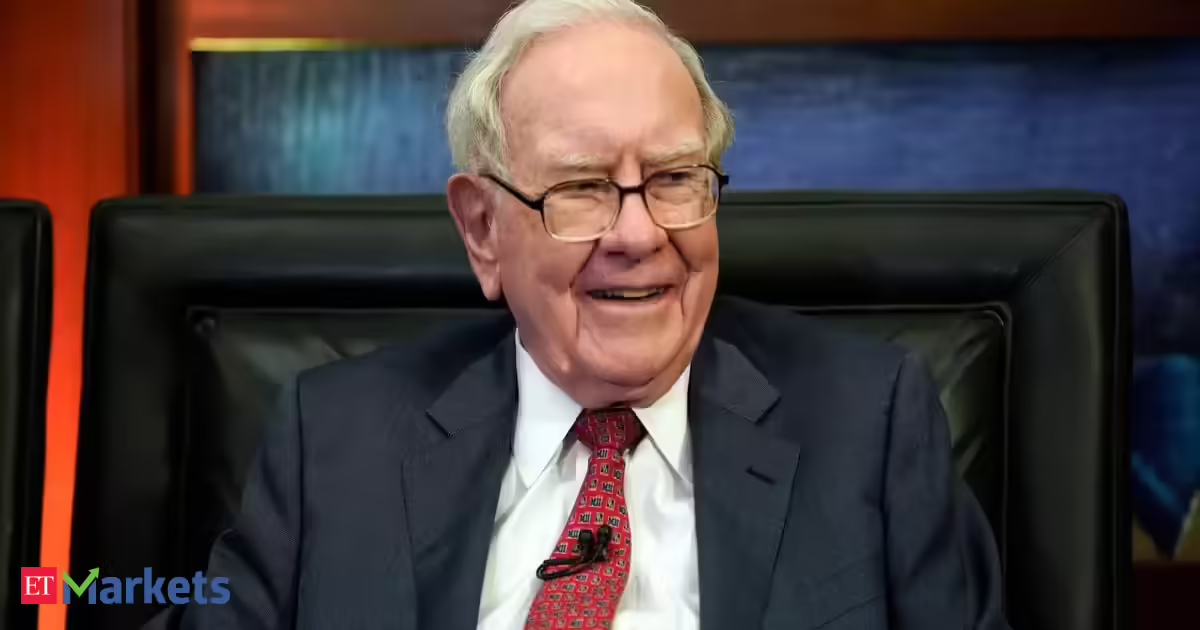
Warren Buffett sits on $400 bn cash as Michael Burry warns of AI bubble. Is a massive market crash coming?

Blockchain Researcher Defends Ethereum Foundation, Says It’s ‘Exactly’ Doing Its Job

21 Years Later, Tom Cruise’s Sci-Fi Spectacle Is One of Steven Spielberg’s Biggest Movies Ever Made


-

 Crypto World3 days ago
Blockchain.com files with SEC for U.S. IPO
-

 Fashion2 days ago
Holiday Weekend Open Thread – Corporette.com
-

 Business2 days ago
Dell Technologies DELL Stock Surges 15% on AI Server Momentum and Analyst Upgrades in 2026
-

 Crypto World2 days ago
Space X IPO Is ‘Bad News’ for Tech Stocks: But What About Bitcoin?
-

 Crypto World1 day ago
Robinhood crypto COO Tanya Denisova exits
-

 Politics2 days ago
Makerfield: a tale of two social-media histories
-

 Crypto World2 days ago
AI infrastructure race heats up as IREN pitches full-stack strategy, WhiteFiber lands $160M deal
-

 Tech2 days ago
WhatsApp ads could make Irish debut after discussions with DPC
-
 Tech2 days ago
A 0.12% parameter add-on gives AI agents the working memory RAG can’t
-

 Crypto World2 days ago
Bitcoin Accumulation Weakens as BTC Realized Losses Hit $600M
-
Crypto World6 days ago
Revolut Launches Dogecoin Debit Card Across UK and EU
-

 Tech2 days ago
You Can Now Add ChatGPT To PowerPoint
-

 Sports2 days ago
2026 CJ Cup Byron Nelson leaderboard: Brooks Koepka finds putting stroke in Round 1
-
 NewsBeat3 days ago
Charity run by Reform leader Malcolm Offord accused of ‘law breaking’ over Scottish registration
-

 Crypto World2 days ago
Trump Media’s Bitcoin Stash Shrinks Again as 2,650 BTC Lands on Crypto.com
-

 Business2 days ago
Trump Invests $1M-$5M in Kura Sushi USA Chain With 27 California Locations
-
Business2 days ago
Goldman Sachs reinstates Ageas stock coverage with neutral rating
-

 Crypto World6 days ago
SEC to propose tokenized stock framework as Wall Street efforts deepen: Bloomberg
-

 Politics7 days ago
SECOND secret Israeli base discovered in Iraqi desert
-

 Crypto World4 days ago
Exa Labs raises $250 million in funding led by a16z
You must be logged in to post a comment Login