

Crypto World
XRP users warned as fake Xaman airdrop scams spread



XRP Ledger developer and Xaman founder Wietse Wind renewed a warning to XRP users after scam accounts again targeted the wallet’s brand.
Summary
- Xaman founder Wietse Wind said fake desktop wallet and airdrop scams are targeting XRP users.
- More than 20 scam X accounts and 10 fake domains now appear daily, Wind said.
- Related reports said David Schwartz warned XRP users about fake airdrops and impersonators across platforms.
His latest post said fake Xaman accounts and websites continue to promote a desktop wallet and airdrop that do not exist.
The warning follows a similar alert from Ripple CTO Emeritus David Schwartz earlier this month, when he said fake airdrops, giveaways, and impersonators had increased across the XRP Ledger community. The fresh notice keeps attention on social engineering risks around XRP wallets.
Fake Xaman accounts target XRP users
Wind said more than 20 new X scam accounts impersonate Xaman Wallet each day. He also said more than 10 new domains appear daily, with websites pretending to be linked to the official wallet.
He warned users in direct terms: “There is no desktop wallet! No airdrop!” He added that the team reports the accounts, but new ones continue to appear. The message was aimed at users who may see fake links in replies, posts, or search results.
Scammers push fake wallet downloads
The fake campaigns often use copied branding to make users believe they are dealing with Xaman. Some sites push a fake desktop wallet, while others promote free token claims that ask users to connect wallets or sign transactions.
Xaman is a self-custody wallet for the XRP Ledger and Xahau ecosystem. Its official site says users control their assets through private keys held on their own devices, which makes transaction signing a key security step.
Earlier reports also described fake browser plugins, fake support pages, and direct messages from accounts posing as wallet staff. Those warnings said Xaman users should rely on in-app support and avoid outside channels that ask for wallet access.
Ripple-linked warnings continue
Related coverage reported that Schwartz warned XRPL users about a sharp rise in fake airdrops and giveaway scams. He said users should treat such posts with caution, adding that “any such posts you see are likely scams.”
Ripple has also warned users about fake support accounts and impersonation. Earlier reports said a fake Instagram account posed as Ripple CEO Brad Garlinghouse and pushed an XRP giveaway scheme. Such scams often copy real images and company names.
XRP users urged to avoid unknown links
The latest warning places wallet safety back at the center of the XRP community’s security debate. Fraud attempts often rely on user action, not a failure in the XRP Ledger itself.
Users should avoid unknown links, fake support messages, and websites asking them to connect wallets for free tokens. They should also avoid downloading any Xaman desktop app because Wind said no such product exists.
The message is direct for XRP holders: verify the source before signing any transaction. A fake airdrop, wallet download, or support message can become a wallet-draining attempt once a user approves it.



BlackRock, Franklin Templeton, JPMorgan, Citadel Securities, Société Générale, the NYSE, Nasdaq, and the Bank of England are all building the same thing right now. Not Bitcoin holdings. Not ETFs. They are rebuilding the global financial system’s plumbing on blockchain rails.
Summary
- Tokenized real-world assets crossed $29 billion, with the market on track for $100 billion this year.
- Tokenized U.S. Treasuries grew from $380 million in 2023 to $13.4 billion by April 2026.
- BlackRock, Franklin Templeton, JPMorgan, Citadel Securities, Nasdaq, and others are building tokenization infrastructure.
- Tokenization is shifting from crypto-native experiments to regulated financial rails used by major institutions.
The market for tokenized real-world assets just crossed $29 billion. It is on track for $100 billion this year. And it is happening with almost no coverage in the crypto press, because tokenization is boring, technical, and run by exactly the firms that crypto Twitter spent a decade insisting would never show up.
The most important crypto story is the one no one is talking about
If you wanted to understand what crypto will look like in five years, you would not start with Bitcoin price predictions. You would not start with Ethereum’s roadmap. You would not start with the latest meme coin or the newest layer two. You would start with a quiet line item on RWA.xyz that read, in early May 2026, “Total tokenized asset value: $29.27 billion.”
That number doesn’t sound dramatic. It is dwarfed by Bitcoin’s market cap. It is smaller than several individual altcoins. The category does not have a flagship token to rally around. The headlines it generates are dry. And yet, of all the things happening in digital assets right now, the slow institutional migration of traditional financial instruments onto public blockchains is the one most likely to matter in ten years, and it is the one getting the least attention from the audience that is supposedly built to care about it.
The numbers, briefly. The tokenized real-world asset market (excluding stablecoins) grew from roughly $1.5 billion in early 2023 to $29.27 billion by April 2026, a near-twentyfold expansion. Within that, tokenized US Treasuries went from $380 million in Q1 2023 to $13.4 billion by April 2026, a 37x jump. Tokenized commodities, mostly gold, hit $7.3 billion. Tokenized equities crossed $960 million, more than doubling from mid-2025. Yield-bearing on-chain dollar instruments, the bridge category between stablecoins and tokenized funds, added another $8 billion or so on top.
Over forty major financial institutions are now actively issuing tokenized products on public blockchains. That includes BlackRock, the largest asset manager in the world, which has its $2.4 billion BUIDL fund running on Ethereum, recently extended to multiple chains, and as of Q1 2026 plugged into Uniswap.
Franklin Templeton runs its BENJI tokenized money market fund across multiple blockchains and recently partnered with Ondo Finance to launch tokenized versions of five ETFs tradable 24/7 via crypto wallets. Circle, Fidelity, WisdomTree, JPMorgan, Citadel Securities, Société Générale, Nomura, HSBC, the DTCC, Euroclear, the London Stock Exchange Group, and the Bank of England are all building infrastructure in this space.
What is being built, in plain language, is a new layer for the financial system. Treasuries that settle in seconds rather than days. Money market funds that can be used as DeFi collateral. ETFs that trade twenty-four hours a day. Stocks that can be borrowed against without being sold. Private credit that used to sit in illiquid, opaque, multi-million-dollar minimum vehicles, now sliced into tokens with on-chain provenance and continuous price discovery. Real estate debt. Bonds. Repos. Gold. Eventually, equities. The list keeps growing.
And the people building it are exactly the ones the crypto industry spent ten years insisting did not understand what was coming.
Why $29 billion sounds small but is not
It is fair to ask: $29 billion is not a lot in the context of a $130 trillion global capital market. Why does this matter now, if at all?
Three reasons.
First, the rate of change is what matters here, not the absolute size. The tokenized RWA market grew 263 percent year-over-year in 2025. It grew roughly 30 percent in Q1 2026 alone. That compound monthly growth rate above ten percent puts the sector on a trajectory that, if it merely holds, will cross $100 billion this year and reach trillion-dollar scale within five. The McKinsey, BCG, and Standard Chartered analyst notes that put 2030 tokenization at $5 to $30 trillion are not lottery-ticket forecasts. They are what happens if today’s growth rate continues.
Second, the quality of the participants has changed. The 2021 wave of tokenization was mostly DeFi-native projects experimenting at the margins. The 2026 wave is the largest asset managers, custodians, exchanges, and central banks in the world. In Q1 2026 alone: BlackRock’s BUIDL fund went live on Uniswap, the first time a major asset manager connected a regulated tokenized fund to a decentralized exchange. The DTCC, Euroclear, Tradeweb, Citadel Securities, and Société Générale completed the first cross-border intraday repo using tokenized UK gilts on the Canton Network. Galaxy Digital’s tokenized GLXY shares became available as collateral on Solana’s largest lending protocol. Binance relaunched tokenized stock trading in partnership with Ondo Finance. None of these moves is the work of crypto-native startups looking for a niche. These are TradFi institutions wiring their own products onto blockchain rails.
Third, the regulatory environment has shifted meaningfully in the institutions’ favor. In Q1 2026, the SEC issued its first formal statement on tokenized securities in January. In February, it approved WisdomTree’s tokenized money market fund for intraday trading.
In March, the SEC and CFTC released joint guidance on digital asset taxonomy. The GENIUS Act on stablecoins took effect in 2025. The CLARITY Act on market structure cleared committee in May 2026 and is on track for a possible signing this summer.
Larry Fink, the CEO of BlackRock, who eight years ago called Bitcoin “an index of money laundering,” now publicly describes tokenization as the future of finance, with the explicit endorsement that tokenizing traditional assets will “make investments easier to issue, easier to trade, and easier to access.”
These three things together, the growth rate, the participants, and the regulatory tailwind, make the current $29 billion number a deeply misleading anchor. The right way to read it is not “small.” The right way to read it is “early.”
What is actually being tokenized, and why
To see why this matters in practice, look at what is being put on chain first and ask why a sophisticated CFO or treasurer wants it there.
Tokenized US Treasuries are the biggest category at $13.4 billion. The pitch is direct. A short-dated Treasury bill earns yield, but holding a T-bill traditionally means using a fund vehicle, paying for custody, and being unable to move the asset without selling. A tokenized Treasury fund pays the same yield but settles in seconds, runs twenty-four hours a day, can be transferred peer-to-peer between accounts, and crucially can be used as collateral in on-chain lending markets without first being liquidated. For a corporate treasurer managing operating cash, this is a meaningful upgrade. The yield comes from the same Treasuries; the operational flexibility is entirely new.
The leading products tell the story. Circle’s USYC sits at $2.7 billion. Ondo’s suite, including OUSG, at $2.6 billion. BlackRock’s BUIDL at $2.4 billion. Franklin Templeton’s BENJI at $1 billion. WisdomTree’s WTGXX at $861 million. The architecture varies, BUIDL is a regulated fund wrapper for qualified investors, OUSG is a tokenized note that holds BUIDL as its underlying asset, USDY is yield-bearing for non-US investors, but the common theme is “Treasury exposure plus on-chain composability.”
Tokenized commodities are the third-largest category at $7.3 billion. Gold dominates. The pitch here is simpler still: a tokenized gold claim trades twenty-four hours a day, settles in seconds, and is divisible to fractions of a gram. HSBC’s Hang Seng Investment announced plans to launch a gold ETF with tokenized shares. Hong Kong’s HashKey Chain supports the territory’s first regulated silver-backed RWA token. Tokenized commodities are slowly broadening from gold into other metals.
Tokenized equities crossed $960 million by March 2026, up sharply from $424 million at mid-2025. Ondo holds roughly sixty percent of this segment through its Global Markets platform, which offers tokenized versions of US stocks including BlackRock, Coinbase, Coupang, and Circle, among others. The use case here is partly about access (non-US investors who want exposure to US equities) and partly about composability (tokenized stocks usable as DeFi collateral). The NYSE and Nasdaq are both building their own 24/7 tokenized securities infrastructure on different architectural approaches, with the NYSE working through a partnership with Securitize and Nasdaq receiving SEC approval in March for tokenized stock trading.
Private credit is the second-largest category at roughly seventeen percent of total RWA value. This is the segment with the largest long-term upside and the most structural complexity. Global private credit is a $1.7 trillion asset class largely locked inside multi-million-dollar minimum funds with quarterly liquidity and minimal transparency. Tokenization promises continuous price discovery, fractional access, and instant settlement. Most of that promise is still ahead of the product, but the firms working on it, Apollo, Hamilton Lane, Securitize, Centrifuge, are not crypto tourists.
Tokenized repo is the most under-noticed development of Q1 2026. The DTCC, Euroclear, Tradeweb, Citadel Securities, and Société Générale executed the first cross-border intraday repo using tokenized UK gilts on the Canton Network. The Bank of England launched its Synchronisation Lab in the same quarter to explore tokenized settlement with central bank money. The repo market is one of the most plumbing-heavy pieces of global finance, with trillions of dollars of daily volume. Moving any meaningful share of it onto tokenized rails is the kind of structural change that, once it starts, does not stop.
The three firms running the institutional layer
For the segment that has scaled most, tokenized Treasuries, the institutional layer comes down to three names: BlackRock, Franklin Templeton, and Ondo Finance. Each plays a different role, and the way they interact tells you most of what you need to know about how this sector is being built.
BlackRock anchors the institutional credibility layer. Its BUIDL fund is the largest tokenized Treasury product on a public blockchain. The architecture, a regulated fund wrapper distributed through Securitize on Ethereum and now several other chains, with BNY Mellon as custodian, is the template every competitor has copied. BUIDL went live on Uniswap in Q1 2026, the first time a regulated tokenized fund became tradable through a decentralized exchange. The top ten holders of BUIDL control roughly 98 percent of supply, which sounds concentrated until you realize it reflects BUIDL’s role as the wholesale liquidity backbone for the entire sector. Other products, including Ondo’s OUSG, hold BUIDL as their reserve asset.
Franklin Templeton holds the first-mover credential. Its BENJI tokenized money market fund launched on a public blockchain in 2021, making it the first SEC-registered tokenized money market fund. BENJI now operates across multiple blockchains with $1 billion in AUM, up roughly 140 percent over two years. Franklin Templeton has described tokenization as “structural rather than cyclical,” language designed to signal the firm is in this to build infrastructure rather than run a pilot. In Q1 2026 the firm partnered with Ondo to launch tokenized versions of five ETFs, tradable 24/7 through crypto wallets.
Ondo Finance is the connector. Unlike BlackRock and Franklin Templeton, Ondo is crypto-native, founded in 2021 with backing from Coinbase Ventures and Founders Fund. Ondo’s role is to take institutional-grade underlying assets, like BUIDL, and wrap them in smart contracts that are usable in DeFi, accessible to a broader base of investors, and deployable across multiple chains. OUSG holds BUIDL as its primary reserve. USDY, Ondo’s yield-bearing dollar product for non-US investors, is backed by short-term Treasuries and bank deposits, and has generated over $1.5 billion in cumulative DEX volume across chains like BNB Chain and Solana. Ondo Global Markets, the tokenized equities platform, holds about sixty percent market share in its segment with $550 million in TVL. The SEC closed its investigation into Ondo without charges in November 2025, and the firm filed a voluntary registration statement in February 2026.
The most important observation about this trio is that they are partners as much as competitors. BUIDL provides the institutional plumbing. BENJI provides the compliance precedent. Ondo provides the distribution and composability layer. The sector is not a winner-take-all market. It is a stack, and the firms occupying different positions in the stack reinforce each other’s growth.
What this means for the rest of crypto
This is the part of the story that most directly affects readers who do not care about tokenized money market funds but do hold crypto.
Tokenization is the channel through which traditional finance is, in practice, adopting crypto. Not by buying Bitcoin. Not by launching ETFs as marketing exercises. By moving its own products, the funds, the bonds, the equities, the repos, the commodities, onto the same public blockchains crypto-native projects use. Every tokenized Treasury fund deployed on Ethereum builds that blockchain’s institutional usage, fee revenue, and stickiness. Every tokenized equity on Solana does the same. Every tokenized repo on the Canton Network strengthens the case for institutional-grade blockchain infrastructure broadly.
That has knock-on effects.
For Ethereum, tokenization is the single most important long-term demand driver. The largest tokenized funds in the world settle on Ethereum or Ethereum L2s. If even a small fraction of the projected $100 billion-plus tokenization market lands on Ethereum’s rails, the network’s institutional usage in 2027 will look fundamentally different from its retail-dominated profile in 2021.
For Solana, tokenization is the most credible institutional use case beyond meme trading. Galaxy Digital chose Solana for its tokenized equity collateral pilot. BNB Chain saw $1.3 billion of USDY DEX volume. Tokenized equities scaling on Solana would meaningfully shift the perception of the chain among allocators.
For DeFi protocols, tokenization is the long-awaited “real yield” thesis arriving in concrete form. Lending markets like Aave and Morpho can now hold tokenized Treasuries as collateral, which pulls in capital that was structurally unable to engage with DeFi when the only collateral on offer was volatile crypto. The result is a class of DeFi user who is not a degenerate trader chasing 200 percent APY but a corporate treasurer earning four percent on tokenized T-bills while keeping the option to borrow against them.
For Bitcoin holders, the tokenization story is more indirect. Bitcoin itself does not host tokenized RWAs at scale, and its base layer is not designed to. But Bitcoin sits in the same regulatory and institutional ecosystem as the rest of the tokenized asset complex. The capital and credibility that flow into tokenized Treasuries flow into the same custody platforms, prime brokers, and compliance frameworks that hold Bitcoin. Indirectly, this builds the rails that make Bitcoin allocation easier and more durable for the institutions that have already begun, and that pipeline is wider than any single ETF approval would be.
What can still go wrong
A piece that only described the upside would be marketing, so here is the honest side.
Tokenization remains operationally complex. A tokenized Treasury fund is still a fund, with off-chain custody, off-chain administration, off-chain audit, and off-chain regulators. The blockchain wrapper does not eliminate counterparty risk. It changes where claims are recorded, not where assets live. The 2023 USDC depeg over Silicon Valley Bank exposure is the cautionary tale every tokenized asset issuer now writes against. If the institutions providing custody fail, the tokens are only as good as the recovery process for the underlying.
Regulation remains a moving target. The Q1 2026 SEC and CFTC clarifications were a step forward, but tokenized equities, tokenized private credit, and tokenized real estate each carry distinct regulatory questions that have not been fully answered. A tokenized equity issued in one jurisdiction may face restrictions when held by an investor in another. Tax treatment of yield-bearing tokenized instruments remains messy across borders.
Concentration is real. The top ten BUIDL holders own 98 percent of supply. The top three tokenized Treasury products account for more than half the segment. Early-stage market structure looks oligopolistic, which is fine until a major participant has a problem and creates a contagion path that did not exist in the pre-tokenized version of the same instruments.
And the gap between current scale and the trillion-dollar projections is enormous. The forty-times growth required for the sector to reach $1 trillion is not impossible at current rates, but it requires sustained institutional adoption, regulatory continuity, and the absence of a serious failure event. Any of those three can falter, and the entire growth curve flattens.
The story underneath the story
The reason tokenization is the real story, and the reason most coverage misses it, is that it does not look like crypto. There is no token to pump. There is no community to rally. The growth chart is steady rather than parabolic. The companies involved are the firms crypto Twitter spent a decade dunking on. The progress arrives in SEC press releases and BlackRock product announcements rather than in CT threads. None of this is the aesthetic of crypto, which is partly why coverage of it has been so thin.
But it is the substance. The thing crypto was supposed to be for, depending on which generation of the argument you grew up with, was the disintermediation of legacy finance, or the upgrade of money to internet speeds, or the creation of programmable financial infrastructure that did not depend on permission from banks. Tokenization is, quite literally, all three of those things happening at once. The fact that it is happening through banks, with permission, on regulated rails, is what makes it real and durable rather than ideological and brittle. The ideological version of crypto, the one that promised to make TradFi obsolete, mostly failed. The pragmatic version, the one that takes TradFi’s products and ships them on better rails, is succeeding.
That is the story. It is happening at scale. It is accelerating. The biggest financial institutions in the world are building it together rather than fighting it. And the crypto press is mostly looking the other way, because tokenization does not photograph well and does not have a meme.
In ten years, the question will not be whether Bitcoin or Ethereum won. It will be whether the global financial system runs on tokenized rails. The answer to that question is being written right now, $29 billion at a time, and it is being written by the firms most people thought would never show up.
They showed up. They are building. And the rest of us, if we are paying attention, will eventually catch on.
This article is for informational purposes and does not constitute financial or investment advice. Tokenized asset markets, regulatory frameworks, and product structures evolve quickly; the figures and product details described reflect reporting available as of mid-May 2026. Always do your own research.
Senior officials at the Commodity Futures Trading Commission who raised concerns about prediction market companies were suspended, investigated and eventually pushed out of the agency.
According to a New York Times investigation published Sunday, the officials had flagged concerns about Polymarket, Crypto.com and a Gemini affiliate, each with alleged business ties to the Trump family. Career staff worried that Crypto.com was not treating small bettors fairly, that Polymarket lacked adequate fraud protections and that Gemini’s affiliate had not completed the required regulatory review to operate.
Despite those concerns, then-acting CFTC chair Caroline Pham and her senior counsel intervened to help the firms get what they wanted, sources told the NYT. By the end of 2025, two officials who had raised questions were placed on administrative leave and under internal investigation. Three others who had enforced crypto laws faced the same fate. None were told what they had done wrong.
“But current and former agency staffers said in interviews that the commission’s work force took away a clear message: Don’t cause trouble for those industries,” the report wrote.
Related: US Senate Banking Committee votes to advance CLARITY Act
CFTC pulls back on crypto enforcement
The report noted that the CFTC has significantly pulled back on crypto enforcement. The agency dropped at least five crypto investigations and went from filing more than 80 crypto enforcement actions under Biden to just two under Trump. Both of the recent cases targeted individual operators, not major firms.
Pham left the agency to join MoonPay, a crypto firm partnered with Polymarket. Her senior counsel, Brigitte Weyls, became general counsel at Gemini Titan, the same company whose application she helped approve, the NYT claimed. Current chair Michael Selig, the agency’s sole commissioner, previously represented crypto firms as a corporate lawyer.
Crypto.com is a business partner of Trump Media. Polymarket received investment from Donald Trump Jr-backed venture capital firm 1789 Capital. Gemini’s founders are financial backers of American Bitcoin Corp, a crypto firm co-founded by Eric Trump.
“President Trump only acts in the best interests of the American public,” Davis Ingle, a White House spokesman, told the outlet. “There are no conflicts of interest.”
Cointelegraph reached out to Polymarket, Crypto.com and Gemini for comment, but had not received a response by publication.
Relateed: CFTC no-action letter eases event contract reporting rules
CFTC sues states over prediction markets
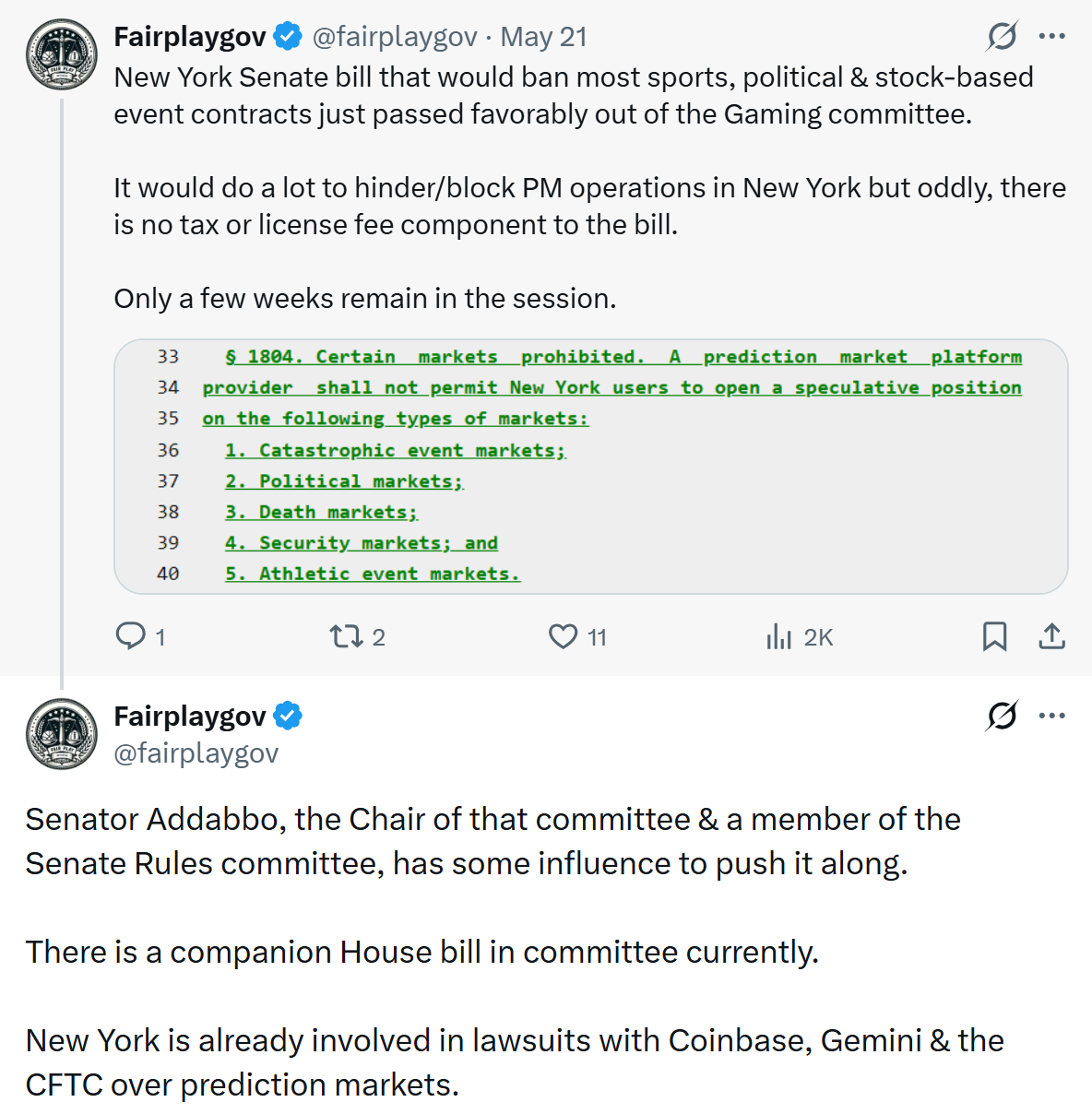
As Cointelegraph reported, the CFTC has filed lawsuits against over their legal proceedings against prediction market platforms, launching action against regulators in Wisconsin, Minnesota, New York, Arizona, Connecticut and Illinois.
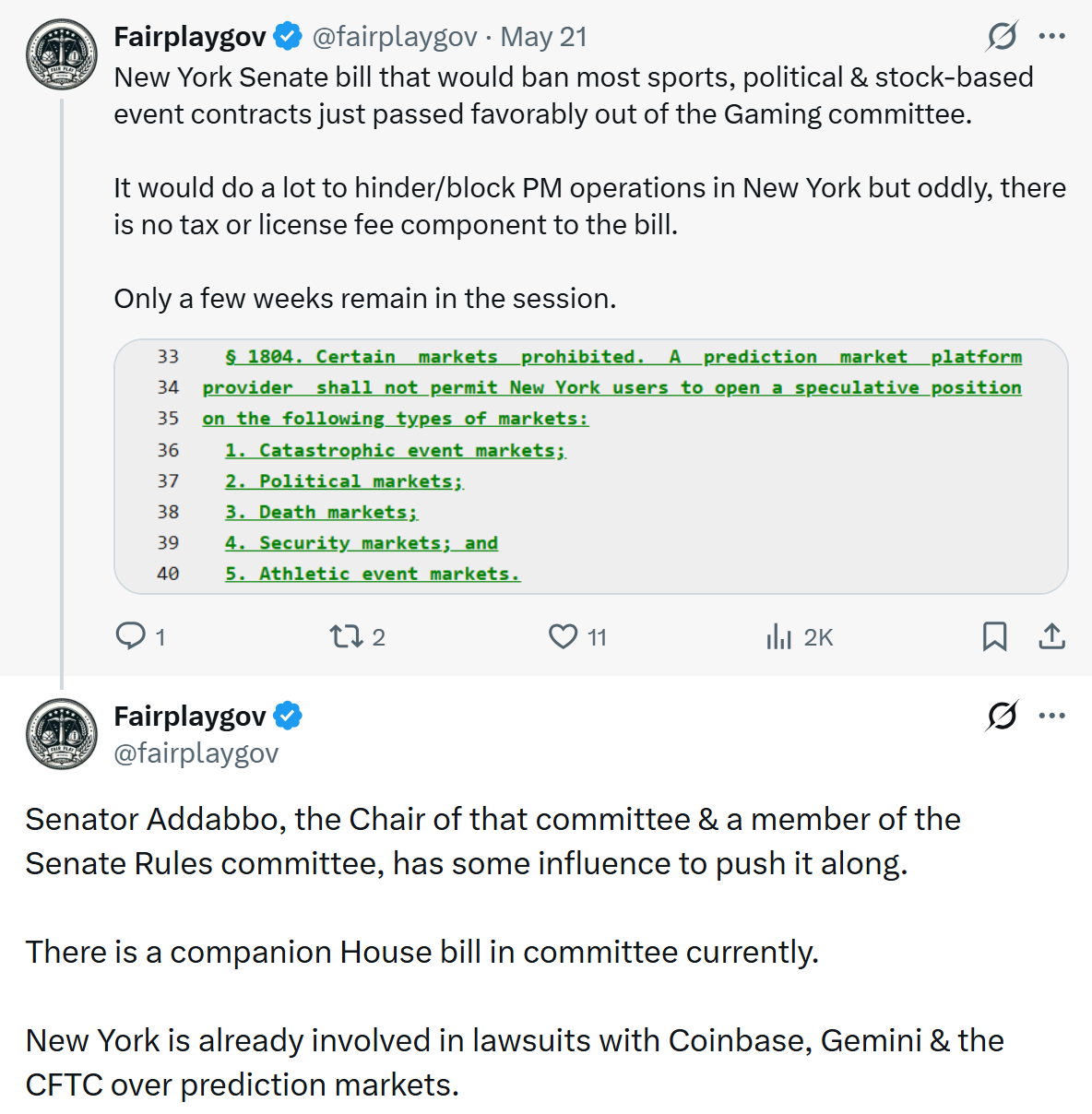
Source: Fairplaygov
Last week, the House Agriculture Committee urged Trump to nominate four commissioners to the CFTC, warning the agency is ill-equipped to handle its growing responsibilities with only one member in place.
Magazine: Guide to the top and emerging global crypto hubs — Mid-2026


Senior Commodity Futures Trading Commission officials who raised concerns about prediction market firms were suspended, investigated and pushed out, according to a New York Times investigation.
Summary
- NYT reported CFTC officials raised concerns about Polymarket, Crypto.com and a Gemini affiliate before suspensions.
- Crypto.news reported CFTC relief for event contracts as prediction market legal fights widened nationwide.
- The CFTC sued New York after state actions against Coinbase and Gemini prediction markets.
The NYT reported that career officials questioned activity tied to Polymarket, Crypto.com and a Gemini affiliate. Staff raised concerns over consumer treatment, fraud controls and whether one affiliate had finished a needed regulatory review.
The report said then-acting CFTC chair Caroline Pham and senior counsel Brigitte Weyls later helped the firms move forward. The NYT said two officials who raised questions were placed on administrative leave by late 2025. Three other staff members tied to crypto enforcement also faced the same action.
Crypto enforcement falls under scrutiny
The NYT report said the CFTC pulled back from crypto enforcement under the current administration. It said the agency dropped at least five crypto probes and filed only two crypto enforcement cases, both against individual operators.
The article also said staff saw a clear message inside the agency: “Don’t cause trouble.” The White House denied conflict claims. Spokesman Davis Ingle told the NYT, “There are no conflicts of interest.”
Prediction market rules remain contested
Related crypto.news coverage reported that the CFTC gave no-action relief for fully collateralized event contracts listed on regulated exchanges. The relief covered some swap data reporting and recordkeeping duties for designated contract markets, clearing firms and market participants.
The CFTC also opened a wider rule process for prediction markets in March. The Federal Register notice said the agency sought public comment on event contracts, public interest limits, cost-benefit issues and possible future rules.
Meanwhile, crypto.news reported that prediction market platforms face state-level legal fights even as federal officials support broader CFTC control. The report said the CFTC had challenged actions in Arizona, Connecticut, Illinois, New York and Wisconsin.
Reuters also reported that the CFTC sued New York on April 24. The agency accused the state of intruding on federal authority after New York sued Coinbase Financial Markets and Gemini Titan over prediction market products.
As crypto.news reported, Congress has also raised concern over the CFTC’s thin leadership bench. The House Agriculture Committee last week pressed President Trump to fill the agency’s four vacant commissioner seats, saying a one-member commission cannot keep pace with its expanding crypto and prediction market duties.
Polymarket talks add to pressure
Crypto.news reported that Polymarket has been in active talks with the CFTC to lift a four-year U.S. ban tied to a 2022 enforcement action and $1.4 million settlement. The report said the talks center on contract design, KYC and reporting.
The same coverage said Polymarket bought QCX LLC, a CFTC-registered exchange, for about $112 million in 2025. That deal could help the platform build a regulated U.S. path if officials approve the plan.
The dispute now comes as Congress weighs broader crypto rules. Crypto.news reported that the Senate Banking Committee advanced the CLARITY Act in a 15-9 vote, a bill that would split digital asset oversight between the SEC and CFTC.

After more than eight years at the helm of America’s central bank, Jerome Powell’s term ended on Friday, and he was replaced by the seventeenth Federal Reserve Chair, Kevin Warsh.
Given US President Trump’s growing public issues with Powell for refusing to lower the key interest rates, the POTUS’s new pick is expected to have a more open-minded approach to the institution’s monetary policy. He has also expressed support for BTC in the past, which has some altcoin fans questioning whether it extends to other crypto assets.
As such, we decided to ask one of the most popular AI models whether XRP, the third-largest non-stablecoin altcoin, could benefit as well.
Far More Nuanced
Gemini said that BTC benefits from being viewed as “digital gold,” but the landscape around utility-focused alts such as XRP under a Warsh-led Federal Reserve is “far more nuanced.” It added that the new Fed head is likely to bring a “mix of strict macroeconomic discipline and an open-minded approach to financial innovation that could uniquely impact the Ripple ecosystem.”
His pre-office disclosures revealed investments across the DeFi space, Layer-1 blockchains, and digital asset exchanges, which shows an appetite for cryptocurrency utility beyond just store-of-value propositions.
More importantly for XRP, Warsh has been vocal about the “modernization of money.” He has argued in the past that central banks must “proactively engage with digital currencies and has pushed for the US to consider a Central Bank Digital Currency to remain competitive, especially against initiatives like China’s digital yuan.”
Ripple has positioned the XRP Ledger to act as a neutral bridge asset for various CBDCs, which could benefit the underlying asset.
“A Fed Chair who is actively exploring the integration of digital, blockchain-based money into the traditional financial system provides a massive structural tailwind for Ripple’s core business model,” concluded Gemini for its bull case.
But There’s More
However, it’s not all promising and bullish predictions. The AI warned that Warsh has repeatedly noted that the explosion of alternative digital assets is largely a byproduct of loose monetary policy. XRP, similar to most altcoins, relies heavily on broad market liquidity.
Gemini believes capital is likely to become more expensive in the US as Warsh would want to reduce the Fed’s footprint in financial markets. In such tight liquidity environments, investors typically “flee from altcoins toward safer assets or bitcoin,” added Gemini.
If the new Fed Chair executes his vision of higher real rates and a smaller Fed balance sheet, XRP could “face severe downward price pressure as speculative capital dries up.”
The post Will XRP Skyrocket With Warsh Heading the Fed? Gemini Outlines Ripple’s Path Forward appeared first on CryptoPotato.
Crypto World
VELO Protocol Emerges as a Key Player in the Next Generation of Global Payment Infrastructure

TLDR:
- Velo and Lightnet share ties to CP Group, giving the ecosystem deep regulatory and banking access across Asia
- USDV is backed by BlackRock’s BUIDL fund via Securitize, making it a regulated, yield-bearing settlement asset.
- mBridge, the BIS-backed multi-CBDC platform, mirrors the exact settlement architecture Velo has been building.
- Regional V-Stablecoins tied to local fiat currencies point to a multilayered, interoperable payment framework.
VELO Protocol and its associated ecosystem are drawing renewed attention as observers examine parallels between the project’s infrastructure and emerging frameworks for cross-border settlement.
With regulated stablecoins, tokenized real-world assets and multilateral payment corridors gaining traction globally, VELO’s positioning has become a topic of discussion in institutional crypto circles.
USDV and the Shift Toward Regulated Settlement Assets
Crypto analyst Marco Salzmann recently shared observations on X, noting that VELO may be “one of the most misunderstood infrastructure plays in crypto.” He pointed to its connections with Lightnet, XRPL, EVOLVE and multi-CBDC initiatives as evidence of a broader architectural alignment.
At the center of this discussion is USDV, Velo’s native settlement stablecoin. Unlike conventional stablecoins, USDV carries exposure to BlackRock’s USD Institutional Digital Liquidity Fund, known as BUIDL, tokenized through Securitize. This structure positions USDV as a yield-bearing, regulated digital asset rather than a simple liquidity tool.
As global regulators tighten oversight, particularly following MiCA implementation in Europe, the market has begun separating regulated institutional assets from unregulated bridges.
USDV appears designed for the former category, which may carry weight with institutional payment infrastructure.
Velo has also explored additional V-Stablecoins tied to regional fiat currencies. This points toward a multilayered settlement architecture built around interoperable regional liquidity rather than a single dominant asset.
Lightnet, mBridge and the Asian Payment Corridor
Velo and Lightnet share a co-founder in Chatchaval Jiaravanon, a member of the family behind CP Group, one of Asia’s most influential conglomerates.
That connection carries practical weight, given that cross-border payment systems depend heavily on regulatory access, banking relationships and geopolitical trust.
Lightnet’s presence in Hong Kong is particularly relevant here. The city is increasingly functioning as a regulated digital asset sandbox and a potential gateway into broader Chinese financial experimentation.
Through partnerships such as WeLab and its pursuit of Money Service Operator licensing, Lightnet has established itself within a key future payment corridor connecting ASEAN, Hong Kong and China.
Adding another layer is mBridge, the BIS-backed multi-CBDC platform involving the central banks of China, Hong Kong, Thailand and the UAE.
Its focus on multilateral netting, national currency settlement and blockchain accounting closely mirrors the infrastructure Velo and Lightnet have been building over several years.
Whether these overlaps translate into formal integration or simply reflect parallel development remains an open question.
However, the convergence of regulated stablecoins, tokenized treasury exposure, OTC fiat gateways and multi-CBDC corridors around a common set of players is worth monitoring closely going forward.

Crypto World
Five Key Stocks to Monitor Next Week: Marvell, Dell, Salesforce, Costco, and Tesla Take Center Stage

Key Takeaways
- Marvell Technology’s earnings will spotlight custom AI chip demand and data center infrastructure trends
- Dell Technologies must demonstrate that strong AI server revenue is driving improved profitability
- Salesforce results will reveal whether enterprise spending on AI-powered software is accelerating
- Costco’s quarterly report offers insight into spending patterns among value-conscious consumers
- Tesla remains a focal point without earnings, as investors track robotaxi developments, China sales, and AI initiatives
The coming week brings a packed calendar with five significant companies poised to influence market sentiment across artificial intelligence infrastructure, enterprise technology, consumer retail, and electric vehicles.
AI Infrastructure Takes Center Stage
Marvell Technology delivers its quarterly results next week, positioning itself as a crucial indicator for AI infrastructure investment. The semiconductor company specializes in custom chip solutions, optical networking technology, and data center connectivity components. The primary question: are hyperscale cloud providers maintaining aggressive AI capital expenditure?
Marvell Technology, Inc., MRVL
The bar is elevated following impressive share price performance. Strong results would validate the thesis that AI-driven semiconductor demand extends well beyond Nvidia to encompass the broader chip ecosystem.
Dell Technologies also announces results this week. Market perception has evolved from traditional PC manufacturer to a proxy for enterprise AI server adoption. Recent momentum stems from robust orders in high-performance computing and data center infrastructure.
The critical question centers on margin expansion. While AI server revenue looks impressive, these systems carry substantial build costs. Investors demand evidence that this business generates meaningful bottom-line improvement, not just top-line growth.
Enterprise Software and Retail Under Examination
Salesforce provides a contrasting perspective on artificial intelligence adoption. Unlike hardware manufacturers, it serves as a litmus test for actual enterprise investment in AI software tools and intelligent automation platforms.
The software giant has emphasized AI agents and integrated data solutions as its primary growth catalyst. Key metrics include revenue acceleration, operating margin trends, and tangible evidence of customer adoption for these newer offerings.
Costco represents the week’s bellwether for consumer spending patterns. The warehouse club appeals particularly to affluent and value-oriented households, making it an effective gauge of discretionary spending.
Analysts will scrutinize comparable store sales, membership renewal rates, and customer traffic patterns. Given the stock’s premium multiple, investors require both robust current performance and optimistic forward guidance.
Tesla won’t release quarterly results but consistently commands attention. Market participants monitor robotaxi timeline updates, Chinese market performance, vehicle margin trends, and public statements from CEO Elon Musk.
The electric vehicle manufacturer emphasizes a long-horizon narrative encompassing artificial intelligence, fully autonomous driving technology, and robotics applications. However, investors simultaneously seek near-term validation of sustained demand and stable profitability.
Key Monitoring Points
This quintet represents distinct market segments. Marvell and Dell illuminate AI infrastructure investment trends. Salesforce demonstrates whether capital flows into enterprise AI software. Costco reflects consumer financial health. Tesla functions as both a sentiment indicator for retail investors and a barometer for AI-adjacent growth narratives.
Results from these five companies could establish clearer market direction as June approaches.
Key Takeaways
- The S&P 500 has completed its most impressive winning streak since 2023, yet market experts are flagging potential summer weakness.
- Historical data from Dow Jones Market Data shows the S&P 500 typically loses 2.8% between April and September during midterm election cycles.
- Crude oil prices climbing toward $110 per barrel and the 10-year Treasury yield reaching a 12-month peak of 4.61% are creating market headwinds.
- Semiconductor names including Sandisk, Micron, and AMD have experienced declines ranging from 9% to 14% across five trading sessions amid broader concerns.
- According to Deutsche Bank, a full market correction would require sustained oil shocks, contractionary economic indicators, or aggressive Federal Reserve policy tightening.
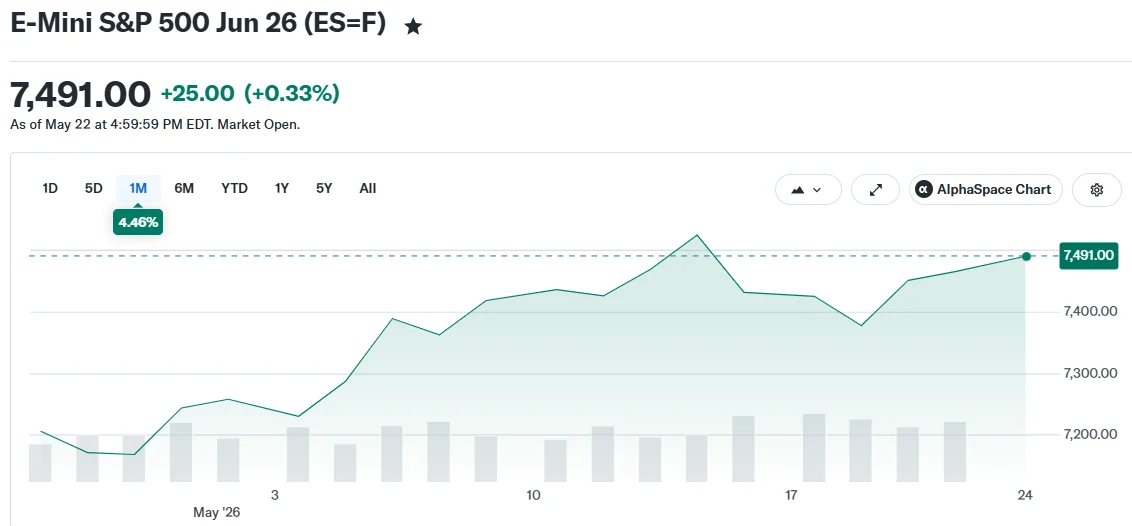
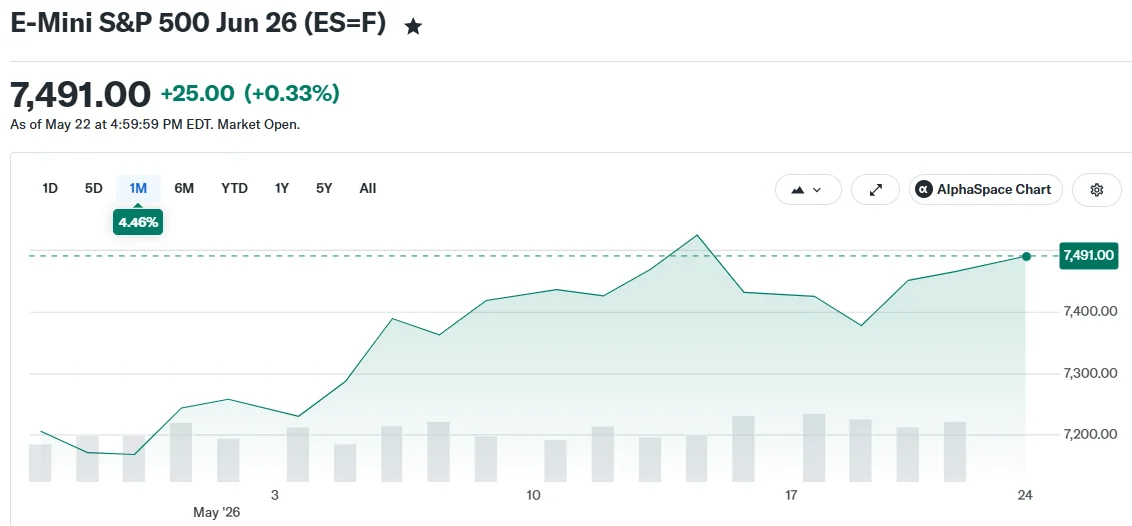
The S&P 500 has achieved eight consecutive weeks of positive returns — marking its strongest performance streak since 2023. Friday’s session concluded with all three major indices posting gains, extending the weekly winning pattern.
However, as we transition into June, market analysts are raising yellow flags. Historical patterns suggest that summer months during midterm election cycles have traditionally presented challenges for equity markets.
Data compiled by Dow Jones Market Data reveals that the S&P 500 typically experiences an average decline of 2.8% from late April through late September in years featuring midterm elections. Through May, the benchmark index has already climbed 3.7% this year.
Historical midterm summers have witnessed dramatic declines. The benchmark index plummeted over 25% in 1930, dropped nearly 30% in 1974, and tumbled 24% in 2002 — all during midterm cycles. Even when these extreme cases are excluded from the calculation, the average return for this period registers virtually zero, showing a minimal gain of just 0.006%.
The Cboe Volatility Index is currently trading at 16.7%. Charlie McElligott, a strategist at Nomura, has highlighted this level as notably elevated for a market experiencing such a robust upward trajectory, indicating potential underlying vulnerabilities.
Jeffrey Hirsch, who publishes the Stock Trader’s Almanac, explains that midterm election years typically redirect investor attention from corporate earnings toward political uncertainty. While he doesn’t anticipate a full bear market, he suggests the market may experience “sideways choppy” movement throughout the summer months.
Jay Hatfield from Infrastructure Capital Advisors highlights a cyclical seasonal trend: equity markets typically demonstrate strength during earnings reporting periods but show weakness in the intervals between them.
Crude Oil Surge and Yield Increases Compound Market Concerns
Meanwhile, international markets have experienced downward momentum over recent weeks due to escalating tensions involving Iran.
Brent crude oil has rallied near $110 per barrel, fueled by supply chain disruptions affecting the Strait of Hormuz. This surge is driving gasoline prices upward just as Memorial Day weekend travel approaches.
The 10-year US Treasury yield has advanced to a new 12-month high of 4.61%. Elevated yields enhance the attractiveness of fixed-income securities relative to equities while simultaneously increasing corporate financing costs.
The pairing of persistent inflation readings and climbing yields has triggered selling pressure within technology and semiconductor sectors. Sandisk and Micron have each declined approximately 14% over five consecutive sessions. AMD has retreated roughly 9% during the same timeframe.
Henry Allen, a strategist at Deutsche Bank, indicated that a significant market pullback would necessitate at least one of three catalysts: a prolonged oil price shock, definitively contractionary economic metrics, or aggressive interest rate increases from central banking authorities. He observed that while crude prices remain elevated, none of these conditions have clearly materialized.
Nevertheless, Hatfield suggested a potential positive scenario. Should Democrats secure the House while Republicans maintain Senate control, the resulting divided government could benefit markets. Historical evidence shows that legislative gridlock has generally supported equity valuations by minimizing the probability of substantial policy transformations.
“Gridlock is generally great for stocks,” Hatfield said.


Blockchain researcher William Mougayar defended the Ethereum Foundation after months of criticism over ETH sales, unstaking activity, and limited public communication.
Summary
- William Mougayar said critics misread the Ethereum Foundation by treating it like a marketing team.
- Recent Foundation sales to BitMine totaled 25,000 ETH across three OTC deals lately.
- Separate reports showed 38,305 ETH unstaked from Lido and earlier queues during recent treasury moves.
Mougayar said critics often judge the Ethereum Foundation by the wrong standard. In his X post titled “Leave the Foundation Alone,” he argued that the group serves the protocol rather than ETH’s market price.
He said ETH, Ethereum, and the Ethereum Foundation are separate parts of the ecosystem. He described ETH as money, Ethereum as shared compute, and the Foundation as a non-profit working to reduce its own role over time.
ETH sales keep drawing questions
The defense comes as the Foundation faces questions over its treasury activity. Related coverage reported that it sold 10,000 ETH to BitMine on May 1 at an average price of $2,292 per ETH.
That sale followed another 10,000 ETH sale to BitMine one week earlier and a 5,000 ETH sale in March. The March deal was priced at $2,042.96 per ETH and was also done through an OTC transaction.
Crypto.news reported that the Foundation said the May sale would fund core operations and activities. The group listed protocol research, ecosystem work, and community grants as funding areas.
Unstaking moves add to public debate
The Foundation has also made large staking changes. On April 26, crypto.news reported that it unstaked 17,035.326 ETH, worth about $40 million, shortly after moving close to a 70,000 ETH staking target.
On May 12, another report said the Foundation withdrew 21,270 ETH from Lido staking. Arkham said the move placed the funds into Ethereum’s withdrawal queue while the unstaking process runs.
The Foundation did not explain the April unstaking move at the time, which led some market users to question whether the ETH could later be sold. However, the report noted that no official statement linked the withdrawal to a market sale.
Research funding remains the core argument
Mougayar said the Foundation is meant to harden Ethereum and fund work that others may not support. That view matches the Foundation’s grant activity, which has focused on zero-knowledge research, validator security, Ethereum clients, and public infrastructure.
He also rejected the idea that the Foundation should act like a marketing team for ETH. His argument was that Ethereum’s main support body should become less central as the network matures.
The debate now centers on two different views of the same institution. Some ETH holders want clearer communication and fewer large treasury moves. Mougayar’s position is that the Foundation should protect the protocol, even when that does not match short-term market demands.

A prominent blockchain researcher is pushing back against critics who say the Ethereum Foundation is dragging down ETH’s fundamentals. William Mougayar—Toronto-based investor, researcher, and author—argued in a post that the Ethereum Foundation (EF) is performing exactly the role it was designed for: a protocol steward that should diminish its own centrality over time, rather than act as a marketing engine for ETH or the ecosystem.
In a message posted on X titled “Leave the Foundation Alone,” Mougayar contends that ETH, Ethereum, and the Ethereum Foundation are three distinct entities with separate trajectories. He described the asset as money, the infrastructure as shared compute, and the Foundation as a non-profit steering the protocol toward irrelevance for its founders—an arrangement he says is essential for long-term decentralization. He warned that conflating the three leads to misguided forecasts and misplaced anger.
The exchange comes amid renewed chatter within the crypto community about the EF’s recent moves—such as ETH sales, unstaking activity, and a period of relative quiet from the organization—that critics claim undermine ETH’s price performance.
Despite the controversy, Mougayar’s stance underscores a broader debate: should a foundation that helps shepherd a public protocol actively market the asset or should it minimize its footprint to ensure the protocol survives beyond any one group’s interests? He likened calls for the EF to “king-making” to expecting the IETF to run Super Bowl ads for TCP/IP, arguing that foundational bodies are not tasked with such promotion.
The discussion unfolds as ETH trades near $2,117, up about 4.7% on the day, according to market data. Yet the token remains well off its peak, trading more than 57% below its all-time high of roughly $4,953 reached in August last year. The price backdrop adds nuance to the EF’s strategic moves and the community’s reactions.
The timeline around the EF’s liquidity actions has added fuel to the debate. In recent weeks, the foundation completed a third over-the-counter sale of ETH to BitMine Immersion Technologies, offloading 10,000 ETH at an average price of $2,292—roughly $22.9 million, according to Cointelegraph’s reporting. When included with two earlier transactions—5,000 ETH in March and another 10,000 ETH in the prior week—the foundation’s ETH sales to BitMine totalled about $47 million in recent weeks. The timing of these sales has been closely watched as a barometer for the EF’s stance on liquidity management and market signaling.
At the same time, the EF has unstaked substantial quantities of ETH. In the same period, the foundation unstaked 17,035 ETH, worth about $40 million. Earlier in the month, it also unstaked 21,270 ETH from the Lido validator pool, worth nearly $50 million. These movements—combined with ongoing OTC sales—have fed ongoing speculation about the EF’s impact on ETH’s circulating supply and liquidity, and how investors should interpret the foundation’s evolving balance sheet.
Key takeaways
- The Ethereum Foundation frames its role as a protocol steward aiming to reduce centrality over time, rather than acting as a marketer for ETH or the ecosystem.
- Critics argue that EF activity—sales, unstaking, and silence—can influence ETH price, while supporters say such moves reflect prudent liquidity management and long-term protocol health.
- Recent EF liquidity moves include a 10,000 ETH OTC sale to BitMine at an average of $2,292, plus earlier sales, totaling roughly $47 million in recent weeks.
- Unstaking actions—17,035 ETH (~$40 million) and 21,270 ETH (~$50 million) from Lido—have added to the perception of the EF gradually reducing its on-chain footprint.
- The debate touches on broader questions of decentralization, governance, and market signaling in a post-merge Ethereum ecosystem.
EF’s stated mission vs. market perceptions
According to Mougayar, the EF is deliberately hardening the protocol by shipping upgrades and funding research that others do not fund. He described this as a deliberate “subtraction path”—a shift toward a future where the world does not rely on the EF as a central node. In his view, this approach is what enables Ethereum to evolve beyond the influence of any single organization, which in turn can foster resilience as the network grows.
That framing stands in contrast to increasing calls within parts of the community for more aggressive outreach or institutional engagement from the Foundation. Mougayar’s analogy—comparing the EF to a protocol standard body rather than a marketing arm—highlights a core tension in how readers interpret the foundation’s responsibilities in a rapidly maturing ecosystem.
Market observers, however, note that the EF’s actions are not occurring in a vacuum. The ETH price, while resilient in the near term, has faced sustained pressure from broader crypto cycles, macro factors, and debates about token supply, staking dynamics, and institutional participation. The latest price moves—ETH up roughly 4.7% on the day—show that the market remains sensitive to liquidity shifts and the narrative around Ethereum’s governance and development path.
Past reporting from Cointelegraph on the EF’s liquidity activity provides context for the latest moves. The 10,000 ETH sale to BitMine was the third OTC transaction in a sequence that has now moved tens of millions of dollars in ETH to a single buyer. Separately, the foundation’s unstaking activity has added a new layer of complexity to supply dynamics, particularly as ETH approaches key milestones in staking and network upgrades. The combined effect of sales and unstaking continues to shape debates about how the EF’s balance sheet and decision-making influence investor sentiment and price action.
For readers seeking more granular context on these transactions, the accompanying coverage reported that the third OTC sale occurred at an average price of $2,292 per ETH, and that the foundation’s unstaking volumes include a notable 17,035 ETH from staking deployments and an additional 21,270 ETH drawn from Lido staking pools—figures that underscore the scale of the Foundation’s liquidity management in the current cycle.
As the community digests these moves, observers will be watching not only ETH’s price trajectory but also the cadence of upgrades and the Foundation’s funding of independent research. In a market where liquidity and developer momentum are often intertwined, the EF’s strategy to fund research and advance protocol improvements without heavy promotional efforts remains a defining feature of Ethereum’s evolution.
Looking ahead, industry watchers will ask: where does the EF’s subtraction path lead next? Will further upgrades continue to comingle with liquidity actions, and how will institutional actors respond to a Foundation that openly embraces a reduced role in day-to-day market signaling? If the EF maintains its course, the next few quarters could illuminate how a decentralized protocol sustains momentum while gradually stepping back from direct influence—an experiment with implications for governance, funding models, and long-term network health.
Readers should stay attentive to forthcoming upgrades and EF-funded research milestones, as these signals will shape how investors and builders interpret the Foundation’s balancing act between stewardship and autonomy. Whether this strategy will translate into clearer long-term value for ETH holders remains a central question for the ecosystem in the months ahead.
Key Takeaways
- A preliminary framework for concluding hostilities between the U.S. and Iran is approaching completion, according to President Trump.
- The agreement includes provisions to reopen the Strait of Hormuz, a critical passage for approximately 20% of the world’s petroleum.
- Negotiators have established a 30-60 day window to resolve outstanding matters and finalize terms.
- Tehran’s nuclear ambitions represent the most significant unresolved obstacle in negotiations.
- Crude markets have already responded with declining prices following initial reports of diplomatic progress.
President Trump revealed on Saturday that a preliminary accord with Iran is approaching completion, establishing groundwork for comprehensive peace negotiations. The proposed agreement includes reopening the Strait of Hormuz, the critical maritime corridor that facilitates approximately one-fifth of global petroleum transportation.
The President disclosed the development via Truth Social, indicating that the framework had been “substantially completed” through discussions involving the United States, Iran, and multiple intermediary nations. He stated that complete details would be made public in the near future.
The strategic waterway has remained inaccessible since Iran imposed a closure following combined U.S.-Israeli military operations that resulted in the death of Iran’s long-standing leader Ali Khamenei during late February. This blockade has significantly impacted international petroleum markets and intensified wider economic challenges.
Brent crude contracts concluded Friday’s trading session slightly above $100 per barrel, while the American WTI benchmark finished the week exceeding $96. Oil prices had already begun retreating Thursday when preliminary indications of a possible ceasefire arrangement emerged in media reports.
Diplomatic Progress and Negotiations
On Saturday, Trump conducted conversations with heads of state from Saudi Arabia, the UAE, Qatar, Pakistan, Turkey, Egypt, Jordan, and Bahrain. These discussions were followed by a call with Israeli Prime Minister Benjamin Netanyahu, who has traditionally resisted diplomatic overtures toward Iran.
Esmail Baghaei, spokesperson for Iran’s foreign ministry, verified that both nations were approaching the “concluding phase” of developing a memorandum of understanding. He characterized the 30-60 day timeframe for reaching a comprehensive agreement as achievable.
The proposed framework outlines that Iran would provisionally reopen the Strait of Hormuz and eliminate passage fees during the negotiation period. Reciprocally, Washington would terminate its maritime blockade affecting Iranian harbors. Tehran is additionally pursuing rapid release of roughly $100 billion in frozen financial assets currently held internationally under American sanctions.
Pakistan, along with multiple Arab states, has advocated for extending the existing ceasefire by six weeks to provide additional time for diplomatic efforts.
Nuclear Program Stands as Major Obstacle
The preliminary framework leaves unaddressed the fundamental disagreement concerning Iran’s nuclear capabilities. The United States seeks a comprehensive agreement incorporating a two-decade moratorium on Iranian nuclear operations and Tehran’s commitment to transfer its inventory of highly enriched uranium to American custody.
Iran has categorically refused both demands. Supreme Leader Mojtaba Khamenei declared publicly this week that no enriched uranium would be permitted to leave Iranian territory. Officials from Tehran have indicated that nuclear matters should be deliberated at a subsequent stage, concurrent with comprehensive sanctions removal.
Baghaei informed state media: “At this stage, our entire focus is on ending the war.”
Additional unresolved matters encompass Iran’s ballistic missile capabilities and its assistance to regional armed factions — both representing critical concerns for Israel and Washington’s Gulf allies.
Iran’s semiofficial Fars News agency disputed Trump’s characterization, asserting that any agreement would preserve Iran’s authority over transit routes, scheduling, and passage authorization through the Strait of Hormuz.
Hostilities have not formally concluded. American military personnel and equipment remain deployed in Israel, and armed conflict could restart should diplomatic efforts fail.
Certain Republican senators, including Lindsey Graham, have openly encouraged Trump to recommence military operations rather than offer diplomatic compromises.
This framework represents the most recent chapter in a protracted series of exchanges between Washington and Tehran that has alternated between promising diplomatic breakthroughs and threats of renewed military engagement.

Burnham slammed for saying he won’t renationalise Thames Water

NBA announces 2025-26 All-Defensive Teams

Good Lock is why I keep coming back to the Galaxy S26


-

 Crypto World3 days ago
Blockchain.com files with SEC for U.S. IPO
-

 Fashion2 days ago
Holiday Weekend Open Thread – Corporette.com
-
 Business2 days ago
Dell Technologies DELL Stock Surges 15% on AI Server Momentum and Analyst Upgrades in 2026
-
 Crypto World2 days ago
Space X IPO Is ‘Bad News’ for Tech Stocks: But What About Bitcoin?
-

 Crypto World1 day ago
Robinhood crypto COO Tanya Denisova exits
-
 Crypto World2 days ago
Bitcoin Accumulation Weakens as BTC Realized Losses Hit $600M
-

 Politics2 days ago
Makerfield: a tale of two social-media histories
-

 Tech3 days ago
WhatsApp ads could make Irish debut after discussions with DPC
-

 Crypto World2 days ago
AI infrastructure race heats up as IREN pitches full-stack strategy, WhiteFiber lands $160M deal
-
 Tech2 days ago
A 0.12% parameter add-on gives AI agents the working memory RAG can’t
-

 Business2 days ago
Trump Invests $1M-$5M in Kura Sushi USA Chain With 27 California Locations
-
Crypto World6 days ago
Revolut Launches Dogecoin Debit Card Across UK and EU
-

 Tech2 days ago
You Can Now Add ChatGPT To PowerPoint
-

 Sports2 days ago
2026 CJ Cup Byron Nelson leaderboard: Brooks Koepka finds putting stroke in Round 1
-
 NewsBeat3 days ago
Charity run by Reform leader Malcolm Offord accused of ‘law breaking’ over Scottish registration
-

 Crypto World2 days ago
Trump Media’s Bitcoin Stash Shrinks Again as 2,650 BTC Lands on Crypto.com
-
Business2 days ago
Goldman Sachs reinstates Ageas stock coverage with neutral rating
-
 Crypto World6 days ago
SEC to propose tokenized stock framework as Wall Street efforts deepen: Bloomberg
-

 Politics7 days ago
SECOND secret Israeli base discovered in Iraqi desert
-

 Crypto World4 days ago
Exa Labs raises $250 million in funding led by a16z
You must be logged in to post a comment Login