

Crypto World
CFTC Officials Who Questioned Prediction Markets Were Suspended: NYT

Senior officials at the Commodity Futures Trading Commission who raised concerns about prediction market companies were suspended, investigated and eventually pushed out of the agency.
According to a New York Times investigation published Sunday, the officials had flagged concerns about Polymarket, Crypto.com and a Gemini affiliate, each with alleged business ties to the Trump family. Career staff worried that Crypto.com was not treating small bettors fairly, that Polymarket lacked adequate fraud protections and that Gemini’s affiliate had not completed the required regulatory review to operate.
Despite those concerns, then-acting CFTC chair Caroline Pham and her senior counsel intervened to help the firms get what they wanted, sources told the NYT. By the end of 2025, two officials who had raised questions were placed on administrative leave and under internal investigation. Three others who had enforced crypto laws faced the same fate. None were told what they had done wrong.
“But current and former agency staffers said in interviews that the commission’s work force took away a clear message: Don’t cause trouble for those industries,” the report wrote.
Related: US Senate Banking Committee votes to advance CLARITY Act
CFTC pulls back on crypto enforcement
The report noted that the CFTC has significantly pulled back on crypto enforcement. The agency dropped at least five crypto investigations and went from filing more than 80 crypto enforcement actions under Biden to just two under Trump. Both of the recent cases targeted individual operators, not major firms.
Pham left the agency to join MoonPay, a crypto firm partnered with Polymarket. Her senior counsel, Brigitte Weyls, became general counsel at Gemini Titan, the same company whose application she helped approve, the NYT claimed. Current chair Michael Selig, the agency’s sole commissioner, previously represented crypto firms as a corporate lawyer.
Crypto.com is a business partner of Trump Media. Polymarket received investment from Donald Trump Jr-backed venture capital firm 1789 Capital. Gemini’s founders are financial backers of American Bitcoin Corp, a crypto firm co-founded by Eric Trump.
“President Trump only acts in the best interests of the American public,” Davis Ingle, a White House spokesman, told the outlet. “There are no conflicts of interest.”
Cointelegraph reached out to Polymarket, Crypto.com and Gemini for comment, but had not received a response by publication.
Relateed: CFTC no-action letter eases event contract reporting rules
CFTC sues states over prediction markets
As Cointelegraph reported, the CFTC has filed lawsuits against over their legal proceedings against prediction market platforms, launching action against regulators in Wisconsin, Minnesota, New York, Arizona, Connecticut and Illinois.
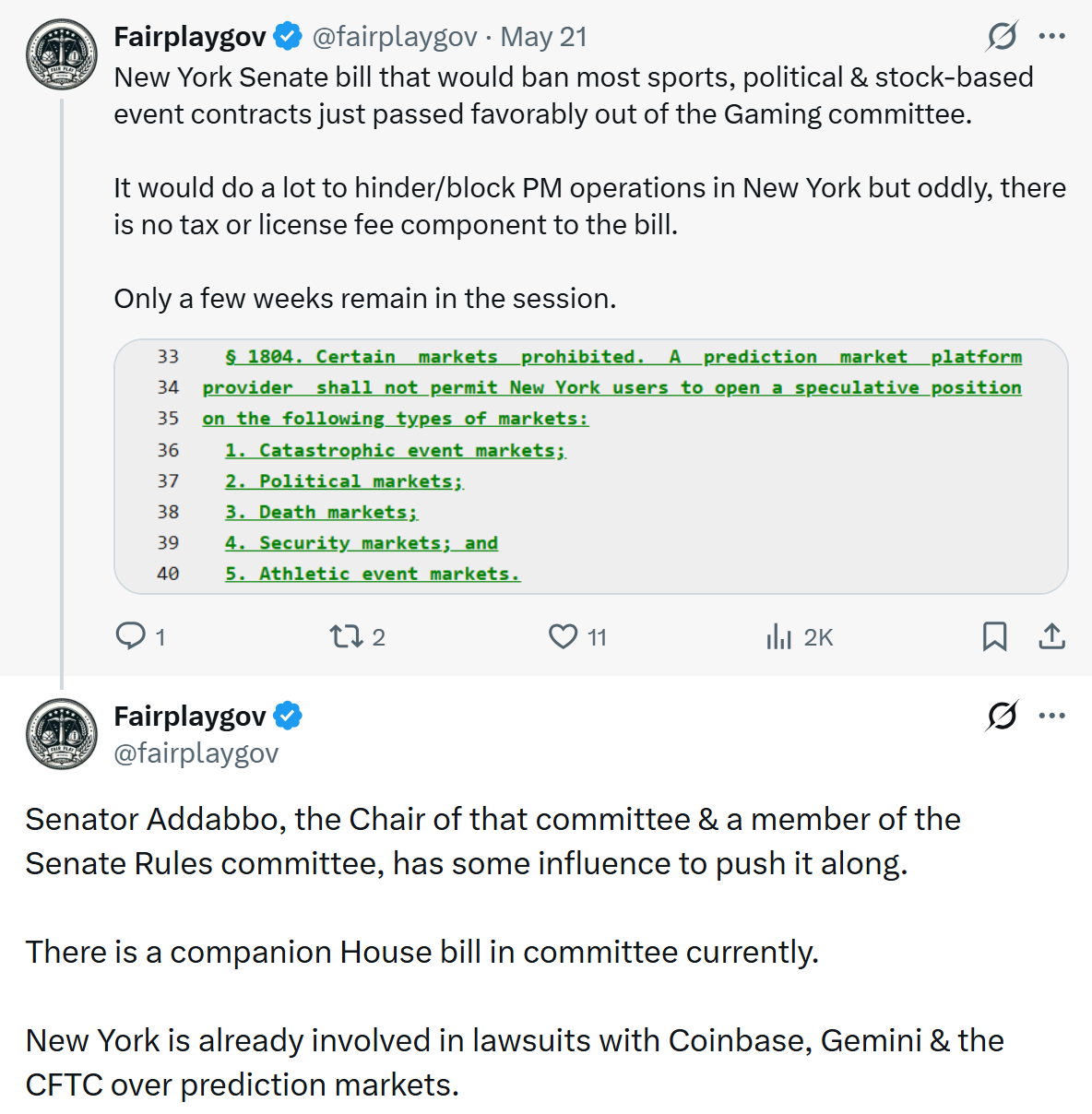
Source: Fairplaygov
Last week, the House Agriculture Committee urged Trump to nominate four commissioners to the CFTC, warning the agency is ill-equipped to handle its growing responsibilities with only one member in place.
Magazine: Guide to the top and emerging global crypto hubs — Mid-2026



The crypto industry has spent years debating whether quantum computing poses an existential threat to blockchains like Bitcoin and Ethereum. Now, researchers and builders believe artificial intelligence may be accelerating that timeline, and forcing a broader rethink of how digital security works altogether.
Leaders working on post-quantum cryptography and blockchain security described a rapidly changing landscape in which AI is simultaneously becoming a weapon for attackers, a defensive tool for developers, and an accelerator of quantum computing research.
“The security landscape of the future is going to be different,” said Alex Pruden, CEO of Project Eleven, a company focused on quantum-resistant infrastructure for crypto.
“Between quantum and AI, we’re going to go into a world where security, and this is more broadly than just crypto, you simply cannot count on the way you’ve always done things,” Pruden said.
The convergence of AI and quantum computing has become increasingly urgent following warnings from major technology firms and researchers that cryptographically relevant quantum computers may arrive sooner than previously expected. While experts remain divided on exactly when a quantum computer capable of breaking modern encryption will emerge, many believe AI could dramatically compress development timelines.
“AI is definitely being used to accelerate the development of quantum computing,” Pruden said. Researchers are already using machine learning systems to optimize quantum error correction, one of the field’s biggest engineering bottlenecks.
Illia Polosukhin, co-founder of NEAR Protocol and a former Google AI researcher, said AI has already been accelerating scientific discovery for years.
“AI is becoming more and more of an accelerator,” Polosukhin said. “The rate of research is going to accelerate from here, and we have already seen progress that people didn’t expect would come this early.”
Polosukhin pointed to his time at Google in 2016, when machine learning systems were already being used to discover new materials. “It might be that the next generation quantum computer will be built with AI and quantum computers of this generation,” he said. “It’s feeding into itself.”
For security researchers, the threat is no longer simply theoretical. The growing concern is that governments and sophisticated actors are already collecting encrypted internet traffic today with the expectation that future quantum computers will eventually be able to decrypt it, a strategy often referred to as “harvest now, decrypt later.” “If I know quantum computers are coming in a couple of years, I will start trying to capture all possible data that’s going around,” Polosukhin said.
“Everything we’re putting on the internet, if you’re identifiable as a person of interest, you can assume will be decrypted in two years,” he added. “It’s most likely happening already.”
The implications for crypto are especially severe because most blockchain networks rely on the same elliptic curve cryptography used across the broader internet. A sufficiently powerful quantum computer could theoretically derive private keys from public keys, allowing attackers to compromise vulnerable wallets and systems.
But researchers increasingly argue the bigger story is not quantum alone, it is the combination of quantum computing and AI creating a permanent security arms race.
Artificial intelligence is already becoming increasingly effective at identifying software vulnerabilities and implementation flaws. “I would expect the advent of AI to accelerate… even more hacks,” Pruden said. “You have these AI models that are able to find either implementation bugs in the underlying cryptography or increasingly, I think, break the cryptography itself.”
At the same time, developers are deploying AI defensively for code auditing, testing and formal verification, mathematical techniques used to prove software behaves as intended. “AI can help with formal verification of post-quantum systems,” Pruden said. “That theoretically makes them more secure.”
The result, researchers say, is a future where security can no longer be treated as static infrastructure that gets upgraded once every decade. “Nothing is going to be as static as it’s been in the future,” Pruden said. “Either a quantum computer comes online to break some fundamental assumption, or AI gets smart enough to break that assumption too.”
That shift is already beginning to force blockchain networks to rethink how quickly they can evolve. Several ecosystems, including Ethereum, Zcash, Solana, Ripple and NEAR, are actively researching or implementing post-quantum migration strategies.
NEAR recently announced plans to integrate post-quantum cryptography directly into its account infrastructure, allowing users to rotate cryptographic schemes without migrating assets to entirely new wallets. “Back in 2018, when we were designing [NEAR], we were like: ‘Hey, quantum will come, we should have an easy way to do it,’” Polosukhin said.
Still, the transition remains technically difficult. Post-quantum cryptographic systems are often significantly larger and slower than current standards. “The cryptography that’s currently standardized for post-quantum is very big and slow,” Polosukhin said.
The broader implication, according to researchers, is that both AI and quantum computing are undermining a foundational assumption of the digital age: that encryption remains reliable for long periods.
Instead, security may increasingly become an adaptive, continuously evolving process, in which systems must constantly upgrade just to survive.
Read more: Here’s how bitcoin, Ethereum and other networks are preparing for the looming quantum threat


Litecoin has returned to market discussion after crypto analyst Crypto Patel said LTC could still reach higher cycle targets, while warning that a $1,000 move remains difficult without stronger institutional demand.
Summary
- Litecoin traded near $53, remaining about 87% below its May 2021 all-time high price level.
- Crypto Patel said $500 is possible next cycle, while $1,000 needs extreme institutional demand conditions.
- Canary’s spot Litecoin ETF added regulated access, but early flows have stayed limited so far.
Litecoin traded at $53.40 on May 24, 2026, according to crypto.news price data. The token was up 2.8% over 24 hours but remained down 5.32% over seven days and 4.95% over 30 days.
Crypto.news listed Litecoin’s market cap at about $4.12 billion, with a market rank of #27. Its 24-hour trading volume stood near $205.46 million, while the price moved between $51.95 and $54.04 during the same window.
The token remains far below its May 2021 all-time high of $410.26. That gap has shaped the latest debate, with some traders viewing LTC as a long accumulation asset and others pointing to its weak recovery compared with Bitcoin, Ethereum, and Solana.
Crypto Patel framed Litecoin as a patience trade rather than a short-term breakout asset. He said LTC is not a “100x rocket” and gave a more realistic path of $150 to $300 between 2026 and 2028, with a possible extension toward $400 to $600 during stronger market conditions.
ETF access supports the bullish case
The strongest bullish argument centers on regulated access. Related crypto.news coverage said Canary Capital’s Litecoin ETF is a classic spot product that holds actual LTC through regulated custody partners such as Coinbase Custody and BitGo.
That product gives investors a brokerage-based route to LTC exposure without handling wallets, private keys, or exchange accounts. Earlier crypto.news coverage also reported that the SEC had formally acknowledged Litecoin ETF filings from CoinShares, while recognizing spot Litecoin filings from Grayscale and Canary Capital.
Still, ETF access has not yet created Bitcoin-style demand for Litecoin. Crypto.news reported in November 2025 that Solana, Hedera, and Litecoin ETFs posted inflows during a session when Bitcoin and Ethereum ETFs saw outflows, but Litecoin’s listed inflow figure was only $855,880.
That gap supports Crypto Patel’s caution. He argued that a $500 target could be possible in a strong cycle, but “$1,000+ requires multi-cycle thesis going into 2030+.” In his view, LTC needs full institutional embrace before that higher target becomes realistic.
The 2027 halving adds a supply argument
Litecoin’s supply structure also remains central to the bullish case. Crypto.news data showed a circulating supply near 77.2 million LTC out of a maximum supply of 84 million, meaning more than 91% of the total supply has already entered circulation.
The next Litecoin halving is projected for around July 27, 2027. The block reward will fall from 6.25 LTC to 3.125 LTC after that event, cutting new issuance by half.
That setup gives Litecoin a clear scarcity story. If demand rises through ETFs or exchange access while new supply falls, LTC bulls expect tighter market conditions. However, halvings do not guarantee price gains. They only reduce future issuance.
Litecoin also has MWEB, its optional privacy layer. Litecoin.com explains that MimbleWimble Extension Blocks let users move coins into a parallel private block secured by the same miners, then return to the base layer when needed.
$1,000 target faces market math
Crypto Patel’s bear case focused on market size. At $500, Litecoin would need a market cap of about $42 billion based on its 84 million maximum supply. At $1,000, the fully diluted value would reach about $84 billion.
That would place Litecoin near the top of the market, far above its current rank. The token would need major capital rotation, ETF demand, stronger payment use, and wider market support to reach that level.
The analyst also noted that Litecoin never reclaimed its 2021 high while other large assets recovered more strongly. That point matters because older proof-of-work assets often depend on cycle rotation rather than new ecosystem growth.
Litecoin also faces competition from stablecoins in payments. USDT and USDC now handle fast dollar transfers across several networks, reducing the need for volatile payment coins in some use cases. That weakens part of Litecoin’s older payment narrative.
Litecoin use remains active but limited
Litecoin still has real network history. It has operated for more than 14 years and remains one of the oldest proof-of-work networks. Its fixed supply, lower fees, and long uptime continue to support its role as a payments-focused asset.
Related crypto.news coverage also showed Litecoin gaining broader use inside regulated crypto products. Coinbase added LTC, XRP, DOGE, and ADA as collateral for USDC loans through Morpho, giving eligible users a way to borrow without selling their holdings.
That does not turn Litecoin into a DeFi ecosystem. LTC still lacks the smart contract activity, yield markets, and developer base seen on Ethereum, Solana, and other chains. For supporters, that simplicity is the point. For critics, it limits growth.
The current market read is therefore balanced. Litecoin has ETF access, a 2027 halving, a capped supply, and a long operating record. It also has weak recent price momentum, modest ETF flows, and stronger competition from stablecoins and smart contract networks.
Crypto Patel’s final view reflects that split. “Can LTC hit $500? Possible in next bull cycle peak.” He placed the probability at 20% to 30%. For $1,000, he gave only 5% to 10%, tied to an extreme demand scenario.
Disclosure: This article does not represent investment advice. The content and materials featured on this page are for educational purposes only.

TLDR:
- Binance denied allegations tying $850M in Iran-linked crypto flows directly to its exchange platform.
- The WSJ report cited blockchain data and compliance documents tied to Iranian payment networks.
- Binance said sanctions-linked exposure fell sharply after expanding compliance and monitoring systems.
- U.S. authorities continue reviewing whether Iranian-linked entities used Binance to evade sanctions.
Binance Iran-Linked Transactions returned to the spotlight after fresh allegations connected the exchange to Iranian-linked payment flows.
The claims emerged amid ongoing U.S. compliance oversight, while Binance pushed back against the report and defended its sanctions monitoring framework and internal controls.
Binance Pushes Back Against Iran-Linked Transaction Allegations
Binance rejected allegations that an Iran-linked network processed nearly $850 million through the exchange over two years.
The claims were published in a report citing blockchain data, compliance documents, and law enforcement sources monitoring terrorism financing activities.
According to the report, the transactions were connected to a payment network allegedly engineered by Iranian businessman Babak Zanjani.
Much of the reported activity allegedly flowed through a single Binance trading account that reportedly remained active until January this year.
Binance CEO Richard Teng publicly disputed the claims through a post on X. Teng described the allegations as “fundamentally inaccurate” and stated the reported transactions happened before the involved parties were officially sanctioned by regulators.
A Binance spokesperson also argued that the report overstated the exchange’s direct involvement in the transactions.
The company explained that blockchain tracing can include intermediary wallets and decentralized addresses before funds eventually reach sanctioned entities.
The exchange maintained that indirect blockchain exposure should not be confused with direct servicing of sanctioned accounts.
Binance further stated that most of the alleged transaction volume did not originate from activity conducted directly on its platform.
The report also revisited previous claims involving more than 1,500 Iran-linked accounts allegedly operating through intermediaries.
Some transactions reportedly continued into 2026, according to foreign law-enforcement agencies cited in the investigation.
Binance Compliance Oversight Remains Under Scrutiny
The Binance Iran-Linked Transactions controversy arrives while the exchange remains under a U.S.-appointed compliance monitor tied to its 2023 settlement.
Binance previously agreed to pay $4.3 billion to settle allegations involving sanctions and anti-money laundering violations.
Former Binance CEO Changpeng Zhao stepped down after pleading guilty to violating U.S. anti-money laundering requirements.
The latest report stated that U.S. authorities continue examining whether Iranian-linked entities used Binance to bypass sanctions restrictions.
The Wall Street Journal also reported that internal Binance investigators previously flagged suspicious account activity connected to the alleged network.
According to the report, investigators identified linked accounts operated by associates and relatives connected to Zanjani through shared-device access patterns.
Binance denied accusations that compliance investigators faced retaliation after raising sanctions concerns. The company stated that employee departures referenced in previous reports occurred because of individual circumstances rather than internal disagreements over compliance practices.
Meanwhile, Binance said its compliance structure has expanded considerably since the 2023 settlement. The exchange reported that more than 1,500 employees now work across compliance and risk-management divisions globally.
Binance also released internal figures showing sanctions-linked transaction exposure declined sharply between 2024 and 2025.
The company said exposure reportedly dropped from 0.284% of exchange activity to around 0.009% after strengthening monitoring systems and enforcement controls.

Senior officials at the Commodity Futures Trading Commission who flagged concerns about prediction market operators were ultimately suspended and subjected to internal investigations, according to a New York Times examination published over the weekend. The investigation centers on three firms—Polymarket, Crypto.com and a Gemini affiliate—each reportedly linked to the Trump family in ways that career staff believed warranted closer regulatory scrutiny. Internal sources cited by the Times said frontline staff worried Crypto.com did not treat small bettors fairly, Polymarket lacked adequate fraud protections, and Gemini’s affiliate had not completed the requisite regulatory review to operate in this space.
According to The New York Times, acting CFTC chair Caroline Pham and her senior counsel intervened to facilitate the firms’ access to the markets they sought to operate. By the end of 2025, two staffers who had raised concerns were placed on administrative leave and placed under internal investigation, while three others who enforced crypto laws faced similar outcomes. None of those staffers were told the specific allegations against them. In interviews, current and former agency personnel said the message from leadership was tentative: avoid friction with the industries the commission was regulating.
Key takeaways
- Internal concerns about prediction-market operators within the CFTC culminated in personnel suspensions and internal investigations, highlighting potential tensions between regulatory enforcement and industry influence.
- Interventions by then-acting chair Caroline Pham and senior counsel allegedly helped firms obtain favorable outcomes, raising questions about independence in decision-making.
- The New York Times report documents a notable shift in crypto enforcement posture, with a retreat from investigations and actions under the Biden administration compared with the prior period.
- Leadership movements and professional ties to the crypto sector are foregrounded, including Pham’s departure to MoonPay and the career transitions of senior counsel Brigitte Weyls and CFTC chair Michael Selig.
- Political and corporate linkages remain contentious, with Crypto.com, Polymarket and Gemini cited as having connections to political figures or fundraising networks, prompting consideration of conflicts of interest among regulators and regulated entities.
- The broader regulatory landscape for crypto remains unsettled, as Congress, the CFTC and other agencies navigate enforcement priorities, licensing, and cross-border policy implications.
Internal dynamics at the CFTC and the enforcement trajectory
The NYT investigation portrays a commission where officials who raised warnings about notable prediction-market operators faced administrative discipline and internal scrutiny, even as those same firms sought regulatory accommodation. The report emphasizes a tension between safeguarding market integrity and maintaining collaborative relationships with firms that have sought favorable regulatory positioning. As described, two enforcement-focused staffers were placed on leave and subjected to investigations, while others who had pursued crypto-operations‑related enforcement faced similar outcomes. The lack of publicly disclosed reasons for discipline compounds questions about due process and transparency in regulatory governance.
Observers say the episodes reflect a broader concern about the CFTC’s capacity to independently police rapidly evolving crypto markets while managing political and industry pressures. The agency’s reported shift toward a more cautious enforcement posture in recent years—evidenced by a reduction in crypto-related actions—has been a focal point for industry participants and observers seeking to understand the regulator’s long-term approach to market safeguards.
In the report, the agency’s leadership is shown as balancing strategic risk considerations with political and commercial relationships. Pham’s departure to MoonPay—a crypto firm that has partnered with Polymarket—illustrates the permeability of leadership transitions in a sector where regulatory oversight intersects with corporate strategy. The subsequent appointment and career moves of other senior figures, including the confirmation of Michael Selig as chair, add to the complexity of assessing how regulatory priorities will translate into concrete policy and enforcement steps.
Contributors to the discussion about independence and governance point to public statements and background affiliations. For instance, the report notes that the agency’s leadership historically engages with firms across the industry, which can complicate perceptions of impartiality when regulatory actions intersect with industry interests. In a related vein, critics argue that the CFTC’s enforcement stance should reflect a consistent standard that protects traders’ rights, ensures fair disclosure, and upholds transparent regulatory processes—especially given the highly international and interconnected nature of crypto markets.
Regulatory ties and the broader policy environment
The New York Times narrative intersects with ongoing debates about the appropriate regulatory framework for crypto and prediction markets in the United States. The CFTC has, in the past, pursued actions against state-level processes and entities attempting to regulate or operate prediction-market platforms, reflecting a contested landscape at the intersection of commodities regulation, gambling laws and fintech innovation. The Times report references a broader pattern of regulatory friction around prediction markets, including litigation involving several states and venues that have pursued or resisted certain market structures under various legal authorities.
Within the policy discourse, questions persist about ensuring robust fraud prevention, fair access for retail participants, and rigorous supervision of platforms that offer contract-based exposure to real-world events. Policymakers have also flagged the need for clear licensing pathways and consistent regulatory expectations for crypto firms seeking to operate across state lines or in collaboration with traditional financial institutions. In this broader context, industry observers emphasize the importance of clear, enforceable standards that protect consumers while enabling legitimate innovation and capital formation in the digital asset space.
As highlighted by related reporting, the CFTC’s stance on crypto enforcement appears intertwined with legislative and executive considerations. For example, lawmakers have urged timely nominations to fill CFTC seats to ensure the agency has a full complement of commissioners to supervise an expanding regulatory remit. The House Agriculture Committee recently urged President Trump to nominate four commissioners, underscoring concerns about the agency’s capacity to oversee growing responsibilities with a single member in place. These dynamics occur alongside ongoing discussions about cross-border harmonization, the role of international standards, and potential alignment with initiatives such as MiCA in Europe and other regional regulatory regimes.
Cointelegraph reached out to Polymarket, Crypto.com and Gemini for comment on these developments but had not received a response by publication. Authorities and stakeholders have acknowledged that the regulatory environment for prediction markets remains unsettled, with ongoing litigation, enforcement considerations and policy proposals shaping the trajectory of the industry and the institutions that regulate it.
Related: CFTC no-action letter eases event contract reporting rules
Closing perspective
The episodes detailed in the NYT report underscore the fragility of governance frameworks surrounding crypto and prediction-market activities in the United States. As regulators grapple with enforcement priorities, licensing standards, and congressional oversight, the question remains: how can agencies balance rigorous market supervision with the need to foster legitimate innovation and maintain public trust in an ever-evolving financial landscape?
A New York Times investigation published this week paints a portrait of regulatory pushback that collided with a rising crypto and prediction-market ecosystem at the U.S. Commodity Futures Trading Commission (CFTC). The piece details how senior officials who raised concerns about certain prediction-market operators—Polymarket, Crypto.com and a Gemini affiliate—were sidelined, investigated, and ultimately removed from the agency. The report raises questions about whether regulatory independence was compromised as political and industry interests intersected with enforcement decisions.
According to the Times, concerns flagged by career staff included fair treatment of small bettors, insufficient fraud protections at Polymarket, and an incomplete regulatory review for a Gemini affiliate. Yet, the article contends that acting CFTC chair Caroline Pham and a senior counsel intervened to help these firms advance their objectives. By the end of 2025, two officials who had raised questions were placed on administrative leave and investigated, and three others involved in crypto enforcement faced similar fates. Those involved told the Times they were not informed what specific actions prompted the sanctions. The report quotes current and former agency staffers who described a broader message that emerged within the CFTC: avoid provoking the emerging crypto and prediction-market industries.
Key takeaways
- Internal concerns over major prediction-market platforms: Career staff warned about Polymarket’s fraud protections, Crypto.com’s treatment of small bettors, and Gemini’s affiliate not completing regulatory review.
- Enforcement posture shifts under the agency’s leadership: The Times notes a reduced crypto-enforcement footprint, with several investigations dropped and a move away from broad cases toward individual operators.
- Leadership and potential conflicts of interest: Caroline Pham left the CFTC for MoonPay; a key official who helped approve Gemini Titan’s application later moved to a Gemini unit, raising questions about regulatory capture or influence.
- Industry ties and political milieu: The report highlights business relationships tying the involved firms to political figures and entities, including Trump-associated ventures and investors.
- Regulatory and legislative context expanding pressure: The story aligns with ongoing calls in Congress to bolster the CFTC’s capacity as it faces a rapidly evolving crypto landscape.
Regulatory posture and the enforcement arc
The Times’ account portrays a CFTC that, in its handling of crypto and prediction-market firms, appears to have shifted away from aggressive enforcement. The article notes a contrast between the Biden era’s broader enforcement push and the current period, which it characterizes as more restrained. Specifically, the agency reportedly dropped at least five crypto investigations, and the number of crypto-enforcement actions fell from more than 80 under the Biden administration to only a couple during the period described by the report, with those recent cases aimed at individual operators rather than large firms.
The piece points to a leadership dynamic at the top of the agency. Caroline Pham, who helped steer policy before departing for MoonPay—an entity tied to Polymarket—left a vacancy in the chair role, with Michael Selig serving as the agency’s sole commissioner and acting chair. The report notes that Selig previously represented crypto firms as a corporate lawyer, underscoring concerns about potential conflicts of interest within the agency’s upper ranks. In parallel, Brigitte Weyls, who was the senior counsel referenced in the Times’ reporting, became general counsel at Gemini Titan after assisting with Gemini Titan’s application.
Industry ties, approvals, and risk signals
The investigation maps several notable ties between the implicated platforms and political and financial actors. Crypto.com is described as a business partner of Trump Media. Polymarket attracted investment from 1789 Capital, a venture capital firm associated with Donald Trump Jr. Gemini’s founders have reportedly been backers of American Bitcoin Corp, a cryptocurrency firm co-founded by Eric Trump. The Times presents these connections as part of a broader mosaic of influence that could complicate regulatory decision-making or create perceptions of preferential treatment.
In response to questions about conflicts of interest, a White House spokesperson asserted that “President Trump only acts in the best interests of the American public” and denied conflicts, a claim that the Times cited in its coverage. As with all such allegations, Crypto industry participants and the agencies involved have not publicly contested every detail of the report in the same forum, and the agency did not immediately offer a formal response to the Times’ findings in print at publication.
Enforcement actions against states and the broader regulatory frontier
Beyond internal dynamics, the Times recounts the CFTC’s legal posture toward prediction-market regulation at the state level. Cointelegraph has reported on the CFTC’s lawsuits against state regulators seeking to apply or interpret restrictions on prediction markets in places such as Wisconsin, Minnesota, New York, Arizona, Connecticut and Illinois. The Times’ framing suggests that the federal agency’s stance toward state-level regulation has interacted with a patchwork of state approaches, potentially creating uneven enforcement and compliance pressures for platforms operating within multiple jurisdictions.
Meanwhile, momentum on Capitol Hill has signaled that lawmakers intend to strengthen the CFTC’s oversight capacity. The House Agriculture Committee recently urged President Trump to nominate multiple commissioners to fill the agency’s leadership ranks, arguing that the CFTC is ill-equipped to oversee a rapidly expanding crypto and commodities ecosystem with only one sitting member. The unfolding political dynamic adds a layer of uncertainty about how quickly and how robustly the agency will recalibrate its crypto enforcement posture in the coming months.
For readers seeking broader context, the New York Times’ investigation arrives amid ongoing coverage of regulatory developments and industry tensions that are shaping investor and operator expectations. The timing suggests that market participants are watching closely not only for concrete enforcement actions but for the signals that regulatory capture concerns may influence future policy and decision-making within the CFTC.
Related coverage from Cointelegraph has discussed how the CFTC’s stance on event-contract reporting and data requirements has evolved, offering additional background on how the agency has managed the reporting framework around prediction-market activity in recent years. These themes collectively illuminate the broader regulatory frontier that traders, platform operators, and developers must navigate as market structures and use cases continue to diversify.
As the debate over independence, accountability, and industry influence continues, investors and operators should monitor upcoming regulatory nominations, potential reforms to employees’ conflicts-of-interest rules, and any new enforcement guidelines that the CFTC may publish as part of its response to this evolving landscape.
Source: New York Times investigation, May 24, 2026. The Times report and linked material provide the central narrative about staff concerns, leadership changes, and the alleged influence of political and business ties on regulatory outcomes. Cointelegraph has previously reported on related state-level actions and enforcement activity that contextualize how prediction markets intersect with federal oversight.
StablR, a European stablecoin issuer backed by Tether, suffered an exploit on Saturday that drained funds from its minting contract and sent both its euro and dollar-pegged tokens sharply below their pegs. Security firm Blockaid, which first flagged the attack on-chain, said roughly $2.8 million… Read the full story at The Defiant
Crypto World
Solana Q1 Performance Defies Market Slump With Record Transactions and Rising App Revenue
TLDR:
- Solana recorded 112.6M average daily non-vote transactions in Q1, marking a new all-time high for the network.
- Launchpad platforms generated $144M, making up 42% of total Solana app revenue in the first quarter of 2025.
- Solana’s RWA market cap grew 43% QoQ to $2.01B, with BlackRock’s BUIDL fund doubling to $525.4M in Q1.
- Solana added support for x402 and Stripe’s Machine Payments Protocol, linking it to both major agent payment standards.
Solana Q1 performance remained surprisingly resilient even as broader crypto markets experienced sharp corrections.
On-chain activity held steady across multiple metrics, including transaction volume, fee payers, and application revenue. While token prices faced pressure, the underlying network continued to process record activity.
This divergence between price and fundamentals has drawn attention from analysts tracking the chain’s long-term trajectory heading into Q2 2025.
Transaction Activity and App Revenue Hold the Network Together
Daily non-vote transactions on Solana reached a new all-time high in Q1. The network printed 112.6 million average daily non-vote transactions, up 50% quarter-over-quarter. That figure alone signals that user activity was not slowing down despite market conditions.
Chain GDP stayed nearly flat at approximately $342.2 million for the quarter. Daily fee payers also held steady at around 2.2 million, showing consistent demand for block space. These numbers suggest the network maintained a stable base of active users.
Crypto analyst Kaff posted on X, noting that apps on Solana were “still making real money,” with launchpads alone generating roughly $144 million.
That figure represented about 42% of total Solana application revenue for the quarter. Solana’s App Revenue-to-Chain Revenue ratio also rose to 382%, meaning applications captured far more value than the base layer itself.
Trading platforms continued to lead in revenue generation. Pump.fun brought in $124.7 million, up 17% QoQ, while Axiom Exchange posted $42.4 million, up 36%. Raydium generated $34.6 million, Phantom earned $23.4 million, and Jupiter recorded $23.1 million across a broader revenue mix.
RWAs and Payments Emerge as the Next Major Catalyst
Beyond trading, real-world assets are drawing serious institutional interest on Solana. RWA market cap on the chain grew 43% quarter-over-quarter, reaching approximately $2.01 billion. BlackRock’s BUIDL fund doubled to $525.4 million after Anchorage Digital added custody support.
Kamino Finance saw only an 8% decline in the quarter while integrating PRIME and ONyc into its DeFi infrastructure.
That positions it as a growing hub for institutional-grade liquidity on Solana. Tokenized card and collectible platforms also saw activity, with Collector Crypt capturing 89% of that segment.
Payments represent another area gaining momentum. Visa, Stripe, Worldpay, Western Union, Fiserv, and PayPal have all moved closer to Solana-based settlement and product development.
The network also added support for x402 and Stripe’s Machine Payments Protocol, making it compatible with both major agent payment standards.
DePIN revenue reached $9.1 million in Q1, up 28%, led by Helium and GEODNET. Perpetuals DEX volume fell 29% QoQ to roughly $1.14 billion daily, though GM Trade saw its daily volume surge over 8,000% after pivoting toward RWA-based perpetuals.

AI platforms are launching at an unprecedented rate, but most of them face the same problem: nobody knows they exist. Building the technology is one thing. Getting it covered by the media is something else entirely. Kooc Media, a PR distribution agency that has been delivering guaranteed press coverage for crypto, fintech and iGaming companies since 2017, is now offering dedicated PR and news coverage packages for AI platforms and artificial intelligence companies.
The Media Challenge Facing AI Platforms
The AI industry is one of the most competitive sectors in technology right now. New AI platforms, machine learning tools and intelligent automation products are entering the market constantly. For every company that breaks through and gains widespread recognition, dozens of equally capable platforms go unnoticed because they never secured meaningful media coverage.
The problem is not a lack of newsworthy stories. AI platforms are doing genuinely interesting things — launching new capabilities, closing funding rounds, forming partnerships, solving real business problems. The problem is access. Most AI companies are built by technical teams that do not have PR experience, media relationships or the budget to hire a traditional agency that charges monthly retainers with no guaranteed results.
This is where Kooc Media steps in. The agency operates on a model that guarantees placements on named publications at fixed prices. There are no retainers, no uncertain timelines, and no risk of paying for outreach that produces nothing.
“AI companies are in a similar position to where crypto startups were a few years ago,” said Michelle De Gouveia, spokesperson for Kooc Media. “There is a huge amount of innovation happening, but many of these companies do not have the PR infrastructure or media contacts to get their story in front of the right audience. That is exactly what we help with.”
Guaranteed News Coverage on Owned Publications
The reason Kooc Media can guarantee coverage is that it owns and operates its own network of news websites. This is unusual for a PR agency. Most firms rely entirely on pitching third-party journalists, which means results are never certain. Kooc Media’s portfolio includes established publications such as Blockonomi, CoinCentral, MoneyCheck, Parameter, Beanstalk and Computing — sites that cover technology, finance, digital innovation and the AI sector directly. The full network can be viewed on the agency’s brands page.
Because these publications are controlled in-house, client content can be published the same day it is submitted. For AI platforms announcing product launches, platform updates, new integrations or investment news, same-day coverage means the announcement reaches readers while it is still fresh and relevant.
Each placement is on a real publication with an existing audience and genuine domain authority. These are not press release dumps or placeholder pages. They are active news sites that publish daily content and attract organic traffic from search engines and direct readership.
Wider Distribution Through Partner Networks
Kooc Media’s owned sites are the foundation of every package, but the agency also offers full newswire distribution that extends coverage well beyond its own network. Press releases are distributed to hundreds of partner websites and thousands of syndicated outlets, significantly increasing the reach of every announcement.
For AI platforms that want maximum exposure, higher-tier packages can place content on major business and financial media outlets. These include Business Insider, Bloomberg, Benzinga, MarketWatch, USA Today and Dow Jones feeds. Having an AI platform featured alongside mainstream financial and technology news adds a level of credibility that is difficult to achieve through organic outreach alone.
Every campaign includes full reporting with live links to each placement. Clients can see exactly where their news appeared, share those links with stakeholders, and track the coverage directly. The AI-specific packages and pricing are detailed on Kooc Media’s AI PR page.
How News Coverage Supports Long-Term Search Visibility
For AI platforms, the value of press coverage extends far beyond the day an article is published. Every article placed on a high-authority news domain creates a backlink to the company’s website. These backlinks carry significant SEO weight, helping the platform rank higher in search results for competitive terms.
AI platforms need to be discoverable when potential users search for phrases like “AI platform,” “AI tools for business,” “machine learning platform,” “AI automation software” or “enterprise AI solutions.” Ranking well for these terms drives a steady stream of organic traffic that no amount of social media posting can match.
Because Kooc Media’s packages distribute content across multiple high-authority sites simultaneously, each campaign builds a cluster of quality backlinks rather than a single mention. Over time, this accumulation of authoritative links has a compounding effect on search performance.
AgentLocker.ai: A Dedicated AI Directory for Clients
As part of its commitment to the AI sector, Kooc Media has launched AgentLocker.ai, an AI tools and agents directory built to help users discover, compare and evaluate artificial intelligence products. The directory covers the full range of AI platforms, from task-specific automation tools to large-scale autonomous agent systems.
AgentLocker.ai is owned and operated by Kooc Media, and every client that purchases an AI PR package will be included and featured on the directory at no extra cost. This gives AI platforms a permanent, searchable presence that works alongside their press coverage.

A directory listing on AgentLocker.ai serves a different purpose to a press release. While news coverage drives a burst of attention around a specific announcement, a directory listing provides continuous discoverability. People browsing AgentLocker.ai are actively looking for AI solutions, which means the traffic it sends is highly relevant. The listing also adds another quality backlink from a niche AI domain, reinforcing the SEO gains from press distribution.
“We built AgentLocker.ai because we saw a need for a straightforward, well-organised directory of AI tools and agents,” said De Gouveia. “Giving our PR clients a free listing there was an obvious step — it adds real value on top of the media coverage they are already getting.”
Experience Built in Fast-Moving Industries
Kooc Media’s move into AI PR is backed by years of proven delivery in equally demanding sectors. The agency’s crypto PR services have been used by token launches, DeFi protocols, blockchain infrastructure companies and Web3 startups to secure coverage across leading crypto and finance publications. Its gambling PR packages support online casinos, sportsbooks and iGaming operators that need guaranteed placements on finance and entertainment news sites.
The publishing infrastructure, editorial team and distribution network that powers these services is the same system now available to AI platforms. Nothing has been assembled from scratch. AI clients are accessing a mature, tested operation that has been refined over years of delivering results in fast-paced markets.
Services across all sectors include press release writing, sponsored articles, homepage placements on owned publications, newswire distribution to partner outlets, and fully managed campaigns run by Kooc Media’s internal editorial team. AI platforms that do not have a marketing department can hand the entire process to the agency and have professional news coverage live within days.
Getting AI Platforms the Coverage They Deserve
The AI industry is moving quickly, and the platforms that establish media presence early will carry that advantage as the market grows. Kooc Media’s combination of owned news sites, partner newswire distribution, same-day publishing, full reporting and a free AgentLocker.ai listing gives AI platforms a practical, results-driven path to the coverage they need.
Kooc Media’s PR packages are available now through the company’s website at https://kooc.co.uk.
Disclaimer: This is a Press Release provided by a third party who is responsible for the content. Please conduct your own research before taking any action based on the content.
Crypto World
AI agents are starting to pay with crypto as Coinbase, Stripe and Visa want in, Keyrock report says


Artificial intelligence (AI) agents autonomously spending money online is still a tiny market, but some of the world’s largest tech, payments and crypto firms are already racing to build the infrastructure for it, Keyrock said in a new report.
The crypto trading and investment firm estimated that AI agents settled over $73 million across roughly 176 million transactions on blockchain rails between May 2025 and April 2026.
The volumes remain negligible compared to traditional finance (TradFi). Visa, for example, alone processes $14.5 trillion annually. But the significance lies less in the headline U.S. dollar value and more in how quickly the infrastructure stack is forming, the report argued. Global firms such as Coinbase (COIN), Stripe, Google (GOOG) and Visa (V) all rolled out competing systems for machine-to-machine payments.
The broader idea behind agentic payments is that software increasingly consumes digital services autonomously rather than through human-managed subscriptions and accounts. An AI trading agent, for example, could continuously purchase market data, cloud computing or AI-generated analysis in tiny increments throughout the day without a human authorizing each payment manually.
That potential is driving ambitious forecasts how big the agentic payment sector could grow. Gartner projects AI agents could intermediate $15 trillion in purchases by 2028, while McKinsey estimated retail agentic commerce could reach $3 trillion-$5 trillion by 2030, according to the Keyrock report.
Those projections imply growth rates even faster than stablecoins experienced during their breakout years, the report said, but said the pace of infrastructure deployment already signals the market is moving beyond its experimentation phase.
Coinbase’s x402 protocol has emerged as one of the leading crypto-native systems. The protocol allows AI agents to pay directly with USDC for services such as blockchain analytics or cloud infrastructure without creating accounts or subscriptions.
Stripe, with its Tempo blockchain, launched a competing framework called Machine Payments Protocol (MPP), while Google introduced AP2, a system focused on delegated spending authorization for AI agents. Visa has extended its card network with tokenized credentials designed for AI-driven commerce.
Crypto rails and stablecoins are emerging as the preferred settlement layer, and the economics help explain why.
Some 76% of agent transactions fall below the 30 cent fixed-fee floor common in card payments, according to the report. Most payments ranged between one and 10 cents, making traditional rails impractical for automated software agents buying data, AI inference or API access. Meanwhile, stablecoin settlement on some blockchains like Base and Tempo costs fractions of a cent.
Currently, 98.6% of machine payments settle in USDC, the stablecoin issued by Circle (CRCL). That solidifies Circle’s position in crypto payments, but also introduces risk of concentration, creating dependency on a single issuer.
Regulation could be a source of constraint for the growth. MiCA in Europe, the U.S. GENIUS Act and the EU AI Act are all expected to take effect around mid-2026, yet none of them directly address autonomous machine-to-machine transactions or questions around liability and agent identity, the report noted.


BlackRock, Franklin Templeton, JPMorgan, Citadel Securities, Société Générale, the NYSE, Nasdaq, and the Bank of England are all building the same thing right now. Not Bitcoin holdings. Not ETFs. They are rebuilding the global financial system’s plumbing on blockchain rails.
Summary
- Tokenized real-world assets crossed $29 billion, with the market on track for $100 billion this year.
- Tokenized U.S. Treasuries grew from $380 million in 2023 to $13.4 billion by April 2026.
- BlackRock, Franklin Templeton, JPMorgan, Citadel Securities, Nasdaq, and others are building tokenization infrastructure.
- Tokenization is shifting from crypto-native experiments to regulated financial rails used by major institutions.
The market for tokenized real-world assets just crossed $29 billion. It is on track for $100 billion this year. And it is happening with almost no coverage in the crypto press, because tokenization is boring, technical, and run by exactly the firms that crypto Twitter spent a decade insisting would never show up.
The most important crypto story is the one no one is talking about
If you wanted to understand what crypto will look like in five years, you would not start with Bitcoin price predictions. You would not start with Ethereum’s roadmap. You would not start with the latest meme coin or the newest layer two. You would start with a quiet line item on RWA.xyz that read, in early May 2026, “Total tokenized asset value: $29.27 billion.”
That number doesn’t sound dramatic. It is dwarfed by Bitcoin’s market cap. It is smaller than several individual altcoins. The category does not have a flagship token to rally around. The headlines it generates are dry. And yet, of all the things happening in digital assets right now, the slow institutional migration of traditional financial instruments onto public blockchains is the one most likely to matter in ten years, and it is the one getting the least attention from the audience that is supposedly built to care about it.
The numbers, briefly. The tokenized real-world asset market (excluding stablecoins) grew from roughly $1.5 billion in early 2023 to $29.27 billion by April 2026, a near-twentyfold expansion. Within that, tokenized US Treasuries went from $380 million in Q1 2023 to $13.4 billion by April 2026, a 37x jump. Tokenized commodities, mostly gold, hit $7.3 billion. Tokenized equities crossed $960 million, more than doubling from mid-2025. Yield-bearing on-chain dollar instruments, the bridge category between stablecoins and tokenized funds, added another $8 billion or so on top.
Over forty major financial institutions are now actively issuing tokenized products on public blockchains. That includes BlackRock, the largest asset manager in the world, which has its $2.4 billion BUIDL fund running on Ethereum, recently extended to multiple chains, and as of Q1 2026 plugged into Uniswap.
Franklin Templeton runs its BENJI tokenized money market fund across multiple blockchains and recently partnered with Ondo Finance to launch tokenized versions of five ETFs tradable 24/7 via crypto wallets. Circle, Fidelity, WisdomTree, JPMorgan, Citadel Securities, Société Générale, Nomura, HSBC, the DTCC, Euroclear, the London Stock Exchange Group, and the Bank of England are all building infrastructure in this space.
What is being built, in plain language, is a new layer for the financial system. Treasuries that settle in seconds rather than days. Money market funds that can be used as DeFi collateral. ETFs that trade twenty-four hours a day. Stocks that can be borrowed against without being sold. Private credit that used to sit in illiquid, opaque, multi-million-dollar minimum vehicles, now sliced into tokens with on-chain provenance and continuous price discovery. Real estate debt. Bonds. Repos. Gold. Eventually, equities. The list keeps growing.
And the people building it are exactly the ones the crypto industry spent ten years insisting did not understand what was coming.
Why $29 billion sounds small but is not
It is fair to ask: $29 billion is not a lot in the context of a $130 trillion global capital market. Why does this matter now, if at all?
Three reasons.
First, the rate of change is what matters here, not the absolute size. The tokenized RWA market grew 263 percent year-over-year in 2025. It grew roughly 30 percent in Q1 2026 alone. That compound monthly growth rate above ten percent puts the sector on a trajectory that, if it merely holds, will cross $100 billion this year and reach trillion-dollar scale within five. The McKinsey, BCG, and Standard Chartered analyst notes that put 2030 tokenization at $5 to $30 trillion are not lottery-ticket forecasts. They are what happens if today’s growth rate continues.
Second, the quality of the participants has changed. The 2021 wave of tokenization was mostly DeFi-native projects experimenting at the margins. The 2026 wave is the largest asset managers, custodians, exchanges, and central banks in the world. In Q1 2026 alone: BlackRock’s BUIDL fund went live on Uniswap, the first time a major asset manager connected a regulated tokenized fund to a decentralized exchange. The DTCC, Euroclear, Tradeweb, Citadel Securities, and Société Générale completed the first cross-border intraday repo using tokenized UK gilts on the Canton Network. Galaxy Digital’s tokenized GLXY shares became available as collateral on Solana’s largest lending protocol. Binance relaunched tokenized stock trading in partnership with Ondo Finance. None of these moves is the work of crypto-native startups looking for a niche. These are TradFi institutions wiring their own products onto blockchain rails.
Third, the regulatory environment has shifted meaningfully in the institutions’ favor. In Q1 2026, the SEC issued its first formal statement on tokenized securities in January. In February, it approved WisdomTree’s tokenized money market fund for intraday trading.
In March, the SEC and CFTC released joint guidance on digital asset taxonomy. The GENIUS Act on stablecoins took effect in 2025. The CLARITY Act on market structure cleared committee in May 2026 and is on track for a possible signing this summer.
Larry Fink, the CEO of BlackRock, who eight years ago called Bitcoin “an index of money laundering,” now publicly describes tokenization as the future of finance, with the explicit endorsement that tokenizing traditional assets will “make investments easier to issue, easier to trade, and easier to access.”
These three things together, the growth rate, the participants, and the regulatory tailwind, make the current $29 billion number a deeply misleading anchor. The right way to read it is not “small.” The right way to read it is “early.”
What is actually being tokenized, and why
To see why this matters in practice, look at what is being put on chain first and ask why a sophisticated CFO or treasurer wants it there.
Tokenized US Treasuries are the biggest category at $13.4 billion. The pitch is direct. A short-dated Treasury bill earns yield, but holding a T-bill traditionally means using a fund vehicle, paying for custody, and being unable to move the asset without selling. A tokenized Treasury fund pays the same yield but settles in seconds, runs twenty-four hours a day, can be transferred peer-to-peer between accounts, and crucially can be used as collateral in on-chain lending markets without first being liquidated. For a corporate treasurer managing operating cash, this is a meaningful upgrade. The yield comes from the same Treasuries; the operational flexibility is entirely new.
The leading products tell the story. Circle’s USYC sits at $2.7 billion. Ondo’s suite, including OUSG, at $2.6 billion. BlackRock’s BUIDL at $2.4 billion. Franklin Templeton’s BENJI at $1 billion. WisdomTree’s WTGXX at $861 million. The architecture varies, BUIDL is a regulated fund wrapper for qualified investors, OUSG is a tokenized note that holds BUIDL as its underlying asset, USDY is yield-bearing for non-US investors, but the common theme is “Treasury exposure plus on-chain composability.”
Tokenized commodities are the third-largest category at $7.3 billion. Gold dominates. The pitch here is simpler still: a tokenized gold claim trades twenty-four hours a day, settles in seconds, and is divisible to fractions of a gram. HSBC’s Hang Seng Investment announced plans to launch a gold ETF with tokenized shares. Hong Kong’s HashKey Chain supports the territory’s first regulated silver-backed RWA token. Tokenized commodities are slowly broadening from gold into other metals.
Tokenized equities crossed $960 million by March 2026, up sharply from $424 million at mid-2025. Ondo holds roughly sixty percent of this segment through its Global Markets platform, which offers tokenized versions of US stocks including BlackRock, Coinbase, Coupang, and Circle, among others. The use case here is partly about access (non-US investors who want exposure to US equities) and partly about composability (tokenized stocks usable as DeFi collateral). The NYSE and Nasdaq are both building their own 24/7 tokenized securities infrastructure on different architectural approaches, with the NYSE working through a partnership with Securitize and Nasdaq receiving SEC approval in March for tokenized stock trading.
Private credit is the second-largest category at roughly seventeen percent of total RWA value. This is the segment with the largest long-term upside and the most structural complexity. Global private credit is a $1.7 trillion asset class largely locked inside multi-million-dollar minimum funds with quarterly liquidity and minimal transparency. Tokenization promises continuous price discovery, fractional access, and instant settlement. Most of that promise is still ahead of the product, but the firms working on it, Apollo, Hamilton Lane, Securitize, Centrifuge, are not crypto tourists.
Tokenized repo is the most under-noticed development of Q1 2026. The DTCC, Euroclear, Tradeweb, Citadel Securities, and Société Générale executed the first cross-border intraday repo using tokenized UK gilts on the Canton Network. The Bank of England launched its Synchronisation Lab in the same quarter to explore tokenized settlement with central bank money. The repo market is one of the most plumbing-heavy pieces of global finance, with trillions of dollars of daily volume. Moving any meaningful share of it onto tokenized rails is the kind of structural change that, once it starts, does not stop.
The three firms running the institutional layer
For the segment that has scaled most, tokenized Treasuries, the institutional layer comes down to three names: BlackRock, Franklin Templeton, and Ondo Finance. Each plays a different role, and the way they interact tells you most of what you need to know about how this sector is being built.
BlackRock anchors the institutional credibility layer. Its BUIDL fund is the largest tokenized Treasury product on a public blockchain. The architecture, a regulated fund wrapper distributed through Securitize on Ethereum and now several other chains, with BNY Mellon as custodian, is the template every competitor has copied. BUIDL went live on Uniswap in Q1 2026, the first time a regulated tokenized fund became tradable through a decentralized exchange. The top ten holders of BUIDL control roughly 98 percent of supply, which sounds concentrated until you realize it reflects BUIDL’s role as the wholesale liquidity backbone for the entire sector. Other products, including Ondo’s OUSG, hold BUIDL as their reserve asset.
Franklin Templeton holds the first-mover credential. Its BENJI tokenized money market fund launched on a public blockchain in 2021, making it the first SEC-registered tokenized money market fund. BENJI now operates across multiple blockchains with $1 billion in AUM, up roughly 140 percent over two years. Franklin Templeton has described tokenization as “structural rather than cyclical,” language designed to signal the firm is in this to build infrastructure rather than run a pilot. In Q1 2026 the firm partnered with Ondo to launch tokenized versions of five ETFs, tradable 24/7 through crypto wallets.
Ondo Finance is the connector. Unlike BlackRock and Franklin Templeton, Ondo is crypto-native, founded in 2021 with backing from Coinbase Ventures and Founders Fund. Ondo’s role is to take institutional-grade underlying assets, like BUIDL, and wrap them in smart contracts that are usable in DeFi, accessible to a broader base of investors, and deployable across multiple chains. OUSG holds BUIDL as its primary reserve. USDY, Ondo’s yield-bearing dollar product for non-US investors, is backed by short-term Treasuries and bank deposits, and has generated over $1.5 billion in cumulative DEX volume across chains like BNB Chain and Solana. Ondo Global Markets, the tokenized equities platform, holds about sixty percent market share in its segment with $550 million in TVL. The SEC closed its investigation into Ondo without charges in November 2025, and the firm filed a voluntary registration statement in February 2026.
The most important observation about this trio is that they are partners as much as competitors. BUIDL provides the institutional plumbing. BENJI provides the compliance precedent. Ondo provides the distribution and composability layer. The sector is not a winner-take-all market. It is a stack, and the firms occupying different positions in the stack reinforce each other’s growth.
What this means for the rest of crypto
This is the part of the story that most directly affects readers who do not care about tokenized money market funds but do hold crypto.
Tokenization is the channel through which traditional finance is, in practice, adopting crypto. Not by buying Bitcoin. Not by launching ETFs as marketing exercises. By moving its own products, the funds, the bonds, the equities, the repos, the commodities, onto the same public blockchains crypto-native projects use. Every tokenized Treasury fund deployed on Ethereum builds that blockchain’s institutional usage, fee revenue, and stickiness. Every tokenized equity on Solana does the same. Every tokenized repo on the Canton Network strengthens the case for institutional-grade blockchain infrastructure broadly.
That has knock-on effects.
For Ethereum, tokenization is the single most important long-term demand driver. The largest tokenized funds in the world settle on Ethereum or Ethereum L2s. If even a small fraction of the projected $100 billion-plus tokenization market lands on Ethereum’s rails, the network’s institutional usage in 2027 will look fundamentally different from its retail-dominated profile in 2021.
For Solana, tokenization is the most credible institutional use case beyond meme trading. Galaxy Digital chose Solana for its tokenized equity collateral pilot. BNB Chain saw $1.3 billion of USDY DEX volume. Tokenized equities scaling on Solana would meaningfully shift the perception of the chain among allocators.
For DeFi protocols, tokenization is the long-awaited “real yield” thesis arriving in concrete form. Lending markets like Aave and Morpho can now hold tokenized Treasuries as collateral, which pulls in capital that was structurally unable to engage with DeFi when the only collateral on offer was volatile crypto. The result is a class of DeFi user who is not a degenerate trader chasing 200 percent APY but a corporate treasurer earning four percent on tokenized T-bills while keeping the option to borrow against them.
For Bitcoin holders, the tokenization story is more indirect. Bitcoin itself does not host tokenized RWAs at scale, and its base layer is not designed to. But Bitcoin sits in the same regulatory and institutional ecosystem as the rest of the tokenized asset complex. The capital and credibility that flow into tokenized Treasuries flow into the same custody platforms, prime brokers, and compliance frameworks that hold Bitcoin. Indirectly, this builds the rails that make Bitcoin allocation easier and more durable for the institutions that have already begun, and that pipeline is wider than any single ETF approval would be.
What can still go wrong
A piece that only described the upside would be marketing, so here is the honest side.
Tokenization remains operationally complex. A tokenized Treasury fund is still a fund, with off-chain custody, off-chain administration, off-chain audit, and off-chain regulators. The blockchain wrapper does not eliminate counterparty risk. It changes where claims are recorded, not where assets live. The 2023 USDC depeg over Silicon Valley Bank exposure is the cautionary tale every tokenized asset issuer now writes against. If the institutions providing custody fail, the tokens are only as good as the recovery process for the underlying.
Regulation remains a moving target. The Q1 2026 SEC and CFTC clarifications were a step forward, but tokenized equities, tokenized private credit, and tokenized real estate each carry distinct regulatory questions that have not been fully answered. A tokenized equity issued in one jurisdiction may face restrictions when held by an investor in another. Tax treatment of yield-bearing tokenized instruments remains messy across borders.
Concentration is real. The top ten BUIDL holders own 98 percent of supply. The top three tokenized Treasury products account for more than half the segment. Early-stage market structure looks oligopolistic, which is fine until a major participant has a problem and creates a contagion path that did not exist in the pre-tokenized version of the same instruments.
And the gap between current scale and the trillion-dollar projections is enormous. The forty-times growth required for the sector to reach $1 trillion is not impossible at current rates, but it requires sustained institutional adoption, regulatory continuity, and the absence of a serious failure event. Any of those three can falter, and the entire growth curve flattens.
The story underneath the story
The reason tokenization is the real story, and the reason most coverage misses it, is that it does not look like crypto. There is no token to pump. There is no community to rally. The growth chart is steady rather than parabolic. The companies involved are the firms crypto Twitter spent a decade dunking on. The progress arrives in SEC press releases and BlackRock product announcements rather than in CT threads. None of this is the aesthetic of crypto, which is partly why coverage of it has been so thin.
But it is the substance. The thing crypto was supposed to be for, depending on which generation of the argument you grew up with, was the disintermediation of legacy finance, or the upgrade of money to internet speeds, or the creation of programmable financial infrastructure that did not depend on permission from banks. Tokenization is, quite literally, all three of those things happening at once. The fact that it is happening through banks, with permission, on regulated rails, is what makes it real and durable rather than ideological and brittle. The ideological version of crypto, the one that promised to make TradFi obsolete, mostly failed. The pragmatic version, the one that takes TradFi’s products and ships them on better rails, is succeeding.
That is the story. It is happening at scale. It is accelerating. The biggest financial institutions in the world are building it together rather than fighting it. And the crypto press is mostly looking the other way, because tokenization does not photograph well and does not have a meme.
In ten years, the question will not be whether Bitcoin or Ethereum won. It will be whether the global financial system runs on tokenized rails. The answer to that question is being written right now, $29 billion at a time, and it is being written by the firms most people thought would never show up.
They showed up. They are building. And the rest of us, if we are paying attention, will eventually catch on.
This article is for informational purposes and does not constitute financial or investment advice. Tokenized asset markets, regulatory frameworks, and product structures evolve quickly; the figures and product details described reflect reporting available as of mid-May 2026. Always do your own research.

‘My dad might still be alive if doctors had gone to his home – we need more mental health support’
Veris Residential investors brace for last earnings before sale

AI is speeding up the quantum threat to crypto, security experts warn

US brings back mandatory military draft registration

Steven Gerrard disagrees with Gary Neville over ‘shock’ Chelsea and Arsenal claim | Football

Register Renaming | Hackaday

The financial breakthrough that you’re in need of is just a #prayer away | 2Corinthians 8:9

Child’s Future: Financial Worries Explained #shorts

Burning 500M crypto tokens in 10 seconds #solana #cryptocurrency #mintcraft #defi #solanatoken
-

 Crypto World3 days ago
Blockchain.com files with SEC for U.S. IPO
-

 Fashion2 days ago
Holiday Weekend Open Thread – Corporette.com
-

 Business2 days ago
Dell Technologies DELL Stock Surges 15% on AI Server Momentum and Analyst Upgrades in 2026
-

 Crypto World2 days ago
Bitcoin Accumulation Weakens as BTC Realized Losses Hit $600M
-

 Crypto World2 days ago
Space X IPO Is ‘Bad News’ for Tech Stocks: But What About Bitcoin?
-

 Crypto World1 day ago
Robinhood crypto COO Tanya Denisova exits
-

 Politics2 days ago
Makerfield: a tale of two social-media histories
-

 Tech3 days ago
WhatsApp ads could make Irish debut after discussions with DPC
-

 Crypto World2 days ago
AI infrastructure race heats up as IREN pitches full-stack strategy, WhiteFiber lands $160M deal
-
 Tech2 days ago
A 0.12% parameter add-on gives AI agents the working memory RAG can’t
-

 Business2 days ago
Trump Invests $1M-$5M in Kura Sushi USA Chain With 27 California Locations
-
Crypto World6 days ago
Revolut Launches Dogecoin Debit Card Across UK and EU
-

 Tech2 days ago
You Can Now Add ChatGPT To PowerPoint
-

 Sports3 days ago
2026 CJ Cup Byron Nelson leaderboard: Brooks Koepka finds putting stroke in Round 1
-

 Crypto World2 days ago
MicroStrategy’s Saylor Says Miners No Longer Set Bitcoin Price, Another Force Has Taken Over
-

 Crypto World2 days ago
Trump Media’s Bitcoin Stash Shrinks Again as 2,650 BTC Lands on Crypto.com
-
Business2 days ago
Goldman Sachs reinstates Ageas stock coverage with neutral rating
-
 NewsBeat3 days ago
Charity run by Reform leader Malcolm Offord accused of ‘law breaking’ over Scottish registration
-

 Crypto World6 days ago
SEC to propose tokenized stock framework as Wall Street efforts deepen: Bloomberg
-

 Politics7 days ago
SECOND secret Israeli base discovered in Iraqi desert
You must be logged in to post a comment Login