
Sports
Amy Hunt and a tale of two cities

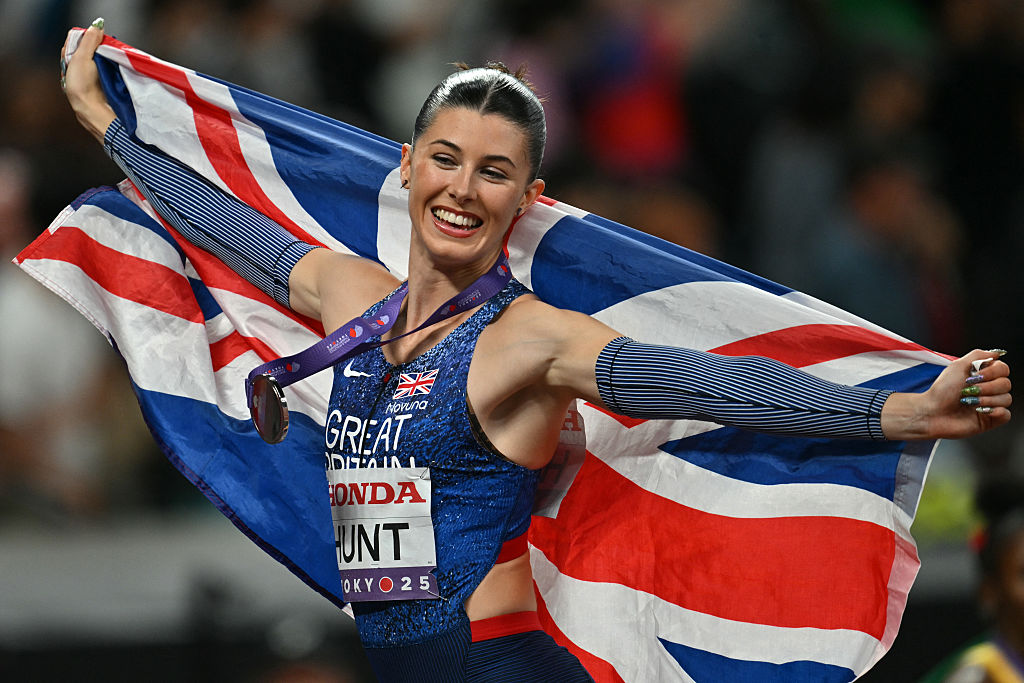
British sprinter excelled on the global stage with 200m silver in Tokyo but, as she explains, it was a run in London which provided one of the most pivotal moments of her career.
It was the performance that kept her going in the darkest of times – the proof that there was something worth fighting for as the impact of serious injury hit hard. Yet, with fitness fully restored in the early stages of this outdoor season, it also began to weigh more heavily. A source of frustration as much as inspiration.
Amy Hunt was just 17 in the summer of 2019 when she covered 200m in 22.42, an under-18 world record that marked her out as an exceptional young sprinting talent. For a variety of reasons in the intervening years – be it Covid, the challenge of combining top level athletics with an English literature degree at Cambridge or a ruptured left quadriceps that required surgery – the now 23-year-old went into this year with that mark still representing her personal best. To her mind, however, it certainly no longer represented the ceiling of her abilities.
“When I went through my surgery, I thought: ‘I ran faster than all of my idols did at 17 so I clearly have something’,” she says of that record. “I had this intangible, intrinsic sense of: ‘I’m supposed to be good. I have that ability inside of me’, and I knew that that wasn’t going to disappear. That run happened for a reason. You can’t just get that quick through pure fluke or chance.
“It was starting to be frustrating as we moved into this year, because I kept saying: ‘I can’t believe 17-year-old me is quicker than I’m running right now. She was really quick!’.”
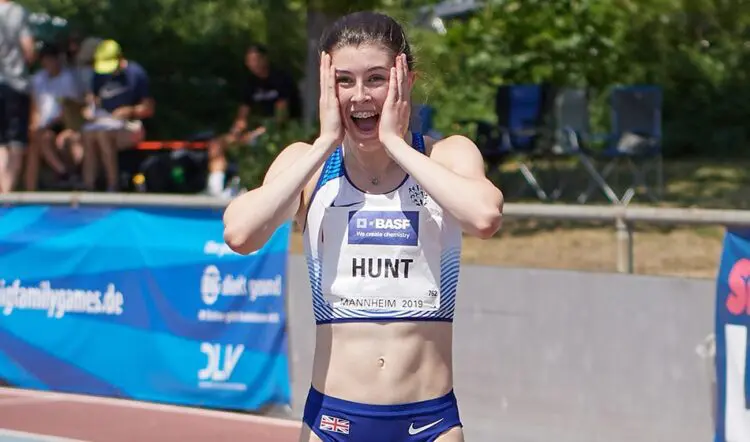
After graduating from university and teaming up with coach Marco Airale in the Italian city of Padua in the summer of 2023, Hunt had spent much of that time rebuilding herself. “When I first joined this group, there was still such a big disparity between left and right,” she says. “Because the injury was so traumatic, it killed off a lot of my nerves. It took quite a while to reconfigure everything, strengthen that side and rebuild that whole neural connection. A lot of what we were doing the first year was just reaching an equilibrium and then, when we started again a year ago, it was like: ‘Right. We’re finally on a clean slate’.”
Hunt has been one of the most raced athletes in the world in 2025 and, after a full indoor season where she dropped her 60m PB from 7.21 to 7.09 and finished fifth at the World Indoor Championships, the time felt right to start rewriting her outdoor marks.
Everything was coming together, and a then 100m PB of 11.03 (her best is now 11.02) promptly arrived at the Doha Diamond League in early May, but it was the 200m time that was the most significant – and the one that was proving to be elusive.
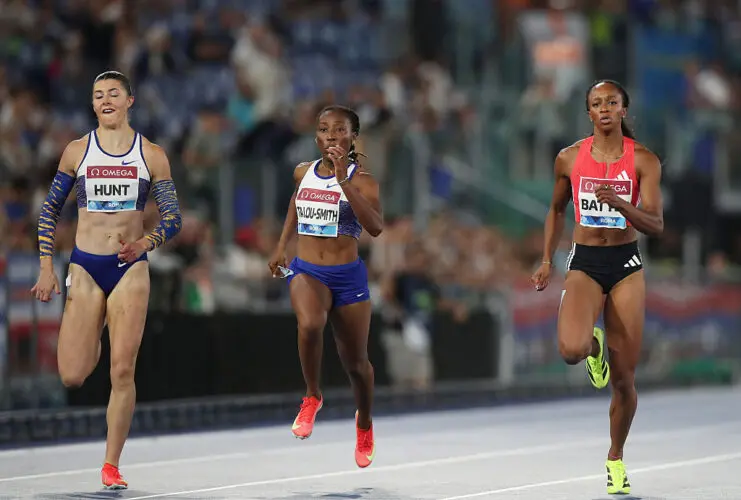
A run of 22.44, albeit with an illegal tailwind of 2.5, put it under threat in mid-May, while she clocked 22.67 at June’s Rome Diamond League while suffering with what turned out to be shingles and 22.45 at the Paris Diamond League was in part due to an unkind lane draw. “The conditions were there in so many races, but it wasn’t quite happening,” she says.
Hunt’s next opportunity, it turned out, would come in London. A broad smile spreads across her face as she recalls that Diamond League meeting.
“It was in front of 60,000 home fans and my whole family, my coaches, my agents were there. My best friend Julie was there taking pictures so I got to run over and hug her at the end,” she says. The embrace was very much celebratory, too. Hunt had clocked 22.31 – a run that represented so much.
“In a sense, it was like saying farewell to the younger version of Amy, and stepping into the next stage of my life and my career,” she says. “The process of growing up, almost. It’s like that turned over a new leaf for me and gave me that confidence of ‘I’m finally my own sprinter again. I don’t have that 17-year old sitting on my back’.
“I ran 22.31 and, after the race, coach said to me: ‘You know, you’re going to run that in [something like] two years’ time, and you’re going to turn around to me and be really, really annoyed’. It’s so funny but a month later, at the Silesia Diamond League, I ran exactly the same time and I was so annoyed. I remember storming back to the warm-up area and he was like: ‘Do you remember what I said to you in London?’. I’d gone from this person that was sobbing about having broken 22.42 to now being so angry with myself at what was such a messy race that had actually still been 22.31. I think it shows my progress as an athlete.”
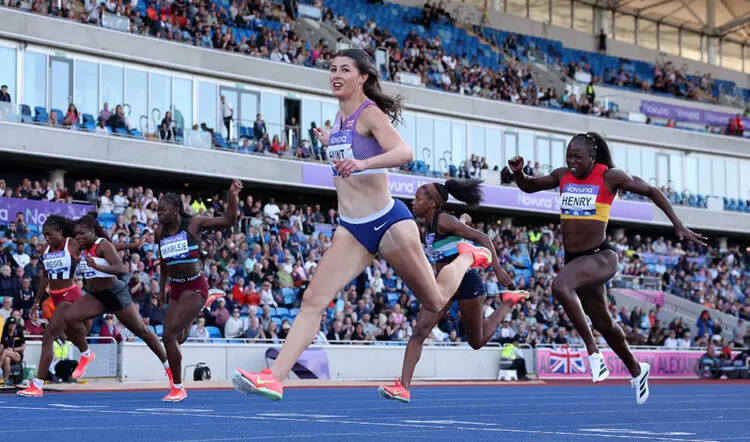
An even bigger indication of Hunt’s development came at the World Championships. She had reached the 100m semi-finals in Tokyo but had high hopes of making a bigger impact over the half lap event, fully aware that her finishing strength and speed could take her a long way. Heading to Japan, her PB now stood at 22.14 from a photo finish final at the British Championships which had just gone the way of Dina Asher-Smith but proved to be another big moment of the summer.
Another chunk was removed from Hunt’s PB in the World Championships semi-finals, when she clocked 22.08. In the final, America’s Melissa Jefferson-Wooden strode away to gold but, behind her, the medals were up for grabs and the Briton promptly seized hers as she flew to silver. It was testament to her being able to stay relaxed in the most heightened of circumstances.
“My parents got me a little compact mirror that lights up and sometimes, in the call room, I’ll actually be using that to top up my make-up, which may sound quite vain, but it’s a tactic to calm yourself down,” says Hunt of her pre-race preparation. “You can’t really have a shaky hand while you’re doing your lip liner so it’s a tactic to bring yourself back to that moment and remember that you’re here, you’re in the present. Just feel it, and don’t be worrying about what’s about to happen. I enjoy the feeling of being in the call room, being sat there and feeling on the precipice of something.”
Stepping out on to the track, familiarity was Hunt’s friend.
“[At the World Championships] I was always in lane five [for the 200m],” she adds. “When I got to the final, I was like: ‘This is the exact same pair of blocks, this is the exact lane, the angles, curves, trajectories are the same’. And I’d run a PB the day before so I was thinking: ‘You just have to run exactly the same as that’.
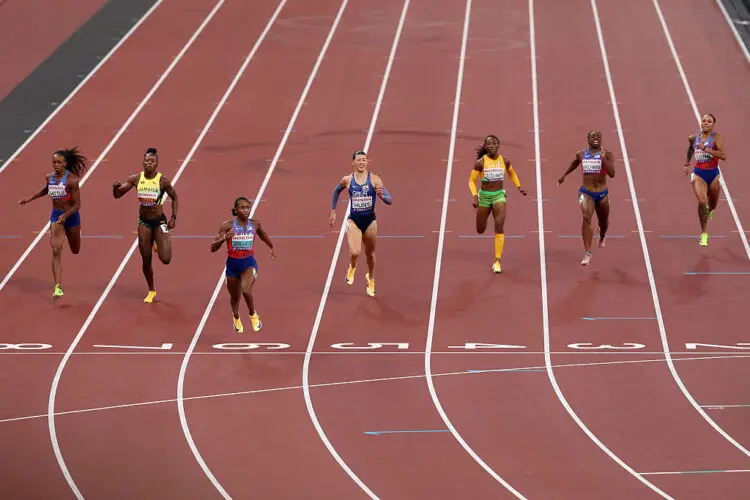
“I remember standing on the start line, really taking in the moment, looking into the crowd, and thinking: ‘All these people have turned up just to cheer us on, and they’re so excited to watch the race. And I’m so excited to race’. I was so ready to go.”
Bahamian sprinter Anthonique Strachan’s false start added to the challenge but, when the final did get underway, the thoughts rushed in for Hunt.
“I can definitely hear the crowd [when I’m racing] but it’s like the crowd noise that you hear in films, where it’s more background noise,” she says. “I’m trying to listen to my thoughts, the race plan, trying to work out where I am in the race and if I need to change tactics. There’s so much flashing through your mind in that moment.
“Because I was in lane five and Marie-Josée Ta Lou-Smith was in lane four, we had said that: ‘As long as you don’t see her, or she doesn’t come past you, by the time it gets to 100m to go, you will be absolutely fine’. She’s a magnificent starter so I was like: ‘If I can stay ahead of her around the bend, I know I’m going to be alright because I’m a lot stronger than the other girls, so I just need to put myself in a position where I can then cause damage’.
“When I got to 100m I realised that we were all in one line and I was just trying so hard to stay focused. I was swearing in my head non-stop and thinking: ‘Oh my gosh, it’s on. It’s really on. I’m about to do this!
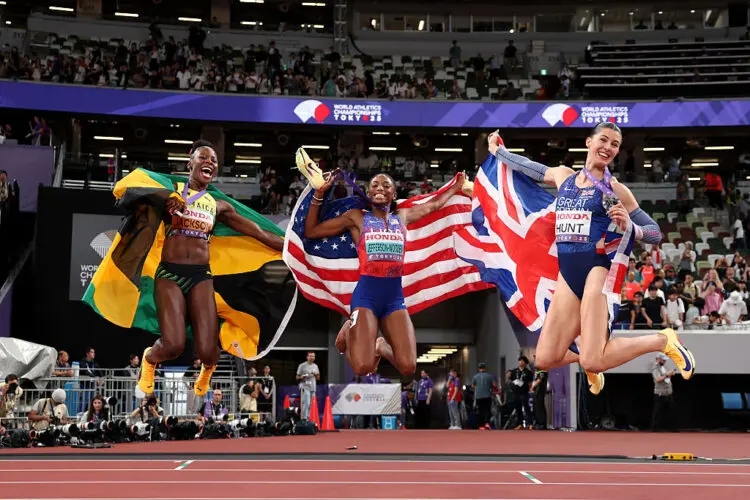
“I don’t remember anything about that middle part of the race. I just remember hitting the edge of the turn and thinking: ‘Oh my God, I’m gonna do this’ and then about 20m out [from the line] is the next memory I have. I’m just trying to think: ‘Hold your form’.
“This year I experienced a couple races that set me up incredibly well for Tokyo. At the British Championships, for example, in the 200m final I probably dipped for the line a little bit too early but that was so, so helpful, because when we got to Tokyo I didn’t do the same thing. In the 200m, as soon as you start dipping early, it’s horrible and it’s unrecoverable. You have to time the dip quite well.
“So all these lessons were going through my mind and then I crossed the line, and I threw myself at it. I knew there were two or three of us in the mix, and I thought I was ahead, but I was never sure.”
Confirmation soon arrived that Hunt had secured second place, ahead of the reigning champion Shericka Jackson. After the celebrations, there was some tourist time with her mum in Japan following the championships, then a holiday in Saint Lucia. When Hunt speaks to AW she is doing so from her home in Padua. Training has resumed and there are multiple targets to aim for next year, from the world indoors, to the Commonwealth Games in Glasgow, European Championships in Birmingham and World Athletics’ new Ultimate Championships.
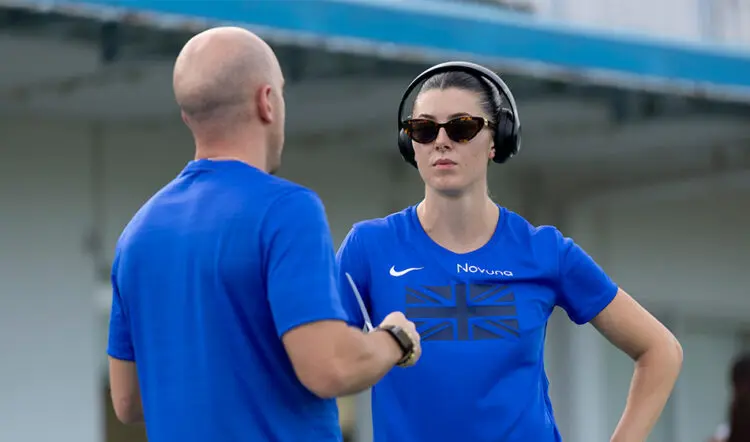
“We’re not afraid to go for everything,” she says. “In the 60m, I was fifth in the world this year and that’s now the expectation for next year. That’s the benchmark. We’re starting to encroach more on the British records and that’s another big target. I’m just a very competitive person, so I’m quite looking forward to the many competitions that we have coming up next year.”
Should she achieve some of her aims in 2026, Hunt might find herself finishing another year being named as AW’s British Female Athlete of the Year. For now, she’ll enjoy this one, though.
“I think we forget how strong a nation we are in track and field,” she says. “When we talk to people from other countries and obviously when I talk to other people in my training group, they really respect the UK in terms of its track and field legacy, its history, its athletes. We have such a rich track and field culture so [the award] is actually a very big deal.”



