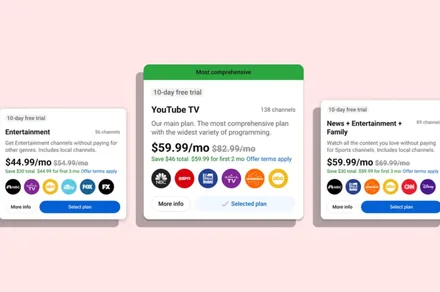




YouTube TV announced plans to introduce new genre-specific bundles last year to give users the flexibility to pick and pay for the content they actually want to watch. Four of these bundles are now live in the US, with the platform planning to roll out over ten bundles across Sports, News, Entertainment, and Family content in the coming weeks.
YouTube TV announced the rollout in a recent blog post, highlighting the content included in the introductory bundles and their pricing. The base Sports plan, priced at $64.99/month, will give subscribers access to all major broadcasters, alongside sports networks like FS1, NBC Sports Network, and all of ESPN networks. Subscribers ill also gain access to ESPN Unlimited this fall.
The Sports + News plan includes everything from the Sports plan, along with national news networks such as CNBC, Fox News, MSNBC, CNN, CSPAN, Bloomberg, and Fox Business. It’s priced at $71.99/month. The Entertainment plan, which is the most affordable of the four, costs $54.99/month and includes all major broadcasters and content, “ranging from FX dramas to Hallmark classics, with channels such as Comedy Central, Bravo, Paramount, Food Network, HGTV, and many more.”
Finally, the News + Entertainment + Family plan, priced at $69.99/month, combines news and entertainment channels with family content like Disney Channel, Nickelodeon, National Geographic, Cartoon Network, PBS Kids and more.
Advertisement
YouTube TV bundles offer big savings, especially for new subscribers
All four bundles is priced lower than the main YouTube TV plan, the platform’s most comprehensive offering with over 100 networks across genres. For those who haven’t previously subscribed to YouTube TV, the bundles are available at a discount.
The Sports plan is available for $54.99 per month for the first year, while the Sports + News, Entertainment, and News + Entertainment + Family plans are priced at $56.99, $44.99, and $59.99/month, respectively, for the first three months.
This cutaway view shows the interior of the Starlab space station’s laboratory. (Starlab Illustration)
How do you design a living space where there’s no up or down? That’s one of the challenges facing Teague, a Seattle-based design and innovation firm that advises space companies such as Blue Origin, Axiom Space and Voyager Technologies on how to lay out their orbital outposts.
Mike Mahoney, Teague’s senior director of space and defense programs, says the zero-gravity environment is the most interesting element to consider in space station design.
“You can’t put things on surfaces, right? You’re not going to have tables, necessarily, unless you can attach things to them, and they could be on any surface,” he told GeekWire. “So, directionality is a big factor. And knowing that opens up new opportunities. … You could have, let’s say, two scientists working in different orientations in the same area.”
Mike Mahoney is senior director of space and defense programs at Teague. (Photo via LinkedIn)
Over the next few years, NASA and its partners are expected to make the transition from the aging International Space Station to an array of commercial space stations — and Teague is helping space station builders get ready for the shift.
In the 1980s, Teague helped Boeing and NASA with their plans for Space Station Freedom, an orbital project that never got off the ground but eventually evolved into the International Space Station. Teague also partnered with NASA on a 3D-printed mockup for a Mars habitat, known as the Crew Health and Performance Exploration Analog.
Advertisement
Nowadays, Teague is focusing on interior designs for commercial spacecraft, a business opportunity that capitalizes on the company’s traditional expertise in airplane design.
Mahoney said Teague has been working with Jeff Bezos’ Blue Origin space venture on a variety of projects for more than a decade. The first project was the New Shepard suborbital rocket ship, which made its debut in 2015.
“We partnered with their engineering team to design for the astronaut experience within the New Shepard space capsule,” Mahoney said. “It’s all the interior components that you see that come together, from the linings to the lighting. We created a user experience vision for the displays as well.”
GeekWire’s Alan Boyle sits in one of the padded seats inside a mockup of the crew capsule for Blue Origin’s suborbital spaceship, on display at a space conference in 2017. The door of the capsule’s hatch is just to the right of Boyle’s head. (GeekWire File Photo / Kevin Lisota)
Teague also worked with Blue Origin on design elements for the Orbital Reef space station and the Blue Moon lunar lander. “We were involved in initial concepting for the look and feel of the vehicles,” Mahoney said. “In other cases, we designed and built mockups that were used for astronaut operations and testing. How do we navigate around the lunar lander legs? How do we optimize toolboxes on the surface of the moon?”
Other space station ventures that have benefited from Teague’s input include Axiom Space (which also brought in Philippe Starck as a big-name designer) and Starlab Space, a joint venture founded by Voyager Technologies and Airbus.
Advertisement
Starlab recently unveiled a three-story mockup of its space station at NASA’s Johnson Space Center in Texas. The mockup is built so that it can be reconfigured to reflect tweaks that designers want to make in the space station’s layout, before launch or even years after launch.
“One of the things that’s been very helpful along this development path has been working with Teague, because you have to have a really good idea on how you lay out this very large volume so that you can optimize the efficiency of the crew,” said Tim Kopra, a former NASA astronaut who now serves as chief human exploration officer at Voyager Technologies.
Kopra compared the Starlab station to a three-story condo. “The first floor is essentially like the basement of a large building that has the infrastructure,” he said, “It has our life support systems, avionics and software, the toilets, the hygiene station — which encompasses both the toilet and a cleaning station — and the workout equipment.”
The second floor serves as a laboratory and workspace, with a glovebox, freezer, centrifuge, microscope and plenty of racks and lockers for storage. “We are very focused on four different industries: semiconductors, life sciences, pharmaceuticals and materials science,” Kopra said.
Advertisement
He said the third floor will be a “place that people will enjoy … because Deck 3 has our crew quarters, our galley table, our windows and a little bit more experiment capacity.”
First ever look inside Voyager Space's Starlab Space Station mockup. The space station is 17m tall & 7.7m wide, essentially a 3-story tall building, and can host 4 astronauts continuously & 8 astronauts briefly. The company hopes to launch Starlab by 2029, to replace the ISS. pic.twitter.com/BzwfjUwkmZ
The galley table is a prime example of how zero-gravity interior design differs from the earthly variety. “No chairs,” Kopra said. “Just like on the ISS, all you need is a place to hook your feet. There are little design features, like where do you put a handrail, and how tall is the table?” (He said the designers haven’t yet decided whether the table should be round or square.)
Kopra said one of his top design priorities is to use the station’s volume, and the astronauts’ time, as efficiently as possible. “Time is extremely valuable on the ISS. They calculate that crew time is worth about $135,000 per hour,” he said. “Ours will be a fraction of that, but it really illustrates how important it is to be efficient with the time on board.”
Advertisement
Starlab is laid out to maximize efficiency. “We have a really cool design where the middle has a hatchway that goes all the way through the three stories,” he said. “So, imagine if it were a fire station, you’d have a pole that went from floor to floor. We don’t need a fire pole. We can just translate through that area.”
Mahoney said human-centered design will be more important for commercial space stations than it was for the ISS.
“In the past, space stations have been primarily designed for professionally trained, military background astronauts,” he said. “Now we’ll have different folks in there. … How do we think about how researchers and scientists will be using these spaces? How do we think about non-professional private astronauts? As the International Space Station gets retired, how do these companies step in to fill the void, serving NASA but also a lot of these new customers?”
A three-story mockup of the Starlab space station has been installed inside a building at NASA’s Johnson Space Center in Texas. (Starlab Photo)
An interior view of the Starlab mockup highlights the large observation windows and emergency equipment. (Starlab Photo)
The Internal Payload Laboratory inside the Starlab mockup features a glovebox, cold stowage, an optical bench and a workbench. (Starlab Photo)
Level 3 of the Starlab mockup includes the crew quarters, galley and Earth viewing areas. Starlab Space’s partners include Hilton and Journey, the team behind the Sphere in Las Vegas. (Starlab Photo)
When will commercial space stations step in? The answer to that question is up in the air.
But NASA has been slow to follow through on the revised plan, sparking concern in Congress. Late last month, the space agency said it was still working to “align acquisition timelines with national space policy and broader operational objectives.” Now some lawmakers are calling on NASA to reconsider its plan to deorbit the ISS in the 2030-2031 time frame.
The timetable for the space station transition may be in flux, but Mahoney and other space station designers are staying the course — and taking the long view.
“We may not know right now how the space station is going to be used 20 years from now,” Mahoney said. “How do we start to future-proof and create a system within that’s modular and flexible, so that we can add technologies and add systems, or we can configure in different ways? … Those are the kinds of things that we’re thinking about designing for.”
House Judiciary Committee member Jamie Raskin (D-MD) has asked the US Department of Justice to turn over all its communications with both Apple and Google regarding the companies’ decisions to remove apps that shared information about sightings of US Immigrations and Customs Enforcement officers. Several apps that allowed people to share information about where they had seen ICE members were removed from both Apple’s App Store and Google’s Play Store in October. Politicoreported that Raskin has contacted Attorney General Pam Bondi on the issue and also questioned the agency’s use of force against protestors as it executes the immigration policy set by President Donald Trump.
“The coercion and censorship campaign, which ultimately targets the users of ICE-monitoring applications, is a clear effort to silence this Administration’s critics and suppress any evidence that would expose the Administration’s lies, including its Orwellian attempts to cover up the murders of Renee and Alex,” Raskin wrote to Bondi. He refers to Minneapolis residents Renee Good and Alex Pretti, who were both fatally shot by ICE agents. In the two separate incidents, claims made by federal leaders about the victims and the circumstances of their deaths were contradicted by eyewitnesses or camera footage, echoing violent interactions and lies about them that occurred while ICE conducted raids in Chicago several months ago.
Another day, another wave of gaming layoffs. Today it’s Riot Games with the announcement that it’s cutting jobs on its pair-based fighting game 2XKO. For context, a representative from Riot confirmed to Game Developer that about 80 people are being cut, or roughly half of 2XKO’s global development team.
“As we expanded from PC to console, we saw consistent trends in how players were engaging with 2XKO,” according to the blog post from executive producer Tom Cannon. “The game has resonated with a passionate core audience, but overall momentum hasn’t reached the level needed to support a team of this size long term.”
The console launch for 2XKO happened last month. Cannon said the company’s plans for its 2026 competitive season have not altered with the layoffs. He added that Riot will attempt to place the impacted people at new positions within the company where possible.
Looking for the most recent regular Connections answers? Click here for today’s Connections hints, as well as our daily answers and hints for The New York Times Mini Crossword, Wordle and Strands puzzles.
Today’s Connections: Sports Edition is all about the Winter Olympics. If you’re struggling with today’s puzzle but still want to solve it, read on for hints and the answers.
Connections: Sports Edition is published by The Athletic, the subscription-based sports journalism site owned by The Times. It doesn’t appear in the NYT Games app, but it does in The Athletic’s own app. Or you can play it for free online.
Hints for today’s Connections: Sports Edition groups
Here are four hints for the groupings in today’s Connections: Sports Edition puzzle, ranked from the easiest yellow group to the tough (and sometimes bizarre) purple group.
Yellow group hint: Elegant ice sport.
Advertisement
Green group hint: Sports cinema.
Blue group hint: Five for fighting.
Purple group hint: Unusual Olympic sport.
Answers for today’s Connections: Sports Edition groups
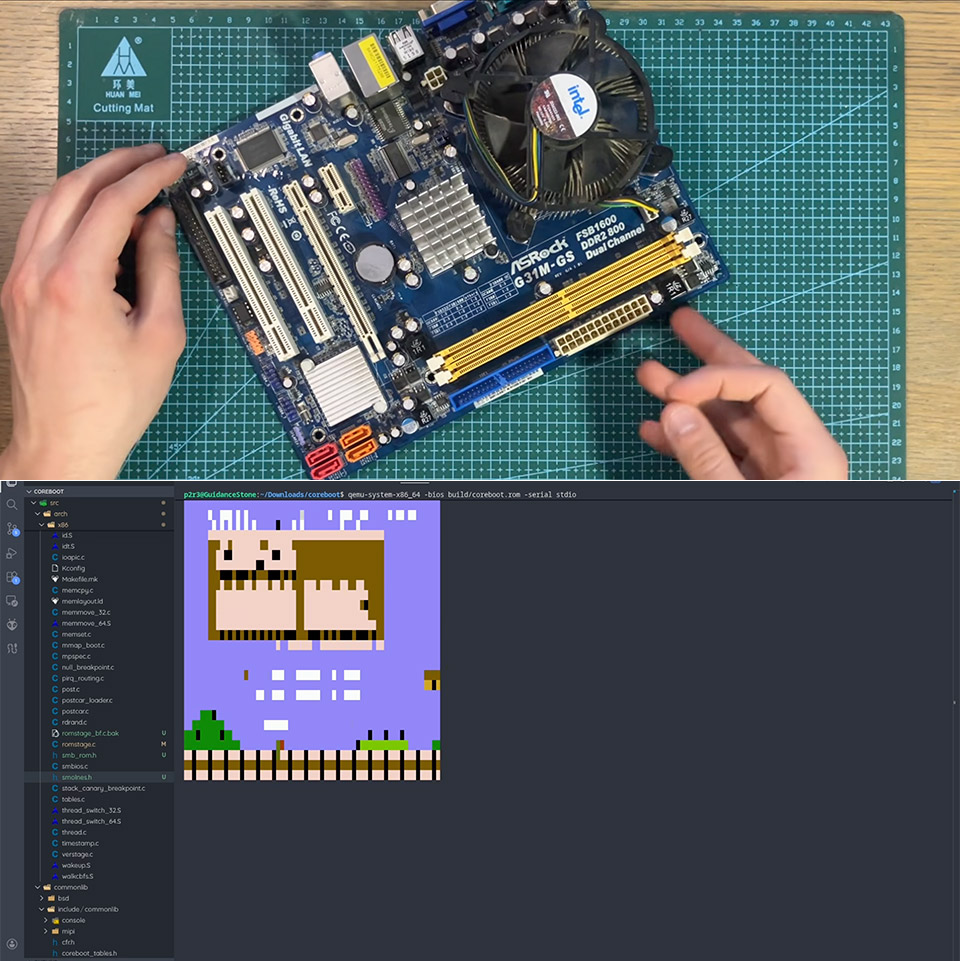
Installing an RPi Pico board like it’s a modchip. (Credit: Tucker Osman, YouTube)
Although generally iPads tend to keep their resale value, there are a few exceptions, such as when you find yourself burdened with iCloud-locked devices. Instead of tossing these out as e-waste, you can still give them a new, arguably better purpose in life: an external display, with touchscreen functionality if you’re persistent enough. Basically someone like [Tucker Osman], who spent the past months on making the touchscreen functionality play nice in Windows and Linux.
While newer iPads are easy enough to upcycle as an external display as they use eDP (embedded Display Port), the touch controller relies on a number of chips that normally are initialized and controlled by the CPU. Most of the time was thus spent on reverse-engineering this whole process, though rather than a full-depth reverse-engineering, instead the initialization data stream was recorded and played back.
This thus requires that the iPad can still boot into iOS, but as demonstrated in the video it’s good enough to turn iCloud-locked e-waste into a multi-touch display. The SPI data stream that would normally go to the iPad’s SoC is instead intercepted by a Raspberry Pi Pico board which pretends to be a USB HID peripheral to the PC.
Ahead of the official launch on February 12, 2026, a French publication has leaked the key features of Sony’s WF-1000XM6 TWS earbuds. Per Dealabs, the device will feature a new QN3e chipset that is three times faster than the one on the XM5s.
Along with eight adaptive microphones (beamforming + bone conduction), up from six on the outgoing model, the chipset should offer smarter, more responsive, and effective active noise cancellation (ANC).
A faster brain for better silence
Further, the model could get an “Adaptive NC Optimizer” feature that adjusts the noise-cancellation intensity based on the user’s environment, optimizing the performance in real time.
Advertisement
Like the XM5s, the XM6 will offer three core listening modes: Noise Cancelling, Ambient Sound Mode, and regular (with no cancellation or passthrough). Moreover, expect the earbuds to offer noticeably better noise cancellation, perhaps enough to be on par with the AirPods Pro 3.
The report also mentions a “new speaker” or audio driver that should deliver richer audio than the 8.4mm Dynamic Driver X on the XM5s. Sony could also equip the device with an upgraded Digital-to-Analog Converter (DAC) and an enhanced amplifier.
Sound upgrades beyond ANC
On the software side, the flagship earbuds could get DSEE Ultimate support, a more advanced upscaling technology than DSEE Extreme on the XM5s. It can improve both the sample rate frequency and the bit depth of compressed audio files.
Additional features may include adaptive sound control, Quick Attention mode, background music effect, and Speak to Chat. The device should also support LE Audio and Auracast.
Advertisement
You could also get Spatial Audio with Head Tracking, new audio modes, Bluetooth v5.3 (with multi-point connectivity), support for Hi-Res Wireless (LDAC) codec, and a 10-band equalizer within the Headphones Connect app to customize the sound.
The Sony WF-1000XM5 launched at $300, a price I expect Sony will stick withSimon Cohen / Digital Trends
Sony WF-1000XM6 to demand $80 over the AirPods Pro 3
Regarding battery life, the Sony WF-1000XM6 should last up to eight hours on a single charge (likely with ANC) and up to 24 hours with the charging case (which supports fast and wireless charging).
Post their launch on February 12, 2026, the Sony WF-1000XM6 are expected to be available in the United States for $329.99, in Black and Silver finishes (commanding a more premium price tag than the AirPods Pro 3).
Looking for the most recent Connections answers? Click here for today’s Connections hints, as well as our daily answers and hints for The New York Times Mini Crossword, Wordle, Connections: Sports Edition and Strands puzzles.
Today’s NYT Connections puzzle was pretty difficult, I thought. I did get a kick out of the green group, though. Read on for clues and today’s Connections answers.
The Times has a Connections Bot, like the one for Wordle. Go there after you play to receive a numeric score and to have the program analyze your answers. Players who are registered with the Times Games section can now nerd out by following their progress, including the number of puzzles completed, win rate, number of times they nabbed a perfect score and their win streak.
Here are four hints for the groupings in today’s Connections puzzle, ranked from the easiest yellow group to the tough (and sometimes bizarre) purple group.
OPPO has just expanded it’s Reno 15-series lineup with the all-new Reno 15C. With it, the Chinese smartphone maker is targeting users looking for a compact smartphone with strong camera capabilities and long battery life. To mark the start of sales, OPPO is offering multiple launch benefits, including bank discounts of up to ₹3,500, exchange offers, cashback, no-cost EMI options, and zero down payment schemes across online and offline channels.
Display and Software
The OPPO Reno 15C features a 6.57-inch flat AMOLED display with Full HD+ resolution and a 120Hz refresh rate. The panel offers up to 1,400 nits of peak brightness. Powering the device is the Qualcomm Snapdragon 6 Gen 1 processor.
On the software front, the Reno 15C runs Android 16 with ColorOS 16 on top. The smartphone also carries IP66, IP68, and IP69 certifications, offering resistance against dust and water.
Camera
The Reno 15C comes with a triple rear camera setup consisting of a 50MP primary sensor, an 8MP ultra-wide camera, and a 2MP macro lens. On the front, the phone features a 50MP selfie camera that supports 4K HDR video recording at up to 60fps.
OPPO has also included AI-powered camera features such as AI Pop Out, AI Flash Photography 2.0, and AI Motion Photo slow-motion to enhance photography and video recording.
Advertisement
Battery and Charging
Battery life is one of the highlights of the Reno 15C. The smartphone packs a 7,000mAh battery, aimed at delivering extended usage with fewer charging breaks. It supports 80W SUPERVOOC fast charging, allowing the device to be topped up quickly when needed.
Positioned as the most affordable model in the Reno 15 lineup, the Reno 15C sits below the Reno 15, Reno 15 Pro, and Reno 15 Pro Mini, offering a more balanced feature set at a lower price point.
Price and Availability
The OPPO Reno 15C is available in two storage variants in India. OPPO has priced the 8GB RAM with 256GB storage model at Rs 34,999, while the 12GB RAM with 256GB storage variant costs Rs 37,999. The smartphone comes in Afterglow Pink and Twilight Blue colour options. Furthermore, users can pre-order the phone through Amazon, Flipkart, and the OPPO online store. The device will also be available at selected offline retail stores.
Hackers are exploiting SolarWinds Web Help Desk (WHD) vulnerabilities to deploy legitimate tools for malicious purposes, such as the Zoho ManageEngine remote monitoring and management tool.
The attacker targeted at least three organizations and also leveraged Cloudflare tunnels for persistence, and the Velociraptor cyber incident response tool for command and control (C2).
The malicious activity was spotted over the weekend by researchers at Huntress Security, who believe that it is part of a campaign that started on January 16 and leveraged recently disclosed SolarWinds WHD flaws.
“On February 7, 2026, Huntress SOC analyst Dipo Rodipe investigated a case of SolarWinds Web Help Desk exploitation, in which the threat actor rapidly deployed Zoho Meetings and Cloudflare tunnels for persistence, as well as Velociraptor for means of command and control,” Huntress says.
According to the cybersecurity company, the threat actor exploited the CVE-2025-40551 vulnerability, which CISA flagged last week as being used in attacks, and CVE-2025-26399.
Advertisement
Both security problems received a critical severity rating and can be used to achieve remote code execution on the host machine without authentication.
It’s worth noting that Microsoft security researchers also “observed a multi‑stage intrusion where threat actors exploited internet‑exposed SolarWinds Web Help Desk (WHD) instances,” but they did not confirm exploitation of the two vulnerabilities.
Attack chain and tool deployment
After gaining initial access, the attacker installed the Zoho ManageEngine Assist agent via an MSI file fetched from the Catbox file-hosting platform. They configured the tool for unattended access and registered the compromised host to a Zoho Assist account tied to an anonymous Proton Mail address.
The tool is used for direct hands-on keyboard activity and Active Directory (AD) reconnaissance. It was also used to deploy Velociraptor, fetched as an MSI file from a Supabase bucket.
Advertisement
Velociraptor is a legitimate digital forensics and incident response (DFIR) tool that Cisco Talos recently warned was being abused in ransomware attacks.
In the attacks observed by Huntress, the DFIR platform is used as a command-and-control (C2) framework that communicates with attackers via Cloudflare Workers.
The researchers note that the attacker used an outdated version of the Velociraptor, 0.73.4, which is vulnerable to a privilege escalation flaw that allows increasing permissions on the host.
The threat actor also installed Cloudflared from Cloudflare’s official GitHub repository, using it as a secondary tunnel-based access channel for C2 redundancy.
Advertisement
In some cases, persistence was also achieved via a scheduled task (TPMProfiler) that opens an SSH backdoor via QEMU.
The attackers also disabled Windows Defender and Firewall via registry modifications to make sure that fetching additional payloads would not be blocked.
“Approximately a second after disabling Defender, the threat actor downloaded a fresh copy of the VS Code binary,” the researchers say.
Attack chain Source: Huntress
Security updates and mitigation
System administrators are recommended to upgrade SolarWinds Web Help Desk to version 2026.1 or later, remove public internet access to SolarWinds WHD admin interfaces, and reset all credentials associated with the product.
Huntress also shared Sigma rules and indicators of compromise to help detect Zoho Assist, Velociraptor, Cloudflared, and VS Code tunnel activity, silent MSI installations, and encoded PowerShell execution.
Advertisement
Neither Microsoft nor Huntress attributed the observed attacks to any specific threat groups, and nothing about the targets was disclosed beyond Microsoft characterizing the breached environments as “high-value assets.”
Modern IT infrastructure moves faster than manual workflows can handle.
In this new Tines guide, learn how your team can reduce hidden manual delays, improve reliability through automated response, and build and scale intelligent workflows on top of tools you already use.
As fans of the vinyl revival, we’re excited when record players of any kind get their moment in the sun. So when watching the Olympics over the weekend, I was quite surprised and pleased to see a very distinctive looking turntable featured in a car commercial. The turntable was VPI’s flagship Titan Direct and the car is the first all-electric vehicle from Lexus, the RZ SUV.
While I’m happy to see this well-regarded luxury auto-maker take the plunge into fully electric vehicles — and delighted to see them highlighting a high-end Hi-Fi system in the ad — I was struck by the irony that the turntable featured in the ad, the VPI Titan Direct ($95,000), sells for approximately twice the cost of the Lexus EV ($47,295). Even if you load up the premium trim of the Lexus RZ with its top of the line “Mark Levinson” (powered by Harman) 13-speaker 1,800-Watt sound system, you’re still out the door for under $60,000. Though sadly, you won’t get Dolby Atmos with that.
Meanwhile, for $95,000, the VPI Titan Direct doesn’t even come with a cartridge. It does, however, come with the company’s 12-inch 3D-printed Fatboy Gimbal tonearm, known for its rigidity and its unique triangular-to-circular taper, which is said to reduce resonance and improve tracking. The tonearm features precision gimbal bearings, upgraded Nordost Reference wiring, and a micrometer-style counterweight for simple and accurate tracking force adjustment.
The VPI Titan Direct supports up to three tonearms for quick swaps among cartridges. Shown here with two tonearms installed (image from manufacturer).
The Titan Direct turntable itself features a high mass magnetic direct drive design, pneumatic air-suspension isolation, and a gorgeous triple-stack chassis designed for maximum resonance control. While the version shown in the ad only had a single tonearm installed, the ‘table supports up to three tonearms of virtually any length or manufacturer. This gives audiophiles the option to switch among different tonearm/cartridge combinations instantly, without lengthy set-up for the swaps.
Lexus RZ: Is It a Souped Up Toyota?
As for the car, if it looks a bit familiar, that’s because it shares the chassis, wheelbase, e-TNGA platform and basic silhouette of its Toyota sibling, the BZ4x. But the Lexus version features more distinctive styling including a more aggressive “spindle body” front end, a rear spoiler, more refined interior and higher overall performance. With up to 402 total system horsepower and 0–60 MPH times as quick as 4.1 seconds (on the 550e F SPORT trim), the RZ offers a sporty feel for a little fun after dropping off the little tykes at soccer practice.
The RZ’s built-in 71.4 kWh battery offers 228 to 302 miles of range, depending on configuration, and its integrated DC fast-charging system can recharge from roughly 10% to 80% capacity in around 30 minutes at a high speed DC charger. U.S. versions of the RZ feature the NACS charging port, making it compatible with a wide range of DC fast chargers (including most chargers in the Tesla supercharger network).
Advertisement
The Lexus RZ EV features a nicely appointed interior with central infotainment screen.
Unlike Ford and GM (and, of course, Tesla), Lexus is very late to the EV game, thanks to its parent company Toyota dragging its feet on full electric vehicles and betting the farm on hybrid vehicles instead. While popular hybrid cars like the Toyota Prius can get higher fuel efficiency than their ICE (Internal Combustion Engine) counterparts, their combustion engines still require regular maintenance like oil changes, tune-ups, belt changes and more, leading to overall higher cost of ownership, compared to EVs.
A modern EV drive train includes only a few dozen moving parts, from battery to motor to linkage to wheels. Meanwhile modern ICE engines can include over 2,000 moving parts, each of which is a potential point of failure over time. Also, even a highly efficient hybrid vehicle’s on-board combustion engine produces local emissions at the tailpipe, which contribute toward local air pollution (particularly in cities) while an ICE contributes zero local emissions and can be powered by green energy sources such as solar, wind and hydro-electric power.
While modern EVs still rarely exceed 300 miles of range, the build-out of DC fast charging stations is making long distance road trips more feasible, and the lower NVH (Noise, Vibration and Harshness) of an EV leads to less driver fatigue over long distances.
The Bottom Line
We’re happy to see distinctive high-end audio gear used to promote EV technology. And while you could buy two of the cars for the cost of one of the turntables, there’s nothing to say you can’t buy one of each if you’ve got the means. Just don’t try installing the turntable in the car. That would not end well. You might scratch a record.