Connect with us

NewsBeat

three true tales of love at first sight at Regency masquerade balls

Published

on

three true tales of love at first sight at Regency masquerade balls

Countless love stories throughout the ages hinge on the idea of love at first sight. Immediate, unwavering infatuation the moment eyes meet. Two people finding each other across a crowded, glittering ballroom or perhaps bumping into each other accidentally. But what if your true love is hidden behind a disguise? And flees before you have a chance to learn their name?

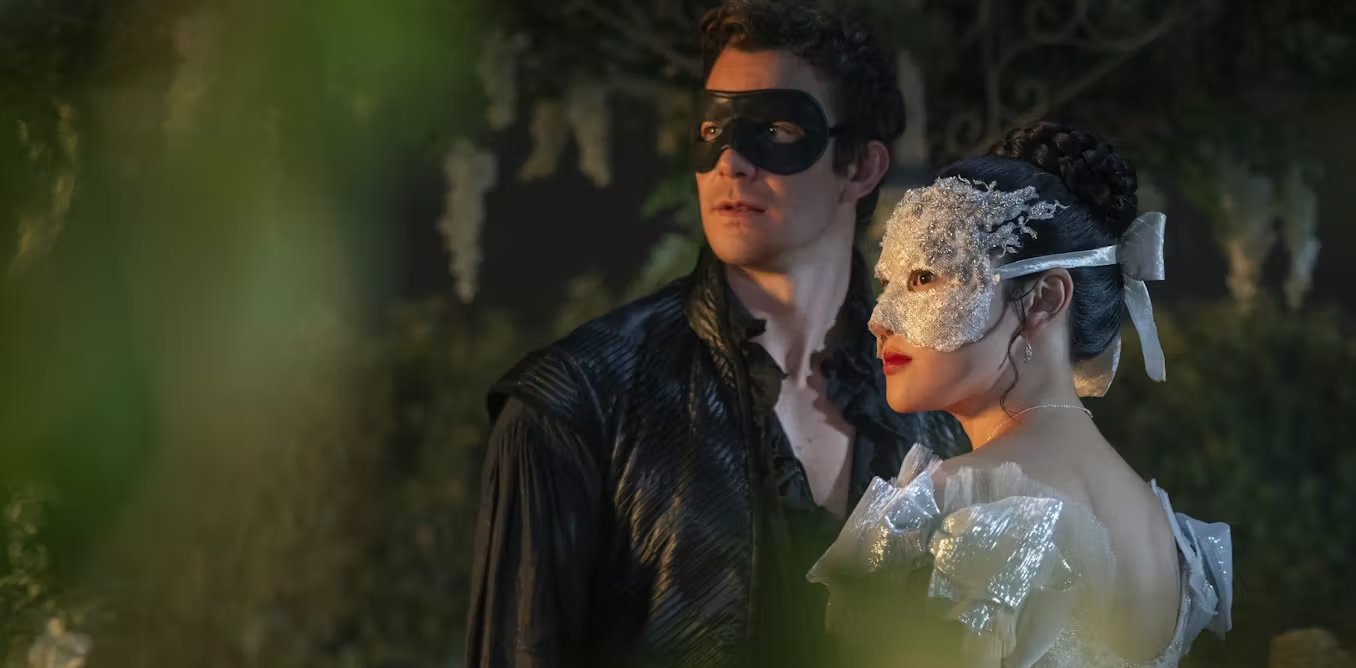
Such is the challenge facing Benedict Bridgerton (Luke Thompson) in the most recent season of Bridgerton. The first episode of season four centres around a truly spectacular masquerade ball at Bridgerton House and sets up a re-imagining of the Cinderella story, with Regency flare.

Sparkling in silver from head to toe, servant Sophie Baek (Yerin Ha) manages to sneak into the lavish elite entertainment unnoticed. It is there she finds herself in the company of Benedict, one of the most sought-after bachelors in London and a notorious rake. Sparks fly as their gazes lock and the world fades away into a night of enchantment until the resounding chimes of the midnight hour cause Sophie to flee, leaving Benedict with no more than a fast farewell and sole silver glove.

Even without the concealment of a mask, Prince Charming had a hard enough time finding Cinderella – so what chance would mere mortals have had at finding missed connections, let alone true love at the masquerade?

Advertisement

The trailer for Bridgerton season four.

In the case of real Regency woman Elizabeth Chudleigh, it was more like lust at first sight. Chudleigh, whose clandestine marriage was falling apart before her eyes, was an ageing maid of honour in the court of the Princess of Wales. One whisper of her despair, about her marriage or her age, would endanger her post in court, for, as attendants to the princess, maids of honour were expected to be young, unmarried ladies of repute.

As Chudleigh biographer Catherine Ostler explains, she needed to do something to grab the attention of eligible elite bachelors and the masquerade was the perfect place to do so. The masquerade offered the fashionable elite an exclusive space where they could flaunt their status, wealth, and taste through character, comic, or fancy dress.

Advertisement

A contemporary illustration of Chudleigh as Iphigenia.
Wiki Commons

Wearing a bold and breathtaking costume that exposed her breasts – or at the very least gave the illusion of nudity – Chudleigh took an enormous risk when she arrived at the King’s Theatre in 1749. Disguised as the mythical character Iphigenia, this daring decision boldly put Chudleigh’s sexuality, charms and body on display for all to see.

The author and politician Horace Walpole, who witnessed the dress, recalled in his correspondence that she was “so naked that you would have taken her for Andromeda”.

Luckily for Chudleigh, she became an overnight sensation and managed to catch the eye of one of the most powerful men in the country: His Royal Majesty, King George II. The king was besotted. Walpole himself saw George II fall head over heels, writing “our gracious Monarch has a mind to believe himself in love” with Chudleigh, which was most clearly made evident when he kissed her in front of his advisors.

Depictions of Chudleigh’s scandalous dress, or rather, undress, appeared in print shop windows across the country while reports of the risque costume circulated through correspondence and newspapers, such as the General Advertiser, across the country. Chudleigh herself appeared regularly at the king’s side. Though her position as mistress to His Majesty was relatively short-lived, lasting no more than a few years, her gamble at the masquerade not only aided her in climbing the social ladder and expanding her social circles, it inextricably linked her to the masquerade and transformed her from a maid of honour into a cultural phenomenon.

Advertisement

Smitten at first sight

James Hamilton, the sixth duke of Hamilton, had not imagined he would find himself utterly and completely intoxicated at the evening’s masquerade from anything other than copious amounts of wine, as was his tendency. He was 28 and still unmarried, despite his wealth and not unattractive features.

Portrait of Elizabeth Gunning with her pet dog

Portrait of Elizabeth Gunning, then Duchess of Hamilton by Gavin Hamilton (1752).
Scottish National Portrait Gallery

As he moved among the domino cloaks, harlequins and fancy dresses he spotted her, the rumoured beauty from Ireland, Elizabeth Gunning. She was striking. He was smitten – and he must marry her.

The thought, though impulsive, was not uncharacteristic of Hamilton who was known to follow his fancies – not unlike Benedict Bridgerton. The duke could not keep Gunning from his thoughts. Their paths crossed two weeks later at Lord Chesterfield’s where Hamilton was distracted beyond repair, making “violent love [with his attentions] at one end of the room while he was playing at pharaoh (cards) at the other end”. He subsequently lost £1,000.

In early February their met once again at a masquerade. Hamilton could no longer restrain himself and proposed that evening. Dressed as a demure Quaker, the flattered, and likely overwhelmed, Gunning accepted. Without a dowry to her name, Gunning had to rely on beauty, behaviour and a little luck to break the barriers of rank and marry significantly above her station.

Advertisement

The pair married in secret at a chapel two nights later, on Valentine’s Day nonetheless, before Hamilton’s family could interfere in this inferior match. The clandestine union was sealed at midnight with a bed-curtain ring, for Hamilton had forgotten to bring the proper one. The marriage, though rushed, was a small sort of happily ever after for Gunning, now the Duchess of Hamilton, who became a fashionable leading lady of the Georgian elite.
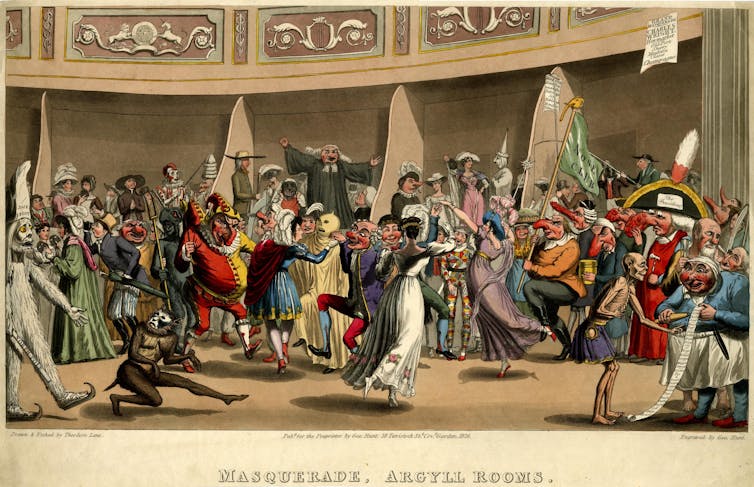
Painting of dancers as a masquerade ball
Masquerade, Argyll Rooms by T Lane (1826).
The Trustees of the British Museum, CC BY-NC-SA

Not all Regency encounters had fairy tale, or even fanciful endings. Newspapers occasionally advertised missed connections at masquerades with clues including costume descriptions, initials and conversation topics.

In 1778, one eager gentleman addressed his note in The Morning Post to “A Lady in a light blue dress, and mask of the same colour, who was at the Pantheon Masquerade, and danced two or three dances” with him. She claimed she knew the gentleman she was keeping company with, having seen “him almost every day walking in Bond-street, or St. James’s-street, but would not tell who she was”. He requests that she “send a line to Stewart’s Coffee-house, Broad-street, informing him where is to be met with, it will be the means of quieting an anxious mind”.

Unlike Bridgerton’s Cinderella story, it is impossible to know whether or not this real pair found each other beyond the walls of the ball. One thing is for certain, however. True love at first sight–or true lust–is not the stuff of fairytales alone, though it may be harder to find when its wearing a mask.


Looking for something good? Cut through the noise with a carefully curated selection of the latest releases, live events and exhibitions, straight to your inbox every fortnight, on Fridays. Sign up here.


Advertisement

Source link

Continue Reading
Click to comment

Leave a Reply

Your email address will not be published. Required fields are marked *

NewsBeat

Councillor takes matters into own hands over “badly neglected” road signs

Published

on

Ipso logo

“I cannot fix potholes myself, but I can at least make sure signs are clean, clear and readable,” he said.

A local councillor has said that he has been forced to take it upon himself to go out and clean road signs which have been “badly neglected” by the Department for Infrastructure.

Advertisement

Alliance Councillor Aaron Skinner has been out and about in Carrickfergus and Greenisland over the weekend, cleaning a number of road signs.

Cllr Kinner said that while he can’t fix the potholes in the roads, he can at least do his bit to make the roads a bit safer.

“With road conditions continuing to deteriorate, I cannot fix potholes myself, but I can at least make sure signs are clean, clear and readable for drivers and pedestrians,” he said.

“Local DfI staff on the ground are working as hard as they can, but are being let down by a Department that is failing to provide the resources needed to keep roads safe and properly maintained.

Advertisement

“While cleaning signs will not fix the wider problems, it is about doing something useful rather than standing back and accepting things as they are.”

A DFI spokesperson said: “The Department’s resource budget, which is used to deliver day-to-day maintenance activities, has been under significant pressure for over a decade.

“In response, the Department has had to reduce its routine road maintenance activities to a limited service, which prioritises public safety, with priority given to mandatory and warning signs.”

For all the latest news, visit the Belfast Live homepage here and sign up to our daily newsletter here.

Source link

Continue Reading

NewsBeat

What a Renaissance plate reveals about a woman who shaped literary history

Published

on

What a Renaissance plate reveals about a woman who shaped literary history

The expression is: “handed to you on a silver plate”. But a recent breakthrough came to me on a painted ceramic one. Following the clues on that plate led me to solve a small historical puzzle: who once owned a Renaissance manuscript now held in Paris.

Known as a maiolica, the plate features three different imprese: that is, emblems used during the Renaissance as personal badges. Under a coat of arms is a music scroll bearing pauses and rests; on a balustrade in the foreground, the Latin motto Nec spe nec metu (neither by hope nor by fear), and, repeated twice, the most unassuming of all: a Latin numeral, XXVII.

I had seen that number years earlier, inside an embellishment on the first page of a manuscript at Paris’ Bibliothèque nationale de France, not far from where the plate was being shown, on a temporary loan from the V&A to the Al Thani Collection Foundation. The manuscript was a partial copy of a lost one, and I had been trying to figure out where it came from.

The coat of arms and the different imprese were all Isabella d’Este’s (1474–1539), Marchioness of Mantua, daughter of Duke Ercole I d’Este of Ferrara and Eleanor of Aragon. The answer was suddenly obvious: the Parisian manuscript was originally in her personal library.

Advertisement

Portrait d’Isabelle d’Este by Leonardo da Vinci (1499).
Louvre

Despite marrying at just 16, Isabella was an extremely well-educated woman. This likely helped her to play her part in ruling Mantua, especially when her husband Francesco Gonzaga was away fighting in the Italian wars and then taken prisoner. She also had considerable personal financial resources, and was free to spend her money as she wished, enabling her to become the most significant female collector of the Italian Renaissance.

A patron of the arts, Isabella was portrayed in medals, paintings and drawings by several artists, including Leonardo da Vinci. To house her antiquities and artworks, she adapted some rooms within her apartments. One of them was known as her studiolo, a room dedicated to private reading and writing. Many leading artists were commissioned paintings to adorn it, as well as her new apartment in Mantua, where she moved after her husband’s death in 1519.

Isabella’s considerable library was also housed there. A partial inventory drawn up after her death reveals that it was more akin to the libraries of Renaissance elite men than courtly women. It consisted mostly of contemporary books and secular works, instead of inherited volumes and religious texts, and it contained an unusually high proportion of handwritten books.

Advertisement

During her lifetime, Isabella used at least eight different imprese. These could be marks of possession, as seen with the Parisian manuscript and the V&A plate, as well as the other 23 surviving pieces of its dinner service. However, they were also intended to convey coded messages.

A Renaissance impresa contained some sort of personal statement, concerning its bearer’s situation, philosophy, aspirations, personal qualities. Unlike coats of arms, which were inherited, it expressed nothing related to family lines or social standing, could be used by anyone who decided to design one and altered or discarded at will.

Since its true meaning required interpretation, an impresa was often ambiguous. Isabella’s pauses and rests on a musical scroll could signify silence, a traditionally feminine virtue, but also, being symmetrical, a visual representation of the principle of balance – not unlike her Latin motto. Whatever its meaning, it was one of those Isabella chose to adorn the gowns she wore for special occasions, namely, her brother Alfonso’s wedding to Lucrezia Borgia in 1502.

Painting of gods being looked up to by men
One of the many paintings commissioned for Isabella’s studiolo, Parnassus by Andrea Mantegna (1496–1497).
Louvre

The marchioness did not appreciate overly complicated explanations of her imprese. In 1506, when the author Mario Equicola wrote a booklet on her Latin motto, she stated in a letter to the noblewoman who was protecting him at the time that “we did not have it created with as many mysteries as he has attributed to it”.

Isabella’s Latin motto was, unusually, reused by others, including one of her sons and a Spanish king. Not so the enigmatic XXVII. Its presence on the first page of the Parisian manuscript is therefore proof of Isabella’s ownership.

Advertisement

Other evidence was already known. The Parisian manuscript is a partial copy of the lost Raccolta Aragonese, an anthology of rare early Italian poetry, gifted by the statesman Lorenzo de’ Medici to Federico d’Aragona, son of the king of Naples, around 1477. The last sovereign of his dynasty, Federico went into exile in France with his books.

After his death, most of them passed to his widow, who settled in Ferrara under the protection of Isabella’s family. Her letters reveal that in January 1512 she managed to borrow the collection:

“The book of the first vernacular poets that Your Majesty was so good as to lend me I will hold in all due respect and reverence, and it will not fall into the hands of anyone else. As soon as I have finished with it, I will send it back to Your Majesty, whom I thank for her great humanity toward me.”

Isabella was not lying. She wanted the book because of the rarity of its contents, and she liked to be the sole or near-sole owner of texts. We could already hypothesise that she had commissioned a copy, and we now know this to be true. Thanks to her initiative, these rare poems enjoyed wider circulation; but this is a result neither she nor her correspondent could have anticipated.

Advertisement

Looking for something good? Cut through the noise with a carefully curated selection of the latest releases, live events and exhibitions, straight to your inbox every fortnight, on Fridays. Sign up here.


Source link

Continue Reading

NewsBeat

Meet & Marrow in Darlington confirms its opening date

Published

on

Meet & Marrow in Darlington confirms its opening date

Meet & Marrow, run by childhood friends Nicola Patterson and Axel Tucker, will open on Duke Street on Monday, February 16.

The café was due to open at Firthmoor Community Centre last September but this never came to fruition after the duo decided the location was not right for their long-term plans.

In November 2025 they securing a new home on Duke Street.

Axel said getting the site ready to welcome customers has been a rollercoaster of emotions for him and Nicola, and said they cannot wait to open.

Advertisement

He said: “We are both excited, but we are beyond that now. It is about dotting the I’s and crossing the T’s, making sure we have not rushed anything.

“There is a massive anticipation in the town for our product to come out, so we are making sure we give ourselves that due diligence.”

And it’s the relationship between the childhood friends turned business partners which Axel says makes the experience even better.

The best thing I have done is get close to my best mate. When I am having a rubbish time, I feel like I am burdening Nicola, but when she is having a rubbish time, I know she feels the same like she’s burdening me.

Advertisement

“But that is because we are working in tandem, we do need each other.

“I am with my missus and she is with her partner and we are both on the phone to each other every day.

“It is nice to have a strong enough relationship in that we are friends and not business partners. That is the rewarding factor.”

Axel, who works offshore but is also a model, admitted the move and refurbishment of the building has been stressful at times.

Advertisement

Nicola Patterson and Axel Tucker outside Meet & Marrow on Duke Street, Darlington (Image: Stuart Boulton)

“If it was not for modelling, I feel I would have been screwed on my half because I would not have been able to uphold my end on this venture,” he said.

“Two weeks ago, before the last thing was on the wall, I was feeling a bit of pressure. Once that was done, the feeling went and I was quite emotional.

“When everyone left, I stayed at the café for more than two hours, and I just stood and cried.”

And Axel spoke of just how excited the pair are to open their doors and serve the first customer next Monday.

Advertisement

He said: “There is an element of nerves, but at the same time there is more excitement.

“People have been coming up to us both saying how much they are looking forward to coming down.

“My partner had seen the pictures and thought it looked nice, but she came in and it took her breath away. That is what it has been like for everyone.

“We cannot wait to open.”

Advertisement

Source link

Continue Reading

NewsBeat

New pension reform to help millions of public sector workers

Published

on

New pension reform to help millions of public sector workers

The changes, introduced by the government for members of the Local Government Pension Scheme (LGPS), target one of the most persistent drivers of pension inequality: time taken out of paid work for caring responsibilities, particularly maternity leave.

For millions of women working across local government – from school kitchens and libraries to housing services and street cleaning – the reforms represent a meaningful shift towards a fairer pension system.

What is the gender pension gap?

Women make up around three-quarters of the LGPS’s nearly seven million members, yet still retire with lower pensions on average than men.

Advertisement

One of the main reasons is maternity leave. Periods of unpaid additional maternity leave have historically not counted towards pension savings, permanently reducing retirement income for women who take time out to care for children.

As Pensions Minister Torsten Bell put it: “For too long, women have been penalised in retirement simply for having children.”

Maternity, adoption and shared parental leave made pensionable

At the heart of the pension scheme reforms is a change that directly tackles this structural problem. Unpaid additional maternity leave, shared parental leave and adoption leave will now be automatically pensionable.

This means women will no longer see their pension pots shrink simply because they stepped away from work to care for a new baby or child.

Advertisement

Torsten Bell said the change marks a fundamental shift in how the pension system treats families: “These reforms mean that for millions of women working in local government, taking time out to care for a new baby will no longer cost them their pension security.”

“This is about a pension system that works for modern families and properly values the vital contribution of working women across our public services.”

Frontline workers see real financial gains

These reforms are designed to benefit everyday workers, not just higher earners. Women serving school lunches, cleaning public buildings, managing libraries and maintaining local services are among those set to benefit most.

Local Government and Homelessness Minister Alison McGovern described the changes as a long-overdue correction: “It is shocking that this gender imbalance in our pension system has persisted for so long, and I am proud that these reforms will help correct this historic inequality.

Advertisement

“These crucial changes will give hard-working cleaners, librarians, school cooks and other public servants the security in retirement they deserve.”

Changes to survivor pensions

The pension scheme reforms to tackle the gender pension gap also address inequalities in survivor benefits.

Due to flaws in previous regulations, some surviving partners – particularly those in opposite-sex marriages and partnerships – could receive lower pension payments than others, while some same-sex couples received more generous entitlements.

Under the new rules, all discrimination based on sex or relationship type will be removed, with backdated payments and higher future pensions ensuring equal treatment for all survivors.

Advertisement

Another key reform removes the age cap that required an LGPS member to have died before age 75 for their survivor to receive a lump sum payment, a rule that could unfairly deny families vital financial support.

Keeping more women enrolled in pensions

Recognising that women are more likely to opt out of workplace pensions due to affordability pressures or career breaks, the government is also enhancing data collection to better understand why members leave the scheme.

The aim is to keep more people, particularly women, saving for retirement and benefiting from long-term pension growth.

Trade unions have welcomed the reforms while urging further action across the wider workforce.

Advertisement

Recommended reading:


TUC General Secretary Paul Nowak says: “Everyone deserves a decent quality of life in retirement, but the gender pension gap means that too many women are pushed into hardship.

“That’s why these measures are an important step forward — they will make a meaningful difference for millions of women working in local government.

“It’s now vital we see more action to close the gender pensions pay gap across the whole workforce.”

Advertisement

Source link

Continue Reading

NewsBeat

Boucher Road Playing Fields decision to go back to the drawing board as GAA and soccer pitch plan shelved

Published

on

Ipso logo

Nationalist parties say the decision is “discrimination” and “anti- GAA.”

Plans to end concerts at Boucher Road Playing Fields for two new GAA pitches and a soccer pitch have been shelved.

Now discussions on the future of the park will return to the Belfast City Council table after a significant backlash by promoters, the music community and local politicians.

Last Friday the majority of elected representatives at a Belfast City Committee meeting decided to return the Boucher Road Playing Fields to their “original purpose” as a dedicated sports facility, meaning large-scale music concerts and festivals at the site would end in a few years time.

Advertisement

However, at the February meeting of the full Belfast Council on Monday, February 9, on a tight vote the chamber passed a joint DUP and Alliance proposal, and then a Green Party proposal. Both proposed defer a decision on Boucher Road Playing Fields, pending further discussions, which might include looking at the possibility of dual-use at the park to keep big music gigs there.

READ MORE: £22million announced for controversial North Belfast community hub

READ MORE: Calls made to revoke George Mitchell’s Freedom of Belfast

Sinn Féin said the decision was “discrimination,” while the SDLP said it was “anti- GAA.”

Advertisement

The council stated after the meeting: “At the full meeting of council on Monday February 9, elected members agreed to refer any decision regarding the council’s pitches programme back to its Strategic Policy and Resources Committee for further discussion.

“This includes a decision on the future use of Boucher Road Playing Fields, with agreement by elected members to bring back a specific report on this particular location.”

On Friday a decision was made behind closed doors at City Hall on Friday, in a restricted session away from the public and press, to provide two full-size GAA pitches and one intermediate soccer pitch at the Playing Fields, as part of the council’s Pitch Strategy. The decision sailed through with votes from Sinn Féin, the SDLP and the DUP, but with opposition from Alliance.

The balance of power changed on Monday after the DUP changed their position on the proposal, and a joint Alliance/DUP proposal got through, backed by 30 votes in favour to 28 votes against. A Green Party proposal to defer all decisions back to committee passed on a similar score, and technically is the chosen amendment.

Advertisement

If Friday’s decision had been ratified at the full council, Belfast would have lost a major outdoor concert venue with a capacity of 40,000. Known for hosting massive concerts and festivals like Belfast Vital, the Fields have hosted A listers such as Bruce Springsteen, Ed Sheeran, Liam Gallagher, The Killers, Sam Fender, and Eminem.

This has not come without controversy, and locals have been airing their grievances for years about the disruption created by the big live events. The Fields have hosted large gigs since 2010, and while a huge source of income to the city economy, are an ongoing source of upset to neighbours.

Every summer South Belfast councillors warn of disruption and logistical challenges for residents during the summer season of big concerts. In 2024 the council set up a “Social Value Fund” to be allocated to those local communities beside Boucher Road Playing Fields who felt adverse effects from large concerts.

In June 2022 Boucher Fields were confirmed to remain a venue for music gigs and other events, when its entertainment licence was renewed, despite complaints and objections from local residents. Two months later Belfast council announced extra residential security to protect residents around the Playing Fields gigs after people were left “traumatised” in their homes after an Ed Sheeran concert.

Advertisement

After the announcements on Friday by Sinn Féin that the GAA pitches and a soccer pitch were approved, and gigs would end at Boucher, critics argued that closing the venue without an alternative site lined up would “kill” the city’s large-scale music scene. They added the lack of a transition plan would leave a significant gap in the city’s cultural and arts infrastructure.

The Alliance/DUP proposal states the council “agrees to defer any final decision regarding the future of the Boucher Road site,” and requests a report including an assessment of how the site can be “reconfigured to support enhanced sports provision alongside a major events venue with a capacity of up to 40,000.”

The proposal asks for an evaluation of “potential alternative sites across the city suitable for development as a major events space” as well as “a comprehensive analysis of the economic impact of Boucher Road operating as an events venue, including benefits to local businesses, tourism, and employment.”

The proposal also urges the council to work with promoters and partners such as Eventsec, MCD, and Shine, to “look at options of creating a hybrid site which provides sporting facilities and large scale events with a capacity of 40,000.”

Advertisement

DUP Councillor Sarah Bunting said at the meeting: “It does feel some of these decisions have been pushed through in a whirlwind of activity, and it might be time just to take a slight pause, even though the usual slow process of getting things through this council can be extremely frustrating at times.

“We fully support the return of Boucher Playing Fields to pitches, that 100 percent remains our objective, we have worked persistently to move this forward and our position hasn’t changed.”

She added: “What I cannot support is the political theatre, which we witnessed on Friday with both the Pitches Strategy and leisure transformation. Before these issues even reached full council, before ratification and before final scrutiny in this chamber, Sinn Féin’s well-oiled publicity machine was already in motion.

“Press releases were issued, credits were named and narratives were written, but importantly process was ignored. And then predictably came the photo opportunities.”

Advertisement

She added: “Over the past few days we have engaged directly with promoters. They have indicated a willingness to work constructively with the council, and crucially to potentially cover the costs of additional works required to ensure this site can function both as pitches and as an events space.”

Green Party Councillor Áine Groogan said: “We have really put the cart before the horse here. The Pitches Strategy has not been agreed, it is due to come back next month, and I don’t understand why we are agreeing outcomes of a strategy that is not itself agreed.

“Decision in terms of priorities for funding and phasing should all flow from the strategy.”

Alliance Councillor Micky Murray said: “No one is arguing Boucher Road should remain an events space forever. I am not opposed to turning it to playing fields in the long term, to close it without first securing a replacement is simply poor planning.

Advertisement

“We all know that music tourism is a major economic driver that contributes over £135 million to the local economy. What we get at Boucher is over £10 million to the local economy, £2.5 million in hotel stays and £1 million in other hospitality.”

Sinn Féin Councillor Ciaran Beattie said: “There is one way to describe this, and it is discrimination. It is because of what it is. We are talking about 26 sites across Belfast, and the only two sites that people have issues with are GAA pitches.

“If you look at the usage across the city, in terms of the deficit, there are 45,158 hours of a deficit for GAA in the city. That is nearly double what it is for soccer.”

He said the hybrid approach “just wouldn’t work” at Boucher, and said Sinn Féin would be demanding an equality impact assessment on any decision to block the Boucher pitches plan.

Advertisement

SDLP Councillor Carl Whyte said a deferral was “an anti-GAA move in the chamber.”

For all the latest news, visit the Belfast Live homepage here and sign up to our daily newsletter

Source link

Advertisement
Continue Reading

NewsBeat

How scientists and artists can collaborate to cut through ‘ecofatigue’ and inspire positive action

Published

on

How scientists and artists can collaborate to cut through ‘ecofatigue’ and inspire positive action

Pairing scientists with an artist-in-residence can cut through “ecofatigue” (feelings of overwhelm or exhaustion about environment issues that lead to apathy and inaction), spark emotion and change the way people deal with plastics.

My team and I recently published a study that demonstrated this is a low-cost and feasible way to tackle plastic waste in towns.

In a quiet gallery space in London, visitors paused before 13 luminous coastal scenes. Throwaway bottles bobbed in the surf; snack wrappers frayed into microplastic constellations. Many people left this exhibition determined to change their own habits.

These paintings were part of my team’s project called Trace-P (Transitioning to a circular economy for plastics with an artist-in-residence) which involves turning environmental evidence into compelling art, then measuring what the public do as a result.

Advertisement

Decades of leaflets, posters and worthy campaigns about plastic pollution haven’t shifted behaviour fast enough. Research (including our own previous work) shows that emotion, storytelling and “intergenerational influence” – ideas flowing from children to adults – can outperform dry facts alone. Throughout that previous project, 99% of audiences reported higher awareness, 70% intended to change how they dispose of electronic or e-waste and 65% planned to repair or reuse their belongings more. That success inspired us to test an art-led model for plastics.

The global context is stark. More than 400 million tonnes of plastic are produced each year. Only around 9% of that is mechanically recycled worldwide. A global plan to end plastic pollution by 2040 will require deep shifts in policy and markets to eliminate problematic items, scale reuse and design products that are suitable for recycling.

Art cannot deliver those reforms, but it can mobilise public demand for them.

Our plastics researchers collaborated with a professional artist, Susannah Pal. After interviews and laboratory visits, she produced a series of tragicomic (humorously sad) seascapes. In addition to running public exhibitions in London and Southampton, Pal held an online and in-person drawing workshop for the public.

Advertisement

Visitors learnt about the science of marine litter pathways, microplastics and consumption patterns through powerful imagery that intended to trigger emotion rather than through facts and data. We collected feedback from participants and gallery visitors via on-site in-person surveys, Post-it note “reaction walls” where people could scribble their comments and impressions of the artwork and social media posts by visitors.

Our paper, recently published in the Journal of Cleaner Production, calls this approach “com-art”. This combination of creative skills with scientific evidence can improve communication with the general public and lead to more positive action.

Viewers told us that the artworks educated them about sources and negative effects of plastic pollution. They also said that the art provoked emotions – from sadness to resolve – that helped the messages stick and encouraged them to cut personal plastic use or question throwaway lifestyles.

Advertisement

The Wasp and The Bottle​.
Susannah Pal

The feedstock problem

Europe’s plastics system is inching towards circularity via new policies and technologies such as deposit return schemes, but not nearly fast enough. In 2022, circular plastics accounted for 13.5% of new products. EU plastic recycling has essentially stalled, with plastic packaging recycling rates hovering around 40–42%.

Huge amounts of plastic waste are sent for incineration and valuable feedstock (the fossil fuel-based raw materials used to make plastic) is burned instead of being recycled or redirected back into manufacturing.

Public support for reuse, deposit return schemes and better sorting of contaminated waste is the missing multiplier.

Globally, governments are negotiating a treaty to end plastic pollution. To reach its proposed goals, citizens will need to accept refills, returnables and redesigned packaging. Art projects like ours can engage citizens with changes to everyday routines around plastic consumption and disposal.

Advertisement


À lire aussi :
How Captain Planet cartoons shaped my awareness of the nature crisis


From inspiration to influence

Cities, schools and museums can start by making art part of their waste strategy. A local artist-in-residence, hosted by a council gallery, museum or library, costs little (a few thousand pounds) compared with large-scale infrastructure projects (that cost millions).

Art projects can help unlock more enthusiasm from citizens for deposit return schemes (refundable deposits for returning containers), reuse pilots or new recycling sorting rules. Artists can jointly create exhibitions with local schools to harness intergenerational influence. You can use short before- and after-project surveys to see what works.

Art interventions often deliver powerful but shortlived boosts in awareness and intent. By reinforcing moments – new shows, classroom projects, hands-on repair events – we can extend this awareness. It is also worth repeating art activities to reinforce messages.

Advertisement

Emotion opens the door to action, and convenient systems keep people walking through it. Exhibitions can be ideal opportunities to recruit residents to refill trials, deposit return collections or school “plastic-free lunch” weeks. These events can showcase possible next steps for people to take through QR codes and sign-ups to activities or maps of refill points, for example.

Plastics touch everything: health, climate, local jobs. Moving to a circular economy will take regulation, redesign and investment and public imagination. Our study shows that artists make the science more legible, memorable and motivating – and this can spark change in communities.


Imagine weekly climate newsletter

Don’t have time to read about climate change as much as you’d like?

Get a weekly roundup in your inbox instead. Every Wednesday, The Conversation’s environment editor writes Imagine, a short email that goes a little deeper into just one climate issue. Join the 47,000+ readers who’ve subscribed so far.


Source link

Advertisement
Continue Reading

NewsBeat

Mewgenics review – catnip for turn-based strategy fans

Published

on

Mewgenics review - catnip for turn-based strategy fans
Mewgenics – a very odd game (Edmund McMillen and Tyler Glaiel)

A new indie game from the makers of The Binding Of Isaac may seem a frivolous tale of magical furballs but it’s actually one of the most deeply complex strategy titles of recent years.

For a brief time, at the end of the 2010s, turn-based strategy games were fashionable. Despite loving the genre, we never would have thought that possible but, alas, those 15 minutes of fame were fleeting, and the obsession was only brief as far as mainstream gamers were concerned. As such it’s unlikely there’ll ever be another XCOM and a game like Into The Breach was only ever going to be a one-off.

Although Baldur’s Gate 3’s combat did keep the concept alive for triple-A gaming – and there’s a Star Wars themed XCOM clone coming out this year – turn-based strategies have largely returned to being the preserve of indie developers. And Mewgenics is about as indie as it gets, as one glimpse at the graphics and the credits – which largely consist of just two people – will tell you.

Beyond all the cat nonsense, Mewgenics is a disarmingly complex strategy roguelite combined with a breeding simulator to furnish an army of moggies to take on the powers of evil. It’s very silly and incredibly deep, in what must be one of the most extreme mismatches ever seen, between how a game looks and how it plays.

Advertisement

Although Mewgenics is essentially two games in one the basic explanation of what you’re doing is relatively straightforward. You start by managing your team of felines, kitting them out much as you might in XCOM itself. You can take four of them at a time on a single roguelite run, with combat resolved in an isometric arena reminiscent of Final Fantasy Tactics and all its many derivatives.

Should you be so skilled as to survive to the end of the day any cats that remain are automatically retired and can no longer be used again (except in special cases that we won’t spoil). Instead, you have to select replacements from your ever-growing cattery – ideally ones that have been purposefully bred for the occasion.

Expert, exclusive gaming analysis

Sign up to the GameCentral newsletter for a unique take on the week in gaming, alongside the latest reviews and more. Delivered to your inbox every Saturday morning.

Advertisement

There’s a whole research and development element that goes on at your home base, both in terms of breeding the cats and expanding your HQ, with additional rooms and equipment that allow for buffs and other upgrades to be carried across multiple runs.

Although managing the loadouts of your cats involves a lot of very nerdy video game style considerations, the breeding is both complex and funny. Rather than dealing with test tubes and cloning vats, as you might expect when genetically engineering an army of killer kitties, you instead have to encourage loving relationships, making the critters feel comfortable and trying to stop fights between competing males. Even then your plans may be thwarted, if a female cat rejects a potential partner or a cat’s sexual preferences mean it’s not interested.

Advertisement

While breeding is important there’s also the issue of cat collars, which confer class types and associated abilities, and which frequently take the role of the most desirable loot. Combing genetics with collars, especially if your cat had a particularly powerful parent, allows your pussycats to gain abilities from multiple classes but also causes mutations and disorders, which can be either positive or negative – from sharper claws to an unstoppable urge to eat nearby poo.

Normally at this point in a review, we’d try to assure you that the game isn’t necessarily as complex as it sounds, but in this case that’s not really true. Mewgenics is a satisfyingly deep game, but it is a lot to take in at the start, especially given it can’t take itself seriously enough to give proper tutorials and the interface isn’t the most instinctive – especially when it comes to item descriptions, which make Elden Ring seem transparent.

Mewgenics screenshot of a battle
Battles start off in familiar form but soon get very wacky (Edmund McMillen and Tyler Glaiel)

The whole breeding aspect could easily have been a whole game in itself but technically it’s just a prelude to the combat, which in theory is fairly standard for the genre, as you move and attack across grid-based maps. However, the complexity of your cats’ abilities and weapons, and the weirdness of your enemies, means fights are highly unpredictable.

A successful run can take up to three hours but there’s so much randomness involved in that, in terms of the abilities your team is served up (you pick one from a selection of four each time you level up), the enemies, the locations, and random rolls of the virtual die, that the game can seem brutally unfair at times. At a base level it’s not actually that difficult but if luck is not smiling on you then it seems anything but.

As you might guess from the visuals, Mewgenics is by the creators of The Binding of Isaac. We can’t pretend it’s an art style we’ve ever liked but the game is made by basically two guys, so it’s hard to be too negative, especially given the impressive variety in cat and monster appearances. But a lot of the humour didn’t land for us and some of the depictions of the mutated or injured cats are, like their previous games, quite disturbing.

Advertisement

Despite its foibles, Mewgenics is an extremely ambitious and well thought out game. We didn’t gel with some of the elements, especially the random aspects and the artwork, but they’re clearly meant to be like that and are not an accident. Just like a cat, Mewgenics does not apologise for being itself and while it may not be purr-fect it’s impossible not to forgive its missteps, even when it’s purposefully annoying you.

Mewgenics review summary

In Short: One of the most complex and rewarding strategy games of recent years, hidden behind a mask of weird humour, ugly visuals, and a lot of random number generation.

Pros: The breeding and levelling up elements are wonderfully complex and involved. Great combat, with a wide range of enemies and some inspired bosses. Tons of content and permutations.

Cons: Significant random elements can be frustrating and disheartening. Steep learning curve, not helped by an unhelpful interface and lack of guidance. Ugly art style and questionable sense of humour.

Advertisement

Score: 8/10

Formats: PC
Price: TBA
Publisher: Edmund McMillen and Tyler Glaiel
Developer: Edmund McMillen and Tyler Glaiel
Release Date: 10th February 2026
Age Rating: N/A

Advertisement
Mewgenics screenshot of a battle
You better hope Lady Luck is on your side (Edmund McMillen and Tyler Glaiel)

Email gamecentral@metro.co.uk, leave a comment below, follow us on Twitter.

To submit Inbox letters and Reader’s Features more easily, without the need to send an email, just use our Submit Stuff page here.

For more stories like this, check our Gaming page.

Advertisement

Source link

Advertisement
Continue Reading

NewsBeat

Police launch Bolton next of kin appeal for woman, 39

Published

on

Police launch Bolton next of kin appeal for woman, 39

Pamela Hillidge, died at Bradford Street, Bolton on Friday under circumstances the police do not deem to be suspicious.

A Greater Manchester Police spokesperson said: “Do you know the next of kin of a woman from Bolton?

“Pamela Hillidge (39) died at Bradford Street, Bolton on Friday 6 February 2026.

Advertisement

“There are no suspicious circumstances surrounding her death.”

Once the police have the details that they need, they will be passed along to the Coroner’s Office to let full cause of death be established.

‘Next of Kin’ is not fully defined under UK law, but is usually understood to refer to the closest living relative, be that a parent, a child, or a sibling.

Anyone with more information is urged to call the Police Coroner’s Office on 0161 856 4687.

Advertisement

Source link

Continue Reading

NewsBeat

Marc Anthony says accusations against Beckhams are ‘hardly the truth’ as row rumbles on

Published

on

Daily Mirror

The 57-year-old singer is extremely close to the family and is godfather to Cruz – he has finally addressed the ongoing controversy surrounding the Beckhams in an interview

Marc Anthony has spoken out after being dragged into the centre of the Beckham family’s bitter – and very public – spat.

The 57-year-old singer has been blamed for causing the Beckham family feud, with comments he allegedly made at the 2022 wedding of Brooklyn and Nicola Peltz coming back to haunt him.

Anthony performed at the 2022 nuptials, and afterwards apparently called Victoria Beckham “the most beautiful woman in the room”, with sources claiming the comment left Nicola rushing from the room in tears. Brooklyn also rehashed the incident in his six-page social media takedown of his parents only weeks ago.

Advertisement

In an interview with the Hollywood Reporter, Anthony dubbed the Beckhams a “wonderful” family.

“I have nothing to say about what’s happening with the family,” he said.

“They’re a wonderful, wonderful family. I’ve known them since before the kids were born. I’m godfather to Cruz. I’m really close to the family. But I have nothing to say about what happened there. It’s extremely unfortunate how it’s playing out.”

Advertisement

The Grammy Award winner then added that how the feud has played out “is hardly the truth”.

A report by PEOPLE from 2025 told of the mother-of-the-groom horror story, with another guest coming forward to confirm the incident in 2026. One source told PEOPLE that the moment left guests “in shock” and that a slow dance between Victoria and Brooklyn was inappropriate.

Fast-forward to January of this year, with Brooklyn taking to Instagram to publicly put his parents on blast. He also accused David and Victoria of attempting to sabotage his relationship with his wife, Nicola, 30.

In the now-expired six-page Instagram story, he wrote: “For my entire life, my parents have controlled narratives in the press about our family.

Advertisement

“The performative social media posts, family events and inauthentic relationships have been a fixture of the life I was born into… I believe the truth always comes out.”

He added that he had previously been “controlled by a family that values public promotion above all else” and said he had found “peace and relief” with Nicola.

“I have been silent for years and made every effort to keep these matters private,” he continued. “Unfortunately, my parents and their team have continued to go to the press, leaving me with no choice but to speak for myself and tell the truth about only some of the lies that have been printed.

Advertisement

“I do not want to reconcile with my family. I’m not being controlled, I’m standing up for myself for the first time in my life.”

Brooklyn also alleged his parents interfered in his wedding plans, claiming Victoria cancelled making Nicola’s dress at the last minute and that he was pressured into signing away rights to his name before the wedding — something he said would have affected his wife and future children.

Meanwhile, David and Victoria appeared to present a united front alongside their other children — Romeo, 23, Cruz, 20, and Harper, 14 — as they attended Haute Couture Fashion Week in recent weeks. Victoria and David Beckham have yet to publicly respond to their son’s claims.

Advertisement

“I have been silent for years and made every effort to keep these matters private,” he continued. “Unfortunately, my parents and their team have continued to go to the press, leaving me with no choice but to speak for myself and tell the truth about only some of the lies that have been printed.

“I do not want to reconcile with my family. I’m not being controlled, I’m standing up for myself for the first time in my life.”

Source link

Advertisement
Continue Reading

NewsBeat

Tang Hall Primary School rebuild to begin next week

Published

on

Tang Hall Primary School rebuild to begin next week

Construction work is set to begin next week during the February half-term at Tang Hall Primary School after more than a year of delays.

As The Press reported in September 2024, the collapse of construction group ISG meant that much anticipated plans to rebuild the 100 year old building in Tang Hall was unable to even start.


RECOMMENDED READING:


Building work by ISG was stopped at another York primary school – Hempland in Heworth, which is also part of the Pathfinder Multi Academy Trust (MAT) – with work there yet to restart.

Advertisement

Lorraine Atkinson, headteacher at Tang Hall Primary School, said that the staff were “excited” to see the rebuild work finally starting again with contractors Tilbury Douglas at the helm.

She said: “This first phase is a crucial step in enabling the construction of our new school, which will greatly enhance our facilities and learning spaces.

Head teacher Lorraine Atkinson with Tang Hall pupils (Image: Provided)

“We are grateful for the patience and support of our school community as this work begins.”

The current school, which dates back to the 1920s, will be replaced with a purpose-built, single-storey building which will include modern facilities including classrooms, a nursery, library, staff rooms, offices, and a hall.

Advertisement

Work will begin with the remodelling of part of the existing building to allow all pupils and staff to be housed on one half of the site and once complete, part of the current building will be demolished to make way for the new facility.

Play equipment outside the school (Image: Provided)

A spokesperson for Pathfinder Multi Academy Trust said: “We are delighted that the first step in Tang Hall’s new build project will shortly be underway.

“Tilbury Douglas will complete the project to the approved plans and specifications, which includes the construction of the new L-shaped single storey school building on the north-west part of the site, with the addition of a new playing field, play area, landscaping, and significantly improved outdoor space on the eastern half of the site.

“The school will remain fully operational throughout the project, with careful planning in place to ensure the safety and wellbeing of pupils, staff, and visitors at all times.”

Advertisement

Contractors are set to start work next week (Image: Provided)

The new building, expected to be completed by winter 2027, will occupy a smaller footprint, allowing for more outdoor space and facilities on the site.

The Department for Education (DfE), which is funding and managing the rebuild, has appointed another new main contractor – Morgan Sindall Construction – for sister school Hempland Primary.

The concrete foundations and steel structure of Hempland’s new two-storey building were already completed by ISG prior to all works ceasing in September 2024.

The Pathfinder spokesperson said: “We have been working closely with the teams at the DfE and Morgan Sindall to get work restarted at Hempland as soon as possible.

Advertisement

The build will provide students with more outside space (Image: Provided)

“Extensive site surveys and remedial works have been taking place and we anticipate full-scale construction being able to resume during the summer term.

“We recognise the disruption and uncertainty caused by the delays in the project and would like to thank pupils, staff, parents and local residents for their continued patience, support and understanding.

“We are looking forward to delivering two purpose-built schools fit for 21st century learning which will benefit their communities for many years to come.”

Advertisement

Source link

Continue Reading

Trending

Copyright © 2025