







Security teams log 54% of successful attacks and alert on just 14%. The rest move through your environment unseen.
The Picus whitepaper shows how breach and attack simulation tests your SIEM and EDR rules so threats stop slipping by detection.
OpenAI is rolling out some significant enhancements to ChatGPT’s memory feature, particularly if you’ve been using the chatbot through a free account. Before getting to those improvements, a quick recap will help set the stage for what to expect: OpenAI shipped its first memory feature in April 2024. By the company’s own admission, this early implementation, then known as saved memories, was basic. It depended on strong cues from user, such as a direct prompt telling ChatGPT to remember a fact. People also found the chatbot’s memories became less relevant over time. So over the next year, OpenAI began working on the first version of a feature it would end up calling dreaming.
Dreaming runs in the background, allowing ChatGPT to synthesize information from many different conversations without it relying on explicit instructions to remember something. “Over the last year, dreaming supplemented saved memories to create a step-function improvement in ChatGPT’s ability to personalize responses and offset the staleness of saved memories,” OpenAI explains. “However, it historically was never sufficient as a standalone memory system.”
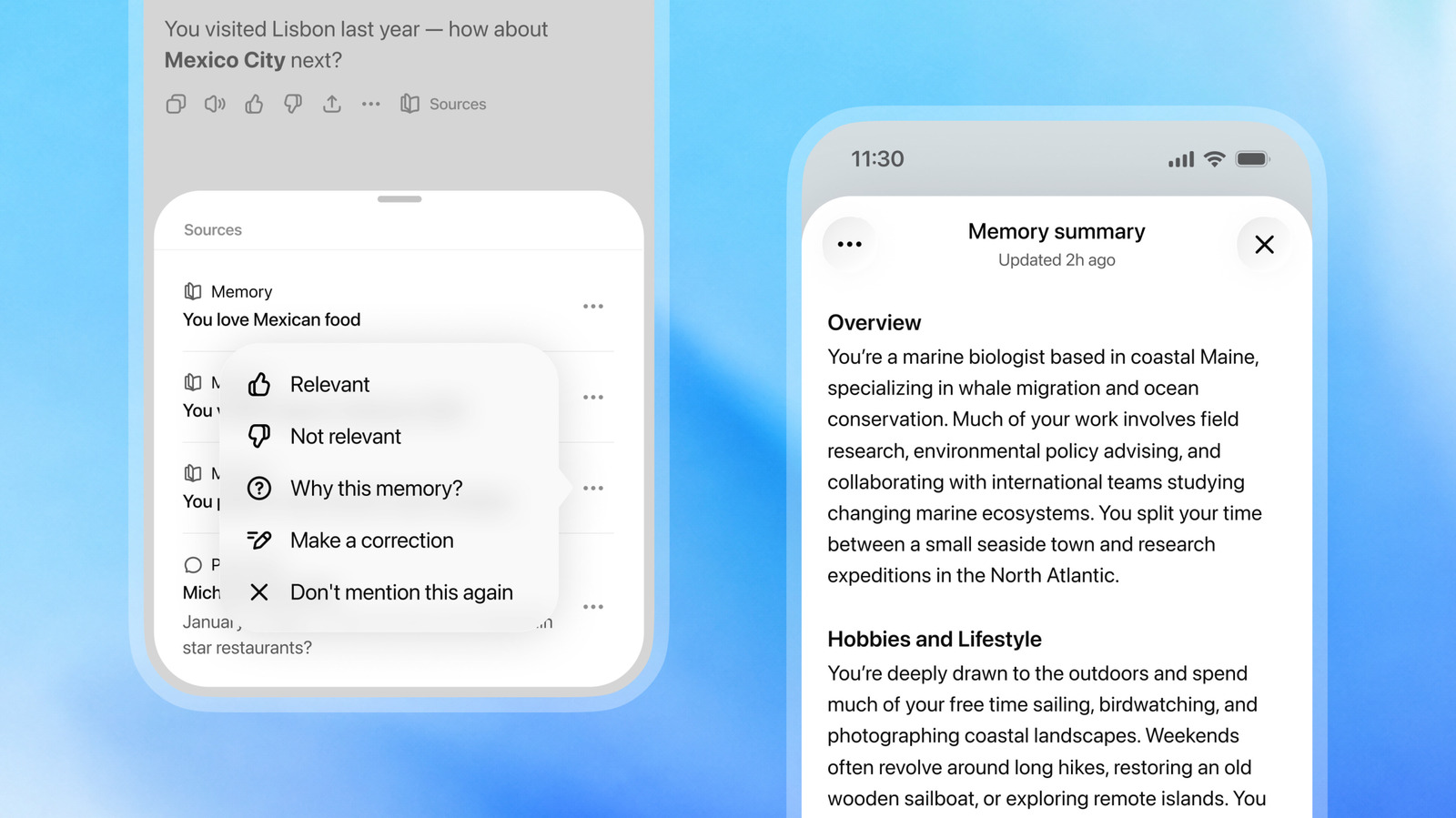
That brings us to today’s release, which sees OpenAI rolling out what it describes as a new memory architecture that builds on the dreaming process to offer something that is “significantly” more capable and compute-efficient. Now, as ChatGPT synthesizes information about you, it will write a “memory summary” you can read at any time. From there, you can add and update information about yourself, as well as tell ChatGPT when it should reference what it knows about you and your preferences. “If you want to drill down into a particular area to learn more, just chat with the model,” says OpenAI. The new summary is designed to complement the memory sources feature OpenAI released alongside GPT-5.5 Instant. Sources allow you to see the information ChatGPT used to personalize an answer, and edit or delete that context as desired. You can see both features pictured above.
Besides offering greater visibility to the user, OpenAI says the new dreaming architecture is better at carrying forward context. For example, if you’ve talked to ChatGPT about photography in the past and mentioned the camera you currently use, the chatbot will know to generate tailored results the next time you ask for product recommendations that are compatible with your photography setup.
Similarly, OpenAI says the new architecture is better at following preferences. Say you’re planning a trip, ChatGPT will use things it has learned from past travel conversations to inform its responses. Using photography as example again, it might suggest a Singapore itinerary that includes suggestions on spots where you can do street photography. To bring everything together, ChatGPT will automatically revise its memories as time passes, so that it doesn’t do something like reference a trip you took in the past as if it were coming up.
OpenAI is beginning to roll out the new memory architecture to Plus and Pro users in the US starting today. Thanks to behind-the-scenes efficiency improvements, ChatGPT will, for the first time, soon start recording memories through the dreaming process for free accounts. As a Plus or Pro user, those enhancements will translate to ChatGPT offering greater memory capacity. The new architecture will roll out to users in other countries in the coming weeks.
For the past two years, the technology industry has raced to make AI agents more capable — teaching them to write code, navigate software interfaces, manage files, and orchestrate multi-step workflows with increasing autonomy. What the industry has not done, at least not with any consistency, is answer the question that keeps chief information security officers awake at night: what happens when an agent goes wrong?
On Tuesday at its annual Build developer conference, Microsoft offered what may become the definitive answer. The company introduced Microsoft Execution Containers, or MXC — a policy-driven execution layer, built into the Windows operating system itself, that lets developers and IT administrators declare exactly what an AI agent can and cannot access, with those boundaries enforced at runtime by the OS kernel.
The announcement, buried within a sweeping set of developer-focused updates, is arguably the most consequential platform move Microsoft made at Build this year, and it has the potential to reshape how every enterprise on Earth thinks about deploying autonomous AI software.
MXC is not a product you buy. It is an SDK and a policy model — a foundational primitive embedded in Windows and the Windows Subsystem for Linux — that provides what Microsoft calls a “composable sandbox spectrum.” That spectrum ranges from lightweight process isolation, already adopted by GitHub Copilot’s command-line interface, all the way up to micro-virtual machines, Linux containers, and full cloud instances running on Windows 365.
The system separates an agent’s execution from the user’s desktop, clipboard, user interface, and input devices. Critically, it binds every agent to a strong identity — either a local ID or a cloud-provisioned identity backed by Microsoft Entra — so that every action the agent takes can be attributed, audited, and governed.
The implications are enormous. Until now, the enterprise deployment of AI agents has been stuck in a paradox: the more autonomous and useful an agent becomes, the more dangerous it is to let it operate on a corporate network without guardrails. MXC is Microsoft’s attempt to break that paradox — not by making agents less capable, but by making the environment they operate in fundamentally more controlled.
To understand why MXC matters, consider what an AI agent actually does when it runs on your computer. Unlike a traditional application, which operates within well-understood boundaries — a word processor reads and writes documents, a browser fetches web pages — an AI agent is, by design, unpredictable. It receives a goal in natural language, reasons about how to achieve it, and then takes actions: opening files, executing code, calling APIs, browsing the web, interacting with other software. Each of those interactions creates what security professionals call “attack surface.”
Microsoft’s own blog post framed the challenge in stark terms. The company wrote that “as agents become more capable and autonomous, they’re delivering material productivity gains. But they’re also introducing new risk, and the issue isn’t just the agent. It’s the entire system the agent operates across.” Every interaction between agents and humans, tools, applications, models, and other agents “exposes new attack surface and introduces different failure modes.” Microsoft characterized this as “a multi-layer systems problem.”
This is not a theoretical concern. In the months leading up to Build, security researchers demonstrated numerous ways that AI agents could be manipulated — through prompt injection, through malicious tool calls, through data exfiltration disguised as normal workflow. For enterprises that handle sensitive data, proprietary models, and regulated information, the absence of a trusted execution environment has been the single biggest barrier to moving agents from demo to deployment.
MXC operates on a deceptively simple principle: declare what the agent can do before it runs, and let the operating system enforce those declarations at runtime. A developer or an IT administrator writes a policy that specifies which files, directories, and network resources an agent is allowed to access. MXC then creates a contained execution environment — a sandbox — that enforces those boundaries regardless of what the agent attempts to do.
What makes MXC unusual, and potentially very powerful, is the breadth of its isolation options. Microsoft designed the system so that a single SDK and policy model can map to the appropriate isolation construct for any given workload. For a lightweight coding assistant that just needs to read the current project directory, fast process isolation may be sufficient. For an autonomous agent that executes arbitrary code downloaded from the internet, a full micro-VM may be required. The system is designed to be “dynamically composable based on intent and risk,” meaning that the level of isolation can be adjusted based on what the agent is actually doing, not just what category it falls into.
Session isolation is a particularly important feature. MXC separates the agent’s execution from the user’s desktop, clipboard, UI, and input devices. This directly mitigates several classes of attacks that security researchers have identified as particularly dangerous for AI agents: UI spoofing, where an agent manipulates what the user sees to trick them into approving a malicious action; input injection, where an agent sends keystrokes or mouse clicks to other applications; and cross-session data leakage, where information from one user’s session bleeds into another.
During a pre-briefing with VentureBeat the night before the announcement, a Microsoft developer offered a vivid demonstration of the technology in action. He had set up the open-source agent framework OpenClaw running inside MXC’s sandbox on his personal development machine. He then instructed the agent to delete all the files on his desktop. The agent attempted to comply — but the sandbox prevented it. “If you look at my desktop here, you see how clean my desktop is,” the developer said during the demo. “That’s a lie.” The files, he explained, were completely safe because “the container won’t allow it.”
The demonstration went further, showcasing the granularity of MXC’s controls. Users can mark specific files as read-only for the agent, restrict access to the browser and screen capture, control whether the agent can see location data, and have all of those permissions managed centrally by an enterprise IT department through Intune policies. The agent operates inside what is effectively a one-way mirror: it can do the work it has been asked to do, but it cannot see or touch anything outside the boundaries that its policy defines.
Pavan Davuluri, Microsoft’s Executive Vice President for Windows and Devices, underscored during the pre-briefing that the primitives MXC introduces — security, containment, isolation, and user control — are essential to making AI agents commercially viable.
He emphasized that these capabilities are “not unique to OpenClaw” and that “this pattern repeats itself over and over” for any agent running on a Windows device. The primitives that exist in the operating system now “for the file around security, containment, isolating them, having users in control,” he said, are what will make agents safe enough for ordinary consumers and corporate deployments alike.
For corporate IT departments, the most significant element of the MXC announcement is not the SDK itself but its integration with Microsoft’s existing enterprise security stack through what the company calls Agent 365. Arriving in preview in July, Agent 365 layers Microsoft’s Entra identity service and Intune device management platform on top of MXC, so that IT administrators can govern agent containment centrally while developers choose the level of isolation their workload demands.
The integration goes further: Microsoft Defender will provide runtime threat protection, Entra will handle identity and access management, Intune will enforce device-level policies, and Microsoft Purview will extend its data governance and compliance capabilities to agent activity. This means that an enterprise could, in theory, allow employees to run AI agents on their corporate machines — even powerful, autonomous agents that execute code and manage files — while maintaining the same kind of centralized visibility and control that IT departments currently have over traditional applications.
Microsoft described the identity layer in its official blog: “Windows assigns agents a local ID or a cloud provisioned identity backed by Entra and attributes all activity from the container to that identity, so you can clearly differentiate human from agent.” For regulated industries — financial services, healthcare, government — the ability to produce an audit trail that distinguishes between human actions and agent actions on the same machine could prove to be a regulatory requirement, not merely a nice-to-have feature. Every agent action attributable to a specific identity, every containment boundary enforceable through the same policy infrastructure that already governs hundreds of millions of Windows devices — this is the architecture that could finally move AI agents from pilot programs to production.
Platform announcements at developer conferences are often aspirational. What distinguishes the MXC launch is the breadth and specificity of the partners already building on it. Microsoft named five: OpenAI, Nvidia, Manus, Nous Research (maker of the Hermes agent), and the OpenClaw open-source project. Each is integrating MXC in a distinct way that illuminates a different use case for the technology.
OpenAI’s involvement is particularly striking. David Wiesen, a member of OpenAI’s technical staff, said that “working with Microsoft on the Microsoft Execution Containers (MXC) allows us to explore new patterns for AI agents to safely and efficiently generate and execute code.” He added that by combining Codex’s capabilities with MXC’s execution environment, the goal is “to help developers move from intent to reliable execution faster, while maintaining the security and control enterprises need.” The reference to Codex — OpenAI’s code-generation agent — suggests that MXC could become the default execution environment for one of the most widely anticipated agent products in the industry.
Nvidia is bringing its OpenShell framework to Windows built on MXC, providing what Microsoft described as “an easy-to-deploy package for autonomous, always-on agents safely.” Manus, the Chinese-born AI agent startup that gained viral attention earlier this year, is also integrating. Tao Zhang, Manus’s Chief Product Officer, said that MXC “gives developers a policy-driven way to define what an agent can access and enforce those boundaries at runtime, so more autonomous agents can operate safely in enterprise environments.” And Dillon Rolnick, the CEO of Nous Research, offered what may be the most concise articulation of why MXC matters: “Continuously-running local agents, like Hermes Agent, require intentional isolation. Developers need control over what an agent can access and trust that those controls will hold.”
One of the more revealing stories behind the MXC announcement involves OpenClaw. During the press pre-briefing, a Microsoft developer described how the partnership came together organically — Peter Steinberger, OpenClaw’s creator, sent him a direct message in January expressing interest in collaborating. What began as a casual conversation evolved into a full-fledged platform partnership, with Microsoft developers contributing to the OpenClaw Windows companion app, built as a native WinUI application rather than a wrapped web app.
The OpenClaw integration serves as what Scott called “the ultimate test app for all the stuff that [the Windows platform team] is making.” If OpenClaw — which by its nature gives agents broad autonomy to execute tasks on a user’s machine — can run securely within MXC’s containment boundaries, then the containment system is robust enough for any agent. Scott explained the philosophy driving the work: “Think of OpenClaw Windows as the ultimate test app… If OpenClaw can succeed on Windows, that means that the Linux support is there, the container support is there, the containment is there.”
The companion app demonstrates the full spectrum of MXC’s enterprise controls — file permissions, network access, screen capture restrictions, location data — all manageable centrally through Intune policies. Microsoft donated the project to OpenClaw and plans to continue contributing to it as open source. As one member of the Windows leadership team put it during the briefing: “All agents, all comers, everyone is welcome on Windows… It’s going to run great on Windows, because the primitives are there. The base of the pyramid is solid.”
MXC arrives at a moment when the technology industry is grappling with a fundamental tension. AI agents represent what may be the most significant new category of software since mobile applications, and every major technology company is racing to build them. But the security and governance infrastructure required to deploy these agents responsibly in enterprise environments barely exists. Microsoft’s approach is distinctive because it locates the trust layer at the operating system level rather than in the agent framework, the model provider, or a third-party security product.
This is a deliberate architectural choice. By building containment into Windows itself, Microsoft ensures that the security guarantees hold regardless of which agent, which model, or which framework a developer chooses.
It also means that the hundreds of millions of Windows devices already managed through Intune and secured through Defender can, in principle, become agent-ready through a software update rather than a rip-and-replace deployment.
Apple’s approach to AI agents leans heavily on its walled-garden ecosystem, offering security through restriction — limiting which agents can run and what they can do. Google’s approach, centered on its cloud infrastructure, offers security through centralization. Microsoft’s approach offers security through declaration and enforcement — allowing any agent to run, but containing its impact through OS-level policy.
For enterprises that operate in heterogeneous environments with diverse toolchains and multiple AI providers, the Microsoft model may prove the most practical. The competitive dynamics are already shifting: with OpenAI’s Codex, Nvidia’s OpenShell, and independent agent frameworks like Manus and Hermes all building on MXC, Microsoft is positioning Windows not just as the platform where agents run, but as the platform where agents can be trusted to run.
MXC is available now in early preview, meaning developers can begin building against the SDK and testing containment policies. The Agent 365 integration with Defender, Entra, Intune, and Purview is scheduled for preview in July — a timeline aggressive enough to suggest that much of the engineering work is already done, but far enough out to allow for refinement based on developer feedback.
The real test, however, will come when enterprises begin deploying agents at scale on production networks. Containment is only as good as the policies that govern it, and writing effective agent policies for complex enterprise environments will be an entirely new discipline — one that IT departments have not yet developed and that no vendor has yet figured out how to teach. The technology is promising, but an empty sandbox is just an empty box. Filling it with the right rules, for the right agents, in the right contexts, will require a level of organizational sophistication that most companies are only beginning to contemplate.
Still, the significance of what Microsoft announced on Tuesday is difficult to overstate. For the first time, a major operating system vendor has proposed a comprehensive, kernel-level answer to the question of how autonomous AI software should be contained, identified, and governed on the devices where most of the world’s work actually gets done. The industry spent two years teaching agents to act. Microsoft is now betting that the bigger business — and the harder engineering problem — is teaching the operating system to watch.
Apple is all set to host its yearly Worldwide Developer Conference next week, where it is expected to announce the long-awaited Siri update. As excited as I am for the smart assistant to finally work like it was supposed to all these years, the iOS 27 sneak peek could potentially confirm Apple’s next big launch: the foldable iPhone Ultra.
I say this because iPhones have trailed behind their Android counterparts in true multitasking capabilities. Sure, they have a Dynamic Island that pops up crucial information with a press-and-hold without leaving the current app. But it isn’t the same as running multiple apps side-by-side simultaneously or one app on top of another. Such use cases are crucial for big-screen foldable phones – or even big slab phones for that matter. This iOS limitation is one of the reasons I believe the 6.9-inch screen estate on Pro Max models isn’t utilized to its full potential. But this might change at next week’s WWDC.
According to a Bloomberg report, Apple’s foldable iPhone will feature an “iPad-like interface when opened.” It could support running two apps side-by-side and add sidebars to many apps. We’ve never had an iPhone running multiple apps on the screen simultaneously, and if Apple demos such an instance at WWDC 26, it’ll likely point towards the launch of an iPhone with a larger screen – hopefully, one that folds.
However, iOS 27 needs more than just an iPad-like multitasking UI to take advantage of its bigger canvas. After using most of the foldable phones launched in the last five years, I have a few notes for Apple to maximize the big screen potential.
The Oppo Find N6 can run three apps simultaneously and multiple more as pop-up windows.
The Oppo Find N6 is my favorite foldable phone. It has an anti-reflective screen for better outdoor legibility, big battery all-day endurance and above all, a software experience that makes it a multitasking powerhouse. It is much more than having a simple split-screen at your disposal. That’s not to say I don’t use split-screen multitasking but running two apps side-by-side isn’t ideal when you have to type in one app (like Google Docs). Once the keyboard pops up, you get less space to type.
Oppo (and OnePlus) solved this issue in 2023, when you could run two apps side-by-side and a third one in full-screen at the bottom. It lets me reference search material from a webpage on the left half of the screen and have a PDF running on the other half, while also running Google Docs at the bottom to type my story on the go.
The latest Oppo Find N6 takes it to the next level with its Free-Flow Window feature, which lets you run up to four apps simultaneously in resizeable windows. Is four apps too much? Yes. But is it logical? Also yes. I thought it was overkill till I was at the airport and had to urgently submit my invoices. I opened Google Sheets (to create the invoice), Calculator (to calculate my month’s income for taxes), Keep (to take tax notes), and Chrome (to cross-check my published work.
I could do all of this on a slab phone by constantly flipping between each app. However, having the ability to run all of these apps without exiting another and resize them to your liking truly helps save time and effort. I’ve also used this feature to take notes while attending meetings and referencing shared PDFs simultaneously.
I’d love to have this feature on the iPhone Fold with an iPad-like taskbar at the bottom. It could make the iPhone Ultra like an iPad Mini when unfolded but one that fits inside my pocket.
A sidebar might not be great on slab phones but it can help you be more productive on foldable phones.
The iOS 27 redesign could touch Siri, Search, Camera, Safari, Weather, Image Playground and more. For the sake of iPhone Fold’s big screen, I hope it also adds two things to the system user interface.
First, I’d love to get a Samsung Galaxy Z Fold 7-like sidebar. It might not sound very useful in theory but every foldable phone has this feature now, and it is for a good reason. When AI Select was first rolled out on a Samsung phone, it was only possible to access it through the sidebar. This Galaxy AI feature allowed me to highlight a portion of my current screen and suggest contextual actions.
For instance, I used it to add Calendar events from my emails. I could open an email invite, swipe the sidebar to access AI Select and highlight the event information to automatically have the date, time and address on my Calendar app. Unless you have Gemini enabled on your Gmail account, you’d need to manually add these details to create a Calendar event.
I also use the sidebar to access the Files app and other apps for pop-up (like Calculator), which I don’t have on my taskbar. While the Bloomberg report said a sidebar could make its way to certain apps, I’d love to have system-wide accessibility so I can use it on top of my on-screen content, no matter what app I’m currently using.
Honor’s extended folders allow me to have one-tap access for up to five apps while having them grouped together.
Second, I want more smartphone manufacturers to borrow Honor’s extended folders. It helps keep apps within one-tap access, while also letting me group them. It is the best of both worlds – having a folder as well as a single app icon on the screen.
This feature was adopted by more Android skins last year but most of them are limited to three apps. Honor allows me to add up to five apps in a vertical or horizontal extended folder, which groups my favorite apps without needing me to tap on a folder to access them. It is a neat feature that I’ve missed immensely since I shifted back to my iPhone 17 Pro Max. The best I can do on an iPhone right now is move apps closer to each other, or use Smart Stack to group a few widgets together.
These iOS 27 additions would make the upcoming Apple foldable easier to use and help maximize its big screen utility. I hope we can get our first look at some of them next week at WWDC 26, alongside the other more exciting iOS 27 features. Either way, it is going to be a packed week for Apple software!
Airbnb CEO Brian Chesky has had enough of merely being an artificial intelligence kingmaker. He now plans to back a new AI lab of his own. The news, broken by Bloomberg and confirmed to TechCrunch by a person familiar with the situation, marks Chesky as one of many Silicon Valley machers who are unsatisfied with the models coming out of the frontier labs.
While Airbnb has adopted AI coding tools, Chesky said last year it hasn’t struck an LLM partnership because existing products weren’t quite ready.
Still, Chesky has plenty of insight. He met Sam Altman in 2006 through Y Combinator, which incubated Airbnb, and stayed in touch. When OpenAI took off, he began meeting regularly with Altman to offer advice about managing a hypergrowth tech company.
Chesky, who was reportedly considered a potential OpenAI board member, helped broker Altman’s return to power after its board of directors fired the CEO for lack of candor. Chesky advised Altman on public relations and rallied support for him among Silicon Valley bigwigs.
Now, however, he appears to be entering competition with his mentee’s company.
It’s not clear what the focus of Chesky’s new AI lab will be, although the Bloomberg article mentions user interaction and design, areas that he has emphasized at Airbnb.
That’s not unlike what Brett Adcock is doing at Hark, the AI lab he launched late last year to develop a novel user interface for an AI assistant, although the startup is also emphasizing hardware products.
Chesky also won’t be going into “founder mode” at this operation; a person familiar with the situation says he will remain as Airbnb’s CEO and not lead the new lab himself. Whoever gets the job will have to contend not only with the other AI labs, but also with a founding chair (we presume) known as a micromanager.
A representative for Airbnb and Chesky declined to comment.

A Texas company has formally signaled plans to build a data center in downtown Seattle, even as the city moves toward a moratorium that could impact the construction of such facilities.
Digital Realty of Austin, a real estate investment trust with more than 300 data centers worldwide, wants to demolish the building at 301 Virginia St. and replace it with a six-story structure: a data center on four floors plus a lab, office and retail space, permit filings show.
The proposal comes as the City Council weighs a one-year ban on new data centers, prompted by a wave of public concern over the AI industry’s demands on power, water and utility rates. On Wednesday, the council’s land use committee voted to send the measure to the full council.
The Puget Sound Business Journal, which first reported on the proposal, quoted a Digital Realty spokesperson describing it as “a highly connected, network-dense facility, not an AI data center.” The company told the publication it is still assessing the project’s power needs.

Whether the moratorium would apply to the project is unclear. Digital Realty submitted its filings May 29. As the council’s proposed resolution describes it, the ban would prohibit the city from filing, processing or approving applications for new data centers for a year.
The resolution language cites the growth in the use of AI and notes that new data centers “require great amounts of electricity for operation, resulting in significant increases in demand for electricity and requiring investment in new infrastructure to meet demand.”
@media (max-width: 600px) {
aside.callout { float:none !important; max-width:100% !important; margin-left:0 !important; margin-right:0 !important; }
aside.callout .callout-img { display:none !important; }
}
It’s part of a national backlash against the data center boom, as communities push to slow projects over concerns about power and water use.
Digital Realty is not new to the neighborhood. The company already operates a colocation data center in the 34-story Westin Building at 2001 Sixth Ave. Heat from the building’s data centers is piped across the street to help warm Amazon’s offices. That project is part of a district-energy system set up with Clise Properties, which also owns the 301 Virginia St. site.
Formerly a Bed Bath & Beyond store, the building is currently home to Cannonball Arts, a contemporary art and music venue from the producers of the Bumbershoot festival.
On Thursday, Cisco warned of a high-severity, unpatched zero-day in the Cisco Catalyst SD-WAN Manager (tracked as CVE-2026-20245) actively exploited in attacks enabling root privilege escalation.
The zero-day flaw impacts all deployment types, including On-Prem Deployment, Cisco SD-WAN Cloud-Pro, Cisco SD-WAN Cloud (Cisco Managed), and Cisco SD-WAN for Government (FedRAMP).
In a Thursday advisory, Cisco said the issue stems from insufficient validation of user-supplied input, and it can allow local attackers with low privileges to execute arbitrary commands as root.
“An attacker could exploit this vulnerability by uploading a crafted file to the affected system. A successful exploit could allow the attacker to perform command injection attacks on an affected system and elevate their privileges as the root user,” the company explained.
“To exploit this vulnerability, the attacker must have netadmin privileges on the affected system. This would require valid credentials or exploitation of CVE-2026-20182 or CVE-2026-20127. Cisco is not aware of successful exploitation by other methods,” it added. “Cisco is not aware of successful exploitation by other methods. Cisco has observed limited cases where the exploitation of this bug resulted in a configuration change pushed to edge devices.”
Formerly known as SD-WAN vManage, this network management software helps admins monitor and manage up to 6,000 Catalyst SD-WAN devices from a single dashboard.
Cisco’s Product Security Incident Response Team (PSIRT) became aware of CVE-2026-20245 exploitation in June after Google Cloud cybersecurity subsidiary Mandiant reported the flaw but did not share any details.
However, it shared indicators of compromise (IOCs) warning admins to check their SD-WAN /var/log/scripts.log file for attempts to upload tenant configuration data to vSmart controllers to escalate privileges through legitimate commands, as in the following example:
Apr 15 09:44:57 vmanage vScript: Tenant list upload per vsmart serial number: /usr/bin/vconfd_script_upload_tenant_list.sh -cli path /home/admin/malicious.csv vpn 0
“For help determining if a Cisco Catalyst SD-WAN Manager has been compromised, customers may open a case with the Cisco TAC,” the company added, advising admins first to generate an admin-tech file to help with the review.
Last month, Cisco also tagged a maximum severity Catalyst SD-WAN Controller authentication bypass flaw (CVE-2026-20182) as actively exploited as a zero-day to gain administrative privileges on unpatched devices.
While Cisco has not yet released patches for CVE-2026-20245, it advised customers to upgrade to the software fixed for CVE-2026-20182 on May 14.
In February, Cisco patched another Catalyst SD-WAN Manager information disclosure security flaw (CVE-2026-20133), which CISA flagged as actively exploited in late April, and, two weeks later, warned that two more flaws (CVE-2026-20128 and CVE-2026-20122) were being abused in the wild.
In March, it also addressed and flagged a critical authentication-bypass vulnerability (CVE-2026-20127) that has been exploited in zero-day attacks since at least 2023.
Over the last several years, CISA has tagged 90 Cisco vulnerabilities as abused in the wild, four of them in Cisco Catalyst SD-WAN Manager and six others exploited by ransomware operations.
Security teams log 54% of successful attacks and alert on just 14%. The rest move through your environment unseen.
The Picus whitepaper shows how breach and attack simulation tests your SIEM and EDR rules so threats stop slipping by detection.

Soccer fans who aren’t there in person or not glued to their phones or TVs during FIFA World Cup matches in Seattle will be able to look to the sky for results.
Visit Seattle is planning to launch what it calls a first-ever drone scoreboard, lighting up the city’s skyline with scores from each of the six matches that will be played in Seattle.
The activation will take place at the Space Needle to add another visual flair to an event expected to draw huge crowds to the city.
The drones will be flown by Sky Elements, the Fort Worth, Texas-based company that has put on shows at T-Mobile Park for a Mariners game, Lumen Field for the Seahawks, and at the Needle for New Year’s Eve.
Seattle advertising agency Copacino Fujikado and Seattle-based PR agency C+C are also part of the production.
Visit Seattle is a nonprofit marketing organization that champions Seattle and King County as destinations for travel and tourism.
Here is the schedule for FIFA World Cup matches in Seattle:
A couple of years ago, someone searching for our company found a website that looked like ours, used a version of our name, and sold proxies we had nothing to do with.
The impersonators were already operating before we rebranded from Smartproxy to Decodo in April 2025.
They registered smartproxy.org and smartproxy.cn to catch the traffic searching for the original domain name, and the rebrand gave them an even larger pool of people who had not heard about the change.
In 2025, the World Intellectual Property Organization handled 6,282 domain name disputes, a record for the organization. Cybersquatting cases have risen 68% since 2020.
Digital squatting now moves money, steals login credentials, and pulls customers toward infrastructure tied to cybercrime. Here are five things we did, and five things any business can do, when someone copies your brand.
Digital squatting means registering or using a domain name in bad faith to profit from someone else’s trademark. A bad actor registers a domain close to an established brand, then uses it to intercept traffic, collect payments for services they never deliver, harvest login credentials, or push malware. Most victims find out only after their money disappears.
Squatting comes in a few common forms:
1. Typosquatting registers misspellings of popular domains, such as gooogle.com instead of google.com;
2. Combosquatting adds a keyword to a real brand name, producing domains like brand-login.com or brand-deals.com;
3. TLD squatting takes the same brand name across .org, .net, .io, and .ai;
4. Homograph attacks swap in visually identical characters from other alphabets, like a Cyrillic “а” for a Latin “a”.
We met digital squatting as the target, not the observer. We operated as Smartproxy for seven years, and over that time, the name picked up enough recognition for impersonators to want it. They registered .org and .cn, domains with no connection to our company, our infrastructure, or our team. The site copies a version of our former name and sells proxies we have nothing to do with, catching traffic from people who searched for Smartproxy.
The squatting also shaped how we could operate in China. The obvious domains were already taken, so before the rebrand, we had to run our China presence under a separate name, smartdaili.cn. A customer in that market searching for the brand could land on an impostor site first.
The rebrand to Decodo did not end the problem. It added a fresh group of people who knew the old name and never heard about the change, which is exactly who the lookalike domains target. The harm reached real customers, and we saw it in their complaints to us.
Trustpilot reviews describe people who paid the lookalike sites, sent irreversible cryptocurrency payments, received poor support, and got low-quality service under a name they trusted.
The case changed shape when researchers tested the impersonator’s product directly. The independent researchers have purchased a standard weekly unlimited residential plan on smartproxy.org, the same product any retail buyer can get, and measured where its traffic actually exited. The method is one any paying customer could repeat, which is part of why the result carries weight.
Proxyway sent roughly 6.96 million HTTP requests through the plan across one week, with each request landing on an endpoint that logged the exit IP address. After removing duplicates, the pool showed 2,023,029 unique IPs, of which 2,019,488 were IPv4, and 3,541 were IPv6. The success rate sat at 90.25%, in line with what the service advertised.
To find where those IPs came from, Proxyway compared the pool against a reference dataset of 16,192,293 verified IPIDEA exit nodes, observed over the 30 days ending January 29, 2026. Antoine Vastel, VP of Research at DataDome, built that dataset by routing traffic through IPIDEA endpoints himself and confirming each address as a working exit node, rather than relying on marketing claims. IPIDEA is the residential proxy network that Google’s Threat Intelligence Group disrupted back in January.
The comparison surfaced 773,087 IPs present in both pools. That figure equals 38.21% of the smartproxy.org pool and 4.77% of the IPIDEA dataset. The numbers sit in the table below:
|
Metric |
Value |
Row 0 – Cell 2 |
|
Smartproxy.org unique IPs (test pool) |
2,023,029 |
Row 1 – Cell 2 |
|
IPIDEA dataset unique IPs (Vastel) |
16,192,293 |
Row 2 – Cell 2 |
|
IPs present in both pools |
773,087 |
Row 3 – Cell 2 |
|
Overlap as a share of smartproxy.org |
38.21% |
Row 4 – Cell 2 |
|
Overlap as a share of IPIDEA |
4.77% |
Row 5 – Cell 2 |
Residential pools rotate, so some overlap between any two services is normal. IPinfo estimates monthly IPv4 retention in residential pools at around 40%, meaning roughly four in ten addresses visible this month remain next month, while the rest cycle out. Two pools drawing from genuinely separate apps, SDKs, and device populations should not share anything close to 38% of their IPs across a few-week window.
The IPv4 address space spans more than 4 billion addresses, so an overlap at this scale would be a statistical anomaly if the sources were independent. The pool sizes point the same way. The smartproxy.org pool of about 2 million IPs is roughly an eighth of the 16.2 million IPIDEA dataset, the proportion you would expect when one provider draws from part of a larger upstream pool. Shared sourcing explains the data cleanly.
Each step below works on its own. Together, they cover monitoring, prevention, legal action, search, and customer communication.
Catching a fake domain after a customer reports it means the damage has already happened. Monitoring closes that gap.
Set up these alerts:
i) Domain registration alerts for your brand name across common TLDs and misspellings;
ii) Brand-mention monitoring across search results and social platforms;
iii) Certificate transparency logs, which flag new SSL certificates issued for domains containing your brand name.
We learned the full extent of our case through third-party research and customer complaints, later than we wanted. Monitoring would have surfaced the registrations sooner. A weekly check across the main extensions and the three or four most likely misspellings of your name catches most attempts while they’re still new.
A squatter can’t register a domain you own. Defensive registration removes the easiest targets before anyone reaches for them.
Claim the obvious variations:
i) Major TLDs such as .org, .net, .io, and .ai
ii) Common misspellings of your brand name country-code domains for markets you operate in, such as .co.uk, .de, and .cn.
Turn on registrar lock, use a reputable domain registrar, and keep your registration details current. We hit this wall directly when the obvious domains in China were already taken. Claim your namespace early, because the cost of registering domains is far lower than reclaiming them later.
Trademark law gives you specific tools against squatters. The tools work, though they move slowly, so start them early. The following is general information, not legal advice.
Your main options:
i) Register your trademark, which is the foundation for every other action;
ii) Send a cease-and-desist letter to the registrant
iii) Report abuse directly to the registrar hosting the domain.
When someone searches your brand, the page they click decides whether they reach you or a copy. Ranking above the impersonator removes most of their traffic.
Make the real you easy to find:
i) Publish content that states your official domains in plain language;
ii) Keep rebranding and company information current across your site and profiles;
iii) Use structured data and verified social media profiles so search engines confirm your identity.
We published direct, on-record clarifications so anyone searching the old brand finds the truth quickly. We say it plainly: we operate at decodo.com globally and decodo.cn in China. Everything else using the old name isn’t us
Customers can’t avoid a fake site that they don’t know exists. Telling them turns your audience into a filter against the impersonator.
Reach them through every channel you have:
i) Email warnings to your existing customer list;
ii) A banner or notice on your website;
iii) A help-center article that customers find when they search for the problem;
iv) Posts on the social accounts your customers already follow.
Brand impersonation now sits next to the infrastructure-trust problem the IPIDEA takedown exposed. A fake domain can route customers into compromised device pools, which makes this a question for security and legal teams, not just marketing. Give it a cross-functional owner who watches domains, files complaints, and updates customers on a schedule.
Google’s action against IPIDEA reduced the available device pool for proxy operators by millions and, in Google’s words, may carry downstream impact across affiliated resellers. Squatting that depends on that kind of infrastructure carries the same exposure. Demand transparency from any provider you buy from, and apply the same standard to your own supply chain.
We feature the best proxy sites.
This article was produced as part of TechRadar Pro Perspectives, our channel to feature the best and brightest minds in the technology industry today.
The views expressed here are those of the author and are not necessarily those of TechRadarPro or Future plc. If you are interested in contributing find out more here: https://www.techradar.com/pro/perspectives-how-to-submit
![]()
In a regulatory filing on Wednesday, SpaceX said it will offer 555.6 million shares at $135 each, valuing the company at $1.76 trillion. If the IPO is successful, SpaceX would raise $75 billion, potentially shattering the current fundraising record held by Saudi Aramco – the Saudi Arabian state-owned oil company…
Read Entire Article
Source link
Believe it or not, this is not the first robotaxi-assisted theft.
A burglar used a Waymo to steal a bunch of yoga clothes and seemed to have gotten away with it, according to a report by SF Chronicle. The incident occurred all the way back in January and the suspect remains at large.
The burglar took a Waymo to a San Francisco yoga studio, robbed the place blind and then exited via that same robotaxi, according to security footage described by TechCrunch. Waymo turned over the suspect’s account information to authorities but it didn’t lead police anywhere useful.
Interestingly, authorities weren’t able to get interior footage of the ride itself. Waymo vehicles record everything, but don’t hold onto that footage forever. Reports have indicated that when cops filed a search warrant in April, it was already gone. Police weren’t able to identify the suspect using the vehicle’s exterior camera footage because it had been “blurred for privacy reasons.”
This is potentially good news for people worried about the long-term surveillance capabilities of Waymo vehicles, though we still have some questions as to when the company deletes old footage. Engadget has reached out to Waymo to ask for clarification on that and the blurred exterior camera footage.
Oddly, this isn’t the first time a ne’er-do-well has opted for a Waymo to help commit a crime. Someone used one of the company’s vehicles a getaway car after robbing a grocery store. That person, however, was almost immediately caught.
Whether it’s working on woodworking projects, maintaining our vehicles, or even just storing emergency food supplies, our garages can be the space where our imagination goes wild. If you do need to equip it properly, Harbor Freight is always a good place to start. Known for its wide range of exclusive in-house brands, you can snag a ton of highly-rated finds for under $50, like hand tool sets, power tools, and specialized cleaning materials.
Or, you can swing the other way and invest in high-end professional equipment that can last you years of use. Either way, there are plenty of tips and tricks you can use to get more bang for your buck at Harbor Freight, especially if you’re patient enough to wait for markdowns and parking lot sales. With generous warranties that guarantee hassle-free replacement for hand tools and limited 90-day for workmanship defects, it’s an ideal place to start building up your dream garage set up.
If budget isn’t a problem, and you just want to be ahead of the curve, the retailer is constantly churning out new products. In 2026, Harbor Freight has released fresh products across the board that span ladders, lighting, power tools, and even add-ons to its growing organization portfolio. Here are some of the new Harbor Freight offers that you can add to your garage today.
With a working load of up to 225 lbs, the Franklin 3-Step Steel Folding Step Stool boasts an extra-wide platform with slip-resistant feet, so you don’t have to worry about ruining your garage floors while you’re at work. Weighing a little under 15 lbs, or about the weight of an average bowling ball, it’s light enough for the average adult to carry.
It’s about 2.83 inches x 48.75 inches when folded, which means you only need 3 inches to be able to store it. It’s worth noting that it’s only listed for indoor use, which makes it perfect for places like your kitchen, closet, or garage, but not necessarily for your outdoor projects. That said, the steel ladder is OSHA/ANSI compliant, so it’s still suitable even for professional work environments.
Retailing for $49.99, the Franklin 3-Step Steel Folding Step Stool is listed as available exclusively in-store, as of June 2026. If you’re still on the fence or want to purchase online, the good news is that it isn’t the first of its kind from the Franklin line up. Harbor Freight also sells an older model, the $29.99 Franklin 2-Step Steel Stool, which can give you an idea of what to expect. If you don’t need so much height, and have limited storage space, there’s also the 1-Step Folding Stool that retails for just $6.49.
For people with overflowing garages, the $139.99 U.S. General 5-Tier Steel Garage Shelving can help bring more order. Compared to other storage racks in the market, it’s unique for how you can also set it up in two ways. You can opt for a single vertical track that measures 48 inches by 24 inches by 78 inches, or split it and have a pair of 39-inch racks instead.
You can also adjust the shelf placement with 1.5-inch increments if you need more vertical space. Each of its five wire mesh shelves can hold up to 1,000 lbs each (or 5,000 lbs in total). It’s also NFS certified, so it’s safe for holding dry food for long-term emergency storage needs.
You will need to consider something else if you’re based in Alaska or Hawaii — those are the only two states to where it can’t be shipped, due to its weight. It weighs a little under 68 lbs, so it’s built to be sturdy. It’s also boltless, so you can expect faster assembly and less maintenance around periodically tightening bolts. While it’s not the cheapest shelf brand on the market, U.S. General cabinets are made in the United States, so it’s a good option for people who want to support local manufacturing, but if you want to maximize your garage space, another option is to build a custom tote rack with wood instead.
Among the many ways to improve the air quality in your garage, ventilation can make one of the biggest differences, especially when it comes to regulating the temperature. You can do this with the Central Machinery 24-inch Wall-Mount Fan. Designed with a 360-degree tilting head, it has two speeds: 7,150 CFM (low) and 7,600 CFM (high).
You can attach it to corners, ceilings, and regular walls with its mounting bracket. Meant for use with standard 120V plugs, Central Machinery notes that the powder-coated finish is made for daily use and with garages and basements in mind. The wall-mounted fan comes with a 7.5 ft power cord, plus a UL certification and thermal overload protection for added peace of mind.
At $149.99, the Central Machinery 24-inch Wall Mount Fan can feel like a big investment. However, its commercial-grade fan mount features can make it worth it during the hot, summer months. However, if you’re already using your garage walls for slat wall storage, Central Machinery also sells a similarly-sized 2-Speed High-Velocity Shop Fan that retails for the same price.
While it’s also 24 inches and have features like overload protection, it has handles and is designed to be rolled around on the garage floor. This makes it better for drying carpets or airing out paint fumes. For just under $60, the 20-inch 3-Speed High Velocity Fan is also another highly rated fan in its portfolio and may be enough for small garage spaces.
Depending on your budget, Harbor Freight sells several highly-rated air spray brands, such as Avanti, Central Pneumatic, and Spectrum. At the top of the list is Black Widow by Spectrum, which recently released a new model, the Professional HVLP Touch-Up Air Spray Gun with Rear Fan Control.
With a maximum pressure of 25 psi, it has a 3.9 oz per minute flow rate with listed applications that include usage on auto, wood, and metal. Black Widow by Spectrum notes that it’s made for spot repairs and finishing. It has a 1.0 mm nozzle and ¼-inch air inlet, which works for fine finish, base, and top coats. The spray pattern can also be changed between rounds to fan with a maximum of 9 inches. For owners of the Spectrum cup system, it comes with an adapter that works with this too.
Priced at $129.99, the Black Widow by Spectrum professional touch-up gun is often compared to significantly more expensive DeVILBISS spray guns. As of June 2026, this HVLP touch-up gun model is listed as being an in-store exclusive, but you do have other options from Black Widow by Spectrum that you can order from the Harbor Freight website. For example, the slightly more expensive $179.99 Professional HVLP Gravity-Feed Air Spray Gun with Rear Fan Control, which ships with a 1.7 mm nozzle, can be a viable alternative.
When it comes to working in our garages, making sure it’s lit properly can help us do our jobs more effectively and avoid all kinds of accidents. Retailing for just under $100, the Braun 10,000 Lumen Multidirectional Corded LED Tripod Work Light has a lot of neat features that make it worth the price tag. To create its 360-degree illumination, it has ultrabright 10,000 lumen LEDs, which make it ideal for wide coverages. If you need more precision, it has both a rotating head and rotating panels (vertical and horizontal) for more focused lighting needs.

Standing at 47 inches tall with a collapsible tripod, along with an adjustable base that can be extended up to 75 inches. For added portability, it also has easy grip handles. Made with durable polycarbonate lenses, it has a built-in storage for its 8ft power cord made for 120V plugs with TUV certification.

According to the listing, it’s primarily for indoor use, like garages and workshops, but its manual does indicate that it can be used outdoors with the right extension cords. Apart from this work light, Braun has also released a lot of new lighting solutions worth considering, like its $29.99 1,000 Lumen Rechargeable Slim Headlamp. There’s also a UV Lead Detector Flashlight, which isn’t just useful for hotel stays, but also good for finding water leaks in your garage.
This is BROKEN! INSANE 5x MONEY CAR WASH WEEK! The NEW GTA Online UPDATE Today! (GTA5 New Update)
Jade Biosciences, Inc. (JBIO) Discusses Positive Interim Results From JADE101 Phase I Healthy Volunteer Study and Development Plans Transcript
SpaceX just won a second Golden Dome contract. This one is $4.16 billion.
SHE IS KILLING XRP!!! WATCH URGENT AND ACT FAST
French Open 2026 results: Alexander Zverev beats Rafael Jodar and will play Jakub Mensik in semi-finals
FIRST NIGHT REVIEW: Take That bring the Circus back to life in spectacular sun-soaked style
Is the Spurs Phenom Already Better Than Prime Diesel?
CryZENx Releases Fresh Playable Content Deep Inside Jabu-Jabu for His Ocarina of Time Remake
Novak Djokovic v Joao Fonseca LIVE: French Open latest scores and results after Jannik Sinner’s shocking collapse
The House | Inside Andy Burnham’s Makerfield Campaign: “Nobody Thinks This Is In The Bag”
CFTC Has Approved the First Regulated Bitcoin Perpetual Contract in the U.S.
Maddox Jolie-Pitt Legally Requests to Drop Brad’s Surname
Weak ‘Supergirl’ Box Office Tracking Amid Milly Alcock Backlash
Bruce Willis’ Generosity Resurfaces Amid His Dementia
Snowflake (SNOW) Stock Rallies on Strong Q1 Results and AI Product Growth
One of the Greatest Sitcoms of All Time Shoots Up Apple TV’s Charts 11 Years Later
Demand Conditions Improve In Chemicals Sector In April 2026
This Week In Security: Ubiquiti Fixes, And FreeBSD Joins The Club You Don’t Want To Join
MicroStrategy Moves $30 Million in BTC to Coinbase Prime: Is the Bitcoin Sell-Off Already Here?
Seagate (STX) Stock Surges to Record High on AI Boom and Legal Settlement
You must be logged in to post a comment Login