

Crypto World
Best Exchanges to Trade Oil With Crypto in 2026: The Complete Guide

The crypto industry isn’t what it was a few years ago. I remember when I started, there were a handful of exchanges – all centralized- and nobody would ever consider that buying stocks or commodities on them was even possible. Well, that’s not the case anymore. Tokenization is now a major part of the field, and trading commodities such as oil is not only possible but also generates billions in trading volume every single day.
As blockchain infrastructure evolves, traders in 2026 can access oil markets through tokenized assets and decentralized platforms without relying on conventional brokers.
In the following, I will walk you through everything you need to know about trading oil with crypto – starting from the exchanges you can use, a step-by-step tutorial on how to use them, their fees, pros, cons, differences, and more.
Main Takeaways:
- Trading oil with crypto typically provides synthetic exposure to crude oil via perpetual futures.
- Most of the products are settled in stablecoins like USDC and USDT.
- You can trade oil with crypto on both centralized and decentralized exchanges.
- The best platform will depend on your preference.
- Hyperliquid, Binance, and Bybit are amongst the best options.
Understanding the Link Between Oil Markets and Cryptocurrency
The connection between oil markets and cryptocurrency has strengthened and become more pronounced as multiple digital asset platforms expand beyond spot trading into derivatives and real-world asset (RWA) exposure.
Traditionally, oil trading has been largely dominated by futures contracts on regulated exchanges. Now, however, crypto infrastructure has evolved to enable similar exposure through tokenized alternatives. Instead of holding physical barrels of oil or using legacy brokers, traders can speculate on oil prices using crypto-collateralized perpetual contracts that mirror crude oil benchmarks such as Brent or WTI.
In fact, several major platforms have already accelerated this process. Most famously, the popular decentralized perpetual contracts exchange Hyperliquid quickly became the preferred place to trade oil during the weekend when the war between the US, Israel, and Iran started. It remains a preferred platform for trading tokenized oil, with billions in open interest within weeks.
Centralized exchanges are also becoming increasingly popular. Binance, for example, offers oil-linked derivatives that function much like traditional oil futures but are settled in crypto. Bybit has also introduced trading interfaces that bridge traditional finance concepts and digital assets, allowing users to gain exposure to commodities such as crude oil alongside crypto markets.
In any case, this evolution reflects a broader trend: cryptocurrency exchanges are quickly becoming multi-asset trading venues. Oil, as one of the most liquid commodities in the world, is nothing but a natural extension.
It’s worth noting, though, that the link remains synthetic rather than physical – the prices are derived from external markets, and the positions are usually settled in stablecoins or other cryptocurrencies.
Best Exchanges to Trade Oil With Crypto: Detailed Comparison for 2026
.cp-only-mobile{display:none}
@media(max-width:720px){
.cp .table .price .cp-only-mobile{display:inline;font-weight:600;margin-right:.25rem}
}
| Name | Features | Rating |
|---|---|---|
|
||
|
||
|


I have to divide this section into two categories: decentralized and centralized exchanges that feature oil-linked products tradable with stablecoins.
For years, the consensus has been that centralized exchanges are easier to use, but, to be honest, Hyperliquid comes very close to that experience without requiring you to custody your funds with them. This will be reflected in my following review.
Decentralized Exchanges
Hyperliquid: Best for On-Chain Derivatives Traders
Hyperliquid is the largest decentralized cryptocurrency exchange by far, capturing over 90% of the DEX market share for perpetual futures trading. It also pioneered oil-linked derivatives after they launched HIP-3 on mainnet. For a long time, it was the only place where users could trade OIL contracts using crypto, even on weekends, making it a valuable instrument for price discovery during times of military conflict in the Middle East.
So, yes, Hyperliquid treats crude as a 24/7 on-chain perpetual market. Instead of going through a traditional commodity broker, users can post crypto collateral and take long or short exposure to oil-linked contracts.
In my opinion, this is the most crypto-native experience of the three – you get wallet-backed access, on-chain settlement, perpetual futures, funding rates, and continuous trading all at once.
Of course, centralized venues eventually caught on, but Hyperliquid accounts for a huge portion of the trading volume and for a good reason. Of course, there are some drawbacks. Hyperliquid is not a regulated commodity exchange (but neither are Binance or Bybit). The onboarding experience for non-crypto users can be a bit intimidating, because they would have to set up a wallet and bridge funds to the exchange – something that many people might find scary. However, if you have connected a wallet to any Web3 dApp before, you will experience no problems whatsoever.
Now, it’s worth noting that the markets available on Hyperliquid are deployed by 3rd-party firms, who build on top of the exchange’s infrastructure – that’s what their builder codes program is for. That said, this also suggests these companies support the markets, meaning that the Hyperliquid team isn’t responsible for them.
Presently, the teams offering oil-linked perps on Hyperliquid include:
- WTIOIL-USDC (By trade.xyz)
- BRENTOIL-USDC (by trade.xyz)
- USOIL-USDH (by Kinetiq)
- OIL-USDH (by Felix)
Together, they account for close to $1 billion in daily trading volume.
Pros:
- Fully crypto-native oil trading experience
- Wallet-based access without using a broker or a custody service
- 24/7 trading
- Strong fit for experienced on-chain derivatives traders
Cons:
- Oracle and infrastructure risk are part of the trading environment
- Less beginner-friendly
- Third-party providers for the markets themselves
Centralized Exchanges
Binance: Best for Existing Binance Futures Users
- Identical interface to standard crypto futures
- Deep liquidity and robust learning tools
- Effortless deployment of existing stablecoin balances
- Geographic access limitations
- Requires trusting a centralized party with assets
Binance offers direct exposure to crude and Brent oil prices through its derivatives platform, Binance Futures. The pairs are:
- CLUSDT for Crude Oil
- BZUSDT for Brent Oil
Now, the convenience here is rather evident – Binance is the world’s largest cryptocurrency exchange with millions of daily active users. These traders now have a way to gain exposure to oil perpetual future contracts right at their fingertips. The trading experience is exactly the same as for cryptocurrency derivatives, and there is literally no learning curve.
Trading is 24/7, and maximum leverage is currently set at 100x.
Pros:
- Familiar platform for existing crypto traders
- Strong ecosystem, wallet infrastructure and educational resources
- Convenient for users who already hold stablecoins on Binance
Cons:
- Product availability can vary by region
- Users have to custody their funds with Binance
Bybit: Best for Multi-Asset Crypto Traders
- Quick stablecoin-settled oil exposure
- Streamlined system combining crypto and TradFi
- Advanced features with mobile accessibility
- Restricted in certain jurisdictions
- Requires close tracking of overnight swap charges
Bybit is a direct option for trading oil with crypto. Just like Binance, it’s well-suited for people who already use the platform to trade cryptocurrencies.
The exchange offers a TradFi service, enabling trading of WTI and Brent oil using USDT. It gives the experience a very familiar structure for crypto derivatives traders.
I have found this model easy to understand, and it’s clear that centralized exchanges are expanding into stocks and commodities in a way that doesn’t disconnect users from their existing experience.
The main strength in that is convenience. Bybit bridges crypto balances and traditional markets without requiring a separate commodities broker. The platform also offers mobile access and advanced tools.
Pros:
- Uses USDT, which is convenient for crypto traders
- Familiar derivatives-style trading interface
- Useful for traders who want crypto, commodities, and other markets in one account
Cons:
- Regional restrictions may apply
- Spreads, commissions, and overnight/swap fees require your close attention
Fees and Costs
Fees vary widely across the platforms I’ve chosen to review. They can also change based on account tier, trading volume, region, and market conditions.
In general, I strongly suggest that you look beyond the headline-maker-and-taker fee. You should consider funding rates, spreads, slippage, withdrawal fees, bridging costs, and any commissions or overnight costs before settling down on an exchange.
The following table attempts to simplify your choice:
.binance-dark-container-inline * {
box-sizing: border-box !important;
}
.binance-dark-container-inline table,
.binance-dark-container-inline table * {
margin: 0 !important;
padding: 0;
}
.binance-dark-container-inline table {
border: none !important;
border-spacing: 0 !important;
max-width: 100% !important;
}
.binance-dark-container-inline table tbody tr:hover {
background: #1f2937 !important;
}
Why Traders Are Using Crypto Platforms to Trade Oil
If you’ve traded commodities – you know, oil has traditionally been traded through brokers, futures exchanges, CFDs, and other conventional financial platforms. For many crypto traders, these routes can feel slow. I know when I was setting up my brokerage account, I had to go through lengthy administrative procedures – something that I just don’t have to deal with to that extent when trading on a crypto-native platform.
And let’s face it – you are highly unlikely to trade in physical oil, so derivatives is likely to be what you’re looking for. That said, here are some advantages I like about trading oil with crypto.
24/7 Market Access
This is undoubtedly why many traders use crypto platforms for oil exposure, because they provide around-the-clock access. Traditional oil futures tend to follow exchange trading hours, while many crypto-native markets are designed to operate continuously. This can be very attractive, and it is to me, especially during holidays, weekends, or periods of geopolitical tension, when oil-related news may break while traditional markets are closed.
Trading with Stablecoins
If you already use it, then chances are you are holding some stablecoins, or at least trade against them. With all of the above trading platforms, you can trade oil directly with your stablecoins.
They also make the experience feel familiar, which I will touch upon a bit later, but for now – know that you can post collateral, open long or short positions, monitor profit and loss, and settle trades in dollar-denominated stablecoins like USDT or USDC.
No Brokers Required
Crypto platforms can reduce (I’m not saying they will entirely replace it) the need for a separate commodities broker.
For those of you who already trade crypto, this removes a whole lot of friction. You won’t need to open new accounts with a legacy brokerage, get used to a new interface, or move capital between different financial platforms.
As you can already imagine, this is particularly appealing for crypto-native users.
Familiar Trading Experience
Oil-linked products on crypto exchanges resemble the perpetual futures markets that most of you might already be familiar with. If not, they are basically tailored to regular users with plenty of quality-of-life upgrades. This is especially true for centralized exchanges, which basically hold your hand throughout the entire setup process.
Now, these are just some of the benefits, but others include:
- Access during high-volatility events
- One account for multiple markets
- Ability to trade both directions, and more.
Key Risks of Trading Oil With Crypto
Most of the risks present in all sorts of perpetual futures are also inherently present in oil trading with crypto. Namely, these include:
- Market volatility
- Leverage and liquidation risk
- Funding rate risk
- Liquidity and slippage risk
- Platform and custody risk
However, there are a few specifics I should address.
Oracle and Pricing Risk
Crypto-based oil markets rely on external price feeds, for the most part, including index calculations or various oracle systems designed to track benchmarks such as Brent or WTI. If the oracle is delayed, inaccurate, manipulated, or temporarily disconnected from the underlying market, traders may face unexpected pricing issues.
Now, it’s hard to say if this risk is present more with decentralized or centralized exchanges, since both types (even the large names) have experienced them at some point in the past, but it’s one that you should keep into account if you’ve decided to tap into crypto-based oil trading.
Decentralized vs Centralized Platforms: Comparison Table
I can’t recommend a single best option for every trader. The truth is that decentralized platforms and centralized exchanges come with different trade-offs, and the right choice largely depends on your experience level, custody preferences, and risk tolerance.
Here’s a summarized table that will help you in your choice:
.binance-dark-container-inline * {
box-sizing: border-box !important;
}
.binance-dark-container-inline table,
.binance-dark-container-inline table * {
margin: 0 !important;
padding: 0;
}
.binance-dark-container-inline table {
border: none !important;
border-spacing: 0 !important;
max-width: 100% !important;
}
.binance-dark-container-inline table tbody tr:hover {
background: #1f2937 !important;
}
Frequently Asked Questions (FAQs)
Can you trade oil with crypto?
Yes, many crypto platforms now offer oil-linked products that let traders gain exposure to crude oil prices using stablecoins or crypto collateral. In most of the cases, these are derivatives or synthetic markets rather than physical oil ownership.
Are crypto oil products backed by real barrels of oil?
Usually, no. Most oil-linked crypto products track benchmarks such as Brent or WTI through derivatives, perpetual contracts, indexes, or oracle-based pricing rather than giving traders ownership of physical crude oil.
Which crypto exchanges let you trade oil?
Oil-linked products are available on exchanges such as Hyperliquid, Binance, and Bybit. Availability can change, so you should always check the live platform before you decide to deposit funds.
Can you trade oil with crypto on weekends?
Yes, most of the crypto-based oil markets are open 24/7. However, weekend trading usually comes with wider spreads, lower liquidity, and pricing differences from traditional oil markets.
Is trading oil with crypto safe?
Yes, trading oil with crypto is generally considered to be safe. Of course, you need to consider market volatility, leverage risk, liquidation risk, and all the caveats that come with perpetual futures trading.
Do you need USDT or USDC to trade oil with crypto?
Yes, you need USDT or USDC to trade oil with crypto. Most of the exchanges support at least one of the stablecoins, so make sure to check which is it before you deposit.
Final Verdict: Best Crypto Exchange to Trade Oil
Hyperliquid is the best crypto exchange to trade oil if you are a crypto native and prefer an on-chain experience. Both Binance and Bybit are great options if you are an existing user or if you are looking for a reliable, trusted, and safe centralized exchange to trade oil.
Keep in mind that the main appeal here is convenience. For inexperienced traders, it might feel a little intimidating, but I’ve found that crypto exchanges do a very good job of walking you through the basics, as well as providing ongoing learning materials for you to improve as a trader.
In short, trading oil with crypto can be incredibly useful for those of you who value speed, stablecoin settlement, and crypto-native access. Of course, it’s not a shortcut around risk.
The post Best Exchanges to Trade Oil With Crypto in 2026: The Complete Guide appeared first on CryptoPotato.



X Money has begun rolling out to Premium and Premium+ subscribers in the United States, adding deposit accounts, instant transfers, and a Visa debit card directly to the social media platform.
Summary
- X Money offers annual yields of up to 6% and free transfers between users.
- Eligible X Card purchases can earn 3% cashback, with free ATM withdrawals also available.
- A cash sweep program provides eligible users with up to $10 million in FDIC coverage.
- X has not announced support for Bitcoin, Dogecoin, or any other cryptocurrency.
X Money brings banking tools inside the social platform
X Money combines peer-to-peer payments with financial services commonly offered by banks and digital payment applications. Users can send funds instantly to other X accounts without paying a transfer fee.
The service also includes interest-bearing deposit accounts with annual percentage yields of up to 6%. Eligible purchases made through the X Card, a Visa debit card connected to the account, can receive 3% cashback.
Subscribers can receive direct deposits as many as two days early. Other features include wire transfers, checks, free ATM withdrawals, and access to dedicated customer support.
X described the launch as the first peer-to-peer payment service built directly into a US social media platform. The company also claimed it is the first US social network to combine insured deposit accounts, interest earnings, a debit card, and broader payment tools inside its main product.
The rollout is initially limited to Premium and Premium+ subscribers in the United States. X has not provided a timetable for extending the service to free users or international markets.
Cross River Bank powers accounts and transfers
Cross River Bank provides the regulated banking infrastructure behind X Money. The bank holds customer deposits and connects the service to the payment networks needed to move funds.
Cross River operates an application programming interface-based banking system supporting accounts, transfers, and compliance services. The bank said the infrastructure can serve X’s large user base and support additional financial products as the platform expands.
Individual deposits held directly at Cross River receive Federal Deposit Insurance Corporation protection of up to $250,000. X Money also automatically places deposits in a cash sweep program that distributes customer funds among participating insured banks.
Eligible customers can receive aggregate pass-through FDIC insurance of up to $10 million through that program. However, X Payments is not itself a bank or an FDIC-insured institution.
Coverage applies only if a participating insured bank fails and the customer meets all applicable requirements. Users would therefore depend on the underlying banks and the sweep program’s records to establish their eligibility.
X Money uses passkeys to authenticate accounts and allows customers to create individual transaction limits and additional approval requirements. Visa provides security and risk-management protections for transactions completed with the X Card.
Musk previously outlined broader payment ambitions
X owner Elon Musk has discussed turning the platform into a hub for communications and financial services since acquiring the company, then called Twitter, in 2022.
During an internal meeting in October 2023, Musk described payments as covering more than transfers between friends.
“When I say payments, I actually mean someone’s entire financial life,” Musk said.
He added that services involving money or securities could eventually operate through X, arguing that users might no longer need a conventional bank account. The new rollout advances that plan, although its current features continue to rely on regulated banks and established payment networks.
Musk also announced in March that X Money would enter early public access in April. The wider rollout to eligible US subscribers follows that initial testing phase.
Bitcoin and Dogecoin remain outside X Money
Musk has previously supported cryptocurrency payments through his other companies. Tesla began accepting Dogecoin for selected merchandise in 2022, while Musk had earlier proposed allowing users to pay for Twitter Blue subscriptions with DOGE.
He has also described Dogecoin as better suited to routine transactions than Bitcoin, which he views primarily as a store of value. Tesla briefly accepted Bitcoin for vehicle purchases in 2021 before suspending the option over concerns about the energy used for mining.
Those comments have repeatedly fueled expectations that crypto could become part of X’s payment system. However, X has not announced support for Bitcoin, Dogecoin, stablecoins, or any other digital asset within X Money.
Musk has also rejected the idea of an X-issued cryptocurrency. Responding to warnings about unauthorized tokens in 2023, he said X had never launched a crypto token and “never will.”
For now, X Money operates as a dollar-based US financial service supported by Cross River and Visa. Any future crypto integration would require a separate announcement from X.


A federal judge ruled that Minnesota’s law banning prediction markets likely runs afoul of the Commodity Exchange Act, granting a preliminary injunction against the law to Kalshi, Polymarket and the Commodity Futures Trading Commission.
Judge Katherine Menendez, of the U.S. District Court for the District of Minnesota, ruled Monday that Minnesota’s recently passed law that would ban prediction market operators from offering their products in the state seems to be preempted by the federal CEA, and that the companies and federal regulator “are likely to succeed” in showing so after a full trial.
Kalshi, Polymarket and the CFTC sued Minnesota earlier this year after the state passed the law criminalizing the operation of prediction markets, arguing that the statute violated the CFTC’s jurisdiction to oversee “swaps,” which prediction market contracts are structured as.
In her ruling, Judge Menendez said that the three parties had shown they were likely to succeed in their arguments that the law underpinning U.S. commodities exchanges preempts the state law, that the CFTC has jurisdiction over these products and that the plaintiffs would likely succeed on the merits of the case.
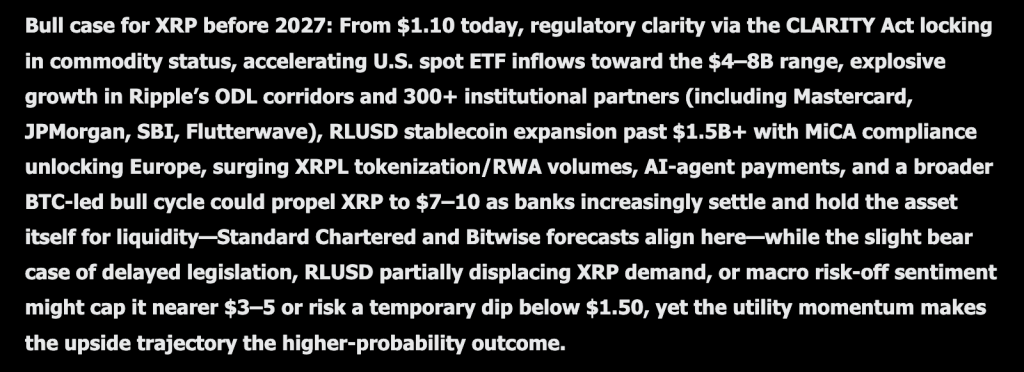
Elon Musk Grok AI is not thinking in quarters for this one either. From $1.10 today, the prediction is a run toward $7 to $10 sometime before 2027, based on the idea that XRP will finally become a bank-held asset rather than just a bank-used rail.
The foundation is regulatory. Grok points to the CLARITY Act, which would lock in XRP’s commodity status and remove the single biggest legal cloud that has hung over this coin for years.
US spot ETF inflows are expected to accelerate toward the $4B to $8B range on the back of that clarity. That kind of institutional plumbing tends to arrive quietly and then show up all at once in the price.
Ripple’s own network numbers back up the utility argument. Explosive growth in ODL corridors, plus more than 300 institutional partners now including names like Mastercard, JPMorgan, SBI, and Flutterwave.
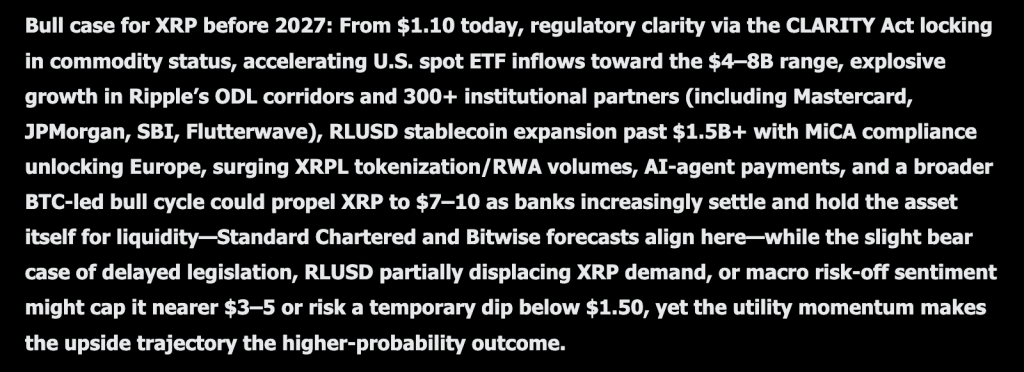
RLUSD stablecoin expansion has pushed past $1.5B, with MiCA compliance opening the door to Europe in a real way. Layer on surging XRPL tokenization and RWA volumes, plus early AI agent payment activity, and Grok sees a network doing meaningfully more than it was two years ago.
The final piece is simply riding the wave. A broader BTC-led bull cycle could pull XRP along with it, and Grok notes that Standard Chartered and Bitwise forecasts land in a similar zone, which is nothing when two independent shops agree on direction.
The bear case is specific rather than dismissive. Delayed legislation, RLUSD partially cannibalizing XRP demand rather than complementing it, or a broader macro risk-off turn could cap the price near $3 to $5, or even force a temporary dip below $1.50.
Grok still calls the upside path the higher-probability outcome, but it does not pretend that the downside scenario is small. A dip below $1.50 from here would erase a meaningful chunk of the current price before any bullish thesis has a chance to play out.

XRP Price Prediction: Five Years Of XRP In One Chart, And It Is Still Fighting The Same Ceiling
Zoom out to the weekly and XRP’s history is really just two enormous spikes separated by long, grinding silence. The 2021 run topped near $1.96, then spent almost three full years drifting between $0.30 and $0.60 with barely any life in it.
Late 2024 changed that completely. Price exploded from under $0.60 to above $3.30 in a matter of weeks, one of the sharpest moves this asset has ever produced, before spending 2025 chopping between $1.80 and $3.65 in a wide, volatile range.
The current pullback has brought XRP back down to $1.10086, up 0.36% for the week, with a range between $1.08229 and $1.16411. That puts the price roughly in the middle of where it sat right before the late 2024 breakout even started.
Support on this weekly chart sits at $1.00, a level that has acted as both a floor and a ceiling multiple times over the last five years. Below that, $0.80 is the next real shelf from the 2025 consolidation.
Resistance is heavier and further away. First at $1.60, then the thick supply zone between $2.20 and $2.60, where the price spent most of 2025 fighting for direction.
Momentum on the weekly is neutral, sitting in the same kind of digestion phase Bitcoin’s own chart is showing right now, which makes sense given how correlated these two assets have become.
For Grok AI $7 to $10 predicts to have any weekly chart support, XRP needs to first reclaim that $2.20 to $2.60 zone that rejected it twice in 2025. Everything above that stays a story about regulation and adoption until the price actually confirms it.
Discover: The best crypto to diversify your portfolio with
Here is what Grok AI Predicts For LiquidChain’s Near Future
Every cycle has a moment where waiting becomes the most expensive decision you can make. That moment is now.
Bitcoin, Ethereum, and XRP are all pinned under the same resistance they have been testing for weeks. The macro unlock is perpetually one data point away. The institutional money keeps arriving next quarter. Large-cap traders waiting for a breakout are queuing for a decision that belongs to someone else entirely.
Grok AI has identified what experienced cycle traders already act on. Capital that registers as statistical background noise at Bitcoin’s market cap can completely reprice a small, undiscovered project.
The asymmetry is not complicated. It lives in the distance between what something is genuinely worth and what the market has currently assigned it. The moment that distance gets noticed, it collapses. Before that moment, it is fully open.
Cross-chain fragmentation has been quietly taxing every DeFi participant since the first bridge went live. Bitcoin, Ethereum, and Solana were engineered independently with zero shared infrastructure and no design intent to communicate.
Every transaction crossing those ecosystem boundaries absorbs the cost of that decision in fees, failed execution, and slippage that hits before settlement even begins. The bridge industry did not fix this problem. It built a business model on top of it.
LiquidChain removes the business model entirely. Three networks unified inside a single execution layer. One deployment reaches all of them simultaneously. No cross-chain tax is extracted from any interaction anywhere.
Grok AI predicts it as a coin worth watching. The presale sits at $0.01454 with just over $860,000 raised.
Execution is unproven. Adoption is an open question. Established assets offer a smoother path toward a ceiling that the entire market can already see. LiquidChain is the entry point that stops existing once the market finds it.
Don’t Miss Out on Our $1,000 USDT Airdrop on ByBit
The post Elon Musk Grok AI Predicts XRP Price Prediction That Has Ripple Investors Excited appeared first on Cryptonews.
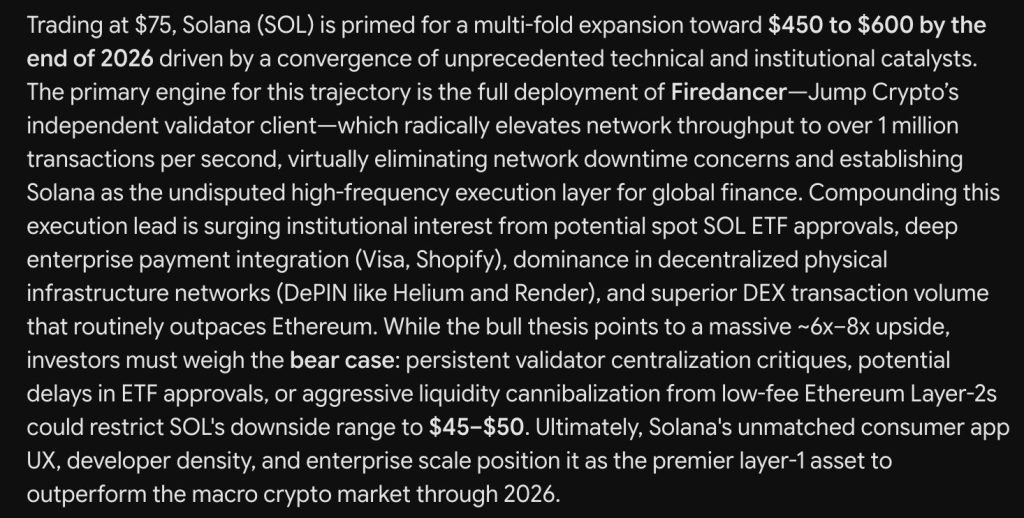
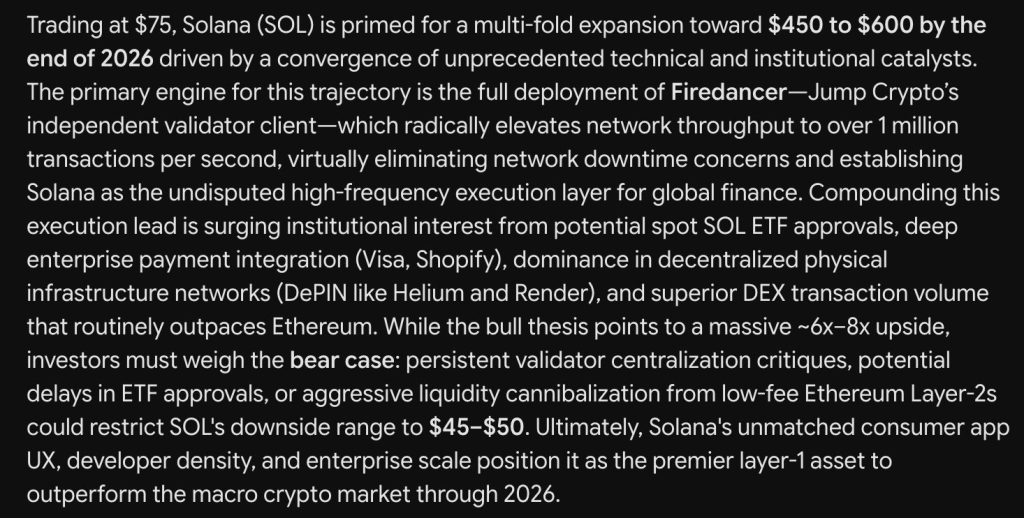
Google Gemini AI is not being subtle about this prediction. From $75 today, the price prediction is $450 to $600 by the end of 2026, a move that would multiply Solana price six to eight times over.
The engine behind it is a single piece of infrastructure. Full deployment of Firedancer, Jump Crypto’s independent validator client, is expected to push network throughput past 1 million transactions per second.
That kind of capacity does more than speed things up. Gemini argues it virtually eliminates the outage risk that has dogged Solana’s reputation for years, positioning the network as the default high frequency execution layer for global finance.
Institutional interest is stacking on top of that technical shift. Potential spot SOL ETF approvals, deep payment integration with names like Visa and Shopify, and dominance in decentralized physical infrastructure networks like Helium and Render all point the same direction.
Gemini also flags something worth sitting with. Solana’s DEX transaction volume routinely outpaces Ethereum’s, which is a real usage metric rather than a speculative one.
The bear case is not vague either. Persistent validator centralization critiques, potential delays in ETF approvals, or aggressive liquidity cannibalization from low fee Ethereum Layer 2s could all cap Solana’s downside near $45 to $50.
Gemini still frames the unmatched consumer app experience, developer density, and enterprise scale as the deciding factors, positioning Solana as the layer 1 asset built to outperform the broader market through 2026.

Solana Price Prediction: SOL Needs A Number It Has Not Touched Since Winter
The daily chart tells a rougher story than the prediction does. SOL topped near $257 in September 2025, and what followed was a mostly uninterrupted decline into a low near $60 by February 2026.
Since that crash, price has spent five months building a wide, choppy range. Two separate rallies, one in December and one in May, both stalled almost exactly at $100, and both rolled over hard afterward.
Today closed at $75.29, up 1.11%, with the session ranging between $74.40 and $75.91. That is a modest green day sitting in the lower half of a range that has trapped this coin since winter.
Support sits at $70, then the June low near $60 that has now held twice. Resistance stacks at $85, then $95, then the persistent $100 ceiling that has rejected every real breakout attempt this year.
Momentum here is neither compressed nor extended, sitting in a neutral zone that reflects a market still deciding whether the June low was the actual bottom. For Gemini’s $450 target to have any grounding, Solana first needs to do something it has failed to do twice in 2026, close above $100 and actually hold there.
That single level is the entire gap between where this prediction lives and where the chart currently sits.
Discover: The Best Crypto to Diversify Your Portfolio
You Might Like What Gemini AI Predicts About This New Layer 3 Called LiquidChain
The money that wins cycles never waits at resistance.
Large caps are stuck. Bitcoin, Ethereum, and XRP keep testing the same ceilings with nothing breaking through. Every macro catalyst has a new arrival date. Every institutional wave has a new quarter attached. Waiting on someone else’s decision is not a trade.
Small market cap infrastructure plays operate on completely different physics. A rotation that vanishes as noise at Bitcoin’s scale reprices an undiscovered project by multiples. The opportunity lies in the gap between what something is genuinely worth and what the market has assigned it. That gap closes permanently the moment discovery happens.
Multi-chain fragmentation is one of the most expensive unsolved problems in DeFi. Bitcoin, Ethereum, and Solana run as completely isolated systems. No shared architecture. No native interoperability. Every time value crosses those boundaries it pays in fees, slippage, and failed transactions.
LiquidChain makes the crossing free. Gemini AI predicts and agrees. All 3 networks within a single execution environment. Single deployment. Complete ecosystem access. No tax on any interaction.
The presale is at $0.01454 with just over $890,000 raised. Early and undiscovered. That combination does not last long.
Explore the LiquidChain Presale
The post Google Gemini AI Predicts Solana Price Could 8x Before End of 2026 appeared first on Cryptonews.
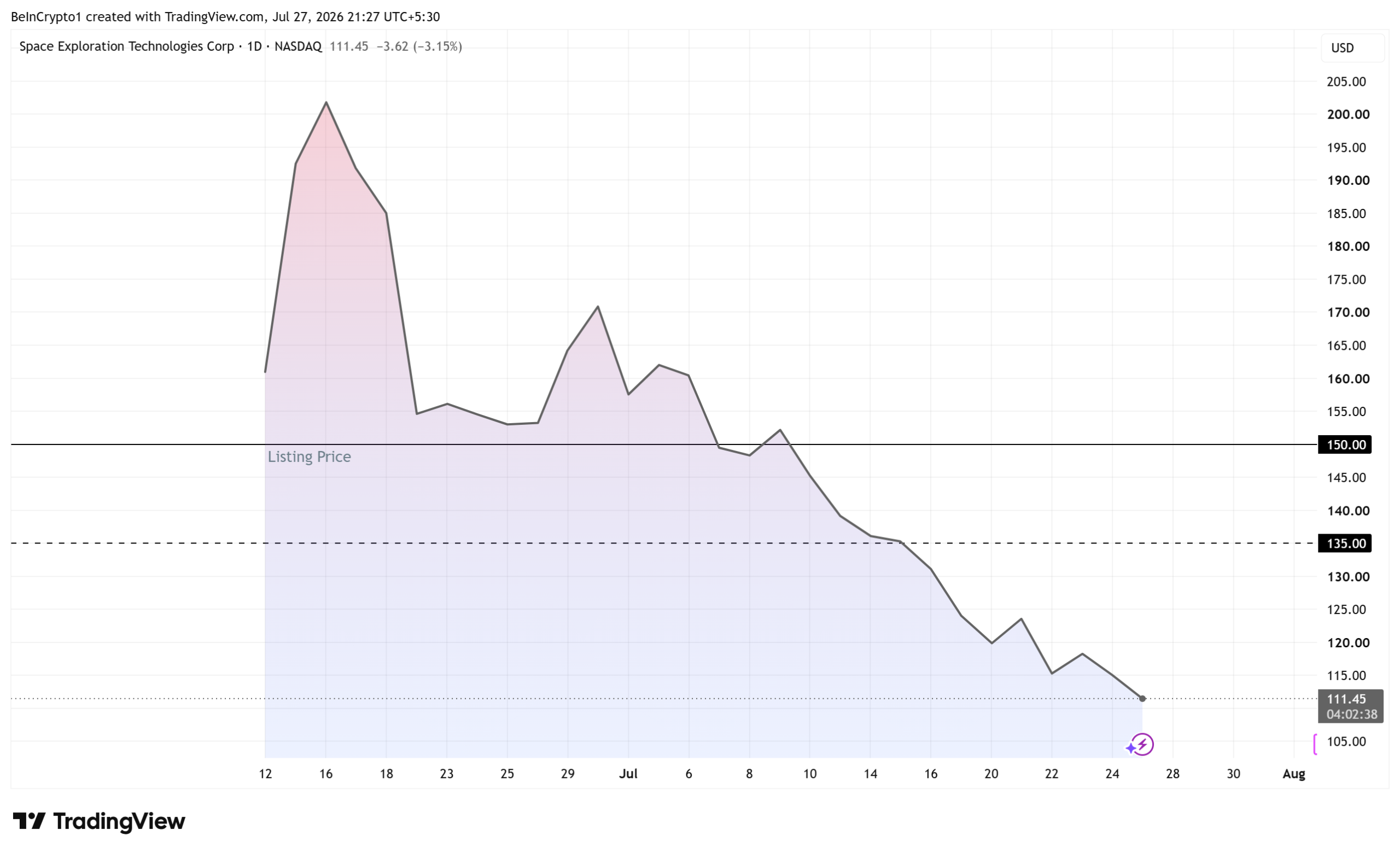
SpaceX stock (SPCX) is now worth less than it was on day one. Shares closed near $115 last week. That is about 15% below the $135 price the company set for its June 12 debut.
Anyone buying at the listing is underwater. The obvious question is whether it comes back, and there is one good place to look for the answer.

What Just Happened to SpaceX Stock
SpaceX sold 555.6 million shares at $135 each. That raised almost $75 billion and valued the company near $1.77 trillion, according to its prospectus.
The start was strong. Shares opened at $150 and closed the first day around $161. By June 16 they hit $225.64.
Then the mood turned. The stock fell 6.7% on July 22 to $115.26. That is roughly 49% below the June high.
The company is now worth about $1.52 trillion. An earlier part of the slide had already wiped $500 billion from Musk’s fortune.
Three things went wrong at once:
- Starship slipped
- Rival Blue Origin raised new money, and
- China caught a rocket booster.
That last one stung. On July 10, China landed a Long March 10B booster in a net on a sea platform. It became only the second country to bring an orbital booster home. SpaceX did it first in December 2015, so China is about a decade behind.
Peter Schiff called the drop a broader market crash warning. Now, IPO investors are sitting on nearly 20% loss.
Why Two Dates in August Matter So Much
SpaceX reports earnings for the first time on August 4. Two trading days later, on August 6, a lot of shares become sellable.
Here is why that matters. When a company lists, insiders sign a lock-up. It stops them selling for a set period.
SpaceX built its lock-up around earnings instead of the calendar. Once results are out, up to 911.5 million shares are free to trade.
Elon Musk is not one of the sellers. His shares are locked for 366 days, with no early exit, so he cannot sell until June 2027.
Follow us on X to get the latest news as it happens
The Huge Batch of Shares That Will Not Be Sold
A second batch of 455.8 million shares was also lined up for August. Almost nobody has noticed that it will not arrive.
Those shares only unlock if the stock trades 30% above the IPO price. In cash terms, that means $175.50.
It has to close there on five of the 10 days ending on the earnings date. The stock is near $115, so it cannot happen.
The fall has therefore cut the amount of stock hitting the market. Roughly half the expected August supply is already gone.
Why Meta Fits Better Than Tesla
Most people compare SpaceX to Tesla. That comparison does not work.

Tesla listed in June 2010. It sold 13.3 million shares at $17 and raised $226 million. SpaceX raised about 330 times more.
Facebook, now Meta, is the better match. It priced at $38 in May 2012 and raised $16 billion.
Both put the founder firmly in charge. Musk holds 82.4% of the voting power at SpaceX while owning less than half the shares.
He does it with a second class of stock worth 10 votes each. Ordinary shares get one vote.
Small investors piled into both deals. Early reports said SpaceX would give retail buyers 30% of the offering. CNBC later reported the real figure came in at just over 20%.
SpaceX, 2026
Meta, 2012
Tesla, 2010
IPO price
$135.00
$38.00
$17.00
Money raised
$75.0B
$16.0B
$226M
Value at listing
$1.77T
$104B
About $2B
First-day close
$161, up 19%
$38.23, up 0.6%
$23.89, up 41%
Founder voting power
82.4%
Majority
None special
Worst fall below IPO price
15% so far
53.3%
Recovered fast
Time to get back to IPO price
Pending
14.5 months
Weeks
What Meta’s Lock-Up Actually Did to the Stock
This is the part worth remembering. Meta went through the same fear in 2012, twice.

The first unlock came on August 16, 2012, covering 271 million shares. The stock fell 6.3% that day.
The second was far bigger. On November 14, 2012, some 1.19 billion shares came free.
The stock went up 12.6%. The biggest wave of selling turned into the best day.
The damage had already been done in advance. Meta bottomed on September 4, 2012, closing at $17.73. That was 53.3% below its IPO price, more than three times the fall SpaceX holders have seen.
“This is an example of why it’s so dangerous to rush into buying a heavily hyped IPO during its first few days of trading,” Peter Schiff noted.
What Would Turn SpaceX Stock Around
Meta did not recover on hope. It recovered on one number.
On July 24, 2013, it reported that mobile made up about 41% of its ad sales. Three quarters earlier the figure was near 14%.
Revenue grew 53% in a year. The stock jumped almost 30% the next day.
It finally closed back above $38 on August 2, 2013. That took 14.5 months.
SpaceX needs a number of its own. Starlink profits, launch numbers, and Starship progress are the candidates.
Analysts cannot agree on what any of it is worth. Their price targets run from $156 all the way to $239.
Morgan Stanley says a drop to $100 would price the company’s AI work at almost nothing. Chart watchers point to a falling wedge pattern that often breaks upward.

Cathie Wood still calls SpaceX her favorite long-term holding. Meanwhile Google’s SpaceX stake stays locked up for longer.
Meta took 14.5 months and one very good earnings report. SpaceX gets its first shot at that on August 4, two days before the selling can start.
The post The Closest IPO Parallel to SpaceX Is Not Tesla But This Stock appeared first on BeInCrypto.


Cointelegraph is committed to providing independent, high-quality journalism across the crypto, blockchain, AI, and fintech industries.
All news, reviews, and analyses are produced with full journalistic independence and integrity. For more details on our standards and processes, please read our Editorial Policy.
Bitcoin (BTC) heads into the end of July juggling volatility catalysts as the Federal Reserve reacts to US inflation.
Key points:
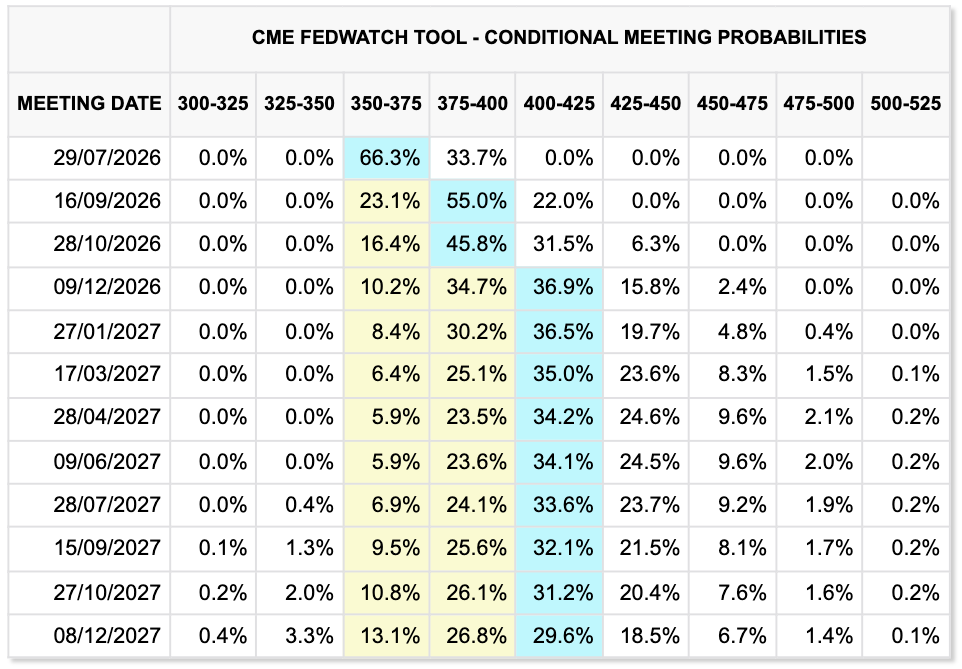
- The Fed will deliver its latest decision on interest rates as US bond yields spike, with markets seeing a September hike as likely.
- June PCE inflation is due on Thursday after hitting a three-year high of 4.1% last month
- Signs of a shift in the equities uptrend places the focus on Bitcoin’s macro correlation.
- Whales exchange inflows cool by 44% since June
Markets remain split on rate outlook
Attention turns once more to the US Federal Reserve this week, with the Federal Open Market Committee (FOMC), chaired by Kevin Warsh, set to announce its latest interest rate decision on Wednesday, July 29.
A combination of geopolitical tensions and persistent inflation pressures has reshaped expectations for Fed policy and put the possibility of further rate hikes back on the table as the US 2-year Treasury yield climbed to 4.3% last week. The latest data from the CME Group’s FedWatch Tool currently sees a 31% chance of a hike this week, with a hike at the September meeting having odds as high as 50%.
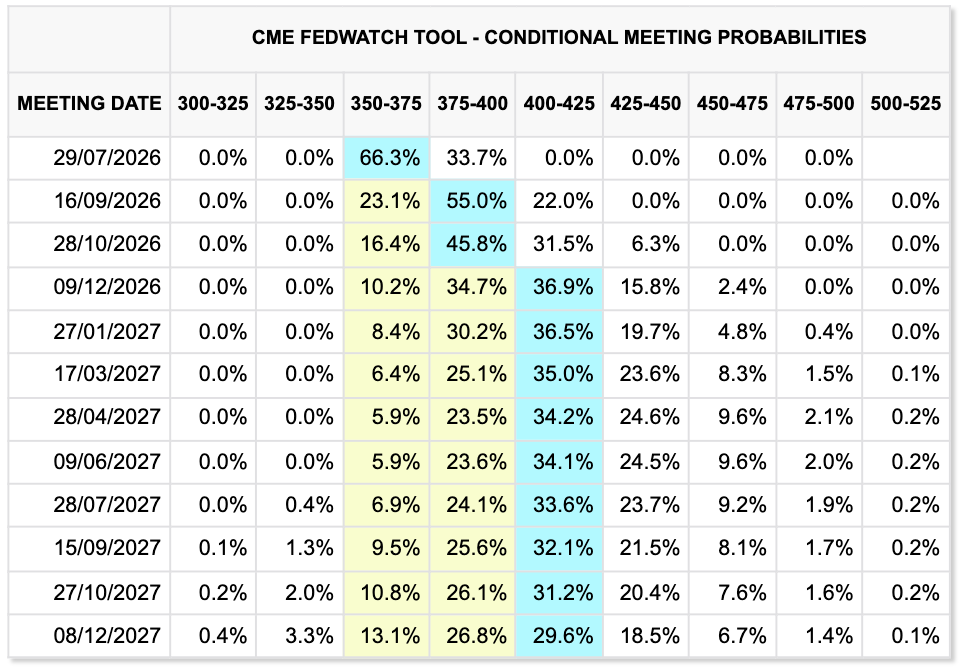
Fed target rate probabilities (screenshot). Source: CME Group
These rate hike expectations were tempered slightly as oil prices dropped 8% in the early hours of Monday as the US and Iran paused strikes. Rate hike odds therefore shifted from 37.4% to 33.7%. Ongoing developments in the Middle East thus continue to introduce volatility into the macroeconomic outlook, even as PPI inflation data released earlier in the month came in below expectations.
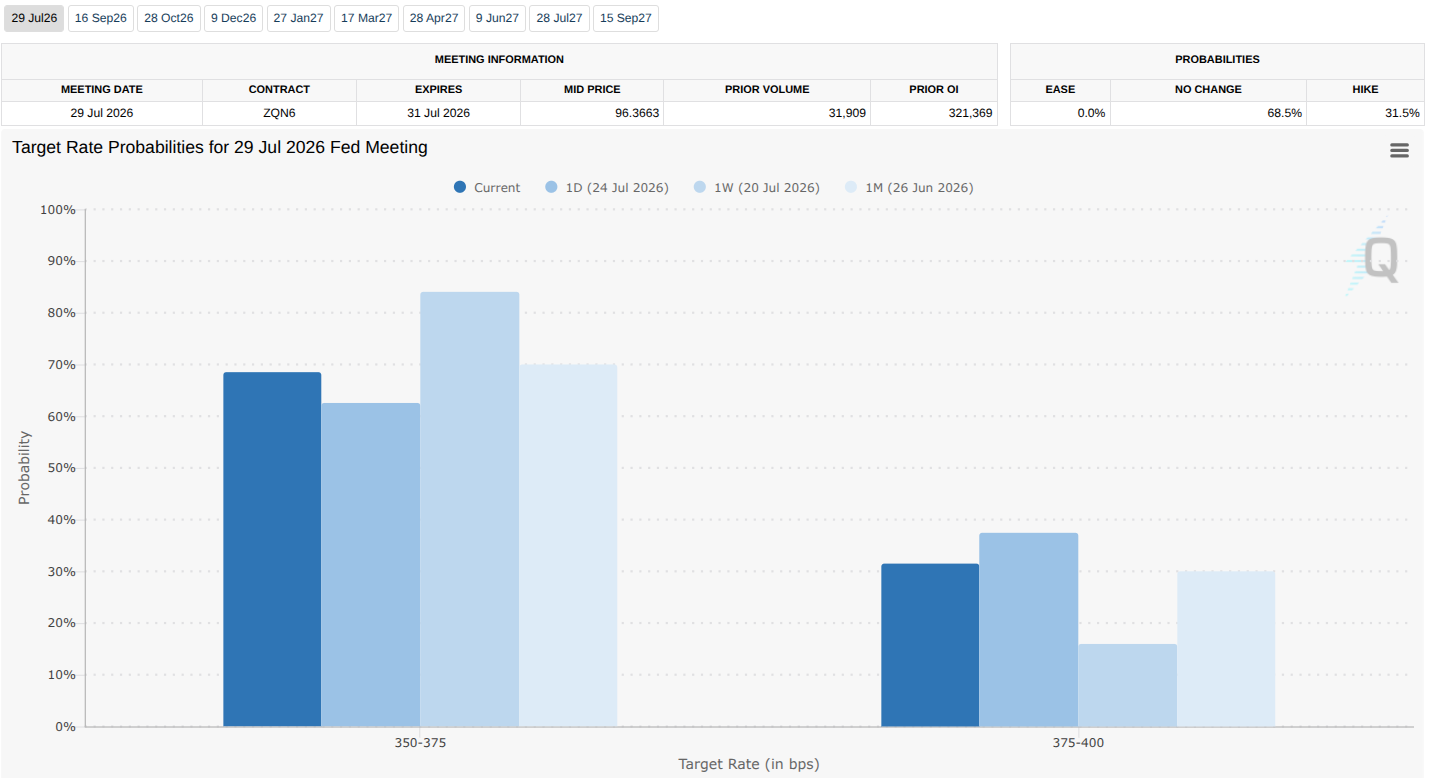
Fed target rate probability comparison for July FOMC meeting (screenshot). Source: CME Group
Commenting, trading resource Mosaic Asset Company also noted a pending upward breakout in 30-year bonds. Although the long end of the bond curve now plays a diminished role in funding the US government, this could notionally add to pressure on Warsh as he shapes his language at the post-FOMC press conference.
“The 30-year Treasury yield is also testing a key breakout level once again. In May, the 30-year yield saw a false break above the 5% level which has served as resistance since late 2023,” it summarized in the latest edition of its regular newsletter, The Market Mosaic.
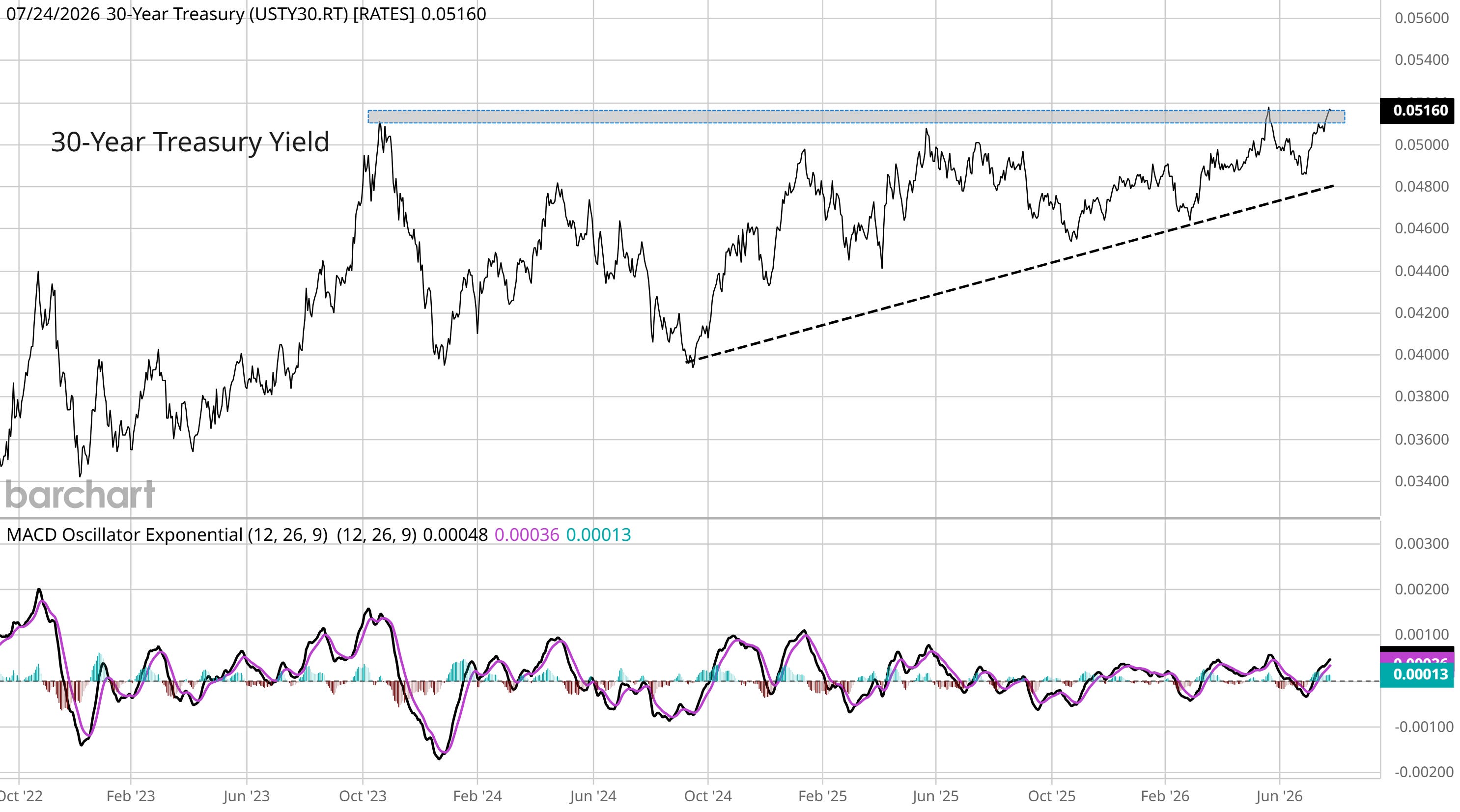
US 30-year bond-yield data. Source: Mosaic Asset Company
Even before the latest turmoil, new Fed chair Warsh had steered clear of dovish language on the economy and kept his post-FOMC statement and press conference notably brief.
“Inflation remains elevated relative to the Committee’s 2 percent goal, in part reflecting supply shocks that have driven price increases in certain sectors, including energy,” he said at the time.
PCE inflation seen falling from three-year high
Beyond the FOMC, markets will be watching the Personal Consumption Expenditures (PCE) index on Thursday for fresh signals over the impact of the US-Iran war on inflation trends. The June print of the index, currently sits at three-year highs.
PCE volatility can have a snap impact on risk-asset performance as traders reprice potential Fed reactions. June’s release coincided with Bitcoin dropping to macro lows around $58,000.
Prefacing its latest analysis, the International Monetary Economics Network (IMEN) predicted that PCE would be moderately lower compared to May’s 4.1% year-on-year tally. “U.S. inflation: We currently expect June PCE inflation to be 3.7% year‑over‑year,” it wrote on X.
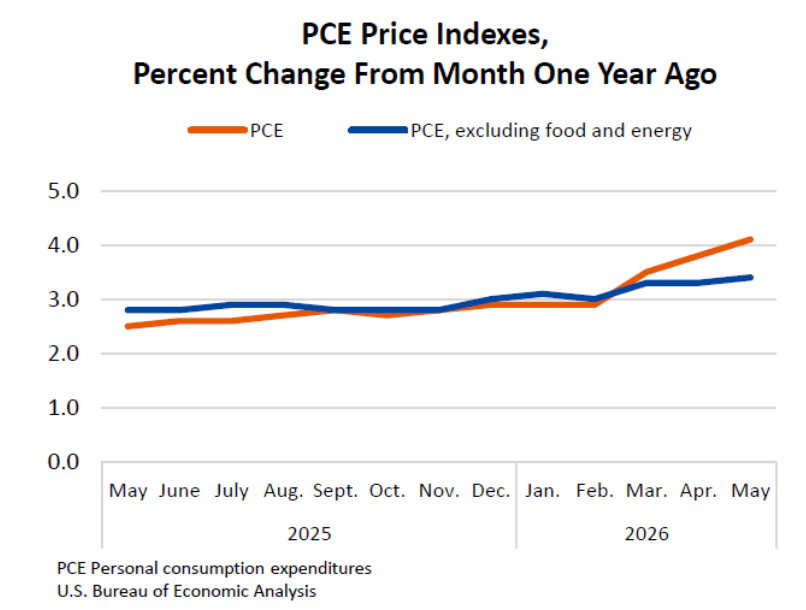
US PCE inflation data (screenshot). Source: Bureau of Economic Analysis
Correlation between Bitcoin and equities remains absent
On higher timeframes, correlations between Bitcoin and major equity indices have largely disappeared. Data from TradingView currently puts the daily correlation between BTC/USD and the S&P 500 with a 20-week loopback window as practically absent, at its lowest levels since March. Against the tech-heavy Nasdaq Composite Index, meanwhile, its current correlation coefficient of 0.11 was last observed in mid-February. While correlations on the weekly timeframe move slowly, bearish geopolitical and macro events have the potential to make the two asset classes move in lockstep again.
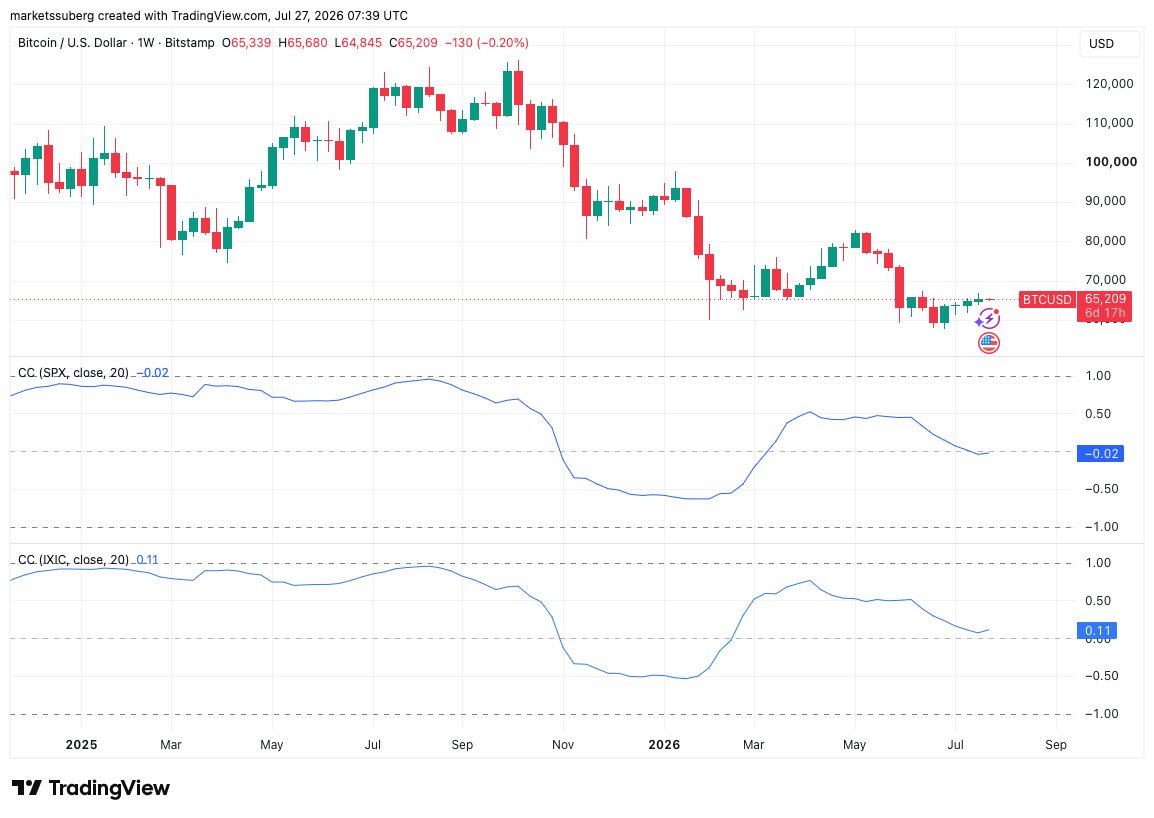
BTC/USD one-week chart with rolling 20-week stocks correlation. Source: Cointelegraph/TradingView
For now, corporate earnings in the US have continued to surpass expectations. However, given the historically high valuations, this is unlikely to shield the market from potential pullbacks. Several major US tech stocks saw significant drawdowns last week. The Magnificent 7 falling by an aggregate 5.3% through Friday after $GOOGL and $TSLA had already suffered sell-offs earlier in the week.
In spite of this, “Alphabet, $GOOGL , is the single largest margin contributor after significantly beating earnings estimates,” the Kobeissi Letter commented on the topic at the weekend.
“Meanwhile, 86% of reporting S&P 500 firms have so far beaten EPS estimates, while 80% have exceeded revenue expectations. AI is driving historic earnings growth.”
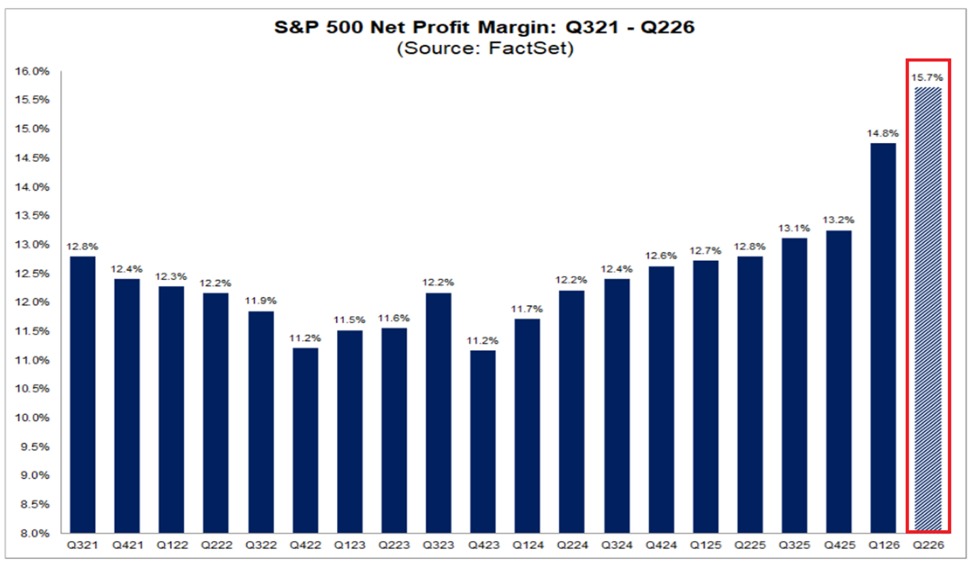
S&P 500 net profit-margin data. Source: The Kobeissi Letter on X.com
Mosaic Asset Company highlighted the risks that the rate environment may exert on US equities.
“Rising rates across the yield curve could keep pressuring stock prices, where indexes like the S&P 500 and Nasdaq peaked in early June and are now losing key support levels. At the same time, market breadth is deteriorating while the backdrop for seasonality is transitioning from a bullish tailwind to bearish headwind. Seasonality during mid-term election years also tends to produce lower average returns and larger drawdowns.”
With these emerging hurdles, the S&P 500 is at risk of losing its bullish setup altogether, Mosaic warns.
“The S&P already lost one key support level with the 50-day moving average (MA – black line). If trendline support in the triangle gives way, that could set up a test of the 200-day MA (green line) that’s currently near the 7,000 level (or 5% downside from current levels),” it added alongside an explanatory chart.
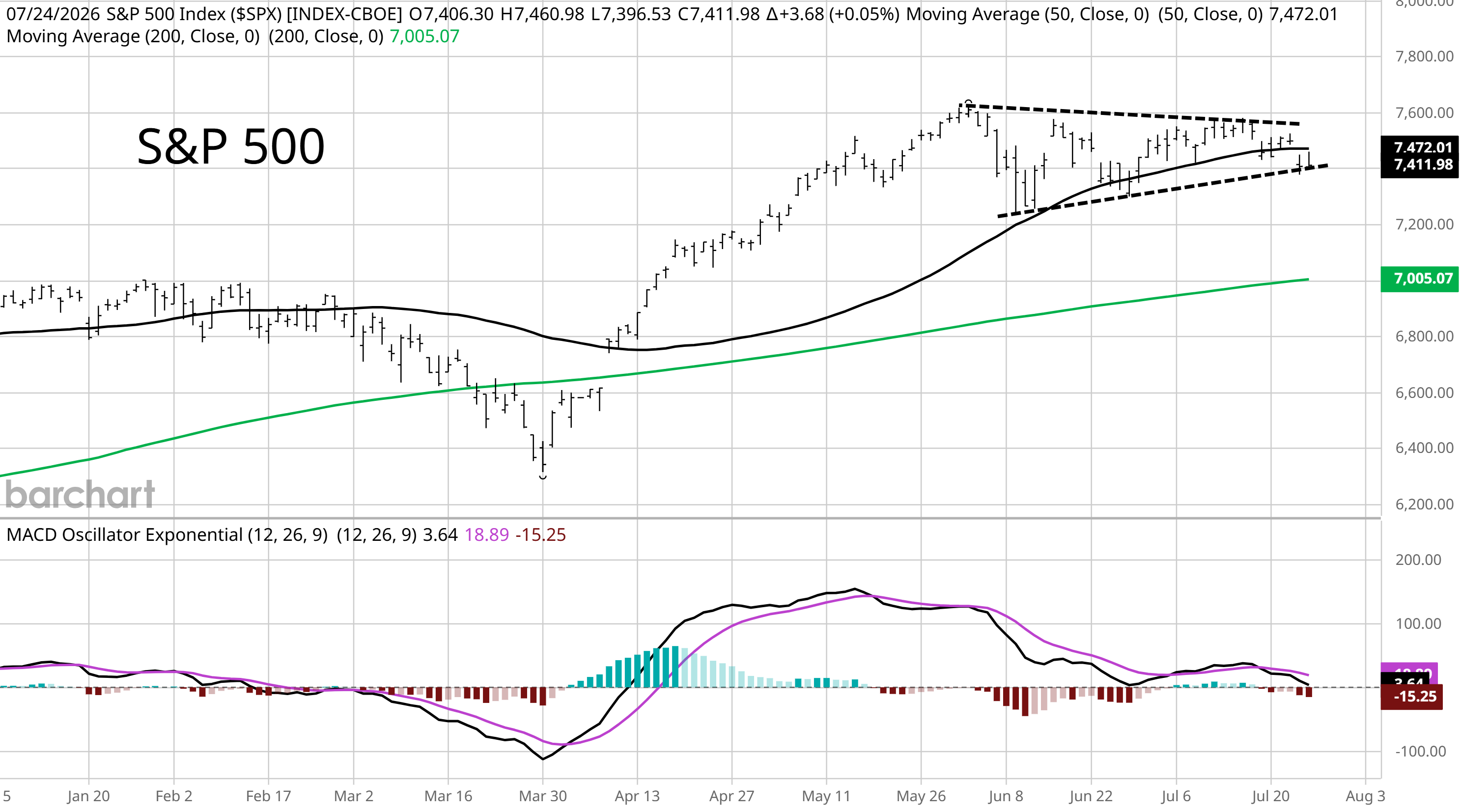
S&P 500 data. Source: Mosaic Asset Company
On shorter time frames, the picture remains fluid, with a pause in hostilities between the US and Iran providing a bullish impulse across risk assets. US WTI crude oil dropped as low as $83 per barrel to start the week, having previously eyed $95.
“The market is beginning to price-in a peace deal again,” Kobeissi responded.
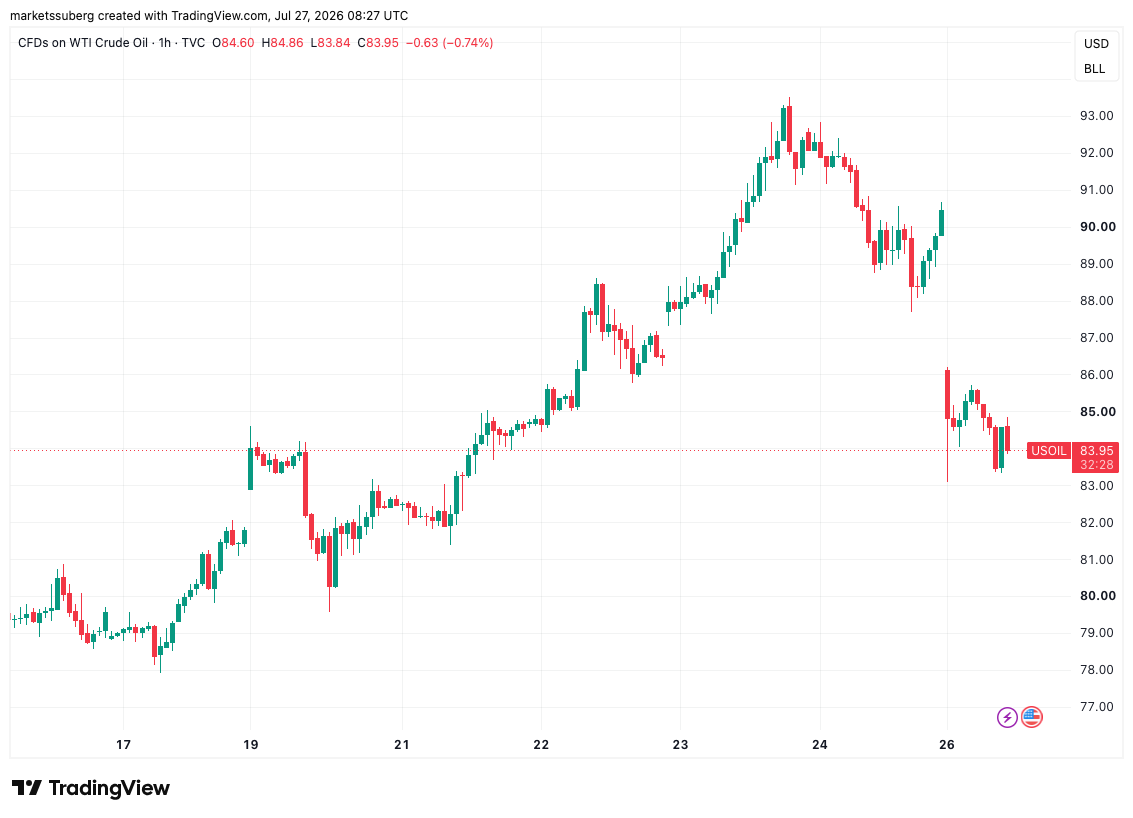
CFDs on US WTI crude oil one-hour chart. Source: Cointelegraph/TradingView
“Boring” BTC price range tests 50-month trend line
Bitcoin went on to seal new local highs after Sunday’s weekly close, reaching $65,680 on Bitstamp. Still in a familiar range, BTC/USD battled its 50-month exponential moving average (EMA) trend line, having previously flipped it to resistance in a copycat move from the 2022 bear market.
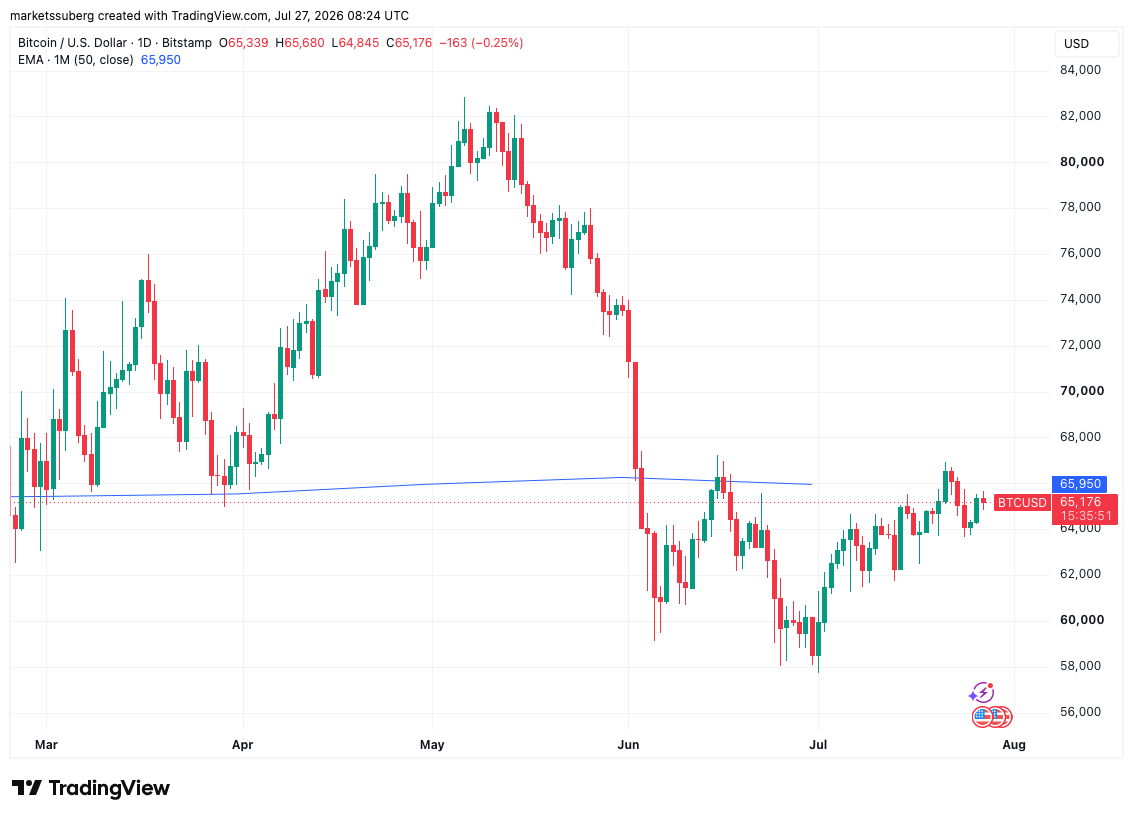
BTC/USD one-day chart with 50-month EMA. Source: Cointelegraph/TradingView
Commenting on the current market setup, trader and analyst Rekt Capital flagged resurgent sell-side pressure.
“The more seller-dominant the volume becomes while Bitcoin is at resistance, the greater the chances for a rejection from here,” he warned X followers on Sunday.
Rekt Capital brought the 200-week simple moving average (SMA) into the equation, describing price as “sandwiched” between it and its 50-month counterpart.
“Continued price compression here is unsustainable and will eventually force major volatility,” he forecast.
“And if the seller volume keeps coming in at this rate, then there’ll likely be a breakout on seller volume to precede a rejection from this local resistance area.”
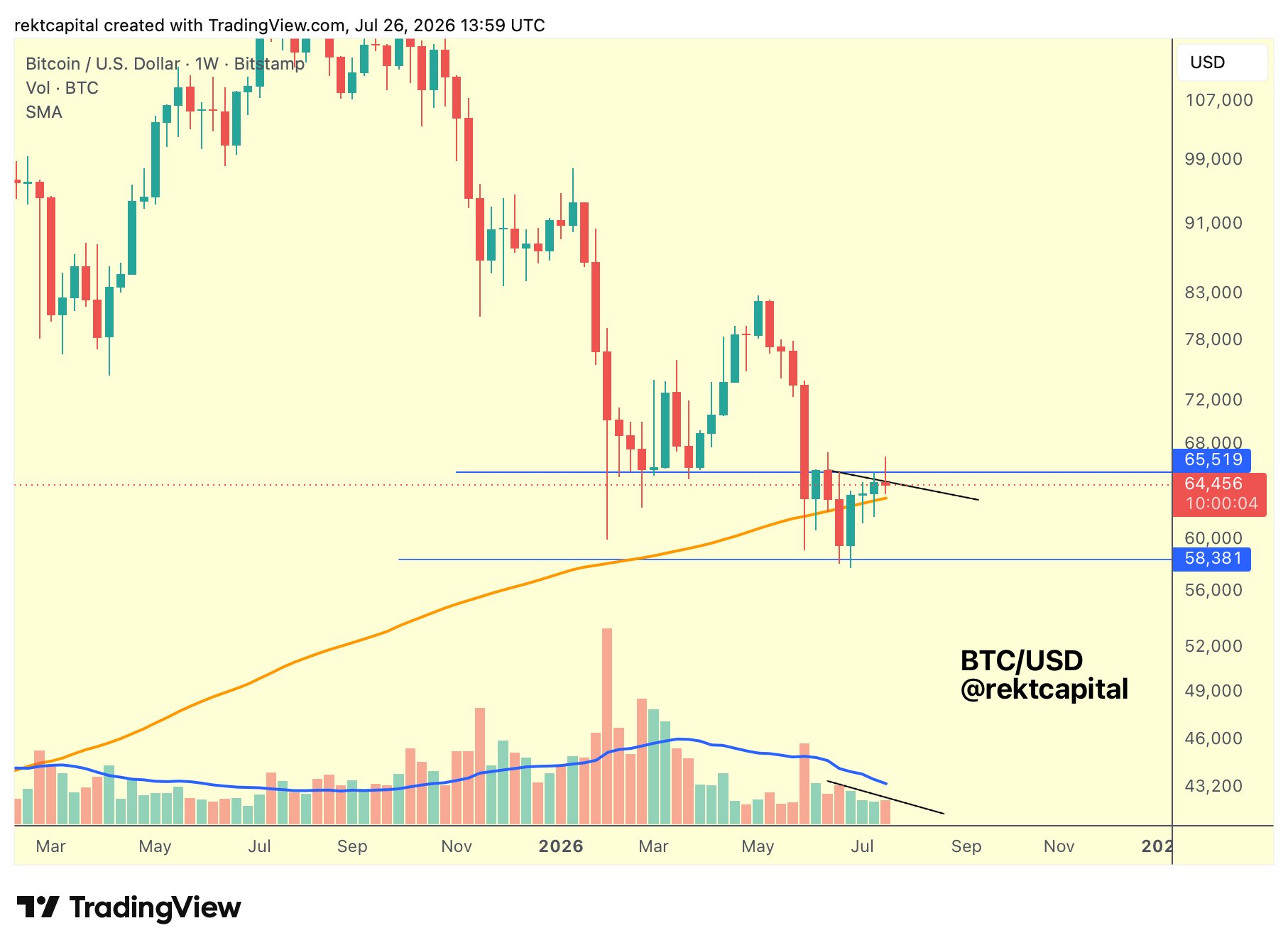
BTC/USD one-week chart. Source: Rekt Capital on X.com
Binance whale inflows nearly halve since mid-June
Commenting on the FOMC meeting and its impact on crypto markets, onchain analytics platform CryptoQuant sees a potential knock-on effect for sell-side pressure on major exchanges.
Related: BTC supply in profit eyes 60%, but analysis hints recovery may ‘roll back over’
According to their data, BTC inflows from whales to Binance, have dropped by up to 44% since June 12, while retail inflows fell 22%.
“This leaves retail inflows at roughly twice the level of whale inflows, with a gap of $3.9 billion,” contributor Amr Taha wrote in a blog post on Monday.
“The divergence suggests that the composition of BTC transfers into Binance has shifted: retail participants are currently significantly more active than whales in sending BTC to the exchange.”
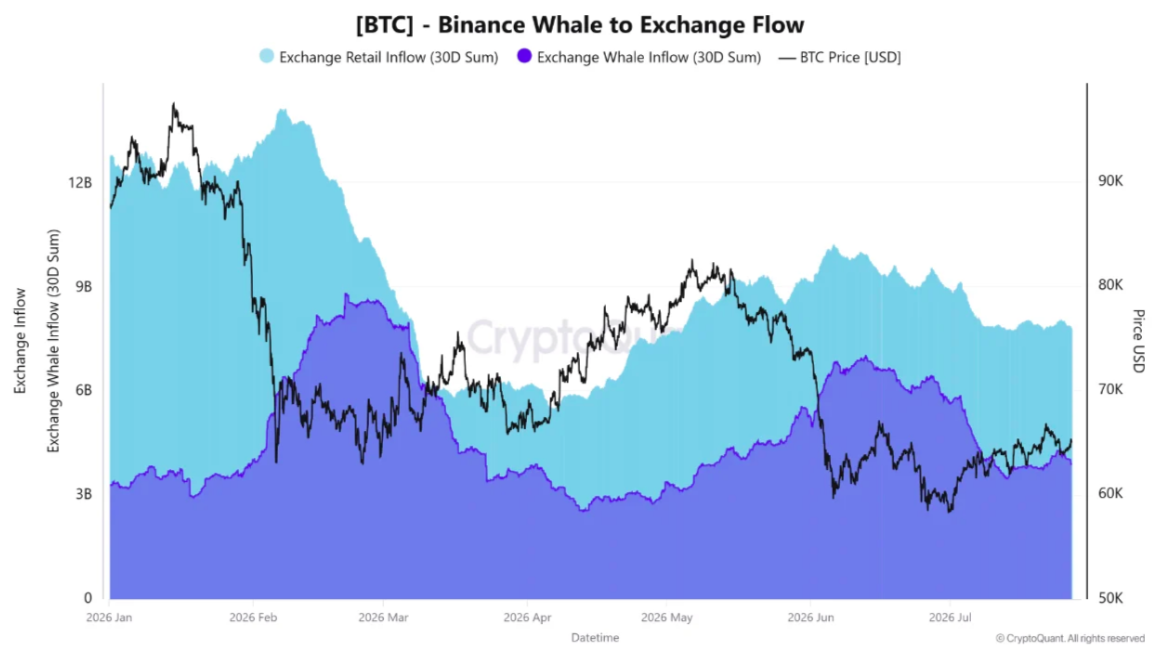
Bitcoin whale inflows to Binance (screenshot). Source: CryptoQuant
Taha described the FOMC meeting as a “major macro catalyst” that could reshape the approach of all investor cohorts to the market.
“With retail inflows now running at 2x whale inflows, Wednesday’s Fed decision could provide an important test of whether the current divergence between the two BTC cohorts persists or begins to converge,” he concluded.
As Cointelegraph reported, Binance saw single-day withdrawals of over 9,000 BTC last week.


The deal brings wallet technology to Payward’s enterprise platform, potentially reducing the number of infrastructure providers businesses need to integrate with.
Nic Carter reportedly almost joined World Liberty Financial (WLFI), the Trump family crypto venture. He allegedly walked away when cofounder Steve Witkoff said “memecoin” as “me-me” coins.
Carter described the 2024 Miami meeting to New York magazine. World Liberty says his account is wrong, and that it never offered him the job.
Witkoff Could not Explain the Product
Carter invests for Castle Island Ventures. He also voted for Trump in 2024. Witkoff wanted him as an advisor. But Witkoff could not describe the decentralized finance (DeFi) business.
“He didn’t know what crypto or DeFi was. He didn’t know what the pitch was,” the New York feature reported, citing Nic Carter.
Witkoff had one clear goal, Carter says. The launch had to happen before the election. That way Trump was still a private citizen.
Carter turned the role down. He warned the project could cost Trump votes. That is when Witkoff’s tone hardened.
World Liberty’s own Gold Paper supports part of that read. It says the sole utility of WLFI is governance. Holders get no right to any return or dividend.
WLFI Holders are Still Locked In
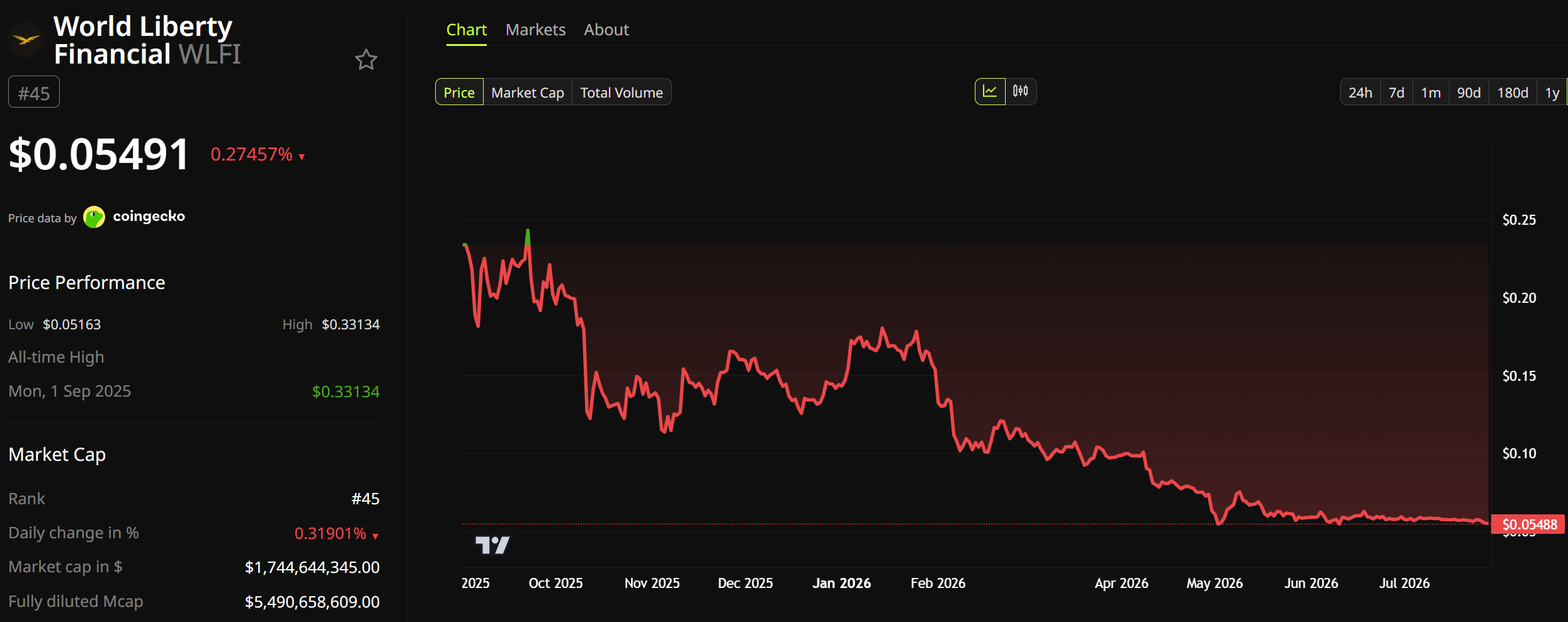
WLFI trades near $0.055, against a record of $0.3313 on Sept. 1, 2025. That was the first day of open trading. The price fell 40% before it ended.

World Liberty released only 20% of each investor’s tokens that day. Just 31.8% of the supply trades now. An April plan unlocks the rest from 2028. Holders who vote against it stay locked.
The company also added a contract function letting it freeze any wallet. That change landed eight days before trading opened.
Justin Sun was the largest early backer. He sued World Liberty Financial in California for fraud. The company countersued for defamation in Miami. Both cases remain at an early stage.
The venture has been lucrative for the family even as the token sank. Reporting on the Trump family crypto windfall tracks how little of it reached ordinary holders.
Carter saw a token with no business behind it. Two years on, most of the supply is still frozen. The unlock schedule runs past the end of Trump’s term.
The post VC Reportedly Rejected Trump Crypto Venture After Steve Witkoff’s Memecoin Blunder appeared first on BeInCrypto.

New York City just published a list of 31,000 homes. It names the streets, the buildings, and the apartment numbers. Crypto founders say it is a map to rich people’s front doors.
The city released the file on July 24. It exists to find second homes that owe a new tax. Officials expected about 10,000 properties. They got three times that.
What New York City Actually Published
The tax started July 1. It targets homes that are not where the owner actually lives.
A condo or co-op lands on the list at $1 million. A house has to be worth $5 million.
That $1 million line matters. It is why the roll holds 24,700 apartments but only 6,800 houses.
State law told the city to name every property that “may be subject” to the tax. It also told the city to identify co-op apartments by street address and unit number.
So the file does not just flag a building. It flags the apartment.
Ben Williams is a property tax lawyer at Rosenberg & Estis. He testified at the city’s hearing on the rules. He told Bloomberg the list is far too broad, and that many homes will come off it on appeal.
Spectrum News NY1 reporter Bernadette Hogan flagged the file, noting that owner names sit in the spreadsheet as well.
Bills go out by August 30. Owners then get 30 days to object. The final list is due December 31.
Crypto Founders Call It a Mass Doxxing
Uniswap founder Hayden Adams searched a few luxury buildings. He found the homes of people he knows. He also found nearly every other unit in those towers.
“Not only were their units listed, but nearly every unit in the entire building was listed. They clearly took an incredibly expansive view of ‘could be’ and just doxxed a huge percentage of all expensive apartments in new york city,” wrote Adams.
That is the law working as written. The city has to list every unit that might owe the tax. At a $1 million threshold, that pulls in whole buildings.
Helius CEO Mert Mumtaz made a narrower point. The data was already public, he said. It was just messy. Now it is clean, sorted, and easy to download.
Castle Island Ventures partner Nic Carter went further. He pointed to the France crypto kidnapping toll, which has climbed all year.
“So this is a list of wealthy people and their addresses. As we’ve seen in France and Sweden this leads to crypto kidnappings torturings and murders. Yes real estate records are semi public but this is an easily searchable database and target list,” Carter stated.
Attack Data Gives the Warning Weight
CertiK counted 52 wrench attacks in the first half of 2026. A wrench attack is simple. Criminals use force or threats to make someone hand over their crypto.
The count was 39 a year earlier. It follows the most violent year recorded for crypto crime.
The sums got much bigger too. Victims faced $124.2 million in the first half of 2026, up from $10.5 million. The average case jumped from $270,000 to $2.39 million.
One number stands out. Home invasions rose from a single case to 20.
But the map does not point at New York. France had 33 of the 52 attacks. Europe had 39. The United States had four. Sweden, which Carter named, had two.
The risk is about method, not place. CertiK calls it “data-driven targeting.” Attackers stitch together leaked databases, property records, and tax files. They build a full profile before they ever knock on a door.
That is not theory. French investigators say a tax office employee sold crypto investor data to criminal networks. The same fear followed new UK tax rules that make exchanges hand over user data.
CertiK now urges regulators to lock down government databases that tie people to crypto and addresses.
New York’s list holds no crypto data at all. What it adds is the address. That only helps someone who already knows you own crypto.
The final roll arrives December 31. How far it falls below 31,000 will show how seriously the city took the warning.
The post Finding Crypto Millionaires in New York Just Got Easier appeared first on BeInCrypto.

X Money launches US payments with yields up to 6%

Blake Garrett Death Scene Reveals New Details on Final Hours

BlackRock JUST Declared a 10-Year Bitcoin SUPERCYCLE – Matt Hougan

Renter of Home in Anne Heche Crash Denies Settlement With Son

No Jackpot Winner as $257 Million Prize Rolls Over to $269 Million Monday Draw

Weekend Open Thread: Staud – Corporette.com
BlackRock JUST Declared a 10-Year Bitcoin SUPERCYCLE – Matt Hougan

#map #mapper #maps #mapping #geo #geography #europe #shorts #gdp #money #rich

Ten Major Financial Impacts of Pension Reforms in Punjab | Employees Corner PK
-

 Fashion3 days ago
Weekend Open Thread: Brooks Brothers
-

 Crypto World7 days ago
Grayscale Files For Worldcoin ETF, WLD Registers Sharp Rise
-

 NewsBeat6 days ago
How a former Blue Peter presenter stunned America’s Got Talent judges
-

 Tech23 hours ago
Intel is reversing course and bringing hyper-threading back to its server chips
-

 Tech7 days ago
Sail Virtually Aboard The “Itanic” With IA-64 Emulator
-
 Tech7 days ago
Turtle Beach Command Series KB7 review: a nifty screen-equipped gaming keyboard
-
 Business6 days ago
New Jersey voter registration controversy explained: How 6,600 noncitizens got on the rolls, and what happens next
-
 Entertainment6 days ago
Johnny Depp’s R-Rated Gothic Cult Classic Gets New Release Ahead of Sydney Sweeney Remake
-

 Crypto World5 days ago
Ethics, other provisions in crypto Clarity Act to be further discussed
-

 Politics13 hours ago
Luke Littler dismantles Gerwyn Price to retain title in Blackpool
-
 NewsBeat7 days ago
Shanghai science forum photos show China’s AI and robotics advances in rivalry with US
-
 Sports1 day ago
Commonwealth Games boxing: Jadumani Singh seals dominant 5-0 win over Pakistan’s Sumama Rehman to enter quarter-finals | Commonwealth Games News
-

 Sports4 days ago
2026 3M Open leaderboard: Scottie Scheffler finds putter in Round 1, sits three back
-

 News Videos4 days ago
The Peugeot Family: How 200 Years of an “Old Money” Dynasty Died in A Boardroom
-

 Fashion4 days ago
16 Dresses for the High Summer Event
-

 Politics1 day ago
Spain sweeps the board at 2026 World Cup with individual awards
-

 Crypto World7 days ago
Andrew Cuomo joins OKX board as crypto exchange expands in U.S.
-
 Entertainment3 days ago
A New Post-Apocalyptic Gundam Anime Series Blasts Into SDCC
-

 News Videos1 day ago
BITCOIN JUST ENTERED THIS CRITICAL ZONE…
-

 Crypto World2 days ago
XRP Ledger adds $2.6B as RWA inflows rank second
You must be logged in to post a comment Login